Will the U.S. Follow New Zealand’s Lead and Repeal National Academic Standards?


I-am-more-than-just-a-test-score-1024x683


Kiwis don’t like corporations telling them what to do.


Especially when it comes to educating their children.


That’s why this week, New Zealand’s Education Minister Chris Hipkins announced that schools in the pacific island nation would no longer need to use the national academic standards mandated by the government for the last decade.


“I don’t think anyone will be surprised that we are ditching a failed experiment,” he said.


“We want teachers focused on less testing and more teaching because that’s the way we’re going to improve students’ progress.”


I pause at this point for American readers to catch their breath.


Yes, a national government just reversed course on standardized, canned, one-size-fits-all academic standards for all students in its public schools.


Yes, they had spent millions of dollars to create, roll out and enforce the standards.


But now they see the results have been less than expected and they’re changing their collective minds.


Shocking, I know.


If only we still did things like that in THIS country.


But wait, there’s more.


Why exactly did New Zealand turn against its national standards?


Did parents hate them?


Yes.


Did kids hate them?


Yes.


Did teachers hate them?


Yes.


All things that could be said of our own Common Core. But was there more to it?


Yes.


In short, New Zealand’s national standards weren’t helping kids learn. In fact, they appeared to have the exact opposite effect.


New Zealand children’s performance on international tests dropped significantly since the standards were introduced in 2010.


And publication of these results showing 10-year-old’s reading achievement taking a nosedive since the standards adoption ignited an already smoldering public outcry.


New Zealand’s average score on the Progress in International Reading Literacy Study (PIRLS) had been steady for 15 years, but fell dramatically at the end of 2015. In short, New Zealand went from 23rd to 33rd out of 50 countries.


Funny.


The US has had a strikingly similar result on the same test with the same age children since the mandate to use the Common Core.


The PIRLS is an assessment given to fourth-graders in schools around the world every five years. In 2016, the average score for US students dropped from fifth in the world in 2011 to 13th. And the drop wasn’t merely perfunctory. It was “statistically significant” according to test organizers.


The biggest drop was for the lowest-performing students, what the organizers considered a sign that we’re providing much greater support for economically advantaged children than for underprivileged ones.


Why is this important?


Because Common Core was introduced across the nation in 2010-11. These fourth grade students were the first to be educated using the Core since Kindergarten, and far from creating a boost in achievement, it opened a chasm.


Reading scores went down just as they consistently have done time-and-time-again since we started using the standards.


Scores go down on state tests. National tests. International tests.


Meanwhile the test makers and their proxies keep telling us the problem is that the standards are simply more rigorous and it just will take time for our children to get up to speed. Meanwhile their publishing and software subsidiaries sell us hundreds of millions of dollars worth of new text books, new computer programs, new devices, new apps, new “specialists” and consultants offering professional developments, etc.


Choo! Choo! The gravy train is rolling. We can’t let something like international test scores derail the money train!


Keep in mind, this is the same international test and the same age group of children that caused a revolution in New Zealand.


Will our response be the same?


Probably not.


New Zealand’s authentic reform resulted from a political change. The National Party was replaced by the Labour Party, and repealing national academic standards was part of their platform.


It marked a sharp divide between the philosophies of both groups.


The National Party wanted more testing, more data, more standardization, more holding funding hostage to test scores – just like both Republicans and Democrats in the US.


However, the New Zealand Labour Party ran on significant reductions to standardized education, substantial cuts to standardized testing, repealing national standards and considerable investment in students, schools and teachers.


We in the US simply have no political equivalent.


There is no political party – right, left or centrist – that puts the needs of children, parents, teachers and working people at the center of its platform.


Both the left and right take billions of dollars in campaign contributions from the testing and privatization industries and thus support policies that serve the interest of their donors over their constituents.


There is a tremendous political opportunity here for one party to change course and support a winning strategy.


Republicans tried it in 2016 by lambasting Common Core and then quietly forgetting they could do a thing about it at the state level every day since.


Including today.


Admittedly their education policy is incoherent since they support every standardization and privatization initiative on record so long as a black President didn’t touch it. And even then their opposition melts away when they have the power to do something about it but no one’s looking because the President is too busy playing nuclear chicken with North Korea on Twitter.


Imagine if politicians promised to fix something and then had the courage to actually do it!


It worked in New Zealand.


It’s worked in many places all over the world.


Why can’t it work here?


There Are Very Few Bad Students, Bad Parents and Bad Teachers

parent-teacher-student


Maybe the problem with public schools is that people just aren’t trying hard enough.


There are too many bad students, bad parents, and bad teachers out there.


At least, that’s what the rich folks say.


They sit behind their mahogany desks, light a Cuban cigar with a thousand dollar bill and lament the kind of gumption that got them where they are today just isn’t present in the unwashed masses.


Never mind that they probably inherited their wealth. Never mind that the people they’re passing judgment on are most often poor and black. And never mind that struggling schools are almost always underfunded compared to those in wealthier neighborhoods and thus receive fewer resources and have larger class sizes.


Tax cuts feed the rich and starve the poor, but somehow the wealthy deserve all the breaks while OUR cries are always the fault of our own grumbling stomachs.


As a 15-year veteran teacher in the public school classroom, I can tell you I’ve seen very few people who aren’t trying.


I’ve seen plenty of struggling students but hardly any I’d simply write off as, “bad.” That’s a term I usually reserve for wilted fruit – not human beings.


I’ve seen plenty of parents or guardians striving to do the best with what they have, but few I’d honestly give up on. And I’ve seen lots of teachers endeavoring to do better every day, but hardly any that deserve that negative label.


In fact, if anything, I often see people trying their absolute hardest yet convinced that no matter what they do it won’t be enough.


“It’s not very good.”


That’s what I hear everyday.


Ask most students to share their writing and you’ll get that as preamble.


“I didn’t do a very good job.”


“This sucks.”


“It’s butt.”


“I can’t do this.”


“It’s grimy.”


“It’s trifling.”


Something to let you know that you should lower your expectations.


This piece of writing here is not worth your time as teacher, they imply. Why don’t you just ignore it? Ignore me.


But after all this time, I’ve learned a thing or two about student psychology.


I know that they’re really just afraid of being judged.


School probably always contained some level of labeling and sorting, distinguishing the excellent from the excreble. But that used to be a temporary state. You might not have done well today, but it was a step on the journey toward getting better.


However, these days when we allow students to be defined by their standardized test scores, the labels of Advanced, Proficient, Basic or Below are semi-permanent.


Students don’t often progress much one way or another. They’re stuck in place with a scarlet letter pinned to their chests, and we’re not even allowed to question what it really means or why we’re forced to assess them this way.


So I hear the cries of learned helplessness more often with each passing year.


And it’s my job to dispel it.


More than teaching new skills, I unteach the million lashes of an uncaring society first.


Then, sometimes, we get to grammar, reading comprehension, spelling and all that academic boogaloo.


“Mr. Singer, I don’t want you to read it. It’s not my best work.”


“Let me ask you something?” I say.


“What?”


“Did you write it?”


“Yeah.”


“Then I’m sure it’s excellent.”


And sometimes that’s enough. Sometimes not.


It’s all about trust, having an honest and respectful relationship. If you can’t do that, you can’t teach.


That’s why all this computer-based learning software crap will never adequately replace real live teachers. An avatar – a simulated person in a learning game package – can pretend to be enthusiastic or caring or a multitude of human emotions. But kids are very good at spotting lies, and that’s exactly what this is.


It’s a computer graphic pretending to care.


I actually do.


Which would you rather learn from?


When a student reads a piece of their own writing aloud, I always make sure to find something to praise.


Sometimes this is rather challenging. But often it’s not.


Most of my kids come to me because they’ve failed the government-mandated test, their grades didn’t set the world on fire, and/or they have special needs.


But I’ve been privileged to see and hear some of the most marvelous writing to come out of a middle school. Colorful adventures riding insects through a rainbow world, house parties with personal play-lists and famous friends, political discourses on the relative worth of the Roman Empire vs. African culture, and more real life crime dramas than every episode of every variation of Law and Order.


It’s just a matter of showing kids what makes them so special. And giving them the space to discover the exceptional in themselves and each other.


There’s a danger in my profession, though, of becoming bitter.


We’re under so much pressure to fix everything society has done to our children, and document every course of action, all while being shackled to a test-and-punish education policy handed down from lawmakers who don’t know a thing about education. We’re constantly threatened with being fired if test scores don’t improve – even for courses of study we don’t teach, even for kids we don’t have in our classes!


It can make the whole student-teacher relationship adversarial.


You didn’t turn in your homework!? Again! Why are you doing this to me!?


But it’s the wrong attitude. It’s understandable, but it’s wrong.


Every year I have a handful of students who don’t do their work. Or they do very little of it.


Sometimes it’s because they only attend school every third or fourth day. Sometimes it’s because when they are here, they’re high. Sometimes they’re too exhausted to stay awake, they can’t focus on anything for more than 30 seconds, they’re traumatized by violence, sickness or malnutrition. And sometimes they just don’t care.


But I don’t believe any of them are bad students.


Let me define that. They are bad at being students. But they aren’t bad students.


They aren’t doing what I’ve set up for them to demonstrate they’re learning.


They might do so if they altered behavior A, B or C. However, this isn’t happening.


Why?


It’s tempting to just blame the student.


They aren’t working hard enough. They lack rigor. They don’t care. They’re an active threat to this year’s teaching evaluation. They’re going to make me look bad.


But I rarely blame the student. Not in my heart.


Let me be clear. I firmly deny the pernicious postulation that teachers are ultimately responsible for their students’ learning.


I believe that the most responsible person for any individual student’s education is that student.


However, that isn’t to say the student is solely responsible. Their actions are necessary for success, but they aren’t always sufficient.


They’re just children, and most of them are dealing with things that would crush weaker people.


When I was young, I had a fairly stable household. I lived in a good neighborhood. I never suffered from food insecurity. I never experienced gun violence or drug abuse. And my parents were actively involved.


Not to mention the fact that I’m white and didn’t have to deal with all the societal bull crap that gets heaped on students of color. Security never followed my friends and I through the shopping mall. Police never hassled us because of the color of our skin. Moreover, I’m a csis male. Young boys love calling each other gay, but it never really bothered me because I wasn’t. And, as a man, I didn’t really have to worry about someone of an opposite gender twice my size trying to pressure me into sex, double standard gender roles or misogyny – you know, every day life for teenage girls.


So, no. I don’t believe in bad students. I believe in students who are struggling to fulfill their role as students. And I think it’s my job to try to help them out.


I pride myself in frequent success, but you never really know the result of your efforts because you only have these kids in your charge for about a year or two. And even then I will admit to some obvious failures.


If I know I’ve given it my best shot, that’s all I can do.


Which brings me to parents.


You often hear people criticizing parents for the difficulties their children experience.


That kid would do better if her parents cared more about her. She’d have better grades if her parents made sure she did her homework. She’d have less social anxiety if her folks just did A, B or C.


It’s one of those difficult things that’s both absolutely true and complete and total bullshit.


Yes, when you see a struggling student, it’s usually accompanied by some major disruption at home. In my experience, this is true 90% of the time.


However, there are cases where you have stable, committed parents and children who are an absolute mess. But it’s rare.


Children are a reflection of their home lives. When things aren’t going well there, it shows.


Does that mean parents are completely responsible for their children?


Yes and no.


They should do everything they can to help their young ones. And I think most do.


But who am I to sit in judgment over other human beings whose lives I really know nothing about?


Everyone is going through a struggle that no one else is privy to. Often I find my students parents aren’t able to be home as much as they’d like. They’re working two or more minimum wage jobs just to make ends meet. Or they work the night shift. Or they’re grandparents struggling to pick up the slack left by absentee moms and dads. Or they’re foster parents giving all they can to raise a bunch of abused and struggling children. Or they’re dealing with a plethora of their own problems – incarcerations, drugs, crime.


They’re trying. I know they are.


If you believe that most parents truly love their children – and I do believe that – it means they’re trying their best.


That may not be good enough. But it’s not my place to criticize them for that. Nor is it society’s.


Instead we should be offering help. We should have more social programs to help parents meet their responsibilities.


It may feel good to call parents names, but it does no good for the children.


So I don’t believe in bad parents, either. I just believe in parents who are struggling to do their jobs as parents.


And what about people like me – the teachers?


Are we any different?


To a degree – yes.


Students can’t help but be students. They have no choice in the matter. We require them to go to school and (hopefully) learn.


Parents have more choice. No one forced adults to procreate – but given our condemnation of birth control and abortion, we’ve kind of got our fingers on the scale. It’s hard to deny the siren song of sex and – without precautions or alternatives – that often means children.


But becoming a teacher? That’s no accident. It’s purposeful.


You have to go out and choose it.


And I think that’s significant, because no one freely chooses to do something they don’t want to do.


After the first five years, teachers know whether they’re any good at it or not. That’s why so many young teachers leave the profession in that time.


What you’re left with is an overwhelming majority of teachers who really want to teach. And if they’ve stayed that long, they’re probably at least halfway decent at it.


So, no, I don’t really believe in bad teachers either.


Certainly some are better than others. And when it comes to those just entering the profession, all bets are off. But in my experience, anyone who’s lasted is usually pretty okay.


All teachers can use improvement. We can benefit from more training, resources, encouragement, and help. Cutting class size would be particularly useful letting us fully engage all of or students on a more one-on-one basis. Wrap around services would be marvelous, too. More school psychologists, special education teachers, counselors, tutors, mentors, aides, after school programs, etc.


But bad teachers? No.


Most of the time, it’s a fiction, a fantasy.


The myths of the bad student, the bad parent and the bad teacher are connected.


They’re the stories we tell to level the blame. They’re the propaganda spread by the wealthy to stop us from demanding they pay their fair share.


We know something’s wrong with our public school system just as we know something’s wrong with our society.


But instead of criticizing our policies and our leaders, we criticize ourselves.


We’ve been told for so long to pick ourselves up by our own bootstraps, that when we can’t do it, we blame the boots, the straps and the hands that grab them.


We should be blaming the idiots who think you can raise someone up without offering any help.


We should be blaming the plutocrats waging class warfare and presenting us with the bill.


There may be few bad students, parents and teachers out there, but you don’t have to go far to find plenty of the privileged elite who are miserable failures at sharing the burdens of civil society.

Please Help Puerto Rican Teachers and Their Communities Survive Hurricane Devastation

22016207_10155208870603152_2061682385_n

Mercedes Martinez is looking for water.

The President of the Federacion de Maestros of Puerto Rico, an island teachers union, has taken to the soggy streets to find bottled water for friends and family.

After Hurricane Maria, thousands of people including many local public school teachers have lost their homes.

Many of the 3.4 million residents of this U.S. territory don’t have access to water, power or roads. At least 13 people died during the storm and 70,000 more are at risk should a dam in the western part of the island break.

Martinez was luckier than most. Though her town is battered, the streets are flooded and many buildings damaged, her house remains standing.

But like many resilient islanders, she wasn’t satisfied just to scavenge for her immediate circle.

Even though she has no Internet at home, she gathered members of the union together and jury-rigged what signal she could to reach out for relief from the mainland.

“The union is collecting donations to help,” she said.

“The Federacion de Maestros of Puerto Rico, which I preside, is receiving donations so we can help poor communities, teachers and students that lost everything.”

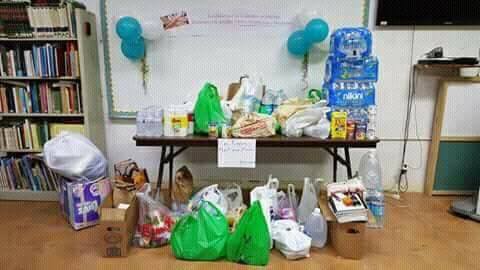
The union opened their offices for donations. They’re looking for canned foods, medicine, bottled water, clothes, insect repellent, bed sheets, etc.

You can send donations to:


The Federacion de Maestros of Puerto Rico

Urb El Caribe

1572 Ave Ponce de Leon
San Juan, PR, 00926.


The organization also has a gofundme Website at https://www.gofundme.com/solidaridad-victimas-huracan-maria

They’ve already received almost $7,000 in one day, but their goal is $40,000.

The Website includes this message:

“Thanks to all the compañeros and compañeras who have donated from various parts of the United States and other neighboring countries. The Federacion de Maestros of Puerto Rico (FMPR) is offering a network of support for those affected by the hurricane. Soon we will be informing the concrete steps. We encourage everyone to continue sharing the link for more partners to join in this effort. Together we will rise for Puerto Rico and help the poor and marginalized communities. Fight Yes!”

In the meantime, though schools have been closed across the island since the storm, teachers are supposed to report tomorrow.

“Right now communication on the internet is rough since a lot of towers were destroyed,” Martinez said.

“But to anyone who can help, thank you from the bottom of my heart.”

21463388_2022504187984316_4797333836297533816_n

21463416_2022504154650986_3527817112544667844_n

21753012_2021027091465359_20083949444758849_o

The following items are most in need:


* Personal Hygiene *
Towels
Toothbrush / hair brush
Soap (preferably bar)
Toothpaste
Shampoo / Conditioner
Deodorant (Unisex)
Razor Blades
Sanitary Towels / tampons / cup
Slapjones
Sanitary paper
Splash / perfume / Nenuco (F / M)
Gel
Shoes
Stockings
Interiors (Underpants / panties)
Pants
Shirts
Baby Clothes (F / M)
Diapers
Desitil / Balmex / Avenoo / A+D

* FOOD *
Canned Goods (Chicken / Tuna)
Export Cookies
Cereal
Uht milk
Rice
Oil
Salt
Soups
Sausages
Jamonilla
Corned beef
Pan (slice)
Potatoes
Guinean
Bananas
Pumpkin
Onions
Yams
Yautía
Hot
Fruit
Coffee
Sugar
Salt
Water
Pasta (Spaghetti / Mac)

* miscellaneous *
Greca / boot
Pan / pot
Gas Estufitas
Batteries
Lanterns
Candles
Sleeping bags
Mattress inflables
Bed Linen
Clorox
Mosquito repellent
Cups / utensils / plastic dishes

* MEDICINE *
Drugs “over the counter”
Panadol/Advil/Tylenol
Imodium
Pepto Bismol
Hydrogen peroxide
Alcohol
Cotton
Band-AIDS
Triple antibiotic
Syrups (e.g. Robitussin)

* school effects *
Variety

Why I Teach

https___blueprint-api-production.s3.amazonaws.com_uploads_card_image_488464_d6180c5d-946d-4770-9d02-091555a03a3b

Every year it’s the same nightmare.

I’m in front of a class of middle school students who aren’t paying any attention to me.

I point to the board, stamp my foot, even scream in vain.

But the children keep acting up – throwing pencils, swearing, hurting each other’s feelings.

It’s like I’m invisible.

And then I wake up.

Every teacher probably has a similar dream the night before their first day with students.

It’s a dream of impotence and redundancy.

Kind of like the businessmen and their political puppets claim we, teachers, are every day.

But the reality is much different.

Kids come bouncing in to my room, bristling with energy, half concealed hopes and fears.

Before they come in, I’m full of doubt: Can I still do this for another year? Will I be able to keep up with the work load? Will I be able to accommodate all the extra services for every special education student in my mainstreamed classroom? Do I have enough desks, pencils, paper? Have I planned enough for the first week? Will I be able to keep students interested, entertained, disciplined, engaged, working, inspired?

But the second the kids enter the classroom – literally the exact second – all my doubts disappear.

There’s no time.

I have more than two dozen children to see to at any given moment – and their needs outweigh any of mine.

It wasn’t until about halfway through the day that I even had an instant to myself to stop, breathe and reflect.

After my first bathroom break in more than 3 hours, then grabbing my lunch and collapsing into a seat- the first time I’m off my feet with no anxious little faces looking up to me – I think back on my day and realize – I absolutely love this!

No, really.

My feet hurt, my temples throb from making a hundred tiny decisions every 40 minutes, my body feels like it’s already been through a war… But there is no place in the world I would rather be.

Look what I’ve already accomplished today!

I took about 50 anxious human beings and made them feel like it was going to be okay.

I made 50 faces smile, sigh and relax.

I worked for hours on a new syllabus last week with manga graphics and punchy repartee, and when the kids got it today, they knew this class wasn’t going to be boring. I planned some ice breaker games to get them focused on our budding community of learners. I modeled how we can interact and still respect each other.

And in return I heard: “This is the best class!” “Mr. Singer is my favorite teacher!” “I don’t like to read or write but I’m really looking forward to doing your homework!”

How can you hear such things and not come away energized and new? How can you see such things and not feel a warm glow in your heart?

One of my first assignments is to have students write a letter about themselves. It’s now day 3 and I’m sitting at my desk reading through them.

It’s heartbreak city. Dead or absent parents, lost friends and pets, moving from place-to-place, older brothers and sisters serving as caregivers, pledges to work hard this year and make some missing adult proud. I find myself tearing up and writing supportive comments: “That’s so sad.” “I hope you like it here.” “You’ve already made me proud.”

I go through my Individual Education Plans and see a catalogue of hurt and trauma. Babies, they’re just babies, and they’ve gone through more than I have in my whole life. And I’m more than three times their age!

How can I not come to school every day and give my very best?

A public school is more than a building to me. It’s a temple to humanity. It’s where we go to offer ourselves to other people.

Every action, every thought spent on these children is holy. The tiniest gesture is magnified through infinite time and space. When I help a child gain confidence in her reading, I help not just her. I help everyone she will ever come into contact with –her co-workers, her friends, family, even her own children if she someday has some.

It’s humbling. Amazing. Staggering.

Where else can you see the accumulated hurt of the world and actually make a dent in it? Where else can you reach out not just to a cause or an idea but to a living person?

I’m lucky. I am so lucky. My circumstances allowed me to do whatever I wanted with my life.

I could have become a doctor or a lawyer. I could have gone into business and made a whole mess of money. But I never wanted any of that. I wanted to make a difference. I wanted to help people.

I remember the pitying looks peers would give me in my 20s. What a waste, they seemed to say. But I’ve never regretted it.

This is what I was meant to do. It’s the only thing I ever could and still respect myself.

Some folks will tell you teaching is about numbers and data. Increase these test scores. Cut costs by this much. Boost profits, escalate the graph, maximize effectiveness.

These people are fools.

Teaching has nothing to do with any of that. It’s about the children. Being there for them. Being an active part of eternity.

Thankful eyes, delighted smiles, joyous laughter. Ameliorating hurt. Igniting a tiny candle whose light will grow to encompass sights I will never see.

That’s why I teach.

Why Care About Other People’s Children

health-kids-smiling

As a vocal critic of charter and voucher schools, one of the most frequent questions I get from readers is this:

“Why should I care about other people’s children?”

One reader put it this way:

“Why should my child’s education and safety have to suffer because of difficult and violent students? …it isn’t my responsibility to pay for a miscreant’s education.”

The question says more than any answer could.

It shows quite clearly that school choice is an essentially selfish position.

That’s why some folks champion privatized education – they only care about their own children. In effect, when a parent sends their children to a charter or voucher school, they are telling the community that they don’t care what happens to any one else’s kids so long as their kids are properly cared for and educated.

It is the root cause of most of our problems in education today and has nothing to do with children. It’s all about adults – adults lacking empathy.

On the one hand, I get it. As a parent, you can’t help but love your child more than anyone else’s. You would beg, cheat and steal to make sure your child has enough to eat, is clothed and sheltered, has everything she needs to succeed in this world.

That’s a position for which few would show any embarrassment. It’s just being human.

But it shouldn’t also mean that you don’t care at all for other children.

I’d like to pose a radical thought – loving my child does not mean I’m indifferent to yours.

Children are innocent. They haven’t done anything to earn the hate or enmity of the world. They see everything with fresh eyes. Many of them haven’t even learned the prejudices and ignorance of their parents. And even where they have, it is so new it can be changed.

When you look at a babe in arms do you feel the same indifference? I don’t.

Perhaps it’s just the way we’re built. I feel an immediate nurturing instinct. I want to protect and provide for children – any children – even if they’re not mine.

If you saw a baby all alone crying on the side of the road, would you stop to help her? I would. I couldn’t help it. I can do no other.

If I saw a toddler in distress, a tween, even an unruly teenager in need, I would try to help. And I think most of us would do the same.

Doing so wouldn’t hurt my child. In fact, it would show her how a decent person acts towards others. It would teach her empathy, kindness, caring. It would demonstrate the values I try to instill in her – that we’re all in this together and we owe certain things to the other beings with which we share this world.

Why would you not want to do that?

We do not live in a world where you have to choose between your child and all others. There is a middle course. We can do for all society’s children without unduly sacrificing our own.

And if we can, why wouldn’t we?

Public school is essentially a community endeavor. It is an attempt to give everyone in your neighborhood the same start, the same opportunity, the same advantages.

It means allowing all children who live in the community the ability to attend the community school. That’s better than selecting the best and brightest and to Hell with the rest.

It means the community pooling its wealth to help all students. That’s better than dividing that pool up and pitting one group against another so that some get what they need and others don’t.

It means having an elected school board who holds public meetings, deliberates in the open and has to offer almost all documents to the light of day. That’s just better than an appointed board of directors who hold private meetings behind closed doors and who aren’t compelled to show any documentation for how they’re spending public tax money.

When you send your child to school – any school – she will have to deal with other students. She will meet children who are mean, unkind, unruly and a bad influence. But this is true at all schools – public and private, voucher or charter, secular or parochial. The biggest difference is racial and economic.

Our educational institutions today have become so segregated by class and race that even our public schools offer white middle class and wealthy students the opportunity to learn in an environment nearly devoid of children of color or children who live in poverty. This divide is drastically widened by charter, private and parochial schools.

So when people complain about the class of children they want to keep separate from their progeny, it is always imbued with a racist and classist subtext.

What they mean is: I don’t want my child to have to put up with all those black students, all those brown children, all those unwashed masses of impoverished humanity.

I proudly send my daughter to public school for the same reasons that many withhold their children from it. I want her to experience a wide variety of humanity. I want her to know people unlike her, and to realize that they aren’t as different as they might first appear. I want her to know the full range of what it means to be human. I want her to be exposed to different cultures, religions, nationalities, world views, thoughts and ideas.

And I want it not just because it’s better for my community – I want it because it’s better for her, too.

I want my daughter and I to both live in a world populated by educated citizens. I want us both to live in a society that treats people fairly, and where people of all types can come together and talk and reason and enjoy each other’s company.

Only under the most extreme circumstances would I ever subject her to charter, private or parochial schooling. And things would have to come to a pretty pass for me to home school her.

Imagine! Thinking I could offer my child all the richness of a public school experience, all the knowledge of a district’s worth of teachers, all the variety of social contact – how vain I would need to be to think I could do all that, myself!

Some people want their children to become little versions of themselves. They want to create a generation of mini-me’s who’ll carry on their way of thinking into the future.

That’s not my goal at all.

I want my daughter to share my core values, I want her to learn from my experiences, but I don’t want her to think like me at all. I want her to be a new person, special and unique.

I want her to be her.

If you stop and think about it, that’s what most of us want for our children.

It’s a common goal that can be achieved with a common mechanism.

So why should we care about other people’s children?

Because it’s better for ours. Because doing so makes us better people. Because all children are ends in themselves. Because they’re beautiful, unique sparks of light in a dark universe.

If those aren’t reasons enough, I can’t help you.

Reaching Black Students Harder for White Teachers in the Age of Trump

Screen shot 2017-05-08 at 7.51.23 PM

“Not everything that can be faced can be changed. But nothing can be changed until it is faced.”
James Baldwin

“I have a great relationship with the blacks. I’ve always had a great relationship with the blacks.”
Donald Trump

Mariah’s eyes were wide as dinner plates.

She covered her mouth with her journal and pointed at the wipe board at the front of the room.

On it, I had written my question for the day. It’s how I usually begin class for my 8th grade students.

It read:

“Some movies and books like “To Kill a Mockingbird” describe what life was like in the South before the civil rights movement. To do so, they use the N-Word. Is it ever okay to us the N-Word? Why or why not? When might it be appropriate if at all? Why?”

I guess I’ve been teaching this for too long, because I didn’t expect Mariah’s reaction.

Not that was she alone. Several of my mostly impoverished and black students were looking around at each other in shock.

Kendra even said under her breath, “I don’t want to do this.”

We had just begun reading the novel yesterday. I thought it was time to address this issue before we were confronted with the word in the text.

In all of my classes that day, students had been interested in the query. But never had any of them reacted this way.

One student raised her hand and asked, “Which word are you talking about?”

I said, “I don’t want to say it, but it starts with an N and rhymes with trigger. Do you know what I’m getting at?”

They knew. Yet in removing doubt, I had only reinforced their outrage.

I thought maybe if they tried to write an answer first, it might help them organize their thoughts and maybe comprehend the point of the lesson. But they wouldn’t be directed back to the page.

Latrell was particularly upset. “It’s not always just words against black people,” he said. “How would you like it if we talked about words against white people?”

There were grumbles of agreement.

So there it was.

My white skin was the impediment. Here I was, a white man telling mostly black students to think about the appropriateness of the N-Word. I wasn’t trying to express an opinion of my own one way or the other. I wanted them to express their opinions.

But I had taken it for granted that asking them the question was appropriate in the first place.

I had forgotten that you can’t talk about racism with just anyone. It’s the same with sexual violence or abuse or a host of other topics that are deeply personal.

You need a relationship, the recognition of shared values and the promise of safety.

I assumed that I already had provided that for my students. In most classes that understanding seemed to be there. But for whatever reason, these students didn’t feel comfortable talking about this with me.

And I get it.

It’s the confluence of skin and history. No matter what I do, no matter what I say, I will always resemble the oppressor to some people. In the age of the Donald, it’s only gotten worse.

Building walls, casual misogyny, rushed deportations, religious intolerance – all are at the forefront of our modern social discourse now. These are matters not hidden under euphemisms or disguised as well-meaning public policy. They’re commands from on high, dictates coming from a mouth in a face that looks much like mine.

No wonder these kids didn’t want to talk about hate speech with me. I resemble the personification of hate speech.

I’ve been teaching “Mockingbird” for over a decade, but this was the first time in years that I paused not knowing what to do.

Should I force the issue and push forward? Should I give in and try to read the novel without the discussion? Should I put the book away altogether and find something else to teach?

I decided to get more information.

I asked the students to tell me how they felt. I asked them to explain what they were feeling.

Many were angry with me for even asking. They accused me of being racist. They tried to make me angry and blow up the lesson.

But I swallowed my pride and just let them talk.

After each statement, I repeated what I took them to be saying and asked if that was correct.

At first, many students didn’t even seem to be certain what they meant. When I repeated it to them, they shook their heads or said they weren’t sure.

Kendra spoke, “Mr. Singer, you tell me. Why are we talking about this? It don’t do nothing.”

I said, “Can we all agree that racism is a bad thing?”

But she deflected.

“Why’s it always got to be about black people? Other people experience racism,” she said.

And I agreed. I reminded them that we had just finished reading “The Diary of Anne Frank.” I asked why we had read it.

At first the loudest students said they didn’t know, but then Eva said it was to try to make sure nothing like the Holocaust ever happened again.

I nodded, and repeated my original question, “So can we all agree racism is bad? Raise your hand if you think racism is bad.”

They all raised their hands.

“Okay,” I said. “Then how do we stop it if we can’t talk about it?”

Kendra responded, “Mr. Singer, when we leave this class, none of this is going to matter. People are still going to be racist. Cops still gonna’ kill little black kids. People like you still gonna’ push people like me out.”

Others chimed in with similar comments.

I nodded, and said, “You’re right.”

That silenced them.

“You’re right, Kendra,” I said. “Maybe we can’t stop racism with what we say in here. Maybe no one can. But the hope is that if we talk about it, we’ll reduce it, we’ll cut it down to size. What do you think? Do you think we can take all the racism in the world and cut it down even by just a little bit?”

She didn’t say anything.

No one did. But hands were raised in the air. No one was shouting. No one seemed angry. Several students wanted to talk, and they were looking to me to organize the discussion.

So I let them talk.

All the time I had scheduled to write the journal fell through the hour glass and then some.

And when the discussion was petering out, I promised them that I would be available after class if anyone wanted to continue talking about it.

Then we picked up the book and continued reading.

I don’t know if it was the best class I’ve ever taught.

It was disturbing and uncomfortable.

I don’t see myself as anyone’s savior. But I’m there to help. I had hoped my students knew that.

But as a public school teacher, you learn not to take anything students do personally. They’re all going through a struggle you know little about.

I don’t want them to see me as an adversary. I want them to see me as a fellow traveler, as someone on their side.

But so much has changed in the last 100 days.

It’s a different world.

Racism and prejudice are no longer at the same remove. They never went away, but now they’re an unspoken presence coiled at our feet – constantly.

I have no answers. I ask questions and try to get my students to think about their own answers.

I just hope we’ll continue to have the courage to try.

I May Have Just Been Murdered By House Republicans

couple


I may be dead already.


And House Republicans may be the ones who killed me.


With the passage of a healthcare bill they, themselves, haven’t read – haven’t studied – haven’t thoughtfully considered in any way – it seems they’ve opened the door for insurance companies to deny people coverage due to pre-existing conditions.


I have one.


I’ve had two small heart attacks this year.


So I sit here stunned at the news on my computer feeling very much at a loss.


People have legitimate political differences, but this… it’s just beyond anything I’ve ever experienced personally.


There are people who count on me – my daughter, my wife, my students. I’m not so vain as to imagine that they can’t get along without me, but my loss will hurt them. I think at the very least they’ll miss me.


I’m 43-years-old. I’ve lived a good life. I just never expected to be abandoned in such a way by a society I’d always thought was more humane.


But if this legislation becomes the law of the land, what will I do?


I take six or seven pills a day to control my cholesterol, keep the stints in my heart clean, control my blood pressure, slow my heartbeat, etc. Without them, I almost certainly will have another heart attack. Yet I have no idea how I could possibly afford to take them without insurance.


And if I get sick, I won’t be able to work. I’ll bring in even less money. I won’t be able to help support my family. I’ll end up being a liability, a burden.


House Republicans have to know there are people out there like me. There have to be a lot of people in even worse shape than I am.


Are they really going to just let all of us die?


I had hoped to see my daughter grow up. She’s only 8-years-old, the most precious person in my life. No one is more full of energy, more vivacious and joyful. She loves to draw and write short stories. She pretends to be a teacher just like her father and gives her stuffed animals assignments.


I guess I’ll never get to see the person she becomes. I’ll never find out if she goes to college, if she finds love, if she has children of her own.


Can it really all come down to this?


My wife and I have been through a lot together. We met back in high school. Before I became a public school teacher, we worked together at various local newspapers. She supports me when I can’t go on. I hope I am able to give her back even a fraction of the strength she lends me.


Does this mean we’ll have to say goodbye, and so much sooner than I ever imagined?


My middle school students and I just finished reading “The Diary of Anne Frank.” When we closed the book, there were some tears shed. I passed around the tissues, and we discussed how we felt. Many of them expressed anger that some people could hold others’ lives so cheaply as the Nazis did Anne and her family. Are House Republicans guilty of a similar crime? They aren’t rounding anyone up to send to death camps, but they’re apparently content to let many of us just die.


The pundits tell me I have nothing to worry about. The bill won’t pass the Senate, they say. And even if it does, the President would be breaking every campaign promise he ever made, if he signs it.


So what else is new?


This is the world we live in now.


It’s not the country I was born into. It’s a cold place. A heartless reality.


Perhaps tomorrow I’ll gather the strength to resist, to call my Congressperson again, to protest, to organize.


But as for today…


I can’t even.


So I’ll head home, and give my family a big hug, spend whatever time I can with them.


Because if my life now depends on the compassion of Republican lawmakers, I may not have much of it left.


Arne Duncan Designed Rahm Emanuel’s Latest Attack on Poor Students of Color

1357229004

Sometimes an idea is just too stupid to keep it all to yourself.

Ask Arne Duncan.

Sitting at his lonely desk as managing partner of the Emerson Collective, a limited liability corporation pushing school and immigration policy, he must have missed his days as President Barack Obama’s Education Secretary.

After all, he was the architect of Race to the Top, a federal policy that at best wasted billions of tax dollars without helping students learn – at worst it enriched private charter school operators, standardized test and publishing corporations and private prison operators without helping kids learn.

At the dawn of 2017 with Donald Trump just beginning to flush public education down the toilet in favor of school vouchers, Duncan took to the Internet wondering how he, too, could bring harm to inner city students.

On Jan. 11, he sent an email to Chicago Mayor Rahm Emanuel with a suggestion that was pure Duncan – let’s help poor children of color by making it harder to graduate!

Chicago Public School students have suffered from decades of budget cuts, teacher layoffs and even the closure of 49 schools almost exclusively in poor, black or Latino neighborhoods. A former district CEO even plead guilty to a $23 million kickback scheme.

As a result, the more than 400,000 students, 37.7% of which are black and more than 80% of which are poor, have struggled academically.

How would Arne help them? Make them submit more paperwork in order to get a diploma. They must prove that after 12th grade they’re going to college, trade school, an internship, the military or would otherwise be gainfully employed. OR ELSE they can’t graduate!

“Think about making completing a FAFSA [financial aid application] and applying to two or three colleges or the military a new CPS graduation requirement,” Duncan wrote to Emanuel in emails released to the Chicago Sun-Times through a Freedom of Information Act request. “Graduation rates continue to rise. This would signal the importance of ongoing education/training. A HS diploma is great, but not enough. No other school system I know of has taken this next step.”

Duncan followed up in February, and Emanuel replied, “Thanks. You know we are doing a version of your graduation requirement.”

Duncan responded, “Didn’t know. Good?”

No. Not good, Arne.

Because of your neoliberal meddling, when this year’s 9th graders finish their senior year, they’ll have to jump through yet another hoop to get their diplomas.

The Brookings Institute concluded in 2016 that cities like Chicago with pronounced income inequality are more likely to see higher rates of secondary school drop-outs, and lower graduation rates. An unrelated 2014 study found that Chicago ranked eighth among American cities in an index of income inequality.

None of that is helped by a new graduation requirement.

But Duncan disagrees.

He wrote an op-ed published in the Chicago Tribune praising the plan – his plan.

“Some people worry that raising graduation standards will cause more young people to drop out, but they’re wrong,” he wrote. “Young people don’t drop out because school is too hard. They drop out because it is too easy and they are not engaged. They don’t understand how it’s relevant to their lives.”

Wrong, Arne. It’s not a matter of school being too easy. It’s a matter of life being too hard. Imagine being an impoverished inner city student. You’re malnourished, there are few books in your home, you’re struggling to survive in a world populated by drugs and gangs, you’re suffering from post traumatic stress and your neighborhood school is closed, your teacher is laid off, there’s no tutoring, no arts or humanities classes. And they keep making you take endless high stakes standardized tests. THAT’S what makes students loose interest in school. Not because it’s too easy!

But Emanuel, a former investment banker and Obama’s White House Chief of Staff, only understands business solutions to human challenges.

When proposing this new graduation requirement, he said he got the idea from charter schools.

But of course! Private corporations running schools at public expense always know what is best!

Or is that NEVER know what is best? I guess it depends on whose interest you’re looking out for – businesspeople or students.

Emanuel doesn’t think this new policy is a major change.

“We already have around 62 percent of our kids are already either accepted into college or accepted into community college, and our goal is to make sure nobody spikes the ball at 12th grade,” Emanuel said. “We want to make 14th grade universal. That’s the new goal line.”

Is it, Rahm? It’s interesting that you’re doing this for inner city kids but no one is suggesting it for wealthy kids in the suburbs.

This statement about expectations explains why:

“Just like you do with your children, college, post-high school, that is what’s expected,” Emanuel said. “If you change expectations, it’s not hard for kids to adapt.”

So poor black and Latino kids need YOUR expectations. Is that it? It’s up to YOUR patriarchy to step in and tell them what to do with their lives after high school or else – what? They’ll just sit home on food stamps doing nothing?

This is Chicago – where police brutality is an everyday thing. Gun violence is out of control. And you think these kids and their parents live in crippling, generational poverty because they aren’t trying hard enough to get jobs or better themselves?

Those seem to be the underlying assumptions here. It’s not about giving these 18-year-olds a helping hand. It’s about pushing them to pull themselves up by their own bootstraps.

It only takes a second of thought to realize why this is a bad idea.

The district has been cutting staff positions left and right – especially at schools serving poor students of color. Has any additional funding been budgeted to ensure district guidance counselors are in place to help students meet this goal? NOPE.

Students can graduate if they prove they’ve got a job after high school. Those aren’t exactly growing on trees – especially jobs that pay more than minimum wage. What if students can’t find employment? That’s reason to withhold their diplomas? Your academic fate should be held up because there aren’t enough positions as a fry chef!?

Sure, seniors can apply to a local community college, which according to a spokesperson for City Colleges of Chicago, lets everyone in. But what if this isn’t the path for them? Not everyone is made for college. Why is the city stepping in to demand a post graduate plan from students? Isn’t this really just a recruitment plan for these community colleges and/or the military?

Is this even legal? These kids have passed all their classes. They’ve earned a diploma. You can’t simply withhold it because their post-secondary plans don’t meet with your approval.

When the district withholds its first diploma, look for a legal challenge where taxpayers will be in the uncomfortable position of paying for legal counsel to stop a child from graduating.

This Duncan/Emanuel policy is something you might expect from a certified moron like current Education Secretary Betsy DeVos. (She wants teachers armed against grizzly bear attacks.)

But it should be noted that both Duncan and Emanuel are Democrats. They’re just not progressives.

You wonder why a fool like Trump won the Presidency? It’s because of neoliberal attitudes like these. Both of these men were part of the Obama administration. And Hillary Clinton was following in the same footsteps – or certainly she didn’t speak out against it.

Emanuel’s political career is backed by the same big money conservatives that back Chris Christie, Mitt Romney and Bruce Rauner. He’s a puppet of charter schools, hedge fund managers and the Koch Brothers.

In fact, his corruption was so bad that during the 2016 primary, he became an issue for Democratic Presidential contenders. Bernie Sanders actually called him out in a tweet saying: “I want to thank Rahm Emanuel for not endorsing me. I don’t want the endorsement of a mayor shutting down schools and firing teachers.”

Screen shot 2017-04-18 at 12.51.54 PM

Rahm had endorsed Clinton putting her in a bad position. Ann O’Leary, Clinton’s education advisor, said in private emails that Emanuel was “bad for Chicago schools.”
Like Clinton’s campaign manager, John Podesta, O’Leary was a longtime supporter of corporate education reform policies – and so was Clinton. Hillary supported George W. Bush’s terrible No Child Left Behind – the law that changed federal education policy from focusing on equity to holding schools hostage for their standardized test scores.

O’Leary was worried about how Emanuel might hurt Clinton – especially in light of Bernie’s tweet.

In a private email to senior Clinton staff, she wrote:

“Bernie is beating us up over Rahm’s record on schools in Chicago. The Chicago school system is overloaded with debt and likely to run out of cash before the end of the school year. As a result, they are withholding their pension contributions, and laying off teachers and support staff.

I reached out to Randi W[eingarten, President of the American Federation of Teachers] and she suggested that she tweet something tomorrow making it clear that Rahm and Rauner have been bad for Chicago schools and then HRC [Hillary Rodham Clinton] retweets.

That sounds like a toxic idea to me given Rahm’s endorsement, but I don’t think this issue is going away.

We could: (a) have HRC say something more forceful about the state working to help Chicago pay off debt so the schools can focus on teaching and learning; (b) have Randi say something more mild and we could retweet. But I do worry that short of going after Rahm, these options are not going to be satisfactory. So the (c) option is to stay silent for now.

Thoughts?”

O’Leary’s final decision was to do nothing.

And we all know how that turned out.

Screen shot 2017-04-18 at 12.52.54 PM

The worst part is that the Democrats don’t appear to have learned anything.

Here’s what Duncan had to say just this month about how Democrats should be fighting the Trump administration’s education policies:

“The federal government is disinvesting in public education and withdrawing from accountability, so states and districts have to step up and lead.”

But Arne, your administration disinvested in public schools, too. Emanuel is famous for it!

And we all know what “accountability” means to neoliberals like you. It means endless standardized testing and closing schools catering to poor students of color. It means giving charter schools, book publishers and testing corporations a blank check.

No one is going to vote for that anymore.

That is just not a viable alternative to Republican policies that take all of this to its logical conclusion.

Destroying public schools slowly is not a viable alternative to destroying them quickly. Democrats need to either discover their real progressive roots or else move aside for grassroots groups to take over.

That’s a suggestion worth sending to your buddies Rahm, Hillary and Barack via email.

Dept of Ed Hires Anti-Civil Rights Crusader to Protect Student’s Nonexistent Civil Rights

Screen shot 2017-04-16 at 1.27.11 AM

Candice Jackson is a victim of oppression.

When she was attending Stanford University in the mid-1990s, a minority calculus tutoring group refused to help her because she was white.

Sure she could probably afford to pay for private tutoring, but it was the point of the  thing.

She came from a family where both parents ran medical practices. Her dad, Dr. Rick Jackson, even unsuccessfully ran for Congress. You know – just like black families redlined into the ghetto and struggling to find work because of their African-sounding names.

Why shouldn’t the limited amount of tutoring spaces serve her as well as people from traditionally less privileged backgrounds? White lives matter, ya’ll.

“I am especially disappointed that the University encourages these and other discriminatory programs,” she wrote in the Stanford Review. “We need to allow each person to define his or her own achievements instead of assuming competence or incompetence based on race.”

With that kind of empathy and innate understanding of social justice, I – for one – am overjoyed that U.S. Education Secretary Betsy DeVos has hired Jackson to run the department’s Office for Civil Rights.

Well, she’s acting assistant secretary for the office. Technically she was hired as deputy assistant secretary, because that doesn’t require a confirmation hearing. A permanent assistant secretary will have to be approved by Congress – if DeVos ever gets around to nominating one.

I’m sure she’ll do that soon. There’s no way she’d sneak in someone who doesn’t believe in civil rights whose main job is to protect civil rights! That would be like hiring a Secretary of Education who doesn’t believe in the mission of public education tasked with protecting public schools!

That’s unpossible!

And Jackson is all about civil rights. The 39-year-old attorney is anti-women’s rights, anti-distributive justice and possibly even anti-compulsory education and anti-Civil Rights Act of 1964!

Just perfect!

I mean what does the Department of Education have to do with civil rights anyway?

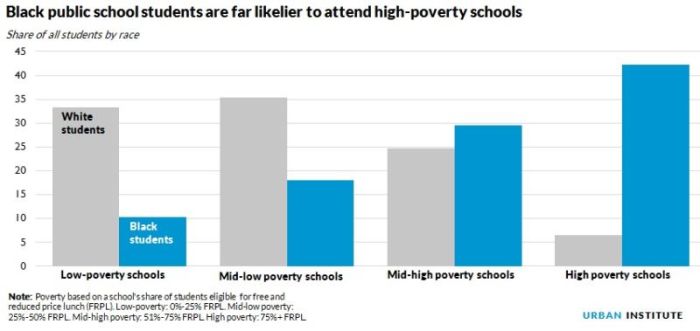
According to the department’s own statistics, black students are at least six times more likely than white students to attend poor schools. These schools have smaller budgets, fewer resources, a crumbling infrastructure, larger classes and higher student needs based on the trauma of living in poverty – worse nutrition, lack of books in the home, exposure to violence and abuse, etc. Meanwhile, white students are three times more likely than blacks to attend rich schools overflowing with resources, pristine infrastructures, small class sizes, and fewer needs.

k2sij4hm9oqedzpfqslp

j1wqdpqnvg4fuwjx7opd

Is that fair? Should the government do anything about ensuring all students receive the same opportunities?

Heck no!

That’s up to… I don’t know… somebody else. And what about all those poor white kids trapped in poor schools with a majority of students of color!? Who’s going to help the six percent of white kids in mostly black schools escape?

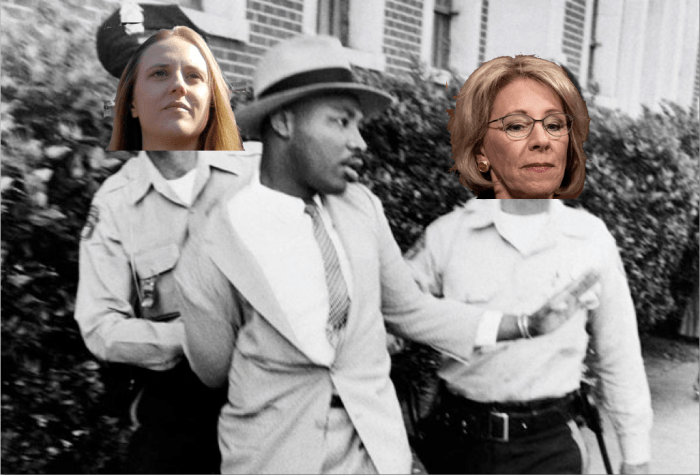
Betsy DeVos – that’s who! Donald Trump – who is really indistinguishable from Dr. Martin Luther King, Jr., and her are proposing a school voucher program so that these white kids can go to a charter, private or religious school.

The black kids? Maybe the choice schools will accept some of them, I mean if the appointed boards and CEOs who run them want to take these kids, it’s really all up to them. We aren’t going to force them to do anything. We’re all libertarians here in Washington now. You wouldn’t want us to trample on the civil rights of charter and private school operators, would you?

Of course not!

And we’re certainly not going to do anything to help these impoverished public schools succeed. No additional funding. No preferential treatment! The free market will sort things out – it always does.

And people wonder why DeVos needs to be protected by U.S. Marshals at a cost of $1 million a month.

Her department is doing away with services the public has come to rely on: protecting special needs students, protecting college students from predatory loans, and now prosecuting civil rights violations.

The liberal snowflakes! Pull yourselves up by your bootstraps! Why are you demanding the government provide you with actual services in return for your tax dollars? You should be demanding tax cuts. That way you can just buy everything you need, yourselves, like the billionaire DeVos family and even the well to do Jacksons.

It’s a wonder why DeVos doesn’t pay for her own security detail – or why President Trump demands we pay for the extra security for all his trips to Mar-a-Lago.

But in any case, the extra security is clearly necessary for DeVos. Every other Education Secretary in history has been able to make due with protection from the Secret Service – from agents already on the payroll and in fact still on the payroll now. But when you’re striping the public of services and enacting programs like school vouchers that Americans angrily don’t want, you need the extra protections.

It’s like Saddam Hussein and Kim Jong Un. They didn’t and don’t have Royal Guards just because they love/loved pageantry. They need/needed protection from the people. That’s how you know you’re best serving the people. You need protected from them.

This is the conservative dream – federal employees appointed by bureaucrats instead of voted on by representatives, public servants who don’t believe in public service, and a military machine protecting them from the taxpayers.

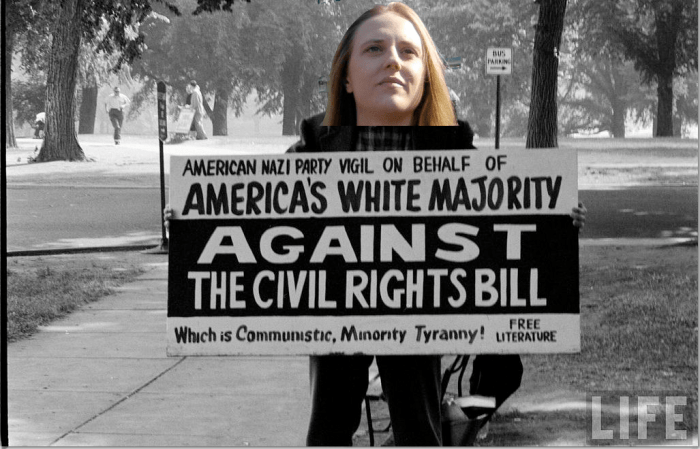
This is the kind of administration that will finally ensure that never again will any white person ever be inconvenienced by people of color and all their needs! Never will the poor or minorities ever receive any federal help that could be perceived by white people as extra help – if we forget about all that we have helping us.

Finally we’ll all be equal. And some of us will be even more equal than others!

Screen shot 2017-04-16 at 1.30.48 AM

Standardized Testing Creates Captive Markets

thumbnail_Screen Shot 2017-04-07 at 10.41.23 AM

It’s easy to do business when the customer is forced to buy.

But is it fair, is it just, or does it create a situation where people are coerced into purchases they wouldn’t make if they had a say in the matter?

For example, school children as young as 8-years-old are forced to take a battery of standardized tests in public schools. Would educators prescribe such assessments if it were up to them? Would parents demand children be treated this way if they were consulted? Or is this just a corporate scam perpetrated by our government for the sole benefit of a particular industry that funnels a portion of the profits to our lawmakers as political donations?

Let’s look at it economically.

Say you sold widgets – you know, those hypothetical doodads we use whenever we want to talk about selling something without importing the emotional baggage of a particular product.

You sell widgets. The best widgets. Grade A, primo, first class widgets.

Your goal in life is to sell the most widgets possible and thus generate the highest profit.

Unfortunately, the demand for widgets is fixed. Whatever they are, people only want so many of them. But if you could increase the demand and thus expand the market, you would likewise boost your profits and better meet your goals.

There are many ways you could do this. You could advertise and try to convince consumers that they need more widgets. You could encourage doctors and world health organizations to prescribe widgets as part of a healthy lifestyle. Or you could convince the government to mandate the market.

That’s right – force people to buy your products.

That doesn’t sound very American does it?

In a Democratic society, we generally don’t want the government telling us what to purchase. Recall the hysteria around the Obamacare individual mandate requiring people who could afford to buy healthcare coverage to do so or else face a financial tax penalty. In this case, one might argue that it was justified because everyone wants healthcare. No one wants to let themselves die from a preventable disease or allow free riders to bump up the cost for everyone else.

However, it’s still a captive market though perhaps an innocuous one. Most are far more pernicious.

According to dictionary.com, a captive market is “a group of consumers who are obliged… to buy a particular product, thus giving the supplier a monopoly” or oligopoly. This could be because of lack of competition, shortages, or other factors.

In the case of government mandating consumers to buy a particular product, it’s perhaps the strongest case of a captive market. Consumers have no choice but to comply and thus have little to no protection from abuse. They are at the mercy of the supplier.

It’s a terrible position to be in for consumers, but a powerful one for businesspeople. And it’s exactly the situation for public schools and the standardized testing industry.

Let’s break it down.

These huge corporations don’t sell widgets, they sell tests. In fact, they sell more than just that, but let’s focus right now on just that – the multiple choice, fill-in-the-bubble assessments.

Why do our public schools give these tests? Because peer-reviewed research shows they fairly and accurately demonstrate student learning? Because they’ve been proven by independent observers to be an invaluable part of the learning process and help students continue to learn new things?

No and no.

The reason public schools give these tests is because the government forces them. The Elementary and Secondary Education Act (ESEA) requires that all students in grades 3-8 and once in high school take certain approved standardized assessments. Parents are allowed to refuse the tests for their children, but otherwise they have to take them.

It wasn’t always this way. When the act was first passed in 1965, it focused almost entirely on providing students with equitable resources. That all changed in 2001, with the passage of No Child Left Behind, a reauthorization of this original bill. And ever since, through every subsequent reauthorization and name change, the federal law governing K-12 schools has required the same standardized testing.

The testing corporations don’t have to prove their products. Those products are required by law.

It’s one of the largest captive markets in existence. That’s some 50.4 million children forced to take standardized assessments. The largest such corporation, Pearson, boasts profits of $9 billion annually. It’s largest competitor, CBT/ McGraw-Hill, makes $2 billion annually. Others include Education Testing Services and Riverside Publishing better known through its parent company Houghton Mifflin Harcourt.

If many of these companies sound like book publishers, that’s because they are or their parent companies are. And that’s no coincidence. It’s another way they bolster their own market.

Not only do many of these testing corporations make, provide and score standardized assessments, they make and provide the remedial resources used to help students pass.

So if your students are having difficulty passing the state test, often the same company has a series of workbooks or a software package to help remediate them. It’s a good business model. Cash in before kids take the test. Cash in when they take it. And if kids fail, cash in again to remediate them.

Ever wonder why our test scores are so low? Because it’s profitable! The money is all on the side of failure, not success. In fact, from an economic point of view, there is a disincentive to succeed. Not for teachers and students, but for the people who make and grade the tests.

But that’s not all.

Once you have a system in place, things can become static. Once districts already have the books and resources to pass the tests, the testing corporation has less to sell them, the market stagnates and thus their profits go down or at least stop growing.

The solution once again is to create yet another captive market. That’s why Common Core was created.

These are new academic standards written almost exclusively by the testing corporations and forced on districts by federal and state governments. Under President Barack Obama’s Race to the Top initiative, $500 million in federal education grants were tied to adopting these new standards. States were coerced to push Common Core on their districts or else lose out on much needed funding.

This resulted in the need for districts to buy all new materials – new text books, new workbooks, new software, etc. It also required the states to order brand new standardized tests. So once again the testing industry cashed in at both ends.

And these tests were more needlessly difficult so more children would fail and need costly remediation.

Was there a pressing academic need for these new standards? Was there any evidence that these standards would increase student learning? Were there even any independent studies conducted to attempt to prove a need?

No. This was a total money grab. It was naked greed from one industry completely enabled by our lawmakers at the federal and state levels.

Republicans made noises against it, and some still do. But consider this – the overwhelming majority of state houses are controlled by the GOP. They have the power to repeal Common Core at any time. Yet almost none of them did or do.

Ask yourself why. It has nothing to do with the Democrats. Republicans are owned by the same masters as the so-called liberals – these same test corporations.

You have to understand that our government is no longer ruled by the principle of one person, one vote. Money has become speech so wealthy corporations get a huge say in what our government does.

If an industry gets big enough and makes enough donations to enough lawmakers, they get the legislation they want. In many cases, the corporations write the legislation and then tell lawmakers to pass it. And this is true for lawmakers on both sides of the aisle.

Standardized testing and Common Core are one pernicious example of our new captive market capitalism collapsing into plutocracy.

Our tax dollars are given away to big business and our voices are silenced.

Forget selling widgets. Our children have BECOME widgets, hostage consumers, and access to them is being bought and sold.

We are all slaves to this new runaway capitalism that has freed itself from the burden of self-rule.

How long will we continue to put up with it?

How long will we continue to be hostages to these captive markets?