Charter School Lotteries – Why Most Families Don’t Even Apply

Screen Shot 2017-07-03 at 1.33.34 PM

Who gets to enroll in your school?


This question is at the heart of the charter school debate.


While traditional public schools have to accept any student who meets residency requirements, charter schools can be entirely more selective.


They don’t have to take just any student. They can pick and choose based on pretty much whatever criteria they want.


Despite the fact that charters are publicly funded and privately run, transparency requirements are so low in most states that regulators aren’t even allowed to check up on their enrollment practices.


It’s a situation rife with the potential for fraud and abuse with America’s most vulnerable students often being victimized and huge corporations raking in record profits.


Critics say that charter schools routinely accept only the easiest students to educate. They take those with the best academic records, without disciplinary problems or special education needs. This allows them to spend less money to run their schools and claim all their students are doing well because of artificially inflated test scores.
But when critics level such charges against the charter school industry, the most common reply is an appeal to charter school lotteries.


When these privatized schools get more applications than they have seats, they often resort to a lottery to determine which students get to enroll.


The infamous propaganda movie “Waiting for Superman” had a much quoted scene where poor children held onto their lottery tickets as they hoped and prayed to be saved from a “failing public school.”


Advocates claim this is what makes charters fair: Students get in by pure chance.


But it’s not true.


More often than not, whenever enrollment data is available, it shows that charter administrators are, in fact, selective.


Take BASIS School Inc., a charter chain with 18 schools in Arizona, three in Texas and one in Washington D.C. The chain’s schools in Tucson and Scottsdale are highly ranked on Newsweek’s “America’s Most Challenging High Schools” list, and on the Best High Schools list of U.S. News & World Report.


However, their enrollment figures show them to be out-and-out cherry pickers.


They typically over-enroll Asian-American students and under enroll Latinos. They also enroll a much lower proportion of special education students than the state average and – shockingly – have zero English Language Learners.


Despite corporate accolades, this is not a successful model of public education. It is prejudicial, exclusionary and entirely the goal of for-profit educational institutions everywhere.


But besides outright corruption from charter administrators, there are other factors that suppress the neediest students from even applying to charter schools.


In short, they don’t want to go to these types of schools. They can’t afford losing the services and amenities they would typically receive at traditional public schools. They can’t afford the extra out-of-pocket costs charters demand.


Frankly, many charter schools are set up for middle class or wealthier students. Even if accepted, the poor would get fewer services and be forced to pay more than they could afford.


1) They Can’t Afford Uniforms


Many charter schools require students to wear uniforms. Most traditional public schools do not. Therefore, even though your local charter school is funded by tax dollars, it can be a hefty financial burden to attend.


How much more does it cost? That depends. Each charter school has different requirements.


For instance, in the New Orleans Parents’ Guide, the cost for a single uniform is estimated at more than $70. That’s at least $350 for a week’s worth of clothes. However, many estimates I’ve seen have been much higher.


Many charters require students to wear blazers – something a traditional public school student wouldn’t be caught dead wearing. These are pretty expensive items. They can cost anywhere from $80-$250 each.


Moreover, some charters, like most in the KIPP network, require everyday items like socks and shirts to contain an embroidered school logo. That’s at least an additional $10-15 per item.


For impoverished parents who routinely shop at local thrift stores or the Salvation Army, charter school uniforms can put them out of reach.


To be fair, about 19% of traditional public schools also require uniforms. However, they are typically much less expensive. In fact, they rarely amount to more than requiring clothing to be of a wide variety of colors and/or styles.


And if parents can’t afford the extra cost, traditional districts are required to either forgo the requirement or help parents meet it. They cannot deny children an education based on their parents inability to buy uniforms. Charter schools, on the other hand, can.


2) They Need Special Education Programs


Charter schools are rarely – if ever – known for their special education programs. Traditional public schools, on the other hand, are renowned for meeting the needs of diverse students with various abilities. If your child has special needs, going to a charter school simply may not be an option.


One reason for this is the basic structure of each type of institution. Traditional public schools are usually much bigger than charter schools. As a result, they can pool their resources to better meet special students needs.


At charter schools nationally, disabled students represent only about 7-8% of all students enrolled. At traditional public schools, they average a little more than 11%, according to a Government Accountability Office analysis of Department of Education data. So traditional public schools already have the staff, infrastructure and experience to help these children. Moreover, it would be cost prohibitive for charters to add them, especially when they’re designed specifically to make a profit.


Perhaps more troubling is this: charter schools rarely identify students as having special needs. Students who would get extra help and services in a traditional public school setting, do without in charter schools. In fact, parents who feel their children’s needs aren’t being met at charters, often disenroll them and place them back in their traditional public school for the extra help.


Parents with students who have learning disabilities or extra needs simply can’t afford letting their children languish in a privatized school setting that may well ignore their child’s individual needs.


3) They Need Free/Reduced Breakfast and Lunches


Though the state and federal government pay for free or reduced breakfast or lunch programs, charter schools often don’t offer them. Traditional public schools do. It’s that simple. If you’re having trouble feeding your children, sending them to a charter school can mean letting them go hungry.


Take Arizona. Statewide, more than 47% of all students receive free or reduced-priced lunch. However, charter schools in the BASIS network have none.  This doesn’t mean none of their students qualify. Clearly some of them do. The BASIS chain has chosen not to participate.


Why? Perhaps it’s to keep away students who have greater needs.


If so, it’s working.


Even when charters don’t actively weed out hard to teach students, they can set things up to make them less likely to apply.


4) They Need Busing To-And-From School


Often students don’t live within walking distance of their school. Traditional public schools routinely provide busing. Charter schools often do not. If you can drive your child to-and-from school, this is not an issue. If you’re poor and don’t have your own means of transportation, this is an added burden.


And if you think this is only a feature of the most fly-by-night charters, think again. The BASIS network – again, which includes some of the highest rated charters in the country – does not provide busing.


Traditional public schools are often at the heart of the community. They spring up around community centers, parks, and social gathering places. Charter schools are more often located at new or repurposed sites that can be miles away from the people they serve.


When the traditional public school offers a free ride to-and-from school, it can be an insurmountable burden to go to a charter where you have to find another way to get there. Parents who are working multiple jobs and/or the night shift may find it impossible to take their kids to the local charter. But perhaps this is exactly why charters aren’t offering busing in the first place. They don’t want these children.


5) They Don’t Have Time and/or Money For Extra Charter Demands


Charter schools demand an awful lot from parents. Traditional public schools do not. While children often benefit from involved parents, that’s not always possible. It’s unfair to require parental involvement as a prerequisite of enrollment.


Many charter schools require parents to volunteer at the school for so many hours a week. They often require “suggested” donations for extra services and for parents to buy books, supplies, or to pay an additional fee for extra curricular activities that would be provided for free at traditional public schools.


The BASIS network, for instance, requests that families contribute at least $1,500 a year per child to the school to fund its teacher bonus program. Families are also required to pay a $300 security deposit, purchase books, and pay for activities that would be free if the student attended a public school.


This is simply out of reach for the most disadvantaged students. Their parents are out of work or working multiple jobs to support them. They can’t volunteer at the school when they have to serve a shift at WalMart. They can’t afford the additional costs.


So, yes, charters often select against the poorest and neediest students when deciding whom to enroll.


However, even when they conduct fair lotteries to determine enrollment, they often set things up to discourage the neediest families from even applying in the first place.


NOTE: Special thanks to Priscilla Sanstead on this article.

Supreme Court Paves the Way to Taxing Churches

Screen Shot 2017-06-27 at 11.39.13 AM


Finally some good news!


A U.S. Supreme Court decision yesterday pokes a hole in the separation of church and state. But that hole goes both ways.


Justices ruled 7-2 that Missouri could not withhold tax dollars to resurface a playground at a church preschool simply on the grounds that it’s a religious institution.


Therefore, one can expect any day now a ruling that the church can’t be exempted from paying taxes for the same reason.


Here’s the key issue.


Traditionally, the government doesn’t pay for the church. But now our highest court in the land has ruled that’s discriminatory!


Never mind that Missouri actually relented in this case and paid for the concrete anyway making the entire ruling moot and something that no other Supreme Court in history would have voted on because doing so would expose justices as being activists legislating from the bench.


No. Now that Republicans stole the seat of President Barack Obama’s rightful nominee, Merrick Garland, with President Donald Trump’s nominee, Neil Gorsuch (i.e. Scalia 2.0), the court is a decidedly fascist institution.


In other words, it’s no longer a body of scholarly justices dedicated to interpreting the law. It’s now a shell corporation of paid corporate lobbyists issuing justifications to support the mandates of the billionaire class.


The five wealthiest people in the country have as much money as 750 million people – each. And most of these mega-rich want to destroy our public school system so they can hoover up tax dollars into their private portfolios. (Once you’ve got that much money, it’s just a game where you’re playing against other multi-billionaires to see who can get all the money, flip over the board and proclaim themselves King.)


To do this, they need school vouchers to help destabilize the system. Chop it down, remove any pretense of accountability to taxpayers about how that money is being spent and then sweep up that sweet, sweet money.


It also has the added benefit of ensuring the next generation is dumb enough to – I don’t know – continue voting for reality TV stars as President.


But that’s just the most obvious implication.


Now that the state has been shown to be responsible to support the church, the reverse has also been proven: the church has responsibilities to support the state.


That’s right. No more tax free status for houses of worship.


Get ready to dig deep into your pockets, parishioners. Uncle Sam needs a new pair of shoes.


Who’s paying for all those needless wars of aggression? The Church Lady! That’s who!


Where are we going to get the money to keep up the counterproductive war on drugs? The collection plate!


Yep. The assembled flock is about to get fleeced!


What conservatives seem to forget is that the wall of separation between church and state wasn’t erected just to protect the state from influence by religion. It also was set up to protect religion from the state.


Once you have money flowing from one to the other, regulations are soon to follow.


Expect your cute little parochial school to put away the Bible and replace it with “The Origin of Species”.


What? Your faith compels you to believe in the Creation of Man by God and not scientific evolution of organisms through heritable traits? I guess you’ll just have to teach the controversy.


Some people in America still think that there’s value in having both public and private schools. They seem to think that it’s actually a benefit having school systems where people are taught differently. But this new ruling paves the way (pun intended) to breaking down the walls between each type of institution.


Yes, public schools will become more like religious schools. But religious schools will also become more like public schools.


The entire education system will become one big watered down whole. And – giggle – those pushing for it actually call the process “School Choice”!


Oh the plutocrats will do their best to cover it all up with culture war nonsense. You’ll hear hours of cable news blather about poor conservative bakers fighting not to make cupcakes for gay people. But behind this high profile grist for the mill will be active efforts at homogenization, government overreach and oligarchy.


There’s one way in which this is good news. Some people have always thought churches were getting off easy, that they were being allowed undue influence on politics without having to pay the entrance fee of taxation like the rest of us.


However, this was only ever true at some houses of worship. Others were dedicated to spirituality, community and charity while eschewing affairs of state altogether.


This new ruling rips away protections from those authentically beneficent congregations as it does those more politically inclined. It exposes the preacher and the partisan equally.


Moreover, anyone who doesn’t want their tax dollars supporting someone else’s religious beliefs can expect their cries to fall on deaf ears. Christians will fund Muslims and Jews will fund Christians and all will pay for the Church of Satan and whatever sect is formed to take advantage of this brave new source of tax revenue. Religion is now decidedly in the public domain and all that goes with it.


The results are bound to displease everyone – except the mega-rich.


In short, you can’t tear down the rules that were set up to protect everyone without opening us all up to ruin.


America’s religious people are about to find that out.


It’s almost poetic justice.


Get ready to reap what you sow.

Here’s an Idea: Guarantee Every Child an Excellent Education

Little African Girl At Wooden Fence With Thumbs Up.

Let’s get one thing straight: there are plenty of things wrong with America’s school system. But they almost all stem from one major error.

We don’t guarantee every child an excellent education.

Instead, we strive to guarantee every child THE CHANCE at an excellent education. In other words, we’ll provide a bunch of different options that parents and children can choose from – public schools, charter schools, cyber schools, voucher schools, etc.

Some of these options will be great. Some will be terrible. It’s up to the consumer (i.e. parents and children) to decide which one to bet on.

In many places this results in children bouncing from school-to-school. One school is woefully deficient, they enroll in another one. One school closes suddenly, they start over again at another.

It’s terribly inefficient and does very little good for most children.

But that’s because it’s not designed with them in mind. It does not put the child first. It puts the education provider first.

It is a distinctly privatized system. As such, the most important element in this system is the corporation, business, administrator or entrepreneurial entity that provides an education.

We guarantee the businessperson a potential client. We guarantee the investor a market. We guarantee the hedge fund manager a path to increased equity. We guarantee the entrepreneur a chance to exploit the system for a profit.

What we do NOT guarantee is anything for the students. Caveat emptor – “Let the buyer beware.”

Imagine if, instead, we started from this proposition: every child in America will be provided with an excellent education.

Sound impossible? Maybe. But it’s certainly a better goal than the one we’re using.

And even if we somehow managed to do it – even if every school was excellent – that doesn’t mean every child would become a genius. You can only provide the basis for an excellent education; it is up to the individual learner – with help from parents, teachers, and other stakeholders – to take advantage of what is put before him or her.

That is not a crazy goal to have. Nor does it mean that education would necessarily become stagnated.

It doesn’t matter what kind of school students go to – it matters that each and every school that receives public funding must be excellent.

That doesn’t mean they each must be excellent in the same ways. One wouldn’t expect them to be carbon copies of each other. Students have different needs. One would expect each classroom and each teacher to be doing different things at different times.

However, there are some things that are universal. There are some principles that are just better than others. Here are four:

First, it is better for schools receiving public funding to have to spend that money openly. They shouldn’t be able to spend that money behind closed doors without any public scrutiny or accountability.

Second, it’s better that the majority of the decisions made about how the school is run are made in public by duly-elected school board members drawn from the community, itself. That is much more preferable to political appointees who are not accountable to the parents and community.

Third, it is better if a school cannot deny a student enrollment based on that student’s special needs, race, religion, creed, sexual orientation, academic record or other factors. If the school receives public funds, it should not be allowed to turn anyone away.

Finally, it is better if a school teaches material that is academically appropriate, generally accepted as mainstream core concepts of the subject and Constitutional. Schools funded with tax money should not teach religious concepts like Creationism. They should not teach history and science from a Biblical point of view. They should not teach racial, sexual and religious discrimination.

None of these four principles should really be controversial. But each of them is violated by our current education system.

Some voucher schools violate the latter proposition. The other three are often violated by charter, cyber and voucher schools.

The only type of school that does not routinely violate these propositions is traditional public schools. Yet that is also the type of school being consistently undermined by most of our current educational policies.

So if we start from the idea that every student should get an excellent education, we start with the proposition to support and renew our public schools.

In doing so, we would need a national commitment to bringing every public school up to snuff.

Many of them already are – Hint: they’re found in rich neighborhoods. The ones that struggle are almost always found in poorer neighborhoods, and that’s no accident. It’s the result of savage funding inequalities.

What we’d need to do is ensure schools serving impoverished students receive equitable funding compared with schools serving the middle class and wealthy kids. Impoverished students must by necessity receive as much funding as the privileged ones. In fact, given the deprivations and increased needs of impoverished students, they should actually receive more funding. Middle class and rich kids have academic advantages over poor kids before they even enter kindergarten. They have more books in the home, more educated parents, better nutrition, better neonatal care, and often more stable home environments. If we really committed ourselves to making sure even these kids got the best possible education, we’d need to start spending more money on them.

Next, we’d need to do something about school segregation. Our public school system is now almost as segregated – and in some places even more segregated – than it was before the landmark Brown vs. Board decision 50 years ago. The only way to guarantee everyone an excellent education is to make it increasingly difficult to hurt some students without hurting all. There is no separate but equal. When we keep students apart by race or class, we ensure inequality among them.

And perhaps most important is this: we must remove the profit principle from education. We cannot allow decisions to be made based on what is best for corporations. Academic decisions about how to teach, how to assess student learning and how to assess teaching should be made by professional classroom educators.

This means no more high stakes standardized testing. No more Common Core. No more depersonalized computer-based learning. No more value added measures used to evaluated teachers. No more union busting. No more Teach for America.

We need to start valuing teachers and teaching again. And we need to pay and treat them as one of the most valuable parts of our society.

These measures would not be easy to accomplish, but they would have an immense impact on our schools.

This would require a substantial outlay of additional funding. We could save money by discontinuing costly practices that don’t benefit children (i.e. testing, charter and voucher funding, etc.). But make no mistake, it would cost money. However, we’re one of the richest countries in the world. We spend a ridiculous amount already on the military. You’re telling me we can’t find the money to spend on our children? If we’re not willing to spend on our future, we don’t deserve to have one.

It requires only a change in focus, a reevaluation of our priorities and goals.

Education should not be market driven. It should be student driven.

We should no longer guarantee business a class of consumers.

Instead, every student in this country no matter if they are rich or poor, black or white, male or female, gay or straight, religious or not – every student should be guaranteed an excellent education.

It’s really that simple.

National Education Association Seems to Endorse Replacing Teachers With Computers

robots-replace-humans-840x420


When all the teachers are gone, will America’s iPads pay union dues?


It’s a question educators across the country are beginning to ask after yet another move by our national unions that seems to undercut the profession they’re supposed to be supporting.


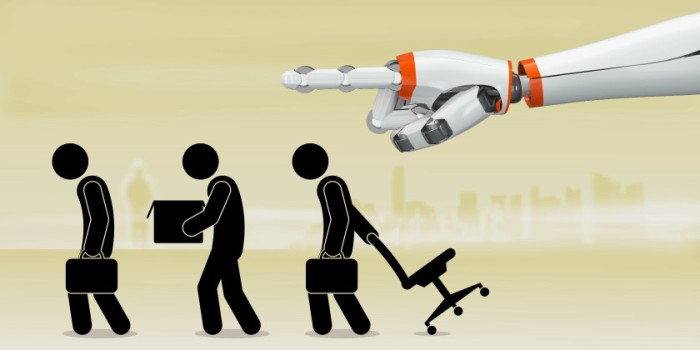
The National Education Association (NEA), the largest labor union in the U.S., published a shortsighted puff piece on its Website that seemingly applauds doing away with human beings working as teachers.


In their place would be computers, iPads, Web applications and a host of “devices” that at best would need human beings to serve as merely lightly trained facilitators while children are placed in front of endless screens.


The article is called, “As More Schools Look to Personalized Learning, Teaching May Be About to Change,” by Tim Walker.


Teacher-blogger Emily Talmage led the charge with a counter article on her site called “Anatomy of a Betrayal.” She outlined the NEA’s change from being critical of such initiatives to joining with the likes of Jeb Bush and various foundations, tech firms and school voucher advocates in celebrating it.


Make no mistake.


This is not merely an examination of changing teaching practices. It is a movement by tech giants to further standardize and privatize America’s public schools.


This isn’t to say that technology can’t enhance learning. But classroom teachers with any kind of experience know that simply plopping a child in front of a computer screen is a terrible way to do it. It’s the equivalent of having all your questions answered by an automated voice on the telephone versus being able to ask questions of a living, breathing person.


And they have the gall to call it “personalized learning” as if it were meeting all the needs of students one-on-one. It isn’t.


It’s one-on-one, but it isn’t meeting anyone’s needs except bankers, hedge fund managers, charter school operators and tech investors.


It’s a way to drastically reduce the cost of education for poor and minority students by removing the need for a teacher. It’s the educational equivalent of an automated cashier in the grocery store, but unlike at Giant Eagle, it doesn’t just tally your bill, it pretends to teach.


This is the definition of a McEducation. It’s the logical extension of policymakers who think that 5-week trained Teach for America recruits are equivalent to education graduates with four-five year degrees and years of classroom experience. They’re just replacing TFA recruits with Apps.


Don’t get me wrong. America’s public schools have a lot of problems. They’re segregated by both economics and race. The poor and minority schools are inadequately funded and inequitably resourced. They are forced to compete for what little money remains with charter school vampires who are allowed to spend it however they like with little to no accountability or transparency. More money disappears down the gullets of voucher schools to subsidize the rich and indoctrinate Christian fundamentalists. And to top it all off, our public schools are forced to give scientifically invalid standardized assessments that are incentivized to fail as many students as possible so the same corporations that make the tests can sell districts remediation materials. Meanwhile, a large portion of these profits earned off public schools are reinvested in lawmakers reelection campaigns so they’ll pass legislation that continues to treat our children as golden geese for business and industry.


The NEA should know that. We have more than enough enemies to fight. But instead of taking arms, our national unions have been racing toward the bottom to compromise and keep that proverbial seat at the table. They’ll fight for teacher tenure. They’ll fight right-to-work legislation. But policies that undermine the very fabric of the profession? NAH.


We saw the same thing with Common Core. Educators knew you can’t teach higher order thinking skills to children without first doing the groundwork of process. But the book publishers had new textbooks to market so the NEA backed a horse they knew was dead at the starting gate.


And now we have the tech giants – the Zuckerbergs and Gates – slobbering over the profits they can make by callously removing teachers from the equation.


I’ve seen this first hand.


My district has a one-to-one iPad initiative. For two years, each of my students has had a device in every class. It hasn’t dramatically improved learning. At best, it’s increased students’ computer literacy. At worst, it’s a toy that actually distracts from authentic learning.


They allow me, the teacher, to give all assignments digitally. But that requires the network to function perfectly, the devices to be fully charged, the assignments to be entered precisely, the students to engage with them correctly and creatively – when handing students a paper and having them hand it back is actually much more efficient.


They allow students to look up unfamiliar vocabulary quickly, but they rob students of the context skills necessary to know which definition is appropriate, and experience using prefixes, suffixes and roots.


They allow students to easily access infinite information but without the skills to critically read it. More kids read the summary on the Internet than read the book – and even then, they don’t understand it.


They allow students to make colorful Keynote presentations and iMovies, but do nothing to prepare them how to intelligently organize the materials.


And – worst of all – they convince number crunching administrators that assignments, tests and lessons can be given digitally with hours of screen time. As if that was equivalent to authentic learning.


That is the end goal.


Everyone knows it. Isaac Asimov wrote about it in 1954 with his classic science fiction story “The Fun They Had” about a future where computerized home schooling was the norm. But even in his story, kids felt like they were being cheated out of something important that their ancestors had experienced in a traditional public school setting.


Instead of heeding his warning, our unions are rushing to make that world a reality.


You don’t strengthen unions by undercutting the professionals they’re supposed to represent.


Somebody needs to tell our union leaders – preferably by replacing them.

teacher-left-behind11

School Vouchers: Transubstantiate Your Cash For Fun and Profit

Screen Shot 2017-06-09 at 2.36.42 PM


When is a tax dollar not a tax dollar?

When it’s used to pay for a school voucher.

That’s the slight of hand behind much of our education policy today.

Lawmakers want to give away a huge bundle of your cash to religious schools, but they can’t because of that pesky old First Amendment.

The establishment clause sets up a distinct separation between church and state. It explicitly forbids public money being spent on any specific religion.

So these lawmakers do a bit of magic. They take that money, wave their hands over it, mumble a few secret words and Voilà! It’s no longer public; it’s private. And private money can be spent any way you want – even on religion.

Here’s how they do it.

You simply take public tax dollars and turn them into credits that can be used to pay for alternatives to public schools. Call it a “school voucher.”


But wait a minute. Isn’t that like a check? If Peter writes Paul a check, that money is no longer Peter’s. Now it’s Paul’s. Right?

Yes. But that’s not what’s happening here.

A school voucher isn’t a check. A check is an order to your bank to transfer funds to another account or to be exchanged for cash or goods or services. School vouchers do not come from your account. And they cannot be transferred into just any account or spent in any way.

They’re more like food stamps. It’s not money that can be used in any way you see fit. It’s money that can only be used to pay for a child’s education. And you can only use it at a private or parochial school.

You can’t go into a fancy restaurant and buy a filet mignon dinner with food stamps. Likewise, you can’t go to a real estate developer and buy a house using your school vouchers.

This money does not therefore change from public to private. Yes, individuals get a limited choice of how this money will be spent, but that’s true of all public money. Go to a local council meeting, a school board meeting, write your Congressperson, petition your state Senator – in all of these cases, you are exercising choice on how public tax dollars are being spent: Don’t spend tax dollars on that bridge. Don’t spend public money on that program.

Even in the case of food stamps, individuals decide how public dollars are spent for your private use – within specified limits.

If that was really private money, there would be no restrictions on how it could be spent – or certainly no more restrictions than on any other private money.

But lawmakers are pretending like this isn’t true. They’re pretending that simply changing the name of the money changes its substance. It’s a lie. It’s slight of hand. They’re trying to trick you into assuming a transformation has taken place that has not.


BAD DEAL


Moreover, it’s a metamorphosis we shouldn’t want in the first place.

Think about it.

We want our public money spent in an accountable fashion. We want there to be a record of how it was spent and what it was spent on. We want that information to be readily available, and if that money was misappropriated, we want to be able to act on that.


School vouchers remove much of that accountability. Private and parochial schools simply don’t provide the same transparency as traditional public schools. Often there is no elected school board, no public meetings, no open documents. Nada.


But if the parents who used the school voucher don’t like how the money is being spent, they can disenroll their child, right? So if they’re comfortable without this transparency, that’s all that matters, right?


Wrong. School vouchers are not paid for 100% by the parent. They are paid for with an aggregation of local tax dollars above and beyond what individual parents pay in school taxes.


In short, this is not just your money even if it’s spent on your kid. You shouldn’t be the only one who gets a say in how this money is spent. The community provided this money. The community should decide how it’s spent. At very least, the community should get a say.


If the community doesn’t want children to be raised with a distinctly Biblical view of history and science, the community shouldn’t have to contribute to that. If individual parents want to spend their own money on that, fine. That’s your prerogative. But school vouchers are made up of public tax dollars, yet we’re removing the majority of the public from having a voice in how that money is spent.


Moreover, traditional public schools are required not to discriminate against students. They can’t select against students based on learning disabilities, ethnicity, skin color, gender, religion, sexual orientation, etc. And that’s a really good thing. Everyone’s money is used to pay for these schools. These schools should serve everyone.


But private and parochial schools (and charter schools, too, by the way) aren’t held to this same standard. It’s telling, for example, that U.S. Secretary of Education Betsy DeVos has refused to commit to holding private and parochial schools that accept school vouchers accountable if they discriminate against children. She seems to be implying that the U.S. government will stand aside and let public tax dollars be spent to support schools that discriminate. And the reason they think they can get away with this is the cynical monetary alchemy outlined above: school vouchers are private money and can be spent any way parents want. It isn’t and they can’t.


This is government sanctioned money laundering, pure and simple.


Lawmakers have been bought off with huge donations from the privatization industry to enact legislation friendly toward private and parochial schools.


NAME CHANGE


In some cases, they don’t even use the name “school vouchers.” They call it education tax credit scholarships, but it’s effectively the same thing.


Instead of distributing the vouchers directly to parents, they allow businesses and individuals to make tax deductible donations to nonprofits set up explicitly to distribute vouchers for private and parochial schools.


The reason? People don’t like school vouchers. But if you call it a “scholarship,” it’s more palatable. For instance, while school vouchers are mostly supported by Republicans, a substantial number of Democrats support education tax credit scholarships.


In 17 states you can get substantial tax credits for donating to one of these private and parochial school scholarships.


Louisiana, Oklahoma, Pennsylvania, Rhode Island, and Virginia, for example, all provide tax credits worth between $65 and $95 on every $100 donated. Alabama, Arizona, Georgia, Montana, and South Carolina go even further by reimbursing 100% of the donation. You read that right. Donate $100, get $100 back.


Oh, but it gets much worse. Since these are considered donations, you can also claim them as charitable deductions and get an additional 35% off your taxes. So you donate $100 and get back $135! Yes. You actually make money off this deal!


In my home state of Pennsylvania, investors can even “triple dip” receiving a state tax credit, a reduction in their state taxable income, and a reduction in their federal taxable income. And, yes, that means they sometimes get back more in tax breaks than they provide in contributions.


Meanwhile all of these “savings” come from money stolen from local public schools. Businesses and individual investors are profiting off of the deteriorating conditions at public schools.


Ever wonder why class sizes are ballooning, teachers are being furloughed and electives are falling by the wayside? It’s because people are making money off children’s suffering.


In my home state of Pennsylvania, we call this the Opportunity Scholarship Tax Credit (OSTC) and the Educational Improvement Tax Credit (EITC) programs.


The state Budget and Policy Center estimates that about 76% of these “scholarships” go to religious schools. That was approximately $95 million dollars in 2014-15 (the last year for which data was available).


Many of these educational institutions are explicitly fundamentalist. This includes the 155 schools in the Association of Christian Schools International (ASCI) where they boast of “the highest belief in biblical accuracy in scientific and historical matters.” It also includes 35 schools in the Keystone Christian Education Association.


How many more parochial schools are using tax dollars to teach fundamentalist curriculum? Without an audit, we’ll never know.


And that’s a really significant issue.


These scholarships are supposed to be eligible only to low income students. Yet a significant number of them are being utilized at private schools with average tuitions of $32,000 – far more than the few thousand dollars provided by the scholarships. They are apparently being used by wealthy and middle class students who can already afford private schools but are using public tax dollars to reduce the cost.


A total of $11.2 million in EITC and OSTC tax credits went to just 23 of the most exclusive and expensive private schools in 2014-15. That’s 9% of the total. Suburban Philadelphia’s Haverford School, alone, received $2.2 million, buying down its $37,500 tuition.


How many parents misused these scholarships in this way? What is the racial and ethnic makeup of recipients? Again, without an audit, we don’t know.


This is not how public money should be spent.


We need to put the breaks on these initiatives, not expand them into a federal incentive program as the Trump Administration proposes.


Whether you call them education tax credit scholarships or school vouchers, these programs do not transform public money into private.


They are a scam. They are theft. And their biggest victims are children.

Betsy’s Choice: School Privatization Over Kids’ Civil Rights

Betsy DeVos attends education meeting at the White House in Washington


Betsy DeVos seems to be confused about her job.


As U.S. Secretary of Education, she is responsible for upholding the civil rights of all U.S. students.


She is NOT a paid lobbyist for the school privatization industry.


Yet when asked point blank by Sen. Jeff Merkley (D-Ore.) whether her department would ensure that private schools receiving federal school vouchers don’t discriminate against lesbian, gay, bisexual, transgender and queer (LGBTQ) students, she refused to give a straight answer.


She said that the these schools would be required to follow all federal antidiscrimination laws but her department would not issue any clarifications or directives about exactly how they should be doing it.


“On areas where the law is unsettled, this department is not going to be issuing decrees. That is a matter for Congress and the courts to settle,” DeVos said at a hearing before the Senate Appropriations Subcommittee on Labor, Health and Human Services, and Education yesterday.


“I think you just said where it’s unsettled, such discrimination will continue to be allowed under your program. If that’s incorrect, please correct it for the record,” Merkley replied.


DeVos did not correct him.


Instead she simply repeated, “Schools that receive federal funds will follow federal law, period.”


Merkley said she was dodging the question.

“I think that’s very important for the public to know, that today, the secretary of education, before this committee, refused to affirm that she would put forward a program that would ban discrimination based on LGBTQ status of students or would ban discrimination based on religion,” he said.


“Discrimination in any form is wrong. I don’t support discrimination in any form,” DeVos replied.


But that doesn’t mean she’ll fight against it.


She held firm to her position that it is not her job as Secretary of Education to fight for students’ civil rights. That is the responsibility of Congress and the courts.


But she’s wrong.


The Office for Civil Rights (OCR) is part of the Department of Education.


According to the department’s own Website, the “OCR’s mission is to ensure equal access to education and to promote educational excellence through vigorous enforcement of civil rights in our nation’s schools.”


There is nothing “unsettled” about that at all. What IS unsettled is how and if the U.S. Constitution allows federal funds to be spent on private schools in any manner whatsoever.


At very least, it has been argued that giving tax dollars to parochial schools violates the establishment clause of the First Amendment guaranteeing a separation of church and state. Moreover, the degree to which voucher schools that don’t explicitly teach religion would have to abide by federal laws about what they can and should do is likewise “unsettled.”


Yet DeVos has no problem advocating for the school privatization industry. In fact, it has been her lifelong calling. As a billionaire Republican mega-donor, that’s exactly what she’s done for years – shoving bundles of cash at candidates and lawmakers to support school vouchers and charter schools.


Someone needs to remind her that that is no longer her role. In her official capacity as Secretary of Education, her job is not to advocate for school choice. But it IS her job to protect students’ civil rights – regardless of the type of school those students attend.


If a school is at all public, she is responsible for ensuring those students’ rights. And receiving public funds makes a school public.


Specifically, she is responsible for ensuring no child is discriminated against on the basis of race, color and national origin, according to Title VI of the Civil Rights Act of 1964.  This includes protecting children who are being treated unfairly due to limited understanding of the English language or who are still learning to speak the language. This includes children experiencing bigotry as a result of their shared ancestry, ethnicity or religion such as Muslims, Sikhs or Jews.


It is also her job to protect children from sexual discrimination as per Title IX of the Education Amendments of 1972.  No matter her own personal conservative views, she must protect pregnant teens or teen parents. And to speak toward Merkley’s point, according to the Department’s Website, this explicitly includes, “…sex stereotypes (such as treating persons differently because they do not conform to sex-role expectations or because they are attracted to or are in relationships with persons of the same sex); and gender identity or transgender status.”


She is also required to be a champion of students with disabilities as per Section 504 of the Rehabilitation Act of 1973 and Title II of the Americans with Disabilities Act of 1990. Moreover, Title II explicitly forbids public entities – whether or not they receive federal funds – from demonstrating any partiality against students with disabilities.


And that’s just the tip of the iceberg. She has to protect against age discrimination per the Age Discrimination Act of 1975 and enforce the Boy Scouts of America Equal Access Act. She is responsible for investigating complaints about equal access to youth groups conducting meetings at public schools and/or that receive federal funding.


To quote the Website, one more time:


“These civil rights laws extend to all state education agencies, elementary and secondary school systems, colleges and universities, vocational schools, proprietary schools, state vocational rehabilitation agencies, libraries and museums that receive federal financial assistance from ED [the Education Department].”


I’m not so sure DeVos understand this – at all.


Nor do I expect her to get much help from the political ideologues she’s using to staff the department.


Take her choice for Assistant Secretary in the Office for Civil Rights, Candice Jackson.


She’s an ANTI-Civil Rights activist. She literally doesn’t believe in the office she’s running.


The 39-year-old attorney is anti-women’s rights, anti-distributive justice and possibly even anti-compulsory education and anti-Civil Rights Act of 1964!


She once filed a complaint against her prestigious college, Stanford University, for discriminating against her rights as a rich, white person by refusing to allow her access to free minority tutoring.


For all its faults, the Barack Obama administration took civil rights seriously. So much so that conservatives often criticized the Democratic organization as being overzealous in the execution of its duties.


The Obama era Education Department issued so many clarifications of the law that it received a record number of civil rights complaints. This required hundreds of additional lawyers and investigators and increasing the civil rights division by 30 percent.


Complaints went from more than six thousand in 2009 to almost ten thousand in 2015. Of these, the largest increase was in complaints of sex discrimination.


However, President Donald Trump has recommended the Department be downsized in his budget proposal.


The Reality TV star would cut the Department’s budget by 13 percent, or $9 billion, eliminating after-school and summer programming for kids and professional development for teachers.  Instead, he would invest $250 million in a school voucher incentive program and an additional $168 million for charter schools.


Also, getting a boost is personal security for DeVos, herself. She is spending an additional $1 million a month for U.S. Marshalls to guard her against protesters.


It should come as no surprise that Trump and DeVos don’t support the mission of the Department of Education. Both have expressed interest in disbanding the office altogether.


In a February magazine interview, DeVos said, “It would be fine with me to have myself worked out of a job. But I’m not sure that – I’m not sure that there will be a champion movement in Congress to do that.”


Likewise, Trump wrote in his 2015 book “Great Again: How to Fix Our Crippled America” that “if we don’t eliminate [the department] completely, we certainly need to cut its power and reach.”


That is exactly what DeVos is doing.


Under Presidents George W. Bush and Obama, it could be argued the Department was guilty of overreach. But Trump and DeVos are going in the opposite extreme.


Someone has to look out for students’ civil rights. That someone has traditionally been the Department of Education. With DeVos abdicating her responsibilities and continuing her role as a school privatization cheerleader, it is anyone’s guess who – if anyone – will step into the void.

Teachers Union President Joins Anti-Union Operative to Praise Charter Schools

Screen Shot 2017-06-02 at 3.53.25 PM


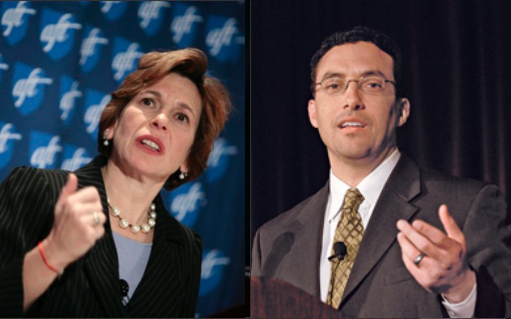
Randi Weingarten must be out of her damn mind!


The president of the second largest teachers union in the country, The American Federation of Teachers, is now writing op-eds with anti-union activists!?

Just this week she authored an article in the Los Angeles Times along with Jonah Edelman.

Perhaps you remember him. He’s the corporate shill who infamously bragged on YouTube about tricking teachers unions into supporting an Illinois law that would have stripped educators of their right to strike while eliminating seniority and due process.

Yes, THAT Jonah Edelman!

And why is she joining forces with a man who has dedicated his life to destroying the lives of the more than 1.5 million people she is supposed to represent!?

To fight school vouchers while pretending charter schools are a much better alternative.

No, I’m not kidding.

In the midst of an article that correctly outlines many of the problems with school vouchers, you’ll find this telling nugget:

“We believe taxpayer money should support schools that are accountable to voters, open to all, nondenominational and transparent about students’ progress. Such schools — district and charter public schools — are part of what unites us as a country.”

So once again we get the false distinction between charter and voucher schools.

Yet they ignore that BOTH are run privately without community input.

BOTH are not accountable to taxpayers.

BOTH are allowed to cherry pick the easiest students to educate and turn away those with special needs.

Yet Weingarten and her new best friend somehow think charters are worlds better than vouchers.

Wrong! They’re BOTH terrible.

Publicly funding privately run schools is nearly the same no matter whether you call them charter, private or parochial schools!

Yet we see Democratic partisans trying desperately to distinguish their cash cow charter schools from the extremely similar golden geese of voucher schools.

It’s a trick. Republicans champion privatized education in all of its forms. Democrats pretend to be discerning by boosting only charter schools.

But there’s really very little difference between these two positions. In each case, these partisan hacks are defending privatization against any and all forms of public education.

Weingarten apparently is even willing to throw the majority of her constituents under the bus to do so!

Charter schools are a failed social experiment. The majority have become merely parasites on traditional public school districts sucking out much needed funding without putting anything of value back.

They result in larger class sizes, a narrowing of the curriculum and more layoffs for the very teachers Weingarten is supposed to represent.

In the rare occasions when charters actually provide good educational value, the law explicitly allows them to change for the worse at any time. The problem isn’t a few bad apples. It’s the concept of charter schools, themselves.

You can’t have a separate level of school competing with its community district and expect the two not to end up harming each other. You can’t allow one school to operate in the dark without hardly any transparency and expect operators not to take personal advantage of it. You can’t allow one school to choose its students without expecting to drastically segregate the community’s children.

Yet here we have Weingarten joining hands with the devil signing a Faustian bargain with the blood of every member of the American Federation of Teachers.

Yes, school vouchers are a bad idea. They violate the separation of church and state. But other than that, they’re pretty much the same as charter schools. If you agree to defend the one while attacking the other, you’re just fighting about what to name the privatized school that will eventually overtake the public ones.

Weingarten should know that.

But this isn’t the first time recently that she’s agreed to hob knob with those salivating over the destruction of her own chosen profession.

Just last month, she went on a field trip to a public school with Betsy DeVos, our Anti-Education Education Secretary.

As parent and teacher activists were physically barring DeVos from entering some public schools, Weingarten was giving her a guided tour!

Some will say that we need to educate DeVos, a Republican mega-donor with next to zero experience of public education and a history of spending billions to destroy public schools. So how did it work out?

DeVos said the school was nice but could benefit from more privatization.

Thanks anyway, Randi.

You can’t make friends with the corporate education reformers.

This was one of the major weaknesses of Democratic Presidential candidate Hillary Clinton. She tried to walk this same divide praising “high quality” charter schools while criticizing those that exploit the system.

In both cases, they’re ignoring the fact that the system was designed EXPLICITLY TO BE EXPLOITED – by charter schools.

This is one of the reasons I’ve been calling for Weingarten and Lily Eskelsen Garcia, President of the National Education Association, to step down.

They aren’t listening to their constituents.

They have both gone rogue. They are playing politics on our dime without giving proper consideration to what’s in our benefit.

Teachers don’t want their national union representatives playing patty cake with those out to destroy us. We want action in the streets! We want activists and resisters, not diplomats and politicians.

It’s time Randi and Lily stepped aside for union leaders who understand what our schools, our students and our profession really needs.

Destroying the Separation of Church and State is Beyond Stupid

religious-fanatic

There is a special place in Hell for those trying to destroy the separation of church and state.


It’s kind of like:


Hey! Let’s turn this country into a Christian version of Iran!


Or:


If only my child’s school was more like a terrorist training camp!


Seriously, what the heck is wrong with you? Torquemada and Osama Bin Laden are not role models of 21st Century education.


But okay. In a way I get it. You’re a Christian fundamentalist, and you’re afraid secular education will turn your child against your faith.


Well, Number One, if your beliefs are so weak that just hearing an alternative will destroy them, then maybe they deserve to be destroyed. And, Number Two, that’s what religious schools are for! Reach into your pocket and pay for your little choirboy or choirgirl to be educated in the church basement. But I’m not using my tax dollars to help indoctrinate your child in whatever medieval mumbo jumbo you believe in.


You think the world was created in six days? You think the sun orbits around the Earth? You think the Earth is flat!? FINE! I’m not going to pay so your kids grow up just as ignorant!


Mixing religion with our public school curriculum is not a good thing.


When my kids take science, I want them to learn things based on empiricism and the scientific method – not whatever “truth” is enshrined in a holy book written before the germ theory of disease. The answer to a question about whooping cough isn’t “God did it.”


The same goes for literature. I want my child to read a wide variety of texts from various points of view, written by people of various faiths, from a multitude of cultures, genders and world views – not just a pantheon of iron age tribal chiefs and a smattering of cloistered feudal monks! I want my child to think about what she’s read and come to her own conclusions – not have “the truth” handed down to her from on high.


And when it comes to social studies, I want my child to understand history and government without the biases of the right wing taught as if they were the only logical ways to organize a society. I want my child to be a good citizen with a working knowledge of how government functions complete with a catalogue of the errors of past centuries. I don’t want my child molded to think a certain way and only that way so that she’ll vote a certain way and only that way.


Oh, and math? That’s just for boys.


It’s ironic that the advocates of school vouchers often couch their arguments in the language of liberty and choice when they’re really advocating for the elimination of those very things.


This isn’t about school choice. It’s about eliminating my child’s right to free thought. It’s about society pumping out a generation of religious zealot clones to feed the polling places of one political party so that they’ll vote against their own interests and keep the rich and powerful gobbling up 99% of the wealth.


But shouldn’t kids be allowed to talk about religion in school?


Sure. And they can and do right now in public school.


There is nothing to stop children from discussing their views about God and religion in school. They can even pray. No one will discriminate against them for it. That’s their right.


The only prohibition is against a religious discussion or prayer conduced by a teacher. When my students bring up God during a class discussion – and it happens – I let them talk. If they ask my views, I politely decline. I might say that some people believe this or some people believe that. But I never say what I believe.


Why would you want anything different? Do you really want teachers forcing their faith (or lack of faith) on your children? I suppose if you choose exactly the kind of school with teachers who think exactly like you, then this doesn’t matter. But isn’t it better to let kids figure out their own theologies perhaps with help from you, their parents?


When it comes to facts, an education professional is just what the doctor ordered. When it comes to opinions – and faith is the ultimate opinion – children should be free to think for themselves. If you want a religious leader to lend his or her normativity, that’s up to you. But don’t step on other parents who have different worldviews, cultures, faiths.


And please don’t give me this crap that the words “separation of church and state” don’t appear in the Constitution. Neither do the words “self-protection” appear in the Second Amendment, but you still cling to your guns on the excuse that they keep you and your family safe.


The separation of church and state is a long-standing interpretation of the establishment clause of the First Amendment to the U.S. Constitution. It has been upheld time and again. You may call yourself a “conservative” for going against it, but actually you’re the very definition of a radical. It is I who is being conservative in defending it.


Thomas Jefferson wrote, “In every country and in every age, the priest has been hostile to liberty. He is always in alliance with the despot, abetting his abuses in return for protection to his own.”


The same can be said of those with torches and pitchforks gathered around the separation of church and state. They seek no freedom other than the freedom to discriminate against those unlike themselves.


They are our racists, sexists and xenophobes. They are those prejudiced against anyone who thinks thoughts unsanctioned by their clergy. They seek to pour cement over the social structure and keep it in place with ignorance.


We must fight them to our last breath because if they win… God help us!

Report: Charter School Vampires Drain Traditional PA Districts Dry

o-VAMPIRE-FANGS-facebook

If you ever needed proof that charter schools harm traditional public school districts, look no further.

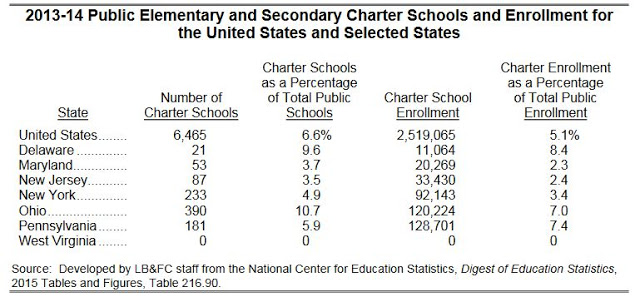
A new report by Pennsylvania’s Legislative Budget and Finance Committee concludes that these privately run but publicly financed schools often drain traditional public districts of funding.

The report conducted at the behest of the state House and Senate found that charter schools have attached themselves in some way to almost every district in the Commonwealth, but not equally. Half of the state’s traditional public schools suffer from 80% of the state’s charter parasites.

Moreover, 40% of traditional districts with “significant” charter enrollment are struggling to make ends meet. The reason: unfair state mandates about how traditional districts must pay their charter school hangers-on.

The report is based on interviews with 36 superintendents. A total of 29 of these leaders said charter schools hurt their districts. Only four superintendents mentioned any positive impacts at all.

Much of the damage comes from Pennsylvania’s insistence on funding charter schools out of traditional public school budgets. Instead of charter school money coming directly from the state, much of it comes from the traditional district where it has set up shop.

In effect, it’s like a leach sucking away money that could be going to traditional public school students. We’re one of only 13 states that does this.

It leads to many problems.

Chief among them are the state’s special education laws. Local districts are required to pay their charters extra money for special education students. But this additional funding isn’t based on the number of special needs students actually present in the charter school. It’s based on an arbitrary 16%. Local districts pay charters as if these schools had 16% special education students whether they do or not. This incentivizes charters to enroll less than 16% and pocket the difference.

It’s a system so corrupt that only one other state – Massachusetts – uses it.

We’ve always known the system allows for fraud. We just couldn’t prove it was actually taking place – until now. According to the Pennsylvania Department of Education (PDE), in the 2014-2015 school year alone, local districts gave roughly $294.8 million in special ed supplements to charter schools. However, actual charter expenditures on special ed were only $193.1 million.

That’s $101.7 million in profit for charter operators! Ca-ching!

It’s also more than $100 million set aside to educate children that’s not being used for that purpose!

But that’s not the only way charter schools are sucking out local districts’ finances.
Times are tough. Money is hard to come by. If a district struggles to pay its charter schools, the state steps in and withholds the amount of money due to the charter schools from the state funding it would normally send the district – and sends that money directly to the charters instead.

In effect, the state ensures charters are fully funded, while local districts are left to struggle.

And to make matters worse, when charters file a complaint, the state doesn’t even verify if it’s true. The state doesn’t check to see if the district actually did pay its charters or not. It just withholds whatever money charter operators say they’re owed.

Local districts can appeal overpayments to charters. Right now there are 317 general appeals pending for a total of nearly $30 million in disputed funding – half of which is from Philadelphia, alone!

Nor is this the only area where charters are given preferential treatment. When a charter school attaches itself to a traditional public school, that traditional district must pay to transport kids to the charter school – but it is not required to provide transportation to its own students.

Pennsylvania is one of only 11 states to require transportation to charter schools.

But that’s not the worst of it.

PA charter report

Now we come to cyber charter schools – the Count Draculas of the charter world.

The report estimates an additional $100 million in overpayments to cyber charters because of state law that overestimates their expenses. They are collecting much more money than they need to operate. They don’t have the same costs as brick-and-mortar institutions.

Cyber charter school students are given a computer and internet access. That’s about it. No costly building to run. Students usually do their lessons at home. Even when taking into account cyber charter staff, expenses are much lower than at other kinds of schools yet they are calculated without consideration of these differences.

Once again, state tax dollars that could be used to educate students become pure profit for charter operators. It is businessmen who win and students who lose.

The legislature used to acknowledge the burden charter schools put on local districts. The state budget used to include a line item reimbursing local districts for a percentage of their payments to charters. In 2010-11, that was $225 million. However, this money disappeared during the Gov. Tom Corbett administration when Republicans gained control of the legislature and prioritized tax cuts over charter school relief.

Though Corbett was defeated by Democrat Tom Wolf for the governorship, the legislature is still controlled by Republicans and the charter school reimbursement remains a distant memory.

But perhaps this new report signals a change in policy.

It contains several suggestions to fix Pennsylvania’s broken charter school laws. These include:

  • Permitting school districts to negotiate charter per pupil payment rates and methods.
  • Eliminating mandates for transportation that are inconsistent with services offered for district-operated schools.
  • Requiring the state to check with local districts when charter schools complain of underpayment.
  • Requiring greater transparency and fiscal accountability addressing problems like shell ownership, leasing, state payments, and conflict of interest policies.
  • Allowing audits of charter school funds.
  • Prohibiting the guaranteeing of loans where there is no direct school involvement.
  • Requiring charters to submit financial records for the district to review.
  • Requiring parents who place students in charters to first register with the local school district and then notify the district of changes in status.
  • Eliminating public school districts’ responsibility for charter school compliance with compulsory attendance requirements.

However, perhaps the biggest game changer is how charters set up shop in the first place.

Right now when charter operators want to open a school in a local district, the local school board gets to say yea or nay. However, school directors aren’t allowed to consider how this will financially impact the district. The report suggests this be changed; Districts should be allowed to approve or deny charters based on dollars and cents.

Currently local school directors are forced to approve charters that they know will hurt their students. This change would require charters to be equal partners with traditional districts or else be blocked. In effect, it would transform them from parasites to symbiotic organisms.

And as luck would have it, there are already two separate but similar bills that have been introduced that propose many of these changes.

One (Senate Bill 670) was introduced by Sen. Jim Brewster (D-McKeesport). The other (Senate Bill 198) was introduced by Sen. Vincent Hughes (D-Philadelphia). Brewster’s bill would “realign and redefine how local school districts, charter schools, students and taxpayers interact.” Hughes’ legislation would “provide local school boards with the tools to better oversee charter schools in their school districts.”

Charter school reform is something that members of both parties have expressed interest in. However, until recently Republican efforts at it have been light on reform and heavy on destructive means to further deregulate an already dangerously unregulated industry, thus worsening the problem.

Charter support has been strongly bipartisan. Champions of this new report claim that these suggested reforms aren’t anti-charter. They’re an effort to make both charters and traditional public schools work together instead of against each other.

Time will tell whether lawmakers are willing to do so.

Given the large donations received from the charter industry to lawmakers on both sides of the aisle, true reform may be difficult.

But at least we now have a state-sanctioned report to point to when referencing the multitude of problems associated with the industry.

Charters have been officially recognized by the state as parasites.

Will lawmakers do something to stop that unending sucking sound?

Why Care About Other People’s Children

health-kids-smiling

As a vocal critic of charter and voucher schools, one of the most frequent questions I get from readers is this:

“Why should I care about other people’s children?”

One reader put it this way:

“Why should my child’s education and safety have to suffer because of difficult and violent students? …it isn’t my responsibility to pay for a miscreant’s education.”

The question says more than any answer could.

It shows quite clearly that school choice is an essentially selfish position.

That’s why some folks champion privatized education – they only care about their own children. In effect, when a parent sends their children to a charter or voucher school, they are telling the community that they don’t care what happens to any one else’s kids so long as their kids are properly cared for and educated.

It is the root cause of most of our problems in education today and has nothing to do with children. It’s all about adults – adults lacking empathy.

On the one hand, I get it. As a parent, you can’t help but love your child more than anyone else’s. You would beg, cheat and steal to make sure your child has enough to eat, is clothed and sheltered, has everything she needs to succeed in this world.

That’s a position for which few would show any embarrassment. It’s just being human.

But it shouldn’t also mean that you don’t care at all for other children.

I’d like to pose a radical thought – loving my child does not mean I’m indifferent to yours.

Children are innocent. They haven’t done anything to earn the hate or enmity of the world. They see everything with fresh eyes. Many of them haven’t even learned the prejudices and ignorance of their parents. And even where they have, it is so new it can be changed.

When you look at a babe in arms do you feel the same indifference? I don’t.

Perhaps it’s just the way we’re built. I feel an immediate nurturing instinct. I want to protect and provide for children – any children – even if they’re not mine.

If you saw a baby all alone crying on the side of the road, would you stop to help her? I would. I couldn’t help it. I can do no other.

If I saw a toddler in distress, a tween, even an unruly teenager in need, I would try to help. And I think most of us would do the same.

Doing so wouldn’t hurt my child. In fact, it would show her how a decent person acts towards others. It would teach her empathy, kindness, caring. It would demonstrate the values I try to instill in her – that we’re all in this together and we owe certain things to the other beings with which we share this world.

Why would you not want to do that?

We do not live in a world where you have to choose between your child and all others. There is a middle course. We can do for all society’s children without unduly sacrificing our own.

And if we can, why wouldn’t we?

Public school is essentially a community endeavor. It is an attempt to give everyone in your neighborhood the same start, the same opportunity, the same advantages.

It means allowing all children who live in the community the ability to attend the community school. That’s better than selecting the best and brightest and to Hell with the rest.

It means the community pooling its wealth to help all students. That’s better than dividing that pool up and pitting one group against another so that some get what they need and others don’t.

It means having an elected school board who holds public meetings, deliberates in the open and has to offer almost all documents to the light of day. That’s just better than an appointed board of directors who hold private meetings behind closed doors and who aren’t compelled to show any documentation for how they’re spending public tax money.

When you send your child to school – any school – she will have to deal with other students. She will meet children who are mean, unkind, unruly and a bad influence. But this is true at all schools – public and private, voucher or charter, secular or parochial. The biggest difference is racial and economic.

Our educational institutions today have become so segregated by class and race that even our public schools offer white middle class and wealthy students the opportunity to learn in an environment nearly devoid of children of color or children who live in poverty. This divide is drastically widened by charter, private and parochial schools.

So when people complain about the class of children they want to keep separate from their progeny, it is always imbued with a racist and classist subtext.

What they mean is: I don’t want my child to have to put up with all those black students, all those brown children, all those unwashed masses of impoverished humanity.

I proudly send my daughter to public school for the same reasons that many withhold their children from it. I want her to experience a wide variety of humanity. I want her to know people unlike her, and to realize that they aren’t as different as they might first appear. I want her to know the full range of what it means to be human. I want her to be exposed to different cultures, religions, nationalities, world views, thoughts and ideas.

And I want it not just because it’s better for my community – I want it because it’s better for her, too.

I want my daughter and I to both live in a world populated by educated citizens. I want us both to live in a society that treats people fairly, and where people of all types can come together and talk and reason and enjoy each other’s company.

Only under the most extreme circumstances would I ever subject her to charter, private or parochial schooling. And things would have to come to a pretty pass for me to home school her.

Imagine! Thinking I could offer my child all the richness of a public school experience, all the knowledge of a district’s worth of teachers, all the variety of social contact – how vain I would need to be to think I could do all that, myself!

Some people want their children to become little versions of themselves. They want to create a generation of mini-me’s who’ll carry on their way of thinking into the future.

That’s not my goal at all.

I want my daughter to share my core values, I want her to learn from my experiences, but I don’t want her to think like me at all. I want her to be a new person, special and unique.

I want her to be her.

If you stop and think about it, that’s what most of us want for our children.

It’s a common goal that can be achieved with a common mechanism.

So why should we care about other people’s children?

Because it’s better for ours. Because doing so makes us better people. Because all children are ends in themselves. Because they’re beautiful, unique sparks of light in a dark universe.

If those aren’t reasons enough, I can’t help you.