Why Care About Other People’s Children

health-kids-smiling

As a vocal critic of charter and voucher schools, one of the most frequent questions I get from readers is this:

“Why should I care about other people’s children?”

One reader put it this way:

“Why should my child’s education and safety have to suffer because of difficult and violent students? …it isn’t my responsibility to pay for a miscreant’s education.”

The question says more than any answer could.

It shows quite clearly that school choice is an essentially selfish position.

That’s why some folks champion privatized education – they only care about their own children. In effect, when a parent sends their children to a charter or voucher school, they are telling the community that they don’t care what happens to any one else’s kids so long as their kids are properly cared for and educated.

It is the root cause of most of our problems in education today and has nothing to do with children. It’s all about adults – adults lacking empathy.

On the one hand, I get it. As a parent, you can’t help but love your child more than anyone else’s. You would beg, cheat and steal to make sure your child has enough to eat, is clothed and sheltered, has everything she needs to succeed in this world.

That’s a position for which few would show any embarrassment. It’s just being human.

But it shouldn’t also mean that you don’t care at all for other children.

I’d like to pose a radical thought – loving my child does not mean I’m indifferent to yours.

Children are innocent. They haven’t done anything to earn the hate or enmity of the world. They see everything with fresh eyes. Many of them haven’t even learned the prejudices and ignorance of their parents. And even where they have, it is so new it can be changed.

When you look at a babe in arms do you feel the same indifference? I don’t.

Perhaps it’s just the way we’re built. I feel an immediate nurturing instinct. I want to protect and provide for children – any children – even if they’re not mine.

If you saw a baby all alone crying on the side of the road, would you stop to help her? I would. I couldn’t help it. I can do no other.

If I saw a toddler in distress, a tween, even an unruly teenager in need, I would try to help. And I think most of us would do the same.

Doing so wouldn’t hurt my child. In fact, it would show her how a decent person acts towards others. It would teach her empathy, kindness, caring. It would demonstrate the values I try to instill in her – that we’re all in this together and we owe certain things to the other beings with which we share this world.

Why would you not want to do that?

We do not live in a world where you have to choose between your child and all others. There is a middle course. We can do for all society’s children without unduly sacrificing our own.

And if we can, why wouldn’t we?

Public school is essentially a community endeavor. It is an attempt to give everyone in your neighborhood the same start, the same opportunity, the same advantages.

It means allowing all children who live in the community the ability to attend the community school. That’s better than selecting the best and brightest and to Hell with the rest.

It means the community pooling its wealth to help all students. That’s better than dividing that pool up and pitting one group against another so that some get what they need and others don’t.

It means having an elected school board who holds public meetings, deliberates in the open and has to offer almost all documents to the light of day. That’s just better than an appointed board of directors who hold private meetings behind closed doors and who aren’t compelled to show any documentation for how they’re spending public tax money.

When you send your child to school – any school – she will have to deal with other students. She will meet children who are mean, unkind, unruly and a bad influence. But this is true at all schools – public and private, voucher or charter, secular or parochial. The biggest difference is racial and economic.

Our educational institutions today have become so segregated by class and race that even our public schools offer white middle class and wealthy students the opportunity to learn in an environment nearly devoid of children of color or children who live in poverty. This divide is drastically widened by charter, private and parochial schools.

So when people complain about the class of children they want to keep separate from their progeny, it is always imbued with a racist and classist subtext.

What they mean is: I don’t want my child to have to put up with all those black students, all those brown children, all those unwashed masses of impoverished humanity.

I proudly send my daughter to public school for the same reasons that many withhold their children from it. I want her to experience a wide variety of humanity. I want her to know people unlike her, and to realize that they aren’t as different as they might first appear. I want her to know the full range of what it means to be human. I want her to be exposed to different cultures, religions, nationalities, world views, thoughts and ideas.

And I want it not just because it’s better for my community – I want it because it’s better for her, too.

I want my daughter and I to both live in a world populated by educated citizens. I want us both to live in a society that treats people fairly, and where people of all types can come together and talk and reason and enjoy each other’s company.

Only under the most extreme circumstances would I ever subject her to charter, private or parochial schooling. And things would have to come to a pretty pass for me to home school her.

Imagine! Thinking I could offer my child all the richness of a public school experience, all the knowledge of a district’s worth of teachers, all the variety of social contact – how vain I would need to be to think I could do all that, myself!

Some people want their children to become little versions of themselves. They want to create a generation of mini-me’s who’ll carry on their way of thinking into the future.

That’s not my goal at all.

I want my daughter to share my core values, I want her to learn from my experiences, but I don’t want her to think like me at all. I want her to be a new person, special and unique.

I want her to be her.

If you stop and think about it, that’s what most of us want for our children.

It’s a common goal that can be achieved with a common mechanism.

So why should we care about other people’s children?

Because it’s better for ours. Because doing so makes us better people. Because all children are ends in themselves. Because they’re beautiful, unique sparks of light in a dark universe.

If those aren’t reasons enough, I can’t help you.

Hero of New CW Action Series to be a Charter School Principal

black-lightning-in-costume-in-first-look-of-the-cw-s-new-series


Charter schools are incredibly contentious.


They serve about 7% of American students, but siphon away funding from traditional public schools serving the majority of the population.


They are rife with scandals: Many close suddenly without warning. They often hire teachers without certifications from accredited universities. Administrators have been known to buy yachts and expensive gifts with tax dollars meant to educate children. They cherry pick the easiest students to educate and kick out the most difficult.


And that just scratches the surface!


Why would you want to purposefully set your action adventure series there!?


That’s exactly what the CW has done with its new series Black Lightning.


The network released an extended description for the show today in an announcement for its fall schedule:


“Jefferson Pierce (Cress Williams) is a man wrestling with a secret. As the father of two daughters and principal of a charter high school that also serves as a safe haven for young people in a New Orleans neighborhood overrun by gang violence, he is a hero to his community…”


To which I can’t help but wonder, “WHY!?


Why, CW!? Why put your hero at the head of a charter school?


In the original DC comic book on which this television series is based, Pierce is a principal at Garfield High School in the fictional city of Metropolis.


When the writers moved the setting to New Orleans and made the hero a charter school principal, they were making purposeful changes to the mythology.


Why?


What does it add to the series with the inclusion of this extra detail?


Yes, Jefferson Pierce is African American. It’s about time we have more black super heroes. Marvel did an amazing job with its Netflix show based on Luke Cage, a character also created by writer Tony Isabella.


But charter schools are not uniquely black. The National Association for the Advancement of Colored People (NAACP) issued a moratorium on charter school expansion just last year. The national civil rights organization has been publically critical of charter schools’ impact on children of color since 2010.


Specifically, the resolution states:


“…the NAACP opposes the privatization of public schools and/or public subsidizing or funding of for-profit or charter schools…”


“…the NAACP calls for full funding and support of high quality free public education for all children…”


The resolution goes on to oppose tax breaks to support charter schools and calls for new legislation to increase charter school transparency. Moreover, charters should not be allowed to kick students out for disciplinary reasons.


Yet THIS is where the CW decides to set its Sci Fi/Fantasy series!?


Perhaps the writers wanted to place the action in historic New Orleans, a city that has had almost nothing but charter schools since Hurricane Katrina.


But this is far from a success story.


After one of the worst natural disasters to hit the US in decades, the state fired almost all of its public school teachers, disbanded almost all local public school districts and reopened them as charter schools. New Orleans is now the only nearly all charter school city in the country.


Though supporters claim that this has resulted in increased test scores and graduation rates, the city’s schools cannot honestly be described as having turned around.


The district is still the fourth lowest performing educational institution in the country. Moreover, when compared with traditional public school districts in the state and controlling for factors like race, ethnicity, and poverty, New Orleans charter school students do much worse academically. For instance, on eighth-grade reading and math tests, charter-school students performed worse than their public-school counterparts by enormous margins—2 to 3 standard deviations.


These are the largest gaps between public and charter schools in the nation!


And that’s not all! Before becoming an all-charter district, the city had a substantial amount of teachers of color. Now they’re mostly gone.


This is where your escapist superhero fantasy is taking place?


New Orleans charter schools are notorious for strict discipline policies where students describe feeling like they’re in prison.


You want your hero to be a principal HERE!?


Teachers and parents describe feeling demoralized and ignored. They filed a federal civil rights complaint in 2014 and still pine for the community schools they experienced when they were children.


And this is where you’re shooting your action adventure series?


I can’t help but wonder why the CW would greenlight such an irresponsible drama.


Perhaps Black Lightning will fight to turn his nefarious charter school back into a traditional public institution with an elected school board, public meetings and sensible regulations.


Other than that, I cannot imagine why any sane television network would actively decide to champion school privatization.


In the original comic book, Pierce eventually was made Secretary of Education by President Lex Luthor. Perhaps the CW is drawing a parallel between their hero and our current Education Secretary Betsy DeVos.


President Donald Trump certainly brings to mind the super-villain Luthor – except that Luthor is known for being an evil genius and Trump is only known for one of those things…


But why would you want to associate your superhero with the most unpopular Education Secretary in history. DeVos only got her position after a split Senate confirmation and a tie-breaking vote by Vice President Mike Pence. She has been publicly booed at a graduation ceremony at an all black college where she spoke. Parents and protesters have physically stopped her from entering several schools.


You want us to associate your hero with THAT!?


Full disclosure, I love CW’s superhero line-up. The Flash is delightful Sci-Fi fun. Arrow is escapist vigilante justice. Supergirl is girl power drama. Legends of Tomorrow is time travel fun.


But what the heck will Black Lightning be!?


Moreover, I loved Netflix’s Luke Cage. I think it was one of the best Marvel superhero series – something that transcended the genre and seemed to be addressing authentic social issues like the Black Lives Matter movement, police brutality, etc.


I can’t imagine how Black Lightning would do any of that.


Having a political subtext can elevate a TV show and put it in the center of the cultural zeitgeist. But it has to be done with sensitivity and intelligence.


Having CW’s hero be a charter school principal is a ham-handed nod to school privatizers and equity managers. Audiences want someone who fights for the underdog – not investment bankers.


I just don’t get it, CW.

I May Have Just Been Murdered By House Republicans

couple


I may be dead already.


And House Republicans may be the ones who killed me.


With the passage of a healthcare bill they, themselves, haven’t read – haven’t studied – haven’t thoughtfully considered in any way – it seems they’ve opened the door for insurance companies to deny people coverage due to pre-existing conditions.


I have one.


I’ve had two small heart attacks this year.


So I sit here stunned at the news on my computer feeling very much at a loss.


People have legitimate political differences, but this… it’s just beyond anything I’ve ever experienced personally.


There are people who count on me – my daughter, my wife, my students. I’m not so vain as to imagine that they can’t get along without me, but my loss will hurt them. I think at the very least they’ll miss me.


I’m 43-years-old. I’ve lived a good life. I just never expected to be abandoned in such a way by a society I’d always thought was more humane.


But if this legislation becomes the law of the land, what will I do?


I take six or seven pills a day to control my cholesterol, keep the stints in my heart clean, control my blood pressure, slow my heartbeat, etc. Without them, I almost certainly will have another heart attack. Yet I have no idea how I could possibly afford to take them without insurance.


And if I get sick, I won’t be able to work. I’ll bring in even less money. I won’t be able to help support my family. I’ll end up being a liability, a burden.


House Republicans have to know there are people out there like me. There have to be a lot of people in even worse shape than I am.


Are they really going to just let all of us die?


I had hoped to see my daughter grow up. She’s only 8-years-old, the most precious person in my life. No one is more full of energy, more vivacious and joyful. She loves to draw and write short stories. She pretends to be a teacher just like her father and gives her stuffed animals assignments.


I guess I’ll never get to see the person she becomes. I’ll never find out if she goes to college, if she finds love, if she has children of her own.


Can it really all come down to this?


My wife and I have been through a lot together. We met back in high school. Before I became a public school teacher, we worked together at various local newspapers. She supports me when I can’t go on. I hope I am able to give her back even a fraction of the strength she lends me.


Does this mean we’ll have to say goodbye, and so much sooner than I ever imagined?


My middle school students and I just finished reading “The Diary of Anne Frank.” When we closed the book, there were some tears shed. I passed around the tissues, and we discussed how we felt. Many of them expressed anger that some people could hold others’ lives so cheaply as the Nazis did Anne and her family. Are House Republicans guilty of a similar crime? They aren’t rounding anyone up to send to death camps, but they’re apparently content to let many of us just die.


The pundits tell me I have nothing to worry about. The bill won’t pass the Senate, they say. And even if it does, the President would be breaking every campaign promise he ever made, if he signs it.


So what else is new?


This is the world we live in now.


It’s not the country I was born into. It’s a cold place. A heartless reality.


Perhaps tomorrow I’ll gather the strength to resist, to call my Congressperson again, to protest, to organize.


But as for today…


I can’t even.


So I’ll head home, and give my family a big hug, spend whatever time I can with them.


Because if my life now depends on the compassion of Republican lawmakers, I may not have much of it left.


Don’t Trash the Department of Education. Fix It.

thumbnail_Screen Shot 2017-04-26 at 2.52.28 PM

How do you get people to refuse a helping hand?

Answer: Prove to them that it’s not helping.

That’s the strategy of the Trump administration in regard to his cabinet of billionaires. The Reality TV star turned President has nominated a series of out-of-touch and unqualified one percenters to head various federal government agencies.

Rex Tillerson, Rick Perry, Ben Carson – Each of these silver spooned numbskulls was put in place to “prove” to the American public how inane and useless the federal government is – by making the federal government inane and useless.

Nowhere is this more obvious than the Department of Education with its Republican mega-donor turned Education Secretary, Betsy DeVos.

DeVos has spent her entire adult life buying off mostly Republican lawmakers throughout the country to destroy public schools and replace them with charter, private and parochial schools.

She is a self-inflicted cancer on the system, a know-nothing religious zealot who spouts more factually challenged whoopers than Sean Spicer and Donald Trump combined.

But the endgame for putting a person who barely ever walked into a public school in charge of nationwide public school policy is clear – she’s there to demonstrate why the department should be disbanded.

With every idiotic statement, every Unconstitutional policy suggestion – she’s a corporate sponsored demo of why we need to trash this cabinet position altogether.

This has been the conservative dream since President Ronald Reagan. How dare his Democratic predecessor Jimmy Carter create a Department of Education, in the first place! Not only did Ronnie, the B-movie actor turned chief executive, have to defeat Carter, he needed to erase all of his predecessor’s policies. (Sound familiar? [Cough!] [Obamacare!] [Cough!])

And with Betsy DeVos’ help, Trump may finally get to realize Reagan’s dream.

To be fair, President George W. Bush did his fair share to make the department unpalatable. And so did Barack Obama!

Under Carter, the department was an extension of the Elementary and Secondary Education Act (ESEA) of 1965, which tried to bring equity to America’s public schools. However, Bush transformed it into No Child Left Behind, a blatant federal power grab changing the focus to high stakes standardized testing and punishing schools that taught poor children.

Obama took this terrible legislation to its inevitable conclusion and transformed the Department of Education into a bribe factory, dangling federal help before impoverished schools only if these schools would spend it on test prep, edutech software and Common Core. Never mind that these “reforms” don’t actually help children. It was all about helping the corporations behind them.

Much of the modern zeitgeist behind the continued movement to disband the department comes from authentic bipartisan opposition to these changes. The modern Department of Education hasn’t been much of a helping hand for almost two decades. It’s been a cruel taskmaster and a money laundering service for the publishing and testing industry. And it’s overstepped its federal authority coercing states to do as Washington bureaucrats (or at least their wealthy donors) demand.

Add to that the new wrinkle of DeVos – a representative who is all of those things but also transparently self-serving and – frankly – stupid.

No wonder people want to disband the department!

It’s a rallying cry that’s not hard to get behind. Unless you think about it for two minutes.

Because it’s not the Department of Education that’s the problem. It’s what we’ve done to it.

The department has a vital and important role to play in making sure our system of public education serves everyone. Speaking in broad terms, the department should be dedicated to these three things: ensuring public schools are being properly funded, student and parent civil rights are not being violated and to be a repository for national data and research.

These are incredibly important. Right now we have one of the most inequitable school funding systems in the world. The majority of public education funding comes not from the federal government or the states, but from individual communities. If you live in a poor neighborhood, your kids get less education funding. If you live in a rich neighborhood, your kids get more. This is why the nearly 50% of all public school children living in poverty are struggling academically – we aren’t providing them with the resources to succeed.

The state and federal government could be doing something about that. At the federal level, the department of education oversees billions of dollars in grants to poor schools. Admittedly much of that money is tied to standardized testing and other corporate education reforms. We should cut those ties. We should provide help for proven, authentic education practices freely chosen by these districts. That’s something that could have a huge impact on student success. And it’s a project we should expand, not destroy under draconian budget cuts or the closure of the department.

Second, we have to admit that parents’ and students’ civil rights are often in jeopardy. This means special education students seeking an appropriate learning environment and modifications. This means students being discriminated against because of their religious beliefs or lack thereof. This means minority students facing disproportionate discipline policies, unfair grading and/or lack of opportunities offered to other racial or ethnic groups. This means women and transgender students suffering discriminatory dress codes or bathroom policies. In short, it means that someone needs to be the moderator and protector of student and parent rights.

And finally, there needs to be a repository of national student data. This has gotten a negative connotation lately because of Bush and Obama’s incredibly permissive policies allowing edutech companies to collect a horde of student data for economic purposes. Let me be clear: The department shouldn’t be doing that at all. Student privacy should be respected. Computer programs and apps should not collect sensitive information about individual students to be sold to advertisers or used to market products to them.

But there is an incredible amount of aggregate information about student groups collected by the federal government that could be used to help improve the lives of students. This includes information on the racial proficiency gap and the amount of resources provided by states and municipalities. Moreover, we need an impartial entity to fund educational research about which reforms actually help students learn. Relying on corporations to fund research that “proves” the efficacy of their own products is not good science.

In short, disbanding the Department of Education would be a disaster. What would happen to Pell Grants, for instance? What would happen to the bundles of federal money that boost our public schools? Who would make sure states are doing their jobs? Where could we go to find accurate data about how our schools are doing nationally and not just state-by-state?

If we got rid of the department, at best these jobs would fall back on other government agencies that haven’t the funding, staff or ability to accomplish them. More likely, it would result in the elimination of billions of education dollars that the states simply couldn’t (or wouldn’t) replace. Abuses against students on the grounds of civil rights, gender, special education, etc. would skyrocket with little to no recourse. And we would be in the dark about how well we were educating our nation’s children.

I sympathize with those who wish to make government more efficient, but the Department of Education is not a place to make cuts. If you really wanted to close an unnecessary federal department, start with the most recent one – the Department of Homeland Security. Nowhere else is there a more obvious duplication of services and waste of tax dollars to provide a service that was already being provided. But you never hear anyone suggest we close this department because (1) it was proposed by a Republican, and (2) as a nation, we have a broad, bipartisan priority on the safety of our citizens.

If only we had the same for public education!

But we don’t. In fact, many conservatives scoff at the very idea of public schools on the grounds that it’s “socialism” – as if social security, Medicare and a standing military were not!

Too many people have bought into the lie that there is something unAmerican about public school. On the contrary, our system is implicit in our very form of government and the flower of our founding fathers’ thoughts.

The rich and powerful don’t want a robust system of public education because it goes against their interests. An informed, thinking public is harder to control. They especially don’t want minorities or the poor to be well-educated because once people realize how much they’re being exploited, they won’t continue to submit to the status quo.

In short, the Department of Education needs to change. It needs to be revitalized from the ground up. And DeVos is not the person to do it.

However, we shouldn’t let her incompetence make us throw it all away. We need to find ways to agitate, resist and survive the Trump administration while preserving as much as we can of our Democracy – and our sanity – in the process. We need to find and support prospective lawmakers and public servants who will actually represent us, the people, instead of Trump’s billionaire buddies. We need a robust, grassroots movement to take back our government.

And then we can begin the hard work of making our government work for us again. Part of that will involve the Department of Education.

Let’s Hear It For Black Girls!

Natural-Hair-600x398


“Sisters are more than the sum of their relative disadvantages: they are active agents who craft meaning out of their circumstances and do so in complicated and diverse ways.”

-Melissa Harris-Perry, Sister Citizen (2011)


Let’s hear it for black girls!


They are beautiful, bold, irrepressible and – above all – so incredibly strong.


Black girls will outlast any struggle, face down any adversary, and – more often than not – triumph in the face of adversity.


I know. I’m a public school teacher, and many of my best students are black and female.


That doesn’t necessarily mean they get the best grades. Some earn A’s and some don’t. But when it comes to pure willpower and the courage to stand up for themselves, no one beats a black girl.


Those are rare qualities nowadays. Sometimes it doesn’t make these girls easy to have in class. But think about how important they are.


As a teacher, it sure makes your life easier when students do whatever they’re told. But in life, we don’t want citizens who simply follow orders. We want people who think for themselves, people who question directives and do only what they think is right.


In short, we need people who act more like black girls.


As a white male, it’s taken me some time to come to an appreciation of black womanhood. But after about 15 years teaching in public schools serving mostly poor, minority students, appreciate them I do.


Think of the challenges they face and often overcome. Not only are they subject to the same racism as black males, they also have to function under the burden of male patriarchy and the quiet sexism that pervades American society.


According to a study entitled Unlocking Opportunity for African American Girls by the NAACP and the National Women’s Law Center, African-American girls suffer from higher rates of sexual violence and intimate partner violence than white women, high rates of sexual harassment in school, and they are more vulnerable to sex trafficking than any other group.


In addition, more than one-third of black female students did not graduate on time in 2010, compared to 19 percent of white female students. However, there has been progress. Despite a lingering graduation gap, black girls have actually increased their graduation rate by 63% in the past 50 years, according to the National Coalition on Black Civic Participation. Unfortunately, this hasn’t meant they’ve built up more wealth. In 2010, single black women’s median wealth was just $100 compared to single white women’s wealth, which was $41, 500.


And it only gets worse the closer we look at it. Black women are the only group whose unemployment rate remained stagnant at 10.6%, while the overall rate for workers in the United States dropped from 7.2% to 6.1% between August 2013 and August 2014, according to a National Women’s Law Center report on jobs data. More than a quarter of black women live in poverty, according to the Center for American Progress, despite making up a larger portion of the workforce than white and Latina women.


Despite such problems, black women start businesses at six times the national average, according to the Center for American Progress. And this is even more startling when you realize they are also more likely to be denied small business loans and federal contracts.


It’s one of the reasons black girls are so special. Those who somehow survive the incredible pressures society puts them under often become super achievers. They can do almost anything.


Perhaps it’s an internalization of the advice black women often get from their mothers. They’re frequently told they have to work harder and do more just to be noticed, and they often do. In my classes, I’ve had more black girls achieve grades over the 100% mark than any other group. And that’s not easy to do. But it’s typical black girl power – they try to be more than perfect.


However, it takes a toll.


They are more likely to die of breast cancer than any other racial group, according to the Centers for Disease Control and Prevention. The reasons are complex, but include the fact that black women experience delays in diagnosis and treatment. Like many oppressed people, they often internalize that oppression – they don’t take care of themselves and the stress can be a killer.


And for those who can’t overcome the unfair pressures we place them under, the results are even worse. In school, I’ve seen precious and valuable girls thrown into a sometimes cruel and uncaring disciplinary system – a system from which it can be hard to extract yourself.


Some teachers and schools when faced with the independence and forthrightness of black girls don’t know how to handle them. In such cases, these girls are often disciplined out of all proportion to their population size in school districts. For example, in New York City, black girls made up only 28% of the student body during the 2011-2012 school year, but were 90% of all girls expelled that year from the city’s schools, according to the “Black Girls Matter” report by the African American Policy Forum. Similarly, black girls made up only 35% of the Boston public school population that same year, but accounted for 63% of all girls expelled.


In short, we’ve got a lot of work to do to dismantle a national system of racism and white privilege. But even beyond that, as a society we need to recognize and appreciate black girls. A little bit would go a long way.


We need to acknowledge the unique talents and skills of these amazing young women. And so much of it starts with a matter of conceptualization in the white adult mind.


Instead of seeing them as defiant, we need to recognize their independence. Instead of seeing them as challenging your authority, you need to see them as asserting themselves and standing up for their beliefs.


Those are all such positive qualities. How many times do adults complain that kids today don’t care enough about things – their apathy, their entitlement, their indifference. As a group, black girls are nothing like that! They are exactly the opposite! But instead of praising them for it, instead of valuing them, white adults often feel threatened and respond by trying to crush what they perceive as a rebellious and disruptive element in their classrooms or in society.


That’s why I love the Black Girl Magic movement.


It was created by CaShawn Thompson to celebrate the beauty, power and resilience of black women. It started as a simple social media hashtag – #BlackGirlMagic.


It embodies a theme I’ve already touched on – the irrepressible spirit of black women, how they are faced with an overwhelming mountain of challenges but somehow manage to overcome them and become tremendous overachievers! It’s a celebration of everything good and positive about the black female experience.


I think it’s just wonderful.


How can you not look at someone like Misty Copeland and not appreciate her success? She’s the first ever black principal at the American Ballet Theatre. She has shot to the top of one of the whitest, wealthiest and most elitist arts you can pursue.


Or how about Gabby Douglas? You can’t watch videos of the amazing Olympic gymnast, who at only 17, absolutely wowed the world with gold medals despite internet trolls hating on her hair.


And if we’re talking undue hate and criticism, no woman in recent memory has suffered as much as Michelle Obama. Whatever you think of her husband’s Presidency, you have to admit Michelle was a model of grace under pressure. How many times did haters pick apart her appearance while she just got on with the business of making school lunches healthier and being a tremendous role model for children of color and women of all races and creeds.


Or Ava DuVernay, the amazing director snubbed at the Oscars for her film “Selma.” What did she do? She made another amazing film “13th” about how the 13th Amendment ended slavery but opened the door to the prison industrial complex.


That’s Black Girl Magic. And it’s actually pretty common.


So come on, fellow white people. Let’s celebrate black girls.


Stop trying to touch their hair or compare them with Eurocentric standards of beauty. Stop, pause and actually see them. See them for who and what they are.


Black girls are amazing and make the world a better place.


Here’s to all the incredible and irreplaceable black girls in my classes and in my life!


You go, girls!

Decolonizing Through Dialogue: Authentic Teaching in the Age of Testing and Common Core

waitingsuperman3023


If you’re not careful, being a public school teacher can become an act of colonization.


This is especially true if you’re a white teacher like me with classes of mostly black students. But it’s not the only case. As an educator, no matter who you are or whom you teach, you’re a symbol of authority and you get that power from the dominant structures in our society.


Believe it or not, our schools are social institutions, so one of their chief functions is to help recreate the social order. Students enter as malleable lumps of clay and exit mainly in the shapes we decide upon. Therefore, as an educator, it’s hard not to fall into the habit of molding young minds into the shapes society has decided are appropriate.


In some ways this is inevitable. In others, it’s even desirable. But it also runs against the best potential of education.


In short, this isn’t what a teacher should be. My job in front of the classroom isn’t to make my students into anything. It’s to give them the opportunity, to generate the spark that turns them into their best selves. And the people who ultimately should be the most empowered in this process are the students, themselves.


But it’s easier said than done.


The danger is best expressed in that essential book for any teacher, “Pedagogy of the Oppressed,” where Paulo Freire writes:


“Worse yet, it turns them (the students) into ‘containers,’ into ‘receptacles’ to be filed by the teacher. The more completely she fills the receptacles, the better a teacher she is. The more meekly the receptacles permit themselves to be filled, the better students they are.”


In most cases this means Eurocentrism – a kind of worship of all things white and denigration of all things black, brown and all pigments between.


We take the status quo and find every blind justification for it. In fact, this can become the curriculum, itself. Every counter-narrative, every criticism of the power structure then naturally becomes a danger. Revisionist history becomes history. European philosophy becomes the only accepted definition of rationality. Ideologies of empire become obvious and inescapable. White becomes the norm and racism, misogyny, homophobia, xenophobia all become hidden and internalized.


You’ve heard the criticism of curriculums focusing exclusively on dead white males. This is why.


And not only does it silence minority voices, it reinforces a false view of the world. Folk singer Tom Paxton made that clear in this classic song:

What Did You Learn In School Today?”

What did you learn in school today,
Dear little boy of mine?
What did you learn in school today,
Dear little boy of mine?

I learned that Washington never told a lie,
I learned that soldiers seldom die,
I learned that everybody’s free,
And that’s what the teacher said to me,
And that’s what I learned in school today,
that’s what I learned in school.

What did you learn in school today,
Dear little boy of mine?
What did you learn in school today,
Dear little boy of mine?

I learned the policemen are my friends,
I learned that justice never ends,
I learned that murderers pay for their crimes,
Even if we make a mistake sometimes,
And that’s what I learned in school today,
That’s what I learned in school

What did you learn in school today,
Dear little boy of mine?
What did you learn in school today,
Dear little boy of mine?

I learned that war is not so bad,
I learned about the great ones we’ve had.
We fought in Germany and in France
And some day I might get my chance.
And that’s what I learned in school today,
That’s what I learned in school

What did you learn in school today,
Dear little boy of mine?
What did you learn in school today,
Dear little boy of mine?

I learned our government must be strong;
It’s always right and never wrong!
Our leaders are the finest men
And we elect them again and again,
And that’s what I learned in school today,
That’s what I learned in school


We can see why this kind of teaching is valued. It reinforces the status quo. But at its core education is essentially subversive. It supports new ways of thinking. It is by definition revolutionary. When you encourage students to think for themselves, some may come to conclusions that differ from the norm. This is entirely healthy and the only way societies can grow and change. But it’s inimical to the people in power who often are in charge of the educational system. They don’t want new ideas if those ideas will challenge their hold on the reigns of power. Socrates wasn’t forced to drink hemlock, after all, because his lessons supported the Athenian elite.


So we’re left with a real quandary. How do teachers remain free to inspire while being a part of a system that doesn’t value inspiration?


The natural forces of society work against authentic teaching like gravity pulling at a rocket. Unless you’re actively pushing against the ground, the most natural thing in the world is to just go with the flow. The textbook says this is the way. Teacher training programs often agree. Cooperating teachers who have been in the classroom for decades back it up. This is the best method. Just keep it up.


But it’s not. And you shouldn’t. There is another way even though it’s hard to see. And THAT’S often what you need to be doing for your students.


Let me pause at this point to make one thing clear: I don’t have all the answers.


I am no expert in how to do this. I have fallen victim to it, myself, more often than I’d like to admit. It may be next to impossible to avoid the accepted route much of the time. But if we want to be good teachers, we need to try.


If we really want to provide the best service to our students, their parents and the community, we have to break out of the mold. We have to allow our students the chance of seeing the world and not just our version of it.


The best ways I’ve found to do this are through selection of texts, use of Socratic Seminars and allowing as much choice as possible in assignments.


When selecting texts, you want to be as inclusive as possible. Provide students with the widest possible range of authors and opinions. In Language Arts, this means purposeful multiculturalism. It means authors of color being prized equally with the European cannon. It means women and transgender authors. It means authors subscribing to a wide range of beliefs and skepticisms. And it means accepting genres and forms that are often devalued like song lyrics, rap, Manga, graphic novels and anything that can be considered deep, substantial texts.


Finding such sources can be exhausting, but it’s also exhilarating. Unfortunately, not all schools permit teachers to do this to the same degree. Some districts mandate teachers only use certain texts already approved by the school board. Others provide a list of approved texts from which teachers can pick.


Each educator will have to find ways to navigate the system. It’s best if you can find support from administrators and in the community for what you want to do and go from there. But this can be a challenging road especially in our era of high stakes testing and Common Core which values authentic teaching not at all.


Another essential tool is class discussion. You may or may not be able to broaden the texts being discussed, but you can usually provide space for students to discuss those texts in class.


My 8th graders and I use the Socratic Seminar method of discussion extensively.


With almost every piece of literature, I write guided open-ended questions for the students to consider. The questions come out of the text, but I try to focus on queries that will get students thinking about how the text relates to their lives, gender and economic issues, questions of theme, race and opportunities to make connections of every type. Eventually, I even allow students to begin writing these questions, themselves.


The way I see it, my role is essentially an opportunity maker. It isn’t about finding an answer that will please me, the teacher. It’s about exploring the subject. It’s not about what I think. It’s about what students think. And that makes all the difference.


Finally, I’ve found it beneficial to allow students choice in their assignments.


There are many ways for students to demonstrate knowledge. They can write essays, take a test, create a collage, design a power point presentation, make an iMovie, act out a scene, etc. I try to expose students to multiple formats the first half of the year and then give them increased choice in how they’d like to express themselves in the second half.


Not only does this free students to think, it encourages the deepest kind of learning. It makes the lesson vital, important and intrinsic.


All of these approaches share a common feature: dialogue. They put the student, teacher and the author in a vital relationship. They take steps to equalize that relationship so that one isn’t more important than the others. It’s not just what the author, teacher or student thinks – it’s the interrelationship of the three.


Ultimately, it’s up to the student to decide the relative value of the results. Sure, they get grades. Sure, the system will judge students based on those grades. But the value of those grades isn’t as important as the resultant learning and the value students place on the experience.


To me, that’s the best kind of learning. And it’s the result of authentic teaching and dialogue.


It is the most inimical thing to colonization. Students are not enslaved to a system. They aren’t in servitude to a prepackaged group of ideas and norms.


They are valued and empowered.


Isn’t that what we’re supposed to be doing for them?

The Joy of Opting Out of Standardized Testing

o-KIDS-ARTS-facebook

Testing season is a gray period in my classroom.


But it’s a joy in my house.


As a classroom teacher with a daughter in the public school system, I’m always struck by the difference.


In school I have to proctor the federally mandated standardized tests. But I’ve opted my own daughter out. She doesn’t take them.


So at home, I get to see all the imaginative projects she’s created in her class while the other kids had to trudge away at the exam.


“Daddy, daddy, look!” she squeals.


And I’m bombarded by an entire Picasso blue period.


Or “Daddy, will you staple these?”


And I’m besieged by a series of her creative writing.


My daughter is only in second grade and she loves standardized test time.


It’s when she gets to engage in whatever self-directed study strikes her fancy.


Back in kindergarten I missed the boat.


Even as an educator, myself, I had no idea the district would be subjecting her to standardized tests at an age when she should be doing nothing more strenuous than learning how to share and stack blocks.


But when I found out she had taken the GRADE Test, a Pearson assessment not mandated by the state but required by my home district in order the receive state grant funding, I hit the roof.


I know the GRADE test. I’m forced to give a version of it to my own 8th grade students at a nearby district where I work. It stinks.


Ask any classroom teacher and they’ll tell you how useless it is. Giving it is at best a waste of class time. At worst it demoralizes children and teaches them that the right answer is arbitrary – like trying to guess what the teacher is thinking.


Then I found out my daughter was also taking the DIBELS, a test where she reads a passage aloud and is given a score based on how quickly she reads without regard to its meaning. In fact, some of the passages test takers are forced to read are pure nonsense. It’s all about how readers pronounce words and whether they persevere through the passage. It’s not so much about reading. It’s about grit.


No. My precious little one won’t be doing that.


I talked candidly to her kindergarten teacher about it. I trust her judgment, so I wanted to know what she thought. And she agreed that these tests were far from necessary. So I set up a meeting with the principal.


The meeting lasted about an hour. Sure, it was a little scary. No one wants to rock the boat. But even he agreed with most of what I had to say. He didn’t feel as strongly about it as I did, but he respected my wishes and that was that.


Ever since, my daughter hasn’t taken a single standardized test.


For me, it was a political statement as well as a parental one. I wanted to do my part to chip away at the corporate school reform movement. I know how much they rely on these test scores to justify closing poor schools like mine. I don’t want to give them a chance.


But little did I know what bliss I would be providing for my little one.


Beyond politics, I thought I was just protecting her from a prolonged period of boredom, unfair assessments and cognitively invalid measurements.


I wanted to shield her from adult woes. What I didn’t realize was I was opening a door for her creativity.


It’s amazing. All the other poor children sit there dutifully filling in bubbles while she pours her heart out onto the page.


She loves creating these illustrated books telling the wildest narratives: Colorful superheroes blast bad guys into oblivion. Game show hosts get lost in other dimensions. Even her Mommy and Daddy get in on the action riding Yoshi through Super Mario land.


Often she adds text to these adventures. Her spelling could use some work, but I’m impressed that an 8-year-old even attempts some of these words. Sometimes she writes more in her adventure books than my 8th graders do on their assigned homework.


I’ve even noticed a marked improvement in her abilities during this time. Her handwriting, sentence construction, word choice and spelling have taken a leap to the next level. While her classmates are wasting time on the assessments, she’s actually learning something!


I wish I could provide the same opportunities for my students that I have for my daughter.


It’s strange.


As a parent, I have the power to make educational decisions on behalf of my child. But as a trained education professional, I’m not allowed the same privilege.


Don’t teachers stand in loco parentis? Well this is loco, so let me parent this. Let me at least talk to their parents about it – but if I do that on school time, in my professional capacity, I’m liable to be reprimanded.


I have studied standardized testing. It was part of my training to become a teacher. And the evidence is in. The academic world knows all this stuff is bunk, but the huge corporations that profit off of these tests and the associated test-prep material have silenced them.


I have a masters in my field. I’m a nationally board certified teacher. I have more than a decade of successful experience in the classroom. But I am not trusted enough to decide whether my students should take these tests.


It’s not like we’re even asking the parents. We start from the assumption that children will take the tests, but if the parents complain about it, we’ll give in to their wishes.


It’s insanity.


We should start from the assumption the kids won’t take the test. If parents want their kids to be cogs in the corporate machine, they should have to opt IN.


As a teacher, I can try to inform my students’ parents about all this, but at my own peril. If the administration found me talking about this with parents, I could be subject to a reprimand. Giving my honest educational opinion could result in me losing my job.


As you can see, it hasn’t stopped me. But I teach in a high poverty, mostly minority district. My kids’ parents often don’t have the time to come up to the school or even return phone calls. They’re working two or three jobs. They’re struggling just to put food on the table. They don’t have time for standardized tests!


So every test season I sadly watch my students trudge away at their federally mandated bubbles. I see their anxiety, their frustration, their sad, sad faces.


And it breaks my heart.


But then I come home to my daughter’s exuberant creations!


You would not believe the joy of opting out!

Trump Budgets More Money to Kill Kids in Yemen Than Educate Kids in USA

o-CPS-BUDGET-CUTS-SCHOOL-CLOSINGS-PROTEST-facebook


Donald Trump apparently would rather kill children in other countries than educate them in ours.


When you make a budget, you betray your priorities.


As Paul Begala said, “The budget is a profoundly moral document. For where your treasure is, there will your heart be.”


So where exactly are Donald Trump’s priorities?


While boosting the military by $54 billion in his 2018 budget, he slashes spending at the U.S. Department of Education by $9.2 billion – the largest cut in the department’s history.


This sad excuse for a man actually proposes that guns and tanks are more important than school children. Perhaps his motto should be “Save the guns! Fuck the children!”


No wonder he obsesses about the size of his hands and literally brags about the size of his genitals on the campaign trial. Can you imagine the infinitesimal pecker you would have to possess to need to brandish phallic pistols instead of taking care of the children in your fucking care!?


What a disgrace!


And moreover, he doesn’t even know how to effectively use the armed forces at his disposal.


Against advice from the military, this pustule with a fake weave authorized a disastrous raid in Yemen in early February that left a US Navy SEAL and 14 civilians dead including an 8-year-old American girl, Nawar al-Awlaki.


At least we know where all this military money will be going. It’s cash for his toy chest so Trump can play army with our sons and daughters. Sure, there will be no more public schools, but if your kids survive to adulthood, they can be Trump’s toys soldiers!


Moreover, look at where this overgrown Cheeto is making the cuts. In order to pay for a $1.4 billion increase in charter and voucher schools, the majority of these cuts come at the expense of the nation’s public schools – institutions serving 90% of our students.


He proposes downsizing the entire department by 13.5% reducing or eliminating grants for teacher training, after-school programs and aid to ­low-income and first-generation college students.


So we’re throwing out proven programs that help kids learn for fly-by-night scams that have ignited scandals across the country. Charter and voucher schools can pick and choose their students. Public schools can’t. And we’re siding with the freakin’ choice schools!?


Traditional public schools have elected school boards. They have open meetings. You actually get a say in how your kid is educated and how your tax money is spent. But the choice schools do all this behind closed doors with appointed boards accountable only to the moneymen. And we’re siding with the option that gives us LESS choice – in the name of “Choice”!


I guess this shouldn’t be a surprise. We’re talking about the founder of Trump University – a fake business school that forced this professional liar to settle out of court for millions. Of course he sides with charter and voucher schools! They’re the kind of institutions he knows – scams!


The priority isn’t school children. It’s wealthy investors that can cash in with our tax dollars burdened by little-to-no oversight.


And if that wasn’t bad enough, Trump wants to block funding to feed impoverished children! He actually wants to cut the already struggling Special Supplemental Nutrition Program for Women, Infants, and Children, known as WIC, by $200 million.


The program serves more than 7.8 million people about three-quarters of which are children and infants.


So this human-sized hemorrhoid has money for guns and businessmen but pinches pennies on infant’s baby formula. Make no mistake – children will die because of this. And those who do survive will grow up malnourished. Their brains will not be as fully developed as middle class and wealthy kids. They will not do as well in school, they’ll struggle to even graduate and boost the numbers of our special education population.


And when called on it, Mick Mulvaney, Trump’s budget office director, told the press that feeding hungry children doesn’t work!

He actually said this:


“Let’s talk about after-school programs generally: they’re supposed to help kids who don’t get fed at home get fed so they do better in school. Guess what? There’s no demonstrable evidence that they’re actually doing that. There’s no demonstrable evidence they’re actually helping results, helping kids do better in school.”


Not only is this untrue based on multiple studies, it’s morally bankrupt.


The Trump administration is actually suggesting we shouldn’t help feed hungry kids because they don’t score high enough on their standardized tests!


Do you base your humanity solely on graduation rates? Should I not help a needy person if it doesn’t somehow boost the GDP?


Fuck you, Mulvaney, and fuck you, Trump!


I’m sorry. I know I’ve dropped more F- bombs in this piece than Trump’s grabbed unsolicited pussies. But what other response is appropriate than seething, inchoate rage!?


That our country has sunk to this level of selfishness and shortsightedness! The hypocrisy and greed!


I’m a public school teacher. I don’t use these words during the school day. But I will get a front row seat to how this budget will affect children.


I’ll be there when the rubber hits the road. And I’ll do what I can to help. I’ll stay extra hours to tutor. I’ll bring in food so my kids can eat. I’ll listen to their problems and offer solutions.


I’ll keep doing all the things I’m doing now. But I’m only one person. Our public school teachers are only one group. We can’t save every child in America ourselves!


And the parents can’t do it, either. Neither can our school board members, volunteers and concerned citizens.


We need a strong, moral government to step in and help.


I know that’s not a popular sentiment. Government has become bad by definition because of a generation of politicians who don’t believe in it running for office to prove themselves right.


But we all pay taxes. (Well, the middle class and poor do.) And we deserve a return on that investment.


America deserves better than this Trump budget. Our children deserve a better future than this.


Because if Trump gets his way, there may be no future at all.

Always Be Testing – The Sales Pitch for Corporate Education Reform

Screen Shot 2017-03-15 at 10.31.13 AM

(After the “Brass Balls” speech in “Glengarry Glen Ross,” by David Mamet.)


(Rated PG-13 for language)


(Interior: a public school classroom during an after school staff meeting. Teachers are seated at student desks including Singer, Moss and Aaronow. Williamson, a middle school principal, stands in front of the room flanked by Blake, a motivational speaker brought in by the state. Singer is furiously grading papers. The other teachers are pleasantly chatting about trifles before Blake calls the gathering to attention.)


[Blake]
Let me have your attention for a moment! So you’re talking about what? You’re talking about that kid you failed, some son of a bitch who doesn’t want to pass, some snot-nosed brat you’re trying to remediate and so forth. Let’s talk about something important. Are they all here?


[Williamson]
All but one.


[Blake]
Well, I’m going anyway. Let’s talk about something important! (to Singer) Put that colored marker down!


[Singer]

But I’m grading papers…


(Blake)

I said Put that marker down! Markers are for testers only.


(Singer scoffs)


[Blake]

Do you think I’m fucking with you? I am not fucking with you. I’m here from downtown. I’m here from the Governor and the Legislature. And I’m here on a mission of mercy. Your name’s Singer?


[Singer]
Yeah. Mister Singer, actually.


[Blake]
You call yourself a teacher, you son of a bitch?


[Moss]

I don’t have to listen to this.

 
[Blake]
You certainly don’t, Madam. Cause the good news is – you’re fired. The bad news is you’ve got, all you got, just one week to regain your jobs, starting today. Starting with today’s meeting.


[Moss]

What!? The union contract doesn’t allow you to just fire us all without cause.


[Blake]

Union!? There ain’t no more union! This is a Right to Work state now, Bitch. And that means you have the right to work – for less – until I fire your sorry ass.


(Assorted grumbling)


[Blake]

Oh, have I got your attention now? Good. Cause we’re adding a little something to this month’s merit pay. As you all know, the teacher whose students get the highest test scores gets a bonus. First prize is a thousand bucks. Anyone want to see second prize? Second prize is a box of pencils. Third prize is you’re fired. You get the picture? You’re laughing now?


[Singer]

That’s ridiculous. Mrs. Moss teaches the advanced kids. All her students get high test scores.


[Blake]

What? And your kids are in the general track? They don’t get high test scores? Then step it up, Singer! You want to get a paycheck in this district, you’ve got to earn a paycheck. You got test prep manuals. The school board paid good money for them. Get those workbooks so your kids can pass the test!


[Singer]

Workbooks!? That’s not learning?


[Blake]

That’s where you’re wrong. Workbooks are the only learning that counts! Kids take the tests that show whether you’re doing your fucking jobs! You want to keep working here? You want to keep sucking at the public tit? You get those kids to pass the motherfucking tests. And those workbooks do that. They teach kids how to pass the motherfucking tests!


[Singer]

But my kids are all from poor homes. They’re malnourished. They don’t get the same medical care. There are no books in their homes. Many of them suffer from PTSD from abuse or exposure to violence….


[Blake]

And you think they deserve some kind of entitlement? A medal? Fuck them and fuck you! Let me make one thing perfectly clear – If you can’t get your students to pass shit, you ARE shit, hit the bricks, Pal, and beat it cause you are going out!


[Singer]

Are you kidding me right now? You want my students to pass these tests. The tests are unfair. They’re economically and culturally biased. The connection between the tests and learning is weak.


[Blake]
The fucking tests are weak? You’re weak. I’ve been in this business for fifteen weeks.


[Moss]
Fifteen weeks? Try thirty years.


[Blake]

Anyone who’s still a teacher after thirty years should be put to sleep. All you need is a year or two. That’s what I’m doing. Teach for America. Five weeks training, two year commitment, then move on to Washington where you can advise lawmakers on what schools need.


[Moss]

What’s your name?


[Blake]

Fuck you, that’s my name! You know why, Missy? Cause you drove a Hyundai to get to work. I drove an eighty thousand BMW. That’s my name.


[Singer]

I took the bus.


[Blake]

(To Singer) And your name is “you’re wanting.” You can’t play in a man’s game. You can’t teach them. (at a near whisper) And you go home and tell your wife your troubles.

(to everyone again) Because only one thing counts in this life! Get them to score above basic. Get them to demonstrate the minimum skills necessary!


[Singer]

What about what they think and feel?


[Blake]

No one gives a shit about what they think and feel. You hear me, you fucking faggots?


(Blake flips over a blackboard which has two sets of letters on it: ABT, and AITP.)


[Blake]

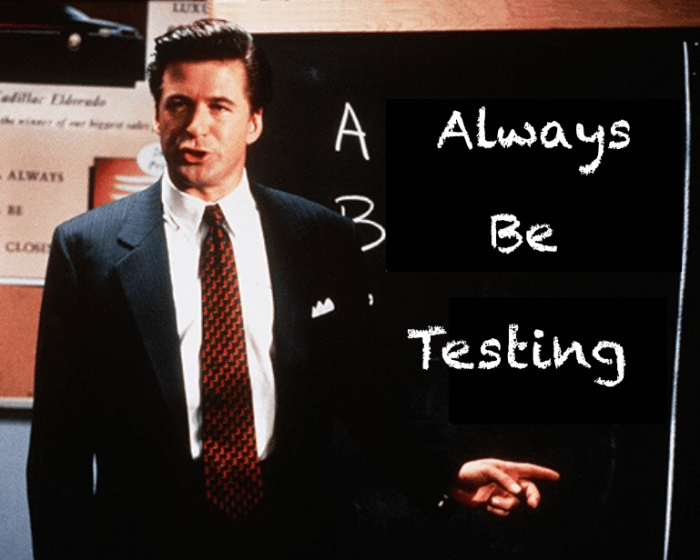
A-B-T. A- Always, B-be, T-testing. Always be testing! Always be testing!! A-I-T-P. Attention, interest, testing, passing. Attention — do I have your attention? Interest — are you interested? I know you are because it’s fuck or walk. Your kids pass or you hit the bricks! Testing – you will test those students by Christ!! And passing. A-I-T-P; get out there!! You got the students comin’ in; you think they came in to get out of the rain?


[Singer]

Actually, many of my students live in public housing down there by the railroad tracks. You know those slums? Roofs leak in half those units…


[Moss]

And for a lot of kids school is the only structure they get all day. Their parents are out working two to three jobs. They have to take care of themselves and often younger siblings.


[Singer]

And food. Don’t forget food. If it wasn’t for the free breakfast and lunch program, many of my kids wouldn’t eat…


[Blake]

Bullshit. A kid doesn’t walk into this school unless he wants to pass. That’s why they’re here! They want to learn! They’re sitting out there waiting to be told what to do. Are you gonna’ tell ‘em? Are you man enough to tell them?


[Moss]

I’m a woman. Most of us are women.


[Blake]

(to Moss) What’s the problem, Pal?


[Moss]

You think you’re such a hero, you’re so rich. Why are you coming down here and wasting your time on a bunch of bums?


(Blake sits and takes off his gold watch)


[Blake]
You see this watch? You see this watch?


[Moss]
Yeah.


[Blake]

That watch cost more than your SMART Board. (Takes off his shoe) You see this shoe? Italian. It costs more than your entire salary. (slicks back his hair) You see this haircut?


[Moss]

I get it.


[Blake]

Do you? Because I do. I made 26 million dollars last year. How much do you make? You see, Pal, that’s who I am. And you’re nothing. Nice person? I don’t give a shit. Good mother? Fuck you – go home and play with your kids!! (to everyone) You wanna work here? Test!! (to Aaronow) You think this is abuse? You think this is abuse, you cocksucker? You can’t take this — how can you take the abuse you get in a classroom?! You don’t like it — leave. I can go out there tomorrow with the materials you got, make myself a thousand dollars in merit pay! Tomorrow! In one class! Can you? Can you? Go and do likewise! A-I-T-P!! Get mad! You sons of bitches! Get mad!!


[Singer]

Oh, I’m mad. I’m mad that a shallow schmuck like you thinks he can come in here and tell us how to do our jobs. School is about so much more than test scores. You can’t reduce it all to a multiple choice assessment. These kids need a broad curriculum, not just reading and math. They need science, art, social studies, foreign language, recess – all the stuff the rich kids get at the $50,000 a year private schools. And all you want to give them are standardized tests!


[Blake]

You know what it takes to teach public school?


(He pulls something out of his briefcase. He’s holding up a hammer and a plastic model of a one-room schoolhouse. He puts the model down on Aaronow’s desk and then smashes it to pieces with the hammer.)


[Blake]
It takes school choice to teach in a public school. It takes charter and voucher schools, schools run like a business – not this mamby, pamby, commie, socialist shit!


[Moss]

Choice? Is that what you call letting private interests suck up public tax dollars without the same transparency and regulations as public schools? You mean schools not run by an elected school board, who meet in private and do almost whatever they please with our tax dollars? You mean schools that can turn away the hardest to teach children – unlike public schools that take everyone?


[Blake]
I’m talking about schools with balls!
(He puts the hammer over his crotch,– he puts it away after a pause)


[Blake]
You want a paycheck? Do like the choice schools do — Go and do likewise, folks. The money’s out there, you pick it up, it’s yours. You don’t–I have no sympathy for you. You wanna go into your classes tomorrow and test and get your kids to pass, it’s yours. If not you’re going to be shining my shoes. Bunch of losers sitting around in a bar. (in a mocking weak voice) “Oh yeah, I used to be a teacher, it’s a tough racket.” (he takes out a software package from his briefcase) This is the new Common Core aligned diagnostic system. It’s like the MAP, Study Island, iReady and iStation – only better.


[Singer]

Those programs suck.


[Blake]

This is better. With it, your students will sit behind a computer screen for several hours every day taking stealth assessments.


[Singer]

You mean mini-tests?


[Blake]

No. Not mini-tests. They’ll run through the program and get instruction on every Common Core standard and their answers will show how much they’ve learned.


[Singer]

They’re tests. Standardized tests. Every day.


[Blake]

This is the Pearson leads. And to you, it’s gold. And you don’t get it. Why? Because to give it to you is just throwing it away. (he hands the software to Williamson) It’s for testers. (sneeringly) Not teachers.


I’d wish you good luck but you wouldn’t know what to do with it if you got it. (to Moss as he puts on his watch again) And to answer your question, Pal: why am I here? I came here because the Governor and Legislature are paying me to be here. They’re paying me a lot more than you. But I don’t have to take their money. I can make that tying my shoes. They asked me for a favor. I said, the real favor, follow my advice and fire your fucking ass because a loser is a loser.


(He stares at Moss for a sec, and then picking up his briefcase, he leaves the room with Williamson)


[Singer]

What an asshole.


[Moss]

He may be an asshole but he’s got the state on his side.


[Aaronow]

This isn’t what I signed up for. This isn’t why I became a teacher.


[Moss]

What did you sign up for?


[Aaronow]

TO TEACH! Not to be some… some… glorified real estate agent!


[Singer]

It’s funny. We know how crazy all this testing, Common Core, and charter school crap is, but no one wants to hear us.


[Moss]

And now without collective bargaining, we can’t even speak up without fear of being fired.


[Aaronow]

Fear!? If we don’t push all this teaching to the test nonsense, they’re going to fire us. And if we do, they can replace us with computer programs. We’re damned if we do, damned if we don’t.


[Singer]

Not if people wake up. (Moss and Aaronow scoff) Not if the public takes a stand, if parents and teachers opt their kids out of the tests…


[Aaronow]

Didn’t you hear the man!? They’re putting the kids on computer programs to test them every day!


[Singer]

Then we fight every day. We protest every day. We get parents together and other concerned citizens and we go to the capital and we fight. Call your representative. Go to your Senator’s office. Stage a sit in. Hold a mock trial. Write a blog parodying a scene from a famous movie. Get public attention. Make some noise.


[Aaronow]

And you think people will care? You think people will know?


[Singer]

We’ll teach them. We’ll show them. That’s what we do.


[Moss]

We have no other choice.


[Aaronow]

Always be testing?


[Singer]

Always be teaching.


(Curtain)


The Original Scene from GlenGarry Glen Ross:

Congress Frees Public Schools From Federal Test & Punish – Where’s the Catch?

Trump+Selection+Education+Secretary+Betsy+kBaA0SDAd_tx

Let’s say you were kidnapped and kept in a small basement room where you were routinely beaten and starved.

Then after years of this treatment, your captors brought in a massage table and offered you a filet mignon after your spa treatment.

You’d be more than a little bit confused.

That’s the position of parents, students and teachers today.

After almost two decades of punishing public schools and their students for low test scores, Congress suddenly decides to step back and leave it to the states!?

Until now the federal government had mandated increasing high stakes standardized tests and forcing schools that don’t meet a certain threshold to be stripped of their school boards, turned into charters or simply closed. Until now, the federal government coerced states to enact every fly-by-night corporate education reform from Common Core to Teach for America to evaluating teachers based on student test scores.

But now the feds are just walking away!?

First, in 2015 lawmakers passed the Every Student Succeeds Act (ESSA), a reauthorization of federal K-12 education policy that (depending on how you interpret it) limited federal power over public schools. However, the Obama administration offered guidelines that put much of that federal power back in place.

Now both the House and Senate have voted to repeal those Obama administration guidelines in favor of… well… some other interpretation.

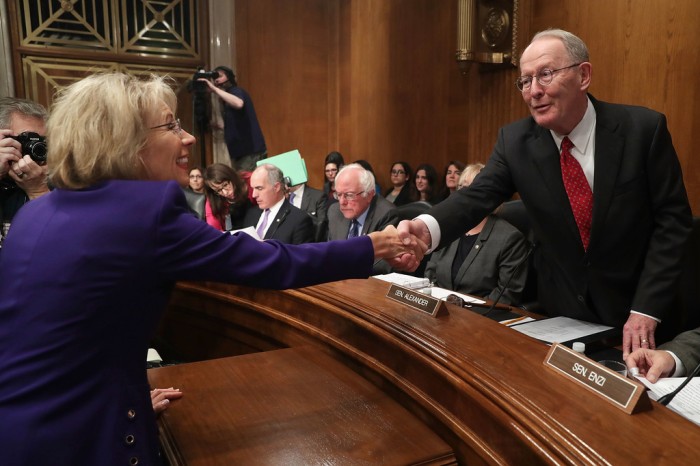
Sen. Lamar Alexander (R-Tennessee), chairman of the Health, Education, Labor and Pensions committee and one of the architects of the ESSA, says states can just follow what’s written in the law. But this is a 1,061 page document full of legalese, meandering bipartisan compromises and – frankly – contradictory language. Even the most simple legislation needs interpretation, and in this case it needs extensive interpretation.

Education Secretary Betsy DeVos is expected to offer her take on what all this means by Monday. So buckle up for that one. I’m sure the nation’s Grizzlies are so upset they can barely finish their picnic baskets.

As for the rest of us, it’s hard to know what this all will mean.

Alexander offered a detailed explanation that anyone interested in this issue should read.

I’m no fan of the Senator’s. I think he’s a blatant opportunist, an unapologetic partisan and out to protect only one person – numero uno.

But he makes some excellent points about federal overreach in the Department of Education under the previous two administrations.

Moreover, unlike DeVos, the supremely unqualified Education Secretary he helped ram through Congress over bipartisan objections, he knows something about schools. He was Secretary of Education, himself, from 1991-93 under President George H. W. Bush.

First, the ESSA still mandates annual testing. Even without the Obama guidelines, students will still be tested in grades 3-8 and once in high school.

Second, Alexander says the law still requires each state to hold its public schools accountable. Each state must submit a plan detailing how it intends to do that by September of 2017. There is plenty of latitude on exactly how states will do this, but whatever they decide, this new accountability system must be implemented by next school year (2017-2018).

Moreover, he says, states have to identify and provide support to at least the lowest performing 5% of their schools. This must be done by the beginning of the 2018-2019 school year.

They also must use academic and English language proficiency indicators in their accountability systems. Which indicators? Standardized testing? Maybe – maybe not.

Many accountability provisions, such as the requirement that educators measure reading scores, math scores, and graduation rates, are specifically mentioned in the ESSA.

Still, many questions remain.

For instance: if the Department of Education isn’t allowed to tell states what to do, how is it supposed to help them comply with the law?

Alexander cites “Non-regulatory guidance; Dear Colleague letters; Frequently-Asked-Questions documents; Webinars, phone calls, and in-person conferences.”

Alexander stresses that repealing the Obama regulations does not open to door for the Department of Education to mandate a nationwide school voucher plan – unfortunately.

He writes, “A school choice program cannot be unilaterally created by the Department of Education. Only Congress could create a voucher program, and, unfortunately, Congress has rejected doing that.”

However, the Trump administration and DeVos have already made their intentions known about school vouchers. They intend to use Title I dollars – money usually earmarked for the most impoverished students – as federal bribes to enact vouchers. It’s basically the same thing Obama did with Race to the Top – promising federal money to states if their schools do what the feds want them to do.

For all his talk about states rights, Alexander appears to have no problems with this same kind of Obama-style coercion.

But he does appear to be correct about the transfer of power.

Apparently, the states really will regain control over their public schools.

This could be a very positive thing. And it’s not the only one.

In addition to repealing Obama’s accountability regulations, Congress scrapped Obama’s teacher preparation rules.

This change was less controversial. Eight Democrats joined Republicans in voting to repeal the teacher preparation regulations. By comparison, no Democrats voted to dismantle the accountability rules and one Republican joined them in opposition.

The teacher preparation rules were released in October after years of delay.

The main point of contention was the requirement that states develop a rating system aimed at evaluating the success of their teacher preparation programs. This would have included how programs’ teachers perform based on a measure of student academic achievement. Though the final version gained some flexibility with how to determine student academic success beyond just test scores, it remained a hot mess.

Any programs that didn’t perform well on the state’s rating system would have lost access to federal grants aimed at supporting teachers who work in high-need certification areas and in low-income schools (or TEACH grants). In effect, it would have pushed for a new generation of teachers dedicated to test prep and Common Core.

And these repeals of Obama regulations – these seeming improvements just waiting for Donald Trump’s signature – are brought to us by the same people who support removing protections for trans students. These are the same legislators who gave us an unexperienced mega-donor as Education Secretary.

Frankly, I’m having trouble believing it.

I hope I’m wrong, but I’m waiting for the other shoe to drop.

Perhaps the standardized testing industry has consolidated so much support at the various Republican controlled state legislatures that it no longer needs support in Washington. Perhaps our ridiculously gerrymandered state legislative districts will make any resistance even more difficult. Perhaps a completely toothless Department of Education will embolden the most racist state legislators to dramatically increase segregation and civil rights abuses for the poor and minorities.

Or perhaps Republicans actually got one right?