Grades and Test Scores Don’t Matter. A Love of Learning Does.

Screen Shot 2018-05-04 at 8.28.42 AM


My daughter probably would be shocked to discover what I truly think about grades.


They don’t matter all that much.


The other day she brought home a pop quiz on sloths from her third grade class. It had a 40% F emblazoned on the top in red ink.


I grabbed the paper from her book bag and asked her to explain what had happened.


She smiled nervously and admitted that she had rushed through the assignment.


I told her I knew she could do better and was very disappointed.


Then we reread the article in her weekly reader and found the right answers to the questions she’d missed.


But if my little girl would be stunned, my students would probably be even more gobsmacked!


As a 7th grade Language Arts teacher, it’s my job to hand out grades. And I don’t give my students too much slack.


Just this morning, I turned to one of my kiddos placidly drawing a Spider-Man doodle in homeroom and asked if he had given me yesterday’s homework.


He wasn’t sure, so I pulled up the gradebook and surprise, surprise, surprise – no homework.


So he took out the half-completed packet, promised to get it done by the end of the day and promptly began working on it.


Don’t get me wrong. No one would ever confuse me for a teacher obsessed with grades and test scores.


I’m way too laid back for that. But my students know I will penalize them if they don’t hand in their assignments. And if it isn’t their best work, I’ll call them out on it.


The way I see it, grades and test scores offer an approximation of how well a student tries to achieve academic goals.


In Language Arts classes like mine, that’s reading, writing and communicating.


After a year of study, I want my students to leave me with an increased ability to read and understand what they’ve read. I want them to form a thoughtful opinion on it and be able to communicate that in multiple ways including verbally and in writing.


An overreliance on testing and grading can actually get in the way of achieving that goal.


According to a University of Michigan study from 2002, a total of 80% of students base their self worth on grades. The lower the grades, the lower their self-esteem.


Common Core fanatics like Bill Gates and David Coleman probably would say that’s a good thing. It provides incentive for children to take school seriously.


However, I think it transforms a self-directed, authentic pursuit of knowledge into grade grubbing. It makes an intrinsic activity purely extrinsic.


Learning no longer becomes about satisfying your curiosity. It becomes a chase after approval and acceptance.


We already know that measuring a phenomena fundamentally changes that phenomena. With a constant emphasis on measurement, children become less creative and less willing to take risks on having a wrong answer.


That’s one of the reasons I prefer teaching the academic track students to the honors kids. They aren’t used to getting all A’s, so they are free to answer a question based on their actual thoughts and feelings. If they get a question wrong, it’s not the end of the world. It hasn’t ruined a perfect GPA and put valedictorian forever out of reach.


Too much rigor (God! I hate that word!) creates academic robots who have lost the will to learn. Their only concern is the grade or the test score.


It also increases the motivation to cheat.


According to a national survey of 24,000 students from 70 high schools, 64% admitted to cheating on a test.


But if the goal is authentic learning, cheating doesn’t help. You can’t cheat to understand better. You can only fool the teacher or the test. You can’t fool your own comprehension.


If you find a novel way of realizing something, that’s not cheating – it’s a learning strategy.


I know this is heresy to some people.


Even some of my colleagues believe that grading, in general, and standardized testing, in particular, are essential to a quality education.


After all, without an objective measure of learning, how can we predict whether students will do well once they move on to college or careers?


Of course, some of us realize standardized testing doesn’t provide an objective measurement. It’s culturally and racially biased. Those test scores don’t just correlate with race and class. They are BASED on factors inextricably linked with those characteristics.


When the standard is wealth and whiteness, it should come as no surprise that poor students of color don’t make the grade. It’s no accident, for example, that American standardized testing sprung out of the eugenics movement.


Yet you don’t need to crack open a book on history or pedagogy to see the uselessness of testing.


High stakes assessments like the SAT do NOT accurately predict future academic success.


Kids with perfect scores on the SAT or ACT tests don’t do better than kids who got lower scores or never took the tests in the first place.


Numerous studies have shown this to be true. The most recent one I’ve seen was from 2014.


Researchers followed more than 123,000 students who attended universities that don’t require applicants to take these tests as a prerequisite for admission. They concluded that SAT and ACT test scores do not correlate with how well a student does in college.


However, classroom grades do have predictive value – especially when compared to standardized tests. Students with high grades in high school but middling test scores do better in college than students with higher test scores and lower grades.


Why? Because grades are based on something other than the ability to take one test. They demonstrate a daily commitment to work hard. They are based on 180 days (in Pennsylvania) of classroom endeavors, whereas standardized tests are based on the labor of an afternoon or a few days.


Yet even classroom grades have their limits.


I remember my high school graduation – sitting on the bleachers in my cap and gown listening to our valedictorian and salutatorian give speeches about the glorious future ahead of us.


Yet for each of those individuals, the future wasn’t quite so bright. Oh, neither of them burned out, but they didn’t exactly set the world on fire, either.


In fact, when I went to college, I found a lot of the highest achievers in high school struggled or had to drop out because they couldn’t adjust. The new freedom of college was too much – they partied and passed out. Yet a middle-of-the-road student like me (Okay, I was really good in English) did much better. I ended up in the honors college with a double major, a masters degree and graduating magna cum laude.


And it’s not just my own experience. The research backs this up.


A Boston College study tracked more than 80 valedictorians over 14 years. These high school high achievers all became well-adjusted professional adults. But none of them made major discoveries, lead their fields or were trailblazers.


For that, you need someone willing to take risks.


The folks the researchers followed admitted that this wasn’t them. Many confessed that they weren’t the smartest people in their classes. They just worked really hard and gave teachers exactly what they thought they wanted.


So what’s the point?


Some people will read this and think I’m against all testing and grading.


Wrong.


I give tests. I calculate grades. And I would do this even if I had the freedom to do whatever I wanted. (Though I would throw every standardized test right in the garbage.)


I think grades and testing have their place. But they aren’t the end, they are a means to an end.


They are crude estimations of learning. They’re an educated guess. That’s all.


We need to move beyond them if we are to modernize our public schools.


Don’t get rid of grades and testing, just change the emphasis. Put a premium on curiosity and creativity. Reward academic risk taking, innovation and imagination. And recognize that most of the time there may be several right answers to the same question.


Heck other countries like Finland already do this.


For the first six years of school, Finnish children are subjected to zero measurement of their abilities. The only standardized test is a final given at the end of senior year in high school.


As a result, their kids have some of the highest test scores in the world. By not focusing on standards and assessments, they counterintuitively top the charts with these very things.


There’s a lesson here for American education policy analysts.


And that lesson is the title of this article.


Like this post? I’ve written a book, “Gadfly on the Wall: A Public School Teacher Speaks Out on Racism and Reform,” now available from Garn Press. Ten percent of the proceeds go to the Badass Teachers Association. Check it out!


book-3


Arming Already Stressed Out Teachers Will Only Increase the Chance of School Shootings

1541539


It happened in Georgia yesterday.


A beloved social studies teacher locked himself in his classroom while his students stood outside the door.


When the principal came with the key, the teacher fired a handgun through an exterior window.


Students ran, one even twisting her ankle in the escape.


Thankfully, no one else appears to have been injured.


However, the incident brings into focus a vital component of the gun debate.


Teachers are already under tremendous stress.


Arming them won’t stop gun violence. All it does is add another potential shooter.


It’s only been about two weeks since a shooting at Stonemason Douglas High School in Florida left 17 dead.


That’s at least 19 school shootings so far in 2018 – and it’s only the beginning of March!


In that time, the national media and the Trump administration have focused on one specific solution to stopping such violence from happening again: giving teachers guns.


The latest incident in Georgia underlines why this is such a terrible idea.


Teachers are not super heroes.


Take it from me. I’m an almost 15 year veteran of the middle school classroom in western Pennsylvania.


We’re just human beings.


My colleagues and I have all the same human failings and weaknesses as everybody else.


We get tired and overworked and put upon and stressed and sometimes…


…Sometimes we don’t handle it well.


I know some people don’t want to hear it.


Society has piled all kinds of responsibilities and unreasonable expectations on our shoulders.


We’re no longer allowed to be just educators.


We’re parents, counselors, disciplinarians, doctors, psychologists, lawyers, nutritionists…. The list goes on-and-on.


And now politicians actually want us to add law enforcement to the job description?


We’re already under colossal pressure, and some folks want to add a gun to that situation?


That’s lighting a fuse.


But don’t just take my word for it.


Back in 2015, tens of thousands of educators filled out the Quality of Worklife Survey conducted by the American Federation of Teachers and the Badass Teachers Association.


After responses from 91,000 school employees and 31,000 who completed the entire 80-question survey, a picture of the emotional landscape became clear.


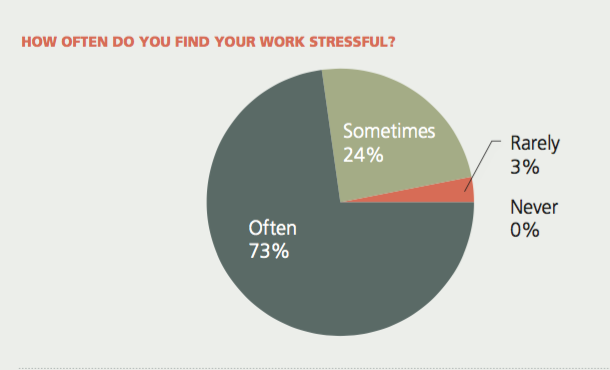
A total 73% of respondents said they often feel stressed at work.

Screen Shot 2018-03-01 at 12.48.15 PM

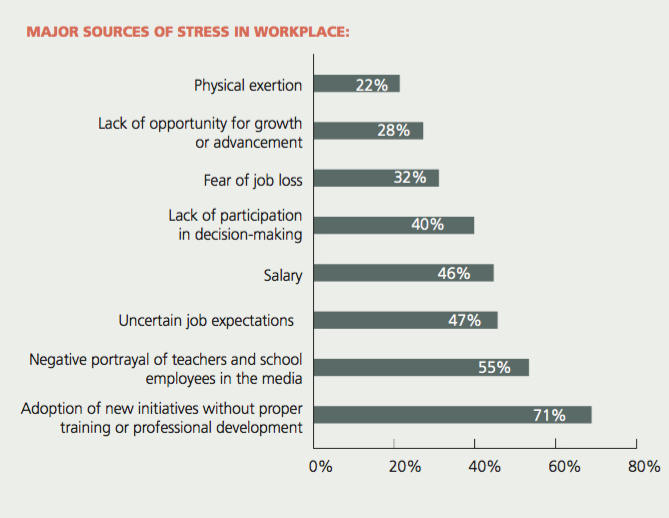
The reasons? Adoption of new initiatives without proper training or professional development (71%), negative portrayal of teachers and school employees in the media (55%), uncertain job expectations (47%) and salary (46%) were the most common responses.

Screen Shot 2018-03-01 at 12.48.58 PM

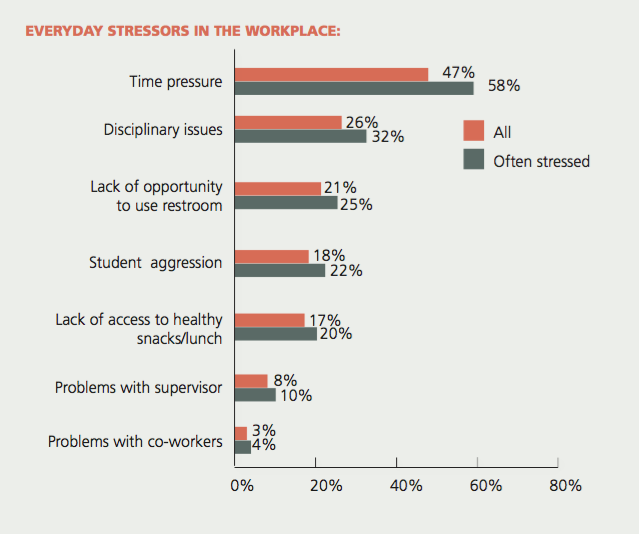
The survey identified the following as most common everyday stressors in the workplace – time pressures, disciplinary issues and even a lack of opportunity to use the bathroom.

Screen Shot 2018-03-01 at 12.49.11 PM

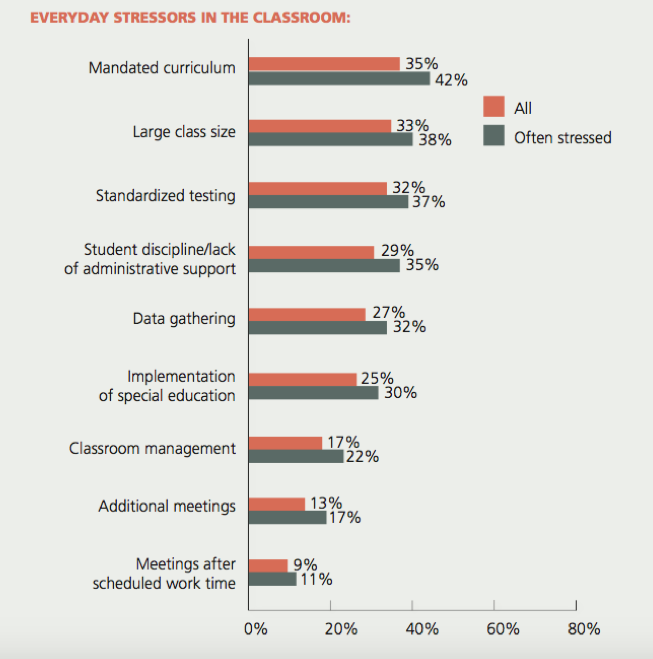
Focusing just on the classroom, top stressors were mandated curriculum, large class sizes and standardized testing.

Screen Shot 2018-03-01 at 12.49.35 PM

Many teachers claimed to be the victims of violence at school.


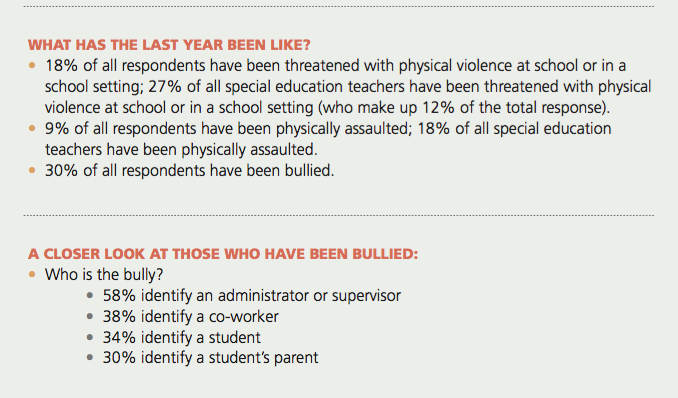
A total 18% of all respondents said they had been threatened with physical violence – though the percentage jumped to 27% when looking solely at special education teachers.


A total of 9% of all respondents claimed to have been physically assaulted at school. Again the percentage jumped to 18% of all special education teachers.


But it’s not just physical assault.


A total of 30% claim to have been bullied by administrators (58%), co-workers (38%), students (34%) and student’s parents (30%).

Screen Shot 2018-03-01 at 1.03.57 PM

This is the situation where policymakers want to throw firearms.


Most gun violence doesn’t involve a shooter doing harm to others. The great majority of gun deaths are self-inflicted.


Even without adding guns to the mix, several high profile teachers and administrators already have committed suicide.


In October of 2010, for example, a California elementary school teacher named Rigoberto Ruelas, Jr. took his own life after the Los Angeles Times published a report labeling him a “less effective teacher.” Despite the fact that students and parents praised Ruelas, who taught in one of poorest schools in his district and who also was born, raised and continued to live in area where his school was located, the Times targeted him among other so-called “less effective” teachers as part of a major propaganda campaign.


And this isn’t an isolated incident. In July of 2015, a New York City principal under investigation for altering Common Core test scores, killed herself by jumping in front of a subway car.


Adding guns to this situation will just mean more teachers taking their own lives with a bullet.


That may have been the intent of the Georgia teacher in yesterday’s shooting.


Local police said they didn’t think he was trying to injure anyone else. When he shot his gun out of the window, he appeared to be trying to get others to leave him alone.


Arming teachers is a terrible solution to school violence. It’s taking an already stifling room and turning up the heat.


We need sensible gun regulations to reduce the pressure, not increase it.


We need sensible school policies that treat teachers and students like human beings and not just cogs in the system.


But this requires us to break out of a dangerous pattern in how we deal with social problems.


When we see a problem, we generally just shrug and leave it up to public schools and teachers to solve.


Inadequate resources – leave it to teachers to buy school supplies out of pocket.


Inequitable funding – increase class size and leave it to teachers to somehow make up the difference.


We can’t do the same with gun violence. We can’t just toss teachers a gun and tell them to sort it out.


Teachers can’t solve all of society’s problems alone.


That’s going to take all of us.


And we’ll need more than disingenuous proposals like answering gun violence with more guns.

Economists Don’t Know Crap About Education

3c19197


I hate to be blunt here, but economists need to shut the heck up.


Never has there been a group more concerned about the value of everything that was more incapable of determining anything’s true worth.


They boil everything down to numbers and data and never realize that the essence has evaporated away.


I’m sorry but every human interaction isn’t reducible to a monetary transaction. Every relationship isn’t an equation.


Some things are just intrinsically valuable. And that’s not some mystical statement of faith – it’s just what it means to be human.


Take education.


Economists love to pontificate on every aspect of the student experience – what’s most effective – what kinds of schools, which methods of assessment, teaching, curriculum, technology, etc. Seen through that lens, every tiny aspect of schooling becomes a cost analysis.


And, stupid us, we listen to them as if they had some monopoly on truth.


But what do you expect from a society that worships wealth? Just as money is our god, the economists are our clergy.


How else can you explain something as monumentally stupid as Bryan Caplan’s article published in the LA Times “What Students Know That Experts Don’t: School is All About Signaling, Not Skill-Building”?


In it, Caplan, a professor of economics at George Mason University, theorizes why schooling is pointless and thus education spending is a waste of money.


It would be far better in Caplan’s view to use that money to buy things like… oh… his new book “The Case Against Education: Why the Education System Is a Waste of Time and Money.”


His argument goes something like this: the only value of an education is getting a job after graduation.


Businesses only care about school because they think it signifies whether prospective employees will be good or bad at their jobs. And students don’t care about learning – they only care about appearing to have learned something to lure prospective employers. Once you’re hired, if you don’t have the skills, employers have an incentive to give you on the job training. Getting an education is just about getting a foot in the door. It’s all just a charade.


Therefore, we should cut education funding and put kids to work in high school where they can learn how to do the jobs they’ll need to survive.


No wonder economics is sometimes called “The Dismal Science.” Can you imagine having such a dim view of the world where THAT load of crap makes sense?


We’re all just worker drones and education is the human equivalent of a mating dance or brilliant plumage – but instead of attracting the opposite sex, we’re attracting a new boss.


Bleh! I think I just threw up in my mouth a little bit.


This is what comes of listening to economists on a subject they know nothing about.


I’m a public school teacher. I am engaged in the act of learning on a daily basis. And let me tell you something – it’s not about merely signifying.


I teach 7th and 8th grade language arts. My students aren’t simply working to appear literate. They’re actually attempting to express themselves in words and language. Likewise, my students aren’t just working to appear as if they can comprehend written language. They’re actually trying to read and understand what the author is saying.


But that’s only the half of it.


Education isn’t even just the accumulation of skills. Students aren’t hard drives and we’re not simply downloading information and subroutines into their impressionable brains.


Students are engaged in the activity of becoming themselves.


Education isn’t a transaction – it’s a transformation.


When my students read “The Diary of Anne Frank” or To Kill a Mockingbird, for example, they become fundamentally different people. They gain deep understandings about what it means to be human, celebrating social differences and respecting human dignity.


When my students write poetry, short fiction and essays, they aren’t merely communicating. They’re compelled to think, to have an informed opinion, to become conscious citizens and fellow people.


They get grades – sure – but what we’re doing is about so much more than A-E, advanced, proficient, basic or below basic.


When the year is over, they KNOW they can read and understand complex novels, plays, essays and poems. The maelstrom of emotions swirling round in their heads has an outlet, can be shared, examined and changed.


Caplan is selling all of that short because he sees no value in it. He argues from the lowest common denominator – no, he argues from the lowest actions of the lowest common denominator to extrapolate a world where everything is neatly quantifiable.


It’s not hard to imagine why an economist would be seduced by such a vision. He’s turned the multi-color world into black and white hues that best suit his profession.


In a way, I can’t blame him for that. For a carpenter, I’m sure most problems look like a hammer and a nail. For a surgeon, everything looks like a scalpel and sutures.


But shame on us for letting one field’s myopia dominate the conversation.


No one seems all that interested in my economic theories about how to maximize gross domestic product. And why would they? I’m not an economist.


However, it’s just as absurd to privilege the ramblings of economists on education. They are just as ignorant – perhaps more so.


It is a symptom of our sick society.


We turn everything into numbers and pretend they can capture the reality around us.


This works great for measuring angles or determining the speed of a rocket. But it is laughably unequipped to measure interior states and statements of real human value.


That’s why standardized tests are inadequate.


It’s why value added teacher evaluations are absurd. It’s why Common Core is poppycock.


Use the right tool for the right job.


If you want to measure production and consumption or the transfer of wealth, call an economist.


If you want to understand education, call a teacher.

Wake Up, America! You Have a School Shooting Problem!

photos-century-poc


There have been 11 school shootings so far this year.


And January isn’t even over yet.


That makes about 50 for the academic year – roughly one a week.


Some involve no injuries. Some are suicide attempts. And some, like the latest in Kentucky, involve an active shooter hunting and killing children.


While gun violence is a problem throughout the country, it is especially virulent at educational institutions.


According to an FBI study that looked at incidents from 2000-2013, nearly one quarter of all U.S. shootings took place at schools. And they’re on the rise.


Yet this latest incident barely raised an eyebrow in the collective consciousness.


Hardly anyone even attempted to offer a solution.


The reason?


Since Sandy Hook, we’ve effectively given up.


In December of 2012 a gunman walked in to Sandy Hook Elementary School in Newtown, Connecticut, and killed 20 children and six adults, and we did nothing.


We stood by after the murder of elementary kids and couldn’t get up the collective energy to do one damn thing to stop things like this from happening again.


No new regulations.


No assault weapons ban.


No gun buyback programs.


NOTHING.


In fact, the only thing we did do was actually weaken gun laws to INCREASE the likelihood of more kindergarten kids dying by shot and shell.


In this country we have created a false dichotomy – it’s either children or guns — and we’ve chosen GUNS!


We’re told to buy bullet-proof backpacks, arm school teachers, and have gun wielding police patrol the buildings, but don’t do anything about the firearms, themselves.


America has 4.4 percent of the world’s population, but almost half of the civilian-owned guns in the world.

guns_per_capita

It’s no wonder, then, that our citizens are so much more likely to die at end of a barrel.


Since Sandy Hook, there have been more than 1,500 mass shootings (including those done at locations other than schools).

Screen Shot 2018-01-26 at 7.59.15 AM

According to the Gun Violence Archive, there have been at least 1,518 mass shootings, with at least 1,715 people killed and 6,089 wounded as of October 2017.


The database defines a mass shooting as one in which at least four people (not counting the shooter) were shot regardless of whether those wounds were fatal or not. And since some shootings go unreported, it’s likely only giving us the bare minimum.


But that’s just mass death and destruction.


The overwhelming majority of gun deaths are smaller scale – police brutality, domestic violence, suicides, accidents, etc. America’s total annual firearm deaths came to more than 33,000 in 2014.


This is patently absurd.


Other countries don’t have the same level of gun violence as we do, even per capita.


There are certain facts that we refuse to accept.


States with more guns have more gun deaths.

gun_ownership_states

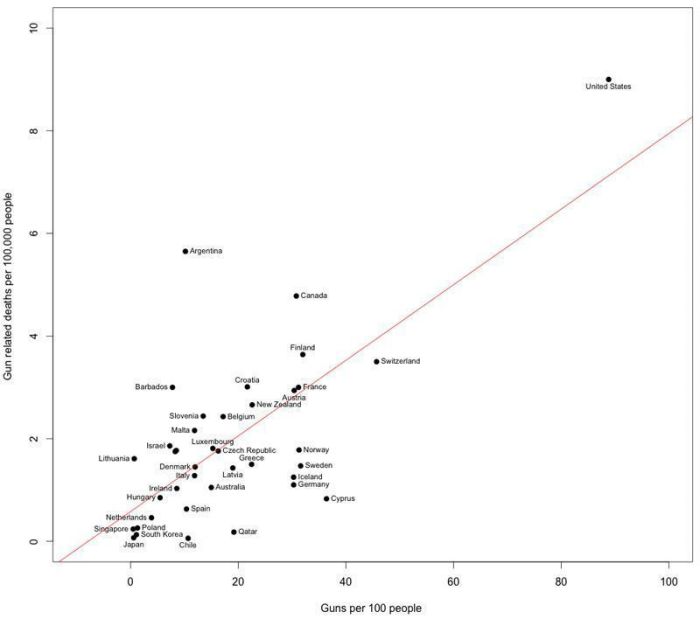
Countries with more guns likewise have more gun deaths.

guns_country

Meanwhile, states with tighter gun regulations have fewer gun-related deaths.

gun_control_vs_deaths

Countries with more rigorous gun control likewise have fewer gun related deaths.

(Don’t believe me? See Florida’s “The Geography of Gun Deaths,” and a 2016 review of 130 studies in 10 countries, published in Epidemiologic Reviews.)


Yet we’re told that gun control is useless because new laws will just be pieces of paper that criminals will ignore. However, by the same logic, why have any laws at all?


Congress should just pack it in, the courts should close up and the army should just all go home. Criminals will do what they please – there’s nothing we can do about it.


This kind of thinking is the triumph of business over sense.


The gun industry is making billions of dollars off this cycle of gun violence: mass shooting, fear of regulation, increase in sales. Repeat ad infinitum.


We may never be able to stop all gun violence, but we can take steps to make it more unlikely. We can at least make it more difficult for people to die by firearm.


And this doesn’t have to mean getting rid of all guns.


It just means sensible regulations.


According to the Pew Research Center, when you ask people about specific firearm regulations, the majority is in favor of most of them – both Republicans and Democrats.


We don’t want the mentally ill to be able to buy guns. We don’t want suspected terrorists to be able to purchase guns. We don’t want convicted criminals to be able to buy guns. We want mandatory background checks for private sales at gun shows.

guns_support

Yet our lawmakers stand by helpless whenever these tragedies occur because they are at the mercy of their donors.


The gun industry owns too many lawmakers.


Our continued gun violence problem is a symptom of our flagging democracy.


In a Republic like ours, our representatives are supposed to enact our will in the halls of power. Yet they don’t actually represent us. They represent business and the wealthy.


Until we regain control of our government, we will always be at the mercy of the dollar and the gun.


Our children will remain merely the most innocent victims of our heartless and unfair politics.


Gun violence is not an everyday occurrence at our schools. In fact, children are actually safer there than anywhere else. But everything is relative. Going to class to learn you’re ABC’s shouldn’t bring with it even a moderate chance of fiery death!


But that’s 2018 America. We live in a culture of death.


You need no further proof of that than the weekly report of which school got struck by the lightning of gun violence. Which children were mowed down by the consequences of an out of control plutocracy today?


Bang. Bang. Democracy is dead.

Few Kids in the World Can Pass America’s Common Core Tests, According to New Study

chinese-children-crush-americans-in-math-thanks-to-a-mindset-americans-only-display-in-one-place-sports


Could you jump through a hoop?


Probably if it were lying on the ground.


But what if it were held slightly higher? Let’s say waist high? Sure.


Shoulder height? Maybe with some practice.


How about if we raised the hoop to the rafters of a three story auditorium? Could you jump through THAT?


No. Of course not.


You could train with the world’s greatest coach, with the best equipment, 24-hours a day and you still couldn’t jump that high.


Yet that’s kind of what the U.S. has been expecting of its public school students – minus the resources.


We hold the hoop ridiculously out of reach and then blame them when they can’t jump through it.


But don’t take my word for it.


This is the conclusion of a new study that came out in January called “How High the Bar?” by the National Superintendents Roundtable and the Horace Mann League.


They found the benchmarks for passing the National Assessment of Educational Progress (NAEP) and American Common Core tests put success out of reach for most students the world over.


To do so, they linked the performance of foreign students on international tests of reading, mathematics, and science to the proficiency benchmarks of NAEP and thus Common Core aligned tests which use NAEP benchmarks to determine passing or failure.


The difference is the NAEP is only meant to compare how students in various states stack up against each other. Common Core tests, on the other hand, apply exclusively to kids within states.


No one’s actually expected to pass the NAEP. It’s only given to a sample of kids in each state and used to rank state education systems. The U.S. government, however, gives almost all its students Common Core tests and expects them all to pass – in fact, failure to do so could result in your public school being closed and replaced with a charter or voucher institution.


However, in both cases, the study concluded the score needed to meet the bare minimum of passing was absurdly too high – so much so that hardly any group of children in the entire world met it.


It’s important to note that these aren’t standardized testing skeptics.


They believe in the assessments. They even believe in Common Core. What they don’t believe in is the benchmarks we’re expecting our kids to meet to consider them having passed.


And this has massive consequences for the entire education system.


The media has uncritically repeated the lie that American public schools are failing based almost exclusively on test scores that show only one third of our students passing.


But if the same tests were given to students the world over with the same standard for success, even less would pass it, according to the study. If we drew the red line on international tests at the same place we draw it on the NAEP and  Common Core tests, almost every child in the world would be a dunce.


Kids from Singapore would fail. Kids from South Korea would fail. Kids from Japan would fail. You name a country where kids do nothing but study for high stakes standardized tests, and even they couldn’t meet our uniquely American criterion for passing.


In fact, the percentage of our students who do pass under these ridiculous benchmarks often exceeds that of other countries.


So when you hold kids up to impossible standards a few actually make it – and more of our kids do than our international peers.


That doesn’t mean the benchmarks are good. But it doesn’t mean the American education system is failing either. In fact, just the opposite.


We have a high stakes standardized testing system that not only does not assess kids fairly, but it actually hides their success!


In the words of the study’s authors, “…the analysis suggest the U.S. has established benchmarks that are neither useful nor credible.”


How did this happen?


It comes down to one word – proficient.


If you’re proficient, it’s thought you’re competent, you are able to do something. You might not be incredible at it, but you can get the job done.


Kind of like this:


Hey. Did you hear about my leaky faucet? The plumber fixed it after three tries because he’s proficient at his job.


Oh really? My plumber fixed my leaky faucet in only one try and didn’t even charge me because she’s advanced at her job.


That sort of thing.


There are only four scores you can achieve on most standardized assessments: Advanced, Proficient, Basic and Below Basic. The first two are considered passing and the last two are failing.


However, this doesn’t line up with the five general grades most public schools give in core subjects:


A – Excellent

B – Very good

C – Average

D – Poor

F – Failing


A-D is usually considered passing. Only F is failing.


So you might expect them to line up like this:


Advanced – A and B

Proficient – C

Basic – D

Below Basic – F


However, that’s not how they line up on NAEP. According to Diane Ravitch, who served on the National Assessment Governing Board, the federal agency that supervises NAEP, they line up like this:


Advanced – A+

Proficient – A

Basic – B and C

Below Basic – D and F


This is important, because saying someone scored a proficient on the NAEP doesn’t mean they’re just okay at it. It means they’re excellent but have room to improve.


The problem is that when developers of Common Core tests set their benchmarks, they used almost the same ones as the NAEP. Yet the NAEP benchmarks were never meant to be the same as grade level ones. Confounding the two puts mere passing out of reach for most students.


And that’s not just out of reach for most American students. It’s out of reach for international students!


In short, American students are doing B work on their Common Core tests and failing with a Basic. Yet in other countries, this would be passing with room to spare.


Moreover, when you hear that only one third of American students are Proficient or above, that means only one third are doing A or A+ work on their Common Core tests. That’s actually rather impressive!


According to the study:


“National judgments about student proficiency and many state Common 
Core judgments about “career and college readiness” are defective and misleading… 
According to NAEP officials, Proficient does not mean grade level performance. The misuse of the term confuses the public. The effects of this misuse are reflected in most Common Core assessments…


NAEP’s term “Proficient” does not even mean proficient. “Students who may be proficient in a subject, given the common usage of the term, might not satisfy the requirements for performance at the NAEP achievement level.”


The report even cites other independent analysts that have come to similar conclusions such as the U.S. General Accounting Office, the National Academy of Sciences, and the Brookings Institution.


In short:


“Advocates who push for school improvement on the grounds of questionable benchmarks are not strengthening education and advancing American interests, but undermining public schools and weakening the United States.”


Some specifics.


The study was conducted by comparing performance of foreign students on international tests of reading, mathematics, and science with the NAEP and American Common Core tests.


Very few foreign students were able to score high enough to meet what is considered proficiency on the NAEP and Common Core tests.


In fact, in 4th grade reading, not a single nation was able to meet the benchmark.


In 8th grade math, only three nations (Singapore, South Korea and Japan) had 50 percent or more students who could meet the criterion.


In 8th grade science, only one nation (Singapore) had 50 percent or more students meeting the benchmark.


But wait.


Even though the benchmarks are unfair and few nations children could meet them, the percentage of U.S. children who did meet them was higher than most other nations.


Take 4th grade reading.


Screen Shot 2018-01-22 at 8.48.54 AM


No one had 50% or more of its kids scoring a proficient or advanced. But 31% of U.S. kids actually met the benchmark, putting us fifth behind only Singapore, the Russian Federation, Finland, and England.


Only 31% of our kids could do it, but only four other nations out of 40 could do better.


That’s kind of impressive. Yet judging our scores in abstraction solely on this unrealistic proficiency standard, we’re failures. The whole process hides how well our kids actually do.


Bottom line, Common Core benchmarks are too high and paint an unfair picture of our education system, according to the study:


“When citizens read that “only one-third” or “less than half” of the students in their local schools are proficient in mathematics, science, or reading, they can rest assured that the same judgments can be applied to students throughout most of the world…


Globally, in just about every nation where it is possible to compare student performance with our national benchmarks, the vast majority of students cannot demonstrate their competence because the bars are set unreasonably high.”


Screen Shot 2018-01-22 at 8.47.29 AM


At very least, this invalidates the scores of the NAEP and every Common Core test yet given in this country. It demands we set new benchmarks that are in line with grade level performance.


At most, it casts doubt on the entire process of high stakes standardized testing.


It demonstrates how the data can be manipulated to show whatever testing corporations or other interested parties want.


Standardized testing is a gun, and we have been demanding schools shoot themselves in the foot with it.


Instead of trying to hold our schools to impossible standards, we should be holding our lawmakers to standards of common decency. We should concentrate on equitable funding, reintegration, and supporting our public school system and public school teachers. Not enriching private testing corporations so they’ll paint a misleading picture of student performance to justify pro-privatization schemes.


When will our policymakers rise to meet the benchmarks of honesty, empathy and caring about the well-being of children?


In the final analysis, that may be bar they are simply incapable of reaching.

Hidden Gadfly – Top 5 Stories (By Me) You May Have Missed in 2017

7fd6a56c2ffc7a03c9fd2f431a543e92


So that was 2017.


It was a year that frankly I wasn’t sure I’d survive.


But I did. We did. Together.


I think if there’s any lesson from the last 365 days, it’s that: We can endure anything if we stay united.


We’ve taken down titans of industry simply by acts of belief. When women came forward with credible tales of abuse, for the first time we – as a society – actually believed them.


We’ve taken down the most morally repugnant child abusers with designs on national office simply by supporting the black vote. And no matter how much power tried to disenfranchise our brothers and sisters of color, we stood by them and made sure their voices were heard.


We’ve taken down the authors of some of the most backward legislation in the country by supporting the very people who were targeted – I’m talking about Danica Roem the first transgender state legislator in the country taking down the author of Virginia’s bigoted bathroom bill! Absolutely amazing!


These are the kinds of things we need more of in the New Year.


If you take all the “minorities” in this country – minorities of gender, race, sexuality, creed, religion, etc. – if you add us all together, we actually are the majority!


When you add white people of conscience with black people, Latinos and Hispanics, LGBTs, women, Muslims, and every other historically disenfranchised group, we have the upper hand. And when you compare economic disparities of the 99% vs the 1% or poor vs rich, it’s not even close!


And I’m not talking about some time in the future. I’m talking about right now!


All we need to do is stand together and fight for each other.


Our democracy is in tatters, but not much needs to remain to empower our overwhelming supermajority.


So as 2018 is about to dawn, I am filled with hope for the future. A truly amazing year may be about to dawn. It’s all up to us.


In the meantime, I take my last look over my shoulder at the year that was.


As an education blogger, I write an awful lot of articles, 119 articles so far this year. In fact, this piece – which will probably be my last of the year – brings me to 120!


I’ve already published a countdown of my most popular articles. If you missed it, you can still read it here.


However, as is my custom, I like to do one final sweep of my annual output counting down honorable mentions. These are the top five articles that maybe didn’t get as many readers, but that I think deserve a second look.


I hope you enjoy my top 5 hidden gems before I place them in the Gadfly vault and begin the hard work of making 2018 a better tomorrow:


5) Standardized Testing Creates Captive Markets


Published: April 8 thumbnail_Screen Shot 2017-04-07 at 10.41.23 AM


Views: 4,301


Description: Standardized testing is often championed by people who claim to be free market capitalists. Yet it struck me that there was nothing free about the market being perpetrated on public schools when it comes to high stakes tests. Schools don’t give these tests because anyone in these districts actually thinks they help students learn. We do it because we’re forced by federal and state governments. It’s a racket, and in this article I explain exactly how and why.


Fun Fact: This article was well received, but I thought it might deserve to be even more so. Education writer and classroom teacher Frank Stepnowski wrote about it in his most recent book RETRIBUTION: A scathing story of mandatory minutiae, softening students, pretentious parents, too much testing, common core conundrums, and the slow death of a noble profession.” He was so taken by it he even taught my piece to his high school composition students. In addition, education historian Diane Ravitch probably liked this article more than any single work I’ve ever written. She positively beamed on her blog calling it, “One of the best articles you will ever read about standardized testing.” I guess it’s no wonder that I included it in my first book published just a few months ago, “Gadfly on the Wall: A Public School Teacher Speaks Out on Racism and Reform.” In particular, Ravitch wrote:


“When I read this post by Steven Singer, I was so excited that I thought about devoting an entire day to it. Like posting it and posting nothing else for the entire day. Or posting this piece over and over all day to make sure you read it. It is that important.


Steven’s post explains two different phenomena. First, why is standardized testing so ubiquitous? What does it have a death grip on public education?


Second, in the late 1990s, when I was often in D.C., I noticed that the big testing companies had ever-present lobbyists to represent their interests. Why? Wasn’t the adoption of tests a state and local matter? NCLB changed all that, Race to the Top made testing even more consequential, and the new ESSA keeps up the mandate to test every child every year from grades 3-8. No other country does this? Why do we?”


4) I Am Not A Hero Teacher


Published: Aug. 1 Screen Shot 2017-08-01 at 10.53.52 AM


Views: 2,137


Description: According to landmark research by Dan Goldhaber and James Coleman, only about 9 percent of student achievement is attributable to teachers. The entire school experience only accounts for 20%. By far, the largest variable is out of school factors, which accounts for 60% of a student’s success. Yet we insist on holding teachers accountable for nearly 100% of it. We demand our teachers be superhuman, give them next to zero support, and then get indignant when they can’t do it all alone. Sorry, folks, I’m just a human being.


Fun Fact: Our expectations for teachers are ridiculous. We want them to do everything and then we blame them for acting like saviors. I think it’s vital that people acknowledge this impossible situation we put educators in and start to take more social responsibility. Your schools won’t get better until you do something about it. Stop complaining and get to work. That means voting for lawmakers who support public education. That means attending school board meetings. That means holding the decision makers responsible. Not just taking advantage of an easy scapegoat.


3) A Teacher’s Dilemma: Take a Stand Against Testing or Keep Abusing Children


Published: Sept 8 AJGE5E_2026469c


Views: 1,262


Description: What does a teacher think about when he or she is forced to give a standardized test? This article is my attempt to capture the no-win situation that our society forces on teachers every year. Apparently we must choose between doing things that we know are harmful to our students or taking a stand and possibly losing our jobs. You become a teacher to help children and then find that harming them is in the job description. Is this really what society wants of us?


Fun Fact: This article resonated deeply with some readers. In fact, a theater group in Ithaca, NY, Civic Ensemble, was so inspired by it that they used my article as the basis for a scene in a play made up of teacher’s real life stories about the profession. The play was called “The Class Divide.” You can watch a video of a practice performance of my scene here.


2) Top 10 Reasons Public Schools are the BEST Choice for Children, Parents & Communities


Published: Sept. 15 thumbsup


Views: 734:


Description: A lot has been written about why charter and voucher schools are bad for parents, students and society. Less has been written about the ways that public schools do better than privatized education. This was my attempt to illuminate the ways public schools are better. They attract better teachers, have a more robust sense of community, have more educational options, have greater diversity, are more fiscally responsible – and that’s just the first five!


Fun Fact: When you list all the ways public schools are better than privatized ones, it becomes hard to imagine why they’re struggling. Public schools are clearly the best choice. The fact that they are being sabotaged by the privatization industry and their creatures in government is inescapable.


1) Black Progress Does Not Come At White Expense


Published: Nov. 14

People of different races hold hands as they gather on the Arthur Ravenel Jr. bridge in Charleston


Views: 219


Description: When you ask racists why they oppose racial equity, the number one reason they give is the feeling that equity is a zero sum game. If black people are put on an equal footing with white people, then white people will ultimately lose out. This is patently untrue. White people will lose supremacy over other races, but they need not become subservient or lose their own rights. We can champion fairness for all without doing ourselves harm.


Fun Fact: This article kind of died on the vine, but I’m still proud of it. I think it is one of my best this year expressing my own thoughts and feelings about antiracism. I just wish more people had read it, because it sounds like this is an idea that more white people need to hear. We can only build a better world hand-in-hand.


NOTE: Special thanks to my fellow education blogger, Russ Walsh, who originally gave me the idea to write a countdown of under-read articles. He does it, himself, every year at his own excellent blog. If you’re new to the fight against corporate education reform, Russ has written an excellent primer on the subject – A Parent’s Guide to Public Education in the 21st Century: Navigating Education Reform to Get the Best Education for My Child.


Gadfly’s Other Year End Round Ups

This wasn’t the first year I’ve done a countdown of the year’s greatest hits. I usually write one counting down my most popular articles (like the one you just read from 2017) and one listing articles that I thought deserved a second look. Here are all my end of the year articles since I began this crazy journey in 2014:

2017

What’s the Buzz? A Crown of Gadflies! Top 10 Articles (by Me) in 2017

thumbnail_Screen shot 2017-12-26 at 3.44.17 PM

2016

Worse Than Fake News – Ignored News. Top 5 Education Stories You May Have Missed in 2016

ignoring-wisdom

Goodbye, 2016, and Good Riddance – Top 10 Blog Post by Me From a Crappy Year

screen-shot-2016-12-27-at-3-29-49-am

 2015

Gadfly’s Choice – Top 5 Blogs (By Me) You May Have Missed from 2015

Screen shot 2016-01-02 at 11.01.09 PM


Who’s Your Favorite Gadfly? Top 10 Blog Posts (By Me) That Enlightened, Entertained and Enraged in 2015

Screen shot 2015-12-30 at 12.57.49 AM

2014

Off the Beaten Gadfly – the Best Education Blog Pieces You Never Read in 2014

Wonderfull illusion art painting

Top 10 Education Blog Posts (By Me) You Should Be Reading Right Now!

computer-people-png-300x202


Still can’t get enough Gadfly? I’ve written a book, “Gadfly on the Wall: A Public School Teacher Speaks Out on Racism and Reform,” now available from Garn Press. Ten percent of the proceeds go to the Badass Teachers Association. Check it out!
book-4


What’s the Buzz? A Crown of Gadflies! Top 10 Articles (by Me) in 2017

thumbnail_Screen shot 2017-12-26 at 3.44.17 PM


We made it, Readers.


Somehow we survived 2017 – the first year of the Trump Presidency.


What a monstrosity that has been so far!


Republicans have stolen more than $1 trillion from our pockets to give to their mega-wealthy donors in the form of tax cuts. A 3-2 GOP majority on the Federal Communications Commission (FCC) repealed Net Neutrality. And the party of Lincoln endorsed and funded a child molester for US Senate – though he thankfully lost.


We’re in new territory. Politics has always appealed to the best and worst of our natures: Good people who really want to make a difference and sniveling cowards willing to do whatever their sugar daddies tell them. But unfortunately our world has increasingly rewarded the latter and almost extinguished the former.


However, don’t lose heart. The cockroaches are all out in the open. They’ve become so emboldened by the words “President” and “Trump” voiced together that they no longer feel the need to hug a wall.


All it would take is a good boot and a series of stomps to crush them forever.


Someone get me my shoes.


In the meantime, I sit here at my kitchen table recovering from a turkey coma preparing for a nostalgic look back at everything that’s happened here at Gadfly on the Wall in the past year.


It was quite a 365 days! Most amazing was the publication of my book, “Gadfly on the Wall: A Public School Teacher Speaks Out on Racism and Reform” from Garn Press. It’s a thorough reworking and “Best Of” this blog over the last three years.


Sales have been strong and reviews are starting to come in. I am absolutely floored when I get messages from people I admire telling me they got the book and appreciate this or that. It’s been my lifelong dream to publish a book, and now I’ve done it. The New Year will involve lots of promotion – hopefully I can get decision makers to read it!


Other than that, it’s been a busy year blogging. I wrote 118 articles! That’s about one every three days!


And people have been reading them.


I’ve had more than 364,000 hits – about the same as in 2016. This puts the total views over the 1 million mark at more than 1,216,000! That’s quite a landmark for a blog that’s only been around since July, 2014. And it doesn’t count all the readers I get from articles reposted on the Badass Teachers Association Blog, Huffington Post, Commondreams.org, the LA Progressive, Alternet, BillMoyers.com or other sites.


I’ve also gotten 1,510 more people to follow me for a total of 12,845.


I’m so honored that readers still like coming to this site for news and commentary. As long as you care to enter those virtual doors, I’ll be here, hunched over my computer, pounding away at the keys.


So without further ado, let’s take a look back at the top 10 articles from this blog that got the Inter-webs humming:


10) Teacher Appreciation Week is a Pathetic Joke!

Published: May 10, 2017 Screen Shot 2017-05-10 at 3.38.28 PM


Views: 4,320


Description: At the end of every school year we get Teacher Appreciation Week. It’s nice. Educators get free donuts and cookies, a pat on the head and then the rest of the year we get all the blame for society’s problems without any additional funding, repealing terrible policies or even acknowledgement of what the real issues are in our schools. It’s a sham. Someone had to say it, so I did. Thanks for the snack, but it takes a village, folks! Get off your butts and take some responsibility!


Fun Fact: Some people, even teachers, were really upset by this article. They thought it was ungrateful. Don’t get me wrong, I am truly appreciative for any crumb the public wants to give us, teachers, but I’m not going to let it pass as if that counts as true support. Salving your conscience isn’t enough. We need true allies to get down in the mud and fight with us. Otherwise, it’s just an empty gesture.


9) White Privilege, Public Schools and Ugly Christmas Sweaters


Published: Dec 22 Screen Shot 2017-12-22 at 1.02.56 PM


Views: 4,324


Description: This one’s hot off the press! It describes a situation at one of the schools were I’ve taught over the years and how dress code policies can support white privilege. They’re the broken windows policing of academia, and we need to put much more thought into them before laying down blanket restrictions.


Fun Fact: Some readers took exception to this piece because they thought I didn’t do enough to stop a wayward administrator despite the fact that I never said what I did or didn’t do. Some even complained that it was dumb to simply acknowledge racism and racist policies and actions. I don’t know what world they’re living in. White folks voted for Donald J. Trump to be President. We’ve got a long way to go, and acknowledging everyday prejudice seems a worthy goal to me.


8) America’s Founding Fathers Were Against School Choice

Published: Feb 16 3551131_f520


Views: 4,483


Description: The entire premise of school privatization goes against the founding principles of our nation. We were born out of the Enlightenment, not the profit motive. Our founders would look on in horror at charter and voucher schools. Though they aren’t perfect, only truly public schools embody the ideals of the Revolution. True conservatives and true patriots would support that system, not strive to blow it up for personal financial gain.


Fun Fact: Some people took issue with an appeal to the founders who were not exactly perfect. It’s true. In practice many of them did not live up to their own high ideals. However, who does? It is the ideal that matters, not the clay feet of our forebears.


7) Middle School Suicides Double As Common Core Testing Intensifies


Published: July 24 Screen Shot 2017-07-24 at 10.35.30 AM


Views: 5,800


Description: Teen suicides are up – especially among middle school age children. At the same time, we’ve been testing these kids into the ground. More standardized assessments – and these are unnecessarily more difficult to pass Common Core assessments. This is exactly what happens in countries that put such emphasis on testing – they have a higher suicide rate. It’s no wonder that this is happening here, too. Policymakers want us to be more like Asian countries? Be careful what you wish for!


Fun Fact: This article infuriated the good folks at the Education Post. Peter Cunningham had his flunkies attack me on Twitter complaining that I was an angry white dude making undue correlations. Yet every other explanation for the fact of increased middle school suicides was merely a correlation, too. Proving causation is almost impossible. It is just as reasonable – even more so – to conclude that testing is having an impact on the suicide rate as to intuit the cause being increased reliance on social media. The big money folks don’t want us making the connection I made here. All the more reason to believe there is truth behind it.


6) School Choice is a Lie. It Does Not Mean More Options. It Means Less.


Published: Oct. 6 fake1


Views: 7,880


Description: School choice is a misnomer. It’s school privatization. It has very little to do with providing more options for parents or students. It’s about allowing big corporations to avoid public school regulations and profit off your child swiping your tax dollars. School choice is merely a marketing term.


Fun Fact: I must have really pissed someone off when I wrote this one because it caused Facebook to block me for a week. No matter. Readers liked this one so much they shared it for me all over. Why was I targeted? It could be personal since charter school cheerleader Campbell Brown is literally the arbiter of truth at Facebook. Or it could be the social media site’s attempt to bully me into spending money on advertising. Either way, their attempted censorship didn’t work.


5) Dear Teachers, Don’t Be Good Soldiers for the EdTech Industry


Published: Sept 3 FullSizeRender


Views: 8,358


Description: As teachers, we’re often expected to use new technology in our classrooms. However, we’re rarely involved in the decision making process. We’re rarely allowed to decide which technology to use and sometimes even how to use it. Software packages are just handed down from administration or school board. However, the EdTech Industry is not our friend. More often than not it is unscrupulous in the ways it is willing to profit off of our students through data mining, competency based learning and a variety of privacy threatening schemes. It’s up to us to be brave enough to say, “No.”


Fun Fact: I was surprised by how much the piece resonated with readers. So many other educators said they felt they were being bullied into using apps or programs that they thought were of low quality or downright harmful. Sure, there were some who called me a luddite, but the fact remains: we shouldn’t be using technology for technology’s sake. We should be doing so only to help students learn. That requires us to use our best judgment, not follow orders like good soldiers.


4) Teachers Don’t Want All This Useless Data


Published: June 23 26948475_l-too-much-data


Views: 12,459


Description: Administrators love to gift teachers with tons and tons of data. They bury us under reams of standardized test results and expect us to somehow use that nonsense to inform our teaching. It’s crazy. We already collect authentic data on our students for 180 days a year in the classroom in the course of our teaching. Yet they think these mass produced corporate evaluated snap shots are going to somehow change everything? That’s not how you help educators. It’s how you abdicate any responsibility yourself.


Fun Fact: This one really took off especially on the Huffington Post. Many readers seemed to be truly surprised that teachers felt this way. No authentic educator gives in to being data driven. We’re data informed but student driven. And if you want us to do something else, you don’t have the best interests of the kids at heart.


3) PA Legislature Plans Taking Away Teachers’ Sick Days


Published: Feb 2 thumbnail_teachers-sick-719435


Views: 17,702


Description: This was another tone deaf proclamation from the Republican majority in Harrisburg. It was pure meat for the regressive base in gerrymandered districts that if passed they knew would never be signed by our Democratic Governor Tom Wolf. It turns out the backlash was such that they didn’t even have the courage to put it to a vote.


Fun Fact: I never expected this one to be nearly as popular as it was. Usually articles about Pennsylvania get a few hundred local readers and that’s it. But this one infuriated everyone. How dare lawmakers propose this! Don’t they know how many bacteria teachers are exposed to!? Do they want us to come to school sick and spread the disease to our students!? I’d like to think that the article had something to do with this terrible piece of legislation disappearing, but I have no evidence to support it. However, I can say that it will probably be back when they think no one is looking, and it will still make me sick.


2) U.S. Public Schools Are NOT Failing. They’re Among the Best in the World


Published: Jan 29 surprised-kid-investor-050213


Views: 23,841


Description: Everyone says public schools are failing. I call bullshit. It depends on how you’re evaluating them, and – frankly – we’re not being fair to our American education system. Sure. There are plenty of ways we can improve, but there’s a lot we’re doing right, too. In fact, many of the things we get right, few other systems do around the world. We excel in our ideals. If we just had the courage of our convictions, our system would be beyond the moon! Even as it is, we have much to celebrate. And other nations would do well to emulate us in these ways.


Fun Fact: I’m quite proud of this one. It’s the only article in the Top 10 here that was included in my book. For the definitive version, you’ll have to go there. Some sections received major rewrites and clarifications. I think the published version is much better. But no matter which version you choose, I’m proud to have an answer for all those out there spreading the myth that our education system is an irredeemable mess. They want us to get rid of the good and replace it with more bad. I say we keep the good and build on it.


1) Ignorance and Arrogance – the Defining Characteristics of the Betsy DeVos Hearing


Published: Jan 18 betsydevos-png-crop-cq5dam_web_1280_1280_png


Views: 28,670


Description: Betsy DeVos’ confirmation hearing was an absolute horror show. It’s even worse when you consider she was confirmed by the Republican majority in a tie vote that was broken by Vice President Mike Pence (that still sends shivers down my spine). Here was someone who knows next to nothing about public education except that she wants to destroy it. She wouldn’t commit to protecting students rights even those under the umbrella of special education. There’s more I could say but I just threw up in my mouth a little bit. Excuse me.


Fun Fact: I’m honored that so many readers turned to my blog for commentary about this. It was a moment of shared horror that hasn’t weakened much in the subsequent months. We’re all just waiting for sanity to return but at least we can do so together. We’re all in this side-by-side and hand-in-hand. We can defeat the Betsy DeVos’ and the Donald Trump’s of the world if we stay strong. It could happen any day now.


Gadfly’s Other Year End Round Ups

This wasn’t the first year I’ve done a countdown of the year’s greatest hits. I usually write one counting down my most popular articles (like the one you just read from 2017) and one listing articles that I thought deserved a second look. Here are all my end of the year articles since I began this crazy journey in 2014:


2016

Worse Than Fake News – Ignored News. Top 5 Education Stories You May Have Missed in 2016

ignoring-wisdom


Goodbye, 2016, and Good Riddance – Top 10 Blog Post by Me From a Crappy Year

screen-shot-2016-12-27-at-3-29-49-am


 2015

Gadfly’s Choice – Top 5 Blogs (By Me) You May Have Missed from 2015


Screen shot 2016-01-02 at 11.01.09 PM


Who’s Your Favorite Gadfly? Top 10 Blog Posts (By Me) That Enlightened, Entertained and Enraged in 2015

Screen shot 2015-12-30 at 12.57.49 AM


2014

Off the Beaten Gadfly – the Best Education Blog Pieces You Never Read in 2014

Wonderfull illusion art painting


Top 10 Education Blog Posts (By Me) You Should Be Reading Right Now!

computer-people-png-300x202


Still can’t get enough Gadfly? I’ve written a book, “Gadfly on the Wall: A Public School Teacher Speaks Out on Racism and Reform,” now available from Garn Press. Ten percent of the proceeds go to the Badass Teachers Association. Check it out!
book-2

Will the U.S. Follow New Zealand’s Lead and Repeal National Academic Standards?


I-am-more-than-just-a-test-score-1024x683


Kiwis don’t like corporations telling them what to do.


Especially when it comes to educating their children.


That’s why this week, New Zealand’s Education Minister Chris Hipkins announced that schools in the pacific island nation would no longer need to use the national academic standards mandated by the government for the last decade.


“I don’t think anyone will be surprised that we are ditching a failed experiment,” he said.


“We want teachers focused on less testing and more teaching because that’s the way we’re going to improve students’ progress.”


I pause at this point for American readers to catch their breath.


Yes, a national government just reversed course on standardized, canned, one-size-fits-all academic standards for all students in its public schools.


Yes, they had spent millions of dollars to create, roll out and enforce the standards.


But now they see the results have been less than expected and they’re changing their collective minds.


Shocking, I know.


If only we still did things like that in THIS country.


But wait, there’s more.


Why exactly did New Zealand turn against its national standards?


Did parents hate them?


Yes.


Did kids hate them?


Yes.


Did teachers hate them?


Yes.


All things that could be said of our own Common Core. But was there more to it?


Yes.


In short, New Zealand’s national standards weren’t helping kids learn. In fact, they appeared to have the exact opposite effect.


New Zealand children’s performance on international tests dropped significantly since the standards were introduced in 2010.


And publication of these results showing 10-year-old’s reading achievement taking a nosedive since the standards adoption ignited an already smoldering public outcry.


New Zealand’s average score on the Progress in International Reading Literacy Study (PIRLS) had been steady for 15 years, but fell dramatically at the end of 2015. In short, New Zealand went from 23rd to 33rd out of 50 countries.


Funny.


The US has had a strikingly similar result on the same test with the same age children since the mandate to use the Common Core.


The PIRLS is an assessment given to fourth-graders in schools around the world every five years. In 2016, the average score for US students dropped from fifth in the world in 2011 to 13th. And the drop wasn’t merely perfunctory. It was “statistically significant” according to test organizers.


The biggest drop was for the lowest-performing students, what the organizers considered a sign that we’re providing much greater support for economically advantaged children than for underprivileged ones.


Why is this important?


Because Common Core was introduced across the nation in 2010-11. These fourth grade students were the first to be educated using the Core since Kindergarten, and far from creating a boost in achievement, it opened a chasm.


Reading scores went down just as they consistently have done time-and-time-again since we started using the standards.


Scores go down on state tests. National tests. International tests.


Meanwhile the test makers and their proxies keep telling us the problem is that the standards are simply more rigorous and it just will take time for our children to get up to speed. Meanwhile their publishing and software subsidiaries sell us hundreds of millions of dollars worth of new text books, new computer programs, new devices, new apps, new “specialists” and consultants offering professional developments, etc.


Choo! Choo! The gravy train is rolling. We can’t let something like international test scores derail the money train!


Keep in mind, this is the same international test and the same age group of children that caused a revolution in New Zealand.


Will our response be the same?


Probably not.


New Zealand’s authentic reform resulted from a political change. The National Party was replaced by the Labour Party, and repealing national academic standards was part of their platform.


It marked a sharp divide between the philosophies of both groups.


The National Party wanted more testing, more data, more standardization, more holding funding hostage to test scores – just like both Republicans and Democrats in the US.


However, the New Zealand Labour Party ran on significant reductions to standardized education, substantial cuts to standardized testing, repealing national standards and considerable investment in students, schools and teachers.


We in the US simply have no political equivalent.


There is no political party – right, left or centrist – that puts the needs of children, parents, teachers and working people at the center of its platform.


Both the left and right take billions of dollars in campaign contributions from the testing and privatization industries and thus support policies that serve the interest of their donors over their constituents.


There is a tremendous political opportunity here for one party to change course and support a winning strategy.


Republicans tried it in 2016 by lambasting Common Core and then quietly forgetting they could do a thing about it at the state level every day since.


Including today.


Admittedly their education policy is incoherent since they support every standardization and privatization initiative on record so long as a black President didn’t touch it. And even then their opposition melts away when they have the power to do something about it but no one’s looking because the President is too busy playing nuclear chicken with North Korea on Twitter.


Imagine if politicians promised to fix something and then had the courage to actually do it!


It worked in New Zealand.


It’s worked in many places all over the world.


Why can’t it work here?


Public School Teachers Are Absent Too Much, Says Charter School Think Tank

school-shadows


Have you ever heard of media bias?

I don’t think many so-called journalists have.

At least their editors haven’t or perhaps they just don’t care.

Otherwise, why would self-respecting hard news purveyors publish the results of a study by charter school cheerleaders that pretends to “prove” how public school teachers are worse than charter school teachers?

That’s like publishing a study denigrating apples written by the national pear council.

 
Breaking news: Pepsi says, “Coke sucks!”

In a related story McDonalds has startling evidence against the Burger King!

THIS IS NOT NEWS!

THIS IS PROPAGANDA!

I know it’s become trendy to defend the media when our lame-ass President attacks every factually-based report that puts him in a bad light as “fake news.” But the giant media conglomerates aren’t doing themselves any favors with lazy reporting like this.

And I know what many journalists are thinking when they do it, because I used to be one:

I’ll publish the report and include dissenting opinions and that will be okay because I will have shown both sides and readers can make up their own minds.

But what’s the headline? What’s the spin? Who is David in this story and who is Goliath? When multiple stories like this appear all over the news cycle, what impression is made on your readers?

It’s the same thing with climate science. Ninety seven percent of climate scientists say global climate change is man-made and happening. Yet the news gives us one scientist and one crank climate denier and pretends like that’s fair and balanced.

And here we get one biased neoliberal think tank vs. millions of public school teachers all across the country and since you’ve given us an equal number to represent each side, you pretend THAT’S fair and balanced.

It isn’t.

But who’s paying your advertising revenue?

Who owns the media conglomerates that publish your articles?

Often the same people publishing bullshit reports like this one. That’s who.

No wonder they get so much coverage!

So here’s the deal.

The Fordham Institute wrote a report called “Teacher Absenteeism in Charter and Traditional Public Schools.” They concluded that 28.3 percent of teachers in traditional public schools miss eleven or more days of school versus 10.3 percent of teachers at charter schools.

To come up with these figures they used data from Betsy Devos’ Department of Education.

So let the hand-wringing begin!

Look how bad public school teachers are and how much more dedicated is the charter school variety! Look at how much money is being lost! Look at the damage to student academic outcomes!

Won’t someone think of the children!?

WHY WON’T SOMEONE PLEEEEAAASSSEEE THINK OF THE CHILDREN!!??

This report brought to you by the Bill and Melinda Gates Foundation, Bloomberg Philanthropies, the Eli and Edythe Broad Foundation, the College Board, Education Reform Now, the Walton Family Foundation and a host of other idle rich philanthrocapitalists who are drooling over the prospect of privatizing public schools and hoovering up public money as private profit.

Oh. If that’s not enough, Fordham actually runs a series of charter schools in Ohio.

Biased much?

So what’s wrong with the report?

First of all, it’s not news.

Neoliberal think tanks have been publishing propaganda like this for at least a decade. Play with the numbers here, look only at this data and we can paint a picture of “failing” schools, “failing” teachers and therefore justify the “need” for school privatization.

Second, look at all the important data Fordham conveniently leaves out.

Look at the number of hours public school teachers work in the United States vs. those in other comparable countries, say those included in The Organization for Economic Cooperation and Development (OECD).

In fact, the OECD (which is not biased one way or another about American school privatization) released a mountain of statistics about how many hours teachers work in various countries.

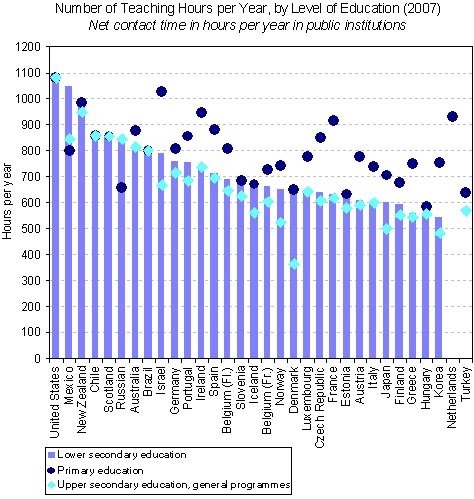
The result: in the United States teachers on average spend more time teaching and receive less pay than those in other countries.

American teachers spend on average 1,080 hours teaching each year. Across the O.E.C.D., the average for most countries is 794 hours on primary education, 709 hours on lower secondary education, and 653 hours on upper secondary education general programs.


teachingtime
Source: OECD


Yet American teachers start at lower salaries and even after 15 years in the profession, earn less money than their international counterparts.

So – assuming Fordham’s absenteeism statistics are accurate – why do public school teachers miss so much school? They’re exhausted from the hours we demand they keep!

But what about charter school teachers? Aren’t they exhausted, too?

Some certainly are.

Working in a charter school often requires grueling hours and fewer benefits. That’s why charters have a higher turnover than public schools.

Since they’re often not unionized, charter schools usually have younger, less experienced staff who don’t stay in the profession long. In fact, they rely on a constant turnover of staff. At many of the largest charter chains such as Success Academy and the Knowledge is Power Program (KIPP), teachers average only 4 years before moving on to another career, according to the New York Times. And this is typical of most charter chains.

So why don’t charter school teachers take as many sick days as traditional public school teachers? Maybe because when they check out, they often don’t check back in.

Moreover, there is a significant difference in the student population at both kinds of school – privatized vs. public.

As their marketing departments will tell you, the students in a charter school choose to be there. The charter schools often weed out the students with behavior problems, special needs or those who are otherwise more difficult to teach. As a result, the strain on teachers may not be as severe. When you’re only serving kids who want to be there and who are easy to teach, maybe you don’t need as much downtime.

Public school teachers, on the other hand, face real dangers from burnout.

According to a study by Scholastic (that actually goes counter to its pro-privatization bias), we work 53 hours a week on average. That comes out to 7.5 hours a day in the classroom teaching. In addition, we spend 90 minutes before and/or after school mentoring, tutoring, attending staff meetings and collaborating with peers. Plus 95 additional minutes at home grading papers, preparing classroom activities and other job-related tasks.

And for teachers who oversee extracurricular clubs, that’s even more work – 11-20 additional hours a week, on average.

Add to that the additional trauma public school children have experienced over the last decade. More than half of public school students now live below the poverty line. That means increased behavior issues, increased emotional disturbances, increased special needs, increased malnutrition, increased drug use – you name it.

Public school teachers deal with that every day. And you seriously wonder that some of us need some downtime during the year to deal with it.

Moreover, let’s not forget the issue of disease.

Working in a public school is to immerse yourself in a petri dish of bacteria and viruses. My first year teaching, I got so sick I was out for weeks until I developed immunities to strains of illnesses I had never been exposed to before.

Kids are constantly asking for tissues and blowing their noses and sometimes not even washing their hands. This is why teachers often purchase the tissues and hand sanitizers that school districts can’t or won’t – we’re trying to stop the spread of infection.

When teachers get sick (and often bring these delightful little maladies home to their spouses, children and families) what do you expect them to do? Continue going to work and further spreading the sickness around to healthy children?

And speaking of illness, let’s talk stress.

Stress is a killer. Do you think pushing the responsibility for the entire school system on to teachers while cutting their autonomy has an effect on teachers individual stress levels?

I can tell you from my own personal experience I had two heart attacks last year. And in the 15 years I’ve been a teacher, my health has suffered in innumerable ways. I’m actually on medication for one malady that makes me immunosuppressed and more susceptible to other illnesses.

So, yeah, sometimes I need to take a sick day. But if you ask most teachers, they’d rather stay in the class and work through it.

Having the day off is often more trouble than it’s worth. You have to plan an entire lesson that can be conducted in your absence, you have to give the students an assignment to do and you have to grade it. Even with the day off, you have a mountain of work waiting for you when you return.

So as a practicing public school teacher, I dispute the findings of the Fordham Institute.

They don’t know what they’re talking about.

They have focused in on data to make their chosen targets, public school teachers, look bad while extolling the virtues of those who work in privatized systems.

There is a manufactured shortage of teachers across the country. We’ve got 250,000 fewer teachers in the classroom than we did before the great recession of 08-09. Yet class enrollment has increased by 800,000 students.

So if we wanted today’s students to have the same experience as those of only a decade ago, we’d need to hire at least 400,000 more teachers.

I wonder why college undergraduates aren’t racing to become education majors. I wonder why there aren’t more incentives to get more teachers in the classroom and why there isn’t a boom of more teaching jobs.

And I wonder why reports like this are talked about as if they were anything but what they are – school privatization propaganda.

My Students Are Addicted to Screens

07BRODY-facebookJumbo

Michael sat at his desk with ear buds inserted, an iPad balanced in front of his eyes and an old fashioned paper book open on his desk.

His head was bopping and weaving. His eyes were transfixed on a YouTube video of an animated soldier blasting away bad guys. And his book was laid out in front of him, largely ignored.

This was during our class’ sustained silent reading time – a period of 15-20 minutes where my 7th grade students were supposed to read self-selected books. Eventually, they’d have to complete a project, but today all they had to do was read.

Still, many used the time the same way as Michael did – lost in cyberspace, merely pretending their eyes gloss over the page.

“And what did the teacher do?” I hear some readers say indignantly.

“If you allow this type of behavior, you’re worse than the child doing it.”

So come with me as I redirect Michael.

“Hey, buddy,” I say.

“Huh?” he responds as if awakened from a dream.

“Are you reading?”

“Uh. Yeah.”

“You’re not just watching that video and ignoring your book?”

“Nope,” he says now fully awake. And he proceeds to give me a canned summary of the text that he memorized from the Internet.

But I’m still skeptical.

“I’m going to take your iPad away just for SSR time,” I say.

BUT WHY!? I’M READING!”

“I just want you to be able to concentrate on what you’re reading.”

And as I gently pry the iPad from his curled fists, he stands up and gives me a look of pure hatred.

This is a look from a 7th grade boy who’s considering violence.

It’s the same look you’d get trying to take away a dog’s bone, or an addict’s crack pipe.

It truly depends on the child what happens next. Some will regain control, slam down into their seats and sulk. Others will whine and cause a scene. And some will lose all control and lash out.

This is what teachers deal with every day when it comes to technology in the classroom.

In point of fact, many of our children are addicted to their devices.
iPads, laptops, Smartphones – we might as well be giving them pills, joints and syringes.

According to Merriam Webster, addiction is defined as, “compulsive need for and use of a habit-forming substance… [characterized] by well-defined physiological symptoms upon withdrawal.”

For most students, their devices have become just that – a compulsion, the cause of a nearly irresistible impulse to check them, access them, use them to keep themselves entertained and plugged in.

With repeated use, it becomes habit forming, and separation from the device can lead to a kind of withdrawal.

From a neuro-psychological point of view, one wonders if repeated use is clinically damaging – especially to adolescent brains that have not yet fully formed.

From an educational point of view, one wonders if relying on such devices in class is pedagogically sound.

I’m not qualified to answer the first question (though it deserves much more study than it is receiving). But from my 15 plus years of experience in the classroom, I feel qualified to answer the second – and that answer is often a resounding “NO.”

In my kids’ everyday lives, this type of constant technology reliance doesn’t make them better students. It doesn’t give them access to more information. It makes them dependent on instant gratification and sensory overload.

Their minds are submerged in a soup of constant noise and conflicting demands for their attention. Stringing together thoughts and coming to reasoned opinions becomes increasingly difficult.

This isn’t to say that technology has no place in the classroom.

There are ways to use it that can enhance learning. However, in my experience these are NOT the ways it is being used most of the time. That takes, thought, planning, intention. Instead, many well-meaning administrators or school directors prescribe technology as an end in itself regardless of the goals of an individual lesson. They want to prove their buildings, schools or districts are cutting edge, and that only takes the constant use of technology – not surgical, intentional use.

It’s not that teachers don’t know how to apply it or don’t care. It’s that technology – especially the presence of a one-to-one device in the hands of every child at all (or most) times – creates more problems than it solves.

This is why the same people who invented these technologies strictly regulate them for their own children.

Bill Gates and Steve Jobs, two of the biggest tech titans in the business, famously limited screen time for theirs sons and daughters.

Gates, a Microsoft co-founder, refused to let his children have personal technological devices until they were developmentally ready for them.

“We don’t have cellphones at the table when we are having a meal,” he told the Mirror. “We didn’t give our kids cellphones until they were 14 and they complained other kids got them earlier.”

Today, most children get their own cellphones at age 10. And if their schools have one-to-one initiatives like mine, they have their own iPad as early as 5th grade with less but still substantial hours of usage as early as kindergarten.

Jobs, an Apple co-founder, also limited screen time for his children.

When asked if his children liked the original iPad shortly after it was launched, Jobs said, “They haven’t used it. We limit how much technology our kids use at home.”

In fact, according to Walter Isaacson, who wrote a near-definitive Jobs’ biography, technological devices were only allowed at prescribed times.

“Every evening Steve made a point of having dinner at the big long table in their kitchen, discussing books and history and a variety of things,” he said.

“No one ever pulled out an iPad or a computer. The kids did not seem addicted at all to devices.”

And this practice seems common among parents in Silicon Valley.

According to educators Joe Clement and Matt Miles, authors of “Screen Schooled: Two Veteran Teachers Expose How Technology Overuse is Making Our Kids Dumber,” those in the tech industry know the dangers of their own products on children.

A number of specialty Silicon Valley schools, say Clement and Miles, such as the Waldorf School, rely almost exclusively on low-tech tools to teach. This often means chalkboards and pencils. The emphasis is on learning interpersonal skills such as cooperation and respect – not the ins and outs of computer coding.

At Brightworks School, even the physical environment of the class is a tool to learning. Students attend class in treehouses and kids learn creativity by building things with their hands.

This is a far cry from the technological wonderland our kids are being sold by these kids’ parents.

No one really knows what effect it’s having on growing minds. However, psychologists are beginning to see alarming trends.

For instance, frequent use of social media makes an eighth-grader’s risk for depression 27% higher. Moreover, use of smart phones for at least three hours a day increases children’s risk of becoming suicidal. Some experts believe that increased use of technology has contributed to the teen suicide rate which for the first time eclipses the homicide rate.

We are jumping head first into an educational model that puts technological devices like a tablet at the center of learning.

Teachers assign lessons on the device. Students complete assignments on it. Projects are virtual as is research. Even conversations are conducted through a chat page, emails or messaging.

Why? Not necessarily because of any proven link to increased academic results. It’s because tech companies are marketing their devices to schools and students.

This is industry-driven, not pedagogically-driven.

There is an unquestioned bias that doing things with technology is somehow better simply because we’re using technology. However, an article written on a computer will not necessarily be better than one written with pen and ink. There are other factors involved.

Now Gates and company are pushing personalized learning objectives. Sometimes called competency based education, these continue to place the device in the center of what should be the student-teacher relationship.

Student learning becomes a video game and the teacher becomes a virtual avatar. Kids spend their time doing infinite standardized testing as if it were authentic education, yet it’s all on-line so it appears to be cutting edge. It isn’t.

It’s just another scam.

In my own classes, I’ve put the brakes on unquestioned technology. I only use devices, programs or applications that are (1) reliable and (2) when I know why I’m using them.

Even then, I find myself unable to even talk to students without beginning every lesson telling them to at least temporarily put their devices away so they can hear the directions.

Sure, I could give them a QR code to scan and get a written copy of the directions. I could upload a video for them to watch. But that limits direct feedback. It makes it more difficult for them to ask questions. And it makes it almost impossible for me to tell if 20-30 kids are actually doing the assignment before they turn it in for grading.

These are just kids, and like kids in any age they’ll take the path of least resistance. Often they’ll try to get through the assignment as quickly as possible so they can listen to music, or watch a video, or play a video game or chat on-line.

Lessons can be engaging or thought-provoking or spark the creative impulse. But you have to get students’ attention first.

That’s hard to do when they always have the option to crack their brains open over a virtual frying pan and watch it sizzle away.

To be fair, living in the modern world, we’re probably all somewhat addicted to technology. This blog isn’t written on papyrus and it isn’t being accessed in a hefty library volume.

I use social media – Facebook and Twitter mainly – to disperse it.

But there’s a difference between me and my students.

I’m an adult.

I know the concessions I’m making. I enter into this with eyes open. I have a lifetime of experience and knowledge with which to make such a decision.

Children don’t have that. They look to us to protect them.

We are their guardians. We’re only supposed to subject them to things that will help them learn, keep them healthy and happy.

But in our rush to be trendy and hip, we’re failing them miserably.

We’re letting business and industry take over.

It’s time to take a stand.

Our kids may be addicted, but we don’t have to be their pushers.

We need to get them clean and show them how to use this brave new tool with moderation and restraint.