Farcical Senate Closer to Selling Education Secretary Position to Highest Bidder

636203281251576440-gty-631920418


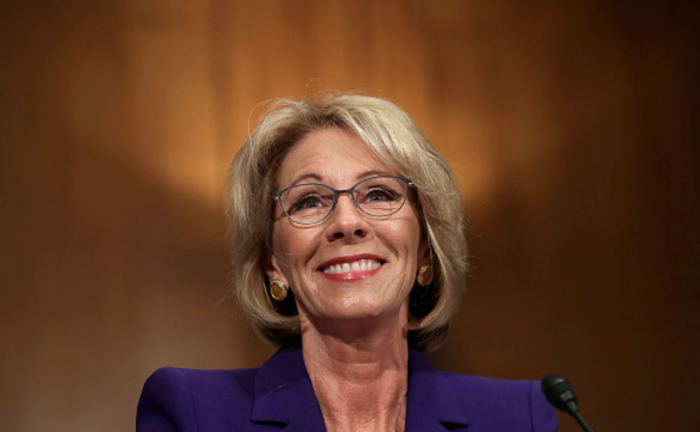
Unqualified billionaire Betsy DeVos is one step closer to becoming our next Education Secretary.


In one of the most embarrassing displays of subservience, once-respected Sen. Lamar Alexander (R-TN) pushed the nomination through committee this afternoon despite numerous objections from Democrats.


The Senate Health, Education, Labor and Pensions (HELP) Committee voted along party lines 12-11 to bring DeVos before the full Senate. A final vote has not yet been scheduled.


DeVos has next to zero experience with public schools. She never attended one. Her children never attended one. She never taught in one. Nor does she even have a degree in education.


Her entire experience is bribing policymakers to enact Common Core, push school choice measures and reduce transparency at charter schools – measures that have gutted public schools in her home state of Michigan.


At her confirmation hearing two weeks ago, DeVos’ ignorance of even the most basic education knowledge was laughably on display.

She wouldn’t commit to protecting students with special needs.

She wouldn’t commit to keeping guns out of school campuses.

She wouldn’t commit to holding charter and voucher schools to the same standards as traditional public schools.

She didn’t know the Individuals with Disabilities Education Act (IDEA) was a federal law.

And she couldn’t explain the difference between proficiency and growth, two of the most common academic terms.

DeVos entire qualifications are that, along with her family, she has donated around $200 million to mostly Republican lawmakers.

That includes direct donations to at least five members of the HELP Committee:

Sen. Bill Cassidy (R-LA) – $70,200

Sen. Tim Scott (R–SC) – $49,200

Sen. Todd Young (R-IN) – $48,600

Sen. Richard Burr (R-NC) – $43,200

Sen. Lisa Murkowski (R-AK) – $43,200

If you add in PACS funded by DeVos and family, the number jumps to 10 members of the committee including Sen. Alexander, himself.

Senators have been bombarded by calls from constituents not to confirm DeVos, but greenbacks apparently talk much louder than our fragile excuse-for-a-Democracy.

However, two GOP members of the committee said that their votes today do not necessarily guarantee support on the final vote.

Sen. Susan Collins, (R-ME) and Sen. Murkowski said they were approving DeVos out of deference to Donald Trump. In effect, the President can nominate whomever he likes, and the Senate should vote on it.

Both Collins and Murkowski said they’re still concerned about DeVos’ seeming lack of commitment to enforce laws protecting disabled students and other policies.


“I would advise she not yet count on my vote,” Murkowski said.


The Senate, just like the HELP Committee, is controlled by Republicans. DeVos is only another party line vote away from becoming Secretary of Education.


It is a position that she has apparently already bought and paid for.


Along with her deep ignorance and antipathy toward public schools, Democrats object to DeVos’ financial entanglements. She has already agreed to divest herself from more than 100 investments at the urging of the nonpartisan Office of Government Ethics. However, it is difficult to gauge how deeply she is committed to enterprises that could benefit her financially through her position, if confirmed. It is hard to imagine any other candidate for the position with as many ties to for-profit enterprises potentially biasing decisions that should be made for the benefit of the nation’s children and not personal gain.


Meanwhile, the ranking Democrat in the HELP committee, Sen. Patty Murray, (D-WA), claims that DeVos may have plagiarized her written answers to questions asked by her committee.


DeVos seems to have nearly quoted a Justice Department press release, a magazine article, federal statutes, and Education Department materials without attribution, seemingly passing them off as her own responses, Murray said.

These are mistakes that would earn a public school student a failing grade. Apparently standards are much lower for government office.

Teachers must have advanced degrees just to preside over a classroom. DeVos will be presiding over the nations schools.

It is next to impossible to claim that her nomination is moving forward based on merit.

Our children will be left vulnerable to the whims of a woman who has no idea what she’s doing and has demonstrated a desire to destroy their schools.

If Republicans (and Democrats) have any spine at all, the time has come to show it. Or else just take your dirty money and shut up.

Trump says our schools are “Flush with Cash!?” They’re Falling Apart!

img_6296

Donald Trump lies.

If you haven’t learned that yet, America, you’ve got four more cringe-inducing years to do so.

Even in his inaugural address, he couldn’t help but let loose a whooper about US public schools.

“Americans want great schools for their children, safe neighborhoods for their families and good jobs for themselves,” he said. “But for too many of our citizens, a different reality exists. … An education system flush with cash but which leaves our young and beautiful students deprived of all knowledge.”

To which nearly every poor, nonwhite public school parent, student and teacher in the country replied, “What’s that heck did he just say now!?”

Los Angeles Unified School district routinely has broken desks and chairs, missing ceiling tiles, damaged flooring, broken sprinklers, damaged lunch tables and broken toilet paper dispensers.

They’re flush with cash!?

New York City public schools removed more than 160 toxic light fixtures containing polychlorinated biphenyls, a cancer causing agent that also hinders cognitive and neurological development. Yet many schools are still waiting on a fix, especially those serving minority students.

They’re flush with cash!?

At Charles L. Spain school in Detroit, the air vents are so warped and moldy, turning on the heat brings a rancid stench. Water drips from a leaky roof into the gym, warping the floor tiles. Cockroaches literally scurry around some children’s classrooms until they are squashed by student volunteers.

They’re flush with freakin cash!?

Are you serious, Donald Trump!?

And this same picture is repeated at thousands of public schools across the nation especially in impoverished neighborhoods. Especially in communities serving a disproportionate number of black, Latino or other minority students.

In predominantly white, upper class neighborhoods, the schools often ARE “flush with cash.” Olympic size swimming pools, pristine bathrooms – heck – air conditioning! But in another America across the tracks, schools are defunded, ignored and left to rot.

A full 35 states provide less overall state funding for education today than they did in 2008, according to the Center on Budget and Policy Priorities, which focuses on reducing poverty and inequality. Most states still haven’t recovered from George W. Bush’s Great Recession and the subsequent state and local budget cuts it caused. In fact, over the same period, per pupil funding fell in 27 states and still hasn’t recovered.

And the federal government has done little to help alleviate the situation. Since 2011, spending on major K-12 programs – including Title I grants for underprivileged students and special education – has been basically flat.

The problem is further exacerbated by the incredibly backward way we allocate funding at the local level which bears the majority of the cost of education.

While most advanced countries divide their school dollars evenly between students, the United States does not. Some students get more, some get less. It all depends on local wealth.

The average per pupil expenditure for U.S. secondary students is $12,731. But that figure is deceiving. It is an average. Some kids get much more. Many get much less. It all depends on where you live. If your home is in a rich neighborhood, more money is spent on your education than if you live in a poor neighborhood.

The U.S. is one of the only countries in the world – if not probably the ONLY country – that funds schools based largely on local taxes. Other developed nations either equalize funding or provide extra money for kids in need. In the Netherlands, for example, national funding is provided to all schools based on the number of pupils enrolled. But for every guilder allocated to a middle-class Dutch child, 1.25 guilders are allocated for a lower-class child and 1.9 guilders for a minority child – exactly the opposite of the situation in the U.S.

So, no. Our schools are not “flush with cash.” Just the opposite in many cases.
But what about Trump’s other claim – the much touted narrative of failing schools?

Trump says our schools “leave… our young and beautiful students deprived of all knowledge.”

Not true.

Graduation rates are at an all-time high of 83.2 percent. Moreover, for the first time minority students are catching up with their white counterparts.

It’s only international comparisons of standardized test scores that support this popular myth of academic failure. And, frankly, even that is based on a warped and unfair reading of those results.

It depends on how you interpret the data.

Raw data shows US children far from the top of the scale. It puts us somewhere in the middle – where we’ve always been for all the decades since they’ve been making these comparisons. Our schools have not gotten worse. They have stayed the same.

However, this ignores a critical factor – poverty. We’ve known for decades that standardized tests are poor measures of academic success. Bubble tests can assess simple things but nothing complex. After all, they’re scored based on answers to multiple choice questions. In fact, the only thing they seem to measure with any degree of accuracy is the parental income of the test-taker. Kids from rich families score well, and poor kids score badly.

Virtually all of the top scoring countries taking these exams have much less child poverty than the U.S. If they had the same percentage of poor students that we do, their scores would be lower than ours. Likewise, if we had the same percentage of poor students that they do, our scores would go through the roof! We would have the best scores in the world!

Moreover, the U.S. education system does something that many international systems do not. We educate everyone! Foreign systems often weed children out by high school. They don’t let every child get 13 years of grade school (counting kindergarten). They only school their highest achievers.

So when we compare ourselves to these countries, we’re comparing ALL of our students to only SOME of theirs – their best academic pupils, to be exact. Yet we still hold our own given these handicaps!

This suggests that the majority of problems with our public schools aren’t bad teachers, or a lack of charter schools and school choice. It’s money, pure and simple.

We invest the majority of our education funding in rich white kids. The poor and minorities are left to fend for themselves.

This won’t be solved by Trump’s pick for Education Secretary, Betsy DeVos and her school choice schemes. In fact, that’s exactly what’s weakened public schools across the country by leaching away what meager funding these districts have left. Nor will it be solved by a demagogue telling fairy tales to Washington’s credulous and ignorant.

We need to make a real investment in our public schools. We need to make a commitment to funding poor black kids as fairly as we do rich white kids.

Otherwise, the only thing flushed will be children’s future.

Ignorance and Arrogance – the Defining Characteristics of the Betsy DeVos Hearing

betsydevos-png-crop-cq5dam_web_1280_1280_png

Betsy DeVos wouldn’t commit to protecting students with special needs.

She wouldn’t commit to keeping guns out of school campuses.

She wouldn’t commit to holding charter and voucher schools to the same standards as traditional public schools.

She didn’t know the Individuals with Disabilities Education Act (IDEA) was a federal law.

And she couldn’t explain the difference between proficiency and growth.

That’s your nominee for Secretary of Education, America!

During a hearing of the Senate Committee on Health, Education, Labor and Pensions (HELP) tonight, DeVos showed herself to be hopelessly out of her depth.

She tried to cover her ignorance by being noncommittal. But it was obvious that she had no idea what she was talking about more than half the time.

And far from being a fair arbiter, Senator Lamar Alexander, the Republican chairperson of the committee, did everything he could to shield her from further embarrassment. He artificially limited each member of the committee to only five minutes of questions.

Why? Because in the past the committee had fewer questions for President Barack Obama’s nominees for the position, Arne Duncan and John King.

What a farce! Duncan and King were terrible Education Secretaries, but at least they had some experience in the field! Duncan was Superintendent of Chicago Public Schools. King started his own charter school and was New York Commissioner of Education.

Betsy DeVos was never anything. She has never held a real job. She’s never had a job interview, nor has she ever been hired by anyone!

Her entire portfolio is being a rich Republican mega-donor. All she’s ever done is use her and her family’s obscene fortune to push for school vouchers, remove charter school accountability, advocate for Common Core and persecute LGBT people.

Of course there will be more questions! It’s not because she’s a Republican or that she was nominated by GOP President-elect Donald Trump!

It’s because she’s a twit!

Moreover, she hasn’t yet been cleared of conflicts of interest from the ethics commission nor have her financial disclosures been made public.

But no worries. Big Daddy Alexander was there to protect her from Senators on both sides of the aisle who had pointed questions for her about her experience, knowledge and about what she planned to do to public education if confirmed.

Never in the history of this nation has a more unqualified candidate been presented for such an important job.

How ironic that under the Trump administration we’re presented with a potential Education Secretary so in need of education, herself!

It’s an insult to the nation’s parents, students and teachers.

So how did she even get here?

Money.

She’s given nearly $2.7 million in political donations to 370 individuals and causes over the past 20 years through 819 total contributions, according to the National Institute on Money in State Politics. A little more than $2 million of that has gone to Republican candidates or causes, while a mere $8,000 went to Democratic candidates or groups.

That includes at least five members of the HELP Committee who will get to vote on her nomination. Sen. Tim Scott (R–SC) has received $49,200 from the DeVos family and was a keynote speaker at DeVos’ American Federation for Children annual summit in May 2016. Sen. Bill Cassidy (R-LA) has received at least $70,200 from the DeVoses. Two other HELP committee members, Sens. Richard Burr (R-NC) and Lisa Murkowski (R-AK), each have received $43,200 from the family. Newly elected Sen. Todd Young (R-IN) got $48,600 from the DeVos family in 2016.

However, those are just direct donations. Ten members of the HELP committee have received donations from Alticor Political Action Committee, or ALTIPAC. This PAC belongs to Alticor, the DeVos family company and parent company of Amway—the multilevel marketing giant that fueled the DeVos family fortune—and receives nearly half of its funds from the DeVos family. This includes Sen. Alexander, himself, who received $4,500 from ALTIPAC.

Devos has been rather upfront in the past about why she’s donated so much money to politicians.

In a 1997 op-ed she wrote for the Capitol Hill newspaper Roll Call, DeVos explained: “[M]y family is the largest single contributor of soft money to the national Republican party… I have decided, however, to stop taking offense at the suggestion that we are buying influence. Now, I simply concede the point… We expect a return on our investment.”

This is something she shares with Trump, who has also bragged about paying for influence with his own campaign donations. “I’ve given to everybody. Because that was my job,” Trump bragged at a rally last January. “I gotta give it to them. Because when I want something, I get it. When I call, they kiss my ass.”

That’s what we saw tonight on Capital Hill. It wasn’t a confirmation hearing. It was a bunch of bought politicians lining up to kiss DeVos’ white privileged butt.

There was resistance, but to what end?

Reason, knowledge, ethics – none of that matters here. We are truly in the age of the plutocrats where money has arrogantly attempted to buy governmental power outright. Right in front of our noses.

Only time will tell if she is ultimately confirmed.

In the meantime, our system of public education hangs in the balance.

The Racists Roots and Racist Indoctrination of School Choice

screen-shot-2017-01-15-at-8-10-02-am

“Simple justice requires that public funds, to which all taxpayers of all races contribute, not be spent in any fashion which encourages, subsidizes, or results in racial discrimination.”
-President John F. Kennedy

“Injustice anywhere is a threat to justice everywhere.”
-Dr. Martin Luther King, Jr.

Billionaires and far right policymakers are pushing for school choice.

I say they’re pushing for it because voters always turn it down.

Every single referendum held on school choice in the United States has been defeated despite billions of dollars in spending to convince people to vote for it.

But advocates aren’t discouraged that the public isn’t on their side. They have money, and in America that translates to speech.

The Donald Trump administration is dedicated to making our public schools accept this policy whether people want it or not.

But don’t think that’s some huge change in policy. The previous administration championed a lighter version of these market-driven plans. The main difference goes like this: Democrats are for charter schools and tax credits for private and parochial schools. Republicans are for anything that calls itself a school getting your tax dollars – charter schools, private schools, religious schools – if some charlatan opens a stand on the side of the road with the word “school”in the title, they get tax dollars.

In all this rush to give away federal and state money, no political party really champions traditional public schools. Ninety percent of children attend them. In opinion polls, a majority of Americans like their local community schools. But like most things Americans want, politics goes the other way. Universal healthcare? Have Romneycare. Universal background checks on all gun sales? Nah. That sort of thing.

However, what often gets lost in the rush of politicians cashing in on this policy is its racist roots.

You read that right. School choice was invented as a mechanism of white flight. Before the federal government forced schools to desegregate, no one was all that interested in having an alternative to traditional public schools. But once whites got wind that the Supreme Court might make their kids go to school with black kids, lots of white parents started clamoring for “choice.”

It was intended as a way to get around Brown vs. Board. In 1953, a year before that landmark decision, many white southerners felt it was vitally important to continue a segregated education. They deeply desired to continue having “separate but equal” schools for the races, yet the US Supreme Court seemed ready to strike that down.

Enter Georgia’s Gov. Herman Talmadge who created what became known as the “private-school plan.” Talmadge proposed an amendment to the Georgia Constitution to empower the general assembly to privatize the state’s public education system. “We can maintain separate schools regardless of the US Supreme Court by reverting to a private system, subsidizing the child rather than the political subdivision,” Talmadge said.

The plan goes like this. If the Supreme Court mandates desegregation (as it did), the state would close the schools and issue vouchers allowing students to enroll in segregated private schools.

Fortunately, Talmadge’s plan was never implemented in Georgia. But it became the model for segregationists everywhere.

In Prince Edward County, Virginia, the plan actually came to fruition – sort of.

Two years before the 1959 federal desegregation deadline, local newspaper publisher J. Barrye Wall explained what county leaders were planning:

“We are working [on] a scheme in which we will abandon public schools, sell the buildings to our corporation, reopen as privately operated schools with tuition grants from [Virginia] and P.E. county as the basic financial program,” he wrote. “Those wishing to go to integrated schools can take their tuition grants and operate their own schools. To hell with ’em.”

Ultimately the county refused to sell the public school buildings. However, public education in Prince Edward County was nevertheless abandoned for five years, from 1959 to 1964. During that time, taxpayer dollars were funneled to the segregated white academies, which were housed in privately owned facilities such as churches and the local Moose Lodge.

The federal government struck down the program as a misuse of taxpayer funds after only a year, but even so whites benefited and blacks lost. Since there were no local taxes collected to operate public schools during those years, whites could invest in private schools for their children, while blacks in the county were left to fend for themselves. Since they were unable and unwilling to finance their own private, segregated schools, many black children were simply shut out of school for multiple years.

In other states, segregationists enacted “freedom of choice” plans that allowed white students to transfer out of desegregated schools. Any black students that tried to do the same had to clear numerous administrative hurdles. Moreover, entering formerly all-white schools would subject them to harassment from teachers and students. Anything to keep the races apart in the classroom – and usually the entire building.

Eventually, segregationists began to realize that separate black and white schools would no longer be tolerated by the courts, so they had to devise other means to eliminate these “undesirables.”

Attorney David Mays, who advised high-ranking Virginia politicians on school strategy, reasoned:

“Negroes could be let in [to white schools] and then chased out by setting high academic standards they could not maintain, by hazing if necessary, by economic pressures in some cases, etc. This should leave few Negroes in the white schools. The federal courts can easily force Negroes into our white schools, but they can’t possibly administer them and listen to the merits of thousands of bellyaches.”

Mays turned out to be somewhat prescient. Though desegregation efforts largely succeeded at first, in the last 20-30 years whites accomplished through housing and neighborhood segregation what they couldn’t legally enforce through outright school segregation. District lines were drawn to minimize the number of blacks at predominantly white schools and vice versa. Moreover, since funding was often tied to local property taxes, whites could legally ensure black schools got less resources than white schools. And with standardized tests constantly showing students at these schools as failing, policymakers could just blame the school instead of what they’d done to set the school up for failure.

Today racist policies undermine much of the structure of our public schools. We should acknowledge this and work to peel it back. We need to ensure all schools are equitably funded, that class sizes are under control, that all students get a broad curriculum and the services they need. But in the absence of a new, robust desegregation policy, our schools will always be in danger of racist programs that can easily select which students to benefit and which to ignore.

Instead of doing this hard work, we’re engaged in resurrecting the school choice policies of the deep South and universalizing them across the country. School vouchers are extremely similar to Talmadge’s private school plan. The main difference is that vouchers don’t close public schools outright, they simply allow them to be defunded and ignored. With universal school vouchers, public schools often become the de facto holding area for whichever group of children the private schools refuse to accept or who can’t afford private school tuition even with the vouchers.

Charter schools are built on the Prince Edward County model. They’re administered as private institutions yet claim to be somehow public. As a result, they’re allowed to bypass many of the rules that protect students at public schools from discrimination and fraud. In effect, they’re largely unregulated. In the modern age, that means they can be incredibly substandard for long periods of time and no one knows or intervenes. The kinds of scandals perpetrated at some charter schools are simply not possible at traditional public schools. Some charters close without notice, have facilities used as nightclubs, involve taxpayer funds used for non-school purposes such as apartments for mistresses, the purchase of yachts, etc.

In both cases, charters and voucher schools often cater to mostly one race rather than another. That increases segregation at both these facilities and traditional public schools. But voucher schools can go a step further. They can even put racism on the curriculum.

Supporting the racial order is often what’s actually being taught at private and religious schools. They are infamous for revisionist history and denying climate science. What’s less well-known is how they often try to normalize racist attitudes.

The American Christian Education (ACE) group provides fundamentalist school curriculum to thousands of religious schools throughout the country. Included in this curriculum is the A Beka Book and Bob Jones University Press textbooks.  A Beka publishers, in particular, reported that about 9,000 schools nationwide purchase their textbooks.

These books include the following gobsmackers:

“[The Ku Klux] Klan in some areas of the country tried to be a means of reform, fighting the decline in morality and using the symbol of the cross. Klan targets were bootleggers, wife-beaters, and immoral movies. In some communities it achieved a certain respectability as it worked with politicians.”
—United States History for Christian Schools, 3rd ed., Bob Jones University Press, 2001

“God used the Trail of Tears to bring many Indians to Christ.”
—America: Land That I Love, Teacher ed., A Beka Book, 1994

“A few slave holders were undeniably cruel. Examples of slaves beaten to death were not common, neither were they unknown. The majority of slave holders treated their slaves well.”
—United States History for Christian Schools, 2nd ed., Bob Jones University Press, 1991

“To help them endure the difficulties of slavery, God gave Christian slaves the ability to combine the African heritage of song with the dignity of Christian praise.  Through the Negro spiritual, the slaves developed the patience to wait on the Lord and discovered that the truest freedom is from the bondage of sin. By first giving them their spiritual freedom, God prepared the slaves for their coming physical freedom. ”
-Michael R. Lowman, George Thompson, and Kurt Grussendorf, United States History:  Heritage of Freedom, 2nd ed. (Pensacola, FL: A Beka Book, 1996), p. 219.

“Africa is a continent with many needs. It is still in need of the gospel…Only about ten percent of Africans can read and write. In some areas the mission schools have been shut down by Communists who have taken over the government.”
—Old World History and Geography in Christian Perspective, 3rd ed., A Beka Book, 2004

Gay people “have no more claims to special rights than child molesters or rapists.”
—Teacher’s Resource Guide to Current Events for Christian Schools, 1998-1999, Bob Jones University Press, 1998

Brown v. Board of Education is described as social activism by the Supreme Court: “While the end was a noble one – ending discrimination in schools – the means were troublesome… liberals were not willing to wait for a political solution.”
-Teacher’s Resource Guide to Current Events for Christian Schools, 1998 – 1999 (Greenville, SC: Bob Jones University Press, 1998), p. 34

These are claims that are uncritically being taught to children at many voucher schools. If this were happening only at private schools, it would be troubling that racists were indoctrinating their children in the same hatred and bigotry of their parents. However, that we’re actually using public money – and planning to expand the amount of public money – to increase the racism and prejudice of the next generation is beyond troubling! It’s infuriating!

School choice does not enhance civil rights. It is inimical to them. It is part of a blatant policy to make America racist again. We cannot allow the Trump administration and any neoliberal Democrats who quietly support his ends to undo all the progress we’ve made in the last 60 years.

The bottom line is this – voters don’t want school choice. It does nothing to better childrens’ educations. It is a product of segregation and racism and even in its modern guise it continues to foster segregation and racism.

If we care about civil rights, social equality and democratic rule, school choice is something that should be relegated to the dust heap of history. It’s time to move forward, not look back fondly on the Confederacy, Jim Crow and segregationism.

Self-Serving Public Servants – Trump, DeVos and the Rise of the Plutocrats

screen-shot-2017-01-10-at-2-47-00-pm


This election cycle we have witnessed a subtle change to our political landscape – and it’s probably not the one you’re thinking about.


It’s not that Republicans have gained control of a large chunk of our government. It’s not that racists, anti-feminists and xenophobes have been emboldened by their Presidential pick winning the highest office in the land. It’s not even that the Democrats have been exposed as weak, blind and cheaply bought.


Well, it’s not just those things.


There’s something deeper and even more unprecedented going on here.


It used to be that the wealthy bribed politicians to do their bidding. Now the wealthy are becoming the politicians.


I don’t mean just millionaires. They’ve always been willing to fill an elected office. I mean the mega-rich. I mean billionaires. The Crassuses, The Midases, the Astors, The Rockefellers.


Sure, many lawmakers on both sides of the aisle have always used their offices to enrich themselves. They enter the houses of government as moderately middle class but leave with pockets bursting and the opportunity to snag even more riches in the future as corporate lobbyists for the industries they were supposed to be regulating.


But now people aren’t making their fortunes in Washington. They’re entering the ring already in possession of obscene wealth. And they’re using it out in the open to tell the rest of us what to do.


This is a profound change in the Trump administration. It’s a change signaled by the President-elect, himself, and those he’s picked to serve on his cabinet of billionaires.


Until recently, Trump was no politician. He was a conman and reality TV star. He was the rich child of a rich man who spent his inheritance buying stuff, went bankrupt, and then called himself a businessman.


To help aide him in his deceptions, he used his fortune to purchase politicians. He famously donated to Hillary Clinton in 2008. Why? Because she represented his interests.


Now Trump has forgone the middlewoman. He’s taken the stage, himself. He isn’t pushing his interests forward by giving money to some accepted establishment figure. He is pretending to be that establishment figure, himself. More accurately, he’s pretending to be a maverick. After all, he was the guy who was going to Washington to drain the swamp – yet all he’s done is import more alligators, vines and toxic swamp water.


And he’s not alone. He’s championed other wealthy puppet masters to do the same.


Look at his pick for Secretary of Education, Betsy DeVos.


Her entire career consists of bribing lawmakers so they’ll enact market-driven education policies that benefit herself and other members of her exclusive country club. Huge corporations, hedge fund managers, corporate raiders preying on public schools – everyone gets a piece. Her and her family of privileged religious fanatics and warmongers have pushed for unregulated charter schools, vouchers for tax funding of religious and private schools, and the spread of Common Core for all. None of it affects her or her children who never attended public school. It’s all a matter of ideology and profit so entwined that even she probably doesn’t know which is which anymore.


To be Secretary of Education used to require a knowledge of… things, not a sizable bankbook. It used to require some years of experience in the area of education or government. You had to be a teacher or run a school or a district. You had to have at least served in some major capacity as a public servant, as a governor or senator.


DeVos has done none of these things. Neither has Trump, in fact. But both have given money to so-called establishment political figures to do what they want. And the same could be said for most of his cabinet picks.


In effect, the Trumpsters have pulled down the curtain between Oz the Great and Powerful and the man pulling the strings. They aren’t hiding behind the anonymity of their donations anymore. The rats have crawled out of the woodwork and are doing the job, themselves.


It’s somewhat unprecedented.


One wonders what will happen if the trend continues. Will we see other wealthy figures take center stage? Will the philanthrocapitalists like Bill Gates run for office? Will the Koch Brothers take matching Senate seats? Will George Soros be appointed Supreme Court Justice? Is Mark Zuckerberg running for Governor?


It is very possible. This may be the age of the plutocrat. And the fascist.


It certainly shows a lack of fear on their part and a disdain for the voting public.


They used to think that we wouldn’t put up with this crap. They used to think that they had to preserve at least the facade of a democracy. Our public servants, we were told, are just little people like us, people of conscience who volunteer to serve the public good. It wasn’t true. Most of them were bought and sold – but now the wealthy aren’t even bothering with the act.


They have become so overconfident that they think they can stand out in the open and make the rules themselves – in person.


And we won’t do a damn thing.


Certainly there is no opposition party. The Democrats are almost as corrupt as the Republicans, and what’s more, they’re much weaker. After 8 years of President Obama, they’ve only lost more state houses, more governors’ mansions, more political offices and prestige. Whenever they’ve been in a position to actually oppose the plutocracy, they’ve mostly limited themselves to empty, symbolic gestures or even tried to mimic the worst behaviors of the GOP.


To be fair, there is a mounting insurgency within the Democrats lead by people like Bernie Sanders, Keith Ellison and (to some degree) Elizabeth Warren. But it is a nascent movement at present with an uncertain future. It certainly isn’t worrying the plutocrats unchained.


The real wild card here is you.


Yes, you.


What will you do now that those ruling the world have come out of the shadows? Will you submit to their dominion or will you rise up and fight?


That is the question to which no one yet knows the answer. And it is the only opposition that can take back our government, our freedoms, and our democracy.


You and me. We make up the numerical majority. When do we get a say? When will we have had enough of being ruled? When will we reject the lottery of birth? When will we rise up and take back what’s rightfully ours?

Why Schools Should NOT Be Run Like Businesses

school-closures

America loves business.


We worship the free market. Nothing is more infallible – not reason, not morals, not even God.


Money is the true measure of success – the more you have, the better a person you are.


This perverted ideology has taken over much of American life. Where we once cared about our country, justice and fair play, today it has all been reduced to dollars and cents.


Every problem can be answered by business. Every endeavor should be made more business-like. Every interaction should be modeled on the corporate contract, and every individual should try to maximize the outcome in his or her favor. Doing so is not just good for you, personally, but it’s what’s best for everyone involved. And this dogma is preached by the high priests of the market who claim that as they, themselves, get wealthier, one day we too will reap the same rewards – but that day never seems to come.


These principles are articles of faith so deeply ingrained that some folks can’t see past them. They have become the driving force behind our country and much of the world. Meanwhile, most people get ever poorer, our environment gets increasingly polluted and everything is up for sale.


One of the last holdouts against this market-driven nightmare is the public school system.


We still have widespread educational institutions run democratically at public expense dedicated to providing every child with the tools and opportunities to learn.


They’re not perfect. Far from it. But they enshrine one of the last vestiges of the America of our grandparents. Democracy and justice are the system’s core values – not profit, expansion and market share.


However, our schools suffer from disinvestment. Since we’ve segregated the rich from the poor into privileged and impoverished neighborhoods, it’s easy to provide more funding and resources to wealthy children and less to poor ones. That’s the main reason why some schools struggle – they haven’t the resources of the Cadillac institutions. Whenever we look at school spending, we look at an average allotment never bothering to consider that most of that money goes to children of the wealthy and much less to poor kids. Nor do we consider that more than half of our public school students live below the poverty line. Public schools strive to overcome the barriers of poverty, but the way we fund them ensures many of them are burdened by these same factors.


To make matters worse, our federal and state governments have allowed huge corporations to profit off our schools through an industry based on constant standardized testing and then selling schools the remediation materials to pass the tests. That’s all Common Core is – a more efficient way to market text books and test prep materials regardless of their inherent value (or lack thereof) to students. The same people criticizing public schools for being untouched by a business ethic often ignore how much they have already been brutalized by free market capitalism and the profit motive.


In any case, despite all these encumbrances, these problems are all surmountable. Doing so only requires us to go in the opposite direction away from the boardroom and the Wall Street subprime bubble. We need to work intrinsically for the good of each student. We need to see them as ends in themselves and not just incidentally for how much profit they can generate.


Unfortunately, such a solution is inconceivable to those in power. It goes against everything in which they believe. Too many Americans have been converted to the cult of the market so that the only solution they can support is to double down on what’s not working – to turn public schools even further into a business.


It’s absurd. Not everything benefits from being sold for a profit. Imagine if your spouse suggested running your marriage that way. It would turn you both into prostitutes selling yourselves at ever cheaper rates while any self respect, dignity and love disappeared.


Some things just are not for sale. Would you give up your deepest held convictions because doing so might help you turn a profit? Today I’m not a Christian, I believe in Baal because he’s got a bigger market share. Today I’m skeptical about gravity because the Acme Parachute Company is offering a bonus to jump out of the tenth floor naked.


Only fools let themselves be manipulated in this way. And that’s exactly what corporations and big business are trying to do with our public schools. Make no mistake. These are our institutions – they belong to us – yet privateers see a way to gobble up tax dollars while downgrading the services provided. They want to play us all for suckers even if it means leaving the next generation of poor and middle class children in the lurch. The only thing that matters to them is making bank.


They say we should run schools like a business? What kind of business exactly?


There are many different kinds of free enterprise. A coal company runs much differently from a restaurant, for example.


Public schools are nothing like any for-profit business. Sure, historically we’ve had a small percentage of private schools, but our country has never survived on an education system that is wholly private. By definition, the model does not work for everyone. That’s what the term “private” means – belonging to one person or group and not another. Our schools traditionally serve everyone. No single business in the country does that day-in-day-out. Perhaps we could find some new paradigm that would fit public schools, but let’s not pretend we can take some business model that already exists and apply it willy nilly. At the start, this mindset is naive at best.


Second, most businesses fail.


Most public schools succeed. They have a proven track record. Why are we going to jump to a model that builds its success on the failure of competitors?


Competition means there will be winners and losers. That’s fine in sports. It’s even fine in most goods and services. There’s not so much at stake. If I go to a bad restaurant, I have a bad meal. No big deal. I just go somewhere else tomorrow. If I get a bad education, there is no do over. I’m screwed.


That’s just not acceptable. Would you bet your life on opening a new restaurant? Would you bet your child’s education? Schools might not live up to your expectations, but the system isn’t set up from the outset so that some of them will eventually crash and burn.


Third, businesses get to choose their raw materials. If you’re making pizzas, you buy the best grains, cheese, tomatoes, etc. But public schools don’t get to choose their students. They have to teach even those who are more difficult to instruct. They accept kids with special needs, kids who’ve been abused, who live in poverty, who are undernourished, etc. And that’s how it needs to be.


If we were to follow the typical business model where the goal is merely profit, we would try to find ways to weed out these difficult students and make them someone else’s problem. In fact, that’s exactly what many privately-run charter schools and vouchers schools do. If they want our tax dollars, they shouldn’t be allowed to discriminate against our children. We should be seeking to stop such nefarious practices, not universalize them.


Finally, businesses are not essentially democratic. Corporations are beholden to their shareholders and businesses are beholden to their founders. Who, exactly, fits that role if we model our school after a business?


Public schools are run by democratically elected school boards. Privately run charter and voucher schools often are run by appointees. They aren’t beholden to the public who provide the tax dollars they need to operate. They are beholden to the limited group of people who would profit from them economically.


This is a terrible model for public schools. It gives very little back to the taxpayer. It gives less value to the student.


Should we run our schools like businesses? Not if we value students and taxpayers more than the handful of investors looking to profit off our dime.

MythBuster: Do We Have a “Government-Run Education Monopoly”?

screen-shot-2016-11-22-at-11-48-57-pm


“There’s no failed policy more in need of change than our government-run education monopoly, and you know that’s exactly what it is.”

With these words, candidate Donald Trump unleashed his K-12 education policy at a campaign stop in September, two months before winning the general election.

In the speech, the former reality TV star and current President-elect vowed to spend $20 billion in federal tax dollars to encourage more charter and voucher schools nationwide.

It remains his most concrete executive policy offering to date. Yet it’s based on this characterization of public schools as a “government-run education monopoly.”

One wonders – is it true? Do we really have such a thing here in the U.S. or is it just propaganda to boost an unpopular education scheme?

The devil, it seems, is in the details.

The answer is both yes and no: Yes, public schools are government-run. No, they’re not a monopoly.

First, let’s consider “government-run.” Everything the government does from paving the roads, to delivering mail, to protecting us from invaders is “government-run.” The military is government-run. Would you rather a foreign power tell our soldiers what to do? Congress is government run. Would you rather big business come in and decide all our laws?

In that same spirit, yes, our public schools are indeed government run. But who else should run them? Russia!? The Mafia!? A media cabal?

In emphasizing the role of government in education, Trump appears to be trying to stoke the fires of anti-government sentiment. There is certainly a lot of that going around, deservedly so given the way the federal government has encroached on the states, the states have encroached on local government, etc.

However, public schools are not essentially federally-run schools, nor are they state-run schools. They are subject to federal and state mandates, but the major decisions about what happens in your neighborhood schools are made by your duly elected school board. They are not controlled by some nameless, faceless government bureaucracy. They’re controlled by you, your friends and neighbors – people you voted for and who are held accountable every few weeks at open meetings.

That, too, is government.

It’s not Big Brother. It’s Howdy Neighbor.

Let’s turn now to the “Monopoly” part.

A monopoly is the complete control of the supply or trade in a commodity or service. To put it in terms of the titular Parker Brothers board game, you have a monopoly when you own both Boardwalk and Park Place – you’re in control of what happens to all the dark blue properties. However, if you don’t have titles to BOTH, you don’t have a monopoly, and therefore can’t buy houses, hotels or charge double the normal rent.

Therefore, there is no education monopoly – no one has complete control of all the various kinds of schools. There are private schools, home schools, magnet schools, charter schools, even voucher schools. No one owns them all, no one tells them all what to do.

Yes, you could say that the overwhelming majority of them are public schools, but so what? That’s not a monopoly. There are far more personal computers out there than Macs. That doesn’t mean PCs have a monopoly on the field.

Once again, the term “monopoly” is meant to stir anti-government sentiment. We are meant to balk at the degree to which government – local government – is in control of our education system.
I’m sorry, but there is nothing objectionable about schools being controlled at the local level.

Are you upset by federal intrusions in school policy? Me, too.

Are you reeling about unfunded federal mandates? Me, too.

Are you angry about states sweeping in and stealing local control from impoverished inner city parents? Me, too.

But I’m just not one bit upset about being allowed a say in how my tax dollars are spent at my community school district. If you ask me, that how things SHOULD BE.

But Trump is proposing we change it. He’s proposing exactly the same kind of federal intrusion that drove many of us up the wall when it was done by President Barack Obama.

Obama used the Department of Education to bribe cash-strapped states into adopting Common Core. And now Trump wants to do the same thing with charters and voucher schools.

Excuse me, but it’s not the federal government’s job to dangle money in front of state legislatures with strings attached. The Department of Education is supposed to ensure all schools have adequate funding. It’s not supposed to tell us how we should be running our schools unless we’re breaking the law or violating students civil rights.

But what about parental rights? Shouldn’t parents be allowed to choose a school for their own children?

Heck no.

Hear me out. When you fall down the steps in your home alone, do you get to choose which governmental service comes to help you, or do you just call 9-1-1? When you need the police, do you get to choose officers from halfway across the state or make do with your local boys in blue? When your house catches on fire, do you shop around or call the nearest fire station?

It’s called a community for a reason. You’re a part of it, for better or for worse.

Our grandparents never thought they were so entitled they could pick and choose what governmental service should meet their needs. They joined the army, not Blackwater. They called the fire department where they volunteered. And they sent their kids to the local public school.

Yes, some public schools are better than others – which is just another way of saying that some are better funded. THAT is a problem we need to fix at the local, state and federal level. That’s something the President and Congress and our Governors and our state legislatures should actually be working on. But instead of meeting the real needs of their constituents, they’re too busy with all this choice nonsense.

Why? It’s a scam.

We’re talking Donald Trump here – founder of Trump University. He just settled out of court for $25 million for a fake business school that defrauded students out of hundreds of millions of dollars. If there’s one thing he knows, it’s a good scam.

Think about it.

Expanding charter and voucher schools, reduces accountability to taxpayers. These “choice” schools rarely are governed by elected school boards. They don’t have to abide by the same kinds of transparency standards as traditional public schools. They can spend our tax dollars in almost anyway they want behind closed doors, and there’s nothing we can do about it. In fact, there have been a rash of high profile scandals where charter and voucher operators have defrauded the public out of millions of dollars.

Who wants to expand that? Criminals!

Not me. I’m a taxpayer. I want a full account of how my money is spent, and most voters are with me.

We didn’t just vote for President a few weeks ago. Many states held referendums on whether to expand charter schools or not. In every case, voters decided against it.

But does Trump care? No way. This proposed school choice policy is yet another example of the federal government ignoring the will of the people in favor of wealthy donors hoping to further enrich themselves at public expense. It opens the door for profiteers to keep stealing our money.

And they justify it by offering a false choice:

Hey parents, they say. Want to enroll your children in a school with little to no accountability, a school you may not be able to afford unless you spend some of your own money in addition to the tuition you get from the state, a school that can turn you down for whatever reason including race, religion or nationality, a school that may very well be no better and often much worse than a traditional public school?

But they spin it, offering slick commercials and preying on the ignorant and hopeless. That weakens the traditional public schools because it means a loss in revenues. Therefore, the public schools get worse, which is a reason for more parents to try the ‘choice’ schools, etc. It’s an endless cycle where students lose but investors in for-profit schools win.

Invariably, it leads to a further social stratification of schools. The rich go to the best schools, the middle class to the middling schools and the poor to the substandard ones. You think we’ve got segregated schools now, wait until Trump’s school choice policies! It’ll benefit the Nazis of the alt-right who want more white flight, but most kids will lose.

Such a policy does not represent the best of America. This country was founded on the principles of working together. We haven’t always lived up to it, but our ideals are ones of shared sacrifice, community and brotherhood. Trump’s education policy is about selfishness and greed.

That’s your real choice. Which will it be?

State Senator To Propose Rewriting PA Charter School Law To Hold the Industry Accountable

screen-shot-2016-10-12-at-4-50-04-pm


Pennsylvania’s charter school law is a national disgrace.


It allows charters to defraud the public and provide a substandard education to our children.


Charter school managers pay themselves with taxpayer money for leases on properties they already own. They funnel money through shell companies into their own pockets. Academic achievement at many charters is far below par.


And it’s all legal.


That’s why state Auditor General Eugene DePasquale has long called it the “worst charter school law” in the country. But his call for sweeping reforms from the legislature has fallen on mostly deaf ears.


Until now.


State Sen. Jim Brewster (D-45) is in the early stages of proposing legislation that would ensure charter schools are held as accountable as other public schools.


Specifically it would require these types of schools, which are ostensibly public but privately managed, to be transparent, fiscally solvent and responsible to taxpayers.


“It has become abundantly clear that systemic changes are needed in how brick and mortar and cyber charters operate in Pennsylvania,” Brewster says.  “There is a growing frustration that charters are unaccountable.”


The bill doesn’t have a Senate number yet, nor has its specific language been made available. However, the State Senator from McKeesport announced plans to formally propose it in Harrisburg within the next several weeks.


Brewster’s bill would:

  • Require local school boards to sign off on any new charter construction project costing more than $1 million. The project would have to be backed by a financing arrangement with a local industrial development authority or other government entity. This way charters would have to prove that new construction projects are fiscally sound and won’t be abandoned after wasting millions of taxpayer dollars.


  • Compel charter schools to prove they have the funds to keep running for the entire school year. They would have to post a bond, other type of surety, or agree to a payment escrow arrangement. This would ensure charters don’t close suddenly leaving students and parents in the lurch.


  • Limit the scope of the state Charter School Appeal Board to solely determining whether the local school board acted appropriately in reviewing charter school applications. The state should not be approving new charter schools. That power should remain at the local district level, though the state can determine if local school boards are acting within the bounds of the law.


  • Require officials from the state Department of Education (PDE) to visit the proposed site of a charter school to ascertain the condition of its physical building. Their report will then be made a part of the charter application. This way charters can’t get away with paying themselves for properties they already own and they won’t be able to open with substandard buildings.


  • Mandate that a charter school applicant obtain approval from multiple school districts if the charter school draws more than 25 students from a specific district. Every district impacted by the opening of a new charter should have a say whether it can open.


  • Upgrade accountability by requiring a quarterly report on the operations of the charter school to the local school board – with the report delivered in person by a charter school official. While traditional public schools report on operations monthly, reporting four times annually would greatly increase charter school transparency. At present charters don’t have to provide such reports sometimes for years after opening. Moreover, having a flesh and blood representative of the charter school at these meetings would allow for the public to ask questions about how their money is being spent.


  • Make a structured financial impact statement part of the charter school application. This would include an estimation of enrollment multiplied by tuition payments. The impact statement may serve as the justification for denial of a charter application. This would be huge. Traditional public schools can be sucked dry of funding from fly-by-night charters without their record of proven success. Necessitating an impact statement of this kind would truly make the local district and the charter school educational partners and not competing foes.


  • Increase the percentage of certified teachers at charters from 75 percent to 90 percent of faculty, though current faculty would be grandfathered in. Except under extreme circumstances, all teachers at traditional public schools are certified. Making charters raise the bar close to that of traditional public schools is an improvement – though Brewster has in the past proposed legislation to require 100 percent of charter teachers to be certified. It’s unclear why he’s settled on 90 percent here.


  • Prohibit charter board members from receiving payments for school lease arrangements.  This issue was highlighted in August in the auditor general’s report where he found $2.5 million tax dollars being defrauded in this way. Charter operators have complained that nothing they did was illegal. This measure would ensure that in the future such moves would be explicit violations of the law.


  • Impose a moratorium on the approval of new cyber-charter schools since their academic performance has been so consistently below that of traditional public schools and brick-and-mortar charters. In fact, A recent nationwide study found that cyber charters provide 180 days less of math instruction and 72 days less of reading than traditional public schools. (By the way, there are only 180 days in an average school year.)


Brewster said these reforms offer a place to begin real robust regulation of the charter industry. However, he is open to adding others.


“The auditor general has made a number of worthwhile recommendations and I’ve combined some of these ideas with other features to produce what I believe is an excellent starting point for comprehensive reform,” he says.


“We need to dig deep and look critically at the charter law to make sweeping changes. In this year alone, the auditor general has pointed out that the reimbursement process is flawed, that there were too many reimbursement appeals and that the cyber charter law reeked with ethical issues, poor oversight and a lack of transparency.


“It is clear that the charter law is not helping schools, charters themselves or the taxpayers.”


There are more than 150 charter schools statewide enrolling more than 128,000 students, according to state data. Nearly half of these schools are in the Philadelphia area.

Two years ago, DePasquale released a set of specific recommendations to improve the charter law, which Brewster drew upon when writing his proposed legislation. DePasquale’s suggestions called for an independent board to oversee charter school processes and functions — including lease reimbursements and student enrollment. He also suggested public hearings involving charter changes, limits on fund balances and guidelines on calculating teacher certification benchmarks.


Brewster said he is not unduly singling out the charter school industry. He says he is confident making these changes will help charter schools by ensuring only high quality institutions are allowed in the Commonwealth.


The Democrat Representing the 45th legislative District says he realizes that October is late in the year to be proposing such sweeping changes. He is doing so now to raise awareness of the issue, though he doesn’t expect it to come to a vote until the next legislative session at the earliest.


He hopes to bring up many of these issues tomorrow (Oct. 13) at a Senate Democratic Policy Committee hearing at the Monroeville Municipal Building in Monroeville in his district.


The legislature tried to pass a charter school reform bill (House Bill 530 ) this summer but it had been rewritten into more giveaways to the industry than regulations. For instance, it would have allowed charters to open almost anywhere in the state without approval from local school districts. As such, it lost support.


Government watchers cautioned that this charter Trojan Horse bill might rear its ugly head again in Harrisburg. Here’s hoping that Brewster’s bill has more success and isn’t likewise bastardized into a piece of legislation that gives away the store.


If there’s one thing most people agree about in the Keystone state, it’s that we need charter school reform. Brewster’s Bill may be the answer to our prayers.

If I Were Secretary of Education – A Classroom Teacher’s Fantasy

thumbnail_fullsizerender

I will never be Secretary of Education.

Frankly, I’m just not qualified.

I’m only a classroom teacher. The powers that be don’t trust someone like me with that kind of responsibility. It’s okay to give me a roomful of impressionable children everyday, but there’s no confidence I can make sound policy decisions. For that we need someone with experience in management – not schools, pedagogy, children or psychology.

The presiding incumbent in this prestigious position, John King, somehow overcame that handicap. He had taught for three whole years at a charter school, but the bulk of his experience is in administration – administrating a Boston charter school with high suspension and attrition rates. He also was New York State Education Commissioner, where he single-handedly dismantled the state system of education and sparked one of the largest parental revolts in the nation in the state’s opt out movement.

The previous Secretary of Education, Arne Duncan, was much more qualified, having never taught a day in his life. Before getting Congressional approval, he was appointed to run a charter school and later was entrusted as CEO of Chicago City Schools where he likewise blundered his way to the top with policy decisions that devastated a great system of public education.

What do I have to offer compared to all that? I only have more than a decade’s worth of experience helping kids learn. I’m only one of 3% of teachers nationwide who are Nationally Board Certified. I’ve only earned a Masters degree in Education. I only help run a more than 56,000 member national education advocacy group, the Badass Teachers Association, and write a popular blog dedicated to education and civil rights.


I’ve never sunk a major metropolitan school. I’ve never been run out of a populous state chased by citizens armed with torches and pitchforks.

But let’s close our eyes and imagine that somehow through the magic of education bloggery I was whisked into office at the U.S. Department of Education.

What would a person like me do as Secretary?


1) Respect the Limits of the Job

Though George W. Bush and Barack Obama come from opposite ends of the political spectrum, these two Presidents did more to increase the powers of the Department of Education than any chief executives before them. They turned it into – as former Education Secretary Lamar Alexander puts it – a national school board with the Secretary was the national superintendent.

The department forced test and punishment policies on the states, cudgeled and bribed state officials to enact lousy Common Core Standards, and held federal grants hostage unless states accepted every corporate education reform scheme big business could think up.

Don’t get me wrong. I’m a New Deal Franklin D. Roosevelt Democrat, but even I think these two administrations blatantly abused their power and overstepped their Constitutional authority.

So the first thing I would do is take a step back and follow the law. The recently enacted Every Student Succeeds Act (ESSA) sets explicit limits on federal power over education policy returning much of it to the states. As Education Secretary, I would respect the power of the states to control public education. It is the state’s job to set policy. It is the federal government’s job to provide support, encouragement and oversight.

Therefore, the role of the Department of Education is to ensure public schools are being properly funded, civil rights are not being violated and to be a repository for national data and research. I’d dedicate myself to that – not some corporate fueled power trip that both parties condemn except when they’re practicing it.


2) Push for More Federal Funding for Public Schools

Therefore, the first thing I would do is use the full power of the office to ensure the federal government is giving its utmost to help state public schools. I would use whatever grants were available to increase federal funding to the most impoverished schools. I would fully fund Title I. I would increase the federal share of Special Education – (Under Part B of the Individuals with Disabilities Education Act (IDEA) the federal government is supposed to fund 40% of the per pupil cost of all special education students but has never met this obligation. I would seek to rectify that if possible.) I would enact a national after school tutoring initiative. I would provide funding to hire additional teachers to reduce class size.  And as far as is possible, I would forgive college students loan debt so they can begin their lives with a clean slate.

This is something that those who seek to disband the U.S. Department of Education never seem to understand. The federal government has an important role to play in our school systems. It’s not the unfounded power grab of the last few decades, but we need another robust player on the field to help the states achieve their goals and also to keep the states honest.

If we disbanded the Department of Education, as some conservatives from Reagan to Paul to Cruz to Trump suggest, what would happen to Pell Grants, for instance? What would happen to the bundles of federal money that boost our public schools? Who would make sure states are doing their jobs? Where could we go to find accurate data about how our schools are doing nationally and not just state-by-state?

If we got rid of the department, at best these jobs would fall back on other government agencies that haven’t the funding, staff or ability to accomplish them. More likely, it would result in the elimination of billions of education dollars that the states simply couldn’t (or wouldn’t) replace. Abuses against students on the grounds of civil rights, gender, special education, etc. would skyrocket with little to no recourse. And we would be in the dark about how well we were educating our nation’s children.


3) Encourage States to Enact Accountability Measures that Don’t Include Standardized Testing

Accountability has become a dirty word in many education circles because of the way the Bush and Obama administrations have perverted it to mean test and punish. It has become a boondoggle for the standardized testing industry, an excuse to close poorly funded and often urban public schools to be replaced by unaccountable charter schools. While this is a terrible misuse of federal power, states must be responsible for the education they provide their children. And contrary to popular belief, this can be accomplished without resorting to the usual corporate reform measures.

As Secretary, I would put an immediate stop to the era of test and punish at the federal level. As it stands, the ESSA allows states to determine what they will use to demonstrate their educational progress for students. This is a state decision, but I would encourage states not to use standardized testing. I would offer to help any state interested to find new ways to show accountability. For instance, districts could submit to a simple audit showing student-teacher ratios, per pupil funding, discipline data broken out by race, degree of segregation, richness of the curriculum, etc.

Let me be clear: it is up to states to make these decisions. As Secretary, I would have no power to force legislatures or departments of education to do any of this. However, I’m willing to bet that many states would be excited by these possibilities and jump at the opportunity. Helping them achieve this would be my job.


4) Stop Federal Funding to Charter Schools, Teach for America and Common Core

Speaking of encouragement, I would stop all federal help for corporate education reform policies. That means turning off the money faucet for programs that enrich corporations and big business at the expense of school children.

This means not one more federal dollar to help private companies open new charter schools. Teach for America would have to rely on its corporate donors, not the taxpayers. And the Common Core gravy train would come to a screeching halt. No more money to help states enact the standards, no more bags of cash for book publishers and test manufacturers.

If states that had enacted the Core wanted to keep it, fine. If not, fine. But they would be on their own.

(In a sad aside, opposition to Common Core is most virulent from conservatives, yet there are an awful lot of state legislatures completely in GOP control that could get rid of Common Core tomorrow but which have done – and continue to do – nothing about it. No matter who the next Education Secretary is, the fate of Common Core is in the hands of state legislatures across the country – not the President, not Congress and not the Education Secretary. There’s far too much rhetoric and not nearly enough action.)


5) Do Everything I Can to Increase Teacher Autonomy, Respect, Pay and Training

Finally, I would use my position as Education Secretary to boost the greatest resource we have to help students learn – teachers. I would speak out on the need for educators to have autonomy in the classroom so they are empowered to meet student needs. I would work to increase public perception and respect for the profession. We simply can’t afford teacher bashing, because when you disrespect educators, you reduce their power to help kids. I would boost teachers pay through matching state grants. If you want the best possible teachers, you have to pay for them. If you want to attract the best people to the field, you need to ensure they will have a reliable middle class income and not have to work a second job or use their own money to buy school supplies. I would invest federal funds in training programs so the newest crop of teachers are up to date with the latest pedagogy and techniques. I would encourage more people of color to enter the field. And I would partner with teachers unions to strengthen protections for teachers while educating the public on the meaning of due process and the reality that strong unions mean fewer bad teachers in the classroom.


Are there more things we need to do to help improve our national system of public education? Certainly.


We need to start integrating schools again and stop the constant push to segregate through charter schools and white flight. We need to ensure every student receives adequate, equitable, sustainable funding. We need to change charter school laws so that they can’t cherry pick students and are as transparent and accountable as traditional public schools. We need to stop closing struggling schools and address root causes. We need to stop state takeovers except under the most dire of circumstances and set limits on how long states can stay in control. And we need to pass strong student privacy laws – even updating the Family Education Privacy Act (FERPA) to protect our children from predatory ed-tech companies that constantly data mine students and sell millions of data points on our children to the highest bidder.

There are a whole host of things needing done. However, most of these things go beyond the powers of the Department of Education and its cabinet level Secretary. They can only be addressed by the President, Congress, state legislatures and/or the court system. The Education Department can help steer that agenda, it can be an ally to real positive change, but it can’t go it alone.

Unfortunately, no matter who wins the Presidency in November – Clinton or Trump – neither seems likely to nominate an Education Secretary who would do any of the things I’ve outlined.


For all his talk of reducing the size of the government, Trump proposes increasing the federal footprint with school choice initiatives turning the Department of Education into a wheelbarrow marked “free money” for big business and parochial schools while forcing states to accept his school policies. Meanwhile, Clinton is likely to continue the course set by Bush and Obama of embracing every corporate school reform package from which Wall Street benefits.

It’s a crazy time full of crazy candidates and crazy solutions, but of this we can be sure – no one is crazy enough to let a teacher make decisions about public education policy.

Most Charter Schools are Public Schools in Name ONLY

charterart

Charter schools are public schools.

But are they?

Really?

They don’t look like a duck. They don’t quack like a duck. Do you really want to serve them confit with a nice orange sauce?

Sure, charters are funded by tax dollars. However, that’s usually where the similarities end.

They don’t teach like public schools, they don’t spend their money like public schools, they don’t treat students or parents like public schools – in fact, that’s the very reason they exist – to be as unlike public schools as possible.

Advocates claim charters exist as laboratory schools. They are free to experiment and find new, better ways of doing things. Once they’ve proven their successes, these improved practices will eventually trickle down to our more traditional houses of learning.

At least, that’s the ideal behind them. But to my knowledge it’s never happened.

As a public school teacher, I can never recall being at a training where charter operators taught us how to do things better with these time-tested strategies. I do, however, recall watching excellent co-workers furloughed because my district had to meet the rising costs of payments to our local charters.

Moreover, if the freedom to experiment is so important, why not give that privilege to all public schools, not just a subset?

The reality is much different than the ideal. In the overwhelming majority of cases, charter schools are vastly inferior to their more traditional brethren. To understand why, we need to see the differences between these two kinds of learning institutions and why in every case the advantage goes to our much-maligned, long suffering traditional public schools:

1) Charters Don’t Accept all Students

Charter schools are choosey. They don’t take just any old students. They only accept the ones they want. And the ones they want are usually easy and less expensive to teach.

The process is called “Creaming” because they only pick the cream of the crop. Then when these students who are already doing well continue to do well at a charter, the administrators take all the credit. It’s as if they were saying – Look how well we teach. All these former A-students continue to get A’s here at our school. It’s really quite an achievement. (Not.)

However, sometimes the bait-and-switch isn’t so obvious. Occasionally, charters actually do accept special needs and/or difficult students – for a few months. Then when the big standardized test is coming up, they quietly give these kids the boot. That way they can claim they accept everyone but still get excellent standardized test scores.

Ironically, that’s what they mean by “School Choice.” It’s usually touted as a way of giving alternatives to parents and students. In reality, the choice only goes to administrators. Not “Which school do YOU want to attend?” but “Which students do WE want to accept to make our charter look good?”

Keep in mind, this situation is allowed by law. Charters are legally permitted to discriminate against whichever students they want.

By contrast, traditional public schools accept all students who live within the district. It doesn’t matter if children have special needs and therefore cost more to educate. If a child lives within district boarders, your neighborhood public school will take him or her in and provide the best experience possible.

Bean counters complain about poor test scores, but traditional public schools aren’t gaming the system. They aren’t weeding out difficult students. They take everyone. Administrators have no choice. This is dictated by law. Public schools are equal opportunity educators.

2) Charters Have No Transparency

Have you ever been to a school board meeting? Ever listened to school directors debate the merits of one course of action versus another? Ever looked over public documents detailing district finances and how money is spent? Ever read over bids vendors provide for services? Ever spoken at a public meeting to school directors about what you think is the best way to proceed in a given situation? Ever had a school director or two disappoint and then worked to vote him or her out of office?

At traditional public schools, you can do all of this – even if you don’t have any children in the school system! At a charter school, you’re out of luck.

Charters rarely have to tell you how they spend their money, rarely debate management decisions in public, rarely invite or even permit you a seat in the audience. Heck! They don’t have to!

Charters survive on public money, but once that money goes in those charter doors, the public never sees it again. If you don’t like how the charter is treating your child, you can remove the little dear from the school. But if a non-parent doesn’t like how they suspect the charter is spending his or her tax money, there is absolutely no recourse. You are taxed without any representation. Wars have been fought over such things. It’s hard to imagine how that can be Constitutional.

In sum, traditional public schools are like most other government organizations. They are required by law to be transparent to the public. Charter schools, however, are money pits and what goes down those gaping holes is lost forever from public view.

3) Charters Advertise

Have you ever seen those huge billboards by the side of the road trying to convince motorists to send their children to a charter chain? Ever hear a radio advertisement about how happy little kiddos are at Brand X Charter School?

Those advertisements cost money. Your money, to be exact. You paid for those commercials. And what’s more, every penny spent on those glossy advertisements is one less that actually goes to educate your child.

By contrast, traditional public schools are not allowed to advertise. All their budget dollars have to be spent on things broadly educational. They have to spend on books, teachers, building upkeep, etc.

Not only are charters allowed to keep quiet about how they spend their money, even if they told you, it doesn’t all have to be spent on the children in their care. What could possibly go wrong with that?

4) Charters Defraud the Public

Despite all their best efforts at secrecy, charter school operators have been caught in countless financial scandals in recent years. According to Integrity in Education$200 million in taxpayer money was lost, misused, or wasted in just 15 of the 42 states that have charter schools.

These aren’t mere allegations. These abuses are well documented. The report states: “Charter operators have used school funds illegally to buy personal luxuries for themselves, support their other businesses, and more.”

Mountains of evidence demonstrate fraud throughout the country: Schoolchildren defrauded in Pennsylvania; “out-of-control” charters in Michigan and Florida; rampant misspending in Ohio; bribes and kickbacks, also in Ohio; revenues directed to a for-profit company in Buffalo, NY; subpoenas for mismanaged charters in Connecticut. Heck! In California alone, $100 million in fraud losses were expected just last year.

And that’s just the fraud we can see!

I’m not saying our traditional public schools are scandal free, but nothing like this level of malfeasance has been revealed. Traditional schools are under much stricter regulations. People are actually watching to make sure nothing like these charter scandals happen at our time-tested neighborhood schools. They are much better value for your money.

5) Charters Often Get Worse Results

It all comes down to teaching and learning. When we compare the results at charters versus traditional public schools, who does better?

Bottom line: the research shows that the overwhelming majority of charter schools are no better – and often much worse than traditional public schools. This is true even of studies backed by the charter school industry, itself!

For example, a recent study by charter-friendly CREDO found that in comparison to traditional public schools “students in Ohio charter schools perform worse in both reading and mathematics.”

In a study of Chicago’s public schools, the University of Minnesota Law School found that “Sadly the charter schools, which on average score lower that the Chicago public schools, have not improved the Chicago school system, but perhaps made it even weaker.”

Another report from Data First – part of the Center for Public Education – says, “the majority of charter schools do no better or worse than traditional public schools.”

However, there is plenty of evidence of charter schools producing dismal academic results for students. For instance, a Brookings report showed low performance in Arizona’s charter schools. A District of Columbia researcher for In the Public Interest group, “could not provide a single instance in which its strategy of transferring a low-performing school to a charter management organization had resulted in academic gains for the students.” The Minnesota Star Tribune reported that “Students in most Minnesota charter schools are failing to hit learning targets and are not achieving adequate academic growth.” Over 85 percent of Ohio’s charter students were in schools graded D or F in 2012–2013. In the celebrated New Orleans charter experiment, the Investigative Fund found that “eight years after Hurricane Katrina…seventy-nine percent of RSD charters are still rated D or F by the Louisiana Department of Education.”

That’s not exactly a record of success!

Meanwhile, our traditional public schools often do a much better job.

The National Assessment of Educational Progress (NAEP) reports that U.S. math and reading skills have improved for all levels of public school students since the 1970s, with the greatest gains among minority and disadvantaged students. Other results indicate that our schools achieve even greater success when properly funded.

The facts seem pretty clear. Charter schools are not like traditional public schools at all.

Most charter schools are a losing prospect for our children and our Democracy. Yet well-funded corporate lobbying interests continue to push charters as a public policy solution while instigating the closure of an increasing number of traditional public schools.

This is like closing hospitals and opening clinics on the power of crystals, snake oil and phrenology.

We need a national moratorium on new charter schools. We need to investigate every existent charter to determine if each are providing a quality service to students and not just the charter’s corporate share holders.

We know what works, and it isn’t charter schools. Support your friendly, neighborhood, traditional public school.