In that time, the national media and the Trump administration have focused on one specific solution to stopping such violence from happening again: giving teachers guns.
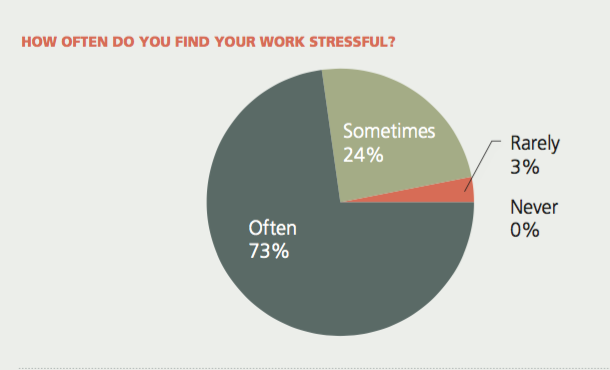
Back in 2015, tens of thousands of educators filled out the Quality of Worklife Survey conducted by the American Federation of Teachers and the Badass Teachers Association.
After responses from 91,000 school employees and 31,000 who completed the entire 80-question survey, a picture of the emotional landscape became clear.
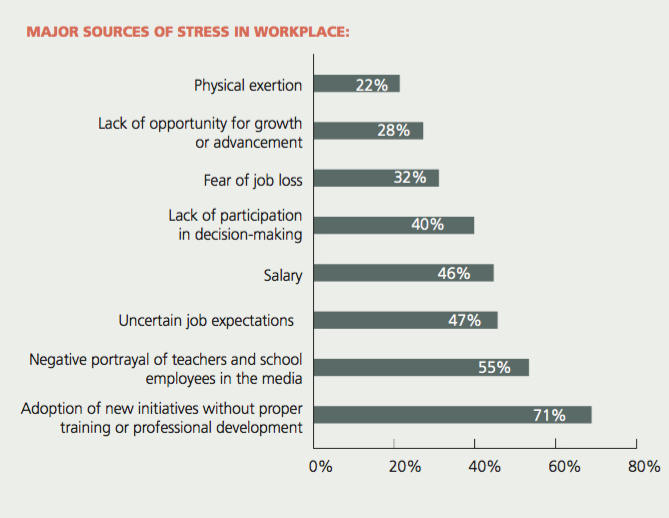
The reasons? Adoption of new initiatives without proper training or professional development (71%), negative portrayal of teachers and school employees in the media (55%), uncertain job expectations (47%) and salary (46%) were the most common responses.
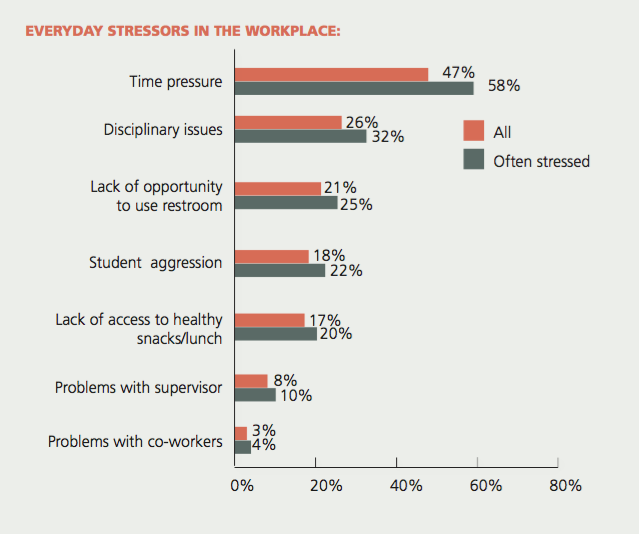
The survey identified the following as most common everyday stressors in the workplace – time pressures, disciplinary issues and even a lack of opportunity to use the bathroom.
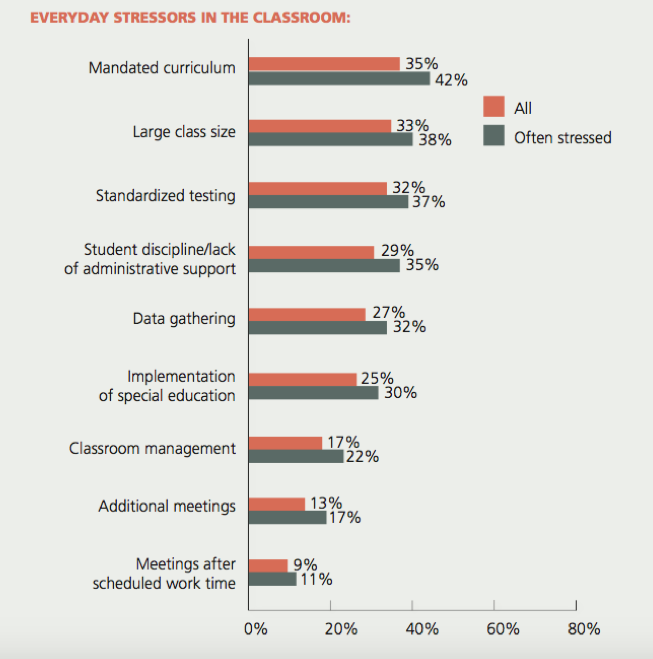
Focusing just on the classroom, top stressors were mandated curriculum, large class sizes and standardized testing.
Many teachers claimed to be the victims of violence at school.
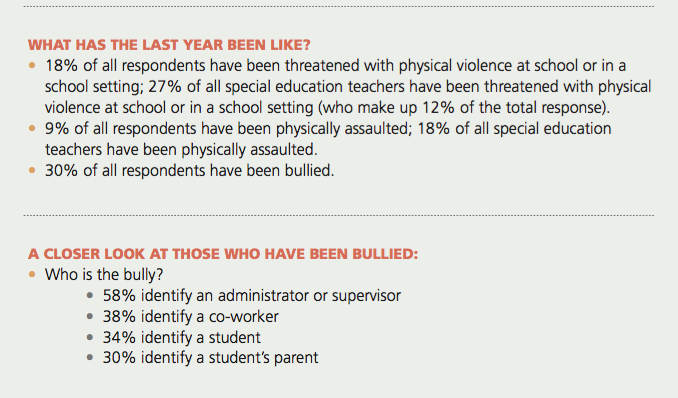
A total 18% of all respondents said they had been threatened with physical violence – though the percentage jumped to 27% when looking solely at special education teachers.
A total of 9% of all respondents claimed to have been physically assaulted at school. Again the percentage jumped to 18% of all special education teachers.
But it’s not just physical assault.
A total of 30% claim to have been bullied by administrators (58%), co-workers (38%), students (34%) and student’s parents (30%).
This is the situation where policymakers want to throw firearms.
Most gun violence doesn’t involve a shooter doing harm to others. The great majority of gun deaths are self-inflicted.
Even without adding guns to the mix, several high profile teachers and administrators already have committed suicide.
In October of 2010, for example, a California elementary school teacher named Rigoberto Ruelas, Jr. took his own life after the Los Angeles Times published a report labeling him a “less effective teacher.” Despite the fact that students and parents praised Ruelas, who taught in one of poorest schools in his district and who also was born, raised and continued to live in area where his school was located, the Times targeted him among other so-called “less effective” teachers as part of a major propaganda campaign.
And this isn’t an isolated incident. In July of 2015, a New York City principal under investigation for altering Common Core test scores, killed herself by jumping in front of a subway car.
Adding guns to this situation will just mean more teachers taking their own lives with a bullet.
That may have been the intent of the Georgia teacher in yesterday’s shooting.
Local police said they didn’t think he was trying to injure anyone else. When he shot his gun out of the window, he appeared to be trying to get others to leave him alone.
Arming teachers is a terrible solution to school violence. It’s taking an already stifling room and turning up the heat.
We need sensible gun regulations to reduce the pressure, not increase it.
We need sensible school policies that treat teachers and students like human beings and not just cogs in the system.
But this requires us to break out of a dangerous pattern in how we deal with social problems.
When we see a problem, we generally just shrug and leave it up to public schools and teachers to solve.
Inadequate resources – leave it to teachers to buy school supplies out of pocket.
Inequitable funding – increase class size and leave it to teachers to somehow make up the difference.
We can’t do the same with gun violence. We can’t just toss teachers a gun and tell them to sort it out.
Teachers can’t solve all of society’s problems alone.
That’s going to take all of us.
And we’ll need more than disingenuous proposals like answering gun violence with more guns.
Even states that historically boasted the most growth are falling behind. Of charter powerhouses Texas, Florida, Ohio and California – only Texas has shown a significant upward trend.
So what happened?
How did the hippest new thing to hit education since the chalk board suddenly hit such a wall? After all, it wasn’t so long ago that every celebrity from Magic Johnson to Andre Agassi to Deion Sanders to Sean “Puffy” Combs to Pitt Bull had their own charter school. Even Oprah Winfrey, the queen of multimedia, donated millions to charter networks in Louisiana, California, Pennsylvania, Colorado, Texas and her home state of Illinois.
How could something with so much high profile support be running out of gas?
The charter school funded think tank (read: propaganda network) released a report boiling the issue down to three factors: real estate costs, a teacher shortage and political backlash.
Real estate costs? Yes, few public schools want to offer you public property to put your privately run school that will inevitably gobble up a good portion of its funding and turn a portion of that into profit for private investors.
Teacher shortage? Yes, when you pay your educators the least, don’t allow your employees to unionize, and demand high hours without remuneration, you tend to find it harder than most educational institutions to find people willing to work for you.
Political backlash? DING! DING! DING!
Of course, most people who aren’t paid by the charter school industry – as those working for CRPE are – would simply call this a charter school backlash – not political, at all.
This isn’t one political party seeking advantage over another. It’s concerned citizens from both sides of the aisle worried about the practices of the charter school industry.
The general public is starting to understand exactly what charter schools are and why they are a bad idea for children and society.
-They cherry pick which students to enroll and how long to keep them enrolled – they only let in the easiest to teach and give the boot to any that are struggling before standardized testing time.
-And they very often close unexpectedly and/or are the site of monetary scandals where unscrupulous charter school operators take the money and run.
Moreover, it’s no accident that much of the criticism of charter schools comes from people of color. About one quarter of all charter school students are black, whereas black students make up only 15 percent of enrollment at traditional public schools.
To put that in perspective, approximately 837,000 black students were enrolled at charter schools during the 2016-17 school year. Yet civil rights organizations are concerned that this over-representation is having negative consequences on students of color.
Seventy percent of black charter school students have few white classmates, according to a study by the Civil Rights Project at UCLA.
But some charters are even worse. More than 1,000 of the nation’s 6,747 charter schools had student bodies made up of at least 99% minority students, according to an Associated Press analysis from three years ago. And it’s getting worse!
Researchers found the situation is even more dire for minorities. Black students are four times more likely to be suspended than white students, and students with disabilities are twice as likely to be suspended as non-disabled students.
With all these problems dogging their heels, it’s no wonder that the charter school juggernaut is starting to lose momentum.
Instead of concentrating solely on why these schools are losing popularity, we should also ask what set them shooting off into the stratosphere in the first place.
After all, no one was really crying out for private schools run with public money.
No one, that is, except big business and greedy investors looking for a quick buck.
Since the Clinton administration, charter school investments get automatic tax credits that allow investors to double their money in as little as 7 years. Lobbying at the state and federal level by charter schools and their investors and contractors have enabled a monetary scam to enrich private industry at public expense.
Put simply, charters are not subject to the same instructional, operational, fiscal, accounting or conflict of interest rules as traditional public schools. Therefore, in most states it’s perfectly legal for a charter school operator to give his brother the instructional contract, his sister the maintenance contract and his uncle the textbook contract. He can replace the teachers with computer programs and apps, while his own privately held company rents and leases the school building at a hefty markup – all with public money.
What we’re seeing in terms of a backlash is just a more common realization of the motives behind charter schools echoed in the negative consequences these schools leave behind.
The neoliberal agenda is as fervently being pushed by the right wing as the left – more so.
This slowdown may signal that people have gone beyond politics.
We don’t care what the left and the right wish to sell us. We’re not willing to buy the charter school boloney anymore. If our policymakers want to continue getting our votes, they may need to give in to what the people actually want and stop trying to lead us over the cliff and feed us to the sharks.
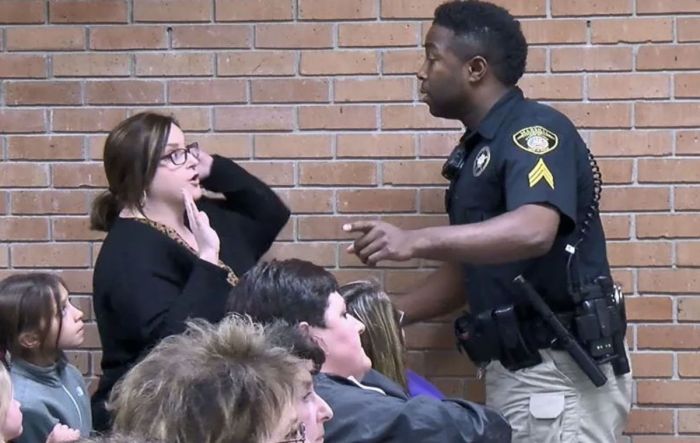
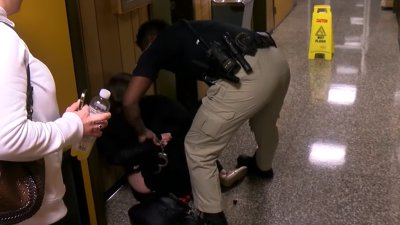
We’ve all seen the shocking video from Vermillion Parish in Louisiana this week where a teacher is tackled to the ground and arrested because she asked a question to the school board.
It’s a gross abuse of power that brings up many issues:
Public servants responding to the public with violence.
Elected representatives refusing to hear from their constituents and – in fact – taking action to silence them.
Leaders who are supposed to oversee children’s educations unconcerned with the lesson local kids will be taking home from the actions of adults who are supposed to set a better example.
The eight-member board had been deadlocked 4-4 on whether or not to give Superintendent Jerome Puyau a raise. Then one of the members died. Instead of his wife filling in until a new election could be held, board president Anthony Fontana , who was in favor of the raise, appointed a like-minded replacement and tried to force a vote.
So Deyshia Hargrave, a district teacher and parent, asked why the superintendent should get a raise while the teachers haven’t had one in several years.
It was a reasonable question, asked at the proper time, in a respectful tone, when comments were directed specifically at her.
However, Reggie Hilts, the Abbeville city marshal who also serves as a school resource officer, told her she was being disruptive and asked her to leave – which she did. When she got out in the hall, he forced her to the ground, put her in handcuffs and pushed her out of the building.
It was completely unjustified, a horrific violation of Hargrave’s rights and goes counter to the very purpose of public school.
It is the idea that district wide decisions about our children’s learning should be made by duly-elected members of the community in the full light of day. Except where doing so would violate an individual’s personal rights, all school documents are public. They are voted on in public. And they are subject to question and comment by the public.
If the taxpayers – the people who foot the bill for the majority of the district costs – don’t approve of what their representatives are doing, they can take steps to replace them.
Vermillion Parish School Board would do well to remember this.
The actions taken by City Marshall Hilts were either done at the behest of the board or certainly without any public dissent among the members.
They stomped on Hargrave’s First Amendment rights and ignored their responsibility to the community they serve.
If my description of how a public school is supposed to work sounds like a lecture, that’s intentional. These representatives could do with a lesson in how democracy works.
Our actions have consequences and those consequences only become more consequential when we become public servants. The board, the superintendent and certainly Hilts may very well have opened themselves up to legal action.
But beyond putting themselves in danger from having to pay punitive damages to Hargrave – that I hope they pay out of the superintendent’s bloated salary – they have betrayed a dangerous attitude toward the very concept of self-rule.
Whether they meant to or not, they have given the children of Vermillion Parish a lesson in government and community values.
Make no mistake. The children are watching. They get the TV news and status updates on Facebook and Twitter. They have access to YouTube. Doubtless, they have seen this video countless times. They have probably played it over and over again.
They saw their teacher brutally manhandled by a supposed law enforcement officer. And they heard the deafening silence from the school board about it.
They know now that this kind of behavior is deemed acceptable in Vermillion Parish. Beware the kind of behavior adults can expect from children who are given such a disgraceful example!
Moreover, these children are well aware of the matter in dispute.
The board is fighting to give the superintendent a $38,000 raise. Yet they refuse to give another penny to teachers – all while class sizes have jumped from 21 to 29 students, according to Hargrave.
That is not what leaders do who care about the well-being of students. It is a result of backroom deals and the good ol’ boys network.
The lesson is that hard work doesn’t matter. The only thing you should worry about is making a deal no matter whom it hurts. Just look out for numero uno.
After all, the board could give the teachers something – some token of appreciation to show that they value their continued commitment to the children of the community. But they don’t. Yet they fight tooth and nail to do so for one individual who has in no way proven himself indispensable.
Critics complain that teachers don’t deserve a raise because they already earn more money than the majority of the people who live in the community. (An argument which – by the way – would also apply to the superintendent.)
But even beyond basic logic, it’s a bogus line of reasoning!
Doctors attend patients in poor communities. They still earn high salaries – maybe not as high as they would serving the wealthy, but they have to be able to survive, to pay back the loans they took out to go through medical school, etc. So do lawyers, accountants and specialists of all kinds. That’s just capitalism. If you want someone to provide a good or service, you have to pay them a competitive wage. Otherwise, they’ll move on to greener pastures.
The kids see you pinching pennies. They know what that means – you don’t think they’re worth the investment.
The lessons of Vermillion Parish go far beyond Louisiana.
When Hilt wrestled a woman half his size to the ground and placed her under arrest for the crime of exercising her rights, he put the entire community in jail.
When the board directed him to act – or at very least neglected to stop him – they made themselves culpable in the crime.
Republicans have stolen more than $1 trillion from our pockets to give to their mega-wealthy donors in the form of tax cuts. A 3-2 GOP majority on the Federal Communications Commission (FCC) repealed Net Neutrality. And the party of Lincoln endorsed and funded a child molester for US Senate – though he thankfully lost.
We’re in new territory. Politics has always appealed to the best and worst of our natures: Good people who really want to make a difference and sniveling cowards willing to do whatever their sugar daddies tell them. But unfortunately our world has increasingly rewarded the latter and almost extinguished the former.
However, don’t lose heart. The cockroaches are all out in the open. They’ve become so emboldened by the words “President” and “Trump” voiced together that they no longer feel the need to hug a wall.
All it would take is a good boot and a series of stomps to crush them forever.
Someone get me my shoes.
In the meantime, I sit here at my kitchen table recovering from a turkey coma preparing for a nostalgic look back at everything that’s happened here at Gadfly on the Wall in the past year.
Other than that, it’s been a busy year blogging. I wrote 118 articles! That’s about one every three days!
And people have been reading them.
I’ve had more than 364,000 hits – about the same as in 2016. This puts the total views over the 1 million mark at more than 1,216,000! That’s quite a landmark for a blog that’s only been around since July, 2014. And it doesn’t count all the readers I get from articles reposted on the Badass Teachers Association Blog, Huffington Post, Commondreams.org, the LA Progressive, Alternet, BillMoyers.com or other sites.
I’ve also gotten 1,510 more people to follow me for a total of 12,845.
I’m so honored that readers still like coming to this site for news and commentary. As long as you care to enter those virtual doors, I’ll be here, hunched over my computer, pounding away at the keys.
So without further ado, let’s take a look back at the top 10 articles from this blog that got the Inter-webs humming:
Description: At the end of every school year we get Teacher Appreciation Week. It’s nice. Educators get free donuts and cookies, a pat on the head and then the rest of the year we get all the blame for society’s problems without any additional funding, repealing terrible policies or even acknowledgement of what the real issues are in our schools. It’s a sham. Someone had to say it, so I did. Thanks for the snack, but it takes a village, folks! Get off your butts and take some responsibility!
Fun Fact: Some people, even teachers, were really upset by this article. They thought it was ungrateful. Don’t get me wrong, I am truly appreciative for any crumb the public wants to give us, teachers, but I’m not going to let it pass as if that counts as true support. Salving your conscience isn’t enough. We need true allies to get down in the mud and fight with us. Otherwise, it’s just an empty gesture.
Description: This one’s hot off the press! It describes a situation at one of the schools were I’ve taught over the years and how dress code policies can support white privilege. They’re the broken windows policing of academia, and we need to put much more thought into them before laying down blanket restrictions.
Fun Fact: Some readers took exception to this piece because they thought I didn’t do enough to stop a wayward administrator despite the fact that I never said what I did or didn’t do. Some even complained that it was dumb to simply acknowledge racism and racist policies and actions. I don’t know what world they’re living in. White folks voted for Donald J. Trump to be President. We’ve got a long way to go, and acknowledging everyday prejudice seems a worthy goal to me.
Description: The entire premise of school privatization goes against the founding principles of our nation. We were born out of the Enlightenment, not the profit motive. Our founders would look on in horror at charter and voucher schools. Though they aren’t perfect, only truly public schools embody the ideals of the Revolution. True conservatives and true patriots would support that system, not strive to blow it up for personal financial gain.
Fun Fact: Some people took issue with an appeal to the founders who were not exactly perfect. It’s true. In practice many of them did not live up to their own high ideals. However, who does? It is the ideal that matters, not the clay feet of our forebears.
Description: Teen suicides are up – especially among middle school age children. At the same time, we’ve been testing these kids into the ground. More standardized assessments – and these are unnecessarily more difficult to pass Common Core assessments. This is exactly what happens in countries that put such emphasis on testing – they have a higher suicide rate. It’s no wonder that this is happening here, too. Policymakers want us to be more like Asian countries? Be careful what you wish for!
Fun Fact: This article infuriated the good folks at the Education Post. Peter Cunningham had his flunkies attack me on Twitter complaining that I was an angry white dude making undue correlations. Yet every other explanation for the fact of increased middle school suicides was merely a correlation, too. Proving causation is almost impossible. It is just as reasonable – even more so – to conclude that testing is having an impact on the suicide rate as to intuit the cause being increased reliance on social media. The big money folks don’t want us making the connection I made here. All the more reason to believe there is truth behind it.
Description: School choice is a misnomer. It’s school privatization. It has very little to do with providing more options for parents or students. It’s about allowing big corporations to avoid public school regulations and profit off your child swiping your tax dollars. School choice is merely a marketing term.
Fun Fact: I must have really pissed someone off when I wrote this one because it caused Facebook to block me for a week. No matter. Readers liked this one so much they shared it for me all over. Why was I targeted? It could be personal since charter school cheerleader Campbell Brown is literally the arbiter of truth at Facebook. Or it could be the social media site’s attempt to bully me into spending money on advertising. Either way, their attempted censorship didn’t work.
Description: As teachers, we’re often expected to use new technology in our classrooms. However, we’re rarely involved in the decision making process. We’re rarely allowed to decide which technology to use and sometimes even how to use it. Software packages are just handed down from administration or school board. However, the EdTech Industry is not our friend. More often than not it is unscrupulous in the ways it is willing to profit off of our students through data mining, competency based learning and a variety of privacy threatening schemes. It’s up to us to be brave enough to say, “No.”
Fun Fact: I was surprised by how much the piece resonated with readers. So many other educators said they felt they were being bullied into using apps or programs that they thought were of low quality or downright harmful. Sure, there were some who called me a luddite, but the fact remains: we shouldn’t be using technology for technology’s sake. We should be doing so only to help students learn. That requires us to use our best judgment, not follow orders like good soldiers.
Description: Administrators love to gift teachers with tons and tons of data. They bury us under reams of standardized test results and expect us to somehow use that nonsense to inform our teaching. It’s crazy. We already collect authentic data on our students for 180 days a year in the classroom in the course of our teaching. Yet they think these mass produced corporate evaluated snap shots are going to somehow change everything? That’s not how you help educators. It’s how you abdicate any responsibility yourself.
Fun Fact: This one really took off especially on the Huffington Post. Many readers seemed to be truly surprised that teachers felt this way. No authentic educator gives in to being data driven. We’re data informed but student driven. And if you want us to do something else, you don’t have the best interests of the kids at heart.
Description: This was another tone deaf proclamation from the Republican majority in Harrisburg. It was pure meat for the regressive base in gerrymandered districts that if passed they knew would never be signed by our Democratic Governor Tom Wolf. It turns out the backlash was such that they didn’t even have the courage to put it to a vote.
Fun Fact: I never expected this one to be nearly as popular as it was. Usually articles about Pennsylvania get a few hundred local readers and that’s it. But this one infuriated everyone. How dare lawmakers propose this! Don’t they know how many bacteria teachers are exposed to!? Do they want us to come to school sick and spread the disease to our students!? I’d like to think that the article had something to do with this terrible piece of legislation disappearing, but I have no evidence to support it. However, I can say that it will probably be back when they think no one is looking, and it will still make me sick.
Description: Everyone says public schools are failing. I call bullshit. It depends on how you’re evaluating them, and – frankly – we’re not being fair to our American education system. Sure. There are plenty of ways we can improve, but there’s a lot we’re doing right, too. In fact, many of the things we get right, few other systems do around the world. We excel in our ideals. If we just had the courage of our convictions, our system would be beyond the moon! Even as it is, we have much to celebrate. And other nations would do well to emulate us in these ways.
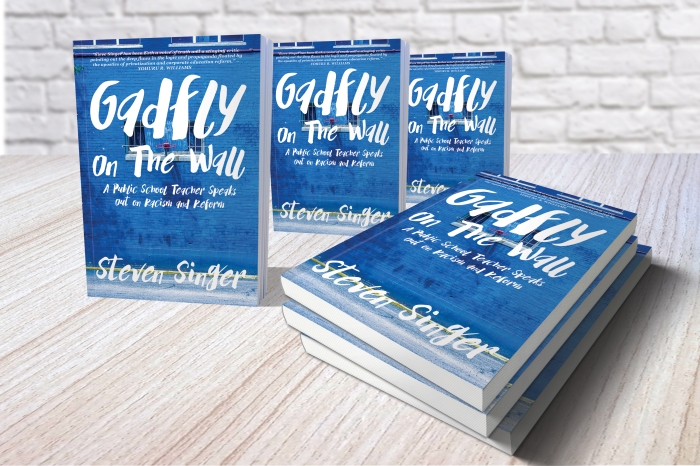
Fun Fact: I’m quite proud of this one. It’s the only article in the Top 10 here that was included in my book. For the definitive version, you’ll have to go there. Some sections received major rewrites and clarifications. I think the published version is much better. But no matter which version you choose, I’m proud to have an answer for all those out there spreading the myth that our education system is an irredeemable mess. They want us to get rid of the good and replace it with more bad. I say we keep the good and build on it.
Description: Betsy DeVos’ confirmation hearing was an absolute horror show. It’s even worse when you consider she was confirmed by the Republican majority in a tie vote that was broken by Vice President Mike Pence (that still sends shivers down my spine). Here was someone who knows next to nothing about public education except that she wants to destroy it. She wouldn’t commit to protecting students rights even those under the umbrella of special education. There’s more I could say but I just threw up in my mouth a little bit. Excuse me.
Fun Fact: I’m honored that so many readers turned to my blog for commentary about this. It was a moment of shared horror that hasn’t weakened much in the subsequent months. We’re all just waiting for sanity to return but at least we can do so together. We’re all in this side-by-side and hand-in-hand. We can defeat the Betsy DeVos’ and the Donald Trump’s of the world if we stay strong. It could happen any day now.
Gadfly’s Other Year End Round Ups
This wasn’t the first year I’ve done a countdown of the year’s greatest hits. I usually write one counting down my most popular articles (like the one you just read from 2017) and one listing articles that I thought deserved a second look. Here are all my end of the year articles since I began this crazy journey in 2014:
So it was almost Christmas break and my middle school students were shuffling in to homeroom.
One of the girls turns to me and says, “Mr. Singer, am I okay to wear this?”
Hold up. I teach English.
I am not a fashionista or even particularly clothes conscious. So this question took me by surprise.
In the split second it took me to comprehend what she was asking and focus my eyes on the girl, I was expecting she might have on something too revealing or perhaps had an inappropriate slogan on her shirt or a marijuana leaf.
But no. She had on a simple blue long sleeve sweater with a red Superman symbol in the middle.
I was about to say that what she was wearing was perfectly acceptable, but then I remembered the dress code.
It was a new directive from the school board, and it was – frankly – a horror show.
We used to have a perfectly fine dress code that only made students refrain from clothing that was dangerous, inappropriate or sexually explicit. But then someone on the board heard about a neighboring district that modeled itself after a private school academy – so they had to do the same thing here.
It was beyond stupid. Only certain colors were allowed. Only certain kinds of clothing. No designs on t-shirts. And on and on.
I frankly paid no attention to it. But administrators did.
Though they rarely punished students for being late to class, improperly using cell phones or dropping an f- bomb, they swept through the building every morning to make sure every student was undeniably in dress code – to the letter.
And if a child was wearing a verboten item of clothing! Heaven forbid! That child was sent to in-school suspension for the remainder of the day unless a parent brought a change of clothing.
The same students would sit in “The Box” for days or weeks while their education was in suspended animation because they just couldn’t figure out which clothes the school board considered to be appropriate. (Or more likely they wanted a vacation from class.)
So when this girl – let’s call her Amy – asked me about her outfit, it was a pretty serious question.
And a difficult one.
Normally the Superman symbol would violate dress code, but I remembered that since it was only a few days before the holiday break, as an extra treat, students had been allowed to wear an “ugly Christmas sweater.” It was either that or conform to the usual dress code.
So all around me children were wearing fluffy red and green yarn creations sporting snowmen, Christmas trees and Santas.
But Amy was wearing a big red S.
By any definition, that’s not a Christmas sweater, and if the administrators wanted to take a hard line on the rules – and they usually did – she was out of dress code.
I told her what I thought. I said I had no personal problem with it and wouldn’t report her to the principal, but if she had a change of clothes, she might want to consider using them.
She didn’t.
And even if she did, it was too late. An administrator barreled into the room and proceeded to examine each child’s clothing.
Amy took her backpack and put it on backwards so that it covered her chest and the offending S.
Even that didn’t work.
When the administrator got to her, he asked to see what was under her backpack. She sighed and showed him.
But miraculously he said, “Okay,” and moved on.
Amy and I both breathed a sigh of relief. She was saved and wouldn’t have to spend the rest of the day in our school’s version of prison.
Before we could get too comfortable though, the hushed silence was broken when the administrator started screaming at another girl in the back of the room.
“That is not in dress code, and you know that’s not a Christmas sweater!” he screamed, cords standing out on his neck.
“How many times have I told you, but you think you can get away with anything…” and he continued to yell at her as she stomped out into the hall and presumably her locker.
And as she left, I saw that he was right. The girl he was yelling at – let’s call her Jada – was not wearing a Christmas sweater. She was wearing a plain gray and white flannel shirt. I don’t know how or why, but I guess that violated the dress code.
And for this offense she spent the day in in-school suspension.
I guess that’s not really Earth shattering, but it really bothered me.
It just seemed so unfair.
Jada was by no means a perfect student. But neither was Amy.
They both frequently broke rules and did pretty much what they wanted. They both could get an attitude, be catty, and mean.
However there was one distinguishing difference between them that immediately jumped to your attention – the color of their skins.
Amy was lily white. Jada was chocolate brown.
Now I’m not saying this administrator – who was white, by the way – was a virulent racist. I don’t know what went on inside his mind or heart.
In fact, I’d always thought of him as a fair-minded person who did his best to be impartial and treat students equally.
However, here was a case where he got it dead wrong.
Did he let Amy go because she was white? I don’t know. Did he come down on Jada because she was black? I don’t know.
My guess is that he was moving in a fog. He went to at least half of all the homerooms in the building checking each child to make sure they were in dress code. For some reason, when he looked at Amy, what he saw didn’t set off alarm bells. When he looked at Jada, it did.
Perhaps he remembered that Amy’s dad was a local cop and he didn’t relish having to call the police station to tell the officer that his daughter needed a change of clothes. Perhaps when he looked at Jada he was reminded of all the times she had been written up or defiant.
I accept that they are necessary in a public school setting.
It’s difficult to teach if students parts are hanging out, if they’re displaying coded messages on their chests, have advertising or rude statements on their clothing.
I once reported a girl for wearing a shirt that said “WTF.” She didn’t realize that I knew what the acronym meant. Another time I reported a student for wearing flip-flops. They were dangerous because kids could trip and fall but also the incessant slapping of plastic against heels drives me bonkers.
But other than that, I rarely get involved in dress codes.
Frankly, I think too strict a restriction on what students wear and too stringent enforcement of such policies does more harm than good.
It’s the school equivalent of broken windows policing. Instead of lowering crime by cracking down on the little stuff, too punitive severity in a dress code teaches kids that rules are arbitrary. Moreover, it creates fear and distrust of authority figures.
And – intentionally or not – it is a mechanism for enforcing white privilege.
Anytime I’ve had to oversee in-school suspension, there have been a disproportionate number of students of color in there for dress code violations than white students.
I know that’s not scientific, but it’s the data that I have.
Certainly each state has different laws and different legal definitions of these terms so there is some variability of what these schools are in practice. However, the general description holds in most cases. Voucher schools are privately run at (at least partial) public expense. Charter schools are privately run but pretend to be public. In both cases, they’re private – no matter what their lobbyists or marketing campaigns say to the contrary.
Despite these facts, when we talk about privatized schools, we ignore the real distinctions and focus on the fake ones. We overlook the salient features and instead describe privatized schools as vehicles for choice.
They’re not.
FAKE CHOICE
School choice.
Got choice?
Parents should have the freedom to choose the school their children attend.
But using “choice” as the ultimate descriptor of what privatized schools are and what they offer is at best misleading and at worst an outright lie.
They are essentially private businesses existing for the sole purpose of making a profit.
Critics say the public school option is not a choice because there is only one public school district in a given neighborhood. Yet isn’t it the parents who decide the neighborhood where they live? In most cases, even the wealthiest district has rental properties where people can move to take advantage of an exceptional school system.
If a student lives in a public school’s service area, the district must accept that student. It doesn’t matter if educating that child will cost more than the average per pupil expenditure. It doesn’t matter if she is easy or difficult to educate, if she has a record of behavior or discipline problems, if she has special needs, if she has low test scores. The public school must accept her and give her the best education possible.
Privatized schools are legally allowed to be selective. They can deny enrollment based on whatever reasons they choose. Charter schools may have to be more careful about their explicit reasoning than voucher schools, but that’s just a restriction on what they say, not on what they do. The results are the same. If they want to deny your child entry because of her race, ethnicity, religion, sexual orientation, whatever – they can. They just have to put something more creative down as the reason why.
Vouchers schools don’t even have to give you a reason at all.
And charters have a multitude of ways to avoid accountability. They can simply pretend to have conducted a lottery. Or they can include an onerous series of demands for enrollment such as expensive uniforms, school supplies and parental volunteering at the school, to discourage difficult students from applying.
Critics will argue that these problems are a feature of the limited scope of so-called school choice programs. If there were more of them, the market would self-correct and many of these irresponsible practices would disappear.
Yet such a belief shows a complete ignorance of how business works in America.
Let’s say you have three districts in your part of the state, one of which is exceptional and the other two struggle. If we allow students at the struggling districts to attend the exceptional one, what happens? You have a mass exodus to the exceptional district while the other two close due to lack of funding.
Moreover, it ignores the realities on the ground. Why were there two struggling districts and one exceptional one? Almost always this is because of the wealth disparity between the three districts. The exceptional district probably serviced wealthier children. They have fewer needs than poor children. They have books in the home, less food uncertainty, less exposure to violence, racism and trauma.
Yet the rich district has an overabundance of resources to meet whatever needs its students have. It can levy higher taxes and thus spend more per pupil than the other struggling districts.
So when you combine the three districts, you end up being unable to continue spending the same amount per pupil. You probably have to decrease that spending and thus all students receive fewer services. However, at the same time, student needs for services increase because now you’re also trying to educate the more impoverished and racially diverse students from the two previously struggling districts.
No, even this kind of school choice doesn’t improve the quality of education. It degrades it.
When I wake up to go to work in the morning, am I preparing to be a teacher or a test proctor?
Am I engaged in the practice of nurturing young minds or am I a tool of the establishment?
Should I be held accountable to the dozens of students in my classroom, their parents and the community – or to my administrators, the bureaucrats and moneyed interests ordering us around?
I ask these questions not as a rhetorical device. I really don’t know the answers. Because the solution begins with me.
Today was not a banner day in my classroom, and I can honestly say it was not my fault.
I had to give my 7th grade students the Classroom Diagnostic Tools assessment in Reading/Lit for grades 6-high school.
If you’re not familiar with the CDT, this is an optional test offered by Data Recognition Corporation for students in Pennsylvania’s public schools. It’s a way to assess student learning to predict whether they’ll pass there annual federally mandated standardized tests (also created by Data Recognition Corp. in the Keystone State). In addition, it offers example questions of the type that students struggled to answer correctly on the diagnostic.
It’s very helpful if you want to print out a buttload of test prep, give it to students and then read the paper quietly at your desk – something I never do.
For the second straight year, I’ve been forced to give it to my students three times annually – twice before the Pennsylvania System of School Assessment (PSSA) tests and once after.
I am not a fan.
Students hate it. It does not return valuable data. And it takes precious time that I could be using to actually teach something.
When I told my kids they were going to have to take the assessment this morning, one girl said, “I hate the CDTs. It stands for I Can’t Do This.”
Another girl had a more visceral reaction. When she saw the letters “CDT” on the board, she literally began rolling around on the floor and groaning.
These are the kinds of students I have – victims of generational poverty, malnutrition, childhood trauma, violence, drug abuse and systemic racism and prejudice. Strong-arming them into another standardized test isn’t doing them any favors.
Compare their reaction this morning to yesterday’s lesson.
We had just finished a unit on plot using Dr. Seuss stories and cartoons to illustrate complex concepts like exposition, conflict, rising action, climax, resolution, theme, etc.
I made a competitive review game through a program called Kahoot, and kids were out of their seats, jumping around, squealing with delight as they demonstrated their knowledge of what they’d learned. It got so loud one of the principals came running over from the office to make sure things weren’t getting out of hand. But what he found were students so engaged by the work they could barely contain themselves.
Heck! I even gave them a test of my own creation right afterward. There were no groans. There were no protests.
They sat at their seats like grown adults, concentrated and answered the questions to the best of their abilities.
Compare that with today’s assessment.
Behaviors off the hook. Sullen looks. Demands to use the restroom, go to their lockers, visit the nurse – ANYTHING but be here in class and do this test.
Why the difference?
Because they knew what was expected on MY test, and they knew they could meet my expectations.I was there for the lesson. I made the test.I would grade it.I have a relationship with these kids and they know I will assess them fairly.
But not on this standardized CDT nonsense!
Data Recognition Corp isn’t there for the lesson. It has no rapport with students. Kids don’t know what the expectations are and don’t think they can meet them. And they have no sense that this multi-billion dollar corporation will grade them fairly for their efforts.
And here I am in front of this room of unruly children forced to have to defend the bullcrap garbage that I’m being coerced to do to them.
I want to apologize. I want to tell them this is not my idea. And after a while, I even DID that. But it’s no use.
It matters little whether the executioner does his job with reluctance or not. He’s still here to end your life. And I was still cast in the role of ending their education for the day and replacing it with “proof” that they aren’t good enough.
When the test was over, so many children showed me their scores with hurt faces.
What purpose do I serve enforcing policies I know to be detrimental?
I went through five years of college to become a teacher – not a prison guard. But on days like today that’s what I am. I’ve devoted over a decade of my life to nourishing children, not ordering them all to march in line single file.
But here I am, a paid thug who browbeats and coerces innocents into doing things they don’t want to do for purposes that won’t benefit them and will in fact be used against them.
I wonder what the school board would say if I had the guts to stand in front of them at a public meeting and tell them.
I guess I’ll just have to keep wondering because the last time I tried to address that august body without an explicit invitation, I was told I wasn’t allowed to do so since I don’t live in the district where I teach.
But sometimes I question whether the elected representatives of my district even understand what I’m being bulldozed into doing in their name.
Do you know I am abusing your children? I am crushing their creativity, their self-respect, their curiosity. Is that really what you want of me? Is that what you hired me for?
Don’t get me wrong.
It’s not really anything new. I’ve been doing this for almost 15 years. It’s just harder every year.
I heap on justifications – you have to do the bad stuff so you can do the good stuff. You have to enforce the testing so you can do authentic teaching.
Meanwhile, politicians pretend like they’re doing something to fix it. Gov. Tom Wolf (whom I generally like) cuts off a few days from the PSSA tests this year. But he keeps the recommendation that we take the CDTs. He keeps the entire test-and-punish framework in place. Like most Democrats, he’s willing to twiddle around the edges but has no guts to do away with what’s wrong and replace it with what’s right.
Meanwhile, parents in my state are generally clueless.
I used to send home a letter to parents reminding them of their right to opt out of standardized tests. It almost got me fired.
And for my efforts, I think maybe one or two parents over five years actually took me up on it.
I go to my local union and tell them my concerns. They nod and ask for more information and then quietly forget it.
Meanwhile, the national unions are behind the testocracy 100%. They’ll wag their fingers and complain about testing, but they’re too busy making sure the teaching profession even exists tomorrow to stop for small potatoes like bad practices.
I feel so alone here.
I’m pulling my hair out and the only response I get is from the choir (Hallelujah!) and the corporate education reformers (How dare you!?).
The majority stays silent. And complicit.
I’m just not sure I can do it anymore.
I’ve thought about calling in sick whenever I have to give a standardized test. It would be a lot of days, but I could do it.
That might be safe, but it would be cowardly.
I’d just be saving myself the pain and humiliation of giving the tests. My students would still be forced to take them.
So what do I do?
I write.
I write blogs like this one.
I pound out my cares and reservations, put them in a virtual bottle and set it adrift on the seas of the Internet.
It’s a constant gamble.
Someday someone may read them who can end my career.
Or maybe someone with the power to make a difference will read them.
Maybe that’s you.
Maybe it’s all of us.
I don’t know.
I have no solutions today. Just shame and regrets.
In fact, if the teacher really were responsible – if she did all the work and took the test – how could you rationally say this grade belonged to the student? No, it wouldn’t be Billy’s, it would be his teacher’s.
The truth goes something like this: You are responsible only for things within your control. The greater your degree of control, the greater your degree of responsibility.
This is not complicated.
It is simple logic. Cause and effect.
But ignoring it is perhaps the most virulent, incorrigible, fact-resistant mistake in the entire field of public education.
Lawmakers are getting it wrong. The media is getting it wrong. Superintendents, principals – even teachers are getting it wrong.
Just today at a training in my district, I was shown a spreadsheet of student test scores and told in no uncertain terms that this was something I have control over.
I DON’T.
I don’t have control over the raw scores. I don’t even have control over how much a student improves from one year to another.
The student does.
HE controls how hard he works on assignments. HE exhibits the most control over the results of his assessments.
This doesn’t mean I’m completely helpless.
I do have control over certain aspects of students’ academic experience.
I control what work is assigned, when it is assigned and to whom.
I control whether there is extra credit, what counts as homework, who gets extra help, etc.
In many cases, I even get to decide whether students have completed their work and if assessments have been completed successfully.
Yet he is not alone here. Besides, me, his teacher, there is also the principal, the student’s parents, his friends and even society as a whole.
All of these and more contribute to student success.
The principal controls school policy. He determines what discipline the student receives, the clarity of school rules, etc.
Likewise, students’ friends are part of their social network. They can help with homework, form a study group, or distract from school work, denigrate work ethic, etc.
Society also plays a role. If a student is part of a community that values education and work ethic, that student will more likely put forth more effort. If the student lives in a community where school is seen as unimportant and teachers are not respected, that will have a negative impact, etc.
And the number one factor other than the student, himself, that contributes to his success is parents. They control home life, emotional support, tutoring, nutrition, etc.
All of these complex factors combine to add up to an individual student’s success. However, at the end of the day, it is the student, himself, that bears the brunt of the responsibility for what he does.
That’s why we call it HIS grade and not someone else’s.
This is the most obvious thing in the world, but it has certain consequences for education policy.
As we’ve seen, this misrepresents the student-teacher relationship. It blames the teacher for things well beyond his or her control.
It turns students into passive objects acted on by magical super teachers who can somehow make them learn simply by – what – endless repetition of test prep materials?
Why would students put forth their best in this scenario? If they’re failing, it’s somehow not their fault. It’s their teachers!
Parents, for instance, are crucially important, but we’re leaving them completely out of the loop.
When parents struggle to fulfill their responsibilities, why is there little to no help? The answer: because we’ve hidden the fact that such responsibilities even exist. We’ve thrown it all on the teacher and the school.
All these out-of-school factors are obscured, yet taken together they are almost determinate. After all, this is why poor and minority students disproportionately struggle academically.
You can demand every student jump six feet straight up, but those with the best resources will meet this goal much more frequently than those without.
And who is in control of those resources? Who decides which children get the smallest class sizes, the best home environments, the most conducive social networks, etc.?
The ultimate responsibility may rest with the student, but until we all realize and acknowledge our collective responsibilities to all students, success will always be out of reach for far too many of them.
Billy may take the test, but it is society that is failing to meet its responsibilities.
Republicans have been arguing for years that the federal government can’t tell the states what they should be teaching. That’s the crux of opposition, and the newly reauthorized federal law governing K-12 schools, the Every Student Succeeds Act (ESSA), underlines it.
The power is unequivocally in the hands of governors and state legislatures.
The states control which academic standards their public schools are supposed to subscribe to or not. And since the beginning of 2017, the states are overwhelmingly in Republican control.
There are 98 partisan state legislative chambers in the United States. Republicans dominate 67 of them. In fact, the GOP controls both legislative chambers in 32 states – the most it has in the party’s history! And in 24 of those states, Republicans also run the show in the Governor’s mansion – the trifecta!
In short, despite any limits on Presidential power, the GOP has never been in a better position to get rid of Common Core.
If Republicans truly wanted to repeal it, they could do so tomorrow, and there’s zero Democrats could do about it in almost half of the country.
Yet, Republicans don’t.
They haven’t.
And they don’t seem in any rush to put it on their agenda in the future.
Which brings me to a serious question any critic of Common Core has to answer: WHY!?
Republicans say they hate Common Core.
They have the power to get rid of it.
Why don’t they do it?
THE STATE OF COMMON CORE
Despite any comments to the contrary, any blathering talking head nonsense from media pundits, the facts remain the same.
Sure, some legislatures have changed the name and made nominal revisions (Hello, Pennsylvania!) but they’re still essentially the same standards applied in the same way. The Common Core’s own Website doesn’t distinguish between states that have the standards outright and those where they have been slightly revised or renamed.
Specifically, nine states have announced plans to rewrite or replace the standards, but in the majority of these cases, they have resulted merely in slight revisions. Only Missouri, Oklahoma, and Tennessee appear to have created significantly different standards, according to Education Week.
So what’s the hold up?
MAIN OBJECTIONS TO THE CORE
Full disclosure: I am not a Republican. I am the farthest thing you could find to a Republican. But on this one issue we agree.
No, I don’t think Common Core will make your child gay or indoctrinate kids into a far left worldview or any of a number of bizarre, crackpot criticisms you might hear from mentally ill pundits being exploited by far right media conglomerates. Nor am I opposed simply to undo any signature legislative achievements of our first black President.
Even if people like Glenn Beck and I disagree on the reasons why, we both agree on the course of action – repeal Common Core.
Yet the incumbent batch of GOP lawmakers across the country are letting us both down.
If one has to be beaten by Republicans, at least let them accomplish the things that have bipartisan support. That includes repealing Common Core.
Though the media likes to characterize this as a conservative issue, it’s not just Republicans who want to get rid of the Core. Regardless of politics, most people dislike the standards. They aren’t popular with adults. They aren’t popular with children. And most tellingly, they aren’t popular with classroom teachers.
According to the most recent Education Next poll, less than half of all Americans, 49%, favor the policy. In partisan terms, that’s 37% of Republicans and 57% of Democrats. And that support has been steadily dropping every year – by 20 points for Republicans and seven for Democrats since 2013.
And among teachers, the drop is even more dramatic. Only 40% now favor the Core. That’s a drop of 36 points among those who know the standards best!
POLITICAL PARALLELS
So let’s get rid of them.
For once I’m with Trump.
But the legislatures just won’t do it.
In some ways, this shares parallels with the healthcare debate.
Before going forward, let me just say that I am NOT in favor of repealing Obamacare and going back to the previous system. Nor am I in favor of repealing without a replacement or any of the so-called “skinny” plans put forth by the GOP.
All the legislatures would have to do is reinstate them.
Pennsylvania’s standards were particularly reasonable, flexible yet grade appropriate and comprehensive.
We could go back to them tomorrow.
But we don’t.
Why?
It’s that same question again.
What is holding us back?
STANDARDIZED TESTING
Here’s my theory: it’s the testing.
One of the most frustrating things for Common Core critics is when apologists say they hate standardized testing but love Common Core.
The two are inextricably interlinked. You can’t have Common Core without the testing. That is the whole point of the standards – to tell districts what to focus on because those things will be on the federally mandated high stakes standardized tests.
If states repeal Common Core, what happens to these tests?
Before adopting the Core, each state had a test aligned to its own specific standards. Even where some states had the same tests, their standards were significantly similar to allow this. In any case, most states that have adopted the Core have had to buy new, more difficult tests.
Sure, we could all go back to the tests we used to give, but this would present certain problems.
First, many states were taking tests that were already being aligned with Common Core before they officially adopted it. If they got rid of the standards, they couldn’t go back to the old tests because they’re already Common Core specific.
In theory, they could ask to reinstate older versions of the test that aren’t Common Core aligned. However, in practice for some states, this might necessitate the creation of yet another batch of new tests.
However, in many states like Pennsylvania, this wouldn’t be an issue. Before the Core, they had their own tests based on state specific standards. There’s really no reason why they couldn’t dust off these old tests and put them back into circulation.
The problem is that this would require politicians to justify the millions of dollars (at least $7 billion nationally) they wasted on the new tests, new workbooks, new textbooks, etc.
Lawmakers would have to own their mistakes.
They’d have to say, “My bad!”
And most of them aren’t about to do that.
Of course, there is a third option: they could undo the high stakes testing altogether. They could characterize this not as a misstep but a reform.
According to the ESSA, all states have to give federally mandated standardized tests from grades 3-8 and once in high school.
But what exactly those tests look like is debatable.
The federal government is supposed to give them leeway in this matter. What better way for the Trump administration and Betsy DeVos to demonstrate their commitment to local control than by approving accountability plans that don’t include standardized testing?
I’m sure if lawmakers were really serious about getting rid of Common Core, they could figure out a way to make this work. It would just require a commitment to patching up the massive hole in our school funding system where the standardized testing industry has been sucking away tax dollars that could be better used elsewhere – like in the actual act of teaching students!
THE CYNICAL INTERPRETATION
Which brings me to perhaps the most cynical interpretation of the data.
Republicans may be avoiding the Common Core issue because their opposition up to now was simply disingenuous partisan infighting. They could be craven servants to the testing industry. Or – and this is the worst case scenario – they could have another endgame in mind entirely.
For instance, here’s Trump adviser Kellyanne Conway during an interview with Jake Tapper on CNN.
Education Secretary Betsy DeVos “will get on with the business of executing on the president’s vision for education,” Conway said. “He’s made very clear all throughout the campaign and as president he wants to repeal Common Core, he doesn’t think that federal standards are better than local and parental control…And that children should not be restricted in terms of education opportunities just by their ZIP code, just by where they live. We’ve got to look at homeschooling, and charter schools, and school choice and other alternatives for certain students.”
It’s possible that today’s Republicans at both the state and federal level aren’t concerned with repealing Common Core because it’s irrelevant to their ultimate goal – repealing the very notion of public education.
If every school or almost every school was a charter, voucher or homeschool, Common Core would be a moot point.
After all, choice schools don’t have to follow most regulations. That could include using the Core.
On the other hand, charter schools often allegedly do use Common Core, but regulations are so lax with so few measures to hold them accountable for anything in most states that whether they’re actually using the standards and to what extent is anyone’s guess. Unscrupulous charter operators could conceivably forgo the standards regardless of state mandates with little fear of being found out or contradicted.
This may be the ultimate selling point for school choice. Almost anything goes. It could certainly allow schools to circumvent Common Core, just as it allows them to circumvent civil rights protections, fiscal responsibility, democratic local control – really any kind of protections to ensure taxpayer money is being spent responsibly and kids are actually being educated.
In short, it hammers a nail with a bazooka. Yet conservative lawmakers may only be concerned with who’s selling the bazooka and not who gets hit by the shrapnel.
It will become just another revenue stream in a multitudinous school system where education only has meaning in how much it can profitize students and enrich investors.
That may be the true endgame for policymakers.
Common Core is just one of a number of schemes they’re pushing to take advantage of the country’s fastest growing revenue stream: our children.
CONCLUSIONS
THIS is why lawmakers – both Republican and Democrat – won’t get rid of Common Core.
They are bought and sold employees of Wall Street and Corporate America.
Too many people are making a fortune off the backs of our children – charter and voucher school investors, book publishers, software companies, test manufacturers, private prison corporations! They aren’t about to let their profits take a nosedive by allowing their paid agents in the legislature to turn off the gravy train.
Here’s a high stakes testing statistic you won’t hear bandied about on the news.
The suicide rate among 10- to 14-year-olds doubled between 2007 and 2014 – the same period in which states have increasingly adopted Common Core standards and new, more rigorous high stakes tests.
To be fair, researchers, educators and psychologists say several factors are responsible for the spike, however, pressure from standardized testing is high on the list.
In fact, it is a hallmark of other nations where children perform better on these tests than our own.
According to the National Youth Policy Institute in Korea, one in four students considers committing suicide. In fact, Korea has the second highest youth suicide rate among contemporary nations.
For several years, the Korean school system has topped the roughly 70 member countries of the Organization for Economic Co-operation and Development (OECD) educational league, which measures 15-year-old students’ knowledge through the PISA test, an international student assessment exam within OECD member states.
However, the system is roundly criticized for its emphasis on memorization and test prep with little real-life application. In fact, 75 percent of South Korean children attend “cram schools” where they do little else than prepare for standardized assessments.
Likewise, Chinese students suffer similar curriculum and rates of child suicide. Though Shanghai students have some of the highest scores in OECD, abuse runs rampant.
According to the China Daily, teachers at Hubei Xiaogan No 1 High School in central Hubei province actually rigged their students up to IV drips in the classroom so they could continue studying after being physically exhausted.
Brook Larmer of the New York Times reports visiting student dormitories in Maotanchang, a secluded town in Anhui province, where the windows were covered in wire mesh to prevent students from jumping to their deaths.
In the United States, education “reform” hasn’t reached these depths, but we’re getting closer every year.
Efforts to increase test scores have changed U.S. schools to closer resemble those of Asia. Curriculum is being narrowed to only the tested subjects and instruction is being limited to testing scenarios, workbooks, computer simulations, practice and diagnostic tests.
A classroom where students aren’t allowed to pursue their natural curiosities and are instead directed to boring and abstract drills is not a place of joy and discovery. A school that does not allow children to express themselves but forces constant test prep is a lifeless environment devoid of hope.
But that’s not the worst of it.
American students are increasingly being sorted and evaluated by reference to their test score rather than their classroom grade or other academic indicators. Students are no longer 6th, 7th or 8th graders. They’re Below Basics, Basics, Proficents and Advanced. The classes they’re placed in, the style of teaching, even personal rewards and punishments are determined by a single score.
In some states, like Florida, performance on federally mandated tests actually determine if students can advance to the next grade. Some children pass their classes but don’t move on purely because of test scores well within the margin or error.
His mother explains that he had to take a summer remediation course and a retest, but still failed by one point. She couldn’t bear to tell him, but he insisted that he had failed and was utterly crushed.
After a brief period where he was silent, alone in his room, she became apprehensive:
“I … ran down the hall to [his] room, banged on the door and called his name. No response. I threw the door open. There was my perfect, nine- year-old freckled son with a belt around his neck hanging from a post on his bunk bed. His eyes were blank, his lips blue, his face emotionless. I don’t know how I had the strength to hoist him up and get the belt off but I did, then collapsed on the floor and held [him] as close to my heart as possible. There were no words. He didn’t speak and for the life of me I couldn’t either. I was physically unable to form words. I shook as I held him and felt his heart racing.
“I’d saved [him]! No, not really…I saved him physically, but mentally he was gone…The next 18 months were terrible. It took him six months to make eye contact with me. He secluded himself from friends and family. He didn’t laugh for almost a year…”
The boy had to repeat the third grade but is haunted by what had happened as is his mother.
And this is by no means an isolated incident.
According to U.S. Census Bureau statistics, the suicide rate for 5- to 14- year-olds jumped by 39.5 percent from 2000 to 2013. The rate for 15- to 24-year-olds, which was already 818% higher than for younger children, also increased during the same time period by 18.9 percent.
That’s more than 5,000 children and rising each year taking their own lives.
Again, high stakes testing isn’t responsible for all of it. But the dramatic increase along with a subsequent increase in high stakes testing is not unrelated.
The Alliance for Childhood, a nonpartisan, nonprofit organization that advises on early education, compiled a report from parents, teachers, school nurses, psychologists, and child psychiatrists noting that the stress of high-stakes testing was literally making children sick.
On testing days, school nurses report that their offices are filled with students complaining of headaches and stomachaches. There have even been reports of uncontrollable sobbing.
In 2013, eight prominent New York principals were so alarmed by this increasing student behavior that they wrote a letter to parents expressing their concerns:
“We know that many children cried during or after testing, and others vomited or lost control of their bowels or bladders. Others simply gave up. One teacher reported that a student kept banging his head on the desk, and wrote, ‘This is too hard,’ and ‘I can’t do this,’ throughout his test booklet.”
School counselors note increasing student anxiety levels, sleep problems, drug use, avoidance behaviors, attendance problems, acting out, etc. that increase around testing time and during test prep lessons. This is a major contributor, they say, to the unprecedented increase in the number of young children being labeled and treated for psychiatric illnesses ranging from learning disabilities and attention disorders to anxiety and depression.
And the psychological trauma isn’t limited to the students, alone. The adults also suffer from it.
In 2015, Jeanene Worrell-Breeden, a West Harlem elementary school principal, took her own life by jumping in front of a subway train to escape a standardized testing scandal. Under intense pressure from the federal and state government to improve academic achievement, she had allegedly instructed her staff to change students’ answers on a new Common Core aligned high stakes test.
But the trauma isn’t always so dramatic. Teachers and principals often suffer in silence. And when it affects the adults in the room, imagine what it does to the children.
This is why there is a growing grass roots movement against these sorts of assessments and other corporate school reforms.
It’s time the media connect the dots and report these sorts of stories in context.
Don’t just shrug when reporting on child suicide rates, if you report it at all. Give the microphone to experts who can point the finger where it belongs.
And the rest of us need to make sure our representatives at the state, local and federal level know where we stand.
High stakes testing is child abuse. We should not emulate other nations’ scores especially when they come at such a cost.
























 gadflyonthewallblog