Economists Don’t Know Crap About Education

3c19197


I hate to be blunt here, but economists need to shut the heck up.


Never has there been a group more concerned about the value of everything that was more incapable of determining anything’s true worth.


They boil everything down to numbers and data and never realize that the essence has evaporated away.


I’m sorry but every human interaction isn’t reducible to a monetary transaction. Every relationship isn’t an equation.


Some things are just intrinsically valuable. And that’s not some mystical statement of faith – it’s just what it means to be human.


Take education.


Economists love to pontificate on every aspect of the student experience – what’s most effective – what kinds of schools, which methods of assessment, teaching, curriculum, technology, etc. Seen through that lens, every tiny aspect of schooling becomes a cost analysis.


And, stupid us, we listen to them as if they had some monopoly on truth.


But what do you expect from a society that worships wealth? Just as money is our god, the economists are our clergy.


How else can you explain something as monumentally stupid as Bryan Caplan’s article published in the LA Times “What Students Know That Experts Don’t: School is All About Signaling, Not Skill-Building”?


In it, Caplan, a professor of economics at George Mason University, theorizes why schooling is pointless and thus education spending is a waste of money.


It would be far better in Caplan’s view to use that money to buy things like… oh… his new book “The Case Against Education: Why the Education System Is a Waste of Time and Money.”


His argument goes something like this: the only value of an education is getting a job after graduation.


Businesses only care about school because they think it signifies whether prospective employees will be good or bad at their jobs. And students don’t care about learning – they only care about appearing to have learned something to lure prospective employers. Once you’re hired, if you don’t have the skills, employers have an incentive to give you on the job training. Getting an education is just about getting a foot in the door. It’s all just a charade.


Therefore, we should cut education funding and put kids to work in high school where they can learn how to do the jobs they’ll need to survive.


No wonder economics is sometimes called “The Dismal Science.” Can you imagine having such a dim view of the world where THAT load of crap makes sense?


We’re all just worker drones and education is the human equivalent of a mating dance or brilliant plumage – but instead of attracting the opposite sex, we’re attracting a new boss.


Bleh! I think I just threw up in my mouth a little bit.


This is what comes of listening to economists on a subject they know nothing about.


I’m a public school teacher. I am engaged in the act of learning on a daily basis. And let me tell you something – it’s not about merely signifying.


I teach 7th and 8th grade language arts. My students aren’t simply working to appear literate. They’re actually attempting to express themselves in words and language. Likewise, my students aren’t just working to appear as if they can comprehend written language. They’re actually trying to read and understand what the author is saying.


But that’s only the half of it.


Education isn’t even just the accumulation of skills. Students aren’t hard drives and we’re not simply downloading information and subroutines into their impressionable brains.


Students are engaged in the activity of becoming themselves.


Education isn’t a transaction – it’s a transformation.


When my students read “The Diary of Anne Frank” or To Kill a Mockingbird, for example, they become fundamentally different people. They gain deep understandings about what it means to be human, celebrating social differences and respecting human dignity.


When my students write poetry, short fiction and essays, they aren’t merely communicating. They’re compelled to think, to have an informed opinion, to become conscious citizens and fellow people.


They get grades – sure – but what we’re doing is about so much more than A-E, advanced, proficient, basic or below basic.


When the year is over, they KNOW they can read and understand complex novels, plays, essays and poems. The maelstrom of emotions swirling round in their heads has an outlet, can be shared, examined and changed.


Caplan is selling all of that short because he sees no value in it. He argues from the lowest common denominator – no, he argues from the lowest actions of the lowest common denominator to extrapolate a world where everything is neatly quantifiable.


It’s not hard to imagine why an economist would be seduced by such a vision. He’s turned the multi-color world into black and white hues that best suit his profession.


In a way, I can’t blame him for that. For a carpenter, I’m sure most problems look like a hammer and a nail. For a surgeon, everything looks like a scalpel and sutures.


But shame on us for letting one field’s myopia dominate the conversation.


No one seems all that interested in my economic theories about how to maximize gross domestic product. And why would they? I’m not an economist.


However, it’s just as absurd to privilege the ramblings of economists on education. They are just as ignorant – perhaps more so.


It is a symptom of our sick society.


We turn everything into numbers and pretend they can capture the reality around us.


This works great for measuring angles or determining the speed of a rocket. But it is laughably unequipped to measure interior states and statements of real human value.


That’s why standardized tests are inadequate.


It’s why value added teacher evaluations are absurd. It’s why Common Core is poppycock.


Use the right tool for the right job.


If you want to measure production and consumption or the transfer of wealth, call an economist.


If you want to understand education, call a teacher.
When Will It Happen Here?


classroom


It could happen at anytime in my classroom.


The thing we’ve all been dreading.


A hasty announcement of lock down. An unexpected fire alarm. The sounds of shouting, running feet and… gunshots.


The lights could go out. The door could burst in.


There’s really very little we could do.


My room has no windows. No closets. Nowhere to hide.


These are the thoughts going through my head as my students sit at their desks during homeroom this morning.


Jayden is taking off his hoodie before the principal catches him out of dress code.


Alaina is pestering me for a pass to the library.


Darnell is surreptitiously munching on a pixie stick stashed in his book bag.


It’s all so mundane, so subdued, so quiet.


A few kids are on the computers in the back, others at their desks reading books, writing papers, or listening to music on their iPads.


But there’s very little conversation.


The class of middle schoolers is restrained, thoughtful – which is unusual for children of 12 or 13.


I sit slumped at my desk – exhausted though I haven’t even taught my first class yet.


The news from last night still plays in my head.


Seventeen people killed by an expelled student at a high school in Parkland, Florida.


Or was it two killed in Kentucky?


How long was it since the last one?


And now here we are – back in the line of fire.


I can’t help but think about my daughter somewhere across town. She’s probably just entering her third grade classroom maybe munching on the remains of a candy heart from Valentine’s Day. Just like me and my students, she’s in the cross hairs.


But what can we do about it?


I can’t hold her out of school forever. I can’t quit my job and work from home. Even if I could, there’s absolutely nothing I can do for the twenty children quietly sitting at their desks in the room with me, abiding the rules of a society too broken to protect us.


After last night, it feels like things have changed somehow.


There have been 18 school shootings so far this year. And it’s only February. Most have resulted in zero injuries.


Of those where people were hurt, the person most in danger was the shooter. But I can’t stop thinking about those cases where a hunter came to school to kill children and teachers.


As an educator, I’ve been taught how to handle just about every situation.


If one of my children acts out, or doesn’t hand in her homework, or even throws up – I know what to do.


But none of my training has prepared me to out teach a semiautomatic weapon.


I can’t differentiate past a bullet.


There is no paperwork that will invalidate the gunpowder or slow the endless rounds through whatever they come into contact.


If someone comes to school with a gun and a will to kill, I will be little more than a target.


But don’t get me wrong.


This doesn’t mean society should gift me a handgun to keep in my desk next to the chalk.


I am not a law enforcement officer or an action hero. I’m a teacher.


You don’t want me returning fire at every mindless bureaucratic hitch in the schedule. You want me assigning essays and chapter readings. You don’t want me keeping a gun out of reach of curious youngsters always at my desk and in my personal space. You want me safeguarding student assignments and – heck – my cell phone that kids keep trying to snatch and look through my camera roll.


What we need is real gun control legislation.


We need an assault weapons ban.


We need to close the gun show loophole.


We need buyback programs to get the mountains of firearms off the streets and out of the arsenals of a handful of paranoid “survivalists”.


In short, we need lawmakers willing to make laws.


We need legislators who will represent the overwhelming majority of the public and take sensible action to protect the people of this country.


What we don’t need are the trolls who hijack every conversation arguing the semantics of the term “assault rifle” or “terrorist.”


We don’t need weak politicians cautioning against “politicizing” mass shootings because the violence is too fresh.


We don’t need anyone’s thoughts and prayers.


We need action.


And we need it yesterday.


Some people are calling on teachers to take action to force our lawmakers to finally do something.


They suggest a national teachers strike on May 1st – May Day – if Congress refuses to act.


That sounds like a good idea to me.


I’m game.


But we need more than that.


We need everyone who feels the same way to join in the fight.


Parents, children, grandparents, principals, police, firefighters, soldiers and nurses – the multitudinous faces of America must come together to fight this monstrosity as one.


I may sit in that classroom.


My students and my daughter may be in danger.


But America must be the shield.


America must rise up and protect our future.


WE must take charge.


Otherwise, it is not a case of can it happen here.


It is a case of when.

Study Suggests Bringing “No Excuses” Discipline Policies from Charter to Public Schools

no_excuses_charter


The teacher begins class by taking out her Glock.


She casually walks to the front of the room and shoots a misbehaving student in the head.


All the others immediately begin working on their assignment.


It sounds like something from a horror movie. But it’s actually not all that far away from what real researchers at the Brookings Institution and Princeton University are suggesting we do.


Sarah Cohodes has written a new report called “Charter Schools and the Achievement Gap” that praises “No Excuses” discipline policies at urban charter schools and suggests they be more widely implemented at traditional public schools serving the poor and students of color.


I wish I were kidding.


Let’s return to the hyperbolic situation with which I began this article.


The noise of a gunshot brings the principal racing to the classroom.


She notices the slumped bleeding body of the shot child and walks up to the teacher ready to physically disarm and arrest her. But then she notices all the rows of neatly placed desks and the children diligently doing their work.


She glances down at a paper here and there and notices that the children are getting most of their work correct.


So she turns to the teacher and says, “Carry on, Ms. C. You seem to have everything under control here.”


That’s perhaps the most immediate concern brought by Cohodes research – it proposes to evaluate a discipline model based solely on its academic results and completely ignores other aspects of the student experience. For instance, how does the model affect students’ social and emotional development? Is it harmful to students’ curiosity, self-motivation and psychological well-being?


Pardon me, but these are important issues.


I don’t care if my fictional teacher’s shoot first discipline policy gets students to do exceptional classwork. My daughter will not be enrolled in that class – nor do I expect anyone would want their child to learn in such an environment regardless of how well it maximized test scores.


Let me be clear. This is hyperbole, but with a point.


“No Excuses” discipline policies don’t result in any gunshot wounds or deaths (to my knowledge), but they do create environments that are not conducive to the flourishing of children.


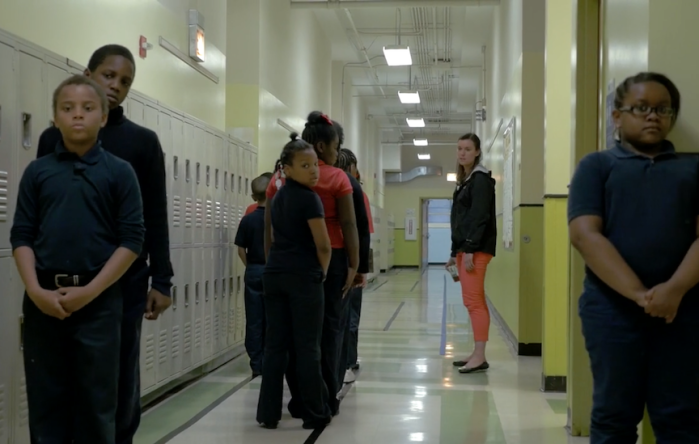
For instance, at a New Orleans charter school, students were punished for not standing straight, not sitting up straight, for putting their heads down, for closing their eyes for too long, for not tracking speakers correctly with their eyes! Between classes students had to walk single file between the wall and a line marked with orange tape. And they had strict dress codes.


This is not school. It is prison.


And it’s unsurprising that these sorts of discipline policies are found at urban charter schools like the KIPP network serving mostly poor and minority students.


Cohodes champions them because – in her view – they get results.


I say that she is missing the point.


Her view of what is important in school is far too narrow.


Moreover, it’s based on a misconception of what constitutes academic success.


Cohodes concludes “No Excuses” policies work solely because schools with such policies tend to have students who get higher test scores.


This is to make a few assumptions.


First, it assumes that the number of students weeded out by such discipline policies isn’t significant enough to wipe out the apparent increase in scores. The punishment for breaking the rules at these schools is often detention, suspension or expulsion. Every child who is enrolled at the beginning of the year isn’t there by testing time. How do we know that the school hasn’t lost so many students who couldn’t obey the rules that they wipe out any gains in testing?


Second, she is assuming standardized testing provide accurate assessments of knowledge and skills. This is far from an accepted premise. These tests have repeatedly been shown to be both economically and racially biased. Cohodes is assuming that since the students scoring better on the assessments are still poor and predominantly black, what they’re being tested on is fair.


Standardized tests are poor assessments. Multiple choice exams do not possess the flexibility to allow for creativity and depth of knowledge. They simply expect a “standard” student to think a certain way and reward dissimilar students for conforming to that standard.


“No Excuses” charter schools may be better at getting different children to act and think alike, but that is not necessarily an endorsement.


Cohodes concludes that these gains in test scores are ultimately beneficial because they will lead to success at college. However, numerous studies have shown that charter school students end up dropping out of college at higher rates than traditional public school students. They simply haven’t learned how to motivate themselves to learn without the rigid, military structures of the charter school environment. One can imagine similar outcomes for charter students (successful charter students) who immediately enter the workforce.


None of these considerations make it into Cohodes research.


She jumps from the brilliant standardized success of “No Excuses” charter schools to the need to include these policies in traditional public schools.


Cohodes worries that the charter school sector can never fully compete with traditional public schools, so we need to make traditional public schools more like charter schools.


However, I cannot imagine many parents would jump at the chance to have their children treated like prison inmates for the chance of higher test scores.


Unlike charter schools, public schools have school boards. They have to make their decisions in public and are accountable to voters who can come to the public meeting, protest and even run for a seat on the board themselves.


In short, this is a terrible idea.


It is somewhat staggering that a grown adult could look exclusively at the data and come to such a conclusion without considering what it means for flesh-and-blood students.


Not only that, but we’re talking about predominantly black and brown students. Is it somehow more acceptable because we’re talking about turning schools serving darker skinned students into Guantanamo Bay? Would it be as acceptable for rosy cheeked affluent white kids?


This is what happens when you let economists set public policy.


It is essential that we include parents, teachers, psychologist and even students in the processes. Otherwise, we’ll continue to get heartless number crunching offered as sincere solutions to our problems.

Wake Up, America! You Have a School Shooting Problem!

photos-century-poc


There have been 11 school shootings so far this year.


And January isn’t even over yet.


That makes about 50 for the academic year – roughly one a week.


Some involve no injuries. Some are suicide attempts. And some, like the latest in Kentucky, involve an active shooter hunting and killing children.


While gun violence is a problem throughout the country, it is especially virulent at educational institutions.


According to an FBI study that looked at incidents from 2000-2013, nearly one quarter of all U.S. shootings took place at schools. And they’re on the rise.


Yet this latest incident barely raised an eyebrow in the collective consciousness.


Hardly anyone even attempted to offer a solution.


The reason?


Since Sandy Hook, we’ve effectively given up.


In December of 2012 a gunman walked in to Sandy Hook Elementary School in Newtown, Connecticut, and killed 20 children and six adults, and we did nothing.


We stood by after the murder of elementary kids and couldn’t get up the collective energy to do one damn thing to stop things like this from happening again.


No new regulations.


No assault weapons ban.


No gun buyback programs.


NOTHING.


In fact, the only thing we did do was actually weaken gun laws to INCREASE the likelihood of more kindergarten kids dying by shot and shell.


In this country we have created a false dichotomy – it’s either children or guns — and we’ve chosen GUNS!


We’re told to buy bullet-proof backpacks, arm school teachers, and have gun wielding police patrol the buildings, but don’t do anything about the firearms, themselves.


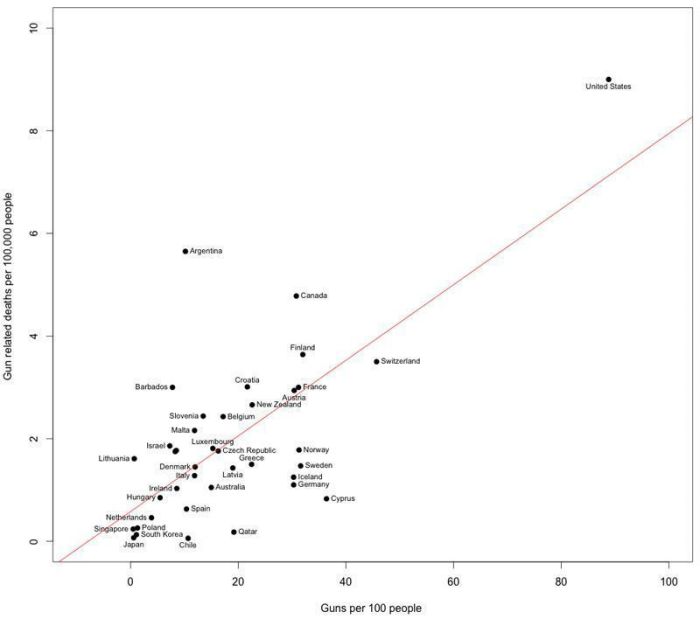
America has 4.4 percent of the world’s population, but almost half of the civilian-owned guns in the world.

guns_per_capita

It’s no wonder, then, that our citizens are so much more likely to die at end of a barrel.


Since Sandy Hook, there have been more than 1,500 mass shootings (including those done at locations other than schools).

Screen Shot 2018-01-26 at 7.59.15 AM

According to the Gun Violence Archive, there have been at least 1,518 mass shootings, with at least 1,715 people killed and 6,089 wounded as of October 2017.


The database defines a mass shooting as one in which at least four people (not counting the shooter) were shot regardless of whether those wounds were fatal or not. And since some shootings go unreported, it’s likely only giving us the bare minimum.


But that’s just mass death and destruction.


The overwhelming majority of gun deaths are smaller scale – police brutality, domestic violence, suicides, accidents, etc. America’s total annual firearm deaths came to more than 33,000 in 2014.


This is patently absurd.


Other countries don’t have the same level of gun violence as we do, even per capita.


There are certain facts that we refuse to accept.


States with more guns have more gun deaths.

gun_ownership_states

Countries with more guns likewise have more gun deaths.

guns_country

Meanwhile, states with tighter gun regulations have fewer gun-related deaths.

gun_control_vs_deaths

Countries with more rigorous gun control likewise have fewer gun related deaths.

(Don’t believe me? See Florida’s “The Geography of Gun Deaths,” and a 2016 review of 130 studies in 10 countries, published in Epidemiologic Reviews.)


Yet we’re told that gun control is useless because new laws will just be pieces of paper that criminals will ignore. However, by the same logic, why have any laws at all?


Congress should just pack it in, the courts should close up and the army should just all go home. Criminals will do what they please – there’s nothing we can do about it.


This kind of thinking is the triumph of business over sense.


The gun industry is making billions of dollars off this cycle of gun violence: mass shooting, fear of regulation, increase in sales. Repeat ad infinitum.


We may never be able to stop all gun violence, but we can take steps to make it more unlikely. We can at least make it more difficult for people to die by firearm.


And this doesn’t have to mean getting rid of all guns.


It just means sensible regulations.


According to the Pew Research Center, when you ask people about specific firearm regulations, the majority is in favor of most of them – both Republicans and Democrats.


We don’t want the mentally ill to be able to buy guns. We don’t want suspected terrorists to be able to purchase guns. We don’t want convicted criminals to be able to buy guns. We want mandatory background checks for private sales at gun shows.

guns_support

Yet our lawmakers stand by helpless whenever these tragedies occur because they are at the mercy of their donors.


The gun industry owns too many lawmakers.


Our continued gun violence problem is a symptom of our flagging democracy.


In a Republic like ours, our representatives are supposed to enact our will in the halls of power. Yet they don’t actually represent us. They represent business and the wealthy.


Until we regain control of our government, we will always be at the mercy of the dollar and the gun.


Our children will remain merely the most innocent victims of our heartless and unfair politics.


Gun violence is not an everyday occurrence at our schools. In fact, children are actually safer there than anywhere else. But everything is relative. Going to class to learn you’re ABC’s shouldn’t bring with it even a moderate chance of fiery death!


But that’s 2018 America. We live in a culture of death.


You need no further proof of that than the weekly report of which school got struck by the lightning of gun violence. Which children were mowed down by the consequences of an out of control plutocracy today?


Bang. Bang. Democracy is dead.

Few Kids in the World Can Pass America’s Common Core Tests, According to New Study

chinese-children-crush-americans-in-math-thanks-to-a-mindset-americans-only-display-in-one-place-sports


Could you jump through a hoop?


Probably if it were lying on the ground.


But what if it were held slightly higher? Let’s say waist high? Sure.


Shoulder height? Maybe with some practice.


How about if we raised the hoop to the rafters of a three story auditorium? Could you jump through THAT?


No. Of course not.


You could train with the world’s greatest coach, with the best equipment, 24-hours a day and you still couldn’t jump that high.


Yet that’s kind of what the U.S. has been expecting of its public school students – minus the resources.


We hold the hoop ridiculously out of reach and then blame them when they can’t jump through it.


But don’t take my word for it.


This is the conclusion of a new study that came out in January called “How High the Bar?” by the National Superintendents Roundtable and the Horace Mann League.


They found the benchmarks for passing the National Assessment of Educational Progress (NAEP) and American Common Core tests put success out of reach for most students the world over.


To do so, they linked the performance of foreign students on international tests of reading, mathematics, and science to the proficiency benchmarks of NAEP and thus Common Core aligned tests which use NAEP benchmarks to determine passing or failure.


The difference is the NAEP is only meant to compare how students in various states stack up against each other. Common Core tests, on the other hand, apply exclusively to kids within states.


No one’s actually expected to pass the NAEP. It’s only given to a sample of kids in each state and used to rank state education systems. The U.S. government, however, gives almost all its students Common Core tests and expects them all to pass – in fact, failure to do so could result in your public school being closed and replaced with a charter or voucher institution.


However, in both cases, the study concluded the score needed to meet the bare minimum of passing was absurdly too high – so much so that hardly any group of children in the entire world met it.


It’s important to note that these aren’t standardized testing skeptics.


They believe in the assessments. They even believe in Common Core. What they don’t believe in is the benchmarks we’re expecting our kids to meet to consider them having passed.


And this has massive consequences for the entire education system.


The media has uncritically repeated the lie that American public schools are failing based almost exclusively on test scores that show only one third of our students passing.


But if the same tests were given to students the world over with the same standard for success, even less would pass it, according to the study. If we drew the red line on international tests at the same place we draw it on the NAEP and  Common Core tests, almost every child in the world would be a dunce.


Kids from Singapore would fail. Kids from South Korea would fail. Kids from Japan would fail. You name a country where kids do nothing but study for high stakes standardized tests, and even they couldn’t meet our uniquely American criterion for passing.


In fact, the percentage of our students who do pass under these ridiculous benchmarks often exceeds that of other countries.


So when you hold kids up to impossible standards a few actually make it – and more of our kids do than our international peers.


That doesn’t mean the benchmarks are good. But it doesn’t mean the American education system is failing either. In fact, just the opposite.


We have a high stakes standardized testing system that not only does not assess kids fairly, but it actually hides their success!


In the words of the study’s authors, “…the analysis suggest the U.S. has established benchmarks that are neither useful nor credible.”


How did this happen?


It comes down to one word – proficient.


If you’re proficient, it’s thought you’re competent, you are able to do something. You might not be incredible at it, but you can get the job done.


Kind of like this:


Hey. Did you hear about my leaky faucet? The plumber fixed it after three tries because he’s proficient at his job.


Oh really? My plumber fixed my leaky faucet in only one try and didn’t even charge me because she’s advanced at her job.


That sort of thing.


There are only four scores you can achieve on most standardized assessments: Advanced, Proficient, Basic and Below Basic. The first two are considered passing and the last two are failing.


However, this doesn’t line up with the five general grades most public schools give in core subjects:


A – Excellent

B – Very good

C – Average

D – Poor

F – Failing


A-D is usually considered passing. Only F is failing.


So you might expect them to line up like this:


Advanced – A and B

Proficient – C

Basic – D

Below Basic – F


However, that’s not how they line up on NAEP. According to Diane Ravitch, who served on the National Assessment Governing Board, the federal agency that supervises NAEP, they line up like this:


Advanced – A+

Proficient – A

Basic – B and C

Below Basic – D and F


This is important, because saying someone scored a proficient on the NAEP doesn’t mean they’re just okay at it. It means they’re excellent but have room to improve.


The problem is that when developers of Common Core tests set their benchmarks, they used almost the same ones as the NAEP. Yet the NAEP benchmarks were never meant to be the same as grade level ones. Confounding the two puts mere passing out of reach for most students.


And that’s not just out of reach for most American students. It’s out of reach for international students!


In short, American students are doing B work on their Common Core tests and failing with a Basic. Yet in other countries, this would be passing with room to spare.


Moreover, when you hear that only one third of American students are Proficient or above, that means only one third are doing A or A+ work on their Common Core tests. That’s actually rather impressive!


According to the study:


“National judgments about student proficiency and many state Common 
Core judgments about “career and college readiness” are defective and misleading… 
According to NAEP officials, Proficient does not mean grade level performance. The misuse of the term confuses the public. The effects of this misuse are reflected in most Common Core assessments…


NAEP’s term “Proficient” does not even mean proficient. “Students who may be proficient in a subject, given the common usage of the term, might not satisfy the requirements for performance at the NAEP achievement level.”


The report even cites other independent analysts that have come to similar conclusions such as the U.S. General Accounting Office, the National Academy of Sciences, and the Brookings Institution.


In short:


“Advocates who push for school improvement on the grounds of questionable benchmarks are not strengthening education and advancing American interests, but undermining public schools and weakening the United States.”


Some specifics.


The study was conducted by comparing performance of foreign students on international tests of reading, mathematics, and science with the NAEP and American Common Core tests.


Very few foreign students were able to score high enough to meet what is considered proficiency on the NAEP and Common Core tests.


In fact, in 4th grade reading, not a single nation was able to meet the benchmark.


In 8th grade math, only three nations (Singapore, South Korea and Japan) had 50 percent or more students who could meet the criterion.


In 8th grade science, only one nation (Singapore) had 50 percent or more students meeting the benchmark.


But wait.


Even though the benchmarks are unfair and few nations children could meet them, the percentage of U.S. children who did meet them was higher than most other nations.


Take 4th grade reading.


Screen Shot 2018-01-22 at 8.48.54 AM


No one had 50% or more of its kids scoring a proficient or advanced. But 31% of U.S. kids actually met the benchmark, putting us fifth behind only Singapore, the Russian Federation, Finland, and England.


Only 31% of our kids could do it, but only four other nations out of 40 could do better.


That’s kind of impressive. Yet judging our scores in abstraction solely on this unrealistic proficiency standard, we’re failures. The whole process hides how well our kids actually do.


Bottom line, Common Core benchmarks are too high and paint an unfair picture of our education system, according to the study:


“When citizens read that “only one-third” or “less than half” of the students in their local schools are proficient in mathematics, science, or reading, they can rest assured that the same judgments can be applied to students throughout most of the world…


Globally, in just about every nation where it is possible to compare student performance with our national benchmarks, the vast majority of students cannot demonstrate their competence because the bars are set unreasonably high.”


Screen Shot 2018-01-22 at 8.47.29 AM


At very least, this invalidates the scores of the NAEP and every Common Core test yet given in this country. It demands we set new benchmarks that are in line with grade level performance.


At most, it casts doubt on the entire process of high stakes standardized testing.


It demonstrates how the data can be manipulated to show whatever testing corporations or other interested parties want.


Standardized testing is a gun, and we have been demanding schools shoot themselves in the foot with it.


Instead of trying to hold our schools to impossible standards, we should be holding our lawmakers to standards of common decency. We should concentrate on equitable funding, reintegration, and supporting our public school system and public school teachers. Not enriching private testing corporations so they’ll paint a misleading picture of student performance to justify pro-privatization schemes.


When will our policymakers rise to meet the benchmarks of honesty, empathy and caring about the well-being of children?


In the final analysis, that may be bar they are simply incapable of reaching.

Men, Too, Need No Longer Suffer in Silence the Pain of Sexual Harassment

sad-man-silhouette-on-bench


This is one of the hardest articles I’ve ever written.


I’ve started it several times. And each time I deleted it.


After all, what right do I have to talk about sexual harassment?


I wasn’t raped.


I wasn’t drugged, beaten or blackmailed.


No one physically abused me in any way that did lasting physical harm.


But I was misused.


I was harassed.


And I shouldn’t have been.


I was made a victim, and my victimizer was a woman.


That, alone, shames me to my core.


I’m a grown man.


We’re not supposed to care about things like this.


We’re supposed to be unfeeling, undisturbed, stoic cowboys with our eyes ever fixed on the horizon.


If anything, I should be the one accused, not the accuser.


Some would deny that you even CAN sexually harass a man.


They’d look at the cultural ideal of manhood as an emotionally stunted beast of burden, and say men are too callous and shallow to be susceptible to this sort of pain. After all, men are always ready for the next sexual encounter. Or we should be, because that’s what it means to be a man.


But they’re wrong.


Men have feelings, too. We hurt. We cry. And we can be scarred by unwelcome advances.


So what happened?


It was almost thirty years ago.


I was just a kid in middle or high school – 8th or 9th grade.


It was in pottery class.


I’ve always loved the arts. I used to draw every spare second. My notebooks were covered with doodles and sketches. Cartoon dinosaurs and skulls. Sometimes an alien or dragon.


And I loved working with clay, too.


For years my mother had a vase I made in that pottery class. It was fat on the bottom with a slender neck. Purple glaze on the outside with a blue interior. Mom displayed it proudly in her dinning room, sometimes with a few flowers inside, until one day it accidentally fell from a shelf and shattered.


I might have been working on that same vase when it happened. I really can’t remember.


I think it was a pinch pot.


I was standing at a table I shared with three or four other students, wrapping tubes of hand rolled clay around and around into the shape of a container, when someone came up behind me, grabbed my butt and squeezed.


I jumped in surprise, and said “Ohh!” or something.


Then I heard, “Hey, sweet cheeks!”


And laughter. All coming from the other side of the room.


I turned my head to see who it had been.


It was a girl I hardly knew though she had been in my classes since first grade.


Let’s call her Nancy.


She was a chunky but not unattractive girl from the other side of the room.


She walked back to her friends, both boys and girls, at her table, and they were all losing it over what had happened.


I blushed and turned back to my work, feeling like the clay my fingers molded.


I couldn’t even process what had happened.


Why had Nancy just walked over to me and pinched my butt?


It wasn’t even a playful pinch. It wasn’t grabbing someone with the palm of your hand and giving a squeeze. She had clawed into my flesh, secured a good hunk and pulled.


It was angry and mean.


I didn’t understand. What had I ever done to her?


I barely knew her. I hadn’t said more than ten words to her in eight years.


“You like that?” she asked from across the room.


I just kept working on my pot, looking at it as if it were the only thing left in the universe.


The others at my table were giggling, too.


I remember it like a scene in slow motion. Me rolling out and unwinding the clay. Everyone else laughing. Nancy smirking.


And then she came back and did it again!


I jumped and squealed.


But I did nothing. I said nothing.


She pinched me at least three or four more times. Maybe more.


And she said something each time.


And like it was on a script, always the laughter and guffaws.


Eventually I think I started to quietly cry.


That’s when it stopped mostly.


The others at my table were as silent as I was. When they saw my reaction, I think they got embarrassed.


We were all working with incredible concentration trying not to acknowledge what was happening.


I made sure not to turn and look behind me. But I could hear the snickers.


Where was the teacher?


The room had a strange L-shape. At the foot of the L was a kiln where she was diligently firing last week’s pottery. From where she was, she probably couldn’t see the rest of us working at our tables.


I don’t think she saw anything. She never said anything if she did.


When she returned to our side of the art room, she may have asked if I was okay. I’m not sure. I probably just shrugged it off. Maybe asked to go to the bathroom.


Why did this bother me so much?


Because I wasn’t asking for anyone to come over and touch me like that.


I just wanted to make my stupid pot. I just wanted to be left alone.


I didn’t want to be treated like anyone’s joke. I didn’t want my physicality to be the cause of anyone’s laughter.


It’s not that Nancy was a pariah or a terrible person or anything. If things had been different, I might have responded differently.


But when you’re a guy in high school, you aren’t allowed to be upset when a girl comes and pinches you.


You’re supposed to respond a certain way.


I couldn’t ask her to stop. I’m supposed to love it.


Even if it’s a joke.


Even if it’s a way to denigrate me in front of the whole class. Even if it’s a way to proclaim me the most undesirable boy in the whole room.


It felt like someone pointing at a banana peel in the trash and mockingly saying, “Yum! Yum!”


But I was the garbage.


It certainly made me feel that way.


I’m not sure why this has bothered me for so long.


Maybe it’s the feeling of powerlessness – that there was nothing I could do. Maybe it was a feeling that I should be reacting differently. I should be more assertive either telling her to leave me alone or maybe actually liking the physical contact.


I’m not sure how to explain it.


I was made to feel inferior and degraded.


Perhaps that’s why I’ve remained silent about it all these years. The only solution had seemed to be to forget about it and move on.


Yet doing so leaves a cold lump in your chest. Oh, it won’t kill you. But it’s always there. You just learn to live with it.


I suppose in writing about it, I’m trying to rid myself of that lump.


I don’t know if it will work. But I’m tired of carrying it around with me anymore.


We’re living in a remarkable moment. Women everywhere feel empowered to share their stories of abuse at the hands of men. Shouldn’t I feel empowered to share my story of abuse at the hands of a woman?


But there does seem to be a disconnect here. A disanalogy.


No matter who you are, everyone has been the victim at one point or another.


Whether you’re male or female, rich or poor, black or white – everyone has been on the losing side.


However, some people use that truth as an excuse to pretend that all groups have been equally targeted. They use it as a way to justify the marginalization and minimalization of women and people of color, for instance, groups that have been most often earmarked for abuse.


Let me be clear – I firmly reject that. I am not All Lives Mattering sexual harassment and abuse. Clearly, women have born the brunt of this burden and men have more often been the cause.


But that doesn’t mean that men are immune to being victimized or that women are incapable of being aggressors.


Perhaps that’s my point in writing this – to caution against easy expectations and easy labels.


Toxic masculinity exists because we have toxic expectations for men and boys. Our society molds them into the shape of our collective expectations.


It’s about time we expect more from men.


And it’s time we allow them the space to be hurt so that they, too, need no longer suffer in silence.

Public Schools Best Fulfill Dr. King’s “Purpose of Education”

CZCqp_RUkAE-ZHI


What is the purpose of education?


Is it to train the next generation of workers?


Or is it to empower the next generation of citizens?


Is it to give children the skills necessary to meet the needs of business and industry?


Or is it to provide them the tools to self-actualize and become the best people they can be?


In today’s world, our leaders continue to insist that the answer to the question is the former corporate training model. Knowledge is only valuable if it translates to a job and thus a salary.


But we didn’t always think that way.


As another Martin Luther King Day is about to dawn this week, I’m reminded of the man behind the myth, a person who clearly would deny this materialistic view of learning.


When we think of Dr. Martin Luther King, Jr., we usually think of the towering figure of the Civil Rights Movement who gave the “I have a dream” speech during the March on Washington in 1963.


However, as a teacher, I find myself turning to something he wrote in 1947 when he was just an 18-year-old student at Morehouse College.


While finishing his undergraduate studies in sociology, he published an essay in the student paper called “The Purpose of Education.”


Two sections immediately jump off the page. The first is this:


“We must remember that intelligence is not enough. Intelligence plus character–that is the goal of true education. The complete education gives one not only power of concentration, but worthy objectives upon which to concentrate. The broad education will, therefore, transmit to one not only the accumulated knowledge of the race but also the accumulated experience of social living.”


So for King it wasn’t enough for schools to teach facts. It wasn’t enough to teach skills, math, writing, reading, history and science. The schools are also responsible for teaching children character – how to be good people, how to get along with each other.


It’s a worthy goal.


But 2018 contains a far different educational landscape than 1947.


When King wrote, there were basically two kinds of school – public and private. Today there is a whole spectrum of public and private each with its own degree of self-governance, fiscal accountability and academic freedom.


On the one side we have traditional public schools. On the other we have fully private schools. And in the middle we have charter, voucher and home schools.


So which schools today are best equipped to meet King’s ideal?


Private schools are by their very nature exclusionary. They attract and accept only certain students. These may be those with the highest academics, parental legacies, religious beliefs, or – most often – families that can afford the high tuition. As such, their student bodies are mostly white and affluent.


That is not King’s ideal. That is not the best environment to form character, the best environment in which to learn about people who are different than you and to develop mutual understanding.


Voucher schools are the same. They are, in fact, nothing but private schools that are subsidized in part by public tax dollars.


Charter schools model themselves on private schools so they are likewise discriminatory. The businesses who run these institutions – often for a profit – don’t have to enroll whoever applies. Even though they are fully funded by public tax dollars, they can choose who to let in and who to turn away. Often this is done behind the cloak of a lottery, but with no transparency and no one checking to ensure it is done fairly, there is no reason to believe operators are doing anything but selecting the easiest (read: cheapest) students to educate.


Charter schools have been shown to increase segregation having student bodies that are more monochrome than those districts from which they cherry pick students. This is clearly not King’s ideal.


Homeschooling is hard to generalize. There is such a wide variety of experiences that can be described under this moniker. However, they often include this feature – children are taught at home by their parent or parents. They may or may not interact with their academic peers and the degree to which they meet and understand different cultures is variable to say the least. They may meet King’s ideal, but frankly the majority of them probably do not.


So we’re left with traditional public schools. Do they instill “intelligence plus character”?


Answer: it depends.


There are many public schools where children of different races, nationalities, religions, and creeds meet, interact and learn together side-by-side.


Students wearing hajibs learn next to those wearing yarmulkes. Students with black skin and white skin partner with each other to complete class projects. Students with parents who emigrated to this country as refugees become friends with those whose parents can trace their ancestors back to the Revolutionary War.


These schools are true melting pots where children learn to become adults who value each other because of their differences not fear each other due to them. These are children who not only learn their academics as well – if not often better – than those at competing kinds of schools, but they also learn the true face of America and they learn to cherish it.


This is the true purpose of education. This is the realization of King’s academic ideal and his civil rights dream.


However, this is not the case at every public school.


While there are many like this, there are too many that are increasingly segregated. In fact, in some areas our schools today are more segregated than they were at the time of Dr. King’s assassination.


These are schools that get the lion’s share of resources, that have the newest facilities, the widest curriculum, the most affluent clientele.


So, no, not even all public schools meet this ideal. But those that don’t at least contain the possibility of change.


We could integrate all public schools. We could never integrate our charter, voucher and private schools. That goes against their essential mission. They are schools made to discriminate. Public schools are meant to be all inclusive. Every one could meet King’s ideal, if we only cared enough to do it.


Which brings me to the second section of King’s early essay that pops off the page:


“The function of education, therefore, is to teach one to think intensively and to think critically. But education which stops with efficiency may prove the greatest menace to society. The most dangerous criminal may be the man gifted with reason, but with no morals.”


Seventy one years ago, King was warning us about the situation we suffer today.


When we allow academics to be distinct from character and understanding, we put ourselves at the mercy of leaders with “reason, but with no morals.”


We put ourselves and our posterity in the hands of those like President Donald Trump, the fruit of a fully private education.


Racism and privilege become the defining characteristics of a class without character, in King’s sense.


If we want to reclaim what it means to be an American, if we want to redefine ourselves as those who celebrate difference and defend civil rights, that begins with understanding the purpose of education.


It demands we defend public schools against privatization. And it demands that we transform our public schools into the integrated, equitable institutions we dreamed they could all be.

What’s the Buzz? A Crown of Gadflies! Top 10 Articles (by Me) in 2017

thumbnail_Screen shot 2017-12-26 at 3.44.17 PM


We made it, Readers.


Somehow we survived 2017 – the first year of the Trump Presidency.


What a monstrosity that has been so far!


Republicans have stolen more than $1 trillion from our pockets to give to their mega-wealthy donors in the form of tax cuts. A 3-2 GOP majority on the Federal Communications Commission (FCC) repealed Net Neutrality. And the party of Lincoln endorsed and funded a child molester for US Senate – though he thankfully lost.


We’re in new territory. Politics has always appealed to the best and worst of our natures: Good people who really want to make a difference and sniveling cowards willing to do whatever their sugar daddies tell them. But unfortunately our world has increasingly rewarded the latter and almost extinguished the former.


However, don’t lose heart. The cockroaches are all out in the open. They’ve become so emboldened by the words “President” and “Trump” voiced together that they no longer feel the need to hug a wall.


All it would take is a good boot and a series of stomps to crush them forever.


Someone get me my shoes.


In the meantime, I sit here at my kitchen table recovering from a turkey coma preparing for a nostalgic look back at everything that’s happened here at Gadfly on the Wall in the past year.


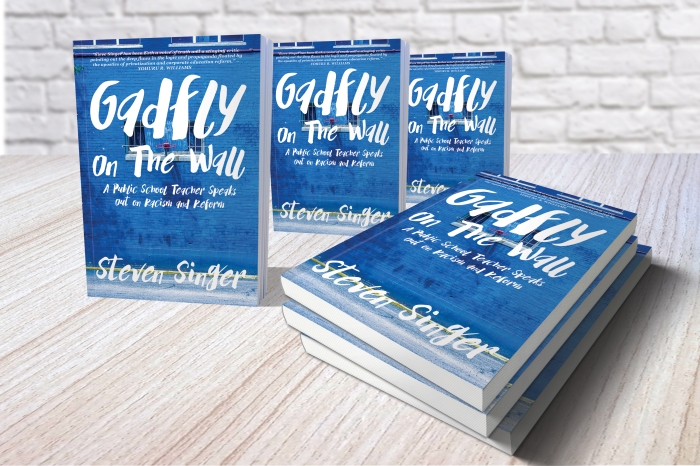
It was quite a 365 days! Most amazing was the publication of my book, “Gadfly on the Wall: A Public School Teacher Speaks Out on Racism and Reform” from Garn Press. It’s a thorough reworking and “Best Of” this blog over the last three years.


Sales have been strong and reviews are starting to come in. I am absolutely floored when I get messages from people I admire telling me they got the book and appreciate this or that. It’s been my lifelong dream to publish a book, and now I’ve done it. The New Year will involve lots of promotion – hopefully I can get decision makers to read it!


Other than that, it’s been a busy year blogging. I wrote 118 articles! That’s about one every three days!


And people have been reading them.


I’ve had more than 364,000 hits – about the same as in 2016. This puts the total views over the 1 million mark at more than 1,216,000! That’s quite a landmark for a blog that’s only been around since July, 2014. And it doesn’t count all the readers I get from articles reposted on the Badass Teachers Association Blog, Huffington Post, Commondreams.org, the LA Progressive, Alternet, BillMoyers.com or other sites.


I’ve also gotten 1,510 more people to follow me for a total of 12,845.


I’m so honored that readers still like coming to this site for news and commentary. As long as you care to enter those virtual doors, I’ll be here, hunched over my computer, pounding away at the keys.


So without further ado, let’s take a look back at the top 10 articles from this blog that got the Inter-webs humming:


10) Teacher Appreciation Week is a Pathetic Joke!

Published: May 10, 2017 Screen Shot 2017-05-10 at 3.38.28 PM


Views: 4,320


Description: At the end of every school year we get Teacher Appreciation Week. It’s nice. Educators get free donuts and cookies, a pat on the head and then the rest of the year we get all the blame for society’s problems without any additional funding, repealing terrible policies or even acknowledgement of what the real issues are in our schools. It’s a sham. Someone had to say it, so I did. Thanks for the snack, but it takes a village, folks! Get off your butts and take some responsibility!


Fun Fact: Some people, even teachers, were really upset by this article. They thought it was ungrateful. Don’t get me wrong, I am truly appreciative for any crumb the public wants to give us, teachers, but I’m not going to let it pass as if that counts as true support. Salving your conscience isn’t enough. We need true allies to get down in the mud and fight with us. Otherwise, it’s just an empty gesture.


9) White Privilege, Public Schools and Ugly Christmas Sweaters


Published: Dec 22 Screen Shot 2017-12-22 at 1.02.56 PM


Views: 4,324


Description: This one’s hot off the press! It describes a situation at one of the schools were I’ve taught over the years and how dress code policies can support white privilege. They’re the broken windows policing of academia, and we need to put much more thought into them before laying down blanket restrictions.


Fun Fact: Some readers took exception to this piece because they thought I didn’t do enough to stop a wayward administrator despite the fact that I never said what I did or didn’t do. Some even complained that it was dumb to simply acknowledge racism and racist policies and actions. I don’t know what world they’re living in. White folks voted for Donald J. Trump to be President. We’ve got a long way to go, and acknowledging everyday prejudice seems a worthy goal to me.


8) America’s Founding Fathers Were Against School Choice

Published: Feb 16 3551131_f520


Views: 4,483


Description: The entire premise of school privatization goes against the founding principles of our nation. We were born out of the Enlightenment, not the profit motive. Our founders would look on in horror at charter and voucher schools. Though they aren’t perfect, only truly public schools embody the ideals of the Revolution. True conservatives and true patriots would support that system, not strive to blow it up for personal financial gain.


Fun Fact: Some people took issue with an appeal to the founders who were not exactly perfect. It’s true. In practice many of them did not live up to their own high ideals. However, who does? It is the ideal that matters, not the clay feet of our forebears.


7) Middle School Suicides Double As Common Core Testing Intensifies


Published: July 24 Screen Shot 2017-07-24 at 10.35.30 AM


Views: 5,800


Description: Teen suicides are up – especially among middle school age children. At the same time, we’ve been testing these kids into the ground. More standardized assessments – and these are unnecessarily more difficult to pass Common Core assessments. This is exactly what happens in countries that put such emphasis on testing – they have a higher suicide rate. It’s no wonder that this is happening here, too. Policymakers want us to be more like Asian countries? Be careful what you wish for!


Fun Fact: This article infuriated the good folks at the Education Post. Peter Cunningham had his flunkies attack me on Twitter complaining that I was an angry white dude making undue correlations. Yet every other explanation for the fact of increased middle school suicides was merely a correlation, too. Proving causation is almost impossible. It is just as reasonable – even more so – to conclude that testing is having an impact on the suicide rate as to intuit the cause being increased reliance on social media. The big money folks don’t want us making the connection I made here. All the more reason to believe there is truth behind it.


6) School Choice is a Lie. It Does Not Mean More Options. It Means Less.


Published: Oct. 6 fake1


Views: 7,880


Description: School choice is a misnomer. It’s school privatization. It has very little to do with providing more options for parents or students. It’s about allowing big corporations to avoid public school regulations and profit off your child swiping your tax dollars. School choice is merely a marketing term.


Fun Fact: I must have really pissed someone off when I wrote this one because it caused Facebook to block me for a week. No matter. Readers liked this one so much they shared it for me all over. Why was I targeted? It could be personal since charter school cheerleader Campbell Brown is literally the arbiter of truth at Facebook. Or it could be the social media site’s attempt to bully me into spending money on advertising. Either way, their attempted censorship didn’t work.


5) Dear Teachers, Don’t Be Good Soldiers for the EdTech Industry


Published: Sept 3 FullSizeRender


Views: 8,358


Description: As teachers, we’re often expected to use new technology in our classrooms. However, we’re rarely involved in the decision making process. We’re rarely allowed to decide which technology to use and sometimes even how to use it. Software packages are just handed down from administration or school board. However, the EdTech Industry is not our friend. More often than not it is unscrupulous in the ways it is willing to profit off of our students through data mining, competency based learning and a variety of privacy threatening schemes. It’s up to us to be brave enough to say, “No.”


Fun Fact: I was surprised by how much the piece resonated with readers. So many other educators said they felt they were being bullied into using apps or programs that they thought were of low quality or downright harmful. Sure, there were some who called me a luddite, but the fact remains: we shouldn’t be using technology for technology’s sake. We should be doing so only to help students learn. That requires us to use our best judgment, not follow orders like good soldiers.


4) Teachers Don’t Want All This Useless Data


Published: June 23 26948475_l-too-much-data


Views: 12,459


Description: Administrators love to gift teachers with tons and tons of data. They bury us under reams of standardized test results and expect us to somehow use that nonsense to inform our teaching. It’s crazy. We already collect authentic data on our students for 180 days a year in the classroom in the course of our teaching. Yet they think these mass produced corporate evaluated snap shots are going to somehow change everything? That’s not how you help educators. It’s how you abdicate any responsibility yourself.


Fun Fact: This one really took off especially on the Huffington Post. Many readers seemed to be truly surprised that teachers felt this way. No authentic educator gives in to being data driven. We’re data informed but student driven. And if you want us to do something else, you don’t have the best interests of the kids at heart.


3) PA Legislature Plans Taking Away Teachers’ Sick Days


Published: Feb 2 thumbnail_teachers-sick-719435


Views: 17,702


Description: This was another tone deaf proclamation from the Republican majority in Harrisburg. It was pure meat for the regressive base in gerrymandered districts that if passed they knew would never be signed by our Democratic Governor Tom Wolf. It turns out the backlash was such that they didn’t even have the courage to put it to a vote.


Fun Fact: I never expected this one to be nearly as popular as it was. Usually articles about Pennsylvania get a few hundred local readers and that’s it. But this one infuriated everyone. How dare lawmakers propose this! Don’t they know how many bacteria teachers are exposed to!? Do they want us to come to school sick and spread the disease to our students!? I’d like to think that the article had something to do with this terrible piece of legislation disappearing, but I have no evidence to support it. However, I can say that it will probably be back when they think no one is looking, and it will still make me sick.


2) U.S. Public Schools Are NOT Failing. They’re Among the Best in the World


Published: Jan 29 surprised-kid-investor-050213


Views: 23,841


Description: Everyone says public schools are failing. I call bullshit. It depends on how you’re evaluating them, and – frankly – we’re not being fair to our American education system. Sure. There are plenty of ways we can improve, but there’s a lot we’re doing right, too. In fact, many of the things we get right, few other systems do around the world. We excel in our ideals. If we just had the courage of our convictions, our system would be beyond the moon! Even as it is, we have much to celebrate. And other nations would do well to emulate us in these ways.


Fun Fact: I’m quite proud of this one. It’s the only article in the Top 10 here that was included in my book. For the definitive version, you’ll have to go there. Some sections received major rewrites and clarifications. I think the published version is much better. But no matter which version you choose, I’m proud to have an answer for all those out there spreading the myth that our education system is an irredeemable mess. They want us to get rid of the good and replace it with more bad. I say we keep the good and build on it.


1) Ignorance and Arrogance – the Defining Characteristics of the Betsy DeVos Hearing


Published: Jan 18 betsydevos-png-crop-cq5dam_web_1280_1280_png


Views: 28,670


Description: Betsy DeVos’ confirmation hearing was an absolute horror show. It’s even worse when you consider she was confirmed by the Republican majority in a tie vote that was broken by Vice President Mike Pence (that still sends shivers down my spine). Here was someone who knows next to nothing about public education except that she wants to destroy it. She wouldn’t commit to protecting students rights even those under the umbrella of special education. There’s more I could say but I just threw up in my mouth a little bit. Excuse me.


Fun Fact: I’m honored that so many readers turned to my blog for commentary about this. It was a moment of shared horror that hasn’t weakened much in the subsequent months. We’re all just waiting for sanity to return but at least we can do so together. We’re all in this side-by-side and hand-in-hand. We can defeat the Betsy DeVos’ and the Donald Trump’s of the world if we stay strong. It could happen any day now.


Gadfly’s Other Year End Round Ups

This wasn’t the first year I’ve done a countdown of the year’s greatest hits. I usually write one counting down my most popular articles (like the one you just read from 2017) and one listing articles that I thought deserved a second look. Here are all my end of the year articles since I began this crazy journey in 2014:


2016

Worse Than Fake News – Ignored News. Top 5 Education Stories You May Have Missed in 2016

ignoring-wisdom


Goodbye, 2016, and Good Riddance – Top 10 Blog Post by Me From a Crappy Year

screen-shot-2016-12-27-at-3-29-49-am


 2015

Gadfly’s Choice – Top 5 Blogs (By Me) You May Have Missed from 2015


Screen shot 2016-01-02 at 11.01.09 PM


Who’s Your Favorite Gadfly? Top 10 Blog Posts (By Me) That Enlightened, Entertained and Enraged in 2015

Screen shot 2015-12-30 at 12.57.49 AM


2014

Off the Beaten Gadfly – the Best Education Blog Pieces You Never Read in 2014

Wonderfull illusion art painting


Top 10 Education Blog Posts (By Me) You Should Be Reading Right Now!

computer-people-png-300x202


Still can’t get enough Gadfly? I’ve written a book, “Gadfly on the Wall: A Public School Teacher Speaks Out on Racism and Reform,” now available from Garn Press. Ten percent of the proceeds go to the Badass Teachers Association. Check it out!

book-2

White Privilege, Public Schools and Ugly Christmas Sweaters

Screen Shot 2017-12-22 at 1.02.56 PM

This is one of those stories that’s been bothering me for a while.


I won’t say it happened recently or at my current district, but after teaching in the public school system for almost two decades, you see a lot that most people never hear about.


So it was almost Christmas break and my middle school students were shuffling in to homeroom.


One of the girls turns to me and says, “Mr. Singer, am I okay to wear this?”


Hold up. I teach English.


I am not a fashionista or even particularly clothes conscious. So this question took me by surprise.


In the split second it took me to comprehend what she was asking and focus my eyes on the girl, I was expecting she might have on something too revealing or perhaps had an inappropriate slogan on her shirt or a marijuana leaf.


But no. She had on a simple blue long sleeve sweater with a red Superman symbol in the middle.


I was about to say that what she was wearing was perfectly acceptable, but then I remembered the dress code.


It was a new directive from the school board, and it was – frankly – a horror show.


We used to have a perfectly fine dress code that only made students refrain from clothing that was dangerous, inappropriate or sexually explicit. But then someone on the board heard about a neighboring district that modeled itself after a private school academy – so they had to do the same thing here.


It was beyond stupid. Only certain colors were allowed. Only certain kinds of clothing. No designs on t-shirts. And on and on.


I frankly paid no attention to it. But administrators did.


Though they rarely punished students for being late to class, improperly using cell phones or dropping an f- bomb, they swept through the building every morning to make sure every student was undeniably in dress code – to the letter.


And if a child was wearing a verboten item of clothing! Heaven forbid! That child was sent to in-school suspension for the remainder of the day unless a parent brought a change of clothing.


The same students would sit in “The Box” for days or weeks while their education was in suspended animation because they just couldn’t figure out which clothes the school board considered to be appropriate. (Or more likely they wanted a vacation from class.)


So when this girl – let’s call her Amy – asked me about her outfit, it was a pretty serious question.


And a difficult one.


Normally the Superman symbol would violate dress code, but I remembered that since it was only a few days before the holiday break, as an extra treat, students had been allowed to wear an “ugly Christmas sweater.” It was either that or conform to the usual dress code.


So all around me children were wearing fluffy red and green yarn creations sporting snowmen, Christmas trees and Santas.


But Amy was wearing a big red S.


By any definition, that’s not a Christmas sweater, and if the administrators wanted to take a hard line on the rules – and they usually did – she was out of dress code.


I told her what I thought. I said I had no personal problem with it and wouldn’t report her to the principal, but if she had a change of clothes, she might want to consider using them.


She didn’t.


And even if she did, it was too late. An administrator barreled into the room and proceeded to examine each child’s clothing.


Amy took her backpack and put it on backwards so that it covered her chest and the offending S.


Even that didn’t work.


When the administrator got to her, he asked to see what was under her backpack. She sighed and showed him.


But miraculously he said, “Okay,” and moved on.


Amy and I both breathed a sigh of relief. She was saved and wouldn’t have to spend the rest of the day in our school’s version of prison.


Before we could get too comfortable though, the hushed silence was broken when the administrator started screaming at another girl in the back of the room.


“That is not in dress code, and you know that’s not a Christmas sweater!” he screamed, cords standing out on his neck.


“How many times have I told you, but you think you can get away with anything…” and he continued to yell at her as she stomped out into the hall and presumably her locker.


And as she left, I saw that he was right. The girl he was yelling at – let’s call her Jada – was not wearing a Christmas sweater. She was wearing a plain gray and white flannel shirt. I don’t know how or why, but I guess that violated the dress code.


And for this offense she spent the day in in-school suspension.


I guess that’s not really Earth shattering, but it really bothered me.


It just seemed so unfair.


Jada was by no means a perfect student. But neither was Amy.


They both frequently broke rules and did pretty much what they wanted. They both could get an attitude, be catty, and mean.


However there was one distinguishing difference between them that immediately jumped to your attention – the color of their skins.


Amy was lily white. Jada was chocolate brown.


Now I’m not saying this administrator – who was white, by the way – was a virulent racist. I don’t know what went on inside his mind or heart.


In fact, I’d always thought of him as a fair-minded person who did his best to be impartial and treat students equally.


However, here was a case where he got it dead wrong.


Did he let Amy go because she was white? I don’t know. Did he come down on Jada because she was black? I don’t know.


My guess is that he was moving in a fog. He went to at least half of all the homerooms in the building checking each child to make sure they were in dress code. For some reason, when he looked at Amy, what he saw didn’t set off alarm bells. When he looked at Jada, it did.


Perhaps he remembered that Amy’s dad was a local cop and he didn’t relish having to call the police station to tell the officer that his daughter needed a change of clothes. Perhaps when he looked at Jada he was reminded of all the times she had been written up or defiant.


I say again – I don’t know.


However, there is little doubt in my mind that this is an example of white privilege – in action if not in intent.


The administrator gave Amy the benefit of the doubt because of her whiteness and came down on Jada because of her blackness.


This may not have been at the forefront of his mind – it probably wasn’t – but I believe that somewhere in his subconscious, racial attitudes and preconceptions played a part in this snap decision.


If I had taken him aside and mentioned it to him, perhaps he would have reconsidered. But probably not since I was just a subordinate.


Perhaps later after school over a few drinks he might have thought better of it.


But this kind of thing happens all the time.


White people make snap decisions about people of different races based on these same shadowy, unexamined racial preconceptions.


And in each case, the beneficiary is invariably the white person and the loser is the black person.


That’s white privilege. People like me and Amy get the benefit of the doubt, while people like Jada and the majority of my other students don’t.


It’s something we, white people, need to acknowledge.


I’ll say one more thing about dress codes.


I accept that they are necessary in a public school setting.


It’s difficult to teach if students parts are hanging out, if they’re displaying coded messages on their chests, have advertising or rude statements on their clothing.


I once reported a girl for wearing a shirt that said “WTF.” She didn’t realize that I knew what the acronym meant. Another time I reported a student for wearing flip-flops. They were dangerous because kids could trip and fall but also the incessant slapping of plastic against heels drives me bonkers.


But other than that, I rarely get involved in dress codes.


Frankly, I think too strict a restriction on what students wear and too stringent enforcement of such policies does more harm than good.


It’s the school equivalent of broken windows policing. Instead of lowering crime by cracking down on the little stuff, too punitive severity in a dress code teaches kids that rules are arbitrary. Moreover, it creates fear and distrust of authority figures.


And – intentionally or not – it is a mechanism for enforcing white privilege.


Anytime I’ve had to oversee in-school suspension, there have been a disproportionate number of students of color in there for dress code violations than white students.


I know that’s not scientific, but it’s the data that I have.


In fact, I strongly suspect that discipline based on dress code enforcement is rarely reported to the state or federal government because it would show a major uptick in discipline against black students. It would further prove that minorities are written up more than white kids and get more strict punishments.


Standardized dress is as bad as standardized tests. We shouldn’t demand all our children dress alike and conform to a nonsensical norm.


Especially when the norm is whiteness.


Ugly Christmas sweaters, indeed!


I mean how white can you get?

My Students Are Addicted to Screens

07BRODY-facebookJumbo

Michael sat at his desk with ear buds inserted, an iPad balanced in front of his eyes and an old fashioned paper book open on his desk.

His head was bopping and weaving. His eyes were transfixed on a YouTube video of an animated soldier blasting away bad guys. And his book was laid out in front of him, largely ignored.

This was during our class’ sustained silent reading time – a period of 15-20 minutes where my 7th grade students were supposed to read self-selected books. Eventually, they’d have to complete a project, but today all they had to do was read.

Still, many used the time the same way as Michael did – lost in cyberspace, merely pretending their eyes gloss over the page.

“And what did the teacher do?” I hear some readers say indignantly.

“If you allow this type of behavior, you’re worse than the child doing it.”

So come with me as I redirect Michael.

“Hey, buddy,” I say.

“Huh?” he responds as if awakened from a dream.

“Are you reading?”

“Uh. Yeah.”

“You’re not just watching that video and ignoring your book?”

“Nope,” he says now fully awake. And he proceeds to give me a canned summary of the text that he memorized from the Internet.

But I’m still skeptical.

“I’m going to take your iPad away just for SSR time,” I say.

BUT WHY!? I’M READING!”

“I just want you to be able to concentrate on what you’re reading.”

And as I gently pry the iPad from his curled fists, he stands up and gives me a look of pure hatred.

This is a look from a 7th grade boy who’s considering violence.

It’s the same look you’d get trying to take away a dog’s bone, or an addict’s crack pipe.

It truly depends on the child what happens next. Some will regain control, slam down into their seats and sulk. Others will whine and cause a scene. And some will lose all control and lash out.

This is what teachers deal with every day when it comes to technology in the classroom.

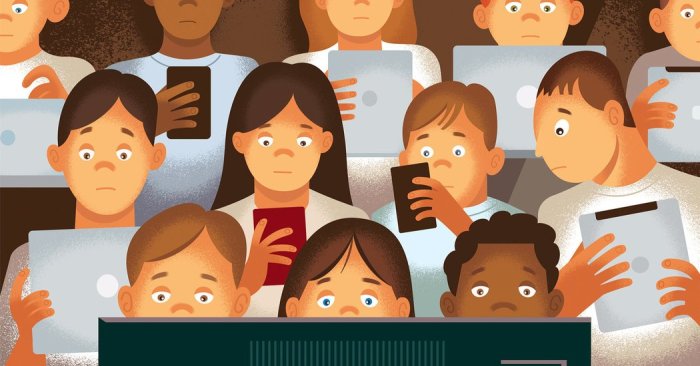
In point of fact, many of our children are addicted to their devices.
iPads, laptops, Smartphones – we might as well be giving them pills, joints and syringes.

According to Merriam Webster, addiction is defined as, “compulsive need for and use of a habit-forming substance… [characterized] by well-defined physiological symptoms upon withdrawal.”

For most students, their devices have become just that – a compulsion, the cause of a nearly irresistible impulse to check them, access them, use them to keep themselves entertained and plugged in.

With repeated use, it becomes habit forming, and separation from the device can lead to a kind of withdrawal.

From a neuro-psychological point of view, one wonders if repeated use is clinically damaging – especially to adolescent brains that have not yet fully formed.

From an educational point of view, one wonders if relying on such devices in class is pedagogically sound.

I’m not qualified to answer the first question (though it deserves much more study than it is receiving). But from my 15 plus years of experience in the classroom, I feel qualified to answer the second – and that answer is often a resounding “NO.”

In my kids’ everyday lives, this type of constant technology reliance doesn’t make them better students. It doesn’t give them access to more information. It makes them dependent on instant gratification and sensory overload.

Their minds are submerged in a soup of constant noise and conflicting demands for their attention. Stringing together thoughts and coming to reasoned opinions becomes increasingly difficult.

This isn’t to say that technology has no place in the classroom.

There are ways to use it that can enhance learning. However, in my experience these are NOT the ways it is being used most of the time. That takes, thought, planning, intention. Instead, many well-meaning administrators or school directors prescribe technology as an end in itself regardless of the goals of an individual lesson. They want to prove their buildings, schools or districts are cutting edge, and that only takes the constant use of technology – not surgical, intentional use.

It’s not that teachers don’t know how to apply it or don’t care. It’s that technology – especially the presence of a one-to-one device in the hands of every child at all (or most) times – creates more problems than it solves.

This is why the same people who invented these technologies strictly regulate them for their own children.

Bill Gates and Steve Jobs, two of the biggest tech titans in the business, famously limited screen time for theirs sons and daughters.

Gates, a Microsoft co-founder, refused to let his children have personal technological devices until they were developmentally ready for them.

“We don’t have cellphones at the table when we are having a meal,” he told the Mirror. “We didn’t give our kids cellphones until they were 14 and they complained other kids got them earlier.”

Today, most children get their own cellphones at age 10. And if their schools have one-to-one initiatives like mine, they have their own iPad as early as 5th grade with less but still substantial hours of usage as early as kindergarten.

Jobs, an Apple co-founder, also limited screen time for his children.

When asked if his children liked the original iPad shortly after it was launched, Jobs said, “They haven’t used it. We limit how much technology our kids use at home.”

In fact, according to Walter Isaacson, who wrote a near-definitive Jobs’ biography, technological devices were only allowed at prescribed times.

“Every evening Steve made a point of having dinner at the big long table in their kitchen, discussing books and history and a variety of things,” he said.

“No one ever pulled out an iPad or a computer. The kids did not seem addicted at all to devices.”

And this practice seems common among parents in Silicon Valley.

According to educators Joe Clement and Matt Miles, authors of “Screen Schooled: Two Veteran Teachers Expose How Technology Overuse is Making Our Kids Dumber,” those in the tech industry know the dangers of their own products on children.

A number of specialty Silicon Valley schools, say Clement and Miles, such as the Waldorf School, rely almost exclusively on low-tech tools to teach. This often means chalkboards and pencils. The emphasis is on learning interpersonal skills such as cooperation and respect – not the ins and outs of computer coding.

At Brightworks School, even the physical environment of the class is a tool to learning. Students attend class in treehouses and kids learn creativity by building things with their hands.

This is a far cry from the technological wonderland our kids are being sold by these kids’ parents.

No one really knows what effect it’s having on growing minds. However, psychologists are beginning to see alarming trends.

For instance, frequent use of social media makes an eighth-grader’s risk for depression 27% higher. Moreover, use of smart phones for at least three hours a day increases children’s risk of becoming suicidal. Some experts believe that increased use of technology has contributed to the teen suicide rate which for the first time eclipses the homicide rate.

We are jumping head first into an educational model that puts technological devices like a tablet at the center of learning.

Teachers assign lessons on the device. Students complete assignments on it. Projects are virtual as is research. Even conversations are conducted through a chat page, emails or messaging.

Why? Not necessarily because of any proven link to increased academic results. It’s because tech companies are marketing their devices to schools and students.

This is industry-driven, not pedagogically-driven.

There is an unquestioned bias that doing things with technology is somehow better simply because we’re using technology. However, an article written on a computer will not necessarily be better than one written with pen and ink. There are other factors involved.

Now Gates and company are pushing personalized learning objectives. Sometimes called competency based education, these continue to place the device in the center of what should be the student-teacher relationship.

Student learning becomes a video game and the teacher becomes a virtual avatar. Kids spend their time doing infinite standardized testing as if it were authentic education, yet it’s all on-line so it appears to be cutting edge. It isn’t.

It’s just another scam.

In my own classes, I’ve put the brakes on unquestioned technology. I only use devices, programs or applications that are (1) reliable and (2) when I know why I’m using them.

Even then, I find myself unable to even talk to students without beginning every lesson telling them to at least temporarily put their devices away so they can hear the directions.

Sure, I could give them a QR code to scan and get a written copy of the directions. I could upload a video for them to watch. But that limits direct feedback. It makes it more difficult for them to ask questions. And it makes it almost impossible for me to tell if 20-30 kids are actually doing the assignment before they turn it in for grading.

These are just kids, and like kids in any age they’ll take the path of least resistance. Often they’ll try to get through the assignment as quickly as possible so they can listen to music, or watch a video, or play a video game or chat on-line.

Lessons can be engaging or thought-provoking or spark the creative impulse. But you have to get students’ attention first.

That’s hard to do when they always have the option to crack their brains open over a virtual frying pan and watch it sizzle away.

To be fair, living in the modern world, we’re probably all somewhat addicted to technology. This blog isn’t written on papyrus and it isn’t being accessed in a hefty library volume.

I use social media – Facebook and Twitter mainly – to disperse it.

But there’s a difference between me and my students.

I’m an adult.

I know the concessions I’m making. I enter into this with eyes open. I have a lifetime of experience and knowledge with which to make such a decision.

Children don’t have that. They look to us to protect them.

We are their guardians. We’re only supposed to subject them to things that will help them learn, keep them healthy and happy.

But in our rush to be trendy and hip, we’re failing them miserably.

We’re letting business and industry take over.

It’s time to take a stand.

Our kids may be addicted, but we don’t have to be their pushers.

We need to get them clean and show them how to use this brave new tool with moderation and restraint.