The Charter School Swindle – Selling Segregation to Blacks and Latinos

Screen Shot 2016-05-31 at 4.22.46 PM


Segregation now!


Higher suspension rates for black students!


Lower quality schools for Latinos!


These may sound like the campaign cries of George Wallace or Ross Barnett. But this isn’t the 1960s and it isn’t Alabama or Mississippi.


These are the cries of modern day charter school advocates – or they could be.


School choice boosters rarely if ever couch their support in these terms, but when touting charter schools over traditional public schools, this is exactly what they’re advocating.


According to the Civil Right Project at UCLA, “The charter school movement has been a major political success, but it has been a civil rights failure.”


It’s choice over equity.


Advocates have become so blinded by the idea of choice that they can’t see the poor quality of what’s being offered.


Because charter schools DO increase segregation. They DO suspend children of color at higher rates than traditional public schools. And they DO achieve academic outcomes for their students that are generally either comparable to traditional public schools or – in many cases – much worse.


In Brown vs. Board of Education, the U.S. Supreme Court ruled that it is Unconstitutional to have “separate but equal” schools because when they’re separate, they’re rarely equal. Having two parallel systems of education makes it too easy to provide more resources to some kids and less to others.


Who would have ever thought that some minority parents would actually choose this outcome, themselves, for their own children!?


After Bloody Sunday, Freedom Rides, bus boycotts and countless other battles, a portion of minority people today somehow want more segregation!?


It’s hard to determine the extent of this odd phenomena. Charter advocates flood money into traditional civil rights organizations that until yesterday opposed school privatization. Meanwhile they hold up any examples of minority support as if it were the whole story. However, it is undeniable that large minority populations still oppose their school systems being charterized.


It’s especially troubling for civil rights advocates because black and brown charter supporters have been sold on an idea that could accurately be labeled Jim Crow. And they don’t even seem to know it.


The reason is two-fold: (1) the success of privatization propaganda and (2) the erosion of our public school system.


Charter schools are big business. Many of them are managed by huge corporations for a profit. They are run at taxpayer expense with little to no oversight. As you might expect, this often results in multi-million dollar financial scandals and worse outcomes for students. But these facts have not fazed some of the public. Propagandists know how to sell people on things that are bad for them: Fast food, miracle cures and charter schools.


They’ve marketed corporate McSchools as if these were mostly charitable institutions founded for the sole purpose of making children’s lives better. Meanwhile, funds that might actually help kids learn are funneled to hedge fund mangers and investors: Schools don’t open yet tax money disappears. Student services are reduced below that offered at comparable neighborhood public schools. Charter students are expelled for low test scores or special needs. Yet the public still buys the glossy full-color advertisement without bothering about the small print.


One thing corporate education reformers have over advocates of traditional public schools is their willingness to talk about race. They clothe their arguments in the terms of the Civil Rights movement. They talk about having high expectations for children of color. They talk about closing the achievement gap. They talk about understanding the needs of minority children.


It’s all bullshit.


Their “high expectations” are really just an excuse for treating brown and black kids as if they weren’t human. They put these children under intense pressure, berating them for wrong answers and kicking them out if they don’t perform.


Yet the academic results produced at charter schools are often less than stellar. Sometimes they’re downright abysmal. Instead of addressing the fundamental inequalities inherent in the achievement gap – economically and culturally biased high stakes testing, shoddy and developmentally inappropriate academic standards, etc. – they reinforce that status quo. It’s like instead of fighting a prohibition against sitting in the back of the bus, they berate black folks for not enjoying the ride.


I’m sorry. But when it comes to understanding the needs of black and Latino kids, I refuse to believe children of color need a second-class education system. (Just as I refuse to believe Teach for America’s claim that all black kids really need are less experienced, less educated and less committed teacher trainees.)


Perhaps if traditional public schools actually addressed these issues head on, privatizers wouldn’t appear to be saviors. There are real problems faced by children of color in our school systems. They have real needs that most of our schools – charter, traditional, private or parochial – just are not meeting. But while charter schools pay lip service to the problems without fixing them and in fact often making them worse, public schools pretend these problems don’t exist in the first place.


No wonder some minority parents choose charter schools. At least there they get the illusion that someone cares about their needs.


In fact, privatizers couldn’t sell their substandard products if it weren’t for what we’ve allowed to happen to our traditional public schools. Segregation is made worse in charter schools, but it is also prevalent at our traditional public schools – though often to a lesser degree.


We have allowed traditional public schools to be largely segregated based on parental income. We have schools for poor kids and schools for rich kids. Thus, we have schools for black kids and schools for white kids. And guess which ones are well-funded and which go lacking?


This is what people are really talking about when they mention “failing schools.” They pretend as if the teachers are failing, the principals are failing, the democratic process, itself, is failing. In reality, it is our state and federal lawmakers who are failing. They have failed to provide equitable resources that our nation’s children need.


Schools cost money. If you don’t provide the funding necessary to properly educate children, you will get an inferior result. Meanwhile, pundits play with numbers and make false comparisons to hide this basic fact – we aren’t providing all kids with the resources they need to succeed. Rich kids have enough. Poor kids don’t. But we look at national averages, add in unfunded legal mandates and pretend that tells the whole story.


How does this happen? Segregation. In fact, we’re allowing segregation of place to determine segregation of school. Instead of counteracting an unfair status quo, we’re letting the way things are today determine how things will be tomorrow.


Fact: people of different ethnicities tend to cluster together, like with like. Part of this is because people tend to self-segregate with people around whom they feel most comfortable. However, this is also a function of social planning. Banks tend to shy away from giving loans to families of color who want to move into white neighborhoods. Moreover, white homeowners are often reluctant to sell to families of color. The result is an America made up of black neighborhoods and white neighborhoods.


In organizing our public schools we could try to overcome these differences, but instead we amplify them. In many states we insist that schools be funded based on local property taxes. So poor brown and black people who happen to live clustered together get poorly funded schools for their kids. And rich white folks who live together in their gated communities get well-funded schools for their progeny.


Is it any wonder then that some people of color buy into the charter school lie? They’re offered the choice between an obviously under-resourced public school or a glossy new charter school that actually offers them less. But they don’t see that far. They’re tired of the indifference behind traditional public school funding and opt to try something different. Unfortunately, it’s just another lie and a more pernicious one for several reasons.


First, charter schools take an already segregated population and make it worse. Second, they weaken the already stumbling traditional public schools by siphoning off their dwindling funding. And finally, they obscure the fact that it’s often the same policymakers who champion charters that are responsible for eroding public schools in the first place.


People of color would be much better served by sticking with their traditional public schools and fighting to make them better. For all their faults, traditional public schools often provide a better quality education. They have more resources and less flexibility to take away those resources. They have more well-trained and experienced staff. And since they serve a more diverse population, they offer the chance for people of similar economic backgrounds but diverse cultures to join together in common cause.


Dividing people makes them weaker politically. When people band together, they have power. They can fight more effectively for what they deserve. Perhaps this is the greatest problem with charter schools – they destroy communities and rob neighborhoods of the collective power that is their due.


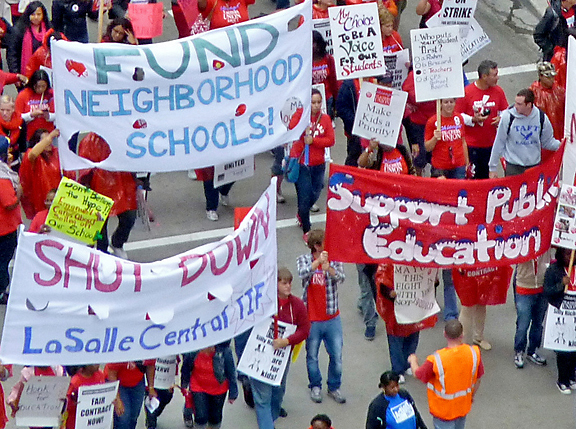
In many areas of the country, communities of color know this. Ask them in New Orleans what they think of their all-charter school district. Ask them in Chicago what they think of the city’s plan to close public schools and turn them into charters. Ask them in Philadelphia or any urban district taken over by the state.


They’ll tell you straight out how privatized education is cultural sabotage. They’ll tell you how it’s the new colonialism, another element of the new Jim Crow. They’ll tell you how important it is to fight for our system of public schools.


And when privatizers and propagandists try to paint all communities of color as if they support charter schools, these folks will loudly cry foul.


They aren’t buying the snake oil. The rest of us need to step up and help those who have been swindled to see the truth. Likewise we need to recognize their truth – that the struggle for civil rights is ongoing.


Because we can’t win the fight against privatization without them. And they can’t win the fight for equality without us.


We need each other.


Public school advocates need to recognize it’s not all about testing, Common Core and privatization. We can’t be so afraid to talk about race. We need to recognize that racism is not an unnecessary distraction, it’s at the center of our struggle.


We need communities of color.


We need our black and brown brothers and sisters.


Because only together shall we all overcome this madness.

Great Reading Must Be Felt, Not Standardized

black-history-month-featured-photo-520x345

I made my classes cry today.

That sounds terrible, but if I’m honest, I knew it would happen and meant to do it.

I teach in an urban district and most of my 8th grade students are African American and/or impoverished. We’re reading Harper Lee’s classic novel “To Kill a Mockingbird” together, and the kids were loving it.

Until today when we got to the verdict in the Tom Robinson trial.

Jaquan closed his book with wide eyes.

“What the heck happened?” he asked.

Other students in the room murmured their agreement.

“They found him guilty!? What the F!?”

“I hate this book.”

“This is so freakin’ racist.”

I let them go on for a moment.

Frankly, it was the reaction I had been expecting.

It happens every year around this time.

Until this moment, my kids were really into the book. They were enjoying the case and excited by how well the defense attorney, Atticus Finch, had proven that Tom, a black man in the 1930s South, is innocent of raping a white woman.

But even last night I knew what was coming. The next day – today – I’d have to go and break their hearts when they read what the jury actually decides. Some of them were bound to be crushed. And today they were.

For those who haven’t cracked this book open in decades, let me recap.

There is no physical evidence that the crime actually took place. Moreover, because of a crippling injury as a child, Tom is physically incapable of perpetrating the crime in the first place.

In a world where black males could be tortured and killed just for whistling at a white woman – like Emmett Till – it’s clear that Tom is the victim, not the aggressor.
It seems like a slam dunk case. Yet the all-white jury finds Tom guilty, and ultimately he is shot 17 times in prison after losing all hope and trying to escape.

It’s no wonder that when we read that cascade of Guilty’s from the jury’s mouths today, my kids couldn’t believe it.

Some of my best students closed the book or threw it away from them.

So I let them express their frustrations. Some talked about how the story hit too close to home. They have family members in jail or who have been killed in the streets by police. One girl even told us that she’s never met her own mother. The woman has been locked away since the child was an infant, and because of a missing birth certificate, my student hasn’t even been allowed to visit.

“Mr. Singer, when was this book written?” one of the girls in the back asked.

“The late 1950s,” I said.

“I thought you were going to say it just came out.”

And so we talked about what the book has to do with things happening today. We talked about Eric Garner. We talked about Michael Brown, Trayvon Martin, Sandra Bland, Tamir Rice and Freddie Gray.

At a certain point, conversation ceased.

My class of rowdy teenagers became quiet. We could hear people stomping in the hall, a movie being shown a few doors down.

There might have been a few tears.

I knew it would happen.

Last night I debated softening the blow, preparing them for what was about to take place. When we read “The Diary of Anne Frank” a month ago, I made sure they’d know from the very beginning that Anne dies. It should have been no surprise to them when Anne and her family are captured by the Nazis. It’s scary and upsetting but not entirely unexpected.

However, with “Mockingbird” I just let events unfold. And I stand by that decision.

It’s frustrating and painful, but my students need to feel that. It’s something I can’t shield them from.

It’s not that they have never felt this way before. Many of them have experienced racism and injustice in their everyday lives. But for this book to really have the desired impact, they need to FEEL what the author meant. And it needs to come from the book, itself.

A book isn’t just sheets of paper bound together with glue and cardboard. It’s a living entity that can bite. That’s the power of literature.

I can’t in good conscience shield them from that. They need to see it and experience it for themselves.

Writer Flannery O’Connor put it like this:

“I prefer to talk about the meaning in a story rather than the theme of a story. People talk about the theme of a story as if the theme were like the string that a sack of chicken feed is tied with. They think that if you can pick out the theme, the way you pick the right thread in the chicken-feed sack, you can rip the story open and feed the chickens. But this is not the way meaning works in fiction.

“When you can state the theme of a story, when you can separate it from the story itself, then you can be sure the story is not a very good one. The meaning of a story has to be embodied in it, has to be made concrete in it. A story is a way to say something that can’t be said any other way, and it takes every word in the story to say what the meaning is. You tell a story because a statement would be inadequate. When anybody asks what a story is about, the only proper thing is to tell him to read the story. The meaning of fiction is not abstract meaning but experienced meaning, and the purpose of making statements about the meaning of a story is only to help you experience that meaning more fully.”

This is what our policymakers either misunderstand or forget when they demand we assess understanding with standardized tests.

The meaning of a story is not expressable in discrete statements A, B, C, or D. We wouldn’t read them if it was.

Every person is unique. So is every reaction to literature.

You can’t identify the meaning of this story on a multiple choice test. You can’t express what it means to YOU. All you can do is anticipate the answer the test maker expects. And that’s not reading comprehension. It’s an exercise in sycophantry. It teaches good toadying skills – not good reading strategies.

Perhaps that’s why Common Core encourages us to shy away from complex texts like “Mockingbird.” We’re told to focus on short snippets of fiction and to increase our student’s diet of nonfiction. Moreover, we’re told to stay away from narratives like Anne Frank’s. Instead, we should have our children read from a greater variety of genres including instruction books, spreadsheets, recipes – just the facts – because as Common Core architect David Coleman famously said, “No one gives a shit what you think or feel.”

Frankly, we don’t do a whole lot of that in my class. We still read literature.

Today, even after the blowout, we kept reading “Mockingbird.”

My kids suffered along with Jem and Scout. They reveled in Atticus’s example. They feared where it was all going.

And when class was over, a few of them had come around.

“This is such a good book, Mr. Singer,” one girl told me on the way out.

“Is Atticus going to die?” another asked to which I smiled and shrugged.

Jaquan stayed after the bell to ask his own question.

“Do you think in a hundred years things will be any different?”

“How do you mean?”

“I mean do you think people will still do things like THIS?” he said holding up his book.

I looked at him and swallowed.

“I don’t know, Jaquan,” I said. “But things are better now than they were. We can hope.”

He nodded.

I clapped him on the back and wished him a good weekend.

You don’t get that kind of reaction from Common Core, and you can’t assess it on a standardized test.

Students can’t ask such questions to computer programs.

They need teachers with the freedom to teach and assess as they see fit.

Otherwise, it is not just Tom Robinson that suffers a miscarriage of justice.

We all do.

Whiteness: The Lie Made True

a456ccf8db4592c7a80552986d7ac86d

“The discovery of a personal whiteness among the world’s peoples is a very modern thing,—a nineteenth and twentieth century matter, indeed.” – W. E. B. Du Bois


What color is your skin?


You don’t have to look. You know. It’s a bedrock fact of your existence like your name, religion or nationality.


But go ahead and take a look. Hold out your hand and take a good, long stare.


What do you see?


White? Black? Brown?


More than likely, you don’t see any of those colors.


You see some gradation, a hue somewhere in the middle, but in the back of your mind you label it black, white, brown, etc.


When I look, I see light peach with splotches of pink. But I know that I’m white, White, WHITE.


So where did this idea come from? If my skin isn’t actually white – it’s not the same white I’d find in a tube of paint, or on a piece of paper – why am I labeled white?


The answer isn’t scientific, cultural or economic.


It’s legal.


Yes, here in America we have a legal definition of whiteness.


It developed over time, but the earliest mention in our laws comes from the Naturalization Act of 1790.


Only 14 years after our Declaration of Independence proclaimed all people were created equal, we passed this law to define who exactly has the right to call him-or-herself an American citizen. It restricted citizenship to persons who resided in the United States for two years, who could establish their good character in court, and who were white – whatever that meant.


In 1896 this idea gained even more strength in the infamous U.S. Supreme Court decision Plessy v Ferguson. The case is known for setting the legal precedent justifying segregation as “separate but equal.” However, the particulars of the case revolve around the definition of whiteness.


Homer Plessy was kicked off the white section of a train car, and he sued – not because he thought there was anything wrong with segregation, but because he claimed he was actually white. The U.S. Supreme Court was asked to define what that means.


Notably the court took this charge very seriously, admitting how important it is to be able to distinguish between white and non-white. Justices claimed whiteness as a kind of property – very valuable property – the denial of which could incur legal sanction.


In it’s decision, the court said, “if he be a white man, and be assigned to the color coach, he may have his action for damages from the company, for being deprived of his so-called property. If he be a colored man and be so assigned, he has been deprived of no property, since he is not lawfully entitled to the reputation of being a white man.”


Plessy wasn’t the only one to seek legal action over this. Native Americans were going to court claiming that they, too, were white and should be treated as such. Much has been written about the struggle of various ethnic groups – Irish, Slovak, Polish, etc. – to be accepted under this term. No matter how you define it, most groups wanted it to include them and theirs.


However, it wasn’t until 1921 when a strong definition of white was written in the “Emergency Quota and Immigration Acts.” It states:


“A White person has been held to include an Armenian born in Asiatic Turkey, a person of but one-sixteenth Indian blood, and a Syrian, but not to include Afghans, American Indians, Chinese, Filipinos, Hawaiians, Hindus, Japanese, Koreans, negroes; nor does white person include a person having one fourth of African blood, a person in whom Malay blood predominates, a person whose father was a German and whose mother was a Japanese, a person whose father was a white Canadian and whose mother was an Indian woman, or a person whose mother was a Chinese and whose father was the son of a Portuguese father and a Chinese mother.”


So there you have it – whiteness – legally defined and enforceable as a property value.


It’s not a character trait. It’s certainly not a product of the color wheel. It’s a legal definition, something we made up. THIS is the norm. THAT is not.


Admitting that leads to the temptation to disregard whiteness, to deny its hold on society. But doing so would be to ignore an important facet of the social order. As Brian Jones writes, the artificiality of whiteness doesn’t make it any less real:


“It’s very real. It’s real in the same way that Wednesday is real. But it’s also made up in the same way that Wednesday is made up.”


You couldn’t go around saying, “I don’t believe in Wednesdays.” You wouldn’t be able to function in society. You could try to change the name, you could try to change the way we conceptualize the week, but you couldn’t ignore the way it is now.


And whiteness is still a prominent feature of America’s social structure.


Think about it. A range of skin colors have become the dominant identifier here in America. We don’t like to talk about it, but the shade of your epidermis still means an awful lot.


It often determines the ease with which you can get a good job, a bank loan or buy a house in a prosperous neighborhood. It determines the ease with which you can go to a well-resourced school, a district democratically controlled by the community and your access to advanced placement classes. And it determines the degree of safety you have when being confronted by the police.


But to have whiteness as a signifier of the good, the privileged, we must imply an opposite. It’s not a term disassociated from others. Whiteness implies blackness.


It’s no accident. Just as the concept of whiteness was invented to give certain people an advantage, the concept of blackness was invented to subjugate others. However, this idea goes back a bit further. We had a delineated idea of blackness long before we legalized its opposite.


The concept of blackness began in the Virginia colonies in the 1600s. European settlers were looking to get rich quick through growing tobacco. But that’s a labor-intensive process and before mechanization it frankly cost too much in salaries for landowners to make enough of a profit to ensure great wealth. Moreover, settlers weren’t looking to grow a modest amount of tobacco for use only in the colonies. They wanted to produce enough to supply the global market. That required mass production and a disregard for humanity.


So tobacco planters decided to reduce labor costs through slavery. They tried enslaving the indigenous population, but Native Americans knew the land too well and would escape quicker than they could be replaced.


Planters also tried using indentured servants – people who defaulted on their debts and had to sell themselves into slavery for a limited time. However, this caused a lot of bad feeling in communities. When husbands, sons and relations were forced into servitude while their friends and neighbors remained free, bosses faced social and economic recriminations from the general population. Moreover, when an indentured servant’s time was up, if he could raise the capital, he now had all the knowledge and experience to start his own tobacco plantation and compete with his former boss.


No. planters needed a more permanent solution. That’s where the idea came from to kidnap Africans and bring them to Virginia as slaves. This was generational servitude, no time limits, no competition, low cost.


It’s important to note that it took time for this kind of slavery to take root in the colonies. Part of this is due to various ideas about the nature of Africans. People at the time didn’t all have our modern prejudices. Also it took time for the price of importing human beings from another continent to became less than that of buying indentured servants.


The turning point was Bacon’s Rebellion in 1676. Hundreds of slaves and indentured servants came together and deposed the governor of Virginia, burned down plantations and defended themselves against planter militias for months afterwards. The significance of this event was not lost on the landowners of the time. What we now call “white” people and “black” people had banded together against the landowners. If things like this were to become more frequent, the tobacco industry would be ruined, or at very least much less profitable for the planters.


After the rebellion was put down, the landed gentry had to find a way to stop such large groups of people from ever joining in common cause again. The answer was the racial caste system we experience today.


The exact meaning of “white” and “black” (or “colored”) was mostly implied, but each group’s social mobility was rigidly defined for the first time. Laws were put in place to categorize people and provide benefits for some and deprivations for others. So white people were then allowed to own property, own guns, participate in juries, serve on militias, and do all kinds of things that were to be forever off-limits to black people. It’s important to understand that black people were not systematically barred from these things before.


Just imagine how effective this arrangement was. It gave white people a permanent, unearned social position above black people. No matter how hard things could get for impoverished whites, they could never sink below this level. They would always enjoy these privileges and by extension enjoy the deprivation of blacks as proof of their own white superiority. Not only did it stop whites from joining together with blacks in common cause, it gave whites a reason to support the status quo. Sound familiar? It should.


However, for black people the arrangement was devastating.


As Brian Jones puts it:


“For the first time in human history, the color of one’s skin had a political significance. It never had a political significance before. Now there was a reason to assign a political significance to dark skin — it’s an ingenious way to brand someone as a slave. It’s a brand that they can never wash off, that they can never erase, that they can never run away from. There’s no way out. That’s the ingeniousness of using skin color as a mark of degradation, as a mark of slavery.”


All that based on pigmentation.


Our political and social institutions have made this difference in appearance paramount in the social structure, but what causes it? What is the essential difference between white people and black people and can it in any way justify these social distinctions, privileges and deprivations?


Science tells us why human skin comes in different shades. It’s based on the amount of melanin we possess, a pigment that not only gives color but blocks the body from absorbing harmful ultraviolet radiation from the sun. Everyone has some melanin. Fair skinned people can even temporarily increase the amount they have by additional solar exposure – tanning.


If the body absorbs too many UV rays, it can cause cancers or produce birth defects in the next generation. That’s why groups of people who historically lived closer to the equator possess more melanin than those further from it. This provided an evolutionary advantage.


However, the human body needs vitamin D, which often comes from sunlight. Having a greater degree of melanin can stop the body from absorbing the necessary Vitamin D and – if another source isn’t found -health problems like Sickle-cell anemia can occur.


That’s why people living further from the equator developed lighter skin over time. Humanity originated in Africa, but as peoples migrated north they didn’t need the extra melanin since they received less direct sunlight. Likewise, they benefited from less melanin and therefore easier absorption of Vitamin D from the sunlight they did receive.


Map_of_Indigenous_Skin_Colors


That’s the major difference between people of different colors.


Contrary to the persistent beliefs of many Americans, skin color doesn’t determine work ethic, intelligence, honesty, strength, or any other character trait.

In the 19th through the 20th Centuries, we created a whole field of science called eugenics to prove otherwise. We tried to show that each race had dominant traits and some races were better than others.


However, modern science has disproven every scrap of it. Eugenics is now considered a pseudoscience. Everywhere in public we loudly proclaim that judgments like these based on race are unacceptable. Yet the pattern of positive consequences for light skinned people and negative consequences for dark skinned people persists. And few of us want to identify, discuss or – God forbid – confront it.


And that’s where we are today.


We in America live in a society that still subscribes to the essentially nonsensical definitions of the past. Both white and black people have been kept in their place because of them.


In each socio-economic bracket people have common cause that goes beyond skin color. But the ruling class has used a racial caste system to stop us from joining together against them.


This is obvious to most black people because they deal with the negative consequences of it every day. White people, however, are constantly bombarded by tiny benefits without noticing they’re present at all. White people take it as their due – this is what all people deserve. And, yes, it IS what all people deserve, but it is not what all people are receiving!


We are faced with a difficult task. We must somehow both understand that our ideas about race are man-made while taking arms against them. We must accept that whiteness and blackness are bogus terms and yet they dramatically affect our lives. We must preserve all that makes us who we are while fighting for the common humanity of all.


And we can’t do that by simply ignoring skin color. That kind of colorblindness only helps perpetuate the status quo. Instead, we must pay attention to inequalities based on the racial divide and actively work to counteract them.


In short, there are no white people and black people. There are only racists and anti-racists.


Which will you be?

Standardized Tests Have Always Been About Keeping People in Their Place

 Screen shot 2016-04-04 at 8.25.53 PM


There are some things that can’t be unseen.


America’s history of standardized testing is one of them.


Today, critics from all sides of the political spectrum decry the overuse of high stakes tests while paradoxically championing them for accountability purposes – especially for schools serving minority students.


Civil rights organizations that last year opposed testing have suddenly come to demand itnot because testing ensures racial equity but for fear of losing wealthy donors tied to the assessment industry.


Yet one look at where these tests come from and how they have been used in the past shows their essentially classist and racist natures.


Make no mistake – standardized testing has been a tool of social control for the last century. And it remains one today.


Twisted statistics, made up math, nonexistent or biased research – these are the “scientific” supports for standardized testing. It has never been demonstrated that these kinds of tests can accurately assess either intelligence or knowledge, especially as that knowledge gets more complex. But there is an unspoken agreement in political circles to pretend that testing is rock solid and produces scores that can be relied on to make decisions that will have tremendous effects on the lives of students, teachers, parents and communities.


Our modern assessments are holdovers from the 1910s and ‘20s, an age when psychologists thought they could isolate the racial markers for intelligence and then improve human beings through selective breeding like you might with dogs or cats.


I’m not kidding.


It was called eugenics.


Psychologists like Carl Brigham, Robert Yerkes, and Lewis Terman were trying to find a way to justify the social order. Why is it that certain people are at the top and others at the bottom? What is the best way to decide who belongs where?


To answer these questions they appealed to a radical misreading of Gregor Mendel and Charles Darwin. They thought they had discovered something new about the human brain. Positive traits such as intelligence were widespread in Northwestern European races and almost nonexistent in others. Moreover, negative traits such as laziness and criminality were common in nonwhites and almost absent in those same Northwestern Europeans.


It was really just the same kind of racial prejudices that have been prevalent throughout Europe for centuries, but now American pseudoscientists had found a justification for believing them. In fact, they argued that these deductions weren’t prejudices at all. They were facts based on evidence. It was “science.”


To make such conclusions they had to blind themselves to the effects of wealth and social class. The rich tend to be more well-behaved and educated than the poor. These psychologists took this to mean that the rich were somehow genetically superior. And since the rich were mostly of Northwestern European ancestry, they concluded their genes produced a racially superior type of human. They ignored the fact that a privileged upbringing bestows certain benefits while an impoverished one inflicts life-altering wounds. Ultimately, their “science” was simply a justification for their prejudices.


They came to many of these “discoveries” during the First World War. Yerkes developed the U.S. Army Alpha and Beta Intelligence tests that were given to almost all American soldiers. Ostensibly, the assessments were used to determine where soldiers were best suited – support services, the trenches, the officer core, etc.


The rational was to ensure these assignments were being given more fairly and objectively. Before these tests, soldiers were assigned based on wealth and class. Now soldiers were assigned based on tests – that supported the exact same assignments based on wealth and class.


Until this point, I.Q. tests had to be given by one highly trained proctor to one person at a time. Yerkes’ advancement was to put it all on paper so that multiple people could take the tests at once.


However, the tests were deeply flawed. Yerkes claimed they showed a person’s natural intelligence. But the questions were clearly assessing knowledge of facts like a 1900s version of trivial pursuit.


For instance, here is Question 18 of the Alpha Test:
“Velvet Joe appears in advertisements of … (tooth powder)(dry goods)(tobacco)(soap).” The answer is tobacco. How you could know that without having seen period advertisements is beyond me. In any case, it gave good cover for positioning white, affluent men as officers while mostly darker complected and working class soldiers populated the trenches.


After the armistice, Yerkes and Brigham used the wartime test results to continue sorting and ranking Americans. They claimed that their assessments had shown a terrible danger for the human race: nearly half of the white draft (47.3%) was feeble-mind. The cause? Not enough exposure to print advertising? No. They were interbreeding with members of inferior genetic strains.


“No citizen can afford to ignore the menace of race deterioration,” wrote Yerkes in 1922 in the introduction to Brigham’s “A Study of American Intelligence”.


In that same book, one of Brigham’s most seminal, the author was even more specific:


“American education is declining and will proceed… with an accelerating rate as the racial mixture becomes more and more extensive.”


Something had to be done. Pure whites needed to be segregated from mongrel races. But how to do it without being accused of prejudice or bias? How to make it seem like science? Once again, the answer was standardized testing.


Brigham created a civilian test of intelligence that could be used to sort and rank students just as the Army Alpha and Beta tests had been used to sort soldiers. He called it the Scholastic Aptitude Test or S.A.T.


Yes, THAT SAT.


Though the test has been revised multiple times since Brigham created it, the purpose has remained the same – to distinguish the wheat from the chaff, to hold some students up as worthy of further educational investment and to keep others out. Moreover, the means by which the SAT makes this distinction was and remains culturally and economically biased. Researchers have been pointing out since Brigham’s day that the test favors students from wealthy, white backgrounds over those from poor minority homes. Yet today 2.1 million teenagers every year still must take the test to get into the college of their choice.


And so eugenics became education policy throughout the country from primary to post-secondary school.


Terman, who created the Stanford-Binet Intelligence Test to identify “slow” children for special education programs, went on to champion rigid academic tracking for all students in public schools based on standardized testing. The idea was to give the racially pure students extra resources and keep the mixed or lower races in classes more suited to their lower intellects and eventual menial stations in life.


It is sad that many of these ideas persist in our present-day schools. Even today, economically disadvantaged and minority students still make up the majority of remedial and academic classes while the children of the middle class and the wealthy (most of whom incidentally are white) disproportionately populate the honors classes. Today we write that off as merely accidental if we think about it at all. However, a peek at history shows quite clearly that it is exactly how the system has been designed to work.


From there eugenics became the dominant American policy of social organization. It was a required course of study for all education majors at colleges and universities. It was the justification for our isolationist foreign policy allowing thousands of immigrants to be turned away for fear of watering down the U.S. gene pool. Even inside our own borders, tens of thousands of Americans were subjected to mandatory sterilization to ensure degenerate genes were eradicated. In fact, it wasn’t until the end of WWII and the Nuremberg Trials when the eugenicist star began to fade.


We come to a difficult and painful chapter in American history. The word “Nazi” has become an overenthusiastic and easy pejorative for anything that critics wish to vilify. Godwin’s Law states that almost any argument on the Internet will eventually degrade to one side calling the other Adolph Hitler.


He has a point. We should be careful. Too often we wield the sledgehammer of Nazism to smash anything we don’t like. But we can’t let it silence the truth. Sometimes a policy really is Nazism. And if eugenics isn’t, I don’t know what is.


Here it is from Hitler’s Mein Kampf:
“There is today one state in which at least weak beginnings toward a better conception [of immigration] are noticeable. Of course, it is not our model German Republic, but the United States.”


Hitler proudly told his comrades just how closely he followed the progress of the American eugenics movement. “I have studied with great interest,” he told a fellow Nazi, “the laws of several American states concerning prevention of reproduction by people whose progeny would, in all probability, be of no value or be injurious to the racial stock.”


Hitler even wrote a fan letter to American eugenic leader Madison Grant calling his race-based eugenics book, The Passing of the Great Race his “bible.”


And lest we forget the U.S. based Rockefeller Foundation helped found the eugenics program in Germany and even funded the section that Josef Mengele worked in before he went to Auschwitz. By 1926, Rockefeller had donated some $410,000 – almost $4 million in 21st-Century money – to hundreds of German researchers. Without American funds, these programs could not have gotten off the ground.


Nazis even looked to the US Supreme Court for inspiration.
In 1927, the court decided in Buck v. Bell that mandatory sterilization of feeble-minded individuals was, in fact, Constitutional. The ruling, which has never been explicitly overturned, resulted in the forced sterilization of between 60,000 and 70,000 Americans.


Justice Oliver Wendell Holmes wrote, “It is better for all the world, if instead of waiting to execute degenerate offspring for crime, or to let them starve for their imbecility, society can prevent those who are manifestly unfit from continuing their kind…. Three generations of imbeciles are enough.”


The Nazis at the Nuremberg Trials repeatedly quoted Holmes’s words in their own defense.


This is what finally tainted the eugenics brand beyond repair. Psychologists and policymakers didn’t want to be associated with the horrors of the war. They didn’t want any of the blame though they clearly deserved a portion of it. They inspired it.


It took almost two additional decades for these ideas to largely dissipate. It wasn’t until the 1960s and the Civil Rights movement when Americans began to question the social order and the educational system that helped preserve it.


Schools changed. Students were increasingly desegregated both racially and academically. Less emphasis was put on testing and sorting and more on experimentation and self-discovery. Creativity and original thinking were prized above all else. Things weren’t perfect, but we had entered a new era that refused to put children into rigid boxes. They were all unique and valuable and should be treated as such. But it couldn’t last.


Flash forward to 1983. President Ronald Reagan’s National Commission on Excellence in Education put out a report called “A Nation at Risk.” Like the eugenicist work of the ‘10s and ‘20s, it purported to “prove” that our public schools were failing. Something must be done.


The answer was the same as that of the eugenicists. We needed more standardized tests. We needed to return to the practices of sorting and ranking students followed by rigid tracking.


It didn’t matter that “A Nation at Risk” was just as flawed and biased as Brigham’s WWI data.  It didn’t matter that this same policy hadn’t yielded superior academic results in the 1920s, ‘30s. and 40s. It didn’t matter that since we’d put an emphasis on desegregation and creativity, American education was producing unprecedented racial and economic equity. Politically, the only thing to do was return to testing and tracking.


And that’s what we did. It took time. There was opposition. But eventually, we passed No Child Left Behind, which changed the federal role in education from one of ensuring equity to one of rewards and punishment all based on a new generation of flawed and biased standardized testing.


It was a brave new world where all the evils of the past were revisited on our children. And it succeeded – and continues to succeed – because we don’t remember our history. We let policymakers rename the errors of our progenitors and never question their true purpose.


Both Republicans and Democrats have been in control. Both sides blame the other, but left and right wing are both complicit in what remains our national policy.


It is just as racist as that perpetrated by the eugenicists. The major difference is emphasis. In the 1920s, Terman would talk candidly about the racial order. Today, no one mentions it – not openly.


Instead, we get talk about the “racial proficiency gap.” Undeniably poor minority students don’t score as well on standardized tests. Instead of wondering if the problem is the assessments, themselves, we’re pushed to question what teachers and schools are doing wrong.


We wonder why schools serving impoverished students (who are disproportionately brown and black) apparently don’t teach kids as well as schools serving wealthier populations. And anyone who mentions the difference in resources between these schools is quickly silenced. Anyone who mentions the impact of an impoverished upbringing and environment is quickly escorted from the room.


Instead of doing anything to actually help these students, our policy is to close their schools and/or turn them into fly-by-night charter schools.


“We’ve been able to do things – for example, close schools for academic failure. It is hugely difficult, it’s hugely controversial and it’s absolutely the right thing to do,” said former US Education Secretary Arne Duncan.


Imagine if instead of “academic failure” he had said “racial and economic failure.” Because that is what it comes down to. Duncan was decrying low test scores. That’s why these schools were closed. But the test scores aren’t the root cause. That’s poverty. And it disproportionately affects minority students. But you can only see that if you admit the tests are inaccurate assessments of students’ abilities – as countless peer-reviewed academic studies continue to prove.


“I think the best thing that happened to the education system in New Orleans was Hurricane Katrina,” Duncan famously said.


Our highest education official in the country actually praised a natural disaster that killed between 1,200 and 1,800 people (mostly minorities) for destroying their public schools so they could be rebuilt as charters. Did it actually improve children’s academic outcomes? No.


This whole charter school push is another element of our modern educational pseudoscience. These types of schools have never been proven to help kids learn. In fact, the research shows they either do no better or often much worse than traditional public schools. It is an article of faith with our modern education policymakers that schools serving poor minority children should be run by private corporations and schools serving wealthy white students can be allowed to be run by the community.


None of this could happen without the false objectivity of standardized testing.


A hundred years ago, the eugenicists used their test scores to explain away a racist and classist social order. Today we use similarly flawed test scores to justify a similarly prejudicial social order.


Testing remains a way of keeping you in your place.


People are starting to notice. Hence the quick move by the testing industry to co-opt the largest and most well-funded Civil Rights organizations. Hence appointing John King to succeed Duncan as U.S. Secretary of Education – a brown face to silence racial complaints.


Are the people championing standardization and privatization racist? Honestly, I don’t know. I can’t see into their hearts. But it is undeniable that the results of their policies disproportionately hurt our black and brown children. Judging by effect – not necessarily intention – they are racist as well as classist.


Some may be true believers who actually think these policies will help children learn. I’m sure many of the eugenicists of the past felt the same way. Keeping “racially inferior” children in the slow class was purported to be for their own benefit, just as closing poor black schools is said to help them learn.


That’s why I’ve written this and other articles. It is essential that we understand the terrors and errors of past education policy.


If we hadn’t forgotten this dark page of American history, perhaps our children wouldn’t be forced to repeat it.


My Students Are Scared of Donald Trump


trump-800x430


“Are they gonna’ make us all leave?”


That was the question one of my 8th grade students asked today.


He sits in the front row – quiet, reserved, eyes usually pointed sullenly at his desk.


He doesn’t ask questions. Not publicly.


If he has something to say, he’ll ask me before or after class.


But there he was with his hand in the air and his eyes firmly fixed on mine.


“Tyree, are you afraid someone’s going to make you leave your country?”


He nodded and I saw several other black faces nodding throughout the room.


“Are you afraid someone’s going to send you… where… to Africa?”


“Yeah,” Tyree said for the group.


I teach Language Arts at an under-resourced school in Western Pennsylvania. I’m white and most of my students are black. Almost all of them are from poor families. Very few are Hispanic or Muslim.


We had been discussing the Holocaust in preparation to read “The Diary of Anne Frank.”


I often try to make connections with current events during this time, but today I didn’t have to do any connecting. My students did it for me.


“I don’t like Donald Trump,” Jacklyn said. “He’s racist.”


And Tyree spoke again – impatiently, nervously – “Who are you voting for, Mr. Singer?”


I paused. “I don’t think it would be appropriate for me to say,” I responded, “but I will say this…”


And I looked all of them in the face.


“Not. Donald. Trump.”


You could feel the sigh go through them like a physical thing.


They are actually scared. And something like it happened in every class today.


I mentioned Adolph Hitler and they came back with Donald Trump.


History had come alive. It was a boogeyman haunting the shadows. And the only thing that dispels shadows is light.


I had to reassure them. It wasn’t in my lesson plan. I had done no prior research for it, but this was the direction they were pulling me. I had had no intention of talking about Donald Trump, but we needed to go there.


We had a discussion comparing and contrasting the two men. They both wrote books, but “Mein Kampf” is very different than “The Art of the Deal.” Both were captivating speakers who promote violence, but Trump speaks at a third grade level. Both said hateful things against minorities, but only Hitler advocated eradicating people from the face of the Earth. Both proposed minorities be monitored by the government but Hitler focused mostly on Jews while Trump focuses mostly on Muslims.


The conversation went on.


In over a decade in the classroom, I’ve never had students so upset about politics. Sure they get angry when unarmed people of color are shot by the police. Sure they feel the pull of Baltimore and Ferguson. But never have they cared about who’s running for President. They won’t be able to vote, themselves, for five or more years.


But they wanted to talk public affairs. What was I to do? The purpose of history is to learn from it. We look to the past so we won’t repeat it. Yet that was a lesson I didn’t need to teach. They already knew it. That’s why they were bringing this up.


We talked political parties. We discussed how the Nazis were a political organization like the Democrats and the Republicans are today. We talked about how Hitler had been a house painter and Donald Trump was a reality TV star who inherited most of his money.


And we talked about racism.


Why people hate others. The definition of prejudice – how racism is one kind of prejudice but there are many others – hating people because of religion, because they’re disabled, because of their sexuality.


Jermaine said he was uncomfortable going to the bathroom in public in case someone gay walked in.


I asked if he thought a gay man would try to make a move on him while he was on the toilet. I asked if he’d ever make a move on someone while that person was on the toilet.


The class laughed.


Someone mentioned Chicago and how protesters had forced Trump to cancel his rally. Yes. An 8th grade student knew about that.


And then someone mentioned Bernie Sanders. Yes. They brought him up, too.


Some of my kids liked him because they said he wasn’t racist. Others thought he would legalize marijuana.


So I asked if anyone knew about the other candidates. And that’s where their news-savvy faded. Someone said something strange about Hillary Clinton that they heard she was against soil. I still don’t know what he meant.


Another child said he heard Tom Cruise was running. “TED Cruz,” I corrected. None had heard of John Kasich.


I explained how a primary election works. We talked about how Hitler was elected. We talked about the Reichstag vs. Congress.


“Didn’t we have concentration camps here in America?” someone asked. So we talked about Japanese internment camps and compared those to what you’d find in Europe.


At some point I lost track of all we talked about. But when the bell rang, the tension was gone.


They got up calmly and went to the door. Many of them made a point to cheerfully say goodbye or dap me up on their way. You always know middle school students love you when they do that.


Jason stopped by my desk on the way out and said, “My dad’s going to vote for Donald Trump.” He was blushing.


“He may have good reasons,” I said. “Maybe you should ask him about it.” He smiled and walked out.


Only one student was left.


“You, okay, Tyree?” I asked.


He was grinning. “You’d be a good history teacher, Mr. Singer,” he said.


I shook my head. “And you’re a good history student.”


I clapped him on the back, before writing him a pass to his next class.


My plans sat murdered on my desk.


But I had taught a much better lesson.


Nothing happens without cause.


We can understand it if we try.


Understanding is the key to prevention.


And we’re in this together.


NOTE: All student names have been changed to protect their anonymity.

.


Beyoncé Upstaged by White Fragility at the Super Bowl

Pepsi Super Bowl 50 Halftime Show
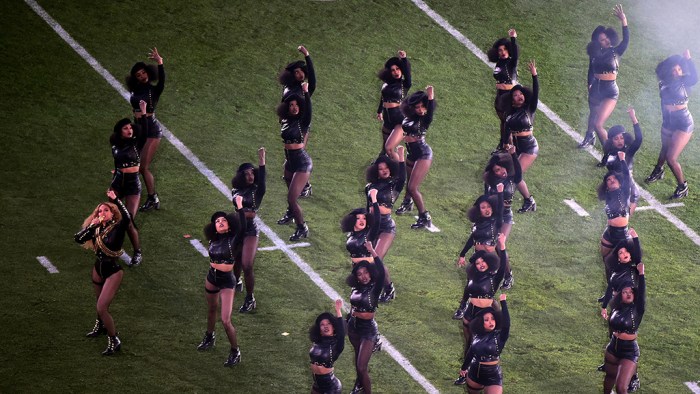
SANTA CLARA, CA – FEBRUARY 07: Beyonce performs during the Pepsi Super Bowl 50 Halftime Show at Levi’s Stadium on February 7, 2016 in Santa Clara, California. (Photo by Harry How/Getty Images)


Black women’s bodies are scary.


That’s the lesson we learned this Super Bowl Sunday.


When Beyoncé and 30 backup dancers performed a brief rendition of her new song, “Formation” during the halftime show, talking heads all over the country exploded.


Oh my God! Are those pro-black lyrics!? Are they making an allusion to the Black Panthers!? Was the music video to this song critical of overzealous police murdering black folks!?


Turn off the TV! This is too political for family entertainment!


When did we become so squeamish in this country? Can’t we all just sit back and enjoy seductive women gyrating in unison anymore?


I guess not. Not if they’re black.


Sleek female bodies in tight leather outfits displaying every curve of their anatomy – if their skin is black and their hair is Afro-ed and their fists are briefly in the air, it’s way too scary for white male libidos.


And that’s really the problem here.


Who was this performance supposed to be for? Fifty years of Super Bowl logic would suggest the target demographic was light skinned, heterosexual and possessing a penis. But these women had something to say – maybe. They had a message beyond “Look at me! I’m hot!”


How am I – as a red-blooded American male – supposed to commodify and objectify these women’s bodies if their brains are trying to convey a message that goes beyond mere consumerism?


That’s what the Super Bowl is, really. Some people say they watch it only for the commercials, but that’s all there is. It’s all a big advertisement for the American way of life.


Sit back, drink beer, eat pizza, watch an essentially meaningless contest and – whatever you do – don’t think about the way things really are. Don’t think about the problems we have and how we might fix them. Stay asleep. Watch the game and stay fast asleep.


And please don’t tell me this has nothing to do with race. If they were white girls with a message about world hunger, the outrage would be demonstrably more muted. If there’d be any outrage at all.


No. This was a direct assault on our tacit consent to be colorblind in all things. As a society we’ve silently agreed to refrain from mentioning anything about race in public.


Why are you even bringing up the fact that those dancers were black, someone is bound to ask.


My answer: because I have eyes.


Denying the pigment of their skin does no one any favors. And talking about it doesn’t denigrate them in any way. In fact, it acknowledges a key component of their being.


But Beyoncé’s performance didn’t let us forget her skin color. She made it important, and our white male society doesn’t want to admit it.

Or at least that’s what the 24-hour news cycle has made of it. Did Queen B really intend her routine to be taken as such a revolutionary display of black power? It’s hard to say.


In the actual performance, there is nothing much that is overtly political. Vaguely martial outfits? Dancing in an X-formation? A raised fist? Maybe.


The only somewhat rebellious moment occurred after they had already left the field. A few dancers held a sign offstage asking for justice for Mario Woods – a black San Francisco man gunned down by police. If you blinked, you missed it.


But the same cannot be said of the recently released music video for the song. It contains many images of black oppression from police brutality to the slow response to Hurricane Katrina. However, if you never saw the video, would you make that connection?


I didn’t. It went right over my head.


To be fair, I’d had a few.


It wasn’t until the next day that I read about the media’s hyperventilating all over it. Viewers had to actively search out the video to find any revolutionary content. Maybe that was Bey’s intent. Maybe not.


Either way, I find it hard to believe that most people’s immediate reaction was the same as that of the pundits.


At first, it was only a vocal minority that made a big deal about it. Then it snowballed into the center of our public discourse. I’m not sure why it’s gained such purchase. Maybe it’s because the halftime show always elicits strong emotions. Maybe it’s because it’s an election year. But without a doubt, a lot of folks’ white fragility is showing.


People of color are often stereotyped as having a thin skin about these issues. If black or brown folks bring it up, they’re criticized as “playing the race card.” But this situation shows how reactionary we, white people, really are.


No one decried Coldplay for starting the show with “Viva la Vida” – a song featuring the lyric, “When I Ruled the World.” People of color aren’t theorizing that the song by the whiter-than-white Chris Martin is really a Caucasian lament about the loss of white power.


“I used to rule the world

Seas would rise when I gave the word

Now in the morning I sleep alone

Sweep the streets I used to own”


Why? Because it would be just as ridiculous! Black folks have more important things to worry about – like the very things that white people are mad at Beyoncé for bringing up!

Unions Can’t Just Be About What We’re Allowed to Do: Social Justice Unionism

7983807401_6b0075f742_b.sm_a

If labor unions were an animal, they’d be an old hound dog napping on the porch.

They’re slow to get up and chase away burglars but they do like to howl at night.

Most of the time you don’t even know they’re around until the dinner bell rings. Then that ancient mutt is first to bolt into the kitchen to find a place at the table.

It’s kind of sad really. That faithful old dog used to be really something in his youth.

He was fierce! He’d bark at trespassers even tearing them apart if they threatened his patch of land.

Old Uncle Sam used to yell at him and even threaten the pooch with a rolled up newspaper, but that dog didn’t care. He had a sense of right and wrong, and he didn’t mind getting into deep trouble fighting for what he thought was fair.

Today, however, the only thing that really riles him is if you threaten to take away his ratty old bone.

Let’s face it. Unions have become kind of tame. They’re housebroken and not much of a threat to those people waiting in the shadows to rob us blind.

Some people say we’d be better off without them. But I don’t agree. Even a decrepit canine can act as a deterrent, and thieves sure are frightened of dogs.

Think about all unions have given us: the weekend, child labor laws, vacation time, pensions, lunch breaks, healthcare, the 8-hour day, maternity leave, safety measures, due process, sick leave and free speech protections on the job!

They didn’t get us all that by sitting politely at the table with their hands crossed. They didn’t do all that by contributing modest sums to political campaigns. They didn’t do it by obsessively protecting collective bargaining at the expense of all else.

Unions used to take to the streets. They took over the job site. They marched with signs and placards. They exercised people power.

And the government was scared of them. The President called out the army to get them back to work. Lawmakers hired mercenaries to break strikes with clubs and guns. But eventually Congress passed laws to placate them.

Unfortunately, That was a long time ago.

For decades the pendulum has been swinging against us. Federal and state laws have become increasingly restrictive. They want to tell us when we can strike and how long. They want to tell us when and if we can collect dues. And – frankly – they want to tell us to just disperse and do whatever the bosses want – because the business class has already bought and paid for our politicians.

For decades we’ve heard to their propaganda on TV, the radio and the print media. Well-paid shills have poured their poison in our ears about the evils of the labor movement. They’ve spoken these lies so often lots of people believe them.

Workers used to fight to make sure everyone got a fair deal. Now the working man has been brainwashed to focus instead on making sure no one else gets more than him. And the bosses are laughing all the way to the bank.

Union membership is at the lowest it’s been in a century. So are wages adjusted for inflation. A family of four used to be able to get by comfortably on one salary. Now it can barely make ends meet with two.

Yes. There’s no doubt about it. We need unions today more than ever.

But for unions to survive, they must change. They have to become a reflection of the membership and not just of the leaders.

During this presidential election cycle, we’ve seen our largest national unions – the National Education Association (NEA) and American Federation of Teachers (AFT) endorsing a candidate without bothering to actively poll their members. We’ve seen them speak for us on policy decisions without asking our opinions. We’ve seen them act just like the corrupt politicians who we should be fighting against.

Yes, it is time for a change. No longer can our unions be run from the top down. They must be run from the bottom up. They shouldn’t tell us what to do. We, the membership, should be giving orders to them.

Moreover, we need to stop obsessing about collective bargaining. I’m not saying that’s unimportant. But it can’t be the only thing we do.

Our unions used to be in the midst of larger social movements. We were part of the Civil Rights movement. We were part of the push for desegragation. We were part of the fight to protect children and provide them a decent education.

We need to continue that today. And in some places we are already doing that! Look to Chicago, Detroit and Philadelphia. Teachers unions in those urban areas are fighting not just for better pay and benefits but for the communities they serve. Detroit teachers en mass are calling off sick to protest horrible conditions in the schools. Chicago teachers are marching in the streets with the community to demand indictments for police murdering their black and brown students. Philadelphia teachers are supporting students who walk out of class to protest state disinvestment and toxic testing.

THIS is what unions should be doing. We should be fighting for social justice. We should be a central part of the struggle to turn the tide against corporatization, privatization and standardization of our country’s public goods. We should be marching hand-in-hand with BlackLivesMatter activists. We should be in the front lines of the fight to save our environment and replace fossil fuels with renewable energy.

We must be part of the community and not apart from it. We must share in the struggles and goals of those we serve. We must be an example of the old truism that a rising tide raises all ships. After all, the word “union” literally means together. By definition we must all be in this together or else we’re not even really a union.

And to do this we have to stop being so concerned with what they tell us we can do.

We live in a democratic society. The government gets its power from us, from our consent. That means that if there are enough of us, we trump their corrupt laws. They only get to make those laws because we say so. And court decisions – even Supreme Court decisions – mean nothing next to the court of public opinion.

The bosses buy the politicians and tell them to legislate us into a box. It’s time to break out of that box. We can’t be afraid to take our power back. We shouldn’t be afraid of our government. Our government should be afraid of us.

How do we do it? Organize.

If you belong to a union, roll up your sleeves and get active. Run for office. Convince like-minded folks to join you. Take over your local. Spread to your national.

If you don’t belong to a union, start one at your job. Talk to your co-workers. Talk about the benefits for each of you and your neighborhoods. Fight for your rights.

I know. It’s a whole lot easier to complain. Real change, though, takes real work.

We used to know these things. Somewhere along the line we forgot.

So wake up, you yeller cur dog, and get off the porch. Take to the streets.

Because the surest way to take back our country is to take back our unions.

Top 10 Reasons School Choice is No Choice

LittleKidThumbsDown

On the surface of it, school choice sounds like a great idea.

Parents will get to shop for schools and pick the one that best suits their children.

Oh! Look, Honey! This one has an exceptional music program! That one excels in math and science! The drama program at this one is first in the state!

But that’s not at all what school choice actually is.

In reality, it’s just a scam to make private schools cheaper for rich people, further erode the public school system and allow for-profit corporations to gobble up education dollars meant to help children succeed.

Here’s why:

1) Voucher programs almost never provide students with full tuition.

Voucher programs are all the rage especially among conservatives. Legislation has been proposed throughout the country taking a portion of tax dollars that would normally go to a public school and allowing parents to put it toward tuition at a private or parochial school. However, the cost of going to these schools is much higher than going to public schools. So even with your tax dollars in hand, you don’t have the money to go to these schools. For the majority of impoverished students attending public schools, vouchers don’t help. Parents still have to find more money somewhere to make this happen. Poor folks just can’t afford it. But rich folks can so let’s reduce their bill!? They thank you for letting them buy another Ferrari with money that should have gone to give poor and middle class kids get an education.

2) Charter and voucher schools don’t have to accept everyone

When you choose to go to one of these schools, they don’t have to choose to accept you. In fact, the choice is really all up to them. Does your child make good grades? Is he or she well-behaved, in the special education program, learning disabled, etc.? If they don’t like your answers, they won’t accept you. They have all the power. It has nothing to do with providing a good education for your child. It’s all about whether your child will make them look good. By contrast, public schools take everyone and often achieve amazing results with the resources they have.

3) Charter Schools are notorious for kicking out hard to teach students

Charter schools like to tout how well they help kids learn. But they also like to brag that they accept diverse students. So they end up accepting lots of children with special needs at the beginning of the year and then giving them the boot before standardized test season. That way, these students’ low scores won’t count against the charter school’s record. They can keep bragging about their high test scores without actually having to expend all the time and energy of actually teaching difficult students. Only public schools take everyone and give everyone their all.

4) Voucher and charter schools actually give parents less choice than traditional public schools

Public schools are governed by different rules than charter and voucher schools. Most public schools are run by a school board made up of duly-elected members from the community. The school board is accountable to that community. Residents have the right to be present at votes and debates, have a right to access public documents about how tax money is being spent, etc. None of this is true at most charter or voucher schools. They are run by executive boards or committees that are not accountable to parents. If you don’t like what your public school is doing, you can organize, vote for new leadership or even take a leadership role, yourself. If you don’t like what your charter or voucher school is doing, your only choice is to withdraw your child. See ya.

5) Charter Schools do no better and often much worse than traditional public schools

Pundits and profiteers love to spout euphoric about how well charter schools teach kids. But there is zero evidence behind it. That is nothing but a marketing ploy. It’s like when you’re in a bad neighborhood and walk past a dive that claims to have the best cup of coffee in the city. Yuck. Surely, some charter schools do exceptionally well. However, most charters and almost all cyber charters do worse than their public school counterparts. Fact.

6) Charters and voucher schools increase segregation

Since the 1950s and ’60s, we used to understand there was no such thing as separate but equal education. Before then we had Cadillac schools for white kids and broken down schools for black kids. The Supreme Court ruled that unconstitutional. But today we have Cadillac schools for rich and middle class kids (most of whom are white) and broken down schools for the poor (most of whom are black or brown.) After making tremendous strides to integrate schools and provide an excellent education for everyone, our public schools have been resegregated. Charter and voucher schools only make this problem worse. They either aid in white flight or leach away minority students. This just makes it easier to give some kids a leg up while keeping others down.

7) Charter and voucher schools take away funding at traditional public schools

It costs almost the same amount of money to run a school building of a given size regardless of the number of kids in it. When students leave the public schools for charter or voucher schools, the public school loses valuable resources. It now has less revenue but the same overhead. So even if you found an excellent charter or voucher school to send your child, you would be hurting the chances of every other student in the public school of having their own excellent education. This is what happens when you make schools compete for resources. Someone ends up losing out on an education.

8) Properly funding parallel school systems would be incredibly wasteful and expensive

We could fix this problem by providing adequate funding for all levels of the school system – traditional public schools, charters, voucher schools, etc. However, this would be exorbitantly expensive. We don’t adequately fund our schools now. Adding additional layers like this would mean increasing national spending exponentially – maybe by three or four times the current level. And much of that money would go to waste. Why have three fully stocked school buildings in one community when one fully stocked building would do the job? I don’t imagine residents would relish the tax hike this would require.

9) School choice takes away attention from the real problems in our public schools – poverty and funding equity

We have real problems. More than half of public school students live below the poverty line. They are already several grade levels behind their non-impoverished peers before they even enter kindergarten. They need help – tutoring, counseling, wraparound services, nutrition, etc. The predicament is even more complicated by the way we fund our schools. Throughout the country, poor districts get less money than wealthy or middle class ones. The students who go to these schools are systematically being cheated out of resources and opportunities. And instead of helping them, we’re playing a shell game with charter and voucher schools. The problem isn’t that parents don’t have several excellent choices. If they’re poor, they often don’t have one.

10) School choice is not supported by a grass roots movement. It is supported by billionaires.

The proponents of school choice will tell you that they are only doing the will of the people. This is what parents want, they say. Baloney. While there are individuals who support school choice, the overwhelming majority of money behind this movement comes from conservative billionaires actively trying to dismantle the public education system. They want to steal the public system and replace it with a private one. They don’t care about your child. They just want to steal the hundreds of billions of tax dollars we pay to educate our children. This is not philanthropy. It is a business transaction meant to screw you and your child out of your rights.

If we really want to ensure every child in this country gets an excellent education, the answer isn’t school choice. Instead, we need to commit to supporting our public school system. We all need to be in this together. Yes, our schools should look at the needs of each child and tailor education to fit appropriately. But that shouldn’t be done in parallel school systems. It should be done under the same umbrella. That way, you can’t defund and defraud one without hurting all. It can’t just be about your child. It has to be about all children.

That’s the only choice worth making.


NOTE: This article was given a shout out on Diane Ravitch’s blog and published on the Badass Teachers Association blog.


Taking Back Your Name – The Pros and Cons of Political Correctness

introduction


“What I think the political correctness debate is really about is the power to be able to define. The definers want the power to name. And the defined are now taking that power away from them.”
Toni Morrison

“Never trust anyone who says they do not see color. This means to them, you are invisible.”
Nayhyirah Waheed


Call me Steve.

Not Steven. Not Stephen. Certainly not Steveareno.

It’s a preference. My preference. My choice. And if people want to be in my good graces, they’ll comply with my wishes.

There’s nothing strange or unreasonable about this. We do it all the time – usually when we’re being introduced to someone.

“Hi. I’m Steve.”

“Nice to meet you, Steve. I’m Elisha.”

“Elisha? What a beautiful name!”

“Thank you, Steven.”

“Please. Call me Steve.”

Is there anything wrong with that? Does that stifle conversation? Does it stop people from talking freely to each other?

No. Certainly some names are hard to pronounce or – in my case – remember. But overcoming those hurdles is just common decency. It’s not too much to ask – especially if you’re going to be dealing with this person for an extended length of time.

The idea that allowing people to define themselves somehow shuts down conversation is rather strange. But it’s the essence of opposition to political correctness.

“Political correctness is tyranny with manners,” said conservative icon Charlton Heston.

I wonder if he would have felt the same if we’d called him Charlie Hessywessytone.

A more fleshed out criticism comes from President George H. W. Bush who said, “The notion of political correctness declares certain topics, certain expressions, even certain gestures off-limits. What began as a crusade for civility has soured into a cause of conflict and even censorship.”

Is that true? Is political correctness really censorship? That’s the conflation made by many conservatives and even some liberals. After all, popular Left-wing comedian Bill Maher sarcastically calls his HBO show “Politically Incorrect,” and he often rails against the practice.

There’s a kernel of truth to it. We are asked to change the way we speak. We’re asked to self-censor, but we already do this frequently without wailing against a loss of free speech.

Human beings are subject to various impulses, but as adults, we learn which ones we can act on and which we shouldn’t. I may think it would be hilarious to run into a crowded movie theater and yell, “FIRE!” However, I know that doing so – while possibly funny to a certain kind of person – would result in injuries and trauma as moviegoers stampede out of the theater. So I don’t do it. Is that censorship? Maybe. But it’s censorship with a small c.

The Hestons, Bushes and Mahers of the world seem to think political correctness is more like Capital C Censorship. But this is demonstrably false.

That kind of Censorship is the act of officials, possibly agents of the government, a corporation or some other formal bureaucracy. But political correctness has nothing to do with officials. There are no censors. There are only people who ask to be named a certain way.

A censor looks at a news report of military operations in Iraq and deletes material that would give away the army’s location. Political correctness is nothing like that. It involves someone asking others to refer to themselves THIS WAY and not THAT WAY.

The penalties for violating Censorship are official. Ask Chelsea Manning who is serving a 35-year prison sentence for doing just that. The penalties for violating political correctness are social. You may be criticized, condemned or disliked.

If you criticize Manning for releasing classified documents to Wikileaks, you’re not violating political correctness. That’s your opinion, and you’re entitled to it. However, Manning is a trans woman who is going through hormone replacement therapy. If you refer to her as “him” you are violating political correctness. You’re naming her in a way that violates her wishes. The penalty is not a prison sentence. It’s a sour look.

So political correctness is not Censorship. In some ways, the confusion comes from the term “political correctness,” itself.

Though its origins are hard to pin down, it appears to have been coined by the Soviets to mean judging “the degree of compatibility of one’s ideas or political analysis with the official party line in Moscow.” At least that’s what the International Encyclopedia of Social Studies says.

The term came to prominence in the United States in conservative writer Dinesh D’Souza’s book “Illiberal Education.” He disparaged affirmative action as a kind of political correctness that gave preference to (what he saw as) unqualified minority students over whites in college admissions.

So the first mention of the term in the USA was simply to disparage liberal political policies. It was a ham-handed way of comparing the Left with the Soviets. Yet somehow this term has become the handle by which we know simple civility. It’s kind of hard to feel positively about a concept that begins with a mountain of unearned negative connotations.

Conservatives know the power of getting to name something. It’s their go-to propaganda tactic and lets them control much of the debate. For instance, that’s why the Right loves to call Social Security an “entitlement.” There’s truth to it because you’re entitled to getting back the money you pay in, but it’s full of unearned negative connotations as if these people were somehow demanding things they don’t deserve.

In essence, political correctness shouldn’t be political at all. It’s just kindness. It’s just being a decent human being. Don’t purposefully call someone by a name they wouldn’t appreciate. Respect a person’s ownership of their own identity.

And for some people that’s hard to do. Their conceptions of things like gender, sexuality, race and religion are extremely rigid. The only way to be a man is THIS WAY. The only way to be spiritual is THAT WAY. But if they give voice to these ideas in the public square – especially in the presence of people who think differently – they will be frowned upon.

But is this really so dissimilar to the crowded movie theater? Refusing to acknowledge someone else’s identity is harmful to that person. It tramples the soul similarly to the way their body would be trampled in a stampeded exit. So you shouldn’t do it.

The result is an apparently much more tolerant society. It’s no longer okay to use racial, cultural, gender and sexual stereotypes in public. You’re forced to give other people consideration – or else face the consequences of being disliked. And on the surface, that’s a much more inviting world to live in.

However, there is a glaring problem. In some ways, this has made public discourse more antiseptic. People don’t always say what they mean in the public square. It’s not that they’ve changed the way they think about the world. They’ve just learned to keep it to themselves until they’re around like-minded individuals. They reserve their racist, classist, sexist language for use behind closed doors.

This is why when I’m at a party peopled exclusively by white folks, some partygoers may let racial epithets slip out. And we all laugh nervously to be polite. Or maybe it’s more than politeness. Maybe for some it’s to relieve the tension of such refreshing candor like taking off a girdle. Fwew! Here, at least, I can say what I really think without having to worry about people looking down on me for it!

Since such reactions occur mostly in homogeneous groups, it makes the world look much more enlightened than it really is. Pundits and policymakers look around and cheer the end of these social ills when they haven’t ended at all. They’ve merely gone underground.

And so we have an epidemic of colorblind white people who can’t see racism because of the gains of political correctness. Somehow they forget those unguarded moments. Somehow they haven’t the courage to examine their own souls. Or perhaps they don’t care.

And so we have the conundrum: which is better – to live in a world where all individuals have the right to name themselves or to live in a world where our most basic prejudices are on display for all to see?

Personally, I pick political correctness, and here’s why.

Words are important. We think in words. We use them to put together our thoughts. If we continue to respect individuals’ names in word, eventually we’ll begin to do so in thought and deed.

This isn’t mind control. It’s habit. It’s recognizing an ideal and working toward it. As Aristotle taught, the way to become a good person is to act like one. Eventually, your preferences will catch up with your habits.

I think that’s what’s happening today. Look at the children. They’re so much less prejudiced and racist than we, adults. This is because they’ve learned political correctness first. They didn’t have to unlearn some archaic white-cisgender-centrism. This is normal to them, and I think that’s a good thing.

Obviously some people will balk at this idea. They will look at this ideal as reprehensible. They want to return to a world where women were little more than property, a world where black people knew their place, where sexual identity was as simple as A or B.

But I think most of us recognize that this is not a world where we’d want to live. Modern society can be scary and confusing but trying to respect everyone as a person isn’t a bad thing. It’s consideration, concern, warmth.

Perhaps the best way to love your fellow humans is to call them by their proper names.

Gov. Rick Snyder Should Be Forced to Drink Nothing But Contaminated Flint Water for the Rest of His Life

Screen shot 2016-01-22 at 12.02.36 AM

As I write this, I have a fresh glass of ice cold water sitting next to me.

It is so clear I can see the wood grain of the the table through it. When I put it to my mouth, my lips almost go numb from the cold.

I gulp down way more than I should. In moments, it seems, the glass is empty.

Nothing satisfies like a crisp simple glass of water.

But in Flint, Michigan, that straightforward, easy pleasure can kill you.

And-or poison your children, cause learning disabilities, hearing loss, vomiting, high blood pressure, pain or numbness in the extremities, infertility or miscarriage. Among a host of other equally terrible maladies.

From the water.

Nine months ago the state officials who took over running Flint because the city was just too darn poor for self government, they shut off the flow of already treated Lake Huron water from Detroit. They replaced it with untreated raw water from the Flint River. The plan was to save money by treating this water, themselves, from a source that had been continually polluted for decades by the disappearing auto industry.

However, this noxious brew corroded the pipes, stripped out the lead and put it right into the water glasses Flint parents were using to hydrate their children.

More than 8,500 children. With high amounts of lead in their blood. Suffering untold injuries. For life.

Oh and the overwhelming majority of them are African American and/or impoverished. Whoops!

Gov. Rick Snyder has been defensively apologizing for this disaster. He knew all about it long before the taps were shut off. He even released a slew of inter-office emails about the situation where officials play pass-the-buck as Flint residents gulp down this filth from their faucets. As citizens complained about the water’s color and odor. As physicians protested it wasn’t safe for human consumption.

Even now Snyder STILL says people can safely bathe their children in this dirty, smelly, poisoned water. Just make sure the kiddos don’t drink it. In fact, he says he wouldn’t mind bathing his own grandchildren in this mess.

Yeah. Kinda takes away any sincerity from his “apology” and his statement that he’s responsible, doesn’t it?

Why isn’t this man in jail? Why is he still in the Governor’s mansion?

If we lived in a just country, this poor excuse for a human being would AT VERY LEAST be locked away in a dungeon somewhere never to sting our eyes at the sight of his repulsive face. A more appropriate punishment would be making him drink nothing but his own contaminated Flint tap water for the rest of his life as he suffers from the effects of lead poisoning – like all those thousands of children he helped poison to save a few bucks.

But no. In the America where we live, his only mistake was getting caught. And now he’s losing political points having to apologize without really doing much. Yeah, he’s called in the National Guard to help deliver bottled water. Yeah, he’s turned back on the Lake Huron water, but Flint’s pipes are already ruined so lead is still leaking into the water. Why are these poor people still being charged with a water bill for something they can’t use? No one except for Grandpa Rick Snyder would use this foul stuff for anything!

Meanwhile, Darnell Earley, the emergency manager appointed by Snyder who actually switched Flint’s water in the first place is at a new government job. He’s emergency manager of another Michigan public service – Detroit Public Schools! Dilapidated buildings, fungus growing on the walls, slime leaking from the ceiling, broken toilets – a state-provided learning environment overseen by this functionary who’s doing a heckuva job! Teachers trying to raise awareness of the situation have staged a series of “sickouts.” But Snyder’s administration still doesn’t have any money to waste on Detroit school kids – just like it didn’t have any money to provide potable water to Flint residents.

And the cycle continues. Crap gets flushed from one source to another – and I’m not talking about the Flint water system!

You can try to make justifications and excuses, but the lie gets awfully thin in Michigan. And if you think this is the only place where business trumps public welfare, you must be drinking from Snyder’s water cooler. Chicago, Philadelphia, Atlantic City, the entire island of Puerto Rico! Terrorists with government jobs are slowly dismantling our metropolitan areas, our public goods, everything that made America great!

And what the heck is being done about it? A lot of news stories, talking heads shaking their noggins and pointing their fingers everywhere except where the blame really lies.

It’s enough to drive one to drink.

Speaking of which, excuse me while I take another swig from my water glass.

Ah!

No, I don’t live in Flint. But this sure isn’t tap water. Are you kidding me?

In Pennsylvania we’ve had too many scares with Giardiasis and other bacteria in our municipal water occasionally making us sick.

I pay extra to bring this water to the house in huge jugs and put it on a machine that keeps it ice cold and refreshing anytime of the day or night.

Some people can’t afford it.

What are they to do?

Can anyone really feel safe drinking from the tap ever again?

What kind of a world is it where we can’t even trust the water?

What kind of world are we leaving for our children?

We are all a few months from becoming Flint.

It could already be happening.

Will we let it?