The Lone Voice of Dissent Against Standardized Testing

Businesswoman shouting through the megaphone in the open air.


Everybody wants to fight the good fight.


Until the battle begins.


Then many of us are all too ready to give in to what was intolerable just a moment before.


To paraphrase Thomas Paine:


These are the times that try men’s souls. The summer soldier and the sunshine patriot will, in times of crisis, shrink from service, but those who stand up in time of need deserve the love and thanks of every man and woman.


I see this almost every day in our schools.


Ask nearly any teacher what they think about high stakes standardized testing, and they’ll complain until they’re blue in the face.


They’ll give you gripes and grievances galore.


The tests take too long. They’re not valid assessments. They narrow the curriculum. They’re dumbing down the teaching profession and ripping away our autonomy.


To which I say – Amen, Sister!


Standardized tests more accurately measure economics than academics – poor kids generally fail and rich kids pass. They’re culturally biased, poorly put together, unscientifically graded and demonstrate a gobbsmacking conflict of interest.


Two conflicts of interest, actually.


First, the people who make the tests, grade the tests and thus have a financial interest in failing the most students possible because that means we have to buy more remediation material which they also conveniently sell.


Second, these test scores are used by the school privatization industry to unfairly label public schools failures so they can more easily sell fly-by-night charter and voucher schools.


So, yeah. Almost all of us agree standardized testing sucks.


But when there’s an administrator present, I too often find I’m the only one willing to speak that truth. My colleagues, who are pleased as punch to gripe in private, suddenly go quiet in the presence of their superiors.


What’s worse, some of them don’t just stay quiet – they offer arguments to support whatever nonsensical test-based solution our boss has in mind today.


Let’s say an administrator suggests we do something about the handful of students who opt out of standardized tests.


We could just respect the rights of parents who have handed in their written intention to opt their children out under a religious exemption – the only option in Pennsylvania. Or we could do as the administrator suggests and force kids who’ve been opted out to take a standardized look-a-like assessment.


I hear something like that, and I’m on my feet ready to fight.


But I find myself standing there alone.


“You can’t do that,” I say.


“It violates state law. In particular, Pennsylvania Code Title 22 Chapter 4, section 4.4.


(Okay, I had to look up the particulars later, but I made sure the administrator got them.)


Consider subsection (d) (4). And I quote:


If upon inspection of a State assessment parents or guardians find the assessment to be in conflict with their religious belief and wish their students to be excused from the assessment, the right of the parents or guardians will not be denied…”


Or how about subsection (d) (3):


“School entities shall adopt policies to assure that parents or guardians [have]… (3) The right to have their children excused from specific instruction that conflicts with their religious beliefs, upon receipt by the school entity of a written request from the parent or guardians.” (Emphasis mine)


In other words, parents have a right to excuse their children from the tests and/or instruction such as test look-a-likes.


If we go forward with requiring students who are opted out to take tests that are just like the ones their parents instructed us NOT to give, we will be violating parents’ rights under state law.”


That seems pretty airtight to me.


But the administrator disagrees.


And I look around at the assembled mass of workaday teachers for support.


Not a peep.


Instead I get this:


-We’re being evaluated on these standardized tests, we have to make sure kids take them seriously.


-I see where you’re coming from but we have to do something about these kids who are opting out just to get out of doing the work. They don’t have any real intellectual objection. They’re just lazy.


-We’ve got to do something about grade inflation.


Oh. Em. Gee.


Yet after the meeting, some of them cautiously walk up to me asking my opinion of what went down.


YOU DON’T WANT TO HEAR MY OPINION RIGHT NOW!


Take my word for it.


Tomorrow or the next day or the next week, they’ll be complaining again.


I’ve seen some of these people reduced to tears by administrators unfairly manipulating them based on their students’ test scores.


Yet none of them have the guts to stand up and be counted when the moment comes.


I say again – everyone wants to fight. But no one wants to do the fighting.


They want someone else to do it for them.


Does that make you angry?


It makes me furious.


But if you feel that way, you’ve got to do something about it.


You think teachers are too cowardly? What have YOU done to fight corporate education reform today?


You think too many administrators are quislings. You think the lawmakers are bought and sold. You think the public schools are under attack.


Well, get off your ass and do something.


I am tired of being the lone voice of dissent here.


All across the country there are people like me – people willing to stand up and fight.


But it’s a big country, and we’re usually spread pretty thin.


We need people willing to put their money where their mouths are – right here, in our hometowns.


Put up or shut up, America.


Do you want a school system that serves the needs of children?


You’ve got to make it happen.


I can’t do this all by myself.

You Can’t Be Anti-Opt Out and Pro-Democracy

20130220-michels-edy-chamness-sign

Our lawmakers have a problem.

This summer they doubled down on one of the most anti-democratic mandates in the federal repertoire yet they claim they did so to protect states rights.

Here’s the problem.

Every year, hundreds of thousands of public school parents across the country opt their children out of standardized testing.

But Congress voted to keep mandating that 95% of students take the tests.

It all happened with the much celebrated bipartisan passage of the Every Student Succeeds Act (ESSA), the federal law that governs K-12 schools.

While lawmakers made changes here and there to let the states decide various education issues, they kept the mandate that students participate in annual testing.

They didn’t leave that to the states. Whether they were Republican or Democrat, almost all lawmakers thought it was just fine for the federal government to force our children to take standardized tests at least every year in 3-8th grades and once in high school.

If any school district, has more than 5% of students that don’t take the tests – for whatever reason – the federal government can deny that district funding.

Think about that for a moment.

Our lawmakers are supposedly acting in our interests. They’re our representatives. We’re their constituents. They get their power to pass laws because of our consent as the governed. Yet in this instance they chose to put their own judgement ahead of ours.

They could have made an exception for parents refusing the tests on behalf of their children. They just didn’t see the need to do so.

Why? Because they were worried about minority students.

It’s a laughable claim in so many ways.

It goes something like this – without standardized testing, we’ll have no way of knowing if public schools are educating students of color.

Let’s say for a moment that this were true. In that case, we can expect no parent of color would ever refuse standardized testing for his/her child.

First, this is demonstrably untrue. Black and brown parents may not be the most numerous in the opt out movement, but they do take part in it.

Second, in the majority of cases where white parents refuse testing, that would have no bearing on whether testing helps or hurts students of color. If the point is the data testing gives us on black kids, what white kids do on the test is irrelevant.

Third, even if opting out hurt students of color, one would assume that it is the parents prerogative whether they want to take part. If a black parent doesn’t want her black son to take a multiple choice exam, she should have the right to waive that exam and the responsibility would be on her head.

So there is absolutely no reason why lawmakers should have overstepped their bounds in this way and blocked all parents rights about what the schools do to their children.

It is a clear case of governmental overreach. And there are plenty of parents just waiting to bring it to the U.S. Supreme Court for the ultimate Constitutional test.

However, that probably won’t happen for the same reason it never happened through the 15 years of No Child Left Behind (NCLB) which also contained the annual testing rule.

The federal government has never withheld tax dollars based on students not taking standardized tests. officials at the U.S. Department of Education have made threats, but they have never devolved into action.

The bottom line is this: they know how Unconstitutional this mandate is, and they aren’t itching to have it tested in the highest court in the land.

It would open a whole can of worms about standardized testing. What is the federal government allowed to do and not allowed to do about education policy?

The ESSA is an attempt to reduce the federal role, but keeping the annual testing mandate was either a grievous mistake or the last vestiges of federal hubris.

But let’s return to the reasoning behind it – so-called civil rights fears.

Various groups including the NAACP asked for it to be included to protect minority students. Annual testing is the only way, they claimed, to make sure schools are teaching students of color.

It’s nonsense.

There are plenty of ways to determine if schools are meeting the needs of minority students – especially since most students of color go to segregated schools.

Even after Brown v. Board, we have schools that cater to black kids and schools that cater to white kids. We have schools for poor kids and rich kids.

It is obvious which schools get the most resources. Why isn’t that part of this “accountability” scheme? We can audit districts to see how much is spent per pupil on poor black kids vs rich white kids. We can determine which groups go to schools with larger class sizes, which groups have more access to tutoring and social services, which groups have expanded or narrowed curriculums, which groups have access to robust extra-curricular activities, which groups have the most highly trained and experienced teachers, etc.

In fact, THAT would tell us much more about how these two groups are being served by our public schools than standardized test scores. We’ve known for almost a century that these test scores are more highly correlated with parental income than academic knowledge. They’re culturally biased, subjectively scored and poorly put together. But they support a multibillion dollar industry. If we allow a back door for all that money to dry up, it will hurt lawmakers REAL constituents – big business.

So why were civil rights groups asking the testing mandate be kept in the bill? Because the testing industry is comprised of big donors.

Only a few months before passage of the ESSA, many of these same civil rights groups had signed declarations against standardized testing. Then suddenly they saw the light as their biggest donors threatened to drop out.

Make no mistake. Standardized testing doesn’t help poor minority children. It does them real harm. But the testing industry wrapped themselves up in this convenient excuse to give lawmakers a reason to stomp all over parental rights.

The conflict wasn’t between civil rights and parental rights. It was between parental rights and corporate rights. And our lawmakers sided with the corporations.

Let me be clear: legislators cannot be against opt out and in favor of individual rights.

The two are intimately connected.

Our schools have no business telling parents how to raise their kids. But our parents DO have a right to do the opposite. In fact, that’s how the system is supposed to work.

We, parents and citizens, control our schools – not you, our representatives. The principal can’t say you haven’t a right to opt out your kid. He’s just your representative. So is the teacher.

Everyone who works in the school is there to do what you want them to do for your child. Yes, they are well trained and have a world of knowledge and experience that we should draw on. And in most cases, they’re being forced to confront us by lawmakers who are tying their hands and directing them to do the dirty work.

We have common cause. We need to stand with our teachers and principals, our school boards and education professors. We need to stand together against lawmakers who think they know better.

In short, we don’t need lawmakers consent to opt out. They need our consent to stop us.

They get their power from us. They work for us.

And it’s time they get to work and rescind the annual testing mandate.

Corporate School Reform for Rich Kids: A Modest Proposal

Screen shot 2016-07-19 at 8.37.14 PM

America’s wealthy children are in a crisis.

Every year they score better than most of their foreign counterparts on international tests.

They’re better in math. They’re better in reading. They’re better in science. Heck! American students just won the International Math Olympiad for the second year in a row! They beat heavy hitters like Korea, China, Singapore, Taiwan, North Korea, Russia, the UK, Hong Kong, Japan and 90 other countries!

Yet our media still refuses to acknowledge their accomplishments by lumping our wealthiest students in with the middle class and poor. They say American students are failing when it’s just the poor kids. And even when you add them all together, we’re in the middle, and we’ve always been in the middle since these international tests began.

It’s just not fair that our wealthy students don’t get recognized for their accomplishments. The media takes their exceptional scores and mixes them in with those of children living in broken homes going to under-funded schools in high crime neighborhoods. Obviously those kids are struggling. It’s not fair to make the wealthy look bad by mixing their scores in with these “ghetto” kids.

But that’s not the worst part. All this negative publicity is actually starting to force lawmakers to do something about it. There is a policy movement in our country that’s been around for nearly 20 years made to combat this exact problem. It’s called corporate education reform, and the rich kids are being left out!

Just look at all the programs being aimed at improving education for poor kids. I mean, sure, more than half of public school children live in poverty these days. But why should they get all these innovations?

If things keep up this way, the rich kids will get totally left behind. In the interests of fairness, we must make some of these same reforms available for the wealthy.

For instance, why is it only the poor kids who get the benefit of being taught by Teach for America recruits? These are idealistic youngsters who have a college degree – but not a degree in teaching – who get to come into an underprivileged environment and educate the masses. What about those from privileged upbringings? Shouldn’t they get the benefit of this program, too?

Think about it! These are young adults with lots of knowledge about the world and a real desire to help kids learn! Sure they don’t have enough desire to go out there and learn how to actually teach, but that’s just liberal indoctrination. You don’t need a degree to do that. A six weeks training program is fine!

Their enthusiasm makes up for any shortcomings in pedagogy. It’s like someone who loves medical dramas volunteering to do your surgery. Or maybe someone who watched every season of Law and Order volunteering to defend you in court. The attention to detail of a Trekkie at a Star Trek convention tops the knowledge of an astrophysicist any day!

Why is it only the poor kids that get that!? Rich children are being robbed of this opportunity. It’s time we furlough all their fancy teachers with their PhDs and Masters degrees and replace them with Teach for America.

But of course that won’t be enough.

The poor kids also have a huge leg up when it comes to academic standards.

Many wealthy families send their children to private schools with the best of everything. They have a wide curriculum, extracurricular activities, arts and music – everything impoverished public schools lack. But what they don’t have are universal standards.

That’s right. In most states, only our public schools have been forced to enact Common Core State Standards. These are a set of academic standards for all school children to ensure every student will be ready for college and/or a career by graduation.

Where are these standards for our rich kids? They’re being left behind! We let their private school teachers make up their own standards! How can we trust them with that? Despite their manners and good breeding, these are just teachers we’re talking about! What do they know about education?

Common Core standards were created with hardly any input from classroom teachers or child psychologists. Instead we relied upon self-appointed experts from the standardized testing industry. They decided what should be taught so it will line up exactly with their state-mandated tests.

Just imagine! Rich kids don’t get that benefit! No one teaches them to the test! Their teachers just guess and – still they get good grades – but imagine how well they’d do if they had the same benefits of the poor kids! If impoverished children fail, these same test corporations provide the remedial material! What better way to improve?

And that’s another thing! Why are the wealthiest kids who go to exclusive private schools exempt from taking state-mandated tests? How do we know they’re getting the best education possible if they haven’t demonstrated it on a multiple choice exam? These private schools could be totally faking it! We don’t know they’re providing a world class education without the proof standardized testing affords. Rich parents need to demand their kids be tested just like the poor kids.

One way they could do that while still reaping all the benefits of private schools is by enrolling in charter schools.

Rich parents rarely take advantage of that if they can afford the prestigious preparatory academies. But why? Choice is great and even more choice is greater!

Charter schools are really just private schools paid for with taxpayer money. They’re often run by private companies or unelected boards and in many cases expected to turn a profit. This also means they don’t have to do the same things as traditional public schools though for the most part they are subject to giving state-mandated tests.

In fact, they have very loose transparency requirements. We don’t really know much of what they do. But everywhere they’re touted as a massive improvement to the public school system.

They’re so good we don’t even demand that they prove how good they are. It’s just that obvious! (Pay no attention to peer reviewed studies that show them to be no better and often much worse than traditional pubic schools. That’s just scientific method mysticism.)

So why can’t there be more charter schools just for rich kids? Administrators get to pick which kids attend these schools anyway. Why not select just the upper crust, the crème de la crème, a better class of students? In fact, in many cases they already do. They select the students who already do the best academically and boot those with sub par skills or who are in need of special education. That’s how they inflate their test scores. But they also could select for economic factors instead of just academic ones.

Now you have to be careful. There have been a couple charter schools (actually quite a lot of them) that have been found to be scamming the public. Think Trump University for K-12. These schools steal taxpayer money, cut services, increase profits, disband and sneak away in the night. But there are many… well… a few high quality ones out there. And since choice is always good, shouldn’t rich families roll the dice on these institutions just like poor families?

Yes, there’s a chance rich kids educations will be ruined at charters – a big chance – but shouldn’t the wealthy have the same opportunity to gamble on their children’s futures that the poor do?

The point is this: there are plenty of shiny corporate education reforms out there aimed almost exclusively at the poor. If these reforms are so great, shouldn’t the rich get them, too?

Otherwise, these reforms are just opportunities for private industry to get rich quick off the backs of impoverished children! That can’t be right, can it?

The fact that the rich almost never take advantage of these reforms has to be a coincidence, right? Maybe they just don’t know how great these corporate school reforms are. I just can’t understand why no one is telling them, selling it to them.

After all, many of the people who create and propose these reforms have children who go to educational institutions that don’t use them. Arne Duncan was U.S. Secretary of Education, and his kids don’t experience the very policies he imposed on impoverished youngsters. Neither do Bill Gates’ and President Barack Obama’s kids. It’s just so unfair to them.

So I’m asking, please, let the children of the rich and powerful experience these same corporate educate reforms. Every child deserves the right to be taught by an untrained instructor. Every child should have an education devised by non-experts making huge profits off the results. Every child’s success should be determined through mass marketed, standardized, A,B,C exams. Every child should get to go to a school where the administration can reduce services and maximize profit.

Only then can we finally compare test scores between rich and poor. Only then will be one America!

Only then will no rich child be left behind.

(Or we could just give the poor kids all the benefits of the rich ones and throw away this corporate education crap, but no. That’s too radical. This is only a modest proposal.)

The First Rule of Test Club is We Don’t Talk About Test Club

whistleblower_whistleblowing_danger_brian_stauffer_cw_single_use-100462731-primary.idge

How can you criticize standardized testing if you aren’t allowed to talk about the tests?

To show why these assessments are bad, you have to be able to mention specific questions on the exams.

But if you do that, you will be violating the test company’s copyright and thus be subject to legal action.

So there will be no discussion of your concerns, no defense of the questions in question. Instead you’ll be threatened to silence.

This is the Catch-22 for teachers, parents and children throughout the nation.

We know the federally mandated high stakes assessments public school children must take are poorly constructed, culturally and racially biased, and ultimately unfair. But if we speak up in public with any kind of specificity, we’re threatened with steep fines. And if we write about it on-line, those articles will be taken down, censored or otherwise disappeared.

This is what happened to Prof. Celia Oyler of Teachers College, Columbia University this week when she posted an anonymous classroom teacher’s critique of the 4th grade PARCC exam on her blog.

Since the article reproduced three live questions from the exam, Oyler received a threatening email from PARCC CEO Laura Slover.

Oyler acquiesced to the CEO’s demand that she remove the PARCC questions, but she did not – as Slover commanded – reveal the name of her source. Oyler is debating legal action of her own against the testing company.

Meanwhile, education bloggers across the country have engaged in civil disobedience by reprinting Oyler’s entire post along with the PARCC questions. Many of these articles have been taken down by Twitter, Facebook or other Internet enforcers.

It’s a sad day in America when free speech is treated so disdainfully.

These PARCC questions are considered private property, but in many important ways they are not. They were developed at public expense. They were funded by taxpayers for use in our public schools. As such, they should be subject to public review.

And we may review them – privately. Ostensibly anyone could ask their local school district officials to be allowed to come in to the principal’s office and look over the tests. In fact, this is one of the first steps parents go through to opt their children out of taking the exams. You can page through the tests with supervision so you don’t make any copies or remove any materials from the building.

I’m sorry. This is just not the same thing as putting these tests under public scrutiny.

I can look at them, myself, and make up my own mind. So can you. We can even meet and talk about this together in our own private homes. But the second I go to a public forum like a school board meeting and begin to discuss these assessments in any detail, I can be charged with breaking the testing company’s copyright.

And so can my child. In fact, multiple students have already been harassed on-line by test corporation Pearson for allegedly talking about their exams.

This begs several questions: Can we legally hold minors accountable to such contracts without first providing them with legal representation of their own? Moreover, can they be forced to enter into these agreements without the presence of their parents or guardians?

However, there is an even more basic question with more far-reaching implications for the entire high stakes enterprise: How can experts explain what is wrong with the tests, if they can’t talk about anything on the tests?

Oyler mentions a question from the 4th Grade PARCC exam that is written at least two years above the grade level being assessed. Students are asked to read at a level beyond their years in order to find an answer. That’s patently unfair. But it’s one thing to make that claim – it’s quite another to point to the exact question and prove it beyond a shadow of a doubt.

Unfortunately, this vital fact is being completely ignored. The testing companies have already silenced that debate. We’re not discussing the quality of the test anymore. We’re discussing free speech. It’s an important issue, but it isn’t the one we started with.

Standardized assessments are not top secret military documents. Reproducing a test question that tens of thousands of students have already seen is not analogous to Edward Snowden or Julian Assange.

Hundreds of test questions are already released by assessment corporations as examples to help with test preparation. Some of them even show up on the actual tests. Why not release them all? One couldn’t possibly go through every question and memorize the answers before taking the tests.

When the assessment industry gets to show us only a portion of the questions they use, they’re bound to display only the least objectionable ones in the bunch. We’re accepting an illusion of transparency and forking out more than $1 billion annually for the privilege.

A product created with such a wealth of taxpayer dollars should be open to public review and debate. At very least, we should demand these questions are subject to independent review. That doesn’t mean the testing companies get to hire so-called experts with ties to their industry to sign off on the questions. It means real experts should have a say. We should hear from PhD’s in the field like Oyler. We should hear from classroom teachers. We should hear from parents and even students.

This is the only way we can ensure students are being assessed fairly. We shouldn’t just trust the huge corporations manufacturing this stuff. We have to know exactly what’s on the tests.

Without such public scrutiny and outcry, test corporations have no incentive to better their products. In fact, this is exactly how New York State residents got rid of perhaps the most infamous test question ever reported – The Pineapple Question.

You can read about the whole thing here, but the basic story goes as follows. Several years ago, students who finished their 8th grade reading test couldn’t get over how absurd this question was. They talked about it to anyone who would listen. Eventually, the question was reprinted on parent Leonie Haimson’s blog, Class Size Matters. It became a national head-scratcher. People all over the country called for the question’s removal.

Without public input, the Pineapple Question might still be on the tests. Students could still be trying to answer a question almost everyone thinks is ridiculous.

People often say they want more accountability in public education. Isn’t it time we started to hold the test manufacturers accountable for their products? Isn’t it time we restored free speech to public education?

We can’t improve our schools if we’re more concerned with a private company’s copyright than we are with the quality of the product they’re providing us.

We can’t have a functioning school system if whistle blowers are silenced.

The PARCC Test: Exposed

standardized_test


The following article comes from Prof. Celia Oyler’s blog. In it, she reprinted an anonymous teacher’s critique of the 4th grade PARCC exam. Since the piece includes three live test questions from the exam, the article has been repeatedly taken down under threat that it violates copyright. I hold that this is a spurious claim and am re-posting the article in-full as an act of civil disobedience. The public has a right to know exactly what questions are on the standardized tests they’re paying to be produced.


The PARCC Test: Exposed

The author of this blog posting is a public school teacher who will remain anonymous.

I will not reveal my district or my role due to the intense legal ramifications for exercising my Constitutional First Amendment rights in a public forum. I was compelled to sign a security form that stated I would not be “Revealing or discussing passages or test items with anyone, including students and school staff, through verbal exchange, email, social media, or any other form of communication” as this would be considered a “Security Breach.” In response to this demand, I can only ask—whom are we protecting?

There are layers of not-so-subtle issues that need to be aired as a result of national and state testing policies that are dominating children’s lives in America. As any well prepared educator knows, curriculum planning and teaching requires knowing how you will assess your students and planning backwards from that knowledge. If teachers are unable to examine and discuss the summative assessment for their students, how can they plan their instruction? Yet, that very question assumes that this test is something worth planning for. The fact is that schools that try to plan their curriculum exclusively to prepare students for this test are ignoring the body of educational research that tells us how children learn, and how to create developmentally appropriate activities to engage students in the act of learning. This article will attempt to provide evidence for these claims as a snapshot of what is happening as a result of current policies.

The PARCC test is developmentally inappropriate
In order to discuss the claim that the PARCC test is “developmentally inappropriate,” examine three of the most recent PARCC 4th grade items.

A book leveling system, designed by Fountas and Pinnell, was made “more rigorous” in order to match the Common Core State Standards. These newly updated benchmarks state that 4th Graders should be reading at a Level S by the end of the year in order to be considered reading “on grade level.” [Celia’s note: I do not endorse leveling books or readers, nor do I think it appropriate that all 9 year olds should be reading a Level S book to be thought of as making good progress.]

The PARCC, which is supposedly a test of the Common Core State Standards, appears to have taken liberties with regard to grade level texts. For example, on the Spring 2016 PARCC for 4th Graders, students were expected to read an excerpt from Shark Life: True Stories about Sharks and the Sea by Peter Benchley and Karen Wojtyla. According to Scholastic, this text is at an interest level for Grades 9-12, and at a 7th Grade reading level. The Lexile measure is 1020L, which is most often found in texts that are written for middle school, and according to Scholastic’s own conversion chart would be equivalent to a 6th grade benchmark around W, X, or Y (using the same Fountas and Pinnell scale).

Even by the reform movement’s own standards, according to MetaMetrics’ reference material on Text Complexity Grade Bands and Lexile Bands, the newly CCSS aligned “Stretch” lexile level of 1020 falls in the 6-8 grade range. This begs the question, what is the purpose of standardizing text complexity bands if testing companies do not have to adhere to them? Also, what is the purpose of a standardized test that surpasses agreed-upon lexile levels?

So, right out of the gate, 4th graders are being asked to read and respond to texts that are two grade levels above the recommended benchmark. After they struggle through difficult texts with advanced vocabulary and nuanced sentence structures, they then have to answer multiple choice questions that are, by design, intended to distract students with answers that appear to be correct except for some technicality.
Finally, students must synthesize two or three of these advanced texts and compose an original essay. The ELA portion of the PARCC takes three days, and each day includes a new essay prompt based on multiple texts. These are the prompts from the 2016 Spring PARCC exam for 4th Graders along with my analysis of why these prompts do not reflect the true intention of the Common Core State Standards.

ELA 4th Grade Prompt #1

Refer to the passage from “Emergency on the Mountain” and the poem “Mountains.” Then answer question 7.
1. Think about how the structural elements in the passage from “Emergency on the Mountain” differ from the structural elements in the poem “Mountains.”
Write an essay that explains the differences in the structural elements between the passage and the poem. Be sure to include specific examples from both texts to support your response.

The above prompt probably attempts to assess the Common Core standard RL.4.5: “Explain major differences between poems, drama, and prose, and refer to the structural elements of poems (e.g., verse, rhythm, meter) and drama (e.g., casts of characters, settings, descriptions, dialogue, stage directions) when writing or speaking about a text.”

However, the Common Core State Standards for writing do not require students to write essays comparing the text structures of different genres. The Grade 4 CCSS for writing about reading demand that students write about characters, settings, and events in literature, or that they write about how authors support their points in informational texts. Nowhere in the standards are students asked to write comparative essays on the structures of writing. The reading standards ask students to “explain” structural elements, but not in writing. There is a huge developmental leap between explaining something and writing an analytical essay about it. [Celia’s note: The entire enterprise of analyzing text structures in elementary school – a 1940’s and 50’s college English approach called “New Criticism” — is ridiculous for 9 year olds anyway.]

The PARCC does not assess what it attempts to assess

ELA 4th Grade Prompt #2
Refer to the passages from “Great White Shark” and Face the Sharks. Then answer question 20.
 Using details and images in the passages from “Great White Sharks” and Face to Face with Sharks, write an essay that describes the characteristics of white sharks.

It would be a stretch to say that this question assesses CCSS W.4.9.B: “Explain how an author uses reasons and evidence to support particular points in a text.”

In fact, this prompt assesses a student’s ability to research a topic across sources and write a research-based essay that synthesizes facts from both articles. Even CCSS W.4.7, “Conduct research projects that build knowledge through investigation of different aspects of a topic,” does not demand that students compile information from different sources to create an essay. The closest the standards come to demanding this sort of work is in the reading standards; CCSS RI.4.9 says: “Integrate information from two texts on the same topic in order to write or speak about the subject knowledgeably.” Fine. One could argue that this PARCC prompt assesses CCSS RI.4.9.

However, the fact that the texts presented for students to “use” for the essay are at a middle school reading level automatically disqualifies this essay prompt from being able to assess what it attempts to assess. (It is like trying to assess children’s math computational skills by embedding them in a word problem with words that the child cannot read.)

ELA 4th Grade Prompt #3

  1. In “Sadako’s Secret,” the narrator reveals Sadako’s thoughts and feelings while telling the story. The narrator also includes dialogue and actions between Sadako and her family. Using these details, write a story about what happens next year when Sadako tries out for the junior high track team. Include not only Sadako’s actions and feelings but also her family’s reaction and feelings in your story.

Nowhere, and I mean nowhere in the Common Core State Standards is there a demand for students to read a narrative and then use the details from that text to write a new story based on a prompt. That is a new pseudo-genre called “Prose Constructed Response” by the PARCC creators, and it is 100% not aligned to the CCSS. Not to mention, why are 4th Graders being asked to write about trying out for the junior high track team? This demand defies their experiences and asks them to imagine a scenario that is well beyond their scope.

Clearly, these questions are poorly designed assessments of 4th graders CCSS learning. (We are setting aside the disagreements we have with those standards in the first place, and simply assessing the PARCC on its utility for measuring what it was intended to measure.)

Rather than debate the CCSS we instead want to expose the tragic reality of the countless public schools organizing their entire instruction around trying to raise students’ PARCC scores.

Without naming any names, I can tell you that schools are disregarding research-proven methods of literacy learning. The “wisdom” coming “down the pipeline” is that children need to be exposed to more complex texts because that is what PARCC demands of them. So children are being denied independent and guided reading time with texts of high interest and potential access and instead are handed texts that are much too hard (frustration level) all year long without ever being given the chance to grow as readers in their Zone of Proximal Development (pardon my reference to those pesky educational researchers like Vygotsky.)

So not only are students who are reading “on grade level” going to be frustrated by these so-called “complex texts,” but newcomers to the U.S. and English Language Learners and any student reading below the proficiency line will never learn the foundational skills they need, will never know the enjoyment of reading and writing from intrinsic motivation, and will, sadly, be denied the opportunity to become a critical reader and writer of media. Critical literacies are foundational for active participation in a democracy.

We can look carefully at one sample to examine the health of the entire system– such as testing a drop of water to assess the ocean. So too, we can use these three PARCC prompts to glimpse how the high stakes accountability system has deformed teaching and warped learning in many public schools across the United States.

In this sample, the system is pathetically failing a generation of children who deserve better, and when they are adults, they may not have the skills needed to engage as citizens and problem-solvers. So it is up to us, those of us who remember a better way and can imagine a way out, to make the case for stopping standardized tests like PARCC from corrupting the educational opportunities of so many of our children.

Co-opting the Language of Authentic Education: The Competency Based Education Cuckoo

Reed_warbler_cuckoo

Cuckoo!


Cuckoo!


Such is the incessant cry of the hour from one of the most popular souvenirs of the black forest of Germany – the cuckoo clock.


Time is demarcated by the chirp of an 18th century animatronic bird jumping forward, moving a wing or even opening its beak before making its distinctive cry.


However, in nature the cuckoo has a more sinister reputation.


It’s one of the most common brood parasites.


Instead of investing all the time and energy necessary to raise its own young, many varieties of cuckoo sneak their eggs into the nests of other birds. When the baby cuckoos hatch, they demand an increasing amount of their clueless foster parents’ care often resulting in neglect of the birds’ own children.


Parental care is co-opted. The love and affection natural to raise parent birds’ own children are diverted to another source. And the more parent birds try to help the interloper’s child, the less they can help their own.


Corporate education reformers must be bird lovers. Or at very least they must enjoy antique cuckoo clocks.


In fact, one could describe the entire standardization and privatization movement as a Homo sapien version of brood parasitism.


Profiteers co-opt authentic education practices so that they no longer help students but instead serve to enrich private corporations.


When parents, teachers and administrators unwittingly engage in corporate school reform strategies to help students learn, they end up achieving the opposite while the testing industry and charter school operators rake in obscene profits.


But some of us have seen through the scam, and we think it’s cuckoo.


We’ve seen this kind of bait and switch for years in the language used by oligarchs to control education policy. For instance, the defunct federal No Child Left Behind legislation had nothing to do with making sure no kids got left behind. It was about focusing obsessively on test and punish even if that meant leaving poor kids in the rear view.


Likewise, the Obama administration’s Race to the Top program has nothing to do with quickening the pace to academic excellence. It’s about glorifying competition among students while providing them inequitable resources. Teach for America has very little to do with teaching or America. It’s about underpreparing poor children with unqualified instructors and giving cover to privatization operatives. School Choice has nothing to do with giving parents educational alternatives. It’s about letting privatized schools choose which students they want to admit so they can go through the motions of educating them as cheaply as possible and maximize profits for shareholders.


And on and on.


The latest such scheme to hoodwink communities out of authentic learning for their children is Competency Based Education (CBE) a term used interchangeably with Proficiency Based Education (PBE). Whatever you call it, this comes out to the same thing.


Like so many failed policy initiatives that came before it offered by the same group of think tank sycophants, its name belies the truth. CBE and PBE have nothing to do with making children competent or proficient in anything except taking computer-based tests.


That’s what the whole program consists of – forcing children to sit in front of computers all day at school to take unending high stakes mini-tests. And somehow this is being sold as a reduction in testing when it’s exactly the opposite.


This new initiative is seen by many corporate school reformers as the brave new world of education policy. The public has soundly rejected standardized tests and Common Core. So this is the corporate response, a scheme they privately call stealth assessments. Students will take high stakes tests without even knowing they are doing it. They’ll be asked the same kinds of multiple-choice nonsense you’d find on state mandated standardized assessments but programmers will make it look like a game. The results will still be used to label schools “failing” regardless of how under-resourced they are or how students are suffering the effects of poverty. Mountains of data will still be collected on your children and sold to commercial interests to better market their products.


The only difference is they hope to trick you, to hide that it’s even happening at all. And like a cuckoo pushing its egg into your nest, they hope you’ll support what’s in THEIR best interests while working against what would really help your own children.


And the method used to achieve this deception is co-opting language. They’d never enact what real classroom teachers want in school, but they will take our language and use it to clothe their own sinister initiatives in doublespeak.


So we must pay attention to their words and tease out what they really mean.


For instance, they describe CBE as being “student-centered.” And it is – in that their profit-making machine is centered on students as the means of sucking up our tax dollars.


They talk about “community partnerships,” but they don’t mean inviting parents and community members into the decision making process at your local school. They mean working together with your local neighborhood privatization firm to make big bucks off your child. Apple, Microsoft, Walmart – whatever huge corporation can sell computers and iPads to facilitate testing every day.


They talk about “personalized instruction,” but there’s nothing personal in it. This just means not allowing students to progress on their computer programs until they have achieved “mastery” of terrible Common Core standards. If standardized testing is a poor form of assessment, these edu-programs are worse. They don’t measure understanding. They measure zombie cognitive processes – the most basic surface type of spit-it-back to me answers.


And if that isn’t bad enough, such an approach subtly suggests to kids that learning is only valuable extrinsically. We don’t learn for intrinsic reasons like curiosity. We lean to get badges on the program, to progress forward in the game and compulsively collect things – like any good consumer should.


Today’s children already have problems socializing. They can more easily navigate cyber relationships than real flesh-and-blood interactions. And CBE will only make this worse. Not only will children continue to spend hours of after-school time on-line, the majority of their school day will be spent seated at computer terminals, isolated from each other, eyes focused on screens. And every second they’ll be monitored by that machine – their keystrokes, even the direction their eyes are looking!


I’m not making this up! It shows engagement, tenacity, rigor – all measurable, quantifiable and useful to justify punishing your school.


They call it “one-to-one computer technology.” Yes, each child will be hooked up to one device. But how does that alone help them learn? If every child had a book, would we call it one-to-one book access? They call it “blended learning” because it mixes instruction from a living, breathing person with sit-and-stare computer time. It sounds like a recipe. I’ll blend the sugar and milk until I have a nice whipped cream. But it conceals how much time is spent on each.


Don’t get me wrong. There are effective uses of technology in schools. But this is not one of them.


Students can make Keynote presentations, record movies, design graphics, write programs, etc. But taking endless testing disguised as a video game adds nothing but boredom to their day. A few years ago, I was forced by administrators to put my own students on iStation twice a week. (I’ve since convinced them to let us be.) In any case, when we used the program, it would have been more effective had we called it nap time. At least then my kids wouldn’t have felt guilty about sleeping through it.


The corporate education reformers are trying to sneak all of this under our noses. They don’t want us to notice. And they want to make it harder to actually oppose them by stealing our words.


When public school advocates demand individualized learning for their children, the testocracy offers us this sinister CBE project. When we decry annual testing, they offer us stealth assessment instead.


We must continue to advocate for learning practices that work. We can’t let them steal our language, because if we do, they’ll steal our ability to engage in authentic learning.


And to do that, we must understand the con. We have to deny the technocrats their secrecy, deny them access to our children as sources of profit.


We must guard our nests like watchful mama birds.


The cuckoos are out there.


They are chirping in the darkness all around us.


Don’t let them in.

School Accountability Without Standardized Testing

IMG_5312-cropped-proto-ccsa_root___topic_hero-thumb-640xauto-2188

Q: Is it possible to ensure educational accountability without giving standardized tests?


A: Not only is it possible, it is necessary.


In fact, we will never have accountability while we continue giving standardized tests.


This is the irony of modern education policy.


High stakes testing is seen as the only tool that can ensure schools operate correctly when in reality it is the very thing that blocks true responsibility.


Pundits and policymakers cry crocodile tears as they draw up elaborate ways to punish teachers and students for low test scores. Meanwhile they ignore some of the most basic facts about how education works.


FACT: Students and teachers are not the only factors.


FACT: Students and teachers don’t decide how much funding their schools get.


FACT: Students and teachers don’t get to decide education policy.


FACT: An education system is made up of a complex interplay of several interconnected factors that include parents, the community, the economy, culture, media, and local, state and federal governments.


FACT: High stakes testing ensures that teachers and students are held accountable for the entire education system including the vast majority of factors beyond their control.


So let’s stop pretending that standardized tests hold schools accountable. They don’t. They just point the finger without offering anything to help.


True accountability would be about diagnosing problems so we can fix them, not trying to fire your way to the top. When you break your arm, the doctor doesn’t immediately suggest you chop it off. He sets the bone and puts it in a cast and sling so it can heal.


When it comes to true accountability, we need to look beyond the school at all the factors involved. We also need to look to the legislature, the taxpayers, parents, the community, the media, and all stake holders.


However, this does not mean there are no ways to assess if schools, superintendents, administrators, teachers, and students are doing a good job.


In fact, it’s not even difficult to achieve. And we don’t need a single standardized test to do it.


We need a two-pronged approach. We must assess student learning, but we also must assess the adequacy of school funding, where it’s going and where it needs to go.


These measures are most often ignored in accountability discussions. When it comes to adequate funding, we usually blame the poor for being unable to provide for their children. And since many states allocate education funding based largely on local property taxes, we have rich schools with oodles of cash and poor schools that are falling over. True accountability would ensure all students – both rich and poor – start from an equal playing field. When society neglects this, it is society that is failing, not poor children.


When it comes to how funding is spent, we either throw up our hands that there’s no way to evaluate school funding or we pretend that school directors will be transparent just because. Both are untrue.


I still believe that local control is the best way to ensure true accountability. When school directors are not elected but appointed– as they are in charter schools – there is no reason to spend wisely. In fact, the laws are set up to shield charter school boards from having to show the community how they are spending taxpayer money. And since most are set up for-profit, there is an incentive to reduce services for students while keeping the saving as profit for themselves and their shareholders.


When school boards are elected and are required to hold deliberations in public, accountability is built in. Voters decide who gets to make decisions and if those decisions made in the light of day are in the best interests of their children. Moreover, elected school directors who come from the community have an incentive to make that community in which they live the best it can be and to provide the best quality education they can.


This isn’t to say that elected school boards are perfect. They are made up of human beings and are therefore fallible. You don’t have to go far to find local school directors who try to deliberate important decisions in private without notifying the public, circumvent the bidding process, make backroom deals, etc.


But there are ways to hold them and the community accountable for providing a quality education.


California has come up with an ingenious plan.


For the second year, the Golden State has been engaged in a bold experiment. Policymakers have initiated a new K-12 finance system: the Local Control Funding Formula (LCFF) and the Local Control Accountability Plans (LCAPs) that go with it.


Basically, California public schools use multiple-indicators to determine where funding needs to go and how to hold schools accountable for spending it wisely.


It’s not perfect. It certainly has some bugs in it, and I do NOT recommend we simply extend the program nationwide as is.


For instance, the program still uses standardized testing as one of many multiple measures of success. This is better than having testing be the sole measure or even the most important one. But – as you shall see – we can do better.


The law requires each district to identify specific goals and spending priorities in eight areas. I would modify them as follows:

  1. Basic services such as equipped classrooms, qualified teachers, textbooks and materials. It is essential to know if these needs are being met so we can budget accordingly. If funding is lacking, assessing the deficiency in this way helps make the argument for an increase of cash.


  1. Implementation of District Created Standards for all students, including English Learners (ELs). California specifically denotes Common Core standards here. I think that is a mistake. Accepting wholesale a set of unproven standards made by non-educators who have never been inside a district building or in front of a classroom is a recipe for disaster. Instead, teachers in each district should develop their own standards and then test whether they are achieving their goal. Many policymakers are in love with the idea of national standards but that’s like suggesting all restaurants must have some version of the McDonalds value menu. Standards should be locally developed to meet the needs of real students not idealized ones.


  1. Parental Involvement. This simply cannot be ignored. Schools need to know if parents are invested in the district, and if not, administrators and faculty need to work to find ways to bring them in. Schools can institute family game nights, community picnics, parent-teacher nights with food and babysitting services. No school can ever achieve greatness without parents. We must find ways to increase involvement where it is lacking and encourage increased involvement where it is present at all. We must work to make parents feel welcome and make them a part of the decision-making process for school activities and functions.


  1. Student Achievement as measured by district assessments, English Learner reclassification to fluency, and other criteria. California includes Common-core aligned standardized tests in this area. I think this is a mistake and that we can find better assessments here. I’ll return to this in a moment.


  1. Student Engagement determined by rates of attendance and absenteeism, dropout rates, and graduation. We must gauge how well students are buying in to what the school has to offer. And if it is lacking, we must take steps to improve it. Schools shouldn’t just provide a prepackaged product. They should actively engage students and provide classes and services suited to their needs. Student engagement is one way to determine if schools are successfully doing that.


  1. School Climate evident in rates of suspension and expulsion, as well as other locally-identified measures. Discipline is very important but must be conducted judiciously. It must be fair and not unduly harsh. It must serve the purpose of improving academic outcomes. Moreover, we need to make sure there are no racial or cultural biases at work – even if they are unconscious. We want to create an inviting atmosphere, not a stepping stone to the prison system.


  1. Access to a Broad Curriculum evident through student enrollment across grade levels and subject areas. We know high stakes testing narrows the curriculum. We must work to actively broaden the curriculum and offer students a wide range of classes to maximize their educational experience. This includes arts, music, foreign languages and extra curricular activities. If we don’t have the funds to make that happen, what better tool to help argue for an increase than a detailed account of what’s missing and why it’s important?


  1. Other Student Outcomes as identified locally, which may include locally chosen tests and assessments. This could include participation in AP exams, college courses, etc. No accountability system would be complete without an “Other” category. Districts should be free to customize to meet the needs of students, parents and the community.


Which brings us back to testing.


We’ve got to have it. There must be some way to assess student learning. But we needn’t resort to money-making corporate products.


Teachers have been creating tests since the beginning of time. No one ever thought there was anything wrong with that until giant corporations discovered they could make huge profits selling us their standardized assessments.


We need to trust teachers again to assess as they see fit. But we can do more than that. We can have district-wide assessments systems that are not standardized – that are personalized – yet comparable across the district.


Performance or portfolio-based assessments.

Schools around the country are incorporating direct demonstrations of student learning into their assessment programs. These include projects, individual and group presentations, reports, papers and portfolios of work collected over time. These provide much more accurate reflections of student learning than snapshot tests developed far from the classroom. Moreover, if properly coordinated by departments and administrators, these assessments are comparable across the district.


The New York Performance Standards Consortium is leading the way. It consists of 28 schools, including grades 6-12, throughout the state that rely on these teacher-created assessments to the exclusion of standardized tests.


And the results have been tremendous! These public schools have higher graduation rates and better college-retention rates, while serving a population similar to that of other urban schools. We say we’re looking for innovations that work. This is it!


Just imagine a school that used such an accountability system. It would have a plethora of data about what’s working, what isn’t working and what needs to be done to correct deficiencies.


We forget that accountability systems show our values. High stakes testing pretends that the only thing that matters is the results of a standardized test. Nothing could be farther from the truth.


A system like the one I’ve described would ensure every student receives a robust education that is assessed fairly. It would invigorate children, parents and the community. And when students graduate from such a school, they would be prepared for whatever comes next.


Moreover, there’s not a single standardized test necessary in the whole system!


Our policymakers need to start thinking along these lines. These aren’t pie in the sky suggestions. Most of these ideas already have been tested and proven effective.


We need to free our minds from a reliance on the testing industry. We need to think outside the bubble and free our children from corporate servitude as education policy – a system that ensures they won’t receive a quality education – all under the guise of “accountability.”


Can real accountability exist without standardized tests?


Yes. That’s the only way it can.

High Stakes Testing Holds The Most Powerful the Least Accountable

 High Stakes Testing Does Not Hold Schools Accountable. It Ensures That Those Most Responsible Escape Accountability


Screen Shot 2016-04-08 at 3.29.21 PM 

People should be accountable for their actions.


If you make a mess, you should have to clean it up. If you decide how things run, you should be responsible if it fails.


So why do we allow those most responsible for our public school system to escape from accountability? Why do we instead blame everything on teachers and students?


Public school policy at the federal, state and local level has been dominated by high stakes testing for the last 15 years. It has not improved educational outcomes for students. In fact, just the opposite. But we are doing NOTHING to change it.


It’s called test and punish. We give students standardized tests and if enough of them fail over time, we close their schools and/or fire their teachers. We force them to move to a new school or a charter school where they continue to struggle without a single additional resource to help them succeed.


No Child Left Behind (NCLB) installed most of these policies in 2001. This year we revised the federal law that governs K-12 schools into the Every Student Succeeds Act (ESSA). It does little more than continue these same policies while rearranging the deck chairs on our sinking system.


Kids aren’t failing because they’re lazy or dumb. Their teachers aren’t shirking their duties. Instead we have a nationwide epidemic of child poverty. And the effects of that lifestyle make it extremely hard to achieve academically. Kids aren’t focused on book learning when they’re physically and emotionally exhausted, experiencing post-traumatic stress and undernourished.


Why has nothing been done to help them?


The answer is accountability.


Not real accountability. Not holding people accountable for things under their control. Not going up to the people and institutions that actually cause the errors and malfeasance. Instead we push all the blame onto teachers and students and call that “Accountability.”


Make no mistake. When politicians and policymakers talk about “accountability” this is what they mean – scapegoating educators and children for things well beyond their control.


An education system is made up of a complex interplay of several interconnected factors that include parents, the community, the economy, culture, media, and local, state and federal governments. Students and teachers are only two such factors.


High stakes testing ensures that ONLY teachers and students are held accountable. They are responsible for the entire education system but have control of very little of it.


For instance, do students and teachers decide how much funding their schools get? No.


Do students and teachers decide which education policies are enacted? No.


So why are they being held responsible for these things?


When schools without adequate funding can’t provide the necessary resources for students to succeed, we pretend like it’s the teachers and students fault. When academic policies handed down by non-educators fail to help kids learn, we pretend like it’s the students and teachers fault.

It’s not.


As New York University Education Professor Pedro Noguera said:


“We’ve designed an accountability system that holds those with the most power the least accountable. The governors are not accountable, the state legislature is not accountable… You can’t hold kids and teachers accountable and not hold the people in control in the first place.”


It’s not a difficult concept – we test the kids and punish the teachers if they fail. And since the focus is firmly on only those two factors, all others become invisible. No one’s holding lawmakers accountable for providing equitable funding. No one’s holding policymakers and think tanks accountable for forcing inadequate and untested Common Core academic standards down our throats. No one’s holding billionaire philanthropists accountable for using our schools as their private playgrounds for whatever social engineering scheme they thought up in the Jacuzzi. No one’s holding privately run charter schools accountable for – just about anything – instead of letting them operate behind a curtain of deniability and unending profit.


This would be impossible without standardized testing. It frames the question. It defines the debate. It assumes that only teachers and students are relevant. Therefore, it ensures that none of the obscured factors will have to do anything to help the system improve. And so it ensures that our education system will fail many of our students – especially those most in need.


This is the irony of modern education policy. The apparatus that allegedly ensures accountability makes that very thing impossible.


That’s how the system is designed. And policymakers are terrified you’ll notice. So they have developed a scapegoat for their own failures – the public school teacher.


Students may score badly – and they’ll have to pay for that when their school is closed or charterized as a result – but it is the teachers who are the true enemy. After all, if teachers did a better job, pundits claim, students wouldn’t fail.


The idea goes like this:


Children won’t learn unless we force teachers to educate them.


Teachers don’t get into that profession because they care about children. They just want an easy job with summers off where they don’t have much to do but collect huge salaries.


This is the great lie, the diversion, smoke and mirrors to get you to stop paying attention to lawmakers, policy wonks, environmental and other factors. Instead look only to those lazy/evil teachers and their satanic labor unions.


THAT’S why they say we need standardized testing!


If we remove the testing, they say, no one will be responsible for making sure kids learn. After all, why would teachers teach unless we threaten their jobs first?


As if teachers can heroically control all the factors involved in student learning. (Spoiler alert: they can’t.) As if teachers get into their profession because they don’t want to practice it. (Spoiler alert: teachers become teachers because they want to teach!) As if earning a middle class income for providing a valuable societal resource were unreasonable. (Spoiler alert: it isn’t.) As if due process meant you can’t be fired for cause. (Spoiler alert: unionized teachers are fired for cause every day.) As if teachers were paid for summers off. (Spoiler alert: they aren’t though some have their salaries earned during 9 months paid out over 12.)


If we really wanted to improve public education, we’d look at ALL the factors involved. We’d throw back the assumptions that have mired us in this quagmire.


And the first assumption that has to go is that standardized testing is a valuable assessment tool.


Standardized tests are terrible assessments. We’ve known that for almost a century. Invariably they narrow the curriculum. They suck up countless hours of class time that could be better spent. They measure more the circumstances kids live in than any academic ability. They’re culturally, racially and economically biased.


But we keep giving them with no end in sight – not because they make teachers do a better job, but because they give cover to those actually responsible for harming our children’s education.


There is such a thing as accountability without standardized tests. It is possible to examine all the factors involved and make changes accordingly.


We can, for instance, make sure all schools receive the same basic services. We can make sure all classrooms are equipped with up-to-date books, materials, desks, etc. We can make sure no schools go without heat, have crumbling infrastructure and/or suffer from infestation of vermin, mold and filth. We can make sure all children have access to healthy food. We can make sure no children are drinking water poisoned with lead.


We can look at parental involvement. An overwhelming amount of research shows this is vital to academic success, but in our poorest neighborhoods parents are often the least involved in their children’s schooling. Why is that? Many of them are working three or more minimum wage jobs just to feed and clothe their children. There’s little time to help with homework when you’re working the night shift. So countermeasures such as raising the minimum wage and increasing the frequency, access and training for well-paying jobs would actually improve education as well as the economy.


We can look at school climate. What are the rates of suspensions and expulsions? What are the root causes? How can we improve student discipline without being overly punitive? How can we increase student engagement? How do we improve student attendance and graduation rates?


We can update our broken system of student assessment. This may come as a surprise to our policymakers, but there are many ways to assess student learning that have nothing to do with standardized tests. For example, we can institute performance or portfolio-based assessments. Instead of evaluating students based on a snapshot of their performance on a given day or week, we can base it on a grading period or even an entire school year. Assessments can include projects, individual and group presentations, reports and papers and portfolios of work collected over time. You don’t have to be an education expert to realize these would be better measurements of academic achievement than multiple choice tests – BUT IT HELPS! And we can do this without resorting to stealth assessments like competency based education.


Does this mean that teachers should escape accountability? Absolutely not. But we can ensure they’re evaluated fairly. Don’t judge them based on factors beyond their control. Judge them based on what they actually do. As the old adage goes, you can bring a horse to water, but you can’t make him drink. Evaluate teachers on whether they’ve brought their little ponies to water. Did they engage in best practices? Are they engaged in professional development? How do they treat their students? Are they grading fairly? In almost every profession, workers are evaluated based on observation from their superiors. Teaching should be no different.


It’s shocking that no one on the national stage is talking about this. Pundits and policymakers shake their heads at standardized test scores, they point their fingers and cry crocodile tears for the children. But hardly anyone is doing a thing to make positive change.


Our schools have been transformed into factories. We’ve let them become resegregated based on race and wealth. We’ve let the rich schools get Cadillac funding while the poor ones struggle to survive on the leftovers. We’ve let non-educators set the standards and curriculum. We’ve let the testing industry co-opt and bribe our lawmakers and social institutions. We’ve opened the door wide for privitizers to steal as much of the shrinking funding pie as possible and funnel it into their own bank accounts without producing any quality for the students they’re supposed to be serving.


In short, we’ve let those responsible for setting our public schools aflame get away scot-free!


They’re laughing all the way to the bank. And the tool that lets them get away with it is standardized testing.


Throw back the curtain and show them for what they truly are.


Fight back. Refuse the tests for your children. Join the Badass Teachers Association, United Opt Out and the Network for Public Education. Write your legislators. Write to the newspapers. Take to the streets. Make some noise.


Hold them accountable.

Standardized Tests Have Always Been About Keeping People in Their Place

 Screen shot 2016-04-04 at 8.25.53 PM


There are some things that can’t be unseen.


America’s history of standardized testing is one of them.


Today, critics from all sides of the political spectrum decry the overuse of high stakes tests while paradoxically championing them for accountability purposes – especially for schools serving minority students.


Civil rights organizations that last year opposed testing have suddenly come to demand itnot because testing ensures racial equity but for fear of losing wealthy donors tied to the assessment industry.


Yet one look at where these tests come from and how they have been used in the past shows their essentially classist and racist natures.


Make no mistake – standardized testing has been a tool of social control for the last century. And it remains one today.


Twisted statistics, made up math, nonexistent or biased research – these are the “scientific” supports for standardized testing. It has never been demonstrated that these kinds of tests can accurately assess either intelligence or knowledge, especially as that knowledge gets more complex. But there is an unspoken agreement in political circles to pretend that testing is rock solid and produces scores that can be relied on to make decisions that will have tremendous effects on the lives of students, teachers, parents and communities.


Our modern assessments are holdovers from the 1910s and ‘20s, an age when psychologists thought they could isolate the racial markers for intelligence and then improve human beings through selective breeding like you might with dogs or cats.


I’m not kidding.


It was called eugenics.


Psychologists like Carl Brigham, Robert Yerkes, and Lewis Terman were trying to find a way to justify the social order. Why is it that certain people are at the top and others at the bottom? What is the best way to decide who belongs where?


To answer these questions they appealed to a radical misreading of Gregor Mendel and Charles Darwin. They thought they had discovered something new about the human brain. Positive traits such as intelligence were widespread in Northwestern European races and almost nonexistent in others. Moreover, negative traits such as laziness and criminality were common in nonwhites and almost absent in those same Northwestern Europeans.


It was really just the same kind of racial prejudices that have been prevalent throughout Europe for centuries, but now American pseudoscientists had found a justification for believing them. In fact, they argued that these deductions weren’t prejudices at all. They were facts based on evidence. It was “science.”


To make such conclusions they had to blind themselves to the effects of wealth and social class. The rich tend to be more well-behaved and educated than the poor. These psychologists took this to mean that the rich were somehow genetically superior. And since the rich were mostly of Northwestern European ancestry, they concluded their genes produced a racially superior type of human. They ignored the fact that a privileged upbringing bestows certain benefits while an impoverished one inflicts life-altering wounds. Ultimately, their “science” was simply a justification for their prejudices.


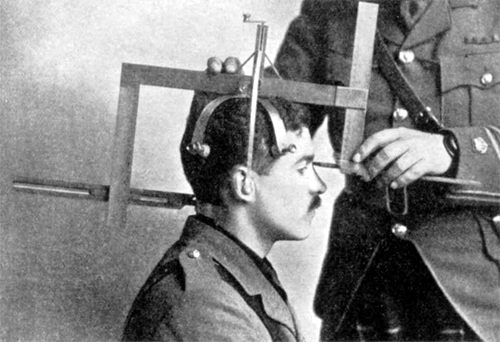
They came to many of these “discoveries” during the First World War. Yerkes developed the U.S. Army Alpha and Beta Intelligence tests that were given to almost all American soldiers. Ostensibly, the assessments were used to determine where soldiers were best suited – support services, the trenches, the officer core, etc.


The rational was to ensure these assignments were being given more fairly and objectively. Before these tests, soldiers were assigned based on wealth and class. Now soldiers were assigned based on tests – that supported the exact same assignments based on wealth and class.


Until this point, I.Q. tests had to be given by one highly trained proctor to one person at a time. Yerkes’ advancement was to put it all on paper so that multiple people could take the tests at once.


However, the tests were deeply flawed. Yerkes claimed they showed a person’s natural intelligence. But the questions were clearly assessing knowledge of facts like a 1900s version of trivial pursuit.


For instance, here is Question 18 of the Alpha Test:
“Velvet Joe appears in advertisements of … (tooth powder)(dry goods)(tobacco)(soap).” The answer is tobacco. How you could know that without having seen period advertisements is beyond me. In any case, it gave good cover for positioning white, affluent men as officers while mostly darker complected and working class soldiers populated the trenches.


After the armistice, Yerkes and Brigham used the wartime test results to continue sorting and ranking Americans. They claimed that their assessments had shown a terrible danger for the human race: nearly half of the white draft (47.3%) was feeble-mind. The cause? Not enough exposure to print advertising? No. They were interbreeding with members of inferior genetic strains.


“No citizen can afford to ignore the menace of race deterioration,” wrote Yerkes in 1922 in the introduction to Brigham’s “A Study of American Intelligence”.


In that same book, one of Brigham’s most seminal, the author was even more specific:


“American education is declining and will proceed… with an accelerating rate as the racial mixture becomes more and more extensive.”


Something had to be done. Pure whites needed to be segregated from mongrel races. But how to do it without being accused of prejudice or bias? How to make it seem like science? Once again, the answer was standardized testing.


Brigham created a civilian test of intelligence that could be used to sort and rank students just as the Army Alpha and Beta tests had been used to sort soldiers. He called it the Scholastic Aptitude Test or S.A.T.


Yes, THAT SAT.


Though the test has been revised multiple times since Brigham created it, the purpose has remained the same – to distinguish the wheat from the chaff, to hold some students up as worthy of further educational investment and to keep others out. Moreover, the means by which the SAT makes this distinction was and remains culturally and economically biased. Researchers have been pointing out since Brigham’s day that the test favors students from wealthy, white backgrounds over those from poor minority homes. Yet today 2.1 million teenagers every year still must take the test to get into the college of their choice.


And so eugenics became education policy throughout the country from primary to post-secondary school.


Terman, who created the Stanford-Binet Intelligence Test to identify “slow” children for special education programs, went on to champion rigid academic tracking for all students in public schools based on standardized testing. The idea was to give the racially pure students extra resources and keep the mixed or lower races in classes more suited to their lower intellects and eventual menial stations in life.


It is sad that many of these ideas persist in our present-day schools. Even today, economically disadvantaged and minority students still make up the majority of remedial and academic classes while the children of the middle class and the wealthy (most of whom incidentally are white) disproportionately populate the honors classes. Today we write that off as merely accidental if we think about it at all. However, a peek at history shows quite clearly that it is exactly how the system has been designed to work.


From there eugenics became the dominant American policy of social organization. It was a required course of study for all education majors at colleges and universities. It was the justification for our isolationist foreign policy allowing thousands of immigrants to be turned away for fear of watering down the U.S. gene pool. Even inside our own borders, tens of thousands of Americans were subjected to mandatory sterilization to ensure degenerate genes were eradicated. In fact, it wasn’t until the end of WWII and the Nuremberg Trials when the eugenicist star began to fade.


We come to a difficult and painful chapter in American history. The word “Nazi” has become an overenthusiastic and easy pejorative for anything that critics wish to vilify. Godwin’s Law states that almost any argument on the Internet will eventually degrade to one side calling the other Adolph Hitler.


He has a point. We should be careful. Too often we wield the sledgehammer of Nazism to smash anything we don’t like. But we can’t let it silence the truth. Sometimes a policy really is Nazism. And if eugenics isn’t, I don’t know what is.


Here it is from Hitler’s Mein Kampf:
“There is today one state in which at least weak beginnings toward a better conception [of immigration] are noticeable. Of course, it is not our model German Republic, but the United States.”


Hitler proudly told his comrades just how closely he followed the progress of the American eugenics movement. “I have studied with great interest,” he told a fellow Nazi, “the laws of several American states concerning prevention of reproduction by people whose progeny would, in all probability, be of no value or be injurious to the racial stock.”


Hitler even wrote a fan letter to American eugenic leader Madison Grant calling his race-based eugenics book, The Passing of the Great Race his “bible.”


And lest we forget the U.S. based Rockefeller Foundation helped found the eugenics program in Germany and even funded the section that Josef Mengele worked in before he went to Auschwitz. By 1926, Rockefeller had donated some $410,000 – almost $4 million in 21st-Century money – to hundreds of German researchers. Without American funds, these programs could not have gotten off the ground.


Nazis even looked to the US Supreme Court for inspiration.
In 1927, the court decided in Buck v. Bell that mandatory sterilization of feeble-minded individuals was, in fact, Constitutional. The ruling, which has never been explicitly overturned, resulted in the forced sterilization of between 60,000 and 70,000 Americans.


Justice Oliver Wendell Holmes wrote, “It is better for all the world, if instead of waiting to execute degenerate offspring for crime, or to let them starve for their imbecility, society can prevent those who are manifestly unfit from continuing their kind…. Three generations of imbeciles are enough.”


The Nazis at the Nuremberg Trials repeatedly quoted Holmes’s words in their own defense.


This is what finally tainted the eugenics brand beyond repair. Psychologists and policymakers didn’t want to be associated with the horrors of the war. They didn’t want any of the blame though they clearly deserved a portion of it. They inspired it.


It took almost two additional decades for these ideas to largely dissipate. It wasn’t until the 1960s and the Civil Rights movement when Americans began to question the social order and the educational system that helped preserve it.


Schools changed. Students were increasingly desegregated both racially and academically. Less emphasis was put on testing and sorting and more on experimentation and self-discovery. Creativity and original thinking were prized above all else. Things weren’t perfect, but we had entered a new era that refused to put children into rigid boxes. They were all unique and valuable and should be treated as such. But it couldn’t last.


Flash forward to 1983. President Ronald Reagan’s National Commission on Excellence in Education put out a report called “A Nation at Risk.” Like the eugenicist work of the ‘10s and ‘20s, it purported to “prove” that our public schools were failing. Something must be done.


The answer was the same as that of the eugenicists. We needed more standardized tests. We needed to return to the practices of sorting and ranking students followed by rigid tracking.


It didn’t matter that “A Nation at Risk” was just as flawed and biased as Brigham’s WWI data.  It didn’t matter that this same policy hadn’t yielded superior academic results in the 1920s, ‘30s. and 40s. It didn’t matter that since we’d put an emphasis on desegregation and creativity, American education was producing unprecedented racial and economic equity. Politically, the only thing to do was return to testing and tracking.


And that’s what we did. It took time. There was opposition. But eventually, we passed No Child Left Behind, which changed the federal role in education from one of ensuring equity to one of rewards and punishment all based on a new generation of flawed and biased standardized testing.


It was a brave new world where all the evils of the past were revisited on our children. And it succeeded – and continues to succeed – because we don’t remember our history. We let policymakers rename the errors of our progenitors and never question their true purpose.


Both Republicans and Democrats have been in control. Both sides blame the other, but left and right wing are both complicit in what remains our national policy.


It is just as racist as that perpetrated by the eugenicists. The major difference is emphasis. In the 1920s, Terman would talk candidly about the racial order. Today, no one mentions it – not openly.


Instead, we get talk about the “racial proficiency gap.” Undeniably poor minority students don’t score as well on standardized tests. Instead of wondering if the problem is the assessments, themselves, we’re pushed to question what teachers and schools are doing wrong.


We wonder why schools serving impoverished students (who are disproportionately brown and black) apparently don’t teach kids as well as schools serving wealthier populations. And anyone who mentions the difference in resources between these schools is quickly silenced. Anyone who mentions the impact of an impoverished upbringing and environment is quickly escorted from the room.


Instead of doing anything to actually help these students, our policy is to close their schools and/or turn them into fly-by-night charter schools.


“We’ve been able to do things – for example, close schools for academic failure. It is hugely difficult, it’s hugely controversial and it’s absolutely the right thing to do,” said former US Education Secretary Arne Duncan.


Imagine if instead of “academic failure” he had said “racial and economic failure.” Because that is what it comes down to. Duncan was decrying low test scores. That’s why these schools were closed. But the test scores aren’t the root cause. That’s poverty. And it disproportionately affects minority students. But you can only see that if you admit the tests are inaccurate assessments of students’ abilities – as countless peer-reviewed academic studies continue to prove.


“I think the best thing that happened to the education system in New Orleans was Hurricane Katrina,” Duncan famously said.


Our highest education official in the country actually praised a natural disaster that killed between 1,200 and 1,800 people (mostly minorities) for destroying their public schools so they could be rebuilt as charters. Did it actually improve children’s academic outcomes? No.


This whole charter school push is another element of our modern educational pseudoscience. These types of schools have never been proven to help kids learn. In fact, the research shows they either do no better or often much worse than traditional public schools. It is an article of faith with our modern education policymakers that schools serving poor minority children should be run by private corporations and schools serving wealthy white students can be allowed to be run by the community.


None of this could happen without the false objectivity of standardized testing.


A hundred years ago, the eugenicists used their test scores to explain away a racist and classist social order. Today we use similarly flawed test scores to justify a similarly prejudicial social order.


Testing remains a way of keeping you in your place.


People are starting to notice. Hence the quick move by the testing industry to co-opt the largest and most well-funded Civil Rights organizations. Hence appointing John King to succeed Duncan as U.S. Secretary of Education – a brown face to silence racial complaints.


Are the people championing standardization and privatization racist? Honestly, I don’t know. I can’t see into their hearts. But it is undeniable that the results of their policies disproportionately hurt our black and brown children. Judging by effect – not necessarily intention – they are racist as well as classist.


Some may be true believers who actually think these policies will help children learn. I’m sure many of the eugenicists of the past felt the same way. Keeping “racially inferior” children in the slow class was purported to be for their own benefit, just as closing poor black schools is said to help them learn.


That’s why I’ve written this and other articles. It is essential that we understand the terrors and errors of past education policy.


If we hadn’t forgotten this dark page of American history, perhaps our children wouldn’t be forced to repeat it.

 

Blinded by Pseudoscience: Standardized Testing is Modern Day Eugenics


eugenics-testing.jpg


Adolph Hitler was a big fan of standardized testing.


It helped justify much of the horrors of the Nazi regime.


National Socialism is nothing but applied biology,” he said.


In other words, it’s just science, people. Some races are simply inferior to others. Black people, Jews, Gypsies, Hispanics – they just can’t hold a candle to the superior races of Northwestern Europe.


And Hitler based much of this on the “science” of Eugenics, especially the work done in America in the 1910s and ‘20s.


Eugenicists used a flawed and biased interpretation of Gregor Mendel’s laws on heredity to argue that lawlessness, intelligence, and even economic success are passed down in families due to dominant or recessive genes. Moreover, the negative traits are widespread in certain races and the positive ones in others.


Practitioners like Carl Brigham used IQ tests to PROVE white people were just the best and everyone else, well, maybe they should just stop breeding. (In fact, laws were passed in the U.S. imposing mandatory sterilization on thousands based on the conclusions of these “scientists.”)


Brigham was a U.S. Army psychologist who used WWI data to declare that whites (especially those born inside the United States) were the most intelligent of all peoples and that immigrants were genetically inferior. He went on to refine his work into an even better indicator of intelligence the he called the Scholastic Aptitude Test or S.A.T.


Perhaps you’ve heard of it.


In his seminal work, A Study of American Intelligence, Brigham concluded that American education is declining and “will proceed with an accelerating rate as the racial mixture becomes more and more extensive.”


To combat this mixture, eugenicist education reformers encouraged schools to rigidly track students into low, middle and high level classes – similar to the way many of our schools are organized today.


Lewis Terman, Professor of Education at Stanford University and originator of the Stanford-Binet intelligence test, expressed these views in his textbook, The Measurement of Intelligence (1916). He wrote:


“Among laboring men and servant girls there are thousands like them [feebleminded individuals]. They are the world’s “hewers of wood and drawers of water.” And yet, as far as intelligence is concerned, the tests have told the truth. … No amount of school instruction will ever make them intelligent voters or capable voters in the true sense of the word.


… The fact that one meets this type with such frequency among Indians, Mexicans, and negroes suggests quite forcibly that the whole question of racial differences in mental traits will have to be taken up anew and by experimental methods.


Children of this group should be segregated in special classes and be given instruction which is concrete and practical. They cannot master, but they can often be made efficient workers, able to look out for themselves. There is no possibility at present of convincing society that they should not be allowed to reproduce, although from a eugenic point of view they constitute a grave problem because of their unusually prolific breeding” (91-92).


This was the original justification for academic tracking. Terman and other educational psychologists convinced many schools to use high-stakes and culturally-biased tests to place “slow” students into special classes or separate schools while placing more advanced students of European ancestry into the college preparatory courses.


Compare that ideal to the increasingly segregated American schools of today. We have schools for the rich and schools for the poor. We have schools for black and brown kids and schools for whites.


Terman would have been in heaven!


It was the work of patriots like Brigham and Terman that the Nazis relied on heavily to justify their forced sterilization programs and ultimately the Holocaust, itself.


Does that sound extreme? It isn’t.


At the Nuremberg Trials, Nazi scientists repeatedly praised the work of American eugenicists, who uncoincidentally also created the standardized test model of education favored by corporate education reformers today.


It’s easy to follow their logic. If certain races can be scientifically proven to be inferior, it is a small step to thinking that they should be stopped from breeding or eradicated from the face of the planet altogether.


And the pseudo-scientific justification for this scheme was standardized testing. The IQ test – which has since been shown to be incredibly biased – was used to justify mass murder. And then Brigham refined that same test into our most popular current standardized assessment – the SAT. In fact, all standardized tests that students are forced to take today owe a huge debt to the SAT and other standardized assessments used by Terman and other eugenicist educators.


The resemblance between testing in the 1910s and the 2010s is obvious to those who will but look.


Similar to the IQ test, modern standardized exams like the Partnership for Assessment of Readiness for College and Careers (PARCC) repeatedly have been shown to be biased in favor of affluent and white test takers. Supporters bemoan the “racial proficiency gap,” but that’s just a nice way of wondering why the same folks Hitler thought were “inferior” don’t do well on our modern tests.


This is no accident. It’s how the assessments are designed.


The IQ test is supposed to demonstrate an innate intelligence. However, modern psychologists have become increasingly skeptical that intelligence is fixed. So standardized assessments like the SAT are supposed to somehow show BOTH what students have learned AND their innate intelligence. That’s the justification behind the high stakes. You have to pass the SAT to show you’re smart enough to do well in college.


Such outright racism would not be tolerated today, so it becomes cloaked in doublespeak. It’s good that poor black students don’t score well on standardized tests because that shows us they need extra help. And then, instead of providing any help, we close their schools or turn them over to fly-by-night charter operators.


Once again, standardized tests are used as the justification for doing something obviously racist. If anyone said, “We’re going to close and privatize all the schools serving minorities and the poor,” people would revolt. However, when you say we’re doing it because of standardized tests – because of “science” – people just shrug and say, “You can’t argue with that!”


The same goes for Common Core State Standards. States were bribed to enact them so that the reasons for attacking public schools would be uniform across the country. This provides another level of pseudo-scientific justification.


They are supposed to ensure every student who graduates high school will be “college and career ready.” However, now that Common Core has been adopted in 46 states and their tests have become aligned with the standards, we’ve seen student scores take a nosedive. Only our rich white kids apparently are ready for college.


So what will we do with those who fall below the mark? We’re sending no additional resources to help them increase their achievement. We’ll just close their schools and/or privatize. And to make sure none of them escape, we’ll make passing the Common Core tests a graduation requirement.


This does not level the playing field. This does not – as some corporate education reformers claim – ensure the sanctity of students Civil Rights. It extensively violates them!


The education model of Test and Punish is a modern eugenics movement. We’re shellacking over class divides so that those below a certain point have no possibility of ever rising to the white place. And I do mean “white.”


Standardized testing is not a ladder of social mobility. It is a means of keeping certain people in their proper place.


Some try to deny the racial component by pointing to the intersection with class. Testing impacts poor white children as it does poor black ones.


To a degree this is true, but remember our eugenic forerunners saw everything in purely racial terms. For instance, today, few people would claim Judaism is a race. It is a religion. It is essentially a belief system, not a set of shared genes even though some adherents do share genetic characteristics after centuries of segregation. But the Nazis considered them a race and, thus, systematically murdered 6 million of them.


The same goes for the poor. Brigham and his Nazi admirers thought that people were poor mainly because of their genes. They are genetically predisposed to being lazy and good for nothing, so they can’t keep a job or advance themselves. Therefore, they’re poor. Pause for a moment to consider the large numbers of people in America today who would agree with them.


Standardized testing treats the poor the same way it does minorities. In fact, it is just the lack of opportunities that come with poverty that cause the very scores that are being used to denigrate these people. Lack of proper nutrition, food insecurity, lack of prenatal care, early childcare, fewer books in the home, exposure to violence – all of these and more combine to result in lower academic outcomes.


But standardized testing puts the blame on the victim. Students score badly because they aren’t working hard enough, corporate reformers say. These kids don’t have enough “rigor.”


To make sure few people actually volunteer to help, we blame their teachers, as well. We make the education profession as unattractive as possible, indicting teachers for all societies ills knowing full well that this will result – as it has – in a nationwide teacher shortage. Then we can deprofessionalize the field and replace educators who have four-year-degrees with lightly trained Teach for America temps.


These kinds of shenanigans didn’t fool the anti-racists of the past.


The great African American scholar W. E. B. Du Bois remarked in 1940, “It was not until I was long out of school and indeed after the [First] World War that there came the hurried use of the new technique of psychological tests, which were quickly adjusted so as to put black folk absolutely beyond the possibility of civilization.”


He could be talking about No Child Left Behind.


In “Intelligence Tests and Propaganda,” scholar Horace Mann Bond issued a warning about the misuse of IQ tests:


“But so long as any group of men attempts to use these tests as funds of information for the approximation of crude and inaccurate generalizations, so long must we continue to cry “Hold!” To compare the crowded millions of New York’s East Side with the children of Morningside Heights [an upper class neighborhood at the time] indeed involves a great contradiction; and to claim that the results of the tests given to such diverse groups, drawn from such varying strata of the social complex, are in any wise accurate, is to expose a fatuous sense of unfairness and lack of appreciation of the great environmental factors of modern urban life.”


He could be talking about Race to the Top.


Karen Lewis, a present-day Chicago teacher and president of her union, says this:


“What many people do not know is that the use of standardized tests has its origins in the Eugenics movement …we have to be clear about the original purpose of standardized tests.


In a society fascinated by statistics, we are often compelled to reduce everything to a single number. Those of us who work with children know that there are so many characteristics that cannot be quantified.


Ask yourselves whether you want to be part of a legacy born of the unholy alliance between the concept of  “natural inequality” and the drudgery that has been imposed on many of our classrooms.”


Make no mistake. Corporate Education Reform is modern day eugenics. It pretends to justify increasing standardization and privatization of public schools through flawed and biased assessments. Its claims that any of this is actually supported by research are spurious. At heart, these are articles of faith – not science. Neither Common Core nor high stakes testing nor charterizing impoverished schools nor putting districts into receivership nor evaluating teachers based on student test scores – none of it has ever been shown in peer-reviewed studies to help students learn.


Corporate Education Reformers are asking all of us to have faith in a racial and economic social order that benefits those already at the top and keeps the rest of us in our place.


And for anyone who questions it, we are continually blinded by their pseudoscientific justifications.