Why Care About Other People’s Children

health-kids-smiling

As a vocal critic of charter and voucher schools, one of the most frequent questions I get from readers is this:

“Why should I care about other people’s children?”

One reader put it this way:

“Why should my child’s education and safety have to suffer because of difficult and violent students? …it isn’t my responsibility to pay for a miscreant’s education.”

The question says more than any answer could.

It shows quite clearly that school choice is an essentially selfish position.

That’s why some folks champion privatized education – they only care about their own children. In effect, when a parent sends their children to a charter or voucher school, they are telling the community that they don’t care what happens to any one else’s kids so long as their kids are properly cared for and educated.

It is the root cause of most of our problems in education today and has nothing to do with children. It’s all about adults – adults lacking empathy.

On the one hand, I get it. As a parent, you can’t help but love your child more than anyone else’s. You would beg, cheat and steal to make sure your child has enough to eat, is clothed and sheltered, has everything she needs to succeed in this world.

That’s a position for which few would show any embarrassment. It’s just being human.

But it shouldn’t also mean that you don’t care at all for other children.

I’d like to pose a radical thought – loving my child does not mean I’m indifferent to yours.

Children are innocent. They haven’t done anything to earn the hate or enmity of the world. They see everything with fresh eyes. Many of them haven’t even learned the prejudices and ignorance of their parents. And even where they have, it is so new it can be changed.

When you look at a babe in arms do you feel the same indifference? I don’t.

Perhaps it’s just the way we’re built. I feel an immediate nurturing instinct. I want to protect and provide for children – any children – even if they’re not mine.

If you saw a baby all alone crying on the side of the road, would you stop to help her? I would. I couldn’t help it. I can do no other.

If I saw a toddler in distress, a tween, even an unruly teenager in need, I would try to help. And I think most of us would do the same.

Doing so wouldn’t hurt my child. In fact, it would show her how a decent person acts towards others. It would teach her empathy, kindness, caring. It would demonstrate the values I try to instill in her – that we’re all in this together and we owe certain things to the other beings with which we share this world.

Why would you not want to do that?

We do not live in a world where you have to choose between your child and all others. There is a middle course. We can do for all society’s children without unduly sacrificing our own.

And if we can, why wouldn’t we?

Public school is essentially a community endeavor. It is an attempt to give everyone in your neighborhood the same start, the same opportunity, the same advantages.

It means allowing all children who live in the community the ability to attend the community school. That’s better than selecting the best and brightest and to Hell with the rest.

It means the community pooling its wealth to help all students. That’s better than dividing that pool up and pitting one group against another so that some get what they need and others don’t.

It means having an elected school board who holds public meetings, deliberates in the open and has to offer almost all documents to the light of day. That’s just better than an appointed board of directors who hold private meetings behind closed doors and who aren’t compelled to show any documentation for how they’re spending public tax money.

When you send your child to school – any school – she will have to deal with other students. She will meet children who are mean, unkind, unruly and a bad influence. But this is true at all schools – public and private, voucher or charter, secular or parochial. The biggest difference is racial and economic.

Our educational institutions today have become so segregated by class and race that even our public schools offer white middle class and wealthy students the opportunity to learn in an environment nearly devoid of children of color or children who live in poverty. This divide is drastically widened by charter, private and parochial schools.

So when people complain about the class of children they want to keep separate from their progeny, it is always imbued with a racist and classist subtext.

What they mean is: I don’t want my child to have to put up with all those black students, all those brown children, all those unwashed masses of impoverished humanity.

I proudly send my daughter to public school for the same reasons that many withhold their children from it. I want her to experience a wide variety of humanity. I want her to know people unlike her, and to realize that they aren’t as different as they might first appear. I want her to know the full range of what it means to be human. I want her to be exposed to different cultures, religions, nationalities, world views, thoughts and ideas.

And I want it not just because it’s better for my community – I want it because it’s better for her, too.

I want my daughter and I to both live in a world populated by educated citizens. I want us both to live in a society that treats people fairly, and where people of all types can come together and talk and reason and enjoy each other’s company.

Only under the most extreme circumstances would I ever subject her to charter, private or parochial schooling. And things would have to come to a pretty pass for me to home school her.

Imagine! Thinking I could offer my child all the richness of a public school experience, all the knowledge of a district’s worth of teachers, all the variety of social contact – how vain I would need to be to think I could do all that, myself!

Some people want their children to become little versions of themselves. They want to create a generation of mini-me’s who’ll carry on their way of thinking into the future.

That’s not my goal at all.

I want my daughter to share my core values, I want her to learn from my experiences, but I don’t want her to think like me at all. I want her to be a new person, special and unique.

I want her to be her.

If you stop and think about it, that’s what most of us want for our children.

It’s a common goal that can be achieved with a common mechanism.

So why should we care about other people’s children?

Because it’s better for ours. Because doing so makes us better people. Because all children are ends in themselves. Because they’re beautiful, unique sparks of light in a dark universe.

If those aren’t reasons enough, I can’t help you.

The Corporate Coup Destroying Our Schools Has Finally Come For Our Government

Screen Shot 2017-03-28 at 4.09.34 PM


First they came for people of color and I said nothing.

Because I am not a person of color.


Then they came for the poor and I said nothing.

For I am not poor.


Then they came for our public schools and I said nothing.

Because I do not send my children to public schools.


Now they’ve come for our government and who is left to speak for me?


This is a paraphrase of Martin Niemöller’s famous lines about the cowardice of German intellectuals during Hitler’s rise to power.


The fascists purged group after group while those who could have stood against them did nothing – until it was too late.


That’s very nearly the position we find ourselves in today in relation to the Trump administration.


The neoliberal and neofascist façade has fallen away. And the naked greed of our runaway capitalist system has been exposed for what it is.


Just this week, Trump unveiled a new government office with sweeping authority to overhaul federal bureaucracy on the business model.


Led by the president’s son-in-law and senior advisor, Jared Kushner, The White House Office of American Innovation will be an autonomous entity enforcing the president’s will. Described as an internal “SWAT team” of strategic consultants, and staffed with former business executives, the office will cut down democratic rule in favor of top-down authoritarianism.


And the excuse is the same one used to deny equity for minorities, the same one used to dismantle protections for the poor and the same one used to unfairly label and close our public schools – we need to run government like a business.


But government is not a business.


The goal of a business is profit for the few. The goal of government is service to the many.


In a private business only the owner or the board of directors reaps the benefits. But our government is not supposed to be set up that way. It’s not supposed to benefit merely all the president’s men. It’s supposed to benefit all of us – the citizens, the taxpayers, the voters.


This is exactly the model that has been used against our public schools.


We have shifted our concern away from students and parents to investors and corporations. For almost two decades, our education policies have increasingly been to reduce local control – especially at schools serving the poor and minorities – and give that control to private charter school operators. We have removed the duly-elected school boards and replaced them with appointed boards of directors. We have removed or diminished democratic rule and replaced it with an autocracy. And all the while the middle class has cheered.


It was a coup in plain site, and no one but parents, students, teachers and intellectuals spoke up.


Our voices were undercut or ignored. When we demanded equal treatment for our children, we were labeled welfare queens wanting something for nothing. When we demanded fair treatment, a safe work environment and resources for our students, we were labeled union thugs standing in the way of progress. At every turn we were tone policed into silence and passed over for the voices of self-proclaimed experts who knew nothing but what they were paid to espouse.


We were told that the only measure of academic success was a standardized test score. But no mention of the white, middle class standard our non-white, impoverished students were being held to.


When our schools were increasingly segregated by race, class and income, we were told that it was only fair. After all, it was based on choice – the choice of the invisible hand of the free market. When our schools were starved of resources, we were told to do more with less. And when our students struggled to survive malnutrition, increased violence and the indentured servitude of their parents to an economic system that barely allowed them to sustain themselves, we blamed them. And their teachers, because how dare anyone actually try to help these untouchables!


We allowed this – all of it – perpetrated by Democrats and Republicans, Conservatives and Liberals, because they’re all really just different dogs to the same masters.


We justified it all in the name of the market, in the name of economics, in the name of business. Why should we care? It rarely affected us directly.


White, middle class folks could get by. It wasn’t OUR schools being given away to private equity firms. It wasn’t OUR children being educated by temporary employees on the model of the peace corps with little training and no experience.


Those were just someone else’s children. We weren’t even sure they were human. They certainly didn’t share the same portion of humanity as we did. They were unwashed and unfed. Even if you washed them, many of them would still have brown skin. We were happy to have them as an underclass, as a cushion to stop us from falling further down the social ladder.


Our kids went to either well resourced public schools with fully elected school boards and shiny new facilities or else we sent our children to pristine private schools that offered the best of everything for a price.


But now the chickens have come home to roost.


Because this same model is being applied to our government.


Now it is us who will lose our voices. It will be our services that are stripped away as an unnecessary cost savings. We will lose our healthcare. We will lose our environment. It will be our democracy suspended to make way for the more efficient means of government – fascism and autocracy.


Who has time to listen to the people? Much easier to just decide what should be done. And we can justify it with our business model. No more voters and representatives. Now we will be businessmen and consumers. Nothing will stand in the way of the corporate class enriching themselves at public expense. They will be merely providing the rest of us with the goods and services of government, the bits that trickle down on our heads like rain or urine.


That is what Trump is attempting. He is turning the United States into a banana republic – even installing his relatives and children in top leadership positions. Our government now resembles the corridors of power in Baghdad under Saddam Hussein with henchmen Uday and Qusay in tow.


The question is this: will we allow it?


Will we continue to allow it?


Will we stand for it as the administration installs Trump loyalty officers in every federal office?


Will we say nothing as nepotism and greed become the most prized attributes of governance?


Will we remain silent as our public schools continue to be raided, sacked and burned?


Because the answer to those questions is the answer to so much more.


Are we on the cusp of revolution or is history merely repeating itself?

Congress Frees Public Schools From Federal Test & Punish – Where’s the Catch?

Trump+Selection+Education+Secretary+Betsy+kBaA0SDAd_tx

Let’s say you were kidnapped and kept in a small basement room where you were routinely beaten and starved.

Then after years of this treatment, your captors brought in a massage table and offered you a filet mignon after your spa treatment.

You’d be more than a little bit confused.

That’s the position of parents, students and teachers today.

After almost two decades of punishing public schools and their students for low test scores, Congress suddenly decides to step back and leave it to the states!?

Until now the federal government had mandated increasing high stakes standardized tests and forcing schools that don’t meet a certain threshold to be stripped of their school boards, turned into charters or simply closed. Until now, the federal government coerced states to enact every fly-by-night corporate education reform from Common Core to Teach for America to evaluating teachers based on student test scores.

But now the feds are just walking away!?

First, in 2015 lawmakers passed the Every Student Succeeds Act (ESSA), a reauthorization of federal K-12 education policy that (depending on how you interpret it) limited federal power over public schools. However, the Obama administration offered guidelines that put much of that federal power back in place.

Now both the House and Senate have voted to repeal those Obama administration guidelines in favor of… well… some other interpretation.

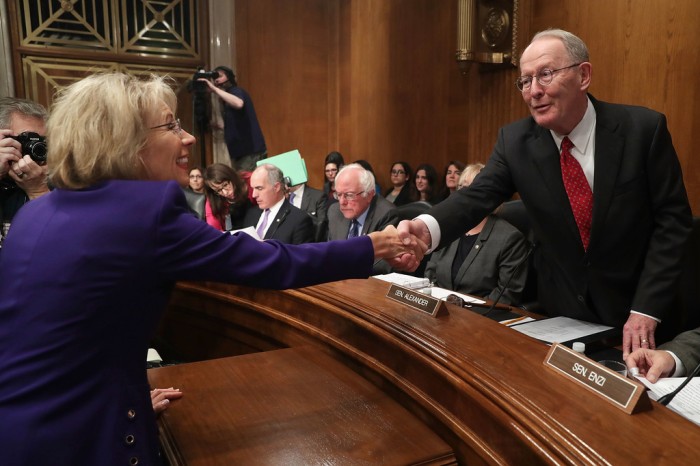
Sen. Lamar Alexander (R-Tennessee), chairman of the Health, Education, Labor and Pensions committee and one of the architects of the ESSA, says states can just follow what’s written in the law. But this is a 1,061 page document full of legalese, meandering bipartisan compromises and – frankly – contradictory language. Even the most simple legislation needs interpretation, and in this case it needs extensive interpretation.

Education Secretary Betsy DeVos is expected to offer her take on what all this means by Monday. So buckle up for that one. I’m sure the nation’s Grizzlies are so upset they can barely finish their picnic baskets.

As for the rest of us, it’s hard to know what this all will mean.

Alexander offered a detailed explanation that anyone interested in this issue should read.

I’m no fan of the Senator’s. I think he’s a blatant opportunist, an unapologetic partisan and out to protect only one person – numero uno.

But he makes some excellent points about federal overreach in the Department of Education under the previous two administrations.

Moreover, unlike DeVos, the supremely unqualified Education Secretary he helped ram through Congress over bipartisan objections, he knows something about schools. He was Secretary of Education, himself, from 1991-93 under President George H. W. Bush.

First, the ESSA still mandates annual testing. Even without the Obama guidelines, students will still be tested in grades 3-8 and once in high school.

Second, Alexander says the law still requires each state to hold its public schools accountable. Each state must submit a plan detailing how it intends to do that by September of 2017. There is plenty of latitude on exactly how states will do this, but whatever they decide, this new accountability system must be implemented by next school year (2017-2018).

Moreover, he says, states have to identify and provide support to at least the lowest performing 5% of their schools. This must be done by the beginning of the 2018-2019 school year.

They also must use academic and English language proficiency indicators in their accountability systems. Which indicators? Standardized testing? Maybe – maybe not.

Many accountability provisions, such as the requirement that educators measure reading scores, math scores, and graduation rates, are specifically mentioned in the ESSA.

Still, many questions remain.

For instance: if the Department of Education isn’t allowed to tell states what to do, how is it supposed to help them comply with the law?

Alexander cites “Non-regulatory guidance; Dear Colleague letters; Frequently-Asked-Questions documents; Webinars, phone calls, and in-person conferences.”

Alexander stresses that repealing the Obama regulations does not open to door for the Department of Education to mandate a nationwide school voucher plan – unfortunately.

He writes, “A school choice program cannot be unilaterally created by the Department of Education. Only Congress could create a voucher program, and, unfortunately, Congress has rejected doing that.”

However, the Trump administration and DeVos have already made their intentions known about school vouchers. They intend to use Title I dollars – money usually earmarked for the most impoverished students – as federal bribes to enact vouchers. It’s basically the same thing Obama did with Race to the Top – promising federal money to states if their schools do what the feds want them to do.

For all his talk about states rights, Alexander appears to have no problems with this same kind of Obama-style coercion.

But he does appear to be correct about the transfer of power.

Apparently, the states really will regain control over their public schools.

This could be a very positive thing. And it’s not the only one.

In addition to repealing Obama’s accountability regulations, Congress scrapped Obama’s teacher preparation rules.

This change was less controversial. Eight Democrats joined Republicans in voting to repeal the teacher preparation regulations. By comparison, no Democrats voted to dismantle the accountability rules and one Republican joined them in opposition.

The teacher preparation rules were released in October after years of delay.

The main point of contention was the requirement that states develop a rating system aimed at evaluating the success of their teacher preparation programs. This would have included how programs’ teachers perform based on a measure of student academic achievement. Though the final version gained some flexibility with how to determine student academic success beyond just test scores, it remained a hot mess.

Any programs that didn’t perform well on the state’s rating system would have lost access to federal grants aimed at supporting teachers who work in high-need certification areas and in low-income schools (or TEACH grants). In effect, it would have pushed for a new generation of teachers dedicated to test prep and Common Core.

And these repeals of Obama regulations – these seeming improvements just waiting for Donald Trump’s signature – are brought to us by the same people who support removing protections for trans students. These are the same legislators who gave us an unexperienced mega-donor as Education Secretary.

Frankly, I’m having trouble believing it.

I hope I’m wrong, but I’m waiting for the other shoe to drop.

Perhaps the standardized testing industry has consolidated so much support at the various Republican controlled state legislatures that it no longer needs support in Washington. Perhaps our ridiculously gerrymandered state legislative districts will make any resistance even more difficult. Perhaps a completely toothless Department of Education will embolden the most racist state legislators to dramatically increase segregation and civil rights abuses for the poor and minorities.

Or perhaps Republicans actually got one right?

Koch Bros Funded Publication Criticizes – ME – on School Choice!

who-me2

You know you’ve made it when the Koch Brothers are funding a critique of your work.

Most of the time I just toil in obscurity.

I sit behind my computer furiously pounding away at the keys sending my little blog entries out onto the Interwebs never expecting much of a reply.

Sure I get fervent wishes for my death.

And the occasional racist diatribe that only tangentially has anything to do with what I wrote.

But a response from a conservative Web magazine funded by the world’s most famous billionaire brothers!?

I guess this is what the big time feels like!

The article appeared in The Federalist, an Internet publication mostly known for anti-LGBT diatribes and climate change denial. But I had the audacity to write something called “Top 10 Reasons School Choice is No Choice.”

I had to be taken down.

And they had just the person to do it – far right religious author Mary C. Tillotson.

You may remember her from such hard hitting pieces as “How Praying a Novena Helped Me Process This Election,” “Sometimes, Holiness is Boring,” and “Why It’s Idiotic to Blame Christians for the Orlando Attack.”
This week her article is called “Top 10 Reasons HuffPo Doesn’t Get School Choice.”

Which is kinda’ wrong from the get-go.

Yes, I published my article in the Huffington Post, but it is not exactly indicative of the editorial slant of that publication. Sure, HuffPo leans left, but it routinely published articles that are extremely favorable to school choice. Heck! Michelle Rhee is a freakin’ contributor!

So I don’t think it’s fair to blame HuffPo for my ideas on school choice. A better title might have been “Top 10 Reasons Singer Doesn’t Get School Choice,” but who the Heck is Singer and why should anyone care!?

Then she gives a quick summary of how my whole piece is just plain wrong: “Steven Singer of The Huffington Post would have you believe that when parents have more choices, they have fewer choices.”

That’s like writing “Steven Singer of Consumer Reports would have you believe buying a used car means you may not be able to get anywhere.”

I stand by that statement. They’re both scams, Mary. The perpetrators of school choice want to convince you to choose a school that gives you fewer choices than public schools do. Just like a used car salesmen may try to convince you to buy a clunker that won’t get you from point A to B.

Claim 1: ‘Voucher programs almost never provide students with full tuition.’

She says I’m wrong because I’m right. She basically admits most vouchers won’t pay the full tuition but that it’s still a help.

Okay. But parents have already paid for a full K-12 public school education that they will not have to supplement at all. That’s a much better value.

Moreover, Mary, you pretend that the cost of the voucher is going to pay for at least 2/3 of private school tuition. This isn’t true. Most of Donald Trump’s kids went to the Hill School in Pennsylvania for more than $55,000 a year. A thousand or two isn’t going to help much.

But Mary disagrees. Most rich folks aren’t eligible for voucher programs, she says, so the hyper elite academies are off the table.

It’s true that most vouchers are given to poor students, but that’s only temporary. The goal is to increase them to middle and upper class students. It’s the first thing they do after initially limiting vouchers to the poor. And she knows this. She’s read Milton Friedman, the conservative nutjob who thought up this scheme to destroy public schools. “The ideal way would be to abolish the public school system…” he said. How? “Privately conducted schools… can develop exclusively white schools, exclusively colored schools and mixed schools,” Friedman wrote.

What a brave new world you’re defending, Mary!

Claim 2: Choice schools don’t have to accept everyone.

She writes, “Singer would have you believe that charter schools and private schools receiving voucher money are cherry-picking the best students to stoke their egos and stats. This isn’t true, and even if it were, it would still provide more choices.”

Um. Okay. So you admit this could be true but it doesn’t matter. Choice is all that matters. Very telling.

Then she goes on to talk about schools that actually do pick their own students, and she argues that it’s okay.

It’s not, Mary. Schools that accept tax dollars should have to accept all students. Otherwise, you’re just guessing that somewhere out there is a school for all kids, but you’re doing nothing to ensure this is true.

Children and families from places destroyed by vouchers and underfunding of public schools such as Detroit have been complaining of this very thing. They go from school to school never able to find one that meets their needs. It’s not that this is a failure of the system either – this IS the system working properly! This IS school choice – a system that only ensures choice but never quality or excellence. It is predicated on the semi-religious belief that the market will take care of everything.

It doesn’t. Ask Dannah Wilson about it.

Claim 3: Charter schools are notorious for kicking out hard-to-teach students.

She acknowledges the point and then changes the subject. She says there are great charters out there like KIPP. Yes, KIPP – a system that does exactly what I just said it does! Look at the huge numbers of students KIPP schools kick out. Look at the very few who make it to graduation. This is a terrible model for your school. I guess Mary lives in a universe of alternative facts where terrible equals great.

I’m kind of embarrassed for you. Let’s just move on, shall we?

Claim 4: Choice schools actually give parents less choice than traditional public schools.

Mary says that every parent should have the right to vote with their feet? Why? I’m not sure. Maybe this explains her position:

“Singer writes, “If you don’t like what your public school is doing, you can organize, vote for new leadership or even take a leadership role, yourself.” But seriously, who has time for that? Some people, yes, but not the single mom working two jobs to make ends meet. It’s a lot easier—and a lot faster, which matters in the life of a child—to enroll a child in a different school than to slog through the political process.”

So it’s a lot easier to have fewer options? Mary, you just argued AGAINST choice. You just said choice is too much work. No one has time for choice? Make up your mind.

That is ridiculous. But moreover it’s untrue. Do you really believe parents have the time to go shopping for new schools every week? That single mom doesn’t have time to go to board meetings but she has the time to enter these charter school lotteries and hope her kids get in? And if they don’t, she has time to trudge across town to another school and when it closes suddenly, she has time to start the process all over again? And again? THIS is the time saving process!? When she could actually be building something as part of her community?

Claim 5: Charter schools don’t perform better than traditional public schools.

She just says both can be good or bad. This sidesteps exactly how bad charter schools can be. Charter operators can take all the money and run. Charters can close without warning. Cyber charters have been found to actually provide less education in math and reading than not going to school at all.

Traditional public schools can struggle, and when they do it’s almost always because they’re underfunded. Yet, they NEVER provide an education that is as bad as the worst charter schools. And most traditional public schools do the best they can with what they have. The problem is strategic disinvestment. We could make almost every traditional public school excellent if we just funded them fairly. But unfortunately billionaires like the Kochs are paying for people like Mary to convince us otherwise.

Claim 6: Charters and vouchers increase segregation.

She basically offers a defense of white parents who want their kids schooled separately from black ones. That’s just choice, baby, and choice is always good.
No, it’s not. We’ve seen that it is better for everyone if children are educated with diverse people. It helps them understand people unlike themselves. It builds a more tolerant and just America.

Yes, our traditional public schools have become more segregated because of the way district lines are drawn. But that doesn’t mean we should double down on segregation. It means we should fight to reverse it.

Then she tells a fairytale about Obama attacking choice schools in Louisiana. He CREATED that system! He was a booster of the all-charter system! He was not an enemy of school choice. Corporate Democrats are not the enemy of school choice! They love it! They are the allies of your own corporate masters, Mary. Do some research.

Claim 7: Charter and voucher schools take away funding from traditional schools.

She basically agrees with me and then says public schools should find a way to deal with it. That’s what private schools do.

But public schools can’t operate like private schools and they shouldn’t for many of the reasons already enumerated here. They accept everyone. They don’t intentionally segregate. Etc.

Moreover, instability is a terrible basis for a school. You want to ensure it will be there for children when they need it. You don’t want schools competing with each other for resources like businesses. Most businesses fail. You don’t want that for schools. You need them to succeed. That means artificially ensuring their success with a steady, reliable stream of funding just like you give to the military. You wouldn’t suggest the Army, Navy, Air Force and Marines compete for funding. Why do that to our public schools?

Claim 8: Funding a variety of schools would be wasteful and expensive.

She says I’m thinking “bureaucratically, considering ‘school systems’ instead of the actual children who are the reason schools exist in the first place.”

Uh, these systems serve children. You need to be able to run them FOR THOSE STUDENTS.

Claim 9: School choice distracts from the real problems: poverty and funding equity.

She agrees that poverty is important. Then she pulls the old “throwing money at problems is a terrible idea” card. Public schools just need to find ways to cut costs. They spend too much. Blah, blah, blah.

She ignores the facts. Public schools spend dramatically different sums on students depending on whether they’re rich or poor. We need equitable school funding. That means spending more on poor children and not complaining about “throwing money” at the problem. No one complains about that at the rich schools where they spend so much more than the poor schools. No one calls it “throwing money” when it’s your own child. That’s “investing in children.” It’s only when it’s THOSE kids that it’s “throwing money” at the problem. It betrays a class conscious prejudice against the poor and – most likely – children of color.

She then goes on to complain about the increase in administrative costs at public schools. This is laughable! Charter schools spend so much more on administrative costs than traditional public schools! A study by Michigan State University and the University of Utah found that charter schools spend on average $774 more per student on administration and $1,140 less on instruction than do traditional public schools.

And then she talks about student achievement not increasing at public schools. Actually, it depends on how you measure it. Standardized testing is a poor measure of achievement. And when you adjust for poverty, our schools are some of the best in the world.

Claim 10: School choice is supported by billionaires, not the grassroots.

Here she just talks about all the events planned during school choice week.

Mary, these are attended by private and parochial schools during the school day. The staff is literally paid to be there. The school children are literally forced to be there because their schools are closed and they are bused in to these events.

That’s not grassroots. That’s the definition of astroturf.

Do some people support school choice? Yes. Less than 10 percent of America’s students attend these schools. But the overwhelming majority of Americans support public schools.

Mary goes on about all the people applying for vouchers but she ignores a much more pertinent fact. Whenever school vouchers have been put to a referendum, voters have always turned it down. This despite who-knows-how-many-millions of dollars in advertising and propaganda to influence voters to support it!

No matter what the position, you can find someone to support it. But the majority of school choice proponents are billionaires and corporatists trying to fool regular people into doing what’s not it their own best interests.

Just ask your editors at the Federalist, Mary. You and your article are a case in point.

But thank you so much for critiquing my article. I’m just a public school teacher. I so rarely get corporate employees writing responses to my work.

Frankly, I didn’t find your piece very convincing, but what do I know? I’m a union thug with an advanced degree, a masters and a national certification. I don’t represent Trump’s America like you do.

I just represent the majority who may one day wake up and take it all back.

How to Get Trump to Support Public Education: A Military Proposal

trump-toy-soldiers

Donald Trump is dead set on destroying public education.


He and his mega-donor Education Secretary Betsy DeVos want to flood the market with vouchers to divert tax dollars to private and parochial schools thereby starving traditional public schools into closing.


But watching the orange one speaking to Congress last night, I got an idea. I know how to get this dimwitted blowhard to support public schools. And every conservative lawmaker will back him up.


Sound impossible? Not really. But the best part is we don’t need the Democrats to do a darn thing. As if they could. Their thumbs are planted so firmly up their own asses it would take an army of proctologists to save the party.


We don’t need them. All we need is language. Just rename things.


It’s the same tactic Nazis have used to take over the Republican Party. They’re no longer called Nazis. Now they’re “white nationalists,” or just members of the “Alt-Right.”


So we can use the same ploy: Conservatives won’t support “public schools” so let’s call them something else – something they will support no matter what.


Here’s the plan: Trump wants to increase military spending by $54 billion. So we reclassify education as a branch of the military.


Defense spending already tops $600 billion a year. Federal education spending is only about $70 billion.


We could combine them and call it an increase in the military!


I know what you’re thinking. If we do that, the armed forces are going to gobble up school funding. Not necessarily.


They can’t spend all the money they get now! The waste, fraud and abuse in the military is legendary. Piles of money – literally piles of cash – simply go missing and no one knows where they went or is held responsible.


But you’re right. We need a reason to prioritize some of that military spending for school kids.


And there’s a simple solution: disaster capitalism.


It’s the same way testing corporations and book publishers got the Bush and Obama administrations to invest in high stakes testing and Common Core. We simply make up a problem and then offer a solution that requires all this federal spending.


I propose we start the following: A WAR ON IGNORANCE!


Every red-blooded Republican can get behind a new war. It’s their white, Christian duty to protect the country. And if they don’t, we can call them “soft on war” or “snowflakes” or “cucks” or some other euphemism for having a small penis.


Think of it.


Our country is under attack from ignorance. We can’t let our children get left behind so we need to invest in the Education Forces. We need an army of teachers equipped with brand new military bases (formerly schools) that will protect us from foreign illiteracy. ISIS hates our science and math. Russia is jealous of our reading comprehension and historical acumen. China despises us for our creativity and scholarship.


If we look at it as a military problem, we’ll be bound to find workable solutions. Do you think the armed forces would allow some military bases serving black and brown soldiers to be underfunded and lacking in guns and tanks? Do you think the Joint Chiefs would permit white military bases to be stocked with missiles and grenades while black bases go wanting? In fact, do you think they’d put up with segregated bases at all!?


NO WAY.


If Education was considered a matter of national security, these problems would go away in a matter of weeks. Each Educational Fortress would be stocked with everything it needs.


And just to make extra sure – let’s change the name of these resources. No more books, computers, desks, etc. We’ll call them knowledge pistols – because pistols are protected by the Second Amendment. No Republican would dare block schools from arming students with Brain Guns that shoot information into their sage skulls. No conservative would stop kids from “Open Carrying” a stack of neatly bound scholar cannons.


Imagine what this would do for teachers. They would no longer be agents of the “government-run” “socialist” system. They would be soldiers, majors, lieutenants, generals in the military. No serious right-winger could bring themselves to criticizing a four star intellectual brigadier general. He’d have to support the troops!


Terrible programs like Teach for America would come to an abrupt end, too. The military wouldn’t let you send a lightly trained trooper into the harshest war zones to do battle. So no more lightly trained teacher temps dropped into our urban schools for a year or two before entering the business world. We only want educator commandos who have gone through rigorous training programs and received full degrees at our university citadels.


And no more evaluating Cranium Commanders with standardized test scores. Value added measures have been proven to be ineffective. The Army, Navy, Air Force or Marines wouldn’t put up with that – so neither should our Grey Matter Training Centers.


Since we’re at it, no more standardized testing for students either. The military doesn’t use a multiple choice test as the ultimate assessment of battle readiness. They use multiple measures especially the recommendation of commanders and drill sergeants.


Wait a minute. What about school choice? The Trump administration has already committed itself to this policy. He of the billion dollar comb over will never allow such a change in policy. It would look – WEAK!


So don’t change it. Just redefine it.


We can still have school choice. Lots of choice. Great choice. Better choice than anyone ever dreamed. Believe me.


All you do is define exactly which schools are eligible to receive these vouchers.


First, they must accept everyone. That eliminates the majority of private, parochial and charter schools.


Second, they must have an elected school board, open meetings where they discuss how public funding is being spent. Also they must teach only secular curriculum – we can’t risk getting left behind other secular nations in science, math, etc. And the voucher must cover the entire cost for the student.


When you’re done with these and other stipulations, either choice schools will have to become what used to be called public schools or else they’ll have to forgo the vouchers entirely.


How could Trump and his Tea Party followers possibly object?


This is a good plan! A great plan! The best plan anyone ever thought of anywhere in the history of this great country!


This is an increase in the military!


This is in the interest of national security!


We can’t afford NOT to do it!


Come on, Conservative America! Support the WAR ON IGNORANCE!


It’s one protracted, never-ending battle that everyone should be able to get behind.


God bless, America!


(Or we could just prioritize knowledge and children more than guns and death. We could acknowledge an obligation to the next generation that goes beyond mere birth. And we could scrap everything corporate-controlled Republicans and Democrats have been pushing for the last several decades and listen to classroom teachers and other experts! —But no! That’s too radical! Better to enact this modest proposal!)

Trump says our schools are “Flush with Cash!?” They’re Falling Apart!

img_6296

Donald Trump lies.

If you haven’t learned that yet, America, you’ve got four more cringe-inducing years to do so.

Even in his inaugural address, he couldn’t help but let loose a whooper about US public schools.

“Americans want great schools for their children, safe neighborhoods for their families and good jobs for themselves,” he said. “But for too many of our citizens, a different reality exists. … An education system flush with cash but which leaves our young and beautiful students deprived of all knowledge.”

To which nearly every poor, nonwhite public school parent, student and teacher in the country replied, “What’s that heck did he just say now!?”

Los Angeles Unified School district routinely has broken desks and chairs, missing ceiling tiles, damaged flooring, broken sprinklers, damaged lunch tables and broken toilet paper dispensers.

They’re flush with cash!?

New York City public schools removed more than 160 toxic light fixtures containing polychlorinated biphenyls, a cancer causing agent that also hinders cognitive and neurological development. Yet many schools are still waiting on a fix, especially those serving minority students.

They’re flush with cash!?

At Charles L. Spain school in Detroit, the air vents are so warped and moldy, turning on the heat brings a rancid stench. Water drips from a leaky roof into the gym, warping the floor tiles. Cockroaches literally scurry around some children’s classrooms until they are squashed by student volunteers.

They’re flush with freakin cash!?

Are you serious, Donald Trump!?

And this same picture is repeated at thousands of public schools across the nation especially in impoverished neighborhoods. Especially in communities serving a disproportionate number of black, Latino or other minority students.

In predominantly white, upper class neighborhoods, the schools often ARE “flush with cash.” Olympic size swimming pools, pristine bathrooms – heck – air conditioning! But in another America across the tracks, schools are defunded, ignored and left to rot.

A full 35 states provide less overall state funding for education today than they did in 2008, according to the Center on Budget and Policy Priorities, which focuses on reducing poverty and inequality. Most states still haven’t recovered from George W. Bush’s Great Recession and the subsequent state and local budget cuts it caused. In fact, over the same period, per pupil funding fell in 27 states and still hasn’t recovered.

And the federal government has done little to help alleviate the situation. Since 2011, spending on major K-12 programs – including Title I grants for underprivileged students and special education – has been basically flat.

The problem is further exacerbated by the incredibly backward way we allocate funding at the local level which bears the majority of the cost of education.

While most advanced countries divide their school dollars evenly between students, the United States does not. Some students get more, some get less. It all depends on local wealth.

The average per pupil expenditure for U.S. secondary students is $12,731. But that figure is deceiving. It is an average. Some kids get much more. Many get much less. It all depends on where you live. If your home is in a rich neighborhood, more money is spent on your education than if you live in a poor neighborhood.

The U.S. is one of the only countries in the world – if not probably the ONLY country – that funds schools based largely on local taxes. Other developed nations either equalize funding or provide extra money for kids in need. In the Netherlands, for example, national funding is provided to all schools based on the number of pupils enrolled. But for every guilder allocated to a middle-class Dutch child, 1.25 guilders are allocated for a lower-class child and 1.9 guilders for a minority child – exactly the opposite of the situation in the U.S.

So, no. Our schools are not “flush with cash.” Just the opposite in many cases.
But what about Trump’s other claim – the much touted narrative of failing schools?

Trump says our schools “leave… our young and beautiful students deprived of all knowledge.”

Not true.

Graduation rates are at an all-time high of 83.2 percent. Moreover, for the first time minority students are catching up with their white counterparts.

It’s only international comparisons of standardized test scores that support this popular myth of academic failure. And, frankly, even that is based on a warped and unfair reading of those results.

It depends on how you interpret the data.

Raw data shows US children far from the top of the scale. It puts us somewhere in the middle – where we’ve always been for all the decades since they’ve been making these comparisons. Our schools have not gotten worse. They have stayed the same.

However, this ignores a critical factor – poverty. We’ve known for decades that standardized tests are poor measures of academic success. Bubble tests can assess simple things but nothing complex. After all, they’re scored based on answers to multiple choice questions. In fact, the only thing they seem to measure with any degree of accuracy is the parental income of the test-taker. Kids from rich families score well, and poor kids score badly.

Virtually all of the top scoring countries taking these exams have much less child poverty than the U.S. If they had the same percentage of poor students that we do, their scores would be lower than ours. Likewise, if we had the same percentage of poor students that they do, our scores would go through the roof! We would have the best scores in the world!

Moreover, the U.S. education system does something that many international systems do not. We educate everyone! Foreign systems often weed children out by high school. They don’t let every child get 13 years of grade school (counting kindergarten). They only school their highest achievers.

So when we compare ourselves to these countries, we’re comparing ALL of our students to only SOME of theirs – their best academic pupils, to be exact. Yet we still hold our own given these handicaps!

This suggests that the majority of problems with our public schools aren’t bad teachers, or a lack of charter schools and school choice. It’s money, pure and simple.

We invest the majority of our education funding in rich white kids. The poor and minorities are left to fend for themselves.

This won’t be solved by Trump’s pick for Education Secretary, Betsy DeVos and her school choice schemes. In fact, that’s exactly what’s weakened public schools across the country by leaching away what meager funding these districts have left. Nor will it be solved by a demagogue telling fairy tales to Washington’s credulous and ignorant.

We need to make a real investment in our public schools. We need to make a commitment to funding poor black kids as fairly as we do rich white kids.

Otherwise, the only thing flushed will be children’s future.

The Racists Roots and Racist Indoctrination of School Choice

screen-shot-2017-01-15-at-8-10-02-am

“Simple justice requires that public funds, to which all taxpayers of all races contribute, not be spent in any fashion which encourages, subsidizes, or results in racial discrimination.”
-President John F. Kennedy

“Injustice anywhere is a threat to justice everywhere.”
-Dr. Martin Luther King, Jr.

Billionaires and far right policymakers are pushing for school choice.

I say they’re pushing for it because voters always turn it down.

Every single referendum held on school choice in the United States has been defeated despite billions of dollars in spending to convince people to vote for it.

But advocates aren’t discouraged that the public isn’t on their side. They have money, and in America that translates to speech.

The Donald Trump administration is dedicated to making our public schools accept this policy whether people want it or not.

But don’t think that’s some huge change in policy. The previous administration championed a lighter version of these market-driven plans. The main difference goes like this: Democrats are for charter schools and tax credits for private and parochial schools. Republicans are for anything that calls itself a school getting your tax dollars – charter schools, private schools, religious schools – if some charlatan opens a stand on the side of the road with the word “school”in the title, they get tax dollars.

In all this rush to give away federal and state money, no political party really champions traditional public schools. Ninety percent of children attend them. In opinion polls, a majority of Americans like their local community schools. But like most things Americans want, politics goes the other way. Universal healthcare? Have Romneycare. Universal background checks on all gun sales? Nah. That sort of thing.

However, what often gets lost in the rush of politicians cashing in on this policy is its racist roots.

You read that right. School choice was invented as a mechanism of white flight. Before the federal government forced schools to desegregate, no one was all that interested in having an alternative to traditional public schools. But once whites got wind that the Supreme Court might make their kids go to school with black kids, lots of white parents started clamoring for “choice.”

It was intended as a way to get around Brown vs. Board. In 1953, a year before that landmark decision, many white southerners felt it was vitally important to continue a segregated education. They deeply desired to continue having “separate but equal” schools for the races, yet the US Supreme Court seemed ready to strike that down.

Enter Georgia’s Gov. Herman Talmadge who created what became known as the “private-school plan.” Talmadge proposed an amendment to the Georgia Constitution to empower the general assembly to privatize the state’s public education system. “We can maintain separate schools regardless of the US Supreme Court by reverting to a private system, subsidizing the child rather than the political subdivision,” Talmadge said.

The plan goes like this. If the Supreme Court mandates desegregation (as it did), the state would close the schools and issue vouchers allowing students to enroll in segregated private schools.

Fortunately, Talmadge’s plan was never implemented in Georgia. But it became the model for segregationists everywhere.

In Prince Edward County, Virginia, the plan actually came to fruition – sort of.

Two years before the 1959 federal desegregation deadline, local newspaper publisher J. Barrye Wall explained what county leaders were planning:

“We are working [on] a scheme in which we will abandon public schools, sell the buildings to our corporation, reopen as privately operated schools with tuition grants from [Virginia] and P.E. county as the basic financial program,” he wrote. “Those wishing to go to integrated schools can take their tuition grants and operate their own schools. To hell with ’em.”

Ultimately the county refused to sell the public school buildings. However, public education in Prince Edward County was nevertheless abandoned for five years, from 1959 to 1964. During that time, taxpayer dollars were funneled to the segregated white academies, which were housed in privately owned facilities such as churches and the local Moose Lodge.

The federal government struck down the program as a misuse of taxpayer funds after only a year, but even so whites benefited and blacks lost. Since there were no local taxes collected to operate public schools during those years, whites could invest in private schools for their children, while blacks in the county were left to fend for themselves. Since they were unable and unwilling to finance their own private, segregated schools, many black children were simply shut out of school for multiple years.

In other states, segregationists enacted “freedom of choice” plans that allowed white students to transfer out of desegregated schools. Any black students that tried to do the same had to clear numerous administrative hurdles. Moreover, entering formerly all-white schools would subject them to harassment from teachers and students. Anything to keep the races apart in the classroom – and usually the entire building.

Eventually, segregationists began to realize that separate black and white schools would no longer be tolerated by the courts, so they had to devise other means to eliminate these “undesirables.”

Attorney David Mays, who advised high-ranking Virginia politicians on school strategy, reasoned:

“Negroes could be let in [to white schools] and then chased out by setting high academic standards they could not maintain, by hazing if necessary, by economic pressures in some cases, etc. This should leave few Negroes in the white schools. The federal courts can easily force Negroes into our white schools, but they can’t possibly administer them and listen to the merits of thousands of bellyaches.”

Mays turned out to be somewhat prescient. Though desegregation efforts largely succeeded at first, in the last 20-30 years whites accomplished through housing and neighborhood segregation what they couldn’t legally enforce through outright school segregation. District lines were drawn to minimize the number of blacks at predominantly white schools and vice versa. Moreover, since funding was often tied to local property taxes, whites could legally ensure black schools got less resources than white schools. And with standardized tests constantly showing students at these schools as failing, policymakers could just blame the school instead of what they’d done to set the school up for failure.

Today racist policies undermine much of the structure of our public schools. We should acknowledge this and work to peel it back. We need to ensure all schools are equitably funded, that class sizes are under control, that all students get a broad curriculum and the services they need. But in the absence of a new, robust desegregation policy, our schools will always be in danger of racist programs that can easily select which students to benefit and which to ignore.

Instead of doing this hard work, we’re engaged in resurrecting the school choice policies of the deep South and universalizing them across the country. School vouchers are extremely similar to Talmadge’s private school plan. The main difference is that vouchers don’t close public schools outright, they simply allow them to be defunded and ignored. With universal school vouchers, public schools often become the de facto holding area for whichever group of children the private schools refuse to accept or who can’t afford private school tuition even with the vouchers.

Charter schools are built on the Prince Edward County model. They’re administered as private institutions yet claim to be somehow public. As a result, they’re allowed to bypass many of the rules that protect students at public schools from discrimination and fraud. In effect, they’re largely unregulated. In the modern age, that means they can be incredibly substandard for long periods of time and no one knows or intervenes. The kinds of scandals perpetrated at some charter schools are simply not possible at traditional public schools. Some charters close without notice, have facilities used as nightclubs, involve taxpayer funds used for non-school purposes such as apartments for mistresses, the purchase of yachts, etc.

In both cases, charters and voucher schools often cater to mostly one race rather than another. That increases segregation at both these facilities and traditional public schools. But voucher schools can go a step further. They can even put racism on the curriculum.

Supporting the racial order is often what’s actually being taught at private and religious schools. They are infamous for revisionist history and denying climate science. What’s less well-known is how they often try to normalize racist attitudes.

The American Christian Education (ACE) group provides fundamentalist school curriculum to thousands of religious schools throughout the country. Included in this curriculum is the A Beka Book and Bob Jones University Press textbooks.  A Beka publishers, in particular, reported that about 9,000 schools nationwide purchase their textbooks.

These books include the following gobsmackers:

“[The Ku Klux] Klan in some areas of the country tried to be a means of reform, fighting the decline in morality and using the symbol of the cross. Klan targets were bootleggers, wife-beaters, and immoral movies. In some communities it achieved a certain respectability as it worked with politicians.”
—United States History for Christian Schools, 3rd ed., Bob Jones University Press, 2001

“God used the Trail of Tears to bring many Indians to Christ.”
—America: Land That I Love, Teacher ed., A Beka Book, 1994

“A few slave holders were undeniably cruel. Examples of slaves beaten to death were not common, neither were they unknown. The majority of slave holders treated their slaves well.”
—United States History for Christian Schools, 2nd ed., Bob Jones University Press, 1991

“To help them endure the difficulties of slavery, God gave Christian slaves the ability to combine the African heritage of song with the dignity of Christian praise.  Through the Negro spiritual, the slaves developed the patience to wait on the Lord and discovered that the truest freedom is from the bondage of sin. By first giving them their spiritual freedom, God prepared the slaves for their coming physical freedom. ”
-Michael R. Lowman, George Thompson, and Kurt Grussendorf, United States History:  Heritage of Freedom, 2nd ed. (Pensacola, FL: A Beka Book, 1996), p. 219.

“Africa is a continent with many needs. It is still in need of the gospel…Only about ten percent of Africans can read and write. In some areas the mission schools have been shut down by Communists who have taken over the government.”
—Old World History and Geography in Christian Perspective, 3rd ed., A Beka Book, 2004

Gay people “have no more claims to special rights than child molesters or rapists.”
—Teacher’s Resource Guide to Current Events for Christian Schools, 1998-1999, Bob Jones University Press, 1998

Brown v. Board of Education is described as social activism by the Supreme Court: “While the end was a noble one – ending discrimination in schools – the means were troublesome… liberals were not willing to wait for a political solution.”
-Teacher’s Resource Guide to Current Events for Christian Schools, 1998 – 1999 (Greenville, SC: Bob Jones University Press, 1998), p. 34

These are claims that are uncritically being taught to children at many voucher schools. If this were happening only at private schools, it would be troubling that racists were indoctrinating their children in the same hatred and bigotry of their parents. However, that we’re actually using public money – and planning to expand the amount of public money – to increase the racism and prejudice of the next generation is beyond troubling! It’s infuriating!

School choice does not enhance civil rights. It is inimical to them. It is part of a blatant policy to make America racist again. We cannot allow the Trump administration and any neoliberal Democrats who quietly support his ends to undo all the progress we’ve made in the last 60 years.

The bottom line is this – voters don’t want school choice. It does nothing to better childrens’ educations. It is a product of segregation and racism and even in its modern guise it continues to foster segregation and racism.

If we care about civil rights, social equality and democratic rule, school choice is something that should be relegated to the dust heap of history. It’s time to move forward, not look back fondly on the Confederacy, Jim Crow and segregationism.

Why Schools Should NOT Be Run Like Businesses

school-closures

America loves business.


We worship the free market. Nothing is more infallible – not reason, not morals, not even God.


Money is the true measure of success – the more you have, the better a person you are.


This perverted ideology has taken over much of American life. Where we once cared about our country, justice and fair play, today it has all been reduced to dollars and cents.


Every problem can be answered by business. Every endeavor should be made more business-like. Every interaction should be modeled on the corporate contract, and every individual should try to maximize the outcome in his or her favor. Doing so is not just good for you, personally, but it’s what’s best for everyone involved. And this dogma is preached by the high priests of the market who claim that as they, themselves, get wealthier, one day we too will reap the same rewards – but that day never seems to come.


These principles are articles of faith so deeply ingrained that some folks can’t see past them. They have become the driving force behind our country and much of the world. Meanwhile, most people get ever poorer, our environment gets increasingly polluted and everything is up for sale.


One of the last holdouts against this market-driven nightmare is the public school system.


We still have widespread educational institutions run democratically at public expense dedicated to providing every child with the tools and opportunities to learn.


They’re not perfect. Far from it. But they enshrine one of the last vestiges of the America of our grandparents. Democracy and justice are the system’s core values – not profit, expansion and market share.


However, our schools suffer from disinvestment. Since we’ve segregated the rich from the poor into privileged and impoverished neighborhoods, it’s easy to provide more funding and resources to wealthy children and less to poor ones. That’s the main reason why some schools struggle – they haven’t the resources of the Cadillac institutions. Whenever we look at school spending, we look at an average allotment never bothering to consider that most of that money goes to children of the wealthy and much less to poor kids. Nor do we consider that more than half of our public school students live below the poverty line. Public schools strive to overcome the barriers of poverty, but the way we fund them ensures many of them are burdened by these same factors.


To make matters worse, our federal and state governments have allowed huge corporations to profit off our schools through an industry based on constant standardized testing and then selling schools the remediation materials to pass the tests. That’s all Common Core is – a more efficient way to market text books and test prep materials regardless of their inherent value (or lack thereof) to students. The same people criticizing public schools for being untouched by a business ethic often ignore how much they have already been brutalized by free market capitalism and the profit motive.


In any case, despite all these encumbrances, these problems are all surmountable. Doing so only requires us to go in the opposite direction away from the boardroom and the Wall Street subprime bubble. We need to work intrinsically for the good of each student. We need to see them as ends in themselves and not just incidentally for how much profit they can generate.


Unfortunately, such a solution is inconceivable to those in power. It goes against everything in which they believe. Too many Americans have been converted to the cult of the market so that the only solution they can support is to double down on what’s not working – to turn public schools even further into a business.


It’s absurd. Not everything benefits from being sold for a profit. Imagine if your spouse suggested running your marriage that way. It would turn you both into prostitutes selling yourselves at ever cheaper rates while any self respect, dignity and love disappeared.


Some things just are not for sale. Would you give up your deepest held convictions because doing so might help you turn a profit? Today I’m not a Christian, I believe in Baal because he’s got a bigger market share. Today I’m skeptical about gravity because the Acme Parachute Company is offering a bonus to jump out of the tenth floor naked.


Only fools let themselves be manipulated in this way. And that’s exactly what corporations and big business are trying to do with our public schools. Make no mistake. These are our institutions – they belong to us – yet privateers see a way to gobble up tax dollars while downgrading the services provided. They want to play us all for suckers even if it means leaving the next generation of poor and middle class children in the lurch. The only thing that matters to them is making bank.


They say we should run schools like a business? What kind of business exactly?


There are many different kinds of free enterprise. A coal company runs much differently from a restaurant, for example.


Public schools are nothing like any for-profit business. Sure, historically we’ve had a small percentage of private schools, but our country has never survived on an education system that is wholly private. By definition, the model does not work for everyone. That’s what the term “private” means – belonging to one person or group and not another. Our schools traditionally serve everyone. No single business in the country does that day-in-day-out. Perhaps we could find some new paradigm that would fit public schools, but let’s not pretend we can take some business model that already exists and apply it willy nilly. At the start, this mindset is naive at best.


Second, most businesses fail.


Most public schools succeed. They have a proven track record. Why are we going to jump to a model that builds its success on the failure of competitors?


Competition means there will be winners and losers. That’s fine in sports. It’s even fine in most goods and services. There’s not so much at stake. If I go to a bad restaurant, I have a bad meal. No big deal. I just go somewhere else tomorrow. If I get a bad education, there is no do over. I’m screwed.


That’s just not acceptable. Would you bet your life on opening a new restaurant? Would you bet your child’s education? Schools might not live up to your expectations, but the system isn’t set up from the outset so that some of them will eventually crash and burn.


Third, businesses get to choose their raw materials. If you’re making pizzas, you buy the best grains, cheese, tomatoes, etc. But public schools don’t get to choose their students. They have to teach even those who are more difficult to instruct. They accept kids with special needs, kids who’ve been abused, who live in poverty, who are undernourished, etc. And that’s how it needs to be.


If we were to follow the typical business model where the goal is merely profit, we would try to find ways to weed out these difficult students and make them someone else’s problem. In fact, that’s exactly what many privately-run charter schools and vouchers schools do. If they want our tax dollars, they shouldn’t be allowed to discriminate against our children. We should be seeking to stop such nefarious practices, not universalize them.


Finally, businesses are not essentially democratic. Corporations are beholden to their shareholders and businesses are beholden to their founders. Who, exactly, fits that role if we model our school after a business?


Public schools are run by democratically elected school boards. Privately run charter and voucher schools often are run by appointees. They aren’t beholden to the public who provide the tax dollars they need to operate. They are beholden to the limited group of people who would profit from them economically.


This is a terrible model for public schools. It gives very little back to the taxpayer. It gives less value to the student.


Should we run our schools like businesses? Not if we value students and taxpayers more than the handful of investors looking to profit off our dime.

Goodbye, 2016, and Good Riddance – Top 10 Blog Post by Me From a Crappy Year

screen-shot-2016-12-27-at-3-29-49-am

Is it just me or did 2016 really stink?

Both personally and publicly, it was a year I’d rather not revisit. I lost family. I lost idols (RIP, David Bowie and Prince). And we lost a horrible, protracted Presidential election.

But as has become a tradition, I find myself in front of the computer compelled to compile this list of the best of my own writings.

It would be easy to just say nothing much of value happened in 2016 so let’s just move on. But that wouldn’t be true.

There were good things. I’m just stumped to remember many of them right now. Perhaps as time goes on we’ll look back fondly on a smattering of events from this year that was. Bob Dylan won the Nobel Prize for Literature. That was kinda cool. There were some decent movies and a heck of a lot of good TV shows. The Arrival, Star Trek Beyond, Deadpool… Game of Thrones, American Horror Story, two excellent series about O. J. Simpson. We got a Harry Potter sequel of sorts – and another movie! I thought “Underground Airlines” by Ben H. Winters was quite good. We got an amazing musical in Lin-Manuel Miranda’s “Hamilton.” Technically it opened in 2015, but it swept the Tonys this year. And hey! We stopped the Dakota Access Pipeline – for now.

It was certainly a productive year for blogging.

There was so much to write about.

This little education and civil rights blog went into overtime. I almost doubled traffic to the Website and got 2,145 more followers for a total of 11,335.

Gadflyonthewallblog, or if you prefer Gadfly on the Wall Blog, has been going strong since July 2014. In those two and a half years, I’ve gotten 849,000 hits – 363,000 just this year, alone. I also increased the number of posts I write a year. Last year, I only managed about 90 posts. This year it was 120 posts – a full 30 additional articles.

I hope you’ve enjoyed them. I hope you’ve found them valuable.

Sometimes readers send me a note saying that they’re going to share this post or that post with their school board or their representative in the House or Senate. I’m always very flattered to hear that something I wrote is helping someone else fight for what’s right. Of course, I do get a lot of hate mail, too. No death threats yet, but it’s getting awfully close. Readers have wished I was dead, but no one has offered to give me that little push to the other side.

I hope that no matter what your reaction, you’ll remember these are just the writings of a humble public school teacher and father. No one pays me, though sometimes I do get donations for the right to reprint something elsewhere. I write all this stuff because I have to. So few people seem to care what people like me have to say – even in my own profession. Like many others, I’ve stopped waiting to be asked.

So for your end of the year amusement, I offer this top ten list of my most popular writing from 2016. And here’s to a better 2017.


10) F is for Friedrichs… and Freeloader: A Supreme Court NightmareScreen shot 2016-01-11 at 9.50.07 PM

Published: January

Views: 5,550

Description: Some crazy lady didn’t want to pay the union for benefits that she got as a member and didn’t want to give them up. And rich folks everywhere had her back. They slobbered all over and pushed forward a bull crap case through the Supreme Court that probably would have made it much more difficult for labor unions everywhere had not Justice Antonin Scalia died deadlocking the vote. This article was my attempt to show how absolutely absurd the argument was against being forced to pay for something that benefits you.

Fun Fact: Now that Congress blocked President Obama’s Constitutional right to appoint a replacement for Scalia, and Donald Trump will probably get to pick a replacement, look for a similar case to come down the pike and win! Oh, 2016, will you ever truly leave?


9) The Charter School Swindle – Selling Segregation to Blacks and LatinosScreen Shot 2016-05-31 at 4.22.46 PM

Published: June

Views: 6,489

Description: Charter school promoters often sell these institutions to minorities as being “Separate but Equal.” Hm. Didn’t Brown v. Board outlaw that kind of practice because if schools were separate, they usually were anything but equal? This article is my attempt to explain how charter marketers are really selling minorities on segregation and trying to talk them out of their own civil rights.

Fun Fact: During the Obama years, it was common practice to sell corporate education reform as a way of increasing civil rights while it actually violated them. It will be interesting to see if that rhetoric gets left behind in the Trump years when lawmakers already seem to have little interest in them at all.


8) ‘We’re Sorry Teachers are Unfairly Blamed’ says John King – Man Responsible for Unfairly Blaming Teachers

Published: February John King AP

Views: 6,832

Description: When John King became temporary Secretary of Education, he went on an apology tour telling educators that the federal government was sorry for how terribly it had treated teachers. In particular, he was sorry the department had blamed educators for societal problems that our schools need to fix without giving them the resources necessary to actually correct them. However, King was personally guilty of many of these same practices in his old job in New York. It was typical disingenuousness from the Obama administration and the Democrats – ignore and abuse their key constituents until election time and then make positive noises in their general direction hoping we’d support them at the polls.

Fun Fact: It didn’t work.


7) Bernie Sanders is Right: We Should Federalize Public School FundingBernie_Sanders_by_Gage_Skidmore

Published: January

Views: 6,947

Description: The way we fund public schools in this country is messed up. In many states, we rely heavily on local property taxes which result in poor communities being substantially underfunded and rich ones having more than enough of everything. In most of the world, funding is done much differently – the burden is handled mostly by the federal government who then distributes it equitably from place-to-place. Bernie Sanders proved he was the real deal by suggesting we do the same thing here in the US, a suggestion that no one in either party was ready for.

Fun Fact: Even some of my readers were uncomfortable with this one. They feared that if the federal government took responsibility for funding, it would increase their ability to micromanage local school districts. This is a fair concern, but there is a way to do this without increasing federal control of education policy, just funding. In any case, funding disparity is an issue that hardly ever even gets acknowledged less than discussed. Thank you, Bernie!


6) Summer Break – the Least Understood and Most Maligned Aspect of a Teacher’s Life

Published: June Screen shot 2016-06-20 at 4.18.07 PM

Views: 7,429

Description: Just about every teacher gets crap from non-educators about summer break. Everyone thinks they know what it’s like to be a teacher and how easy we’ve got it. This post was my way of shutting up the ignorant. It explains why educators aren’t teaching in summer, what they’re actually doing and how the public benefits from giving teachers this time. Share it with someone you love.

Fun Fact: Or just shut someone up with it.


5) Hillary Clinton’s Campaign Manager is a Longtime Corporate Education Reformer

Clinton Gives Speech On American Global Leadership At Washington Conference

Published: March

Views: 9,268

Description: Hillary Clinton’s campaign manager, John Podesta, is not a nice man. I unearthed a speech he gave to corporate school reformers including Jeb Bush in 2012 where he pledges his allegiance to conservative, market-driven school policies. And THIS is the guy who was influencing Hillary’s approach just like he influenced Obama’s when he worked on that campaign. Legend has it, Podesta is responsible for giving us Arne Duncan. He suggested Duncan over Obama’s campaign education advisor Linda Darling Hammond, a critic of high stakes testing. These were truths that needed to be told and tell them I did.

Fun Fact: That this came out was a huge embarrassment to the Clinton campaign. All they could do was suppress it. Even dedicated supporters who read the article had to admit that she would probably not be very good for education – but she’d be better than Trump. It’s these kinds of Faustian bargains that derailed her campaign. How much better off we would have been had we had a real progressive to vote for than just another Democrat in Name Only!


4) What Antonin Scalia’s Death Means to the People I Loveantonin-scalia-26

Published: February

Views: 14,001

Description: Scalia was a terrible Supreme Court judge who used his position to justify hurting a lot of people. While others tried to hide their excitement at his passing, I let mine show. It might not be nice to say, but the world is a better place without him in it. I had hoped my honesty would make it harder for anyone like him to ever reach that office again. Unfortunately, weak Democrats and an incoming Republican President mean his replacement will probably be just as bad as he was.

Fun Fact: Originally my title was much more provocative – something like “Antonin Scalia was a Terrible Person and I’m Glad He is Dead.” It got over 10,000 hits in a few hours, but then I reconsidered and changed the title. People almost immediately stopped reading it.


3) Without Black Culture There Would Be No American CultureScreen shot 2016-06-28 at 12.10.37 AM

Published: June

Views: 15,519

Description: We often talk about black people as victims. Police brutality, civil rights violations, economic disparities – but this is only half of the story. There is a buried history of success that rarely gets mentioned. Think of what American culture would look like without black people. It would be something completely different. This was my attempt to tip my hat at the incredible ways black Americans have made their mark on our society especially in the field of music.

Fun Fact: Black Twitter really liked this article. It was especially gratifying to see how appreciative people were. Of course, at the same time, some folks’ white fragility couldn’t handle it, either. Some readers tried to bully me into making changes here or there for no reason other than that it made black people look too good. Sorry, folks, no one determines what I put on this blog but me.


2) The Essential Selfishness of School Choice

Published: November img_5992

Views: 40,268

Description: School choice is less an education policy than a propaganda effort. Most people don’t understand what it really is. They don’t understand how essentially selfish it is like cutting a piece of pie from the middle of the dish so no one else can get a whole slice. I tried here in the most simple, direct language I could to explain why.

Fun Fact: With the nomination of Betsy DeVos for Education Secretary and Trumps’ promise to spread school choice across the land like a Trump University franchise, the article remains popular. A lot of readers told me that it helped make sense of the issue for them for the first time. No doubt it’s been sent to policymakers across the nation. And it all started when I saw that picture of a ruined pumpkin pie on Reddit. I started to think – isn’t that a lot like school choice?


1) Top 10 Reasons School Choice is No Choice

Published: JanuaryLittleKidThumbsDown

Views: 77,139

Description: Both Democrats and Republicans love school choice. So I thought that real education advocates needed a quick list of the main reasons why it is bad policy. There’s nothing really new or amazing here. We’ve known this for decades, but this keeps getting brought up again and again like zombie legislation. The wealthy will push this forward whether we want it or not. There’s just too much money they can make if it passes. That’s why it’s good to know why what they’re peddling is so harmful to students, parents and communities. Consider it ammunition for quick come backs.

Fun Fact: I wrote this long before the Trump administration was a prospect to be taken seriously. This was long before DeVos or the Donald pledged to bring this to the national stage. It has continuously gotten a steady flow of hits since it was published. If my goal as a blogger is to be useful, I think this post more than any other written this year fits the bill. You can quibble with one or two points here, but all ten are enough to show any rational person why school choice is no choice.

What Diane Ravitch Means To Me

img_6050

Am I crazy?

That’s what many of us had been wondering before we read Diane Ravitch.

As teachers, parents and students, we noticed there was something terribly wrong with our national education policy. The Emperor has no clothes, but no one dared speak up.

Until Diane Ravitch.

We were told our public schools are failing – yet we could see they had never done better than they were doing now.

We were told we should individualize our lessons – but standardize our tests!? We were told teachers are the most important factor in a child’s education – so we need to fire more of them!? We were told the best way to save a struggling school – was to close it!? We were told every child has a right to a quality education – yet we should run our schools like businesses with winners and losers!?

It was absurd, and the first person to question it was Diane Ravitch.

In doing so, she saved many people’s sanity, she saved a generation of students and educators, gave parents clarity and direction, and she started a social movement fighting against the preposterous policies being handed down from clueless businessmen and bureaucrats.

This weekend the Network for Public Education will honor Dr. Ravitch at a dinner on Long Island for her tireless work fighting against this corporate school reform.

I wish I could be there in person to tell her what she means to me and others like me. Instead I offer this modest tribute to a person who changed my life and the lives of so many others.

I was a different person when I read “Life and Death of the American School System” back in 2010.

I had been in the classroom for about seven years, but I was just starting to feel like a real teacher.

I had just completed my National Boards Certification and felt like I wasn’t just surviving with my students anymore but could actually make intelligent decisions about how best to educate them.

And a big part of that was Dr. Ravitch’s book.

For a long time I had noticed that things weren’t as they should be in public schools.

I had put in a great deal of work to get my masters in teaching, to engage in hundreds of hours of professional development, not to mention three to four extra hours every day at the school passed dismissal time doing tutoring, leading extracurricular activities, grading and planning for the next day. I spent hundreds of dollars every month buying books, pencils, erasers, even snacks and meals for my students. Yet the school still treated me – it treated all of us – like greeters at WalMart.

We were highly educated, highly dedicated professionals but our opinions were rarely sought on policy matters. We were the experts in our fields and in our students who we saw everyday more than many of their own parents. Yet we were told where to be and when, what to teach and how long to teach it. We were told how to assess the success of our students and ourselves. And we were told how to best remediate and what else we should be doing that we never had time to do.

Was I really such a failure, I remember thinking. I work hard with my students everyday, see them make tremendous strides and still the standardized tests say it isn’t enough. What was I doing wrong?

Then I read Diane’s book and saw the whole thing from a different perspective.

It wasn’t me that was wrong. It was the system.

It wasn’t the students that were failing. It was the tests that didn’t assess fairly.

It wasn’t the schools that were deficient. It was the way they were resourced, valued and set up to fail by government and industry.

That book and its 2013 sequel, “Reign of Error,” really opened my eyes. They did for many people. Without them, I’m not sure I would still be a teacher today. I’m not sure I could have kept at it thinking that my best efforts could never be enough, that my exhaustion, my fire, my skills would never bridge the gap.

Diane Ravitch put it all in context of the social and historical struggle I had learned about, myself, in high school. I was engaged in the good fight for the civil rights of my students. Brown vs. Board wasn’t just a story in some textbook. I could see how the outmoded excuse of “separate but equal” was still being given today in my own increasingly segregated school and segregated workplace. Why was it that most of my academic students were poor and black? Why was it that the honors kids were mostly upper middle class and white? Why was it that my school situated in a poorer neighborhood was crumbling and the school a few blocks over in the richer neighborhood looked like the Taj Mahal by comparison? And why was it that teachers in my district got $10-20,000 less in their paychecks with the same experience than those in the wealthier community?

Dr. Ravitch made sense of all of that for me. And it made me very angry.

When colleagues came to me to discuss how they wished we had merit pay, I could turn to her books and see how it was a trap. When students came into my classroom after being kicked out of the local charter school, I had an explanation for why they were so academically behind their peers. And when contrarians complained about our union dues and wondered what they were getting in return for their money, I could give them an intelligent answer.

Diane Ravitch gave me the light that made sense of my whole professional world. I had been living and working in it for years, but I never really understood it before. And that gave me the courage to act.

When my state legislature cut almost $1 billion from K-12 education, armed with her books and blogs, I volunteered to lead educators in social actions against them. I sat down with legislators asking them to help. And when they refused, I knew we could protest outside their offices, make noise and the story would get to the media.

Ultimately it didn’t convince the legislature to heal all the cuts, but it helped minimize them, and when the next election cycle came around, we sent the governor packing.

I read Diane’s blog religiously and through her found so many other teachers, professors, parents, and students whose stories weren’t being told by the mainstream media. In fact, whenever so-called journalists deigned to talk about education at all, they rarely even included us in the conversation. So I started my own blog to give voice to what I was seeing.

Through Diane I found a community of likeminded people. I found other teachers on social media who were standing up for their students and communities. I found the Badass Teachers Association and joined and acted and was invited into leadership. We all loved Diane Ravitch and apparently she loved us, too. She became a member, herself, and encouraged us to keep fighting.

Then with Anthony Cody she started the Network for Public Education where even more educators from around the country joined forces. I went to the second annual conference in Chicago and got to meet her in person.

I’ll never forget it. There were hundreds of people gathered together, and she was just standing in the hall talking with a small group. I said to myself, “Oh my God! That’s Diane Ravitch! She’s right there! I could go up and talk to her!”

I looked around and everyone else standing with me had the same look like we’d all been thinking the same thing. Somehow I mustered the courage to walk up to her.

They say you should never meet your idols, but I’m infinitely thankful I didn’t listen to that advice. Diane was eminently approachable. Here I found that same voice I had read so many times, but also a generosity and a goodwill you couldn’t get from the page alone.

She knew who I was, had read my blog and asked me to send her more of my writing. I couldn’t believe it. I thought she was just being polite, but she gave me her email address. I sent her a few articles and she published them on her own site.

Since that day I’ve talked with Diane a few times and she’s always the same. Her intelligence is combined with a boundless empathy and insatiable curiosity about people and ideas. She really cares to know you, to hear your story and to help if she can.

When I had a heart attack about a month ago, she sent me an email telling me to take care of myself. She suggested I change my diet and exercise before confiding that she was having trouble doing this, herself.

Who does that? I’ve never experienced anything like it. I’ve read authors before and maybe written to them, maybe even had them write back. But I’ve never met someone like her who’s actually cared enough to relate to me as an equal, as someone who is important enough to be taken seriously.

In the media, talking heads will sometimes criticize her for changing her mind, because she did do an about face. She had once been Assistance Secretary of Education under President George H. W. Bush where she advocated for standardized testing and the corporate model in education. But when she saw what that really meant, she changed her mind.

To the media, that’s a defect, but to me, it’s a strength. It’s how we learn. We come up with a theory, we test it and if it doesn’t work, we come up with another one. Her philosophy of education is a response to the real world.

That’s what teachers do everyday. We try to reach our students one way and if that doesn’t work, we try something else.

Perhaps that’s really why so many educators have embraced her. She’s like us – a passionate, compassionate empiricist.

I can’t say enough good things about her. I can’t put into words how important Diane Ravitch is to my life. Her ideas changed me. Her ethics invigorated me. Her friendship humbles me.

I’d love to be there this weekend to say all this to her, but I really don’t need to make the trip. Diane Ravitch is always with me. She is in my heart every day.

I love you, Diane.