If the PA Legislature Won’t Pass a Budget, Schools Shouldn’t Give High Stakes Tests

 1408571032000-Opt-out-01

No one gives a high stakes test because he or she thinks it helps kids learn.


Public schools give tests because they are threatened by the state: give this test or we’ll withhold your funding.


In Pennsylvania, the legislature can’t be bothered to pass a budget. So lawmakers have already withheld funding.


So WHY THE HECK ARE SCHOOLS GIVING THESE TERRIBLE TESTS!!?


Pause with me a moment for a smidgen of background.


It seems the Keystone State just can’t afford its public schools.


Not when there are natural gas drillers out there that need to make an obscene profit.


Not when rich folks need another tax cut so they can buy another yacht.


Not when legislative districts are so gerrymandered that lawmakers from rich localities serving a minority of the population will never be held accountable by the majority kept safely away from them in other districts.


Nope. The Commonwealth just can’t afford to educate everyone – especially those that are poor or black or brown.


That’s why the Republican-controlled legislature just can’t compromise with Democratic Gov. Tom Wolf on a budget.


Wolf wants the state to heal almost $1 billion in annual cuts to education made 5 years ago when the GOP also had control of the Governor’s mansion. Meanwhile, the Republicans just want to put another Band-Aid on it.


And this has been going on since July.


It’s time to make some hard decisions. We’ve got to make some cuts, and I have just the place to start: high stakes testing.


Since last year when we aligned our federally mandated assessments with the PA Core (i.e. Common Core lite), we’ve seen a huge spike in failure, test anxiety and public money going to for-profit testing corporations.


It cost taxpayers $30 million to administer the Pennsylvania System of School Assessment (PSSA) tests and $20 million for the Keystone exams last year, according to Department of Education representatives.


And when you add in the 164,500 students who failed and re-tested at least once, that’s an additional $4 million.


We simply can’t afford that kind of cost with no return on the investment.


These tests don’t make children more marketable. They don’t increase graduation rates (just the opposite). They don’t provide any opportunity for teachers to use them diagnostically and thereby increase educational outcomes. They have never been shown to help students in any way.


So why are we giving them?


Sure, the federal government decided in its infinite wisdom (after receiving mountains of cash from the standardization and privatization industry) that all public schools have to give annual assessments. However, the new federal Every Child Succeeds Act (ESSA) is supposed to allow states to decide what those assessments look like.


Students get teacher-created tests in school every week. Maybe our annual assessments look like that.


Heck! We’ve heard so much self-congratulation about how the new federal law gives power back to the states, it’s time to put that to the test. Cut this parasitic line item and move on to things that actually provide value for our students and their families.


And if the state government doesn’t have the guts to do this (spoiler: it doesn’t) then maybe our 500 public school districts do.


Why are school boards sitting back patiently waiting for their Constitutionally-mandated funding to come in?


The legislature is required by its own laws to have its books in order by July 1st. That was more than 270 days ago! If lawmakers can’t do that, why should our school districts listen to anything they say?


School directors should protest, and not just with angry letters. They should publicly proclaim they aren’t going to give their neighborhood children these tests.


The way I see it, that will do one of two things:


In either case, it’s a win.


People talk a lot about state vs. federal power when the real dichotomy is between local and everything else.


No one should be making decisions about how schools generally spend their budgets except for the people who actually live there. No one has the right to tell parents how to spend money on their families. Why should anyone have the right to tell communities how to educate their kids?


Sure, some communities may make bad decisions. And so do some parents. But it’s their decisions to make.


The contrast has never been so sharp.


While partisans in Harrisburg play games with the budget, our local public schools go wanting. They depend on state money to stay afloat. By December, many districts were planning to close their doors because of lack of funds.


Gov. Wolf unilaterally released $2.5 billion to keep them afloat but that’s less than half of last year’s expenditure. Meanwhile, Wolf has already proposed his spending plan for next year while the one for the current year still hasn’t been ratified!


Even under the best circumstances, public schools should stop giving standardized tests. The parents of more than 5,000 students refused testing for their children last year in Pennsylvania, and that number is expected to increase exponentially this year. Nationwide, the parents of hundreds of thousands of students opted out of testing last year. Parents are increasingly questioning the value of unproven assessments that do nothing but enrich for-profit corporations and unfairly label the hardest-working districts as failures.


The only carrot the state and federal government has to keep schools testing has been funding. In the absence of that, it is beyond ludicrous to continue the destructive practice. It would be tantamount to selling your soul to the Devil FOR FREE! Faustian bargains are generally not smart, but without remuneration, they’re idiotic!


So there is absolutely zero reason to follow the state testing mandate. The legislature has reneged on its side of the deal. Local school districts should be free to make whatever autonomous decisions their leaders can to keep them afloat and provide the best education possible for the students in their care.


That means if the state doesn’t pass a budget, local districts shouldn’t give standardized tests.
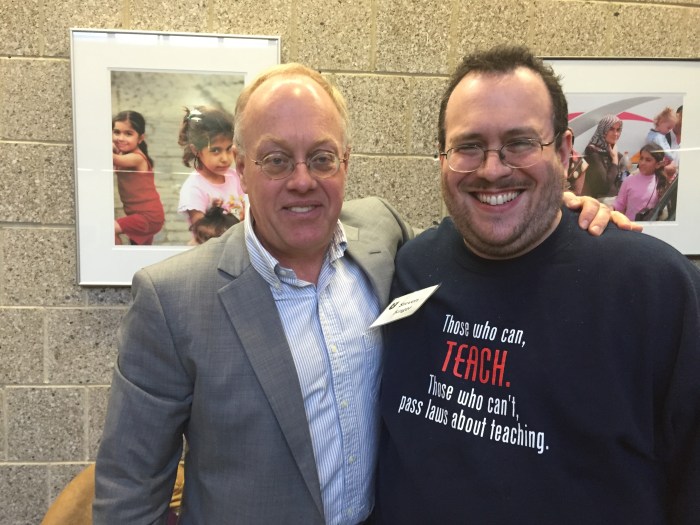
How Radical Must We Be To Get the Schools Our Children Deserve? United Opt Out Musings

GetAttachmentThumbnail-3

There was a point during Chris Hedges keynote address today when I could barely catch my breath.


My chest was heaving, tears were leaking from my eyes and I wasn’t sure I would be able to stop.


The Pulitzer Prize winning journalist had his audience enraptured at the United Opt Out Conference in Philadelphia Saturday morning.


I’ve read Chris before. We’ve all read Chris before. But I had never seen or heard him speak.


It was kind of like hearing a good sermon by a pastor who felt every word he said. And that really was it – Chris FELT every word.


When I’ve read Hedges’ articles on Truthdig, I’ve found myself getting angry. He stirs me up. He disturbs me, makes me feel uncomfortable. And when I heard him speak today I was surprised that he seemed to be reacting the same way to his own words.


When he talked about teaching teenage prisoners, he was emotionally invested in the story he was telling. When he criticized American neoliberal policies, he was just as angry as his audience.


The only difference was that his sorrow and rage somehow became transformed in his throat into something akin to poetry.


He turned the struggle of the oppressed into something beautiful. He transformed the hurt in my chest into something profound. He mutated my disturbance into a sense of actions-to-be.


I won’t repeat the words he said. I’d never be able to reproduce them with anything resembling his eloquence. But I will remark on one of his closing remarks because it hit me like a splash of cold water.


Rebellion, he said, is not about changing the world. It’s about changing yourself.


When you stand up for what is right, you become a better person – whether you achieve your goal or not. In a sense, it doesn’t matter if we destroy the testocracy. But in trying, we transmute ourselves into something better.


I don’t know if that’s true, but I’d like to think so.


I don’t know if we will ever destroy the system of Test and Punish, but I know I can try. I know I can put myself on the line and damn the consequences.


All weekend at the United Opt Out Conference we’ve been talking about rebellion and revolution. There’s no weak tea here in the City of Brotherly Love. No half measures. We’ve been discussing tearing the system down piece-by-piece.


A timid voice speaks up in the back of mind, “Do we really need to do all that? Do we really need revolution just to keep our public schools and make them into something worthy of our children?”


I think I’ve been trying to answer that question for a while now. Maybe a lot of us have.


In a rational country, our demands wouldn’t be so radical.


We want public schools centered on the good of all, not the profit of some. We want educationally valid curricula for our children. We want some control over the school system – both as parents and teachers.


Is that so much to ask? Is that such a lunatic request?


And as I listened to Hedges and Dr. Antonia Darder, Dave Green, Jonathan Pelto, Dr. Denisha Jones, Ceresta Smith, Yohuru Williams, Aixa Rodriguez and many, many others, I heard another timid voice begin to answer the first.


“Yes.”


The system of standardization and privatization of public education confronts students of color and impoverished students head on. They are in the front lines. Yet few people outside of activists seem willing to admit it.


Perhaps the most impressive thing about this conference has been its ability to put issues of human rights at the center of the argument. That’s the essential concept. We’re not just talking about bad education policies. We’re not just talking about schemes for billionaires to make more money. We’re talking about the systematic oppression of a group of people and the widespread complacency and complicity of the majority of the populace.


How do you combat such a monster without being revolutionary? How do you fight for your child without being a rebel?


More has happened at this conference than I can adequately put into words. I’ve met so many incredible people. Some of them I knew, some I had met before, some had only been names I had seen on my computer screen.


I will leave here Sunday feeling refreshed and energized, ready for the battles ahead.


Am I a radical?


Am I becoming a better person?


I don’t know.


But I will keep fighting.


Because I love my daughter, I love my students and I love all children everywhere.


Photo Gallery:


NOTE: This article was given a shout out on Diane Ravitch’s and Jonathan Pelto’s blogs.


United Opt Out Conference Highlights Dual Role of Technology in Education

FullSizeRender


Technology is the most powerful weapon we have against corporate education reform.


It is also our greatest foe.


Such were the remarks of Dr. Stephen Krashen at the United Opt Out Conference on Friday.


The linguist, educational researcher and activist gave the opening keynote address to hundreds of people who traveled to Philadelphia for the conference.


Krashen, who is known for his work on second language acquisition and bilingual education, has been a strong critic of the test and punish policies of the Barack Obama administration.


He warned the assembly of parents, students, teachers, professors and activists about the dangers of Competency Based Education (CBE), the next big thing in the movement to dumb down public schools.


CBE is touted as a way to reduce high stakes standardized testing by allowing students to work at their own pace while on various computer programs. However, Krashen sees this is an increase in testing.


In effect, it’s testing everyday. The computer programs used in CBE are little more than the same kinds of questions you’d see on a standardized test. An emphasis on CBE would replace a robust school curriculum with never-ending test preparation and multiple-choice assessment.


In the hands of a classroom teacher, technology can be an excellent tool to help kids learn. However, top-down policies like CBE only take away educators’ autonomy and turn them into mere facilitators of prepackaged materials of dubious quality.


He noted that the National Governors Association – an organization promoting CBE and Common Core State Standards – admits that there is no research supporting this new policy. But they’re suggesting we do it anyway. In fact, provisions to increase CBE are embedded in the new federal education law – the Every Child Succeeds Act (ESSA).


He sees this as a massive boondoggle to swipe the $600 billion we spend on technology in schools. After all, CBE will require increasingly newer computers at every school that will need to be constantly replaced as they become obsolete.


Krashen quoted Gerald Bracey: “There’s a growing technology of testing that permits us now to do in nanoseconds things we shouldn’t be doing at all.”


There is light at the end of the tunnel though.


The same technology that is being used to pervert the education system can be used to help save it.


Krashen advised activists to use the power of social media to spread the word about CBE and other Trojan Horse reforms – policies that look like they’re helping children while actually hurting them.


“The Internet is our underground,” he said, “Facebook and Twitter are our weapons.”


Though policymakers and journalists rarely listen to experts like classroom teachers, the Internet allows us to spread our message. We don’t need anyone’s permission to speak up. We are all free to do so and should do it more often.


I know many people are scared to speak up, he said, but we can all educate ourselves about what’s happening and then share it and retweet it. We need to do more of this. We need to reach a critical mass. We need to show the world the truth and that it can’t be ignored and buried under the dominant media and political narrative being sold to the public as if it were truth.


These policies, while dangerous in and of themselves, also overshadow the real needs of our school children – namely devastating, generational poverty.


When Congress passes No Child Left Unfed, No Child Without Healthcare, and No Child Left Homeless, then when can talk about No Child Left Behind and Every Child Succeeds, he said.


Dr. Martin Luther King spoke about this issue, claiming that solving poverty would in turn solve any problems with education.


Krashen’s keynote was an exciting beginning to a conference that promises to be eye-opening, exciting and energizing to the community of people fighting to take back our schools from the oligarchy.


Photo Gallery:


‘We’re Sorry Teachers are Unfairly Blamed’ says John King – Man Responsible for Unfairly Blaming Teachers

John King AP

Sometimes the messenger matters.

You wouldn’t expect Native Americans to believe an apology from Christopher Columbus.

You wouldn’t expect African Americans to believe an apology from David Duke.

So why the heck do the Democrats expect teachers to believe an apology from John King!?

The acting U.S. Secretary of Education is – himself – responsible for more attacks on public educators than almost anyone else.

In his former role as New York Chancellor of Education, he refused to fix a school system he was responsible for destroying all the while pointing his finger at teachers.

However, late last month in his new federal position, King gave a speech at a Philadelphia high school acknowledging the mistakes of the Obama administration in tying teachers’ evaluations to student test scores – a practice he was guilty of in New York.

“I think there’s just such an urgency around making sure that teachers feel valued in our society,” King said in an interview with the Washington Post in January.

“It’s one of the things I worry a lot about. I want young people to see a future for themselves as teachers.”

Seriously!?

Were you worried about teachers in New York when you tied their evaluations to unproven and inferior Common Core tests? Were you worried about students when you approved an obviously fraudulent charter school run by an obviously fraudulent con man? Were you worried about the profession when you ignored and dismissed parents at various education forums? Were you worried about public schools when you sparked the largest opt out movement in the country?

I’m sorry, but this apology rings hollow to most educators. We know you. We know that your biggest qualification for your position in charge of the nation’s public school system is a three year stint teaching in a “no excuses” charter school with a high suspension rate.

It’s kind of hard to believe you mean a thing you say. And by extension, it’s hard to believe a thing President Barack Obama says about education, either. He was the dunderhead who picked Arne Duncan to be his first Secretary of Education and then you to succeed him.

It must be an election year.

Since a few months before the Presidential Primaries, the Democrats have been apologizing for the damage they’ve done to public education.

Obama says he wants to reduce standardized tests. That’s great – with less than one year left in his second term! After increasing it beyond even the wildest dreams of his predecessor George W. Bush!

But since we’re talking apologies here, are you, Mr. King, willing to actually do anything to make things better for the nation’s teachers?

For instance, do you think the U.S. Department of Education should be exempt from regulatory capture? In other words, should a regulatory agency like the Department of Ed advance the commercial or political interests of special interests that dominate the industry it is charged with regulating?

In other words, should any employee of the department or their immediate family be permitted to collude with the corporate interests seeking special favor in the field of education? Should a prominent member of the department also be allowed to work for an industry seeking to profit off our public schools? Should his wife?

No? Then perhaps your wife Melissa Steele King shouldn’t be accepting a position at Bellwether Consultants, a leading corporate education reform organization. They represent The New Teachers Project, New School Venture Fund, KIPP, IDEA Charter Schools, Gulen Charter Schools, Rocketship Charters and many others.

So while classroom teachers will only be able to communicate with you through official correspondence, a representative of the standardization and privatization movement will be right across from you at the dinner table every night!

If you really wanted us to take you seriously, your family wouldn’t be pulling this crap.

Your latest apology is just an attempt to smooth over your own Senate education committee confirmation hearing on Thursday, Feb. 25. You want to show how much bipartisan support you have so you can become the official Education Secretary and not just acting Education Secretary.

Look, you might say. I just threw a bone to teachers. They love me!

What a steaming pile of bullshit!

Does that offend you? Oh. Then please accept my most heartfelt apology.


NOTE: Diane Ravitch also posted about this article on her blog.


Who’s Your Favorite Gadfly? Top 10 Blog Posts (By Me) That Enlightened, Entertained and Enraged in 2015

Screen shot 2015-12-30 at 12.57.49 AM

“Pennsylvania educator and public school advocate Steven Singer is one of the most powerful voices in the nation when it comes to speaking out for students, parents, teachers and our public schools.”
Jonathan Pelto, founder of the Education Bloggers Network


“Steven Singer wrote these five terrific posts last year. I didn’t see them when they appeared. Probably you didn’t either. You should.”
Diane Ravitch, education historian


“Your name should be Sweet Steven Singer. You are a delight.”
Karen Lewis, President of the Chicago Teachers Union

11206058_10152940020833860_7943827034975790194_n


Hello. My name is Steven Singer, and I am a gadfly.

I make no apologies for that. It’s what I set out to do when I started this blog in July of 2014.

I told myself that people were too complacent. There was no curiosity. People were too darn sure about things – especially education policy and social issues.

They knew, for instance, that standardized testing was good for children. Why? Because Obama said so. And he’s such a nice man. It’s too bad all those mean Republicans keep making him do all this bad stuff.

They also knew racism was over. After all… Obama! Right? Black President, therefore, the hundreds of years of struggle – finished! Move along. Nothing to see here.

Yet all this “knowledge” went against everything I saw daily as a public school teacher.

Standardized tests are good for children? Tell that to more than half of public school kids now living below the poverty line who don’t have the same resources as middle class or wealthy kids yet are expected to magically ace their assessments. Tell that to the kids who get hives, get sick, or throw up on test day. Tell it to the black and brown students who for some unexplainable reason almost always score lower than their white peers.

Racism is over? Tell that to all my minority students who are afraid to walk home from school because they might get followed, jumped, beaten or killed… by the police! Tell it to their parents who can’t get a home loan and have to move from one rental property to another. Tell it to the advertising executives and marketing gurus who shower my kids with images of successful white people and only represent them as criminals, thugs, athletes or rappers.

So when I started this blog, I consciously set out to piss people off. But with a purpose. To quote the original historical gadfly, Socrates, my role is, “to sting people and whip them into a fury, all in the service of truth.” It seems well suited to a school teacher. After all, Socrates was accused of “corruption of the youth.”

It’s been quite a year. When I went to the Network for Public Education conference in Chicago last April, some folks actually seemed to know who I was. “Don’t you write that Gadfly blog?” was a common question.

When I met NEA President Lily Eskelsen Garcia and AFT President Randi Weingarten, they both said, “I read your blog.” And then they looked me up and down suspiciously as if they were thinking, “THIS is the guy who writes all that stuff!? THIS is the guy giving me such a hard time!?”

Of course, I am human, too. One can’t sting and bite every day. Sometimes the things I write are met with love and approbation. Some weeks even Lily and Randi like me. Sometimes.

Education historian Diane Ravitch has given me tremendous moral support. I can’t tell you how gratifying it is to have one of your heroes appreciate your work! Her book “The Death and Life of the Great American School System” really woke me up as a new teacher. I’m also on the steering committee of the Badass Teachers Association, an organization that has changed my life for the better. The more than 56,000 people  there are my support. I would never have had the courage to start a blog or do half of the crazy things I do without their love and encouragement.

And there are so many more people I could thank: my fellow bloggers Jonathan Pelto, Peter Greene, Russ Walsh, Nancy Flanagan, Mitchell Robinson, and Yohuru Williams. Also the good people at the LA Progressive and Commondreams.org. The incredible and tireless radio host Rick Smith.

There are just too many to name. But no list of acknowledgment would be even close to completion without mentioning my most important supporter – you, my readers. Whether you’re one of the 9,190 people who get every new post delivered by email or if you otherwise contribute to the 486,000 hits my site has received so far, THANK YOU.

So in celebration of my first full year of blogging, I present to you an end of the year tradition – a Top 10 list. Out of the 90 posts I wrote in 2015, these are the ones that got the most attention. Often they incensed people into a fury. Sometimes they melted hearts. I just hope – whether you ended up agreeing with me or not – these posts made you think.

Feel free to share with family, friends, co-workers, etc. After all, I’m an equal opportunity gadfly. I always cherish the chance to buzz around a few new heads!


10) The Democrats May Have Just Aligned Themselves With Test and Punish – We Are Doomed

sanders_warren-620x412

Published: July 17, 2015
Views: 7,122

Description: It hit me like a slap in the face that almost all Senate Democrats voted to make the reauthorization of the federal law governing K-12 public schools a direct continuation of the same failing policies of the Bush and Obama years. Heroes like Bernie Sanders and Elizabeth Warren seemed to be turning their back on teachers, parents and school children. And they were stopped in their efforts by… Republicans!

Fun Fact: This story had some legs. It inspired a bunch of education advocates like myself who are also Bernie Sanders supporters to write the candidate an open letter asking him to explain his vote. His campaign eventually responded that it was about accountability!?


9) Punching Teachers in the Face – New Low in Presidential Politics

cc-600x400

Published: Aug. 3
Views: 14,735

Description: New Jersey Governor Chris Christie thought he’d run for the Republican nomination for President. He thought threatening to metaphorically punch teachers unions in the face would get him votes. It didn’t.

Fun Fact: This new low in Presidential politics came just after Donald Trump had announced he was running. Christie’s new low now seems almost quaint after Trump’s calls to tag all Muslims and monitor their Mosques. How innocent we were back in… August.


8) This Article May Be Illegal – Lifting the Veil of Silence on Standardized Testing

whistle
Published: April 18
Views: 15,818

Description: Teachers and students may be legally restrained from telling you what’s on federally mandated standardized tests, but we’re not restrained from telling you THAT we’re restrained. Is this just protecting intellectual property or direct legal intimidation of educators and children?

Fun Fact: I have not yet been arrested for writing this piece.


7) Stories about Teachers Union Endorsements of Hillary Clinton

Did the AFT Rank and File REALLY Endorse Hillary Clinton for President? If So, Release the Raw Data

(July 12 – 4,448 hits)


The NEA May Be About to Endorse Hillary Clinton Without Input From Majority of Members

(Sept. 21 – 3,873 hits)

A Handful of NEA Leaders Have Taken Another Step Toward Endorsing Hillary Clinton Despite Member Outcry

(Oct. 2 – 739 hits)

Teachers Told They’re Endorsing Hillary Clinton by NEA Leadership, Member Opinions Unnecessary

(Oct. 4 – 7,074 hits)

Screen shot 2015-09-21 at 12.23.19 AM

Published: July 12 – Oct. 4
Views: 16,134 TOTAL

Description: You expect your union to have your back. Unfortunately it seems our teachers unions were more interested in telling us who we’d be endorsing than asking us who the organizations representing us should endorse.

Fun Fact: I broke this story pretty much nationwide. News organizations like Politico were calling me to find out the scoop.


6) Why We Should Have ZERO Standardized Tests in Public Schools

Screen shot 2015-01-30 at 4.35.10 PM

Published: Jan. 30
Views: 16,443

Description: Someone had to say it. We don’t need any standardized tests. We need teacher-created tests. And that’s not nearly as crazy as some people think.
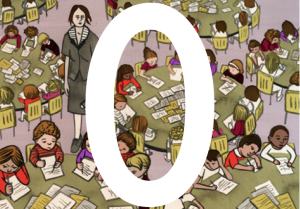
Fun Fact: This was written back when the Elementary and Secondary Education Act (ESEA) was being rewritten and naïve fools like me thought we might actually get a reduction in high stakes testing. Spoiler alert: we didn’t.


5) Atlanta Teacher RICO Conviction is Blood Sacrifice to the Testocracy

aztecshumansacrifice

Published: April 3
Views: 18,187

Description: There is something terribly wrong when we’re using laws created to stop organized crime as a means to convict  teachers cheating on standardized tests. I’m not saying cheating is right, but the mafia kills people. These were just teachers trying to keep their jobs in a system that rewards results and refuses to balance the scales, listen to research or the opinions of anyone not in the pockets of the testing and privatization industries.
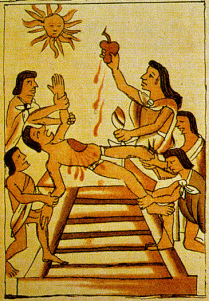
Fun Fact: Watching all those seasons of “The Wire” finally came in handy.


4) Not My Daughter – One Dad’s Journey to Protect His Little Girl From Toxic Testing

FATHERS-AND-DAUGHTERS
Published: March 20
Views: 26,420

Description: How I went to my daughter’s school and demanded she not be subjected to high stakes testing in Kindergarten.

Fun Fact: They were very nice and did everything I asked. If you haven’t already, you should try it!


3) I Am Racist and (If You’re White) You Probably Are, Too

Screen shot 2015-06-02 at 1.42.34 PM

Published: June 2
Views: 28,906

Description: White folks often can’t see white privilege. This is my attempt to slap some sense into all of us. If you benefit from the system, you’re responsible to change it.

Fun Fact: Oh! The hate mail! I still get it almost every day! But I regret nothing! A black friend told me I was brave to write this. I disagreed. Anytime I want I can hide behind my complexion. She can’t.


2) I Am A Public School Teacher. Give Me All the Refugees You’ve Got

syrian_refugee_schools

Published: Nov. 19
Views: 45,196

Description: Our public schools are already places of refuge for our nation’s school children. Send me more. I’ll take them all. I’d rather they end up in my classroom than drowned by the side of a river.

Fun Fact: I got equal love and hate for this one. Some folks were afraid of terrorists. Others didn’t think we could afford it. But many told me my heart was in the right place. Lily and the folks at the NEA were especially supportive.


1) White People Need to Stop Snickering at Black Names

baby-and-parents

Published: Sept. 6
Views: 96,351

Description: Maybe we should stop laughing at black people’s names. Maybe we should try to understand why they are sometimes different.

Fun Fact: You’d have thought I threatened some people’s lives with this one! How dare I suggest people should stop mocking other people’s names! If you want to know how strong white fragility is in our country, read some of the comments! But many people thanked me for bringing up something that had bothered them for years but that they had been too polite to talk about, themselves. This is easily my most popular piece yet.


Much Ado About an Enigma – No One Really Knows What Impact the ESSA Will Have on Public Schools

ESSA-Obama

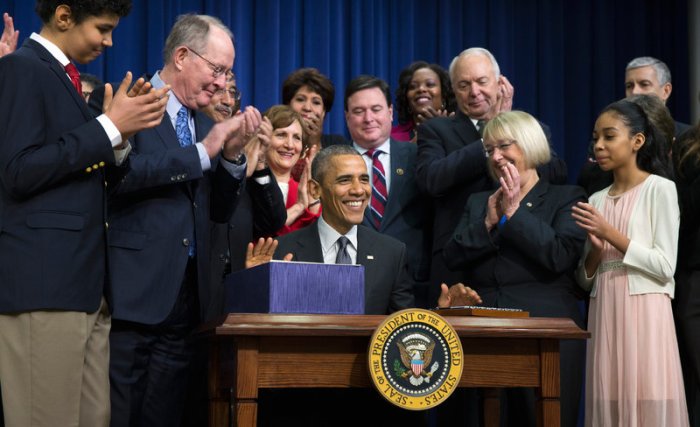
President Barack Obama signed the Every Student Succeeds Act (ESSA) this week.

The new legislation reauthorizes federal law governing K-12 public education.

In 1965 we called it the Elementary and Secondary Education Act (ESEA). Until today we called it No Child Left Behind (NCLB). And now after a much-hyped signing ceremony, the most definitive thing we can say about it is this: federal education policy has a new name.

Seriously. That’s about it.

Does it reduce the federal role in public schools? Maybe.

Does it destroy Common Core State Standards? Possibly.

Is it an improvement on previous policies? Potentially.

Will it enable an expansion of wretched charter schools and unqualified Teach for America recruits? Likely.

The problem is this – it’s an over 1,000 page document that’s been open to public review for only two weeks. Though it was publicly debated and passed in the House and Senate, it was finalized behind closed doors and altered according to secure hurried Congressional votes. As such, the final version is full of legal jargon, hidden compromise, new definitions and verbiage that is open to multiple meanings.

How one reader interprets the law may be exactly the opposite of how another construes it.

Take the much-touted contention that the ESSA reduces the federal role in public schools. Even under the most positive reading, there are limits to this freedom.

The document continues to mandate testing children each year in grades 3-8 and once in high school. It also mandates academic standards and accountability systems. However, what these look like is apparently open to the states.

For instance:

The Secretary [of Education] shall not have the authority to mandate, direct, control, coerce, or exercise any direction or supervision over any of the challenging State academic standards adopted or implemented by a State.

That seems pretty clear. The federal government will not be able to tell states what academic standards to adopt or how student test scores should be used in teacher evaluations.

But it also says that states will have to submit accountability plans to the Department of Education for approval. It says these accountability plans will have to weigh test scores more than any other factor. It says states will have to use “evidence-based interventions” in the schools where students get the lowest test scores.

That sounds an awful lot like the test-and-punish system we have now.

What if your state decides to take a different road and reject the high stakes bludgeon approach to accountability? In that case, some readers argue schools could lose Title I funds – money set aside to help educational institutions serving impoverished populations.

Will that actually happen? No one knows.

It may depend on who will be President in 2017 and whom that person picks as Secretary of Education. And even if the Feds try to take advantage of these potential loopholes, the matter could end up being decided by the U.S. Supreme Court.

What about Common Core?

Some readers interpret the new law as destroying forever the possibility of national academic standards. If states are allowed to pick their own standards, it is highly unlikely they’ll all pick the ones found in the deeply unpopular Common Core. However, the law does force each state to have academic standards of some kind, and it defines what those standards must look like. One interpretation of this is that they must look a lot like the Common Core.

They must be “state-developed college- and career-ready standards.” You read that right – “College and career ready.” That’s the Common Core catchphrase. If someone says they want to eat lunch at “the golden arches,” they haven’t said McDonalds, but you know they’re craving a Big Mac.

Will the Fed allow states to choose standards radically different than the Core? Again only time and – possibly – the courts can tell.

This same problem occurs throughout the document. As the public painstakingly combs through it, new legal wiggle room may be found. And I am not so naive as to suppose we’ve found all of the loopholes yet. Some of these may be the result of poorly chosen wording. Others may be purposefully hidden time bombs waiting for opportunists to exploit.

This uncertainty about exactly what the ESSA will eventually mean for our public schools may help explain the range of reactions to the formative law – from ecstasy to despair to shrugs and snores.

I’m not sure what to think of the thing, myself. I started the whole process disgusted but came around to accepting it if the final result was any kind of improvement over previous legislation. And now that it’s the law of the land, I look at this Frankenstein’s monster of a bill – stitched together pieces of mystery meat – and I don’t know whether to laugh or cry.

I still hope it will live up to the limited promise it holds to bring us some relief from NCLB. But I admit this thing could go sour. Anyone’s guess is as good as mine.

Which brings me to perhaps the biggest problem with this law that no one seems to be talking about.

Education needs reformed. We need to repeal the bogus policies that have been championed by the 1% and their lapdog lawmakers. We need to get rid of test-based accountability. We need to trash high stakes testing, Common Core, value added measures, charter schools and a host of other pernicious policies. We need to initiate a real anti-poverty program dedicated to attacking the actual problem with our schools – inequality of resources.

But more than any of that, we need to reform our government.

We need to find a better way to make our laws. The process that shat out this ESSA must go.

Think about it. No Child Left Behind was an abject failure by any metric you want to use. It didn’t close achievement gaps – it increased them. And the major policy of this law – annual standardized testing – remains intact in the reauthorization!

There has been massive public outcry against annual testing. Parents are leading an exponentially growing civil disobedience movement shielding their children from even taking these assessments. Everyone seems to agree that we test kids too much – even President “I’ll-veto-any-bill-that-deletes-testing” Obama.

Yet our legislators did next to nothing to fix this problem.
Instead preference was given to lobbyists and corporatists interested in making a buck off funding set aside to educate children. The focus was on smaller government – not better government. These aren’t mutually exclusive, but they aren’t exactly one-and-the-same, either.

This can’t continue if we are to keep pretending we have a representative Democracy. The voice of lobbyists must not be louder than voters. Money must be barred from the legislative process. Demagoguery must not overshadow the public good. We need transparency and accountability for those making our laws.

Until that happens, we will never have a sound and just education policy, because we don’t have a sound and just government.

Unfortunately, that is the biggest lesson of the ESSA.


NOTE: This article also was published in the LA Progressive, Badass Teachers Association Blog and quoted extensively on Diane Ravitch’s blog.


We Are All on the Lunatic Fringe – The Centerless Battle Against Corporate Education Reform

cliff_hanging

It was one of the strangest meetings I’ve ever had with a state legislator.

Why?

First of all, we were all teachers.

Even the legislator. Even his Aide!

Pennsylvania State Rep. Dan Miller (D-Mt. Lebanon) had been a history teacher before he sought a law degree and higher office.

His aide had been a Pittsburgh Public School teacher before she was furloughed and found a place in the representative’s office.

And, of course, there were the seven of us – all teachers at my school district.

We crowded together in his tiny district office to talk about how standardized testing is destroying public schools.

Which brings me to the second strangest thing – Rep. Miller didn’t just agree with us, he did so knowledgeably.

I’ve sat across a table from an awful lot of lawmakers, and they almost always try to find common ground. Disingenuously.

Sure! I agree teachers are important! That’s why we need to fire more of them!

You bet neighborhood schools are vital! That’s why I want to close all the public schools and replace them with charters!

Uh-huh! School funding is critical but not more so than classroom teachers. That’s why we’re cutting your budgets! We want to see what you can do!

None of that at Rep. Miller’s office.

When we brought up how important it is to allow parents throughout the Commonwealth to opt their children out of standardized tests without penalizing their school districts, he praised parent rights.

When we described how the definition of school accountability has changed from holding lawmakers accountable to holding teachers accountable, he talked about the sad scapegoating of the profession.

And when we told him about how standardized testing is failing our students, he told us how it would have failed him if he were a student today.

“I wasn’t a very good student,” Miller admitted. He loved history and aced that class consistently, but he barely squeaked by in most other subjects.

The first book he read all the way through was “North and South” by Elizabeth Gaskell – in 11th grade! Why? Because it interested him. “Jane Eyre”? Not so much.

And he admitted that in today’s environment where nothing is counted a success unless it generates a high test score, he would have been lost and probably would have dropped out.

Which brings me to the third strangest thing – Miller isn’t playing partisan politics. As a Democrat, he isn’t blaming everything on the Republicans.

“This is a bipartisan issue,” he said. There’s no reason why both parties can’t agree on what needs to be done to help our schools.

So why doesn’t the legislature do more?

Ignorance. “There’s a low level of analysis of bills down there (in Harrisburg).” Local government usually does a better job.

The representative’s teaching background gives him an edge, he says, but most legislators simply don’t have that knowledge base to draw on.

There’s a lot of good will in the capital, he says. “Most legislators aren’t trying to cause a problem.” They want to try to achieve something, but if those experiments fail, the consequences are dramatic, long lasting and hard to correct.

He even talks well of our Republican ex-Governor Tom Corbett, whose education policies – in my opinion – have crippled the state’s schools.

“He was always polite to me, “ Miller says. “He just didn’t talk.” He wasn’t approachable.

By contrast, Gov. Tom Wolf comes to you. Miller recalls walking in to his own Harrisburg office and Wolf was sitting there waiting for him because he had something he wanted to talk about. Wolf is well liked, even among Republicans. They might not agree with the new Democratic governor, but they have to admit he has the best interests of the state at heart.

Perhaps its Miller’s infinite good will that’s propelled the Democrat with only two years in state office to the House Education Committee.

Republicans have dominated state education policy for years. They still do. But in Miller we have someone who actually has a say in one of the most critical areas in the state. And he knows what he’s talking about, takes time to meet with real live educators and sympathizes with our cause.

Which brings me to perhaps the strangest aspect of the whole meeting – Miller’s analysis why more isn’t being done to combat the testing industry.

“The groundswell isn’t there,” he said. “You’re still the fringe.”

He praised teachers unions like the Pennsylvania State Education Association (PSEA) for being excellent advocates. He said lawmakers get all their emails, but the emphasis seems to be maintaining pension benefits. He understood why this is so, but the issues we were talking about didn’t seem to register on most legislators radar.

It’s bizarre.

If true, there are a heck of a lot of folks on the fringe.

Rep. Miller, himself, for one.

The majority of public school teachers, too.

And the more than three thousand Pennsylvania students whose parents opted them out of standardized testing last year – they’re on the lunatic fringe.

Heck! If we’re all dangling on the outer edge, who’s in the middle? Where’s the mainstream?

Perhaps its just a matter of perception. Maybe the other side just has better public relations.

If so, it’s up to us to spread the word until all of us counterculture anti-standardization and anti-privatization folks are seen for where we really are – at the axis of real school reform.


Thank you to Meagan O’Toole for setting up the meeting. Thank you, Ben Lander, Yvette Robinson Logan, Mary Cay Rojtas-Milliner, Susan Olsen, and Roslyn Stulga for speaking out for your students and profession. And most of all thank you, Rep. Miller, for meeting with classroom teachers to talk about what’s going on in our state’s public schools and actually listening to our stories and advice.

Parent Power Can Crush the Testocracy – and the Government is Scared Witless

opt-out7

“We need to change accountability for schools to be more holistic. My greatest frustration is that I can’t do it fast enough.”
Pedro Rivera, Pennsylvania’s Education Secretary

Parents, you can.

It doesn’t matter where you live. It doesn’t matter what laws are on the books. It doesn’t matter if your state is controlled by Democrats, Republicans or some combination thereof.

No government – not federal, state or local – can trample your parental rights. If you don’t want your child to be evaluated based on standardized tests, your child doesn’t have to be. And if a majority of parents nationwide make this decision, the era of standardized testing comes to an end. Period.

It has already begun.

Across the nation last school year, parents decided to opt their children out of standardized testing in historic numbers. The government noticed and functionaries from New York to California and all places in between are scrambling to deal with it.

In the Empire State one in five students didn’t take federally mandated standardized tests. State education commissioner Mary Ellen Elia responded yesterday by threatening sanctions against schools this year with high opt out numbers. In short, if in the coming year too many kids don’t take the test in a given school, the state will withhold funding.

It’s a desperate move. If the public doesn’t like what its duly elected officials and their functionaries are doing, those same officials and functionaries are vowing to punish the public. But wait. Don’t those people work for the public? Isn’t it their job to do our will? It’s not our job to do theirs.

The message was received a bit better in U.S. Congress where the Elementary and Secondary Education Act (ESEA) is being reauthorized. Two drafts of the law that governs K-12 public schools were approved – one in the House and one in the Senate. And both specifically allow parents to opt their children out of standardized testing. But can schools be punished for it?

The House version says no. The Senate version says it’s up to each state legislature.

These bills are being combined before being presented to President Obama for his signature. If he doesn’t veto the result, one might assume that at worst the issue will become each state’s prerogative.

But you’d be wrong. The state has as much business deciding this matter as does the fed – which is none. This is a parental rights issue. No one has the right to blackmail parents to fall in line with any government education policy. It’s the other way around.

In my own state of Pennsylvania, opt out numbers this year were not as dramatic as in New York, but they still sent a message to state government.

The number of students opted out of state tests tripled in 2015, according to data from the Pennsylvania Department of Education. PSSA math opt-outs rose to 3,270 students from 1,064 in 2014. PSSA English language arts opt-outs rose to 3,245 from 1,068. Those are the largest jumps in the nine years of available data.

And it’s not only parents who are concerned. Teachers continue to speak out against high stakes standardized tests.

Thousands of teachers have told State Education Secretary Pedro Rivera that school accountability needs to be less about test scores and more about reading levels, attendance, school climate, and other measures, he said. They have concerns about graduation requirements and the state’s current system of evaluating schools.

It’s not like these criticism are new. Education experts have been voicing them since at least 1906 when the New York State Department of Education advised the legislature as follows:

“It is a very great and more serious evil to sacrifice systematic instruction and a comprehensive view of the subject for the scrappy and unrelated knowledge gained by students who are persistently drilled in the mere answering of questions issued by the Education Department or other governing bodies.”
-Sharon L. Nichols and David Berliner, Collateral Damage: How High Stakes Testing Corrupts America’s Schools, 2007

Corporate education reformers complain that testing is necessary to hold schools accountable. However, the results are not trustworthy, according to the Pennsylvania Department of Education, itself! In 2011 and now again in 2015, officials are cautioning against using test scores to compare student achievement from year-to-year.

“The 2015 assessment should not and cannot be compared to the 2014 and 2013 assessment,” Rivera said. “It’s apples and oranges. Schools are still working on aligning curriculum to standards. They’re still catching up to teaching what we’re assessing.”

Each year students and teachers are told to hit a moving target, which was the reason also cited for caution four years ago.

While Rivera laments the issue and his inability to change anything soon within the government bureaucracy, parents are not thus encumbered.

All you have to do to save your child from being part of this outdated and destructive system is opt out.

But don’t stop there. Talk to other parents. Talk to classroom teachers. Organize informational get-togethers. Go to the PTA and school board meetings. Get others to join you.

And if the government threatens to withhold funding, lawyers are waiting in the wings to start the class action suits. Withholding taxpayer money expressly put aside to educate children because those same taxpayers disagree with government education policy!? Just try us!

Governments are tools but we hold the handles. If enough of us act this year, there will be no testing next year. Functionaries can threaten and foam at the mouth, but we are their collective boss. If they won’t do what we want them to do, we have the power to boot them out.

A multi-billion dollar industry has sprung up around high stakes standardized testing. Lobbying dollars flow from their profit margins into the pockets of our politicians. But we are more powerful.

Because you can’t serve your corporate masters if you are voted out of office.

Here Comes Everyone – a Day of Inspiration and Advocacy at the Network for Public Education Conference

IMG_3537

Let me ask you a hypothetical question:

If you could have dinner with any five people in the world, who would they be?

You don’t have to ask me that question. I not only had dinner with them, I spent the whole freaking day with them at the Network for Public Education Conference!

And there were more like 500 of those folks!

Imagine everyone you’ve ever read about in the resistance to corporate education reform.

Imagine them all in one place, standing in line all around you waiting to select a Danish.

Yeah. That was breakfast.

I invited the amazing Pennsylvania blogger Russ Walsh to my table to chat over bagels and coffee.

I told him that I’d been so inspired by his criticism of the Dibels test that I refused to allow my own daughter to take it. He laughed and said it was a mighty responsibility.

We hung out. No big deal.

IMG_3528

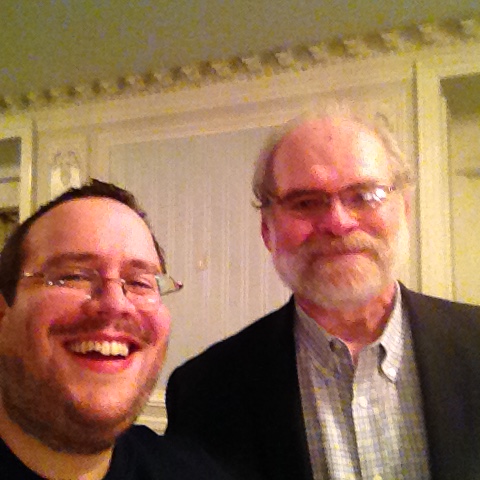
And then I saw Peter Greene of the Curmudgucation blog. We sat together during a break out session and talked shop. He told me how it was frustrating sometimes to feed the beast – to keep writing articles after one of yours had made an impression. I laughed because I knew exactly what he was talking about.

We’re best friends now.

IMG_3532

I was walking down a hallway and there was Diane Ravich right behind me.

Yes! Right. Behind. Me.

I tried to collect myself before walking up to her.

Don’t blow this, Singer! I warned myself, but I kinda’ did anyway.

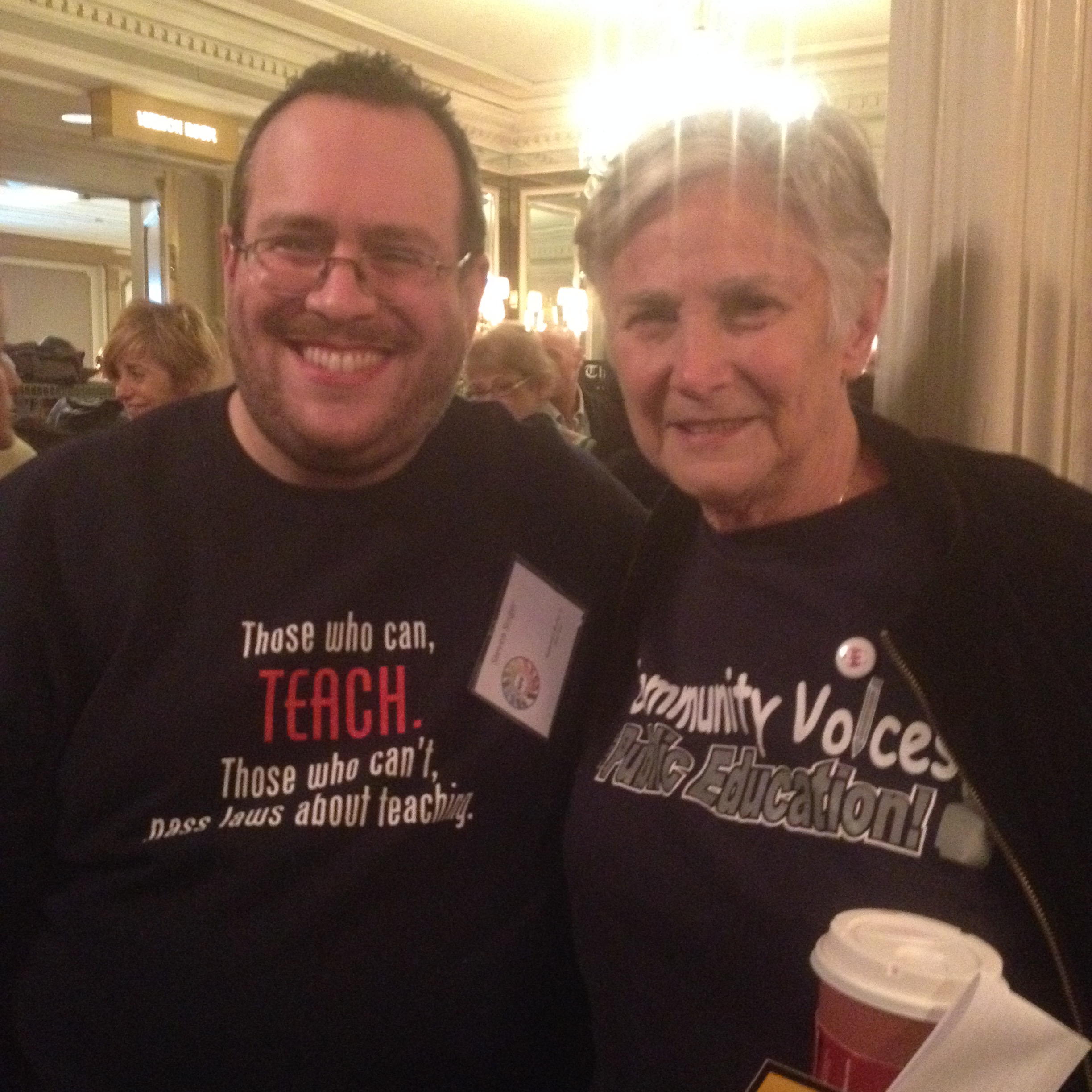
I introduced myself and shook her hand. She knew exactly who I was and said, “I love your blog.”

SIGH.

She loves my blog.

But then I opened my mouth to respond, and all that came out were unrelated syllables. Something like, “blllurgghh.”

But there were more people waiting to talk to her. She probably didn’t notice. Right?

IMG_3553

And really I could go on like this for days.

However, it wasn’t just the opportunity to meet and talk with education heroes. The breakout sessions were amazing:

The Opening Symposium

Brother Jitu Brown of NPE and Tanasia Brown from the Newark Student Union were inspiration personified. Though she’s only a student, Tanasia lead the assembly like a seasoned preacher on Sunday. And Jitu’s words just made you want to rush out of those doors and renew the fight.

IMG_3560

Debunking Myths:

It may not be the zombie apocalypse yet, but some decaying half-dead arguments continue to shamble across the scene. They’ve been disproven repeatedly but some people refused to accept it. Media Matters Hilary Tone and People for the American Way’s Diallo Brooks gave some excellent tips for putting these zombie arguments to rest:

Six Tips For Debunking Myths

1) Familiarize facts – minimize falsity. Start with the truth, not what’s wrong.

2) People believe what they hear. Warn them about it. “You’ll probably hear the Koch Bros. say…”

3) Don’t just debunk – retell. After dispelling a lie, make sure to give a new narrative to replace it.

4) Use graphics. People love visuals.

5) Make things easy to understand. Don’t use jargon. Expect no prior knowledge.

6) Messengers matter. Credible and unexpected sources can be very convincing. When someone you’d expect to disagree with you actually agrees, it makes people think, “Even THIS guy gets it.”

Other tidbits include:

-Call out false progressives. If they don’t understand the real problems, they can’t come up with real solutions.

-The media only talks about education policy with actual education experts 9% of the time.


America’s Suicidal Quest for Educational Excellence:

IMG_3550

Author Yong Zhao brought down the house with an amazing and hilarious presentation. He argued that America’s corporate educational reform movement is destroying the very things about our education system that makes it great.

The goal of increased standardized test scores is ill conceived. Countries with high test scores produce graduates who are less creative and interested in education. Why is this something we want to emulate?

Other tidbits:

-Standardization isn’t a reform. China’s been doing it since 600 AD.

-Our schools aren’t getting worse on standardized tests. They’ve always been bad at them. But that’s not necessarily a bad thing.

-We’re working to weed out and select kids. If children do what some few people want, they’re gifted. If not, they’re special ed. But does that mean our requirements are any good?

-Societies aren’t murdered. They commit suicide. Focusing on standardization instead of creativity and difference, is suicide. We’re destroying our most cherished virtues.

-One of the amazing things about US education is we accept everyone for 12 years. This doesn’t happen everywhere in the world.

-If you spend 10,000 hours working at something you’re already good at, you’ll become great. If you force kids to spend that amount of time on something they don’t like, they’ll only become mediocre.

-WARNING: Common Core may increase standardized test scores but it will make your child hate reading for life.

-We do not instill creativity in our students better than Asian systems. We just kill it less successfully.

-Standardization is preparing kids for jobs being replaced by machines and outsourced. We should not compete with China. We should create new opportunities.

-Do not fit your kids in to the future. Let them create it.

IMG_3558

And so much more!

This has easily been one of the best days of my life. Top 10 for sure.

And there’s still a half day to look forward to tomorrow.

So many burning questions:

-Which education luminary will I eat breakfast with in the morning?

-Will my BFFs Walsh and Greene sign my program book?

-Will I get a chance to express a meaningful sentence to Diane?

Find out in our next exciting episode!

IMG_3562


NOTE: This article also was published on the Badass Teachers Association blog and mentioned on Diane Ravich’s site.

This Article May Be Illegal – Lifting the Veil of Silence on Standardized Testing

whistle

Warning!

What you are about to read may be a criminal act.

I may have broken the law by putting this information out there.

Edward Snowden leaked data about civilian surveillance. Chelsea Manning released top secret military documents.

And me? I’m leaking legal threats and intimidation students and teachers are subject to during standardized testing.

Not exactly a federal crime is it?

No. I’m asking. Is it?

Because teachers are being fired and jailed. Students are being threatened with litigation.

All because they talked about standardized tests.

The US government mandates public school children be subjected to standardized assessments in reading and math in grades 3-8 and once in high school. Most schools test much more than that – even as early as kindergarten.

And since all of these assessments are purchased from private corporations, the testing material is ideological property. The students taking these exams – regardless of age – are no longer treated as children. They are clients entering into a contract.

At the start of these tests, students are warned of the legal consequences of violating the terms of this agreement.

In particular, the Pennsylvania System of School Assessment (PSSA) tests require students to read the following warning on the first day of the assessment:

DO NOT PHOTOGRAPH, COPY OR REPRODUCE MATERIALS FROM THIS ASSESSMENT IN ANY MANNER. All material contained in this assessment is secure and copyrighted material owned by the Pennsylvania Department of Education. Copying of material in any manner, including the taking of a photograph, is a violation of the federal Copyright Act. Penalties for violations of the Copyright Act may include the cost of replacing the compromised test item(s) or a fine of no less than $750 up to $30,000 for a single violation. 17 U.S.C. $ 101 et seq

So the first act of testing is a threat of legal consequences and possible fines.

There are no such warnings on my own teacher-created tests. Sure I don’t want students to cheat, but I don’t threaten to take them to court if they do.
The school has a plagiarism policy in place – as almost every public school does – which was created and approved by the local school board and administration. The first infraction merits a warning. The second one results in a zero on the assignment, and so on.

Moreover, this is something we go over once at the beginning of the year. We do not reiterate it with every test. It would be counterproductive to remind students of the dire consequences of misbehavior right before you’re asking them to perform at their peak ability.


Okay, Brady! Go out there and win us a football game! By the way, if you deflate that football, you will spend the rest of your life in jail. Go get ‘em!

But that’s not all.

In Pennsylvania, we also force kids to abide by a specific code of conduct for test takers. They must enter a quasi-legal relationship before they are even permitted to begin the tests we’re forcing them to take.

Much of this code is common sense. Get a good night’s sleep. Fill in bubbles completely using a number two pencil.

But some of it is deeply disturbing.

For example, students are told to “report any suspected cheating to your teacher or principal.”

They have to agree to be an informer or snitch to a government agency. My students aren’t old enough to vote or even drive a car, but they are directed to collaborate with the government against their classmates.

In addition, they are told NOT to:

-talk with others about questions on the test during or after the test.

-take notes about the test to share with others.

Sure kids shouldn’t talk about the test with classmates DURING the testing session. Obviously! But why can’t they discuss it after the test is over!?

Kids aren’t allowed to say to their friends, “Hey! Did you get the essay question about ‘The Tell-Tale Heart’?”

They aren’t allowed to discuss how difficult it was or compare how each of them answered the questions?

These are children. If you think they aren’t talking, then you just don’t know kids. You don’t know people!

And why shouldn’t they talk about it? They just shared a stressful, common experience. Who wouldn’t want to compare it to what others went through so as to decide how your experience rates? Did you answer the questions well or not? Did you get a more difficult question than others? Did the thing that struck you as odd also hit others the same way?

Personally, I do not consider talking like this to be cheating. It’s just human nature.

But we force kids into a legalistic vow they won’t do it. On the test, we make them fill in a bubble next to the following statement:

By marking this bubble I verify that I understand the “Code of Conduct for Test Takers” that my Test Administrator went over with me.

As a test administrator, I am not allowed to move on until all students have filled in that bubble. I wonder what would happen if one of them refused.

Technically, we aren’t making them promise TO ABIDE by the code of test takers. Perhaps we lack that legal authority. We are, however, making them swear they understand it. Thus we remove ignorance as an excuse for not following it.

But there is a veiled threat here. We imply that not following this code will have harsh legal consequences.

And I’m not sure it should.

Kids certainly ignore it. They almost definitely discuss the exam with their peers after the testing session. But we’ve given them a sense of guilt, fear and anxiety just for being normal human beings.

That’s wrong.

Teachers are forced to do it, too.

Just as there is a code for test takers, there is a code for test proctors.

I have to sign that I understand the “Ethical Standards of Test Administration.” Again, much of this is common sense, but it includes such statements as:

DO NOT:

-Discuss, disseminate or otherwise reveal contents of the test to anyone.

-Assist in, direct, aid, counsel, encourage, or fail to report any of the actions prohibited in this section.

So even teachers technically are not allowed to discuss the test and should report students or colleagues seen doing so.

If I walk into the faculty room, and one of my co-workers describes a question on the test and asks my opinion, I’m supposed to report this person to the authorities.

What kind of Orwellian nightmare are we living in?

If we see a question that is badly worded, misleading, has no correct answer, contains misspelled words – anything out of the ordinary – we’re supposed to remain silent. In fact, we’re not supposed to read anything on the test other than the instructions.

I can’t talk about it to my colleagues, my principal, my spouse, my priest – ANYONE.

What are the consequences of breaking this code?

Ask those teachers in Atlanta who were convicted of cheating. Obviously they did more than just talk about the test and they deserve to be punished. But there is a specific threat to teachers if they violate this code.

According to the “Pennsylvania System of School Assessment Directions for Administration Manuel”:

Those individuals who divulge test questions, falsify student scores, or compromise the integrity of the state assessment system in any manner will be subject to professional disciplinary action under the Professional Educator Discipline Act, 24 P.S. $ 2070. 1a et seq, including a private reprimand, a public reprimand, a suspension of their teaching certificate(s), a revocation of their teaching certificate(s), and/or a suspension or prohibition from being employed by a charter school. [emphasis added]

So teachers may lose our certifications, livelihoods, etc. Heck! We could be charged with racketeering like the Gambino Family and face up to 20 years in jail!

And all just for talking!

I thought speech was protected by law. Doesn’t the First Amendment protect me from prosecution for speaking except under extreme and unusual circumstances?

If my colleagues and I were to discuss the appropriateness of certain test questions, would that really be such a bad thing? If we compared the questions being asked with how we prepared our students for the test, wouldn’t that – in fact – be the responsible thing to do?

I never give my students one of my own teacher-created tests without knowing exactly what’s on it. I’ve read the test from top to bottom. Heck! I made it!

One shouldn’t feel like a whistle-blower for talking about a standardized test. Discussing the appropriateness of specific test questions does not make me Julian Assange.

Therefore, I must ask an important question of you, dear reader: Did I violate these rules by writing this very article? Is the piece you are reading right now illegal?

I contend that it isn’t. The code of conduct for both test takers and test administrators is freely available on-line from the Pennsylvania Department of Education. The legal threat at the beginning of the test is reproduced almost word-for-word in a sample letter the state Department of Education suggests schools send to parents before testing begins.

I haven’t included anything here that is not freely available on the Internet or elsewhere.

But the need I feel to stop and answer this question is kind of scary.

There is a veil of secrecy over these tests and the way they are administered. And it’s no accident. The testing companies don’t want all of this to become public knowledge. They don’t want the quality or inferiority of the actual exams to be known.

And our state and federal governments are protecting them. From whom? Our teachers, parents, and students.

Shouldn’t our legislators be looking out for our rights and not just those of private contractors who were hired to provide a service? Obviously we have to allow test manufacturers the freedom to do their jobs – but some of this seems to go beyond that requirement.

We’re being silenced and intimidated to protect an industry that is of dubious quality and obscene profitability.

Every day more people are asking questions about the validity of standardized testing. Everything from the frequency of the tests to the value of cut scores has been the subject of criticism. Thousands of parents are refusing to let their children take these assessments at all.

Isn’t it time to throw back the Iron Curtain of standardization and look at these tests in the cleansing light of day? Isn’t it time to evaluate this process as well as the product? Do we really want to support a system that encourages silence and snitching from our children and educators?

Isn’t it time to move beyond standardization and toward a system of teacher-created curriculum and testing instead of relying on capitalist profiteers.

Big Corporation is watching.

Let’s poke him in the eye.


NOTE: This article also has appeared on Diane Ravich’s blog, Commondreams.org and the Badass Teachers Association blog.