Without Black Culture There Would Be No American Culture

Screen shot 2016-06-28 at 12.10.37 AM

“We’ve been floating this country on credit for centuries, and we’re done watching and waiting while this invention called whiteness uses and abuses us, burying black people out of sight and out of mind while extracting our culture, our dollars, our entertainment like oil – black gold, ghettoizing and demeaning our creations then stealing them, gentrifying our genius and then trying us on like costumes before discarding our bodies like rinds of strange fruit.”

With these words, Jesse Williams absolutely floored the crowd at the BET Awards Sunday night.

His acceptance speech for the Humanitarian Award was jaw dropping.

Here was a black actor on “Grey’s Anatomy” just telling it like it is on national TV.

He wasn’t afraid a business dominated by white people would take offense (and some white people did). Or if he was, he wasn’t going to let it stop him.

The activist who recently produced a documentary “Stay Woke: the Black Lives Matter Movement” said, “The burden of the brutalized is not to comfort the bystander… If you have a critique for the resistance… then you better have an established record of critique of our oppression.”

No more tone policing. No white fragility. Just if you’re with us, stand up – otherwise, sit down and shut up.

It was beautiful. And it got me thinking.

There are so many obvious truths about our country’s relationship with race that hardly anyone ever gives voice to – especially a white person like me.

So I’m going to add my voice to Jesse’s. I’m just going to say it.

It’s past time we admit it, white people.

American culture would not exist without black culture.

I don’t mean to say that white people are incapable of culture or that if black people had never been kidnapped and brought to our shores as slaves that white people wouldn’t have been able to devise a unique national character.

But if that had happened, it would have been a very different character than what we have today.

It might be America, but it would not be our America. It would be some other thing. I will leave it to speculative fiction to attempt to determine what that might have been like.

However, we need not resort to fantasy to see all the incredible things black people have given us. They’re everywhere, in everything – though usually staring back at us through a white face, heard from a white voice and monetized by a white industry.

The hundreds of years of struggle from slavery through Jim Crow through the modern prison state have given black people plenty of fertile ground with which to build our national culture. Traditionally white people have served as both oppressors and appreciators of the fruits of that oppression.

The most obvious example is music.

There is very little American music not based on black traditions. Even if it is performed by white musicians, even if it is written by white musicians – almost all American music owes an overwhelming debt to black people.

Take rock n’ roll, a style usually associated with white people. The majority of rock musicians are white. The majority of rock stars are white. The majority of rock listeners are white.

But it couldn’t exist without black music – specifically blues and jazz.

Rock n’ roll was invented during the second great migration, when black people from the southern United States came into contact with large groups of whites in big cities such as New York, Chicago, Cleveland, Buffalo, etc. It was the first time many white people heard black music like blues, work songs, etc. It was also the first time many black people heard European instrumentation. The resulting cultural collision was extremely fruitful.

Rhythm and blues (sometimes called “race music”) evolved into distinct new styles – country, jazz, gospel, folk and rock. In many ways the different styles had less to do with actual differences in the music than in rebranding black music for a white audience. When a black musician became known for a particular kind of music, the fledgling music industry tried to monetize it by finding a white musician who could do something similar and thus reach a larger audience.

They figured if X number of white people will listen to this music played by a black musician, X plus thousands more will listen to it if played by a white one. And they were right.

Black musician Chuck Berry was one of the first to play what we’d recognize as rock n’ roll. He took standard jump blues and played the two-note lead line on his guitar that until then was typically performed on piano. He put guitar at the center of the sound, amplified it, electrified it and rock was born.

The genre developed organically with many black musicians taking the lead – Fats Domino, Sister Rosetta Tharp, Goree Carter, Jimmy Preston, Bo Diddley, Little Richard, Joe Hill Louis, Guitar Slim, Howlin’ Wolf and many others.

However, the first certified rock hit “Rock Around the Clock,” was recorded in 1954 by an all white band, Bill Haley and His Comets. With this recording, the die was cast. The music was invented and developed mostly by black musicians, but it wasn’t a major success until it was recorded by white musicians.

The same thing can be seen with Elvis Presley, the so-called “King of Rock n’ Roll.” He wasn’t breaking any new ground. He was just the first white person who could sing like the black blues musicians who came before him. They toiled in obscurity. He cashed in.

This isn’t to say that no black musicians succeeded playing rock n’ roll. But it was predominantly white musicians who popularized the style that their black forebears had created.

To understand this, perhaps it is best to turn to the insight of Amiri Baraka (formerly known as LeRoi Jones). In his classic book “Blues People,” he dissects the complex American relationship of race and music through the 1960s.

Baraka writes that white and black America have different value structures. As such it is a very different thing for a black American and a white American to play the same music.

When a black musician like Louis Armstrong played jazz music – another invention of black culture – he was fulfilling the ideals of his culture. By contrast, when a white musician like Bix Beiderbecke played jazz music, he was rebelling against his.

There is something jarring and revolutionary when white musicians play black music, Baraka writes. In doing so, the music becomes devoid of race. It is no longer black music. It is just music.

However, the musicians who created it are not likewise freed from the ghetto. They’re still black even if their music no longer is.

So what are black musicians left to do but create new music that they can call their own?

This may explain why so few black performers play rock music anymore. It was taken from them. They had to move on.

Even so, their fingerprints are all over everything that came after. The Beatles, Rolling Stones, Led Zeppelin, Metallica, all the way through the White Stripes and Black Keys. Ask any hardcore fan to name the best rock guitarist who ever lived, and the answer is bound to come back – Jimi Hendrix. Yet, Eddie Van Halen made an awful lot more money.

Perhaps the most incredible thing is that black musicians have continued to develop new and more creative music after every appropriation. Funk, Rap, Pop, Hip Hop, modern R&B. One can see all of it as a progression of gentrification and subsequent creation.

It makes me wonder: why do we love black culture so much but not black people?

As Williams said to end his speech this weekend, “…just because we’re magic doesn’t mean we’re not real.”

Black people have achieved amazing things in America. But white people rarely give them their due.

For instance, people generally think of rap as a black thing. But the largest audience for the genre is us, white folks.

There’s something jarring about white teenagers singing along with every n-word in the lyrics of a black rapper’s song as if these kids had the right. We don’t, people.

As Baraka might say, it’s a very different thing when we say it. But it’s more than just rebellion.

Too often white people turn to music that is characterized as black as a way to mock that culture. We demand black culture be commodified in a way that makes sense to our vision of what black people are. And when someone like Williams comes forward to call us out on it, we resent it.

Look around, white folks.

We love our culture, but we’re ignorant of our history.

We enjoy living vicariously through a marketed vision of black struggle but we don’t do anything about the actual struggle before our eyes.

Our black brothers and sisters are crying out in pain. And we’re the cause.

No, we probably didn’t light any crosses afire on anyone’s lawn, but what about our attitudes? What do we say when race comes up? Do we indulge in gut reactions of colorblindness or do we actually listen to what black people have to say? Do we do anything but shrug?

This isn’t about white hate or white guilt. It’s about accepting our responsibilities.

We owe black people much of our very idea of what it is to be an American. Isn’t it time we started paying it back with love and action?

Great Reading Must Be Felt, Not Standardized

black-history-month-featured-photo-520x345

I made my classes cry today.

That sounds terrible, but if I’m honest, I knew it would happen and meant to do it.

I teach in an urban district and most of my 8th grade students are African American and/or impoverished. We’re reading Harper Lee’s classic novel “To Kill a Mockingbird” together, and the kids were loving it.

Until today when we got to the verdict in the Tom Robinson trial.

Jaquan closed his book with wide eyes.

“What the heck happened?” he asked.

Other students in the room murmured their agreement.

“They found him guilty!? What the F!?”

“I hate this book.”

“This is so freakin’ racist.”

I let them go on for a moment.

Frankly, it was the reaction I had been expecting.

It happens every year around this time.

Until this moment, my kids were really into the book. They were enjoying the case and excited by how well the defense attorney, Atticus Finch, had proven that Tom, a black man in the 1930s South, is innocent of raping a white woman.

But even last night I knew what was coming. The next day – today – I’d have to go and break their hearts when they read what the jury actually decides. Some of them were bound to be crushed. And today they were.

For those who haven’t cracked this book open in decades, let me recap.

There is no physical evidence that the crime actually took place. Moreover, because of a crippling injury as a child, Tom is physically incapable of perpetrating the crime in the first place.

In a world where black males could be tortured and killed just for whistling at a white woman – like Emmett Till – it’s clear that Tom is the victim, not the aggressor.
It seems like a slam dunk case. Yet the all-white jury finds Tom guilty, and ultimately he is shot 17 times in prison after losing all hope and trying to escape.

It’s no wonder that when we read that cascade of Guilty’s from the jury’s mouths today, my kids couldn’t believe it.

Some of my best students closed the book or threw it away from them.

So I let them express their frustrations. Some talked about how the story hit too close to home. They have family members in jail or who have been killed in the streets by police. One girl even told us that she’s never met her own mother. The woman has been locked away since the child was an infant, and because of a missing birth certificate, my student hasn’t even been allowed to visit.

“Mr. Singer, when was this book written?” one of the girls in the back asked.

“The late 1950s,” I said.

“I thought you were going to say it just came out.”

And so we talked about what the book has to do with things happening today. We talked about Eric Garner. We talked about Michael Brown, Trayvon Martin, Sandra Bland, Tamir Rice and Freddie Gray.

At a certain point, conversation ceased.

My class of rowdy teenagers became quiet. We could hear people stomping in the hall, a movie being shown a few doors down.

There might have been a few tears.

I knew it would happen.

Last night I debated softening the blow, preparing them for what was about to take place. When we read “The Diary of Anne Frank” a month ago, I made sure they’d know from the very beginning that Anne dies. It should have been no surprise to them when Anne and her family are captured by the Nazis. It’s scary and upsetting but not entirely unexpected.

However, with “Mockingbird” I just let events unfold. And I stand by that decision.

It’s frustrating and painful, but my students need to feel that. It’s something I can’t shield them from.

It’s not that they have never felt this way before. Many of them have experienced racism and injustice in their everyday lives. But for this book to really have the desired impact, they need to FEEL what the author meant. And it needs to come from the book, itself.

A book isn’t just sheets of paper bound together with glue and cardboard. It’s a living entity that can bite. That’s the power of literature.

I can’t in good conscience shield them from that. They need to see it and experience it for themselves.

Writer Flannery O’Connor put it like this:

“I prefer to talk about the meaning in a story rather than the theme of a story. People talk about the theme of a story as if the theme were like the string that a sack of chicken feed is tied with. They think that if you can pick out the theme, the way you pick the right thread in the chicken-feed sack, you can rip the story open and feed the chickens. But this is not the way meaning works in fiction.

“When you can state the theme of a story, when you can separate it from the story itself, then you can be sure the story is not a very good one. The meaning of a story has to be embodied in it, has to be made concrete in it. A story is a way to say something that can’t be said any other way, and it takes every word in the story to say what the meaning is. You tell a story because a statement would be inadequate. When anybody asks what a story is about, the only proper thing is to tell him to read the story. The meaning of fiction is not abstract meaning but experienced meaning, and the purpose of making statements about the meaning of a story is only to help you experience that meaning more fully.”

This is what our policymakers either misunderstand or forget when they demand we assess understanding with standardized tests.

The meaning of a story is not expressable in discrete statements A, B, C, or D. We wouldn’t read them if it was.

Every person is unique. So is every reaction to literature.

You can’t identify the meaning of this story on a multiple choice test. You can’t express what it means to YOU. All you can do is anticipate the answer the test maker expects. And that’s not reading comprehension. It’s an exercise in sycophantry. It teaches good toadying skills – not good reading strategies.

Perhaps that’s why Common Core encourages us to shy away from complex texts like “Mockingbird.” We’re told to focus on short snippets of fiction and to increase our student’s diet of nonfiction. Moreover, we’re told to stay away from narratives like Anne Frank’s. Instead, we should have our children read from a greater variety of genres including instruction books, spreadsheets, recipes – just the facts – because as Common Core architect David Coleman famously said, “No one gives a shit what you think or feel.”

Frankly, we don’t do a whole lot of that in my class. We still read literature.

Today, even after the blowout, we kept reading “Mockingbird.”

My kids suffered along with Jem and Scout. They reveled in Atticus’s example. They feared where it was all going.

And when class was over, a few of them had come around.

“This is such a good book, Mr. Singer,” one girl told me on the way out.

“Is Atticus going to die?” another asked to which I smiled and shrugged.

Jaquan stayed after the bell to ask his own question.

“Do you think in a hundred years things will be any different?”

“How do you mean?”

“I mean do you think people will still do things like THIS?” he said holding up his book.

I looked at him and swallowed.

“I don’t know, Jaquan,” I said. “But things are better now than they were. We can hope.”

He nodded.

I clapped him on the back and wished him a good weekend.

You don’t get that kind of reaction from Common Core, and you can’t assess it on a standardized test.

Students can’t ask such questions to computer programs.

They need teachers with the freedom to teach and assess as they see fit.

Otherwise, it is not just Tom Robinson that suffers a miscarriage of justice.

We all do.

How Far We Have Come Fighting Against the Testocracy: Network for Public Education Conference Ramblings

GetAttachmentThumbnail

Kelly Ann Braun said it best.


“Do you remember three years ago when I said this would all be over in 6 months?”


And we all laughed. Me the loudest, because back then I had thought the same darn thing.


Corporate education reform is on its last legs. Once we tell people about the terrible mistakes of standardized testing and Common Core, it will all be over in an election cycle or two.


Kelly, that incredibly dedicated member of the Badass Teachers Association (BATs) from Ohio, hadn’t been the only one.


It seemed so reasonable back then. Once it became common knowledge, our leaders couldn’t keep perpetuating policies that harm our children, we thought.


No one would actually continue to stomp on the futures of our little kids once we’d pointed out that that was what they were actually doing! Right?


Now the Network for Public Education is having its third annual conference – this one in troubled Raleigh, North Carolina. And far from being on its last legs, the testocracy is mightier than ever with a new federal education policy, the Every Student Succeeds Act, rebranding and refreshing its same horrific disdain for the young.


But that’s not really news, is it?


The powerful have always tried to find ways to keep the poor and minorities under heel. It’s a struggle as old as civilization, itself.


What’s new is us.


Yes, us – the ragtag band of rebels and revolutionaries who gather together every year to celebrate our victories, lament our losses and plan for the future.


This is a real community – stronger than anything I’ve ever experienced. During the year we all have our separate support systems, be they Badass Teachers, United Opt Out, our teachers unions, our communities or – for many of us – some unique combination.


But once a year we all come together from our separate corners of the country (and in some cases beyond) to commune, to gather strength from each other so we can carry on the fight.


I cannot express to you the power and the glory I got this morning listening to Chicago parent activist Rousemary Vega talking about the pain of losing her children’s community school. This is still a raw wound for her, gushing blood. One moment she was heartbreaking sorrow; the next she was frightening strength and determination.


She told us how to learn from her example, how to put up a fight, how to make it as difficult as possible for anyone to ever do this again. And when she was done and I had dried the tears that she had somehow cried with my eyes, I found that I had a tiny Rousemary inside my heart. I will never forget her story. I hope I can call on even a fraction of her strength.


Later I sat in on a conference about Competency Based Education. Two of the founders of United Opt Out, Denisha Jones and Morna Mcdermott, gave the best presentation on the topic I have yet heard.


This is the future of standardized testing. It goes something like this: you don’t want a big high stakes test at the end of the school year? Okay. How about we sit your kids in front of a computer all day, everyday, and they can take endless high stakes mini-tests?


Morna would keep apologizing that what she was saying sounded too far-fetched to be true, but then she’d prove its veracity. Subsequently, Denisha explained how proponents of this new educational scheme had slipped this all under our noses by redefining and co-opting language we all thought we knew. You want “individualized” education? Fine! Kids can sit by themselves as individuals and take these standardized test snippets – in perpetuity.


I left them with a much clearer understanding of how this was happening and exactly what kind of push back is necessary.


Perhaps most inspiring so far though was the keynote address by the Rev. William Barber, president of North Carolina’s NAACP and organizer of Moral Mondays. He put the whole fight in perspective.


History, philosophy, economics, religion all mixed together into a picture that would have been grim if he hadn’t made it so beautiful. Our children are being harmed by the standardization and privatization of public education. The ones hurt the most are those who are poor and minorities, but that doesn’t make them any less “our” children.


This fight can’t just be about your school and your child. We have to love and care about all children and all schools. Only then can we really have a public school system worthy of the next generation.


Finally, the moment came when I couldn’t just sit in the audience and passively take all this in. I was actually on the program – I was part of a bloggers panel!


It was called “Blogging and Other Tools to Educate, Persuade and Mobilize Targeted Audiences.” It featured the amazing talents of Julian Vasquez Heilig, Susan DeFresne, Dora Taylor, Anthony Cody, Jonathan Pelto and – somehow – me!


It was the first time I had presented anything at one of these conferences. Sure I’m in front of my students every day, but this was a room full of adults, many with PhDs or more, who really know what they are talking about.


I had agonized over what I was going to say, wrote out a few remarks and then was told by fellow BAT and activist Gus Morales that I shouldn’t read it. I should just go with the moment. That’s what he says he did during his TWO TED Talks!


I practiced. I tried it his way, but I just couldn’t make it work. So when my time came, I compromised. I talked off the cuff when I could and then returned to the script when I couldn’t.


It seemed to work. I got laughs. I got applause. It looks like no one noticed how utterly terrified I was. (Sh! Our secret.)


And so another year’s worth of inspiration has ended – all stuffed into that first day.


We’re a different group than we were last year. We’re more somber, perhaps. Maybe a bit more seasoned, more knowledgeable.


There’s a sadness that society hasn’t joined us to crush those who would harm our children. But there’s also a renewed commitment to the struggle. A feeling of our place in history.


We hear the marching feet of those who came before. We see their pale upturned faces, their sad smiles. And somewhere in the distance that may be the sound of our own children marching in our footsteps continuing this same fight.


We will have victories. We may end high stakes testing. We may abolish Common Core. But we may never see the promised land.


One day perhaps our children will get there. And the only thing we have to propel them to that place is our love and activism.


At the Network for Public Education, you begin to realize these are really the same thing.


My Students Are Scared of Donald Trump


trump-800x430


“Are they gonna’ make us all leave?”


That was the question one of my 8th grade students asked today.


He sits in the front row – quiet, reserved, eyes usually pointed sullenly at his desk.


He doesn’t ask questions. Not publicly.


If he has something to say, he’ll ask me before or after class.


But there he was with his hand in the air and his eyes firmly fixed on mine.


“Tyree, are you afraid someone’s going to make you leave your country?”


He nodded and I saw several other black faces nodding throughout the room.


“Are you afraid someone’s going to send you… where… to Africa?”


“Yeah,” Tyree said for the group.


I teach Language Arts at an under-resourced school in Western Pennsylvania. I’m white and most of my students are black. Almost all of them are from poor families. Very few are Hispanic or Muslim.


We had been discussing the Holocaust in preparation to read “The Diary of Anne Frank.”


I often try to make connections with current events during this time, but today I didn’t have to do any connecting. My students did it for me.


“I don’t like Donald Trump,” Jacklyn said. “He’s racist.”


And Tyree spoke again – impatiently, nervously – “Who are you voting for, Mr. Singer?”


I paused. “I don’t think it would be appropriate for me to say,” I responded, “but I will say this…”


And I looked all of them in the face.


“Not. Donald. Trump.”


You could feel the sigh go through them like a physical thing.


They are actually scared. And something like it happened in every class today.


I mentioned Adolph Hitler and they came back with Donald Trump.


History had come alive. It was a boogeyman haunting the shadows. And the only thing that dispels shadows is light.


I had to reassure them. It wasn’t in my lesson plan. I had done no prior research for it, but this was the direction they were pulling me. I had had no intention of talking about Donald Trump, but we needed to go there.


We had a discussion comparing and contrasting the two men. They both wrote books, but “Mein Kampf” is very different than “The Art of the Deal.” Both were captivating speakers who promote violence, but Trump speaks at a third grade level. Both said hateful things against minorities, but only Hitler advocated eradicating people from the face of the Earth. Both proposed minorities be monitored by the government but Hitler focused mostly on Jews while Trump focuses mostly on Muslims.


The conversation went on.


In over a decade in the classroom, I’ve never had students so upset about politics. Sure they get angry when unarmed people of color are shot by the police. Sure they feel the pull of Baltimore and Ferguson. But never have they cared about who’s running for President. They won’t be able to vote, themselves, for five or more years.


But they wanted to talk public affairs. What was I to do? The purpose of history is to learn from it. We look to the past so we won’t repeat it. Yet that was a lesson I didn’t need to teach. They already knew it. That’s why they were bringing this up.


We talked political parties. We discussed how the Nazis were a political organization like the Democrats and the Republicans are today. We talked about how Hitler had been a house painter and Donald Trump was a reality TV star who inherited most of his money.


And we talked about racism.


Why people hate others. The definition of prejudice – how racism is one kind of prejudice but there are many others – hating people because of religion, because they’re disabled, because of their sexuality.


Jermaine said he was uncomfortable going to the bathroom in public in case someone gay walked in.


I asked if he thought a gay man would try to make a move on him while he was on the toilet. I asked if he’d ever make a move on someone while that person was on the toilet.


The class laughed.


Someone mentioned Chicago and how protesters had forced Trump to cancel his rally. Yes. An 8th grade student knew about that.


And then someone mentioned Bernie Sanders. Yes. They brought him up, too.


Some of my kids liked him because they said he wasn’t racist. Others thought he would legalize marijuana.


So I asked if anyone knew about the other candidates. And that’s where their news-savvy faded. Someone said something strange about Hillary Clinton that they heard she was against soil. I still don’t know what he meant.


Another child said he heard Tom Cruise was running. “TED Cruz,” I corrected. None had heard of John Kasich.


I explained how a primary election works. We talked about how Hitler was elected. We talked about the Reichstag vs. Congress.


“Didn’t we have concentration camps here in America?” someone asked. So we talked about Japanese internment camps and compared those to what you’d find in Europe.


At some point I lost track of all we talked about. But when the bell rang, the tension was gone.


They got up calmly and went to the door. Many of them made a point to cheerfully say goodbye or dap me up on their way. You always know middle school students love you when they do that.


Jason stopped by my desk on the way out and said, “My dad’s going to vote for Donald Trump.” He was blushing.


“He may have good reasons,” I said. “Maybe you should ask him about it.” He smiled and walked out.


Only one student was left.


“You, okay, Tyree?” I asked.


He was grinning. “You’d be a good history teacher, Mr. Singer,” he said.


I shook my head. “And you’re a good history student.”


I clapped him on the back, before writing him a pass to his next class.


My plans sat murdered on my desk.


But I had taught a much better lesson.


Nothing happens without cause.


We can understand it if we try.


Understanding is the key to prevention.


And we’re in this together.


NOTE: All student names have been changed to protect their anonymity.

.


Say It To My Face: Chicago’s Epic Trump Shutdown

trump_chicago_rally_ap_1457744693678_33791410_ver1.0_640_480
All fascists are cowards.

Especially Donald Trump.

The Reality TV star turned Presidential candidate is known for making bigoted statements at his rallies against Muslims, Latinos, women, black people, the disabled – basically anyone not white, male and straight.

So when thousands of these Muslims, Latinos, women, black people, etc. showed up at his rally in Chicago last night, Trump took a bold stance… and ran away.

He cancelled the rally rather than face them.

Sure there was the potential for violence if he had continued with his speech as planned, but that has never stopped him before. How many times have we seen cellphone videos of minorities being forcibly escorted from his campaign events, sometimes after being beaten or otherwise accosted? I don’t remember Trump canceling any of those events.

But when the people he denigrates show up in force, THAT’S when he pulls the plug. When voicing the same hostility-filled rant puts himself in danger, that’s when he turns tail.

THIS is your strongman, America! A sniveling coward who only has the guts to spout hate speech to a receptive audience!

Hilariously, his supporters are defending the Republican challenger’s brave retreat by appealing to the First Amendment.

Trump’s right to free speech is being violated, they say. What nonsense!

I just saw him on CNN complaining about it. And CBS. And NBC. And every other cable channel plus satellite! If that’s having your First Amendment rights violated, I wish someone would violate mine! Put my blog in the center of the 24-hour news cycle!

Let’s get one thing straight: the First Amendment guarantees your right to free speech. It does not guarantee a right to consequence free speech.

When you build a political campaign on the notion that some people are inferior to people like you, those so-called inferior people are eventually going to call you out.

There’s no hiding behind Uncle Sam’s coattails. YOU did that. You’re responsible for dealing with it.

Another popular response is that the protesters are sinking to Trump’s level. They’re meeting one mob with another.

Wrong. You cannot equate these two groups.

Trump’s supporters are embracing a message of hatred and intolerance. The protesters are espousing a message of love and tolerance. Trump’s supporters are singling out and beating individuals or small groups of minorities. The protesters are overwhelmingly nonviolent – though occasional sporadic violence did erupt at the rally most often when protesters defended themselves.

The protesters marched hand-in-hand into the lion’s den where they were vastly outnumbered. They put their lives on the line to make their views heard. They had the full expectation of being attacked and possibly killed, but they did it anyway. THAT is true bravery. THAT is true conviction – not someone who expected to be in a stadium full of like-minded people waiting to be whipped into a frenzy by a megalomaniac with extremely bad hair.

Which brings me to my favorite criticism of the Chicago protest. Some folks say the protesters had no idea what they were doing. They were just ignorant fools.

Exactly. People coming to protest hatred are ignorant and those coming to celebrate it are intelligent!

And finally we have the man, himself. The Donald has been crying on the news about the organized “thugs” who disrupted his rally.

He must really be rattled to call them “thugs.” Trump isn’t known for falling back on racist dog whistles. Usually he just says it outright. Did he forget his favorite N-word?

So once again Chicago shows us all the way.

The runaway Trump campaign can run roughshod over media criticism, wagging fingers and shaking heads. But the one thing it cannot handle is confrontation by the very people it denigrates.

Like a schoolyard bully, Trump retreats when you call him out.

You don’t like Muslims! Say it to my face!

You don’t like Latinos? Say it to my face!

You don’t like women…

This could take a while.

In the meantime, here’s to those brave Chicago protesters who stopped totalitarianism in its tracks!

They showed us that the only thing we need to truly make America great again is to recognize how great we are when we come together to fight for each other.

Less Resources, Harder Tests: Common Core in the Last Days of Obama

teaching_testing


The bell hadn’t even rung to begin class yet, but Ce Ce already had enough.


She saw the pile of standardized test look-a-like sheets on the front desk and immediately asked if she could go to in-school suspension.


I’m not kidding.


She’d prefer to spend the day in silence doing homework isolated from the rest of the class than practicing high stakes testing with her peers.


And she’s not alone. This happens every year now. As assessment season gets closer, administrators push teachers to do test prep. And students revolt.


I’m not exactly sure why. Test replicas are not my favorite things to do, either, but they’re not THAT bad. I don’t think it can be my teaching since the mutiny usually happens before I’ve even begun.


It’s the testing. Pure and simple. Some students are so demoralized by the very prospect of skill-and-drill that spending one more second reading passages and filling in bubbles seems a fate worse than death.


And I can’t really blame them.


In the last two years, Pennsylvania has modified its mandatory assessments until it’s almost impossible for my students to pass.


Bureaucrats call it “raising standards,” but it’s really just making the unlikely almost unthinkable.


Impoverished students have traditionally had a harder time scoring as well as their wealthier peers. But the policy response has been to make things MORE difficult. How does that help?


Consider this: If a malnourished runner couldn’t finish the 50 yard dash, forcing him to run 100 yards isn’t raising standards. It’s piling on.


Oh. Both your arms are broken? Here. Bench press 300 lbs.


Both your feet were chopped off in an accident? Go climb Mt. Everest.


That’s what’s happening in the Keystone State and across the country. We’re adding extra layers of complexity to each assessment without regard to whether they’re developmentally appropriate or even necessary and fair to gauge individual skills.


Where Common Core State Standards have been adopted (and Pennsylvania has its own version called PA Core), annual tests have become irrationally difficult. That’s why last year’s state tests – which were the first completely aligned to PA Core – saw a steep drop off in passing scores. Students flunked it in droves.


Where the previous tests were bad, the new ones are beyond inappropriate.


Take Text Dependent Analysis (TDA). It’s something we’ve always done in language arts classes, but it’s meaning has subtly changed thanks to PA Core.


Two years ago, it used to denote that students had to refer to the text when writing essays. Now it’s come to mean something more – referring to the text (or texts) with at least two degrees of complexity.


On the Reading section of the Pennsylvania System of School Assessment (PSSA) tests, students must peruse several passages and respond in writing.


Before PA Core, middle school students might have had to read one passage and then explain what its main idea was. This would require them to cite specific examples from the text. For instance, “This passage is mostly about bears because the author writes about hunting them in the Klondike, the ways in which their habitat is affected and their hibernation instinct.” Then students would have to go into more detail highlighting sections of text that support this.


Now students have to read TWO passages and write about something that pervades BOTH but is still tremendously complex. For instance, a 6th grade example released from the state has students read a poem and a folktale about people tricking others into sharing food. Then they have to write about the theme of both pieces and analyze how it is developed in each text using specific references.


The texts concern nothing most students would find interesting and are difficult to understand for children of that age. Moreover, properly developing an essay of this type should be done over the course of several classes. But middle schoolers are expected to do this in a single testing session.


Test proctors are instructed to put aside about 80 minutes for the essay and several related multiple choice questions though, technically, students can take as long as they’d like. They could be given extended time to write for several hours if they want. But most children at this age simply don’t have that kind of stamina. They are not physically and mentally prepared to sit and concentrate like that.


It’s a task many adults would find challenging, but we’re expecting 10- and 11-year-olds to do it!


Can middle school students (ages 10-14) handle this level of complexity, especially in such a short amount of time?


Honestly, it depends on the child. Everyone matures at a different rate. However, for most of the students I have taught in over a decade of middle school experience as a Nationally Board Certified teacher with a Masters Degree in Education, it is my professional opinion that this level of mastery is out of reach.


In fact, at an in-service training, administrators at my building had the entire teaching staff attempt this essay to show us what was expected from students. The general consensus was that it was unreasonable.


Requiring this level of difficulty simply ignores children’s basic humanity. Most of my students come to me not knowing how to write a good essay. If they were all computers, I could break up everything they needed to know into small bits, give it to them piecemeal over the course of the year, and they would learn. But they are not computers – they are children.


That’s why they rebel. We’re demanding more from them than they can give.


It might be different if we met them half way. It might be more reachable if higher expectations came with additional help.


If my students had any chance to achieve at this level so early in their cognitive development, we would need to bring in a team of writing specialists, a flurry of councilors, nutritionists, and wrap around social services. However, no resources have been added to help students meet these added testing hardships. In fact, Pennsylvania has slashed school budgets by almost $1 billion annually.


All the responsibility is thrown on the underfunded schools as if the few teachers who haven’t already been furloughed can somehow perform magic.


A surgeon can’t operate without tools. Nor is he expected to do the job of nurse and physical therapist as well.


It’s a matter of less resources and harder tests, then blame teachers when it doesn’t work.


It’s not just bad policy; it’s a denial of reality.


Add to that the social, cultural and economic aspects. Lawmakers pretend everyone is starting from the same point, but this is demonstrably untrue.


I teach mostly black and brown kids at a high poverty district. Many of my students only get a hot meal at school. They’re malnourished, violence-scarred, and under-equipped. They have few books in the home. Their parents aren’t around because the adults are working multiple jobs to support them. They live in violent neighborhoods where gunshots, drive-bys and premature death are commonplace. And you think they somehow have the same chances of scoring well on standardized assessments as children without these problems!? You expect them to prioritize standardized testing!?


And after years of being subjected to child abuse as education policy, the only thing they’ve learned from testing is that they’re not good at it and they might as well not try.


Is it any wonder some of them would rather sit in our school’s version of prison than stay in class and practice test taking strategies?


We’re running up against the nature of cognition and how young minds grow. We’re ignoring the social, cultural and economic conditions in which these children live. And we’re pretending this is somehow a fair and just accounting of children’s academic skills and their teachers’ effectiveness.


Children need to be engaged. They need to see how an assignment affects their lives. They need to care. They need intrinsic motivation, which is almost impossible to find for a test that is essentially extrinsic.


Our current education policy is the equivalent of holding a gun on children and demanding they perform almost impossible tasks.


It is time to stop the violence. It’s time to end the child abuse.


But is anyone listening?

How Radical Must We Be To Get the Schools Our Children Deserve? United Opt Out Musings

GetAttachmentThumbnail-3

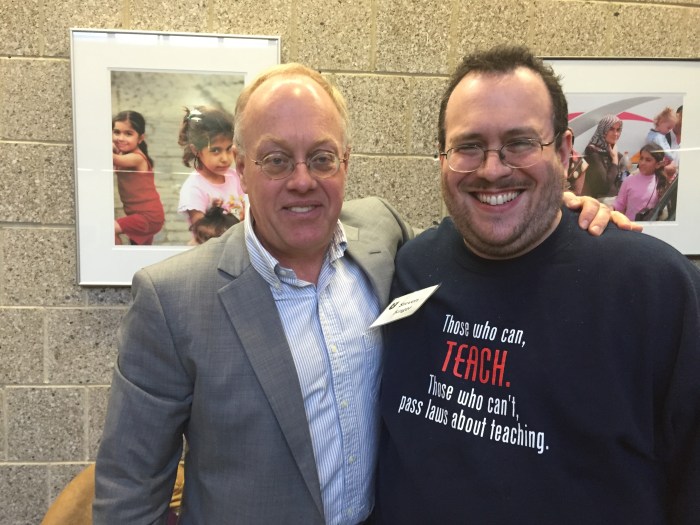
There was a point during Chris Hedges keynote address today when I could barely catch my breath.


My chest was heaving, tears were leaking from my eyes and I wasn’t sure I would be able to stop.


The Pulitzer Prize winning journalist had his audience enraptured at the United Opt Out Conference in Philadelphia Saturday morning.


I’ve read Chris before. We’ve all read Chris before. But I had never seen or heard him speak.


It was kind of like hearing a good sermon by a pastor who felt every word he said. And that really was it – Chris FELT every word.


When I’ve read Hedges’ articles on Truthdig, I’ve found myself getting angry. He stirs me up. He disturbs me, makes me feel uncomfortable. And when I heard him speak today I was surprised that he seemed to be reacting the same way to his own words.


When he talked about teaching teenage prisoners, he was emotionally invested in the story he was telling. When he criticized American neoliberal policies, he was just as angry as his audience.


The only difference was that his sorrow and rage somehow became transformed in his throat into something akin to poetry.


He turned the struggle of the oppressed into something beautiful. He transformed the hurt in my chest into something profound. He mutated my disturbance into a sense of actions-to-be.


I won’t repeat the words he said. I’d never be able to reproduce them with anything resembling his eloquence. But I will remark on one of his closing remarks because it hit me like a splash of cold water.


Rebellion, he said, is not about changing the world. It’s about changing yourself.


When you stand up for what is right, you become a better person – whether you achieve your goal or not. In a sense, it doesn’t matter if we destroy the testocracy. But in trying, we transmute ourselves into something better.


I don’t know if that’s true, but I’d like to think so.


I don’t know if we will ever destroy the system of Test and Punish, but I know I can try. I know I can put myself on the line and damn the consequences.


All weekend at the United Opt Out Conference we’ve been talking about rebellion and revolution. There’s no weak tea here in the City of Brotherly Love. No half measures. We’ve been discussing tearing the system down piece-by-piece.


A timid voice speaks up in the back of mind, “Do we really need to do all that? Do we really need revolution just to keep our public schools and make them into something worthy of our children?”


I think I’ve been trying to answer that question for a while now. Maybe a lot of us have.


In a rational country, our demands wouldn’t be so radical.


We want public schools centered on the good of all, not the profit of some. We want educationally valid curricula for our children. We want some control over the school system – both as parents and teachers.


Is that so much to ask? Is that such a lunatic request?


And as I listened to Hedges and Dr. Antonia Darder, Dave Green, Jonathan Pelto, Dr. Denisha Jones, Ceresta Smith, Yohuru Williams, Aixa Rodriguez and many, many others, I heard another timid voice begin to answer the first.


“Yes.”


The system of standardization and privatization of public education confronts students of color and impoverished students head on. They are in the front lines. Yet few people outside of activists seem willing to admit it.


Perhaps the most impressive thing about this conference has been its ability to put issues of human rights at the center of the argument. That’s the essential concept. We’re not just talking about bad education policies. We’re not just talking about schemes for billionaires to make more money. We’re talking about the systematic oppression of a group of people and the widespread complacency and complicity of the majority of the populace.


How do you combat such a monster without being revolutionary? How do you fight for your child without being a rebel?


More has happened at this conference than I can adequately put into words. I’ve met so many incredible people. Some of them I knew, some I had met before, some had only been names I had seen on my computer screen.


I will leave here Sunday feeling refreshed and energized, ready for the battles ahead.


Am I a radical?


Am I becoming a better person?


I don’t know.


But I will keep fighting.


Because I love my daughter, I love my students and I love all children everywhere.


Photo Gallery:


NOTE: This article was given a shout out on Diane Ravitch’s and Jonathan Pelto’s blogs.


Judging the Judge: What Antonin Scalia’s Death Means to the People I Love

antonin-scalia-26

I am not sad Antonin Scalia is dead.

Wow! It feels so good to say that out loud!

Come on. Admit it. You probably feel the same way.

I know. I know. Everywhere you turn, people are going out of their way to talk about the ramifications of the 79-year-old Supreme Court Justice’s death without passing judgement on him.

“Let’s keep it classy,” they say.

Oh. Stop it.

In his 30 years on the bench, Scalia hurt an awful lot of people. And I mean real, live people – not ideological constructs, not hypotheticals – but moms, dads, husbands, wives, daughters, and sons.

The aggregate amount of misery in the world was drastically increased by his being in it. And now that he’s gone, much of that misery may be relieved.

So please curb any shock you may feel at my thesis. And spare me the false praise of a truly reprehensible human being.

He was against women controlling their own bodies, efforts to desegregate our schools, an individual’s right to love whomever they choose, refraining from executing mentally disabled or teenage prisoners. Heck! He was even against police reading suspects their Miranda Rights!

This was a person who said black people should go to “slower” colleges, homosexuality was the same as murder or bestiality, sex discrimination is constitutional, and maybe we have a right to all carry around rocket launchers in public.

If it is outrageous to feel relief at the death of this man, you may call me outrageous.

I’m not usually the kind of person who celebrates someone else’s death. Not even a famous person.

But you have to admit that the people we love are a lot better off without Scalia in the world.

It’s not like he kept all this to himself. He wasn’t some lone drunkard in the back of the bar mumbling sexist, racist views. He wasn’t your ancient uncle who you only see twice a year making people uncomfortable at the dinner table. He was a judge in the highest court in the land, and his demented and warped world view drove public policy impacting… well… everyone.

He was the deciding vote in several 5-4 decisions that – if they had gone differently – would have greatly benefited every person in this country.

You can thank him for the Presidency of George W. Bush and Citizens United. Let that sink in for a moment.

Imagine all the horrific blunders of the Bush Presidency – easily the worst administration in my lifetime. If the Supreme Court hadn’t given the highest office in the land to Dubya, arguably we wouldn’t have had the Irag War, the Great Recession, No Child Left Behind, the slow response to Hurricane Katrina – maybe even 9-11.

And if you hate what our elections have become, imagine if we didn’t have the Citizens United verdict. Campaign donations would have to be made in public with some limits on how much individuals and corporations can contribute.

How much better the world would have been without these terrible decisions!

I’m not saying Scalia wasn’t a good man in his personal life. I have no idea what he was like to the people he loved. For all I know he may have been a good friend, a loving husband, father and grandfather. He probably had people he cared about and who cared about him. And to those people I send my condolences.

However, he did great harm to just about everyone else. And for that I feel nothing but relief at his death.

Who am I to bask in such schadenfreude?

I am a father and public school teacher.

I have a seven-year-old daughter and several classes full of mostly impoverished and minority students.

And Scalia’s death is good for everyone I care about.

If he were still alive, there was so much more damage he could have done. Take the Friedrichs case, an important one for teachers like me.

The case is an attempt to strip teachers unions of the right to charge members for their services. If the court rules in favor of Friedrichs, it would overturn decades of established law against free riders. People would be allowed to be in a union, enjoy higher salary and benefits negotiated by that union, but not pay dues. It would be absurd. Yet with Scalia still on the bench, most court watchers seem to think we would have had another terrible 5-4 decision.

However, with Scalia’s death, the best anti-union forces would probably receive is a 4-4 decision – not enough to overturn established law. True the case has already been heard by the justices, but a ruling has not yet been handed down. According to the Supreme Court blog, even if Scalia had already written a ruling on this matter, it would be void. Any rulings he wrote that have not yet been made public don’t count.

So the most likely outcome now is that millions of people will continue to be protected from unfair labor practices. And you expect me not to have a big ‘ol smile on my face!?

So where do we go from here?

President Barack Obama will select who is to succeed Scalia. Numerous excellent choices have been floated. If Obama chooses any one of them, he would probably tilt the court fractionally to the left.

Before the body was even cold, Republicans vowed to block any nominee Obama makes until the next President is sworn in. Some are trying out the talking point that Supreme Court Justices have never been sworn in during an election year. But if that were true, we wouldn’t have Justice Anthony Kennedy who was confirmed during the last year of Reagan’s presidency.

Funny. The U.S. Constitution clearly states that the President has the right to nominate Supreme Court Justices with the advice of Congress. Yet so many of these right leaning partisans who considered themselves Constitutionalists last week suddenly find themselves against that revered document today.

I wonder how Scalia would have argued such a situation.

Not really. He was the one who taught the rest of his party how to twist the words of the founding fathers to mean whatever the far right favors this week.

Obama still has more than 300 days in office. If Republicans try to block his nomination until a new face tops the Executive, it would be the longest such obstruction in a century. Of sitting justices, the longest confirmation period was for Clarence Thomas who took 106 days to be approved by Congress.

And that brings us to the 2016 Presidential race.

Scalia’s death is likely to have a huge impact on whom becomes our next President.

If Republicans block Obama’s Supreme Court nominee, it would probably increase voter turnout. Whenever that happens, it favors Democrats since they have more registered members than the GOP.

Either way, Scalia’s death is probably beneficial to whomever the Democratic nominee will be. If either Hillary Clinton or Bernie Sanders get the nomination, supporters of the defeated candidate are more likely to support the reigning Democrat.

Even if voters don’t like the winner’s policies as much as their preferred candidate, they’re likely to support the nominee in order to continue tipping the Supreme Court to the left. After all, three additional justices are 70 or older. Stephen Breyer is 77, Anthony Kennedy is 79, and Ruth Bader Ginsburg is 82.

We have had a long haul these last 15 years. Much social progress has been stalled.

But now that Scalia is out of the picture, the future looks bright.

Maybe things really will turn out alright. Maybe we’ll actually have a chance to build that better world we’ve all been dreaming about.

Rest in Peace, Scalia. The nation can’t wait to move on without you.

Taking Back Your Name – The Pros and Cons of Political Correctness

introduction


“What I think the political correctness debate is really about is the power to be able to define. The definers want the power to name. And the defined are now taking that power away from them.”
Toni Morrison

“Never trust anyone who says they do not see color. This means to them, you are invisible.”
Nayhyirah Waheed


Call me Steve.

Not Steven. Not Stephen. Certainly not Steveareno.

It’s a preference. My preference. My choice. And if people want to be in my good graces, they’ll comply with my wishes.

There’s nothing strange or unreasonable about this. We do it all the time – usually when we’re being introduced to someone.

“Hi. I’m Steve.”

“Nice to meet you, Steve. I’m Elisha.”

“Elisha? What a beautiful name!”

“Thank you, Steven.”

“Please. Call me Steve.”

Is there anything wrong with that? Does that stifle conversation? Does it stop people from talking freely to each other?

No. Certainly some names are hard to pronounce or – in my case – remember. But overcoming those hurdles is just common decency. It’s not too much to ask – especially if you’re going to be dealing with this person for an extended length of time.

The idea that allowing people to define themselves somehow shuts down conversation is rather strange. But it’s the essence of opposition to political correctness.

“Political correctness is tyranny with manners,” said conservative icon Charlton Heston.

I wonder if he would have felt the same if we’d called him Charlie Hessywessytone.

A more fleshed out criticism comes from President George H. W. Bush who said, “The notion of political correctness declares certain topics, certain expressions, even certain gestures off-limits. What began as a crusade for civility has soured into a cause of conflict and even censorship.”

Is that true? Is political correctness really censorship? That’s the conflation made by many conservatives and even some liberals. After all, popular Left-wing comedian Bill Maher sarcastically calls his HBO show “Politically Incorrect,” and he often rails against the practice.

There’s a kernel of truth to it. We are asked to change the way we speak. We’re asked to self-censor, but we already do this frequently without wailing against a loss of free speech.

Human beings are subject to various impulses, but as adults, we learn which ones we can act on and which we shouldn’t. I may think it would be hilarious to run into a crowded movie theater and yell, “FIRE!” However, I know that doing so – while possibly funny to a certain kind of person – would result in injuries and trauma as moviegoers stampede out of the theater. So I don’t do it. Is that censorship? Maybe. But it’s censorship with a small c.

The Hestons, Bushes and Mahers of the world seem to think political correctness is more like Capital C Censorship. But this is demonstrably false.

That kind of Censorship is the act of officials, possibly agents of the government, a corporation or some other formal bureaucracy. But political correctness has nothing to do with officials. There are no censors. There are only people who ask to be named a certain way.

A censor looks at a news report of military operations in Iraq and deletes material that would give away the army’s location. Political correctness is nothing like that. It involves someone asking others to refer to themselves THIS WAY and not THAT WAY.

The penalties for violating Censorship are official. Ask Chelsea Manning who is serving a 35-year prison sentence for doing just that. The penalties for violating political correctness are social. You may be criticized, condemned or disliked.

If you criticize Manning for releasing classified documents to Wikileaks, you’re not violating political correctness. That’s your opinion, and you’re entitled to it. However, Manning is a trans woman who is going through hormone replacement therapy. If you refer to her as “him” you are violating political correctness. You’re naming her in a way that violates her wishes. The penalty is not a prison sentence. It’s a sour look.

So political correctness is not Censorship. In some ways, the confusion comes from the term “political correctness,” itself.

Though its origins are hard to pin down, it appears to have been coined by the Soviets to mean judging “the degree of compatibility of one’s ideas or political analysis with the official party line in Moscow.” At least that’s what the International Encyclopedia of Social Studies says.

The term came to prominence in the United States in conservative writer Dinesh D’Souza’s book “Illiberal Education.” He disparaged affirmative action as a kind of political correctness that gave preference to (what he saw as) unqualified minority students over whites in college admissions.

So the first mention of the term in the USA was simply to disparage liberal political policies. It was a ham-handed way of comparing the Left with the Soviets. Yet somehow this term has become the handle by which we know simple civility. It’s kind of hard to feel positively about a concept that begins with a mountain of unearned negative connotations.

Conservatives know the power of getting to name something. It’s their go-to propaganda tactic and lets them control much of the debate. For instance, that’s why the Right loves to call Social Security an “entitlement.” There’s truth to it because you’re entitled to getting back the money you pay in, but it’s full of unearned negative connotations as if these people were somehow demanding things they don’t deserve.

In essence, political correctness shouldn’t be political at all. It’s just kindness. It’s just being a decent human being. Don’t purposefully call someone by a name they wouldn’t appreciate. Respect a person’s ownership of their own identity.

And for some people that’s hard to do. Their conceptions of things like gender, sexuality, race and religion are extremely rigid. The only way to be a man is THIS WAY. The only way to be spiritual is THAT WAY. But if they give voice to these ideas in the public square – especially in the presence of people who think differently – they will be frowned upon.

But is this really so dissimilar to the crowded movie theater? Refusing to acknowledge someone else’s identity is harmful to that person. It tramples the soul similarly to the way their body would be trampled in a stampeded exit. So you shouldn’t do it.

The result is an apparently much more tolerant society. It’s no longer okay to use racial, cultural, gender and sexual stereotypes in public. You’re forced to give other people consideration – or else face the consequences of being disliked. And on the surface, that’s a much more inviting world to live in.

However, there is a glaring problem. In some ways, this has made public discourse more antiseptic. People don’t always say what they mean in the public square. It’s not that they’ve changed the way they think about the world. They’ve just learned to keep it to themselves until they’re around like-minded individuals. They reserve their racist, classist, sexist language for use behind closed doors.

This is why when I’m at a party peopled exclusively by white folks, some partygoers may let racial epithets slip out. And we all laugh nervously to be polite. Or maybe it’s more than politeness. Maybe for some it’s to relieve the tension of such refreshing candor like taking off a girdle. Fwew! Here, at least, I can say what I really think without having to worry about people looking down on me for it!

Since such reactions occur mostly in homogeneous groups, it makes the world look much more enlightened than it really is. Pundits and policymakers look around and cheer the end of these social ills when they haven’t ended at all. They’ve merely gone underground.

And so we have an epidemic of colorblind white people who can’t see racism because of the gains of political correctness. Somehow they forget those unguarded moments. Somehow they haven’t the courage to examine their own souls. Or perhaps they don’t care.

And so we have the conundrum: which is better – to live in a world where all individuals have the right to name themselves or to live in a world where our most basic prejudices are on display for all to see?

Personally, I pick political correctness, and here’s why.

Words are important. We think in words. We use them to put together our thoughts. If we continue to respect individuals’ names in word, eventually we’ll begin to do so in thought and deed.

This isn’t mind control. It’s habit. It’s recognizing an ideal and working toward it. As Aristotle taught, the way to become a good person is to act like one. Eventually, your preferences will catch up with your habits.

I think that’s what’s happening today. Look at the children. They’re so much less prejudiced and racist than we, adults. This is because they’ve learned political correctness first. They didn’t have to unlearn some archaic white-cisgender-centrism. This is normal to them, and I think that’s a good thing.

Obviously some people will balk at this idea. They will look at this ideal as reprehensible. They want to return to a world where women were little more than property, a world where black people knew their place, where sexual identity was as simple as A or B.

But I think most of us recognize that this is not a world where we’d want to live. Modern society can be scary and confusing but trying to respect everyone as a person isn’t a bad thing. It’s consideration, concern, warmth.

Perhaps the best way to love your fellow humans is to call them by their proper names.

My Daughter is Not a Widget

Father Holding Daughter's Hand

“I’m not sure public schools understand that we’re their customer—that we, the business community, are your customer. What they don’t understand is they are producing a product at the end of that high school graduation. Now is that product in a form that we, the customer, can use it? Or is it defective, and we’re not interested? American schools have got to step up the performance level—or they’re basically turning out defective products that have no future. Unfortunately, the defective products are human beings. So it’s really serious. It’s tragic. But that’s where we find ourselves today.”
Rex Tillerson, ExxonMobil CEO

My daughter just turned seven during this holiday season.

She loves to draw. She’ll take over the dinning room table and call it her office. Over the course of a single hour, she can render a complete story with full color images supporting a handwritten plot.

These narratives usually star super heroes, cartoon characters and sometimes her mommy and daddy. In these flights of fantasy, I’ve traveled to worlds lit by distant suns, been a contestant on a Food Network cooking show, and even been a karate pupil to a Teenage Mutant Ninja Turtle sensei.

That little girl is my pride and joy. I love her more than anything else in this world.

Make no mistake – She is not anyone’s product.

She is not a cog to fit into your machine. She is not merchandise, a commodity, a widget for you to judge valuable or not. She is not some THING for you to import or export. She is not a device, a gadget, a doodad, a doohickey or a dingus. She is not an implement, a utensil, a tool, or an artifact.

Her value is not extrinsic. It is intrinsic.

She is a person with a head full of ideas, a heart full of creativity and passion. She has likes and dislikes. She loves, she lives, she dreams.

And somehow Tillerson, this engineer turned CEO, thinks she’s nothing more than a commercial resource to be consumed by Big Business. He thinks her entire worth as a human being can be reduced to her market value. It doesn’t matter what she desires for herself. It only matters if she fills a very narrow need set by corporate America.

But what else should we expect from the man in charge of ExxonMobil? The corporation has a history of scandal, corruption and malfeasance going back decades.

Since the 1980s the company has been suppressing its own incredibly accurate data on climate change because that science would adversely affect the bottom line of a business that earns its money burning fossil fuels. Moreover, the company funds climate change denial groups. A study by the US Union of Concerned Scientists reports that ExxonMobil funded 29 climate change denial groups in 2004 alone. Since 1990, the report says, the company has spent more than $19 million funding groups that promote their views through publications and Web sites that are not peer reviewed by the scientific community. Need we even mention the corporation’s long history with the American Legislative Exchange Council (ALEC)?

Tillerson and Exxon have also been major boosters of the fracking industry pushing for deregulation as health concerns mount. Most recently, the organization was ordered to pay a $100,000 Environmental Protection Agency civil penalty for an illegal discharge of fluids from a Marcellus Shale natural gas well site in Lycoming County, Pennsylvania.

It’s all about profit at Exxon. The corporation’s cost cutting measures also resulted in the largest oil spill in US waters to date. Environmental impacts are still being felt in Alaska’s Prince William Sound from the 11 million gallons of oil the Exxon Valdez supertanker unintentionally poured into the ocean, coasts and forests in 1989. Subsequent spills have occurred in Brooklyn (2007), the Yellowstone River (2011), Baton Rouge (2012), and Arkansas (2013). But why should that matter? The corporation was listed as the second most profitable in the world on the Fortune 500 in 2014.

Yet Tillerson is somehow worried about American workers being up to snuff? Why? The corporation outsources a steadily increasing share of its jobs overseas. Those that it does keep in the continental US have been subject to massive downsizing efforts. As employees have decreased, corporate profits have increased. And Tillerson expects anyone to think he’s concerned about the well-being of the American worker!? Give me a break!


Exxon_Income_vs_Employment


I suppose it’s not that surprising though that someone who makes $40 million a year, himself, would expect a paycheck to be the ultimate display of personal significance. After all, he probably thinks his exorbitant salary proves that he’s very important.

Albert Einstein never made that kind of money. Heck! Neither did William Shakespeare, Dr. Martin Luther King, Marie Curie, or Abraham Lincoln. So by Tillerson’s ethos, all of these people were defective products unfit for the corporate world. Or at the very least our estimation of them is flawed.

After all, what need have we of Shakespeare’s poetry in the exercise of buying and selling? Perhaps the greatest author ever to write in the English language might find merit in the advertising department. Likewise, Dr. King’s ethic of equality might be useful in human resources. Marie Curie? She’d find gainful employment in research and development but any patents she generated would undoubtedly be held in the corporate interest. And Mr. Lincoln? Perhaps he could be useful as a low level administrator but, no, such iconoclasm as he possessed would probably not be a good fit. He’d end up freeing the wage slaves or other such unprofitable nonsense.

Is this really the American Dream? Find an occupation producing monetary wealth or else lose all claims to value? If so, how loud must history be laughing at us?

The post-Impressionist artist Van Gogh created 900 paintings and 1,100 drawings and sketches. Many of these works now adorn museums around the globe and have forever changed the way we see the world. But during his lifetime, he sold only one painting. So by Tillerman’s logic, he was a defective product, a failure.

This is the sickness of the profiteer – to be forever appraising worth but unable to see true value. It is the disease eating away at the soul of our country. It’s the same mindset that justifies anything in the name of short-term gain – credit default swaps, the housing bubble, charter schools and Common Core.

After all, Tillerson’s notorious quote above comes from an infamous article in Fortune magazine in which the CEO threatened the former governor of Pennsylvania that he’d pull ExxonMobil out of the state if the legislature didn’t adopt some form of Common Core. And so the state gave in to the whim of one man with no experience, knowledge or wisdom about how children learn. And students in more than 500 public school districts are thus constrained by this legal economic blackmail.

I am but a simple man. I don’t bring in a six-figure salary. I’m a teacher in that same public school system. I’m also the father of an elementary student. I am a man of no monetary means and thus little merit. But I say this: the Tillersons of this world are wrong. Our children are worth more than these tiny bean counter brains realize. The purpose of education is not to provide more resources for their pointless game of Monopoly.

My daughter has a life, and her education is a tool to enrich that life. It is her vehicle of understanding the world around her. It is a process to invigorate her sense of wonder. It is a method of understanding how things work and where she fits in the universe.

Yes, she will one day need to seek employment. But what she chooses as her occupation will be up to her. SHE will decide where she fits in, Mr. Tillerson, not you. SHE will decide what is valuable in her life. SHE will decide if she wants to spend her hours in the pursuit of profits or less tangible enterprises.

As such, she needs literature – not standardized tests. She needs mysteries to solve – not Common Core. She needs equitable resourcesnot charter schools. She needs teachers with advanced degrees and dedication to their jobs – not Teach for America temps.

Don’t you dare try to justify all that with some narrow economic view of monetary value. Some things have no price. My daughter is one of them.


NOTE: This article also was featured on Diane Ravitch’s blog, I did an interview about it on the Rick Smith Show, and was quoted in an article about the issue in the Washington Post.