My Students Are Addicted to Screens

07BRODY-facebookJumbo

Michael sat at his desk with ear buds inserted, an iPad balanced in front of his eyes and an old fashioned paper book open on his desk.

His head was bopping and weaving. His eyes were transfixed on a YouTube video of an animated soldier blasting away bad guys. And his book was laid out in front of him, largely ignored.

This was during our class’ sustained silent reading time – a period of 15-20 minutes where my 7th grade students were supposed to read self-selected books. Eventually, they’d have to complete a project, but today all they had to do was read.

Still, many used the time the same way as Michael did – lost in cyberspace, merely pretending their eyes gloss over the page.

“And what did the teacher do?” I hear some readers say indignantly.

“If you allow this type of behavior, you’re worse than the child doing it.”

So come with me as I redirect Michael.

“Hey, buddy,” I say.

“Huh?” he responds as if awakened from a dream.

“Are you reading?”

“Uh. Yeah.”

“You’re not just watching that video and ignoring your book?”

“Nope,” he says now fully awake. And he proceeds to give me a canned summary of the text that he memorized from the Internet.

But I’m still skeptical.

“I’m going to take your iPad away just for SSR time,” I say.

BUT WHY!? I’M READING!”

“I just want you to be able to concentrate on what you’re reading.”

And as I gently pry the iPad from his curled fists, he stands up and gives me a look of pure hatred.

This is a look from a 7th grade boy who’s considering violence.

It’s the same look you’d get trying to take away a dog’s bone, or an addict’s crack pipe.

It truly depends on the child what happens next. Some will regain control, slam down into their seats and sulk. Others will whine and cause a scene. And some will lose all control and lash out.

This is what teachers deal with every day when it comes to technology in the classroom.

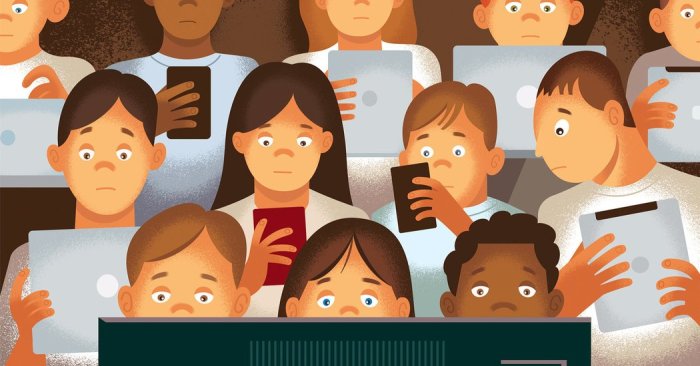
In point of fact, many of our children are addicted to their devices.
iPads, laptops, Smartphones – we might as well be giving them pills, joints and syringes.

According to Merriam Webster, addiction is defined as, “compulsive need for and use of a habit-forming substance… [characterized] by well-defined physiological symptoms upon withdrawal.”

For most students, their devices have become just that – a compulsion, the cause of a nearly irresistible impulse to check them, access them, use them to keep themselves entertained and plugged in.

With repeated use, it becomes habit forming, and separation from the device can lead to a kind of withdrawal.

From a neuro-psychological point of view, one wonders if repeated use is clinically damaging – especially to adolescent brains that have not yet fully formed.

From an educational point of view, one wonders if relying on such devices in class is pedagogically sound.

I’m not qualified to answer the first question (though it deserves much more study than it is receiving). But from my 15 plus years of experience in the classroom, I feel qualified to answer the second – and that answer is often a resounding “NO.”

In my kids’ everyday lives, this type of constant technology reliance doesn’t make them better students. It doesn’t give them access to more information. It makes them dependent on instant gratification and sensory overload.

Their minds are submerged in a soup of constant noise and conflicting demands for their attention. Stringing together thoughts and coming to reasoned opinions becomes increasingly difficult.

This isn’t to say that technology has no place in the classroom.

There are ways to use it that can enhance learning. However, in my experience these are NOT the ways it is being used most of the time. That takes, thought, planning, intention. Instead, many well-meaning administrators or school directors prescribe technology as an end in itself regardless of the goals of an individual lesson. They want to prove their buildings, schools or districts are cutting edge, and that only takes the constant use of technology – not surgical, intentional use.

It’s not that teachers don’t know how to apply it or don’t care. It’s that technology – especially the presence of a one-to-one device in the hands of every child at all (or most) times – creates more problems than it solves.

This is why the same people who invented these technologies strictly regulate them for their own children.

Bill Gates and Steve Jobs, two of the biggest tech titans in the business, famously limited screen time for theirs sons and daughters.

Gates, a Microsoft co-founder, refused to let his children have personal technological devices until they were developmentally ready for them.

“We don’t have cellphones at the table when we are having a meal,” he told the Mirror. “We didn’t give our kids cellphones until they were 14 and they complained other kids got them earlier.”

Today, most children get their own cellphones at age 10. And if their schools have one-to-one initiatives like mine, they have their own iPad as early as 5th grade with less but still substantial hours of usage as early as kindergarten.

Jobs, an Apple co-founder, also limited screen time for his children.

When asked if his children liked the original iPad shortly after it was launched, Jobs said, “They haven’t used it. We limit how much technology our kids use at home.”

In fact, according to Walter Isaacson, who wrote a near-definitive Jobs’ biography, technological devices were only allowed at prescribed times.

“Every evening Steve made a point of having dinner at the big long table in their kitchen, discussing books and history and a variety of things,” he said.

“No one ever pulled out an iPad or a computer. The kids did not seem addicted at all to devices.”

And this practice seems common among parents in Silicon Valley.

According to educators Joe Clement and Matt Miles, authors of “Screen Schooled: Two Veteran Teachers Expose How Technology Overuse is Making Our Kids Dumber,” those in the tech industry know the dangers of their own products on children.

A number of specialty Silicon Valley schools, say Clement and Miles, such as the Waldorf School, rely almost exclusively on low-tech tools to teach. This often means chalkboards and pencils. The emphasis is on learning interpersonal skills such as cooperation and respect – not the ins and outs of computer coding.

At Brightworks School, even the physical environment of the class is a tool to learning. Students attend class in treehouses and kids learn creativity by building things with their hands.

This is a far cry from the technological wonderland our kids are being sold by these kids’ parents.

No one really knows what effect it’s having on growing minds. However, psychologists are beginning to see alarming trends.

For instance, frequent use of social media makes an eighth-grader’s risk for depression 27% higher. Moreover, use of smart phones for at least three hours a day increases children’s risk of becoming suicidal. Some experts believe that increased use of technology has contributed to the teen suicide rate which for the first time eclipses the homicide rate.

We are jumping head first into an educational model that puts technological devices like a tablet at the center of learning.

Teachers assign lessons on the device. Students complete assignments on it. Projects are virtual as is research. Even conversations are conducted through a chat page, emails or messaging.

Why? Not necessarily because of any proven link to increased academic results. It’s because tech companies are marketing their devices to schools and students.

This is industry-driven, not pedagogically-driven.

There is an unquestioned bias that doing things with technology is somehow better simply because we’re using technology. However, an article written on a computer will not necessarily be better than one written with pen and ink. There are other factors involved.

Now Gates and company are pushing personalized learning objectives. Sometimes called competency based education, these continue to place the device in the center of what should be the student-teacher relationship.

Student learning becomes a video game and the teacher becomes a virtual avatar. Kids spend their time doing infinite standardized testing as if it were authentic education, yet it’s all on-line so it appears to be cutting edge. It isn’t.

It’s just another scam.

In my own classes, I’ve put the brakes on unquestioned technology. I only use devices, programs or applications that are (1) reliable and (2) when I know why I’m using them.

Even then, I find myself unable to even talk to students without beginning every lesson telling them to at least temporarily put their devices away so they can hear the directions.

Sure, I could give them a QR code to scan and get a written copy of the directions. I could upload a video for them to watch. But that limits direct feedback. It makes it more difficult for them to ask questions. And it makes it almost impossible for me to tell if 20-30 kids are actually doing the assignment before they turn it in for grading.

These are just kids, and like kids in any age they’ll take the path of least resistance. Often they’ll try to get through the assignment as quickly as possible so they can listen to music, or watch a video, or play a video game or chat on-line.

Lessons can be engaging or thought-provoking or spark the creative impulse. But you have to get students’ attention first.

That’s hard to do when they always have the option to crack their brains open over a virtual frying pan and watch it sizzle away.

To be fair, living in the modern world, we’re probably all somewhat addicted to technology. This blog isn’t written on papyrus and it isn’t being accessed in a hefty library volume.

I use social media – Facebook and Twitter mainly – to disperse it.

But there’s a difference between me and my students.

I’m an adult.

I know the concessions I’m making. I enter into this with eyes open. I have a lifetime of experience and knowledge with which to make such a decision.

Children don’t have that. They look to us to protect them.

We are their guardians. We’re only supposed to subject them to things that will help them learn, keep them healthy and happy.

But in our rush to be trendy and hip, we’re failing them miserably.

We’re letting business and industry take over.

It’s time to take a stand.

Our kids may be addicted, but we don’t have to be their pushers.

We need to get them clean and show them how to use this brave new tool with moderation and restraint.

Mr. and Mrs. Public School Sabotage


Screen Shot 2017-10-27 at 1.35.14 PM


America’s public schools are in crisis.


Because people make money when America’s public schools are in crisis.


And who sits atop this mountain of bribery and malfeasance?


Who gives the money that buys the politicians who make the laws that hurt the kids and profits the donors?


It’s none other than Mr. and Mrs. Public School Sabotage!


Systemic underfunding, laissez-faire segregation and privileging privatization – this is what our children face every day.


It’s time we as a nation stop, take a moment – and offer our hearty congratulations to this years most pernicious saboteurs.


And what a year it was for disrupting education!


Charter schools, voucher schools – no one has benefited more from chucking the public school model in the trash in favor of control by corporations and bureaucrats than Betsy DeVos.


Because she’s both a dark money influence peddler AND a government flunky!


A two-for!


She turned complete ignorance and animosity toward public schools into the highest federal government job overseeing education! Her only qualification? CA-CHING!


But coming up right behind Ms. DeVos is this year’s crowned king.


He certainly knows a thing or two about CA-CHING!


It’s Bill Gates!


Progressive philanthropist by day, by night he transforms into the largest single purveyor of palm grease in the nation. No one has turned tax avoidance into influence more than Gates, the money behind the Common Core, evaluating teachers on student test scores and a plethora of irrational, untested ideas that are only considered mainstream because they have literally trillions of dollars behind them.


So there you have it, America! Your Mr. and Mrs. Public School Sabotage!


Let’s take a closer look at these… winners.


DEVOS


As U.S. Secretary of Education, she’s proposed cutting $10 billion in public school funding, announced changes to make it harder for college students to report sexual assaults, and put struggling university students at risk of higher debt payments with changes to student loans.


But that’s child’s play for the billionaire heiress who married into even more money.


Now she’s planning to weaken the rights of students with disabilities.


That’s right – Jason Vorhees, Michael Myers, Freddy Kruger, they all went after those pesky post-graduate teenagers. But none of them had the audacity to go after kids with learning disabilities!


It’s not that DeVos is undoing any laws. She’s erasing decades of government guidance about how the laws are to be interpreted. And though she claims these 72 directives are simply “outdated unnecessary or ineffective,” she’s not replacing them with anything else. They’re just – gone.


Of the 72 guidelines, 63 affect special education and 9 affect student rehabilitation. And these aren’t simply undoing the work of the Obama administration. Some of these regulations have been in place since the 1980s.


The rescinded policies include “Satellite Centers for Independent Living,” “Nondiscrimination on the Basis of Handicap in Programs and Activities Receiving or Benefiting From Federal Financial Assistance,” and “Information on the Provision of Vocational Rehabilitation Services to Individuals With Hearing Loss (Deaf and Hard of Hearing).”


Bah! Who needs all this paperwork?


Parents and students. That’s who.


These guidelines have helped parents of disabled and special education children advocate for their young ones’ rights. Without them, it may be more difficult for parents and teachers to ensure all children are receiving a free and appropriate education.


That’s some seriously stone cold sabotage, Ms. DeVos!


But at least her motivation is obvious to anyone with eyes.


She’s not purposefully making the lives of K-12, special education and college kids more difficult. Well, she is, but she’s not doing it out of spite. She’s doing it because it helps her investment portfolio.


How can she continue to promote charter and voucher schools that don’t provide the same kinds of quality services for special education and disable students as public schools do? She needs to degrade what the public schools provide, thereby making the privatized alternatives more marketable.


How can she keep making money off predatory lenders unless she loosens the rules to allow them more freedom to gorge on student debt? And how can she keep her lucrative job bending the rules in her favor unless she throws some red meat to the racists, misogynists and anti-Semites who helped elect her boss into the Oval Office?


And if kids get hurt, well those aren’t the people she’s looking out for, are they?


She’s only out for the other rich elites like herself making a mint off of our public tax dollars!


It’s almost enough to make you miss Arne Duncan.


Almost…


(Nah. Not really.)


GATES


Bill Gates, on the other hand, is more contrite.


His Common Core initiative has kind of exploded in his face.


No one likes it. NO ONE.


In fact, it was one of the key talking points President Trump used to garner support. The public’s hatred of Democratic plutocracy made them suckers for the Republican variety.


The problem isn’t so much political. It’s economic.


It’s rich people who think they can do whatever they want with the rest of us and our children.


More than anyone else, Gates is guilty of that kind of unexamined, unrepentant hubris.


Yet to hear him talk, after a string of education policy disasters, he’s learned his lesson.


He’s sorry – like a crack addict is after hitting rock bottom. But he’ll somehow find the courage to light up again.


Gates now admits that the approximate $2 billion he spent pushing us to break up large high schools into smaller schools was a bust.


Then he spent $100 million on inBloom, a corporation he financed that would quietly steal student data and sell it to the corporate world. However, that blew up when parents found out and demanded their children be protected.


Oops. His bad?


He also quietly admits that the $80 million he spent pushing for teachers to be evaluated on student test scores was a mistake. However, state, federal and local governments often still insist on enacting it despite all the evidence against it. Teachers have literally committed suicide over these unfair evaluations, but whatever. Bill learned a lesson.


When it comes to Common Core, though, Bill refuses to take his medicine – even to mouth the words.


By any metric, these poor quality uniform academic standards are an abject failure. He spent hundreds of millions of dollars for development and promotion. He influenced trillions of taxpayer dollars to be poured down the drain on it. All to no avail.


Instead, he’s quietly backing away. No explanation. No apology. Just on to something new.


Kind of like: “That didn’t work. Let’s try something else!”


His new plan – spend $1.7 billion over five years to develop new curriculums and networks of schools, use data to drive continuous improvement, and give out grants to high needs schools to do whatever he says.


What’s so frustrating is that Gates shows glimmers of self-awareness.


“It would be great if our education stuff worked, but that we won’t know for probably a decade,” he said during a speech at Harvard in 2014.


But then when he sees it isn’t working, he just doubles down on the same crap.


While he may not be committed to any one policy, Gates is committed to the idea that he knows best. Whatever nonsense bull crap that floats through his mind deserves to be tried out on a national scale.


No asking experts. No asking teachers, parents or students. Just listen to me, Bill Gates, because I’m rich and that makes me better than you.


No, it doesn’t Bill. It makes you just like Betsy DeVos.


So there they are. Mr. and Mrs. Public School Sabotage.


Short may their reign be.


“They were careless people, Tom and Daisy – they smashed up things and creatures and then retreated back into their money or their vast carelessness or whatever it was that kept them together, and let other people clean up the mess they made.”

-F. Scott Fitzgerald, The Great Gatsby

‘Schools of the Future’ And Other Scams to Monetize Your Child

1963-jetsons-school


Do you feel it?

The future is coming.

There it is hovering just over the horizon.

You squint your eyes trying to get a quick peak before it arrives. But that rarely works. By the time it’s here, it’s never quite in the shape you expected.

Yet we always stop and listen to the prophets and prognosticators. Those google eyed figures, wearing trench coats and sandwich boards standing proudly on milk crates and cracking open their mouths to vociferously voice their “visions.”

They smell like B.O. There are insects in their hair. And their mouths spray halitosis as much as haloes.

Under normal circumstances, we wouldn’t trust them to park our cars, to give us directions, to do just about anything. But when it comes to “The Future” somehow we swallow their swill with conviction.

Through sheer force of charisma they convince us that their predictions will come to pass and if we’re smart we’ll invest in their brand of patented polished snake oil.

So we’ll be ready.

Just once I wish people would heed the skepticisms of the doubting Cassandras. But so it goes.

This week it’s “Schools of the Future.”

Everywhere you look it seems you’ll find some slickly produced inducement to “Rethink schools.” Some admonition to completely change public schools. Some empty promise in naked technology to save us all.

They’ll tell you that our public schools haven’t changed in a century. They’re set up for the agricultural past. Or schools are great for creating assembly line workers for the industrial revolution, but times have changed. And education needs to change with them.

Never mind that schools were never designed to supply any workforce. Their goal was – and is – to help the next generation become citizens capable of free thought.

But whatever.

This sales pitch about outmoded schools sounds really nice.

It resonates.

It makes us feel good.

Yes, I KNEW there was something wrong with my public school. That explains my own failures. I mean, I went through 12 plus years of public schooling and look at me! I’m not one of the handful of billionaires who own the world. It MUST have been the school’s fault!

Forget economic inequality, money in politics or any of that progressive crap! I could be sitting on top of the world with my boot firmly planted on the neck of everyone else – if only the public school had taught me right.

PLEASE!

But this is the comforting lie many folks tell themselves and one of the major reasons corporate school reformers get away with raiding public education. Their lies flatter white people’s vanity.

So billionaire Laurene Powell Jobs’ bought a four-network propaganda hour telling us to “rethink” high school while Education Secretary Betsy DeVos’ began her “Rethink Schools” publicity tour days later.

As if the thought never occurred to anyone else.

Rethink schools? What do you think classroom teachers do? We rethink every lesson every day!

It’s standard practice. We call it reflection. Some of us even keep reflection journals where we jot down things that worked and things that didn’t.

Haven’t these privileged fools ever logged on to the blogosphere? The Internet is fit to bursting with teacher blogs overflowing with ideas about how to change things up. This very blog has been pushing authentic reform after authentic reform – but the powers that be – people like DeVos and her billionaire philanthrocapitalist peers – aren’t listening.

You want to rethink schools? How about sitting down and shutting up?

Seriously.

Let the experts have a say for once.

Classroom teachers have much more experience than you do. We’re there every single day engaged in the actual practice of teaching children. You learn something about it by doing it for at least 180 days a year, for decades. And that’s not even counting the years of college preparation before even entering the classroom, the pedagogy, debate, and hard won wisdom of generations of teachers before us.

Meanwhile, all you have is a bank account.

You’ve hardly stepped foot in a public school to do more than spit on it. Nor did you likely experience it as a student or parent of students who go there.

You know nothing. And that’s no sin in itself.

Many people are ignorant of a great many things. I, for one, am completely ignorant of how to fly an airplane. That’s why I’d never dream of busting open the cockpit and preceding to tell the captain how to land the plane!

But you are not humble enough to admit your own ignorance. You think your money gives you the ability to do anything. After all, you DESERVE all those billions. It’s not an accident of birth or circumstances. You’re just that good, that special, that much better than the rest of us.

And what kind of brilliance do we get from these pampered prophets?

Here’s DeVos remarks to faculty and students at Woods Learning Center in Casper, Wyoming, from Sept. 12:

“…I’m issuing a bold challenge this week: it’s time to rethink school.

For far too many kids, this year’s first day back to school looks and feels a lot like last year’s first day back to school. And the year before that. And the generation before that. And the generation before that!

That means your parent’s parent’s parents!

Most students are starting a new school year that is all too familiar. Desks lined up in rows. Their teacher standing in front of the room, framed by a blackboard. They dive into a curriculum written for the “average” student. They follow the same schedule, the same routine—just waiting to be saved by the bell.”

All that money and the best you can come up with are that we should rearrange the desks!?

It just goes to show that you don’t know what goes on in real public schools.

My middle school classroom doesn’t have desks. We have tables that seat four.

Yes, those seats typically begin the day with students facing the teacher and the board. But you could say the same of seats at any auditorium since Plato’s day. I don’t hear anyone talking about rethinking that!

In any case, seats are mobile. I direct my students to move their seats all around the room. Just yesterday we had them in a circle. The day before, they were in small groups. And many days my students aren’t even in their seats – they’re wandering around the room doing some sort of task or project.

None of this is that revolutionary. Most middle school teachers do the same thing. You have to. Kids that age don’t have the attention span to sit in their seats in the same position for 40 plus minutes at a time.

Seats are often more stationary at the high school level, and they’re probably even less fixed at the elementary.

You would know this if you ever talked to a public school teacher. But, no. You know best because of your net worth.

Let me tell you something. Public schools today are much different than they were in the past.

For example, the way we teach special needs children is light years away from what it was just a few decades ago. We used to send these children to specialized facilities or classrooms in the basement well away from other students. Now, they’re mainstreamed and their educations are dramatically tailored to meet each student’s individual needs.

Schools used to just be about the three R’s – reading, writing and ‘rtithmetic. Today at wealthier districts, students have a wide range of courses to choose from. They have arts, music, foreign languages, vo-tech, extra-curriculars, computer science, robotics, drama, almost anything you can think of! I wish this were true at all schools, but that’s a funding issue, not a lack of innovation.

Many schools are less segregated today than they were before Brown v. Board. The courts have let us down in supporting this Supreme Court decision, instead permitting an awful lot of regression in some districts. But even at the most resegregated schools, they are rarely100% one race or another. We should do something to increase integration, but don’t tell me we haven’t made progress.

Let’s get one thing straight.

People like DeVos and Jobs only care about “rethinking” schools because they have a product to sell.

They’re promoting a problem so they can sell us the solution. They want us to buy more charter and voucher schools, more edutech competency based education B.S., more testing, more publisher and computer boondoggles.

You want real innovative reforms in our public schools?

Here’s what you do.

First step, give the reigns to public school teachers. We’ll tell you what needs to be done.

Here’s a short list:

-Stop privatizing and start supporting public schools.

-Give us equitable funding so that poor and minority students have the funding they need to learn.

Integrate schools again – both racially and economically – no more schools for rich white kids and schools for poor black kids.

Get rid of high stakes testing use funding allocation, spending decisions, principal classroom observations and student projects for accountability purposes, not scores on a limited and biased multiple choice test.

Repeal Common Core and let teachers write their own academic standards instead of being beholden to goals written by corporations to sell their own products and tests.

-Make a national commitment to reducing class size across the board, hire more teachers, increase their autonomy and salary.

Examine very closely every use of technology in the classroom to make sure student data isn’t being stolen by corporations, devices aren’t used for test prep or babysitting, and beware Trojan horse edutech applications like so-called personalized learning and competency based education.

Those are the kinds of reforms that would actually help improve our public schools.

But you can only learn that if you have the humility to listen to the experts – classroom teachers.

And people like DeVos and Jobs have proven they don’t have an ounce of humility.

Perhaps we don’t need to rethink schools. We just need to rethink our standards of expertise.

Betsy DeVos Wants Fewer Rights for Rape Survivors & More for Alleged Attackers

image

As a public school teacher, you see a lot of ugly things.

You see children with bruises under their sleeves. Kids who cringe when your voice gets too loud. Young people traumatized by sexual violence.

Even in middle school.

So when Betsy DeVos decided to take up for alleged rapists while making it harder for survivors of sexual assault to come forward, I took it kind of personally.

Last week, the Secretary of Education for the United States of America blithely announced her plan to no longer require colleges and universities that receive federal funds from prosecuting on-campus sexual assault with the same severity.

Yes. Seriously.

“The prior administration weaponized the Office for Civil Rights to work against schools and against students,” she said at George Mason University in Arlington, Virginia.

“The notion that a school must diminish due process rights to better serve ‘victims’ only creates more victims… If everything is harassment, then nothing is.”

In other words, the billionaire heiress in charge of protecting students’ civil rights thinks there is a power imbalance between rapist and victim. And she’s right. Except that she thinks the alleged rapist is on the losing end of that imbalance.

This may be the most preposterous thing she has ever said. And she’s infamous for saying preposterous things.

In matters of sexual assault, all the power lies with the accuser!?

Has Ms.DeVos ever met a survivor of sexual assault?

I have. I’m sorry to say that I’ve met some while working in our public schools.

To put it bluntly – they were my students.

Little children afraid to go home. Kids with backpacks and cartoon animals on their shirts. Barely teens who kept to themselves, arms locked across their chests. Youngsters who just wanted to stay in class as long as I was staying, who would draw and hum and soak up the least bit of human kindness.

Some of them eventually would confide in me, their teacher. Not that I asked. I would have preferred letting the guidance counselor handle it. I really wasn’t trained for it. But there’s only one thing to do when someone wants to tell you their story – you listen.

And that’s exactly what DeVos is telling us NOT to do.

Don’t listen to accusations of sexual assault unless there is a preponderance of evidence. Start from a position of skepticism and unbelief even so far as making accusers confront their attackers.

After all, it’s the only way to protect from false allegations. As if that were at all common.

Only someone devoid of empathy or intelligence could say such a thing with a straight face – much less present it as a statement of public policy.

Yet DeVos isn’t the only high ranking member of the Education Department voicing it.

Two months ago, Candace Jackson, the official responsible for enforcing campus sexual assault laws for DeVos’ department, told reporters that “90 percent” of sexual assault accusations “fall into the category of ‘we were both drunk,’ ‘we broke up, and six months later I found myself under a Title IX investigation because she just decided that our last sleeping together was not quite right.’”

Jackson, who heads the Department’s Office of Civil Rights, apologized for the statement after public backlash.

But now it’s federal policy!

Like much else from the Trump administration, it flies in the face of the facts.

False accusations do happen, but they are much less frequent than sexual violence. Only between two and ten percent of rape allegations are untrue, according to the National Sexual Violence Resource Center.

Moreover, the same report found that 63 percent of sexual assaults are never even reported to police. Survivors of this heinous crime rarely come forward because of shame, fear and embarrassment.

That’s something I saw first-hand from my students.

They weren’t bragging about an experience they’d lived through. They wanted more than anything to forget it, to ignore what had happened, to get on with their lives. But they just couldn’t. They felt so betrayed, so vulnerable, so guilty, so frightened.

 
DeVos’ new policy will do nothing to change that. If anything, it will only embolden would-be attackers to attempt more assault – a crime that already affects nearly a quarter of college women.

According to a National Institute of Justice report, 20 percent of young women will become the victim of a “completed or attempted sexual assault” while in college. And more than 6 percent of men will also be assaulted.

We shouldn’t be making it harder for people who have been brutalized to seek justice. The accused should have due process, but that’s what an investigation is. In the rare instance of false allegations, those unduly impugned should be exonerated.

Despite what she says, DeVos’ recent actions have nothing to do with that. Before passing down her decision, she met with “Men’s Rights” groups like the National Coalition for Men – organizations that I can honestly say, as a red blooded American male, certainly don’t speak for me.

This is politics, not any concern for justice. It’s no accident that DeVos serves at the pleasure of a President who was caught on a hot microphone bragging about engaging in sexual assault. It’s no accident that his base includes white supremacists. It’s no accident that his party continually stomps on women’s rights.

If we really wanted to help survivors of sexual assault, we’d take steps to make sure the crime they lived through never happens again. At very least, we could take steps to make it more rare.

Imagine if instead of abstinence only sexual education classes, our children were taught actual facts about human sexuality. Imagine if every child learned the meaning and necessity of consent. No means no. Period.

That could have a real impact on these crimes. Over time, we could create a culture of respect and understanding. That certainly seems a worthier goal for a Secretary of Education than removing support for victims of sexual assault.

As to the handful of students who turned to me for help, I really can’t tell you what happened to them afterwards. In most cases, I don’t know myself.

In each instance, I turned to the authorities to ensure my students received the help they needed.

I hope they got it.

Unlike Ms. DeVos, I put them first.

Dear Teachers, Don’t Be Good Soldiers for the EdTech Industry

FullSizeRender

Dear fellow teachers,

Thank you for coming to this meeting on such short notice.

I know you have plenty more important matters to attend to this morning. I, myself, left a pile of ungraded papers on my desk so I could get here. Not to mention I urgently need to fix my seating charts now that I’ve finally met my students and know who can sit with whom. And I’ve got to track down phone numbers for my kids’ parents and go through a  mountain of Individual Education Plans, and… Well, I just want you to know that I get it.

There are a lot of seemingly more pressing concerns than listening to a teacher-blogger jabber about the intersection of politics and our profession.

Is that all of us? Okay, would someone please close the door?

Good. No administrators in here, right? Just classroom teachers? Excellent.

Let’s speak openly. There’s something very important we need to talk about.

There is a force out there that’s working to destroy our profession.

Yes, ANOTHER one!

We’ve got lawmakers beholden to the corporate education reform industry on the right and media pundits spewing Wall Street propaganda on the left. The last thing we need is yet another group dedicated to tearing down our public schools.

But there is. And it is us.

You heard me right.

It’s us.

There is an entire parasitic industry making billions of dollars selling us things we don’t need – standardized tests, Common Core workbook drivel, software test prep THIS, and computer test crap THAT.

We didn’t decide to use it. We didn’t buy it. But who is it who actually introduces most of this garbage in the classroom?

That’s right. US.

We do it. Often willingly.

We need to stop.

And before someone calls me a luddite, let me explain. I’m not saying technology is bad. It’s a tool like anything else. There are plenty of ways to use it to advance student learning. But the things we’re being asked to do… You know in your heart that they aren’t in the best interests of children.

I know. Some of you have no choice. You live in a state or district where teacher autonomy is a pathetic joke. There are ways to fight that, but they’re probably not in the classroom.

It’s not you who I’m talking to. I’m addressing everyone else. I’m talking to all the teachers out there who DO have some modicum of control over their own classrooms and who are told by their administrators to do things that they honestly disagree with – but they do it anyway.

We’ve got to stop doing it.

Corporations want to replace us with software packages. They want to create a world where kids sit in front of computers or iPads or some other devices for hours at a time doing endless test prep. You know it’s true because your administrator probably is telling you to proctor such rubbish in your own classroom so many hours a week. I know MINE is.

Listen, there are several reasons why we should refuse.

First, there’s simple job security. If your principal brought in a Teach for America temp and told you this lightly trained fresh from college kid was going to take over your classes, would you really sit down and instruct her how to do your job!?

I wouldn’t.

That’s the entire point behind this tech industry garbage. You are piloting a program that means your own redundancy.

You are engaged in an effort to prove that they don’t need a fully trained, experienced, 4-year degree professional to do this job. They just need a glorified WalMart greeter to watch the kids as they push buttons and stare at a screen. They just need a minimum wage drone to take up space while the children bask in the warm glow of the program, while it maps their eye movements, catalogues how long it takes them to answer, records their commercial preferences and sells all this data to other companies so they can better market products – educational and otherwise – back to these kids, their school and their parents.

This isn’t about improving educational outcomes. It’s about bringing the cost down and pocketing the savings as profit.

It’s about replacing the end-of-the-year standardized test with daily mini stealth assessments that are just as high stakes and just as effective at providing an excuse for the state or the feds to swoop in and steal control, disband the school board and give the whole shebang to the charter school operator who gives them the most generous campaign donations.

Do NOT be a good soldier here. Do not just follow orders. Doing so is weakening our entire profession. It is putting our jobs in jeopardy. And it’s about time our national teachers unions figured this out instead of conceding the point so their leaders can keep a seat at the table. Someone needs to tell them they shouldn’t be sitting inside the building. They should be with us, outside surrounding it with signs and pitchforks.

The EdTech shell game is not about improving student learning. It’s a commercial coup, not a progressive renaissance.

Think about it.

They call this trash “personalized learning.” How can it really be personalized if kids do the same exercises just at different rates? How is it personalized if it’s standardized? How is it personalized if it omits the presence of actual people in the education process?

It’s teach-by-numbers, correspondence school guano with graphics and a high speed Internet connection.

But we give in. We don’t want to rock the boat. We’re rule followers, most of us. We do what we’re told.

Most teachers were good students, and obedience is too often a defining quality of those who succeed in our education system.

I get it. You don’t want to be a fly in the ointment. You don’t want to make yourself a target.

Me, too.

How dearly I would love to be able to just comply. But I can’t simply go along with something I know in my heart to be wrong. And this is wrong on so many levels.

I sat through a meeting much like this one earlier this year where I was told exactly which programs to force on my students. All the while good teachers whom I respect went through the motions as if nothing was wrong. They talked about how to organize our classes in the system, how to assign test prep and how often, and how to access the data.

But we never discussed why.

We never discussed if doing so was a good idea. That was all taken for granted. It was a decision reserved for someone else, someone from a higher pay grade.

Yet classroom experience is rarely commensurate with salary scale especially once you cross the line into management. Nor is the experience of a handful of administrators equal to that of a plentitude of staff!

No. I’m sorry. At very least that is a discussion WE should be having.

It is the TEACHER’S job to determine what is educationally appropriate. Not the administrators. At most, the building principal should be part of that discussion in her role as lead teacher. But the resolution to go ahead or not should be made together as a staff.

And if an individual teacher thinks based on their own experience with their own students that they should go in a different direction, they should be respected enough as a professional to have the autonomy to do so.

Teachers have to abide by best practices, but test prep in any form is NOT a best practice.

It’s time we stood up en masse and made that clear.

We are our own worst enemy in this regard.

We are too submissive. Too meek.

This world requires teachers to be revolutionaries, to be radicals.

And that doesn’t end in the classroom.

We need to educate parents and the community about what’s happening. The classroom doors are too often closed to the public. The only information they get is from anemic administrators and a mass media that invariably just reports whatever propaganda the corporation puts on the press releases.

We are responsible for our students. We must protect them from the vultures out there trying to water down their educations and reduce the quality of their learning.

We are not the only ones who can take a stand. In fact, IF we are the only ones who do it, we will certainly fail.

But, along with parents, students and concerned citizens, we MUST be part of that resistance.

We MUST take a stand for our children and our profession.

Because without us, there is no hope of success.

So we can no longer afford to be good soldiers in someone else’s army.

It’s time to have the courage of our convictions.

It’s time to rise up, walk hand-in-hand to the front of the staff meeting and tell our administrators:

NO.

Because if we don’t, no one else will.

Why Won’t Republicans Repeal Common Core?

277661_5_


It was a constant refrain from Donald Trump on the stump.


He was going to repeal Common Core. How did we know? He kept repeating it over-and-over.


“We’re cutting Common Core. We’re getting rid of Common Core,” he said during a debate in Detroit.


“Common Core is a total disaster. We can’t let it continue,” he said in a campaign ad.


But then, he did a complete 180:


“We are going to do some things special. Okay. Are you ready? Common Core we’re going to keep.”


What!?


It didn’t go down so well with his supporters. He was literally booed. So he took to Twitter with the following:


“I was referring to the fact that Jeb Bush wants to keep common core.”


Screen Shot 2017-08-11 at 11.41.06 PM

Uh, okay?


So what’s his position now? Someone asked him about it in New Hampshire. His response:


“I didn’t know Common Core was so complicated. Isn’t this ridiculous?”


On that we can agree.


But it really doesn’t matter.


POWER TO THE STATES


Whether Trump supports Common Core or not, he’s actually kind of powerless to do anything about it.


Republicans have been arguing for years that the federal government can’t tell the states what they should be teaching. That’s the crux of opposition, and the newly reauthorized federal law governing K-12 schools, the Every Student Succeeds Act (ESSA), underlines it.


The power is unequivocally in the hands of governors and state legislatures.


The states control which academic standards their public schools are supposed to subscribe to or not. And since the beginning of 2017, the states are overwhelmingly in Republican control.


There are 98 partisan state legislative chambers in the United States. Republicans dominate 67 of them. In fact, the GOP controls both legislative chambers in 32 states – the most it has in the party’s history! And in 24 of those states, Republicans also run the show in the Governor’s mansion – the trifecta!


In short, despite any limits on Presidential power, the GOP has never been in a better position to get rid of Common Core.


If Republicans truly wanted to repeal it, they could do so tomorrow, and there’s zero Democrats could do about it in almost half of the country.


Yet, Republicans don’t.


They haven’t.


And they don’t seem in any rush to put it on their agenda in the future.


Which brings me to a serious question any critic of Common Core has to answer: WHY!?


Republicans say they hate Common Core.


They have the power to get rid of it.


Why don’t they do it?


THE STATE OF COMMON CORE


Despite any comments to the contrary, any blathering talking head nonsense from media pundits, the facts remain the same.


Common Core is still the law of the land in 36 states and the District of Columbia.

Screen Shot 2017-08-11 at 11.46.51 PM

Sure, some legislatures have changed the name and made nominal revisions (Hello, Pennsylvania!) but they’re still essentially the same standards applied in the same way. The Common Core’s own Website doesn’t distinguish between states that have the standards outright and those where they have been slightly revised or renamed.


Specifically, nine states have announced plans to rewrite or replace the standards, but in the majority of these cases, they have resulted merely in slight revisions. Only Missouri, Oklahoma, and Tennessee appear to have created significantly different standards, according to Education Week.


So what’s the hold up?


MAIN OBJECTIONS TO THE CORE


Full disclosure: I am not a Republican. I am the farthest thing you could find to a Republican. But on this one issue we agree.


No, I don’t think Common Core will make your child gay or indoctrinate kids into a far left worldview or any of a number of bizarre, crackpot criticisms you might hear from mentally ill pundits being exploited by far right media conglomerates. Nor am I opposed simply to undo any signature legislative achievements of our first black President.


But I do think there are several rational reasons to be against Common Core. The standards were written almost exclusively by representatives of the standardized testing industry with input from very few practicing classroom teachers and zero child psychologists. They have never been tested and proven effective. In many cases, they are developmentally inappropriate. They were adopted non-democratically. And – perhaps worst of all – they commit schools to the failed educational management technique of test-and-punish.


THAT’S why I’m against Common Core.


But it really doesn’t matter.


Even if people like Glenn Beck and I disagree on the reasons why, we both agree on the course of action – repeal Common Core.


Yet the incumbent batch of GOP lawmakers across the country are letting us both down.


If one has to be beaten by Republicans, at least let them accomplish the things that have bipartisan support. That includes repealing Common Core.


Though the media likes to characterize this as a conservative issue, it’s not just Republicans who want to get rid of the Core. Regardless of politics, most people dislike the standards. They aren’t popular with adults. They aren’t popular with children. And most tellingly, they aren’t popular with classroom teachers.


According to the most recent Education Next poll, less than half of all Americans, 49%, favor the policy. In partisan terms, that’s 37% of Republicans and 57% of Democrats. And that support has been steadily dropping every year – by 20 points for Republicans and seven for Democrats since 2013.


And among teachers, the drop is even more dramatic. Only 40% now favor the Core. That’s a drop of 36 points among those who know the standards best!


POLITICAL PARALLELS


So let’s get rid of them.


For once I’m with Trump.


But the legislatures just won’t do it.


In some ways, this shares parallels with the healthcare debate.


Before going forward, let me just say that I am NOT in favor of repealing Obamacare and going back to the previous system. Nor am I in favor of repealing without a replacement or any of the so-called “skinny” plans put forth by the GOP.


I think we need single payer healthcare. Medicare for all.


But be that as it may. The debate offers us a similar example from the federal level.


Republicans say they hate Obamacare yet despite the fact that Democrats can do nothing to stop them, they refuse to repeal it.


In this case, the reason is obvious – they have nothing with which to replace it.


After all these years, they can’t come up with a plan that will improve upon the one already in place.


But this isn’t the case at the state level when it comes to Common Core.


Each and every state had a set of academic standards before Common Core. In most cases, these standards were actually far superior.


All the legislatures would have to do is reinstate them.


Pennsylvania’s standards were particularly reasonable, flexible yet grade appropriate and comprehensive.


We could go back to them tomorrow.


But we don’t.


Why?


It’s that same question again.


What is holding us back?


STANDARDIZED TESTING


Here’s my theory: it’s the testing.


One of the most frustrating things for Common Core critics is when apologists say they hate standardized testing but love Common Core.


The two are inextricably interlinked. You can’t have Common Core without the testing. That is the whole point of the standards – to tell districts what to focus on because those things will be on the federally mandated high stakes standardized tests.


If states repeal Common Core, what happens to these tests?


Before adopting the Core, each state had a test aligned to its own specific standards. Even where some states had the same tests, their standards were significantly similar to allow this. In any case, most states that have adopted the Core have had to buy new, more difficult tests.


Sure, we could all go back to the tests we used to give, but this would present certain problems.


First, many states were taking tests that were already being aligned with Common Core before they officially adopted it. If they got rid of the standards, they couldn’t go back to the old tests because they’re already Common Core specific.


In theory, they could ask to reinstate older versions of the test that aren’t Common Core aligned. However, in practice for some states, this might necessitate the creation of yet another batch of new tests.


However, in many states like Pennsylvania, this wouldn’t be an issue. Before the Core, they had their own tests based on state specific standards. There’s really no reason why they couldn’t dust off these old tests and put them back into circulation.


The problem is that this would require politicians to justify the millions of dollars (at least $7 billion nationally) they wasted on the new tests, new workbooks, new textbooks, etc.


Lawmakers would have to own their mistakes.


They’d have to say, “My bad!”


And most of them aren’t about to do that.


Of course, there is a third option: they could undo the high stakes testing altogether. They could characterize this not as a misstep but a reform.


According to the ESSA, all states have to give federally mandated standardized tests from grades 3-8 and once in high school.


But what exactly those tests look like is debatable.


The federal government is supposed to give them leeway in this matter. What better way for the Trump administration and Betsy DeVos to demonstrate their commitment to local control than by approving accountability plans that don’t include standardized testing?


States could substitute student projects, classroom grades, internships, even community service for this mandate.


I’m sure if lawmakers were really serious about getting rid of Common Core, they could figure out a way to make this work. It would just require a commitment to patching up the massive hole in our school funding system where the standardized testing industry has been sucking away tax dollars that could be better used elsewhere – like in the actual act of teaching students!


THE CYNICAL INTERPRETATION


Which brings me to perhaps the most cynical interpretation of the data.


Republicans may be avoiding the Common Core issue because their opposition up to now was simply disingenuous partisan infighting. They could be craven servants to the testing industry. Or – and this is the worst case scenario – they could have another endgame in mind entirely.


Whenever the issue is brought up these days – whenever ANY educational issue is brought up – the Trump administration almost always pivots to school choice.


For instance, here’s Trump adviser Kellyanne Conway during an interview with Jake Tapper on CNN.


Education Secretary Betsy DeVos “will get on with the business of executing on the president’s vision for education,” Conway said. “He’s made very clear all throughout the campaign and as president he wants to repeal Common Core, he doesn’t think that federal standards are better than local and parental control…And that children should not be restricted in terms of education opportunities just by their ZIP code, just by where they live. We’ve got to look at homeschooling, and charter schools, and school choice and other alternatives for certain students.”


It’s possible that today’s Republicans at both the state and federal level aren’t concerned with repealing Common Core because it’s irrelevant to their ultimate goal – repealing the very notion of public education.


If every school or almost every school was a charter, voucher or homeschool, Common Core would be a moot point.


After all, choice schools don’t have to follow most regulations. That could include using the Core.


This is especially true at voucher schools and homeschools. They can do pretty much whatever they please in most states. If they don’t want to use Common Core, the states have little power (as yet) to force them to do so. Of course accepting tax-payer funding does open them up to being regulated in the future if the political winds change.


On the other hand, charter schools often allegedly do use Common Core, but regulations are so lax with so few measures to hold them accountable for anything in most states that whether they’re actually using the standards and to what extent is anyone’s guess. Unscrupulous charter operators could conceivably forgo the standards regardless of state mandates with little fear of being found out or contradicted.


This may be the ultimate selling point for school choice. Almost anything goes. It could certainly allow schools to circumvent Common Core, just as it allows them to circumvent civil rights protections, fiscal responsibility, democratic local control – really any kind of protections to ensure taxpayer money is being spent responsibly and kids are actually being educated.


In short, it hammers a nail with a bazooka. Yet conservative lawmakers may only be concerned with who’s selling the bazooka and not who gets hit by the shrapnel.


For a long time now, education policy has been about where the money is, and that is unequivocally behind school choice. What these policies lack in public support they make up for in sugar daddies. Billionaires on both sides of the aisle have been pouring cash into these efforts for years.


Just imagine! Anyone with the backing can start a school and pocket as much of the tax dollars originally meant to educate kids but now transformed into sweet, sweet profit!


In fact, the point behind high stakes testing was primarily to undercut support for public schools. It was to “prove” our schools were failing and needed to be replaced with charter and voucher schools. But once we’ve gotten rid of public schools, the testing won’t be as necessary.


It will become just another revenue stream in a multitudinous school system where education only has meaning in how much it can profitize students and enrich investors.


That may be the true endgame for policymakers.


Common Core is just one of a number of schemes they’re pushing to take advantage of the country’s fastest growing revenue stream: our children.


CONCLUSIONS


THIS is why lawmakers – both Republican and Democrat – won’t get rid of Common Core.


They are bought and sold employees of Wall Street and Corporate America.


Too many people are making a fortune off the backs of our children – charter and voucher school investors, book publishers, software companies, test manufacturers, private prison corporations! They aren’t about to let their profits take a nosedive by allowing their paid agents in the legislature to turn off the gravy train.


THAT’S why Republicans haven’t ended Common Core.


That’s why they never will.

Pity the Corporate School Reformers

bigstock-baby-crying-in-the-crib-80871221


It’s gotta’ be tough to be a corporate school reformer these days.


Betsy DeVos is Education Secretary. Donald Trump is President. Their entire Koch Brothers-funded, ALEC-written agenda is national policy.


But their stripes are showing – big time.


The NAACP has turned against their school privatization schemes. The Journey for Justice Alliance is having none of it. The Movement for Black Lives is skeptical. Even their trusty neoliberal Democratic allies are seeking to put some distance between them.


And it’s making them look… sad.


You’d think they’d have much to celebrate. Their policies are right up there with voter disenfranchisement, the Muslim ban and building a wall.


Charter schools – YES! Voucher schools – YES! Public schools – NO.


High stakes testing is going gangbusters pushed by the federal government with little interference from the states.


Common Core is in almost every school while the most state legislatures do about it is consider giving it a name change.


And in every district serving students of color and the poor, budgets are being slashed to pieces to make room for another juicy tax cut for the rich.


They’ve taken George W. Bush’s education vision – which neoliberal Barack Obama increased – and somehow found a way to double-triple down on it!


They should be dancing in the streets. But somehow they just don’t feel like dancing.


What’s wrong, Michelle Rhee and Campbell Brown? Is that a tear I see in Peter Cunningham’s eye?


Perhaps they’ve seen the error of their ways. Maybe after all this time, they’ve finally realized all children deserve a robust, authentic education, not just the market-driven chance of – maybe – a quality education.


But no.


It’s not that.


It’s the way the Trump administration is going about it.


You see, he’s being – gulp – honest.


He’s actually saying what he means. He’s throwing back the curtain exposing all the racist, classist, capitalist motivations behind corporate education reform.


Even when he lies – which is often – he’s no good at it. His real motives are plain as the weave on his head.


Under Obama, they could do almost the same things, but at least Barack would apologize for it. He’d clothe it in the language of civil rights and make it sound all noble. He’d excuse systemic inequality as the deserved results of competition.


But Trump!? He’s championing all their favorite causes while tweeting skepticism about the very concept of civil rights, ignoring poverty as fake news and just making an all out ass of himself and everyone with whom he associates.


That’s YOU, corporate education reformers.


That’s you. And you’re being forced to own it.


I almost pity you.


What a dark world you must inhabit. To take these sinister schemes that brutalize children and actually believe in them!


Take charter schools.


Imagine sincerely believing that poor black kids deserve to go to schools that aren’t controlled by school boards but instead by unelected bureaucrats. Imagine thinking the color of your skin should determine whether you have a say in your child’s education. White folks get to elect the people running their schools, but not black folks. And you know what, it’s for their own good, say the reformers!


Imagine thinking that the amount of melanin in your skin should determine whether your schools are transparent or not – whether they’re required to have open records, open meetings, even whether they have to follow the same safety protocols and regulations as traditional public schools!


WHITE SCHOOLS – not for profit, spend the budget all on the students. BLACK SCHOOLS – CA-CHING! CA-CHING!


And when it comes to voucher schools, imagine selling a tax cut to a wealthy family as if it somehow benefited poor folks. Letting the Walton’s pocket a few thousand from their kids exclusive private school tuition doesn’t help Ma and Pa Six Pack. Nor does offering a discount to the kind of parochial schools that brainwash kids into thinking that evolution is evil, climate change is a Chinese conspiracy, and slavery was just God’s will.


It’s the difference between trying to sell a glossy fraud like KIPP’s charter school network and an obvious one like the President’s Trump University.


But now everyone sees they’re essentially the same.


No wonder these faux reformers look so down.


Imagine pushing standardized tests as if they were a technological breakthrough. They’ve been around since at least China’s Han Dynasty (206 BC – 220 AD). If that’s cutting edge, I think you’ll like my new APP. It’s called The Wheel!


In America, standardized tests have been around since the 1910s where they were a leading feature of the eugenicist movement. They were a tool to “prove” the racial imperfection of black and brown people and the superiority of whites. Imagine demanding something like that as a civil right!


I couldn’t do it with a straight face. But they did!


And it worked! For a little while.


Now their whole pyramid scheme is just too damn clear. Make the kids take unfair, biased tests that will show how few resources poor black kids get and then use that as a justification for giving them fewer resources, closing their schools and privatizing them. No one’s even tried a scam that blatant since Bernie Madoff went to prison!


What do they have to gain by all this? Money.


Standardized testing is a multi-billion dollar industry. School privatization is a multi-billion dollar industry. If you can find a way to suck up federal, state and local tax dollars meant to educate children and divert that into your private bank account, well you’ve just struck it rich!


Racism pays, folks! Prejudice pays! Because the majority doesn’t mind so much when you take advantage of the underprivileged. That’s why they’re underprivileged in the first place!


And when people like me speak out against them, the best they can do are Ad hominem attacks – you’re too white to question policy affecting black people, or your friends are black but (somehow) not black enough. Today I actually read a response to an article I wrote that came down to these insightful criticisms – Nu-uh! And How dare you! Which we can add to their response to criticisms that charter schools increase segregation – I know you are but what am I?


The folks at the Education Post, a propaganda network passing off most of this nonsense as if it were legitimate news and funded by $12 million from the Broads, the Waltons and other usual suspects, they must really be desperate.


They’ve sold their souls to the Devil and may not even get a good return on the investment.


You see, they’re betting that by the time the Trump zeppelin explodes, their policies will be irreversible.


The problem is that he’s been extremely ineffective. He’s pushing their agenda, but isn’t getting much done.


And with multiple new scandals everyday and increasing calls for impeachment, time is running out.


It’s enough to stoke pity in the hardest of hearts.


Sure these folks have sold out our children for thirty pieces of silver, but they’re still people, after all.


They deserve our empathy, kindness, pity.


Well almost.

Middle School Suicides Double As Common Core Testing Intensifies

Screen Shot 2017-07-24 at 10.35.30 AM


Here’s a high stakes testing statistic you won’t hear bandied about on the news.


The suicide rate among 10- to 14-year-olds doubled between 2007 and 2014 – the same period in which states have increasingly adopted Common Core standards and new, more rigorous high stakes tests.


For the first time, suicide surpassed car crashes as a leading cause of death for middle school children.

In 2014, the last year for which data was available, 425 middle schoolers nationwide took their own lives.


To be fair, researchers, educators and psychologists say several factors are responsible for the spike, however, pressure from standardized testing is high on the list.


In fact, it is a hallmark of other nations where children perform better on these tests than our own.


In our efforts to emulate these countries, we’ve inadvertently imported their child suicide problem.


In South Korea, one of the highest performing nations on international tests, youth suicide is a national epidemic.


According to the National Youth Policy Institute in Korea, one in four students considers committing suicide. In fact, Korea has the second highest youth suicide rate among contemporary nations.


For several years, the Korean school system has topped the roughly 70 member countries of the Organization for Economic Co-operation and Development (OECD) educational league, which measures 15-year-old students’ knowledge through the PISA test, an international student assessment exam within OECD member states.


However, the system is roundly criticized for its emphasis on memorization and test prep with little real-life application. In fact, 75 percent of South Korean children attend “cram schools” where they do little else than prepare for standardized assessments.


Likewise, Chinese students suffer similar curriculum and rates of child suicide. Though Shanghai students have some of the highest scores in OECD, abuse runs rampant.


According to the China Daily, teachers at Hubei Xiaogan No 1 High School in central Hubei province actually rigged their students up to IV drips in the classroom so they could continue studying after being physically exhausted.


Brook Larmer of the New York Times reports visiting student dormitories in Maotanchang, a secluded town in Anhui province, where the windows were covered in wire mesh to prevent students from jumping to their deaths.


In the United States, education “reform” hasn’t reached these depths, but we’re getting closer every year.


Efforts to increase test scores have changed U.S. schools to closer resemble those of Asia. Curriculum is being narrowed to only the tested subjects and instruction is being limited to testing scenarios, workbooks, computer simulations, practice and diagnostic tests.


A classroom where students aren’t allowed to pursue their natural curiosities and are instead directed to boring and abstract drills is not a place of joy and discovery. A school that does not allow children to express themselves but forces constant test prep is a lifeless environment devoid of hope.


But that’s not the worst of it.


American students are increasingly being sorted and evaluated by reference to their test score rather than their classroom grade or other academic indicators. Students are no longer 6th, 7th or 8th graders. They’re Below Basics, Basics, Proficents and Advanced. The classes they’re placed in, the style of teaching, even personal rewards and punishments are determined by a single score.


In some states, like Florida, performance on federally mandated tests actually determine if students can advance to the next grade. Some children pass their classes but don’t move on purely because of test scores well within the margin or error.


The results are devastating.


Marion Brady tells a gut-wrenching story on Alternet about a 9-year-old Florida boy who tried to hang himself after failing the state’s FCAT (Florida Comprehensive Assessment Test) by one point.


His mother explains that he had to take a summer remediation course and a retest, but still failed by one point. She couldn’t bear to tell him, but he insisted that he had failed and was utterly crushed.


After a brief period where he was silent, alone in his room, she became apprehensive:


“I … ran down the hall to [his] room, banged on the door and called his name. No response. I threw the door open. There was my perfect, nine- year-old freckled son with a belt around his neck hanging from a post on his bunk bed. His eyes were blank, his lips blue, his face emotionless. I don’t know how I had the strength to hoist him up and get the belt off but I did, then collapsed on the floor and held [him] as close to my heart as possible. There were no words. He didn’t speak and for the life of me I couldn’t either. I was physically unable to form words. I shook as I held him and felt his heart racing.


“I’d saved [him]! No, not really…I saved him physically, but mentally he was gone…The next 18 months were terrible. It took him six months to make eye contact with me. He secluded himself from friends and family. He didn’t laugh for almost a year…”


The boy had to repeat the third grade but is haunted by what had happened as is his mother.


And this is by no means an isolated incident.


According to U.S. Census Bureau statistics, the suicide rate for 5- to 14- year-olds jumped by 39.5 percent from 2000 to 2013. The rate for 15- to 24-year-olds, which was already 818% higher than for younger children, also increased during the same time period by 18.9 percent.


That’s more than 5,000 children and rising each year taking their own lives.


Again, high stakes testing isn’t responsible for all of it. But the dramatic increase along with a subsequent increase in high stakes testing is not unrelated.


The Alliance for Childhood, a nonpartisan, nonprofit organization that advises on early education, compiled a report from parents, teachers, school nurses, psychologists, and child psychiatrists noting that the stress of high-stakes testing was literally making children sick.


On testing days, school nurses report that their offices are filled with students complaining of headaches and stomachaches. There have even been reports of uncontrollable sobbing.


In 2013, eight prominent New York principals were so alarmed by this increasing student behavior that they wrote a letter to parents expressing their concerns:


“We know that many children cried during or after testing, and others vomited or lost control of their bowels or bladders. Others simply gave up. One teacher reported that a student kept banging his head on the desk, and wrote, ‘This is too hard,’ and ‘I can’t do this,’ throughout his test booklet.”


And they’re not alone.


In fact, student anxiety is so common on test day that most federally mandated tests include official guidelines specifically outlining how to deal with kids vomiting on their test booklets.


School counselors note increasing student anxiety levels, sleep problems, drug use, avoidance behaviors, attendance problems, acting out, etc. that increase around testing time and during test prep lessons. This is a major contributor, they say, to the unprecedented increase in the number of young children being labeled and treated for psychiatric illnesses ranging from learning disabilities and attention disorders to anxiety and depression.


And the psychological trauma isn’t limited to the students, alone. The adults also suffer from it.


In 2015, Jeanene Worrell-Breeden, a West Harlem elementary school principal, took her own life by jumping in front of a subway train to escape a standardized testing scandal. Under intense pressure from the federal and state government to improve academic achievement, she had allegedly instructed her staff to change students’ answers on a new Common Core aligned high stakes test.


But the trauma isn’t always so dramatic. Teachers and principals often suffer in silence. And when it affects the adults in the room, imagine what it does to the children.


It isn’t that teachers aren’t trying to teach or that students aren’t trying to learn. It’s that the expectations and testing are developmentally inappropriate.


Middle school children’s brains are still growing. They are only physically able to learn certain concepts and skills, but we’re forcing them to deal with increasingly advanced and complex concepts at younger ages.


And when expectations and high stakes consequences come crashing down on children, they can feel there is no way out.


This is why thousands of parents have refused to allow their children to take high stakes standardized testing.


This is why there is a growing grass roots movement against these sorts of assessments and other corporate school reforms.


It’s time the media connect the dots and report these sorts of stories in context.


Don’t just shrug when reporting on child suicide rates, if you report it at all. Give the microphone to experts who can point the finger where it belongs.


And the rest of us need to make sure our representatives at the state, local and federal level know where we stand.


High stakes testing is child abuse. We should not emulate other nations’ scores especially when they come at such a cost.


The fact that we don’t engage in the worst abuses of Asian schools should be a point of pride, not jealousy.


We should cherish and nurture our children even if other nations sacrifice theirs on the altar of competition and statistics.

Personalized Learning Without People – An Education Scam from the 1980s Returns

Screen Shot 2017-07-14 at 1.12.10 AM


Sometimes it seems that education policy is nothing but a series of scams and frauds that becomes untenable in one generation only to pop up again 10 or 20 years later with a new name.


Take Personalized Learning, the latest digital product from the ed-tech industry to invade your local public school.


It’s cutting edge stuff.


Except that it isn’t.


It’s just the same old correspondence school nonsense of the 1980s thrown onto an iPad or a laptop.


It was crap back then, and it’s crap today.


But it sounds nice.


Personalized Learning.


I like that.


That’s exactly the kind of educational experience I want for my own daughter.


I’d like her schooling to be tailor-made for her. Teach her in a way she can best understand and that will best engage her mind and build upon her competencies.


However, that’s not what Personalized Learning means.


It’s a euphemism for Competency Based Education or Outcome Based Education.


It means plopping a child in front of a computer screen for hours on end while she takes standardized tests and standardized test look-alikes on-line.


Cartoon avatars lecture students how to answer multiple-choice questions in mind numbing detail before making them go through endless drill-and-kill practice. If kids don’t get a question right, they do it again-and-again until they do.


And somehow this is personalized?


I’ll give you a little tip. You can’t have personal learning without people.


This is personalized the same way Angry Birds and Candy Crush is personalized. Except it’s way less fun – and much higher stakes.


Imagine if all of your classes were taught at the end of an automated help line. That’s really what this is:


“If you don’t understand because you need me to define a word, press 1.


If you don’t understand because you need me to explain punctuation, press 2.


If you don’t understand because you need the question repeated…”


What if your question isn’t on the menu? You have no recourse other than to just keep pushing buttons until you hit the one that’s supposedly “correct”.


Forget for a moment how ineffective that is. Just imagine how boring it is for a growing child.


Nothing stifles a young person’s natural curiosity more than being forced to suffer through hours of tedium.


And what’s worse, we already know this.


We’ve tried this kind of garbage before with similar results.


Back in the 1980s, the Reagan administration deregulated everything it could get its hands on, especially education.


This opened the floodgates to for-profit corporations to offer mail order correspondence courses with little to no accountability but funded by the federal government.

For nearly a decade, student aide systems were systemically pillaged and looted by unscrupulous vendors offering correspondence schools as a trendy alternative for trade schools and credit recovery programs. They charged hefty tuition and fees for nothing more than sending students boilerplate instructional materials, multiple choice tests, and worthless diplomas in the mail.


The blatant fraud was documented by the Senate Permanent Subcommittee on Investigations in the hearings held by then-Chairman Sam Nunn of Georgia. This lead to eliminating correspondence schools from participation in federal aide programs.


Congress realized that sending students a book wasn’t the same as actually teaching them.


But by the late 1990s and early 2000s, things began to change. With the popularization of the Internet, the defunct business model could rebrand itself simply by offering similar materials on-line. And after significant lobbying efforts over the subsequent decades, Congress conveniently forgot its objections to almost the same kind of fraud.


However, this kind of malfeasance was at first mostly confined to credit recovery programs and on-line colleges. In K-12 this was primarily a way for students who had already failed a grade to pass the required core courses over the summer on-line. It was a way to boost graduation rates or even provide resources for students to get a G.E.D.


The poor quality of these programs has been demonstrated time and again.


But instead of limiting, fixing or eliminating them, we’re pushing them into the public school system.


This is seen as a way to save money by teaching without teachers. Sure, you still need a certified educator in the class room (for now) but you can stuff even more children into the seats when the teacher is only a proctor and not responsible for actually presenting the material.


The teacher becomes more of a policeman. It’s his job to make sure students are dutifully pressing buttons, paying attention and not falling asleep.


Moreover, this is sold as a way to boost test scores and meet the requirements of the Common Core. You can easily point to exactly which standards are being assessed on a given day and then extrapolate to how much that will increase struggling students’ scores on the federally mandated standardized test when they take it later in the year.


In fact, students’ answers on these programs are kept and recorded. They are, in effect, stealth assessments that can be used to judge and sort students into remediation classes or academic tracks.


In effect, the year-end high stakes test can be entirely forgotten. Students are given a standardized test every day. Even those whose parents opt them out of the federal assessment have no escape because the tests have become the curriculum, itself.


And all the while tech companies are raking in the cash.


Education policy is not concerned with how best to teach children. It is about how best to open the trough of tax dollars to education corporations – book publishers, test manufacturers and now tech companies.


Meanwhile, the public has almost no idea what’s going on.


Educators are sounding the alarm, but well-paid corporate shills are trying to silence them as being anti-progress.


Calling out bad educational practices conducted on a computer is not Ludditism. Certainly there are better ways to use the technology to help students learn than THIS.


Moreover, there are plenty of things from the ‘80s that deserve being revisited – new wave music, romantic comedies, even the old Rubik’s cube.


But putting crappy correspondence colleges on-line!?


No, thank you.

Where Did All The Integrated Schools Go? Why Segregation is Still Bad

 Screen Shot 2017-07-05 at 2.22.58 AM

School segregation is bad.


Still.


It is shocking to me that in 2017 making this argument remains necessary.


But everywhere you look in the education debate you’ll find people clinging to their segregated charter schools, pushing for more segregated school vouchers, and lobbying to increase segregation at our traditional public schools.


You might be forgiven for thinking that the issue was resolved way back in 1954 when the US Supreme Court ruled in the landmark Brown vs. Board of Education case.


Justices decided that it was unconstitutional to have substandard schools for black and minority students while also maintaining pristine schools for white children, as was the practice in most parts of the country at the time.


They struck down the previous justification of “separate but equal” because when you have separate schools, they are rarely equal.


You might think that’s just common sense. When you have schools just for blacks and schools just for whites, the resources aren’t going to be divided fairly or evenly. One group will always get the upper hand. Better to mix the two groups so it’s harder to select against one or the other.


And this is true of almost every cultural division you can think of: race, gender, class, religion, etc. The only way to protect everyone is to make it harder to hurt one group without hurting them all.


Everyone should already know that. But it still strikes some as news.


What may be less well known is the long, racist history of resistance to this ruling. In fact, what we now call “school choice” was invented during this time as an explicit attempt to avoid desegregation. “Charter Schools” and “School Vouchers” are modern terms that could almost as easily be used to describe the multifarious discriminatory attempts to stop racial mixing by reference to “choice.”


Take vouchers – allocating tax dollars to parents so they could “choose” to send their kids to private schools that won’t accept minorities – they tried it.


Or charters – setting up schools that are privately run but publicly funded so parents can “choose” to send their kids to schools allowed to discriminate against minorities during enrollment – they tried it.


And they’re still trying it and getting away with it.


It took decades for Brown v. Board to truly be enforced nationwide, and even after it became unavoidable, the fight to undermine it never truly died.


Betsy DeVos probably doesn’t consider herself a segregationist. Barack Obama probably doesn’t consider himself an advocate of “apartheid education”. But that’s what the policies each of them support actually accomplish. Both major political parties have been complicit – and are still complicit – in keeping our public schools separated by race and class.


There’s big bucks in it. Privatization means reducing accountability and transparency for how tax dollars are spent, which means unscrupulous corporations can pocket public money with no questions asked.


But it’s not just the charter and voucher industry that increase segregation. Our traditional public schools have also become separate and unequal.


After initial progress, our traditional public schools have been allowed to slip back into segregation. In many parts of the country, they are actually more segregated today than they were at the height of the civil rights movement in the 1960s.


According to a report from the U.S. Government Accountability Office, from 2000 to 2014, school segregation has more than doubled nationwide. That’s twice the number of schools comprised almost entirely of students living in high poverty and/or students of color.


The number went from 7,009 to 15,089 schools. And that’s just the worst offenders – schools with more than three quarters of students from only one race or class. Throughout the country there are thousands more schools not as extreme but still serving mostly poor and/or minority students, and thus receiving fewer resources, more teacher layoffs, dealing with larger classes and crumbling infrastructure.


It wasn’t always like this.


Classrooms were the most diverse from the 1970s through the early 1990s. At peak integration, four out of 10 black southern students attended a white school, while less than a third of all black students attended majority black schools.


What went wrong? The Supreme Court.


The highest court in the land laid down a series of decisions, starting with Milliken vs. Bradley in 1974, that effectively put the breaks on school integration. In fact, that first case is often criticized as “one of the worst Supreme Court decisions” ever.


It dealt with Detroit’s plan to integrate students by busing them from the inner city to the suburbs. The court ruled that such a plan was unconstitutional, because black students only had the right to attend integrated schools WITHIN THEIR OWN SCHOOL DISTRICT. If few white people lived there, well oh well.


And thus, de facto segregation was born.


If black and white people didn’t live together in the same neighborhoods – and they rarely do – then they wouldn’t be forced to go to school together. Forget that banks and insurance companies often refuse or limit loans, mortgages, and insurance to people of color for properties within specific geographical areas – a practice known as red lining. There was nothing municipal or school officials from minority jurisdictions could do to force integration across these artificial borders.


Between 1991 and 1995, the Court made matters even worse in three additional rulings. Justices decided that integration was merely a temporary federal policy and once the imbalance was righted, school districts should be released from any desegregation orders.


The results can be seen in almost every traditional public school in the country. There are rich schools and poor schools. There are black schools and white schools. And our federal and state education policies take advantage of the separation making sure that privileged schools get the lions share of resources while the others have to make do with less.


It is the key issue holding back our system of public education. Almost every school where students have low test scores has a disproportionately high level of poverty and students of color. If our schools were truly integrated, there would be none labeled “failing.” There would only be students who need extra help though they would be equally distributed throughout and thus not stigmatized. Unfortunately, re-segregation has allowed an easy scapegoat, and this, in turn, has been an excuse to build more charter schools and pass more school vouchers that drastically increase that same segregation.


Some people look at this situation and claim that it means we should abandon traditional public schools. If they’re already segregated, they argue, we should just invest in the choice schools.


However, doing so would not solve any of our problems. It would only exacerbate them. The solution to smoking is not more cigarettes. It’s quitting.


School segregation is terrible. That’s true at charter, voucher and traditional public schools.


The presence of segregation is no reason to abandon public education. It just means we need to fix it.


We need to overturn these destructive and short-sighted Supreme Court decisions. We need federal and state policies that recommit us to integration. At very least, we need a moratorium on new charter and voucher programs.


We need to value all children, not just those who resemble us racially, socially and/or economically.


That’s why school segregation is so bad.


It divides our children into discrete groups. It sets up the social structure and ensures the privileged will continue to be prized and the underprivileged will continue to be devalued. It teaches children to trust those like themselves and to distrust those who are different.


School segregation is the mother of racism and prejudice. And until we, adults, have the courage to tackle it, the next generation will grow up just like us – selfish, racist and blind.


John Oliver recently reported on the same issue (Warning: vulgarity):