Here’s an Idea: Guarantee Every Child an Excellent Education

Little African Girl At Wooden Fence With Thumbs Up.

Let’s get one thing straight: there are plenty of things wrong with America’s school system. But they almost all stem from one major error.

We don’t guarantee every child an excellent education.

Instead, we strive to guarantee every child THE CHANCE at an excellent education. In other words, we’ll provide a bunch of different options that parents and children can choose from – public schools, charter schools, cyber schools, voucher schools, etc.

Some of these options will be great. Some will be terrible. It’s up to the consumer (i.e. parents and children) to decide which one to bet on.

In many places this results in children bouncing from school-to-school. One school is woefully deficient, they enroll in another one. One school closes suddenly, they start over again at another.

It’s terribly inefficient and does very little good for most children.

But that’s because it’s not designed with them in mind. It does not put the child first. It puts the education provider first.

It is a distinctly privatized system. As such, the most important element in this system is the corporation, business, administrator or entrepreneurial entity that provides an education.

We guarantee the businessperson a potential client. We guarantee the investor a market. We guarantee the hedge fund manager a path to increased equity. We guarantee the entrepreneur a chance to exploit the system for a profit.

What we do NOT guarantee is anything for the students. Caveat emptor – “Let the buyer beware.”

Imagine if, instead, we started from this proposition: every child in America will be provided with an excellent education.

Sound impossible? Maybe. But it’s certainly a better goal than the one we’re using.

And even if we somehow managed to do it – even if every school was excellent – that doesn’t mean every child would become a genius. You can only provide the basis for an excellent education; it is up to the individual learner – with help from parents, teachers, and other stakeholders – to take advantage of what is put before him or her.

That is not a crazy goal to have. Nor does it mean that education would necessarily become stagnated.

It doesn’t matter what kind of school students go to – it matters that each and every school that receives public funding must be excellent.

That doesn’t mean they each must be excellent in the same ways. One wouldn’t expect them to be carbon copies of each other. Students have different needs. One would expect each classroom and each teacher to be doing different things at different times.

However, there are some things that are universal. There are some principles that are just better than others. Here are four:

First, it is better for schools receiving public funding to have to spend that money openly. They shouldn’t be able to spend that money behind closed doors without any public scrutiny or accountability.

Second, it’s better that the majority of the decisions made about how the school is run are made in public by duly-elected school board members drawn from the community, itself. That is much more preferable to political appointees who are not accountable to the parents and community.

Third, it is better if a school cannot deny a student enrollment based on that student’s special needs, race, religion, creed, sexual orientation, academic record or other factors. If the school receives public funds, it should not be allowed to turn anyone away.

Finally, it is better if a school teaches material that is academically appropriate, generally accepted as mainstream core concepts of the subject and Constitutional. Schools funded with tax money should not teach religious concepts like Creationism. They should not teach history and science from a Biblical point of view. They should not teach racial, sexual and religious discrimination.

None of these four principles should really be controversial. But each of them is violated by our current education system.

Some voucher schools violate the latter proposition. The other three are often violated by charter, cyber and voucher schools.

The only type of school that does not routinely violate these propositions is traditional public schools. Yet that is also the type of school being consistently undermined by most of our current educational policies.

So if we start from the idea that every student should get an excellent education, we start with the proposition to support and renew our public schools.

In doing so, we would need a national commitment to bringing every public school up to snuff.

Many of them already are – Hint: they’re found in rich neighborhoods. The ones that struggle are almost always found in poorer neighborhoods, and that’s no accident. It’s the result of savage funding inequalities.

What we’d need to do is ensure schools serving impoverished students receive equitable funding compared with schools serving the middle class and wealthy kids. Impoverished students must by necessity receive as much funding as the privileged ones. In fact, given the deprivations and increased needs of impoverished students, they should actually receive more funding. Middle class and rich kids have academic advantages over poor kids before they even enter kindergarten. They have more books in the home, more educated parents, better nutrition, better neonatal care, and often more stable home environments. If we really committed ourselves to making sure even these kids got the best possible education, we’d need to start spending more money on them.

Next, we’d need to do something about school segregation. Our public school system is now almost as segregated – and in some places even more segregated – than it was before the landmark Brown vs. Board decision 50 years ago. The only way to guarantee everyone an excellent education is to make it increasingly difficult to hurt some students without hurting all. There is no separate but equal. When we keep students apart by race or class, we ensure inequality among them.

And perhaps most important is this: we must remove the profit principle from education. We cannot allow decisions to be made based on what is best for corporations. Academic decisions about how to teach, how to assess student learning and how to assess teaching should be made by professional classroom educators.

This means no more high stakes standardized testing. No more Common Core. No more depersonalized computer-based learning. No more value added measures used to evaluated teachers. No more union busting. No more Teach for America.

We need to start valuing teachers and teaching again. And we need to pay and treat them as one of the most valuable parts of our society.

These measures would not be easy to accomplish, but they would have an immense impact on our schools.

This would require a substantial outlay of additional funding. We could save money by discontinuing costly practices that don’t benefit children (i.e. testing, charter and voucher funding, etc.). But make no mistake, it would cost money. However, we’re one of the richest countries in the world. We spend a ridiculous amount already on the military. You’re telling me we can’t find the money to spend on our children? If we’re not willing to spend on our future, we don’t deserve to have one.

It requires only a change in focus, a reevaluation of our priorities and goals.

Education should not be market driven. It should be student driven.

We should no longer guarantee business a class of consumers.

Instead, every student in this country no matter if they are rich or poor, black or white, male or female, gay or straight, religious or not – every student should be guaranteed an excellent education.

It’s really that simple.

School Vouchers: Transubstantiate Your Cash For Fun and Profit

Screen Shot 2017-06-09 at 2.36.42 PM


When is a tax dollar not a tax dollar?

When it’s used to pay for a school voucher.

That’s the slight of hand behind much of our education policy today.

Lawmakers want to give away a huge bundle of your cash to religious schools, but they can’t because of that pesky old First Amendment.

The establishment clause sets up a distinct separation between church and state. It explicitly forbids public money being spent on any specific religion.

So these lawmakers do a bit of magic. They take that money, wave their hands over it, mumble a few secret words and Voilà! It’s no longer public; it’s private. And private money can be spent any way you want – even on religion.

Here’s how they do it.

You simply take public tax dollars and turn them into credits that can be used to pay for alternatives to public schools. Call it a “school voucher.”


But wait a minute. Isn’t that like a check? If Peter writes Paul a check, that money is no longer Peter’s. Now it’s Paul’s. Right?

Yes. But that’s not what’s happening here.

A school voucher isn’t a check. A check is an order to your bank to transfer funds to another account or to be exchanged for cash or goods or services. School vouchers do not come from your account. And they cannot be transferred into just any account or spent in any way.

They’re more like food stamps. It’s not money that can be used in any way you see fit. It’s money that can only be used to pay for a child’s education. And you can only use it at a private or parochial school.

You can’t go into a fancy restaurant and buy a filet mignon dinner with food stamps. Likewise, you can’t go to a real estate developer and buy a house using your school vouchers.

This money does not therefore change from public to private. Yes, individuals get a limited choice of how this money will be spent, but that’s true of all public money. Go to a local council meeting, a school board meeting, write your Congressperson, petition your state Senator – in all of these cases, you are exercising choice on how public tax dollars are being spent: Don’t spend tax dollars on that bridge. Don’t spend public money on that program.

Even in the case of food stamps, individuals decide how public dollars are spent for your private use – within specified limits.

If that was really private money, there would be no restrictions on how it could be spent – or certainly no more restrictions than on any other private money.

But lawmakers are pretending like this isn’t true. They’re pretending that simply changing the name of the money changes its substance. It’s a lie. It’s slight of hand. They’re trying to trick you into assuming a transformation has taken place that has not.


BAD DEAL


Moreover, it’s a metamorphosis we shouldn’t want in the first place.

Think about it.

We want our public money spent in an accountable fashion. We want there to be a record of how it was spent and what it was spent on. We want that information to be readily available, and if that money was misappropriated, we want to be able to act on that.


School vouchers remove much of that accountability. Private and parochial schools simply don’t provide the same transparency as traditional public schools. Often there is no elected school board, no public meetings, no open documents. Nada.


But if the parents who used the school voucher don’t like how the money is being spent, they can disenroll their child, right? So if they’re comfortable without this transparency, that’s all that matters, right?


Wrong. School vouchers are not paid for 100% by the parent. They are paid for with an aggregation of local tax dollars above and beyond what individual parents pay in school taxes.


In short, this is not just your money even if it’s spent on your kid. You shouldn’t be the only one who gets a say in how this money is spent. The community provided this money. The community should decide how it’s spent. At very least, the community should get a say.


If the community doesn’t want children to be raised with a distinctly Biblical view of history and science, the community shouldn’t have to contribute to that. If individual parents want to spend their own money on that, fine. That’s your prerogative. But school vouchers are made up of public tax dollars, yet we’re removing the majority of the public from having a voice in how that money is spent.


Moreover, traditional public schools are required not to discriminate against students. They can’t select against students based on learning disabilities, ethnicity, skin color, gender, religion, sexual orientation, etc. And that’s a really good thing. Everyone’s money is used to pay for these schools. These schools should serve everyone.


But private and parochial schools (and charter schools, too, by the way) aren’t held to this same standard. It’s telling, for example, that U.S. Secretary of Education Betsy DeVos has refused to commit to holding private and parochial schools that accept school vouchers accountable if they discriminate against children. She seems to be implying that the U.S. government will stand aside and let public tax dollars be spent to support schools that discriminate. And the reason they think they can get away with this is the cynical monetary alchemy outlined above: school vouchers are private money and can be spent any way parents want. It isn’t and they can’t.


This is government sanctioned money laundering, pure and simple.


Lawmakers have been bought off with huge donations from the privatization industry to enact legislation friendly toward private and parochial schools.


NAME CHANGE


In some cases, they don’t even use the name “school vouchers.” They call it education tax credit scholarships, but it’s effectively the same thing.


Instead of distributing the vouchers directly to parents, they allow businesses and individuals to make tax deductible donations to nonprofits set up explicitly to distribute vouchers for private and parochial schools.


The reason? People don’t like school vouchers. But if you call it a “scholarship,” it’s more palatable. For instance, while school vouchers are mostly supported by Republicans, a substantial number of Democrats support education tax credit scholarships.


In 17 states you can get substantial tax credits for donating to one of these private and parochial school scholarships.


Louisiana, Oklahoma, Pennsylvania, Rhode Island, and Virginia, for example, all provide tax credits worth between $65 and $95 on every $100 donated. Alabama, Arizona, Georgia, Montana, and South Carolina go even further by reimbursing 100% of the donation. You read that right. Donate $100, get $100 back.


Oh, but it gets much worse. Since these are considered donations, you can also claim them as charitable deductions and get an additional 35% off your taxes. So you donate $100 and get back $135! Yes. You actually make money off this deal!


In my home state of Pennsylvania, investors can even “triple dip” receiving a state tax credit, a reduction in their state taxable income, and a reduction in their federal taxable income. And, yes, that means they sometimes get back more in tax breaks than they provide in contributions.


Meanwhile all of these “savings” come from money stolen from local public schools. Businesses and individual investors are profiting off of the deteriorating conditions at public schools.


Ever wonder why class sizes are ballooning, teachers are being furloughed and electives are falling by the wayside? It’s because people are making money off children’s suffering.


In my home state of Pennsylvania, we call this the Opportunity Scholarship Tax Credit (OSTC) and the Educational Improvement Tax Credit (EITC) programs.


The state Budget and Policy Center estimates that about 76% of these “scholarships” go to religious schools. That was approximately $95 million dollars in 2014-15 (the last year for which data was available).


Many of these educational institutions are explicitly fundamentalist. This includes the 155 schools in the Association of Christian Schools International (ASCI) where they boast of “the highest belief in biblical accuracy in scientific and historical matters.” It also includes 35 schools in the Keystone Christian Education Association.


How many more parochial schools are using tax dollars to teach fundamentalist curriculum? Without an audit, we’ll never know.


And that’s a really significant issue.


These scholarships are supposed to be eligible only to low income students. Yet a significant number of them are being utilized at private schools with average tuitions of $32,000 – far more than the few thousand dollars provided by the scholarships. They are apparently being used by wealthy and middle class students who can already afford private schools but are using public tax dollars to reduce the cost.


A total of $11.2 million in EITC and OSTC tax credits went to just 23 of the most exclusive and expensive private schools in 2014-15. That’s 9% of the total. Suburban Philadelphia’s Haverford School, alone, received $2.2 million, buying down its $37,500 tuition.


How many parents misused these scholarships in this way? What is the racial and ethnic makeup of recipients? Again, without an audit, we don’t know.


This is not how public money should be spent.


We need to put the breaks on these initiatives, not expand them into a federal incentive program as the Trump Administration proposes.


Whether you call them education tax credit scholarships or school vouchers, these programs do not transform public money into private.


They are a scam. They are theft. And their biggest victims are children.

Betsy’s Choice: School Privatization Over Kids’ Civil Rights

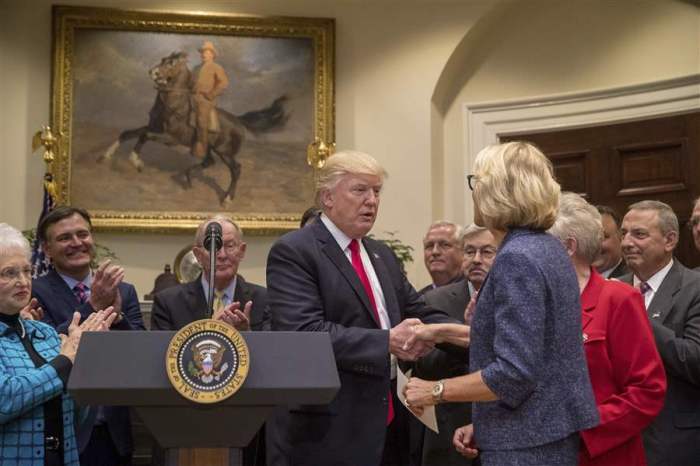
Betsy DeVos attends education meeting at the White House in Washington


Betsy DeVos seems to be confused about her job.


As U.S. Secretary of Education, she is responsible for upholding the civil rights of all U.S. students.


She is NOT a paid lobbyist for the school privatization industry.


Yet when asked point blank by Sen. Jeff Merkley (D-Ore.) whether her department would ensure that private schools receiving federal school vouchers don’t discriminate against lesbian, gay, bisexual, transgender and queer (LGBTQ) students, she refused to give a straight answer.


She said that the these schools would be required to follow all federal antidiscrimination laws but her department would not issue any clarifications or directives about exactly how they should be doing it.


“On areas where the law is unsettled, this department is not going to be issuing decrees. That is a matter for Congress and the courts to settle,” DeVos said at a hearing before the Senate Appropriations Subcommittee on Labor, Health and Human Services, and Education yesterday.


“I think you just said where it’s unsettled, such discrimination will continue to be allowed under your program. If that’s incorrect, please correct it for the record,” Merkley replied.


DeVos did not correct him.


Instead she simply repeated, “Schools that receive federal funds will follow federal law, period.”


Merkley said she was dodging the question.

“I think that’s very important for the public to know, that today, the secretary of education, before this committee, refused to affirm that she would put forward a program that would ban discrimination based on LGBTQ status of students or would ban discrimination based on religion,” he said.


“Discrimination in any form is wrong. I don’t support discrimination in any form,” DeVos replied.


But that doesn’t mean she’ll fight against it.


She held firm to her position that it is not her job as Secretary of Education to fight for students’ civil rights. That is the responsibility of Congress and the courts.


But she’s wrong.


The Office for Civil Rights (OCR) is part of the Department of Education.


According to the department’s own Website, the “OCR’s mission is to ensure equal access to education and to promote educational excellence through vigorous enforcement of civil rights in our nation’s schools.”


There is nothing “unsettled” about that at all. What IS unsettled is how and if the U.S. Constitution allows federal funds to be spent on private schools in any manner whatsoever.


At very least, it has been argued that giving tax dollars to parochial schools violates the establishment clause of the First Amendment guaranteeing a separation of church and state. Moreover, the degree to which voucher schools that don’t explicitly teach religion would have to abide by federal laws about what they can and should do is likewise “unsettled.”


Yet DeVos has no problem advocating for the school privatization industry. In fact, it has been her lifelong calling. As a billionaire Republican mega-donor, that’s exactly what she’s done for years – shoving bundles of cash at candidates and lawmakers to support school vouchers and charter schools.


Someone needs to remind her that that is no longer her role. In her official capacity as Secretary of Education, her job is not to advocate for school choice. But it IS her job to protect students’ civil rights – regardless of the type of school those students attend.


If a school is at all public, she is responsible for ensuring those students’ rights. And receiving public funds makes a school public.


Specifically, she is responsible for ensuring no child is discriminated against on the basis of race, color and national origin, according to Title VI of the Civil Rights Act of 1964.  This includes protecting children who are being treated unfairly due to limited understanding of the English language or who are still learning to speak the language. This includes children experiencing bigotry as a result of their shared ancestry, ethnicity or religion such as Muslims, Sikhs or Jews.


It is also her job to protect children from sexual discrimination as per Title IX of the Education Amendments of 1972.  No matter her own personal conservative views, she must protect pregnant teens or teen parents. And to speak toward Merkley’s point, according to the Department’s Website, this explicitly includes, “…sex stereotypes (such as treating persons differently because they do not conform to sex-role expectations or because they are attracted to or are in relationships with persons of the same sex); and gender identity or transgender status.”


She is also required to be a champion of students with disabilities as per Section 504 of the Rehabilitation Act of 1973 and Title II of the Americans with Disabilities Act of 1990. Moreover, Title II explicitly forbids public entities – whether or not they receive federal funds – from demonstrating any partiality against students with disabilities.


And that’s just the tip of the iceberg. She has to protect against age discrimination per the Age Discrimination Act of 1975 and enforce the Boy Scouts of America Equal Access Act. She is responsible for investigating complaints about equal access to youth groups conducting meetings at public schools and/or that receive federal funding.


To quote the Website, one more time:


“These civil rights laws extend to all state education agencies, elementary and secondary school systems, colleges and universities, vocational schools, proprietary schools, state vocational rehabilitation agencies, libraries and museums that receive federal financial assistance from ED [the Education Department].”


I’m not so sure DeVos understand this – at all.


Nor do I expect her to get much help from the political ideologues she’s using to staff the department.


Take her choice for Assistant Secretary in the Office for Civil Rights, Candice Jackson.


She’s an ANTI-Civil Rights activist. She literally doesn’t believe in the office she’s running.


The 39-year-old attorney is anti-women’s rights, anti-distributive justice and possibly even anti-compulsory education and anti-Civil Rights Act of 1964!


She once filed a complaint against her prestigious college, Stanford University, for discriminating against her rights as a rich, white person by refusing to allow her access to free minority tutoring.


For all its faults, the Barack Obama administration took civil rights seriously. So much so that conservatives often criticized the Democratic organization as being overzealous in the execution of its duties.


The Obama era Education Department issued so many clarifications of the law that it received a record number of civil rights complaints. This required hundreds of additional lawyers and investigators and increasing the civil rights division by 30 percent.


Complaints went from more than six thousand in 2009 to almost ten thousand in 2015. Of these, the largest increase was in complaints of sex discrimination.


However, President Donald Trump has recommended the Department be downsized in his budget proposal.


The Reality TV star would cut the Department’s budget by 13 percent, or $9 billion, eliminating after-school and summer programming for kids and professional development for teachers.  Instead, he would invest $250 million in a school voucher incentive program and an additional $168 million for charter schools.


Also, getting a boost is personal security for DeVos, herself. She is spending an additional $1 million a month for U.S. Marshalls to guard her against protesters.


It should come as no surprise that Trump and DeVos don’t support the mission of the Department of Education. Both have expressed interest in disbanding the office altogether.


In a February magazine interview, DeVos said, “It would be fine with me to have myself worked out of a job. But I’m not sure that – I’m not sure that there will be a champion movement in Congress to do that.”


Likewise, Trump wrote in his 2015 book “Great Again: How to Fix Our Crippled America” that “if we don’t eliminate [the department] completely, we certainly need to cut its power and reach.”


That is exactly what DeVos is doing.


Under Presidents George W. Bush and Obama, it could be argued the Department was guilty of overreach. But Trump and DeVos are going in the opposite extreme.


Someone has to look out for students’ civil rights. That someone has traditionally been the Department of Education. With DeVos abdicating her responsibilities and continuing her role as a school privatization cheerleader, it is anyone’s guess who – if anyone – will step into the void.

Teachers Union President Joins Anti-Union Operative to Praise Charter Schools

Screen Shot 2017-06-02 at 3.53.25 PM


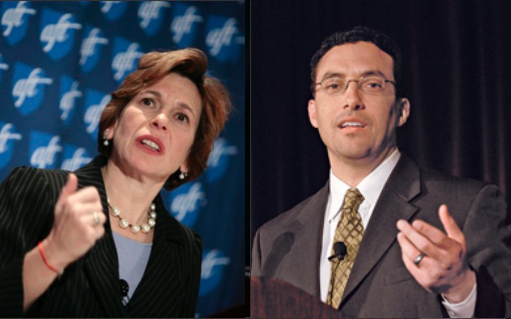
Randi Weingarten must be out of her damn mind!


The president of the second largest teachers union in the country, The American Federation of Teachers, is now writing op-eds with anti-union activists!?

Just this week she authored an article in the Los Angeles Times along with Jonah Edelman.

Perhaps you remember him. He’s the corporate shill who infamously bragged on YouTube about tricking teachers unions into supporting an Illinois law that would have stripped educators of their right to strike while eliminating seniority and due process.

Yes, THAT Jonah Edelman!

And why is she joining forces with a man who has dedicated his life to destroying the lives of the more than 1.5 million people she is supposed to represent!?

To fight school vouchers while pretending charter schools are a much better alternative.

No, I’m not kidding.

In the midst of an article that correctly outlines many of the problems with school vouchers, you’ll find this telling nugget:

“We believe taxpayer money should support schools that are accountable to voters, open to all, nondenominational and transparent about students’ progress. Such schools — district and charter public schools — are part of what unites us as a country.”

So once again we get the false distinction between charter and voucher schools.

Yet they ignore that BOTH are run privately without community input.

BOTH are not accountable to taxpayers.

BOTH are allowed to cherry pick the easiest students to educate and turn away those with special needs.

Yet Weingarten and her new best friend somehow think charters are worlds better than vouchers.

Wrong! They’re BOTH terrible.

Publicly funding privately run schools is nearly the same no matter whether you call them charter, private or parochial schools!

Yet we see Democratic partisans trying desperately to distinguish their cash cow charter schools from the extremely similar golden geese of voucher schools.

It’s a trick. Republicans champion privatized education in all of its forms. Democrats pretend to be discerning by boosting only charter schools.

But there’s really very little difference between these two positions. In each case, these partisan hacks are defending privatization against any and all forms of public education.

Weingarten apparently is even willing to throw the majority of her constituents under the bus to do so!

Charter schools are a failed social experiment. The majority have become merely parasites on traditional public school districts sucking out much needed funding without putting anything of value back.

They result in larger class sizes, a narrowing of the curriculum and more layoffs for the very teachers Weingarten is supposed to represent.

In the rare occasions when charters actually provide good educational value, the law explicitly allows them to change for the worse at any time. The problem isn’t a few bad apples. It’s the concept of charter schools, themselves.

You can’t have a separate level of school competing with its community district and expect the two not to end up harming each other. You can’t allow one school to operate in the dark without hardly any transparency and expect operators not to take personal advantage of it. You can’t allow one school to choose its students without expecting to drastically segregate the community’s children.

Yet here we have Weingarten joining hands with the devil signing a Faustian bargain with the blood of every member of the American Federation of Teachers.

Yes, school vouchers are a bad idea. They violate the separation of church and state. But other than that, they’re pretty much the same as charter schools. If you agree to defend the one while attacking the other, you’re just fighting about what to name the privatized school that will eventually overtake the public ones.

Weingarten should know that.

But this isn’t the first time recently that she’s agreed to hob knob with those salivating over the destruction of her own chosen profession.

Just last month, she went on a field trip to a public school with Betsy DeVos, our Anti-Education Education Secretary.

As parent and teacher activists were physically barring DeVos from entering some public schools, Weingarten was giving her a guided tour!

Some will say that we need to educate DeVos, a Republican mega-donor with next to zero experience of public education and a history of spending billions to destroy public schools. So how did it work out?

DeVos said the school was nice but could benefit from more privatization.

Thanks anyway, Randi.

You can’t make friends with the corporate education reformers.

This was one of the major weaknesses of Democratic Presidential candidate Hillary Clinton. She tried to walk this same divide praising “high quality” charter schools while criticizing those that exploit the system.

In both cases, they’re ignoring the fact that the system was designed EXPLICITLY TO BE EXPLOITED – by charter schools.

This is one of the reasons I’ve been calling for Weingarten and Lily Eskelsen Garcia, President of the National Education Association, to step down.

They aren’t listening to their constituents.

They have both gone rogue. They are playing politics on our dime without giving proper consideration to what’s in our benefit.

Teachers don’t want their national union representatives playing patty cake with those out to destroy us. We want action in the streets! We want activists and resisters, not diplomats and politicians.

It’s time Randi and Lily stepped aside for union leaders who understand what our schools, our students and our profession really needs.

Destroying the Separation of Church and State is Beyond Stupid

religious-fanatic

There is a special place in Hell for those trying to destroy the separation of church and state.


It’s kind of like:


Hey! Let’s turn this country into a Christian version of Iran!


Or:


If only my child’s school was more like a terrorist training camp!


Seriously, what the heck is wrong with you? Torquemada and Osama Bin Laden are not role models of 21st Century education.


But okay. In a way I get it. You’re a Christian fundamentalist, and you’re afraid secular education will turn your child against your faith.


Well, Number One, if your beliefs are so weak that just hearing an alternative will destroy them, then maybe they deserve to be destroyed. And, Number Two, that’s what religious schools are for! Reach into your pocket and pay for your little choirboy or choirgirl to be educated in the church basement. But I’m not using my tax dollars to help indoctrinate your child in whatever medieval mumbo jumbo you believe in.


You think the world was created in six days? You think the sun orbits around the Earth? You think the Earth is flat!? FINE! I’m not going to pay so your kids grow up just as ignorant!


Mixing religion with our public school curriculum is not a good thing.


When my kids take science, I want them to learn things based on empiricism and the scientific method – not whatever “truth” is enshrined in a holy book written before the germ theory of disease. The answer to a question about whooping cough isn’t “God did it.”


The same goes for literature. I want my child to read a wide variety of texts from various points of view, written by people of various faiths, from a multitude of cultures, genders and world views – not just a pantheon of iron age tribal chiefs and a smattering of cloistered feudal monks! I want my child to think about what she’s read and come to her own conclusions – not have “the truth” handed down to her from on high.


And when it comes to social studies, I want my child to understand history and government without the biases of the right wing taught as if they were the only logical ways to organize a society. I want my child to be a good citizen with a working knowledge of how government functions complete with a catalogue of the errors of past centuries. I don’t want my child molded to think a certain way and only that way so that she’ll vote a certain way and only that way.


Oh, and math? That’s just for boys.


It’s ironic that the advocates of school vouchers often couch their arguments in the language of liberty and choice when they’re really advocating for the elimination of those very things.


This isn’t about school choice. It’s about eliminating my child’s right to free thought. It’s about society pumping out a generation of religious zealot clones to feed the polling places of one political party so that they’ll vote against their own interests and keep the rich and powerful gobbling up 99% of the wealth.


But shouldn’t kids be allowed to talk about religion in school?


Sure. And they can and do right now in public school.


There is nothing to stop children from discussing their views about God and religion in school. They can even pray. No one will discriminate against them for it. That’s their right.


The only prohibition is against a religious discussion or prayer conduced by a teacher. When my students bring up God during a class discussion – and it happens – I let them talk. If they ask my views, I politely decline. I might say that some people believe this or some people believe that. But I never say what I believe.


Why would you want anything different? Do you really want teachers forcing their faith (or lack of faith) on your children? I suppose if you choose exactly the kind of school with teachers who think exactly like you, then this doesn’t matter. But isn’t it better to let kids figure out their own theologies perhaps with help from you, their parents?


When it comes to facts, an education professional is just what the doctor ordered. When it comes to opinions – and faith is the ultimate opinion – children should be free to think for themselves. If you want a religious leader to lend his or her normativity, that’s up to you. But don’t step on other parents who have different worldviews, cultures, faiths.


And please don’t give me this crap that the words “separation of church and state” don’t appear in the Constitution. Neither do the words “self-protection” appear in the Second Amendment, but you still cling to your guns on the excuse that they keep you and your family safe.


The separation of church and state is a long-standing interpretation of the establishment clause of the First Amendment to the U.S. Constitution. It has been upheld time and again. You may call yourself a “conservative” for going against it, but actually you’re the very definition of a radical. It is I who is being conservative in defending it.


Thomas Jefferson wrote, “In every country and in every age, the priest has been hostile to liberty. He is always in alliance with the despot, abetting his abuses in return for protection to his own.”


The same can be said of those with torches and pitchforks gathered around the separation of church and state. They seek no freedom other than the freedom to discriminate against those unlike themselves.


They are our racists, sexists and xenophobes. They are those prejudiced against anyone who thinks thoughts unsanctioned by their clergy. They seek to pour cement over the social structure and keep it in place with ignorance.


We must fight them to our last breath because if they win… God help us!

Why Care About Other People’s Children

health-kids-smiling

As a vocal critic of charter and voucher schools, one of the most frequent questions I get from readers is this:

“Why should I care about other people’s children?”

One reader put it this way:

“Why should my child’s education and safety have to suffer because of difficult and violent students? …it isn’t my responsibility to pay for a miscreant’s education.”

The question says more than any answer could.

It shows quite clearly that school choice is an essentially selfish position.

That’s why some folks champion privatized education – they only care about their own children. In effect, when a parent sends their children to a charter or voucher school, they are telling the community that they don’t care what happens to any one else’s kids so long as their kids are properly cared for and educated.

It is the root cause of most of our problems in education today and has nothing to do with children. It’s all about adults – adults lacking empathy.

On the one hand, I get it. As a parent, you can’t help but love your child more than anyone else’s. You would beg, cheat and steal to make sure your child has enough to eat, is clothed and sheltered, has everything she needs to succeed in this world.

That’s a position for which few would show any embarrassment. It’s just being human.

But it shouldn’t also mean that you don’t care at all for other children.

I’d like to pose a radical thought – loving my child does not mean I’m indifferent to yours.

Children are innocent. They haven’t done anything to earn the hate or enmity of the world. They see everything with fresh eyes. Many of them haven’t even learned the prejudices and ignorance of their parents. And even where they have, it is so new it can be changed.

When you look at a babe in arms do you feel the same indifference? I don’t.

Perhaps it’s just the way we’re built. I feel an immediate nurturing instinct. I want to protect and provide for children – any children – even if they’re not mine.

If you saw a baby all alone crying on the side of the road, would you stop to help her? I would. I couldn’t help it. I can do no other.

If I saw a toddler in distress, a tween, even an unruly teenager in need, I would try to help. And I think most of us would do the same.

Doing so wouldn’t hurt my child. In fact, it would show her how a decent person acts towards others. It would teach her empathy, kindness, caring. It would demonstrate the values I try to instill in her – that we’re all in this together and we owe certain things to the other beings with which we share this world.

Why would you not want to do that?

We do not live in a world where you have to choose between your child and all others. There is a middle course. We can do for all society’s children without unduly sacrificing our own.

And if we can, why wouldn’t we?

Public school is essentially a community endeavor. It is an attempt to give everyone in your neighborhood the same start, the same opportunity, the same advantages.

It means allowing all children who live in the community the ability to attend the community school. That’s better than selecting the best and brightest and to Hell with the rest.

It means the community pooling its wealth to help all students. That’s better than dividing that pool up and pitting one group against another so that some get what they need and others don’t.

It means having an elected school board who holds public meetings, deliberates in the open and has to offer almost all documents to the light of day. That’s just better than an appointed board of directors who hold private meetings behind closed doors and who aren’t compelled to show any documentation for how they’re spending public tax money.

When you send your child to school – any school – she will have to deal with other students. She will meet children who are mean, unkind, unruly and a bad influence. But this is true at all schools – public and private, voucher or charter, secular or parochial. The biggest difference is racial and economic.

Our educational institutions today have become so segregated by class and race that even our public schools offer white middle class and wealthy students the opportunity to learn in an environment nearly devoid of children of color or children who live in poverty. This divide is drastically widened by charter, private and parochial schools.

So when people complain about the class of children they want to keep separate from their progeny, it is always imbued with a racist and classist subtext.

What they mean is: I don’t want my child to have to put up with all those black students, all those brown children, all those unwashed masses of impoverished humanity.

I proudly send my daughter to public school for the same reasons that many withhold their children from it. I want her to experience a wide variety of humanity. I want her to know people unlike her, and to realize that they aren’t as different as they might first appear. I want her to know the full range of what it means to be human. I want her to be exposed to different cultures, religions, nationalities, world views, thoughts and ideas.

And I want it not just because it’s better for my community – I want it because it’s better for her, too.

I want my daughter and I to both live in a world populated by educated citizens. I want us both to live in a society that treats people fairly, and where people of all types can come together and talk and reason and enjoy each other’s company.

Only under the most extreme circumstances would I ever subject her to charter, private or parochial schooling. And things would have to come to a pretty pass for me to home school her.

Imagine! Thinking I could offer my child all the richness of a public school experience, all the knowledge of a district’s worth of teachers, all the variety of social contact – how vain I would need to be to think I could do all that, myself!

Some people want their children to become little versions of themselves. They want to create a generation of mini-me’s who’ll carry on their way of thinking into the future.

That’s not my goal at all.

I want my daughter to share my core values, I want her to learn from my experiences, but I don’t want her to think like me at all. I want her to be a new person, special and unique.

I want her to be her.

If you stop and think about it, that’s what most of us want for our children.

It’s a common goal that can be achieved with a common mechanism.

So why should we care about other people’s children?

Because it’s better for ours. Because doing so makes us better people. Because all children are ends in themselves. Because they’re beautiful, unique sparks of light in a dark universe.

If those aren’t reasons enough, I can’t help you.

Hero of New CW Action Series to be a Charter School Principal

black-lightning-in-costume-in-first-look-of-the-cw-s-new-series


Charter schools are incredibly contentious.


They serve about 7% of American students, but siphon away funding from traditional public schools serving the majority of the population.


They are rife with scandals: Many close suddenly without warning. They often hire teachers without certifications from accredited universities. Administrators have been known to buy yachts and expensive gifts with tax dollars meant to educate children. They cherry pick the easiest students to educate and kick out the most difficult.


And that just scratches the surface!


Why would you want to purposefully set your action adventure series there!?


That’s exactly what the CW has done with its new series Black Lightning.


The network released an extended description for the show today in an announcement for its fall schedule:


“Jefferson Pierce (Cress Williams) is a man wrestling with a secret. As the father of two daughters and principal of a charter high school that also serves as a safe haven for young people in a New Orleans neighborhood overrun by gang violence, he is a hero to his community…”


To which I can’t help but wonder, “WHY!?


Why, CW!? Why put your hero at the head of a charter school?


In the original DC comic book on which this television series is based, Pierce is a principal at Garfield High School in the fictional city of Metropolis.


When the writers moved the setting to New Orleans and made the hero a charter school principal, they were making purposeful changes to the mythology.


Why?


What does it add to the series with the inclusion of this extra detail?


Yes, Jefferson Pierce is African American. It’s about time we have more black super heroes. Marvel did an amazing job with its Netflix show based on Luke Cage, a character also created by writer Tony Isabella.


But charter schools are not uniquely black. The National Association for the Advancement of Colored People (NAACP) issued a moratorium on charter school expansion just last year. The national civil rights organization has been publically critical of charter schools’ impact on children of color since 2010.


Specifically, the resolution states:


“…the NAACP opposes the privatization of public schools and/or public subsidizing or funding of for-profit or charter schools…”


“…the NAACP calls for full funding and support of high quality free public education for all children…”


The resolution goes on to oppose tax breaks to support charter schools and calls for new legislation to increase charter school transparency. Moreover, charters should not be allowed to kick students out for disciplinary reasons.


Yet THIS is where the CW decides to set its Sci Fi/Fantasy series!?


Perhaps the writers wanted to place the action in historic New Orleans, a city that has had almost nothing but charter schools since Hurricane Katrina.


But this is far from a success story.


After one of the worst natural disasters to hit the US in decades, the state fired almost all of its public school teachers, disbanded almost all local public school districts and reopened them as charter schools. New Orleans is now the only nearly all charter school city in the country.


Though supporters claim that this has resulted in increased test scores and graduation rates, the city’s schools cannot honestly be described as having turned around.


The district is still the fourth lowest performing educational institution in the country. Moreover, when compared with traditional public school districts in the state and controlling for factors like race, ethnicity, and poverty, New Orleans charter school students do much worse academically. For instance, on eighth-grade reading and math tests, charter-school students performed worse than their public-school counterparts by enormous margins—2 to 3 standard deviations.


These are the largest gaps between public and charter schools in the nation!


And that’s not all! Before becoming an all-charter district, the city had a substantial amount of teachers of color. Now they’re mostly gone.


This is where your escapist superhero fantasy is taking place?


New Orleans charter schools are notorious for strict discipline policies where students describe feeling like they’re in prison.


You want your hero to be a principal HERE!?


Teachers and parents describe feeling demoralized and ignored. They filed a federal civil rights complaint in 2014 and still pine for the community schools they experienced when they were children.


And this is where you’re shooting your action adventure series?


I can’t help but wonder why the CW would greenlight such an irresponsible drama.


Perhaps Black Lightning will fight to turn his nefarious charter school back into a traditional public institution with an elected school board, public meetings and sensible regulations.


Other than that, I cannot imagine why any sane television network would actively decide to champion school privatization.


In the original comic book, Pierce eventually was made Secretary of Education by President Lex Luthor. Perhaps the CW is drawing a parallel between their hero and our current Education Secretary Betsy DeVos.


President Donald Trump certainly brings to mind the super-villain Luthor – except that Luthor is known for being an evil genius and Trump is only known for one of those things…


But why would you want to associate your superhero with the most unpopular Education Secretary in history. DeVos only got her position after a split Senate confirmation and a tie-breaking vote by Vice President Mike Pence. She has been publicly booed at a graduation ceremony at an all black college where she spoke. Parents and protesters have physically stopped her from entering several schools.


You want us to associate your hero with THAT!?


Full disclosure, I love CW’s superhero line-up. The Flash is delightful Sci-Fi fun. Arrow is escapist vigilante justice. Supergirl is girl power drama. Legends of Tomorrow is time travel fun.


But what the heck will Black Lightning be!?


Moreover, I loved Netflix’s Luke Cage. I think it was one of the best Marvel superhero series – something that transcended the genre and seemed to be addressing authentic social issues like the Black Lives Matter movement, police brutality, etc.


I can’t imagine how Black Lightning would do any of that.


Having a political subtext can elevate a TV show and put it in the center of the cultural zeitgeist. But it has to be done with sensitivity and intelligence.


Having CW’s hero be a charter school principal is a ham-handed nod to school privatizers and equity managers. Audiences want someone who fights for the underdog – not investment bankers.


I just don’t get it, CW.

Charter Schools and Voucher Schools are Virtually Identical

Screen shot 2017-05-17 at 8.30.20 PM

The stark orange monolith that was Donald Trump is starting to crumble.

And with it so are the dreams of corporate education reformers everywhere.

Where in previous administrations they could pass off their policies as Democratic or Republican depending on whichever way the wind blows, today their brand has been so damaged by Trump’s advocacy, they fear it may never recover.

Under Presidents George W. Bush and Barack Obama, they could champion both charter schools and school vouchers with impunity. But now the privatizers and profiteers hiding in progressive clothing are trying desperately to rebrand.

Not only is Trump’s voucher plan deeply unpopular, but the public has already begun to associate any kind of school privatization with a doomed President.

So like cockroaches, neoliberals have begun to skitter to one type of privatization over another. Fake Democrats hide beneath unfettered charter school expansion. Bought-and-sold Republicans cling to the idea that we should spend taxpayer dollars on private and parochial schools.

But is there a real substantial difference between each of these so-called “choice” schemes? Or are they both just scams when compared with traditional public schools?

THE DIFFERENCES

Charter Schools and Private Schools are basically the same thing.

The biggest difference between the two is funding.

Charter schools are completely funded by tax dollars. Private schools – even when school vouchers are used – often need to be subsidized by parents. For instance, many private schools charge tuition of $30,000 – $40,000 a year. Vouchers rarely provide more than $6,000. So at best they bring the cost down but still make it impossible for most students to attend private schools.

Sure they may start as an effort to allow only impoverished children to use tax dollars towards private and parochial school tuition. But they soon grow to include middle class and wealthy children, thus partially subsidizing attendance at the most exclusive schools in the country for those families who can already afford it.

Parochial schools, meanwhile, are exactly the same except for one meaningful difference. They teach religion.

Their entire curriculum comes from a distinctly religious point of view. They indoctrinate youth into a way of seeing the world that is distinctly non-secular.

Progressives complain that using tax dollars to pay for student tuition at such schools – even only partial tuition – violates a foundational principal of our nation.

Using public money to pay for religious teaching has historically been interpreted as a violation of the establishment clause of the first Amendment to the Constitution – namely, “Congress shall make no law respecting an establishment of religion, or prohibiting the free exercise thereof…” Thomas Jefferson called it “a wall of separation between Church and State.”

This is further exacerbated in many parochial schools where religious teaching includes a blatant political bias toward conservatism. Children at many of these schools are taught that supply side economics, voter disenfranchisement and prejudice are normative bedrock truths.

These are the main distinctions between voucher and charter schools.

In short, they’re not all exactly the same. And corporate reform apologist are trying to rebuild their brand on these split hairs.

But the similarities between these types of school are much more striking.

THE SIMILARITIES

The biggest commonality between these types of educational institutions is how they’re run. Unlike traditional public schools – which are governed by duly-elected school boards – charter, private and parochial schools are overseen by private interests. They are administered by independent management firms. They rarely have elected school boards. Their operators rarely make decisions in public, and their budgets and other documents are not open to review by taxpayers. This is true despite the fact that they are funded to varying degrees by public tax dollars.

So in all three cases, these schools are run privately, but taxpayers pick up the tab.

It’s ironic. Sending kids to charters, private and parochial schools with public money is called school choice. However, each of these types of schools gives taxpayers much less choice about how their money is being spent.

The community funds the school, but almost all decisions are made by people outside of the community – people appointed, in fact, by bureaucrats or business managers.

To be sure, parents can express their displeasure of administrative decisions by disenrolling their children in the school. But beyond this nuclear option, they are powerless. Even more troubling, taxpayers without children or with children who do not attend these schools have no say whatsoever about how their money is spent.

And to add insult to injury, it doesn’t even really allow the parents to choose which schools their children attend. They can put in a request for their kids to attend a choice school, but enrollment decisions are made by these same private equity managers. In short, administrators make the ultimate choice – not parents.

If the religious school doesn’t want to accept your child for whatever reason including operators’ disapproval of your religious beliefs, they don’t have to accept him. If the private school doesn’t want to accept your child based on race, gender or nationality, they don’t have to accept him. If the charter school doesn’t want to accept your child because of bad grades or troublesome behaviors, they don’t have to accept him.

The traditional public school, however, cannot refuse a child who lives in district borders for any of these reasons. In effect, school choice really isn’t about parental choice. It’s about increasing choice for the operators of privatized schools – letting them choose their students and how to spend your money without any meaningful input from you.

And it’s true at all three types of school!

Those are pretty considerable similarities. Moreover, they highlight major differences between these so-called choice schools and traditional public schools.

This is important because we don’t even have to get into the academic records of individual schools. The way each type of school is structured shows the clear inferiority of choice schools compared to traditional public schools.

By their very structure, public schools give parents and taxpayers much more agency in children’s education and how taxpayer money is spent.

Second, the latitude for school administrators to perpetrate fraud on the public is maximized in so-called choice schools and minimized in public schools. This doesn’t mean public schools are perfect, but it is much better to have a school under public scrutiny and local control than otherwise. This is demonstrated by the huge numbers of charter school scandals popping up in the news every day, where charters close suddenly, money is misspent on luxury items for operators that have nothing to do with education, and – especially in cyber charters – the quality of education students receive is literally lower than having no formal education at all.

Finally, if public schools struggle, it is almost always due to a lack of equitable funding and a surplus of impoverished students. It is no accident that poor students receive less resources and larger class sizes than middle class or wealthy ones. Nor is it an accident that we judge the effectiveness of schools primarily on standardized tests which are so good at highlighting the results of lack of resources rather than any academic deficiency.

If we spent our education dollars ensuring equitable resources instead of funneling tax dollars to charter, private and parochial schools, we would better increase the quality of children’s education. But for the last few decades that has not been the goal of education policy. It has instead been to enrich these same privatized school managers and investors – the corporate education reform industry. Nor is it a coincidence that this industry and its subsidiaries counts itself as major donors to both political parties.

Before she was elevated to Education Secretary, Betsy DeVos was exactly that – a billionaire mega-donor pushing school privatization while getting richer off investments in the same. Now that she’s driving school vouchers off a cliff in the Trump train, her co-conspirators are getting nervous.

Neoliberal Democrats may try to save the movement by claiming charter schools are completely different. But they aren’t. They are fundamentally the same.

The public sees the clear similarities between these kinds of schools. And much of that is thanks to the incompetent boobery of Donald J. Trump.

Don’t Trash the Department of Education. Fix It.

thumbnail_Screen Shot 2017-04-26 at 2.52.28 PM

How do you get people to refuse a helping hand?

Answer: Prove to them that it’s not helping.

That’s the strategy of the Trump administration in regard to his cabinet of billionaires. The Reality TV star turned President has nominated a series of out-of-touch and unqualified one percenters to head various federal government agencies.

Rex Tillerson, Rick Perry, Ben Carson – Each of these silver spooned numbskulls was put in place to “prove” to the American public how inane and useless the federal government is – by making the federal government inane and useless.

Nowhere is this more obvious than the Department of Education with its Republican mega-donor turned Education Secretary, Betsy DeVos.

DeVos has spent her entire adult life buying off mostly Republican lawmakers throughout the country to destroy public schools and replace them with charter, private and parochial schools.

She is a self-inflicted cancer on the system, a know-nothing religious zealot who spouts more factually challenged whoopers than Sean Spicer and Donald Trump combined.

But the endgame for putting a person who barely ever walked into a public school in charge of nationwide public school policy is clear – she’s there to demonstrate why the department should be disbanded.

With every idiotic statement, every Unconstitutional policy suggestion – she’s a corporate sponsored demo of why we need to trash this cabinet position altogether.

This has been the conservative dream since President Ronald Reagan. How dare his Democratic predecessor Jimmy Carter create a Department of Education, in the first place! Not only did Ronnie, the B-movie actor turned chief executive, have to defeat Carter, he needed to erase all of his predecessor’s policies. (Sound familiar? [Cough!] [Obamacare!] [Cough!])

And with Betsy DeVos’ help, Trump may finally get to realize Reagan’s dream.

To be fair, President George W. Bush did his fair share to make the department unpalatable. And so did Barack Obama!

Under Carter, the department was an extension of the Elementary and Secondary Education Act (ESEA) of 1965, which tried to bring equity to America’s public schools. However, Bush transformed it into No Child Left Behind, a blatant federal power grab changing the focus to high stakes standardized testing and punishing schools that taught poor children.

Obama took this terrible legislation to its inevitable conclusion and transformed the Department of Education into a bribe factory, dangling federal help before impoverished schools only if these schools would spend it on test prep, edutech software and Common Core. Never mind that these “reforms” don’t actually help children. It was all about helping the corporations behind them.

Much of the modern zeitgeist behind the continued movement to disband the department comes from authentic bipartisan opposition to these changes. The modern Department of Education hasn’t been much of a helping hand for almost two decades. It’s been a cruel taskmaster and a money laundering service for the publishing and testing industry. And it’s overstepped its federal authority coercing states to do as Washington bureaucrats (or at least their wealthy donors) demand.

Add to that the new wrinkle of DeVos – a representative who is all of those things but also transparently self-serving and – frankly – stupid.

No wonder people want to disband the department!

It’s a rallying cry that’s not hard to get behind. Unless you think about it for two minutes.

Because it’s not the Department of Education that’s the problem. It’s what we’ve done to it.

The department has a vital and important role to play in making sure our system of public education serves everyone. Speaking in broad terms, the department should be dedicated to these three things: ensuring public schools are being properly funded, student and parent civil rights are not being violated and to be a repository for national data and research.

These are incredibly important. Right now we have one of the most inequitable school funding systems in the world. The majority of public education funding comes not from the federal government or the states, but from individual communities. If you live in a poor neighborhood, your kids get less education funding. If you live in a rich neighborhood, your kids get more. This is why the nearly 50% of all public school children living in poverty are struggling academically – we aren’t providing them with the resources to succeed.

The state and federal government could be doing something about that. At the federal level, the department of education oversees billions of dollars in grants to poor schools. Admittedly much of that money is tied to standardized testing and other corporate education reforms. We should cut those ties. We should provide help for proven, authentic education practices freely chosen by these districts. That’s something that could have a huge impact on student success. And it’s a project we should expand, not destroy under draconian budget cuts or the closure of the department.

Second, we have to admit that parents’ and students’ civil rights are often in jeopardy. This means special education students seeking an appropriate learning environment and modifications. This means students being discriminated against because of their religious beliefs or lack thereof. This means minority students facing disproportionate discipline policies, unfair grading and/or lack of opportunities offered to other racial or ethnic groups. This means women and transgender students suffering discriminatory dress codes or bathroom policies. In short, it means that someone needs to be the moderator and protector of student and parent rights.

And finally, there needs to be a repository of national student data. This has gotten a negative connotation lately because of Bush and Obama’s incredibly permissive policies allowing edutech companies to collect a horde of student data for economic purposes. Let me be clear: The department shouldn’t be doing that at all. Student privacy should be respected. Computer programs and apps should not collect sensitive information about individual students to be sold to advertisers or used to market products to them.

But there is an incredible amount of aggregate information about student groups collected by the federal government that could be used to help improve the lives of students. This includes information on the racial proficiency gap and the amount of resources provided by states and municipalities. Moreover, we need an impartial entity to fund educational research about which reforms actually help students learn. Relying on corporations to fund research that “proves” the efficacy of their own products is not good science.

In short, disbanding the Department of Education would be a disaster. What would happen to Pell Grants, for instance? What would happen to the bundles of federal money that boost our public schools? Who would make sure states are doing their jobs? Where could we go to find accurate data about how our schools are doing nationally and not just state-by-state?

If we got rid of the department, at best these jobs would fall back on other government agencies that haven’t the funding, staff or ability to accomplish them. More likely, it would result in the elimination of billions of education dollars that the states simply couldn’t (or wouldn’t) replace. Abuses against students on the grounds of civil rights, gender, special education, etc. would skyrocket with little to no recourse. And we would be in the dark about how well we were educating our nation’s children.

I sympathize with those who wish to make government more efficient, but the Department of Education is not a place to make cuts. If you really wanted to close an unnecessary federal department, start with the most recent one – the Department of Homeland Security. Nowhere else is there a more obvious duplication of services and waste of tax dollars to provide a service that was already being provided. But you never hear anyone suggest we close this department because (1) it was proposed by a Republican, and (2) as a nation, we have a broad, bipartisan priority on the safety of our citizens.

If only we had the same for public education!

But we don’t. In fact, many conservatives scoff at the very idea of public schools on the grounds that it’s “socialism” – as if social security, Medicare and a standing military were not!

Too many people have bought into the lie that there is something unAmerican about public school. On the contrary, our system is implicit in our very form of government and the flower of our founding fathers’ thoughts.

The rich and powerful don’t want a robust system of public education because it goes against their interests. An informed, thinking public is harder to control. They especially don’t want minorities or the poor to be well-educated because once people realize how much they’re being exploited, they won’t continue to submit to the status quo.

In short, the Department of Education needs to change. It needs to be revitalized from the ground up. And DeVos is not the person to do it.

However, we shouldn’t let her incompetence make us throw it all away. We need to find ways to agitate, resist and survive the Trump administration while preserving as much as we can of our Democracy – and our sanity – in the process. We need to find and support prospective lawmakers and public servants who will actually represent us, the people, instead of Trump’s billionaire buddies. We need a robust, grassroots movement to take back our government.

And then we can begin the hard work of making our government work for us again. Part of that will involve the Department of Education.

Trump Can’t Limit Federal Role in Public Schools AND Push School Vouchers

Trump-5-2

Donald Trump is talking out of both sides of his mouth.

Again.

This time he’s signing an executive order demanding the Department of Education study how the federal government oversteps its legal authority with regard to K-12 schools.

Yet he still proposes bribing states with $20 billion in federal funds to enact school vouchers.

Well which is it, Oh Orange One?

Are you for limiting the federal role in education or for coercing states to do your bidding?

Because you can’t be for both.

Either states and local districts determine the bulk of their school policies or not. You can’t barge into our state capitals promising billions of dollars in federal tax money if and only if we enact your chosen reforms.

That’s one of the primary reasons many conservatives (and even a sizable number of progressives) oppose Common Core. The Obama administration promised billions of dollars in Race to the Top grants if and only if states adopted these new, untried academic standards.

How is Trump’s voucher scheme any different?

In both cases, the proposed education reform has not been proven to work, and it’s not being requested by the education community or voters. In fact, when it comes to vouchers, voters have repeatedly turned them down in referendum after referendum.

So if Trump wants to investigate federal overreach, he should start with his own campaign speeches on vouchers.

So why is the former Realty TV star doing this?

Well, his first hundred days are almost up, and he has next to nothing to show for it. Other than uniting the American people against him, President Con Man hasn’t achieved much. One can imagine why he might want to hurry up and toss off yet another executive order so he could put something – anything – in the achievement column.
But there’s a more insidious reason why the founder of Trump University took out his signing pen.

His administration – especially his Department of Education – is particularly inimical to civil rights.

Just look at the brain trust he has running it.

Secretary Betsy DeVos isn’t sure the department should be in the business of protecting special education students. Nor is she willing to take a stand to protect transgender kids.

Latest hire Deputy Assistant Secretary Candice Jackson has repeatedly expressed skepticism about the very existence of civil rights. The 39-year-old attorney is anti-women’s rights, anti-distributive justice and possibly even anti-compulsory education and anti-Civil Rights Act of 1964!

In college, she thought she, herself, was being persecuted because a tutoring group set up for minorities wouldn’t serve her as a white person – despite the fact that she could probably afford to pay for her own damn tutoring.

So this latest “study” into federal overreach is probably an attempt by the Trump administration to justify doing nothing to protect the civil rights of students across the country.

Under President Bad Hair Day, special education students can be denied services with impunity. It’s not the federal government’s job to step in. THAT would be overreach.

And if black and brown students don’t receive the same resources and opportunities as their white counterparts, there’s just nothing the Trump administration can do. They don’t want to step over the line.

It’s not that The Donald doesn’t sympathize with transgender students denied access to bathrooms that correspond with their gender. Ivanka even gave him a stern talking to. It’s just that his tiny little hands are tied. Thems the limits of federal authority, Son.

If you ask me, that’s truly the impetus behind this executive order.

He’s just setting up his next excuse for giving us, the American people, zero return on our tax dollars.

That way he can just shrug and offer more tax cuts to the rich.

Sadly, there is truth to the claim that the Department of Education has overstepped its authority. Both Presidents George W. Bush and Barack Obama frequently usurped states and communities local control. No one was crying out for high stakes testing, more test prep material, and unregulated charter expansion. But that’s what we got!

If you’re looking to Trump to balance the scales, look somewhere else!

He has given no indication that he will be any different. He’ll still push his own agenda on us, but he’ll pretend like we asked for it.

Now that’s the Donald Trump we know best!