I Am Not A Hero Teacher

Screen Shot 2017-08-01 at 10.53.52 AM


I’m sorry.


I am not a hero teacher.


I am not stronger than a locomotive.


I cannot jump tall ignorance in a single bound.


I am not faster than a tax-cutting zealot.


Up in the air – it’s a bird, it’s a plane, but it’s certainly not a teacher because we can’t fly.


I am not bullet proof.


If a gunman storms the building and shoots me, I will be wounded and may die.


Giving me a gun doesn’t help, either, because I am not a marksman.


I am just a man.


I cannot stand in front of a class of thirty and give them each my undivided attention. Not all at once.


When students ask a question, I need time to answer it.


When students hand in a paper, I need time to grade it.


During the workday, I need time to plan my lessons. I need time to call parents. I need time to read all the individual education plans, fill out all the weekly monitoring forms, finish all the administrative paperwork.


At the end of a long day, I get tired and need rest.


At the end of a long week, I need time to spend with my family.


At the end of a long year, I need time to myself – to get a summer job, to take continuing education courses, to plan for next year, to heal.


I need a middle class income – not because I’m trying to get rich, but because I’m human. I need food and shelter. I have a family for whom I need to provide. If you can’t give me that, I’ll need to move on.


Sorry, but it’s true.


I’ll tell you one thing I don’t need. I don’t need the state, federal or local government telling me how to do my job. When I plan my lessons, I need the freedom to teach children in the way that seems most effective to me – the professional in the room.


I also don’t need some bureaucrat telling me how to assess my students. I don’t need some standardized test to tell me what kids have learned, if they can read or write. I’ve spent an average of 80 minutes a day with these children for five days a week. If I can’t tell, I don’t deserve to be in the classroom.


And I don’t need my principal or superintendent setting my colleagues and me against each other. We’re not competing to see who can do a better job. We should be collaborating to make sure everyone succeeds.


What do I need? My union, for one.


I need my right to collective bargaining. I need the power to gather with my colleagues and co-workers so we can create the best possible work environment for myself and my students. I need due process, tenure, so I can’t be fired at the whim of the school board or administrators without having them prove my inequities.


I need my work to be evaluated fairly. Judge me on what I do – not on what my students do with what I’ve given them.


And when it comes to the racial proficiency gap, don’t look to me to exert some kind of supernatural teacher magic. I am not a white savior who can make school segregation, racism and prejudice disappear. I try to treat every student fairly, but my actions can’t undo a system that’s set up to privilege some and disadvantage others.


I guess what I’m trying to say is that if you’re expecting a superhero, I’m bound to disappoint.


And that DOES seem to be what many of you expect us to be.


Seven years ago, Davis Guggenheim characterized the public schools as if we were Waiting for Superman.


Things are so screwed up, he alleged back then, that we need someone with superpowers to swoop in and fix it all.


But there is no superman. There’s just Clark Kent.


That’s me – a bespectacled shlub who shows up everyday in the naive hope that he can make a difference.


According to landmark research by Dan Goldhaber and James Coleman, only about 9 percent of student achievement is attributable to teachers.


That’s right – 9 percent.


If you add in everything in the entire school environment – class size, curriculum, instructional time, availability of specialists and tutors, and resources for learning (books, computers, science labs, etc.), all that only accounts for 20 percent.


There’s another 20 percent they can’t explain. But the largest variable by far is out of school factors. This means parents, home life, health, poverty, nutrition, geographic location, stress, etc. Researchers estimate those count for 60 percent of student success.


Yet we somehow expect teachers (9%) to do it all.


I’m sorry, America. I can’t.


More than half of all public school students live in poverty. No matter how hard I try, I cannot solve that all by myself.


I try to teach children how to read though many are hungry and traumatized by their home lives.


I try to teach children how to write though many haven’t slept the night before, haven’t taken their ADD medication and – to be honest – many haven’t even shown up to school yet.


I most certainly try to get them to pass culturally biased, developmentally inappropriate standardized tests without sucking away every bit of creativity from the classroom.


But much of this is beyond my control.


I can’t help that the federal, state and local government are cutting school funding. I can’t help that my impoverished district has few school supplies, the students enter the building without them because their parents are too poor to buy them. But I can – and do – spend out of my own pocket to make sure all of my students have pencil, paper, whatever they need.


I can’t help that officials at every step of the way want me to narrow my teaching to only things that will appear on the yearly standardized test, that they want me to present it as a multiple choice look-a-like item, that they want me to teach by pointing at a Common Core standard as if that held any meaning in a child’s life. But I can make the lesson as creative as possible and offer kids a chance to engage with the material in a way that connects to their real lives, desires and interests.


I can’t help that kids don’t read like they used to and instead experience the bulk of text on the Internet, Facebook or Twitter. I can’t help that most of their real world writing experience is limited to thumbing social media updates, comments on YouTube videos or communicating through a string of colorful emojis. But I can try to offer them meaningful journal topics that make them think and offer them the chance to share their thoughts in a public forum with their peers.


There’s nothing super about any of it.


But it’s the kind of things teachers do everyday without anyone noticing. It’s the kind of thing that rarely gets noted on an evaluation, rarely earns you a Thank You card or even an apple to put on your desk.


However, when the day is done, students often are reluctant to leave. They cluster about in the hall or linger in the classroom asking questions, voicing concerns, just relieved that there’s someone there they can talk to.


And that’s reason enough for me to stay.


The odds are stacked against me. Help isn’t coming from any corner of our society. But sometimes despite all of that, I’m actually able to get things done.


Everyday it seems I help students understand something they never knew before. I’ve become accustomed to that look of wonder, the aha moment. And I helped it happen!


I get to see students grow. I get to nurture that growth. I get to be there for young ones who have nobody else.


It’s a wonderful feeling.


I know I’m making a difference.


So, yes, I’m no superman.


I have no special powers, no superhuman abilities. I can’t fix all of our social problems all by myself.


But I help to make the future.


That’s why I do what I do.


Thank you for letting me do it.

Who’s More Valuable – a Union Busting Lawyer or a Union Worker?

man-laughing-loudly-300

There he was standing in front of me in line.


New gray pinstriped suit. Silk red Armani tie. White button down shirt so bleached it hurt my eyes.


We were waiting to board our plane to take us to Houston. Me, a public school teacher. Him, a union busting lawyer.


I was on my way to an education and civil rights summit. He was going to an annual lawyers conference, one of many he attends each year.


I got all this information not from talking to the guy. He was jovial enough but he just couldn’t contain his backstory to a single audience. He was in the mood to talk to anybody and everybody as we waited for the stewardess to tell us it was okay to board.


He spent most of his time talking with two representatives of the natural gas industry who had visited my home of Pittsburgh to invest in our rich deposits of Marcellus shale – and incidentally poison our environment. He also joked with another lawyer further up in line and already tipsy.


I listened to him yuk it up about exclusive golf courses, wine country and the presidential election (he’s a Trump supporter) and felt a warm dislike spread through my chest.


I looked at my faded t-shirt and jeans and wondered how it was that this guy gets so much for what he does and I get so little. Oh I get all the intangibles, but he gets… well… the money, pride and prestige.


There he was asking the gas guys about a good steak place for lunch in Houston. I love steak. I’d like to eat a nice, juicy steak. But I can’t afford it.


I’m only able to make this trip because I took the least expensive flight (coach, by the way – guess where he was sitting) and I was sharing a hotel room with a college professor who had saved up enough discretionary funds to cover the room.


While the attorney was dining on steak, I’d be lucky to store up a muffin or two from the hotel’s complimentary breakfast.


Yet there he was telling the whole world his story unafraid that someone would take offense.


Well, I do take offense, buddy.


You make your living finding ways to make it harder for me to make mine. You spend your whole day looking for legal loopholes and documented precedents to take away protections at my job, cut my pay and make me work longer hours without overtime. You eat at expensive restaurants and wear Italian leather shoes while people like me live paycheck-to-paycheck. You are nothing but a parasite.


Yet no one else seemed to take offense at his braggadocio. Only me. The natural gas guys clapped him on the back and congratulated him on the delicious rib eye in his future.


It makes me wonder why unions are so often made to seem the villain and guys like this are seen as good ol’ boys at best and merely innocuous at worst.


I teach young children how to read and write. I open their minds to the world around them and show them how to think critically. I raise up the weak and give succor to the needy.


What value does he add to society? Seriously! How does he make the world one bit better than the way he found it?


Yes, I am a union employee and proud of it. I collectively bargain for a fair wage. I band together with my colleagues for a middle class income so I can afford to be a teacher. I demand professionalism and autonomy so I can do the job. I seek fair treatment so I’m not constantly looking over my shoulder in case a school board member would rather give my job to one of his cousins. And if you’re going to fire me, I ask for due process – proof of wrongdoing.


Somehow in the eyes of the public this makes me a monster.


But this guy gives you nothing. He provides no return on your investment except that he stifles me.


He makes it harder if not impossible for me to stay in the profession. He works so I can’t support my family. He endeavors for me to be paid the minimum wage so I won’t be able to come home and help my daughter with her homework but instead will have to move on to my second or third job. He argues that I should not be considered a professional and should not be treated like an intelligent person with an advanced degree but should be a factory widget who does as he’s told. He tries to make anxiety my normal state. And he seeks to ensure I can be fired at will with no proof, no reason, just an employers whim.


If he achieves his ends, my students will not have a productive atmosphere in which to learn. When you weaken teachers, you weaken students. We all say to put the kids first, but you can’t do that when you put teachers last.


He does all this and still has the gall to boast of it aloud in public. All while I stay silent, seethe and silently rave.


So we got on our plane, and when we landed in Texas went our separate ways.


I spent the weekend fighting for children and families. He partied with his partners. As a taxpayer, you pay a lot of money for his services. I’m a bargain, a steal. You get next to nothing from him. I open the gates for the next generation.


And somehow I’m the bad guy.

Do Unions Belong in the Fight Against Corporate School Reform?

ct-chicago-teachers-rally-met-0610-20150609


In the fight for public education, the forces of standardization and privatization are running scared.


They’ve faced more pushback in the last few years – especially in the last few months – than in a decade.


The Opt Out movement increases exponentially every year. Teach for America is having trouble getting recruits. Pearson’s stock is plummeting. The NAACP and Black Lives Matter have both come out strongly against increasing charter schools.


So what’s a corporate education reformer to do?


Answer: Change the narrative.


They can’t control the facts, so instead they try to control the story being told about the facts.


It’s a classic propaganda technique. As Malcolm X put it:


“If you’re not careful, the newspapers will have you hating the people who are being oppressed, and loving the people who are doing the oppressing.”


Their story goes like this – yes, there is a battle going on over public education. But the two sides fighting aren’t who you think they are.


The fight for public schools isn’t between grassroots communities and well-funded AstroTurf organizations, they say. Despite the evidence of your eyes, the fight isn’t between charter school sycophants and standardized test companies, on the one hand, and parents, students and teachers on the other.


No. It’s actually between people who really care about children and those nasty, yucky unions.


It’s nonsense, of course. Pure spin.


They want you to believe that the corporate vultures preying on our public schools are really just misunderstood philanthropists. And those demanding a fair shake for their own children and communities are really just paid shills from a monolithic and uncaring bureaucracy.


In essence, they want you to believe two things:


1) Despite profiting off the system and zero evidence supporting the efficacy of corporate school policies, they’re motivated purely by empathy.


2) Unions are evil by definition and they pervert everything they touch.


I’m not going to bother with the first claim here. There is an inherent bias from those who wish to change the laws so they can more easily profit off of schools without actually helping students learn and in fact exist at the expense of that learning. If you can’t see through the propaganda wing of the Walmart corporation, the Broad Foundation and Big Daddy Bill Gates, you probably won’t be very receptive to anything else I have to say.


Instead I will focus on the second claim, because it is the more pernicious of the two.


Put simply, unions are not perfect, but they are not evil. In fact, they are essential to the health of public education.


Many progressives are upset with teachers unions because of the current Presidential election. Both the National Education Association (NEA) and the American Federation of Teachers (AFT) endorsed Hillary Clinton in the primary election without what many would consider adequately polling rank and file members. For better or worse, the endorsements were top-down affairs reflecting the preference of union leaders.


That’s not how unions are supposed to work. And it’s having consequences for the way both members and non-members view teachers unions.


Critics infer from this that unions don’t represent membership. They are de facto arms of the waiting Clinton administration and the neoliberal agenda.


There may be some truth to this, but it does not represent the whole picture. Not nearly.


Unions are like any other democratic organization. The larger the association, the further from the grassroots the decision making body.


In the mammoth national unions, decisions are made by representatives most removed from our schools. They probably were teachers or support staff at some point in the past, but that may be ancient history. Now they are professional leaders and therefore at a remove from the grassroots.


By contrast, in our local chapters, leaders are most often working classroom teachers. Decisions are made by those still meeting students’ needs on a day-to-day basis. As such, they retain an authenticity and expertise that may be more cloudy in the large bureaucracies.


This isn’t to say the national unions are by definition unconcerned with the needs of teachers and students. I’m sure that most of the NEA and AFT leadership who decided to endorse Clinton did it because they honestly believe doing so will help public education. And – who knows – they may be right. But what they forgot in this case was the democratic process they were tasked with preserving. As such, they may have to pay a price for their hubris when their terms are up.


In most cases, the leaders of national teachers unions are at too much of a remove to see what is best for our schools. And they usually know that. It is up to the rank and file to tell them what to do, and that’s what happens every year at representative assemblies through various caucuses made up of work-a-day members. And if leaders overstep their authority it is members’ duty to hold them accountable at election time.


So even though the national organizations are most likely to go astray, they often don’t. Usually even these giants are trying to improve the situation in our public schools.


However, it can’t be denied that the most intense and passionate activism happens a bit closer to where the rubber hits the road. It’s those local chapters that are there everyday and make the most difference. They are the heart and soul of unionism.


So when corporate education reformers sneeringly deprecate their opponents as mere unions, they’re glossing over an important distinction. Opposition to privatization and standardization policies doesn’t come from the leadership of the NEA and AFT. It comes from the grassroots. This is not a top down initiative. It is bottom up.


This is how it’s always been. There is no political organization directing the fight to save public education. The Democrats certainly aren’t overly concerned with reigning in charter schools. It was grassroots Democrats – some of whom are also union members – who worked to rewrite the party platform to do so. The Clinton campaign is not directing anyone to opt out of standardized testing. However, voters are demanding that Clinton be receptive to their needs – and some of them are union members.


There is no great union conspiracy to fight these policies. It’s called public opinion, and it’s changing.


That’s what scares the standardizers and privatizers. They’ve had free run of the store for almost two decades and now the public is waking up.


They’re desperately trying to paint this as a union movement when it’s not. Unions are involved, but they aren’t alone. And moreover, their involvement is not necessarily an impediment.


The needs of the community and the needs of teachers are the same.


Both want excellent public schools.


Both want the best for our students.


Both want academic policies that will help students learn – not help corporations cash in.


And both groups want good teachers in the classroom – not bad ones!


The biggest lie to have resonated with the public is this notion that teachers unions are only concerned with shielding bad teachers from justice. This is demonstrably untrue.


Unions fight to make sure teachers get due process, but they also fight to make sure bad teachers are shown the door.


In fact, in districts with strong unions, MORE bad teachers are fired – not less, according to a new study by economics Prof. Eunice Han from the University of Utah.


The study entitled The Myth of Unions’ Overprotection of Bad Teachers concludes that when unions are strong and successfully bargain for higher salaries, they have an incentive to help ensure ineffective teachers don’t receive tenure. In short, it costs too much to keep bad teachers on staff. It is in the interests of the collective bargaining unit to ensure those unfit to teach move along.


Moreover, Han also concludes that strong unions actually help reduce the dropout rate. It just makes sense. When you treat people like the professionals they are, when you give them autonomy and respect, they’re free to concentrate more energy into their jobs than fighting to keep those jobs.


But unions stand in direct opposition to the efforts of corporate vultures trying to swoop in and profit off of public education. Teachers provide a valuable service to students. If your goal is to reduce the cost of that service no matter how much that reduces its value to students, you need a weak labor force. You need the ability to reduce salary so you can claim the savings as profit.


THAT’S why corporate education reformers hate teachers and their unions. We make it nearly impossible to swipe school budgets into their own pockets.


So do unions belong in the fight against corporate education reform?


Answer: Heck yeah! In fact, they are essential to it.


Unions Can’t Just Be About What We’re Allowed to Do: Social Justice Unionism

7983807401_6b0075f742_b.sm_a

If labor unions were an animal, they’d be an old hound dog napping on the porch.

They’re slow to get up and chase away burglars but they do like to howl at night.

Most of the time you don’t even know they’re around until the dinner bell rings. Then that ancient mutt is first to bolt into the kitchen to find a place at the table.

It’s kind of sad really. That faithful old dog used to be really something in his youth.

He was fierce! He’d bark at trespassers even tearing them apart if they threatened his patch of land.

Old Uncle Sam used to yell at him and even threaten the pooch with a rolled up newspaper, but that dog didn’t care. He had a sense of right and wrong, and he didn’t mind getting into deep trouble fighting for what he thought was fair.

Today, however, the only thing that really riles him is if you threaten to take away his ratty old bone.

Let’s face it. Unions have become kind of tame. They’re housebroken and not much of a threat to those people waiting in the shadows to rob us blind.

Some people say we’d be better off without them. But I don’t agree. Even a decrepit canine can act as a deterrent, and thieves sure are frightened of dogs.

Think about all unions have given us: the weekend, child labor laws, vacation time, pensions, lunch breaks, healthcare, the 8-hour day, maternity leave, safety measures, due process, sick leave and free speech protections on the job!

They didn’t get us all that by sitting politely at the table with their hands crossed. They didn’t do all that by contributing modest sums to political campaigns. They didn’t do it by obsessively protecting collective bargaining at the expense of all else.

Unions used to take to the streets. They took over the job site. They marched with signs and placards. They exercised people power.

And the government was scared of them. The President called out the army to get them back to work. Lawmakers hired mercenaries to break strikes with clubs and guns. But eventually Congress passed laws to placate them.

Unfortunately, That was a long time ago.

For decades the pendulum has been swinging against us. Federal and state laws have become increasingly restrictive. They want to tell us when we can strike and how long. They want to tell us when and if we can collect dues. And – frankly – they want to tell us to just disperse and do whatever the bosses want – because the business class has already bought and paid for our politicians.

For decades we’ve heard to their propaganda on TV, the radio and the print media. Well-paid shills have poured their poison in our ears about the evils of the labor movement. They’ve spoken these lies so often lots of people believe them.

Workers used to fight to make sure everyone got a fair deal. Now the working man has been brainwashed to focus instead on making sure no one else gets more than him. And the bosses are laughing all the way to the bank.

Union membership is at the lowest it’s been in a century. So are wages adjusted for inflation. A family of four used to be able to get by comfortably on one salary. Now it can barely make ends meet with two.

Yes. There’s no doubt about it. We need unions today more than ever.

But for unions to survive, they must change. They have to become a reflection of the membership and not just of the leaders.

During this presidential election cycle, we’ve seen our largest national unions – the National Education Association (NEA) and American Federation of Teachers (AFT) endorsing a candidate without bothering to actively poll their members. We’ve seen them speak for us on policy decisions without asking our opinions. We’ve seen them act just like the corrupt politicians who we should be fighting against.

Yes, it is time for a change. No longer can our unions be run from the top down. They must be run from the bottom up. They shouldn’t tell us what to do. We, the membership, should be giving orders to them.

Moreover, we need to stop obsessing about collective bargaining. I’m not saying that’s unimportant. But it can’t be the only thing we do.

Our unions used to be in the midst of larger social movements. We were part of the Civil Rights movement. We were part of the push for desegragation. We were part of the fight to protect children and provide them a decent education.

We need to continue that today. And in some places we are already doing that! Look to Chicago, Detroit and Philadelphia. Teachers unions in those urban areas are fighting not just for better pay and benefits but for the communities they serve. Detroit teachers en mass are calling off sick to protest horrible conditions in the schools. Chicago teachers are marching in the streets with the community to demand indictments for police murdering their black and brown students. Philadelphia teachers are supporting students who walk out of class to protest state disinvestment and toxic testing.

THIS is what unions should be doing. We should be fighting for social justice. We should be a central part of the struggle to turn the tide against corporatization, privatization and standardization of our country’s public goods. We should be marching hand-in-hand with BlackLivesMatter activists. We should be in the front lines of the fight to save our environment and replace fossil fuels with renewable energy.

We must be part of the community and not apart from it. We must share in the struggles and goals of those we serve. We must be an example of the old truism that a rising tide raises all ships. After all, the word “union” literally means together. By definition we must all be in this together or else we’re not even really a union.

And to do this we have to stop being so concerned with what they tell us we can do.

We live in a democratic society. The government gets its power from us, from our consent. That means that if there are enough of us, we trump their corrupt laws. They only get to make those laws because we say so. And court decisions – even Supreme Court decisions – mean nothing next to the court of public opinion.

The bosses buy the politicians and tell them to legislate us into a box. It’s time to break out of that box. We can’t be afraid to take our power back. We shouldn’t be afraid of our government. Our government should be afraid of us.

How do we do it? Organize.

If you belong to a union, roll up your sleeves and get active. Run for office. Convince like-minded folks to join you. Take over your local. Spread to your national.

If you don’t belong to a union, start one at your job. Talk to your co-workers. Talk about the benefits for each of you and your neighborhoods. Fight for your rights.

I know. It’s a whole lot easier to complain. Real change, though, takes real work.

We used to know these things. Somewhere along the line we forgot.

So wake up, you yeller cur dog, and get off the porch. Take to the streets.

Because the surest way to take back our country is to take back our unions.

Teachers Told They’re Endorsing Hillary Clinton by NEA Leadership. Membership Opinions Unnecessary

141231-hillary-clinton-mn-2130_14257f8a4ebbc2bf8806b492060dd415

The decision has been made, teachers.

YOU WILL ENDORSE HILLARY CLINTON IN THE 2016 PRESIDENTIAL PRIMARIES.

Your union has spoken.

Now please donate to the Political Action Committee (PAC).

The National Education Association (NEA) represents 3 million educators. It is the largest labor union in the country. However only about 180 people made the decision to back Clinton.

The NEA Board of Directors voted today 118 to 39 in favor of the endorsement with 8 abstentions and 5 absences.

Thursday the 74 member PAC Council voted to endorse Clinton with 82% in favor, 18% against and some of the largest delegations – California and New Jersey – abstaining.

Check my math here. So 61 PAC votes plus 118 Directors plus one President Lily Eskelsen Garcia equals 180 in favor.

That’s about .00006% of the membership.

And we call that an endorsement.

But wait. It can’t really be that simple. All of these people are voted in by members. Surely they polled their constituencies to gauge how individuals wanted them to vote.

Nope.

To be fair, some NEA directors may have polled state union leaders.

Ronnie Ray James, NEA Director from South Carolina, wrote in to this blog saying he took a straw poll of the South Carolina Education Association (SCEA) board about an early endorsement. He said the vote was close but came out in favor of making the endorsement.

However, that’s a far cry from asking actual card carrying members of the rank and file! Moreover, it is unclear how widespread these straw polls were, if they polled board members about outright support for Clinton and if the leaders of state boards have the pulse of their constituents.

According to NEA by-laws, the organization need go no further to obtain input from individual members for a primary endorsement. Even these straw polls are a formality.

The 8,000 strong Representative Assembly (RA) did not get a say. This larger body representing state and local affiliates will get to vote on an endorsement in the general election when the field is narrowed down to only two major candidates.

But anything like a poll of individual members is apparently not desired by leadership – now or later.

Perhaps that’s because for weeks the rank and file have been vehemently criticizing leaderships’ mounting push to endorse Clinton.

Some opposed to the decision are certainly Bernie Sanders supporters. However, many others complain that it is too early to endorse before candidates have clearly outlined their positions on education or even had a chance to debate.

In an effort to solidify the vote among wavering leadership, Garcia called in the big gun – Hillary Clinton, herself.

The Democratic candidate met with Directors today before the vote. No other candidate was present.

It’s one thing to vote. It’s another thing to do it in the presence of one of the candidates!

This whole process has been a mockery of what labor is supposed to stand for.

Unions are supposed to be about solidarity. The word, itself, means joining together. But this move by NEA leadership has been nothing like that. It has been a top down decision imposed on membership.

It is ludicrous that leaders claim they are representing card carrying rank and file when they haven’t asked us what we think. Nor do they even seem to have the slightest interest in doing so.

Full disclosure: I am not a Clinton supporter. I lean towards Sanders. However, I could accept this decision if it had been conducted democratically – if it really was a reflection of the thoughts of my union brothers and sisters.

Instead, we’ve been treated like sheep. We’ve been herded, fenced in, hushed and placated.

The way I see it, there are only two ways to go from here: we can give up or we can fight back.

It is tempting to become despondent and stop participating in the union. Why bother with people who don’t care what I think? In fact, maybe all those fat cats fighting to destroy us are right. If the NEA won’t include me in something this important, why should I continue defending it? Why keep paying dues?

But I can’t go that route. I won’t. Together we bargain, alone we beg.

The problem is not unions. The problem is our leadership. We must fight to take it back.

We must replace those who would silence the rank and file. We must vote in new leaders who actually represent us and have an interest in our input.

We need leaders who will fight for us, not those who are satisfied with a mere seat at the table and an opportunity to enrich themselves at our expense.

This is hard. It’s much easier to just wave a white flag, go home and watch the football game.

A union is not made of leaders. It is made of members.

Lily is not the NEA. I am.

And I will fight to take it back.


NOTE: This article also was published in the LA Progressive and on the Badass Teachers Association blog.


The NEA May Be About to Endorse Hillary Clinton Without Input From Majority of Members

Screen shot 2015-09-21 at 12.23.19 AM

The largest labor union in the United States may be about to endorse Hillary Clinton for President without a poll of its membership.

Leadership at the National Education Association (NEA) has been making troubling moves toward endorsing Clinton that could commit the organization to supporting the Democratic presidential hopeful with no regard for the wishes of its 3.2 million members.

An endorsement could come as early as Oct. 2-3 when President Lily Eskelsen Garcia is expected to propose a primary endorsement of Clinton at the NEA Board meeting, according to multiple NEA sources. Then the PAC council would vote. If approved, it would go to the board for a final decision.

However, since this is only an endorsement for the primary election, the matter would not need to go before the Representative Assembly (RA). In effect, the move could sidestep the voices of the RA’s 8,000 delegates representing state and local affiliates, student members, retired members, and other segments of the united education profession.

The decision would be made by a handful of leaders and the PAC council. Though there are thousands of PAC council votes, they are distributed by the amount of money raised by each state’s members. This means that little states like Delaware – where members donate greatly – have a larger vote relative to their membership than other states.

The voices of the great majority of members would be silenced.

Already leadership at the highest levels seems to be trying to consolidate Clinton support.

Last Wednesday NEA Directors were invited to an hour-long conference call with Clinton. Few directors were allowed to ask questions and only if those questions had been submitted in advance.

After Clinton left the call, only three state presidents had a moment to speak; all gave positive reflections on Clinton and how she supports teachers and public education.

Despite the fact that several Democrats have been courting the NEA’s endorsement, only Clinton was invited to this call.

Last summer, the NEA invited all presidential candidates to participate in the union’s endorsement process. Only Clinton, Martin O’Malley, and Bernie Sanders did so. Each made a video statement that was shown at the summer’s RA meeting and posted by many to their local groups. Though more candidates have entered the race since then, none have chosen to interview with the NEA.

Ironically, at the same RA meeting, the assembly voted specifically NOT to ignore rank and file membership before endorsing a Presidential candidate. New Business Item 79 states:

NEA, as an organization, will actively engage in conversation and outreach on the NEA endorsement process with all 2016 Presidential campaigns prior to the consideration of a primary recommendation.

It seems if the leadership goes through with the primary endorsement as outlined above, they may be violating NBI 79.

The move is doubly troubling because of the strong-armed manner in which the American Federation of Teachers (AFT) endorsed Clinton in July.

Though the AFT Executive Board voted to endorse Clinton, there is little evidence it did so after adequately gauging members opinions through claimed multiple surveys and telephone town halls. The move caused an uproar and claims the AFT endorsed too early and without rank and file support.

Despite politics at the national level of the NEA, some state affiliates have already made endorsements. For instance, Vermont NEA already endorsed Sanders, their state’s Senator.

“We want to let the whole country in on what we in Vermont have long known,” Vermont NEA president Martha Allen said in a statement. “Bernie’s core values are in line with ours: He is pro-family, pro-worker, pro-education and pro-labor and we believe the time has come for his vision to become a national reality.”

Alternatively, the New Hampshire NEA endorsed Clinton in September. Scott McGilvray, NEA-NH president, called Clinton a “tireless fighter” for students and teachers.

However, Sanders is gaining on Clinton in the polls in the first two primary states. A new Monmouth University poll of likely Democratic voters in New Hampshire gives Sanders the lead over Clinton by a 43-36 margin. Sanders also leads Clinton in Iowa by a 41-40 margin. This is a huge gain from July when Clinton was beating Sanders by 49-25 in that state.

A major endorsement from a union the size of the NEA at this time might give Clinton the boost she needs to solidify her front runner status.

Whatever happens, no matter who the NEA decides to endorse, if anyone, it should be someone leadership can demonstratively prove has the support of the majority of its members.


NOTE: This article also was published on the LA Progressive and the Badass Teachers Association Blog

Broken Promises! Pennsylvania Republicans Ready to Renege on Pension Deal Even if It Means Breaking the Law

 F91E3E25-2DD6-4B65-A7D488D759E216F2

Pennsylvania lawmakers are considering breaking the law.

In fact, they may have already done it.

The reason? Pension debt.

The Commonwealth owes an estimated $50 million in unpaid pension obligations to state employees.

Instead of doing the responsible thing and paying off the state debt, Republican legislators are trying to rip up the bill and pay whatever they want.

If you or I did that, they’d put us in jail. But I guess the rules are different in Harrisburg.

As a public school employee, I work for the commonwealth. So do the state’s troopers, judges, university staff, etc. When I took this job, I signed a contract. I agreed to certain things (i.e. teaching, keeping up my certification, etc.) if the state agreed to certain things (i.e. pay, benefits, etc.).

But now GOP lawmakers – I don’t mean to be partisan but it is ONLY Republicans – want to renege on that deal.

Let’s say I came into school one day and said, “You know what? I just don’t feel like teaching today. But you still have to pay me.” No reasonable person would expect the state to cut me a check.

I need to live up to my end of the bargain. Otherwise, the state doesn’t have to give me one dollar.

And I have no problem with that. I love teaching. There’s nothing else I’d rather do.

But the state has to live up to its end, too. That goes beyond common sense. It’s one of the key principals of any civilized society. Each party to a contract has to abide by the agreement.

That’s really the issue – breach of contract. Legislators want to reduce benefits for both new employees – which is shortsighted but legal – and current employees – which has NEVER been permissible.

This isn’t just my interpretation. When lawmakers in Oregon and Illinois tried to rip up their state employee pensions, their state Supreme Courts ruled it unconstitutional.

State constitutions in both Oregon and Illinois specifically prohibit violation of contracts. Pennsylvania’s state constitution has an almost identical provision.

1+1=2.

That is not serious lawmaking. It’s theater.

This legislation has already passed the state Senate with all Democrats and one Republican voting against it. If it somehow were to pass the state House (which is by no means a sure thing) and if Gov. Wolf signed it into law (which he has said he would NOT do), it would go straight to court.

There would be no cost savings. In fact, the state would have to spend additional taxpayer money to defend legislators’ disdain for their own laws and 370,000 state workers.

So why do it?

Politics.

Gov. Wolf has proposed a budget that would right the wrongs of the previous Republican administration. Among other things, Wolf would restore $1 billion in annual cuts to public schools.

With this, we could reduce class size by rehiring the 25,000 teachers we unnecessarily sacked four years ago. We could ensure all children get arts, music, science labs, foreign languages, sports and extra-curricular activities. Even amenities like school nurses and guidance counselors could be restored.

But from the moment the governor made this promise, Republicans have vowed to oppose it. They had no problem four years ago voting to cripple our state education system. The result: Pennsylvania has the most inequitable school spending in the nation.

The commonwealth spends only 36.1% of the cost to educate students. That’s far below the national average of 45.5%, and ranks 45th in the country. The remaining cost is absorbed by local property taxes. Not only does this put an enormous tax burden on residents, it ensures schools in richer communities are better funded than those in poorer ones.

In fact, Pennsylvania has the worst disparity in the nation between dollars spent on rich vs. poor children.

But our Republican lawmakers are refusing to do anything about that…

Unless!

Unless the Democrats allow them to pilfer state workers pensions.

Republicans are holding the budget hostage to this criminal pension scheme.

Realistically, they need no help in the House and Senate. They control both bodies and in theory could pass whatever they want. However, this is the first year we have a Democrat in the governor’s mansion, so they need to bargain with him.

Funny when Republicans controlled both the executive and legislative branches, they didn’t have the guts to do this alone. Once it failed, who would they have had to blame?

That’s the reason for this elaborate hoax of a bill. They know it’s illegal. They know it won’t make it through court. They know it won’t save the state a dime because it will never be enacted.

But they are putting on a show for the voters.

Look how hard we tried to save the state money, but the Democrats (i.e. Wolf) wouldn’t let us do it. Look how hard we tried to increase school spending, but the Democrats (i.e. Wolf) wouldn’t pass our pension bill so we just couldn’t do it.

Excuse me while I go vomit all over myself!

How did we get in such a situation?

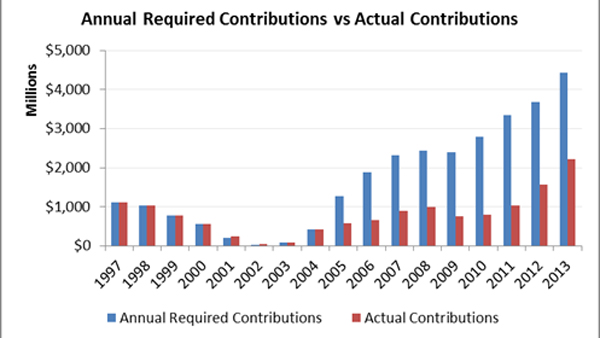
Basically, the legislature stopped paying the bills for 17 years.

pa_required_vs_actual_contributions_pew_600

Both the state government and commonwealth employees are responsible for paying into the pension system. And state workers made all their payments. They put aside 7.5% of their salaries every year to pay for their retirement.

But the legislature didn’t make its payments. It pushed them off to the future, and now that the future’s here, lawmakers have the gall to act like they have no idea where this cost is coming from!?

You ran up the bill! Time to pay! But instead of doing that, you blame the hardworking men and women who do all the state’s actual J.O.B.’s. And you practice Al-Qaeda tactics against labor, teachers and students!

Is that too harsh?

Who else holds people hostage to their demands?

This is terrorism as governmental policy. Our course of action should be the same with guerrilla extremists at home as it is with those on foreign soil: We don’t bargain with fanatics.

Gov. Wolf has a plan to pay off the pension debt. It’s nothing fancy. It’s the same kind of advice you might get from your accountant – or your mom. Refinance, reduce costs elsewhere and pay your bills.

That’s certainly a more sound strategy than holding a knife to workers and kids.


If you live in the commonwealth, please write your Senator and State Representative asking them not to support the GOP pension plan and to pass Gov. Wolf’s budget.

NOTE: This article was also published on the Badass Teachers Association blog. I also talked at length about this subject on the Rick Smith Show.

BONUS VIDEO:

https://www.youtube.com/watch?v=JhUPs6SJQMc

Trust Tests, Not Teachers – Accountability for Dummies

Blame-Criticize-and-Judge

This week, the American Federation of Teachers decided – after years of opposing high-stakes testing – to embrace it.

That’s right. The second largest teachers union in the country took everything their constituent educators hate and gave it a big old sloppy wet kiss.

They call it grade span testing. Tests would still be given almost every year, but only three – one in elementary, one in middle and one in high school – would be high-stakes. The rest would just be “informational.”

Why not get rid of all high stakes tests?

Why not at least get rid of the “informational” ones and reduce the total to three?

ACCOUNTABILITY!

The idea goes something like this. We have to ensure our schools are serving the needs of all our students. And the ONLY way to do that is through standardized tests!

Huh!? The ONLY way!?

That’s what they’re saying. Anything else – unless it is coupled with test scores – is unreliable.

Classroom grades? Insufficient!

Portfolios of student work? Insufficient!

A sworn affidavit by classroom teachers on the lives of their firstborn children!? Probably insufficient, too!

To be fair, one could argue at least the AFT is trying to reduce the number of high-stakes tests. But the total number of tests will remain the same as it is now – ridiculously high! Kids will still test just about every year – much more than any other comparable country. Test prep will remain the de facto curriculum at most schools.

Moreover, the very idea that all the other non-high stakes tests could somehow remain purely informational is naive at best!

Even if the terrorists only put the gun to your head occasionally, that still perverts the whole process.

Why would the AFT change its long-held position now?

It’s no accident. The law that governs our entire K-12 school system is about to be rewritten.

Congress is trying to reauthorize the Elementary and Secondary Education Act (ESEA). When the law went through its last rewrite, it was called No Child Left Behind – a classic Bush era euphemism to hide that the legislation did exactly the opposite of its name.

Simply put: it was a disaster.

It made annual standardized testing the centerpiece of our whole school system. We couldn’t do anything without it. Bubble tests became the only measure of success.

Forget that all the evidence shows standardized tests don’t actually measure student learning. They show parental income. Rich kids generally score high and poor kids score low.

Forget that they’re based on highly subjective cut scores that fluctuate each year and are determined by temporary workers most of whom have no education degree and have an incentive to fail the most students they can.

Forget that they steal time from actual learning, create an environment of fear and are the prime excuse to punish and close schools serving minorities and the poor.

But ACCOUNTABILITY!

Standardized tests return a score, yes. And if you ignore how that score is subjective and educationally inaccurate, you can pretend it’s a universal measure of learning. Then you can use it to justify almost anything as being educationally necessary.

Skimp on education funding? They deserved it because Accountability.

Privatize a school? They deserved it because Accountability.

Bust a union? They deserved it because Accountability.

That’s nonsense!

We used to know better.

Students used to be accountable to teachers and parents. If you didn’t do your homework or try your best in school, you’d earn a failing grade.

Teachers used to be accountable to their principals. Administrators would observe their teachers throughout the year and determine if they were doing a good job.

Principals were then accountable to superintendents who were, in turn, accountable to the school board and finally the community of voters.

The buck stopped at the voting booth. But not anymore!

Now the student, teacher, principal, superintendent, etc. are all at each others throats being held accountable to the standardized tests.

Who’s accountable for the tests? The for-profit corporation that developed them. And who is the corporation accountable to? It’s shareholders.

So we’ve gone from a system where the buck stopped at the community to one where it stops at investors.

Does no one else see a problem with this? Communities are made up of people many of whom have a vested interest in the children who live and go to school there. We’re talking about parents, teachers and taxpayers who want to live among other educated people.

But shareholders only care about getting a return on their investment. They don’t care about the quality of the service they’re providing – only that they can make money providing it. And if lowering the quality will raise the payout, so be it!

So when people justify standardized testing based on accountability, they’re really deifying the bottom line – profits.

But, of course, you can’t say that aloud.

The move is being cloaked in the costume of Civil Rights and progressive politics. The AFT partnered with the Center for American Progress – a privatization cheerleader that poses as a bastion of liberalism. Likewise, 19 Civil Rights organizations including the ACLU and NAACP were convinced to sign on.

Silly me. I thought Dr. King had a dream that everyone would be judged by the content of their character – not the results of their bubble tests!

But – say-it-with-me – Accountability.

There can be no alternative but standardized tests.

We can’t trust classroom grades. We can only trust cut scores.

We can’t trust teachers. We can only trust corporations.

We can’t trust the school board. We can only trust the shareholders.

And thank goodness! Otherwise, Congress might listen to what ordinary folks have to say!

Heck! Congress is starting hearings on it next week! They could vote to stop mandating annual standardized testing! Can you imagine how that would hurt the testing industry!? Billions of dollars might be lost! Imagine the kickbacks and political favors at risk!

So raise your glass to the bottom line, and say a prayer that the parents, teachers and taxpayers don’t do anything to hold us accountable…

Like, for example, emailing testimony against testing to the US Senate at FixingNCLB@help.senate.gov by Monday, Feb. 2.


-Special thanks to Aixa Rodriquez and Owen Jackman for being extra sets of eyes when my own couldn’t stay open anymore. If there are remaining errors, they are mine alone.

-This article also appeared in the LA Progressive, Public School Shakedown and the Badass Teachers Association Blog.


Forget Corporations… Unions Really ARE People

Labor-Unions

One word.

That’s all it takes to make some folks explode with anger.

One PARTICULAR word.

Not the F-word.

Or the C-word.

Or the even the N-word.

It’s the U-word. UNIONS!

Say that word, especially in a positive light, and heads burst like rotten pumpkins holding freshly lit firecrackers!

Eyes narrow, nostrils flare, a vein pops out on a forehead – and then a diatribe comes pouring out of your interlocutor’s mouth like the deep-seated, half-digested bile it is.

I just don’t get it.

Unions are people, after all.

Mitt Romney may have earned himself a place in the Presidential Candidate Hall of Shame for saying the same of corporations. But where he was wrong about the company, firm or business – it’s more truthful to speak this way of labor unions. Or any Democratic institution, for that matter.

No, I don’t mean that unions are individual entities that have lives of their own and deserve civil rights. But the people who make up those unions do.

That’s the whole point. Unions are made up of people. Their whole purpose is to fight for the rights of the individuals in them.

Corporations, on the other hand, have people who work for them, yes, but their raison d’etre is to earn profits for the board of directors or shareholders only.

While both work for the good of their members, unions work for ALL of their members. Corporations only work for the good of a limited selection of those connected with them – the owners.

At least that’s how it’s supposed to work. There are unions that work well and those that don’t. But the concept of a labor union – all the workers at a place of business gathering together to equal the power of the owners – is a good one.

Critics, however, see everything about unions as wrong.

They accuse unions of (1) stifling flexibility and creativity in the workplace. They say unions are (2) Communist, (3) politically allied to the Democrats and (4) increase costs. Among other things.

Let’s examine these claims:

1) Unions stifle flexibility and creativity:

Naysayers act as if unions impose rules on the helpless bosses. This is untrue. There is nothing in any union contract that was not agreed on by both parties. Sometimes it’s quite difficult to reach agreement. Often compromises are made on both sides. But each party has an equal say in what goes into the agreement.

As a result, sometimes the contract gets in the way of an easy fix to a problem. But is that really surprising for a document born of compromise? Neither party gets exactly what it wants. They meet in the middle. Sure, it would be much more flexible for the owners to make all the decisions. Likewise, it would be more flexible if the workers got to make all the decisions, too. But would either really lead to the best working environment?

Take break periods. If it were up to most managers, workers wouldn’t get any time to recoup from the constant demands of the job. They’d have to keep going with no respite until quitting time – maybe with a brief working lunch.

So union contracts often require breaks in the day. Not as much as workers would like and not as few as the bosses would prefer, either. To achieve this, you lose some flexibility.

For instance, if the contract says workers get two 15-minute breaks, you can’t combine them into one 30-minute breather. This makes it difficult if you’re needed at your post but have to stop suddenly to punch out. Otherwise, you won’t have time for both breaks.

It would seem to make more sense to keep working now and take a longer respite later. However, that is not what management and labor agreed to do.

It’s a compromise to benefit both parties. Workers are assured of having breaks in their day while management is assured that labor can’t take advantage of the situation by manipulating the clock to get a prolonged period off. If it becomes a problem, both parties can revisit it and make changes during the next contract negotiations. It may be difficult to change deeply embedded practices, but it can be done.

It doesn’t stop anyone from being creative. It just means you have to work within certain guidelines – and doing that may actually require innovation!

2) Unions are Communist

This is patently false. In fact, there are few more democratic institutions than labor unions.

All decisions are made by majority rule. Members vote on who serves as officers, who will have a seat on the negotiation committee, whether to accept a contract, when and if to go on strike, etc. That doesn’t sound like Soviet Russia! It sounds like Independence Hall in Philadelphia!

The only difference is it attempts to equalize power between the workers and the boss. It never actually achieves this ideal, but it does increase the say of the working stiff over the fat cats of the world.

That is not communism. It’s a respect for people’s individual rights.

Think about it. You don’t lose your human rights the moment you take a job. Why should the owners get free reign over their employees? Likewise, owners don’t lose all their power just because they need other human beings to make the goods and/or services they provide. Labor shouldn’t get to dictate everything either. It’s a give-and-take. When working well, it brings out the best in everyone.

Let’s be clear. THIS is what critics are really railing against. They’d rather preserve the owner’s power. The idea that the elites have to listen at all to menial workers just rubs them the wrong way. They’d rather be the ones making all the decisions – just like Pol Pot, Mao Zedong or Kim Jong-il. Come to think of it, the non-union workplace is more like Stalingrad than the union one.

Without unions, workers are at the mercy of their employers. Not exactly a red, white and blue proposition!

3) Unions are politically allied to the Democratic Party

How I wish this were true!

It would be great if one political party stood up for the rights of the working man! Unfortunately neither donkey nor pachyderm is exactly itching for the job.

Historically, the Democrats have done more to increase unions’ power than the Republicans. But that’s a pretty old and dusty history book you’re reading.

In the past 40 years, both parties have gleefully striped away union protections and rights. The only difference is that some Democratic politicians concede the right of unions to actually exist. Many Republicans act as if they would abolish the institution at the first opportunity.

Rank and file union members vote based on the platforms of the candidates involved. If there were a Republican candidate running on pro-union policies, union members would probably vote for him. That’s just called Democracy.

If a party wants the union vote, just give workers a reason to vote for your candidates.

4) Unions raise costs

Yes, and no.

In the short term, they do. But in the long run, unions may actually increase profits thereby paying for any increased initial investment.

When your business has a labor union, you have to pay higher wages. You have to have more safety regulations so less people get hurt on the job. You pay more for healthcare and pension plans. You have to cover more paid leaves and vacation times.

This is true. But it’s not a liability. It’s an advantage.

When you treat workers well, the quality of their labor increases. It just makes sense. If people are happy at the job, they’re going to do it better than those who hate it. This increases the quality of your product and, thus, sales. So you may have to pay more money upfront, but it gets offset by profits. Does the increase justify the cost? That depends.

Every business needs customers. Without money, consumers can’t buy the goods and/or services you provide. So when you pay a higher salary, you’re creating a potential market.

Consider this. When workers have more money, that’s cash that goes right back into the economy. They have money to buy stuff, maybe even the stuff you’re selling. That’s why Henry Ford famously made sure to increase wages at his auto factories – so that his employees could afford to buy the very cars they were making!

But what about non-union workers? Is it fair that union labor gets all this while everyone else is left wanting?

The short answer – yes.

If you’re jealous of the benefits of being in a union, join one. Don’t tear down someone else. Don’t be a resentful child popping another kid’s balloon because Mommy didn’t buy you one. Go get yours. Unionized labor will welcome you with open arms.

Petulant envy is exactly the attitude the bosses want you to take. You can always tell a news source is bought-and-paid-for when you hear some talking head spouting such petty, childish nonsense.

But leaving aside those who’d rather bring you down than boost themselves up, there’s an even more important reason to support unions. Membership actually benefits all – even non-unionized labor!

It’s called the free market. When unions boost salary and fringe benefits at one business, others have to do the same to compete. If your business doesn’t pay the same high salaries, it will lose the best employees to businesses that do. That’s simple economics.

None of this is seriously in contention. These are proven historical facts. Naysayers really just don’t want to pay a fair wage. They’d rather pay as little as possible and thus bring down salaries and benefits across the board.

In fact, as unions have decreased, that’s exactly what’s happened!

It’s a matter of point of view. Should we aim for a shared prosperity in this country or a limited one? Should we aspire to be a nation that’s best for all or only for some? I know my answer.

What about the global marketplace? Don’t unions make it harder for the US to compete with foreign markets, especially those in the third world?

Again, the answer is both yes and no.

Sure, it costs more to treat labor as human beings than as indentured servants. When you pay a living wage, your costs will be more and your profits initially lower than a company that keeps its workers in dormitories and has suicide nets outside the windows. But do we really want to compete with that? Is that the kind of America you want to live in? Does your morality really allow you to make money off of the misery of your employees?

Heck! Why pay workers at all? Slavery has a much better return on investment. The owners can keep people alive as cheaply as possible and then just work them to death. Profits would soar!

Assuming, of course, there’s anyone left to buy! That’s a pretty big problem. Right now, the third world is only able to continue these practices because it has a willing market here in the US. Without us buying these cheap products, they wouldn’t have customers and, thus, couldn’t continue.

Instead of slobbering all over ourselves in covetousness at their inhumane business practices, we should be putting political pressure on these third world companies to reform! We should boycott their products.

The irony, of course, is that many of the most egregious crimes committed against third world peoples are perpetrated by US companies who’ve outsourced their labor. We are selling short our own workers by preferring brown and black people in foreign lands whom we can more easily exploit.

If Americans had higher wages, they could more easily disengage from these abuses! If US consumers had higher salaries, they’d be more choosey about what they buy – they’d spend more freely on high quality goods – like the kind made by a unionized workforce.

In short, we need to stop shaming hard-working people from using their collective power to improve their lives. There’s nothing wrong with demanding fair treatment. Human beings deserve to be treated humanely.

And that’s exactly what unions are. Human beings.

They are engineers, nurses, auto-workers, letter-carriers and food service employees.

They are your teachers, police and fire fighters.

They are fathers, mothers, sisters, brothers, sons and daughters.

They’re just people.

Not a dirty word.


This article has also been published on the Badass Teachers Association blog.