Florida Attempting to Revive the “Happy Slave” Myth as Real History

Frederick Douglass was widely considered the most photographed American in the 19th century, though he never smiled in a single portrait.

He stares out of the frame with a look of quiet dignity, but never joviality or contentment.

The reason for this is simple – he didn’t want to perpetuate the myth of the “Happy Slave.”

Douglass was born into bondage until he fled to the North at age 20. He was considered a fugitive for nine more years until 1845 when English friends raised $711.66 to buy his freedom. He was already a famous orator, author and abolitionist.

But he knew the power of a picture and how a still image of him grinning ear-to-ear might be used by slaveholders to indicate that people of color enjoyed their own servitude.

Now 158 years after the Civil War, the Florida Department of Education is trying to perpetuate that same myth with its new guidelines for Black history curriculum in public schools.

Among other things, the guidelines suggest that American slavery was not all bad because enslaved people developed skills that “could be applied for their personal benefit.” 

The guidelines say that teachers’ lessons should “examine the various duties and trades performed by slaves (e.g., agricultural work, painting, carpentry, tailoring, domestic service, blacksmithing, transportation).”

This seems like a strange thing to emphasize about people who were engaged in back-breaking, life-shortening fieldwork on the cotton, rice and sugar cane plantations. Putting the focus on the various tasks they completed seems to make slavery little more than another type of “agricultural work” – just one of many “trades.”

But we’re losing sight of the fact that it was forced labor! That seems an essential feature – a defining characteristic!

So enslaved people might acquire skills in bondage that they did not previously possess. They could sometimes become expert artisans who might earn money to buy things.

But they did not own their own bodies! They were property! That limits your buying power in kind of a major way – not to mention your humanity!

No skills, nothing you could purchase could possibly make you cherish your lack of freedom.

In his autobiography, Douglass wrote:

“I have observed this in my experience of slavery, that whenever my condition was improved, instead of its increasing my contentment, it only increased my desire to be free, and set me to thinking of plans to gain my freedom.”

People like to tell stories of enslaved people singing on the plantations to ease their load and as proof of how much they enjoyed their work.

Of this, Douglass wrote:

“Every tone was testimony against slavery, and a prayer to God for deliverance from chains. The hearing of those wild notes always depressed my spirit, and filled me with ineffable sadness. . . . To those songs I trace my first glimmering conception of the dehumanizing character of slavery. . . . The songs of the slave represent the sorrows of his heart; and he is relieved by them, only as an aching heart is relieved by its tears.”

The new education guidelines in the Sunshine state are the latest since the Stop Woke Act was enacted in July 2022. The law says discussions about race must be taught in an “objective manner” and should not be “used to indoctrinate or persuade students to a particular point of view.” It also states that students should not feel guilty for actions taken in the past by people of their same race or origin.

Florida has taken broad measures to align its education standards with Gov. Ron DeSantis’s vision of a state “where woke goes to die,” which constrains teachers to discuss race, gender and sexuality, if at all, only in a way in which the Governor would approve.

The irony is that these guidelines show exactly why teachers need to discuss these subjects more openly and freely – why authentic history MUST be taughtnot some far right fairytale vision of the past.

Not only are these guidelines insensitive at best, state policymakers do not understand the actual record. They seem to believe in Rudyard Kipling’s “white man’s burden” to colonize, civilize, and Christianize non-Europeans – that slavery was a means of protecting and bringing Africans into the civilized era.

But this is pure nonsense – what’s worse it’s antiquated nonsense.

People who were kidnapped from Africa and forced into slavery across the Atlantic were not savages who were civilized by white slavers.

These were people with their own cultures, heritages and, yes, skills.

Most Africans who were abducted to North America were from West Africa and West Central Africa.

Each regional clan or group had professions or crafts such as weaving, basket making, potting, or iron working. They grew agricultural products, made textiles, manufactured goods, music and art. They made traditional foods and had unique customs.

These skills were used by enslaved people in the American South and beyond creating many industries in the US, but their contributions were most often erased.

Take Jack Daniel’s whiskey.

Around 1850, an enslaved man named Nathan “Nearest” Green taught a white man, Jack Daniel, the art of whiskey distillation – though it would take another 150 years before this would be publicly acknowledged.

Daniel was an orphan working as a day laborer on the farm of Dan Call, a Lynchburg preacher, grocer and distiller. Daniel took an interest in the distillery and pleaded to learn the trade. Call eventually introduced him to Green, who he called “the best whiskey maker that I know of,” according to a 1967 biography, Jack Daniel’s Legacy. He instructed the enslaved man to teach the young boy his distilling process.

Green taught Daniel “sugar maple charcoal filtering” (now called the Lincoln County Process), a universally accepted critical step in the making of Tennessee whiskey. This involves filtering the whiskey through wooden charcoal chips before being placed in casks for aging. Food historians believe this was inspired by similar charcoal filtering techniques used to purify water and foods in West Africa. The process imparts a unique flavor that set Jack Daniel’s whiskey apart from its competitors.

After the Emancipation Proclamation, Daniel bought Call’s distillery, renaming it after himself. More than seven generations of the Green family worked either for or with the Jack Daniel’s brand.

It’s important to note that these were skills Green already possessed. They were not learned in bondage. They were brought with him to this country.

Another example of this would be Black cowboys.

Despite the relative lack of Black faces in Hollywood Westerns, Black men made up about 1 in 4 cowboys in the old West.

Men of color handled cattle, tamed horses, worked ranches, encountered outlaws and starred in rodeos. It’s estimated that anywhere from 5,000 to 8,000 Black cowboys were part of the legendary cattle drives of the 1800s.

Many Black cowboys developed their skills in Africa – not America. People abducted from countries such as Ghana and Gambia were already experienced in managing large herds of cattle and their abilities with animals were highly desirable.

During the Civil War, some Texas ranchers who fought with the Confederacy left enslaved people behind to maintain their ranches.

Once again these were skills brought to this country just as the people possessing them were – by force.

The Cotton Gin offers a more contentious example.

Eli Whitney, a white man, is given credit for inventing the machine that revolutionized the production of cotton by greatly speeding up the process of removing seeds from cotton fiber.

However, there is much debate about where he got the idea.

Some historians believe Catherine Greene, a woman he was living with, devised the cotton gin and Whitney merely built it and applied for the patent, since at that time women were not allowed to do this. Others believe the idea was Whitney’s but Greene played an important role as both designer and financier.

However, according to the University of Houston’s College of Engineering, Whitney got the idea from an enslaved person known to history only as Sam. Sam’s father came up with a kind of comb to get the seeds out of a cotton boll. Whitney heard about the idea and simply mechanized it.

Whether Sam or his father were able to invent the cotton gin because of skills learned in America or Africa is hard to say, but they certainly didn’t profit off of them. If they were given any remuneration, it was nothing in comparison to Whitney.

Ironically, this device made the mass cultivation of cotton profitable. The result was that the enslaved population in the United States jumped from about 250,000 around the time of the Revolutionary War to around 4 million at the time of the Civil War.

Sadly, this is far from the only example of white people getting the credit for the intellectual work of enslaved people.

Jo Anderson came up with the idea or at least co-invented a reaping machine that revolutionized agriculture. But the credit went to Cyrus McCormick, the white man who owned him.

Cutting wheat in the early 1800s was slow, difficult and labor-intensive. Workers had to walk and cut the stalks with scythes, and laborers (also called “binders”) walking behind them gathered and tied the stalks into sheaves. The reaper was a device that sheared a wide path of grain. A worker would just need to rake the cut stalks off the machine’s bed onto the ground in ready-to-bind stacks.

In the 1850s, Benjamin Montgomery invented a steamboat propeller designed for shallow water. But since he was enslaved, his invention could not be patented in his name. His owners – future Confederate President Jefferson Davis and his brother Joseph – then tried to patent the propeller in their names but the request was denied since they were not the inventors. It went unpatented.

In 1831, a freed slave named Henry Boyd invented a “Tester Bed” that used wooden side rails. However, he had to let a white man, George Porter, patent his design for him since he could not do it, himself.

Free Black men were technically allowed to patent inventions but it could be incredibly difficult to do so. Often they ended up putting patents in the names of their white lawyers to give them a better shot at acceptance.

While some of these skills may have been learned in servitude, Black people rarely got to experience the rewards they deserved for using them.

It should be achingly obvious that being kidnapped and enslaved did not in the final analysis profit Black people even if they may have occasionally learned skills or earned a little money. Any suggestion otherwise is pure fantasy.

It is a political fiction that is being revived to stop any attempts at actual justice in this country.

Though they are no longer enslaved, African Americans still suffer from the after affects of our peculiar institution. Jim Crow laws continued until the 1960s and the Civil Rights Movement. Even then policies like red lining, discriminatory hiring practices, and over-policing of Black neighborhoods continued. Though progress has been made at each step along the way, Black people still suffer from institutional racism of which Florida’s new educational guidelines are a prime example.

Just in our public education system, children of color are more likely to find themselves in under-funded schools with fewer opportunities, narrowed curriculum and subjected to evaluation by biased standardized tests. They are targeted by fly-by-night charter schools which often have no elected school boards and worse academic records than neighborhood authentic public schools.

Florida’s new guidelines are another attempt to erase the problem without fixing it – to make even stating the racial realities impossible for teachers in the classroom and thus unlikely to be learned by anyone who doesn’t experience this type of inequity first hand.

As Douglass said in a speech in Cork, Ireland:

“The people of America deprive us [Black people] of every privilege—they turn round and taunt us with our inferiority!—they stand upon our necks, they impudently taunt us, and ask the question, why we don’t stand up erect? They tie our feet, and ask us why we don’t run? That is the position of America in the present time. The laws forbid education, the mother must not teach her child the letters of the Lord’s prayer; and then while this unfortunate state of things exist they turn round and ask, why we are not moral and intelligent; and tell us, because we are not, that they have the right to enslave [us].”

It’s no wonder he did not smile in his photographs.

I doubt his expression would change much, If he were alive today and presented with Florida’s idea of Black history.


Like this post?  You might want to consider becoming a Patreon subscriber. This helps me continue to keep the blog going and get on with this difficult and challenging work.

Plus you get subscriber only extras!

Just CLICK HERE.

Patreon+Circle

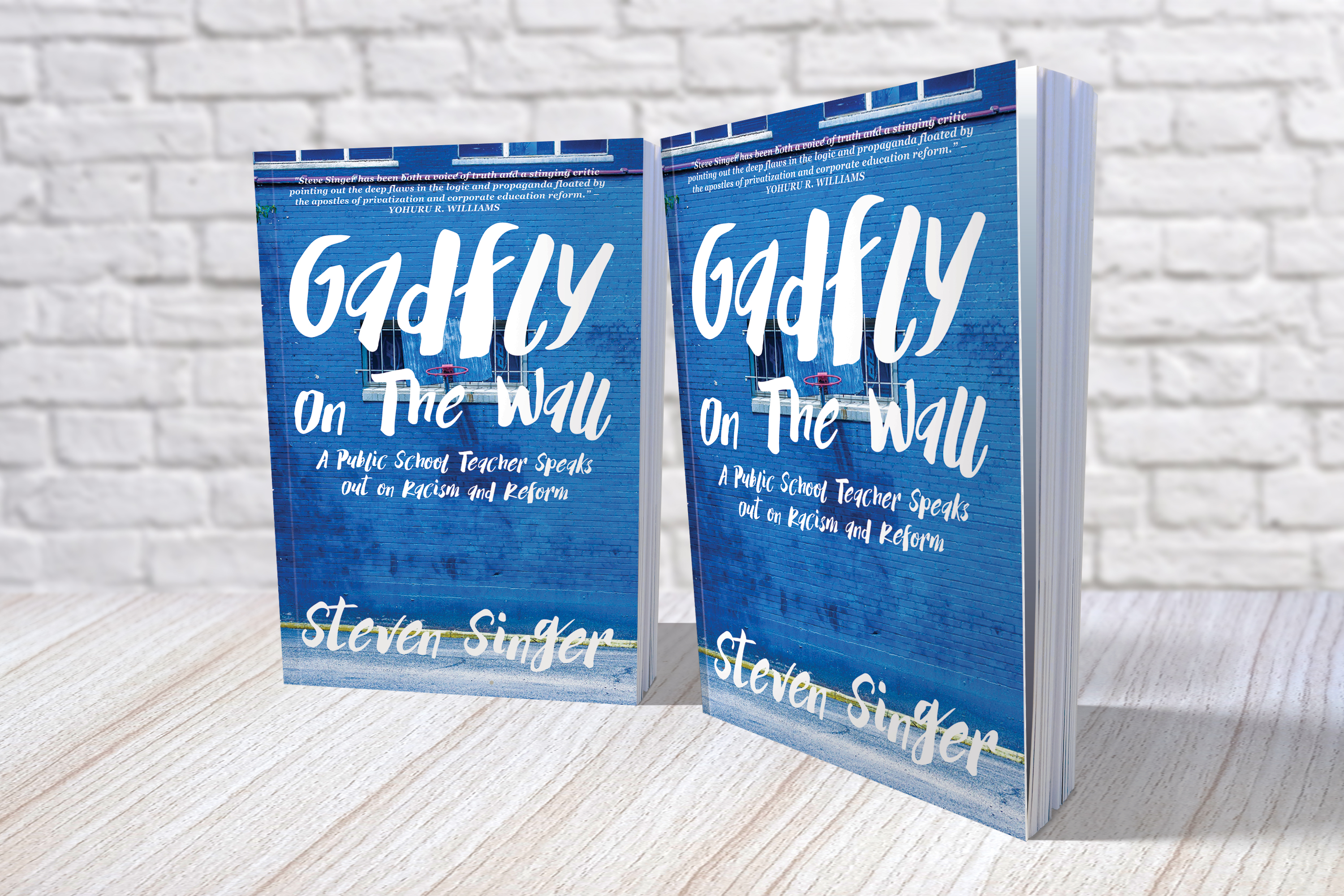
I’ve also written a book, “Gadfly on the Wall: A Public School Teacher Speaks Out on Racism and Reform,” now available from Garn Press. Ten percent of the proceeds go to the Badass Teachers Association. Check it out!

Stay Woke, Public School Teachers

“I advise everybody, be a little careful when they go along through there – best stay woke, keep their eyes open.”

Lead Belly “Scottsboro Boys”

How can you understand a problem if you are not allowed to name it?

How can you fight injustice if you are forbidden from learning its history and connection to the present moment?

These questions are at the heart of a well-financed war against a simple term – woke-ness.


Since the summer of 2020, oligarchs and their tools in the United States have been waging a disinformation campaign against that term – especially as it pertains to our schools.

Chiding, nagging, insinuating – you hear it constantly, usually with a sneer and wagging finger, but what does it really mean?

To hear certain governors, state legislators and TV pundits talk, you’d think it was the worst thing in the world. But it’s not that at all.

In its simplest form, being woke is just being alert to racial prejudice and discrimination.

That’s all – just knowing that these things exist and trying to recognize them when present.

I’m not sure what’s so controversial about that. If we all agree racism is bad, why is it undesirable to acknowledge it exists when it’s demonstrably there?

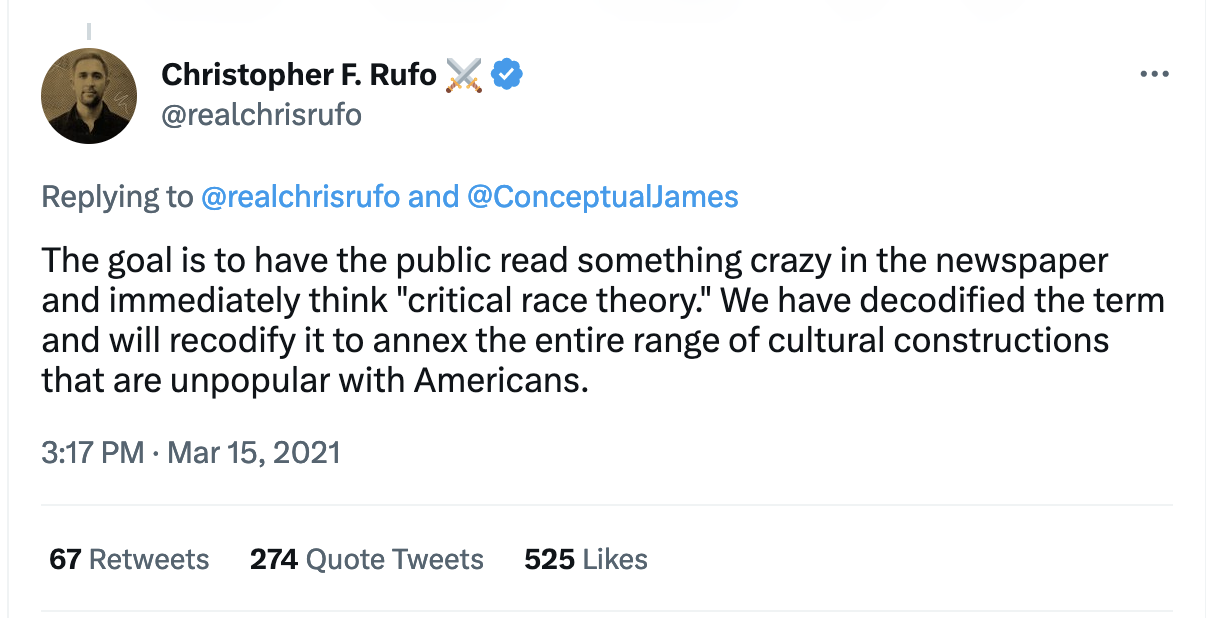
More specifically, being woke means focusing on intersectionality – how issues of race, class and gender overlap and interrelate with each other. It means practicing critical race theory – not the made up dog whistle conservatives use to describe anything they don’t like being taught in school, but the study of how racial bias is inherent in many Western social and legal systems. It means using the lens of Black feminism, queer theory and others to address structural inequality.

Again, why is that a bad thing? If we agree that prejudice is bad, we should want to avoid it in every way possible, and these are the primary tools that enable us to do so.

Our society is not new. We have history to show us how we got here and how these issues have most successfully been addressed in the past.

But these Regressives demand we ignore it all.

Shouldn’t we protect hard-fought advances in human rights? Shouldn’t we continue to strive for social justice and the ability of every citizen to freely participate in our democracy – especially in our public schools?

Of course we should!

But leaders of the backlash will disagree.

Like in so many other areas of our culture, they have stolen the term “woke-ness” and tried to co-opt it into another invented grievance. For people who deride their political opponents as being too fragile and unable to handle reality, they certainly find a million things to cry about on their 24-hour news networks to keep their base angry and engaged all the time.

They have attacked librarians, spied on and harassed teachers, banned books and weaponized the law to forbid certain ideas from our schools and public spheres.


They have targeted and demonized antiracist work. They have tried to discredit the concepts that Black women and LGBTQ people have created to explain and improve the inequitable conditions of their lives.

And the reason is crystal clear – they oppose that work.

They oppose anti-racism. They oppose the rights of Black women and LGBTQ people to better treatment.

They are against everyone but a perceived white, male, heteronormative majority that doesn’t even really exist.

They call their political opponents extremist. They call them groomers. They call them prejudiced and racist.

But it is Regressives’ anti-woke agenda that is really all of those things.

For them, up is down and circles are squares.

As public school teachers, being woke is not a choice. It is a responsibility.

For we are the keepers of history, science and culture.

Who will teach the true history that for more than 400 years in excess of 15 million men, women and children were the victims of the transatlantic slave trade? Who will teach the true history of the fight against human bondage and the struggle for equal rights? Who will teach about women’s fight for suffrage, equal pay, and reproductive freedom? Who will teach about the struggle of the individual to affirm their own gender identity and sexual expression?

We, teachers, must help students understand what happened, what’s happening and why. And to do so we must protect concepts that emerged from decades of struggle against all forms of domination.

It must be us.

It won’t be the College Board, a billion-dollar American business calling itself a non-profit, that after years of stalling finally released its Advanced Placement African American Studies curriculum – a college-level course available for high school students nationwide. In the wake of political backlash, the new course material is as watered-down as weak tea in comparison to previous drafts of the course.

This just goes to show that the free market will never stand up to political power if it is perceived as adversely affecting the bottom line. True education comes not from corporate academic standards or standardized test gatekeepers. It comes from teachers.

And we must teach like never before because our lessons have a pivotal impact on society at large.

Intersectional frames such as those under attack by billionaires posing as populists have been incredibly important in supporting overlooked social problems and addressing today’s human rights failures.

Those of us who know history understand that suppression of knowledge and intellectuals (especially those from marginalized peoples) are a tool used to increase racism and oppression – to overturn the progress of the last century.

Refusing students access to books, criminalizing “divisive concepts,” and discrediting those with whom they disagree have all been tools of domination. Just as denying the persistence of any inequality has been a tool to discredit its victims.

Progress has been made in the last hundred years, but the struggle is not over. And denying that there are any problems left to solve is a way of stifling that progress and turning back the clock against it.

If we give in to these partisan “anti-woke” imperatives, we enable the return of racist and cultural inequalities that had been at least partially rectified years ago. We clear the way for these extremists to bring back a mythical past in which women are meant to be merely subservient to men and where race, gender and sexuality are rigidly defined and limited according to the ruling class.

Teachers, we cannot allow this to happen.

We stand at the gates, the first (and perhaps last) line of defense, because we stand at the schoolhouse doors.

It is a responsibility none of us signed up to take. But here we are.

If we are truly educators, we must teach the truth.

We must put the facts in their proper context.

We must encourage our students to think about what came before and what’s happening now.

We must stay woke.

Or the whole world sleeps.


Like this post?  You might want to consider becoming a Patreon subscriber. This helps me continue to keep the blog going and get on with this difficult and challenging work.

Plus you get subscriber only extras!

Just CLICK HERE.

Patreon+Circle

I’ve also written a book, “Gadfly on the Wall: A Public School Teacher Speaks Out on Racism and Reform,” now available from Garn Press. Ten percent of the proceeds go to the Badass Teachers Association. Check it out!
 

Public School Boards Need to Do Better at Embracing Transparency 


They say sunlight is the best disinfectant.  


So why do so many public school boards hide in the shadows?  


One of the shining virtues of public schools is the requirement that they be transparent and open to the public.  


And they are! 


But too often school directors do so in ways that are unnecessarily burdensome, equivocal or combative.  


Let me give you an example.  


I live in the McKeesport Area School District (MASD) – a community just south of Pittsburgh in Pennsylvania.  


When I heard my school board was considering a proposed district budget for 2022-23 without a tax increase, I wanted to take a look at it. So I went to the district Website and there was a link labelled:  


“Preliminary Budget Information for 2022-23 School Year.”


I clicked on it and got this: 


“The Board of Directors of the McKeesport Area School District has prepared a Preliminary Budget in the amount of funds that will be required by the School District for the fiscal year beginning July 1, 2022. The Proposed Budget is on file in the Office of the Business Manager/Board Secretary, and is available for public inspection in the McKeesport Area School District Administration Building…” [Emphasis mine.


What the heck!?  


Why not just post the preliminary budget on the Internet!? Why make me go all the way to the administration building (during business hours) to see a copy? 


It’s not like I can even turn to my local newspaper to tell me about the district’s budget. With so many cutbacks in local media, our papers rarely even cover school districts anymore unless there’s a big story.  


If I want to know how my district proposes to spend the community’s tax dollars next year, I need to either go to the school board meeting or go to the administration office and look at a copy. Will I be able to take a copy with me to peruse at my leisure? Maybe or maybe not.  


We should be able to do better than this. 


Don’t get me wrong. 


Authentic public schools are way better than privatized schools.  


They’re preferable to anything you’d find at charter or private schools that take school vouchers.  


And one of the biggest reasons why is this requirement of local control, self-government, and a free exchange of information between representatives and the community who elected them.   


Authentic public schools HAVE TO hold public meetings to conduct their business.  


They HAVE TO take comments from the community. 


They HAVE TO make their documentation available to the public.  


And except under extreme circumstances, they HAVE TO be run by elected school boards.


None of that is a given at charter and voucher schools. 


The problem is how too many public school directors meet these obligations. 


MASD, for example, makes its proposed budget available – but not in the most convenient way that it could.  


Let’s be honest. It wouldn’t take much to improve this.  


Posting the full budget online would take just a few seconds. In fact, it’s actually more trouble to have it available in the administration building and task a secretary with presenting it to anyone who comes in-person and asks for it. 


The same thing goes for school board meetings.  


Before I became a public school teacher, I was a journalist often covering public schools.  


I’ve gone to a lot of school board meetings in my life. A LOT.  


And almost every board put unnecessary or onerous restrictions on public comments.  


Residents could come to the meetings and address the board but they often had to sign in before-hand. They couldn’t just show up and speak. They had to let the board know days in advance that they were coming and the subject they planning to speak on.  


If something came up during the meeting unplanned, technically residents weren’t allowed to comment – though I admit I’ve never seen a school board hold to such a policy in the case of unexpected events.


Also there are almost always time limits on public comments.  


Now I know it’s unreasonable to expect members of the public who volunteer to serve as school directors to spend all night listening to rambling or incoherent comments. But these time limits are often way too restrictive – especially when only a handful of people actually turn up to speak.  


Limiting people to two minutes of public comment in a month or even a two-week period is ridiculous.


Then we have the issue of audio visuals at board meetings.  


Many school boards have microphones for people to speak into during the proceedings. This is supposed to allow everyone present to hear what is being said. However, the equipment is often so bad that it actually ends up blurring the speaker’s voice until its incomprehensible or board members who don’t want to be heard simply don’t speak into the microphone.  


Sure – the entire proceedings are being taken down by hand by an administrator for an official written copy of the minutes. But this isn’t even available to the public until a month later when the board votes on last month’s minutes document. The public can’t get a copy of this material until more than a month has passed from it taking place. And it probably isn’t available on-line. 


Finally, we have recordings of the meetings.  


Many school boards now video tape their meetings and stream them live on YouTube, Facebook or some other social media site.  


This is a nice improvement from when community groups had to do this, themselves. And, in fact, it’s really a response to that phenomenon to gain control over what becomes public record. School boards began recording the meetings to discourage others from doing it so the district would have control over this material. And in most cases it worked. 


However, these recordings are almost always of exceedingly poor quality.


Cameras (and microphones) are placed so far away that it is almost impossible to tell what is happening, what is being said or who said it.  


Any teenager with a smart phone and a YouTube channel could do a better job.  


Moreover, these videos often don’t stay posted online for very long. They could easily remain posted so anyone could rewatch them and catch up with what happened at a school board meeting they were unable to attend in-person. But school boards make the express decision to take these videos down so that record is not available. 


Very few of these are accidents. In most cases these are intentional to push the public away at the exact time when they should be inviting them in.  


These are just some examples of how school boards comply with transparency requirements but do so in ways that are inconvenient, onerous or antagonistic. 


It is so unnecessary. 


Things don’t have to be this way.  


School boards should welcome transparency. They should embrace public participation in the process.  


After all, this is one of the major factors that distinguish authentic public schools from privatized ones.  


School directors complain about losing revenue to charter and voucher schools. If they treated the public more like valued members of the decision-making process, they would do a lot to boost their own reputation.  


President James Madison wrote


 “[a] popular Government, without popular information, or­ the means of acquiring it, is but a Prologue to a Farce or a Tragedy.”  


School directors should take this to heart. 


Public schools should not be shadowy corners for school directors to try to sneak through policies under the nose of stake holders.  


They should be shinning centers of the community. 


The sooner school boards understand this, the better it will be for the state of public education and the students, families and communities we are supposed to be serving in the first place. 


Like this post?  You might want to consider becoming a Patreon subscriber. This helps me continue to keep the blog going and get on with this difficult and challenging work.

Plus you get subscriber only extras!

Just CLICK HERE.

Patreon+Circle

I’ve also written a book, “Gadfly on the Wall: A Public School Teacher Speaks Out on Racism and Reform,” now available from Garn Press. Ten percent of the proceeds go to the Badass Teachers Association. Check it out!
Teaching the War in Ukraine is Fighting the War at Home 


How does one teach about war?  


With pictures or words? 


With speeches or documentation? 


With prayers or curses? 


With laughter or tears? 


I began my class like I always do – with a question


“Has anyone heard about what’s happening in Ukraine?” I asked.  


A few hands, but they had only heard the words. They didn’t know what was happening.  


So I showed my 8th graders a short video that summarized events so far. I drew a map of Europe and Asia on the board. I outlined Ukraine, Russia and the European union. I explained about the Soviet Union and its collapse. I explained about NATO and the struggle for power and prestige.  


When I was done, there was a moment of silence. They were all staring up at me. It was one of those rare moments of stillness, a pregnant pause before the questions started raining down.  


A patter at first, then a storm. 


They asked about what they were hearing at home. They searched for corroboration, explanation and/or other viewpoints. 


One child asked if this was NATO’s fault. If it was President Biden’s doing. 


Another asked how it would affect us and why we should care. 


And yet another asked about nuclear proliferation and whether this war meant the end of the world.  


I couldn’t answer all of their questions, though I tried. When there was something I couldn’t say or didn’t know, I pointed them in a direction where they might find some answers.  


But it led to some interesting discussion.  


Then I asked them if they had talked about any of this in their other classes – perhaps in social studies. They all said no, that a few teachers had promised to get to it after finishing the 13 colonies or another piece of mandated curriculum.  


I was surprised but not shocked. I know the tyranny of the curriculum.  


I was only able to talk about this, myself, because of the scope and sequence of Language Arts. You see, it was poetry time and I was about to introduce my students to Alfred Lord Tennyson and “The Charge of the Light Brigade.” 


For those who don’t recall, the poem tells the true story of the battle of Balaclava during the Crimean War. A cavalry regiment of British troops charged Russian gunners and were mostly shot to pieces.  


It’s a pillar of English poetry and a perfect opportunity to talk about warfare in general and Ukraine in particular since the battle took place in the same general area of the world. 


In the poem, a general mistakenly orders the soldiers on horseback armed only with swords to charge the enemy armed with cannons and guns.  


Tennyson writes


“Theirs not to make reply, 
   Theirs not to reason why, 
   Theirs but to do and die.” 


And after the result is graphically portrayed, the speaker extols their virtue: 


“When can their glory fade? 
O the wild charge they made! 
   All the world wondered. 
Honour the charge they made! 
Honour the Light Brigade, 
   Noble six hundred!” 


So I ask my students what they think about it. Is it a soldier’s duty to follow orders no matter what? Should they question those orders?  


Typically, most of them back up Tennyson.  


And then I present them with an 80s heavy metal video by Iron Maiden of the song “The Trooper.”


The video uses images from a silent movie version of the Tennyson poem while singer Bruce Dickinson wails the story of a single soldier of the Light Brigade being senselessly gunned down and dying alone, forgotten on the battle field. 


It certainly gives them something to think about as they watch black and white horses flung in the air and our spandex clad narrator commenting on the situation with hairspray piled locks.  


Students end up leaving the class continuing the debate with each other about heroism and the waste of war.  


I certainly have my own opinions on the matter, but I keep them to myself.  


The way I see it, this isn’t the time for me to insert my opinion into the class. It’s an opportunity for my students to think through the problem, themselves.  


And, frankly, that’s really the point of most of school.  


It’s not the transmission of knowledge. Teachers can’t magic information into children’s heads.  


Instead, we provide opportunities to learn. We encourage students to think. We’re more like gardeners than anything else. We water, we weed, we make sure the soil is fertile. But it is up to the child to grow and in which direction to strive.  


That’s why far right scare mongers are so ignorant and absurd when they try to constrain teachers from teaching about history or racism.  


These campaigns are not aimed at educators. They are aimed at students.  


The goal is to offer children only one path in which to grow.  


They want to stifle thought, stifle free expression, stifle intellectual freedom by removing the option to think.  


They want to remove the opportunity.  


It may not be as dramatic as Putin invading. “Shot and shell” may not be flying. But the forces of fascism are equally at work on the minds of our children.  


In teaching about the war in Europe, educators are waging a battle against the war at home. 

Zhyvitʹ revolyutsiyeyu!

 
Viva la revolución! 

Long live the revolution!


Like this post?  You might want to consider becoming a Patreon subscriber. This helps me continue to keep the blog going and get on with this difficult and challenging work.

Plus you get subscriber only extras!

Just CLICK HERE.

Patreon+Circle

I’ve also written a book, “Gadfly on the Wall: A Public School Teacher Speaks Out on Racism and Reform,” now available from Garn Press. Ten percent of the proceeds go to the Badass Teachers Association. Check it out!
Don’t Tread on Me, But Let Me Tread All Over You: The Credo of Personal Freedom and Limitless Greed

AR-801253793 

Every neighborhood has one.


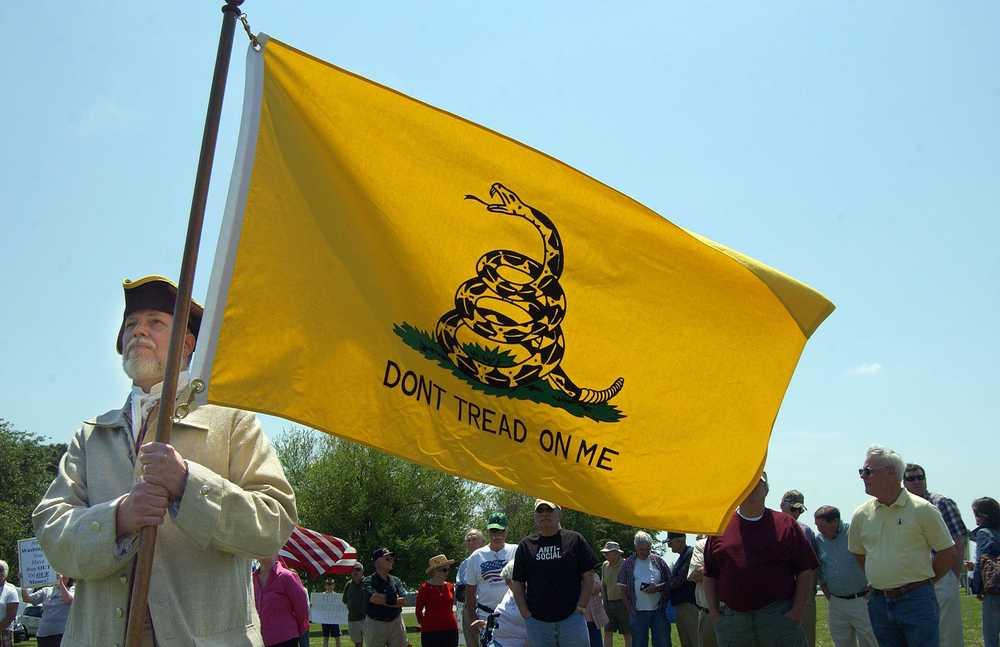
A yellow flag showing a coiled spring of a snake above the motto, “Don’t Tread on Me.”


In my usually well-manicured suburb, you’ll find it waving bravely over the garbage house.


There’s three broken down RVs sitting on the lawn, a busted sofa in the back yard, a rotten picnic bench and several rusted out vehicles in various states of disrepair.


I’m not sure why the owners think anyone would want to tread on them. We’d much rather walk quickly on by without being seen or commented on.


Because in my experience that’s the thing about most of the people who fly this flag.


They’re indignant about anyone stepping on their rights but all too ready to step all over yours.


I remember it wasn’t really too long ago that this flag had no such connotations.


It was simply the Gadsen flag, a relic of the American Revolution. It was nothing more than a reminder of a time when we cherished our national independence from Great Britain and wanted to make sure they knew we didn’t want the King to come back and start ordering us around.


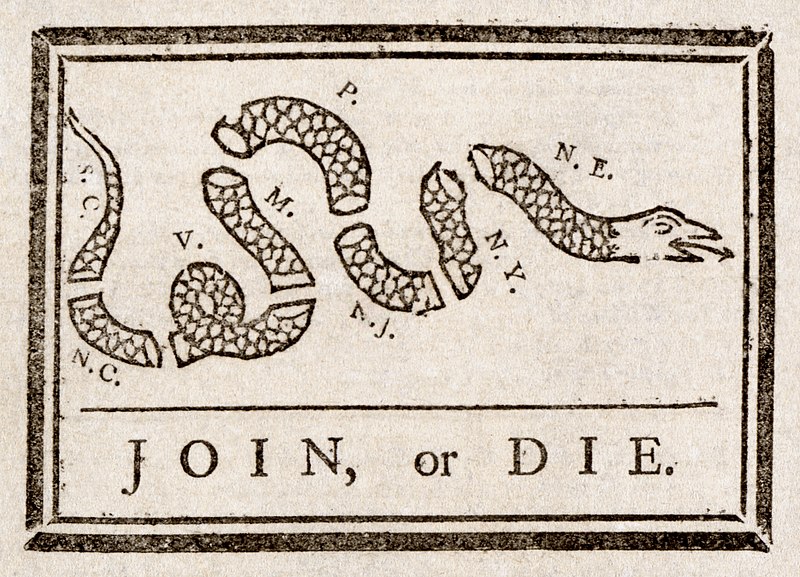
In fact, it was designed by American general and politician Christopher Gadsden in 1775. This “Sam Adams of South Carolina” modeled his patriotic statement first used by the Continental Marines on an earlier famous cartoon from Benjamin Franklin’s Pennsylvania Gazette.


800px-Benjamin_Franklin_-_Join_or_Die


You’ve probably seen it. A snake is cut into several pieces – each representing one of the colonies – with the motto, “Join or Die.”


So originally it was a call for unity, perhaps even federalism. It was a way of framing the argument that we’d be stronger as one nation than as a group of separate states.


Gadsen’s version was really a continuation of that same thought. It was as if he were saying, “Here we are, one unified nation ready to strike to protect itself from tyranny.”


It wasn’t until 2009 that Gadsen’s flag became associated with the radical right.


Like so many hitherto nonpartisan symbols, it was appropriated by the Tea Party movement, which tried to cast their libertarian extremism as somehow harkening back to the American Revolution.


Even the name Tea Party is a misnomer. The original Boston members of the Sons of Liberty who threw British tea into the harbor in 1773 were protesting taxation without representation. Modern day Tea Partiers were protesting the taxes levied by their own duly elected representatives.


They were poor people duped into thinking the rich paid too much despite the fact of gross income inequality and the wealthy not paying their fair share.


It’s this willful ignorance that typifies the contemporary right.


The truth doesn’t matter. It only matters what can be spun into a pithy sound bite that can be broadcast on Fox News or some other propaganda source and then repeated ad infinitum in place of any real debate or conversation.


To be fair, the left does it, too, but not nearly to the same degree.


When a topic makes the rounds of the 24-hour news cycle, you can hear the same canned responses from right and left on just about every channel regardless of who is speaking. The only difference is that the left usually makes at least passing reference to reality while the right closes its eyes and says whatever it believes to be true with perfect conviction.


The Gadsen flag is a perfect example of this hypocrisy.


The motto “Don’t Tread on Me” has come to mean radical individual freedom.


I can do whatever I like and there’s nothing you can do about it.


I can own as many guns as I like. I can teach my kids whatever facts I like. I can discriminate against anyone I like.


But there’s never a mention about other people except to limit what they can do in relation to the speaker.


In short, there’s nothing explicit about making this rule universal – I won’t tread on you if you won’t tread on me.


It’s just don’t tread on me and I’ll do whatever I like in relation to you.


After all, many of these personal freedoms the radical right cherishes actually do impact the rest of us.


Unregulated gun ownership means more shootings, more suicides, more deadly instances of domestic violence, more kids coming to school with semi-automatic guns in their book bags and more malls and theaters slick with bystander blood.


Moreover, if you teach your kids whatever facts you like, that means you indoctrinate them into your worldview. You don’t give them the chance to see the real world for what it is in case they may have different views on it than you do. This impacts both your children and the country, itself, which will have to somehow run with a greater portion of ignorant and close-minded citizens.


And don’t get me started on discrimination! You think you should be able to say whatever you like to whomever you like whenever you like. It’s fine to wear a t-shirt calling Hillary Clinton a “cunt” but when late night comedian Samantha Bee does the same to Ivanka Trump, you’re up in arms!


You think you can support laws that allow bakers to refuse to make wedding cakes for gay couples but are raving mad when a restaurateur refuses service to Sarah Huckabee Sanders!


This kind of sanctimonious duplicity has real world consequences.


Unarmed black people are shot and killed by police at a much higher rate than white people. Yet you won’t tolerate any protest, condemnation or protest. People can’t assemble in the streets, athletes can’t kneel during the national anthem, you won’t even allow the slogan “Black Lives Matter,” because you say, “All Lives Matter,” while in reality you mean “All Lives Except Black Ones.”


You oppose abortion but no one is forcing anyone to have abortions. In your headlong crusade for individual freedom you want to ensure that others don’t have this choice because they might choose differently than you. Or at least they might choose differently than you SAY you do, because when the light of day is cast upon you, we find an alarming number of hypocrites here, too.


There are too many far right politicians who campaign on overturning Roe v. Wade who pressure their mistresses to abort the unwanted issue of their indiscretion.


The underlying cause of such myopia is a perverse focus only on the self.


You look at what you want for you and pay no attention at all to what others should likewise be allowed.


It is the underlying selfishness of post Enlightenment Western thought come back to haunt us.


Hobbes and Locke and Smith told us that greed was good.


It’s what makes the world go round.


You look to your self-interest, and I’ll look to mine, and that’s what’s best for everyone.


However, they forgot that everyone doesn’t have the same power – physical, social, financial or political. Some people are strong and some are weak. Some are rich and some are poor. If you pull the shortest straw at the lottery of birth, you won’t be able to get the same things for yourself as those who won it as soon as the doctor slapped their newborn bums.


So we have layers and layers of class and economics. We have social structures designed to keep black people here and Hispanics there and white people at the top. We have a society that worships the rich and bedevils the poor. We have belief systems that praise one kind of sexuality only and demonizes anything that diverges from that norm. And the most defining thing of any newborn baby is what you’ll find between its legs.


“Don’t Tread on Me” has become a farce.


It’s a maxim hoisted on those with very little individual power to convince them to join together and become powerful while guarding the door for the wealthy.


They sit atop their mountains of trash as if they were dragons on piles of gold.


And they point their pitchforks at the rest of us as if we wanted a piece of it.


In this way, they make themselves the willing patsies of the ruling class.


It’s a sad thing to behold.


Because if we all just stopped for a second and recognized our common humanity, we’d agree that the status quo is unacceptable.


If we were more concerned about the rights of all than just our own rights, we’d agree that the wealth of this great nation has not been fairly distributed.


The snake is coiled and ready to strike but it is pointed in the wrong direction.


It shouldn’t be pointed at 99% of us. And it shouldn’t be so solitary.


It should be a sea of snakes, a great slithering mass of humanity, hissing and spitting with venom, our reptilian eyes focused on the elites.


Don’t tread on me?


Don’t tread on USSSSSSSSSSS!


Like this post? I’ve written a book, “Gadfly on the Wall: A Public School Teacher Speaks Out on Racism and Reform,” now available from Garn Press. Ten percent of the proceeds go to the Badass Teachers Association. Check it out!

WANT A SIGNED COPY?

Click here to order one directly from me to your door!

book-3

The Best Charter School Cannot Hold a Candle to the Worst Public School

Screen Shot 2018-05-24 at 7.43.41 AM.png


There are good charter schools.


I admit that.


There are bad public schools.


I admit that, too.


But if one had to choose between the worst public school and the best charter school, you’d still be better off with the public school.


Does that sound crazy? Does it sound ideological, partisan, or close-minded.


I don’t think so.


Imagine if we said the same thing about tyrannies and democracies.


There are good tyrannies.


There are bad democracies.


Still, I’d prefer the worst democracy to the best tyranny.


Why?


Because even a badly run democracy is based on the principle of self rule. The government gets its right to make and enforce laws from the consent of the will of the governed.


Even if our representatives are corrupt and stupid, even if our federal, state and local agencies are mismanaged and disorganized – there is the potential for positive change.


In fact, the catalyst to that change is embedded in democracy, itself.  Egalitarian systems founded on the principle of one person, one vote tend toward fairness, equity and liberty much more than others.


Bad leaders will be replaced. Bad functionaries will be retrained or superseded. Bad agencies will be renovated, renewed, and made to serve the will of the people.


However, in a tyranny, none of this is true.


Even if you have a benevolent tyrant who does nothing all day but try to do whatever is best for his or her subjects, that is a worse state of affairs.


Eventually the tyrant will change. Absolute power will corrupt him or her absolutely. Or even if this bastion of human goodness is incorruptible, he or she will eventually be deposed, replaced or die.


And there is nothing – absolutely nothing – to ensure the next tyrant is likewise benevolent. In fact, the system is set up to increase the likelihood that the next ruler will be as selfish, greedy and malevolent as possible.


This is because it is the system of tyranny, itself, that is corrupt – even if those that fill its offices are not.


The same goes for good charter schools.


These are schools that are publicly funded but privately run.


As such, the overwhelming majority have no elected school board, their meetings are held in private, their documents are kept secret, they discriminate in enrollment and they take advantage of a plethora of legal loopholes and bad policy to embezzle funds, overcharge for nonexistent utilities and cut services for students while pocketing the “savings” as profit.


If you can find a charter school that does none of these things – congratulations! You have found a diamond in the rough! But it is a diamond that is more likely to turn to coal the second you turn away.


Let’s say you find the rare charter school run by an elected school board. THEY AREN’T REQUIRED TO DO THAT. Organizers could at any time revert to an appointed board. Community members could be making all the decisions when you send your child to school, but by dismissal time they could have all been replaced with flunkies appointed by the private business people who took out the charter from the state in the first place!


Let’s say your charter school has open meetings and public documents. They invite the public to their deliberations. They take public comment and share all their internal communications with taxpayers and the media.  THEY AREN’T REQUIRED TO DO THAT. They could close the doors any day they wanted. And there’s nothing you could do about it.


Why? Because that’s what a charter school is. Despite all the propaganda to the contrary, it is not fundamentally a public school. It is a private school at public expense.


All these things that are optional at a charter school are required at public schools. Not just some public schools – ALL OF THEM!


Public schools are required to have elected school boards (unless taken over by the state). They are required to have open meetings and public documents. They are essentially democratic, whereas even the best charter schools are only democracies because of someone’s goodwill. When the wind changes, so will their system of government.


But that’ not all.


Let’s say you find a charter school that has open enrollment. It accepts every student who applies from its coverage area. Or at least it does so until it runs out of room. If demand exceeds supply, it conducts a lottery to determine which students to let in and which it has to unfortunately turn away.


First of all, if the school doesn’t have open meetings and public documentation, you have no way of knowing whether these lotteries are fair and unbiased. Operators are often charged with cherry picking the best and brightest and denying students with disabilities or behavioral problems – they’ve even been known to discriminate based on race and class.


Second of all, even if your charter school is one of the magical few that just does the right thing with no oversight, THEY AREN’T REQUIRED TO DO THAT. Once they figure out how much money they can save by only accepting the cheapest students to educate, inclusive enrollment policies will be a thing of the past. And you’ll probably never even know the difference.


Public schools aren’t allowed to do that. They have to accept every student from their coverage area regardless of academic deficits, emotional needs, race, religion, class or creed. And if there isn’t enough space, they still can’t turn students away. They have to expand!


And what about the most salient feature of charter schools?


Unlike public schools where all the funding has to be spent on student services, most charter schools are run for profit. They are allowed to cut services for students and swipe the savings for their investors.


Some charter schools don’t do this. BUT THEY CAN! Any day now they could cut little Timmy’s gym class down to twice a week so a shady group of business people in a smoke filled room could stuff a bunch of bills in their own wallets.


Offering French AND Spanish? Adios muchachos. And bonjour to a fistful of dollars going directly into their bank accounts.


All of that is perfectly legal even though it’s your money they’re collecting – money you put aside to help your child learn – there’s not a thing you can do about it.


Sure, you can take your child out of the charter school. But the money funding the school isn’t just your child’s. You’re paying for every student enrolled there. Even if you don’t have kids, you’re footing the bill. And unlike the public school system where you get a voice in how that money is spent, here you don’t get to say a thing.


You just get to pay.


Call me crazy, but I think there’s something wrong with that.


I think that’s worse than even the most decrepit public school.


If a public school has a terrible school board, they can be replaced. In fact, they most certainly will be given time. With each bad policy and unpopular decision, bad school directors motivate taxpayers to vote them out.


This is the exact opposite of charter schools. There is more reason for a charter to replace an elected board with an appointed one so as to increase their autonomy and ability to make money.


Most of the problems with public schools aren’t located in the schools, themselves.


They are the result of strategic disinvestment – archaic funding formulas that allocate less to districts without a large tax base than those in richer neighborhoods. They are the result of segregation schemes that keep the poor and minorities in neighborhoods where they can be ignored and then blamed for their own underprivileged status. They are the result of national and state policies allowed to play the parasite on their budgets – high stakes testing, Common Core and – yes – charter schools.


So, no, I don’t think it’s unreasonable to be so positive about public schools and so negative about charter schools.


The problem with privatized education isn’t just specific to individual schools. It is a feature of the very kind of school we’re talking about in the first place.


Charter schools are at heart a less democratic system than public schools.


Therefore, public schools are always preferable.


I wouldn’t give up my country just because we have an idiot in the oval office. Nor would I give up my public school just because of inadequacies in my local district.


Democracy isn’t for wimps. You have to fight for it.


Those people who are telling you to switch teams are trying to pull the wool over your eyes.


Don’t fall for it.


Public school proud.


Today.


Tomorrow.


Always.


Like this post? I’ve written a book, “Gadfly on the Wall: A Public School Teacher Speaks Out on Racism and Reform,” now available from Garn Press. Ten percent of the proceeds go to the Badass Teachers Association. Check it out!

WANT A SIGNED COPY?

Click here to order one directly from me to your door!

book-4