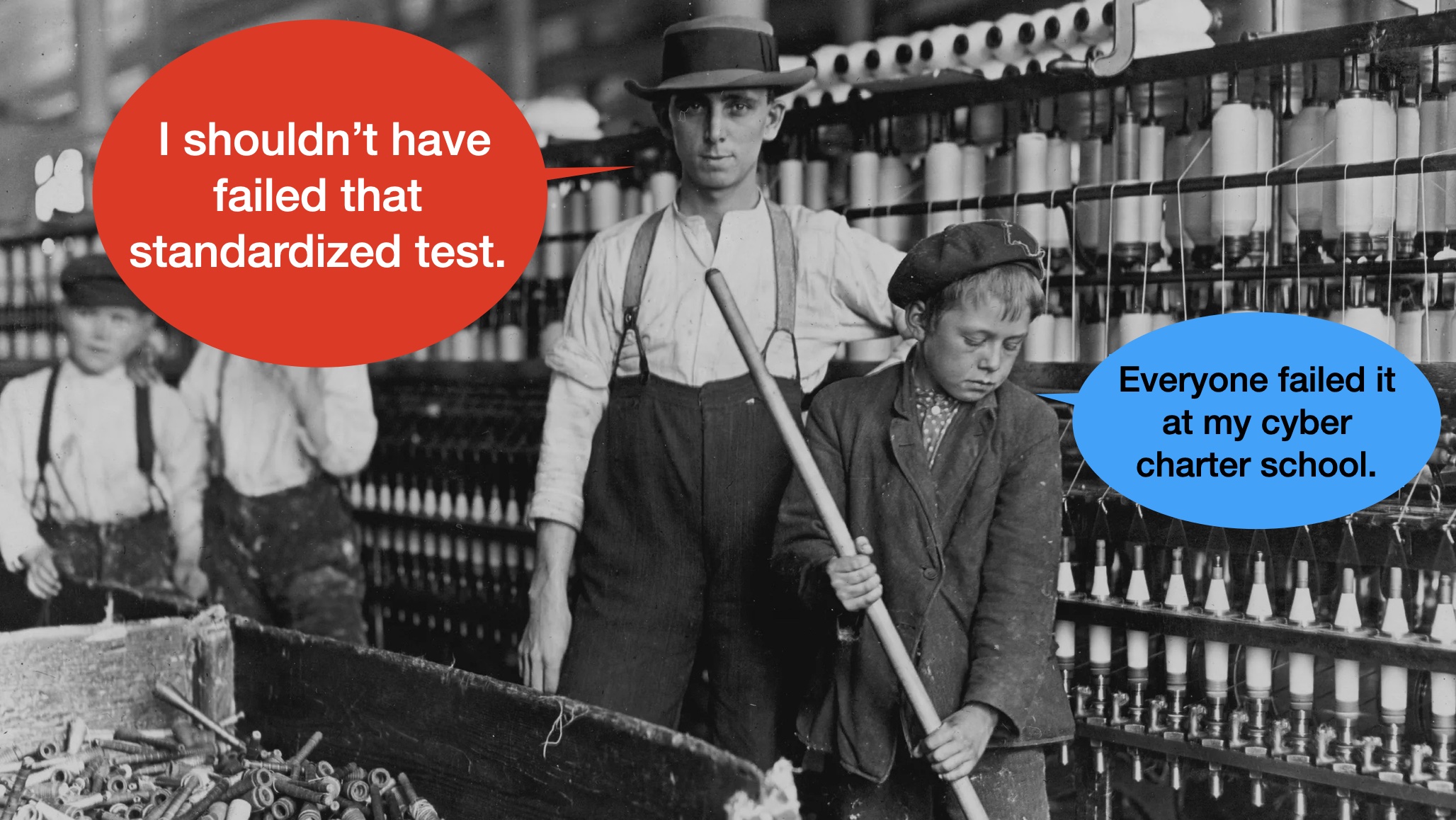
Efforts to Legalize Child Labor are the Next Logical Step After Corporate Education Reform

 
Standardized testing


Privatizing public schools. 


Defunding poor students.  


What’s next? 


Republicans across the United States have an answer – legalizing child labor


Since 1938 with the Fair Labor Standards Act, the Franklin D. Roosevelt administration restricted children younger than 14 from being employed, and put strict rules in place on when those younger than 18 may be employed, for how many hours and in what fields. 


Today Republicans across the country seem poised to repeal those protections. 


In Wisconsin, Republicans want to allow 14-year-olds to work in bars and restaurants serving alcohol. These kids aren’t legally allowed to drink the beverages they’re pouring but I’m sure that won’t cause any problems. Nooooo! 


In Ohio, the GOP majority legislature is trying to allow kids ages 14 and 15 to work until 9 p.m. during the school year with their parents’ permission. Those teens better make sure their homework is done before their work-WORK because there won’t be anytime before bed. (No matter that this is illegal under federal law. I guess the rest of the country will have to change to accommodate the Buckeye State.) 


Donald Trump’s former press secretary, nepo baby, and current Arkansas Gov. Sarah Huckabee Sanders signed a law in March eliminating permits that employers used to have to check to verify a child’s age and their parent’s consent before hiring a minor. Without this, it’s much easier for companies caught violating child labor laws to claim ignorance. But, hey, freedom. Right? 


And that’s not even counting measures to loosen child labor laws that have been passed in New Jersey, New Hampshire and Iowa. (Iowa Republicans were even going to let 14- and 15-year-olds work in dangerous fields including mining, logging and meatpacking, before coming to their senses!) In the last two years, GOP Lawmakers have proposed loosening child labor laws in at least 10 states, according to a report published last month by the Economic Policy Institute. Some of these bills became law and others were withdrawn or vetoed. 


Make no mistake. These are not aberrations. This is the thrust of the mainstream Republican party today. 


National business lobbyists, chambers of commerce and well-funded conservative groups such as Americans for Prosperity – a conservative political network – and the National Federation of Independent Business – an organization that typically aligns with Republicans – are backing the state bills to increase teen participation in the workforce.  


Meanwhile, child labor violations have increased by almost 70% since 2018, according to The Department of Labor. The agency is increasing enforcement and asking Congress to allow larger fines against violators. 


How did we get here? 


Corporate education reform. 


It’s like the old adage: if a frog is suddenly dropped into a pot of boiling water, it will jump out and save itself from impending death. But, if the frog is gently placed in lukewarm water, with the temperature rising slowly, it will not perceive any danger to itself and will be cooked to death. 


That’s what our national education policy has been for the last two decades. Lawmakers on both sides of the aisle have been slowly raising the temperature and now the water is boiling over. 


We’ve been increasingly treating children less as individual humans who are ends in themselves and instead as cogs in the machine, widgets, things to be molded and manipulated for the good of the economy. 


Here we have an entire industry of standardized testing that makes its money as a parasite on the public school system. The same multi-billion dollar corporations design the tests, grade the tests and then offer remediation when kids don’t pass the tests. It’s a classic captive market where the provider has no incentive but to perpetuate the conditions that increase its bottom line. Students aren’t the consumers of this product – school districts are – and they have no choice but participate. It’s encoded in federal and state law. They have to play along and are, themselves, judged by the results of that compliance. 


Then we have privatization – charter and voucher schools. These are institutions ostensibly set up to educate students, but unlike authentic public schools, these organizations are allowed to turn a profit. Some of them get to hide behind the label “non-profit” but the result is the same. And once you allow financial gain of this sort into the system, that’s what it’s all about. Kids become a means to an end, not an end in themselves.  


And let’s not forget how all of this enters into the finances of public schools. Unlike most countries across the globe, education in the US is supported primarily by local taxes. So rich neighborhoods invariably have robust public schools that provide students with all the resources they need. And poor communities have impoverished schools where students get only whatever parents and teachers can scrounge together. In this country, children are not a worthy cause all by themselves – we only care about them if they’re OURS


The entire apparatus of corporate education reform is focused around jobs. In this ideology, the function of school is to prepare students for employment – that is all. It is not to make students good citizens, knowledgeable voters or even fully realized human beings. Rich kids are prepared for the jobs that will keep them rich. Poor kids are prepared for the service industry – so the rich have someone to wait on them in restaurants and stock grocery store shelves. 


The fact that the Covid pandemic has reduced adults willing to continue working in these fields for such low wages has only motivated the wealthy and powerful to fill those vacancies with younger-and-younger people who won’t understand how much they’re being taken advantage of and won’t complain. 


For example, take this quote from Rex Tillerson, former ExxonMobil CEO

“I’m not sure public schools understand that we’re their customer—that we, the business community, are your customer. What they don’t understand is they are producing a product at the end of that high school graduation. Now is that product in a form that we, the customer, can use it? Or is it defective, and we’re not interested? American schools have got to step up the performance level—or they’re basically turning out defective products that have no future. Unfortunately, the defective products are human beings. So it’s really serious. It’s tragic. But that’s where we find ourselves today.” 


We find the same rhetoric on the left as well as the right. 


The Center for American Progress (CAP) – a so-called liberal Washington think tank lead by Barack Obama  and Hillary Clinton minions like John Podesta – repeat the same conservative talking points. For example, CAP published and article called “Preparing American Students for the Workforce of the Future” which read like a companion piece to Tillerson’s diatribe. They did concede that being ready for “civic life” is important as well as being “career ready,” though. 

So far, few Democrats have taken the next logical step along with their Republican colleagues.

And they ARE colleagues. Don’t let the hyped up media culture war distract you. When you take out social issues, America’s two parties are as different as milk chocolate and dark chocolate. They’re the same basic thing separated only by intensity and bitterness.

Republicans are ready to undo child labor protections. Democrats will only take away kids’ rights at school.


This is what you get when you dehumanize students. This is what you get when you signal it is okay to be a predator on student needs to help fulfill the needs of the economy. 


Money comes first. Students – children – are a distant second.  


So finally the chickens of corporate education reform are coming home to roost. I don’t think we’re going to like the eggs. 


Like this post?  You might want to consider becoming a Patreon subscriber. This helps me continue to keep the blog going and get on with this difficult and challenging work.

Plus you get subscriber only extras!

Just CLICK HERE.

Patreon+Circle

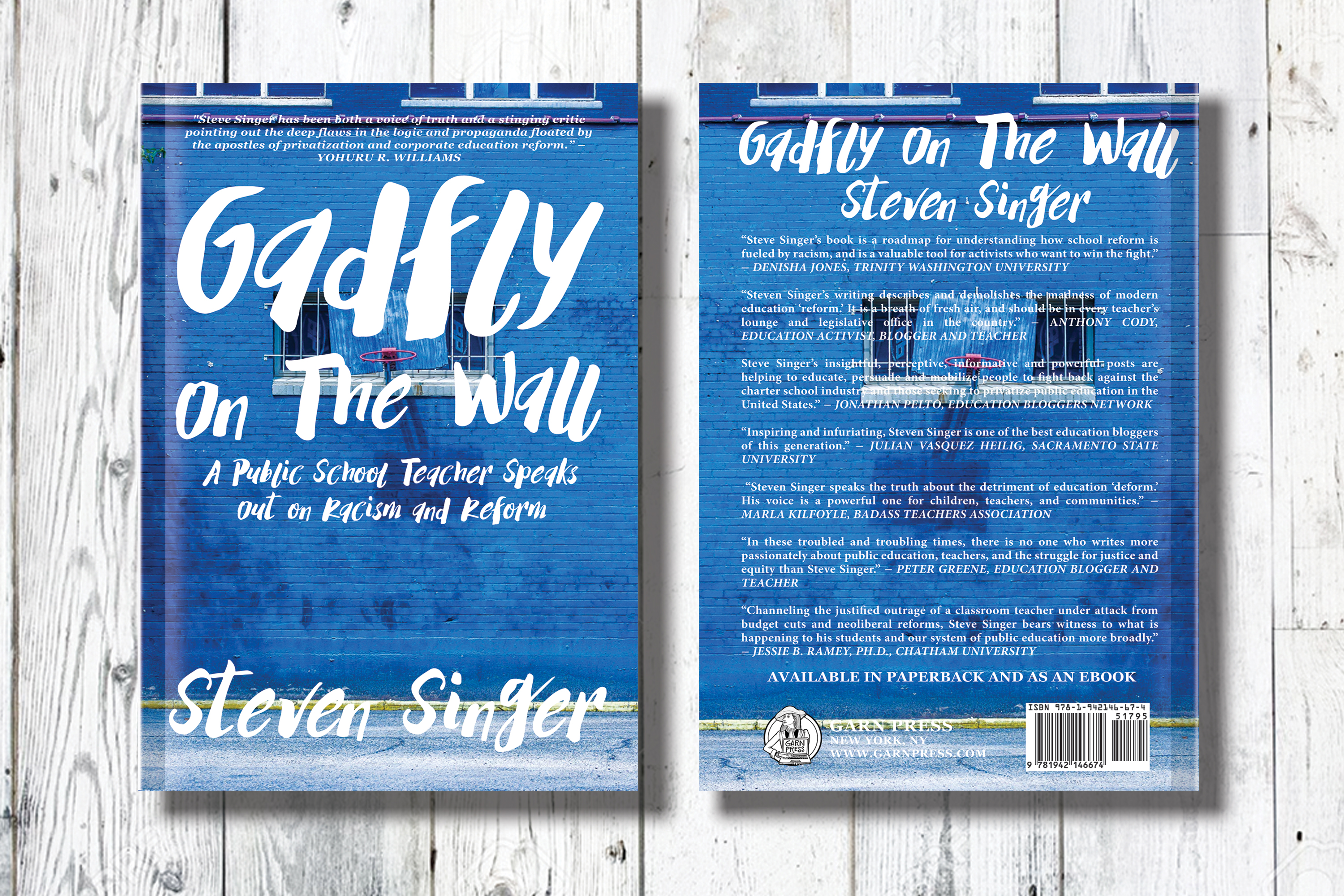
I’ve also written a book, “Gadfly on the Wall: A Public School Teacher Speaks Out on Racism and Reform,” now available from Garn Press. Ten percent of the proceeds go to the Badass Teachers Association. Check it out!


Don’t Extend Kids’ School Day; Shorten Parents’ Work Week

86696511_623051901813150_4570864634906542080_n

 
It’s rough being the parent of an American school student.

 
You often leave for work before your kids have even made it to school yet – and you get home long after they’ve returned.

 
When exactly are you supposed to parent?


Your kids have to get themselves to school. They have to get themselves home. And helping with homework, talking about their days, even setting a good example are all luxuries you have to pay dearly for with an ever-shrinking amount of time.


So what’s the solution?


For those of the think tank persuasion, the answer is more school.

 
Parents and kids schedules aren’t aligned? Well, align them then. Have kids in class from 9 to 5 just like their parents.

 
Not only will that make it easier for adults to take them to-and-from school, but it will prepare kids for the rigors of the adult world.


The neoliberal Center for American Progress, for instance, suggests that synching the school and workday would better allow parents to meet their obligations to their children.


This is especially true, they say, for kids in low-income communities where competitive grant programs could fund the initiative while also holding the money hostage unless their schools engage in more test prep as part of their curriculums.


It’s a terrible idea proposed by terrible individuals working for billionaire philanthrocapitalists.


The think tank is run by John Podesta who was chief of staff for President Bill Clinton and manager of President Barack Obama’s transition team – which tells you a lot about Democratic politics of the last several decades.


However, it does hold a kernel of truth.


The school and workday ARE out of step with each other.


This DOES cause problems.


Something SHOULD be done.


But the solution isn’t to lengthen the time kids are required to spend in the classroom. It is solved by reducing the amount of time their parents have to stay at work.


Think about it.


A LONGER SCHOOL DAY WOULD BE HARMFUL TO STUDENTS


Currently, most children attend school for six to seven hours a day.


If school started earlier or was in session later, we’d be forcing many kids to put in as much as 12-hour days – especially when you factor in transportation and after-school activities.


Students in rural areas or those who live the farthest from school would be the most impacted. Many kids get to school early for breakfast. So if classes began at 9 am, many kids would need to get to school by 8:30 am at the latest – that could mean leaving home by 7:30 am. If the school day ended at 5 pm, these same kids wouldn’t get home until 6 to 7 pm or later.


This would not lead to better academic performance or well adjusted kids. It would result in exhausted and burned out students. Some – perhaps many – would probably cut out after-school activities which would hurt their social, emotional and physical development.


Moreover, kids need time – free time – to discover who they are. They need time to spend with friends, build relationships and enjoy themselves.


They shouldn’t be forced to be adults before they are developmentally ready to do so.


And it’s not just me who says so. Youth advocate Vicki Abeles is sounding the alarm against the idea of a longer school day, too. Abeles, who authored Beyond Measure: Rescuing an Overscheduled, Overtested, and Underestimated Generation, wrote in The New York Times:


“Many of our children are already stretched to unhealthy breaking points, loaded down with excessive homework, extracurricular activities and outside tutoring because they’re led to believe high test scores, a slew of Advanced Placement classes and a packed résumé are their ticket to college and success. This has led to an epidemic of anxious, unhealthy, sleep-deprived, burned-out, disengaged, unprepared children — and overwhelmed and discouraged teachers. The key is creating a healthier, more balanced, more engaging and effective school day, not a longer one.”


Moreover, this is not what other high achieving nations do to succeed. Countries like Finland, Singapore, and China have SHORTER school days – not longer ones. They just try to make the most of the class time they have.


In fact, U.S. teachers already spend more time in the classroom with students than their peers in practically every other developed nation, according to the Organization for Economic Cooperation and Development.


Maybe instead of listening to think tank fools like Podesta, we should pay attention to educators around the world.


And this is to say nothing of cost.


Nine years ago, it took $10 million to lengthen the day at 50 Chicago schools. Each school got $150,000 just to pay for additional salary to compensate teachers for the extra time. The district projected that it would have cost $84 million to increase the program to all its schools.


But that doesn’t include the cost for additional electricity, maintenance and other utilities which is more difficult to estimate.


Who’s going to pay this extra money? We don’t even adequately fund the time kids spend in class NOW! We’re going to stretch tax revenue even further to increase those hours!?


This is the definition of doing more with less. More time, less quality.


SHORTENING THE ADULT WORK WEEK


It would make far more sense to cut parents’ time at work than to increase children’s time at school.


Adults already work too many hours as it is.


In fact, doing so actually makes adults better at their jobs.


That’s not just conjecture or wish fulfillment. It’s been tried and proven correct.


In 2019, Microsoft conducted an experiment at its offices in Japan where employees had to take every Friday off as a paid vacation day. The result was a boost in productivity of 40 percent.


In 2018, Perpetual Guardian, a New Zealand trustee services firm, did almost the same thing on a trial basis. It had employees work four eight-hour days a week but paid them for five. Once again this resulted in an increase in productivity, but also lower stress levels and higher job satisfaction.


The idea of a 32-hour workweek (instead of the traditional 40) is gaining support. After all, much of our time on the job is wasted.


The average number of truly productive hours in an eight-hour day is two hours and 53 minutes, according to a survey of U.K. office workers. Human beings aren’t robots. We can’t just sit at our desks and work. We have all these pointless meetings, frivolous emails and phone calls, co-worker discussions, disruptions and distractions. Imagine if we didn’t have to waste so much time and could focus on other endeavors after putting in a few effective hours at the office. We could get things done and still have time to live our lives.


The five-day, 40-hour workweek is a relatively new invention. A century ago, it was not uncommon for people to work six ten-hour days with only Sundays off for religious worship. Then Henry Ford started giving his autoworkers more time off to create leisure time – so they might have reason to actually buy the cars they were making. It became common practice throughout the country in 1938 when Congress passed the Fair Labor Standards Act. The law was meant to improve conditions and pay for manufacturing workers – and it did that. However, that doesn’t mean it was the be all, end all. We should continue the trend to shorten the workweek even further.


In fact, this is what people expected would happen – that work hours would continue to shrink over time.


In 1930, the economist John Maynard Keynes predicted that the working week eventually would be cut to 15 hours. He figured that by 2030, people would have far more leisure time as their material needs were met.


However, the trend changed in the 1970s as Americans started spending more – not less – time at their jobs. This also coincided with the weakening of labor unions, corporate downsizing and demanding more from employees for decreasing wages and benefits.


Now the US and Korea lead the developed world in long workdays. Americans average 1,786 work hours a year, which is 423 more hours than workers in Germany and over 100 hours more than workers in Japan, according to the Organization for Economic Cooperation and Development (OECD).


CONCLUSION

 
These long hours take a toll on our health and well-being.


It’s telling that instead of realizing that adults need fewer hours on the job, policy wonks try to convince us to make our children shoulder the same burden.


It reminds me of Max Weber’s thesis in his seminal “The Protestant Ethic and the Spirit of Capitalism.” In the book, the sociologist and economist argues that underneath our economic values lies an abiding belief in a Puritan work ethic. The value of work is given a religious and ethical fervor far beyond what it gains us monetarily.


Perhaps we need to take a step back from these unconscious and toxic values to see what is really in the best interests of individuals and families.


It is far past time to shorten the workweek for adults.


That would give us the time we need to be better parents to our children, allow us to be more present and available for them.


It would be far better for families to spend more time together learning and growing than to throw that time down an endless bin of empty industry.


Like this post? I’ve written a book, “Gadfly on the Wall: A Public School Teacher Speaks Out on Racism and Reform,” now available from Garn Press. Ten percent of the proceeds go to the Badass Teachers Association. Check it out!

book-4

Sell Your Soul to the Testocracy: Kamala Harris’s Faustian Teacher Raises

Screen Shot 2019-03-27 at 7.03.07 PM

 
I love the idea of Kamala Harris’ plan to give teachers a pay raise.
 

But once we get past ideas, it’s way more troubling.


The California Senator and Democratic Presidential hopeful is proposing a $13,500 pay increase for the average teacher, with the exact number based on the size of each state’s pay gap.
 

That’s $315 billion more over a decade through federal matching funds, which amounts to a 23 percent salary increase for most educators.


Yes, please!

 
I could certainly use a raise.
 

But as Joe Moore said, “You can’t trust a promise someone makes while they’re drunk, in love, hungry, or running for office.”

 
And Harris IS running for office.


With this policy she’s wooing the national teachers unions and filling the neoliberal seat left by Hillary Clinton in 2016.

 
I love my union, but its leadership is like a college kid during spring break – ready to jump into bed with anyone who says the right words.
 

The fact of the matter is this plan also is favored by the people out to destroy my profession from the inside out.
 

Arne Duncan likes it.
 

Yes, THAT Arne Duncan!

 
Obama’s first Education Secretary. The guy who thought Hurricane Katrina was the best thing to happen to New Orleans because it allowed the government to close the public schools and replace them with charter schools.

The man who held federal grant money hostage unless schools enacted his unproven and disastrous corporate driven education reforms.


The man who encouraged pushing out teachers of color who had four year education degrees in favor of mostly white Teach for America temps with a few weeks crash course training.


The man who encouraged a rapid increase in high stakes standardized testing, narrowed curriculum, let class sizes balloon and decreased authentic lessons.

 
THAT Arne Duncan wrote this about Harris’ plan on Twitter:


“Radical idea: pay the professionals we entrust to teach, nurture and mentor our children a better salary!”


Screen Shot 2019-03-27 at 7.53.10 PM

 
How to reconcile the two?


I draw your attention to what he said on a recent book tour:


“If we were willing to invest in high-quality early childhood education, if we’re willing to pay great teachers and great principals significantly more, the benefits to our society, the benefits to our economy, the benefits to our democracy I think would be extraordinary…

[But] Money is never enough. So you’ll never hear me say, it’s only about money. For me it’s always about your high expectations as well as high support. And we have to hold ourselves accountable for great results. When schools aren’t working, we have to be willing to challenge the status quo. So investment is part of it, but high expectations have to go with that, and we have to hold ourselves accountable as educators for results, absolutely.”


So for Duncan this plan is entirely consistent with corporate education reform.


In fact, it makes sense as a continuation of those policies.


When privatization cheerleaders like Duncan talk about “high quality teachers” and “accountability” what they really mean are strings attached.


In this case, they probably mean merit pay – giving bonuses to teachers whose students get high test scores.


It’s a terrible idea because it encourages bad behavior from teachers, administrators and districts, which in turn hurts kids.


Having all your teachers fight over the rich white kids who get the highest test scores doesn’t help the struggling students. It just means fewer educators will want to teach the underprivileged because they can’t take the financial hit that comes with it.


The result is test prep all day, every day.


I want a raise, but not if it means I have to bastardize my own profession down to that!


And it’s not just Duncan who loves this idea.


Catherine Brown, a senior fellow at the Center for American Progress (CAP), actually helped Harris write this proposal.


“It could be transformative in terms of how we think about elevating and modernizing the teaching profession and the federal role in doing so,” Brown said.


CAP is a neoliberal think tank that worked closely with the Obama and Clinton administrations. And Brown is also the co-author of “The Progressive Case for Charter Schools”.


Any plan to raise teacher salary that is consistent with increased privatization is inherently suspect.


You can’t champion authentic public schools and public school teachers while also pushing for more institutions run without the same transparency, democratic government, and enrollment standards. If you think schools should be able to cherrypick which students to accept, they should be run by appointed bureaucrats, and it’s fine to cut student services while pocketing the profits, you aren’t a friend of public education.


In an article she co-wrote published by CAP called “Fact Sheet: Yes, Increase the Salaries of All Teachers,” she made it clear that merit pay is a good idea.


She wrote:


“…there is still debate surrounding whether all teachers need a raise, or if it is enough to make changes for a select group of teachers through differentiated or merit-based pay. While differentiated and merit-based pay can help alleviate some specific teacher shortages, such as those in subjects or schools that are high-needs, they are not a substitute for higher base pay.”


Ultimately, Brown comes out in favor of an across the board salary increase for teachers, but in her view merit pay is part of that solution.


This is a backdoor for the same snake oil the privatizaters have been selling for years.


As education blogger Peter Greene points out, the language used in Harris’ proposal is right from the neoliberal playbook. It is full of the same euphemisms and code words that have signaled school privatization, high stakes testing and merit pay.


Consider this gem:


“Every child deserves a world-class education, regardless of their ZIP code. Of all in-school factors that impact their success, there’s nothing more important than our teachers.”


“World class education” and  “regardless of ZIP code” mean charter schools galore. And the only “success” these folks are interested in is high test scores.


Or this:


“Our plan will include a multi-billion dollar investment in programs that help elevate the teaching profession and support principals and other school leaders. This includes high-quality teacher and principal residencies early-career induction programs that pair new teachers with mentors and master teachers, career ladder models that allow for advancement opportunities for teacher leaders, and “Grow Your Own” programs that help increase teacher diversity.”


Greene says that the term “Career ladders” is a red flag because it usually denotes career stagnation. It’s code for adding more duties and responsibilities on teachers without actually furthering their careers.


If I’m honest, these are all red flags.


As much as I want a raise, I’m doubtful Harris’ plan would actually accomplish much other than selling my soul to the testocracy.


Ultimately that’s what this is – a Faustian bargain.


We need to invest in greater per pupil spending and let that translate into higher teacher salaries.


We need equitable and sustainable funding formulas that aren’t tied to testing or that don’t open the door for privatization.


And most of all, we need an understanding of the real challenges in education and not a piece of parchment where teachers are supposed to sign in blood.


Like this post? I’ve written a book, “Gadfly on the Wall: A Public School Teacher Speaks Out on Racism and Reform,” now available from Garn Press. Ten percent of the proceeds go to the Badass Teachers Association. Check it out!

book-1

Would Democrats Really Do Better Than Betsy DeVos on Education?

Screen Shot 2018-03-28 at 4.32.52 PM


Everybody hates Betsy DeVos.


As Donald Trump’s Secretary of Education, she’s ignorant, unqualified and insincere.


But would the Democrats really do much better if they had control of the Executive Branch?


The Center for American Progress (CAP), a left leaning think tank, wants you to believe that they would.


The organization founded by John Podesta and deeply tied to both the Clinton and Obama administrations has come out with a list of seven policy goals if Democrats take back the House and/or Senate in the midterm elections this November.


On the face of it, many of these goals are smart and worthy ends to pursue.


But this is the Center for American Progress, after all! These are the same people who pushed charter schools down our throats, the same people who never met a standardized test they didn’t love, the same people who think Teach for America temps are just as good – if not better – than fully licensed, fully trained teachers with 4 or 5 year education degrees.


Frankly, I don’t trust a thing they say.


The last two Democratic administrations pushed almost the same education policies as the last three Republican ones. They often use different rhetoric and pretend to dislike policies that BOTH parties have championed for decades.


So when an organization with a history like CAP offers school policy proposals – even if they’re innocuous on the surface – a closer look often reveals something disturbing hiding just under the skin.


In any case, it’s worth taking a look at this new report to examine what’s helpful in these think tank proposals and in what ways they might hide dangers for students, teachers, parents and society.


THE BAD


Screen Shot 2018-03-29 at 1.45.45 PM


CAP proposes we:


  1. Provide a tutor for all students who are below grade level:


This includes both academic and emotional support. And it sounds great! Imagine what struggling students could do with more one-on-one help!


However, according to the report, CAP’s major problem with previous tutoring initiatives like those provided under the No Child Left Behind Act was that they weren’t “high-quality.” Moreover, “tutoring could grow at the local level, helped along by things like an AmeriCorps expansion.”


Oh great! “high-quality” is often used by think tanks as a euphemism for standardized testing. And AmeriCorp has helped push more Teach for America temps into positions that should be held by teaching professionals.


I would love for struggling students to have extra help, but this sounds too much like sending Teach for America to give poor and minority students test prep and skill drills for hours and hours after school.


2) Go to a 9-to-5 school day:


Child psychologists have been suggesting we start school later in the day for at least a decade to better suit growing bodies and brains. Students would be able to get more sleep and come to school more rested and ready to learn. It would also help parents if students didn’t get out of school up to two hours before most adults are home.


In addition, CAP is cognizant that this would have to be a local decision – it couldn’t be handed down at the federal level. They suggest encouraging the move with more Title I funding and other sweeteners.


However, this ignores the fact that U.S. kids already spend more time in class than their international peers. Few countries make their children suffer through an 8-hour day. In Finland, for example, where kids start later and are released earlier than U.S. children, students get a 15-minute break for every 45 minutes of class work.


This suggestion, coming as it does from test-obsessed partisans, could be just another way to try to increase the amount of work piled on students in order to raise test scores. I advise caution.


3) Pay teachers more


I’m certainly not against this one. CAP notes that teachers only take home about 60 percent of the salaries that employees with similar levels of education earn. They suggest a base salary of $50,000 – up from the current average of $38,000 for incoming educators.


“More-experienced educators with a track record of success should make at least $100,000,” the report suggests (emphasis mine). And THAT’S where I start to feel queasy. What exactly do they mean “track record of success”? Well, this is CAP, so that probably means teachers whose students score well on standardized tests.


So I’m guessing it’s a back door merit pay policy. In other words, they want to offer more money to teachers who clobber their students with the test prep club so they’ll magically score Advanced on high stakes tests. This is yet another attempt to bribe educators to narrow the curriculum, avoid collaboration and sideline students who don’t traditionally score well on these kinds of assessments – the poor and minorities.


I want a raise, believe me. I DESERVE a raise! But not if you’re going to make me sign a Faustian bargain first.


THE GOOD


Screen Shot 2018-03-29 at 1.46.06 PM


CAP proposes we:


4) Offer free breakfast and lunch to all students, no matter what their parents income:


We have this at both my daughter’s school and the district where I teach in western Pennsylvania. It is a tremendous success. Making it a nationwide initiative is an excellent idea.


It’s hard to argue with this, even if the main justification is that better nutrition will lead to better academic outcomes (read: test scores). Plus this removes the stigma of a free meal because all students receive it, and once initiated it would be harder to take away.


5) Provide more opportunity for students going to college to get technical workplace experience:


Students should be able to get real world experience to help them decide if certain careers are for them. I’m struggling to see a downside.


6) Hire more social workers, counselors and school psychologists:


Heck to the yeah. I see no downside there.


 7) Initiate a national infrastructure program to fix crumbling school facilities:


It’s about time! Schools in impoverished neighborhoods are falling apart. We need to bring them up to the same level as those in the upper middle class and wealthy communities. Obviously, we’ll need to audit these programs and make sure money isn’t being wasted or embezzled, but this is a worthy goal well past due.


AND THE OTHER SHOE DROPS


shoe_drop_small


And that’s it.


Not a bad list, over all.


I do have some reservations as noted above. However, many of these proposals would be really positive…


…until the other shoe drops.


Queue Lisette Partelow, CAP’s director of K-12 Strategic Initiatives and the lead author of the report. Pay careful attention to her remarks about the report in Education Week.


The think tank doesn’t expect these policies to be introduced or enacted anytime soon, she says. And even if they were, Partelow understands they would probably go under significant legislative changes before becoming law.


“We’re really excited about this as a counter balance, as an answer to the ideas we’re seeing put forward by [U.S. Secretary of Education] Betsy DeVos and the Trump administration,” Partelow says.


So THAT’S their game!


CAP is playing the long con here. They are putting forward a bunch of puppy dog and teddy bear proposals to contrast with Trump and DeVos.


These aren’t policies as much as they are advertisements for the Democratic party. It’s the equivalent of saying, “We promise we’ll do good things like THESE if you elect Democrats – despite the fact that we mainly focused on standardization and privatization when we were in power.”


Look. Maybe I’m being too cynical.


Maybe the Democrats really, really are going to do a better job this time, cross their hearts and hope to die, if we give them just one more chance.


But words aren’t nearly enough.


I like many of these policy suggestions. But I just don’t trust the Democrats.


The brand has been tainted for me by the Clinton and Obama administrations – by leadership from the same people who are making these suggestions.


In short – I’ll believe it when I see it.


Perhaps the greatest lesson organizations like CAP have taught is not to trust organizations like CAP and the faux progressives they’re selling.

6a00d8341d368753ef01b8d2bc84a9970c

For more, Read CAP’s Full report: HERE.


Like this post? I’ve written a book, “Gadfly on the Wall: A Public School Teacher Speaks Out on Racism and Reform,” now available from Garn Press. Ten percent of the proceeds go to the Badass Teachers Association. Check it out!

book-3