Burning Down the House at TEDxCCSU – Speaking Truth to Power with a BOOM!

31265515_10157264415409018_6319846807568384_n


There’s a reason our society rarely hands teachers the microphone.

We’ll tell you the truth.

Oh, we’re too good mannered to be brazen about it. We’d rather encourage you for trying than criticize you for getting something wrong.

But if you ask us for truth, that’s usually what you’ll get.

Just ask any first grader.

“Is my finger painting good, Miss Pebbles?”

“Oh my, it is!”

“Really?”

“Why yes. I love what you did with that smear of yellow and blue in the corner. Where they overlap, it turns green.”

“Do you think it’s good enough to compete against the seniors in the high school?”

“Maybe you’d better practice a bit more, Dear. At least wait until you can spell your name correctly before devoting your life to art.”

That’s why I was so delighted to get an invitation to do a TED talk.

Here was my chance to tell it like it is.

Sure, some people look to TED for encouragement and life affirming inspiration.

But the way I see it, the only real affirmation is honesty.

Otherwise, it’s just a bromide, a deception, an intellectual hard candy to plop into your skull and let your cranium suck on until all the sugar is gone.

We’ve all seen these TED talks on YouTube or the Internet – some well-dressed dude or dudette standing in front of a crowd with a headset microphone and a grin offering anecdotes and words of wisdom to a theater full of eager listeners.

But after hundreds of thousands of talks in scores of countries, the format has almost become a parody of itself. At many of these events, you’re just as likely to find some Silicon Valley tech millionaire waxing philosophic about his casual Friday’s management style as you are to hear something truly novel.

No, the way I see it, the TED extravaganzas are just asking for a bundle of truth wrapped in a plain brown box – quiet, unassuming and ticking!

For me, doing one was a long time coming.

The first I heard about it was at United Opt Out’s Education and Civil Rights Summit in Houston, Texas, two years ago.

I was rooming with Jesse “The Walking Man” Turner – an education professor at Central Connecticut University and famed social justice activist. He’s been involved with everyone from Moral Monday’s to S.O.S. Save Our Schools. But he’s most well-known for walking from Hartford to Washington, DC, to protest school privatization and standardization  – a feat he did not once, but twice!

Anyway, one night as I was fading into sleep, he whispered to me from across the room, “Steve, you ever thought about doing a TED talk?”

“Huh? Whas tha, Jesse?”

“A TED talk. You ever thought about doing one?”

“Oh I don’t know. That would be pretty cool, I guess.”

“I organize an independent TED event at my school every year. We should get you on the schedule.”

And that was it.

I think. If there was any more to that conversation my conscious mind wasn’t involved in it.

But then the following year I got a call from Jesse asking if I was ready to come to Connecticut.

I wasn’t. I’d just had two mild heart attacks and wasn’t in a condition to go anywhere. I could barely gather the strength to go to school and teach my classes.

What followed was a year of recovery.

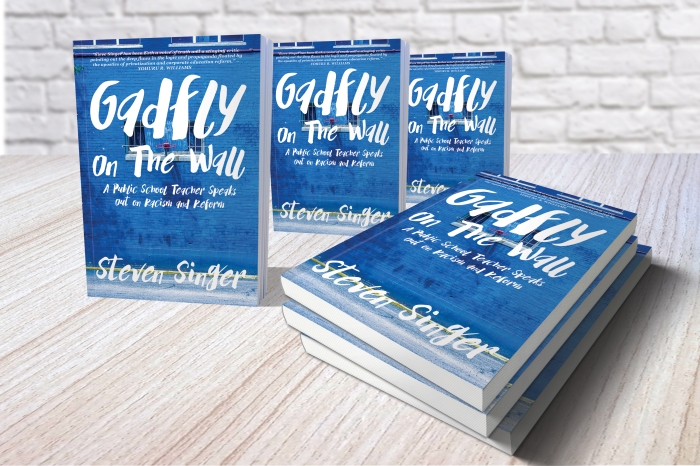
I dedicated myself to my students and my blog and made it through the year. In the summer, I put together my favorite on-line articles into a book for Garn Press – “Gadfly on the Wall: A Public School Teacher Speaks Out on Racism and Reform.”

After it was published in November, I worked to promote it, going from event-to-event, book store-to-book store lecturing, signing, and listening. I was even invited to Chatham College to address their graduating class of teaching students.

Then another surprise. I was one of three educators in western Pennsylvania nominated for a Champions of Learning Award in Teaching from the Consortium for Public Education. In the final analysis, I didn’t end up winning the award, but it was a huge honor.

And then to top it all off, Jesse called me back and asked me if I was ready to come to Hartford and give the TED talk another try.

I jumped on it.

How could I say no?

This year has been like a second chance, a new lease on life. I’ve been eating healthier, exercising, losing weight and taking nothing for granted.

But that comes with certain responsibilities.

I couldn’t go there and just mouth platitudes and self-help advice. I couldn’t just tell some touchy-feely stories from my classroom and conclude about how great it is to be a teacher.

Even though it is great – the best job in the world.

But our profession is under attack.
Public schools are being targeted for destruction. The powers that be are using segregation, targeted disinvestment and standardized testing to destabilize public schools and replace them with privatized ones.

The school house is on fire! This is no time for heart-warming stories. It’s time for anger, agitation and activism!

So that’s what I decided to speak about.

Frankly, that wasn’t what I originally planned.

At first, I was going to talk about how society expects too much of teachers – how we expect educators to do it all.

But then the opportunity came to “practice” my speech in front of my entire school building.

I thought to myself, is THIS really what I want to talk about?

If I only get one shot at this – and I probably will get only one shot – do I really want to spend it on society’s unfair expectations?

That’s when I scrapped what I had and started over, this time focusing on “The Plot to Destroy Public Education.”

I must have rewritten my presentation at least five times.

Jesse said I’d have no more than 15 minutes so I practiced just about every night to make sure I was within that time.

The word may have gotten out around my school because the invitation to speak to the entire building quickly evaporated. Maybe there really was a scheduling mix up. Maybe not.

But it didn’t matter. My presentation was ready like a bomb – no hand holding, no concessions, just the truth.

The weeks flew by.

Before I knew it, it was time to fly to Connecticut. I couldn’t believe it was really happening.

When I got there, Jesse picked me up from the airport. He was a consummate host. He couldn’t have treated me better if I was royalty. He paid for my hotel, paid for most meals, drove me everywhere, kept me in good company and entertainment and even gave me a “Walking Man” mug as a token of his appreciation.

I was the only person flying in from outside of the Hartford area. Most of the other seven speakers were from there or had roots in the community.

All but two others were PhDs. The list of names, vocations and stories were impressive. Dr. Dorthy Shaw, a famed education and women’s studies professor, talked about surviving cancer. Dr. Noel Casiano, a sociologist, criminal justice expert and marriage counselor, told a heartbreaking personal story about the three people who mentored him from troubled teen to successful adult. Dr. Kurt Love, a CCSU professor focusing on social justice and education, talked about the greed underlying our economic and social problems. Dr. Barry Sponder, another CCSU professor focusing on technology in education, talked about flipped classrooms. Dr. Johnny Eric Williams, a sociology professor, talked about the myth of whiteness and how it corrupts how we speak about race.

Elsa Jones and her son Brian Nance were the only other non-PhDs. Jones is an early education consultant and the daughter of the Rev. Dr. William Augustus Jones, Jr., a famed civil rights leader who worked with Dr. Martin Luther King, Jr.

They were the ones I bonded with the most. All four of us went out for pizza after the talks.

But when I first entered the Welte Auditorium in the Central Connecticut State University campus, it was truly frightening.

The building could hold hundreds, perhaps thousands of people. Yet organizers had limited the audience to only a hundred. All the seats were up on the stage.

There was a little circular rug where we were to stand and the camera people were setting everything up.

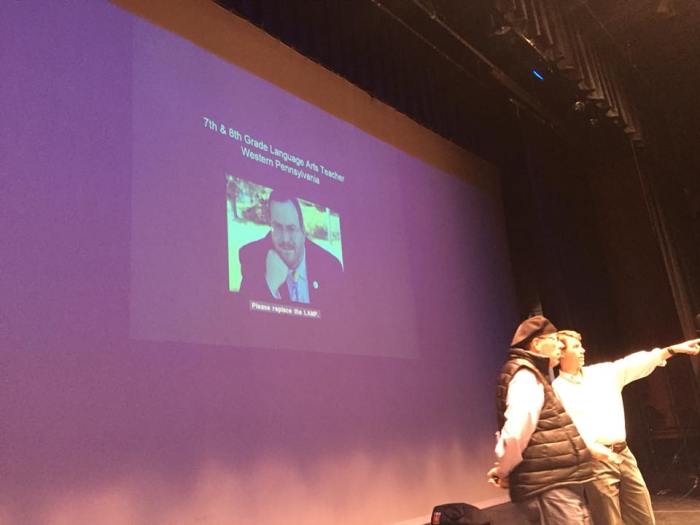
Behind us, a ceiling high blue-purple backdrop would showcase the TED logo and any slides we had prepared.
31392968_10155840677638860_1951634311957953781_n

Which brings up an interesting distinction.

This was not a corporate TED event organized by the TED conference and sanctioned by their foundation. It was a TED “X” event, which means it was independently organized.

TED licenses its name for these grassroots X-events. There are a list of rules that organizers must follow. For example, all tickets to the event must be free. Contrast that with the corporate TED events where tickets go for thousands of dollars.

I was glad I was where I was. This was going to be the real deal – a thoughtful discussion of authentic issues. And somehow I was up there with these incredible thinkers and activists.

The moment came. Drs. Shaw and Casiano had already spoken. I got up from my seat in the front row to get my lapel microphone attached.

Jesse gave me a warm introduction letting everyone in on the secret of my tie – the design was a picture of my daughter repeated to infinity.

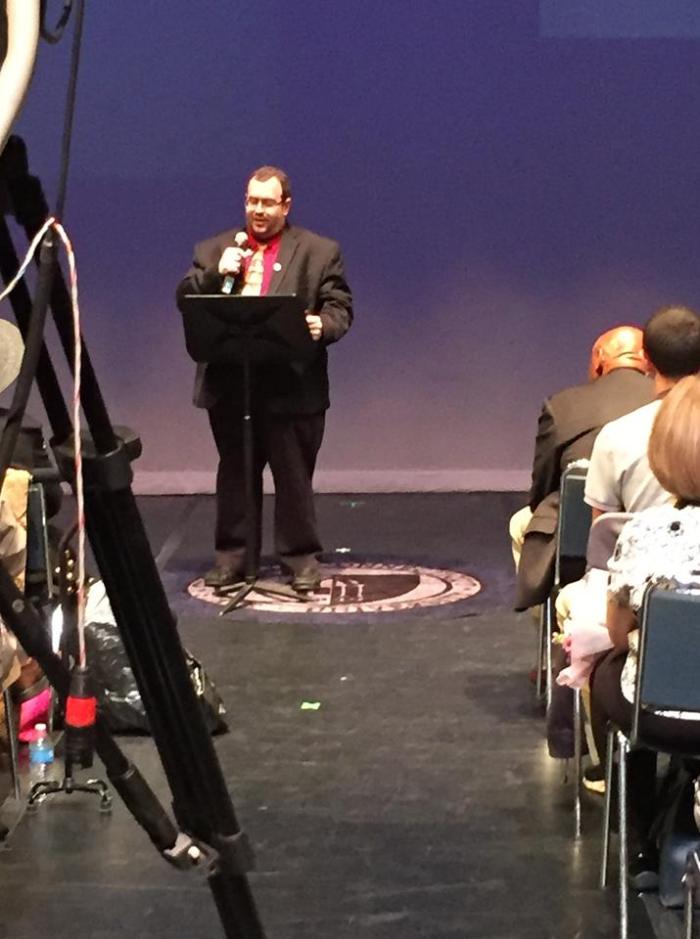
So I walked to my mark and started speaking.

It seems there was some sort of technical difficulty with the microphone. My voice didn’t appear to be coming from the speakers – or if it was, it wasn’t projecting very well. So I spoke louder.

Then Jesse came from the wings and gave me a hand mic and a music stand for my notes.

It took a moment to get used to handling the microphone, the clicker for my slides and my iPad (where I had my notes), but I got the hang of it.

And I was off and running.

I said it. I said it all.

The audience certainly didn’t seem bored. All eyes were on me. A few heads were nodding in agreement. Some faces seemed stunned.

When I ended, there was universal applause. A few folks patted me on the back when I got back to my seat and shook my hand.

And that was it.

I thoroughly enjoyed the remaining presentations but it was hard to concentrate in the post-TED elation.

Jones and Nance were probably the closest to what I was talking about and we got along like we’d known each other for years.

When I got back to the hotel, I felt elation and exhaustion in equal measure.

I had done it.

After months, years of planning, it was over.

Jesse tells me the video will be on-line in a matter of weeks. (I’ll revise this post with the video when it goes live.) Though he did mention that one point in my presentation made him a bit nervous – I had called out Bill Gates for his role in the destruction of public schools. However, Gates is a big donor to TEDs. Jesse half-jokingly said that the TED folks might take issue with that and refuse to upload my speech.

But whatever. I told the truth. If that gets me censored, so be it.

This will be something I’ll never forget.

I’m sorry this article has gone on so long, but there was much to tell. It’s not every day that someone like me gets such a stage and such a potential audience.

Hopefully, my video and my speech will be seen by many people who have never heard of this fight before. Hopefully it will open minds and stoke people to act.

And hopefully the mic issues at the opening won’t be distracting.

Thank you for following my blog and being there with me on this incredible journey.

I left nothing important unsaid. I gave it my all.

Now to see where it goes.


The video is available on YouTUBE and directly on the TED Website.


It’s NOT Education Reform – It’s School Sabotage

sarah-ji_BOERallyMtg-7CROP-678x381


“Language is a weapon of politicians, but language is a weapon in much of human affairs.”

-Noam Chomsky


“Words are things. You must be careful, careful about calling people out of their names, using racial pejoratives and sexual pejoratives and all that ignorance. Don’t do that. Some day we’ll be able to measure the power of words. I think they are things. They get on the walls. They get in your wallpaper. They get in your rugs, in your upholstery, and your clothes, and finally in to you.”


Maya Angelou


Names matter.


What you call something becomes an intellectual shorthand.


Positive or negative connotations become baked in.


Hence the Colorado Democratic Party’s criticism of Democrats for Education Reform (DFER).


After impassioned debate, delegates demanded DFER remove “Democrat” from their name.


It just makes sense. DFER is a group of hedge fund managers pushing for school privatization – a policy the Colorado Democrats vocally oppose.


In fact, one of the organization’s key founders, hedge fund manager Whitney Tilson, was quoted in the film “A Right Denied,” thusly:

“The real problem, politically, was not the Republican party, it was the Democratic party. So it dawned on us, over the course of six months or a year, that it had to be an inside job. The main obstacle to education reform was moving the Democratic party, and it had to be Democrats who did it, it had to be an inside job. So that was the thesis behind the organization. And the name – and the name was critical – we get a lot of flack for the name. You know, “Why are you Democrats for education reform? That’s very exclusionary. I mean, certainly there are Republicans in favor of education reform.” And we said, “We agree.” In fact, our natural allies, in many cases, are Republicans on this crusade, but the problem is not Republicans. We don’t need to convert the Republican party to our point of view…”


So by a 2/3 vote, the Colorado Democrats passed a motion saying in part:


“We oppose making Colorado’s public schools private, or run by private corporations, or segregated again through lobbying and campaign efforts of the organization called Democrats for Education Reform and demand that they immediately stop using the Party’s name, I.e., “Democrat” in their name.”


To which I say “Hurrah!”


DFER definitely is a misnomer.


However, which is more inaccurate – the term “Democrat” or the word “Reform”?


Members of the nefarious school privatization propaganda squad are, in fact, Democrats.


They have registered as voting members of that political party.


However, they certainly aren’t progressives.


They don’t adhere to the traditional views normally associated with the party.


So the Colorado Dems motion is a positive move toward taking back what it means to be a Democrat. And in that spirit, it should be celebrated and emulated by every state and national party association.


The Democrats have always been a big tent party with lots of different ideas being accepted under that umbrella. But putting corporate profits over student needs does not belong there.


My point is that the larger verbal slight of hand isn’t with the organization’s party affiliation. It’s with the term “Reform,” itself.


DFER is not alone in calling what they advocate “Education Reform.”


My question is this – is what they’re proposing really reform at all?


And if so, what kind of reform is it? Who does it benefit? And what does it conceal?


The word “Reform” has positive associations. It’s always seen as a good.


We always want to be reforming something – turning it from bad to good. Or at very least improving it.


And when it comes to education, this is even more urgent.


No one really wants to be against education REFORM. The only reason to oppose it would be if you thought the way we teach was perfect. Then we would need no reform at all. But this is nearly impossible. Human society does not allow perfection because it is created by human beings, who are, in themselves, far from perfect.


However, the term “Education Reform” does not mean just any kind of change to improve teaching.


It has come to mean a very specific list of changes and policies.


It has come to mean standardization, privatization and profitization.


It means increasing the number, frequency and power of standardized assessments to drive curriculum and teaching – More high stakes tests, more teaching to the test, more evaluating teachers based on student test scores, more school closures based on low test scores.


It means reducing democratic local control of schools, reducing transparency of how public tax dollars are spent while increasing control by appointed boards, and increasing the autonomy of such boards at the expense of accountability to the community actually paying for their work.


It means transforming money that was put aside to educate children into potential profit for those in control. It means the freedom to reduce student services to save money that can then be pocketed by private individuals running the school.


If the goal of education is to teach students, “Education Reform” is not about reforming practices for their benefit. It is not, then, reform.


If the goal is to increase profits for private businesses and corporations, then it truly is reform. It will increase their market share and throw off any extraneous concerns about kids and the efficacy of teaching.


However, this is not the goal of education.


Education is not for the benefit of business. It is not corporate welfare.


Education is essentially about providing positive opportunities for students. It is about providing them with the best learning environment, about hiring the best teachers and empowering them with the skills, pay, protections and autonomy to do their jobs. It’s about providing adequate resources – books, computers, libraries, nurses, tutors, etc. – to learn. It’s about keeping kids safe and secure, well-nourished, and healthy.


In short, it’s about everything bogus “Education Reform” either perverts or ignores.


Calling the things advocated by groups like DFER “Education Reform” is pure propaganda.


We must stop doing that.


Even if we use the term to criticize the practice, we’re helping them do their work.


It’s just like the term “School Choice.”


Despite the name, the reality has nothing to do with providing alternatives to parents and students. It really means school privatization.


It’s about tricking parents and students into allowing businesses to swipe the money put aside to educate children while reducing services.


In short, it’s about increasing choices for charter and voucher school operators – not parents or students.


In that way, it is a more limited version of faux “Education Reform.”


So I propose we stop using these signifiers.


Henceforth, “Education Reform” shall be Education Sabotage – because that’s really what it is.


It is about deliberately obstructing goods and services that otherwise would help kids learn and repurposing them for corporate benefit.


Likewise, I propose we stop using the term “School choice.” Instead, call it what it is – School Privatization.


Anyone who uses the older terms is either misguided or an enemy of authentic education.


Perhaps this seems petty.


They’re only words, after all. What does it matter?


It matters a lot.


As Ludwig Wittgenstein wrote:


“The limits of my language mean the limits of my world.”


We cannot effectively fight the forces of segregation, standardization and privatization if we have to constantly define our terms.


We have to take back the meaning of our language, first. We have to stifle the unconscious propaganda that happens every time someone innocently uses these terms in ways that smuggle in positive connotations to corporatist ends.


To take back our schools, we must first take back our language.


To stop the sabotage, we must first stop repeating their lies.


Like this post? I’ve written a book, “Gadfly on the Wall: A Public School Teacher Speaks Out on Racism and Reform,” now available from Garn Press. Ten percent of the proceeds go to the Badass Teachers Association. Check it out!

book-2

In Trump’s America, You No Longer Need to Pretend to be Against School Segregation

34f90d59-7c40-4530-84dc-bddbcc1c652d-9624969d


School segregation is kind of like war.


When asked point blank, no one wants to admit to liking it.


To paraphrase Motown singer songwriter Edwin Starr:


“Segregation. Huh, Good God.


What is it good for?


Absolutely nothing.”


However, when it comes to supporting actual integration programs or even just education policies that don’t make segregation worse, no one in politics really gives a crap.


Both Republicans and Democrats are heavily invested in ways to divide up school students along racial and economic lines – whether they be charter and voucher schools or strategic disinvestment in the public schools that serve the poor and minorities and hording resources for wealthy whites.


That’s why it’s somewhat shocking to hear the outrage over Trump judicial nominee Wendy Vitter.


Trump nominated the extremely partisan justice for a federal judgeship in Louisiana. Yet during a Senate hearing Wednesday, Vitter refused to answer a question from Sen. Richard Blumenthal (D-Conn.) about whether or not she believed the Supreme Court was right in its landmark 1954 decision, Brown v. Board of Education.


The decision overturned the excuse that we could educate white and black people in different facilities so long as they were “separate but equal.” In effect, it said that when we educate the races separately, their schools will never be equal.


And Vitter couldn’t bring herself to affirm this ruling.


“If I start commenting on ‘I agree with this case’ or don’t agree with this case,’ I think we get into a slippery slope,” she said.


“I don’t mean to be coy, but I think I get into a difficult area when I start commenting on Supreme Court decisions which are correctly decided and which I may disagree with,” Vitter said.


She added that the ruling was “binding” and that she would uphold it if confirmed as a judge.


And there we have it, people.


That’s where the bar is set during the Trump administration.


You no longer need to pretend to be against school segregation.


On the one hand, it’s more honest than most people in the political arena.


On the other, how far have we sunk when you don’t even need to feign decency in order to expect having a chance of Congress confirming you?


Let me be clear. Vitter’s nomination should not be approved.


Congress should draw a line in the sand and say that it cannot accept people who do not share bedrock American values on the bench.


If you aren’t in favor of integration, you have no place making decisions about race, class and education.


And that is the barest minimum.


That is merely decorum.


It’s like having the decency to condemn Nazis – something else Trump can’t bring himself to do.


What actually happens to Vitter will probably be determined by the degree of backlash against her.


As of Thursday afternoon, the video clip of Vitter’s comments about Brown V. Board had more than 1.7 million views, and was retweeted over 13,000 times.


A few months ago, another Trump judicial nominee, Matthew Petersen, withdrew from consideration after a video in which he couldn’t answer basic legal questions went viral.


But even if this reprehensible person who has no right sitting in judgement over anything more taxing than a checkbook gets turned away from the bench, we’ll still be far from where we need to be on school segregation.


Despite Brown vs. Board, many of our schools today are more segregated – not less – than they were in the 1960s.


And instead of putting on our big boy pants and tackling the issue, we’ve gone in the opposite direction.


On both sides of the aisle, lawmakers support charter schools. Republicans and a few Democrats support school vouchers. And just about everyone is fine with the fact that our public schools serve vastly disproportionate racial and economic populations yet rely on local tax revenues for funding and thus are inequitably resourced.


In every case, these policies make segregation worse. Yet hardly anyone in the halls of power or in the media even admits it is happening.


At most, you get a news story every anniversary of Brown v. Board about the increased segregation and a journalistic shrug. Well, we don’t know how to solve that one…


Yes, we do!


We need to integrate – not segregate.


We need to end school privatization.


We need to redraw district boundaries.


We need to audit school policies that keep the races apart within districts by building or by class.


And we need robust, equitable funding that can’t be manipulated to favor wealthy white kids.


That will take a lot more moral courage than partisan outrage against Vitter.


Oh, she deserves outrage, but because of her lack of morality, not her political party.


This can no longer be about if your political football team is in power or not.


It has to be about what’s right and wrong.


Caring about integration should be part of what it means to be an American – like freedom, justice and apple pie.


If it isn’t, we have a lot worse problems than one reprehensible would-be judge.


Like this post? I’ve written a book, “Gadfly on the Wall: A Public School Teacher Speaks Out on Racism and Reform,” now available from Garn Press. Ten percent of the proceeds go to the Badass Teachers Association. Check it out!

book-4

Every Public School Teacher Should Support Opting Out of Standardized Tests

Education-not-testing-chicago-protest


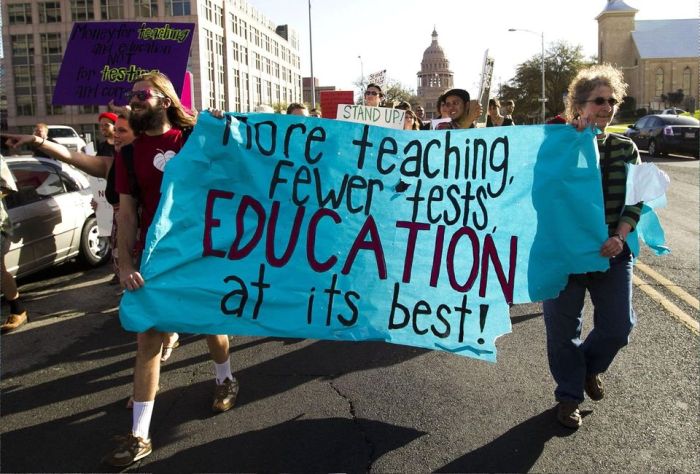
Over the last few years, educators and parents have built up a wall of opposition to high stakes testing in the Opt Out movement.


But now it seems some teachers are starting to tear it down.


Not so long ago, tens of thousands of parents refused letting their children take the tests – with full support of their teachers.


Yet today you hear some educators question their involvement or even if they’re on the right side.


It’s almost like an anthropomorphic red pitcher smashed through the bricks and offered beat down educators a drink.


koolaidman1


And far from refusing that rancid brew, some are actually gulping it down.


“OHH YEAH!”


You hear things like these:


“Opt Out’s dead. Stealth assessment schemes like Personalized Learning and Competency Based Education have replaced the federally mandated tests.”


GLUG. GLUG. GLUG.


“The tests often take up fewer days now so there’s no reason to opt out.”


GLUG. GLUG. GLUG.


“The kids who opt out aren’t doing it for the right reasons. They just want to get out of work.”


GLUG. GLUG…


Blargh! I can’t drink any more of that artificially flavored propaganda crap!


I’ve even heard of some teachers in New York State agreeing to call families who have refused testing in the past and asking them to reconsider!


What the heck!? Have we all lost our minds!?


We’re educators!


If anyone knows the problems with standardized testing, it’s us.


We know in intimate detail how these assessments are biased and unscientific.


So let me counter some of this dangerous disinformation going around.


1) You say the tests take up less time?


Marginally, yes. There are fewer test days.


But we’re still being pressured to narrow the curriculum and teach to the test just about every other day!


2) You say stealth testing has made the traditional standardized assessments irrelevant?


Okay. Competency Based Education is a real problem that threatens to make everyday test day – I’ll go with you there. In fact, schemes like Personalized Learning could transform every app into an opportunity to test kids without them even knowing it.


But that doesn’t mean the old fashioned high stakes tests have gone away!


Far from it. The federal government still requires all states to give these assessments to public school students in grades 3-8 and once in high school.


Let’s say the feds required teachers to give rich kids higher grades than poor children.


Or say the state commanded teachers to copy down sensitive information about students and give it to private corporations.


Imagine if the school board instructed teachers to put minority kids in slower classes than white kids.


If any of that happened, there would be wide scale revolt!


Yet standardized tests do all of these things!


They dishonestly give higher scores to rich kids and lower scores to poor kids.


The apps used for preparation and remediation often steal student data and sell it to third parties.


They are used to justify increased segregation within school buildings because implicit testing bias means white kids generally score higher than children of color. So the white kids get more advanced courses and the brown ones get test prep.


3) You say the Opt Out kids are just trying to get out of doing work. It’s just laziness.


First, of all, it is the parents who are opting their children out of standardized testing – not the students. Second, who are you to question their motives?


We serve the parents and children of the community. If they say they don’t want their children tested in this way, we should listen to them.


Third, why are you defending these tests? They are used by charter and voucher schools as “proof” that the public schools are failing.


These tests are used to justify unfairly evaluating YOUR work, narrowing YOUR curriculum, repealing YOUR union protections, reducing YOUR autonomy, cutting YOUR funding, and ultimately laying YOU off.


Why are you standing up for THAT?


So why are some teachers wavering in their opposition to high stakes tests?


I think it has to do with who we are.


Most teachers are rule followers at heart. When we were in school, we were the obedient students. We were the people-pleasers. We got good grades, kept our heads down and didn’t make waves.


But the qualities that often make for the highest grades don’t often translate into action. That, alone, should tell you something about the limits of assessment which are only exacerbated by standardized test scores. When it comes to complex concepts, it’s hard to assess and even harder to determine if success on assessments is a predictor of future success.


Bottom line: Every teacher should be in favor of the Opt Out movement.


And I don’t mean quietly, secretly in favor. I mean publicly, vocally in favor.


Many teachers are parents, themselves, with children in the districts where they teach. Every educator should opt out their own children from the tests.


If we can’t at least do that and lead by example, what good are we?


Next, we should force our unions to do the things that we can’t as safely do as individuals.


Call parents and ask them to opt IN!? We should be doing just the opposite, but that would put a target on our backs.


As a teacher, I can’t unilaterally call or send a letter home to my students’ parents explaining why they should opt their kids out. If I did that, I could find myself in administration’s cross hairs and face grave repercussions.


But isn’t that why we have a union? To stand up as a collective and do the necessary things we can’t do as individuals?


Imagine if every teachers union in the country routinely sent open letters to all parents asking them to opt their kids out! What an impact that would make!


Imagine if the unions put pressure on the school boards to pass resolutions against testing and in favor of opt out! What effect would that have on state legislatures and the federal government?


How could the feds continue to demand we give high stakes tests when nearly every school board across the country objected and advised parents to refuse testing for their children?


Taken individually, these aren’t really all that difficult things to do.


They require a certain degree of moral courage, to be sure. And teachers have been beaten down by a society that devalues their work and begrudges them just about everything.


But what do we have to lose?


Our backs are already against the wall.


We are being slowly erased – our numbers dwindle more every year while policymakers shrug and point to a teacher shortage that they refuse to explain by reference to the way we’re treated.


The tech moguls and the testing giants are salivating over the prospect of replacing us with apps and low-skilled, low paid babysitters to oversee students hunched over computers and tablets. (See? Told you Personalized Learning was poison.)


We shouldn’t be helping them destroy our own profession by advocating for the same tests they’re using as a tool in our destruction.


It’s high time teachers get some backbone.


We may all end up on the unemployment line, but that’s where we’re headed already.


I’d rather go kicking and screaming.


Who’s with me?

Absurd Defense of Standardized Testing in Jacobin Magazine

11


A bizarre article appeared in this Month’s issue of Jacobin – a left-leaning, even socialist magazine.


It was titled, “The Progressive Case for the SAT” and was written by Freddie DeBoer.


In it, the author attempts to explain why the Scholastic Aptitude Test (SAT) – though flawed – is a more unbiased way to select which students deserve college admissions than indicators like K-12 classroom grades.


It’s all convoluted poppycock made worse by a baroque series of far left think tank connections, intellectual bias and mental illness.


In short, DeBoer argues that our schools are unfair, so we should embrace unfair high stakes tests.


I know. That doesn’t make a lot of sense.


Let me slow it down a bit, premise by premise so you can see his point – or lack thereof.


The current education system privileges white affluent children, says DeBoer, so they have an easier time getting into college than poorer children of color.


Check so far.


Richer whiter kids often go to schools that are better funded than those that teach mostly impoverished minorities. Therefore, the privileged get smaller classes, wider curriculums, more extracurricular activities, more counselors, better nutrition, etc. – while the underprivileged… don’t.


Then DeBoer says that classroom grades are often dependent on the resources students receive. Richer whiter kids get more resources, so they often get better grades.


Still with you so far.


Therefore, he concludes, we need standardized tests like the SAT to help equalize the playing field. We need so-called “objective” assessments to counteract the “subjective” classroom grades.


But DeBoer admits standardized tests aren’t objective! They are also the result of resources – that’s why richer whiter kids tend to score better on them than poorer blacker kids!


The argument makes no logical sense.


Justifying one unfair system with another unfair system is beyond bonkers.


Plus DeBoer contends out of nowhere that classroom grades are more easily manipulated than the tests and thus the tests are more valid.


Wrong again.


Classroom grades are based on roughly 180 days of instruction a year for 12 plus years. The SAT is roughly one day. More if you retake it.


It is MORE difficult to influence 2,160 days worth of grading than 1 or 2 or 3. Not the other way round.


Moreover, classroom grades are tabulated by numerous teachers, many of whom have little or no contact with each other. Standardized test scores are tabulated by a handful of temporary summer workers who often collaborate on the scores.


Whether students get good or bad grades generally doesn’t affect a given teacher. However, low test scores are actually beneficial to testing corporations because they allow the company to make additional money by retesting and selling remediation materials to the district.


If one group is more subject to bias, it is those grading the standardized tests, not the classroom teachers.


He has a point that getting rid of standardized testing won’t by itself eliminate inequality. But doubling down on it certainly won’t either.


That’s just logic.


DeBoer seems to be ignorant of history, as well.


The SAT test didn’t just spring up out of the ground. It was written by people –  Psychologist Carl Brigham building on work by U.S. Army Psychologist Robert Yerkes to be exact.


Brigham devised the SAT in the early half of the 20th Century based on Yerkes’ and his own deeply racist eugenicist theories.


And when I say they were eugenicists, I’m not speaking in hyperbole. They truly believed that some races were just smarter, more moral and downright better than others.


“American education is declining and will proceed… with an accelerating rate as the racial mixture becomes more and more extensive,” wrote Brigham in his seminal A Study of American Intelligence.


“No citizen can afford to ignore the menace of race deterioration,” wrote Yerkes in 1922.


And this idea was the foundation of their application of standardized testing, as Yerkes  noted a year later:


“The contrasting intellectual status of the white versus the negro constituents of the draft appear from table 3. Few residents of the United States probably would have anticipated so great a difference. That the negro is 90 per cent. [sic] illiterate only in part accounts for his inferior intellectual status.”


Yerkes eugenics Table 3


Brigham was basing his ideas on another test created by Yerkes, the Army Alpha and Beta tests.


As noted above, Yerkes  used test scores to “prove” black soldiers in WWI were inferior and thus more suited to menial service and the trenches while whites should be given better positions.


And Brigham continued this practice with his SAT test.


In both cases, the psychologists used standardized testing to back up a racist and classist status quo.


Yet it is this same SAT test that DeBoer is suggesting we keep because it reduces racial and economic bias!


Certainly the SAT has changed some since Yerkes time, but it hasn’t changed THAT much!


And that brings us to DeBoer, himself.


Who is this guy and why did an allegedly respectable publication like Jacobin print his crap theory?


DeBoer appears to be a very troubled individual.


Back in December of 2017, he published a blog post about his mental illness, almost being committed to an institution, the antipsychotic drugs he was taking and the break he would have to take from being a “public intellectual.”


I don’t mean to shame anyone who suffers from mental illness. But when someone offers such a bizarre policy suggestion, questions of stability arise.


Next, there’s DeBoer’s think tank connections.


On the same Website, DeBoer talks about “My anti anti-SAT take for the People’s Policy Project” – the same theory he expanded upon in his Jacobin article.


People’s Policy Project (3P) is a left-leaning think tank created by another frequent Jacobin contributor, lawyer and policy analyst, Matt Bruenig.


You may recall Bruenig. In 2015, he criticized schools that provide more resources to impoverished children by dubbing them “welfare schools.” He saw the inclusion of free healthcare, free meals, free pre-K, and other wraparound services as increasing the welfare state and making children and families dependent on the government for survival.


And, yes, like DeBoer, this is a guy who claims to be a far left Democrat.


This is all very troubling.


Sometimes we fall into the lazy attitude that high stakes testing, charter schools and other corporate education reforms are only championed by the right.


Certainly the left – or at least the far left – is immune to this neoliberal agenda.


You definitely wouldn’t expect to get a heaping helping of top down supply side school policy in Jacobin!


It just goes to show you how little policymakers on both sides of the aisle understand education and how ignorant they can be when we don’t force them to include the experts in the conversation.


I am, of course, talking about real, live classroom teachers.


Until we prize what they can tell us about education, we will continue to be led in circles by the ignorant.


Like this post? I’ve written a book, “Gadfly on the Wall: A Public School Teacher Speaks Out on Racism and Reform,” now available from Garn Press. Ten percent of the proceeds go to the Badass Teachers Association. Check it out!

book-3

Gadfly on the Road – Reflections on My First Book Signing

28056398_10155659682963860_9112619102652029542_n


So there I was standing at a podium in Barnes and Noble before an audience of 25 people who had come to hear me talk about my book.


Speech uploaded to my iPad – check.


Cough drop – check.


Fear that no one would take me seriously – Oh, double, triple check!


Let me just say there is a big difference between sitting behind a keyboard pounding out your thoughts for consumption on the Internet, and being somewhere – anywhere – in person.


I’ve spoken at rallies. I’ve spoken at school board meetings. I’ve spoken in private with lawmakers and news people.


But none of that is quite like being the center of attention at your own invitation, asking people to take time out of their busy lives and drag their physical selves to some prearranged place at some prearranged time just to hear whatever it is you’ve got to say.


I had been practicing my remarks for weeks after school.


I had a 15-20 minute speech ready to go – a distillation of the main themes in my book, “Gadfly on the Wall: A Public School Teacher Speaks Out on Racism and Reform.”


Would people hear what I had to say?


I surveyed the audience. A few people I didn’t know. But there was my mom and dad, a bit more grey haired than I remembered yet doing their parental duty. There were a few colleagues from work – teachers, aides and substitutes. There were a few students standing in the back with their parents. One of my old high school buddies even showed up though he lived about a half hour away.


And there in the second row was my daughter.


For a moment, the whole world seemed to be nothing but her 9-year-old face – a mix of emotions – curiosity, nervousness, boredom.


In that moment, everything else disappeared. I had an audience of one.


I began.


It was surreal.


I spoke the words I had written weeks before, pausing to look up at the audience when I could.


Somehow I was both more and less nervous. I stumbled over parts that had caused no problems when alone. And I hit other points with more passion and purpose than ever before.


At certain points I found myself getting angry at the people behind the standardization and privatization of public education.


I rebuke these greedy saboteurs just about every week on my blog. But there was something different about putting the words on my tongue in public and letting the vibrations beat a rhythm on the ear drums of those assembled before me.


It was like reciting a spell, an incantation. And the effect was visible on the faces of those in front of me.


I glanced at my daughter, expecting her to be nagging her Pap to take her to the children’s section, but she was as entranced as the others.


And was I kidding myself or was there another emotion there? Pride?


I finished my remarks, getting a few laughs here and there. Anger and mirth in equal measure.


I thanked everyone for coming and took questions.


There were quite a bit.


Which aspect of corporate education reform was the worst?


Is there any way for parents to protect their children from standardized testing?


How has the gun debate impacted the move to privatization?


My mother even asked what alternative methods of assessment were preferable to standardized testing.


It went back and forth for a while.


When it seemed to die down, I thanked everyone for coming and said I would be there for as long as anyone would like to talk one-on-one and sign any books if people would like.


I had a line.


Thankfully, my wife brought me the nicest sharpie marker just before I got up there.


I tried to personalize as much as I could but everything seemed to be a variation on “Thanks for Coming.”


Students came up to me with huge grins. Parents asked more questions about their children. Lots of handshaking and hugs.


Teachers came up to tell me I had done a great job. Many introduced me to their kids – most itty bitty toddlers.


A former student who had already graduated got really serious and said, “It was about time someone said that.”


And it was over.


The store manager told me how many books we sold. I had no idea if that was good or bad, but he seemed well satisfied.


I packed everything up in my car and then went looking for my family.


I found them in the children’s section.


They had picked out a few books Mommy was purchasing. A really nice one about Harriet Tubman among them.


My daughter was sitting alone by a toy train set. She was worn out. It had been a long day.


“Daddy!” she said when she saw me. “You were amazing!”


And that was it.


That was all I’d needed.


She asked me about this or that from the speech. Obviously she didn’t understand the ins and outs of what I had said, but some of it had penetrated.


We talked about racism and why that was bad. We talked about what we could do to help stop it.


The rest of the time she held my hand and took me on a tour of the store.


I have hope for a better world, but if I’m honest, I’m not sure if writing this book or my activism or any of it will ever actually achieve its goal.


As ethicist Reinhold Niebuhr wrote, “Nothing that is worth doing can be achieved in our lifetime.”


But I’ve shown my daughter where I stand.


I’ve shown her where I think it’s appropriate to stand.


I’ve shown the same to my students, my family, my community.


They’ll do with that what they will.


I just hope that one day when I’m gone, my daughter will remember what I taught her.


She’ll remember and feel my presence though I’m long gone.


Photos:


Videos of the majority of my speech:

Part 1:

Part 2:

Part 3:


Nationwide Charter School Expansion Slowing Down

woman tired from running.jpg.838x0_q67_crop-smart


Charter schools used to be seen as the hot new concept in education.


But that fad seems to have jumped the shark.


For two decades since the first charter school law was passed in Minnesota, they’ve grown at about 6 to 7 percent nationally.


But for the last three years, that growth has dropped each year – from 7 to 5 to 2 percent.


170216-blog-chart-growth-declining


Even states that historically boasted the most growth are falling behind. Of charter powerhouses Texas, Florida, Ohio and California – only Texas has shown a significant upward trend.


170217-blog-graph-big-four


So what happened?


How did the hippest new thing to hit education since the chalk board suddenly hit such a wall? After all, it wasn’t so long ago that every celebrity from Magic Johnson to Andre Agassi to Deion Sanders to Sean “Puffy” Combs to Pitt Bull had their own charter school. Even Oprah Winfrey, the queen of multimedia, donated millions to charter networks in Louisiana, California, Pennsylvania, Colorado, Texas and her home state of Illinois.


How could something with so much high profile support be running out of gas?


The Center on Reinventing Public Education (CRPE) has a theory.


The charter school funded think tank (read: propaganda network) released a report boiling the issue down to three factors: real estate costs, a teacher shortage and political backlash.


Real estate costs? Yes, few public schools want to offer you public property to put your privately run school that will inevitably gobble up a good portion of its funding and turn a portion of that into profit for private investors.


Teacher shortage? Yes, when you pay your educators the least, don’t allow your employees to unionize, and demand high hours without remuneration, you tend to find it harder than most educational institutions to find people willing to work for you.


Political backlash? DING! DING! DING!


Of course, most people who aren’t paid by the charter school industry – as those working for CRPE are – would simply call this a charter school backlash – not political, at all.


This isn’t one political party seeking advantage over another. It’s concerned citizens from both sides of the aisle worried about the practices of the charter school industry.


The general public is starting to understand exactly what charter schools are and why they are a bad idea for children and society.


For instance:
-Charter schools are rarely controlled by elected school boards – they’re run by appointed bureaucrats.


-They are often run for profit –which means they can reduce services for students and pocket the savings.


-They cherry pick which students to enroll and how long to keep them enrolled – they only let in the easiest to teach and give the boot to any that are struggling before standardized testing time.


-And they very often close unexpectedly and/or are the site of monetary scandals where unscrupulous charter school operators take the money and run.


Moreover, it’s no accident that much of the criticism of charter schools comes from people of color. About one quarter of all charter school students are black, whereas black students make up only 15 percent of enrollment at traditional public schools.


To put that in perspective, approximately 837,000 black students were enrolled at charter schools during the 2016-17 school year. Yet civil rights organizations are concerned that this over-representation is having negative consequences on students of color.


The National Association for the Advancement of Colored People (NAACP) has issued numerous criticisms of charter schools most recently calling for a moratorium on them. So has the Movement for Black Lives and the Journey for Justice Alliance.


In addition to the concerns already mentioned, civil rights advocates are concerned with the tendency of charter schools to increase racial segregation.


Seventy percent of black charter school students have few white classmates, according to a study by the Civil Rights Project at UCLA.


But some charters are even worse. More than 1,000 of the nation’s 6,747 charter schools had student bodies made up of at least 99% minority students, according to an Associated Press analysis from three years ago. And it’s getting worse!


Certainly increasing segregation is a problem even at traditional public schools, but nothing like the numbers we’re seeing in the charter school sector.


Civil rights leaders know that “separate but equal” schools don’t work because when they’re separate, they’re rarely equal.


For instance, charter schools suspend students at a much higher rate than traditional public schools. Some charters suspend more than 70% of those enrolled, according to an analysis from the Center for Civil Rights Remedies at the University of California, Los Angeles.


Researchers found the situation is even more dire for minorities. Black students are four times more likely to be suspended than white students, and students with disabilities are twice as likely to be suspended as non-disabled students.


With all these problems dogging their heels, it’s no wonder that the charter school juggernaut is starting to lose momentum.


Instead of concentrating solely on why these schools are losing popularity, we should also ask what set them shooting off into the stratosphere in the first place.


After all, no one was really crying out for private schools run with public money.


No one, that is, except big business and greedy investors looking for a quick buck.


Since the Clinton administration, charter school investments get automatic tax credits that allow investors to double their money in as little as 7 years. Lobbying at the state and federal level by charter schools and their investors and contractors have enabled a monetary scam to enrich private industry at public expense.


Put simply, charters are not subject to the same instructional, operational, fiscal, accounting or conflict of interest rules as traditional public schools. Therefore, in most states it’s perfectly legal for a charter school operator to give his brother the instructional contract, his sister the maintenance contract and his uncle the textbook contract. He can replace the teachers with computer programs and apps, while his own privately held company rents and leases the school building at a hefty markup – all with public money.


And somehow that’s still called a “public” school.


We have to face this simple fact: Charters took off not because they were a good idea to help kids learn, but because they were an excellent way to make a lot of money off of the government. It was a way to steal money meant to help children.


What we’re seeing in terms of a backlash is just a more common realization of the motives behind charter schools echoed in the negative consequences these schools leave behind.


And in the Trump era, charter schools can’t hide behind a friendly face like Barack Obama.


The neoliberal agenda is as fervently being pushed by the right wing as the left – more so.


This slowdown may signal that people have gone beyond politics.


We don’t care what the left and the right wish to sell us. We’re not willing to buy the charter school boloney anymore. If our policymakers want to continue getting our votes, they may need to give in to what the people actually want and stop trying to lead us over the cliff and feed us to the sharks.

School Choice Week – Choosing Away Your Choice

Sleazy_Businessman


School Choice Week is one of the greatest scams in American history.


It is a well-funded, thoroughly organized attempt to trick parents into signing away their right to make educational choices about their children.


Seriously.


It goes like this:


Salesman: Would you like a choice?


Parent: Sure!


Salesman: Then just agree to never have another choice again.


That’s it in a nutshell.


Choose not to choose.


When you decide to send your child to a so-called choice school – a charter or voucher institution – you lose almost every other choice about what happens at your child’s school.


Sound impossible?


Let me count the decisions you lose by signing on the dotted line.


When you send your child to a school paid for with public money but run by a private organization, you lose:


AN ELECTED SCHOOL BOARD, so you have no say about what the school does.


OPEN DOCUMENTS, so you have no right to see budgets, spending agreements, bids, contracts, etc.


OPEN MEETINGS, so you have no public place to speak up to the people who run your school.


RIGHT TO SELF-GOVERNMENT, so you have no right to run for a leadership position on the school board. Instead you’re at the mercy of appointed flunkies.


THE RIGHT OF ENROLLMENT, so school operators get to choose whether your child gets to attend, unlike public schools which have to accept your child no matter what – so long as you live in the district.


QUALITY SERVICES, so school operators can cut services for your child and pocket the savings as profit or use it to advertise to get more paying butts in seats.


QUALITY TEACHERS, because most charter and voucher schools aren’t required to hire educators with 4-year degrees, and since they don’t pay as well as public schools and often refuse to let their teachers unionize, they attract less experienced and distinguished educators.


DIVERSE CLASSMATES, because charter and voucher schools increase segregation. Your children will be educated with more kids that look just like them. That’s healthy!


And that’s merely at MOST privatized schools. But that’s not all. At some privatized schools you can lose even more! You may also lose:


COMMON SENSE DISCIPLINE POLICIES, so your children will be held to a zero tolerance discipline policy where they may have to sit quietly, eyes forward, marching in line or else face aggressive public reprimands and harsh punishments.


AN UNBIASED SECULAR EDUCATION, so your children will be taught religion and politics as if they were fact all funded by public tax dollars! Hear that sound? That’s our Founders crying.


FREE TIME, so you’ll be required to volunteer at the school regardless of your ability to do so. Gotta’ work? Tough!


MONEY, so you’ll have to pay tuition, buy expensive uniforms, school supplies or other amenities.


And if your children are struggling academically, you may also lose:


ENROLLMENT, so your child is given the boot back to the public school because he or she is having difficulty learning, and thus costs too much to educate.


You lose all that if you decide to enroll your child in a charter or voucher school!


But that’s not all!


If you DON’T decide to send your child to a so-called choice school, you can still lose choice!


Why? Because of the rubes who were fooled into give up their choice. When they did that, they took some of your choices, too.


Because of them, you still lose:


-NECESSARY FUNDING, because your public school has to make up the money it lost to charter and voucher schools somewhere, and that means fewer resources and services for your child.


-LOWER CLASS SIZES, because your public school has to fire teachers and increase class size to make up for lost revenue.


-FAIR ASSESSMENTS, because the state and federal government require your child to take unfair high stakes tests to “prove” your public school is failing and thus justify replacing it with a charter or voucher schoolas if those have ever been proven to be better, but whatever! CA-CHING! CA-CHING!


This is what you get from School Choice Week.


It’s a uniquely American experience – selling the loss of choice — as choice.


And all the while they try to convince you that public schools are the ones that take away your alternatives.


Yet public schools are where you get all those things you lose at privatized schools.


You get elected school boards, open documents, open meetings, the right to self-government, the right of enrollment, quality services, quality teachers, diverse classmates, common sense discipline policies, an unbiased secular education, free time and money! That’s right! You actually get all that and more money in your pocket!


I’m not saying public schools are perfect. There are many ways they need to improve, but it’s difficult to do so when many of the people tasked with improving these schools are more concerned with sabotaging them to make room for privatized systems.


These are paid employees of the charter and voucher school movement who want to kill public schools – BUT THE KILLER IS ALREADY IN THE HOUSE!


Imagine if we dedicated ourselves to making our public school system better!


Imagine if we committed to giving parents and students more choices in the system and not trying to replace that system with one that gives all the benefits and choices away to corporate vultures!


So, yeah, School Choice Week is a scam.


But, hey, enjoy those yellow scarfs.


devosbetsey_011818gn7_lead

Few Kids in the World Can Pass America’s Common Core Tests, According to New Study

chinese-children-crush-americans-in-math-thanks-to-a-mindset-americans-only-display-in-one-place-sports


Could you jump through a hoop?


Probably if it were lying on the ground.


But what if it were held slightly higher? Let’s say waist high? Sure.


Shoulder height? Maybe with some practice.


How about if we raised the hoop to the rafters of a three story auditorium? Could you jump through THAT?


No. Of course not.


You could train with the world’s greatest coach, with the best equipment, 24-hours a day and you still couldn’t jump that high.


Yet that’s kind of what the U.S. has been expecting of its public school students – minus the resources.


We hold the hoop ridiculously out of reach and then blame them when they can’t jump through it.


But don’t take my word for it.


This is the conclusion of a new study that came out in January called “How High the Bar?” by the National Superintendents Roundtable and the Horace Mann League.


They found the benchmarks for passing the National Assessment of Educational Progress (NAEP) and American Common Core tests put success out of reach for most students the world over.


To do so, they linked the performance of foreign students on international tests of reading, mathematics, and science to the proficiency benchmarks of NAEP and thus Common Core aligned tests which use NAEP benchmarks to determine passing or failure.


The difference is the NAEP is only meant to compare how students in various states stack up against each other. Common Core tests, on the other hand, apply exclusively to kids within states.


No one’s actually expected to pass the NAEP. It’s only given to a sample of kids in each state and used to rank state education systems. The U.S. government, however, gives almost all its students Common Core tests and expects them all to pass – in fact, failure to do so could result in your public school being closed and replaced with a charter or voucher institution.


However, in both cases, the study concluded the score needed to meet the bare minimum of passing was absurdly too high – so much so that hardly any group of children in the entire world met it.


It’s important to note that these aren’t standardized testing skeptics.


They believe in the assessments. They even believe in Common Core. What they don’t believe in is the benchmarks we’re expecting our kids to meet to consider them having passed.


And this has massive consequences for the entire education system.


The media has uncritically repeated the lie that American public schools are failing based almost exclusively on test scores that show only one third of our students passing.


But if the same tests were given to students the world over with the same standard for success, even less would pass it, according to the study. If we drew the red line on international tests at the same place we draw it on the NAEP and  Common Core tests, almost every child in the world would be a dunce.


Kids from Singapore would fail. Kids from South Korea would fail. Kids from Japan would fail. You name a country where kids do nothing but study for high stakes standardized tests, and even they couldn’t meet our uniquely American criterion for passing.


In fact, the percentage of our students who do pass under these ridiculous benchmarks often exceeds that of other countries.


So when you hold kids up to impossible standards a few actually make it – and more of our kids do than our international peers.


That doesn’t mean the benchmarks are good. But it doesn’t mean the American education system is failing either. In fact, just the opposite.


We have a high stakes standardized testing system that not only does not assess kids fairly, but it actually hides their success!


In the words of the study’s authors, “…the analysis suggest the U.S. has established benchmarks that are neither useful nor credible.”


How did this happen?


It comes down to one word – proficient.


If you’re proficient, it’s thought you’re competent, you are able to do something. You might not be incredible at it, but you can get the job done.


Kind of like this:


Hey. Did you hear about my leaky faucet? The plumber fixed it after three tries because he’s proficient at his job.


Oh really? My plumber fixed my leaky faucet in only one try and didn’t even charge me because she’s advanced at her job.


That sort of thing.


There are only four scores you can achieve on most standardized assessments: Advanced, Proficient, Basic and Below Basic. The first two are considered passing and the last two are failing.


However, this doesn’t line up with the five general grades most public schools give in core subjects:


A – Excellent

B – Very good

C – Average

D – Poor

F – Failing


A-D is usually considered passing. Only F is failing.


So you might expect them to line up like this:


Advanced – A and B

Proficient – C

Basic – D

Below Basic – F


However, that’s not how they line up on NAEP. According to Diane Ravitch, who served on the National Assessment Governing Board, the federal agency that supervises NAEP, they line up like this:


Advanced – A+

Proficient – A

Basic – B and C

Below Basic – D and F


This is important, because saying someone scored a proficient on the NAEP doesn’t mean they’re just okay at it. It means they’re excellent but have room to improve.


The problem is that when developers of Common Core tests set their benchmarks, they used almost the same ones as the NAEP. Yet the NAEP benchmarks were never meant to be the same as grade level ones. Confounding the two puts mere passing out of reach for most students.


And that’s not just out of reach for most American students. It’s out of reach for international students!


In short, American students are doing B work on their Common Core tests and failing with a Basic. Yet in other countries, this would be passing with room to spare.


Moreover, when you hear that only one third of American students are Proficient or above, that means only one third are doing A or A+ work on their Common Core tests. That’s actually rather impressive!


According to the study:


“National judgments about student proficiency and many state Common 
Core judgments about “career and college readiness” are defective and misleading… 
According to NAEP officials, Proficient does not mean grade level performance. The misuse of the term confuses the public. The effects of this misuse are reflected in most Common Core assessments…


NAEP’s term “Proficient” does not even mean proficient. “Students who may be proficient in a subject, given the common usage of the term, might not satisfy the requirements for performance at the NAEP achievement level.”


The report even cites other independent analysts that have come to similar conclusions such as the U.S. General Accounting Office, the National Academy of Sciences, and the Brookings Institution.


In short:


“Advocates who push for school improvement on the grounds of questionable benchmarks are not strengthening education and advancing American interests, but undermining public schools and weakening the United States.”


Some specifics.


The study was conducted by comparing performance of foreign students on international tests of reading, mathematics, and science with the NAEP and American Common Core tests.


Very few foreign students were able to score high enough to meet what is considered proficiency on the NAEP and Common Core tests.


In fact, in 4th grade reading, not a single nation was able to meet the benchmark.


In 8th grade math, only three nations (Singapore, South Korea and Japan) had 50 percent or more students who could meet the criterion.


In 8th grade science, only one nation (Singapore) had 50 percent or more students meeting the benchmark.


But wait.


Even though the benchmarks are unfair and few nations children could meet them, the percentage of U.S. children who did meet them was higher than most other nations.


Take 4th grade reading.


Screen Shot 2018-01-22 at 8.48.54 AM


No one had 50% or more of its kids scoring a proficient or advanced. But 31% of U.S. kids actually met the benchmark, putting us fifth behind only Singapore, the Russian Federation, Finland, and England.


Only 31% of our kids could do it, but only four other nations out of 40 could do better.


That’s kind of impressive. Yet judging our scores in abstraction solely on this unrealistic proficiency standard, we’re failures. The whole process hides how well our kids actually do.


Bottom line, Common Core benchmarks are too high and paint an unfair picture of our education system, according to the study:


“When citizens read that “only one-third” or “less than half” of the students in their local schools are proficient in mathematics, science, or reading, they can rest assured that the same judgments can be applied to students throughout most of the world…


Globally, in just about every nation where it is possible to compare student performance with our national benchmarks, the vast majority of students cannot demonstrate their competence because the bars are set unreasonably high.”


Screen Shot 2018-01-22 at 8.47.29 AM


At very least, this invalidates the scores of the NAEP and every Common Core test yet given in this country. It demands we set new benchmarks that are in line with grade level performance.


At most, it casts doubt on the entire process of high stakes standardized testing.


It demonstrates how the data can be manipulated to show whatever testing corporations or other interested parties want.


Standardized testing is a gun, and we have been demanding schools shoot themselves in the foot with it.


Instead of trying to hold our schools to impossible standards, we should be holding our lawmakers to standards of common decency. We should concentrate on equitable funding, reintegration, and supporting our public school system and public school teachers. Not enriching private testing corporations so they’ll paint a misleading picture of student performance to justify pro-privatization schemes.


When will our policymakers rise to meet the benchmarks of honesty, empathy and caring about the well-being of children?


In the final analysis, that may be bar they are simply incapable of reaching.

Public Schools Best Fulfill Dr. King’s “Purpose of Education”

CZCqp_RUkAE-ZHI


What is the purpose of education?


Is it to train the next generation of workers?


Or is it to empower the next generation of citizens?


Is it to give children the skills necessary to meet the needs of business and industry?


Or is it to provide them the tools to self-actualize and become the best people they can be?


In today’s world, our leaders continue to insist that the answer to the question is the former corporate training model. Knowledge is only valuable if it translates to a job and thus a salary.


But we didn’t always think that way.


As another Martin Luther King Day is about to dawn this week, I’m reminded of the man behind the myth, a person who clearly would deny this materialistic view of learning.


When we think of Dr. Martin Luther King, Jr., we usually think of the towering figure of the Civil Rights Movement who gave the “I have a dream” speech during the March on Washington in 1963.


However, as a teacher, I find myself turning to something he wrote in 1947 when he was just an 18-year-old student at Morehouse College.


While finishing his undergraduate studies in sociology, he published an essay in the student paper called “The Purpose of Education.”


Two sections immediately jump off the page. The first is this:


“We must remember that intelligence is not enough. Intelligence plus character–that is the goal of true education. The complete education gives one not only power of concentration, but worthy objectives upon which to concentrate. The broad education will, therefore, transmit to one not only the accumulated knowledge of the race but also the accumulated experience of social living.”


So for King it wasn’t enough for schools to teach facts. It wasn’t enough to teach skills, math, writing, reading, history and science. The schools are also responsible for teaching children character – how to be good people, how to get along with each other.

 

It’s a worthy goal.


But 2018 contains a far different educational landscape than 1947.


When King wrote, there were basically two kinds of school – public and private. Today there is a whole spectrum of public and private each with its own degree of self-governance, fiscal accountability and academic freedom.


On the one side we have traditional public schools. On the other we have fully private schools. And in the middle we have charter, voucher and home schools.


So which schools today are best equipped to meet King’s ideal?


Private schools are by their very nature exclusionary. They attract and accept only certain students. These may be those with the highest academics, parental legacies, religious beliefs, or – most often – families that can afford the high tuition. As such, their student bodies are mostly white and affluent.


That is not King’s ideal. That is not the best environment to form character, the best environment in which to learn about people who are different than you and to develop mutual understanding.


Voucher schools are the same. They are, in fact, nothing but private schools that are subsidized in part by public tax dollars.


Charter schools model themselves on private schools so they are likewise discriminatory. The businesses who run these institutions – often for a profit – don’t have to enroll whoever applies. Even though they are fully funded by public tax dollars, they can choose who to let in and who to turn away. Often this is done behind the cloak of a lottery, but with no transparency and no one checking to ensure it is done fairly, there is no reason to believe operators are doing anything but selecting the easiest (read: cheapest) students to educate.


Charter schools have been shown to increase segregation having student bodies that are more monochrome than those districts from which they cherry pick students. This is clearly not King’s ideal.


Homeschooling is hard to generalize. There is such a wide variety of experiences that can be described under this moniker. However, they often include this feature – children are taught at home by their parent or parents. They may or may not interact with their academic peers and the degree to which they meet and understand different cultures is variable to say the least. They may meet King’s ideal, but frankly the majority of them probably do not.


So we’re left with traditional public schools. Do they instill “intelligence plus character”?


Answer: it depends.


There are many public schools where children of different races, nationalities, religions, and creeds meet, interact and learn together side-by-side.


Students wearing hajibs learn next to those wearing yarmulkes. Students with black skin and white skin partner with each other to complete class projects. Students with parents who emigrated to this country as refugees become friends with those whose parents can trace their ancestors back to the Revolutionary War.


These schools are true melting pots where children learn to become adults who value each other because of their differences not fear each other due to them. These are children who not only learn their academics as well – if not often better – than those at competing kinds of schools, but they also learn the true face of America and they learn to cherish it.


This is the true purpose of education. This is the realization of King’s academic ideal and his civil rights dream.


However, this is not the case at every public school.


While there are many like this, there are too many that are increasingly segregated. In fact, in some areas our schools today are more segregated than they were at the time of Dr. King’s assassination.


These are schools that get the lion’s share of resources, that have the newest facilities, the widest curriculum, the most affluent clientele.


So, no, not even all public schools meet this ideal. But those that don’t at least contain the possibility of change.


We could integrate all public schools. We could never integrate our charter, voucher and private schools. That goes against their essential mission. They are schools made to discriminate. Public schools are meant to be all inclusive. Every one could meet King’s ideal, if we only cared enough to do it.


Which brings me to the second section of King’s early essay that pops off the page:


“The function of education, therefore, is to teach one to think intensively and to think critically. But education which stops with efficiency may prove the greatest menace to society. The most dangerous criminal may be the man gifted with reason, but with no morals.”


Seventy one years ago, King was warning us about the situation we suffer today.


When we allow academics to be distinct from character and understanding, we put ourselves at the mercy of leaders with “reason, but with no morals.”


We put ourselves and our posterity in the hands of those like President Donald Trump, the fruit of a fully private education.


Racism and privilege become the defining characteristics of a class without character, in King’s sense.


If we want to reclaim what it means to be an American, if we want to redefine ourselves as those who celebrate difference and defend civil rights, that begins with understanding the purpose of education.


It demands we defend public schools against privatization. And it demands that we transform our public schools into the integrated, equitable institutions we dreamed they could all be.