Standardized Tests Have Always Been About Keeping People in Their Place

 Screen shot 2016-04-04 at 8.25.53 PM


There are some things that can’t be unseen.


America’s history of standardized testing is one of them.


Today, critics from all sides of the political spectrum decry the overuse of high stakes tests while paradoxically championing them for accountability purposes – especially for schools serving minority students.


Civil rights organizations that last year opposed testing have suddenly come to demand itnot because testing ensures racial equity but for fear of losing wealthy donors tied to the assessment industry.


Yet one look at where these tests come from and how they have been used in the past shows their essentially classist and racist natures.


Make no mistake – standardized testing has been a tool of social control for the last century. And it remains one today.


Twisted statistics, made up math, nonexistent or biased research – these are the “scientific” supports for standardized testing. It has never been demonstrated that these kinds of tests can accurately assess either intelligence or knowledge, especially as that knowledge gets more complex. But there is an unspoken agreement in political circles to pretend that testing is rock solid and produces scores that can be relied on to make decisions that will have tremendous effects on the lives of students, teachers, parents and communities.


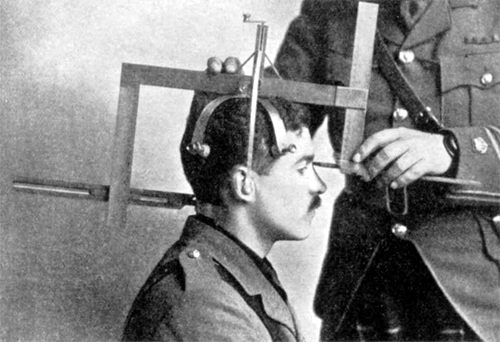
Our modern assessments are holdovers from the 1910s and ‘20s, an age when psychologists thought they could isolate the racial markers for intelligence and then improve human beings through selective breeding like you might with dogs or cats.


I’m not kidding.


It was called eugenics.


Psychologists like Carl Brigham, Robert Yerkes, and Lewis Terman were trying to find a way to justify the social order. Why is it that certain people are at the top and others at the bottom? What is the best way to decide who belongs where?


To answer these questions they appealed to a radical misreading of Gregor Mendel and Charles Darwin. They thought they had discovered something new about the human brain. Positive traits such as intelligence were widespread in Northwestern European races and almost nonexistent in others. Moreover, negative traits such as laziness and criminality were common in nonwhites and almost absent in those same Northwestern Europeans.


It was really just the same kind of racial prejudices that have been prevalent throughout Europe for centuries, but now American pseudoscientists had found a justification for believing them. In fact, they argued that these deductions weren’t prejudices at all. They were facts based on evidence. It was “science.”


To make such conclusions they had to blind themselves to the effects of wealth and social class. The rich tend to be more well-behaved and educated than the poor. These psychologists took this to mean that the rich were somehow genetically superior. And since the rich were mostly of Northwestern European ancestry, they concluded their genes produced a racially superior type of human. They ignored the fact that a privileged upbringing bestows certain benefits while an impoverished one inflicts life-altering wounds. Ultimately, their “science” was simply a justification for their prejudices.


They came to many of these “discoveries” during the First World War. Yerkes developed the U.S. Army Alpha and Beta Intelligence tests that were given to almost all American soldiers. Ostensibly, the assessments were used to determine where soldiers were best suited – support services, the trenches, the officer core, etc.


The rational was to ensure these assignments were being given more fairly and objectively. Before these tests, soldiers were assigned based on wealth and class. Now soldiers were assigned based on tests – that supported the exact same assignments based on wealth and class.


Until this point, I.Q. tests had to be given by one highly trained proctor to one person at a time. Yerkes’ advancement was to put it all on paper so that multiple people could take the tests at once.


However, the tests were deeply flawed. Yerkes claimed they showed a person’s natural intelligence. But the questions were clearly assessing knowledge of facts like a 1900s version of trivial pursuit.


For instance, here is Question 18 of the Alpha Test:
“Velvet Joe appears in advertisements of … (tooth powder)(dry goods)(tobacco)(soap).” The answer is tobacco. How you could know that without having seen period advertisements is beyond me. In any case, it gave good cover for positioning white, affluent men as officers while mostly darker complected and working class soldiers populated the trenches.


After the armistice, Yerkes and Brigham used the wartime test results to continue sorting and ranking Americans. They claimed that their assessments had shown a terrible danger for the human race: nearly half of the white draft (47.3%) was feeble-mind. The cause? Not enough exposure to print advertising? No. They were interbreeding with members of inferior genetic strains.


“No citizen can afford to ignore the menace of race deterioration,” wrote Yerkes in 1922 in the introduction to Brigham’s “A Study of American Intelligence”.


In that same book, one of Brigham’s most seminal, the author was even more specific:


“American education is declining and will proceed… with an accelerating rate as the racial mixture becomes more and more extensive.”


Something had to be done. Pure whites needed to be segregated from mongrel races. But how to do it without being accused of prejudice or bias? How to make it seem like science? Once again, the answer was standardized testing.


Brigham created a civilian test of intelligence that could be used to sort and rank students just as the Army Alpha and Beta tests had been used to sort soldiers. He called it the Scholastic Aptitude Test or S.A.T.


Yes, THAT SAT.


Though the test has been revised multiple times since Brigham created it, the purpose has remained the same – to distinguish the wheat from the chaff, to hold some students up as worthy of further educational investment and to keep others out. Moreover, the means by which the SAT makes this distinction was and remains culturally and economically biased. Researchers have been pointing out since Brigham’s day that the test favors students from wealthy, white backgrounds over those from poor minority homes. Yet today 2.1 million teenagers every year still must take the test to get into the college of their choice.


And so eugenics became education policy throughout the country from primary to post-secondary school.


Terman, who created the Stanford-Binet Intelligence Test to identify “slow” children for special education programs, went on to champion rigid academic tracking for all students in public schools based on standardized testing. The idea was to give the racially pure students extra resources and keep the mixed or lower races in classes more suited to their lower intellects and eventual menial stations in life.


It is sad that many of these ideas persist in our present-day schools. Even today, economically disadvantaged and minority students still make up the majority of remedial and academic classes while the children of the middle class and the wealthy (most of whom incidentally are white) disproportionately populate the honors classes. Today we write that off as merely accidental if we think about it at all. However, a peek at history shows quite clearly that it is exactly how the system has been designed to work.


From there eugenics became the dominant American policy of social organization. It was a required course of study for all education majors at colleges and universities. It was the justification for our isolationist foreign policy allowing thousands of immigrants to be turned away for fear of watering down the U.S. gene pool. Even inside our own borders, tens of thousands of Americans were subjected to mandatory sterilization to ensure degenerate genes were eradicated. In fact, it wasn’t until the end of WWII and the Nuremberg Trials when the eugenicist star began to fade.


We come to a difficult and painful chapter in American history. The word “Nazi” has become an overenthusiastic and easy pejorative for anything that critics wish to vilify. Godwin’s Law states that almost any argument on the Internet will eventually degrade to one side calling the other Adolph Hitler.


He has a point. We should be careful. Too often we wield the sledgehammer of Nazism to smash anything we don’t like. But we can’t let it silence the truth. Sometimes a policy really is Nazism. And if eugenics isn’t, I don’t know what is.


Here it is from Hitler’s Mein Kampf:
“There is today one state in which at least weak beginnings toward a better conception [of immigration] are noticeable. Of course, it is not our model German Republic, but the United States.”


Hitler proudly told his comrades just how closely he followed the progress of the American eugenics movement. “I have studied with great interest,” he told a fellow Nazi, “the laws of several American states concerning prevention of reproduction by people whose progeny would, in all probability, be of no value or be injurious to the racial stock.”


Hitler even wrote a fan letter to American eugenic leader Madison Grant calling his race-based eugenics book, The Passing of the Great Race his “bible.”


And lest we forget the U.S. based Rockefeller Foundation helped found the eugenics program in Germany and even funded the section that Josef Mengele worked in before he went to Auschwitz. By 1926, Rockefeller had donated some $410,000 – almost $4 million in 21st-Century money – to hundreds of German researchers. Without American funds, these programs could not have gotten off the ground.


Nazis even looked to the US Supreme Court for inspiration.
In 1927, the court decided in Buck v. Bell that mandatory sterilization of feeble-minded individuals was, in fact, Constitutional. The ruling, which has never been explicitly overturned, resulted in the forced sterilization of between 60,000 and 70,000 Americans.


Justice Oliver Wendell Holmes wrote, “It is better for all the world, if instead of waiting to execute degenerate offspring for crime, or to let them starve for their imbecility, society can prevent those who are manifestly unfit from continuing their kind…. Three generations of imbeciles are enough.”


The Nazis at the Nuremberg Trials repeatedly quoted Holmes’s words in their own defense.


This is what finally tainted the eugenics brand beyond repair. Psychologists and policymakers didn’t want to be associated with the horrors of the war. They didn’t want any of the blame though they clearly deserved a portion of it. They inspired it.


It took almost two additional decades for these ideas to largely dissipate. It wasn’t until the 1960s and the Civil Rights movement when Americans began to question the social order and the educational system that helped preserve it.


Schools changed. Students were increasingly desegregated both racially and academically. Less emphasis was put on testing and sorting and more on experimentation and self-discovery. Creativity and original thinking were prized above all else. Things weren’t perfect, but we had entered a new era that refused to put children into rigid boxes. They were all unique and valuable and should be treated as such. But it couldn’t last.


Flash forward to 1983. President Ronald Reagan’s National Commission on Excellence in Education put out a report called “A Nation at Risk.” Like the eugenicist work of the ‘10s and ‘20s, it purported to “prove” that our public schools were failing. Something must be done.


The answer was the same as that of the eugenicists. We needed more standardized tests. We needed to return to the practices of sorting and ranking students followed by rigid tracking.


It didn’t matter that “A Nation at Risk” was just as flawed and biased as Brigham’s WWI data.  It didn’t matter that this same policy hadn’t yielded superior academic results in the 1920s, ‘30s. and 40s. It didn’t matter that since we’d put an emphasis on desegregation and creativity, American education was producing unprecedented racial and economic equity. Politically, the only thing to do was return to testing and tracking.


And that’s what we did. It took time. There was opposition. But eventually, we passed No Child Left Behind, which changed the federal role in education from one of ensuring equity to one of rewards and punishment all based on a new generation of flawed and biased standardized testing.


It was a brave new world where all the evils of the past were revisited on our children. And it succeeded – and continues to succeed – because we don’t remember our history. We let policymakers rename the errors of our progenitors and never question their true purpose.


Both Republicans and Democrats have been in control. Both sides blame the other, but left and right wing are both complicit in what remains our national policy.


It is just as racist as that perpetrated by the eugenicists. The major difference is emphasis. In the 1920s, Terman would talk candidly about the racial order. Today, no one mentions it – not openly.


Instead, we get talk about the “racial proficiency gap.” Undeniably poor minority students don’t score as well on standardized tests. Instead of wondering if the problem is the assessments, themselves, we’re pushed to question what teachers and schools are doing wrong.


We wonder why schools serving impoverished students (who are disproportionately brown and black) apparently don’t teach kids as well as schools serving wealthier populations. And anyone who mentions the difference in resources between these schools is quickly silenced. Anyone who mentions the impact of an impoverished upbringing and environment is quickly escorted from the room.


Instead of doing anything to actually help these students, our policy is to close their schools and/or turn them into fly-by-night charter schools.


“We’ve been able to do things – for example, close schools for academic failure. It is hugely difficult, it’s hugely controversial and it’s absolutely the right thing to do,” said former US Education Secretary Arne Duncan.


Imagine if instead of “academic failure” he had said “racial and economic failure.” Because that is what it comes down to. Duncan was decrying low test scores. That’s why these schools were closed. But the test scores aren’t the root cause. That’s poverty. And it disproportionately affects minority students. But you can only see that if you admit the tests are inaccurate assessments of students’ abilities – as countless peer-reviewed academic studies continue to prove.


“I think the best thing that happened to the education system in New Orleans was Hurricane Katrina,” Duncan famously said.


Our highest education official in the country actually praised a natural disaster that killed between 1,200 and 1,800 people (mostly minorities) for destroying their public schools so they could be rebuilt as charters. Did it actually improve children’s academic outcomes? No.


This whole charter school push is another element of our modern educational pseudoscience. These types of schools have never been proven to help kids learn. In fact, the research shows they either do no better or often much worse than traditional public schools. It is an article of faith with our modern education policymakers that schools serving poor minority children should be run by private corporations and schools serving wealthy white students can be allowed to be run by the community.


None of this could happen without the false objectivity of standardized testing.


A hundred years ago, the eugenicists used their test scores to explain away a racist and classist social order. Today we use similarly flawed test scores to justify a similarly prejudicial social order.


Testing remains a way of keeping you in your place.


People are starting to notice. Hence the quick move by the testing industry to co-opt the largest and most well-funded Civil Rights organizations. Hence appointing John King to succeed Duncan as U.S. Secretary of Education – a brown face to silence racial complaints.


Are the people championing standardization and privatization racist? Honestly, I don’t know. I can’t see into their hearts. But it is undeniable that the results of their policies disproportionately hurt our black and brown children. Judging by effect – not necessarily intention – they are racist as well as classist.


Some may be true believers who actually think these policies will help children learn. I’m sure many of the eugenicists of the past felt the same way. Keeping “racially inferior” children in the slow class was purported to be for their own benefit, just as closing poor black schools is said to help them learn.


That’s why I’ve written this and other articles. It is essential that we understand the terrors and errors of past education policy.


If we hadn’t forgotten this dark page of American history, perhaps our children wouldn’t be forced to repeat it.
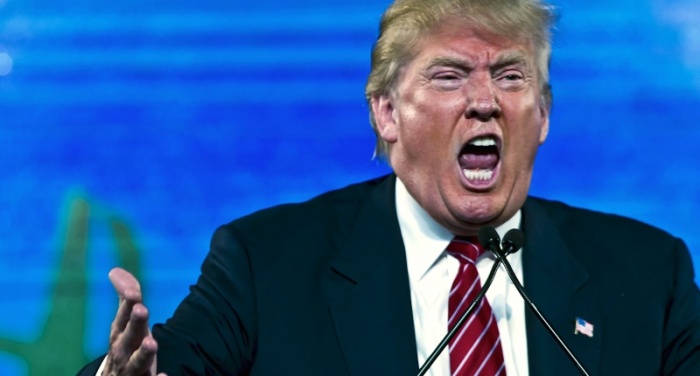

 

My Students Are Scared of Donald Trump


trump-800x430


“Are they gonna’ make us all leave?”


That was the question one of my 8th grade students asked today.


He sits in the front row – quiet, reserved, eyes usually pointed sullenly at his desk.


He doesn’t ask questions. Not publicly.


If he has something to say, he’ll ask me before or after class.


But there he was with his hand in the air and his eyes firmly fixed on mine.


“Tyree, are you afraid someone’s going to make you leave your country?”


He nodded and I saw several other black faces nodding throughout the room.


“Are you afraid someone’s going to send you… where… to Africa?”


“Yeah,” Tyree said for the group.


I teach Language Arts at an under-resourced school in Western Pennsylvania. I’m white and most of my students are black. Almost all of them are from poor families. Very few are Hispanic or Muslim.


We had been discussing the Holocaust in preparation to read “The Diary of Anne Frank.”


I often try to make connections with current events during this time, but today I didn’t have to do any connecting. My students did it for me.


“I don’t like Donald Trump,” Jacklyn said. “He’s racist.”


And Tyree spoke again – impatiently, nervously – “Who are you voting for, Mr. Singer?”


I paused. “I don’t think it would be appropriate for me to say,” I responded, “but I will say this…”


And I looked all of them in the face.


“Not. Donald. Trump.”


You could feel the sigh go through them like a physical thing.


They are actually scared. And something like it happened in every class today.


I mentioned Adolph Hitler and they came back with Donald Trump.


History had come alive. It was a boogeyman haunting the shadows. And the only thing that dispels shadows is light.


I had to reassure them. It wasn’t in my lesson plan. I had done no prior research for it, but this was the direction they were pulling me. I had had no intention of talking about Donald Trump, but we needed to go there.


We had a discussion comparing and contrasting the two men. They both wrote books, but “Mein Kampf” is very different than “The Art of the Deal.” Both were captivating speakers who promote violence, but Trump speaks at a third grade level. Both said hateful things against minorities, but only Hitler advocated eradicating people from the face of the Earth. Both proposed minorities be monitored by the government but Hitler focused mostly on Jews while Trump focuses mostly on Muslims.


The conversation went on.


In over a decade in the classroom, I’ve never had students so upset about politics. Sure they get angry when unarmed people of color are shot by the police. Sure they feel the pull of Baltimore and Ferguson. But never have they cared about who’s running for President. They won’t be able to vote, themselves, for five or more years.


But they wanted to talk public affairs. What was I to do? The purpose of history is to learn from it. We look to the past so we won’t repeat it. Yet that was a lesson I didn’t need to teach. They already knew it. That’s why they were bringing this up.


We talked political parties. We discussed how the Nazis were a political organization like the Democrats and the Republicans are today. We talked about how Hitler had been a house painter and Donald Trump was a reality TV star who inherited most of his money.


And we talked about racism.


Why people hate others. The definition of prejudice – how racism is one kind of prejudice but there are many others – hating people because of religion, because they’re disabled, because of their sexuality.


Jermaine said he was uncomfortable going to the bathroom in public in case someone gay walked in.


I asked if he thought a gay man would try to make a move on him while he was on the toilet. I asked if he’d ever make a move on someone while that person was on the toilet.


The class laughed.


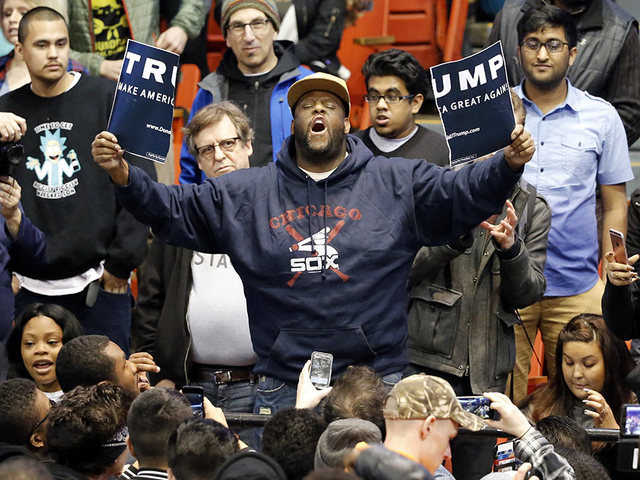
Someone mentioned Chicago and how protesters had forced Trump to cancel his rally. Yes. An 8th grade student knew about that.


And then someone mentioned Bernie Sanders. Yes. They brought him up, too.


Some of my kids liked him because they said he wasn’t racist. Others thought he would legalize marijuana.


So I asked if anyone knew about the other candidates. And that’s where their news-savvy faded. Someone said something strange about Hillary Clinton that they heard she was against soil. I still don’t know what he meant.


Another child said he heard Tom Cruise was running. “TED Cruz,” I corrected. None had heard of John Kasich.


I explained how a primary election works. We talked about how Hitler was elected. We talked about the Reichstag vs. Congress.


“Didn’t we have concentration camps here in America?” someone asked. So we talked about Japanese internment camps and compared those to what you’d find in Europe.


At some point I lost track of all we talked about. But when the bell rang, the tension was gone.


They got up calmly and went to the door. Many of them made a point to cheerfully say goodbye or dap me up on their way. You always know middle school students love you when they do that.


Jason stopped by my desk on the way out and said, “My dad’s going to vote for Donald Trump.” He was blushing.


“He may have good reasons,” I said. “Maybe you should ask him about it.” He smiled and walked out.


Only one student was left.


“You, okay, Tyree?” I asked.


He was grinning. “You’d be a good history teacher, Mr. Singer,” he said.


I shook my head. “And you’re a good history student.”


I clapped him on the back, before writing him a pass to his next class.


My plans sat murdered on my desk.


But I had taught a much better lesson.


Nothing happens without cause.


We can understand it if we try.


Understanding is the key to prevention.


And we’re in this together.


NOTE: All student names have been changed to protect their anonymity.

.


Why is It So Hard to Vote in America? Voter Suppression is Desperation Politics


635942902228020220-Presidential-Primary-9


No one should have to stand in line an entire work day to vote.


But that’s what happened to people in yesterday’s Arizona primary election.


Lines stretched literally for miles. People actually ordered pizza to be delivered to them IN LINE!


Citizens were already getting in line when polls opened at 6 am, and hundreds were still in line when polls closed at 7 pm. The last ballot wasn’t cast until midnight – a new record for the Grand Canyon State!


What the fuck!


The most populous county in the state, Maricopa County, reduced polling locations from 200 during the last election to just 60 this year. That amounts to over 20,000 voters for every location.


The reason? They were trying to save money.


Let that sink in. When you run government like a business, services suffer. It means fewer resources for your schools. More lead in your water. And long as fuck lines to vote.


Oh. And if your skin happens to be black or brown, you get it even worse.


Hispanics and Latinos make up more than 40% of the population of Phoenix (30% state wide). Yet in these densely populated neighborhoods, there were few to no polling places open. I can’t imagine why!


And to top it all off, this “oversight” was used for political gain.


At roughly 8:30 pm, a little over an hour after polls closed, with less than one percent of precincts reporting, the Associated Press declared Hillary Clinton the winner of the Arizona primary.


In Democratic primaries delegates are awarded proportionally. It’s not winner take all. Delegates are awarded by the percent of the vote each candidate receives. If the race is really close delegates are split.


Prematurely declaring Hillary the winner while hundreds are still waiting to vote discourages Bernie Sanders supporters from staying in line and, thus, can reduce the number of delegates he receives.


These are not the actions of a robust Democracy. These are the actions of a de facto oligarchy trying desperately to crush any last remnants of majority rule.


In an age when you can buy anything you want on-line, why do we have to wait on line to vote? If the Internet is safe enough for global commerce and government, why is it too risky for casting a ballot?


It isn’t. The only reason this hasn’t happening is because it would dramatically increase voter turnout. It makes things too easy. While pundits decry “slacktivists” on Facebook and massive political participation on Twitter, they actively discourage bringing Democracy to those same forums.


It’s the same reason why election day isn’t a holiday. If people didn’t have to sneak voting in before or after work or during their lunch break, too many of us would be heard.


During every election cycle, there is an outcry against shady practices like what happened in Arizona, but we never do anything about them after the election cycle. We look at our antiquated primary and caucus system (especially on the Democratic side) and wonder how a modern country can actually function this way. We shake our heads at the Electoral College and maybe make some noise about changing it until the next President is sworn in. Then we all go silent.


Meanwhile, voter suppression efforts gain ground every year – even when the White House isn’t changing hands.


Despite low turnout and nearly non-existent cases of voter fraud, state legislatures are making it increasingly more difficult to vote.


A total of 36 states now have draconian Voter ID laws on the books – 33 of them are being enforced this cycle. During the 2015 legislative session, at least 113 bills that would restrict access to registration and voting were introduced or carried over in 33 states, according to the Brennan Center for Justice.


I know. I was part of the successful effort that defeated one of the most severe Voter ID laws in the country in my home state of Pennsylvania. State Rep. Mike Turzai proudly bragged in 2012 that our law would give the state to a Republican president. After protests and petitions from Philadelphia to Pittsburgh and everywhere in between, the state Supreme Court struck it down.


Meanwhile, other states are trying to enact the same kinds of laws that were ruled unconstitutional in the Keystone State. Wisconsin’s Voter ID law is almost identical to the defunct Pennsylvania legislation. Instead of being defeated, Republican lawmakers are trying to restrict the kinds of permissible identification and prohibit country and town governments from issuing any IDs to residents for free.


And last year, a year after enacting a voter ID law, Alabama shuttered 31 driver’s license offices — most of them in rural, impoverished, majority-black counties. Civil rights groups have filed suit, arguing that the change disproportionately affects racial minorities.


All across the country, early voting hours are being cut. Same day registration is being discontinued. Mountains of paperwork are being required to ensure proof of citizenship. And mysteriously people who have had no problems voting for decades are finding themselves given provisional ballots because of bookkeeping errors.


This has to stop.


Either we live in a country governed by majority rule or not.


Corporations and billionaires set national policy. If we want any chance in taking back our country, we must continue to have the right to vote.


Voting should be protected. It should be free and easy. It should be every citizens right.


Fight for it, America. Fight like your life depends on it.


Your freedoms certainly do.

The One Reason Bernie Sanders is the Best Mainstream Candidate for Parents and Teachers

gettyimages-511353506
It really all comes down to this.

You can talk all day about delegates and superdelegates.

You can talk about polls and electability.

You can talk about political experience, likeability, and authenticity. You can talk about political dynasties, union endorsements and campaign ads. You can talk about how many people show up at who’s rallies and who did what during the Civil Rights movement.

But when push comes to shove, there is one undeniable reason Bernie Sanders is the best mainstream 2016 Presidential candidate: He is running against privatization.

That’s it. Sold.

Everything else is nice. It adds to the appeal, but that one essential reason is enough to tip the scales – knock them over, really – to Bernie’s favor.

America’s parents and teachers are fighting a battle for our children’s schools. Lawmakers on both sides of the aisle stand against us. They are giving away the store. They are selling our system of public education – once the envy of the world – to for-profit corporations piece-by-piece.

They are stealing our schools out from under us, giving them to unscrupulous charter school operators who are stripping away services for our children so that they can pad their own bottom line.

And only Bernie truly stands against them.

It’s not about who said what. It doesn’t matter if he slipped up and said something ignorant about “public charter schools.” It doesn’t matter if Hillary Clinton, too, has occasionally criticized charters.

What matters is that standing against privatization is the backbone of the Sanders campaign. It is the bedrock which supports all of his other platforms. It is the foundation of his entire career in politics.

Might he screw it up once in office? Sure. He’s only human. But the odds are in our favor that he’ll actually improve things.

Hillary Clinton is an intelligent, capable politician. She is not the evil witch that the Right paints her to be. However, her campaign is largely supported by the same people who are privatizing our schools. They aren’t giving her all that money for her to act against their interests.

Might she make some compromises that forestall the worst effects of privatization? Sure. But odds are against us that she’ll be much help. The best scenario we can expect from another Clinton administration is a continuation of the status quo – a status quo that has dramatically increased school privatization.

There are worse things, but can’t we do better than vote for 4-8 more years of slow educational death?

If privatization is the first front of the war against public schools, standardization is the second. Schools are being forced to march in lockstep with Common Core Standards while giving a barrage of high stakes tests.

Both Sanders and Clinton have spotty records here. Sanders voted against the terrible No Child Left Behind legislation that spawned the beast, while Clinton helped nurture it. However, just this year Sanders joined Congressional Democrats trying to continue the era of test and punish through the Every Student Succeeds Act (ESSA) – some of which failed and some of which became part of the final law.

But it doesn’t really matter.

Standardization is the claw of the beast. Privatization is the beast, itself.

High stakes testing is the justification for privatization. Low test scores at under-resourced schools are the excuse for turning them into charters. If Sanders stops the move to charterize, he removes the reason to standardize. A dead lion will not use its claws.

Moreover, he’s had some genuinely good ideas about how best to improve our schools. It was Sanders who inserted into the ESSA a provision allowing some states to develop alternatives to standardized testing.

While most Democrats champion increasing funding to the neediest districts, they blame their inability to do so on the Republicans. Meanwhile, Sanders has proposed rewriting the way schools are funded in the first place. He is the only mainstream candidate with a plan to ensure every school in America receives equitable funding. His solution: federalize pubic school budgets similar to the Scandinavian model that has been proven effective. Is it a risk? Sure. Might it not work? Sure. But at least Bernie has new ideas that could potentially do more than just put Band-Aids on decades of wrongheaded school policies.

This is radically more than just fighting privatization – it is turning it around in its tracks. Only Bernie is actually suggesting a robust, equitable education for all children from preschool through college.

THAT’S why I support Bernie Sanders. THAT’S why I can’t wait to cast my vote in the Pennsylvania primary. THAT’S why so many teachers, parents and concerned citizens are feeling the Bern.

Come join the Revolution already in progress.

It is our fight to win or lose.

Blinded by Pseudoscience: Standardized Testing is Modern Day Eugenics


eugenics-testing.jpg


Adolph Hitler was a big fan of standardized testing.


It helped justify much of the horrors of the Nazi regime.


National Socialism is nothing but applied biology,” he said.


In other words, it’s just science, people. Some races are simply inferior to others. Black people, Jews, Gypsies, Hispanics – they just can’t hold a candle to the superior races of Northwestern Europe.


And Hitler based much of this on the “science” of Eugenics, especially the work done in America in the 1910s and ‘20s.


Eugenicists used a flawed and biased interpretation of Gregor Mendel’s laws on heredity to argue that lawlessness, intelligence, and even economic success are passed down in families due to dominant or recessive genes. Moreover, the negative traits are widespread in certain races and the positive ones in others.


Practitioners like Carl Brigham used IQ tests to PROVE white people were just the best and everyone else, well, maybe they should just stop breeding. (In fact, laws were passed in the U.S. imposing mandatory sterilization on thousands based on the conclusions of these “scientists.”)


Brigham was a U.S. Army psychologist who used WWI data to declare that whites (especially those born inside the United States) were the most intelligent of all peoples and that immigrants were genetically inferior. He went on to refine his work into an even better indicator of intelligence the he called the Scholastic Aptitude Test or S.A.T.


Perhaps you’ve heard of it.


In his seminal work, A Study of American Intelligence, Brigham concluded that American education is declining and “will proceed with an accelerating rate as the racial mixture becomes more and more extensive.”


To combat this mixture, eugenicist education reformers encouraged schools to rigidly track students into low, middle and high level classes – similar to the way many of our schools are organized today.


Lewis Terman, Professor of Education at Stanford University and originator of the Stanford-Binet intelligence test, expressed these views in his textbook, The Measurement of Intelligence (1916). He wrote:


“Among laboring men and servant girls there are thousands like them [feebleminded individuals]. They are the world’s “hewers of wood and drawers of water.” And yet, as far as intelligence is concerned, the tests have told the truth. … No amount of school instruction will ever make them intelligent voters or capable voters in the true sense of the word.


… The fact that one meets this type with such frequency among Indians, Mexicans, and negroes suggests quite forcibly that the whole question of racial differences in mental traits will have to be taken up anew and by experimental methods.


Children of this group should be segregated in special classes and be given instruction which is concrete and practical. They cannot master, but they can often be made efficient workers, able to look out for themselves. There is no possibility at present of convincing society that they should not be allowed to reproduce, although from a eugenic point of view they constitute a grave problem because of their unusually prolific breeding” (91-92).


This was the original justification for academic tracking. Terman and other educational psychologists convinced many schools to use high-stakes and culturally-biased tests to place “slow” students into special classes or separate schools while placing more advanced students of European ancestry into the college preparatory courses.


Compare that ideal to the increasingly segregated American schools of today. We have schools for the rich and schools for the poor. We have schools for black and brown kids and schools for whites.


Terman would have been in heaven!


It was the work of patriots like Brigham and Terman that the Nazis relied on heavily to justify their forced sterilization programs and ultimately the Holocaust, itself.


Does that sound extreme? It isn’t.


At the Nuremberg Trials, Nazi scientists repeatedly praised the work of American eugenicists, who uncoincidentally also created the standardized test model of education favored by corporate education reformers today.


It’s easy to follow their logic. If certain races can be scientifically proven to be inferior, it is a small step to thinking that they should be stopped from breeding or eradicated from the face of the planet altogether.


And the pseudo-scientific justification for this scheme was standardized testing. The IQ test – which has since been shown to be incredibly biased – was used to justify mass murder. And then Brigham refined that same test into our most popular current standardized assessment – the SAT. In fact, all standardized tests that students are forced to take today owe a huge debt to the SAT and other standardized assessments used by Terman and other eugenicist educators.


The resemblance between testing in the 1910s and the 2010s is obvious to those who will but look.


Similar to the IQ test, modern standardized exams like the Partnership for Assessment of Readiness for College and Careers (PARCC) repeatedly have been shown to be biased in favor of affluent and white test takers. Supporters bemoan the “racial proficiency gap,” but that’s just a nice way of wondering why the same folks Hitler thought were “inferior” don’t do well on our modern tests.


This is no accident. It’s how the assessments are designed.


The IQ test is supposed to demonstrate an innate intelligence. However, modern psychologists have become increasingly skeptical that intelligence is fixed. So standardized assessments like the SAT are supposed to somehow show BOTH what students have learned AND their innate intelligence. That’s the justification behind the high stakes. You have to pass the SAT to show you’re smart enough to do well in college.


Such outright racism would not be tolerated today, so it becomes cloaked in doublespeak. It’s good that poor black students don’t score well on standardized tests because that shows us they need extra help. And then, instead of providing any help, we close their schools or turn them over to fly-by-night charter operators.


Once again, standardized tests are used as the justification for doing something obviously racist. If anyone said, “We’re going to close and privatize all the schools serving minorities and the poor,” people would revolt. However, when you say we’re doing it because of standardized tests – because of “science” – people just shrug and say, “You can’t argue with that!”


The same goes for Common Core State Standards. States were bribed to enact them so that the reasons for attacking public schools would be uniform across the country. This provides another level of pseudo-scientific justification.


They are supposed to ensure every student who graduates high school will be “college and career ready.” However, now that Common Core has been adopted in 46 states and their tests have become aligned with the standards, we’ve seen student scores take a nosedive. Only our rich white kids apparently are ready for college.


So what will we do with those who fall below the mark? We’re sending no additional resources to help them increase their achievement. We’ll just close their schools and/or privatize. And to make sure none of them escape, we’ll make passing the Common Core tests a graduation requirement.


This does not level the playing field. This does not – as some corporate education reformers claim – ensure the sanctity of students Civil Rights. It extensively violates them!


The education model of Test and Punish is a modern eugenics movement. We’re shellacking over class divides so that those below a certain point have no possibility of ever rising to the white place. And I do mean “white.”


Standardized testing is not a ladder of social mobility. It is a means of keeping certain people in their proper place.


Some try to deny the racial component by pointing to the intersection with class. Testing impacts poor white children as it does poor black ones.


To a degree this is true, but remember our eugenic forerunners saw everything in purely racial terms. For instance, today, few people would claim Judaism is a race. It is a religion. It is essentially a belief system, not a set of shared genes even though some adherents do share genetic characteristics after centuries of segregation. But the Nazis considered them a race and, thus, systematically murdered 6 million of them.


The same goes for the poor. Brigham and his Nazi admirers thought that people were poor mainly because of their genes. They are genetically predisposed to being lazy and good for nothing, so they can’t keep a job or advance themselves. Therefore, they’re poor. Pause for a moment to consider the large numbers of people in America today who would agree with them.


Standardized testing treats the poor the same way it does minorities. In fact, it is just the lack of opportunities that come with poverty that cause the very scores that are being used to denigrate these people. Lack of proper nutrition, food insecurity, lack of prenatal care, early childcare, fewer books in the home, exposure to violence – all of these and more combine to result in lower academic outcomes.


But standardized testing puts the blame on the victim. Students score badly because they aren’t working hard enough, corporate reformers say. These kids don’t have enough “rigor.”


To make sure few people actually volunteer to help, we blame their teachers, as well. We make the education profession as unattractive as possible, indicting teachers for all societies ills knowing full well that this will result – as it has – in a nationwide teacher shortage. Then we can deprofessionalize the field and replace educators who have four-year-degrees with lightly trained Teach for America temps.


These kinds of shenanigans didn’t fool the anti-racists of the past.


The great African American scholar W. E. B. Du Bois remarked in 1940, “It was not until I was long out of school and indeed after the [First] World War that there came the hurried use of the new technique of psychological tests, which were quickly adjusted so as to put black folk absolutely beyond the possibility of civilization.”


He could be talking about No Child Left Behind.


In “Intelligence Tests and Propaganda,” scholar Horace Mann Bond issued a warning about the misuse of IQ tests:


“But so long as any group of men attempts to use these tests as funds of information for the approximation of crude and inaccurate generalizations, so long must we continue to cry “Hold!” To compare the crowded millions of New York’s East Side with the children of Morningside Heights [an upper class neighborhood at the time] indeed involves a great contradiction; and to claim that the results of the tests given to such diverse groups, drawn from such varying strata of the social complex, are in any wise accurate, is to expose a fatuous sense of unfairness and lack of appreciation of the great environmental factors of modern urban life.”


He could be talking about Race to the Top.


Karen Lewis, a present-day Chicago teacher and president of her union, says this:


“What many people do not know is that the use of standardized tests has its origins in the Eugenics movement …we have to be clear about the original purpose of standardized tests.


In a society fascinated by statistics, we are often compelled to reduce everything to a single number. Those of us who work with children know that there are so many characteristics that cannot be quantified.


Ask yourselves whether you want to be part of a legacy born of the unholy alliance between the concept of  “natural inequality” and the drudgery that has been imposed on many of our classrooms.”


Make no mistake. Corporate Education Reform is modern day eugenics. It pretends to justify increasing standardization and privatization of public schools through flawed and biased assessments. Its claims that any of this is actually supported by research are spurious. At heart, these are articles of faith – not science. Neither Common Core nor high stakes testing nor charterizing impoverished schools nor putting districts into receivership nor evaluating teachers based on student test scores – none of it has ever been shown in peer-reviewed studies to help students learn.


Corporate Education Reformers are asking all of us to have faith in a racial and economic social order that benefits those already at the top and keeps the rest of us in our place.


And for anyone who questions it, we are continually blinded by their pseudoscientific justifications.

Say It To My Face: Chicago’s Epic Trump Shutdown

trump_chicago_rally_ap_1457744693678_33791410_ver1.0_640_480
All fascists are cowards.

Especially Donald Trump.

The Reality TV star turned Presidential candidate is known for making bigoted statements at his rallies against Muslims, Latinos, women, black people, the disabled – basically anyone not white, male and straight.

So when thousands of these Muslims, Latinos, women, black people, etc. showed up at his rally in Chicago last night, Trump took a bold stance… and ran away.

He cancelled the rally rather than face them.

Sure there was the potential for violence if he had continued with his speech as planned, but that has never stopped him before. How many times have we seen cellphone videos of minorities being forcibly escorted from his campaign events, sometimes after being beaten or otherwise accosted? I don’t remember Trump canceling any of those events.

But when the people he denigrates show up in force, THAT’S when he pulls the plug. When voicing the same hostility-filled rant puts himself in danger, that’s when he turns tail.

THIS is your strongman, America! A sniveling coward who only has the guts to spout hate speech to a receptive audience!

Hilariously, his supporters are defending the Republican challenger’s brave retreat by appealing to the First Amendment.

Trump’s right to free speech is being violated, they say. What nonsense!

I just saw him on CNN complaining about it. And CBS. And NBC. And every other cable channel plus satellite! If that’s having your First Amendment rights violated, I wish someone would violate mine! Put my blog in the center of the 24-hour news cycle!

Let’s get one thing straight: the First Amendment guarantees your right to free speech. It does not guarantee a right to consequence free speech.

When you build a political campaign on the notion that some people are inferior to people like you, those so-called inferior people are eventually going to call you out.

There’s no hiding behind Uncle Sam’s coattails. YOU did that. You’re responsible for dealing with it.

Another popular response is that the protesters are sinking to Trump’s level. They’re meeting one mob with another.

Wrong. You cannot equate these two groups.

Trump’s supporters are embracing a message of hatred and intolerance. The protesters are espousing a message of love and tolerance. Trump’s supporters are singling out and beating individuals or small groups of minorities. The protesters are overwhelmingly nonviolent – though occasional sporadic violence did erupt at the rally most often when protesters defended themselves.

The protesters marched hand-in-hand into the lion’s den where they were vastly outnumbered. They put their lives on the line to make their views heard. They had the full expectation of being attacked and possibly killed, but they did it anyway. THAT is true bravery. THAT is true conviction – not someone who expected to be in a stadium full of like-minded people waiting to be whipped into a frenzy by a megalomaniac with extremely bad hair.

Which brings me to my favorite criticism of the Chicago protest. Some folks say the protesters had no idea what they were doing. They were just ignorant fools.

Exactly. People coming to protest hatred are ignorant and those coming to celebrate it are intelligent!

And finally we have the man, himself. The Donald has been crying on the news about the organized “thugs” who disrupted his rally.

He must really be rattled to call them “thugs.” Trump isn’t known for falling back on racist dog whistles. Usually he just says it outright. Did he forget his favorite N-word?

So once again Chicago shows us all the way.

The runaway Trump campaign can run roughshod over media criticism, wagging fingers and shaking heads. But the one thing it cannot handle is confrontation by the very people it denigrates.

Like a schoolyard bully, Trump retreats when you call him out.

You don’t like Muslims! Say it to my face!

You don’t like Latinos? Say it to my face!

You don’t like women…

This could take a while.

In the meantime, here’s to those brave Chicago protesters who stopped totalitarianism in its tracks!

They showed us that the only thing we need to truly make America great again is to recognize how great we are when we come together to fight for each other.

Less Resources, Harder Tests: Common Core in the Last Days of Obama

teaching_testing


The bell hadn’t even rung to begin class yet, but Ce Ce already had enough.


She saw the pile of standardized test look-a-like sheets on the front desk and immediately asked if she could go to in-school suspension.


I’m not kidding.


She’d prefer to spend the day in silence doing homework isolated from the rest of the class than practicing high stakes testing with her peers.


And she’s not alone. This happens every year now. As assessment season gets closer, administrators push teachers to do test prep. And students revolt.


I’m not exactly sure why. Test replicas are not my favorite things to do, either, but they’re not THAT bad. I don’t think it can be my teaching since the mutiny usually happens before I’ve even begun.


It’s the testing. Pure and simple. Some students are so demoralized by the very prospect of skill-and-drill that spending one more second reading passages and filling in bubbles seems a fate worse than death.


And I can’t really blame them.


In the last two years, Pennsylvania has modified its mandatory assessments until it’s almost impossible for my students to pass.


Bureaucrats call it “raising standards,” but it’s really just making the unlikely almost unthinkable.


Impoverished students have traditionally had a harder time scoring as well as their wealthier peers. But the policy response has been to make things MORE difficult. How does that help?


Consider this: If a malnourished runner couldn’t finish the 50 yard dash, forcing him to run 100 yards isn’t raising standards. It’s piling on.


Oh. Both your arms are broken? Here. Bench press 300 lbs.


Both your feet were chopped off in an accident? Go climb Mt. Everest.


That’s what’s happening in the Keystone State and across the country. We’re adding extra layers of complexity to each assessment without regard to whether they’re developmentally appropriate or even necessary and fair to gauge individual skills.


Where Common Core State Standards have been adopted (and Pennsylvania has its own version called PA Core), annual tests have become irrationally difficult. That’s why last year’s state tests – which were the first completely aligned to PA Core – saw a steep drop off in passing scores. Students flunked it in droves.


Where the previous tests were bad, the new ones are beyond inappropriate.


Take Text Dependent Analysis (TDA). It’s something we’ve always done in language arts classes, but it’s meaning has subtly changed thanks to PA Core.


Two years ago, it used to denote that students had to refer to the text when writing essays. Now it’s come to mean something more – referring to the text (or texts) with at least two degrees of complexity.


On the Reading section of the Pennsylvania System of School Assessment (PSSA) tests, students must peruse several passages and respond in writing.


Before PA Core, middle school students might have had to read one passage and then explain what its main idea was. This would require them to cite specific examples from the text. For instance, “This passage is mostly about bears because the author writes about hunting them in the Klondike, the ways in which their habitat is affected and their hibernation instinct.” Then students would have to go into more detail highlighting sections of text that support this.


Now students have to read TWO passages and write about something that pervades BOTH but is still tremendously complex. For instance, a 6th grade example released from the state has students read a poem and a folktale about people tricking others into sharing food. Then they have to write about the theme of both pieces and analyze how it is developed in each text using specific references.


The texts concern nothing most students would find interesting and are difficult to understand for children of that age. Moreover, properly developing an essay of this type should be done over the course of several classes. But middle schoolers are expected to do this in a single testing session.


Test proctors are instructed to put aside about 80 minutes for the essay and several related multiple choice questions though, technically, students can take as long as they’d like. They could be given extended time to write for several hours if they want. But most children at this age simply don’t have that kind of stamina. They are not physically and mentally prepared to sit and concentrate like that.


It’s a task many adults would find challenging, but we’re expecting 10- and 11-year-olds to do it!


Can middle school students (ages 10-14) handle this level of complexity, especially in such a short amount of time?


Honestly, it depends on the child. Everyone matures at a different rate. However, for most of the students I have taught in over a decade of middle school experience as a Nationally Board Certified teacher with a Masters Degree in Education, it is my professional opinion that this level of mastery is out of reach.


In fact, at an in-service training, administrators at my building had the entire teaching staff attempt this essay to show us what was expected from students. The general consensus was that it was unreasonable.


Requiring this level of difficulty simply ignores children’s basic humanity. Most of my students come to me not knowing how to write a good essay. If they were all computers, I could break up everything they needed to know into small bits, give it to them piecemeal over the course of the year, and they would learn. But they are not computers – they are children.


That’s why they rebel. We’re demanding more from them than they can give.


It might be different if we met them half way. It might be more reachable if higher expectations came with additional help.


If my students had any chance to achieve at this level so early in their cognitive development, we would need to bring in a team of writing specialists, a flurry of councilors, nutritionists, and wrap around social services. However, no resources have been added to help students meet these added testing hardships. In fact, Pennsylvania has slashed school budgets by almost $1 billion annually.


All the responsibility is thrown on the underfunded schools as if the few teachers who haven’t already been furloughed can somehow perform magic.


A surgeon can’t operate without tools. Nor is he expected to do the job of nurse and physical therapist as well.


It’s a matter of less resources and harder tests, then blame teachers when it doesn’t work.


It’s not just bad policy; it’s a denial of reality.


Add to that the social, cultural and economic aspects. Lawmakers pretend everyone is starting from the same point, but this is demonstrably untrue.


I teach mostly black and brown kids at a high poverty district. Many of my students only get a hot meal at school. They’re malnourished, violence-scarred, and under-equipped. They have few books in the home. Their parents aren’t around because the adults are working multiple jobs to support them. They live in violent neighborhoods where gunshots, drive-bys and premature death are commonplace. And you think they somehow have the same chances of scoring well on standardized assessments as children without these problems!? You expect them to prioritize standardized testing!?


And after years of being subjected to child abuse as education policy, the only thing they’ve learned from testing is that they’re not good at it and they might as well not try.


Is it any wonder some of them would rather sit in our school’s version of prison than stay in class and practice test taking strategies?


We’re running up against the nature of cognition and how young minds grow. We’re ignoring the social, cultural and economic conditions in which these children live. And we’re pretending this is somehow a fair and just accounting of children’s academic skills and their teachers’ effectiveness.


Children need to be engaged. They need to see how an assignment affects their lives. They need to care. They need intrinsic motivation, which is almost impossible to find for a test that is essentially extrinsic.


Our current education policy is the equivalent of holding a gun on children and demanding they perform almost impossible tasks.


It is time to stop the violence. It’s time to end the child abuse.


But is anyone listening?

How Radical Must We Be To Get the Schools Our Children Deserve? United Opt Out Musings

GetAttachmentThumbnail-3

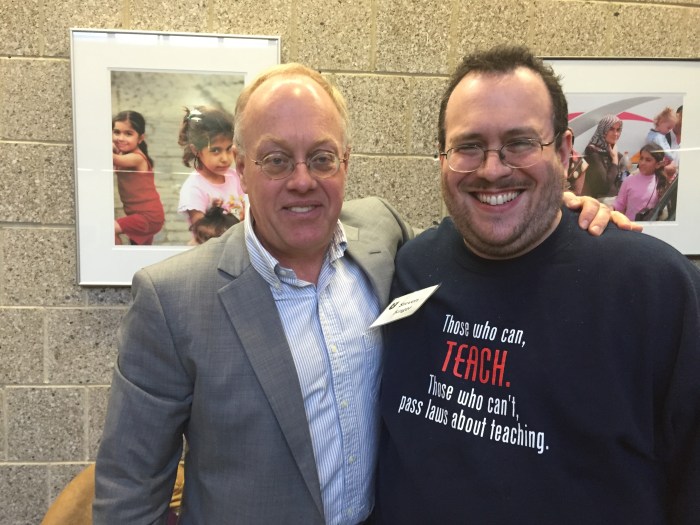
There was a point during Chris Hedges keynote address today when I could barely catch my breath.


My chest was heaving, tears were leaking from my eyes and I wasn’t sure I would be able to stop.


The Pulitzer Prize winning journalist had his audience enraptured at the United Opt Out Conference in Philadelphia Saturday morning.


I’ve read Chris before. We’ve all read Chris before. But I had never seen or heard him speak.


It was kind of like hearing a good sermon by a pastor who felt every word he said. And that really was it – Chris FELT every word.


When I’ve read Hedges’ articles on Truthdig, I’ve found myself getting angry. He stirs me up. He disturbs me, makes me feel uncomfortable. And when I heard him speak today I was surprised that he seemed to be reacting the same way to his own words.


When he talked about teaching teenage prisoners, he was emotionally invested in the story he was telling. When he criticized American neoliberal policies, he was just as angry as his audience.


The only difference was that his sorrow and rage somehow became transformed in his throat into something akin to poetry.


He turned the struggle of the oppressed into something beautiful. He transformed the hurt in my chest into something profound. He mutated my disturbance into a sense of actions-to-be.


I won’t repeat the words he said. I’d never be able to reproduce them with anything resembling his eloquence. But I will remark on one of his closing remarks because it hit me like a splash of cold water.


Rebellion, he said, is not about changing the world. It’s about changing yourself.


When you stand up for what is right, you become a better person – whether you achieve your goal or not. In a sense, it doesn’t matter if we destroy the testocracy. But in trying, we transmute ourselves into something better.


I don’t know if that’s true, but I’d like to think so.


I don’t know if we will ever destroy the system of Test and Punish, but I know I can try. I know I can put myself on the line and damn the consequences.


All weekend at the United Opt Out Conference we’ve been talking about rebellion and revolution. There’s no weak tea here in the City of Brotherly Love. No half measures. We’ve been discussing tearing the system down piece-by-piece.


A timid voice speaks up in the back of mind, “Do we really need to do all that? Do we really need revolution just to keep our public schools and make them into something worthy of our children?”


I think I’ve been trying to answer that question for a while now. Maybe a lot of us have.


In a rational country, our demands wouldn’t be so radical.


We want public schools centered on the good of all, not the profit of some. We want educationally valid curricula for our children. We want some control over the school system – both as parents and teachers.


Is that so much to ask? Is that such a lunatic request?


And as I listened to Hedges and Dr. Antonia Darder, Dave Green, Jonathan Pelto, Dr. Denisha Jones, Ceresta Smith, Yohuru Williams, Aixa Rodriguez and many, many others, I heard another timid voice begin to answer the first.


“Yes.”


The system of standardization and privatization of public education confronts students of color and impoverished students head on. They are in the front lines. Yet few people outside of activists seem willing to admit it.


Perhaps the most impressive thing about this conference has been its ability to put issues of human rights at the center of the argument. That’s the essential concept. We’re not just talking about bad education policies. We’re not just talking about schemes for billionaires to make more money. We’re talking about the systematic oppression of a group of people and the widespread complacency and complicity of the majority of the populace.


How do you combat such a monster without being revolutionary? How do you fight for your child without being a rebel?


More has happened at this conference than I can adequately put into words. I’ve met so many incredible people. Some of them I knew, some I had met before, some had only been names I had seen on my computer screen.


I will leave here Sunday feeling refreshed and energized, ready for the battles ahead.


Am I a radical?


Am I becoming a better person?


I don’t know.


But I will keep fighting.


Because I love my daughter, I love my students and I love all children everywhere.


Photo Gallery:


NOTE: This article was given a shout out on Diane Ravitch’s and Jonathan Pelto’s blogs.


Judging the Judge: What Antonin Scalia’s Death Means to the People I Love

antonin-scalia-26

I am not sad Antonin Scalia is dead.

Wow! It feels so good to say that out loud!

Come on. Admit it. You probably feel the same way.

I know. I know. Everywhere you turn, people are going out of their way to talk about the ramifications of the 79-year-old Supreme Court Justice’s death without passing judgement on him.

“Let’s keep it classy,” they say.

Oh. Stop it.

In his 30 years on the bench, Scalia hurt an awful lot of people. And I mean real, live people – not ideological constructs, not hypotheticals – but moms, dads, husbands, wives, daughters, and sons.

The aggregate amount of misery in the world was drastically increased by his being in it. And now that he’s gone, much of that misery may be relieved.

So please curb any shock you may feel at my thesis. And spare me the false praise of a truly reprehensible human being.

He was against women controlling their own bodies, efforts to desegregate our schools, an individual’s right to love whomever they choose, refraining from executing mentally disabled or teenage prisoners. Heck! He was even against police reading suspects their Miranda Rights!

This was a person who said black people should go to “slower” colleges, homosexuality was the same as murder or bestiality, sex discrimination is constitutional, and maybe we have a right to all carry around rocket launchers in public.

If it is outrageous to feel relief at the death of this man, you may call me outrageous.

I’m not usually the kind of person who celebrates someone else’s death. Not even a famous person.

But you have to admit that the people we love are a lot better off without Scalia in the world.

It’s not like he kept all this to himself. He wasn’t some lone drunkard in the back of the bar mumbling sexist, racist views. He wasn’t your ancient uncle who you only see twice a year making people uncomfortable at the dinner table. He was a judge in the highest court in the land, and his demented and warped world view drove public policy impacting… well… everyone.

He was the deciding vote in several 5-4 decisions that – if they had gone differently – would have greatly benefited every person in this country.

You can thank him for the Presidency of George W. Bush and Citizens United. Let that sink in for a moment.

Imagine all the horrific blunders of the Bush Presidency – easily the worst administration in my lifetime. If the Supreme Court hadn’t given the highest office in the land to Dubya, arguably we wouldn’t have had the Irag War, the Great Recession, No Child Left Behind, the slow response to Hurricane Katrina – maybe even 9-11.

And if you hate what our elections have become, imagine if we didn’t have the Citizens United verdict. Campaign donations would have to be made in public with some limits on how much individuals and corporations can contribute.

How much better the world would have been without these terrible decisions!

I’m not saying Scalia wasn’t a good man in his personal life. I have no idea what he was like to the people he loved. For all I know he may have been a good friend, a loving husband, father and grandfather. He probably had people he cared about and who cared about him. And to those people I send my condolences.

However, he did great harm to just about everyone else. And for that I feel nothing but relief at his death.

Who am I to bask in such schadenfreude?

I am a father and public school teacher.

I have a seven-year-old daughter and several classes full of mostly impoverished and minority students.

And Scalia’s death is good for everyone I care about.

If he were still alive, there was so much more damage he could have done. Take the Friedrichs case, an important one for teachers like me.

The case is an attempt to strip teachers unions of the right to charge members for their services. If the court rules in favor of Friedrichs, it would overturn decades of established law against free riders. People would be allowed to be in a union, enjoy higher salary and benefits negotiated by that union, but not pay dues. It would be absurd. Yet with Scalia still on the bench, most court watchers seem to think we would have had another terrible 5-4 decision.

However, with Scalia’s death, the best anti-union forces would probably receive is a 4-4 decision – not enough to overturn established law. True the case has already been heard by the justices, but a ruling has not yet been handed down. According to the Supreme Court blog, even if Scalia had already written a ruling on this matter, it would be void. Any rulings he wrote that have not yet been made public don’t count.

So the most likely outcome now is that millions of people will continue to be protected from unfair labor practices. And you expect me not to have a big ‘ol smile on my face!?

So where do we go from here?

President Barack Obama will select who is to succeed Scalia. Numerous excellent choices have been floated. If Obama chooses any one of them, he would probably tilt the court fractionally to the left.

Before the body was even cold, Republicans vowed to block any nominee Obama makes until the next President is sworn in. Some are trying out the talking point that Supreme Court Justices have never been sworn in during an election year. But if that were true, we wouldn’t have Justice Anthony Kennedy who was confirmed during the last year of Reagan’s presidency.

Funny. The U.S. Constitution clearly states that the President has the right to nominate Supreme Court Justices with the advice of Congress. Yet so many of these right leaning partisans who considered themselves Constitutionalists last week suddenly find themselves against that revered document today.

I wonder how Scalia would have argued such a situation.

Not really. He was the one who taught the rest of his party how to twist the words of the founding fathers to mean whatever the far right favors this week.

Obama still has more than 300 days in office. If Republicans try to block his nomination until a new face tops the Executive, it would be the longest such obstruction in a century. Of sitting justices, the longest confirmation period was for Clarence Thomas who took 106 days to be approved by Congress.

And that brings us to the 2016 Presidential race.

Scalia’s death is likely to have a huge impact on whom becomes our next President.

If Republicans block Obama’s Supreme Court nominee, it would probably increase voter turnout. Whenever that happens, it favors Democrats since they have more registered members than the GOP.

Either way, Scalia’s death is probably beneficial to whomever the Democratic nominee will be. If either Hillary Clinton or Bernie Sanders get the nomination, supporters of the defeated candidate are more likely to support the reigning Democrat.

Even if voters don’t like the winner’s policies as much as their preferred candidate, they’re likely to support the nominee in order to continue tipping the Supreme Court to the left. After all, three additional justices are 70 or older. Stephen Breyer is 77, Anthony Kennedy is 79, and Ruth Bader Ginsburg is 82.

We have had a long haul these last 15 years. Much social progress has been stalled.

But now that Scalia is out of the picture, the future looks bright.

Maybe things really will turn out alright. Maybe we’ll actually have a chance to build that better world we’ve all been dreaming about.

Rest in Peace, Scalia. The nation can’t wait to move on without you.

Beyoncé Upstaged by White Fragility at the Super Bowl

Pepsi Super Bowl 50 Halftime Show
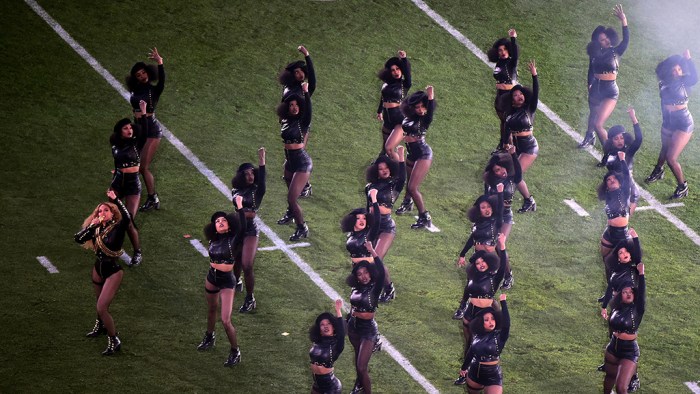
SANTA CLARA, CA – FEBRUARY 07: Beyonce performs during the Pepsi Super Bowl 50 Halftime Show at Levi’s Stadium on February 7, 2016 in Santa Clara, California. (Photo by Harry How/Getty Images)


Black women’s bodies are scary.


That’s the lesson we learned this Super Bowl Sunday.


When Beyoncé and 30 backup dancers performed a brief rendition of her new song, “Formation” during the halftime show, talking heads all over the country exploded.


Oh my God! Are those pro-black lyrics!? Are they making an allusion to the Black Panthers!? Was the music video to this song critical of overzealous police murdering black folks!?


Turn off the TV! This is too political for family entertainment!


When did we become so squeamish in this country? Can’t we all just sit back and enjoy seductive women gyrating in unison anymore?


I guess not. Not if they’re black.


Sleek female bodies in tight leather outfits displaying every curve of their anatomy – if their skin is black and their hair is Afro-ed and their fists are briefly in the air, it’s way too scary for white male libidos.


And that’s really the problem here.


Who was this performance supposed to be for? Fifty years of Super Bowl logic would suggest the target demographic was light skinned, heterosexual and possessing a penis. But these women had something to say – maybe. They had a message beyond “Look at me! I’m hot!”


How am I – as a red-blooded American male – supposed to commodify and objectify these women’s bodies if their brains are trying to convey a message that goes beyond mere consumerism?


That’s what the Super Bowl is, really. Some people say they watch it only for the commercials, but that’s all there is. It’s all a big advertisement for the American way of life.


Sit back, drink beer, eat pizza, watch an essentially meaningless contest and – whatever you do – don’t think about the way things really are. Don’t think about the problems we have and how we might fix them. Stay asleep. Watch the game and stay fast asleep.


And please don’t tell me this has nothing to do with race. If they were white girls with a message about world hunger, the outrage would be demonstrably more muted. If there’d be any outrage at all.


No. This was a direct assault on our tacit consent to be colorblind in all things. As a society we’ve silently agreed to refrain from mentioning anything about race in public.


Why are you even bringing up the fact that those dancers were black, someone is bound to ask.


My answer: because I have eyes.


Denying the pigment of their skin does no one any favors. And talking about it doesn’t denigrate them in any way. In fact, it acknowledges a key component of their being.


But Beyoncé’s performance didn’t let us forget her skin color. She made it important, and our white male society doesn’t want to admit it.

Or at least that’s what the 24-hour news cycle has made of it. Did Queen B really intend her routine to be taken as such a revolutionary display of black power? It’s hard to say.


In the actual performance, there is nothing much that is overtly political. Vaguely martial outfits? Dancing in an X-formation? A raised fist? Maybe.


The only somewhat rebellious moment occurred after they had already left the field. A few dancers held a sign offstage asking for justice for Mario Woods – a black San Francisco man gunned down by police. If you blinked, you missed it.


But the same cannot be said of the recently released music video for the song. It contains many images of black oppression from police brutality to the slow response to Hurricane Katrina. However, if you never saw the video, would you make that connection?


I didn’t. It went right over my head.


To be fair, I’d had a few.


It wasn’t until the next day that I read about the media’s hyperventilating all over it. Viewers had to actively search out the video to find any revolutionary content. Maybe that was Bey’s intent. Maybe not.


Either way, I find it hard to believe that most people’s immediate reaction was the same as that of the pundits.


At first, it was only a vocal minority that made a big deal about it. Then it snowballed into the center of our public discourse. I’m not sure why it’s gained such purchase. Maybe it’s because the halftime show always elicits strong emotions. Maybe it’s because it’s an election year. But without a doubt, a lot of folks’ white fragility is showing.


People of color are often stereotyped as having a thin skin about these issues. If black or brown folks bring it up, they’re criticized as “playing the race card.” But this situation shows how reactionary we, white people, really are.


No one decried Coldplay for starting the show with “Viva la Vida” – a song featuring the lyric, “When I Ruled the World.” People of color aren’t theorizing that the song by the whiter-than-white Chris Martin is really a Caucasian lament about the loss of white power.


“I used to rule the world

Seas would rise when I gave the word

Now in the morning I sleep alone

Sweep the streets I used to own”


Why? Because it would be just as ridiculous! Black folks have more important things to worry about – like the very things that white people are mad at Beyoncé for bringing up!