Where Have School Libraries Gone?

Last week I discovered that an important part of my neighborhood school is gone – the library.

My daughter and I were taking a tour of my old alma mater, McKeesport Area High School, when I noticed the huge empty space where all the books used to be.

“What happened to the library?” I asked the guidance counselor who was showing us where my daughter’s classes would be this year.

Nowhere. Turns out it’s closed – for good.

The school board eliminated its last two librarian positions in 2018 to save money. Even then these had been itinerant librarians who jumped between buildings keeping the libraries open whenever possible but not all day, every day.

Since they’ve been gone, for the past five years teachers could still take their classes to each building library, however, without someone to sort and organize the books, it wasn’t worth the trip. So at the end of last school year, the remaining books in the high school were given away to students and teachers.

This year the high school’s ex-library space is set to become a large group instruction room.

And that may be the fate for the other libraries at the district’s two elementaries and middle school sometime in the future. My daughter tells me both Francis McClure and Founders Hall (the other two district schools she attended) have libraries but her classes rarely went there. It’s probably the same at Twin Rivers, the district’s other elementary school.

What a pity!

When I walked passed the space that used to house the high school library, I saw a few random books piled up on packing pallets ready to be taken away.

I can still remember what the room used to look like 30 years ago when I went to school there – the rows and rows of sturdy wooden shelves. I remember sitting in comfy chairs at wide tables with surfaces worn smooth by years and years of use.

Library time had been so special – curling up with a book and being transported away from the here and now. How many papers had I written with help from those books? How many books had I checked out over the years? Horror stories, joke books, historical narratives, books of world records, myths, reference texts…

My daughter will never know what that’s like unless I take her somewhere outside of the district. There is a local Carnegie library, but there’s nothing like having all of that just a few steps away.

Now I know what some of you probably are thinking: This is 2023. Why do we even need libraries anymore? Can’t kids just use the Internet?

There are many problems with this. Yes, all students in the district have access to Chrome Books and Internet connections in school. But every book is not available on-line. In fact, the number and variety of books available digitally is much smaller than most public or school libraries typically have in their collections – if you’re not going to pay an additional fee.

I can read most of the classics of world literature on the Internet, but anything that isn’t in the public domain is going to require me to pony up some dough. And the same goes for most respected resources.

Want an article from a local or national newspaper or even a magazine? Most require subscriptions to access articles – especially articles from their archives. You can find some free on-line encyclopedias but the articles are limited and it can be difficult for children (and some adults) to be able to tell which are most trustworthy. Wikipedia is still one of the most cited sources, and as useful as it is, you can’t trust it as well as the kind of reference books you’d find in most libraries.

McKeesport Area School District (MASD) isn’t the only public school greatly reducing or doing away with its school libraries.

The School Library Journal and the National Center for Education Statistics (NCES) reported:

“Between the 1999–2000 and 2015–16 school years, the NCES reports that the profession lost the equivalent of more than 10,000 full-time school librarian positions nationwide. That translates to a 19 percent drop in the workforce, from 53,659 to 43,367. The most rapid declines happened from 2009–10 to 2013–14. The decline slowed from then to 2014–15; but resumed larger losses in 2015–16, the latest data available.”

We see school libraries being closed in Philadelphia, Boston, Los Angeles, Washington, DC, etc. A 2016 report in The Guardian indicates how serious the problem is worldwide:

“Libraries should be a right in schools. We must give pupils the opportunity to go to a quiet place to do extra study or to choose a book to read. It is particularly important to children from deprived areas. Opening a library door helps children open their mind. For many, books are too expensive and a library allows students to borrow them.”

The problems is often one of priorities. Districts would rather spend billions on technology than libraries. However, both are important. Schools should not have to choose. They should make more diligent decisions about which technologies are most essential instead of buying every new techno-fad with huge promises and no track record.

In the most impoverished districts, the problem isn’t just what hardware or software to purchase, but how to keep the district afloat without cutting vital services like libraries.

In 2018 when the MASD board eliminated the librarian positions, district officials said the cuts were because of “budgetary constraints” combined with the rise of charter school costs.

Every child living in the district who goes to a charter school takes away funding that would have gone to pay for all the kids attending the distict. MASD paid $2 million toward charter school tuition in 2006-07, which has risen to $14 million in 2022-23, according to Business Manager Scott Domowicz.

If this continues, Domowicz said in May that he expects the district will need to pay $16 million next year. That’s 17 percent of the new budget going toward charter schools.

What a pity that parents who remove their children from authentic public schools are making it more difficult for children in those schools to have access to a campus library!

But they’re also depriving their own children of the same amenity since charter schools are much less likely to have library facilities at all.

According to NCES, in 2020–21 only 52 percent of charter schools had a library media center. And only one-third of these charter school media centers had full-time, paid, state-certified library media center specialists, compared to two-thirds of authentic public schools. It’s actually worse than it seems because these statistics include learning resource centers that are entirely on-line without any physical books. So charter schools actually have fewer traditional libraries than quoted here.

Neighboring districts to MASD have dealt with the issue in similar ways.

Nearby Steel Valley School District (SVSD) still has a library for the middle – high school campus staffed with a full time librarian.

However, the librarian’s schedule is often taken up with teaching and/or study halls making it very difficult for teachers to take their classes to the library.

If administrators and school board members don’t prioritize keeping the library open during the school day, it’s only a matter of time before SVSD goes the way of MASD.

And if that’s not scary enough, think of the academic impact.

There is evidence that school libraries help increase standardized test scores. According to Phi Delta Kappan: Data from more than 34 statewide studies suggest that students tend to earn better standardized test scores in schools that have strong library programs.

It is no coincidence that this is all happening as literacy and facts are being challenged nationwide.

According to the American Library Association’s Office for Intellectual Freedom (OIF), which monitors textual challenges, more than 273 books were challenged or banned in 2020. However, the majority of attempts to remove books go unreported so the reality is probably much higher.

This is part of a concerted effort to make America dumb again. These are political attacks against science, history and facts. It just makes sense they would also target the repositories of these sciences, histories and facts – libraries.

One day our descendants may not even know enough to ask the title with which we began this article. Instead of “Where have school libraries gone?” they may ask, “What was a library?”

“And what was a school?”

One of the last pictures of McKeesport Area High School’s library – Pennsylvania Lt. Gov. Austin Davis (an MASD alum) talks with students during a visit to the district in February 2023.


Like this post?  You might want to consider becoming a Patreon subscriber. This helps me continue to keep the blog going and get on with this difficult and challenging work.

Plus you get subscriber only extras!

Just CLICK HERE.

Patreon+Circle

I’ve also written a book, “Gadfly on the Wall: A Public School Teacher Speaks Out on Racism and Reform,” now available from Garn Press. Ten percent of the proceeds go to the Badass Teachers Association. Check it out!


What Democratic Midterm Victories Mean for Pennsylvania’s Schools

We can breathe a sigh of relief.

Fascism was defeated at the polls.

Christian nationalism, snake oil salesmen and angertainment all fell to the power of the ballot at this week’s midterm election in Pennsylvania.

Democrat Josh Shapiro beat far right Republican Doug Mastriano for Governor.

John Fetterman beat reality TV star Dr. Mehmet Oz for Senator.

And a host of local grassroots progressives triumphed from Summer Lee becoming the first black woman ever elected from our state to the House to Lindsay Williams retaining her seat in the state legislature. Even Austin Davis (my state representative) will become the first black Lt. Governor in the Commonwealth.

And most surprising, the state house may have even flipped to Democratic control after decades in Republican hands. (There are still a few races that are too close to call.)

All-in-all, it was a good night. Especially in an election cycle where Republicans had every advantage. The President’s party usually loses seats during the midterms, and just last week it seemed that Joe Biden would be no exception. However, now that the dust has cleared, the losses seem to be minimal to nonexistent.

So what does it all mean for our state’s schools and the future of our kids’ educations?

First, we can expect far fewer insane policy proposals and those that are put forward will have next to zero chance of passing.

No more worries about our already meager education funding being cut in half.

No more fears of Florida’s regressive “Don’t Say Gay” law restricting free speech coming to the Keystone state.

The Critical Race Theory panic (A.K.A. – teaching actual history) will fade to just another wing nut conspiracy theory thrown to the Republican base to generate support instead of an actual policy proposal to restrict academic freedom.

I suspect a lot of the baseless hysteria Republicans had been shouting from the rafters will decrease as pollsters show them how ineffective it was in getting votes that weren’t already staunchly GOP.

For the first time in years, Republicans may have to push toward the center instead of constantly to the lunatic fringe. Otherwise, they’ll continue to lose.

Second, we may actually see some positive education policies make their way through the state legislature.

Shapiro has promised to increase education funding. That and the still pending court decision on a lawsuit against the state demanding adequate funding may be enough to turn the funding faucet on a few cranks. With Democrats holding an increasing share of seats, all it takes is a few moderate Republicans (are they out there?) to join them to get things done.

However, it isn’t all wine and roses.

During the general election, Shapiro came out in favor of some school voucher programs. This puts him to the right of our current Governor Tom Wolf. So we can look forward to our new Governor supporting an increase for tax credit scholarships and other de facto voucher plans that will drain public education coffers just as we’re working to increase them.

It is also anyone’s guess whether a pro-voucher Governor would support charter school reform – something we desperately need and that Wolf championed during his tenure.

And though both Wolf and Shapiro criticized standardized testing, it would take a mightily informed and courageous state politician to go up against the economic powerhouse of the testing industry.

In short, the election mostly means we don’t have to worry about as many flaming meteorites crashing down on our schools.

Things might even get better here and there – especially with additional funding.

However, we will have to monitor our representatives as if they were little kids sulking by the cookie jar. They will almost definitely try to sneak in some garbage legislation to hurt our students and enrich their corporate buddies.

When we look at the national situation, it appears much the same. Even with Fetterman going to the Senate, it’s unclear whether Democrats will have control of either legislative body. Even if they do, the majority will be razor thin.

A robust Democratic Party determined to enact progressive legislation could make much of such a situation, but as we’ve seen in the past, that is not the case with the current leadership.

The most we can realistically hope for is that they put a stop to insane GOP legislation.

The question is whether we can build on such Democratic gains at both the state and national level. Usually that doesn’t happen. But it will have to be the goal moving forward.

Stopping the worst is a worthy aim but it cannot be everything. We must continue to push our representatives to make actual progress and fix the slow and steady drip of fascism, corporatism and Christian nationalism that has dominated our politics for far too long.

So let us celebrate a worthy election cycle while we prepare for all the political battles still to come.

A sigh of relief, a renewed fighting stance and back into the fray.


Like this post?  You might want to consider becoming a Patreon subscriber. This helps me continue to keep the blog going and get on with this difficult and challenging work.

Plus you get subscriber only extras!

Just CLICK HERE.

Patreon+Circle

I’ve also written a book, “Gadfly on the Wall: A Public School Teacher Speaks Out on Racism and Reform,” now available from Garn Press. Ten percent of the proceeds go to the Badass Teachers Association. Check it out!


Every Charter School Must Be Closed Down – Every. Single. One.

Screen Shot 2019-09-07 at 11.17.21 PM

 
The problem with charter schools isn’t that they have been implemented badly.


Nor is it that some are for-profit and others are not.


The problem is the concept, itself.


Put simply: charter schools are a bad idea. They always were a bad idea. And it is high time we put an end to them.


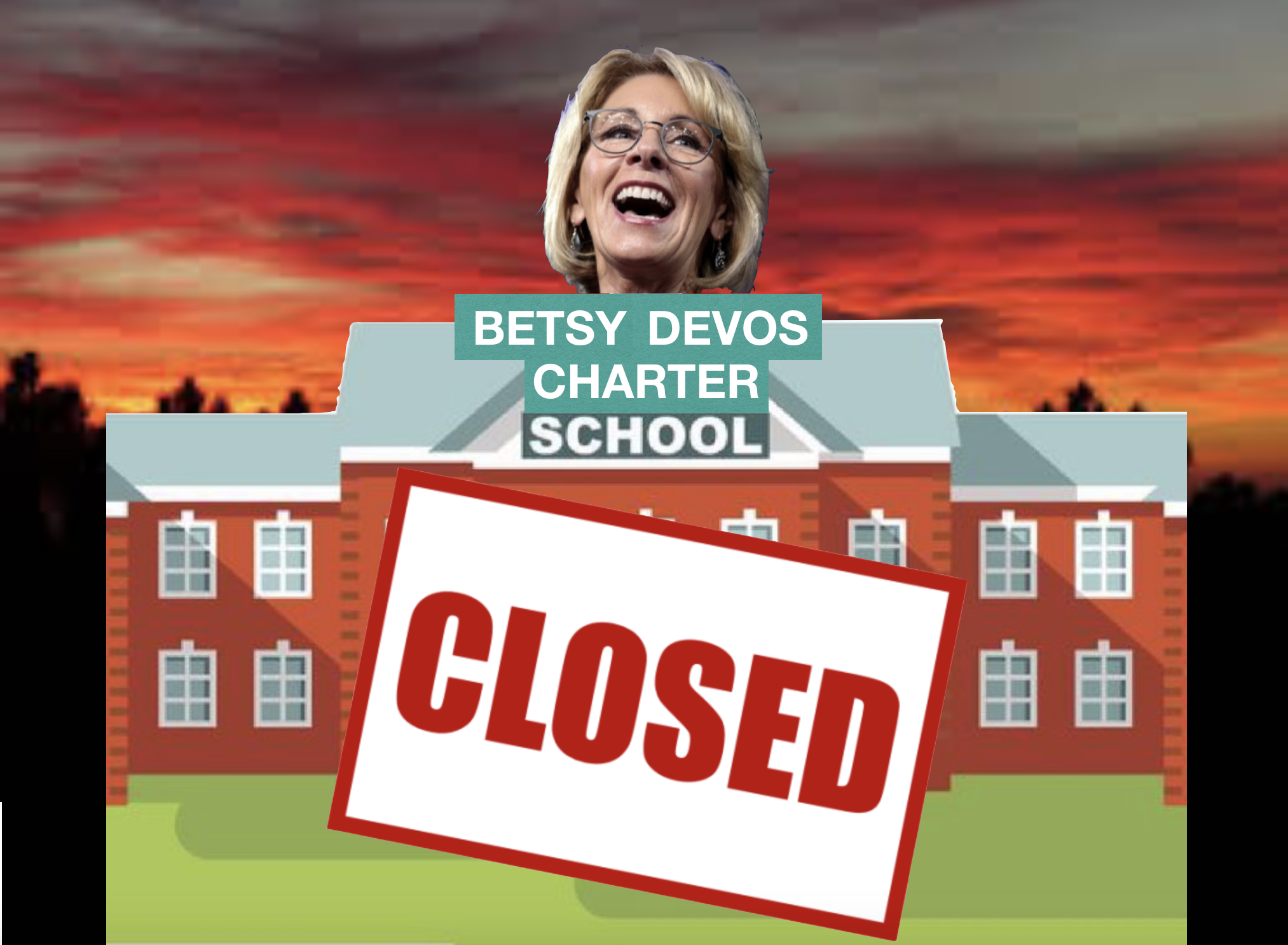
I am overjoyed that lawmakers on both sides of the aisle are starting to hear the criticisms leveled against the charter school industry in the face of the naked greed and bias of the Trump administration and its high priestess of privatization, Betsy DeVos. However, I am also disappointed in the lack of courage displayed by many of these same lawmakers when proposing solutions.


Charter schools enroll only 6 percent of students nationwide yet they gobble up billions of dollars in funding. In my home state of Pennsylvania, they cost Commonwealth taxpayers more than $1.8 billion a year and take more than 25 percent of the state’s basic education funding. That’s for merely 180 schools with 135,000 students!


Charter schools are privately run but publicly financed. They are what happens when the public abrogates its responsibility to run a school and signs that right away (in a charter agreement) with another entity, usually a business or corporation.
As such, these schools are not held to the same standards as authentic public schools. Unlike your neighborhood school, charters are not required to be run by elected boards, to have public meetings, to have open records, or to spend all their money in the service of their students. Nor do they have to provide the same standard of services for students – even children with special needs. Nor do they have to accept all students within their coverage area who enroll. And that’s to say nothing of how they increase racial segregation, are susceptible to fraud and malfeasance, often produce much worse academic results, close without notice, hire many uncertified teachers, trample workers rights and destabilize the authentic neighborhood public schools.


These are not problems that can be solved by fiddling around the edges.


We cannot simply constrain them from stealing AS MUCH from authentic public schools and consider it a victory.


We need to address the issue head on – and that issue is the very concept of charter schools.


Why would the public give up its schools to a private entity? Why allow someone else to take our money and do whatever they want with it behind closed doors? Why allow anyone to give our children less of an education than we’re already providing at our own schools?


We must end this failed experiment. Nothing less will do. It will only provide more breathing room so  that this unjust situation can drag on for another generation.


In Pennsylvania, Gov. Tom Wolf has proposed sweeping reforms via executive order that would make real progress toward holding charter schools accountable. He has asked that the state senate and house take the next step with legislation to finish the job.


Just this past week, Wolf visited Twin Rivers Elementary School in McKeesport along with state Senator Jim Brewster and state Reps Austin Davis and Jake Wheatley to listen to resident and teachers’ concerns and propose solutions.


Such a move is unprecedented and represents a seismic shift in the political landscape. However, I am concerned that lawmakers are too timid to fix the real problem here.


No one has the bravery to come out and say what I’ve said here.


Consider this statement from Brewster, my state Senator:


I have legislation to address some of these issues, but it’s not an indictment on charter school teachers. It’s not an indictment on the charter school concept. It’s an indictment on the process that was put in place 20 some years ago that has put in a playing field that’s not level. Together I believe if we get the charter school folks to the table we can iron this out, we can fix several things that need to be fixed – the funding formula, the capacity, the cap and those sort of things – and when we do that, then the mission statements of the charter schools and the public schools are the same – educate our children, bring their skill sets out, help them achieve their dreams.”


I am deeply grateful for Brewster’s support and willingness to take on the charter industry. And he is right about many things. But not all of them.


He is right, for example, about the financial impact of charter schools on authentic neighborhood public schools.


At the same meeting, McKeesport superintendent Mark Holtzman said, “Charter schools are depleting our resources with no accountability or without being financially responsible. Taxpayer money is being used to flood the media with commercials and billboards right before the start of school so that they can take our students.”


There are roughly 500 students living in the McKeesport district enrolled in brick-and-mortar charter schools and 100 students enrolled in cyber charters. The district spends about $7 million — or 10% of its budget — on charter school payments, according to Holtzman.


It’s roughly the same at other districts in the Mon-Valley. Steel Valley Schools, where I work as a middle school teacher, has budgeted a $6 million payment to charter schools this year – 16% of our spending plan.


Again, I am extremely grateful that Wolf and other state Democrats recognize this fact and are willing to take measures to make matters more fair. I hope many Republicans will join them in this.


However, fixing the way charters are funded alone will not correct the problem.


Charter schools are a parallel service to authentic public schools. If you’re suggesting we fund them both, you’re asking taxpayers to pay for two complete and separate school systems.


Why should we do that? Why should we waste our money on it? I don’t think the people of Pennsylvania – or any state of the union – have money to spare on a pointless duplication of services.


It is a politically impossible position that has zero justification – especially when you consider all the inequitable practices charter schools are allowed to get away with.


In his executive orders, Wolf proposes putting a stop to some of this.


For example, he wants to require charter schools to stop turning away students based on race, ethnicity, gender, disability, intellectual deficits, or other factors. He wants to make charter schools as transparent as authentic public schools. He wants to stop conflicts of interests for charter school board members and operating companies so that they can’t make decisions on behalf of the school that would enrich themselves, their families and/or friends.


These are excellent suggestions and I hope he is able to make them a reality.


However, these “fixes” are all things that authentic public schools already do. They don’t discriminate in enrollment. They are financially accountable and transparent. They aren’t allowed to engage in conflicts of interest.


Why bother making charter schools act like authentic public schools when we already have authentic public schools? That’s like genetically engineering your cat to have a longer snout and say “woof.” Why bother when you already have a dog?


The same could be said about for-profit and non-profit charter schools.


Apologists want to pretend that the former is the “bad” type of charter and the latter is the “good” type.


Wrong.


As Jeff Bryant, an editor at Education Opportunity Network, puts it, this is a “Distinction without a difference.”


These terms only define an organization’s tax status – not whether it is engaged in gathering large sums of money for investors.


With a knowledgeable accountant or hedge fund manager, almost anyone can claim nonprofit status while still enriching yourself. It happens all the time.


For instance, take the use of management companies.


A for-profit charter school can simply cut services to students and pocket the savings as profit.

A nonprofit charter school can do the same thing after engaging in one additional step.

All they have to do is start a “nonprofit” charter school and then hire a for-profit management company to run it. Then the management company can cut services and pocket the profits!


Yet we call such a school “nonprofit.” It’s meaningless.


It doesn’t even matter who owns the for-profit management company. It could even be the same people who own the nonprofit charter school.


The law actually allows you to wear one hat saying you’re nonprofit and then put on a different hat and rake in the cash! The only difference is what hat you’re wearing at the time! You get to claim to be a nonprofit while enjoying all the advantages of being for-profit.


You can even buy things with public tax dollars through your for-profit management company and then if your “nonprofit” school goes bankrupt, you get to keep everything you bought! Or your management company does.


So the public takes all the risk and you reap all the reward. And you’re still called a “nonprofit.”


But let’s not forget real estate shenanigans.


If I own property X, I can sell it to my own charter school and pay myself whatever I want. And I can do the same thing with a nonprofit charter school, I just need to sell it to my for-profit management company which will still buy my property for whatever I decide to pay myself.


Face it – charter schools are a scam.


They are a failed policy initiative.


It’s time they were ended.


But don’t get me wrong. I’m not suggesting we simply throw away the people who work there or the students who are enrolled there.


We need to look at each charter on a case-by-case basis and decide how best to transition them to an authentic public school system.


In some cases, it may make sense to rehabilitate charters into fully public schools with all the transparency and regulations that means. However, in most cases it will mean eventually closing them.


If there are any charters that actually provide valuable services for students and their families wish to keep children enrolled there, we should allow these students to finish their academic careers there. But let the present classes be the last.


In schools that do not offer better outcomes than the neighborhood public school (i.e. the overwhelming majority) students should be transitioned back to the neighborhood schools.


If there are any charters that do not wish to abide by such changes, they should have the opportunity to become what they already are except in name – private schools. The only difference is that taxpayers will no longer take up the tab.


And when it comes to charter school teachers, they should not be punished for having worked in the industry. In fact, we should find ways to bring them into the authentic public schools.


Our public schools need more teachers. Charter teachers who are fully certified should be given first chance to fill some of those vacancies. And charter teachers who are not certified should be given the opportunity to go back to school and complete their education degrees.


Any sane solution to the charter school mess would include these measures with the ultimate goal of ending school privatization in all its forms financed at public expense.


We don’t want privatized prisons. We don’t want privatized mercenary armies like Blackwater. We don’t want privatized schools.


Tax dollars should go to our authentic neighborhood public schools so that we can make them even better than they already are.


Our students deserve the best we can give them – and we can’t give them the best when we’re needlessly paying for two separate school systems and passing legislation with more of an eye on private investors than the welfare of the next generation.


It is my sincere hope that this push for real charter school reform becomes an effort to solve this problem once and for all.


Are we brave enough to do it?


Do we have the courage and conviction to take that on?


Like this post? I’ve written a book, “Gadfly on the Wall: A Public School Teacher Speaks Out on Racism and Reform,” now available from Garn Press. Ten percent of the proceeds go to the Badass Teachers Association. Check it out!
cropped-book-1.jpg