Less Resources, Harder Tests: Common Core in the Last Days of Obama

teaching_testing


The bell hadn’t even rung to begin class yet, but Ce Ce already had enough.


She saw the pile of standardized test look-a-like sheets on the front desk and immediately asked if she could go to in-school suspension.


I’m not kidding.


She’d prefer to spend the day in silence doing homework isolated from the rest of the class than practicing high stakes testing with her peers.


And she’s not alone. This happens every year now. As assessment season gets closer, administrators push teachers to do test prep. And students revolt.


I’m not exactly sure why. Test replicas are not my favorite things to do, either, but they’re not THAT bad. I don’t think it can be my teaching since the mutiny usually happens before I’ve even begun.


It’s the testing. Pure and simple. Some students are so demoralized by the very prospect of skill-and-drill that spending one more second reading passages and filling in bubbles seems a fate worse than death.


And I can’t really blame them.


In the last two years, Pennsylvania has modified its mandatory assessments until it’s almost impossible for my students to pass.


Bureaucrats call it “raising standards,” but it’s really just making the unlikely almost unthinkable.


Impoverished students have traditionally had a harder time scoring as well as their wealthier peers. But the policy response has been to make things MORE difficult. How does that help?


Consider this: If a malnourished runner couldn’t finish the 50 yard dash, forcing him to run 100 yards isn’t raising standards. It’s piling on.


Oh. Both your arms are broken? Here. Bench press 300 lbs.


Both your feet were chopped off in an accident? Go climb Mt. Everest.


That’s what’s happening in the Keystone State and across the country. We’re adding extra layers of complexity to each assessment without regard to whether they’re developmentally appropriate or even necessary and fair to gauge individual skills.


Where Common Core State Standards have been adopted (and Pennsylvania has its own version called PA Core), annual tests have become irrationally difficult. That’s why last year’s state tests – which were the first completely aligned to PA Core – saw a steep drop off in passing scores. Students flunked it in droves.


Where the previous tests were bad, the new ones are beyond inappropriate.


Take Text Dependent Analysis (TDA). It’s something we’ve always done in language arts classes, but it’s meaning has subtly changed thanks to PA Core.


Two years ago, it used to denote that students had to refer to the text when writing essays. Now it’s come to mean something more – referring to the text (or texts) with at least two degrees of complexity.


On the Reading section of the Pennsylvania System of School Assessment (PSSA) tests, students must peruse several passages and respond in writing.


Before PA Core, middle school students might have had to read one passage and then explain what its main idea was. This would require them to cite specific examples from the text. For instance, “This passage is mostly about bears because the author writes about hunting them in the Klondike, the ways in which their habitat is affected and their hibernation instinct.” Then students would have to go into more detail highlighting sections of text that support this.


Now students have to read TWO passages and write about something that pervades BOTH but is still tremendously complex. For instance, a 6th grade example released from the state has students read a poem and a folktale about people tricking others into sharing food. Then they have to write about the theme of both pieces and analyze how it is developed in each text using specific references.


The texts concern nothing most students would find interesting and are difficult to understand for children of that age. Moreover, properly developing an essay of this type should be done over the course of several classes. But middle schoolers are expected to do this in a single testing session.


Test proctors are instructed to put aside about 80 minutes for the essay and several related multiple choice questions though, technically, students can take as long as they’d like. They could be given extended time to write for several hours if they want. But most children at this age simply don’t have that kind of stamina. They are not physically and mentally prepared to sit and concentrate like that.


It’s a task many adults would find challenging, but we’re expecting 10- and 11-year-olds to do it!


Can middle school students (ages 10-14) handle this level of complexity, especially in such a short amount of time?


Honestly, it depends on the child. Everyone matures at a different rate. However, for most of the students I have taught in over a decade of middle school experience as a Nationally Board Certified teacher with a Masters Degree in Education, it is my professional opinion that this level of mastery is out of reach.


In fact, at an in-service training, administrators at my building had the entire teaching staff attempt this essay to show us what was expected from students. The general consensus was that it was unreasonable.


Requiring this level of difficulty simply ignores children’s basic humanity. Most of my students come to me not knowing how to write a good essay. If they were all computers, I could break up everything they needed to know into small bits, give it to them piecemeal over the course of the year, and they would learn. But they are not computers – they are children.


That’s why they rebel. We’re demanding more from them than they can give.


It might be different if we met them half way. It might be more reachable if higher expectations came with additional help.


If my students had any chance to achieve at this level so early in their cognitive development, we would need to bring in a team of writing specialists, a flurry of councilors, nutritionists, and wrap around social services. However, no resources have been added to help students meet these added testing hardships. In fact, Pennsylvania has slashed school budgets by almost $1 billion annually.


All the responsibility is thrown on the underfunded schools as if the few teachers who haven’t already been furloughed can somehow perform magic.


A surgeon can’t operate without tools. Nor is he expected to do the job of nurse and physical therapist as well.


It’s a matter of less resources and harder tests, then blame teachers when it doesn’t work.


It’s not just bad policy; it’s a denial of reality.


Add to that the social, cultural and economic aspects. Lawmakers pretend everyone is starting from the same point, but this is demonstrably untrue.


I teach mostly black and brown kids at a high poverty district. Many of my students only get a hot meal at school. They’re malnourished, violence-scarred, and under-equipped. They have few books in the home. Their parents aren’t around because the adults are working multiple jobs to support them. They live in violent neighborhoods where gunshots, drive-bys and premature death are commonplace. And you think they somehow have the same chances of scoring well on standardized assessments as children without these problems!? You expect them to prioritize standardized testing!?


And after years of being subjected to child abuse as education policy, the only thing they’ve learned from testing is that they’re not good at it and they might as well not try.


Is it any wonder some of them would rather sit in our school’s version of prison than stay in class and practice test taking strategies?


We’re running up against the nature of cognition and how young minds grow. We’re ignoring the social, cultural and economic conditions in which these children live. And we’re pretending this is somehow a fair and just accounting of children’s academic skills and their teachers’ effectiveness.


Children need to be engaged. They need to see how an assignment affects their lives. They need to care. They need intrinsic motivation, which is almost impossible to find for a test that is essentially extrinsic.


Our current education policy is the equivalent of holding a gun on children and demanding they perform almost impossible tasks.


It is time to stop the violence. It’s time to end the child abuse.


But is anyone listening?

If the PA Legislature Won’t Pass a Budget, Schools Shouldn’t Give High Stakes Tests

 1408571032000-Opt-out-01

No one gives a high stakes test because he or she thinks it helps kids learn.


Public schools give tests because they are threatened by the state: give this test or we’ll withhold your funding.


In Pennsylvania, the legislature can’t be bothered to pass a budget. So lawmakers have already withheld funding.


So WHY THE HECK ARE SCHOOLS GIVING THESE TERRIBLE TESTS!!?


Pause with me a moment for a smidgen of background.


It seems the Keystone State just can’t afford its public schools.


Not when there are natural gas drillers out there that need to make an obscene profit.


Not when rich folks need another tax cut so they can buy another yacht.


Not when legislative districts are so gerrymandered that lawmakers from rich localities serving a minority of the population will never be held accountable by the majority kept safely away from them in other districts.


Nope. The Commonwealth just can’t afford to educate everyone – especially those that are poor or black or brown.


That’s why the Republican-controlled legislature just can’t compromise with Democratic Gov. Tom Wolf on a budget.


Wolf wants the state to heal almost $1 billion in annual cuts to education made 5 years ago when the GOP also had control of the Governor’s mansion. Meanwhile, the Republicans just want to put another Band-Aid on it.


And this has been going on since July.


It’s time to make some hard decisions. We’ve got to make some cuts, and I have just the place to start: high stakes testing.


Since last year when we aligned our federally mandated assessments with the PA Core (i.e. Common Core lite), we’ve seen a huge spike in failure, test anxiety and public money going to for-profit testing corporations.


It cost taxpayers $30 million to administer the Pennsylvania System of School Assessment (PSSA) tests and $20 million for the Keystone exams last year, according to Department of Education representatives.


And when you add in the 164,500 students who failed and re-tested at least once, that’s an additional $4 million.


We simply can’t afford that kind of cost with no return on the investment.


These tests don’t make children more marketable. They don’t increase graduation rates (just the opposite). They don’t provide any opportunity for teachers to use them diagnostically and thereby increase educational outcomes. They have never been shown to help students in any way.


So why are we giving them?


Sure, the federal government decided in its infinite wisdom (after receiving mountains of cash from the standardization and privatization industry) that all public schools have to give annual assessments. However, the new federal Every Child Succeeds Act (ESSA) is supposed to allow states to decide what those assessments look like.


Students get teacher-created tests in school every week. Maybe our annual assessments look like that.


Heck! We’ve heard so much self-congratulation about how the new federal law gives power back to the states, it’s time to put that to the test. Cut this parasitic line item and move on to things that actually provide value for our students and their families.


And if the state government doesn’t have the guts to do this (spoiler: it doesn’t) then maybe our 500 public school districts do.


Why are school boards sitting back patiently waiting for their Constitutionally-mandated funding to come in?


The legislature is required by its own laws to have its books in order by July 1st. That was more than 270 days ago! If lawmakers can’t do that, why should our school districts listen to anything they say?


School directors should protest, and not just with angry letters. They should publicly proclaim they aren’t going to give their neighborhood children these tests.


The way I see it, that will do one of two things:


In either case, it’s a win.


People talk a lot about state vs. federal power when the real dichotomy is between local and everything else.


No one should be making decisions about how schools generally spend their budgets except for the people who actually live there. No one has the right to tell parents how to spend money on their families. Why should anyone have the right to tell communities how to educate their kids?


Sure, some communities may make bad decisions. And so do some parents. But it’s their decisions to make.


The contrast has never been so sharp.


While partisans in Harrisburg play games with the budget, our local public schools go wanting. They depend on state money to stay afloat. By December, many districts were planning to close their doors because of lack of funds.


Gov. Wolf unilaterally released $2.5 billion to keep them afloat but that’s less than half of last year’s expenditure. Meanwhile, Wolf has already proposed his spending plan for next year while the one for the current year still hasn’t been ratified!


Even under the best circumstances, public schools should stop giving standardized tests. The parents of more than 5,000 students refused testing for their children last year in Pennsylvania, and that number is expected to increase exponentially this year. Nationwide, the parents of hundreds of thousands of students opted out of testing last year. Parents are increasingly questioning the value of unproven assessments that do nothing but enrich for-profit corporations and unfairly label the hardest-working districts as failures.


The only carrot the state and federal government has to keep schools testing has been funding. In the absence of that, it is beyond ludicrous to continue the destructive practice. It would be tantamount to selling your soul to the Devil FOR FREE! Faustian bargains are generally not smart, but without remuneration, they’re idiotic!


So there is absolutely zero reason to follow the state testing mandate. The legislature has reneged on its side of the deal. Local school districts should be free to make whatever autonomous decisions their leaders can to keep them afloat and provide the best education possible for the students in their care.


That means if the state doesn’t pass a budget, local districts shouldn’t give standardized tests.

High Stakes Testing Doesn’t Protect Civil Rights – It Violates Them

martin-luther-king-jr-small

“Daddy, I know who that is!”

“Who is it?”

“That’s Martin Luther King.”

“That’s right, Baby! Who was he?”

“We saw a movie about him today in school. He had a dream.”

Thus began a fascinating conversation I had with my seven-year-old daughter a few days ago.

I had been going through her book bag and found a picture of Dr. King blazoned above an article about his life.

“He wanted everyone to be nice to each other,” she said.

I laughed. My first grade scholar isn’t that far off.

“He’s one of my heroes,” I said. “He means a lot to me.”

“That’s silly,” she said. “He doesn’t have any super powers.”

Before I could reply, her attention shifted to her stuffed Yoshi doll. She began to play.

One of the best things about being a parent is getting to see the world anew through the eyes of your children. My little girl offers me this vantage point everyday.

Dr. King can’t be a hero. He had no super powers.

Or did he?

“I have a dream,” he famously said, “that my four little children will one day live in a nation where they will not be judged by the color of their skin but by the content of their character.”

It’s a simple wish. A simple insight.

Or is it?

Do we do that today? Do our schools?

As a middle school teacher, I’m well aware how our public schools judge our children, and it’s not by the content of their character. It’s by their standardized test scores.

High scores mean you’re learning. Low scores mean you’re not. And if you’re not learning, that’s your teachers fault and we’re going to close your school or turn it into a charter.

What’s worse, we’re going to do it because that ensures your civil rights.

That’s the story anyway.

Ever since rewriting the federal law governing K-12 schools began to be debated in earnest by Congress, the tale was told that high stakes testing is good for minorities. It makes sure schools aren’t neglecting them.

And now that the Every Student Succeeds Act (ESSA) has been passed, well-meaning people everywhere are wondering if we’re looking out for our black and brown brothers and sister enough – do we have enough federally mandated high stakes tests? Is there enough accountability?

After all, the new law potentially returns much of the power for education policy to the states. What if states don’t give as many tests? How will state legislatures ensure black students aren’t being neglected? Why would schools actually teach black kids if we don’t threaten to close them based on test scores?

These would be laughable questions if they weren’t asked in earnest. With such frequency. Even from some civil rights organizations.

Some things to consider:

1) The ESSA does absolutely nothing to limit standardized testing.

When Congress was rewriting federal education policy, parents, educators, students and experts of every stripe asked for a reduction in testing. It didn’t happen. Exactly the same number of tests are required under the ESSA as there were before it was passed – once a year in grades 3-8 and once in high school.

2) Punishing schools doesn’t help kids learn.

Once upon a time, it was the government’s job to provide schools with adequate resources to help kids master their lessons. Now it has become the government’s job to raise an arbitrary standard and shutter or privatize schools that fall below that mark.

This may come as a surprise, but no school has ever been improved by being closed. Students who are forced to relocate don’t suddenly do better. In fact, they usually do worse academically. Moreover, there is exactly zero evidence that charter schools do better than traditional public schools. In fact, the evidence points in exactly the opposite direction.

3) Standardized tests are poor assessments to judge learning.

Standardized testing has never been shown to adequately gauge what students know, especially if the skills being assessed are complex. The only correlation that has been demonstrated consistently is between high test scores and parental wealth. In general, rich kids score well on standardized tests. Poor kids do not.

Therefore, it is absurd to demand high stakes standardized testing as a means of ensuring students’ civil rights.

Judging kids based on these sorts of assessments is not the utopia of which Dr. King dreamed. We are not judging them by the content of their character. We’re judging them by the contents of their parents bank accounts.

There are real things we could be doing to realize racial and economic equality. We could do something about crippling generational poverty that grips more than half of public school students throughout the country. We could be taking steps to stop the worsening segregation of our schools that allows the effects of test-based accountability to disproportionately strike schools serving mostly students of color. We could invest in our neediest children (many of whom are minorities) to provide nutrition, tutoring, counseling, wrap around services, smaller class sizes, and a diverse curriculum including arts and humanities.

But we’re not doing any of that.

Why?

Because we’re too concerned about continuing the policies of test and punish. We’re too concerned about making sure huge corporations continue to profit off creating, grading and providing materials to prepare for annual standardized testing.

Dr. King may not have had super powers. But from his vantage point almost 50 years in the past, he saw through the lies of today’s education reform movement.

Standardized testing doesn’t protect civil rights. It violates them.

Our school policies for the past few decades have been about denying the right to an equitable education to our poor and minority students. Though the ESSA holds promise to limit federal meddling, it does nothing to change that. And all these people who cry foul at a potential loss of federal power are either ignorant or crying crocodile tears.

It’s no wonder that hundreds of civil rights organizations oppose high stakes testing. Nor is it surprising that the media rarely reports it. And it shouldn’t be a shock to learn that the overwhelming majority of civil rights organizations who have suddenly began championing testing are those who get big donations from the philanthro-capitalists pushing this agenda.

High stakes testing is a racist and classist policy. Period.


NOTE: This article was given a shout out on Diane Ravitch’s blog and published in the Badass Teachers blog.

Who’s Your Favorite Gadfly? Top 10 Blog Posts (By Me) That Enlightened, Entertained and Enraged in 2015

Screen shot 2015-12-30 at 12.57.49 AM

“Pennsylvania educator and public school advocate Steven Singer is one of the most powerful voices in the nation when it comes to speaking out for students, parents, teachers and our public schools.”
Jonathan Pelto, founder of the Education Bloggers Network


“Steven Singer wrote these five terrific posts last year. I didn’t see them when they appeared. Probably you didn’t either. You should.”
Diane Ravitch, education historian


“Your name should be Sweet Steven Singer. You are a delight.”
Karen Lewis, President of the Chicago Teachers Union

11206058_10152940020833860_7943827034975790194_n


Hello. My name is Steven Singer, and I am a gadfly.

I make no apologies for that. It’s what I set out to do when I started this blog in July of 2014.

I told myself that people were too complacent. There was no curiosity. People were too darn sure about things – especially education policy and social issues.

They knew, for instance, that standardized testing was good for children. Why? Because Obama said so. And he’s such a nice man. It’s too bad all those mean Republicans keep making him do all this bad stuff.

They also knew racism was over. After all… Obama! Right? Black President, therefore, the hundreds of years of struggle – finished! Move along. Nothing to see here.

Yet all this “knowledge” went against everything I saw daily as a public school teacher.

Standardized tests are good for children? Tell that to more than half of public school kids now living below the poverty line who don’t have the same resources as middle class or wealthy kids yet are expected to magically ace their assessments. Tell that to the kids who get hives, get sick, or throw up on test day. Tell it to the black and brown students who for some unexplainable reason almost always score lower than their white peers.

Racism is over? Tell that to all my minority students who are afraid to walk home from school because they might get followed, jumped, beaten or killed… by the police! Tell it to their parents who can’t get a home loan and have to move from one rental property to another. Tell it to the advertising executives and marketing gurus who shower my kids with images of successful white people and only represent them as criminals, thugs, athletes or rappers.

So when I started this blog, I consciously set out to piss people off. But with a purpose. To quote the original historical gadfly, Socrates, my role is, “to sting people and whip them into a fury, all in the service of truth.” It seems well suited to a school teacher. After all, Socrates was accused of “corruption of the youth.”

It’s been quite a year. When I went to the Network for Public Education conference in Chicago last April, some folks actually seemed to know who I was. “Don’t you write that Gadfly blog?” was a common question.

When I met NEA President Lily Eskelsen Garcia and AFT President Randi Weingarten, they both said, “I read your blog.” And then they looked me up and down suspiciously as if they were thinking, “THIS is the guy who writes all that stuff!? THIS is the guy giving me such a hard time!?”

Of course, I am human, too. One can’t sting and bite every day. Sometimes the things I write are met with love and approbation. Some weeks even Lily and Randi like me. Sometimes.

Education historian Diane Ravitch has given me tremendous moral support. I can’t tell you how gratifying it is to have one of your heroes appreciate your work! Her book “The Death and Life of the Great American School System” really woke me up as a new teacher. I’m also on the steering committee of the Badass Teachers Association, an organization that has changed my life for the better. The more than 56,000 people  there are my support. I would never have had the courage to start a blog or do half of the crazy things I do without their love and encouragement.

And there are so many more people I could thank: my fellow bloggers Jonathan Pelto, Peter Greene, Russ Walsh, Nancy Flanagan, Mitchell Robinson, and Yohuru Williams. Also the good people at the LA Progressive and Commondreams.org. The incredible and tireless radio host Rick Smith.

There are just too many to name. But no list of acknowledgment would be even close to completion without mentioning my most important supporter – you, my readers. Whether you’re one of the 9,190 people who get every new post delivered by email or if you otherwise contribute to the 486,000 hits my site has received so far, THANK YOU.

So in celebration of my first full year of blogging, I present to you an end of the year tradition – a Top 10 list. Out of the 90 posts I wrote in 2015, these are the ones that got the most attention. Often they incensed people into a fury. Sometimes they melted hearts. I just hope – whether you ended up agreeing with me or not – these posts made you think.

Feel free to share with family, friends, co-workers, etc. After all, I’m an equal opportunity gadfly. I always cherish the chance to buzz around a few new heads!


10) The Democrats May Have Just Aligned Themselves With Test and Punish – We Are Doomed

sanders_warren-620x412

Published: July 17, 2015
Views: 7,122

Description: It hit me like a slap in the face that almost all Senate Democrats voted to make the reauthorization of the federal law governing K-12 public schools a direct continuation of the same failing policies of the Bush and Obama years. Heroes like Bernie Sanders and Elizabeth Warren seemed to be turning their back on teachers, parents and school children. And they were stopped in their efforts by… Republicans!

Fun Fact: This story had some legs. It inspired a bunch of education advocates like myself who are also Bernie Sanders supporters to write the candidate an open letter asking him to explain his vote. His campaign eventually responded that it was about accountability!?


9) Punching Teachers in the Face – New Low in Presidential Politics

cc-600x400

Published: Aug. 3
Views: 14,735

Description: New Jersey Governor Chris Christie thought he’d run for the Republican nomination for President. He thought threatening to metaphorically punch teachers unions in the face would get him votes. It didn’t.

Fun Fact: This new low in Presidential politics came just after Donald Trump had announced he was running. Christie’s new low now seems almost quaint after Trump’s calls to tag all Muslims and monitor their Mosques. How innocent we were back in… August.


8) This Article May Be Illegal – Lifting the Veil of Silence on Standardized Testing

whistle
Published: April 18
Views: 15,818

Description: Teachers and students may be legally restrained from telling you what’s on federally mandated standardized tests, but we’re not restrained from telling you THAT we’re restrained. Is this just protecting intellectual property or direct legal intimidation of educators and children?

Fun Fact: I have not yet been arrested for writing this piece.


7) Stories about Teachers Union Endorsements of Hillary Clinton

Did the AFT Rank and File REALLY Endorse Hillary Clinton for President? If So, Release the Raw Data

(July 12 – 4,448 hits)


The NEA May Be About to Endorse Hillary Clinton Without Input From Majority of Members

(Sept. 21 – 3,873 hits)

A Handful of NEA Leaders Have Taken Another Step Toward Endorsing Hillary Clinton Despite Member Outcry

(Oct. 2 – 739 hits)

Teachers Told They’re Endorsing Hillary Clinton by NEA Leadership, Member Opinions Unnecessary

(Oct. 4 – 7,074 hits)

Screen shot 2015-09-21 at 12.23.19 AM

Published: July 12 – Oct. 4
Views: 16,134 TOTAL

Description: You expect your union to have your back. Unfortunately it seems our teachers unions were more interested in telling us who we’d be endorsing than asking us who the organizations representing us should endorse.

Fun Fact: I broke this story pretty much nationwide. News organizations like Politico were calling me to find out the scoop.


6) Why We Should Have ZERO Standardized Tests in Public Schools

Screen shot 2015-01-30 at 4.35.10 PM

Published: Jan. 30
Views: 16,443

Description: Someone had to say it. We don’t need any standardized tests. We need teacher-created tests. And that’s not nearly as crazy as some people think.

Fun Fact: This was written back when the Elementary and Secondary Education Act (ESEA) was being rewritten and naïve fools like me thought we might actually get a reduction in high stakes testing. Spoiler alert: we didn’t.


5) Atlanta Teacher RICO Conviction is Blood Sacrifice to the Testocracy

aztecshumansacrifice

Published: April 3
Views: 18,187

Description: There is something terribly wrong when we’re using laws created to stop organized crime as a means to convict  teachers cheating on standardized tests. I’m not saying cheating is right, but the mafia kills people. These were just teachers trying to keep their jobs in a system that rewards results and refuses to balance the scales, listen to research or the opinions of anyone not in the pockets of the testing and privatization industries.

Fun Fact: Watching all those seasons of “The Wire” finally came in handy.


4) Not My Daughter – One Dad’s Journey to Protect His Little Girl From Toxic Testing

FATHERS-AND-DAUGHTERS
Published: March 20
Views: 26,420

Description: How I went to my daughter’s school and demanded she not be subjected to high stakes testing in Kindergarten.

Fun Fact: They were very nice and did everything I asked. If you haven’t already, you should try it!


3) I Am Racist and (If You’re White) You Probably Are, Too

Screen shot 2015-06-02 at 1.42.34 PM

Published: June 2
Views: 28,906

Description: White folks often can’t see white privilege. This is my attempt to slap some sense into all of us. If you benefit from the system, you’re responsible to change it.

Fun Fact: Oh! The hate mail! I still get it almost every day! But I regret nothing! A black friend told me I was brave to write this. I disagreed. Anytime I want I can hide behind my complexion. She can’t.


2) I Am A Public School Teacher. Give Me All the Refugees You’ve Got

syrian_refugee_schools

Published: Nov. 19
Views: 45,196

Description: Our public schools are already places of refuge for our nation’s school children. Send me more. I’ll take them all. I’d rather they end up in my classroom than drowned by the side of a river.

Fun Fact: I got equal love and hate for this one. Some folks were afraid of terrorists. Others didn’t think we could afford it. But many told me my heart was in the right place. Lily and the folks at the NEA were especially supportive.


1) White People Need to Stop Snickering at Black Names

baby-and-parents

Published: Sept. 6
Views: 96,351

Description: Maybe we should stop laughing at black people’s names. Maybe we should try to understand why they are sometimes different.

Fun Fact: You’d have thought I threatened some people’s lives with this one! How dare I suggest people should stop mocking other people’s names! If you want to know how strong white fragility is in our country, read some of the comments! But many people thanked me for bringing up something that had bothered them for years but that they had been too polite to talk about, themselves. This is easily my most popular piece yet.


Much Ado About an Enigma – No One Really Knows What Impact the ESSA Will Have on Public Schools

ESSA-Obama

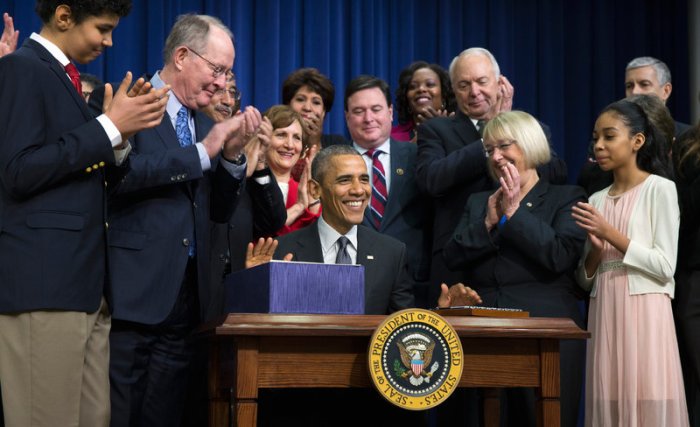
President Barack Obama signed the Every Student Succeeds Act (ESSA) this week.

The new legislation reauthorizes federal law governing K-12 public education.

In 1965 we called it the Elementary and Secondary Education Act (ESEA). Until today we called it No Child Left Behind (NCLB). And now after a much-hyped signing ceremony, the most definitive thing we can say about it is this: federal education policy has a new name.

Seriously. That’s about it.

Does it reduce the federal role in public schools? Maybe.

Does it destroy Common Core State Standards? Possibly.

Is it an improvement on previous policies? Potentially.

Will it enable an expansion of wretched charter schools and unqualified Teach for America recruits? Likely.

The problem is this – it’s an over 1,000 page document that’s been open to public review for only two weeks. Though it was publicly debated and passed in the House and Senate, it was finalized behind closed doors and altered according to secure hurried Congressional votes. As such, the final version is full of legal jargon, hidden compromise, new definitions and verbiage that is open to multiple meanings.

How one reader interprets the law may be exactly the opposite of how another construes it.

Take the much-touted contention that the ESSA reduces the federal role in public schools. Even under the most positive reading, there are limits to this freedom.

The document continues to mandate testing children each year in grades 3-8 and once in high school. It also mandates academic standards and accountability systems. However, what these look like is apparently open to the states.

For instance:

The Secretary [of Education] shall not have the authority to mandate, direct, control, coerce, or exercise any direction or supervision over any of the challenging State academic standards adopted or implemented by a State.

That seems pretty clear. The federal government will not be able to tell states what academic standards to adopt or how student test scores should be used in teacher evaluations.

But it also says that states will have to submit accountability plans to the Department of Education for approval. It says these accountability plans will have to weigh test scores more than any other factor. It says states will have to use “evidence-based interventions” in the schools where students get the lowest test scores.

That sounds an awful lot like the test-and-punish system we have now.

What if your state decides to take a different road and reject the high stakes bludgeon approach to accountability? In that case, some readers argue schools could lose Title I funds – money set aside to help educational institutions serving impoverished populations.

Will that actually happen? No one knows.

It may depend on who will be President in 2017 and whom that person picks as Secretary of Education. And even if the Feds try to take advantage of these potential loopholes, the matter could end up being decided by the U.S. Supreme Court.

What about Common Core?

Some readers interpret the new law as destroying forever the possibility of national academic standards. If states are allowed to pick their own standards, it is highly unlikely they’ll all pick the ones found in the deeply unpopular Common Core. However, the law does force each state to have academic standards of some kind, and it defines what those standards must look like. One interpretation of this is that they must look a lot like the Common Core.

They must be “state-developed college- and career-ready standards.” You read that right – “College and career ready.” That’s the Common Core catchphrase. If someone says they want to eat lunch at “the golden arches,” they haven’t said McDonalds, but you know they’re craving a Big Mac.

Will the Fed allow states to choose standards radically different than the Core? Again only time and – possibly – the courts can tell.

This same problem occurs throughout the document. As the public painstakingly combs through it, new legal wiggle room may be found. And I am not so naive as to suppose we’ve found all of the loopholes yet. Some of these may be the result of poorly chosen wording. Others may be purposefully hidden time bombs waiting for opportunists to exploit.

This uncertainty about exactly what the ESSA will eventually mean for our public schools may help explain the range of reactions to the formative law – from ecstasy to despair to shrugs and snores.

I’m not sure what to think of the thing, myself. I started the whole process disgusted but came around to accepting it if the final result was any kind of improvement over previous legislation. And now that it’s the law of the land, I look at this Frankenstein’s monster of a bill – stitched together pieces of mystery meat – and I don’t know whether to laugh or cry.

I still hope it will live up to the limited promise it holds to bring us some relief from NCLB. But I admit this thing could go sour. Anyone’s guess is as good as mine.

Which brings me to perhaps the biggest problem with this law that no one seems to be talking about.

Education needs reformed. We need to repeal the bogus policies that have been championed by the 1% and their lapdog lawmakers. We need to get rid of test-based accountability. We need to trash high stakes testing, Common Core, value added measures, charter schools and a host of other pernicious policies. We need to initiate a real anti-poverty program dedicated to attacking the actual problem with our schools – inequality of resources.

But more than any of that, we need to reform our government.

We need to find a better way to make our laws. The process that shat out this ESSA must go.

Think about it. No Child Left Behind was an abject failure by any metric you want to use. It didn’t close achievement gaps – it increased them. And the major policy of this law – annual standardized testing – remains intact in the reauthorization!

There has been massive public outcry against annual testing. Parents are leading an exponentially growing civil disobedience movement shielding their children from even taking these assessments. Everyone seems to agree that we test kids too much – even President “I’ll-veto-any-bill-that-deletes-testing” Obama.

Yet our legislators did next to nothing to fix this problem.
Instead preference was given to lobbyists and corporatists interested in making a buck off funding set aside to educate children. The focus was on smaller government – not better government. These aren’t mutually exclusive, but they aren’t exactly one-and-the-same, either.

This can’t continue if we are to keep pretending we have a representative Democracy. The voice of lobbyists must not be louder than voters. Money must be barred from the legislative process. Demagoguery must not overshadow the public good. We need transparency and accountability for those making our laws.

Until that happens, we will never have a sound and just education policy, because we don’t have a sound and just government.

Unfortunately, that is the biggest lesson of the ESSA.


NOTE: This article also was published in the LA Progressive, Badass Teachers Association Blog and quoted extensively on Diane Ravitch’s blog.


Close Reading: Myopia as a Virtue

head in book
Painting by Pawel Kuczynski


You are reading a text.

Yes. Right now.

Your eyes are scanning over symbols called letters. They are joined together into words and sentences and paragraphs to make up the total of this article.

Your brain is in the process of translating these symbols into sounds, meanings, concepts. And you are reacting to those concepts.

You’re having thoughts about what you’re reading. Maybe you’re reminded of a similar article you’ve read sometime in the past. Maybe you’re feeling a thrill of excitement at such an original introduction to an education article. Or perhaps you’re rolling your eyes and wondering why the author is such a doofus.

No matter how you look at it, reading involves complex processes. A whole bunch of stuff is going on to make it happen – all of it essential.

Yet when we evaluate reading comprehension these days, we put the focus squarely on one or two of those multifarious processes. It’s reductive, reactionary, and lame. It’s a dumbing down of the cognitive and metacognitive process. But it makes things easy to grade on a standardized test.

That’s what the fad of close reading is all about. It’s an attempt to make the mysterious and complex mind something that can easily be labeled right or wrong.

For the uninitiated, close reading is the careful, sustained interpretation of a brief passage of text in which great emphasis is put on individual words, syntax, and the order in which sentences and ideas unfold.

It’s not that close reading is unimportant. After all, it’s something good readers do. But an overemphasis on this aspect leaves out so much that is even more vital. It’s like saying the only significant part of the Hershey bar is the wrapper, or the only salient part of eating the Hershey bar is chewing. However, when I unwrap my dessert, there better be chocolate inside, and after I bite into it, I’d better not forget to swallow!

But education specialists with little to no actual classroom experience are making a killing going from school-to-school lecturing teachers about how to teach. And they’re telling us to emphasize close reading to the detriment of all else.

They’re saying we need to give our students short texts of no more than a page or two. We should have our students read these texts without any background into who wrote them or why. We should then have students answer questions that require them to go back to the text, find something and spit it back to us.

For instance:

How does the author use figurative language to develop theme?

Explain how word choice in the passage develops characterization.

Provide examples from the passage that demonstrate the author’s bias.

To the uninitiated, it looks like really important work. It’s not. This is the literary equivalent of taking out the garbage or going on a scavenger hunt. These are good things, but they are not the be-all-end-all. They don’t capture the essential reason we read – to understand.

Imagine if I asked you to go back into the part of this article you’ve already read and find one example of a North American pejorative used by the author. You could do it. You could scan back to the beginning, look through everything I wrote and find that I used the word “Doofus.”

Huzzah! You win the scavenger hunt.

Now explain why I used that word by making reference to textual evidence. You could do that, too. You could look at all the other things I’ve written so far and explain why I probably chose that word.

Congrats!

But notice what you can’t do, what these think tank clones will never ask you to do – form a substantial opinion. Not just why do you think someone else did something but what do you think about what they did?

For example:

Do you think the use of colloquialisms and slang have a place in serious education theory? Why or why not?

When was the most or least effective time you or a colleague used a colloquialism to express a complex thought? Evaluate its effectiveness.

In what ways are forbidden words more or less meaningful than those more easily sanctioned?

At its core, reading is not about discrete facts. No one picks up a piece of text to find out minute fragments of information. Instead, we’re looking for enlightenment. We don’t care so much about how the astronaut puts on the spacesuit. We want to know why she put it on in the first place. We want to know where she’s going. We want to know what it’s like and if we’d want to do something like that ourselves.

But an overemphasis on close reading ignores all this. It pretends readers are robots. It pretends reading is a mechanical process that can be easily divided into its component parts and examined discretely.

Even worse it ignores the needs of individual students. For many children in our modern world, reading of this sort is almost entirely alien to their lives. There are so many things competing for our attention these days that reading often gets neglected. Even if you love to read, it can be difficult to find the time and inclination to sit down, quiet yourself and read.

THIS is where most educators would like to focus – getting students to read at all. We want to show learners why they might want to read. We want to engage them. Demonstrate what an amazing experience a good book can be. We want to foster that look of delight in their eyes, that sense of wonder, the epiphany of literacy.

But instead we’re being told to focus on the nuts and bolts, the everyday boring hunt and seek of mechanical mentation.

Whatever you do, don’t see the forest; see the trees. Don’t look at the big picture; look exclusively to the details and don’t worry your pretty little head about making any larger meaning out of it.

This is tantamount to child abuse. We’re putting blinders on children’s minds and telling them which direction to think. We’re taking away their ownership of the reading experience. It’s no longer about what they want, what they’ve lived through, what they believe or what they see. It’s only about the author’s view – an author they probably don’t care about because they had no part in all the other crucial facets of reading. In fact, I would argue that this isn’t even really reading at all. It’s little more than  decoding. It’s a skill set fit for a corporate drone, not someone in management or any position to make valuable decisions.

It’s no wonder that these prescriptions are only leveled at public schools. Parochial, private and charter schools are specifically left out of these mandates. The same people demanding close reading for your kids want something much different for their own.

This is class warfare as education policy. It’s all about keeping down working families and lifting up the one percent.

That’s essentially what corporate education reform is all about – every tentacle of the beast is wrapped around young minds of the poor, the brown skinned, the undesirable.

But perhaps you don’t agree with me. Perhaps you have your own thoughts on this matter which may differ from mine.

Fine, I say. Good!

Yes, please think about it. Ponder these issues carefully, because while I’m championing free thought, the other side wants nothing less than your children’s complete submission to the status quo.

Feel free to give that a nice close read.

12309794_10206881389730566_1129034647191120195_o


NOTE: This article also was published on the Badass Teachers Association Blog.


Standardized Tests Every Day: the Competency Based Education Scam

rocketship-charter-schools

IN THE NOT TOO DISTANT FUTURE:

Welcome to class, children.

Please put your hands down, and sit at your assigned seat in the computer lab.

Yes, your cubicle partitions should be firmly in place. You will be penalized if your eyes wander into your neighbors testing… I mean learning area.

Now log on to your Pearson Competency Based Education (CBE) platform.

Johnny, are you reading a book? Put that away!

Are we all logged on? Good.

Now complete your latest learning module. Some of you are on module three, others on module ten. Yes, Dara, I know you’re still on module one. You’ll all be happy to know each module is fully aligned with Common Core State Standards. In fact, each module is named after a specific standard. Once you’ve mastered say Module One “Citing Textual Evidence to Determine Analysis” you will move on to the next module, say “Determining Theme or Central Idea for Analysis.”

Johnny, didn’t I tell you to put away that book? There is no reading in school. You’re to read the passages provided by the good people at Pearson. No, you won’t get a whole story. Most of the passages are non-fiction. But I think there is a fun passage about a pineapple coming up in your module today. Isn’t that nice?

Laquan, you haven’t put on your headphones and started your module yet? You’ve been on module three for the past week. How can you learn at your own rate if you never progress beyond module three?

What’s that? Your mother wrote me a note? Let me see that.

Huh. So she wants to know how come you never get beyond module three. You should be able to answer that question for her, yourself, Laquan. (At least you could get that one right.)

Laquan, tell your mother that you haven’t passed the proficiency standard yet. You’ve taken all the remediation available on the computer program, haven’t you? Yes, that fun game where you answered multiple choice questions and when you got one correct the spaceship blasts an asteroid. And then you took the daily assessment but you just haven’t received a passing score yet. But don’t worry. I’m sure if you continue to do the same thing again today… eventually… you’ll get it right. It’s how the state and federal government determine whether you’ve learned anything on a daily basis.

In ancient times, teachers like me used to make up our own assignments. We’d give you books to read… Johnny, have you started yet? …whole books, novels, literature. And then we’d hold class discussions, class projects, act out scenes, draw posters, relate the books to your lives, write essays. But now all that silliness is gone.

Thanks to the good people at the American Legislative Exchange Council (ALEC), the Gates Foundation, and the Foundation for Excellence in Education, The state and federal government have mandated a much more efficient way of determining student learning. Back in the day, they forced schools to give one big standardized test in Reading and Math every year. Teachers would have to scramble with test prep material to make sure all learners could pass the test, because if students didn’t get passing marks, the teacher was out on her butt.

We’ve done away with such silliness now. Thankfully the government got rid of yearly high stakes standardized testing. What we do now is called Competency Based Education. That’s what this program is called. It’s kind of like high stakes standardized testing every day. So much more efficient, so much more data to use to prove you know this set of basic skills written by the testing companies with hardly any input from non-experts like classroom teachers.

That’s how the district became composed of 100% charter schools. No more inefficient school boards made up of community members. Today our schools are run by corporate CEOs who are experts at finding ways to cut corners and increase profits for their shareholders. And, ugh, make you learn good.

Hm. I seem to be talking too much. No one’s paying me to impart any information. I’m just supposed to make sure you’re all hooked up to the program and making satisfactory daily progress. Otherwise, I’ll be out of a job again.

You laugh, but it’s hard to get minimum wage work like this. Since the U.S. Supreme Court made labor unions all but illegal and public schools instituted CBE programs, teachers like me could no longer demand such exorbitant salaries. Now I make an honest living. Speaking of which, I may have to get out of here a few minutes early today to make it to my shift at WalMart. I’m greeter today!

And if you work hard, someday you can be, too!


NOTE: This article also was published on the Badass Teachers Association Blog and quoted extensively on Diane Ravitch’s blog.


While Hillary Clinton Courts Teachers, Bernie Sanders May Have Conceded The Education Vote

hillary_clinton_bernie_sanders_ap_img

Hillary Clinton has made huge strides this week courting education voters. The Democratic Presidential candidate made a statement critical of scandal ridden charter schools. She also met with educators to answer questions in a closed door meeting.

Meanwhile Clinton’s main competition for the Democratic nomination, Bernie Sanders, remains silent on K-12 public education. He’s a favorite among teachers but he hasn’t really articulated much of an education policy at all.

Parents, educators and students are looking for a candidate with the guts to turn away from the destructive school policies of the last two presidents. Both George W. Bush and Barack Obama have increased privatization and standardized testing while reducing teacher and community autonomy. Instead of helping alleviate an epidemic of child poverty, they have blamed the problem on schools and teachers while starving them of the funding they need to succeed.

Frankly, moving away from these corporate education reform policies is a bad fit for Clinton. Her past education positions have been almost identical to that of the Obama administration. She’s been a strong advocate for charter schools and Common Core. She receives hefty support from wealthy corporate school reformers like Eli Broad, George Soros, Bill and Melinda Gates and the Walton family. After all, her first major policy achievement was her 1983 campaign to establish accountability-based school reform in Arkansas when her husband was Governor.

Her connections to this movement have not weakened. Just this week, #TeachStrong – an education reform organization – was launched with ties to Clinton. The group is organized by the Center for American Progress (CAP) – a think tank long affiliated with both Hillary and Bill. Husband and wife have hired numerous staffers from this organization and have championed policies that originated behind CAP’s closed doors. Many education observers are theorizing that the #TeachStrong initiatives which blame teachers and try to make their lives more difficult will eventually become Clinton’s education policies if she becomes President.

By contrast, Sanders would seem to be well suited to oppose these corporate-driven school reforms. He’s anti-privatization, anti-Wall Street and pro-worker. His vitriol against the banking industry and the 1% using tax loopholes to avoid paying their fair share would only be enhanced if he included corporate school reformers on his hit list. These are, after all, most of the same people he’s already going after just for different reasons. Unfortunately, he has yet to embrace public schools. Up to this week, both he and Clinton favored only pre-kindergarten and college support. Now she has started talking about K-12, but Sanders’ lips remain buttoned.

Perhaps this is because he thinks education voters have already sided with Clinton. The largest teachers unions – The National Education Association (NEA) and the American Federation of Teachers (AFT) – both endorsed Clinton in the primary. However, in each case these endorsements were highly controversial coming mainly from union leaders without much or any involvement from rank and file members.

Clinton seems to know that top-down endorsements alone won’t get her votes. She needs to win the hearts and minds of membership, and she seems to be committed to doing just that. Her education comments may not be entirely satisfactory, her connections may be highly unsavory, and her history may be deeply disturbing, but at least she’s making the effort to reach out to voters who care about the education system.

Sanders, where are you? You’re a Democratic Socialist. You say you’re committed to the public good. What is a greater public good than public schools? The education vote is by no means decided. It remains on the table for either candidate to take.

Personally, I don’t think Clinton is a good choice to come to education’s rescue. No matter what she says, I just don’t trust her. Someone who champions privatization isn’t going to save us from for-profit charter schools. Someone who is in bed with the testing industry isn’t going to reduce standardized testing. Someone who helped establish Common Core isn’t going to repeal it.

But if I’m honest, Sanders has skeletons in his closet, too. In the Senate he voted to expand charter school funding, voted for No Child Left Behind and most recently voted to keep test and punish policies in the Elementary and Secondary Education Act. However, given everything else he espouses, all these votes seem like anomalies. While Hillary looks like a seasoned professional who knows exactly what she’s doing in education circles, Bernie seems like a bumbling amateur who keeps making mistakes. It appears all he needs is a good talking to, someone to explain how our interests and his align perfectly. (Call me maybe!)

Of course, there is another possibility. Perhaps Sanders is against us as much as Clinton. Perhaps there is no major politician out there who has any interest in saving our schools.

Perhaps we really are alone.

In that case, maybe we shouldn’t wait for major politicians to come to us. Maybe we should consider supporting someone who is honestly in favor of us but does not yet have much political clout.

What say you, Dr. Jill Stein?

In the meantime I find myself waiting impatiently for Sanders to make his move. But I won’t wait forever. If he wants my vote – and the votes of hundreds of thousands of parents and teachers – he’s going to have to make his case.

Otherwise, we’ll look somewhere else.


NOTE: This article also was published on the Badass Teachers Association blog.


Hillary Clinton’s Charter School Problem

hillary

Good news! Democratic Presidential candidate Hillary Clinton just admitted there are significant problems with the nation’s charter schools!

Bad news! She has no interest in solving them! In fact, she thinks charters are just great.

Here’s Clinton criticizing charter schools:

Most charter schools — I don’t want to say every one — but most charter schools, they don’t take the hardest-to-teach kids, or, if they do, they don’t keep them. And so the public schools are often in a no-win situation, because they do, thankfully, take everybody, and then they don’t get the resources or the help and support that they need to be able to take care of every child’s education.

And all over the country, teachers, parents and students rejoice. Someone actually notices our problem!

Charter school scandals seem to hit the paper with the regularity of a grandfather clock. Charters cut student services and boost overhead to produce profit. Charters rack up debt and then sell it for a profit. Charters fudge the paperwork so they get paid for students who don’t actually attend. And just as Clinton said, they push out the children who are most in need and hardest to teach.

In short, most charter schools stink. Clinton admits we have a problem. But how do we solve it?

Clinton:

I have for many years now, about 30 years, supported the idea of charter schools, but not as a substitute for the public schools, but as a supplement for the public schools. And what I have worked on through my work with the Children’s Defense Fund and my work on education in Arkansas and through my time as first lady and senator is to continue to say charter schools can have a purpose, but you know there are good charter schools and there are bad charter schools, just like there are good public schools and bad public schools.

So I want parents to be able to exercise choice within the public school system — not outside of it — but within it because I am still a firm believer that the public school system is one of the real pillars of our democracy and it is a path for opportunity. …the original idea… behind charter schools was to learn what worked and then apply them in the public schools…

So Clinton’s solution to the charter school crisis is what exactly? She seems to be saying that charter schools have major problems, but the best way to fix them is to redouble our belief in this flawed and failing system.

It sounds like a line from Peter Pan: Clap your hands, children, and Tinkerbell will live! You just have to believe! Oh! Close your eyes and believe in charter schools, and they’ll be all fixed!

It’s a non-answer, an evasion. It’s the kind of politics Hillary Clinton excels at – say something so empty and middle-of-the-road that both sides of a position can find something to like about it. Take something and focus group the hell out of it until it’s almost meaningless.

The problem is that this kind of spin doctoring doesn’t help improve our schools one bit. It’s really an endorsement of the status quo. After all, what solution has she offered here?

If you aren’t paying attention, it sounds like a commitment to fix our charter schools, but it’s actually just a commitment to gift wrap them more of your tax dollars with zero accountability.

Notice what Clinton said about choice. She supports parents having a choice between various kinds of public schools – but not parochial and private schools.

Choice!? What a bunch of baloney! By and large parents don’t want to have to shop around for a school the way you would melons at the grocery store. Weigh them in your hands, look for soft spots and hope they’ll be sweet once you cut through the rind.

Parents want all public schools to be excellent. “Let The Buyer Beware” is a poor principle on which to found our system of public education.

Mrs. Clinton, who exactly are you trying to give choice to – parents or corporations? Do you want parents to be able to choose between several mysterious options or do you want to give corporations another market in which to make a profit?

It’s almost a veiled threat. There are some people out there, she might as well as be saying, who want to give your tax dollars to private and parochial schools. Not me. Nope. I’ll only give your tax dollars to traditional pubic schools or charters.

What goes unsaid is the fact that many charters run themselves like private schools. They’re almost the same thing but on the public dime. Why do you think so many call themselves “academies”? They want to look exactly like private schools. The biggest difference is they can’t violate the separation of church and state.

So Clinton is against private schools if they’re called private schools, but if we call them charter schools, they’re just peachy! Wow! There’s such a world of difference between that view and Jeb Bush’s!

Thanks a bunch, Mrs. Clinton. That’s a mighty progressive position you’ve got there. You’re going to support public schools by allowing parents to opt out of them? This is the best the Democrats can do these days!? Yikes!

And please spare me the nonsense about the original purpose of charter schools. They were supposed to be laboratories to try out new things that would eventually get applied in the traditional public school setting!? That has never happened! Not once! No one has ever looked at the charter school model and said, ‘Gee! They’re really doing such a great job! Let’s do that here!” unless it was in terms of the Cadillac funding they often receive while public schools strive to get by on what’s left between the couch cushions.

Moreover, if having the freedom to experiment is so great, why not offer traditional public schools the same option? Why not free public schools to experiment instead of weighing them down with Common Core and toxic testing (which – if I’m not mistaken – you wholeheartedly support, Mrs. Clinton)?

If most charter schools are abusing that freedom by pushing out needy students, why not take that power away? Why not support a national moratorium on any new charters? Why not investigate every existent charter and close down the ones that aren’t effective? Why not take the money saved by such a venture and use it to invest in the traditional public school system that has proven time-and-again to be the best educational alternative for our nation’s children?

Instead of pretending to offer choices, why not make sure every public school is excellent and allow parents and students choices within those schools such as whether they want to take art, music, foreign languages, extracurricular activities, etc.?

Why? Because those would be real solutions, and if there’s one thing politicians hate, it’s solving problems.

If Clinton did that, she might offend someone. She’d lose votes. Better to try to appear to be pleasing everyone.

And thus she pleases no one.


NOTE: This article also was published in the LA Progressive and on the Badass Teachers Association blog.


Stockholm Syndrome – The Only Reason Any Teachers Still Support Common Core

Screen shot 2015-11-05 at 11.06.26 PM

Common Core is dying a well-deserved death.

The very idea that we need the same academic standards in public schools from coast-to-coast is unpopular, expensive, ineffective and politically suicidal.

The Wall Street Journal reports at least $7 billion taxpayer dollars have been wasted implementing this plan, and it would cost significantly more to finish the job.

“Five years into the biggest transformation of U.S. public education in recent history, Common Core is far from common. Though 45 states initially adopted the shared academic standards in English and math, seven have since repealed or amended them. Among the remaining 38, big disparities remain in what and how students are taught, the materials and technology they use, the preparation of teachers and the tests they are given. A dozen more states are considering revising or abandoning Common Core.”

Meanwhile public support drops precipitously with each passing year. Less than half of all Americans – 49% – and only 40% of teachers now favor the policy. That’s a drop of 16% among the general population since 2013. But even more surprising is the plummeting backing from teachers. Advocacy has dropped 36 points from two years ago when three quarters of educators approved of the change. This is especially damning because of all social groups, teachers know the Core the best.

In political circles lawmakers who used to champion these standards now take pains to distance themselves from them. Politicians as diverse as Jeb Bush and Hillary Clinton now claim they either never supported the policy in the first place or that it’s a good idea that has been badly implemented. Support among Republicans – who initially favored the plan much more than Democrats – has practically vanished.

The writing is on the wall. Common Core is sinking fast.

Yet there remains a minority of real live educators who will cheerfully direct you away from the lifeboats even as the ship of our public schools lists dangerously to port. Despite everything going on around them, they cling to this disastrous policy blunder despite the harshest criticisms.

It’s strange.

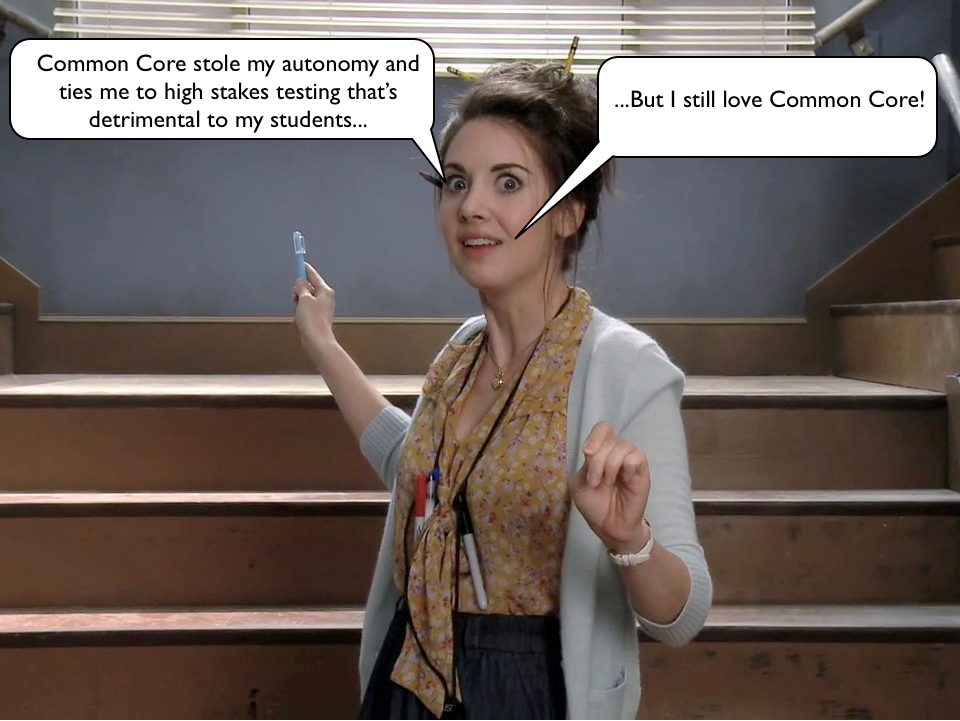
By and large, Common Core wasn’t created by teachers. It was forced on us by policymakers, functionaries and corporations. It usurps our autonomy. It overrides our judgment. And it ties us to practices that almost all of us think are detrimental to our students. But some of us still think it’s the bees knees.

The only explanation I can come up with is Stockholm syndrome. The phenomena, also called capture-bonding, occurs when hostages empathize with their captors. Kidnapping victims sometimes feel sorry for the very people who abducted them. Something similar seems to be happening with the few hardcore supporters of Common Core that are left.

For instance, regardless of the public relations efforts being spewed by corporate America, Common Core was not created by teachers. It’s shocking that this fact is still disputed. It is easily verifiable.

Here it is from the National Governors Associationthese 24 people wrote the first draft of the standards. And these 101 people revised them. None of these people were currently employed as a K-12 classroom teacher. Moreover, very few of them even had K-12 classroom experience at some distant point in their careers. Even less had experience at the middle school or elementary level. Less than that had experience in special education or with English Language Learners.

Therefore saying Common Core was created by teachers is incredibly disingenuous. It’s like taking a single speck from a beef bullion cube and calling it a filet mignon. Something resembling a cow may have been present at one point, but add water and you couldn’t exactly call the flavor beefy.

The overwhelming majority of Common Core authors are identified as working for the testing industry – specifically the College Board and ACT. The second largest group worked for Achieve, a Washington think tank. Others worked exclusively at the college or university level.

Yet there remain a small cadre of real life K-12 teachers who still champion this product. Think about what that means.

They prefer a prepackaged set of academic standards to what they would come up with on their own or with their colleagues. They prefer to give up their own professional judgment based on years of experience, degree certifications and professional development in favor of something handed down to them from the testing corporations and policy wonks. They would rather be told what to do by people with far less experience than to make their own decisions about how to do their own jobs.

Even if everything in the Core was hunky dory, I’d have a problem with that. Call it self-respect. Call it professional pride. I did not get into this field to become anyone’s worker drone. Being a teacher is not on par with being a greeter at Walmart. We need to make complex decisions about how best to educate children every moment of every day. That’s not a mcjob.

This doesn’t mean all the standards contained in the Core are garbage. There are certainly some things in there that promote learning. However, as educators have become more familiar with the contents, glaring mistakes have become apparent – standards that are age inappropriate, too specific, not specific enough, unduly restrictive, and just plain weird. If only there were some objective means of telling the wheat from the chaff.

But there is.

We could have tested the standards to see if they actually aided in comprehension. We could have field tested the product – tried it out in a small scale and then assessed its effectiveness. You would expect any new commodity to go through rigorous research and development. Only a fool would just throw new merchandise out there without any idea if it would work.

Welcome to Fool Nation – population you. That’s where your tax dollars went. Your government spent billions on something completely untried and unproven. And guess what!? It didn’t work.

I have a major problem with that. As a teacher, I am appalled that I am being forced to institute something so careless into my classroom. If the legislature suddenly thought all children should be forced to pour lemon juice on their heads before reading a book, I’d jolly well need a good reason to do it before I started squeezing citrus on top of my classes. But that’s kind of what they did, and they even charged the taxpayers for all the lemons!

However, the strangest part of this whole concern is standardized testing. Here at least we have agreement. Almost everyone says its out of control. We give too many tests. But many teachers go even further questioning these tests effectiveness at all.

High stakes assessments do not promote learning. They narrow the curriculum and punish the neediest students for – in fact – being needy. It’s a proven fact: rich children generally score well and poor children score badly. These are terrible measurements of children’s academic success.

And most folks left on the dwindling bench of Common Core cheerleaders agree! They don’t like testing either! Yet so many times I’ve heard these people say, “I hate the testing but I love the Common Core!”

What!? They’re intimately connected.

Common Core was designed to be assessed by standardized tests. In fact, the standards attempt to make what is taught more representative of what is tested. For instance, most passages on Reading assessments are nonfiction. Therefore, Common Core says most of the reading done in school should be nonfiction. The tests emphasize cold reads. Therefore, the Core says teachers should make their students do more cold reads.

And yet Core advocates only find fault with the tests!? How can you say ‘I don’t like the tests but I like teaching to the tests I don’t like’?

It’s absurd.

And speaking of cognitive dissonance, why are we designing our curriculum backwards from the tests in the first place? Shouldn’t we be designing the tests based on the curriculum? Shouldn’t our assessments be made to prove that students are prepared for real life and not simply that they’re prepared to take the tests?

Bizarrely, all this remains a mystery to the few Common Core standard-bearers left in our classrooms. They want their Common Core. Yes, it was forced on them by bureaucrats. Yes, it’s never been proven to work. Yes, it’s intimately connected to the same standardized testing they hate. But they just can’t get enough of that Core.

Still, don’t be too hard on them. Everyday more of these folks are waking up. Every day more of them discover they are living in The Matrix. Reality is not as it seemed.

Perhaps it will just take more time. Or a strict regime of psychoanalysis, mediation and special pharmaceuticals.

But one day the Common Core will breath its last, and we’ll need everyone to help undo the damage.


NOTE: This article also was published on the Badass Teachers Association blog.