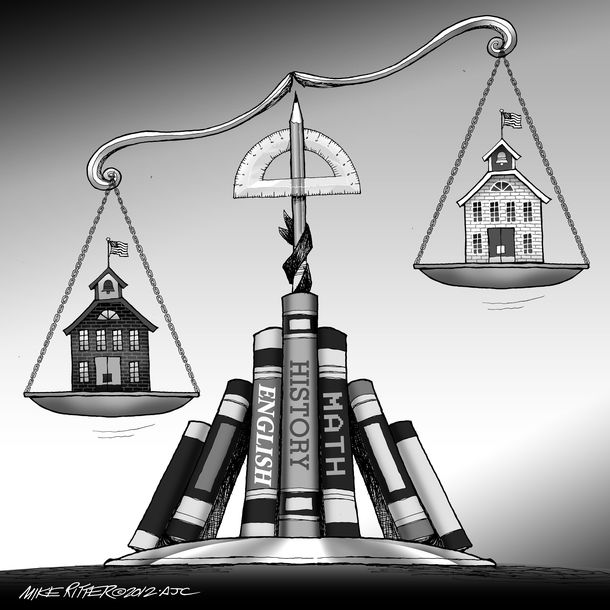
High Stakes Testing Holds The Most Powerful the Least Accountable

 High Stakes Testing Does Not Hold Schools Accountable. It Ensures That Those Most Responsible Escape Accountability


Screen Shot 2016-04-08 at 3.29.21 PM 

People should be accountable for their actions.


If you make a mess, you should have to clean it up. If you decide how things run, you should be responsible if it fails.


So why do we allow those most responsible for our public school system to escape from accountability? Why do we instead blame everything on teachers and students?


Public school policy at the federal, state and local level has been dominated by high stakes testing for the last 15 years. It has not improved educational outcomes for students. In fact, just the opposite. But we are doing NOTHING to change it.


It’s called test and punish. We give students standardized tests and if enough of them fail over time, we close their schools and/or fire their teachers. We force them to move to a new school or a charter school where they continue to struggle without a single additional resource to help them succeed.


No Child Left Behind (NCLB) installed most of these policies in 2001. This year we revised the federal law that governs K-12 schools into the Every Student Succeeds Act (ESSA). It does little more than continue these same policies while rearranging the deck chairs on our sinking system.


Kids aren’t failing because they’re lazy or dumb. Their teachers aren’t shirking their duties. Instead we have a nationwide epidemic of child poverty. And the effects of that lifestyle make it extremely hard to achieve academically. Kids aren’t focused on book learning when they’re physically and emotionally exhausted, experiencing post-traumatic stress and undernourished.


Why has nothing been done to help them?


The answer is accountability.


Not real accountability. Not holding people accountable for things under their control. Not going up to the people and institutions that actually cause the errors and malfeasance. Instead we push all the blame onto teachers and students and call that “Accountability.”


Make no mistake. When politicians and policymakers talk about “accountability” this is what they mean – scapegoating educators and children for things well beyond their control.


An education system is made up of a complex interplay of several interconnected factors that include parents, the community, the economy, culture, media, and local, state and federal governments. Students and teachers are only two such factors.


High stakes testing ensures that ONLY teachers and students are held accountable. They are responsible for the entire education system but have control of very little of it.


For instance, do students and teachers decide how much funding their schools get? No.


Do students and teachers decide which education policies are enacted? No.


So why are they being held responsible for these things?


When schools without adequate funding can’t provide the necessary resources for students to succeed, we pretend like it’s the teachers and students fault. When academic policies handed down by non-educators fail to help kids learn, we pretend like it’s the students and teachers fault.

It’s not.


As New York University Education Professor Pedro Noguera said:


“We’ve designed an accountability system that holds those with the most power the least accountable. The governors are not accountable, the state legislature is not accountable… You can’t hold kids and teachers accountable and not hold the people in control in the first place.”


It’s not a difficult concept – we test the kids and punish the teachers if they fail. And since the focus is firmly on only those two factors, all others become invisible. No one’s holding lawmakers accountable for providing equitable funding. No one’s holding policymakers and think tanks accountable for forcing inadequate and untested Common Core academic standards down our throats. No one’s holding billionaire philanthropists accountable for using our schools as their private playgrounds for whatever social engineering scheme they thought up in the Jacuzzi. No one’s holding privately run charter schools accountable for – just about anything – instead of letting them operate behind a curtain of deniability and unending profit.


This would be impossible without standardized testing. It frames the question. It defines the debate. It assumes that only teachers and students are relevant. Therefore, it ensures that none of the obscured factors will have to do anything to help the system improve. And so it ensures that our education system will fail many of our students – especially those most in need.


This is the irony of modern education policy. The apparatus that allegedly ensures accountability makes that very thing impossible.


That’s how the system is designed. And policymakers are terrified you’ll notice. So they have developed a scapegoat for their own failures – the public school teacher.


Students may score badly – and they’ll have to pay for that when their school is closed or charterized as a result – but it is the teachers who are the true enemy. After all, if teachers did a better job, pundits claim, students wouldn’t fail.


The idea goes like this:


Children won’t learn unless we force teachers to educate them.


Teachers don’t get into that profession because they care about children. They just want an easy job with summers off where they don’t have much to do but collect huge salaries.


This is the great lie, the diversion, smoke and mirrors to get you to stop paying attention to lawmakers, policy wonks, environmental and other factors. Instead look only to those lazy/evil teachers and their satanic labor unions.


THAT’S why they say we need standardized testing!


If we remove the testing, they say, no one will be responsible for making sure kids learn. After all, why would teachers teach unless we threaten their jobs first?


As if teachers can heroically control all the factors involved in student learning. (Spoiler alert: they can’t.) As if teachers get into their profession because they don’t want to practice it. (Spoiler alert: teachers become teachers because they want to teach!) As if earning a middle class income for providing a valuable societal resource were unreasonable. (Spoiler alert: it isn’t.) As if due process meant you can’t be fired for cause. (Spoiler alert: unionized teachers are fired for cause every day.) As if teachers were paid for summers off. (Spoiler alert: they aren’t though some have their salaries earned during 9 months paid out over 12.)


If we really wanted to improve public education, we’d look at ALL the factors involved. We’d throw back the assumptions that have mired us in this quagmire.


And the first assumption that has to go is that standardized testing is a valuable assessment tool.


Standardized tests are terrible assessments. We’ve known that for almost a century. Invariably they narrow the curriculum. They suck up countless hours of class time that could be better spent. They measure more the circumstances kids live in than any academic ability. They’re culturally, racially and economically biased.


But we keep giving them with no end in sight – not because they make teachers do a better job, but because they give cover to those actually responsible for harming our children’s education.


There is such a thing as accountability without standardized tests. It is possible to examine all the factors involved and make changes accordingly.


We can, for instance, make sure all schools receive the same basic services. We can make sure all classrooms are equipped with up-to-date books, materials, desks, etc. We can make sure no schools go without heat, have crumbling infrastructure and/or suffer from infestation of vermin, mold and filth. We can make sure all children have access to healthy food. We can make sure no children are drinking water poisoned with lead.


We can look at parental involvement. An overwhelming amount of research shows this is vital to academic success, but in our poorest neighborhoods parents are often the least involved in their children’s schooling. Why is that? Many of them are working three or more minimum wage jobs just to feed and clothe their children. There’s little time to help with homework when you’re working the night shift. So countermeasures such as raising the minimum wage and increasing the frequency, access and training for well-paying jobs would actually improve education as well as the economy.


We can look at school climate. What are the rates of suspensions and expulsions? What are the root causes? How can we improve student discipline without being overly punitive? How can we increase student engagement? How do we improve student attendance and graduation rates?


We can update our broken system of student assessment. This may come as a surprise to our policymakers, but there are many ways to assess student learning that have nothing to do with standardized tests. For example, we can institute performance or portfolio-based assessments. Instead of evaluating students based on a snapshot of their performance on a given day or week, we can base it on a grading period or even an entire school year. Assessments can include projects, individual and group presentations, reports and papers and portfolios of work collected over time. You don’t have to be an education expert to realize these would be better measurements of academic achievement than multiple choice tests – BUT IT HELPS! And we can do this without resorting to stealth assessments like competency based education.


Does this mean that teachers should escape accountability? Absolutely not. But we can ensure they’re evaluated fairly. Don’t judge them based on factors beyond their control. Judge them based on what they actually do. As the old adage goes, you can bring a horse to water, but you can’t make him drink. Evaluate teachers on whether they’ve brought their little ponies to water. Did they engage in best practices? Are they engaged in professional development? How do they treat their students? Are they grading fairly? In almost every profession, workers are evaluated based on observation from their superiors. Teaching should be no different.


It’s shocking that no one on the national stage is talking about this. Pundits and policymakers shake their heads at standardized test scores, they point their fingers and cry crocodile tears for the children. But hardly anyone is doing a thing to make positive change.


Our schools have been transformed into factories. We’ve let them become resegregated based on race and wealth. We’ve let the rich schools get Cadillac funding while the poor ones struggle to survive on the leftovers. We’ve let non-educators set the standards and curriculum. We’ve let the testing industry co-opt and bribe our lawmakers and social institutions. We’ve opened the door wide for privitizers to steal as much of the shrinking funding pie as possible and funnel it into their own bank accounts without producing any quality for the students they’re supposed to be serving.


In short, we’ve let those responsible for setting our public schools aflame get away scot-free!


They’re laughing all the way to the bank. And the tool that lets them get away with it is standardized testing.


Throw back the curtain and show them for what they truly are.


Fight back. Refuse the tests for your children. Join the Badass Teachers Association, United Opt Out and the Network for Public Education. Write your legislators. Write to the newspapers. Take to the streets. Make some noise.


Hold them accountable.

Standardized Tests Have Always Been About Keeping People in Their Place

 Screen shot 2016-04-04 at 8.25.53 PM


There are some things that can’t be unseen.


America’s history of standardized testing is one of them.


Today, critics from all sides of the political spectrum decry the overuse of high stakes tests while paradoxically championing them for accountability purposes – especially for schools serving minority students.


Civil rights organizations that last year opposed testing have suddenly come to demand itnot because testing ensures racial equity but for fear of losing wealthy donors tied to the assessment industry.


Yet one look at where these tests come from and how they have been used in the past shows their essentially classist and racist natures.


Make no mistake – standardized testing has been a tool of social control for the last century. And it remains one today.


Twisted statistics, made up math, nonexistent or biased research – these are the “scientific” supports for standardized testing. It has never been demonstrated that these kinds of tests can accurately assess either intelligence or knowledge, especially as that knowledge gets more complex. But there is an unspoken agreement in political circles to pretend that testing is rock solid and produces scores that can be relied on to make decisions that will have tremendous effects on the lives of students, teachers, parents and communities.


Our modern assessments are holdovers from the 1910s and ‘20s, an age when psychologists thought they could isolate the racial markers for intelligence and then improve human beings through selective breeding like you might with dogs or cats.


I’m not kidding.


It was called eugenics.


Psychologists like Carl Brigham, Robert Yerkes, and Lewis Terman were trying to find a way to justify the social order. Why is it that certain people are at the top and others at the bottom? What is the best way to decide who belongs where?


To answer these questions they appealed to a radical misreading of Gregor Mendel and Charles Darwin. They thought they had discovered something new about the human brain. Positive traits such as intelligence were widespread in Northwestern European races and almost nonexistent in others. Moreover, negative traits such as laziness and criminality were common in nonwhites and almost absent in those same Northwestern Europeans.


It was really just the same kind of racial prejudices that have been prevalent throughout Europe for centuries, but now American pseudoscientists had found a justification for believing them. In fact, they argued that these deductions weren’t prejudices at all. They were facts based on evidence. It was “science.”


To make such conclusions they had to blind themselves to the effects of wealth and social class. The rich tend to be more well-behaved and educated than the poor. These psychologists took this to mean that the rich were somehow genetically superior. And since the rich were mostly of Northwestern European ancestry, they concluded their genes produced a racially superior type of human. They ignored the fact that a privileged upbringing bestows certain benefits while an impoverished one inflicts life-altering wounds. Ultimately, their “science” was simply a justification for their prejudices.


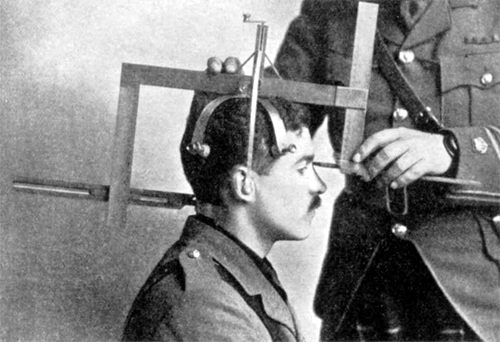
They came to many of these “discoveries” during the First World War. Yerkes developed the U.S. Army Alpha and Beta Intelligence tests that were given to almost all American soldiers. Ostensibly, the assessments were used to determine where soldiers were best suited – support services, the trenches, the officer core, etc.


The rational was to ensure these assignments were being given more fairly and objectively. Before these tests, soldiers were assigned based on wealth and class. Now soldiers were assigned based on tests – that supported the exact same assignments based on wealth and class.


Until this point, I.Q. tests had to be given by one highly trained proctor to one person at a time. Yerkes’ advancement was to put it all on paper so that multiple people could take the tests at once.


However, the tests were deeply flawed. Yerkes claimed they showed a person’s natural intelligence. But the questions were clearly assessing knowledge of facts like a 1900s version of trivial pursuit.


For instance, here is Question 18 of the Alpha Test:
“Velvet Joe appears in advertisements of … (tooth powder)(dry goods)(tobacco)(soap).” The answer is tobacco. How you could know that without having seen period advertisements is beyond me. In any case, it gave good cover for positioning white, affluent men as officers while mostly darker complected and working class soldiers populated the trenches.


After the armistice, Yerkes and Brigham used the wartime test results to continue sorting and ranking Americans. They claimed that their assessments had shown a terrible danger for the human race: nearly half of the white draft (47.3%) was feeble-mind. The cause? Not enough exposure to print advertising? No. They were interbreeding with members of inferior genetic strains.


“No citizen can afford to ignore the menace of race deterioration,” wrote Yerkes in 1922 in the introduction to Brigham’s “A Study of American Intelligence”.


In that same book, one of Brigham’s most seminal, the author was even more specific:


“American education is declining and will proceed… with an accelerating rate as the racial mixture becomes more and more extensive.”


Something had to be done. Pure whites needed to be segregated from mongrel races. But how to do it without being accused of prejudice or bias? How to make it seem like science? Once again, the answer was standardized testing.


Brigham created a civilian test of intelligence that could be used to sort and rank students just as the Army Alpha and Beta tests had been used to sort soldiers. He called it the Scholastic Aptitude Test or S.A.T.


Yes, THAT SAT.


Though the test has been revised multiple times since Brigham created it, the purpose has remained the same – to distinguish the wheat from the chaff, to hold some students up as worthy of further educational investment and to keep others out. Moreover, the means by which the SAT makes this distinction was and remains culturally and economically biased. Researchers have been pointing out since Brigham’s day that the test favors students from wealthy, white backgrounds over those from poor minority homes. Yet today 2.1 million teenagers every year still must take the test to get into the college of their choice.


And so eugenics became education policy throughout the country from primary to post-secondary school.


Terman, who created the Stanford-Binet Intelligence Test to identify “slow” children for special education programs, went on to champion rigid academic tracking for all students in public schools based on standardized testing. The idea was to give the racially pure students extra resources and keep the mixed or lower races in classes more suited to their lower intellects and eventual menial stations in life.


It is sad that many of these ideas persist in our present-day schools. Even today, economically disadvantaged and minority students still make up the majority of remedial and academic classes while the children of the middle class and the wealthy (most of whom incidentally are white) disproportionately populate the honors classes. Today we write that off as merely accidental if we think about it at all. However, a peek at history shows quite clearly that it is exactly how the system has been designed to work.


From there eugenics became the dominant American policy of social organization. It was a required course of study for all education majors at colleges and universities. It was the justification for our isolationist foreign policy allowing thousands of immigrants to be turned away for fear of watering down the U.S. gene pool. Even inside our own borders, tens of thousands of Americans were subjected to mandatory sterilization to ensure degenerate genes were eradicated. In fact, it wasn’t until the end of WWII and the Nuremberg Trials when the eugenicist star began to fade.


We come to a difficult and painful chapter in American history. The word “Nazi” has become an overenthusiastic and easy pejorative for anything that critics wish to vilify. Godwin’s Law states that almost any argument on the Internet will eventually degrade to one side calling the other Adolph Hitler.


He has a point. We should be careful. Too often we wield the sledgehammer of Nazism to smash anything we don’t like. But we can’t let it silence the truth. Sometimes a policy really is Nazism. And if eugenics isn’t, I don’t know what is.


Here it is from Hitler’s Mein Kampf:
“There is today one state in which at least weak beginnings toward a better conception [of immigration] are noticeable. Of course, it is not our model German Republic, but the United States.”


Hitler proudly told his comrades just how closely he followed the progress of the American eugenics movement. “I have studied with great interest,” he told a fellow Nazi, “the laws of several American states concerning prevention of reproduction by people whose progeny would, in all probability, be of no value or be injurious to the racial stock.”


Hitler even wrote a fan letter to American eugenic leader Madison Grant calling his race-based eugenics book, The Passing of the Great Race his “bible.”


And lest we forget the U.S. based Rockefeller Foundation helped found the eugenics program in Germany and even funded the section that Josef Mengele worked in before he went to Auschwitz. By 1926, Rockefeller had donated some $410,000 – almost $4 million in 21st-Century money – to hundreds of German researchers. Without American funds, these programs could not have gotten off the ground.


Nazis even looked to the US Supreme Court for inspiration.
In 1927, the court decided in Buck v. Bell that mandatory sterilization of feeble-minded individuals was, in fact, Constitutional. The ruling, which has never been explicitly overturned, resulted in the forced sterilization of between 60,000 and 70,000 Americans.


Justice Oliver Wendell Holmes wrote, “It is better for all the world, if instead of waiting to execute degenerate offspring for crime, or to let them starve for their imbecility, society can prevent those who are manifestly unfit from continuing their kind…. Three generations of imbeciles are enough.”


The Nazis at the Nuremberg Trials repeatedly quoted Holmes’s words in their own defense.


This is what finally tainted the eugenics brand beyond repair. Psychologists and policymakers didn’t want to be associated with the horrors of the war. They didn’t want any of the blame though they clearly deserved a portion of it. They inspired it.


It took almost two additional decades for these ideas to largely dissipate. It wasn’t until the 1960s and the Civil Rights movement when Americans began to question the social order and the educational system that helped preserve it.


Schools changed. Students were increasingly desegregated both racially and academically. Less emphasis was put on testing and sorting and more on experimentation and self-discovery. Creativity and original thinking were prized above all else. Things weren’t perfect, but we had entered a new era that refused to put children into rigid boxes. They were all unique and valuable and should be treated as such. But it couldn’t last.


Flash forward to 1983. President Ronald Reagan’s National Commission on Excellence in Education put out a report called “A Nation at Risk.” Like the eugenicist work of the ‘10s and ‘20s, it purported to “prove” that our public schools were failing. Something must be done.


The answer was the same as that of the eugenicists. We needed more standardized tests. We needed to return to the practices of sorting and ranking students followed by rigid tracking.


It didn’t matter that “A Nation at Risk” was just as flawed and biased as Brigham’s WWI data.  It didn’t matter that this same policy hadn’t yielded superior academic results in the 1920s, ‘30s. and 40s. It didn’t matter that since we’d put an emphasis on desegregation and creativity, American education was producing unprecedented racial and economic equity. Politically, the only thing to do was return to testing and tracking.


And that’s what we did. It took time. There was opposition. But eventually, we passed No Child Left Behind, which changed the federal role in education from one of ensuring equity to one of rewards and punishment all based on a new generation of flawed and biased standardized testing.


It was a brave new world where all the evils of the past were revisited on our children. And it succeeded – and continues to succeed – because we don’t remember our history. We let policymakers rename the errors of our progenitors and never question their true purpose.


Both Republicans and Democrats have been in control. Both sides blame the other, but left and right wing are both complicit in what remains our national policy.


It is just as racist as that perpetrated by the eugenicists. The major difference is emphasis. In the 1920s, Terman would talk candidly about the racial order. Today, no one mentions it – not openly.


Instead, we get talk about the “racial proficiency gap.” Undeniably poor minority students don’t score as well on standardized tests. Instead of wondering if the problem is the assessments, themselves, we’re pushed to question what teachers and schools are doing wrong.


We wonder why schools serving impoverished students (who are disproportionately brown and black) apparently don’t teach kids as well as schools serving wealthier populations. And anyone who mentions the difference in resources between these schools is quickly silenced. Anyone who mentions the impact of an impoverished upbringing and environment is quickly escorted from the room.


Instead of doing anything to actually help these students, our policy is to close their schools and/or turn them into fly-by-night charter schools.


“We’ve been able to do things – for example, close schools for academic failure. It is hugely difficult, it’s hugely controversial and it’s absolutely the right thing to do,” said former US Education Secretary Arne Duncan.


Imagine if instead of “academic failure” he had said “racial and economic failure.” Because that is what it comes down to. Duncan was decrying low test scores. That’s why these schools were closed. But the test scores aren’t the root cause. That’s poverty. And it disproportionately affects minority students. But you can only see that if you admit the tests are inaccurate assessments of students’ abilities – as countless peer-reviewed academic studies continue to prove.


“I think the best thing that happened to the education system in New Orleans was Hurricane Katrina,” Duncan famously said.


Our highest education official in the country actually praised a natural disaster that killed between 1,200 and 1,800 people (mostly minorities) for destroying their public schools so they could be rebuilt as charters. Did it actually improve children’s academic outcomes? No.


This whole charter school push is another element of our modern educational pseudoscience. These types of schools have never been proven to help kids learn. In fact, the research shows they either do no better or often much worse than traditional public schools. It is an article of faith with our modern education policymakers that schools serving poor minority children should be run by private corporations and schools serving wealthy white students can be allowed to be run by the community.


None of this could happen without the false objectivity of standardized testing.


A hundred years ago, the eugenicists used their test scores to explain away a racist and classist social order. Today we use similarly flawed test scores to justify a similarly prejudicial social order.


Testing remains a way of keeping you in your place.


People are starting to notice. Hence the quick move by the testing industry to co-opt the largest and most well-funded Civil Rights organizations. Hence appointing John King to succeed Duncan as U.S. Secretary of Education – a brown face to silence racial complaints.


Are the people championing standardization and privatization racist? Honestly, I don’t know. I can’t see into their hearts. But it is undeniable that the results of their policies disproportionately hurt our black and brown children. Judging by effect – not necessarily intention – they are racist as well as classist.


Some may be true believers who actually think these policies will help children learn. I’m sure many of the eugenicists of the past felt the same way. Keeping “racially inferior” children in the slow class was purported to be for their own benefit, just as closing poor black schools is said to help them learn.


That’s why I’ve written this and other articles. It is essential that we understand the terrors and errors of past education policy.


If we hadn’t forgotten this dark page of American history, perhaps our children wouldn’t be forced to repeat it.


Blinded by Pseudoscience: Standardized Testing is Modern Day Eugenics


eugenics-testing.jpg


Adolph Hitler was a big fan of standardized testing.


It helped justify much of the horrors of the Nazi regime.


National Socialism is nothing but applied biology,” he said.


In other words, it’s just science, people. Some races are simply inferior to others. Black people, Jews, Gypsies, Hispanics – they just can’t hold a candle to the superior races of Northwestern Europe.


And Hitler based much of this on the “science” of Eugenics, especially the work done in America in the 1910s and ‘20s.


Eugenicists used a flawed and biased interpretation of Gregor Mendel’s laws on heredity to argue that lawlessness, intelligence, and even economic success are passed down in families due to dominant or recessive genes. Moreover, the negative traits are widespread in certain races and the positive ones in others.


Practitioners like Carl Brigham used IQ tests to PROVE white people were just the best and everyone else, well, maybe they should just stop breeding. (In fact, laws were passed in the U.S. imposing mandatory sterilization on thousands based on the conclusions of these “scientists.”)


Brigham was a U.S. Army psychologist who used WWI data to declare that whites (especially those born inside the United States) were the most intelligent of all peoples and that immigrants were genetically inferior. He went on to refine his work into an even better indicator of intelligence the he called the Scholastic Aptitude Test or S.A.T.


Perhaps you’ve heard of it.


In his seminal work, A Study of American Intelligence, Brigham concluded that American education is declining and “will proceed with an accelerating rate as the racial mixture becomes more and more extensive.”


To combat this mixture, eugenicist education reformers encouraged schools to rigidly track students into low, middle and high level classes – similar to the way many of our schools are organized today.


Lewis Terman, Professor of Education at Stanford University and originator of the Stanford-Binet intelligence test, expressed these views in his textbook, The Measurement of Intelligence (1916). He wrote:


“Among laboring men and servant girls there are thousands like them [feebleminded individuals]. They are the world’s “hewers of wood and drawers of water.” And yet, as far as intelligence is concerned, the tests have told the truth. … No amount of school instruction will ever make them intelligent voters or capable voters in the true sense of the word.


… The fact that one meets this type with such frequency among Indians, Mexicans, and negroes suggests quite forcibly that the whole question of racial differences in mental traits will have to be taken up anew and by experimental methods.


Children of this group should be segregated in special classes and be given instruction which is concrete and practical. They cannot master, but they can often be made efficient workers, able to look out for themselves. There is no possibility at present of convincing society that they should not be allowed to reproduce, although from a eugenic point of view they constitute a grave problem because of their unusually prolific breeding” (91-92).


This was the original justification for academic tracking. Terman and other educational psychologists convinced many schools to use high-stakes and culturally-biased tests to place “slow” students into special classes or separate schools while placing more advanced students of European ancestry into the college preparatory courses.


Compare that ideal to the increasingly segregated American schools of today. We have schools for the rich and schools for the poor. We have schools for black and brown kids and schools for whites.


Terman would have been in heaven!


It was the work of patriots like Brigham and Terman that the Nazis relied on heavily to justify their forced sterilization programs and ultimately the Holocaust, itself.


Does that sound extreme? It isn’t.


At the Nuremberg Trials, Nazi scientists repeatedly praised the work of American eugenicists, who uncoincidentally also created the standardized test model of education favored by corporate education reformers today.


It’s easy to follow their logic. If certain races can be scientifically proven to be inferior, it is a small step to thinking that they should be stopped from breeding or eradicated from the face of the planet altogether.


And the pseudo-scientific justification for this scheme was standardized testing. The IQ test – which has since been shown to be incredibly biased – was used to justify mass murder. And then Brigham refined that same test into our most popular current standardized assessment – the SAT. In fact, all standardized tests that students are forced to take today owe a huge debt to the SAT and other standardized assessments used by Terman and other eugenicist educators.


The resemblance between testing in the 1910s and the 2010s is obvious to those who will but look.


Similar to the IQ test, modern standardized exams like the Partnership for Assessment of Readiness for College and Careers (PARCC) repeatedly have been shown to be biased in favor of affluent and white test takers. Supporters bemoan the “racial proficiency gap,” but that’s just a nice way of wondering why the same folks Hitler thought were “inferior” don’t do well on our modern tests.


This is no accident. It’s how the assessments are designed.


The IQ test is supposed to demonstrate an innate intelligence. However, modern psychologists have become increasingly skeptical that intelligence is fixed. So standardized assessments like the SAT are supposed to somehow show BOTH what students have learned AND their innate intelligence. That’s the justification behind the high stakes. You have to pass the SAT to show you’re smart enough to do well in college.


Such outright racism would not be tolerated today, so it becomes cloaked in doublespeak. It’s good that poor black students don’t score well on standardized tests because that shows us they need extra help. And then, instead of providing any help, we close their schools or turn them over to fly-by-night charter operators.


Once again, standardized tests are used as the justification for doing something obviously racist. If anyone said, “We’re going to close and privatize all the schools serving minorities and the poor,” people would revolt. However, when you say we’re doing it because of standardized tests – because of “science” – people just shrug and say, “You can’t argue with that!”


The same goes for Common Core State Standards. States were bribed to enact them so that the reasons for attacking public schools would be uniform across the country. This provides another level of pseudo-scientific justification.


They are supposed to ensure every student who graduates high school will be “college and career ready.” However, now that Common Core has been adopted in 46 states and their tests have become aligned with the standards, we’ve seen student scores take a nosedive. Only our rich white kids apparently are ready for college.


So what will we do with those who fall below the mark? We’re sending no additional resources to help them increase their achievement. We’ll just close their schools and/or privatize. And to make sure none of them escape, we’ll make passing the Common Core tests a graduation requirement.


This does not level the playing field. This does not – as some corporate education reformers claim – ensure the sanctity of students Civil Rights. It extensively violates them!


The education model of Test and Punish is a modern eugenics movement. We’re shellacking over class divides so that those below a certain point have no possibility of ever rising to the white place. And I do mean “white.”


Standardized testing is not a ladder of social mobility. It is a means of keeping certain people in their proper place.


Some try to deny the racial component by pointing to the intersection with class. Testing impacts poor white children as it does poor black ones.


To a degree this is true, but remember our eugenic forerunners saw everything in purely racial terms. For instance, today, few people would claim Judaism is a race. It is a religion. It is essentially a belief system, not a set of shared genes even though some adherents do share genetic characteristics after centuries of segregation. But the Nazis considered them a race and, thus, systematically murdered 6 million of them.


The same goes for the poor. Brigham and his Nazi admirers thought that people were poor mainly because of their genes. They are genetically predisposed to being lazy and good for nothing, so they can’t keep a job or advance themselves. Therefore, they’re poor. Pause for a moment to consider the large numbers of people in America today who would agree with them.


Standardized testing treats the poor the same way it does minorities. In fact, it is just the lack of opportunities that come with poverty that cause the very scores that are being used to denigrate these people. Lack of proper nutrition, food insecurity, lack of prenatal care, early childcare, fewer books in the home, exposure to violence – all of these and more combine to result in lower academic outcomes.


But standardized testing puts the blame on the victim. Students score badly because they aren’t working hard enough, corporate reformers say. These kids don’t have enough “rigor.”


To make sure few people actually volunteer to help, we blame their teachers, as well. We make the education profession as unattractive as possible, indicting teachers for all societies ills knowing full well that this will result – as it has – in a nationwide teacher shortage. Then we can deprofessionalize the field and replace educators who have four-year-degrees with lightly trained Teach for America temps.


These kinds of shenanigans didn’t fool the anti-racists of the past.


The great African American scholar W. E. B. Du Bois remarked in 1940, “It was not until I was long out of school and indeed after the [First] World War that there came the hurried use of the new technique of psychological tests, which were quickly adjusted so as to put black folk absolutely beyond the possibility of civilization.”


He could be talking about No Child Left Behind.


In “Intelligence Tests and Propaganda,” scholar Horace Mann Bond issued a warning about the misuse of IQ tests:


“But so long as any group of men attempts to use these tests as funds of information for the approximation of crude and inaccurate generalizations, so long must we continue to cry “Hold!” To compare the crowded millions of New York’s East Side with the children of Morningside Heights [an upper class neighborhood at the time] indeed involves a great contradiction; and to claim that the results of the tests given to such diverse groups, drawn from such varying strata of the social complex, are in any wise accurate, is to expose a fatuous sense of unfairness and lack of appreciation of the great environmental factors of modern urban life.”


He could be talking about Race to the Top.


Karen Lewis, a present-day Chicago teacher and president of her union, says this:


“What many people do not know is that the use of standardized tests has its origins in the Eugenics movement …we have to be clear about the original purpose of standardized tests.


In a society fascinated by statistics, we are often compelled to reduce everything to a single number. Those of us who work with children know that there are so many characteristics that cannot be quantified.


Ask yourselves whether you want to be part of a legacy born of the unholy alliance between the concept of  “natural inequality” and the drudgery that has been imposed on many of our classrooms.”


Make no mistake. Corporate Education Reform is modern day eugenics. It pretends to justify increasing standardization and privatization of public schools through flawed and biased assessments. Its claims that any of this is actually supported by research are spurious. At heart, these are articles of faith – not science. Neither Common Core nor high stakes testing nor charterizing impoverished schools nor putting districts into receivership nor evaluating teachers based on student test scores – none of it has ever been shown in peer-reviewed studies to help students learn.


Corporate Education Reformers are asking all of us to have faith in a racial and economic social order that benefits those already at the top and keeps the rest of us in our place.


And for anyone who questions it, we are continually blinded by their pseudoscientific justifications.

Judging the Judge: What Antonin Scalia’s Death Means to the People I Love

antonin-scalia-26

I am not sad Antonin Scalia is dead.

Wow! It feels so good to say that out loud!

Come on. Admit it. You probably feel the same way.

I know. I know. Everywhere you turn, people are going out of their way to talk about the ramifications of the 79-year-old Supreme Court Justice’s death without passing judgement on him.

“Let’s keep it classy,” they say.

Oh. Stop it.

In his 30 years on the bench, Scalia hurt an awful lot of people. And I mean real, live people – not ideological constructs, not hypotheticals – but moms, dads, husbands, wives, daughters, and sons.

The aggregate amount of misery in the world was drastically increased by his being in it. And now that he’s gone, much of that misery may be relieved.

So please curb any shock you may feel at my thesis. And spare me the false praise of a truly reprehensible human being.

He was against women controlling their own bodies, efforts to desegregate our schools, an individual’s right to love whomever they choose, refraining from executing mentally disabled or teenage prisoners. Heck! He was even against police reading suspects their Miranda Rights!

This was a person who said black people should go to “slower” colleges, homosexuality was the same as murder or bestiality, sex discrimination is constitutional, and maybe we have a right to all carry around rocket launchers in public.

If it is outrageous to feel relief at the death of this man, you may call me outrageous.

I’m not usually the kind of person who celebrates someone else’s death. Not even a famous person.

But you have to admit that the people we love are a lot better off without Scalia in the world.

It’s not like he kept all this to himself. He wasn’t some lone drunkard in the back of the bar mumbling sexist, racist views. He wasn’t your ancient uncle who you only see twice a year making people uncomfortable at the dinner table. He was a judge in the highest court in the land, and his demented and warped world view drove public policy impacting… well… everyone.

He was the deciding vote in several 5-4 decisions that – if they had gone differently – would have greatly benefited every person in this country.

You can thank him for the Presidency of George W. Bush and Citizens United. Let that sink in for a moment.

Imagine all the horrific blunders of the Bush Presidency – easily the worst administration in my lifetime. If the Supreme Court hadn’t given the highest office in the land to Dubya, arguably we wouldn’t have had the Irag War, the Great Recession, No Child Left Behind, the slow response to Hurricane Katrina – maybe even 9-11.

And if you hate what our elections have become, imagine if we didn’t have the Citizens United verdict. Campaign donations would have to be made in public with some limits on how much individuals and corporations can contribute.

How much better the world would have been without these terrible decisions!

I’m not saying Scalia wasn’t a good man in his personal life. I have no idea what he was like to the people he loved. For all I know he may have been a good friend, a loving husband, father and grandfather. He probably had people he cared about and who cared about him. And to those people I send my condolences.

However, he did great harm to just about everyone else. And for that I feel nothing but relief at his death.

Who am I to bask in such schadenfreude?

I am a father and public school teacher.

I have a seven-year-old daughter and several classes full of mostly impoverished and minority students.

And Scalia’s death is good for everyone I care about.

If he were still alive, there was so much more damage he could have done. Take the Friedrichs case, an important one for teachers like me.

The case is an attempt to strip teachers unions of the right to charge members for their services. If the court rules in favor of Friedrichs, it would overturn decades of established law against free riders. People would be allowed to be in a union, enjoy higher salary and benefits negotiated by that union, but not pay dues. It would be absurd. Yet with Scalia still on the bench, most court watchers seem to think we would have had another terrible 5-4 decision.

However, with Scalia’s death, the best anti-union forces would probably receive is a 4-4 decision – not enough to overturn established law. True the case has already been heard by the justices, but a ruling has not yet been handed down. According to the Supreme Court blog, even if Scalia had already written a ruling on this matter, it would be void. Any rulings he wrote that have not yet been made public don’t count.

So the most likely outcome now is that millions of people will continue to be protected from unfair labor practices. And you expect me not to have a big ‘ol smile on my face!?

So where do we go from here?

President Barack Obama will select who is to succeed Scalia. Numerous excellent choices have been floated. If Obama chooses any one of them, he would probably tilt the court fractionally to the left.

Before the body was even cold, Republicans vowed to block any nominee Obama makes until the next President is sworn in. Some are trying out the talking point that Supreme Court Justices have never been sworn in during an election year. But if that were true, we wouldn’t have Justice Anthony Kennedy who was confirmed during the last year of Reagan’s presidency.

Funny. The U.S. Constitution clearly states that the President has the right to nominate Supreme Court Justices with the advice of Congress. Yet so many of these right leaning partisans who considered themselves Constitutionalists last week suddenly find themselves against that revered document today.

I wonder how Scalia would have argued such a situation.

Not really. He was the one who taught the rest of his party how to twist the words of the founding fathers to mean whatever the far right favors this week.

Obama still has more than 300 days in office. If Republicans try to block his nomination until a new face tops the Executive, it would be the longest such obstruction in a century. Of sitting justices, the longest confirmation period was for Clarence Thomas who took 106 days to be approved by Congress.

And that brings us to the 2016 Presidential race.

Scalia’s death is likely to have a huge impact on whom becomes our next President.

If Republicans block Obama’s Supreme Court nominee, it would probably increase voter turnout. Whenever that happens, it favors Democrats since they have more registered members than the GOP.

Either way, Scalia’s death is probably beneficial to whomever the Democratic nominee will be. If either Hillary Clinton or Bernie Sanders get the nomination, supporters of the defeated candidate are more likely to support the reigning Democrat.

Even if voters don’t like the winner’s policies as much as their preferred candidate, they’re likely to support the nominee in order to continue tipping the Supreme Court to the left. After all, three additional justices are 70 or older. Stephen Breyer is 77, Anthony Kennedy is 79, and Ruth Bader Ginsburg is 82.

We have had a long haul these last 15 years. Much social progress has been stalled.

But now that Scalia is out of the picture, the future looks bright.

Maybe things really will turn out alright. Maybe we’ll actually have a chance to build that better world we’ve all been dreaming about.

Rest in Peace, Scalia. The nation can’t wait to move on without you.

What Antonin Scalia’s Death Means to the People I Love

antonin-scalia-26

I’m not sad Antonin Scalia is dead.

Wow! It feels so good to say that aloud!

Come on. Admit it. You feel exactly the same way.

I know. I know. Everywhere you turn, people are going out of their way to talk about the ramifications of the 79-year-old Supreme Court Justice’s death without passing judgement on him.

“Let’s keep it classy,” they say.

Oh. Stop it.

In his 30 years on the bench, Scalia hurt an awful lot of people. And I mean real, live people – not ideological constructs, not hypotheticals – but moms, dads, husbands, wives, daughters, and sons.

The aggregate amount of misery in the world was drastically increased by his being in it. And now that he’s gone, much of that misery may be relieved.

So spare me any shock at my thesis. Spare me the false praise of a truly reprehensible human being.

He was against women controlling their own bodies, efforts to desegregate our schools, an individual’s right to love whomever they choose, refraining from executing mentally disabled or teenage prisoners. Heck! He was even against police reading suspects their Miranda Rights!

This was a person who said black people should go to “slower” colleges, homosexuality was the same as murder or bestiality, sex discrimination is constitutional, and maybe we have a right to all carry around rocket launchers in public.

If it is outrageous to feel relief at the death of this man, you may call me outrageous.

I’m not usually the kind of person who celebrates someone else’s death. Not even a famous person.

But you have to admit that the people we love are a lot better off without Scalia in the world.

It’s not like he kept all this to himself. He wasn’t some lone drunkard in the back of the bar mumbling sexist, racist views. He wasn’t your ancient uncle who you only see twice a year making people uncomfortable at the dinner table. He was a judge in the highest court in the land, and his demented and warped world view drove public policy impacting… well… everyone.

He was the deciding vote in several 5-4 decisions that – if they had gone differently – would have greatly benefited every person in this country.

You can thank him for the Presidency of George W. Bush and Citizens United. Let that sink in for a moment.

Imagine all the horrific blunders of the Bush Presidency – easily the worst administration in my lifetime. If the Supreme Court hadn’t given the highest office in the land to Dubya, arguably we wouldn’t have had the Iraq War, the Great Recession, No Child Left Behind, the slow response to Hurricane Katrina – maybe even 9-11.

And if you hate what our elections have become, imagine if we didn’t have the Citizens United verdict. Campaign donations would have to be made in public with some limits on how much individuals and corporations can contribute.

How much better the world would have been without these terrible decisions!

I’m not saying Scalia wasn’t a good man in his personal life. I have no idea what he was like to the people he loved. For all I know he may have been a good friend, a loving husband, father and grandfather. He probably had people he cared about and who cared about him. And to those people I send my condolences.

However, he royally screwed just about everyone else. And for that I feel nothing but relief at his death. If only it had come sooner.

Who am I to bask in such schadenfreude?

I am a father and public school teacher.

I have a seven-year-old daughter and several classes full of mostly impoverished and minority students.

And Scalia’s death is good for everyone I care about.

If he were still alive, there was so much more damage he could have done. Take the Friedrichs case, an important one for teachers like me.

The case is an attempt to strip teachers unions of the right to charge members for their services. If the court rules in favor of Friedrichs, it would overturn decades of established law against free riders. People would be allowed to be in a union, enjoy higher salary and benefits negotiated by that union, but not pay dues. It would be absurd. Yet with Scalia still on the bench, most court watchers seem to think we would have had another terrible 5-4 decision.

However, with Scalia’s death, the best anti-union forces would probably receive is a 4-4 decision – not enough to overturn established law. True the case has already been heard by the justices, but a ruling has not yet been handed down. According to the Supreme Court blog, even if Scalia had already written a ruling on this matter, it would be void. Any rulings he wrote that have not yet been made public don’t count.

So the most likely outcome now is that millions of people will continue to be protected from unfair labor practices. And you expect me not to have a big ‘ol smile on my face!?

So where do we go from here?

President Barack Obama will select who is to succeed Scalia. Numerous excellent choices have been floated. If Obama chooses any one of them, he would probably tilt the court fractionally to the left.

Before the body was even cold, Republicans vowed to block any nominee Obama makes until the next President is sworn in. Some are trying out the talking point that Supreme Court Justices have never been sworn in during an election year. But if that were true, we wouldn’t have Justice Anthony Kennedy who was confirmed during the last year of Reagan’s presidency.

Funny. The U.S. Constitution clearly states that the President has the right to nominate Supreme Court Justices with the advice of Congress. Yet so many of these right leaning partisans who considered themselves Constitutionalists last week suddenly find themselves against that revered document today.

I wonder how Scalia would have argued such a situation.

Not really. He was the one who taught the rest of his party how to twist the words of the founding fathers to mean whatever the far right favors this week.

Obama still has more than 300 days in office. If Republicans try to block his nomination until a new face tops the Executive, it would be the longest such obstruction in a century. Of sitting justices, the longest confirmation period was for Clarence Thomas who took 106 days to be approved by Congress.

And that brings us to the 2016 Presidential race.

Scalia’s death is likely to have a huge impact on whom becomes our next President.

If Republicans block Obama’s Supreme Court nominee, it would probably increase voter turnout. Whenever that happens, it favors Democrats since they have more registered members than the GOP.

Either way, Scalia’s death is probably beneficial to whomever the Democratic nominee will be. If either Hillary Clinton or Bernie Sanders get the nomination, supporters of the defeated candidate are more likely to support the reigning Democrat.

Even if voters don’t like the winner’s policies as much as their preferred candidate, they’re likely to support the nominee in order to continue tipping the Supreme Court to the left. After all, three additional justices are 70 or older. Stephen Breyer is 77, Anthony Kennedy is 79, and Ruth Bader Ginsburg is 82.

We have had a long haul these last 15 years. Much social progress has been stalled.

But now that Scalia is out of the picture, the future looks bright.

Maybe things really will turn out alright. Maybe we’ll actually have a chance to build that better world we’ve all been dreaming about.

Rest in Peace, Scalia. The nation can’t wait to move on without you.

Most Charter Schools are Public Schools in Name ONLY

charterart

Charter schools are public schools.

But are they?

Really?

They don’t look like a duck. They don’t quack like a duck. Do you really want to serve them confit with a nice orange sauce?

Sure, charters are funded by tax dollars. However, that’s usually where the similarities end.

They don’t teach like public schools, they don’t spend their money like public schools, they don’t treat students or parents like public schools – in fact, that’s the very reason they exist – to be as unlike public schools as possible.

Advocates claim charters exist as laboratory schools. They are free to experiment and find new, better ways of doing things. Once they’ve proven their successes, these improved practices will eventually trickle down to our more traditional houses of learning.

At least, that’s the ideal behind them. But to my knowledge it’s never happened.

As a public school teacher, I can never recall being at a training where charter operators taught us how to do things better with these time-tested strategies. I do, however, recall watching excellent co-workers furloughed because my district had to meet the rising costs of payments to our local charters.

Moreover, if the freedom to experiment is so important, why not give that privilege to all public schools, not just a subset?

The reality is much different than the ideal. In the overwhelming majority of cases, charter schools are vastly inferior to their more traditional brethren. To understand why, we need to see the differences between these two kinds of learning institutions and why in every case the advantage goes to our much-maligned, long suffering traditional public schools:

1) Charters Don’t Accept all Students

Charter schools are choosey. They don’t take just any old students. They only accept the ones they want. And the ones they want are usually easy and less expensive to teach.

The process is called “Creaming” because they only pick the cream of the crop. Then when these students who are already doing well continue to do well at a charter, the administrators take all the credit. It’s as if they were saying – Look how well we teach. All these former A-students continue to get A’s here at our school. It’s really quite an achievement. (Not.)

However, sometimes the bait-and-switch isn’t so obvious. Occasionally, charters actually do accept special needs and/or difficult students – for a few months. Then when the big standardized test is coming up, they quietly give these kids the boot. That way they can claim they accept everyone but still get excellent standardized test scores.

Ironically, that’s what they mean by “School Choice.” It’s usually touted as a way of giving alternatives to parents and students. In reality, the choice only goes to administrators. Not “Which school do YOU want to attend?” but “Which students do WE want to accept to make our charter look good?”

Keep in mind, this situation is allowed by law. Charters are legally permitted to discriminate against whichever students they want.

By contrast, traditional public schools accept all students who live within the district. It doesn’t matter if children have special needs and therefore cost more to educate. If a child lives within district boarders, your neighborhood public school will take him or her in and provide the best experience possible.

Bean counters complain about poor test scores, but traditional public schools aren’t gaming the system. They aren’t weeding out difficult students. They take everyone. Administrators have no choice. This is dictated by law. Public schools are equal opportunity educators.

2) Charters Have No Transparency

Have you ever been to a school board meeting? Ever listened to school directors debate the merits of one course of action versus another? Ever looked over public documents detailing district finances and how money is spent? Ever read over bids vendors provide for services? Ever spoken at a public meeting to school directors about what you think is the best way to proceed in a given situation? Ever had a school director or two disappoint and then worked to vote him or her out of office?

At traditional public schools, you can do all of this – even if you don’t have any children in the school system! At a charter school, you’re out of luck.

Charters rarely have to tell you how they spend their money, rarely debate management decisions in public, rarely invite or even permit you a seat in the audience. Heck! They don’t have to!

Charters survive on public money, but once that money goes in those charter doors, the public never sees it again. If you don’t like how the charter is treating your child, you can remove the little dear from the school. But if a non-parent doesn’t like how they suspect the charter is spending his or her tax money, there is absolutely no recourse. You are taxed without any representation. Wars have been fought over such things. It’s hard to imagine how that can be Constitutional.

In sum, traditional public schools are like most other government organizations. They are required by law to be transparent to the public. Charter schools, however, are money pits and what goes down those gaping holes is lost forever from public view.

3) Charters Advertise

Have you ever seen those huge billboards by the side of the road trying to convince motorists to send their children to a charter chain? Ever hear a radio advertisement about how happy little kiddos are at Brand X Charter School?

Those advertisements cost money. Your money, to be exact. You paid for those commercials. And what’s more, every penny spent on those glossy advertisements is one less that actually goes to educate your child.

By contrast, traditional public schools are not allowed to advertise. All their budget dollars have to be spent on things broadly educational. They have to spend on books, teachers, building upkeep, etc.

Not only are charters allowed to keep quiet about how they spend their money, even if they told you, it doesn’t all have to be spent on the children in their care. What could possibly go wrong with that?

4) Charters Defraud the Public

Despite all their best efforts at secrecy, charter school operators have been caught in countless financial scandals in recent years. According to Integrity in Education$200 million in taxpayer money was lost, misused, or wasted in just 15 of the 42 states that have charter schools.

These aren’t mere allegations. These abuses are well documented. The report states: “Charter operators have used school funds illegally to buy personal luxuries for themselves, support their other businesses, and more.”

Mountains of evidence demonstrate fraud throughout the country: Schoolchildren defrauded in Pennsylvania; “out-of-control” charters in Michigan and Florida; rampant misspending in Ohio; bribes and kickbacks, also in Ohio; revenues directed to a for-profit company in Buffalo, NY; subpoenas for mismanaged charters in Connecticut. Heck! In California alone, $100 million in fraud losses were expected just last year.

And that’s just the fraud we can see!

I’m not saying our traditional public schools are scandal free, but nothing like this level of malfeasance has been revealed. Traditional schools are under much stricter regulations. People are actually watching to make sure nothing like these charter scandals happen at our time-tested neighborhood schools. They are much better value for your money.

5) Charters Often Get Worse Results

It all comes down to teaching and learning. When we compare the results at charters versus traditional public schools, who does better?

Bottom line: the research shows that the overwhelming majority of charter schools are no better – and often much worse than traditional public schools. This is true even of studies backed by the charter school industry, itself!

For example, a recent study by charter-friendly CREDO found that in comparison to traditional public schools “students in Ohio charter schools perform worse in both reading and mathematics.”

In a study of Chicago’s public schools, the University of Minnesota Law School found that “Sadly the charter schools, which on average score lower that the Chicago public schools, have not improved the Chicago school system, but perhaps made it even weaker.”

Another report from Data First – part of the Center for Public Education – says, “the majority of charter schools do no better or worse than traditional public schools.”

However, there is plenty of evidence of charter schools producing dismal academic results for students. For instance, a Brookings report showed low performance in Arizona’s charter schools. A District of Columbia researcher for In the Public Interest group, “could not provide a single instance in which its strategy of transferring a low-performing school to a charter management organization had resulted in academic gains for the students.” The Minnesota Star Tribune reported that “Students in most Minnesota charter schools are failing to hit learning targets and are not achieving adequate academic growth.” Over 85 percent of Ohio’s charter students were in schools graded D or F in 2012–2013. In the celebrated New Orleans charter experiment, the Investigative Fund found that “eight years after Hurricane Katrina…seventy-nine percent of RSD charters are still rated D or F by the Louisiana Department of Education.”

That’s not exactly a record of success!

Meanwhile, our traditional public schools often do a much better job.

The National Assessment of Educational Progress (NAEP) reports that U.S. math and reading skills have improved for all levels of public school students since the 1970s, with the greatest gains among minority and disadvantaged students. Other results indicate that our schools achieve even greater success when properly funded.

The facts seem pretty clear. Charter schools are not like traditional public schools at all.

Most charter schools are a losing prospect for our children and our Democracy. Yet well-funded corporate lobbying interests continue to push charters as a public policy solution while instigating the closure of an increasing number of traditional public schools.

This is like closing hospitals and opening clinics on the power of crystals, snake oil and phrenology.

We need a national moratorium on new charter schools. We need to investigate every existent charter to determine if each are providing a quality service to students and not just the charter’s corporate share holders.

We know what works, and it isn’t charter schools. Support your friendly, neighborhood, traditional public school.

Unions Can’t Just Be About What We’re Allowed to Do: Social Justice Unionism

7983807401_6b0075f742_b.sm_a

If labor unions were an animal, they’d be an old hound dog napping on the porch.

They’re slow to get up and chase away burglars but they do like to howl at night.

Most of the time you don’t even know they’re around until the dinner bell rings. Then that ancient mutt is first to bolt into the kitchen to find a place at the table.

It’s kind of sad really. That faithful old dog used to be really something in his youth.

He was fierce! He’d bark at trespassers even tearing them apart if they threatened his patch of land.

Old Uncle Sam used to yell at him and even threaten the pooch with a rolled up newspaper, but that dog didn’t care. He had a sense of right and wrong, and he didn’t mind getting into deep trouble fighting for what he thought was fair.

Today, however, the only thing that really riles him is if you threaten to take away his ratty old bone.

Let’s face it. Unions have become kind of tame. They’re housebroken and not much of a threat to those people waiting in the shadows to rob us blind.

Some people say we’d be better off without them. But I don’t agree. Even a decrepit canine can act as a deterrent, and thieves sure are frightened of dogs.

Think about all unions have given us: the weekend, child labor laws, vacation time, pensions, lunch breaks, healthcare, the 8-hour day, maternity leave, safety measures, due process, sick leave and free speech protections on the job!

They didn’t get us all that by sitting politely at the table with their hands crossed. They didn’t do all that by contributing modest sums to political campaigns. They didn’t do it by obsessively protecting collective bargaining at the expense of all else.

Unions used to take to the streets. They took over the job site. They marched with signs and placards. They exercised people power.

And the government was scared of them. The President called out the army to get them back to work. Lawmakers hired mercenaries to break strikes with clubs and guns. But eventually Congress passed laws to placate them.

Unfortunately, That was a long time ago.

For decades the pendulum has been swinging against us. Federal and state laws have become increasingly restrictive. They want to tell us when we can strike and how long. They want to tell us when and if we can collect dues. And – frankly – they want to tell us to just disperse and do whatever the bosses want – because the business class has already bought and paid for our politicians.

For decades we’ve heard to their propaganda on TV, the radio and the print media. Well-paid shills have poured their poison in our ears about the evils of the labor movement. They’ve spoken these lies so often lots of people believe them.

Workers used to fight to make sure everyone got a fair deal. Now the working man has been brainwashed to focus instead on making sure no one else gets more than him. And the bosses are laughing all the way to the bank.

Union membership is at the lowest it’s been in a century. So are wages adjusted for inflation. A family of four used to be able to get by comfortably on one salary. Now it can barely make ends meet with two.

Yes. There’s no doubt about it. We need unions today more than ever.

But for unions to survive, they must change. They have to become a reflection of the membership and not just of the leaders.

During this presidential election cycle, we’ve seen our largest national unions – the National Education Association (NEA) and American Federation of Teachers (AFT) endorsing a candidate without bothering to actively poll their members. We’ve seen them speak for us on policy decisions without asking our opinions. We’ve seen them act just like the corrupt politicians who we should be fighting against.

Yes, it is time for a change. No longer can our unions be run from the top down. They must be run from the bottom up. They shouldn’t tell us what to do. We, the membership, should be giving orders to them.

Moreover, we need to stop obsessing about collective bargaining. I’m not saying that’s unimportant. But it can’t be the only thing we do.

Our unions used to be in the midst of larger social movements. We were part of the Civil Rights movement. We were part of the push for desegragation. We were part of the fight to protect children and provide them a decent education.

We need to continue that today. And in some places we are already doing that! Look to Chicago, Detroit and Philadelphia. Teachers unions in those urban areas are fighting not just for better pay and benefits but for the communities they serve. Detroit teachers en mass are calling off sick to protest horrible conditions in the schools. Chicago teachers are marching in the streets with the community to demand indictments for police murdering their black and brown students. Philadelphia teachers are supporting students who walk out of class to protest state disinvestment and toxic testing.

THIS is what unions should be doing. We should be fighting for social justice. We should be a central part of the struggle to turn the tide against corporatization, privatization and standardization of our country’s public goods. We should be marching hand-in-hand with BlackLivesMatter activists. We should be in the front lines of the fight to save our environment and replace fossil fuels with renewable energy.

We must be part of the community and not apart from it. We must share in the struggles and goals of those we serve. We must be an example of the old truism that a rising tide raises all ships. After all, the word “union” literally means together. By definition we must all be in this together or else we’re not even really a union.

And to do this we have to stop being so concerned with what they tell us we can do.

We live in a democratic society. The government gets its power from us, from our consent. That means that if there are enough of us, we trump their corrupt laws. They only get to make those laws because we say so. And court decisions – even Supreme Court decisions – mean nothing next to the court of public opinion.

The bosses buy the politicians and tell them to legislate us into a box. It’s time to break out of that box. We can’t be afraid to take our power back. We shouldn’t be afraid of our government. Our government should be afraid of us.

How do we do it? Organize.

If you belong to a union, roll up your sleeves and get active. Run for office. Convince like-minded folks to join you. Take over your local. Spread to your national.

If you don’t belong to a union, start one at your job. Talk to your co-workers. Talk about the benefits for each of you and your neighborhoods. Fight for your rights.

I know. It’s a whole lot easier to complain. Real change, though, takes real work.

We used to know these things. Somewhere along the line we forgot.

So wake up, you yeller cur dog, and get off the porch. Take to the streets.

Because the surest way to take back our country is to take back our unions.

Top 10 Reasons School Choice is No Choice

LittleKidThumbsDown

On the surface of it, school choice sounds like a great idea.

Parents will get to shop for schools and pick the one that best suits their children.

Oh! Look, Honey! This one has an exceptional music program! That one excels in math and science! The drama program at this one is first in the state!

But that’s not at all what school choice actually is.

In reality, it’s just a scam to make private schools cheaper for rich people, further erode the public school system and allow for-profit corporations to gobble up education dollars meant to help children succeed.

Here’s why:

1) Voucher programs almost never provide students with full tuition.

Voucher programs are all the rage especially among conservatives. Legislation has been proposed throughout the country taking a portion of tax dollars that would normally go to a public school and allowing parents to put it toward tuition at a private or parochial school. However, the cost of going to these schools is much higher than going to public schools. So even with your tax dollars in hand, you don’t have the money to go to these schools. For the majority of impoverished students attending public schools, vouchers don’t help. Parents still have to find more money somewhere to make this happen. Poor folks just can’t afford it. But rich folks can so let’s reduce their bill!? They thank you for letting them buy another Ferrari with money that should have gone to give poor and middle class kids get an education.

2) Charter and voucher schools don’t have to accept everyone

When you choose to go to one of these schools, they don’t have to choose to accept you. In fact, the choice is really all up to them. Does your child make good grades? Is he or she well-behaved, in the special education program, learning disabled, etc.? If they don’t like your answers, they won’t accept you. They have all the power. It has nothing to do with providing a good education for your child. It’s all about whether your child will make them look good. By contrast, public schools take everyone and often achieve amazing results with the resources they have.

3) Charter Schools are notorious for kicking out hard to teach students

Charter schools like to tout how well they help kids learn. But they also like to brag that they accept diverse students. So they end up accepting lots of children with special needs at the beginning of the year and then giving them the boot before standardized test season. That way, these students’ low scores won’t count against the charter school’s record. They can keep bragging about their high test scores without actually having to expend all the time and energy of actually teaching difficult students. Only public schools take everyone and give everyone their all.

4) Voucher and charter schools actually give parents less choice than traditional public schools

Public schools are governed by different rules than charter and voucher schools. Most public schools are run by a school board made up of duly-elected members from the community. The school board is accountable to that community. Residents have the right to be present at votes and debates, have a right to access public documents about how tax money is being spent, etc. None of this is true at most charter or voucher schools. They are run by executive boards or committees that are not accountable to parents. If you don’t like what your public school is doing, you can organize, vote for new leadership or even take a leadership role, yourself. If you don’t like what your charter or voucher school is doing, your only choice is to withdraw your child. See ya.

5) Charter Schools do no better and often much worse than traditional public schools

Pundits and profiteers love to spout euphoric about how well charter schools teach kids. But there is zero evidence behind it. That is nothing but a marketing ploy. It’s like when you’re in a bad neighborhood and walk past a dive that claims to have the best cup of coffee in the city. Yuck. Surely, some charter schools do exceptionally well. However, most charters and almost all cyber charters do worse than their public school counterparts. Fact.

6) Charters and voucher schools increase segregation

Since the 1950s and ’60s, we used to understand there was no such thing as separate but equal education. Before then we had Cadillac schools for white kids and broken down schools for black kids. The Supreme Court ruled that unconstitutional. But today we have Cadillac schools for rich and middle class kids (most of whom are white) and broken down schools for the poor (most of whom are black or brown.) After making tremendous strides to integrate schools and provide an excellent education for everyone, our public schools have been resegregated. Charter and voucher schools only make this problem worse. They either aid in white flight or leach away minority students. This just makes it easier to give some kids a leg up while keeping others down.

7) Charter and voucher schools take away funding at traditional public schools

It costs almost the same amount of money to run a school building of a given size regardless of the number of kids in it. When students leave the public schools for charter or voucher schools, the public school loses valuable resources. It now has less revenue but the same overhead. So even if you found an excellent charter or voucher school to send your child, you would be hurting the chances of every other student in the public school of having their own excellent education. This is what happens when you make schools compete for resources. Someone ends up losing out on an education.

8) Properly funding parallel school systems would be incredibly wasteful and expensive

We could fix this problem by providing adequate funding for all levels of the school system – traditional public schools, charters, voucher schools, etc. However, this would be exorbitantly expensive. We don’t adequately fund our schools now. Adding additional layers like this would mean increasing national spending exponentially – maybe by three or four times the current level. And much of that money would go to waste. Why have three fully stocked school buildings in one community when one fully stocked building would do the job? I don’t imagine residents would relish the tax hike this would require.

9) School choice takes away attention from the real problems in our public schools – poverty and funding equity

We have real problems. More than half of public school students live below the poverty line. They are already several grade levels behind their non-impoverished peers before they even enter kindergarten. They need help – tutoring, counseling, wraparound services, nutrition, etc. The predicament is even more complicated by the way we fund our schools. Throughout the country, poor districts get less money than wealthy or middle class ones. The students who go to these schools are systematically being cheated out of resources and opportunities. And instead of helping them, we’re playing a shell game with charter and voucher schools. The problem isn’t that parents don’t have several excellent choices. If they’re poor, they often don’t have one.

10) School choice is not supported by a grass roots movement. It is supported by billionaires.

The proponents of school choice will tell you that they are only doing the will of the people. This is what parents want, they say. Baloney. While there are individuals who support school choice, the overwhelming majority of money behind this movement comes from conservative billionaires actively trying to dismantle the public education system. They want to steal the public system and replace it with a private one. They don’t care about your child. They just want to steal the hundreds of billions of tax dollars we pay to educate our children. This is not philanthropy. It is a business transaction meant to screw you and your child out of your rights.

If we really want to ensure every child in this country gets an excellent education, the answer isn’t school choice. Instead, we need to commit to supporting our public school system. We all need to be in this together. Yes, our schools should look at the needs of each child and tailor education to fit appropriately. But that shouldn’t be done in parallel school systems. It should be done under the same umbrella. That way, you can’t defund and defraud one without hurting all. It can’t just be about your child. It has to be about all children.

That’s the only choice worth making.


NOTE: This article was given a shout out on Diane Ravitch’s blog and published on the Badass Teachers Association blog.


High Stakes Testing Doesn’t Protect Civil Rights – It Violates Them

martin-luther-king-jr-small

“Daddy, I know who that is!”

“Who is it?”

“That’s Martin Luther King.”

“That’s right, Baby! Who was he?”

“We saw a movie about him today in school. He had a dream.”

Thus began a fascinating conversation I had with my seven-year-old daughter a few days ago.

I had been going through her book bag and found a picture of Dr. King blazoned above an article about his life.

“He wanted everyone to be nice to each other,” she said.

I laughed. My first grade scholar isn’t that far off.

“He’s one of my heroes,” I said. “He means a lot to me.”

“That’s silly,” she said. “He doesn’t have any super powers.”

Before I could reply, her attention shifted to her stuffed Yoshi doll. She began to play.

One of the best things about being a parent is getting to see the world anew through the eyes of your children. My little girl offers me this vantage point everyday.

Dr. King can’t be a hero. He had no super powers.

Or did he?

“I have a dream,” he famously said, “that my four little children will one day live in a nation where they will not be judged by the color of their skin but by the content of their character.”

It’s a simple wish. A simple insight.

Or is it?

Do we do that today? Do our schools?

As a middle school teacher, I’m well aware how our public schools judge our children, and it’s not by the content of their character. It’s by their standardized test scores.

High scores mean you’re learning. Low scores mean you’re not. And if you’re not learning, that’s your teachers fault and we’re going to close your school or turn it into a charter.

What’s worse, we’re going to do it because that ensures your civil rights.

That’s the story anyway.

Ever since rewriting the federal law governing K-12 schools began to be debated in earnest by Congress, the tale was told that high stakes testing is good for minorities. It makes sure schools aren’t neglecting them.

And now that the Every Student Succeeds Act (ESSA) has been passed, well-meaning people everywhere are wondering if we’re looking out for our black and brown brothers and sister enough – do we have enough federally mandated high stakes tests? Is there enough accountability?

After all, the new law potentially returns much of the power for education policy to the states. What if states don’t give as many tests? How will state legislatures ensure black students aren’t being neglected? Why would schools actually teach black kids if we don’t threaten to close them based on test scores?

These would be laughable questions if they weren’t asked in earnest. With such frequency. Even from some civil rights organizations.

Some things to consider:

1) The ESSA does absolutely nothing to limit standardized testing.

When Congress was rewriting federal education policy, parents, educators, students and experts of every stripe asked for a reduction in testing. It didn’t happen. Exactly the same number of tests are required under the ESSA as there were before it was passed – once a year in grades 3-8 and once in high school.

2) Punishing schools doesn’t help kids learn.

Once upon a time, it was the government’s job to provide schools with adequate resources to help kids master their lessons. Now it has become the government’s job to raise an arbitrary standard and shutter or privatize schools that fall below that mark.

This may come as a surprise, but no school has ever been improved by being closed. Students who are forced to relocate don’t suddenly do better. In fact, they usually do worse academically. Moreover, there is exactly zero evidence that charter schools do better than traditional public schools. In fact, the evidence points in exactly the opposite direction.

3) Standardized tests are poor assessments to judge learning.

Standardized testing has never been shown to adequately gauge what students know, especially if the skills being assessed are complex. The only correlation that has been demonstrated consistently is between high test scores and parental wealth. In general, rich kids score well on standardized tests. Poor kids do not.

Therefore, it is absurd to demand high stakes standardized testing as a means of ensuring students’ civil rights.

Judging kids based on these sorts of assessments is not the utopia of which Dr. King dreamed. We are not judging them by the content of their character. We’re judging them by the contents of their parents bank accounts.

There are real things we could be doing to realize racial and economic equality. We could do something about crippling generational poverty that grips more than half of public school students throughout the country. We could be taking steps to stop the worsening segregation of our schools that allows the effects of test-based accountability to disproportionately strike schools serving mostly students of color. We could invest in our neediest children (many of whom are minorities) to provide nutrition, tutoring, counseling, wrap around services, smaller class sizes, and a diverse curriculum including arts and humanities.

But we’re not doing any of that.

Why?

Because we’re too concerned about continuing the policies of test and punish. We’re too concerned about making sure huge corporations continue to profit off creating, grading and providing materials to prepare for annual standardized testing.

Dr. King may not have had super powers. But from his vantage point almost 50 years in the past, he saw through the lies of today’s education reform movement.

Standardized testing doesn’t protect civil rights. It violates them.

Our school policies for the past few decades have been about denying the right to an equitable education to our poor and minority students. Though the ESSA holds promise to limit federal meddling, it does nothing to change that. And all these people who cry foul at a potential loss of federal power are either ignorant or crying crocodile tears.

It’s no wonder that hundreds of civil rights organizations oppose high stakes testing. Nor is it surprising that the media rarely reports it. And it shouldn’t be a shock to learn that the overwhelming majority of civil rights organizations who have suddenly began championing testing are those who get big donations from the philanthro-capitalists pushing this agenda.

High stakes testing is a racist and classist policy. Period.


NOTE: This article was given a shout out on Diane Ravitch’s blog and published in the Badass Teachers blog.

Bernie Sanders is Right: We Should Federalize Public School Funding

Bernie_Sanders_by_Gage_Skidmore

Bernie Sanders just dropped a massive dose of truth on us Monday night.

No politician in my lifetime has ever said anything so dangerous, fraught with problems, unlikely, impractical, and absolutely on the nose right!

The Presidential candidate running for the Democratic nomination wants to make the federal government largely responsible for funding public schools. Right now districts are supported mostly by local and state taxes.

This is what he said:

“One of the things that I have always believed is that, in terms of education, we have to break our dependency on the property tax, because what happens is the wealthiest suburbs can in fact have great schools but poor, inner-city schools cannot. So I think we need equality in terms of how we fund education, and to make sure the federal government plays an active role to make sure that those schools who need it the most get the funds that they deserve.”


(Find the quote above 17 minutes into this video.)


Wow! What a statement!

Don’t tell me that was focused grouped. Don’t tell me his campaign did a poll first. Don’t tell me he ran that by any big donors for approval.

Whether you agree with it or not, such an audacious remark has to come from a genuine belief. This is really what Bernie thinks, and it’s entirely consistent with the Democratic Socialism of his whole political career.

I don’t think his rival for the party’s nomination, Hillary Clinton, will be parroting THIS stance! If anything, she might criticize him for it. And she’d have a multitude of practical reasons to do so.

Lots of folks on both sides of the aisle are sick of federal intervention in our schools. No Child Left Behind was a disaster. Race to the Top was worse. And the just passed Every Student Succeeds Act (ESSA) amounts to a massive giveback of power to the states. Under the most popular interpretation, the reauthorization of the federal law governing K-12 schools makes the states responsible for filling in the details of education policy while limiting federal interventions.

And now Bernie is suggesting the Fed foot the bill!?

That is going against the political tide. Who would vote for such a thing? Probably not Hillary. Or any of the Republican candidates. Or more than a handful in Congress, either.

But it’s exactly the right thing to do.

The reason?

The biggest problem with America’s public school system isn’t test scores, lazy students, or teachers unions. It’s poverty, segregation and inequitable funding.

We have separate schools for the rich and separate schools for the poor. We have schools serving mostly black and brown populations and schools serving mostly whites. And the way we allocate money and resources to these schools both allows and perpetuates this system.

Nationwide, state and local governments spend 15 percent less per pupil on poor school districts. I see this first hand. My home state of Pennsylvania is the worst offender, providing the poorest districts an embarrassing 33.5 percent less per student. This means higher class sizes, less teachers, less arts and humanities, less electives, less nurses, guidance councilors and wrap around services. This is the reality in 23 states.

An additional 23 states do buck this trend with more progressive funding formulas. States like California and Florida actually provide MORE spending to poor districts. This helps heal the wounds of malnutrition, violence, family instability and a host of other problems that go hand-in-hand with generational poverty. It also offset the costs of greater numbers of special education students and English Language Learners you typically find in these districts.

You might say, then, that the states where poor children get shafted could simply follow the lead of their more enlightened neighbors. Good luck with that! Rich folks rarely volunteer to subsidize the poor. They got theirs, and they vote and donate more regularly to local politicians than their indigent brethren can afford to do.

The result is a funding system based on local wealth. Rich areas have Cadillac education systems. Poor areas have dilapidated ones. That’s demonstrably unfair and leads to worse academic outcomes for needy kids.

What’s worse, no one else runs their schools this way. The U.S. is one of the only countries in the world – if not probably the ONLY country – that funds schools based largely on local taxes. Other developed nations either equalize funding or provide extra money for kids in need. In the Netherlands, for example, national funding is provided to all schools based on the number of pupils enrolled. But for every guilder allocated to a middle-class Dutch child, 1.25 guilders are allocated for a lower-class child and 1.9 guilders for a minority child – exactly the opposite of the situation in the U.S.

Federalizing education funding could solve all these problems. It could set the groundwork for an even playing field. All students could get a fair start in life! That’s a goal worth shooting for! And that’s what Bernie is suggesting.

But it’s an incredibly dangerous proposal.

Our school system still suffers nationwide from the effects of corporate education reform. National policy has been and continues to be one of high stakes standardized testing, poorly conceived and untested academic standards, and a push to privatize struggling schools. Corporatists call this “Accountability.”

It goes something like this: raise your test scores or we’re closing your school and turning it into a for-profit charter. Adopt these academic standards written by the testing companies and we’ll give you a couple extra bucks. De-professionalize teachers with junk science evaluations and hiring under-trained Teach for America temps or else we’ll cut your funding.

THIS is the federal legacy in education, and Bernie is suggesting we give them MORE POWER!?

Yes, and no. I can’t speak for Bernie, but that’s certainly not how this has to go. We can increase the Fed’s responsibility for funding schools without increasing its power over education policy. In my view, education decisions should be made locally, and I don’t mean at the state legislature. Decisions about how best to run schools should be made at the district level by the experts – the teachers and parents.

Certainly there will be those who call for more federal power over policy as a condition of federalized funding. But that has to be a deal breaker. Equitable funding with inequitable policy would just be plugging one hole while making another.

In my view, equitable funding IS the role of the federal government in public education. When the Elementary and Secondary Education Act (ESEA) was first passed in 1965, it’s purpose was to make sure all schools were getting adequate resources. Under Bush and Obama, that became perverted to mean more standardized tests and philanthro-capitalist interventions. Bernie’s suggestion could be a step in returning to the original intent of the law.

Yes, the Fed should be engaged in accountability. It should make sure it’s funding schools properly. Maybe it should even be responsible to make sure those funds are being spent on things that broadly can be construed as education. I don’t mean that the fed should be able to withhold monies from districts with low test scores. But maybe it can prosecute administrators who use funding to lavishly redecorate their offices or who neglect the needs of students in their districts.

However, even if you agree – as I do – that this is a lofty goal, it is almost impossible to achieve. It’s like single-payer healthcare was in the ‘80s and ‘90s. This is what most of the world is doing but it was completely out of reach here politically. In fact, we still don’t have it, but look at how the landscape has changed. Obamacare is not-single payer, but it is a step in that direction. Bernie is even championing going that extra step and providing a medicare like system for all.

What seemed impossible decades ago, now seems within reach. The same may be true one day with federalized education funding.

To be honest, I doubt fixing our school funding system is high on Bernie’s list of things to do. Breaking up the big banks, overturning Citizens United, free college tuition, even healthcare probably come first. And maybe that’s not a bad thing. If any or all of these goals were realized, it would help the more than half of our public school children living in poverty. Moreover, just having equitable funding on the list with these other worthy goals puts it on the national agenda.

Right now, no one else is talking about this. It isn’t even a recognizable goal for most progressives. Frankly, I doubt many people have even thought about it. By bringing this up, Bernie is forcing us to do so.

When I first became an education activist, I thought I was doing it for my students. Then we had a daughter, and I thought I was doing it for her, too. But as the years have gone by, the landscape has changed only slightly. We’re still reaching a level of critical mass when the culture demands a major shift. We’re not there yet. So now I wonder if the people I’m really doing this for are my grandchildren.

One day we may have the courage to change the course of our education system. We may gain the nerve to actually accomplish our convictions. We might actually try to have a nation with liberty and justice for all.

That’s what I’m fighting to achieve. I think many of us are doing the same. But do we have the bravery to take Bernie at his word, to push this topic onto the national stage?

A Bernie Sanders presidency would do that. It might not achieve this lofty goal. Not now. The political winds aren’t favorable. But we can try, knowing full well the dangers and the improbability.

I wish Bernie would flesh out the details of his plan. I wish he’d exorcise the devil from the details. But the very fact that he has the intrepidity to offer this as a solution fills me with hope.

Is it hot in here or am I starting to Feel the Bern?