How to Get Trump to Support Public Education: A Military Proposal

trump-toy-soldiers

Donald Trump is dead set on destroying public education.


He and his mega-donor Education Secretary Betsy DeVos want to flood the market with vouchers to divert tax dollars to private and parochial schools thereby starving traditional public schools into closing.


But watching the orange one speaking to Congress last night, I got an idea. I know how to get this dimwitted blowhard to support public schools. And every conservative lawmaker will back him up.


Sound impossible? Not really. But the best part is we don’t need the Democrats to do a darn thing. As if they could. Their thumbs are planted so firmly up their own asses it would take an army of proctologists to save the party.


We don’t need them. All we need is language. Just rename things.


It’s the same tactic Nazis have used to take over the Republican Party. They’re no longer called Nazis. Now they’re “white nationalists,” or just members of the “Alt-Right.”


So we can use the same ploy: Conservatives won’t support “public schools” so let’s call them something else – something they will support no matter what.


Here’s the plan: Trump wants to increase military spending by $54 billion. So we reclassify education as a branch of the military.


Defense spending already tops $600 billion a year. Federal education spending is only about $70 billion.


We could combine them and call it an increase in the military!


I know what you’re thinking. If we do that, the armed forces are going to gobble up school funding. Not necessarily.


They can’t spend all the money they get now! The waste, fraud and abuse in the military is legendary. Piles of money – literally piles of cash – simply go missing and no one knows where they went or is held responsible.


But you’re right. We need a reason to prioritize some of that military spending for school kids.


And there’s a simple solution: disaster capitalism.


It’s the same way testing corporations and book publishers got the Bush and Obama administrations to invest in high stakes testing and Common Core. We simply make up a problem and then offer a solution that requires all this federal spending.


I propose we start the following: A WAR ON IGNORANCE!


Every red-blooded Republican can get behind a new war. It’s their white, Christian duty to protect the country. And if they don’t, we can call them “soft on war” or “snowflakes” or “cucks” or some other euphemism for having a small penis.


Think of it.


Our country is under attack from ignorance. We can’t let our children get left behind so we need to invest in the Education Forces. We need an army of teachers equipped with brand new military bases (formerly schools) that will protect us from foreign illiteracy. ISIS hates our science and math. Russia is jealous of our reading comprehension and historical acumen. China despises us for our creativity and scholarship.


If we look at it as a military problem, we’ll be bound to find workable solutions. Do you think the armed forces would allow some military bases serving black and brown soldiers to be underfunded and lacking in guns and tanks? Do you think the Joint Chiefs would permit white military bases to be stocked with missiles and grenades while black bases go wanting? In fact, do you think they’d put up with segregated bases at all!?


NO WAY.


If Education was considered a matter of national security, these problems would go away in a matter of weeks. Each Educational Fortress would be stocked with everything it needs.


And just to make extra sure – let’s change the name of these resources. No more books, computers, desks, etc. We’ll call them knowledge pistols – because pistols are protected by the Second Amendment. No Republican would dare block schools from arming students with Brain Guns that shoot information into their sage skulls. No conservative would stop kids from “Open Carrying” a stack of neatly bound scholar cannons.


Imagine what this would do for teachers. They would no longer be agents of the “government-run” “socialist” system. They would be soldiers, majors, lieutenants, generals in the military. No serious right-winger could bring themselves to criticizing a four star intellectual brigadier general. He’d have to support the troops!


Terrible programs like Teach for America would come to an abrupt end, too. The military wouldn’t let you send a lightly trained trooper into the harshest war zones to do battle. So no more lightly trained teacher temps dropped into our urban schools for a year or two before entering the business world. We only want educator commandos who have gone through rigorous training programs and received full degrees at our university citadels.


And no more evaluating Cranium Commanders with standardized test scores. Value added measures have been proven to be ineffective. The Army, Navy, Air Force or Marines wouldn’t put up with that – so neither should our Grey Matter Training Centers.


Since we’re at it, no more standardized testing for students either. The military doesn’t use a multiple choice test as the ultimate assessment of battle readiness. They use multiple measures especially the recommendation of commanders and drill sergeants.


Wait a minute. What about school choice? The Trump administration has already committed itself to this policy. He of the billion dollar comb over will never allow such a change in policy. It would look – WEAK!


So don’t change it. Just redefine it.


We can still have school choice. Lots of choice. Great choice. Better choice than anyone ever dreamed. Believe me.


All you do is define exactly which schools are eligible to receive these vouchers.


First, they must accept everyone. That eliminates the majority of private, parochial and charter schools.


Second, they must have an elected school board, open meetings where they discuss how public funding is being spent. Also they must teach only secular curriculum – we can’t risk getting left behind other secular nations in science, math, etc. And the voucher must cover the entire cost for the student.


When you’re done with these and other stipulations, either choice schools will have to become what used to be called public schools or else they’ll have to forgo the vouchers entirely.


How could Trump and his Tea Party followers possibly object?


This is a good plan! A great plan! The best plan anyone ever thought of anywhere in the history of this great country!


This is an increase in the military!


This is in the interest of national security!


We can’t afford NOT to do it!


Come on, Conservative America! Support the WAR ON IGNORANCE!


It’s one protracted, never-ending battle that everyone should be able to get behind.


God bless, America!


(Or we could just prioritize knowledge and children more than guns and death. We could acknowledge an obligation to the next generation that goes beyond mere birth. And we could scrap everything corporate-controlled Republicans and Democrats have been pushing for the last several decades and listen to classroom teachers and other experts! —But no! That’s too radical! Better to enact this modest proposal!)
Ignorance and Arrogance – the Defining Characteristics of the Betsy DeVos Hearing

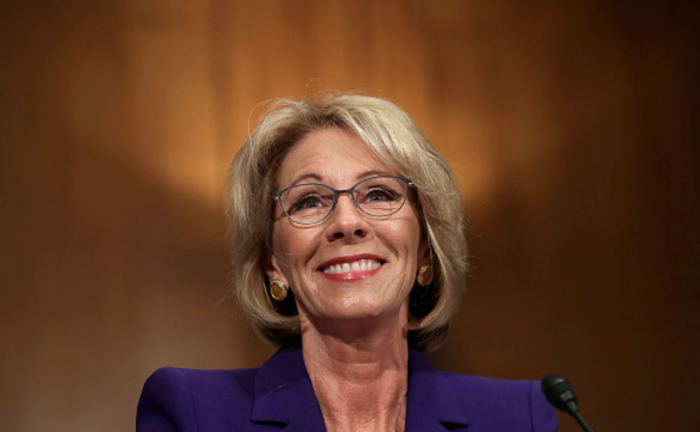
betsydevos-png-crop-cq5dam_web_1280_1280_png

Betsy DeVos wouldn’t commit to protecting students with special needs.

She wouldn’t commit to keeping guns out of school campuses.

She wouldn’t commit to holding charter and voucher schools to the same standards as traditional public schools.

She didn’t know the Individuals with Disabilities Education Act (IDEA) was a federal law.

And she couldn’t explain the difference between proficiency and growth.

That’s your nominee for Secretary of Education, America!

During a hearing of the Senate Committee on Health, Education, Labor and Pensions (HELP) tonight, DeVos showed herself to be hopelessly out of her depth.

She tried to cover her ignorance by being noncommittal. But it was obvious that she had no idea what she was talking about more than half the time.

And far from being a fair arbiter, Senator Lamar Alexander, the Republican chairperson of the committee, did everything he could to shield her from further embarrassment. He artificially limited each member of the committee to only five minutes of questions.

Why? Because in the past the committee had fewer questions for President Barack Obama’s nominees for the position, Arne Duncan and John King.

What a farce! Duncan and King were terrible Education Secretaries, but at least they had some experience in the field! Duncan was Superintendent of Chicago Public Schools. King started his own charter school and was New York Commissioner of Education.

Betsy DeVos was never anything. She has never held a real job. She’s never had a job interview, nor has she ever been hired by anyone!

Her entire portfolio is being a rich Republican mega-donor. All she’s ever done is use her and her family’s obscene fortune to push for school vouchers, remove charter school accountability, advocate for Common Core and persecute LGBT people.

Of course there will be more questions! It’s not because she’s a Republican or that she was nominated by GOP President-elect Donald Trump!

It’s because she’s a twit!

Moreover, she hasn’t yet been cleared of conflicts of interest from the ethics commission nor have her financial disclosures been made public.

But no worries. Big Daddy Alexander was there to protect her from Senators on both sides of the aisle who had pointed questions for her about her experience, knowledge and about what she planned to do to public education if confirmed.

Never in the history of this nation has a more unqualified candidate been presented for such an important job.

How ironic that under the Trump administration we’re presented with a potential Education Secretary so in need of education, herself!

It’s an insult to the nation’s parents, students and teachers.

So how did she even get here?

Money.

She’s given nearly $2.7 million in political donations to 370 individuals and causes over the past 20 years through 819 total contributions, according to the National Institute on Money in State Politics. A little more than $2 million of that has gone to Republican candidates or causes, while a mere $8,000 went to Democratic candidates or groups.

That includes at least five members of the HELP Committee who will get to vote on her nomination. Sen. Tim Scott (R–SC) has received $49,200 from the DeVos family and was a keynote speaker at DeVos’ American Federation for Children annual summit in May 2016. Sen. Bill Cassidy (R-LA) has received at least $70,200 from the DeVoses. Two other HELP committee members, Sens. Richard Burr (R-NC) and Lisa Murkowski (R-AK), each have received $43,200 from the family. Newly elected Sen. Todd Young (R-IN) got $48,600 from the DeVos family in 2016.

However, those are just direct donations. Ten members of the HELP committee have received donations from Alticor Political Action Committee, or ALTIPAC. This PAC belongs to Alticor, the DeVos family company and parent company of Amway—the multilevel marketing giant that fueled the DeVos family fortune—and receives nearly half of its funds from the DeVos family. This includes Sen. Alexander, himself, who received $4,500 from ALTIPAC.

Devos has been rather upfront in the past about why she’s donated so much money to politicians.

In a 1997 op-ed she wrote for the Capitol Hill newspaper Roll Call, DeVos explained: “[M]y family is the largest single contributor of soft money to the national Republican party… I have decided, however, to stop taking offense at the suggestion that we are buying influence. Now, I simply concede the point… We expect a return on our investment.”

This is something she shares with Trump, who has also bragged about paying for influence with his own campaign donations. “I’ve given to everybody. Because that was my job,” Trump bragged at a rally last January. “I gotta give it to them. Because when I want something, I get it. When I call, they kiss my ass.”

That’s what we saw tonight on Capital Hill. It wasn’t a confirmation hearing. It was a bunch of bought politicians lining up to kiss DeVos’ white privileged butt.

There was resistance, but to what end?

Reason, knowledge, ethics – none of that matters here. We are truly in the age of the plutocrats where money has arrogantly attempted to buy governmental power outright. Right in front of our noses.

Only time will tell if she is ultimately confirmed.

In the meantime, our system of public education hangs in the balance.

What My Black Student Taught Me, His White Teacher, About Black Lives

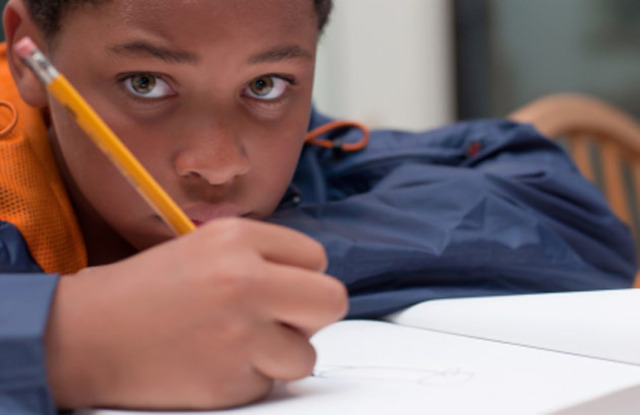
student_081910-thumb-640xauto-704

I can’t tell you how many times Darnell was in detention.

After a while, it didn’t feel right if he wasn’t staying at least an hour after school.

Darnell was late to class.

Darnell swore at another student.

Darnell copied someone’s paper.

Darnell did just about everything and anything that came to his mind. And it earned him time after school with me, his newly-minted 8th grade language arts teacher.

In a class full of mostly brown and black students, many living in an impoverished high crime Pittsburgh suburb, Darnell was the standout. Or at least his misbehavior was.

At first, he complained, but I had his mom on speed dial, and she fully supported my holding him accountable.

He wanted to do his homework during this time, but I made him do busy work instead. The way I looked at it as a young teacher just starting out, if I gave him time to do his school work, it would be a reward, not a punishment.

So I made him copy down dictionary definitions, clean the tables or put up the chairs.

And once he realized there was no way out, he did it all uncomplainingly.

But an hour is a long time, so after a while I let him work on his homework, too.

I had an awful lot of work to do, myself, during these times – piles of papers to grade and lessons to plan – so whatever would keep him quiet would be okay with me.

Unfortunately, Darnell didn’t work that way. He had questions. So many questions.

I had no time, but what else was I gonna’ do?

I answered him. With frustration at first while sitting at my desk.

Then I found myself walking over to him and standing at his table. Then I sat down next to him. And pretty soon we were doing the homework together.

But an hour is a long time, so sometimes he’d finish early. I offered to let him go.

He didn’t want to.

He’d stay and talk: “Did you see the football game, Mr. Singer?”

Or “Did you hear the new Beyoncé album, Mr. Singer?”

Or “How many kids do you have at home, Mr. Singer?”

One day I remember the last bell ringing and looking up to see Darnell at his desk doing homework. I looked back at my stack of papers before I realized – Darnell didn’t have detention today.

I laughed. “You can go home, Buddy,” I said.

“I know,” he replied. “Is it okay if I stay and get this done?”

I shouldn’t have been so surprised. But I was.

I nodded, and he stayed.

I won’t say Darnell ever became a perfect student. He just didn’t have the patience for detailed work. He was more of a big picture guy.

But after months of never turning in homework – years, really – he began to turn all of it in. And I mean all of it!

He wasn’t a great speller, but he started ending all of his sentences with punctuation. And he started all of his sentences with a capitalized word.

He wasn’t a great reader, but he did crack open a few books. Nothing too difficult or complex, but it was more than any teacher I talked to had ever seen him read previously.

At the end of the year, I remember pausing by his desk and praising him.

“Darnell, that’s some mighty fine work you did in here this year,” I said.

And he got this big ol’ grin on his face like he used to get before he was about to engage in some random act of mischief.

“Thanks, Mr. Singer. You’re a really good teacher.”

I smiled and said, “No, Darnell. You’re a good student.”

I remember looking him in the eye to emphasize it. This was a kid with a reputation. I’ll bet few teachers had ever commended him on his school work before.

Then the year ended, and he was gone.

He went on to 9th grade and did even better than in my class. The same in 10th, 11th and 12th.

Oh, sure. He was still a handful and got himself in trouble lots of times. But he did his work and didn’t fail his classes.

I kept an eye on him like I do all my students when they leave me. I try to keep tabs, but there’s always a new bunch just waiting for you at the beginning of the year.

You remember anytime you think about it, which isn’t much.

So it was years later when I heard the news.

Teachers were shaking their heads in the faculty room. The principal held a meeting to tell us about it in case any of our current students were upset, in case any of us had Darnell’s cousins, brothers, sisters, or friends.

He was only 18 when he was murdered.

Shot down in the streets from a passing car.

Police still don’t know whether he was the shooter’s target or if he was just at the wrong place at the wrong time.

The high school teachers, who knew Darnell best, said he had really straightened up his act. He had gotten into community college, wanted to be an engineer.

And they shook their heads. What else was there to say?

I walked back to my classroom and opened a file cabinet.

Inside was a bunch of dusty manila folders – one for each child I had ever made serve a detention.

It didn’t take long to spot Darnell’s. It was one of the thickest.

I opened it up and took out the stack of papers inside.

There were doodles of monsters and basketball players. There were lists of badly spelled vocabulary words in his adolescent handwriting. And there were these halting paragraphs about what he’d done to get detention and how he’d never do it again.

“I’m sorry I wuz late 2 class. I will ask to use bathrom before going.”

“i will not copy LaRonns paper. i will do it myself.”

I read through them all. Every one. I read them again and again until long after everyone else but the janitors had left the building.

I had spent so much time with Darnell.

I had poured my soul into that kid.

But what had it truly accomplished?

He is dead. A victim of his environment. Nothing but a number, a statistic, a footnote.

Just not to me.

By all accounts he had been trying to do good, trying to make something of himself. But it wasn’t enough. Bullets don’t discriminate between the hardworking and the lazy. They just do what they do.

In my mind I tried to see him walking home, a stack of books weighing him down, making him slow. I saw him walking past those ramshackle apartments and slums, that shady park with the broken benches, the street corners where you could buy heroin or pills or weed.

If he was white, would it have been different? If he was white and didn’t live in the “bad neighborhood,” would it have mattered?

If his mom didn’t have to work two or three jobs, would it have helped? If he had someone at home to watch him instead of a bunch of younger siblings and cousins to watch, would things be different?

I don’t know.

But I DO know that there is a list of dead children in my community – some of them my former students – and almost all of them are black.

Darnell wasn’t killed by a policeman, but I’m sure they knew his name. He used to tell me how the cops would often follow him and his friends into the grocery store. “Why they always be doin’ that?” he’d ask me. And I’d just shrug thinking about all the times he’d wait until I wasn’t looking before slapping another child on the neck.

But if Darnell had been white, would we have had different expectations of him? Would we have given him the benefit of the doubt to begin with – like we do white kids?

I wasn’t a very good teacher to Darnell. Every scrap of respect I gave him he had to earn. Why didn’t I give him that respect at the start? Why didn’t I expect the best and then change my expectations as the situation dictated? Why did I instead expect the worst and alter my expectations from there?

I never questioned if or why Darnell was seeking my attention. I just thought of his bad behavior. It was something I wanted to change, so here’s a punishment.

I never offered Darnell my help. I offered help to the class as a whole but not to Darnell individually. Not until he wore me down. Not until helping him was easier than arguing with him.

I never thought about Darnell’s needs. I thought about MY needs of Darnell. I need him to behave so I can teach. Never Darnell’s needs to behave so he can learn.

And there are so many other kids out there like him. I’ve taught so many other little Darnells.

I approach them differently now. It’s a lesson he taught me.

I may have bestowed upon him some spelling and grammar. He taught me humanity. Who is the better teacher?

He taught me to look at black children in a different way.

He taught me to come to them on their terms. To begin anew with an expectation that they will do well no matter what they’ve done in the past. He taught me to look beyond their behaviors and see them as little people. It’s a lesson I’ve never forgotten, and it informs my teaching to this day.

As I sat there with that stack of dusty folders, I realized it doesn’t end at the classroom door.

I used to think being a parent, myself, I had an interest in the future. But that’s not entirely true. Being a parent is one of the most rewarding things you can do, but it isn’t selfless. It only means you care about your child. Not all children.

And that’s where being a teacher is different. After a while, you can’t be selfish anymore. You can’t care for only some people’s futures. You are essentially invested in a future for all, for everyone.

You can try to draw a line in the sand and say “I only care about THESE kids,” but it doesn’t work. You find yourself caring about all of them, all of the children who will become our world when we crumble to dust.

That’s how it should be for everyone.

As a human being, it is my responsibility to fight to make this world a better place for people like Darnell. It’s my responsibility to make sure they all have a future.

But it goes beyond even that. I’m not just any person. I’m a white person.

All the things stacked against a kid like Darnell were stacked in my favor. I lived in a good neighborhood. Police never followed me anywhere. No matter how much I misbehaved, it was always expected I wouldn’t cause any trouble – unless I did.

So it’s my responsibility as a white person to fight my privileged place in society. It’s my responsibility to ensure that black people aren’t held back by entitlements I have not earned and handicaps they do not deserve.

As a white teacher, it is my responsibility to see the best in my children – in ALL of my children. It is my responsibility to meet them where they are and give them support and nurturing and love.

To do so I must see beyond the walls of invisible prejudice. I must see the hurdles, the traps, the maze so I can help them overcome it.

Because Darnell never got to go to college. He never got to become an engineer.

But his life mattered.

Racism is Just One of Two Things Shown in Alton Sterling Killing

-1dd3afa605e6bc1d

Americans are notoriously bad at holding two thoughts in our heads at the same time.

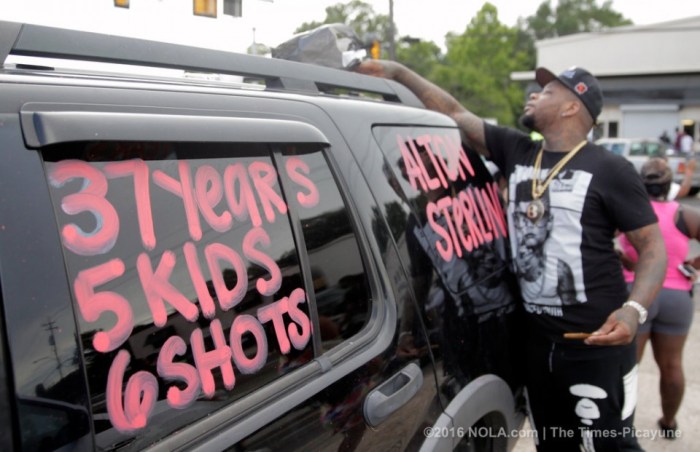
We look at the police shooting of Alton Sterling and can’t decide whether it was racist or if the 37-year-old black man just had it coming.

But we’re missing the point. Sometimes twice.

Baton Rouge Police shot and killed the father of five on July 5th.

The 37-year-old man was killed outside a convenience store in Louisiana because police allegedly got a tip someone was selling CDs and was armed. In the resulting scuffle, Sterling was shot and killed.

If the whole thing weren’t caught on a cell phone video, it probably wouldn’t be more than a sad headline. Just another black dude killed by police.

But the resulting attention has made his name a hashtag and his death a source of outrage – for good reason.

On the video, police tackle Sterling to the ground before gunshots are heard.

One of the officers shouts “gun” before shooting, but store owner Abdullah Mulfahi told the media that Sterling’s hand was not near any weapon and the alleged gun later recovered from his pocket was not visible.

People watch the video (or not) and immediately take sides.

Who is to blame – the police or Sterling?

Was the black man armed? Maybe – though Louisiana is an open carry state so he would be within his rights to do so.

What should he have done when confronted by police? What actions of his might have resulted in police not shooting him dead?

Did he have a record? Is that even relevant since police had no access to that information at the time?

Typically people come to conclusions based on their convictions and not based on the evidence. If you think black people are being victimized by police, then you’re probably on Sterling’s side. If you think black people are naturally violent and police rarely do any wrong, you’re probably on the side of law enforcement.

But what both sides are ignoring is a sense of context.

This was the 15th American killed by police so far in July alone.

Not the 15th black person. The 15th person. Period.

There’s some dispute over exactly how many people have been killed by police so far this year, but the number is surprisingly high. You’d think that would be something the federal government would keep track of, but no. The FBI’s Uniform Crime Reporting Program tabulates every criminal statistic imaginable – except homicide by law enforcement. Alarmingly, it leaves this to the private sector – almost as if it had something to hide.

Much of this is done by the news media, both in and out of the country. The Washington Post puts the number of Americans killed by police this year at 505 people. The Guardian puts it at 560. An open sourced database called Killed by Police puts the number at 580.

Any way you look at it, no matter which tally you go with, 2016 is turning out to be one of the deadliest years for police shootings since people have been counting.

It’s a problem for everyone. Police should not be killing such high numbers of civilians. In fact, in other countries, they don’t. Police kill more people in the U.S. in days than they do in other countries in years.

For instance, U.S. police killed 59 people in 24 days last year. In England and Wales, 55 people were killed by police in 24 YEARS!

And the numbers aren’t that high solely because the United States has a larger population. The entire nation of Canada has about as many people as the entire state of California, yet Canadian police killed 25 people last year to 72 by California law enforcement.

That may be due in part to a lack of accountability.

Despite such high body counts in this country, not a single police officer has served jail time for it in the last few years. Several officers went to trial in 2016, but none were convicted, according to the Wall Street Journal.

Last year had the highest number of officers being charged for shooting civilians in a decade. That number? 12. And none of them – not one – was convicted of murder or manslaughter.

We have a real problem here. American police kill far too many people.

However, this doesn’t mean that racism isn’t a motive in many of these police shootings. In fact, the numbers back that up.

Though more white people are killed by law enforcement in this country, it is black people who are killed at a disproportionately high rate. They only make up 13.2% of the population, yet they are twice as likely to be killed by police as whites. Nearly a quarter of all police homicides this year resulted in dead black folks.

What’s going on here?

First, we live in a police state. Officers often kill suspects with impunity and face little to no consequences. Not all police, certainly, but far too many.

Second, black folks are killed more regularly by police than whites. In fact, if all things were equal, you’d expect MORE white people to be killed than already are. Whites make up 77.7% of the population, yet they account for only half of the victims of police shootings.

This isn’t because black people are so much more violent than whites. According to the Center on Disease Control’s annual Youth Risk Behavior Survey, they engage in violent behavior at similar rates to whites.

For instance, they carry a weapon (whites 17.9% to African Americans 15.2%) and carry guns (whites 5.5% to African Americans 6.5%) at about the same rates. However, blacks are twice as likely to be arrested for weapons possession.

The same holds for assaults. African Americans report being in physical fights at similar rates (36.5% versus 32.5% for whites) but are three times more likely to be arrested for aggravated assault.

It should come as no surprise then that black people are more likely to be killed by police. This holds with everything else we know. When it comes to the criminal justice system, black people are penalized more often and that includes being shot and killed by law enforcement.

Why? Because they’re black. Because of societal attitudes, fears, phobias and prejudices.

For many of us, when we see Sterling’s last moments enacted on that cell phone video, we’re confronted with that fact. We put ourselves in his position. What could he have done differently? Whether he was guilty of a crime or not, what action on his part would have assured that he got out of this situation alive?

Eric Garner was choked to death by police while repeatedly saying, “I can’t breathe!” Tamir Rice was shot by police in two seconds. What exactly could a black person do to avoid being shot if law enforcement already perceives him or her to be a threat?

These are important questions. But they aren’t the only ones.

America has a problem with police violence. In fact, it has two problems. And we can’t solve one without solving the other.

We have to come to terms with this. It is not a case of racism or a police state. It is a case of BOTH.

Florida Shooter’s Strongest Ally Was The American Gun Lobby

os-orlando-shooting-pulse-nightclub

“America is absolutely awash with easily obtainable firearms. You can go down to a gun show at the local convention center and come away with a fully automatic assault rifle, without a background check, and most likely without having to show an identification card. So what are you waiting for?”

-American-born al-Qaeda spokesmen Adam Yahiye Gadahn


Omar Mateen considered himself a terrorist.


He wanted to make that clear to posterity before ending a shooting rampage he initiated in Florida yesterday that left 50 dead and dozens more injured – the worst mass shooting in U.S. history (so far).


During the carnage at an Orlando gay nightclub, he allegedly called 911 to pledge his allegiance to ISIS. He just wanted us to know that.


Now that the shooter’s gone, just as he would have wished, pundits are making a lot of this phone call. Though his family claims he wasn’t particularly religious, media talking heads are seizing upon this one action by an unhinged young man in order to denigrate all American Muslims.


ISIS is a militant organization. Islam is a religion.


By contrast, the KKK is a militant organization. Christianity is a religion.


But never mind that. In Mateen’s case, an entire religion is somehow responsible for the actions of one man. If he had been a white Christian – as most mass shooters are – we probably wouldn’t be seizing on his race or creed. But even though Mateen was born in this country, his family is from Afghanistan, his skin is brown, he was one of THEM.


However, there is no evidence that anyone in the Islamic community helped Mateen conduct his reign of terror. He allegedly saw two men kissing several months earlier, became enraged and planned accordingly.


But we can pinpoint one American institution that gave the self-proclaimed terrorist much aide and comfort in his scheme – the American gun lobby.


In fact, firearm powerbrokers are helping terrorists kill civilians all over the country.


No. I don’t meant to say they are working hand-in-hand with international terrorist organizations like al-Qaeda and ISIS.


But they might as well be.


Our lax gun laws are the direct result of the lobbying efforts of the National Rifle Association (NRA) and other organizations closely associated with the gun industry. Those laws are being exploited by individuals like Mateen bent on murdering as many American civilians as possible.


Before Mateen opened fire, he had been on a terrorist watch list. In fact, the FBI had monitored his past activities.


You might think someone like that would not have been permitted to buy a gun in the first place. But you’d be wrong.


Just six months ago, the U.S. Senate had considered a law to restrict suspected terrorists from buying firearms and explosives, but it was defeated largely by Republican lawmakers accepting huge campaign contributions from the gun industry.


Mateen might have found it much more difficult to carry out this terrorist attack without the help he received from the NRA and so-called conservative lawmakers.


But don’t take my word for it.


Gadahn (quoted above) was killed in a drone strike in 2015, but he was not the only terrorist praising the efforts of the American gun lobby.


A six-page recruiting pamphlet found in terrorist safe houses in Kabul, Afghanistan, called “How Can I Train Myself for Jihad” instructs would-be terrorists “on the advantages the United States offers for firearms training and advises readers on how to exploit them.”


Maybe that’s why a measure like that recently defeated in the Senate to stop suspected terrorists from accessing guns was strongly supported by the George W. Bush administration.


It’s strange. Bush pushed the PATRIOT Act as an invaluable tool to keep America safe from terrorism despite the concerns that it trampled civil liberties. If lawmakers on both sides of the aisle are willing to weaken the 4th amendment’s provisions against unreasonable search and seizures in order to stop terrorism, then why do they oppose much more reasonable restrictions on the 2nd? What makes the right to bear arms so much more important than other privileges enumerated in the Bill of Rights?


In truth, it’s not a philosophical debate. It’s an economic one.


There is simply too much money being made by gun manufacturers – and thus being funneled into political campaigns – to allow for sane firearm policy.


Take the AR-15, one of two firearms used by Mateen yesterday. The same semi-automatic model he used was illegally modified and used to kill 14 and wound 21 in the San Bernardino shootings in late 2015. In 2012, it was also used in the murder of 20 children and six adults at Sandy Hook elementary school in Newtown, Connecticut.


It’s the most popular rifle in the country, and the weapon of choice for mass shooters.


As such, there have been calls to reinstitute the federal assault weapons ban from 1994 – 2004. Some claim that the ban was ineffective, allowing too many loopholes. Others say despite weaknesses it resulted in less people being killed by these types of weapons during the time of the ban.


Though several attempts have been made to reinstitute the ban, it has been stalled by the gun industry largely because of wordplay and minutiae.


They claim the term “assault weapons” is inaccurate at best and propaganda at worst. (Never mind that it was coined by the gun manufacturers, themselves, to increase sales.)

 
Rifles designated as “assault weapons” are not easily distinguishable from other kinds of rifles, they say, so banning them would lead to a slippery slope of banning all guns.


The most basic difference is the firearm’s ability to expel multiple rounds quickly. Because of this, the rifles included under assault weapons bans are usually semiautomatic – a new round is automatically reloaded into the chamber but is not fired until the trigger is squeezed again. The weapons also have detachable magazines, allowing them to fire 10, 20, 30 rounds or more without the need to reload.


However, bans often include “military style” rifles that are not necessarily semiautomatic. Gun advocates claim these rifles are similar to firearms excluded from bans except for cosmetic features to make them appear more militaristic.


Those could include features like a pistol grip, designed to allow a weapon to be fired from the hip; a collapsible or folding stock, which allows the weapon to be shortened and concealed; a flash suppressor, which keeps the shooter from being blinded by muzzle flashes; a muzzle brake, which helps decrease recoil; and a threaded barrel, which can accept a silencer or a suppressor. Bayonet lugs or grenade launchers are also sometimes included.


But are these features truly just cosmetic? Or do they actually make these rifles much more dangerous? No one needs a grenade launcher to hunt for game or protect their home.


When people call for gun regulations, they aren’t necessarily calling for a ban on all guns.


People want a degree of safety in public spaces. They don’t want to be cut down by one or two gunmen causing exponential carnage in seconds.


That seems a reasonable expectation.


Gun industry surrogates claim safety is best assured if everyone is packing heat – an endless stalemate.


In point of fact, there was an armed police officer working security yesterday at the gay club when Mateen sprayed the crowd with bullets. Though he traded fire with Mateen, he was unable to stop the carnage.


It’s absurd. The people who initiate mass shootings rarely survive them. They don’t care about being killed. They only care about spreading death and terror.


Moreover, adding more guns to public spaces only increases the chances of more shootings, many of which would probably be accidental.


The rest of the world has figured this out. There really is no argument to be made here. Polls show that most of the public wants some kind of gun control.


But it won’t happen so long as the gun industry is allowed to buy our lawmakers.


It won’t happen so long as we allow gun industry trolls to drown out all reasonable discussion with their circular zombie arguments.


Mateen couldn’t stand the sight of two men publically expressing their love for each other.


The gun lobby can’t stand the idea of reduced profits.


And together those two aims make up the twin pillars sheltering American terrorists everywhere.

What Antonin Scalia’s Death Means to the People I Love

antonin-scalia-26

I’m not sad Antonin Scalia is dead.

Wow! It feels so good to say that aloud!

Come on. Admit it. You feel exactly the same way.

I know. I know. Everywhere you turn, people are going out of their way to talk about the ramifications of the 79-year-old Supreme Court Justice’s death without passing judgement on him.

“Let’s keep it classy,” they say.

Oh. Stop it.

In his 30 years on the bench, Scalia hurt an awful lot of people. And I mean real, live people – not ideological constructs, not hypotheticals – but moms, dads, husbands, wives, daughters, and sons.

The aggregate amount of misery in the world was drastically increased by his being in it. And now that he’s gone, much of that misery may be relieved.

So spare me any shock at my thesis. Spare me the false praise of a truly reprehensible human being.

He was against women controlling their own bodies, efforts to desegregate our schools, an individual’s right to love whomever they choose, refraining from executing mentally disabled or teenage prisoners. Heck! He was even against police reading suspects their Miranda Rights!

This was a person who said black people should go to “slower” colleges, homosexuality was the same as murder or bestiality, sex discrimination is constitutional, and maybe we have a right to all carry around rocket launchers in public.

If it is outrageous to feel relief at the death of this man, you may call me outrageous.

I’m not usually the kind of person who celebrates someone else’s death. Not even a famous person.

But you have to admit that the people we love are a lot better off without Scalia in the world.

It’s not like he kept all this to himself. He wasn’t some lone drunkard in the back of the bar mumbling sexist, racist views. He wasn’t your ancient uncle who you only see twice a year making people uncomfortable at the dinner table. He was a judge in the highest court in the land, and his demented and warped world view drove public policy impacting… well… everyone.

He was the deciding vote in several 5-4 decisions that – if they had gone differently – would have greatly benefited every person in this country.

You can thank him for the Presidency of George W. Bush and Citizens United. Let that sink in for a moment.

Imagine all the horrific blunders of the Bush Presidency – easily the worst administration in my lifetime. If the Supreme Court hadn’t given the highest office in the land to Dubya, arguably we wouldn’t have had the Iraq War, the Great Recession, No Child Left Behind, the slow response to Hurricane Katrina – maybe even 9-11.

And if you hate what our elections have become, imagine if we didn’t have the Citizens United verdict. Campaign donations would have to be made in public with some limits on how much individuals and corporations can contribute.

How much better the world would have been without these terrible decisions!

I’m not saying Scalia wasn’t a good man in his personal life. I have no idea what he was like to the people he loved. For all I know he may have been a good friend, a loving husband, father and grandfather. He probably had people he cared about and who cared about him. And to those people I send my condolences.

However, he royally screwed just about everyone else. And for that I feel nothing but relief at his death. If only it had come sooner.

Who am I to bask in such schadenfreude?

I am a father and public school teacher.

I have a seven-year-old daughter and several classes full of mostly impoverished and minority students.

And Scalia’s death is good for everyone I care about.

If he were still alive, there was so much more damage he could have done. Take the Friedrichs case, an important one for teachers like me.

The case is an attempt to strip teachers unions of the right to charge members for their services. If the court rules in favor of Friedrichs, it would overturn decades of established law against free riders. People would be allowed to be in a union, enjoy higher salary and benefits negotiated by that union, but not pay dues. It would be absurd. Yet with Scalia still on the bench, most court watchers seem to think we would have had another terrible 5-4 decision.

However, with Scalia’s death, the best anti-union forces would probably receive is a 4-4 decision – not enough to overturn established law. True the case has already been heard by the justices, but a ruling has not yet been handed down. According to the Supreme Court blog, even if Scalia had already written a ruling on this matter, it would be void. Any rulings he wrote that have not yet been made public don’t count.

So the most likely outcome now is that millions of people will continue to be protected from unfair labor practices. And you expect me not to have a big ‘ol smile on my face!?

So where do we go from here?

President Barack Obama will select who is to succeed Scalia. Numerous excellent choices have been floated. If Obama chooses any one of them, he would probably tilt the court fractionally to the left.

Before the body was even cold, Republicans vowed to block any nominee Obama makes until the next President is sworn in. Some are trying out the talking point that Supreme Court Justices have never been sworn in during an election year. But if that were true, we wouldn’t have Justice Anthony Kennedy who was confirmed during the last year of Reagan’s presidency.

Funny. The U.S. Constitution clearly states that the President has the right to nominate Supreme Court Justices with the advice of Congress. Yet so many of these right leaning partisans who considered themselves Constitutionalists last week suddenly find themselves against that revered document today.

I wonder how Scalia would have argued such a situation.

Not really. He was the one who taught the rest of his party how to twist the words of the founding fathers to mean whatever the far right favors this week.

Obama still has more than 300 days in office. If Republicans try to block his nomination until a new face tops the Executive, it would be the longest such obstruction in a century. Of sitting justices, the longest confirmation period was for Clarence Thomas who took 106 days to be approved by Congress.

And that brings us to the 2016 Presidential race.

Scalia’s death is likely to have a huge impact on whom becomes our next President.

If Republicans block Obama’s Supreme Court nominee, it would probably increase voter turnout. Whenever that happens, it favors Democrats since they have more registered members than the GOP.

Either way, Scalia’s death is probably beneficial to whomever the Democratic nominee will be. If either Hillary Clinton or Bernie Sanders get the nomination, supporters of the defeated candidate are more likely to support the reigning Democrat.

Even if voters don’t like the winner’s policies as much as their preferred candidate, they’re likely to support the nominee in order to continue tipping the Supreme Court to the left. After all, three additional justices are 70 or older. Stephen Breyer is 77, Anthony Kennedy is 79, and Ruth Bader Ginsburg is 82.

We have had a long haul these last 15 years. Much social progress has been stalled.

But now that Scalia is out of the picture, the future looks bright.

Maybe things really will turn out alright. Maybe we’ll actually have a chance to build that better world we’ve all been dreaming about.

Rest in Peace, Scalia. The nation can’t wait to move on without you.

Why Are Black People So Nonviolent? And Why Aren’t Whites?

th

If hate were a sport, I’d bet on white.

Really. We’re good at it.

White people have been hating, brutalizing and killing people way more effectively than black people for – well – ever.

Don’t be modest, Caucasians. The Holocaust, ethnic cleansing, colonization of Africa and the Caribbean, American slavery, Native American Genocide, Jim Crow – we’re the world freakin’ champions!

But somehow in the media it’s the black man who is portrayed as the savage.

It’s just not fair. We white folks are so much better at race-based aggression than our darker complected brothers.

Just this Wednesday a white guy walked into a historic African American Church in South Carolina, was accepted as part of the service, stayed for about an hour before shouting a spiteful message and gunning down several parishioners!

Now that’s some hate right there!

But at first the people on my TV refused to give us white folks credit. They were questioning everything from the killer’s motives to his race! As if this had to be a black man in white face persecuting the faithful! Not some kind of hate crime!

Maybe it shouldn’t be surprising that the media narrative always runs counter to the truth of the violent white man and in favor of the myth of the savage black man.

Whenever anyone brings up race and violence, the first thing people mention is crime.

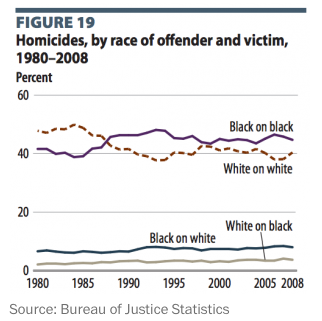
There is more black-on-black crime than white-on-black crime, they say. And they’re correct!

According to a 2013 FBI Uniform Crime Report, when it comes to murder, 90 percent of black victims were killed by black offenders.

However, what people fail to mention is that according to the very same report, 83 percent of white victims were killed by white offenders, too.

These numbers don’t show black people are more violent than white people. They show that BOTH white and black people would rather kill within their own race.

Screen shot 2015-06-18 at 10.33.37 PM

In terms of raw numbers, black people and white people actually commit about the same number of murders. But you wouldn’t know that from the media.

I don’t know why these media types aren’t wringing their hands over the spurt of white violence in this country instead of spending valuable broadcasting minutes exclusively on black people.

You’d almost think they were biased or something, trying to spin the truth, tell you a story that wasn’t entirely factual.

And speaking of bad arguments, this one has suddenly shifted.

We started talking about race-based aggression and we suddenly shifted to all violence. Let’s get back to hate crimes, because that’s really the area where white people excel.

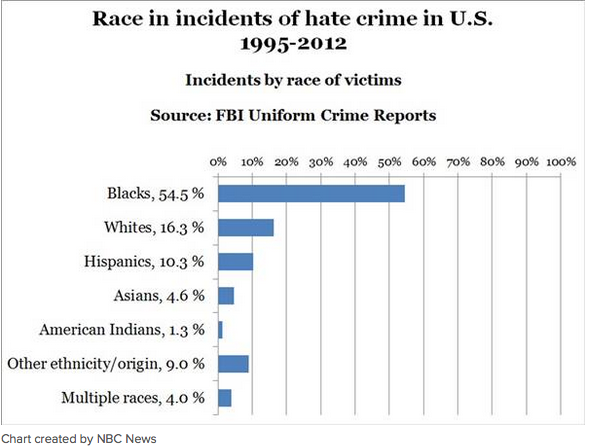
The FBI is charged under the Hate Crime Statistics Act with compiling statistics on spite-based legal transgressions. In its most recent report, for 2013, hate crimes based on race are far more numerous than any other kind.

Screen shot 2015-06-18 at 10.28.45 PM

Moreover, bias-motivated infractions against black folks far exceed those against white people.

According to the FBI statistics, 54.5 percent of the reported single-bias hate crimes that were racially motivated in 2013 targeted blacks. Only 16.3% target whites.

Screen shot 2015-06-18 at 10.28.26 PM

But you really didn’t need an FBI report to tell you that, did you? American history is littered with the bodies of beaten and brutalized people of color. You could make a very convincing argument that these dead souls make up the foundation of our country. Would our economy really have been so robust without the free labor of all those slaves? Heck! Would we even have a country at all if we hadn’t murdered all those indigenous peoples in the first place?

I know. You’re going to say that other predominately white countries have violent histories, too. And you’d be right. But notice the difference in our attitudes about it today!

Historically, Germany is no slacker when it comes to racial violence, but is there any government building in the German Republic today that continues to fly a Nazi flag? Absolutely not. In fact, it is illegal to do so.

By contrast, in America we love the stars and bars of the Confederate flag. It still waves proudly over the South Carolina capital building. (But I’m sure that has nothing to do with the violence we saw at that Charleston church I mentioned earlier!)

So let’s put it to rest. When it comes to hate crimes, white folks kill! But don’t feel too bad, black folks. There are things you’re good at, too. Like nonviolent resistance.

Heck! You’re amazing at that!

Langston Hughes wrote, “Negroes – Sweet and docile, Meek, humble, and kind: Beware the day – They change their mind.”

After all this time, black people have very rarely used violence as a means to achieve their ends, to try to secure the rights and freedoms white America guards so jealously.

In just the past year or so, unarmed black folks have been assaulted or killed for holding toy guns, being suspected of selling loose cigarettes, listening to music at a gas station, asking for help after a car accident, wearing hoodies, wearing bikinis, running, and now just going to church!

And the response from the black community has been pretty darn nonviolent. Yeah there’s been some shouting and looting, but very little beating or killing.

White folks, can you imagine having to undergo such indignity on a daily basis and NOT responding in kind!?

No wonder a blonde white girl from a Christian fundamentalist home darkened her skin, curled her hair and tried to pass as black! Sometimes – often really – it’s darn embarrassing to be white! Black folks have the moral high ground.

Somehow they live in an American society that heaps hatred on their every move and they respond with dignity and perseverance.

So why are black people so nonviolent?

Damned if I know! But I wish us white folks would take a lesson from them.


NOTE: This article also was published on the Badass Teachers Association blog.


UPDATE: There has been a criticism of this article I’d like to address. I have claimed, “In terms of raw numbers, black people and white people actually commit about the same number of murders.” Some say this works against my argument that black people are less violent than white people. After all, there are fewer black people in the country, yet they commit about the same number of murders as white people. Doesn’t that make them more violent?


I think if you factor in poverty, the numbers wash. After all, poor people are generally more violent than those in better circumstances. Since most black people experience higher levels of poverty than most white people, we can only expect higher proportions of murders from them. When your options are limited between working several minimum wage jobs to squeak by or to engage in the drug trade for a higher income bracket, well it’s not surprising. If black folks weren’t subjected to such high poverty rates, we would expect the black murder rate to plummet.


I know some readers won’t accept that answer. And if so, fine. However, this doesn’t affect at all my assertion that black people commit a fraction of the country’s hate crimes. Whether you look at it proportionately or numerically, white folks are MUCH more likely to commit hate crimes than black folks. I think that’s significant.


However, I have received enough correspondence from readers of this article to know that many don’t care. This article has been surprisingly popular. It still gets hundreds of hits every week. Unfortunately, many of the people who seem to find it appear to be those with an axe to grind. WordPress allows me to see what readers type into a search engine to find this article. I can see what sites lead you here. I know that white supremacists and far right conservatives are loving this article as an example of “liberal, white self hate.” The responses to this article in some of the darker corners of the Internet have been as hilarious as they are badly argued. It appears that some people are so committed to the idea that black people are violent that nothing anyone says could convince them otherwise. Moreover, they are so enamored with white violence that they see it as evidence of white superiority or else they try to argue it away as being perpetrated by people who are not truly white.


To those people I have only pity. Love is stronger than hate. I honestly hope that one day you will understand.


The Killer in my Classroom

Screen Shot 2015-05-20 at 2.29.49 PM

Some nights sleep just won’t come.

I toss and turn, crumpling the blankets until I have to get up and read or pour myself a glass of water.

Sitting up in the pre-morning gloom, that’s when they come back to me.

A parade of faces. No names. Words are all lost in the haze of time.

But the faces remain.

Kids I’ve taught and wondered about.

What ever happened to Jason? Did Rayvin ever get into dance school? I wonder if the army took Tyler…

But there’s one face that always comes last.

A strong straight lip. Soft nose. Brooding eyes.

Terance… Terrell… TYRELL.

Yes. That’s his name.

One of my first students. One of my biggest failures.

And I don’t have to wonder what happened to him. I know with a dread of certainty.

He never got to play professional basketball like he wanted. He never even made it out of high school.

No, not dead – though I do have I gaggle of ghosts on my class roster.

He’s a murderer. Life in prison.

I was his 8th grade language arts teacher. It was my first year teaching in the district.

I had a reputation for being able to relate with hard to reach kids so they put me in the alternative education classroom.

I had a bunch of students from grades 6-8 who simply couldn’t make it in the regular school setting.

These were kids with undiagnosed learning disabilities, appalling home environments, and/or chips on their shoulders that could cut iron.

But I loved it.

I taught the Read 180 curriculum – a plan designed for students just like mine. We had three stations: silent reading, computer remediation and small group instruction.

The class was divided in three – students rotated through each group. Though I somehow monitored the whole thing, I spent most of my time meeting with kids in small group instruction.

I had an aide who helped the whole thing run smoothly, too. Lots of planning time, support and resources.

Everyday was exhausting. I could barely stay awake on the ride home. But it was worth it, because I felt like I was making a difference.

And there was Tyrell.

Few days went by without at least one of the children having to be disciplined. Sometimes it was just a simple redirection or even standing in close proximity to kids who seemed set to explode. Other times it was a brief one-on-one counseling session to find out why someone was misbehaving. And sometimes it was so bad kids had to be sent to the office. Once we even had a child escorted out of the building in handcuffs because he brought a weapon to class.

If you’d told me one of those children would end up killing someone, I wouldn’t have blinked. If you told me it would be Tyrell, I wouldn’t have believed you.

He was a gentle giant.

Almost always calm and in control. He was well above the others academically. When one of the others lost his cool, Tyrell would help talk him down.

I wondered why he was there. Turns out he was involved in a bloody fight on the way home from school the year before.

But that rarely made its way into the classroom. It was like he was already doing time – serving out his sentence with these misfits until he could be placed back with the rest of the student population.

I remember when Carlos got caught with the knife, Tyrell’s back had stiffened but he hadn’t moved.

The knife had fallen from Carlos’ pocket across the table and slid to the floor.

Tyrell watched it slide across his desk but said nothing.

“Is that a knife, Carlos?” I asked.

“No!” he said picking it up and putting it back in his pocket.

“Why do you have a knife, Carlos?” I asked.

He shrugged and refused to say anything.

Then Tyrell spoke up.

“It’s for the walk home, Mr. Singer.”

“What?” I asked.

“He needs it,” Tyrell said.

And the look in both of their eyes said it was true.

But what could I do? If he used that knife, I’d be liable.

I had to report it, and I did.

Would I still do that? Was it a mistake?

I don’t know.

But I went to the administration and told them the truth – that I BELIEVED the knife was for self-defense. That something had to be done to protect these kids on the walk home.

Nothing changed. Our district saves a ton of money by forgoing buses. Richer kids get a ride to school. Poorer kids walk.

And Carlos got charged.

Tyrell never said anything about it. But I wondered what we’d find if we searched HIM.

We have metal detectors, but they are far from 100% effective.

I remember one day Tyrell stayed after class to talk to me. Talk quickly turned from grades and assignments to what he wanted to do with his life.

Tyrell loved B-ball. Often wore a Kobe jersey to school. And always the cleanest, brightest Jordans on his feet.

He was going to play ball, he said. No doubt about it.

I tried to convince him to have a backup plan, but he just shook his head.

“What kind of options you think there is out there for a guy like me, Mr. Singer?”

I’ll never forget it. Me trying to convince him he could do anything he wanted, and he just smiling.

“Guy like me only do one of two things,” he said, “He plays some ball or he runs out on the streets.”

I asked him to explain, and he told me about his brothers – how they sold drugs, bought fancy cars, took care of the family.

I kept insisting there was another way – a better way. And finally he agreed but said that his way was easier, safer, more of a sure thing.

“Why should I work my ass off on all this?” he said pointing to his books, “I can make a stack on the street.”

Was there anything I could have said to change his mind?

I don’t know. But I tried.

And that was it, really. I never had another chance. They moved him back to regular ed. a few weeks later.

He finished the year with a different teacher in a different part of the building.

I saw him occasionally, and he’d dap me up, but that was about it.

The next year there was an opening for me in regular ed., too.

Eighth grade with the academic track population.

I had to really think about it. My colleagues thought I was crazy not jumping on it at the first opportunity.

But it was no easy decision.

What finally pushed me over the edge was the rumor that alternative ed. was being downsized.

They would no longer pay for the Read 180 curriculum. No more aides. No more resources and extra planning time.

So I put in for the move and have been there ever since.

Of course, with a much reduced alternative ed. most of the students I would have taught had moved up with me to the regular ed. classroom. Now they’re just bunched in with the regular population.

But I don’t regret it. I love these kids. I love being there for them.

And Tyrell? About a year later, I read about him in the newspaper.

Police think it was a drug related hit. Tyrell was in the backseat. He put his gun to the driver’s head and pulled the trigger.

Bam.

No more future for either of them.

Except on restless nights when Tyrell’s face keeps coming back to me.

Is there something I could have done? Do the words exist for me to have convinced him to change his path? Would he have listened if I hadn’t reported Carlos?

And most importantly – why am I the only one who seems to care?


NOTE: A slightly condensed version of this article was published on Nancy Flanagan’s blog “Teacher in a Strange Land” in Education Week. The expanded version seen here also was published on the Badass Teachers Association blog.

The Worst Sort of Violence Against Children

school_and_TBI_iStock_000007171993XSmall

She was smiling and laughing, but her eyes were terrified.

Sitting in class among her fellow middle school students, her words were all bravado. But her gestures were wild and frightened. Tears were close.

So as the morning bell rang and the conversation continued unabated, I held myself in check. I stopped the loud rebuke forming in my teacher’s throat and just listened.

“You know that shooting at Monroeville Mall Saturday night, Mr. Singer? I was there!”

I swallowed. “My gosh, Paulette. Are you okay?”

She acts street smart and unbreakable, but I can still see the little girl in her. She’s only 13.

She slowed down and told us what happened; a story framed as bragging but really a desperate plea for safety and love.

She went to the mall with her mother. When they separated so she could go to the restroom, the gunfire began. She ran out and Mom was gone. She was ushered into a nearby store where the customers were kept in lockdown. She stayed there until the police cleared the mall, and it was safe to find her mother and go home.

A 17-year-old boy had gunned down three people. One was his target. The others were bystanders – parents who had gotten in the way. Now they were all in the hospital, two in critical condition.

And my student – my beautiful, precious, pain-in-the-butt, braggadocious, darling little child – was stuck in the mix.

I could imagine how scared she must have been separated from her mother, hiding with strangers as police swept the shops, food court and children’s play center.

Here she was telling the class her story and getting more upset with each word.

I gave her a meaningful look and told her we’d talk more later. Then I began class.

But I kept my eye on her. Was that relief I saw as the talk turned from bullets and bloodshed to similes and metaphors? Did the flush leave her cheeks as we crafted multi-paragraph theses? I hope so.

I think I know her pretty well by now. She’s been mine for two years – in both 7th and 8th grades. I even taught her older brother when he was in middle school.

I know she’s rarely going to do her homework – and if she does, it will be finished in the last 20 minutes. I know she’d rather be out playing volleyball or cheerleading than in school writing or reading. I know when she’s secure and when she’s scared.

And I know that today’s lesson will be a breeze for her. So why not put her in her comfort zone, show her things haven’t changed, she’s still the same person, she can still do this – nothing is different?

At least, that was the plan.

As any experienced public school teacher knows, you have to satisfy a person’s basic needs before you have any chance at teaching them something new. Psychologist Abraham Maslow’s Hierarchy of Needs is always at the back of mind.

Students must have their physical needs met first – be fed, have a full night’s rest, etc. Then they have to feel safe, loved, and esteemed before they can reach their potentials.

But meeting these needs is a daily challenge. Our students come to us with a wealth of traumas and we’re given a poverty of resources to deal with them.

How many times have I given a child breakfast or bought a lunch? How many kids were given second-hand clothes or books? How many hours have I spent before or after school just listening to a tearful child pour out his heart?

Let me be clear. I don’t mind.

Not one bit.

It’s one of the reasons I became a teacher. I WANT to be there for these kids. I want to be someone they can come to when they need help. It’s important to me.

But what I do mind is doing this alone. And then being blamed for not healing all the years of accumulated hurt.

Because that’s exactly what’s expected of teachers these days. Fix this insurmountable problem with few tools and if you can’t, it’s your fault.

I didn’t shoot up the mall. I didn’t pass the laws that make it so easy for kids to get a hold of a gun. I didn’t pass the laws that allow such rampant income inequality and the perpetuation of crippling poverty that more than half of our nation’s public school children live with every day. And I sure didn’t slash public school budgets while wealthy corporations got a tax holiday.

But when society’s evils are visited on our innocent children, I’m expected to handle it alone. And if I can’t solve it all by myself, I should be fired.

That is where I take umbrage.

The issue is violence but not all of it comes at the end of a gun.

Keeping public schools defunded and dysfunctional is also a form of violence. Promoting privatization and competition when kids really just need resources is also cruelty. Pretending that standardized curriculum and tests are a Civil Right is also savagery.

It’s called class warfare. Its most prominent victims are children. Its most active soldiers are teachers. And we’re on the front lines every day.

When the bell rang to end class, Paulette stopped by my desk.

I looked up at her ready to give whatever support I could. It was my lunch break, but I was willing to skip it and just talk. I’d get the guidance counselor. I’d call home. Whatever she needed.

But none of it was necessary.

“Are you okay?” I asked.

“Yeah.” She gave me a big smile and a deep breath.

I returned it.

Today would be alright. Tomorrow? We’ll meet that together.

But we sure could use some help.


NOTE: Names and other minor details may have been changed to preserve anonymity.

This Article was also published in The Progressive, Portside Navigator, Common Dreams, Public School Shakedown and the Badass Teachers Association blog.