Hillary Clinton is Not as Bad as Donald Trump – She’s Worse

Screen shot 2016-05-15 at 8.21.59 PM

On the face of it, the title of this article is pure bull crap.

What do you mean Hillary Clinton is worse than Donald Trump!?

She’s not a reality TV star pretending to be Presidential.

She’s not a bigot, a demagogue and a fascist.

She’s not the top choice of racists and white supremacists everywhere.

And you’re right. She’s none of those things.

If I’m being honest, there are plenty of things Clinton has over Trump.

First of all, she’s immensely more qualified to be President. She has decades of experience in public service. Trump has none.

Moreover, she has been instrumental in pushing forward progressive policies. She championed healthcare reform when it was unpopular to do so. Without her work, it is doubtful we’d have the little reforms we have today. Trump, on the other hand, hasn’t lifted a finger to help the American people accomplish anything – unless you count ogling half naked women on the Miss Universe pageant or getting excited over which D-list celebrity he was going to “fire” on The Apprentice.

However, there is an area where both candidates have significant overlap.

If you remove the names and the personalities, if you ignore political affiliation and past history, Donald Trump and Hillary Clinton begin to look very similar.

Who does Trump represent? The 1%.

Who does Clinton represent? The 1%.

It’s really that clear.

In fact, in 2008 Trump famously donated to Clinton’s Presidential campaign. He is exactly the kind of person who wants someone like Clinton in the Oval Office. She would look out for his interests.

Her campaign is financed by Wall Street. Trump IS Wall Street. She was paid exorbitant fees to give private speeches to bankers and stock brokers. One would not be shocked to find Trump in the audience.

Yes, there are differences. One can’t imagine Clinton talking about women with as much arrogant deprecation as Trump. One can’t imagine her suggesting we deport millions of people, that we put all Muslim’s under surveillance, or that many Latinos are murderers and rapists.

But that is exactly what makes her worse. Trump looks like a little dictator (which he is.) Clinton does not.

She appears to be the middle ground. She appears to be the sane candidate – and in some ways she is. But in many of the most important ways that count for Americans living from paycheck-to-paycheck, she isn’t a compromise at all. She’s nearly the same thing.

Imagine two shelves holding poison in a child’s playroom. On one is a purple bottle sporting a skull and crossbones under the word “Poison.” On the other is a bright pink bottle with a smiley face under the word “Candy.” Which is worse?

You know what you’re getting with Trump. Clinton pretends to be something else.

In my opinion, this is why we desperately need Bernie Sanders in the race. He is an actual option between the corporatist campaigns of Trump and Clinton. He actually gives voters a choice.

In his decades in the House and Senate, Sanders worked tirelessly for the 99%. He voted against the Iraq War and the Patriot Act. He was an open critic of Alan Greenspan insisting the Federal Reserve Chairman was only represented “large and wealthy corporations.” He passed more amendments than any other congressperson getting through amazing amounts of legislation. He worked to overhaul the Veterans Administration and audit the Federal Reserve System.

And we’ve seen how energetically the Democratic establishment is fighting to keep Sanders off the ballot. During the primaries, they’ve tried every dirty trick in the book to suppress votes from their own party to ensure Clinton is the only choice in the general election.

It’s unprecedented. Voters like me who might have supported Clinton had she won the primaries fairly have been completely turned off by the Democrats. How can we support a candidate that we’re told we must vote for? Shouldn’t the Democrats be courting our votes, not forcing them?

This just goes to show the need for a third party. The Democrats have been largely overtaken by neoliberals – what we used to call Republicans. Likewise, the GOP has been overtaken by the worst extremists possible – fascist populists of which Trump is a clear representative.

Who is left for progressive voters? Can we really support a neoliberal like Clinton?

No. The only way for progressives to win is to keep Sanders in the race through the general election. Virtually every poll says he would trounce Trump. Many – but not all – polls likewise say Clinton would beat the Republican front runner, but is that even a contest? If both candidates represent the same constituency, it’s not really a choice.

Few things would be worse than a Trump presidency. He would immediately go after our brown-skinned brothers and sisters. He would make things much more difficult for our sisters, mothers and daughters. And he would crash the economy and engage us in disastrous wars of choice across the globe.

A Clinton presidency on the other hand would not be so obviously apocalyptic. She would continue and worsen neoliberal policies strangling our public institutions. She would continue to privatize our schools and enrich the testing and charter industries. She would continue to lock away the poor and minorities while enriching the private prison industry. She would bolster weak environmental regulations while opening back doors for oil and gas companies to rape our planet. And as the majority of people drown in debt, she would wag her finger and blame the poor for their circumstances without offering a lick of help.

In short, Trump would be a mega-nuclear explosion. Clinton would be nuclear radiation – a silent killer. That’s worse. One kills all at once. The other does so slowly by degrees.

This is not a choice any American should be forced to make.

Fight to keep Sanders in the race.

Whiteness: The Lie Made True

a456ccf8db4592c7a80552986d7ac86d

“The discovery of a personal whiteness among the world’s peoples is a very modern thing,—a nineteenth and twentieth century matter, indeed.” – W. E. B. Du Bois


What color is your skin?


You don’t have to look. You know. It’s a bedrock fact of your existence like your name, religion or nationality.


But go ahead and take a look. Hold out your hand and take a good, long stare.


What do you see?


White? Black? Brown?


More than likely, you don’t see any of those colors.


You see some gradation, a hue somewhere in the middle, but in the back of your mind you label it black, white, brown, etc.


When I look, I see light peach with splotches of pink. But I know that I’m white, White, WHITE.


So where did this idea come from? If my skin isn’t actually white – it’s not the same white I’d find in a tube of paint, or on a piece of paper – why am I labeled white?


The answer isn’t scientific, cultural or economic.


It’s legal.


Yes, here in America we have a legal definition of whiteness.


It developed over time, but the earliest mention in our laws comes from the Naturalization Act of 1790.


Only 14 years after our Declaration of Independence proclaimed all people were created equal, we passed this law to define who exactly has the right to call him-or-herself an American citizen. It restricted citizenship to persons who resided in the United States for two years, who could establish their good character in court, and who were white – whatever that meant.


In 1896 this idea gained even more strength in the infamous U.S. Supreme Court decision Plessy v Ferguson. The case is known for setting the legal precedent justifying segregation as “separate but equal.” However, the particulars of the case revolve around the definition of whiteness.


Homer Plessy was kicked off the white section of a train car, and he sued – not because he thought there was anything wrong with segregation, but because he claimed he was actually white. The U.S. Supreme Court was asked to define what that means.


Notably the court took this charge very seriously, admitting how important it is to be able to distinguish between white and non-white. Justices claimed whiteness as a kind of property – very valuable property – the denial of which could incur legal sanction.


In it’s decision, the court said, “if he be a white man, and be assigned to the color coach, he may have his action for damages from the company, for being deprived of his so-called property. If he be a colored man and be so assigned, he has been deprived of no property, since he is not lawfully entitled to the reputation of being a white man.”


Plessy wasn’t the only one to seek legal action over this. Native Americans were going to court claiming that they, too, were white and should be treated as such. Much has been written about the struggle of various ethnic groups – Irish, Slovak, Polish, etc. – to be accepted under this term. No matter how you define it, most groups wanted it to include them and theirs.


However, it wasn’t until 1921 when a strong definition of white was written in the “Emergency Quota and Immigration Acts.” It states:


“A White person has been held to include an Armenian born in Asiatic Turkey, a person of but one-sixteenth Indian blood, and a Syrian, but not to include Afghans, American Indians, Chinese, Filipinos, Hawaiians, Hindus, Japanese, Koreans, negroes; nor does white person include a person having one fourth of African blood, a person in whom Malay blood predominates, a person whose father was a German and whose mother was a Japanese, a person whose father was a white Canadian and whose mother was an Indian woman, or a person whose mother was a Chinese and whose father was the son of a Portuguese father and a Chinese mother.”


So there you have it – whiteness – legally defined and enforceable as a property value.


It’s not a character trait. It’s certainly not a product of the color wheel. It’s a legal definition, something we made up. THIS is the norm. THAT is not.


Admitting that leads to the temptation to disregard whiteness, to deny its hold on society. But doing so would be to ignore an important facet of the social order. As Brian Jones writes, the artificiality of whiteness doesn’t make it any less real:


“It’s very real. It’s real in the same way that Wednesday is real. But it’s also made up in the same way that Wednesday is made up.”


You couldn’t go around saying, “I don’t believe in Wednesdays.” You wouldn’t be able to function in society. You could try to change the name, you could try to change the way we conceptualize the week, but you couldn’t ignore the way it is now.


And whiteness is still a prominent feature of America’s social structure.


Think about it. A range of skin colors have become the dominant identifier here in America. We don’t like to talk about it, but the shade of your epidermis still means an awful lot.


It often determines the ease with which you can get a good job, a bank loan or buy a house in a prosperous neighborhood. It determines the ease with which you can go to a well-resourced school, a district democratically controlled by the community and your access to advanced placement classes. And it determines the degree of safety you have when being confronted by the police.


But to have whiteness as a signifier of the good, the privileged, we must imply an opposite. It’s not a term disassociated from others. Whiteness implies blackness.


It’s no accident. Just as the concept of whiteness was invented to give certain people an advantage, the concept of blackness was invented to subjugate others. However, this idea goes back a bit further. We had a delineated idea of blackness long before we legalized its opposite.


The concept of blackness began in the Virginia colonies in the 1600s. European settlers were looking to get rich quick through growing tobacco. But that’s a labor-intensive process and before mechanization it frankly cost too much in salaries for landowners to make enough of a profit to ensure great wealth. Moreover, settlers weren’t looking to grow a modest amount of tobacco for use only in the colonies. They wanted to produce enough to supply the global market. That required mass production and a disregard for humanity.


So tobacco planters decided to reduce labor costs through slavery. They tried enslaving the indigenous population, but Native Americans knew the land too well and would escape quicker than they could be replaced.


Planters also tried using indentured servants – people who defaulted on their debts and had to sell themselves into slavery for a limited time. However, this caused a lot of bad feeling in communities. When husbands, sons and relations were forced into servitude while their friends and neighbors remained free, bosses faced social and economic recriminations from the general population. Moreover, when an indentured servant’s time was up, if he could raise the capital, he now had all the knowledge and experience to start his own tobacco plantation and compete with his former boss.


No. planters needed a more permanent solution. That’s where the idea came from to kidnap Africans and bring them to Virginia as slaves. This was generational servitude, no time limits, no competition, low cost.


It’s important to note that it took time for this kind of slavery to take root in the colonies. Part of this is due to various ideas about the nature of Africans. People at the time didn’t all have our modern prejudices. Also it took time for the price of importing human beings from another continent to became less than that of buying indentured servants.


The turning point was Bacon’s Rebellion in 1676. Hundreds of slaves and indentured servants came together and deposed the governor of Virginia, burned down plantations and defended themselves against planter militias for months afterwards. The significance of this event was not lost on the landowners of the time. What we now call “white” people and “black” people had banded together against the landowners. If things like this were to become more frequent, the tobacco industry would be ruined, or at very least much less profitable for the planters.


After the rebellion was put down, the landed gentry had to find a way to stop such large groups of people from ever joining in common cause again. The answer was the racial caste system we experience today.


The exact meaning of “white” and “black” (or “colored”) was mostly implied, but each group’s social mobility was rigidly defined for the first time. Laws were put in place to categorize people and provide benefits for some and deprivations for others. So white people were then allowed to own property, own guns, participate in juries, serve on militias, and do all kinds of things that were to be forever off-limits to black people. It’s important to understand that black people were not systematically barred from these things before.


Just imagine how effective this arrangement was. It gave white people a permanent, unearned social position above black people. No matter how hard things could get for impoverished whites, they could never sink below this level. They would always enjoy these privileges and by extension enjoy the deprivation of blacks as proof of their own white superiority. Not only did it stop whites from joining together with blacks in common cause, it gave whites a reason to support the status quo. Sound familiar? It should.


However, for black people the arrangement was devastating.


As Brian Jones puts it:


“For the first time in human history, the color of one’s skin had a political significance. It never had a political significance before. Now there was a reason to assign a political significance to dark skin — it’s an ingenious way to brand someone as a slave. It’s a brand that they can never wash off, that they can never erase, that they can never run away from. There’s no way out. That’s the ingeniousness of using skin color as a mark of degradation, as a mark of slavery.”


All that based on pigmentation.


Our political and social institutions have made this difference in appearance paramount in the social structure, but what causes it? What is the essential difference between white people and black people and can it in any way justify these social distinctions, privileges and deprivations?


Science tells us why human skin comes in different shades. It’s based on the amount of melanin we possess, a pigment that not only gives color but blocks the body from absorbing harmful ultraviolet radiation from the sun. Everyone has some melanin. Fair skinned people can even temporarily increase the amount they have by additional solar exposure – tanning.


If the body absorbs too many UV rays, it can cause cancers or produce birth defects in the next generation. That’s why groups of people who historically lived closer to the equator possess more melanin than those further from it. This provided an evolutionary advantage.


However, the human body needs vitamin D, which often comes from sunlight. Having a greater degree of melanin can stop the body from absorbing the necessary Vitamin D and – if another source isn’t found -health problems like Sickle-cell anemia can occur.


That’s why people living further from the equator developed lighter skin over time. Humanity originated in Africa, but as peoples migrated north they didn’t need the extra melanin since they received less direct sunlight. Likewise, they benefited from less melanin and therefore easier absorption of Vitamin D from the sunlight they did receive.


Map_of_Indigenous_Skin_Colors


That’s the major difference between people of different colors.


Contrary to the persistent beliefs of many Americans, skin color doesn’t determine work ethic, intelligence, honesty, strength, or any other character trait.

In the 19th through the 20th Centuries, we created a whole field of science called eugenics to prove otherwise. We tried to show that each race had dominant traits and some races were better than others.


However, modern science has disproven every scrap of it. Eugenics is now considered a pseudoscience. Everywhere in public we loudly proclaim that judgments like these based on race are unacceptable. Yet the pattern of positive consequences for light skinned people and negative consequences for dark skinned people persists. And few of us want to identify, discuss or – God forbid – confront it.


And that’s where we are today.


We in America live in a society that still subscribes to the essentially nonsensical definitions of the past. Both white and black people have been kept in their place because of them.


In each socio-economic bracket people have common cause that goes beyond skin color. But the ruling class has used a racial caste system to stop us from joining together against them.


This is obvious to most black people because they deal with the negative consequences of it every day. White people, however, are constantly bombarded by tiny benefits without noticing they’re present at all. White people take it as their due – this is what all people deserve. And, yes, it IS what all people deserve, but it is not what all people are receiving!


We are faced with a difficult task. We must somehow both understand that our ideas about race are man-made while taking arms against them. We must accept that whiteness and blackness are bogus terms and yet they dramatically affect our lives. We must preserve all that makes us who we are while fighting for the common humanity of all.


And we can’t do that by simply ignoring skin color. That kind of colorblindness only helps perpetuate the status quo. Instead, we must pay attention to inequalities based on the racial divide and actively work to counteract them.


In short, there are no white people and black people. There are only racists and anti-racists.


Which will you be?

High Stakes Testing Doesn’t Protect Civil Rights – It Violates Them

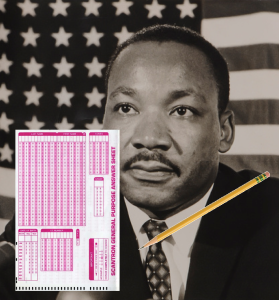
martin-luther-king-jr-small

“Daddy, I know who that is!”

“Who is it?”

“That’s Martin Luther King.”

“That’s right, Baby! Who was he?”

“We saw a movie about him today in school. He had a dream.”

Thus began a fascinating conversation I had with my seven-year-old daughter a few days ago.

I had been going through her book bag and found a picture of Dr. King blazoned above an article about his life.

“He wanted everyone to be nice to each other,” she said.

I laughed. My first grade scholar isn’t that far off.

“He’s one of my heroes,” I said. “He means a lot to me.”

“That’s silly,” she said. “He doesn’t have any super powers.”

Before I could reply, her attention shifted to her stuffed Yoshi doll. She began to play.

One of the best things about being a parent is getting to see the world anew through the eyes of your children. My little girl offers me this vantage point everyday.

Dr. King can’t be a hero. He had no super powers.

Or did he?

“I have a dream,” he famously said, “that my four little children will one day live in a nation where they will not be judged by the color of their skin but by the content of their character.”

It’s a simple wish. A simple insight.

Or is it?

Do we do that today? Do our schools?

As a middle school teacher, I’m well aware how our public schools judge our children, and it’s not by the content of their character. It’s by their standardized test scores.

High scores mean you’re learning. Low scores mean you’re not. And if you’re not learning, that’s your teachers fault and we’re going to close your school or turn it into a charter.

What’s worse, we’re going to do it because that ensures your civil rights.

That’s the story anyway.

Ever since rewriting the federal law governing K-12 schools began to be debated in earnest by Congress, the tale was told that high stakes testing is good for minorities. It makes sure schools aren’t neglecting them.

And now that the Every Student Succeeds Act (ESSA) has been passed, well-meaning people everywhere are wondering if we’re looking out for our black and brown brothers and sister enough – do we have enough federally mandated high stakes tests? Is there enough accountability?

After all, the new law potentially returns much of the power for education policy to the states. What if states don’t give as many tests? How will state legislatures ensure black students aren’t being neglected? Why would schools actually teach black kids if we don’t threaten to close them based on test scores?

These would be laughable questions if they weren’t asked in earnest. With such frequency. Even from some civil rights organizations.

Some things to consider:

1) The ESSA does absolutely nothing to limit standardized testing.

When Congress was rewriting federal education policy, parents, educators, students and experts of every stripe asked for a reduction in testing. It didn’t happen. Exactly the same number of tests are required under the ESSA as there were before it was passed – once a year in grades 3-8 and once in high school.

2) Punishing schools doesn’t help kids learn.

Once upon a time, it was the government’s job to provide schools with adequate resources to help kids master their lessons. Now it has become the government’s job to raise an arbitrary standard and shutter or privatize schools that fall below that mark.

This may come as a surprise, but no school has ever been improved by being closed. Students who are forced to relocate don’t suddenly do better. In fact, they usually do worse academically. Moreover, there is exactly zero evidence that charter schools do better than traditional public schools. In fact, the evidence points in exactly the opposite direction.

3) Standardized tests are poor assessments to judge learning.

Standardized testing has never been shown to adequately gauge what students know, especially if the skills being assessed are complex. The only correlation that has been demonstrated consistently is between high test scores and parental wealth. In general, rich kids score well on standardized tests. Poor kids do not.

Therefore, it is absurd to demand high stakes standardized testing as a means of ensuring students’ civil rights.

Judging kids based on these sorts of assessments is not the utopia of which Dr. King dreamed. We are not judging them by the content of their character. We’re judging them by the contents of their parents bank accounts.

There are real things we could be doing to realize racial and economic equality. We could do something about crippling generational poverty that grips more than half of public school students throughout the country. We could be taking steps to stop the worsening segregation of our schools that allows the effects of test-based accountability to disproportionately strike schools serving mostly students of color. We could invest in our neediest children (many of whom are minorities) to provide nutrition, tutoring, counseling, wrap around services, smaller class sizes, and a diverse curriculum including arts and humanities.

But we’re not doing any of that.

Why?

Because we’re too concerned about continuing the policies of test and punish. We’re too concerned about making sure huge corporations continue to profit off creating, grading and providing materials to prepare for annual standardized testing.

Dr. King may not have had super powers. But from his vantage point almost 50 years in the past, he saw through the lies of today’s education reform movement.

Standardized testing doesn’t protect civil rights. It violates them.

Our school policies for the past few decades have been about denying the right to an equitable education to our poor and minority students. Though the ESSA holds promise to limit federal meddling, it does nothing to change that. And all these people who cry foul at a potential loss of federal power are either ignorant or crying crocodile tears.

It’s no wonder that hundreds of civil rights organizations oppose high stakes testing. Nor is it surprising that the media rarely reports it. And it shouldn’t be a shock to learn that the overwhelming majority of civil rights organizations who have suddenly began championing testing are those who get big donations from the philanthro-capitalists pushing this agenda.

High stakes testing is a racist and classist policy. Period.


NOTE: This article was given a shout out on Diane Ravitch’s blog and published in the Badass Teachers blog.

Gadfly’s Choice – Top 5 Blogs (By Me) You May Have Missed from 2015

Screen shot 2016-01-02 at 11.01.09 PM

There are an awful lot of great blogs out there.

Especially if you’re into education. But many are telling the same story.

You don’t hear much about it in the mass media, yet our public schools are being systematically starved to death. They’re being set up to fail while the vultures of privatization and free enterprise drool over the corpse.

Phony philanthropists offer schools fake donations with more strings attached than Pinocchio and noses twice as long. To secure these financial “gifts,” schools are forced to pay out more than they receive for reforms that ultimately benefit the benefactor more than the beneficiary.

And even when these philanthro-capitalists are absent, our government is pretending to hold schools accountable by forcing them to enact these same unproven, disproven or counter-factual policies that actually make things worse. Then when these schemes fail, lawmakers use that as a justification to close schools and gift them to for-profit companies who squeeze every ounce of profit they can from what’s left while further cheating students out of resources.

It’s a scam, a heist, a racket – and you’re paying for it with your tax dollars.

But if you’ve been reading the plethora of excellent edu-blogs out there, you already know this.

Who writes about this public school shakedown? Often it’s the same teachers, parents, professors and bonafide education experts whom policymakers have excluded from the conversation.

As a public school teacher, myself, with more than a decade in the classroom, a masters degree and a national board certification, my empiricism and experience is not valued. So like many folks burdened with real-world knowledge, I write a blog.

In only a year and a half, I’ve had more than 487,000 hits and 9, 208 followers. In my last post I listed my 10 most popular articles from 2015.

Today I propose to continue a tradition I stole from fellow blogger Russ Walsh. I present not my most popular work, but 5 articles that deserve another look. Most of these didn’t receive massive public attention, but perhaps they should.

Please enjoy your humble gadfly’s choice.


5) Prejudice of Poverty: Why Americans Hate the Poor and Worship the Rich

2children

Published: Nov. 18

Views: 5,005

Description: America is rife with myths about the poor – mainly that the impoverished deserve their poverty. If they just worked harder, they wouldn’t be poor. Moreover, it’s a scam. The rest of us pick up the slack while they lounge around at home living better than we do. These are pernicious lies told with the certainty of truths. This article is my attempt to dispel these myths with facts.

Fun Fact: In my experience, often people are afraid to say certain things because they don’t want to appear racist. However, no such fear exists about sounding prejudiced against the poor, because few realize such bigotry even exists. It does. Big time.


4) Stories about Puerto Rican Resistance to Corporate Education Reform

Parents and Children Occupy Puerto Rican School Refusing to Let Corporate Vultures Raid Its Contents

(Aug. 22 – 1,551 hits)

In Puerto Rico, Students Go On Strike to Stop Teacher Relocations

(Sept. 25 – 1,211 hits)

Puerto Rico Teachers Plan One-Day Strike to Protest Corporate Education Reform

(Nov. 15 – 634 hits)

12050457_10153301043793152_183452142_o

Published: Aug. – Nov.

Views: 3,396 TOTAL

Description: The US territory of Puerto Rico is besieged by vulture capitalists encouraging damaging rewrites to the tax code while buying and selling island debt. Meanwhile hundreds of American private equity moguls and entrepreneurs are using the Commonwealth as a tax haven. As a result, tax revenues to fund public goods like education are drying up and hundreds of schools are being closed. However, the citizenry is putting up one of the most aggressive and successful resistance campaigns against corporate education reform in this hemisphere.

Fun Fact: For a while, few people on the mainland were talking about this – certainly not in the media. That appears to be slowly changing. There is so much we can all learn from Puerto Rico. We need each other.


3) Education Does Not Cure Poverty – It Cures Ignorance

Screen shot 2015-10-17 at 11.36.22 PM

Published: Oct. 18

Views: 3,080

Description: One of the biggest lies told by our national education policymakers is that schools alone can cure poverty. We don’t need an anti-poverty campaign. We just need to ensure people get a good education. This is baloney. The purpose of learning has never been to gain wealth or even teach how to gain wealth. It is and always has been about eradicating ignorance.

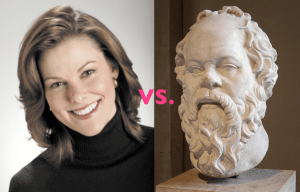
Fun Fact: If more people knew this, there would be no more high stakes testing, Common Core, etc. Also I’m kind of  partial to this article because of the image I made to go along with it. Campell Brown vs. Socrates!? That always makes me smile!


2) Do Americans “Throw Money” At Their Schools? A Fair Funding Primer

Screen shot 2015-07-06 at 11.05.59 PM

Published: July 9

Views: 1,372

Description: How many times have you heard someone complain about all the money we throw at our schools? It’s dismissive nonsense. We aren’t throwing anything. We INVEST in children. That money is not a waste. In fact, it is far from adequate for the job. This post is my attempt to explain the facts behind school funding. Please share.

Fun Fact: It is so nice to have all of this information in one place. I have tweeted, emailed, and posted this article to blowhards and ignoramuses more times than I can remember. Feel free to do the same.


1) We Shall Overcome… Our Lack of Standardized Tests!?

Screen shot 2015-07-19 at 12.34.34 AM

Published: July 19

Views: 628

Description: This is the newest myth being spread about standardized testing. Somehow high stakes assessments ensure that minorities civil rights don’t get violated!? It is exactly the opposite of the truth. Yet many of the more well-funded civil rights organizations suddenly began singing this tune over the summer. My article tries to explain why.

Fun Fact: Make no mistake. Many civil rights organizations still vehemently oppose high stakes testing. If we really want to stand up for our black and brown brothers and sisters, we need to stand with them and counter this AstroTurf narrative at every turn. Testing violates their rights, not protects them.

The Best Way To Honor Tamir Rice is by Reforming Our Broken Justice System

Memorial for Tamir Rice, 12-year-old shot dead by Police in Cleveland

Michael Brown – no indictment.

Eric Garner – no indictment.

Sandra Bland – no indictment.

And now Tamir Rice.

How many times will our justice system refuse to charge police with killing unarmed black people?

What will it take for our courts to accept the responsibility for at least attempting to seek justice?

When will our judicial system deem the death of people of color at the hands of law enforcement to at least be worthy of a trial?

Brown had no weapon but was shot to death by law enforcement.

Garner had no weapon but was choked to death by police.

Bland had no weapon but was found hanged in her jail cell after being assaulted by police during a traffic stop.

Rice had a legal pellet gun that was not pointed at anyone yet he was shot to death two seconds after police arrived.

This is not justice. This is a national travesty that continues to be played out daily. How many more human beings will be ground under the boot of a system that finds no value in their lives?

And don’t give me any of your excuses! Police were just doing there job! These people should have listened to law enforcement! Rice shouldn’t have had a pellet gun!

Listen to yourself. Lethal force is the only option!? Police have no tasers anymore, no pepper spray? Their guns only fire death strokes? They can’t hit non-vital areas meant to incapacitate but not kill?

What a bunch of cowards we are if we don’t demand police publicly explain themselves when they kill another human being – especially someone who posed them no bodily harm! How morally and spiritually bankrupt a nation we are not to weigh the evidence and decide guilt or innocence! “Freedom and justice for all!?” What a sham! What a lie! What a farce!

I don’t know about you, but I am sick of it. I refuse to put up with it for even one more day.

But what can we do?

No. Really.

When reading about these government sanctioned murders, I feel helpless. I’m just one person. What can I do to stop it?

Here are a few suggestions:

1) Ban Grand Juries in Fatal Shootings by Police

Connecticut and – most recently – California already have laws to this effect. District attorneys should have to decide whether officers face criminal charges when they kill people in the line of duty. This decision should be made in the light of day in full view of the public and not behind the closed doors of a grand jury hearing. These hearings involve no judges or defense attorneys and the transcripts of these proceedings are almost always sealed.

The problem is that district attorneys work closely with police and depend on them for political support. Sending cases like these to a grand jury gets the DA off the hook so he or she doesn’t offend the officers.

If the decision had to be made in public, voters could hold DAs accountable. With the grand jury system, there are no consequences because we have no concrete evidence about what happened during the proceedings, what arguments were made, by whom and who made what decisions. That’s a poor breeding ground for justice.

2) Construct a National Database on Police Killings

Right now there is no way to tell exactly how many people are killed by law enforcement in this country every year. Moreover, there is no way to tell if officers involved in these killings were ever charged.

Information can be compiled state-by-state, often through unofficial and anecdotal sources. However, this does not nearly give the full picture of what is going on. The people of this country deserve to know the full scope of the issue. That’s why apologists often claim these sorts of incidents are relatively rare and blown out of proportion by the media. But are they? A national database would prove the matter one way or the other.

Federal law from 1994 already calls for just such a database, yet it has not been funded. This may be due in part to the cost. A pilot study found that it would take a decade and cost $1 billion.

Certainly this is not a quick fix. But don’t we deserve to know this information? And isn’t it suspicious that nothing is being done to compile this data now?

3) Overturn Graham v. Connor

Perhaps the biggest obstacle to seeking justice for those unnecessarily killed by police is a precedent set by the U.S. Supreme Court 25 years ago. Graham v. Connor effectively ruled that police can kill you if they feel you present a “reasonable” threat to their own lives.

The problem is the word “reasonable.” What does that mean? In court, it can be almost anything. It’s a “Get Out of Jail Free” card to police for wanton murder. Justice Sonia Sotomayor calls this a “Shoot first, think later” approach to policing. She says this violates the Fourth Amendment which stipulates what counts as “probable cause” for police actions including arrests. However, Sotomayor is the only sitting justice publicly to take this stance.

This is why without more robust protections for citizens and more realistic expectations for law enforcement, even when cases like these go to court, they rarely result in police convictions.

But courts change. Public opinion can move mountains if given enough time. We need to start putting on the pressure.

Organize, people. Start writing letters. Write petitions. Hold rallies. Meet with your Congress-people. Make some noise.

In the meantime, let us grieve for all the Browns, Garners, Blands and Rices.

Their lives matter. And the best way to prove that is to get off our collective asses and do something about it.


NOTE: This article also was published on Commondreams.org.


Department of Education SorryNotSorry About High Stakes Testing

Screen shot 2015-10-24 at 11.04.43 PM

The Obama Administration must think the nation’s parents, teachers and students are pretty darn dumb.

President Barack Obama and his hand-picked Department of Education are solely responsible for the knuckle dragging academic policies strangling our public schools day in, day out. Yet instead of doing anything to reverse course to proven methods that might actually help kids learn, the department trudges out its annual apology.

It goes something like this:

Hey, Everybody! So sorry about all those high stakes tests, Common Core Standards and Value-Added teaching evaluations. We know they’re bad and we’re going to stop.

Then whatever functionary drew the shortest straw toddles back into the building and for the rest of the year things continue on exactly the same as they always have.

Let’s just pause for a moment and imagine how incredibly stupid they must think we are. I’m surprised they don’t issue public service announcements reminding us to exhale, multi-colored pamphlets on the benefits of blinking, and puppet shows instructing us how to use the potty.

The Obama Administration has had 7 years to fix this mess, and the only things they’ve done are to make it worse. Most of us voted for this so-called progressive because we thought he’d improve upon George W. Bush’s astoundingly wrongheaded school policies. But instead he doubled down on them! We hired a competent janitor but he was successful only in creating greater disorder.

We thought someone with the intelligence and grace of Barack Obama would be able to understand more than the eternal C-student Bush that you can’t ensure equity by standardized testing. That’s like trying to ensure a bathtub was filling with hot water by using nothing but Tarot Cards. The cards don’t give you an accurate reading and even if they did, you’d need to adjust the faucet at some point!

We thought a Constitutional scholar would understand that a national school curriculum violates federal law – even if you get a faux state commission to propose it and slap a new name on the thing! The federal government is allowed to do some things and state governments are allowed to do others. It’s not that hard. Moreover, armchair generals who have zero understanding of educational pedagogy, psychology, sociology and no classroom experience have no business telling teachers what they should be teaching!

We thought a political party that claims to be on educators’ side wouldn’t then turn around and initiate a witch hunt against us using poor student test scores instead of pitch forks and torches. Every independent, peer-reviewed study shows that poor kids do badly on standardized assessments and rich kids do well. Every statistician says you can’t use a test created to measure one thing (students) to measure another (teachers). Yet this is exactly what this so-called intellectual president mandates, and then he and the Democrats expect us to be there for them at the polls!?

In short, we expected a liberal Democrat, but got instead a Conservative Democrat in Name Only (DINO). He took far right ideas that Bush could barely officiate and made them much more efficient and thus much more damaging.

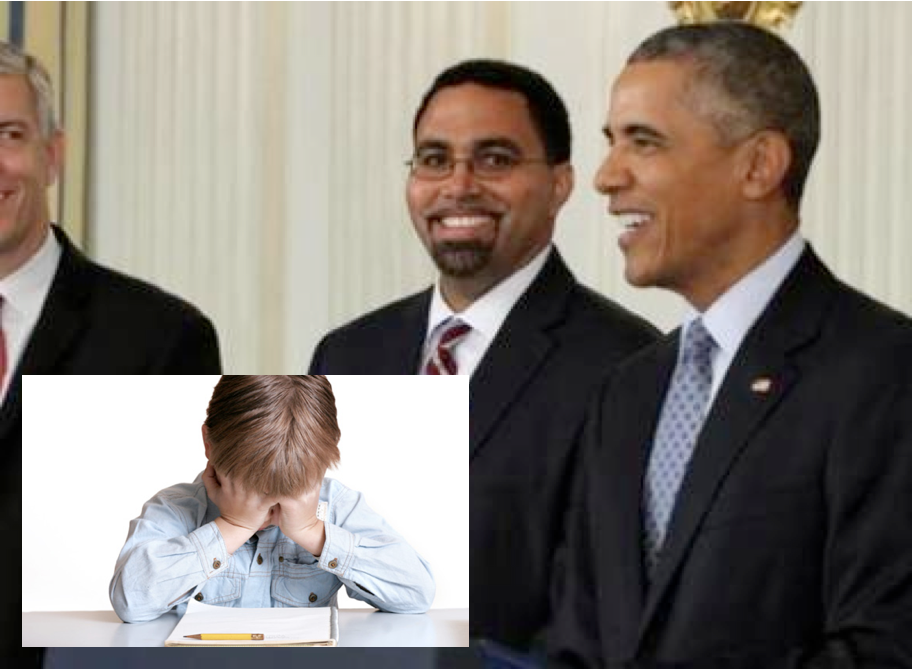
And every year like an alcoholic stumbling off a bar stool, the administration swears they’re not going to take another drink. Then they hire the head of Anheuser-Busch (John King) as a nutritionist. And some of us still believe them!

Just look at the crumbs they’re throwing out to us, peons!

Hey, Girl. We’re going to cut testing down to 2% of the school year.

That’s 23 hours! Almost 3 full days! Imagine if the dungeon master told you he was only going to put you on the rack for 2% of the time! Would you thank him? Maybe, but it would be a pretty half-hearted thank you.

Can the administration prove any positive value for standardized testing? I’m not asking them to trot out the tired party line about equity. I mean can they prove that testing actually helps children learn in any appreciable way? If the answer is no (and Spoiler Alert: it is!) then we shouldn’t be wasting any more time with it. Not 2%. Not 1%. ZERO PERCENT!

Moreover, Obama has been talking about reducing testing since he ran for office in 2008. America’s schools are still waiting for him to come through on that one. Maybe on his last day in office we’ll have a testing moratorium. Fingers crossed!

The department says, “The assessments must be worth taking.” No shit. That’s exactly the problem! They aren’t! And they’re shrouded in secrecy under the guise of test corporations intellectual property. How will we be able to determine they’re “worth taking”? Will you just tell us? THAT sure puts my mind at ease!

You know what assessments have been proven worth taking? The ones created by teachers. Yet these are exactly the kinds of tests that schools have been forced to cut back on. Perhaps this is what the administration has in mind. No more teacher-created tests. Let’s just have tests made by the professional test creators who have no idea what the heck they’re doing!

And speaking teachers, this one’s for you: “No standardized test should ever be given solely for educator evaluation.” It sounds like a condemnation of Value-Added Measures (VAM), of evaluating teachers on student test scores. However, it’s just the opposite. Notice the word “Solely.” We’re not going to give kids tests if we ONLY use them to evaluate their teachers. Well woop-de-do! Professional flunkies will talk to you for hours (if you pay them enough) about how great the tests we give now are at doing both! So no change in policy, just some purple prose to light on fire and blow the smoke up educators hind ends.

Perhaps worst of all is the use of English Language Learners (ELL), students with disabilities and minorities as props. We’re doing it all for them, they say. Bull! Shit!

The administration has nothing to say about fully funding the Individuals with Disabilities Education Act (IDEA). There’s nothing about sanctions on districts that don’t provide proper services for ELLs. There’s nothing about ensuring adequate, equitable and sustainable funding for all students – especially the poor and minorities. Instead the Department of Education pretends like high stakes tests are candy bars and what poor disadvantaged minority ELL disabled kid doesn’t love the soft velvety chocolate taste of a multiple choice test!?

This announcement is not reason to celebrate. It’s more of the same fake apologies soaking wet in crocodile tears and bad candor.

If Hillary Clinton wants to get elected President, she’d better do more than that. If Bernie Sanders wants a shot, he’d better do more than spout socialism about Wall Street and silence about K-12 schools.

You can only lie to our faces for so long. Despite your best attempts to trash public education in the name of saving it, we’re not so dumb as to believe any more of your evasions, deceit and dishonesty.


NOTE: This article also was published on the Badass Teachers Association blog.


White Fragility Frames the Media Narrative of the Million Man March Forward

12139070_1233888909971346_1493116541_n

White people will go a long way to avoid talking about racism.

Not only does it seem invisible to most melanin deficient folks like myself, but we refuse to acknowledge it when someone tries to bring it to our attention.

That’s not racism. There is no racism. Stop stirring up trouble.

Unless someone is wearing a white sheet and burning a cross on a black person’s lawn, most Caucasians close their eyes, stick their fingers in their ears and stay willfully blind.

Sociologists call this White Fragility, and it was on full display in the media response to the Million Man March Forward on Saturday.

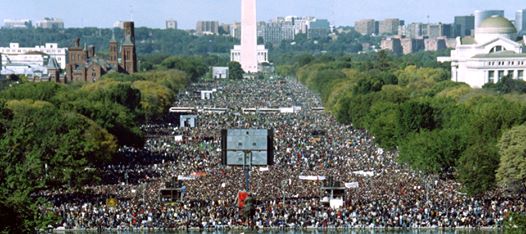
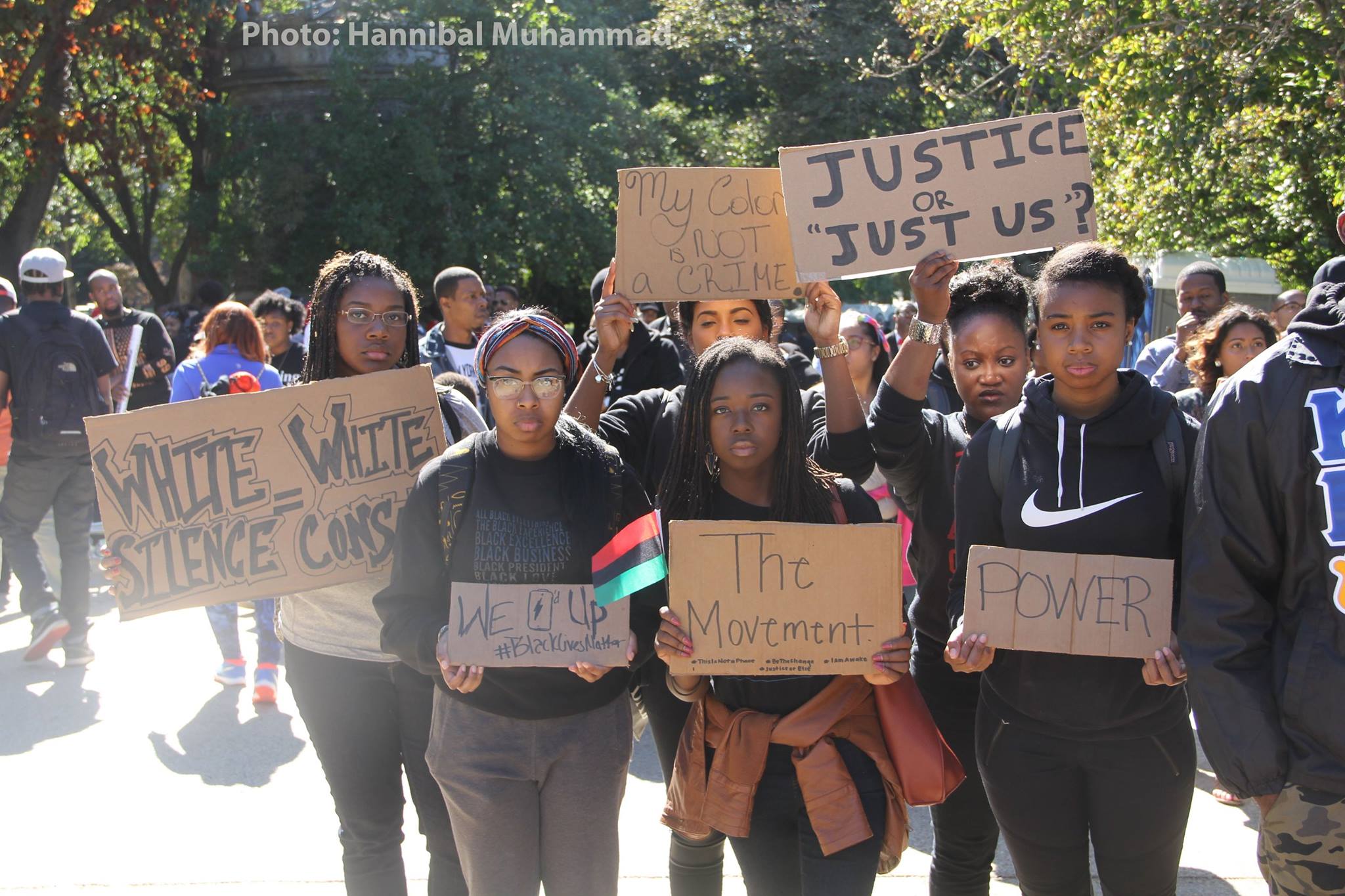
Thousands of African Americans and a smattering of people of other races and ethnicities gathered in the National Mall in Washington, D.C., to demand “Justice or Else” and commemorate the 20th anniversary of the original Million Man March.

Like during that 1995 gathering, today’s media was quick to frame the narrative in a way that silenced legitimate black concerns while benefiting White America.

First, most media outlets refused to cover the event at all. I guess to them there was nothing newsworthy going on. Just tens of thousands of black folks gathering in the nation’s capital. No saggy pants. No guns. Nothing to see here.

When the mainstream news covered it at all, it was to minimized its importance. Short articles basically saying – Here were some black people. Remember that time they did this before? In other news…

I remember the first march back in the 90s. I wasn’t there, but I remember how white folks talked about it. At first there was a genuine fear – black people with a united purpose coming together to better their social standing!? But we quickly found a way to negate everything they were doing.

How? Math.

Har! Har! Look at all those black folks gathered in front of the Capital steps. They held a Million Man March and didn’t even get a million men!

And therefore by the logic of white fragility we can ignore everything they did and said.

Institutionalized racism? Sorry not a million people!

Racial prejudice in hiring and firing employees? Not a million. Can’t hear you!

Police brutality? Come back when you’ve got more people!

12087324_1675832909318901_8512279402781528158_o

Of course it’s still a major point of contention exactly how many bodies showed up that first time. Estimates of the original rally put between 400,000 to 2 million folks on the scene. Unsurprisingly white people almost always go with the smaller number. I guess they don’t think black people can count that high.

But what if the lower estimation is true? Is there some racial math that bestows relevance on a moral crusade based only on sheer numbers? Is it okay to deny a handful of people their rights, a thousand or even a hundred thousand – but somehow a million is the tipping point where I have to say “No more”?

Even if only hundreds of thousands of people showed up, that’s something. Quite a lot, really. Doesn’t that demonstrate an attempt at racial unity, at addressing a shared list of problems? After all, how many people need to attend for White America to take them seriously?

This weekend journalists were careful not to make estimates of the number of attendees at the March Forward. But they’d subtly state that it was less well attended than the previous rally which – given the pictures I’ve seen of both events and the above mentioned disparity – seems somewhat hard to corroborate.

Still the media didn’t stop there. They found other ways to invalidate the event.

For instance, who is leading these marches? The Nation of Islam? Louis Farrakhan? Oh my! White people don’t approve of that! Therefore the whole gathering is unjustified. Poof!

Funny how that works. Black leaders must be perfect. White leaders? Not so much. George W. Bush was a C-student. Bill Clinton had extramarital affairs. Both men served as two-term presidents, and somehow the Republicans and Democrats go on.

Finally there was the rhetoric. This rally was subtitled “Justice or Else.”

That just won’t do. Angry black people demanding justice? No, white people simply will not respond to that kind of tone. If only they had been more polite about it, we might listen, but “Justice or else”!? Nope.

Any rational human being should be able to comprehend why black folks are demanding justice; They aren’t getting much of it from our courts. Unarmed black people are increasingly being murdered by the police and white citizens which prompts the debate of whether a crime has even been committed – a debate in which the answer is often, “No.”

The Black Lives Matter movement has grown because of just such concerns and the group was even represented at the rally.

But white folks – in the guise of analysis – ask what that phrase means “justice or else.” Are black people threatening to attack white people if they don’t get justice? What justice is there beyond a court of law? Do they really expect us to change our laws and hold our courts accountable?

No. Nothing to see here, folks. This throng of humanity peacefully assembling clearly has no valid points to make. Turn the cameras off. Let’s go home.

But had these thousands suddenly thrown bottles, overturned cars or started fires, the spot light would have been turned on full force.

“Another black riot,” newscasters would have proclaimed with glee. CNN would have devoted 24-hour news coverage. Expensive graphics would show the exact extent of the damage between interviews with scared white folks wondering why black people were allowed to misbehave so!

But a peaceful rally of African Americans coming together to share their pain, commemorate their history of struggle and commit to solutions?

Who cares about that? It doesn’t fit the media narrative. It doesn’t help white people ignore their black brothers and sisters problems. It doesn’t help our system of white supremacy remain invisible.

As a representative of the white race, may I make a suggestion? Could we possibly consider listening to what these people have to say? And before rejecting it out of hand, might we look at it objectively and even find a valid point or two? Could we then try to offer our black brothers and sisters a hand?

But the answer is always the same from white folks. Excuse after excuse to ignore, reject, repulse and keep our fragile white eyes firmly shut.

12105954_10106301025970309_961760835270051441_n


NOTE: This article also was published in the LA Progressive and on the Badass Teachers Association blog.


White People Need to Stop Snickering at Black Names

baby-and-parents

As a public school teacher, few things give me as much anxiety as getting my student rosters for the first time.

I look over the list of names for my incoming children and cringe.

How do I pronounce that?

Every year it never fails – there’s always at least four or five names I’ve never seen before – or at least never spelled quite like THAT!

As a white teacher in a district with a majority of black students but very few black teachers, there’s not really many people to turn to for guidance.

And if I don’t figure it out soon, I’ll be making a pretty terrible first impression. No one likes to have their name butchered, especially children, especially if an adult is doing it, especially if that adult is white.

The only solution I’ve found is to soldier on with the first day’s attendance and just try my best:

Me: Shah-NEE-Qwa?

Child: Shah-NAY-Qwa.

Me: JAY-Marcus?

Child: JAH-Marcus.

It’s uncomfortable, but I get through it and eventually learn.

However, one thing I’ve stopped doing is going to other white people for help. That’s a recipe for disaster.

It almost always turns into an exercise in subtle racism and white supremacy. No matter who the person is, no matter how kind, caring or empathetic, the reaction to unique black names is most often derision.

White people snicker and use the situation as the impetus for telling stories about other black names that they thought were even more outrageous.

It’s not that we’re trying to be hateful. I don’t think we even recognize it as racist, but it is.

We use the situation as an opportunity for bonding. THOSE people who are not like you and me – THEY name their children things like THIS! Not like you and me who name our children more respectably.

Make no mistake. This is racist behavior. We are emphasizing the otherness of an entire group of people to put ourselves over and above them.

It’s bigoted, discriminatory, prejudicial and just plain dumb.

What’s wrong with black names anyway? What about them is so unacceptable?

We act as if only European and Anglicized names are reasonable. But I don’t have to go far down my rosters to find white kids with names like Braelyn, Declyn, Jaydon, Jaxon, Gunner or Hunter. I’ve never heard white folks yucking it up over those names.

I can’t imagine why white people even expect people of color to have the same sorts of names as we do. When you pick the label by which your child will be known, you often resort to a shared cultural history. My great-great-grandfather was David, so I’ll honor his memory by calling my firstborn son the same. Jennifer is a name that’s been in my family for generations so I’ll reconnect with that history by calling my daughter by the same name.

Few black people in America share this same culture with white people. If a black man’s great-great-grandfather’s name was David, that might not be the name he was born with – it may have been chosen for him – forced upon him – by his slave master. It should be obvious why African Americans may be uncomfortable reconnecting with that history.

Many modern black names are, in fact, an attempt to reconnect with the history that was stolen from them. Names like Ashanti, Imani and Kenya have African origins. Others are religious. Names like Aaliyah, Tanisha and Aisha are traditionally Muslim. Some come from other languages such as Monique, Chantal, and Andre come from French. I can’t understand why any of that is seen as worthy of ridicule.

Still other names don’t attempt to reconnect with a lost past – they try to forge ahead and create a new future. The creativity and invention of black names is seldom recognized by White America. We pretend that creating names anew shows a lack of imagination when in reality, it shows just the opposite!

Creating something new can be as simple as taking an Anglicized name and spelling it in inventive ways. Punctuation marks also can be utilized in unusual positions to add even more distinctiveness such as in the names Mo’nique and D’Andre.

At other times, they follow a cultural pattern to signify as uniquely African American using prefixes such as La/Le, Da/De, Ra/Re, or Ja/Je and suffixes such as -ique/iqua, -isha, and -aun/-awn.

And for the ultimate in creativity, try mixing and matching various influences and techniques. For instance, LaKeisha has elements from both French and African roots. Other names like LaTanisha, DeShawn, JaMarcus, DeAndre, and Shaniqua were created in the same way.

This is something all cultures do. They evolve to meet the needs of people in a given time and place. Yet when it comes to people of color, we, white folks, whoop and guffaw at it. Heck! When we can’t find black names far enough out of our mainstream, we even make them up!

Don’t believe me? Have you heard of La-a? The story goes that a black girl was given that name and a white person asked how it was pronounced. The black woman said her name was La-DASH-ah. This is often followed by a punchline of black vernacular.

Har! Har! Har!

But it’s not even true! According to Snopes, this is a made up story. It’s the American version of a Polish joke and demonstrates how far white people will go to laugh at black culture.

The great comedy duo Key and Peele tried to call attention to this in their outstanding substitute teacher sketches. In a series of short routines, an almost exclusively white classroom gets a black substitute teacher from the inner city schools. Mr. Garvey is expecting black names, so he pronounces the students’ middle class white names as if they were African American.

Almost everyone loves this sketch. It gets universal laughs, but wait until it’s over. Too many white folks try to continue the giggles by then talking about crazy black names they’ve encountered. But that’s not at all the point Key and Peel were trying to make! They were trying to show how cultural context shapes our expectations of proper names. Mr. Garvey is worthy of our laughter because his expectations are out-of-sync with his surroundings. When we expect all African Americans to have European or Anglicized names, we’re just as out of touch as Mr. Garvey. But like Dave Chapelle’s comedy, sometimes the person laughing the loudest is getting something the comedian didn’t intend at all.

Maybe it wouldn’t be so bad if black names just generated snickers. However, white culture actually selects against people with black sounding names.

Countless studies have shown how much more difficult it is for someone with a black sounding name to get a job, a loan or an apartment than it is for someone with a white sounding name. It’s one of the most obvious features of white supremacy. You may not like black names, personally, but do these people deserve to suffer for embracing their own culture?

Moreover, having a European or Anglicized name is no guarantee of fair treatment. It certainly didn’t help Michael Brown or Freddie Gray.

If we’re really going to treat people equitably, an easy place to begin is with black names. White people, stop the laughter and giggles. I used to do it, myself, until I thought about it. Yes, I’m guilty of the same thing. But I stopped. You can, too.

It’s not the biggest thing in the world. It’s not even the most pressing thing. It’s not a matter of guilt. It’s a matter of fairness.

Because when the final role is taken of all America’s racists and bigots, do you really want your name to be on it?


NOTE: This article also was published on Everyday Feminism and the Badass Teachers Association blog.

Why You Should Thank Harper Lee for Tearing Down Your Childhood Hero

Screen shot 2015-08-27 at 10.47.03 PM

It’s been more than 50 years since Harper Lee published her Pulitzer Prize winning novel “To Kill a Mockingbird.”

In that time, a lot has changed and nothing has changed.

Our schools are still highly segregated and unequal – but we justify that with standardized test scores. Our prisons are still disproportionately filled with black and brown people – but we justify that with the War on Drugs. Racial minorities are still gunned down in the street while their killers get off scot-free – but we justify that with a dysfunctional justice system.

Yes, we have our first black president but most people of color still live under the shadow of white privilege and a government sanctioned caste system.

Now comes “Go Set a Watchman” a book Lee wrote before “Mockingbird” but that works best as a sequel.

Does it matter? Is it still relevant?

I’d say yes.  After all, the original was written as people across the nation were struggling to overthrow the old racist system. And today many of their grandchildren and great-grandchildren are still engaged in that same struggle.

In a world where the majority cling desperately to colorblindness, it’s refreshing to read a book that proclaims black lives matter – even if it was written in the 1950s.

The most striking thing about the new novel is its portrayal of Atticus Finch. In “Mockingbird” he’s described as the quintessential hero – a white lawyer putting himself at great personal risk in a doomed attempt to defend an innocent black man. In “Watchman” Atticus is… well… a bit of a racist.

He’s 20 years older, has joined a neighborhood committee dedicated to keeping the races separate and we learn that at one time he had even been a member of the Ku Klux Klan.

How can we reconcile THIS Atticus with the one we remember from our childhoods? Is it even worth trying? Is the book worth reading?

Let’s start with the book’s literary value. Questions abound about its publication. Lee, 88, lives in a nursing home and is reportedly in ill health. After all this time, did she really want this book out there now or is that the result of overzealous publishers who know any book with her name on it will be a best seller? Moreover, her sister, Alice, served as a protector of Harper’s legacy but almost as soon as she died, the book was slated for publication.

And when you actually crack it open, it’s clear that certain passages are almost identical to others in “Mockingbird.” You can see how the one book lead to the other. Moreover, there are places that could use expansion and others that could use a bit of editing.

However, despite its shortcomings, from the first page to the last “Watchman” is like returning home to Maycomb County.

In the first chapter, we share a 20-something Jean Louise’s excitement on the train from New York south to visit her family, because we want to see these people again, too. Unlike a simple rereading of the classic “Mockingbird,” this time the characters have grown, changed and act in unexpected ways. Like our protagonist, though, we’re in for many a rude awakening.

Scout’s brother, Jem, is dead, and his absence is felt throughout most of the book. At first, I was angry about this. I thought it was simply bad writing, trying to artificially limit the characters. But then I realized Lee had already set up Jem’s demise back in “Mockingbird.” After all, their mother died around the same age from a heart attack – a congenital defect on her side of the family.

Jem’s absence is irksome because it’s real. Too many times in life people who mean so much to us just disappear leaving a hole never to be filled again.

Likewise, Dill is hardly to be seen. However, this shouldn’t be surprising. Both books are semi-autobiographical and his character is modeled after Harper’s childhood friend – Truman Capote. In the novel just as in life, our heroine, Scout/Harper, and Dill/Truman grew apart.

In his place we get Hank – a character never mentioned in “Mockingbird” but who apparently was around – somewhere. He serves as Scout’s boyfriend. Though he’s drawn a bit vaguely, through him we get to see the kind of woman Jean Louise has grown into.

The Scout of “Watchman” is different than her 6-8-year-old self, too. But it’s easy to see how the little girl of the previous book could become the intelligent but restless woman in this text.

Calpurnia is much changed. She no longer works for the family. In fact, she seems to have enclosed herself in the Quarter – the part of town where only the black people live.

With the U.S. Supreme Court ruling in Brown vs. Board of Education,  Maycomb’s black folks seem much less inclined to smile and nod and serve every passing whim of white people. They have an inkling that maybe things could be different, that maybe they’re entitled to equal rights, after all. And these new possibilities come between Jean Louise and the woman who raised her more than any other.

Calpurnia is the one who explained to her what it means to be a woman. She explained everything from menstruation to sexual intercourse. Yet these new possibilities in social justice make it impossible for the two women to have a proper homecoming.

I wonder: would Jean Louise really not begrudge Calpurnia all the rights and privileges she so easily expects as her own right? It’s hard to say but still very sad.

On the other hand, Aunt Alexandra hasn’t changed much. She’s still disapproving, tyrannical yet emotional. Likewise, Uncle Jack is much the same. He’s grown more eccentric but it’s easy to recognize the friendly doctor who bandaged Scout’s hand after she punched her cousin for calling her father a racial epithet in “Mockingbird.” And neither does Atticus seem drastically different at first. He’s older and suffers from terrible arthritis. But at first glance he’s the same caring, wise paternal figure of our remembrances.

For about 100 pages the book is a mostly meandering return to a world we never thought we’d see again. Then everything changes with the bombshell of Atticus’ recent pro-segregation activities.

How can it be possible? Can this really be Atticus Finch? Or is this just bad writing?

We know the character is based on Harper’s own father, Amasa Lee. Is this really more of a portrait of the real man than the fictional one?

It’s hard to say. But as we read on it becomes clear that, yes, this is still the Atticus we remember. But we didn’t know him as well as we thought.

(WARNING: Limited spoilers ahead.)

The heart of the novel is when Jean Louise confronts her father about his seemingly new attitude. In typical Atticus style, he argues with her almost like he was defending himself in court. Some of his defense makes a weird kind of sense. He says he briefly joined the Klan just to see who was behind those hoods. He wanted to know whom he was dealing with. Moreover, his participation in this segregation society was to serve as a moderating influence. He wanted to make sure they didn’t get up to too much trouble.

But this is only half an answer. As he continues, it becomes clear that Atticus actually does believe some of the racist rhetoric of his times. He really doesn’t want black people and white people to be put on an equal footing. He justifies this by saying black people aren’t ready yet. They haven’t been prepared for the rights and privileges of white folks. Maybe some day they will be, but not today.

It’s a disgusting and patronizing argument – infantilizing an entire people. And hearing this out of Atticus mouth – it’s like seeing a spider crawl across a gorgeous face.

Similarly creepy is his appeal to state’s rights – an argument we still hear today from our Tea Party friends. Perhaps it WAS Southern white people’s responsibility to raise up the people of color in their midst – but if they weren’t going to do it, it was past time that someone did!

Scout doesn’t let her father get away with any of this. She does her best to verbally destroy him and run away forever.

But before she can escape, she runs into her Uncle Jack. What he does is equal parts rationality and sexism. I can’t imagine any modern author resolving the story this way. Perhaps that’s for the best. In some ways, Uncle Jack’s actions are more disturbing than Atticus’ opinions.

In the end, Scout learns to accept her father for who he is. Yes, he is dead wrong about black people, but most of the time he’s still the same loving Atticus. It’s a good point. How many people do you love who believe reprehensible things? Probably a lot. That doesn’t mean you stop loving them.

I’d say that’s the central point of the novel. Each of us is responsible for creating our own conscience. We can’t rely on any value system that comes to us prepackaged. We have to examine every facet of our worlds and decide what it is we truly believe. And in doing so we’ll probably reach divergent opinions.

The only way Lee could do that was by showing us the heroic Atticus as nothing but a flesh and blood human being, full of the same frailties and mistaken thinking.

In the end, Scout’s thoughts seem more modern than anyone else’s in the book, more in line with our own views about social justice. But her conclusion only goes so far. We’re still left with questions. How do we reach loved ones who disagree with us? How can we tell if our own ethical intuitions are correct? How can white folks best help people of color secure their rightful place in society?

None of these have answers, but Lee is still asking the right questions. More than 50 years later, we’re still searching for solutions.

Parents and Children Occupy Puerto Rican School Refusing to Let Corporate Vultures Raid Its Contents

Screen shot 2015-08-22 at 9.09.36 AM

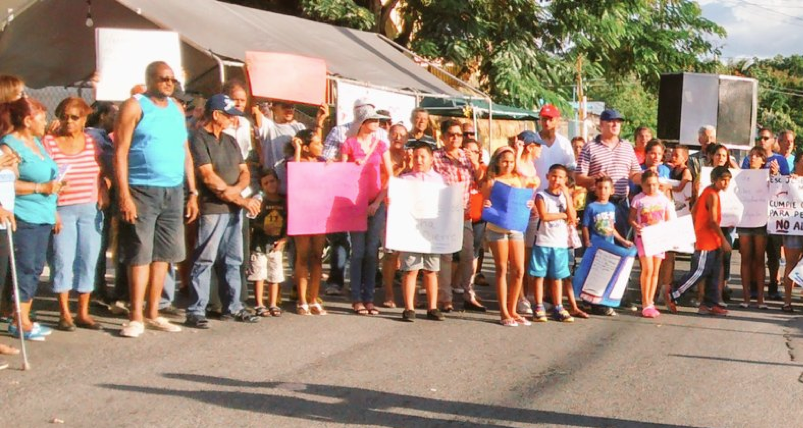
For more than 80 days, about 35 parents and children have been camping out in front of their neighborhood school in the U.S. Territory of Puerto Rico.

The Commonwealth government closed the Jose Melendez de Manati school along with more than 150 others over the last 5 years.

But the community is refusing to let them loot it.

They hope to force lawmakers to reopen the facility.

Department of Education officials have been repeatedly turned away by protesters holding placards with slogans like “This is my school and I want to defend it,” and “There is no triumph without struggle, there is no struggle without sacrifice!”

Officials haven’t even been able to shut off the water or electricity or even set foot inside the building.

The teachers union – the Federación de Maestros de Puerto Rico (FMPR) – has called for a mass demonstration of parents, students and teachers on Sunday, Aug. 23. Protesters in the capital of San Juan will begin a march at 1 p.m. from Plaza Colón to La Fortaleza (the Governor’s residence).

11212175_538567642948296_6542092169551987830_o

The schools being closed are all in low income areas, said union president Mercedes Martinez. “This is detrimental to education, because the necessities of the community, the investment in infrastructure in recent years, the technology, have not been taken into consideration, and neither the parents nor the teachers have been consulted.”

The Jose Melendez de Manati school, for instance, served students 92% of whom live in poverty.

Now that the building has been closed, parents say they can’t afford the cost to transport their children to a new school miles away. And those schools that remain open have been forced to make drastic cuts to remain functional. Class sizes have ballooned to 35 students or more. Amenities like arts, music, health and physical education have typically been slashed.

Why?

The island territory is besieged by vulture capitalists encouraging damaging rewrites to the tax code while buying and selling Puerto Rican debt.

Hundreds of American private equity moguls and entrepreneurs are using the Commonwealth as a tax haven.

Since 2012, U.S. citizens who live on the island for at least 183 days a year pay minimal or no taxes, and unlike those living in Singapore or Bermuda, they get to keep their U.S. passports. After all, they’re still living in the territorial U.S. These individuals pay no local or federal capital gains taxes and no local taxes on dividend interest for 20 years. Even someone working for a mainland company who resides on the island is exempt from paying U.S. federal taxes on his salary.

puerto_rico_teachers_strike.jpg_1718483346

Big corporations are taking advantage of the situation, too.

Worldwide, American companies keep 60 percent of their cash overseas and untaxed. That’s about $1.7 trillion annually.

Microsoft, for instance, routes its domestic operations through Puerto Rican holdings to reduce taxes on its profits to 1.02 percent – a huge savings from the U.S. corporate tax rate of 35 percent! Over three years, Microsoft saved $4.5 billion in taxes on goods sold in the U.S. alone. That’s a savings of $4 million a day!

Meanwhile, these corporate tax savings equal much less revenue for government entities – both inside and outside of Puerto Rico – to use for public goods such as schooling.

Public schools get their funding from tax revenues. Less tax money means less money to pay for children’s educations. As the Puerto Rican government borrowed in an attempt to shore up budget deficits, the economy tanked.

But have no fear! In swooped Hedge Funds to buy up that debt and sell it for a profit.

When this still wasn’t enough to prop up a system suffering from years of neglect, the Hedge Fund managers demanded more school closures, firing more teachers, etc.

Of course, this is only one interpretation of events.

If you ask Wall Street moguls, they’ll blame the situation on declining student enrollment. And they have a point.

Some 450,000 people have left the island in the last decade as the economy suffered an 8-year depression.

There were 423,000 students in the Puerto Rican school system in 2013. That’s expected to drop to 317,000 by 2020.

But is this the cause of the island’s problems or a symptom?

Unfortunately, things look to get much worse before they’ll get any better.

The government warns it may be out of money to pay its bills by as early as 2016. Over the next five years, it may have to close nearly 600 more schools – almost half of the remaining facilities!

Right on cue, Senate President Eduardo Bhatia is proposing corporate education reform methods to justify these draconian measures. This includes privatizing the school system, tying teacher evaluations to standardized test scores and increasing test-based accountability.

“Our interest is to promote transparency and flow of data through the implementation of a standardized measurement and accountability system for all agencies,” Bhatia said, adding that the methodology has been successful in such cities as Chicago.

Despite such overwhelming opposition, protesters are taking the fight to the capitol. “Tax the Rich!” is a popular slogan on signs for Sunday’s march.

11029506_1679179132316825_4270916741405376334_n

“It’s unacceptable that the rich and powerful that created our crisis are the ones asking the working class for more sacrifices,” said Martinez.

“The foreign companies that pay no taxes or a less amount to evade paying their due in contributions – impose a tax on them now!”

This is just a beginning, she adds. Stronger actions will be coming.

In the meantime, those brave parents and children still refuse to give up their shuttered school.

They dream of a day when that empty building once again rings with the laughter of students and the instruction of teachers.

In a country being used by the wealthy to increase their already swollen bank statements, is that really so much to ask?


You can show your solidarity with these Puerto Rican protestors by spreading the word through social media. Post a picture of yourself with a sign saying you’re with them in their fight. Tweet the Commonwealth Secretary of Education @Rafaelroman6. Use the hashtags #EducacionEnPR #SOSdocente.

NOTE: This article was mentioned on Diane Ravich’s blog and was also published on CommonDreams.org and the Badass Teachers Association blog.