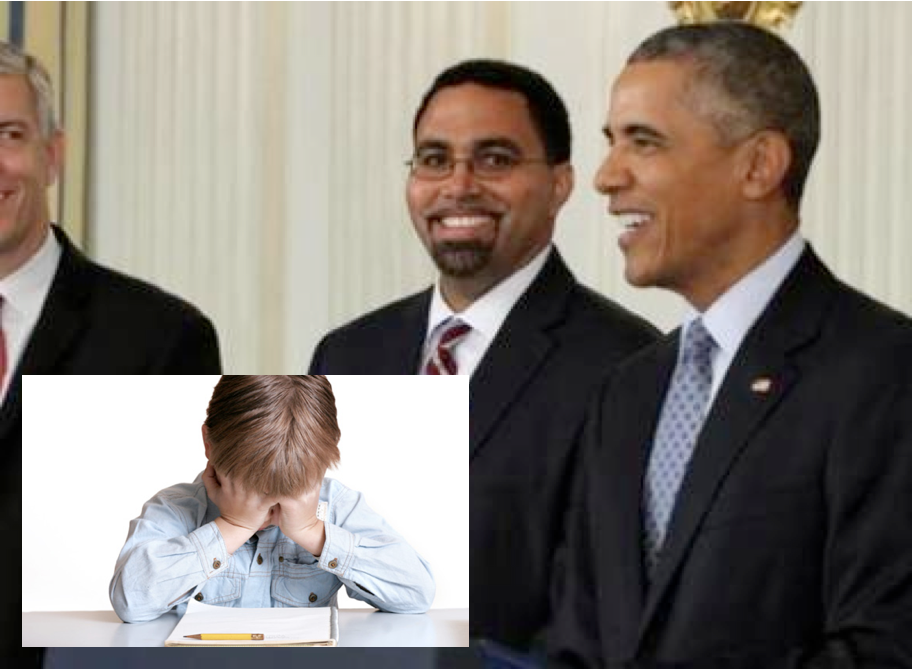
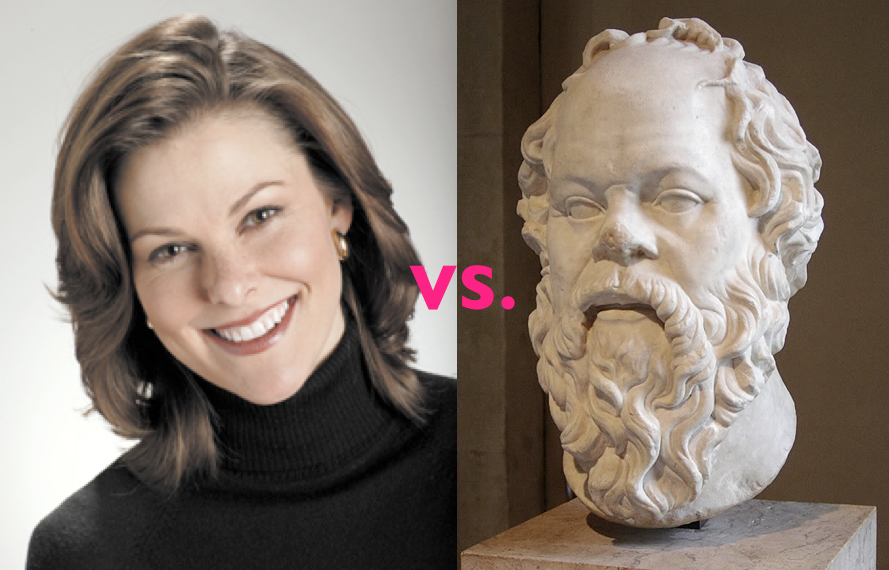
I Doubt Hillary Clinton Plans to Close Half of All Public Schools – But She Does Want to Close Some

www.usnews.com


“This school district, and these schools throughout Iowa, are doing a better than average job. Now, I wouldn’t keep any school open that wasn’t doing a better than average job. If a school’s not doing a good job, then, you know, that may not be good for the kids.”
-Hillary Clinton

The above comments have caused a tremendous stir in the media lately.

Hillary Clinton wants to close half of all public schools!? She wants to shutter all public houses of learning that are average or below average!?

The Federalist even did some quick math and decided this means Clinton would shutter 50,000 schools. They even put that number in the headline of their article!

But hold your horses, media backlash.

I’m not really a Hillary supporter, but this has gotten a little out of hand.

Maybe I’m being too generous here, but I’m going to assume that Clinton may be a lot of things, but stupid isn’t one of them.

She made a gaffe. She said something that doesn’t make much sense mathematically. Close all schools below average? Average means 50%. That’s half of all schools.

It was a blunder, a mistake, a foot-in-the-mouth moment.

I can believe a lot about Clinton, but not that her education policy includes shuttering half of our nation’s schools.

However, don’t take my word for it. Seriously! Ask her. She should clarify what she meant. But give her a chance to do so. Don’t mob her just looking to trip her up.

I doubt I’ll vote for Hillary in the primary, but she deserves a certain modicum of respect. She is an impressive person. She’s accomplished a heck of a lot in her life under some pretty intense circumstances.

As a college student in the 1960s, she volunteered to teach reading to children in poor Boston neighborhoods. She fought to ensure voting access for African Americans and even worked at an alternative newspaper in the black community. As First Lady and in Congress, she pushed for universal pre-kindergarten, arts education, after-school tutoring, smaller class sizes and the rights of families.

And in 2008 she ran an impressive – if ultimately unsuccessful – campaign for President.

As one of the most prominent women in the nation, she’s made some enemies.

Remember that Benghazi nonsense! Conservatives have been out for her blood because an American diplomatic compound in Libya was attacked in 2012 while Clinton was Secretary of State. They’ve trumped up a crazy amount of lies and innuendo that she was somehow responsible when it was the Republican-controlled Congress that voted to reduce security at these installations.

Heck! Michael Bay has a hatched job movie coming out during this election season just to wound Clinton’s current bid for president!

So give the woman some credit. She’s proven she’s a serious-minded, intelligent and capable politician.

However, like every human being she misspeaks from time-to-time. George W. Bush couldn’t open his mouth without English teachers and grammarians hiding under the sofa.

I think this explains much of what she said in Iowa trying to consolidate votes for the first Democratic primary on Feb. 1, 2016.

It explains much – but not all.

Clinton may have fudged her math momentarily forgetting that 50% of all schools are – and always will be – below average. If tomorrow every school in the country provided the greatest education the world has ever seen, half of them would still be below average. That’s what average means.

What bothers me is that Clinton thinks we should be closing schools at all.

That’s not a slip. That’s not a blunder or a miscalculation.

She really seems to believe you can improve public education by closing schools. And THAT is much more dangerous than any nonsense about her going on a nationwide school shuttering spree – something of which she would not, by the way, even have the power to do as President.

This idea that we can close schools to improve education is one of the founding principles of corporate education reform. And it’s demonstrably untrue.

Never has a school ever been improved by being closed. Student academic outcomes do not increase when children are displaced. In fact, they suffer.

If schools are struggling, a sensible strategy would be to find out what’s wrong. What is the reason kids are having trouble reaching academic success?

Spoiler Alert: nine times out of ten the problem is disinvestment. The school doesn’t have adequate resources to meet students’ needs.
More than half of our nation’s public school children live in poverty. Their schools don’t get equitable funding with districts that serve the rich. Moreover, privatization, charterization, increased efforts at vouchers, tax breaks and school choice have segregated our schools to such a degree that these problems disproportionately affect our students of color to a much larger degree than white children.

THAT is the problem with American education. It’s been proven time and again in study after study. Yet corporate education reformers like Michelle Rhee, Campbell Brown, Bill Gates, and Andrew Cuomo continue to ignore the facts in favor of simply closing more schools. In his time as Mayor, Rahm Emanuel has closed 50 Chicago schools46 of which serve mostly black and brown students. And he’s a close Clinton friend.

It is no accident that so many of these corporatists are Democrats. The entire neoliberal wing of the party is sick with these sorts of conservative policies. And Clinton can be connected with many of them.

Since getting the support of the American Federation of Teachers (AFT) and National Education Association (NEA), Clinton’s tried to distance herself from her disaster capitalist buddies. But it isn’t working.

On the one hand, she criticized charter schools for ignoring the most difficult students. On the other, she still champions keeping privatized education in the mix.

On one hand, she thinks there should be a federal investigation of the Chicago Police Department for civil rights abuses. On the other hand, she thinks Rahm is doing a heck-of-a job.

I am deeply troubled that Clinton seems to think we can close our way to academic success. She should know better than that by now. Everyone should. It is absolutely unacceptable that any candidate with such teacher support should hold these views. Quite frankly, it’s a deal breaker.

The ball’s in your court, Hillary. You need to explain what you meant by your Iowa comments.

I admire Clinton’s bravery for actually talking about K-12 education – something her rival Bernie Sanders seems much less inclined to do. However, we all know Clinton’s endorsements by the AFT and NEA don’t represent the views of the rank-and-file. These were top down decisions made without much member input. If Hillary wants those endorsements to translate into votes, she’d better do some serious convincing.

Otherwise it won’t be schools that are shuttered. It will be her campaign.


NOTE: This article also was published on the Badass Teachers Association Blog and mentioned on Diane Ravitch’s blog.

 

Much Ado About an Enigma – No One Really Knows What Impact the ESSA Will Have on Public Schools

ESSA-Obama

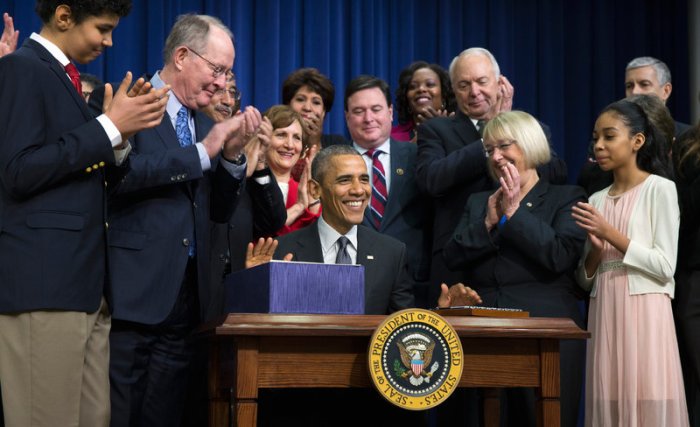
President Barack Obama signed the Every Student Succeeds Act (ESSA) this week.

The new legislation reauthorizes federal law governing K-12 public education.

In 1965 we called it the Elementary and Secondary Education Act (ESEA). Until today we called it No Child Left Behind (NCLB). And now after a much-hyped signing ceremony, the most definitive thing we can say about it is this: federal education policy has a new name.

Seriously. That’s about it.

Does it reduce the federal role in public schools? Maybe.

Does it destroy Common Core State Standards? Possibly.

Is it an improvement on previous policies? Potentially.

Will it enable an expansion of wretched charter schools and unqualified Teach for America recruits? Likely.

The problem is this – it’s an over 1,000 page document that’s been open to public review for only two weeks. Though it was publicly debated and passed in the House and Senate, it was finalized behind closed doors and altered according to secure hurried Congressional votes. As such, the final version is full of legal jargon, hidden compromise, new definitions and verbiage that is open to multiple meanings.

How one reader interprets the law may be exactly the opposite of how another construes it.

Take the much-touted contention that the ESSA reduces the federal role in public schools. Even under the most positive reading, there are limits to this freedom.

The document continues to mandate testing children each year in grades 3-8 and once in high school. It also mandates academic standards and accountability systems. However, what these look like is apparently open to the states.

For instance:

The Secretary [of Education] shall not have the authority to mandate, direct, control, coerce, or exercise any direction or supervision over any of the challenging State academic standards adopted or implemented by a State.

That seems pretty clear. The federal government will not be able to tell states what academic standards to adopt or how student test scores should be used in teacher evaluations.

But it also says that states will have to submit accountability plans to the Department of Education for approval. It says these accountability plans will have to weigh test scores more than any other factor. It says states will have to use “evidence-based interventions” in the schools where students get the lowest test scores.

That sounds an awful lot like the test-and-punish system we have now.

What if your state decides to take a different road and reject the high stakes bludgeon approach to accountability? In that case, some readers argue schools could lose Title I funds – money set aside to help educational institutions serving impoverished populations.

Will that actually happen? No one knows.

It may depend on who will be President in 2017 and whom that person picks as Secretary of Education. And even if the Feds try to take advantage of these potential loopholes, the matter could end up being decided by the U.S. Supreme Court.

What about Common Core?

Some readers interpret the new law as destroying forever the possibility of national academic standards. If states are allowed to pick their own standards, it is highly unlikely they’ll all pick the ones found in the deeply unpopular Common Core. However, the law does force each state to have academic standards of some kind, and it defines what those standards must look like. One interpretation of this is that they must look a lot like the Common Core.

They must be “state-developed college- and career-ready standards.” You read that right – “College and career ready.” That’s the Common Core catchphrase. If someone says they want to eat lunch at “the golden arches,” they haven’t said McDonalds, but you know they’re craving a Big Mac.

Will the Fed allow states to choose standards radically different than the Core? Again only time and – possibly – the courts can tell.

This same problem occurs throughout the document. As the public painstakingly combs through it, new legal wiggle room may be found. And I am not so naive as to suppose we’ve found all of the loopholes yet. Some of these may be the result of poorly chosen wording. Others may be purposefully hidden time bombs waiting for opportunists to exploit.

This uncertainty about exactly what the ESSA will eventually mean for our public schools may help explain the range of reactions to the formative law – from ecstasy to despair to shrugs and snores.

I’m not sure what to think of the thing, myself. I started the whole process disgusted but came around to accepting it if the final result was any kind of improvement over previous legislation. And now that it’s the law of the land, I look at this Frankenstein’s monster of a bill – stitched together pieces of mystery meat – and I don’t know whether to laugh or cry.

I still hope it will live up to the limited promise it holds to bring us some relief from NCLB. But I admit this thing could go sour. Anyone’s guess is as good as mine.

Which brings me to perhaps the biggest problem with this law that no one seems to be talking about.

Education needs reformed. We need to repeal the bogus policies that have been championed by the 1% and their lapdog lawmakers. We need to get rid of test-based accountability. We need to trash high stakes testing, Common Core, value added measures, charter schools and a host of other pernicious policies. We need to initiate a real anti-poverty program dedicated to attacking the actual problem with our schools – inequality of resources.

But more than any of that, we need to reform our government.

We need to find a better way to make our laws. The process that shat out this ESSA must go.

Think about it. No Child Left Behind was an abject failure by any metric you want to use. It didn’t close achievement gaps – it increased them. And the major policy of this law – annual standardized testing – remains intact in the reauthorization!

There has been massive public outcry against annual testing. Parents are leading an exponentially growing civil disobedience movement shielding their children from even taking these assessments. Everyone seems to agree that we test kids too much – even President “I’ll-veto-any-bill-that-deletes-testing” Obama.

Yet our legislators did next to nothing to fix this problem.
Instead preference was given to lobbyists and corporatists interested in making a buck off funding set aside to educate children. The focus was on smaller government – not better government. These aren’t mutually exclusive, but they aren’t exactly one-and-the-same, either.

This can’t continue if we are to keep pretending we have a representative Democracy. The voice of lobbyists must not be louder than voters. Money must be barred from the legislative process. Demagoguery must not overshadow the public good. We need transparency and accountability for those making our laws.

Until that happens, we will never have a sound and just education policy, because we don’t have a sound and just government.

Unfortunately, that is the biggest lesson of the ESSA.


NOTE: This article also was published in the LA Progressive, Badass Teachers Association Blog and quoted extensively on Diane Ravitch’s blog.


Putting the Arts Back in Language Arts – One Journal at a Time

d3493c8db7e1e4b423ce6b5e87f14eb6

This is the fifth in a series of blog posts focused on the value of art in our lives, and the role art can play in resisting the test and punish model of education.  See the intro and links to other posts in the series here.


Sometimes in public school you’ve just got to cut the crap.

No testing. No close reading. No multiple choice nonsense.

Get back to basics – pass out notebooks, crack them open and students just write.

Not an essay. Not a formal narrative. Not an official document. Just pick up a pencil and see where your imagination takes you.

You’d be surprised the places you’ll go.

You might invent a new superhero and describe her adventures in a marshmallow wonderland. You might create a television show about strangers trapped in an elevator. You might imagine what life would be like if you were no bigger than a flea.

Or you might write about things closer to home. You might describe what it’s like to have to take care of your three younger brothers and sisters after school until just before bedtime when your mom comes back from her third minimum wage job. You might chronicle the dangers of walking home after dismissal where drug dealers rule certain corners and gangs patrol the alleys. You might report on where you got those black and blue marks on your arms, your shoulders, places no one can see when you’re fully clothed.

My class is not for the academic all stars. It’s for children from impoverished families, kids with mostly black and brown skin and test scores that threaten to close their school and put me out of work.

So all these topics and more are fair game. You can write about pretty much whatever you want. I might give you something to get you started. I might ask you a question to get you thinking, or try to challenge you to write about something you’ve never thought about or to avoid certain words or phrases that are just too darn obvious. I might ask your opinion of something in the news or what you think about the school dress code or get your thoughts about how things could improve.

Because I actually care what you think.

Strange, I know.

At times like these, I’m not asking you to dig through a nonfiction text or try to interpret a famous literary icon’s grasp of figurative language. It’s not the author’s opinion that matters – it’s yours – because you are the author. Yes, YOU.

You matter. Your thoughts matter. Your feelings. YOU MATTER!

And sometimes students raise their hands and ask me to read what they’ve written. And sometimes – more often than not – the first thing they say is, “It’s no good.” “I don’t like it.” “I did bad on this.”

So I stop reading, I look them right in the eyes and ask them who wrote it.

“Me?” they say.

And I respond, “Then I’m sure it’s excellent.” And it usually is.

My 8th grade students have been ground down so low under the weight of a society that could care less about their well being that they’ve begun to internalize it. They think their thoughts and feelings are worthless. No one cares about what they think.

But I do.

So I offer them a chance to share what they’ve written. I don’t demand. I don’t force anyone to read anything. I know that some things that spill out on the page aren’t for sharing. But I want them to know that I value what they’ve just put down and that I think it’s worth taking the class time to let others hear it, too.

“Mr. Singer, I wrote five pages,” Jaquae tells me this afternoon. “That’s too long to share.”

“I disagree,” I say. “If you think it’s worth our time, you should read it. You deserve our attention.”

So he reads, blows out a cleansing breath and smiles.

In the process, we all become ennobled. We become more. We become a community. We get a peak at our common humanity.

It’s so easy to look at others as mere adversaries. Even our national education policy sees things in terms of a competition, a race. We set children against each other for points, for grades, for attention, just to feel valuable. You’re a Proficient. You’re a Basic. You’re a Below Basic. And somewhere along the way they lose the sense that they’re all valuable because they’re all human beings with thoughts, feelings and experiences that no one else has ever gone through before – but with which everyone can relate.

So I write, too. Every time I set my students a journal, I put pen to paper, as well.

At the beginning of the year, I share what I wrote to show them that it’s okay. At the middle of the year I ask them if they want me to share. And at the end of the year I remain silent unless they ask me to do otherwise.

Because these class moments aren’t about me. They’re about them. I’m willing to be as much a part of their creative space as they want, but it’s a choice, not a dictate.

In my class I will make you learn, but I don’t control what you learn or how you feel about it.

I extend my students this respect because I know that what we’re really doing isn’t some meaningless exercise. We’re creating art.

Not just scribbles on a page. Not something done just to please the teacher. This is an excavation of the soul. We dive into the depths of ourselves and come back all the better for it.

That’s why my students journal almost every day.

That’s why we put mechanics and spelling and grammar aside for a few moments and just write what we need to say.

Because Language Arts, after all, is an Art. It says that right in the title.

My students are artists. I am their muse. I hold a mirror up to their fractured and beaten spirits to show them the grandeur of what resides inside them.

And hopefully they come away inspired.

Because they are wonders. They are joyous. They are little pieces of my heart.


NOTE: This article was also published in Living in Dialogue, the Badass Teachers Association Blog and mentioned on Diane Ravitch’s blog.
 

National Academic Standards – Turning Public Education into McSchools


FullSizeRender

America is obsessed with standardization.

Let’s make everything the same – neat and uniform.

It’s ironic coming from a country that’s always been so proud of its rugged individualism.

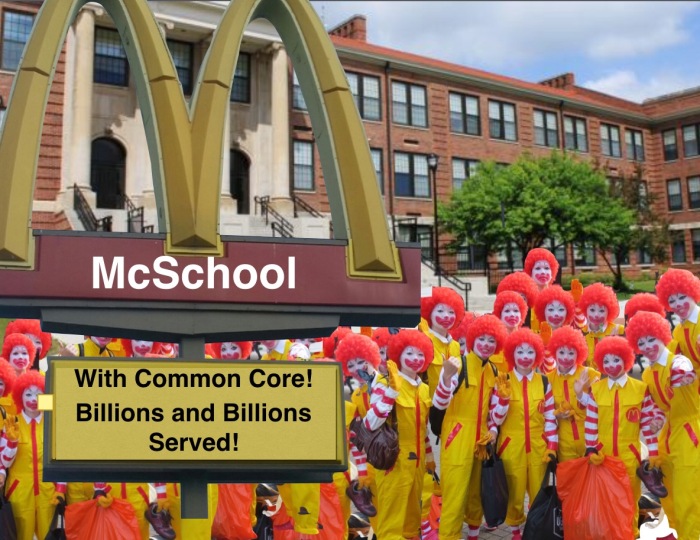
But look almost anywhere in the US of A, and you’ll see a strip mall with almost all of the same stores and fast food restaurants selling the same crusty burgers and fries left waiting for the consumer under a heat lamp.

Somehow this has become THE model for public education, as well. Corporations have convinced our lawmakers that the disposable franchise business schematic is perfect to increase student learning.

That’s where we got the idea for Common Core. All schools should teach the same things at the same times in the same ways.

It’s been a horrendous failure.

But this article isn’t about the Common Core per se. It isn’t about how the Core is unpopular, expensive, developmentally inappropriate, created by non-experts or illegal. It’s about the very idea of national academic standards. After all, if the Core is flawed, one might suggest we simply fix those flaws and institute a better set of national standards. I contend that this would be a failure, too.

The problem with standardization is that it forces us to make uniform choices. In situation A, we always do THIS. In Situation B, we always do THAT. There are some areas where this is a good thing, but education is not one of them.

For instance, we can all agree that children need to read books, but what kind of books? Should they read mostly fiction or nonfiction? Should books be limited by subjects or should they be chosen by interest? Should they be ebooks or hardcopies? Should they be organized by grade level or an individual’s reading level?

These are decisions that are best made in class by the teacher. However, when we write national standards, we’re taking away educators’ autonomy and giving it to some nameless government entity. This isn’t smart. Teachers are the scientists of the classroom. They can use their observational skills to determine what a child needs and how best to meet those needs. If we remove this, we’re forced to guess what hypothetical children will need in hypothetical situations. Even under the best of circumstances, guesses will not be as good as empiricism.

But, some will say, standards should be broad. They shouldn’t determine what children will learn in detail. They just set a framework. For instance, they’ll detail that all children should learn how to add and subtract. All children will learn how to read and write.

There is some truth to this. We can all agree to a basic framework of skills children need before graduation. However, if the framework is this broad, is it even necessary?

Do you really think there are any public schools in this country that don’t attempt to teach adding and subtracting? Are there any schools that don’t teach reading and writing?

I doubt such educational institutions exist, and even if they did, you wouldn’t need national academic standards to change them. By any definition, they would be cheating their students. If the community found out this was going on, voters would make sure things changed.

What about evolution, someone asks. This is a central scientific concept vital to a modern understanding of the field that in many places isn’t being taught in our public schools. Don’t we need national standards to ensure things like evolution are part of the curriculum?

The short answer is no.

For a moment, let me remove my ban on talking about Common Core – our current attempt at national standards. Some people defend the Core with this same argument. However, it should be noted that the Core has no science and history standards. It does nothing to ensure evolution is taught in schools.

But could we ever have standards that did ensure evolution was taught? Yes, we could.

Why don’t we? Why doesn’t Common Core explicitly address this? Because enacting such standards would take political power of a sort that doesn’t exist in this country. Too many voters oppose it. No state or federal legislature would be able to pass it.

But let’s assume for a moment that the political stars had aligned, and we could get lawmakers to vote for this. Why would they need to? This is a central theory to so many fields of science. Do we need an act of Congress to make sure all schools teach about gravity? Do we need one for Nuclear force? Friction?

You don’t need a Congressional order to teach science. If the community wants it, teachers will just do it. That’s their jobs. You can’t legislate that everyone believes in evolution. You have to convince people that it should be taught. National standards won’t change that. You can’t sneak it in under Newton’s laws of motion. We need to come to consensus as a society. As much as I truly believe evolution should be taught in schools, national standards are not going to make that happen.

Even if I were wrong, the cost would be far too high. We shouldn’t want all of our public schools to be uniform. When everyone teaches the same things, it means we leave out the same things. There is far too much to know in this world than can ever be taught or learned in one lifetime. Choices will always need to be made. The question is who should make them?

If we allow individuals to make different choices, it diversifies what people will know. Individuals will make decisions, which will become the impetus to learning, which will then become intrinsic and therefore valued. Then when you get ten people together from various parts of the country, they will each know different things but as a whole they will know so much more than any one member. If they all know the same things, as a group they are no stronger, no smarter than each separate cog. That is not good for society.

We certainly don’t want this ideal when going out to eat. We don’t want every restaurant to be the same. We certainly don’t want every restaurant to be McDonalds.

Imagine if every eatery was a burger joint. That means there would be no ethnic food. No Mexican. No Chinese. No Italian. There would be nothing that isn’t on that one limited menu. Moreover, it would all be prepared the same way. Fast food restaurants excel in consistency. A Big Mac at one McDonalds is much like a Big Mac at any other. This may be comforting but – in the long run – it would drive us insane. If our only choices to eat were on a McDonald’s Value Menu, we would all soon die of diabetes.

But this is what we seem to want of our public schools. Or do we?
There is a bait and switch going on in this argument for school standardization. When we talk about making all schools the same, we’re not talking about all schools. We’re only talking about traditional public schools. We’re not talking about charter schools, parochial schools or private schools.

How strange! The same people who champion this approach rarely send their own children to public schools. They want sameness for your children but something much different for their own.

I have never heard anyone say this approach should be applied to all schools across the board. That’s very telling. These folks want your kids to be limited to the McDonald’s Value Menu while their kids get to go to a variety of fancy restaurants and choose from a much daintier display.

If standardization were so great, why wouldn’t they want it for their own children? I think that proves how disingenuous this whole argument is. Standardization makes no one smarter. It only increases the differences between social classes.

The rich will get a diverse individualized education while the poor get the educational equivalent of a Happy Meal.

Think about it. Every generation of American that has ever gone to public school managed to get an excellent education without the need for national academic standards. Steve Jobs, Jeff Bezos, Bill Clinton, Ronald Reagan, Carl Sagan, Ruth Bader Ginsberg, Spike Lee, Larry King, and Stan Lee along with 90% of the United States population went to public school. None of them needed national academic standards to succeed.

This is a solution in search of a problem. The only reason we’re being sold the need for these standards is because it makes it easier for corporations to profit off federal, state and local tax dollars set aside for education. New standards mean new text books, new tests, new test prep materials, new software, and new computers. In the case of Common Core, it also means failing as many children as possible to secure a never ending supply of the above and an open door to privatization.

We must wake up to the lies inherent in these sorts of policies. Yes, the Common Core is horrible, but the problem goes far beyond the Common Core.

National Academic Standards are a terrible idea propagated by the 1% to turn the rest of us into barely educated subhumans and boost the bottom line.

Do you want fries with that?


NOTE: This article also was published on the Badass Teachers Association Blog and quoted extensively on Diane Ravitch’s blog.


Puerto Rico Teachers Plan One-Day Strike to Protest Corporate Education Reform

11214329_10153183230456981_1552435887463960982_n

Welcome to sunny Puerto Rico.

The ocean is a gorgeous cerulean blue. Palm trees wave gently in the salty breeze. And in the distance you can hear percussion, horns and singing.

The protest has begun.

12242864_10153398609583152_567773654_o

Residents of this United States territory have been fighting freshman Governor Alejandro García Padilla’s efforts to close public schools, privatize those left and shackle teachers to the same corporate education reform schemes that are crippling schools on the mainland.

This Tuesday island educators are asking parents not to send their children to school. Teachers plan to conduct a one-day strike to protest legislation that could be passed the same day to further cripple the Commonwealth’s public education system.

“On November 17th we’ll be giving our lesson’s outside our classrooms,” says Mercedes Martinez, president of the Federación de Maestros de Puerto Rico, the teachers union.

“We’ll be in front of our schools early in the morning and at 10:00 a.m. will march from Congress to the Governor’s Mansion in San Juan. This is one of many activities that we’ll perform in defense of public education. We will not accept these precarious impositions and will fight back.”

12212114_10153398609843152_2007230691_n

The protest is in response to Project 1456 which would close more than 380 public schools. The government has already closed 150 schools in the past 5 years.

This would force many students into even more overcrowded classrooms. Thousands of children would have to be relocated to schools far from their homes.

But that’s not all.

The proposed legislation would also privatize 15% of those schools left standing. Unlike the mainland, Puerto Rico has no charter schools. Teachers went on a 10-day strike in 2008 which only ended after the island Secretary of Education Rafael Aragunde signed an agreement promising not to open any charters.

12226476_10153398609693152_1059022729_n

If privatized schools opened on the island, parents might have to pay an additional fee for services they now enjoy for free. Amenities like lunches and even tuition may have to be subsidized by parents out of pocket.

Moreover, it would collapse the teachers retirement system, Martinez says. Charter schools would not deduct employees payments to the pension system so it might not be able to remain solvent.

Project 1456 would harm teachers in another way, too. It would enact a punitive evaluation system where 20% of educators value would be based on students standardized test scores. Any teacher with a 79% or less would have two years to improve or be fired.

“Teachers will have no rights,” Martinez says.

12231352_10153398610428152_1685357633_n

The proposed legislation has already been approved by the Commonwealth Senate. It’s main author Sen. Eduardo Bhatia is pushing for the House to fast track it for approval.

Discussions began in the House last week.

Protesters were there on Wednesday. They stood up in the government chamber and walked out en mass when it was brought up for discussion. Eighteen of them wore white T-shirts spelling out the message “Our Schools Are Not For Sale.”

12095142_10153786665063035_3426408204355682730_o

Inside the House, presidents of private universities testified in favor of the measure.

“Obviously they want to become administrators of charter schools on our island,” Martinez says.

Outside the building, protesters held their own emblematic hearing on the matter. Community members, teachers and parents testified in the open air about how this legislation would hurt children. They ended with a symbolic vote against it.

12233087_10153398610653152_624717262_n
Puerto Ricans are not alone in this fight.

Jitu Brown, a community organizer from Chicago and Director of Journey for Justice Alliance traveled there to stand in solidarity with those fighting for their schools. Brown participated in a 34-day hunger strike in his hometown a month ago to protest Mayor Rahm Emanuel’s plan to close the last open enrollment school in his neighborhood.

“This beautiful, breathtaking place is marred by ugly U.S colonialism and privatization of public services on steroids!” says Brown of Puerto Rico.

“I was blessed to spend time with powerful people fighting for a better world. Big ups to your warrior spirit, discipline and hospitality! Where we struggle, we can win! If we don’t struggle, we are guaranteed to lose.”

12243064_10153183230516981_9040874307608479627_n

The plight of Puerto Rican communities also inspired support from the Badass Teachers Association, a group of more than 56,000 educators, parents, students and activists.

“The Badass Teachers Association stands in strong solidarity with our brothers and sisters in Puerto Rico who are fighting for the very foundation of their democracy – the survival of their public school system which is under assault by the 1% who seek to close it up and deny Puerto Rican children a right to an education,” says Executive Director Marla Kilfoyle.

Protesters are getting the word out. They’ve already handed out thousands of fliers. Today they plan to drive in a large caravan across the island.

“We’ve got a bunch of cars with sound equipment,” Martinez says.

“We will go to all the communities near our schools in different regions asking parents to support the strike on the 17th.”

12233347_10153398610098152_2099123130_n

Much of the the island’s financial woes are imported from the mainland. Puerto Rico is besieged by vulture capitalists encouraging damaging rewrites to the tax code while buying and selling the territory’s debt.

Hundreds of American private equity moguls and entrepreneurs are using the Commonwealth as a tax haven.

As a result, tax revenues to fund public goods like education are drying up while the super rich rake in profits.

Officials warn the government may be out of money to pay its bills by as early as 2016. Over the next five years, it may have to close nearly 600 more schools – almost half of the remaining facilities!

12208352_10153183230836981_3863947130415132926_n

“That’s why the Teacher’s Federation and other teacher unions allied together to fight back against the attack on our education system,” Martinez says.

“As you can see, we’ve been busy.”

If Project 1456 is passed by the House, the union is considering a general strike.

12268501_10153398610318152_1824591574_o

Of the 135 schools closed in just the last two years, Commonwealth Secretary of Education Rafael Román had originally proposed shuttering 200. The remaining 65 were only kept alive because communities occupied the buildings and refused to let the government step in.

Protesters stormed the Senate in October when Bhatia first introduced Project 1456.

“Senators decided to approve it without discussion because they did not want to listen to teachers chants and indignation,” says Martinez.

“Senator Bhatia has become the symbol for privatization under this administration. He has never been in a public School. He has no bond with it. He’s a demagogue.”


NOTE: This article also was published on the Badass Teachers Association blog.


While Hillary Clinton Courts Teachers, Bernie Sanders May Have Conceded The Education Vote

hillary_clinton_bernie_sanders_ap_img

Hillary Clinton has made huge strides this week courting education voters. The Democratic Presidential candidate made a statement critical of scandal ridden charter schools. She also met with educators to answer questions in a closed door meeting.

Meanwhile Clinton’s main competition for the Democratic nomination, Bernie Sanders, remains silent on K-12 public education. He’s a favorite among teachers but he hasn’t really articulated much of an education policy at all.

Parents, educators and students are looking for a candidate with the guts to turn away from the destructive school policies of the last two presidents. Both George W. Bush and Barack Obama have increased privatization and standardized testing while reducing teacher and community autonomy. Instead of helping alleviate an epidemic of child poverty, they have blamed the problem on schools and teachers while starving them of the funding they need to succeed.

Frankly, moving away from these corporate education reform policies is a bad fit for Clinton. Her past education positions have been almost identical to that of the Obama administration. She’s been a strong advocate for charter schools and Common Core. She receives hefty support from wealthy corporate school reformers like Eli Broad, George Soros, Bill and Melinda Gates and the Walton family. After all, her first major policy achievement was her 1983 campaign to establish accountability-based school reform in Arkansas when her husband was Governor.

Her connections to this movement have not weakened. Just this week, #TeachStrong – an education reform organization – was launched with ties to Clinton. The group is organized by the Center for American Progress (CAP) – a think tank long affiliated with both Hillary and Bill. Husband and wife have hired numerous staffers from this organization and have championed policies that originated behind CAP’s closed doors. Many education observers are theorizing that the #TeachStrong initiatives which blame teachers and try to make their lives more difficult will eventually become Clinton’s education policies if she becomes President.

By contrast, Sanders would seem to be well suited to oppose these corporate-driven school reforms. He’s anti-privatization, anti-Wall Street and pro-worker. His vitriol against the banking industry and the 1% using tax loopholes to avoid paying their fair share would only be enhanced if he included corporate school reformers on his hit list. These are, after all, most of the same people he’s already going after just for different reasons. Unfortunately, he has yet to embrace public schools. Up to this week, both he and Clinton favored only pre-kindergarten and college support. Now she has started talking about K-12, but Sanders’ lips remain buttoned.

Perhaps this is because he thinks education voters have already sided with Clinton. The largest teachers unions – The National Education Association (NEA) and the American Federation of Teachers (AFT) – both endorsed Clinton in the primary. However, in each case these endorsements were highly controversial coming mainly from union leaders without much or any involvement from rank and file members.

Clinton seems to know that top-down endorsements alone won’t get her votes. She needs to win the hearts and minds of membership, and she seems to be committed to doing just that. Her education comments may not be entirely satisfactory, her connections may be highly unsavory, and her history may be deeply disturbing, but at least she’s making the effort to reach out to voters who care about the education system.

Sanders, where are you? You’re a Democratic Socialist. You say you’re committed to the public good. What is a greater public good than public schools? The education vote is by no means decided. It remains on the table for either candidate to take.

Personally, I don’t think Clinton is a good choice to come to education’s rescue. No matter what she says, I just don’t trust her. Someone who champions privatization isn’t going to save us from for-profit charter schools. Someone who is in bed with the testing industry isn’t going to reduce standardized testing. Someone who helped establish Common Core isn’t going to repeal it.

But if I’m honest, Sanders has skeletons in his closet, too. In the Senate he voted to expand charter school funding, voted for No Child Left Behind and most recently voted to keep test and punish policies in the Elementary and Secondary Education Act. However, given everything else he espouses, all these votes seem like anomalies. While Hillary looks like a seasoned professional who knows exactly what she’s doing in education circles, Bernie seems like a bumbling amateur who keeps making mistakes. It appears all he needs is a good talking to, someone to explain how our interests and his align perfectly. (Call me maybe!)

Of course, there is another possibility. Perhaps Sanders is against us as much as Clinton. Perhaps there is no major politician out there who has any interest in saving our schools.

Perhaps we really are alone.

In that case, maybe we shouldn’t wait for major politicians to come to us. Maybe we should consider supporting someone who is honestly in favor of us but does not yet have much political clout.

What say you, Dr. Jill Stein?

In the meantime I find myself waiting impatiently for Sanders to make his move. But I won’t wait forever. If he wants my vote – and the votes of hundreds of thousands of parents and teachers – he’s going to have to make his case.

Otherwise, we’ll look somewhere else.


NOTE: This article also was published on the Badass Teachers Association blog.


Hillary Clinton’s Charter School Problem

hillary

Good news! Democratic Presidential candidate Hillary Clinton just admitted there are significant problems with the nation’s charter schools!

Bad news! She has no interest in solving them! In fact, she thinks charters are just great.

Here’s Clinton criticizing charter schools:

Most charter schools — I don’t want to say every one — but most charter schools, they don’t take the hardest-to-teach kids, or, if they do, they don’t keep them. And so the public schools are often in a no-win situation, because they do, thankfully, take everybody, and then they don’t get the resources or the help and support that they need to be able to take care of every child’s education.

And all over the country, teachers, parents and students rejoice. Someone actually notices our problem!

Charter school scandals seem to hit the paper with the regularity of a grandfather clock. Charters cut student services and boost overhead to produce profit. Charters rack up debt and then sell it for a profit. Charters fudge the paperwork so they get paid for students who don’t actually attend. And just as Clinton said, they push out the children who are most in need and hardest to teach.

In short, most charter schools stink. Clinton admits we have a problem. But how do we solve it?

Clinton:

I have for many years now, about 30 years, supported the idea of charter schools, but not as a substitute for the public schools, but as a supplement for the public schools. And what I have worked on through my work with the Children’s Defense Fund and my work on education in Arkansas and through my time as first lady and senator is to continue to say charter schools can have a purpose, but you know there are good charter schools and there are bad charter schools, just like there are good public schools and bad public schools.

So I want parents to be able to exercise choice within the public school system — not outside of it — but within it because I am still a firm believer that the public school system is one of the real pillars of our democracy and it is a path for opportunity. …the original idea… behind charter schools was to learn what worked and then apply them in the public schools…

So Clinton’s solution to the charter school crisis is what exactly? She seems to be saying that charter schools have major problems, but the best way to fix them is to redouble our belief in this flawed and failing system.

It sounds like a line from Peter Pan: Clap your hands, children, and Tinkerbell will live! You just have to believe! Oh! Close your eyes and believe in charter schools, and they’ll be all fixed!

It’s a non-answer, an evasion. It’s the kind of politics Hillary Clinton excels at – say something so empty and middle-of-the-road that both sides of a position can find something to like about it. Take something and focus group the hell out of it until it’s almost meaningless.

The problem is that this kind of spin doctoring doesn’t help improve our schools one bit. It’s really an endorsement of the status quo. After all, what solution has she offered here?

If you aren’t paying attention, it sounds like a commitment to fix our charter schools, but it’s actually just a commitment to gift wrap them more of your tax dollars with zero accountability.

Notice what Clinton said about choice. She supports parents having a choice between various kinds of public schools – but not parochial and private schools.

Choice!? What a bunch of baloney! By and large parents don’t want to have to shop around for a school the way you would melons at the grocery store. Weigh them in your hands, look for soft spots and hope they’ll be sweet once you cut through the rind.

Parents want all public schools to be excellent. “Let The Buyer Beware” is a poor principle on which to found our system of public education.

Mrs. Clinton, who exactly are you trying to give choice to – parents or corporations? Do you want parents to be able to choose between several mysterious options or do you want to give corporations another market in which to make a profit?

It’s almost a veiled threat. There are some people out there, she might as well as be saying, who want to give your tax dollars to private and parochial schools. Not me. Nope. I’ll only give your tax dollars to traditional pubic schools or charters.

What goes unsaid is the fact that many charters run themselves like private schools. They’re almost the same thing but on the public dime. Why do you think so many call themselves “academies”? They want to look exactly like private schools. The biggest difference is they can’t violate the separation of church and state.

So Clinton is against private schools if they’re called private schools, but if we call them charter schools, they’re just peachy! Wow! There’s such a world of difference between that view and Jeb Bush’s!

Thanks a bunch, Mrs. Clinton. That’s a mighty progressive position you’ve got there. You’re going to support public schools by allowing parents to opt out of them? This is the best the Democrats can do these days!? Yikes!

And please spare me the nonsense about the original purpose of charter schools. They were supposed to be laboratories to try out new things that would eventually get applied in the traditional public school setting!? That has never happened! Not once! No one has ever looked at the charter school model and said, ‘Gee! They’re really doing such a great job! Let’s do that here!” unless it was in terms of the Cadillac funding they often receive while public schools strive to get by on what’s left between the couch cushions.

Moreover, if having the freedom to experiment is so great, why not offer traditional public schools the same option? Why not free public schools to experiment instead of weighing them down with Common Core and toxic testing (which – if I’m not mistaken – you wholeheartedly support, Mrs. Clinton)?

If most charter schools are abusing that freedom by pushing out needy students, why not take that power away? Why not support a national moratorium on any new charters? Why not investigate every existent charter and close down the ones that aren’t effective? Why not take the money saved by such a venture and use it to invest in the traditional public school system that has proven time-and-again to be the best educational alternative for our nation’s children?

Instead of pretending to offer choices, why not make sure every public school is excellent and allow parents and students choices within those schools such as whether they want to take art, music, foreign languages, extracurricular activities, etc.?

Why? Because those would be real solutions, and if there’s one thing politicians hate, it’s solving problems.

If Clinton did that, she might offend someone. She’d lose votes. Better to try to appear to be pleasing everyone.

And thus she pleases no one.


NOTE: This article also was published in the LA Progressive and on the Badass Teachers Association blog.


Rick Smith – Smuggling Teachers Voices Through the Media Embargo

FullSizeRender

I met Rick Smith for the first time in person this summer in Washington, D.C.

He had traveled to our nation’s capital to cover the Badass Teachers Association (BATs) Congress of which I was a member. Though I’d seen pictures and videos of him and even been on his daily radio show a handful of times, I was surprised to see him standing there in the lobby. He looked exactly like his pictures.

Often when you meet someone like that in the flesh, you get a glimpse behind the mask at how much the persona differs from the person. For example, when I was a journalist and interviewed Marvin Hamlisch, he was much more the cranky old man than the consummate showman.

But Rick was just… Rick. Faded denim, golf shirt, tousled hair under a ball cap.

He treated me to breakfast in the hotel restaurant and we talked about politics, activism and education. In a way it was like being on his show except there was no audience. Maybe he didn’t speak as loud and didn’t feel the need to explain the background of a subject for listeners at home, no station identification, but other than that it was pretty much the same.

He’s the real deal. What you see – or usually hear – is what you get.

I remember thanking him for trucking all the way from northern Pennsylvania to be here with us. He wasn’t getting anything extra for this. We certainly didn’t have any money to pay him. Rick was actually interested in hearing what teachers like me had to say.

We had congregated here in the capital to lobby our lawmakers and discuss among ourselves how to change our national education policy into something more student centered and less privatized, corporatized and standardized. And Rick wanted to showcase it on his show. He wanted to be there, to see what we were doing, ask us questions and put it all on the air for listeners across the country.

And – of course – he bought me breakfast.

As I was making my way through a waffle, Rick dropped the bomb on me.

He wanted to know if there was more to this story – if there was enough information for a weekly radio segment.

I carefully swallowed and told him that there was.

We’re living at a time when what’s best for school children isn’t decided by parents or educators. It’s decided by lawmakers, policy wonks, billionaire philanthropists and corporate CEOs with oodles of cash to bribe others to see things their way. Teachers, parents and students are taking to the streets to protest high stakes standardized tests, Common Core, value-added evaluations, charter schools, Teach for America and a host of other corporate education reform policies.

But few in the media seem to be listening.

In the last year, only nine percent of guests discussing education on evening cable news were educators. Yet tech millionaires attempts to dismantle teacher tenure are championed by the likes of Time Magazine. Former CNN anchor Campbell Brown creates a so-called “non-partisan” news site to cheerlead privatization and demonize teachers. At the Republican Presidential debates, candidates fall over each other for the chance to “punch teachers in the face,” while the Democratic Presidential candidates have zero to say about K-12 schools.

And here’s a guy with his own radio show and podcast who is actually interested in what educators think!

We shook hands, made plans and another trip to the buffet.

Now it’s been a little more than two months since the “BATs Radio – This Week in Education” segment premiered. Every week – usually airing Mondays at 5 p.m. Eastern – Rick has two guests chosen by the BATs. And wow! Have we had some amazing interviews!

When the National Education Association (NEA) made the controversial move to endorse Hillary Clinton despite a lack of member outreach, we had history teacher and NEA Board of Directors member Tripp Jeffers on the show. Before the vote, Tripp asked Clinton about her ties to corporate education reformers.

We had New York teacher and Co-Director of BATs Action Committee Michael Flanagan on to talk first hand about what a dismal job our new US Secretary of Education John King had done as Chancellor of New York State Education.

New Orleans parent Karran Harper Royal explained how the Obama administration’s privatization scheme has systematically destroyed public schools in the Big Easy. Wayne Au talked about what it was like to be one of the appellants in the Washington State Supreme Court Case that found charter schools to be unconstitutional. New York parent Karen Sprowal described how the Success Academy charter school had trampled her child’s rights. Jeanette Taylor-Ramann explained what pushed her and several other Chicago parents and teachers to go on a hunger strike to save their last neighborhood school. Puerto Rican teachers union president Mercedes Martinez informed us of the massive island revolt against privatizers in our US territory.

And more and more and more! And it’s only been 8 weeks!

I am so thankful to Rick for making this a reality. Teacher, parent and student voices are getting through the media embargo. We’re being heard. It’s unfiltered news! It’s what’s happening at street level.

This wouldn’t be getting out there so prominently if Rick weren’t interested, if he didn’t think it was something his listeners were interested in hearing. He gives up a significant chunk of his weekends to do it. He gives up time with his family, his children, to bring this to the public.

I can’t express how much that means to me and the more than 56,000 members of BATs.

I remember thanking Rick at the end of that first breakfast meeting and I’ll never forget what he said.

“This is what we do, Steven,” he said. “We’re activists first.”

That’s why Rick Smith is a true progressive hero.


NOTE:

You can hear the BATs Radio – This Week in Education segment most Mondays at 5 p.m. Eastern on the Rick Smith Show. The entire progressive talk show airs weekdays from 3 – 6 p.m. on several radio stations and on-line.

All BATs Radio interviews are archived here in case you missed them.

There are also a plethora of fascinating interviews from the BAT Congress on the Rick Smith Show Website.

This article also was published on the Badass Teachers Association blog.

Department of Education SorryNotSorry About High Stakes Testing

Screen shot 2015-10-24 at 11.04.43 PM

The Obama Administration must think the nation’s parents, teachers and students are pretty darn dumb.

President Barack Obama and his hand-picked Department of Education are solely responsible for the knuckle dragging academic policies strangling our public schools day in, day out. Yet instead of doing anything to reverse course to proven methods that might actually help kids learn, the department trudges out its annual apology.

It goes something like this:

Hey, Everybody! So sorry about all those high stakes tests, Common Core Standards and Value-Added teaching evaluations. We know they’re bad and we’re going to stop.

Then whatever functionary drew the shortest straw toddles back into the building and for the rest of the year things continue on exactly the same as they always have.

Let’s just pause for a moment and imagine how incredibly stupid they must think we are. I’m surprised they don’t issue public service announcements reminding us to exhale, multi-colored pamphlets on the benefits of blinking, and puppet shows instructing us how to use the potty.

The Obama Administration has had 7 years to fix this mess, and the only things they’ve done are to make it worse. Most of us voted for this so-called progressive because we thought he’d improve upon George W. Bush’s astoundingly wrongheaded school policies. But instead he doubled down on them! We hired a competent janitor but he was successful only in creating greater disorder.

We thought someone with the intelligence and grace of Barack Obama would be able to understand more than the eternal C-student Bush that you can’t ensure equity by standardized testing. That’s like trying to ensure a bathtub was filling with hot water by using nothing but Tarot Cards. The cards don’t give you an accurate reading and even if they did, you’d need to adjust the faucet at some point!

We thought a Constitutional scholar would understand that a national school curriculum violates federal law – even if you get a faux state commission to propose it and slap a new name on the thing! The federal government is allowed to do some things and state governments are allowed to do others. It’s not that hard. Moreover, armchair generals who have zero understanding of educational pedagogy, psychology, sociology and no classroom experience have no business telling teachers what they should be teaching!

We thought a political party that claims to be on educators’ side wouldn’t then turn around and initiate a witch hunt against us using poor student test scores instead of pitch forks and torches. Every independent, peer-reviewed study shows that poor kids do badly on standardized assessments and rich kids do well. Every statistician says you can’t use a test created to measure one thing (students) to measure another (teachers). Yet this is exactly what this so-called intellectual president mandates, and then he and the Democrats expect us to be there for them at the polls!?

In short, we expected a liberal Democrat, but got instead a Conservative Democrat in Name Only (DINO). He took far right ideas that Bush could barely officiate and made them much more efficient and thus much more damaging.

And every year like an alcoholic stumbling off a bar stool, the administration swears they’re not going to take another drink. Then they hire the head of Anheuser-Busch (John King) as a nutritionist. And some of us still believe them!

Just look at the crumbs they’re throwing out to us, peons!

Hey, Girl. We’re going to cut testing down to 2% of the school year.

That’s 23 hours! Almost 3 full days! Imagine if the dungeon master told you he was only going to put you on the rack for 2% of the time! Would you thank him? Maybe, but it would be a pretty half-hearted thank you.

Can the administration prove any positive value for standardized testing? I’m not asking them to trot out the tired party line about equity. I mean can they prove that testing actually helps children learn in any appreciable way? If the answer is no (and Spoiler Alert: it is!) then we shouldn’t be wasting any more time with it. Not 2%. Not 1%. ZERO PERCENT!

Moreover, Obama has been talking about reducing testing since he ran for office in 2008. America’s schools are still waiting for him to come through on that one. Maybe on his last day in office we’ll have a testing moratorium. Fingers crossed!

The department says, “The assessments must be worth taking.” No shit. That’s exactly the problem! They aren’t! And they’re shrouded in secrecy under the guise of test corporations intellectual property. How will we be able to determine they’re “worth taking”? Will you just tell us? THAT sure puts my mind at ease!

You know what assessments have been proven worth taking? The ones created by teachers. Yet these are exactly the kinds of tests that schools have been forced to cut back on. Perhaps this is what the administration has in mind. No more teacher-created tests. Let’s just have tests made by the professional test creators who have no idea what the heck they’re doing!

And speaking teachers, this one’s for you: “No standardized test should ever be given solely for educator evaluation.” It sounds like a condemnation of Value-Added Measures (VAM), of evaluating teachers on student test scores. However, it’s just the opposite. Notice the word “Solely.” We’re not going to give kids tests if we ONLY use them to evaluate their teachers. Well woop-de-do! Professional flunkies will talk to you for hours (if you pay them enough) about how great the tests we give now are at doing both! So no change in policy, just some purple prose to light on fire and blow the smoke up educators hind ends.

Perhaps worst of all is the use of English Language Learners (ELL), students with disabilities and minorities as props. We’re doing it all for them, they say. Bull! Shit!

The administration has nothing to say about fully funding the Individuals with Disabilities Education Act (IDEA). There’s nothing about sanctions on districts that don’t provide proper services for ELLs. There’s nothing about ensuring adequate, equitable and sustainable funding for all students – especially the poor and minorities. Instead the Department of Education pretends like high stakes tests are candy bars and what poor disadvantaged minority ELL disabled kid doesn’t love the soft velvety chocolate taste of a multiple choice test!?

This announcement is not reason to celebrate. It’s more of the same fake apologies soaking wet in crocodile tears and bad candor.

If Hillary Clinton wants to get elected President, she’d better do more than that. If Bernie Sanders wants a shot, he’d better do more than spout socialism about Wall Street and silence about K-12 schools.

You can only lie to our faces for so long. Despite your best attempts to trash public education in the name of saving it, we’re not so dumb as to believe any more of your evasions, deceit and dishonesty.


NOTE: This article also was published on the Badass Teachers Association blog.


Education Does Not Cure Poverty – It Cures Ignorance

Screen shot 2015-10-17 at 11.36.22 PM

What good is an education?

Will it get you money? Will it make you rich?

No. Not really.

And that’s one of the biggest problems with American public school policy of the last 15 years. It misunderstands the purpose of the very thing it purports to promote.

Poverty is skyrocketing. It’s been on the rise for at least three decades, but since the economy collapsed in 2008, the ranks of the poor have swollen like an untreated wound left to fester and rot.

We could be doing something about that. We could be working on a jobs package – on something to get people back to work. Instead we crowd around unemployment data and clap each other on the back because on paper it looks like we’ve overcome this obstacle.

Unfortunately, we haven’t.

Since President Barack Obama took office, there have been less people out of work than during the disastrous Bush years. However, most new jobs created since the crash only pay minimum wage. The good jobs are drying up and being replaced by poverty wage employment. And that’s not even counting the hordes of people who’ve given up even looking for a job but don’t merit a mention in these Pollyanna publications!

So how do we truly answer this dilemma? How do we get America back to work?

According to our policymakers, through magic.

Provide people more training, they say. Make sure those out of work obtain new skills and the next generation receives a rigorous education.

It’s the kind of solution our grandparents – who lived through the Great Depression – would have laughed to silence. Give someone a book, put them in a school, place them before a teacher and – POOF – they’ll be able to get one of the nonexistent well paying jobs that – may I repeat – DON’T EXIST!

It’s not that we have an unskilled workforce. We have more people than ever with Doctorates and Masters degrees living on food stamps. The problem is lack of well paying jobs. We’ve tax sheltered, down sized, and corporatized America into a land where the rich play Monopoly with all our cash while the rest of us subsist on McJobs.

Claiming that education alone can resolve this problem is like saying all a starving person really needs is a fork and spoon. But that won’t help if he has nothing to eat!

It should be no surprise that those championing our school system as a silver bullet to our jobless nation speak out of both sides of their mouths. On the one hand, they say, education can save us. On the other, they say, if education was better we wouldn’t need saving. And since they’re almost exclusively employed by the same people who gobbled up all the jobs in the first place and then spat them out to China, it’s a travesty that anyone listens to them.

They’re not offering a solution. They’re making a last ditch effort to clear the board of any remaining public money – education dollars.

If only the teachers had taught us better, they say, we’d all be able to have a corner office in the sky. But since those evil, lazy educators are doing such a bad job, we need to close as many schools as possible to save those kids. And then we can privatize them and swipe even more of that sweet, sweet public money to the 1% who can run charter schools and cut student services while scarfing up the rest as yummy profit.

To prove this thesis, policymakers force untested and irrational reforms on public schools – standardized testing, computerized test prep, Common Core. When none of this works (as planned), they simply blame the educators who never wanted any of this in the first place. But it helps us serve up teachers on a silver platter as the scapegoat of the day.

These so-called reforms solve nothing – they just make things worse.

Furthermore, they’re a distraction, smoke and mirrors so we won’t see the real issue of how we’re being swindled by the 1%. After all, THEY were the ones who got us into this mess in the first place! They were the ones who crashed the economy – not Mrs. Jones, the local science teacher.

We should know this already. It’s out in the open and easy to see. The media is not doing its job of reporting the truth. The public is being dazzled by propaganda that appeals to our basest selves. But most importantly, we’re being fooled because we no longer remember what education is for!

Even under the best of circumstances, education does not make someone rich. That’s not it’s goal. It never has been. Education seeks to enrich people’s minds, not their bank accounts.

Yes, there is a relationship between the two, but its several steps removed. A well educated person may be able to more easily obtain money than an uneducated one. She may be more prepared for a well-paying job. However, being prepared is rarely what makes someone rich.

People gain wealth most often by inheriting it (See Paris Hilton, Bill Marriott, Mitt Romney and Donald Trump). Others get money by cheating the public out of it. This takes a person with a weak moral code, not necessarily strong book smarts. For instance, look to the Walmart model of selling groceries cheaply by paying poverty wages to employees who then must rely on the federal government to survive and thus can only afford to shop at Walmart. That’s not smart. It’s sociopathic. Anyone could have thought that up, but it takes a person with a stunted conception of the value of other people to actually do it.

More important than a college degree are connections. The Rich know the right people. They have contacts in high places with whom they can barter for lucrative tips, jobs and partnerships. They have friends on Wall Street who can tip them off when a stock is about to rise or fall. They know editors at prominent papers who have no problem changing the headlines to match a preconceived narrative rather than the facts on the ground.

Again, that doesn’t require all A’s on your report card. It’s the result of a lottery of birth, social standing and an undeveloped sense of fairness.

There are some people who actually do gain riches on the merits of their intellects. But they are few and far between. Even among them there is a large portion who are more lucky than genius. I love Ben and Jerry’s ice cream, but it doesn’t take an Einstein to come up with it. Sometimes the gods of finance just smile on hippy dippy flavors with fun names.

Since the ancient world, thinkers have postulated that the purpose of education is not to increase material gain – it is to become a better person. The Ancient Greeks believed that there is value in knowledge and wisdom that doesn’t translate into gold. Aristotle called it eudaimonia or human flourishing. The best life includes wisdom.

This builds on the philosophy of Socrates – one of the founders of Western thought – who famously said, “The unexamined life is not worth living.” We have strayed far from these ideals. Today we might say the unreciprocated action is unworth doing. If something doesn’t translate into cold, hard cash, it is considered weak, a wasted effort. Even philanthropy has become a way to gain control over the industry you’re ostensibly trying to help. (See Bill Gates immense influence on Education policy.)

In their hearts, most teachers would side with Aristotle and Socrates over the Waltons and Gates’. And that’s why our corporate masters look down on us. We represent an ethos that they have abandoned and tried to destroy.

They tell themselves the fairy tale that wisdom means cheating others out of money. The removal of ignorance, they say, is the removal of any obstacles toward clawing and punching your way to the top.

But true wisdom recognizes that people are more than mere animals. We do not need to continue the Darwinian struggle of survival of the fittest among ourselves. We can cooperate. We can value each others lives. We can love.

If people valued this kind of knowledge over money, what would happen to the rich? Wouldn’t it prove that they have wasted their lives betraying and manipulating the less fortunate? Wouldn’t it reveal the poverty of their souls?

Because if people were truly educated, they would see these sick, twisted individuals for whom they really are. And we would demand justice. Not so that we could replace these penny-ante tycoons with our own wealth addiction. But instead so that we could all live in peace and bask in the joy of knowledge, compassion and an unending quest to chip away at our own ignorance.


NOTE: This article also was published in the LA Progressive and on the Badass Teachers Association blog.