High Stakes Testing Doesn’t Protect Civil Rights – It Violates Them

martin-luther-king-jr-small

“Daddy, I know who that is!”

“Who is it?”

“That’s Martin Luther King.”

“That’s right, Baby! Who was he?”

“We saw a movie about him today in school. He had a dream.”

Thus began a fascinating conversation I had with my seven-year-old daughter a few days ago.

I had been going through her book bag and found a picture of Dr. King blazoned above an article about his life.

“He wanted everyone to be nice to each other,” she said.

I laughed. My first grade scholar isn’t that far off.

“He’s one of my heroes,” I said. “He means a lot to me.”

“That’s silly,” she said. “He doesn’t have any super powers.”

Before I could reply, her attention shifted to her stuffed Yoshi doll. She began to play.

One of the best things about being a parent is getting to see the world anew through the eyes of your children. My little girl offers me this vantage point everyday.

Dr. King can’t be a hero. He had no super powers.

Or did he?

“I have a dream,” he famously said, “that my four little children will one day live in a nation where they will not be judged by the color of their skin but by the content of their character.”

It’s a simple wish. A simple insight.

Or is it?

Do we do that today? Do our schools?

As a middle school teacher, I’m well aware how our public schools judge our children, and it’s not by the content of their character. It’s by their standardized test scores.

High scores mean you’re learning. Low scores mean you’re not. And if you’re not learning, that’s your teachers fault and we’re going to close your school or turn it into a charter.

What’s worse, we’re going to do it because that ensures your civil rights.

That’s the story anyway.

Ever since rewriting the federal law governing K-12 schools began to be debated in earnest by Congress, the tale was told that high stakes testing is good for minorities. It makes sure schools aren’t neglecting them.

And now that the Every Student Succeeds Act (ESSA) has been passed, well-meaning people everywhere are wondering if we’re looking out for our black and brown brothers and sister enough – do we have enough federally mandated high stakes tests? Is there enough accountability?

After all, the new law potentially returns much of the power for education policy to the states. What if states don’t give as many tests? How will state legislatures ensure black students aren’t being neglected? Why would schools actually teach black kids if we don’t threaten to close them based on test scores?

These would be laughable questions if they weren’t asked in earnest. With such frequency. Even from some civil rights organizations.

Some things to consider:

1) The ESSA does absolutely nothing to limit standardized testing.

When Congress was rewriting federal education policy, parents, educators, students and experts of every stripe asked for a reduction in testing. It didn’t happen. Exactly the same number of tests are required under the ESSA as there were before it was passed – once a year in grades 3-8 and once in high school.

2) Punishing schools doesn’t help kids learn.

Once upon a time, it was the government’s job to provide schools with adequate resources to help kids master their lessons. Now it has become the government’s job to raise an arbitrary standard and shutter or privatize schools that fall below that mark.

This may come as a surprise, but no school has ever been improved by being closed. Students who are forced to relocate don’t suddenly do better. In fact, they usually do worse academically. Moreover, there is exactly zero evidence that charter schools do better than traditional public schools. In fact, the evidence points in exactly the opposite direction.

3) Standardized tests are poor assessments to judge learning.

Standardized testing has never been shown to adequately gauge what students know, especially if the skills being assessed are complex. The only correlation that has been demonstrated consistently is between high test scores and parental wealth. In general, rich kids score well on standardized tests. Poor kids do not.

Therefore, it is absurd to demand high stakes standardized testing as a means of ensuring students’ civil rights.

Judging kids based on these sorts of assessments is not the utopia of which Dr. King dreamed. We are not judging them by the content of their character. We’re judging them by the contents of their parents bank accounts.

There are real things we could be doing to realize racial and economic equality. We could do something about crippling generational poverty that grips more than half of public school students throughout the country. We could be taking steps to stop the worsening segregation of our schools that allows the effects of test-based accountability to disproportionately strike schools serving mostly students of color. We could invest in our neediest children (many of whom are minorities) to provide nutrition, tutoring, counseling, wrap around services, smaller class sizes, and a diverse curriculum including arts and humanities.

But we’re not doing any of that.

Why?

Because we’re too concerned about continuing the policies of test and punish. We’re too concerned about making sure huge corporations continue to profit off creating, grading and providing materials to prepare for annual standardized testing.

Dr. King may not have had super powers. But from his vantage point almost 50 years in the past, he saw through the lies of today’s education reform movement.

Standardized testing doesn’t protect civil rights. It violates them.

Our school policies for the past few decades have been about denying the right to an equitable education to our poor and minority students. Though the ESSA holds promise to limit federal meddling, it does nothing to change that. And all these people who cry foul at a potential loss of federal power are either ignorant or crying crocodile tears.

It’s no wonder that hundreds of civil rights organizations oppose high stakes testing. Nor is it surprising that the media rarely reports it. And it shouldn’t be a shock to learn that the overwhelming majority of civil rights organizations who have suddenly began championing testing are those who get big donations from the philanthro-capitalists pushing this agenda.

High stakes testing is a racist and classist policy. Period.


NOTE: This article was given a shout out on Diane Ravitch’s blog and published in the Badass Teachers blog.

Bernie Sanders is Right: We Should Federalize Public School Funding

Bernie_Sanders_by_Gage_Skidmore

Bernie Sanders just dropped a massive dose of truth on us Monday night.

No politician in my lifetime has ever said anything so dangerous, fraught with problems, unlikely, impractical, and absolutely on the nose right!

The Presidential candidate running for the Democratic nomination wants to make the federal government largely responsible for funding public schools. Right now districts are supported mostly by local and state taxes.

This is what he said:

“One of the things that I have always believed is that, in terms of education, we have to break our dependency on the property tax, because what happens is the wealthiest suburbs can in fact have great schools but poor, inner-city schools cannot. So I think we need equality in terms of how we fund education, and to make sure the federal government plays an active role to make sure that those schools who need it the most get the funds that they deserve.”


(Find the quote above 17 minutes into this video.)


Wow! What a statement!

Don’t tell me that was focused grouped. Don’t tell me his campaign did a poll first. Don’t tell me he ran that by any big donors for approval.

Whether you agree with it or not, such an audacious remark has to come from a genuine belief. This is really what Bernie thinks, and it’s entirely consistent with the Democratic Socialism of his whole political career.

I don’t think his rival for the party’s nomination, Hillary Clinton, will be parroting THIS stance! If anything, she might criticize him for it. And she’d have a multitude of practical reasons to do so.

Lots of folks on both sides of the aisle are sick of federal intervention in our schools. No Child Left Behind was a disaster. Race to the Top was worse. And the just passed Every Student Succeeds Act (ESSA) amounts to a massive giveback of power to the states. Under the most popular interpretation, the reauthorization of the federal law governing K-12 schools makes the states responsible for filling in the details of education policy while limiting federal interventions.

And now Bernie is suggesting the Fed foot the bill!?

That is going against the political tide. Who would vote for such a thing? Probably not Hillary. Or any of the Republican candidates. Or more than a handful in Congress, either.

But it’s exactly the right thing to do.

The reason?

The biggest problem with America’s public school system isn’t test scores, lazy students, or teachers unions. It’s poverty, segregation and inequitable funding.

We have separate schools for the rich and separate schools for the poor. We have schools serving mostly black and brown populations and schools serving mostly whites. And the way we allocate money and resources to these schools both allows and perpetuates this system.

Nationwide, state and local governments spend 15 percent less per pupil on poor school districts. I see this first hand. My home state of Pennsylvania is the worst offender, providing the poorest districts an embarrassing 33.5 percent less per student. This means higher class sizes, less teachers, less arts and humanities, less electives, less nurses, guidance councilors and wrap around services. This is the reality in 23 states.

An additional 23 states do buck this trend with more progressive funding formulas. States like California and Florida actually provide MORE spending to poor districts. This helps heal the wounds of malnutrition, violence, family instability and a host of other problems that go hand-in-hand with generational poverty. It also offset the costs of greater numbers of special education students and English Language Learners you typically find in these districts.

You might say, then, that the states where poor children get shafted could simply follow the lead of their more enlightened neighbors. Good luck with that! Rich folks rarely volunteer to subsidize the poor. They got theirs, and they vote and donate more regularly to local politicians than their indigent brethren can afford to do.

The result is a funding system based on local wealth. Rich areas have Cadillac education systems. Poor areas have dilapidated ones. That’s demonstrably unfair and leads to worse academic outcomes for needy kids.

What’s worse, no one else runs their schools this way. The U.S. is one of the only countries in the world – if not probably the ONLY country – that funds schools based largely on local taxes. Other developed nations either equalize funding or provide extra money for kids in need. In the Netherlands, for example, national funding is provided to all schools based on the number of pupils enrolled. But for every guilder allocated to a middle-class Dutch child, 1.25 guilders are allocated for a lower-class child and 1.9 guilders for a minority child – exactly the opposite of the situation in the U.S.

Federalizing education funding could solve all these problems. It could set the groundwork for an even playing field. All students could get a fair start in life! That’s a goal worth shooting for! And that’s what Bernie is suggesting.

But it’s an incredibly dangerous proposal.

Our school system still suffers nationwide from the effects of corporate education reform. National policy has been and continues to be one of high stakes standardized testing, poorly conceived and untested academic standards, and a push to privatize struggling schools. Corporatists call this “Accountability.”

It goes something like this: raise your test scores or we’re closing your school and turning it into a for-profit charter. Adopt these academic standards written by the testing companies and we’ll give you a couple extra bucks. De-professionalize teachers with junk science evaluations and hiring under-trained Teach for America temps or else we’ll cut your funding.

THIS is the federal legacy in education, and Bernie is suggesting we give them MORE POWER!?

Yes, and no. I can’t speak for Bernie, but that’s certainly not how this has to go. We can increase the Fed’s responsibility for funding schools without increasing its power over education policy. In my view, education decisions should be made locally, and I don’t mean at the state legislature. Decisions about how best to run schools should be made at the district level by the experts – the teachers and parents.

Certainly there will be those who call for more federal power over policy as a condition of federalized funding. But that has to be a deal breaker. Equitable funding with inequitable policy would just be plugging one hole while making another.

In my view, equitable funding IS the role of the federal government in public education. When the Elementary and Secondary Education Act (ESEA) was first passed in 1965, it’s purpose was to make sure all schools were getting adequate resources. Under Bush and Obama, that became perverted to mean more standardized tests and philanthro-capitalist interventions. Bernie’s suggestion could be a step in returning to the original intent of the law.

Yes, the Fed should be engaged in accountability. It should make sure it’s funding schools properly. Maybe it should even be responsible to make sure those funds are being spent on things that broadly can be construed as education. I don’t mean that the fed should be able to withhold monies from districts with low test scores. But maybe it can prosecute administrators who use funding to lavishly redecorate their offices or who neglect the needs of students in their districts.

However, even if you agree – as I do – that this is a lofty goal, it is almost impossible to achieve. It’s like single-payer healthcare was in the ‘80s and ‘90s. This is what most of the world is doing but it was completely out of reach here politically. In fact, we still don’t have it, but look at how the landscape has changed. Obamacare is not-single payer, but it is a step in that direction. Bernie is even championing going that extra step and providing a medicare like system for all.

What seemed impossible decades ago, now seems within reach. The same may be true one day with federalized education funding.

To be honest, I doubt fixing our school funding system is high on Bernie’s list of things to do. Breaking up the big banks, overturning Citizens United, free college tuition, even healthcare probably come first. And maybe that’s not a bad thing. If any or all of these goals were realized, it would help the more than half of our public school children living in poverty. Moreover, just having equitable funding on the list with these other worthy goals puts it on the national agenda.

Right now, no one else is talking about this. It isn’t even a recognizable goal for most progressives. Frankly, I doubt many people have even thought about it. By bringing this up, Bernie is forcing us to do so.

When I first became an education activist, I thought I was doing it for my students. Then we had a daughter, and I thought I was doing it for her, too. But as the years have gone by, the landscape has changed only slightly. We’re still reaching a level of critical mass when the culture demands a major shift. We’re not there yet. So now I wonder if the people I’m really doing this for are my grandchildren.

One day we may have the courage to change the course of our education system. We may gain the nerve to actually accomplish our convictions. We might actually try to have a nation with liberty and justice for all.

That’s what I’m fighting to achieve. I think many of us are doing the same. But do we have the bravery to take Bernie at his word, to push this topic onto the national stage?

A Bernie Sanders presidency would do that. It might not achieve this lofty goal. Not now. The political winds aren’t favorable. But we can try, knowing full well the dangers and the improbability.

I wish Bernie would flesh out the details of his plan. I wish he’d exorcise the devil from the details. But the very fact that he has the intrepidity to offer this as a solution fills me with hope.

Is it hot in here or am I starting to Feel the Bern?

Much Ado About an Enigma – No One Really Knows What Impact the ESSA Will Have on Public Schools

ESSA-Obama

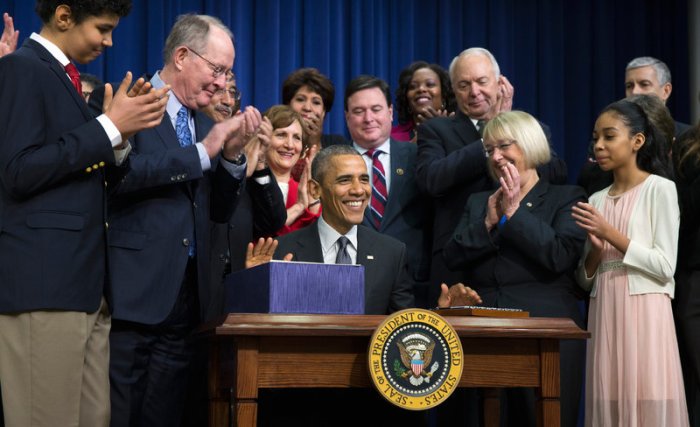
President Barack Obama signed the Every Student Succeeds Act (ESSA) this week.

The new legislation reauthorizes federal law governing K-12 public education.

In 1965 we called it the Elementary and Secondary Education Act (ESEA). Until today we called it No Child Left Behind (NCLB). And now after a much-hyped signing ceremony, the most definitive thing we can say about it is this: federal education policy has a new name.

Seriously. That’s about it.

Does it reduce the federal role in public schools? Maybe.

Does it destroy Common Core State Standards? Possibly.

Is it an improvement on previous policies? Potentially.

Will it enable an expansion of wretched charter schools and unqualified Teach for America recruits? Likely.

The problem is this – it’s an over 1,000 page document that’s been open to public review for only two weeks. Though it was publicly debated and passed in the House and Senate, it was finalized behind closed doors and altered according to secure hurried Congressional votes. As such, the final version is full of legal jargon, hidden compromise, new definitions and verbiage that is open to multiple meanings.

How one reader interprets the law may be exactly the opposite of how another construes it.

Take the much-touted contention that the ESSA reduces the federal role in public schools. Even under the most positive reading, there are limits to this freedom.

The document continues to mandate testing children each year in grades 3-8 and once in high school. It also mandates academic standards and accountability systems. However, what these look like is apparently open to the states.

For instance:

The Secretary [of Education] shall not have the authority to mandate, direct, control, coerce, or exercise any direction or supervision over any of the challenging State academic standards adopted or implemented by a State.

That seems pretty clear. The federal government will not be able to tell states what academic standards to adopt or how student test scores should be used in teacher evaluations.

But it also says that states will have to submit accountability plans to the Department of Education for approval. It says these accountability plans will have to weigh test scores more than any other factor. It says states will have to use “evidence-based interventions” in the schools where students get the lowest test scores.

That sounds an awful lot like the test-and-punish system we have now.

What if your state decides to take a different road and reject the high stakes bludgeon approach to accountability? In that case, some readers argue schools could lose Title I funds – money set aside to help educational institutions serving impoverished populations.

Will that actually happen? No one knows.

It may depend on who will be President in 2017 and whom that person picks as Secretary of Education. And even if the Feds try to take advantage of these potential loopholes, the matter could end up being decided by the U.S. Supreme Court.

What about Common Core?

Some readers interpret the new law as destroying forever the possibility of national academic standards. If states are allowed to pick their own standards, it is highly unlikely they’ll all pick the ones found in the deeply unpopular Common Core. However, the law does force each state to have academic standards of some kind, and it defines what those standards must look like. One interpretation of this is that they must look a lot like the Common Core.

They must be “state-developed college- and career-ready standards.” You read that right – “College and career ready.” That’s the Common Core catchphrase. If someone says they want to eat lunch at “the golden arches,” they haven’t said McDonalds, but you know they’re craving a Big Mac.

Will the Fed allow states to choose standards radically different than the Core? Again only time and – possibly – the courts can tell.

This same problem occurs throughout the document. As the public painstakingly combs through it, new legal wiggle room may be found. And I am not so naive as to suppose we’ve found all of the loopholes yet. Some of these may be the result of poorly chosen wording. Others may be purposefully hidden time bombs waiting for opportunists to exploit.

This uncertainty about exactly what the ESSA will eventually mean for our public schools may help explain the range of reactions to the formative law – from ecstasy to despair to shrugs and snores.

I’m not sure what to think of the thing, myself. I started the whole process disgusted but came around to accepting it if the final result was any kind of improvement over previous legislation. And now that it’s the law of the land, I look at this Frankenstein’s monster of a bill – stitched together pieces of mystery meat – and I don’t know whether to laugh or cry.

I still hope it will live up to the limited promise it holds to bring us some relief from NCLB. But I admit this thing could go sour. Anyone’s guess is as good as mine.

Which brings me to perhaps the biggest problem with this law that no one seems to be talking about.

Education needs reformed. We need to repeal the bogus policies that have been championed by the 1% and their lapdog lawmakers. We need to get rid of test-based accountability. We need to trash high stakes testing, Common Core, value added measures, charter schools and a host of other pernicious policies. We need to initiate a real anti-poverty program dedicated to attacking the actual problem with our schools – inequality of resources.

But more than any of that, we need to reform our government.

We need to find a better way to make our laws. The process that shat out this ESSA must go.

Think about it. No Child Left Behind was an abject failure by any metric you want to use. It didn’t close achievement gaps – it increased them. And the major policy of this law – annual standardized testing – remains intact in the reauthorization!

There has been massive public outcry against annual testing. Parents are leading an exponentially growing civil disobedience movement shielding their children from even taking these assessments. Everyone seems to agree that we test kids too much – even President “I’ll-veto-any-bill-that-deletes-testing” Obama.

Yet our legislators did next to nothing to fix this problem.
Instead preference was given to lobbyists and corporatists interested in making a buck off funding set aside to educate children. The focus was on smaller government – not better government. These aren’t mutually exclusive, but they aren’t exactly one-and-the-same, either.

This can’t continue if we are to keep pretending we have a representative Democracy. The voice of lobbyists must not be louder than voters. Money must be barred from the legislative process. Demagoguery must not overshadow the public good. We need transparency and accountability for those making our laws.

Until that happens, we will never have a sound and just education policy, because we don’t have a sound and just government.

Unfortunately, that is the biggest lesson of the ESSA.


NOTE: This article also was published in the LA Progressive, Badass Teachers Association Blog and quoted extensively on Diane Ravitch’s blog.


Close Reading: Myopia as a Virtue

head in book
Painting by Pawel Kuczynski


You are reading a text.

Yes. Right now.

Your eyes are scanning over symbols called letters. They are joined together into words and sentences and paragraphs to make up the total of this article.

Your brain is in the process of translating these symbols into sounds, meanings, concepts. And you are reacting to those concepts.

You’re having thoughts about what you’re reading. Maybe you’re reminded of a similar article you’ve read sometime in the past. Maybe you’re feeling a thrill of excitement at such an original introduction to an education article. Or perhaps you’re rolling your eyes and wondering why the author is such a doofus.

No matter how you look at it, reading involves complex processes. A whole bunch of stuff is going on to make it happen – all of it essential.

Yet when we evaluate reading comprehension these days, we put the focus squarely on one or two of those multifarious processes. It’s reductive, reactionary, and lame. It’s a dumbing down of the cognitive and metacognitive process. But it makes things easy to grade on a standardized test.

That’s what the fad of close reading is all about. It’s an attempt to make the mysterious and complex mind something that can easily be labeled right or wrong.

For the uninitiated, close reading is the careful, sustained interpretation of a brief passage of text in which great emphasis is put on individual words, syntax, and the order in which sentences and ideas unfold.

It’s not that close reading is unimportant. After all, it’s something good readers do. But an overemphasis on this aspect leaves out so much that is even more vital. It’s like saying the only significant part of the Hershey bar is the wrapper, or the only salient part of eating the Hershey bar is chewing. However, when I unwrap my dessert, there better be chocolate inside, and after I bite into it, I’d better not forget to swallow!

But education specialists with little to no actual classroom experience are making a killing going from school-to-school lecturing teachers about how to teach. And they’re telling us to emphasize close reading to the detriment of all else.

They’re saying we need to give our students short texts of no more than a page or two. We should have our students read these texts without any background into who wrote them or why. We should then have students answer questions that require them to go back to the text, find something and spit it back to us.

For instance:

How does the author use figurative language to develop theme?

Explain how word choice in the passage develops characterization.

Provide examples from the passage that demonstrate the author’s bias.

To the uninitiated, it looks like really important work. It’s not. This is the literary equivalent of taking out the garbage or going on a scavenger hunt. These are good things, but they are not the be-all-end-all. They don’t capture the essential reason we read – to understand.

Imagine if I asked you to go back into the part of this article you’ve already read and find one example of a North American pejorative used by the author. You could do it. You could scan back to the beginning, look through everything I wrote and find that I used the word “Doofus.”

Huzzah! You win the scavenger hunt.

Now explain why I used that word by making reference to textual evidence. You could do that, too. You could look at all the other things I’ve written so far and explain why I probably chose that word.

Congrats!

But notice what you can’t do, what these think tank clones will never ask you to do – form a substantial opinion. Not just why do you think someone else did something but what do you think about what they did?

For example:

Do you think the use of colloquialisms and slang have a place in serious education theory? Why or why not?

When was the most or least effective time you or a colleague used a colloquialism to express a complex thought? Evaluate its effectiveness.

In what ways are forbidden words more or less meaningful than those more easily sanctioned?

At its core, reading is not about discrete facts. No one picks up a piece of text to find out minute fragments of information. Instead, we’re looking for enlightenment. We don’t care so much about how the astronaut puts on the spacesuit. We want to know why she put it on in the first place. We want to know where she’s going. We want to know what it’s like and if we’d want to do something like that ourselves.

But an overemphasis on close reading ignores all this. It pretends readers are robots. It pretends reading is a mechanical process that can be easily divided into its component parts and examined discretely.

Even worse it ignores the needs of individual students. For many children in our modern world, reading of this sort is almost entirely alien to their lives. There are so many things competing for our attention these days that reading often gets neglected. Even if you love to read, it can be difficult to find the time and inclination to sit down, quiet yourself and read.

THIS is where most educators would like to focus – getting students to read at all. We want to show learners why they might want to read. We want to engage them. Demonstrate what an amazing experience a good book can be. We want to foster that look of delight in their eyes, that sense of wonder, the epiphany of literacy.

But instead we’re being told to focus on the nuts and bolts, the everyday boring hunt and seek of mechanical mentation.

Whatever you do, don’t see the forest; see the trees. Don’t look at the big picture; look exclusively to the details and don’t worry your pretty little head about making any larger meaning out of it.

This is tantamount to child abuse. We’re putting blinders on children’s minds and telling them which direction to think. We’re taking away their ownership of the reading experience. It’s no longer about what they want, what they’ve lived through, what they believe or what they see. It’s only about the author’s view – an author they probably don’t care about because they had no part in all the other crucial facets of reading. In fact, I would argue that this isn’t even really reading at all. It’s little more than  decoding. It’s a skill set fit for a corporate drone, not someone in management or any position to make valuable decisions.

It’s no wonder that these prescriptions are only leveled at public schools. Parochial, private and charter schools are specifically left out of these mandates. The same people demanding close reading for your kids want something much different for their own.

This is class warfare as education policy. It’s all about keeping down working families and lifting up the one percent.

That’s essentially what corporate education reform is all about – every tentacle of the beast is wrapped around young minds of the poor, the brown skinned, the undesirable.

But perhaps you don’t agree with me. Perhaps you have your own thoughts on this matter which may differ from mine.

Fine, I say. Good!

Yes, please think about it. Ponder these issues carefully, because while I’m championing free thought, the other side wants nothing less than your children’s complete submission to the status quo.

Feel free to give that a nice close read.

12309794_10206881389730566_1129034647191120195_o


NOTE: This article also was published on the Badass Teachers Association Blog.


Standardized Tests Every Day: the Competency Based Education Scam

rocketship-charter-schools

IN THE NOT TOO DISTANT FUTURE:

Welcome to class, children.

Please put your hands down, and sit at your assigned seat in the computer lab.

Yes, your cubicle partitions should be firmly in place. You will be penalized if your eyes wander into your neighbors testing… I mean learning area.

Now log on to your Pearson Competency Based Education (CBE) platform.

Johnny, are you reading a book? Put that away!

Are we all logged on? Good.

Now complete your latest learning module. Some of you are on module three, others on module ten. Yes, Dara, I know you’re still on module one. You’ll all be happy to know each module is fully aligned with Common Core State Standards. In fact, each module is named after a specific standard. Once you’ve mastered say Module One “Citing Textual Evidence to Determine Analysis” you will move on to the next module, say “Determining Theme or Central Idea for Analysis.”

Johnny, didn’t I tell you to put away that book? There is no reading in school. You’re to read the passages provided by the good people at Pearson. No, you won’t get a whole story. Most of the passages are non-fiction. But I think there is a fun passage about a pineapple coming up in your module today. Isn’t that nice?

Laquan, you haven’t put on your headphones and started your module yet? You’ve been on module three for the past week. How can you learn at your own rate if you never progress beyond module three?

What’s that? Your mother wrote me a note? Let me see that.

Huh. So she wants to know how come you never get beyond module three. You should be able to answer that question for her, yourself, Laquan. (At least you could get that one right.)

Laquan, tell your mother that you haven’t passed the proficiency standard yet. You’ve taken all the remediation available on the computer program, haven’t you? Yes, that fun game where you answered multiple choice questions and when you got one correct the spaceship blasts an asteroid. And then you took the daily assessment but you just haven’t received a passing score yet. But don’t worry. I’m sure if you continue to do the same thing again today… eventually… you’ll get it right. It’s how the state and federal government determine whether you’ve learned anything on a daily basis.

In ancient times, teachers like me used to make up our own assignments. We’d give you books to read… Johnny, have you started yet? …whole books, novels, literature. And then we’d hold class discussions, class projects, act out scenes, draw posters, relate the books to your lives, write essays. But now all that silliness is gone.

Thanks to the good people at the American Legislative Exchange Council (ALEC), the Gates Foundation, and the Foundation for Excellence in Education, The state and federal government have mandated a much more efficient way of determining student learning. Back in the day, they forced schools to give one big standardized test in Reading and Math every year. Teachers would have to scramble with test prep material to make sure all learners could pass the test, because if students didn’t get passing marks, the teacher was out on her butt.

We’ve done away with such silliness now. Thankfully the government got rid of yearly high stakes standardized testing. What we do now is called Competency Based Education. That’s what this program is called. It’s kind of like high stakes standardized testing every day. So much more efficient, so much more data to use to prove you know this set of basic skills written by the testing companies with hardly any input from non-experts like classroom teachers.

That’s how the district became composed of 100% charter schools. No more inefficient school boards made up of community members. Today our schools are run by corporate CEOs who are experts at finding ways to cut corners and increase profits for their shareholders. And, ugh, make you learn good.

Hm. I seem to be talking too much. No one’s paying me to impart any information. I’m just supposed to make sure you’re all hooked up to the program and making satisfactory daily progress. Otherwise, I’ll be out of a job again.

You laugh, but it’s hard to get minimum wage work like this. Since the U.S. Supreme Court made labor unions all but illegal and public schools instituted CBE programs, teachers like me could no longer demand such exorbitant salaries. Now I make an honest living. Speaking of which, I may have to get out of here a few minutes early today to make it to my shift at WalMart. I’m greeter today!

And if you work hard, someday you can be, too!


NOTE: This article also was published on the Badass Teachers Association Blog and quoted extensively on Diane Ravitch’s blog.


Stockholm Syndrome – The Only Reason Any Teachers Still Support Common Core

Screen shot 2015-11-05 at 11.06.26 PM

Common Core is dying a well-deserved death.

The very idea that we need the same academic standards in public schools from coast-to-coast is unpopular, expensive, ineffective and politically suicidal.

The Wall Street Journal reports at least $7 billion taxpayer dollars have been wasted implementing this plan, and it would cost significantly more to finish the job.

“Five years into the biggest transformation of U.S. public education in recent history, Common Core is far from common. Though 45 states initially adopted the shared academic standards in English and math, seven have since repealed or amended them. Among the remaining 38, big disparities remain in what and how students are taught, the materials and technology they use, the preparation of teachers and the tests they are given. A dozen more states are considering revising or abandoning Common Core.”

Meanwhile public support drops precipitously with each passing year. Less than half of all Americans – 49% – and only 40% of teachers now favor the policy. That’s a drop of 16% among the general population since 2013. But even more surprising is the plummeting backing from teachers. Advocacy has dropped 36 points from two years ago when three quarters of educators approved of the change. This is especially damning because of all social groups, teachers know the Core the best.

In political circles lawmakers who used to champion these standards now take pains to distance themselves from them. Politicians as diverse as Jeb Bush and Hillary Clinton now claim they either never supported the policy in the first place or that it’s a good idea that has been badly implemented. Support among Republicans – who initially favored the plan much more than Democrats – has practically vanished.

The writing is on the wall. Common Core is sinking fast.

Yet there remains a minority of real live educators who will cheerfully direct you away from the lifeboats even as the ship of our public schools lists dangerously to port. Despite everything going on around them, they cling to this disastrous policy blunder despite the harshest criticisms.

It’s strange.

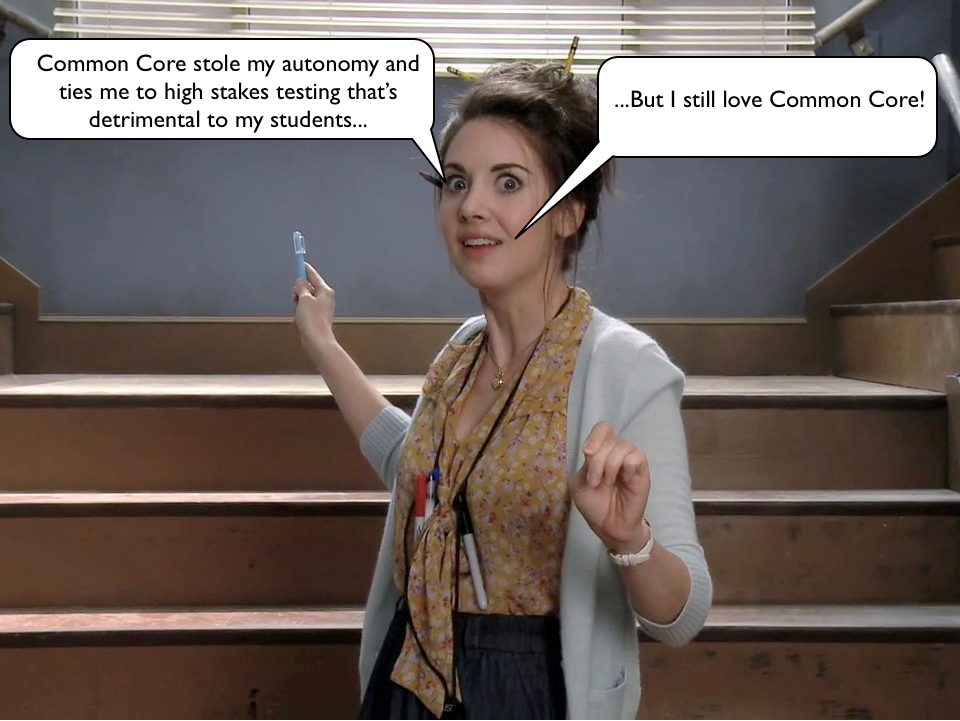
By and large, Common Core wasn’t created by teachers. It was forced on us by policymakers, functionaries and corporations. It usurps our autonomy. It overrides our judgment. And it ties us to practices that almost all of us think are detrimental to our students. But some of us still think it’s the bees knees.

The only explanation I can come up with is Stockholm syndrome. The phenomena, also called capture-bonding, occurs when hostages empathize with their captors. Kidnapping victims sometimes feel sorry for the very people who abducted them. Something similar seems to be happening with the few hardcore supporters of Common Core that are left.

For instance, regardless of the public relations efforts being spewed by corporate America, Common Core was not created by teachers. It’s shocking that this fact is still disputed. It is easily verifiable.

Here it is from the National Governors Associationthese 24 people wrote the first draft of the standards. And these 101 people revised them. None of these people were currently employed as a K-12 classroom teacher. Moreover, very few of them even had K-12 classroom experience at some distant point in their careers. Even less had experience at the middle school or elementary level. Less than that had experience in special education or with English Language Learners.

Therefore saying Common Core was created by teachers is incredibly disingenuous. It’s like taking a single speck from a beef bullion cube and calling it a filet mignon. Something resembling a cow may have been present at one point, but add water and you couldn’t exactly call the flavor beefy.

The overwhelming majority of Common Core authors are identified as working for the testing industry – specifically the College Board and ACT. The second largest group worked for Achieve, a Washington think tank. Others worked exclusively at the college or university level.

Yet there remain a small cadre of real life K-12 teachers who still champion this product. Think about what that means.

They prefer a prepackaged set of academic standards to what they would come up with on their own or with their colleagues. They prefer to give up their own professional judgment based on years of experience, degree certifications and professional development in favor of something handed down to them from the testing corporations and policy wonks. They would rather be told what to do by people with far less experience than to make their own decisions about how to do their own jobs.

Even if everything in the Core was hunky dory, I’d have a problem with that. Call it self-respect. Call it professional pride. I did not get into this field to become anyone’s worker drone. Being a teacher is not on par with being a greeter at Walmart. We need to make complex decisions about how best to educate children every moment of every day. That’s not a mcjob.

This doesn’t mean all the standards contained in the Core are garbage. There are certainly some things in there that promote learning. However, as educators have become more familiar with the contents, glaring mistakes have become apparent – standards that are age inappropriate, too specific, not specific enough, unduly restrictive, and just plain weird. If only there were some objective means of telling the wheat from the chaff.

But there is.

We could have tested the standards to see if they actually aided in comprehension. We could have field tested the product – tried it out in a small scale and then assessed its effectiveness. You would expect any new commodity to go through rigorous research and development. Only a fool would just throw new merchandise out there without any idea if it would work.

Welcome to Fool Nation – population you. That’s where your tax dollars went. Your government spent billions on something completely untried and unproven. And guess what!? It didn’t work.

I have a major problem with that. As a teacher, I am appalled that I am being forced to institute something so careless into my classroom. If the legislature suddenly thought all children should be forced to pour lemon juice on their heads before reading a book, I’d jolly well need a good reason to do it before I started squeezing citrus on top of my classes. But that’s kind of what they did, and they even charged the taxpayers for all the lemons!

However, the strangest part of this whole concern is standardized testing. Here at least we have agreement. Almost everyone says its out of control. We give too many tests. But many teachers go even further questioning these tests effectiveness at all.

High stakes assessments do not promote learning. They narrow the curriculum and punish the neediest students for – in fact – being needy. It’s a proven fact: rich children generally score well and poor children score badly. These are terrible measurements of children’s academic success.

And most folks left on the dwindling bench of Common Core cheerleaders agree! They don’t like testing either! Yet so many times I’ve heard these people say, “I hate the testing but I love the Common Core!”

What!? They’re intimately connected.

Common Core was designed to be assessed by standardized tests. In fact, the standards attempt to make what is taught more representative of what is tested. For instance, most passages on Reading assessments are nonfiction. Therefore, Common Core says most of the reading done in school should be nonfiction. The tests emphasize cold reads. Therefore, the Core says teachers should make their students do more cold reads.

And yet Core advocates only find fault with the tests!? How can you say ‘I don’t like the tests but I like teaching to the tests I don’t like’?

It’s absurd.

And speaking of cognitive dissonance, why are we designing our curriculum backwards from the tests in the first place? Shouldn’t we be designing the tests based on the curriculum? Shouldn’t our assessments be made to prove that students are prepared for real life and not simply that they’re prepared to take the tests?

Bizarrely, all this remains a mystery to the few Common Core standard-bearers left in our classrooms. They want their Common Core. Yes, it was forced on them by bureaucrats. Yes, it’s never been proven to work. Yes, it’s intimately connected to the same standardized testing they hate. But they just can’t get enough of that Core.

Still, don’t be too hard on them. Everyday more of these folks are waking up. Every day more of them discover they are living in The Matrix. Reality is not as it seemed.

Perhaps it will just take more time. Or a strict regime of psychoanalysis, mediation and special pharmaceuticals.

But one day the Common Core will breath its last, and we’ll need everyone to help undo the damage.


NOTE: This article also was published on the Badass Teachers Association blog.


Department of Education SorryNotSorry About High Stakes Testing

Screen shot 2015-10-24 at 11.04.43 PM

The Obama Administration must think the nation’s parents, teachers and students are pretty darn dumb.

President Barack Obama and his hand-picked Department of Education are solely responsible for the knuckle dragging academic policies strangling our public schools day in, day out. Yet instead of doing anything to reverse course to proven methods that might actually help kids learn, the department trudges out its annual apology.

It goes something like this:

Hey, Everybody! So sorry about all those high stakes tests, Common Core Standards and Value-Added teaching evaluations. We know they’re bad and we’re going to stop.

Then whatever functionary drew the shortest straw toddles back into the building and for the rest of the year things continue on exactly the same as they always have.

Let’s just pause for a moment and imagine how incredibly stupid they must think we are. I’m surprised they don’t issue public service announcements reminding us to exhale, multi-colored pamphlets on the benefits of blinking, and puppet shows instructing us how to use the potty.

The Obama Administration has had 7 years to fix this mess, and the only things they’ve done are to make it worse. Most of us voted for this so-called progressive because we thought he’d improve upon George W. Bush’s astoundingly wrongheaded school policies. But instead he doubled down on them! We hired a competent janitor but he was successful only in creating greater disorder.

We thought someone with the intelligence and grace of Barack Obama would be able to understand more than the eternal C-student Bush that you can’t ensure equity by standardized testing. That’s like trying to ensure a bathtub was filling with hot water by using nothing but Tarot Cards. The cards don’t give you an accurate reading and even if they did, you’d need to adjust the faucet at some point!

We thought a Constitutional scholar would understand that a national school curriculum violates federal law – even if you get a faux state commission to propose it and slap a new name on the thing! The federal government is allowed to do some things and state governments are allowed to do others. It’s not that hard. Moreover, armchair generals who have zero understanding of educational pedagogy, psychology, sociology and no classroom experience have no business telling teachers what they should be teaching!

We thought a political party that claims to be on educators’ side wouldn’t then turn around and initiate a witch hunt against us using poor student test scores instead of pitch forks and torches. Every independent, peer-reviewed study shows that poor kids do badly on standardized assessments and rich kids do well. Every statistician says you can’t use a test created to measure one thing (students) to measure another (teachers). Yet this is exactly what this so-called intellectual president mandates, and then he and the Democrats expect us to be there for them at the polls!?

In short, we expected a liberal Democrat, but got instead a Conservative Democrat in Name Only (DINO). He took far right ideas that Bush could barely officiate and made them much more efficient and thus much more damaging.

And every year like an alcoholic stumbling off a bar stool, the administration swears they’re not going to take another drink. Then they hire the head of Anheuser-Busch (John King) as a nutritionist. And some of us still believe them!

Just look at the crumbs they’re throwing out to us, peons!

Hey, Girl. We’re going to cut testing down to 2% of the school year.

That’s 23 hours! Almost 3 full days! Imagine if the dungeon master told you he was only going to put you on the rack for 2% of the time! Would you thank him? Maybe, but it would be a pretty half-hearted thank you.

Can the administration prove any positive value for standardized testing? I’m not asking them to trot out the tired party line about equity. I mean can they prove that testing actually helps children learn in any appreciable way? If the answer is no (and Spoiler Alert: it is!) then we shouldn’t be wasting any more time with it. Not 2%. Not 1%. ZERO PERCENT!

Moreover, Obama has been talking about reducing testing since he ran for office in 2008. America’s schools are still waiting for him to come through on that one. Maybe on his last day in office we’ll have a testing moratorium. Fingers crossed!

The department says, “The assessments must be worth taking.” No shit. That’s exactly the problem! They aren’t! And they’re shrouded in secrecy under the guise of test corporations intellectual property. How will we be able to determine they’re “worth taking”? Will you just tell us? THAT sure puts my mind at ease!

You know what assessments have been proven worth taking? The ones created by teachers. Yet these are exactly the kinds of tests that schools have been forced to cut back on. Perhaps this is what the administration has in mind. No more teacher-created tests. Let’s just have tests made by the professional test creators who have no idea what the heck they’re doing!

And speaking teachers, this one’s for you: “No standardized test should ever be given solely for educator evaluation.” It sounds like a condemnation of Value-Added Measures (VAM), of evaluating teachers on student test scores. However, it’s just the opposite. Notice the word “Solely.” We’re not going to give kids tests if we ONLY use them to evaluate their teachers. Well woop-de-do! Professional flunkies will talk to you for hours (if you pay them enough) about how great the tests we give now are at doing both! So no change in policy, just some purple prose to light on fire and blow the smoke up educators hind ends.

Perhaps worst of all is the use of English Language Learners (ELL), students with disabilities and minorities as props. We’re doing it all for them, they say. Bull! Shit!

The administration has nothing to say about fully funding the Individuals with Disabilities Education Act (IDEA). There’s nothing about sanctions on districts that don’t provide proper services for ELLs. There’s nothing about ensuring adequate, equitable and sustainable funding for all students – especially the poor and minorities. Instead the Department of Education pretends like high stakes tests are candy bars and what poor disadvantaged minority ELL disabled kid doesn’t love the soft velvety chocolate taste of a multiple choice test!?

This announcement is not reason to celebrate. It’s more of the same fake apologies soaking wet in crocodile tears and bad candor.

If Hillary Clinton wants to get elected President, she’d better do more than that. If Bernie Sanders wants a shot, he’d better do more than spout socialism about Wall Street and silence about K-12 schools.

You can only lie to our faces for so long. Despite your best attempts to trash public education in the name of saving it, we’re not so dumb as to believe any more of your evasions, deceit and dishonesty.


NOTE: This article also was published on the Badass Teachers Association blog.


Education Does Not Cure Poverty – It Cures Ignorance

Screen shot 2015-10-17 at 11.36.22 PM

What good is an education?

Will it get you money? Will it make you rich?

No. Not really.

And that’s one of the biggest problems with American public school policy of the last 15 years. It misunderstands the purpose of the very thing it purports to promote.

Poverty is skyrocketing. It’s been on the rise for at least three decades, but since the economy collapsed in 2008, the ranks of the poor have swollen like an untreated wound left to fester and rot.

We could be doing something about that. We could be working on a jobs package – on something to get people back to work. Instead we crowd around unemployment data and clap each other on the back because on paper it looks like we’ve overcome this obstacle.

Unfortunately, we haven’t.

Since President Barack Obama took office, there have been less people out of work than during the disastrous Bush years. However, most new jobs created since the crash only pay minimum wage. The good jobs are drying up and being replaced by poverty wage employment. And that’s not even counting the hordes of people who’ve given up even looking for a job but don’t merit a mention in these Pollyanna publications!

So how do we truly answer this dilemma? How do we get America back to work?

According to our policymakers, through magic.

Provide people more training, they say. Make sure those out of work obtain new skills and the next generation receives a rigorous education.

It’s the kind of solution our grandparents – who lived through the Great Depression – would have laughed to silence. Give someone a book, put them in a school, place them before a teacher and – POOF – they’ll be able to get one of the nonexistent well paying jobs that – may I repeat – DON’T EXIST!

It’s not that we have an unskilled workforce. We have more people than ever with Doctorates and Masters degrees living on food stamps. The problem is lack of well paying jobs. We’ve tax sheltered, down sized, and corporatized America into a land where the rich play Monopoly with all our cash while the rest of us subsist on McJobs.

Claiming that education alone can resolve this problem is like saying all a starving person really needs is a fork and spoon. But that won’t help if he has nothing to eat!

It should be no surprise that those championing our school system as a silver bullet to our jobless nation speak out of both sides of their mouths. On the one hand, they say, education can save us. On the other, they say, if education was better we wouldn’t need saving. And since they’re almost exclusively employed by the same people who gobbled up all the jobs in the first place and then spat them out to China, it’s a travesty that anyone listens to them.

They’re not offering a solution. They’re making a last ditch effort to clear the board of any remaining public money – education dollars.

If only the teachers had taught us better, they say, we’d all be able to have a corner office in the sky. But since those evil, lazy educators are doing such a bad job, we need to close as many schools as possible to save those kids. And then we can privatize them and swipe even more of that sweet, sweet public money to the 1% who can run charter schools and cut student services while scarfing up the rest as yummy profit.

To prove this thesis, policymakers force untested and irrational reforms on public schools – standardized testing, computerized test prep, Common Core. When none of this works (as planned), they simply blame the educators who never wanted any of this in the first place. But it helps us serve up teachers on a silver platter as the scapegoat of the day.

These so-called reforms solve nothing – they just make things worse.

Furthermore, they’re a distraction, smoke and mirrors so we won’t see the real issue of how we’re being swindled by the 1%. After all, THEY were the ones who got us into this mess in the first place! They were the ones who crashed the economy – not Mrs. Jones, the local science teacher.

We should know this already. It’s out in the open and easy to see. The media is not doing its job of reporting the truth. The public is being dazzled by propaganda that appeals to our basest selves. But most importantly, we’re being fooled because we no longer remember what education is for!

Even under the best of circumstances, education does not make someone rich. That’s not it’s goal. It never has been. Education seeks to enrich people’s minds, not their bank accounts.

Yes, there is a relationship between the two, but its several steps removed. A well educated person may be able to more easily obtain money than an uneducated one. She may be more prepared for a well-paying job. However, being prepared is rarely what makes someone rich.

People gain wealth most often by inheriting it (See Paris Hilton, Bill Marriott, Mitt Romney and Donald Trump). Others get money by cheating the public out of it. This takes a person with a weak moral code, not necessarily strong book smarts. For instance, look to the Walmart model of selling groceries cheaply by paying poverty wages to employees who then must rely on the federal government to survive and thus can only afford to shop at Walmart. That’s not smart. It’s sociopathic. Anyone could have thought that up, but it takes a person with a stunted conception of the value of other people to actually do it.

More important than a college degree are connections. The Rich know the right people. They have contacts in high places with whom they can barter for lucrative tips, jobs and partnerships. They have friends on Wall Street who can tip them off when a stock is about to rise or fall. They know editors at prominent papers who have no problem changing the headlines to match a preconceived narrative rather than the facts on the ground.

Again, that doesn’t require all A’s on your report card. It’s the result of a lottery of birth, social standing and an undeveloped sense of fairness.

There are some people who actually do gain riches on the merits of their intellects. But they are few and far between. Even among them there is a large portion who are more lucky than genius. I love Ben and Jerry’s ice cream, but it doesn’t take an Einstein to come up with it. Sometimes the gods of finance just smile on hippy dippy flavors with fun names.

Since the ancient world, thinkers have postulated that the purpose of education is not to increase material gain – it is to become a better person. The Ancient Greeks believed that there is value in knowledge and wisdom that doesn’t translate into gold. Aristotle called it eudaimonia or human flourishing. The best life includes wisdom.

This builds on the philosophy of Socrates – one of the founders of Western thought – who famously said, “The unexamined life is not worth living.” We have strayed far from these ideals. Today we might say the unreciprocated action is unworth doing. If something doesn’t translate into cold, hard cash, it is considered weak, a wasted effort. Even philanthropy has become a way to gain control over the industry you’re ostensibly trying to help. (See Bill Gates immense influence on Education policy.)

In their hearts, most teachers would side with Aristotle and Socrates over the Waltons and Gates’. And that’s why our corporate masters look down on us. We represent an ethos that they have abandoned and tried to destroy.

They tell themselves the fairy tale that wisdom means cheating others out of money. The removal of ignorance, they say, is the removal of any obstacles toward clawing and punching your way to the top.

But true wisdom recognizes that people are more than mere animals. We do not need to continue the Darwinian struggle of survival of the fittest among ourselves. We can cooperate. We can value each others lives. We can love.

If people valued this kind of knowledge over money, what would happen to the rich? Wouldn’t it prove that they have wasted their lives betraying and manipulating the less fortunate? Wouldn’t it reveal the poverty of their souls?

Because if people were truly educated, they would see these sick, twisted individuals for whom they really are. And we would demand justice. Not so that we could replace these penny-ante tycoons with our own wealth addiction. But instead so that we could all live in peace and bask in the joy of knowledge, compassion and an unending quest to chip away at our own ignorance.


NOTE: This article also was published in the LA Progressive and on the Badass Teachers Association blog.


If School Computer Use Reduces Standardized Test Scores, Doesn’t That Prove the Tests are Inadequate?

ipad-kids

Melvin’s hand is up.

He’s a 13-year-old African American with too much energy and not enough self-control.

He’s often angry and out of his seat. He’s usually in trouble. But today he’s sitting forward in his chair with his hand raised high and a look on his face like he’ll explode if I don’t pick him right this second.

So I do.

“Mr. Singer! Can I show my imovie now!?”

This is a first. He hasn’t turned in a lick of homework all month.

“Wow! You’re really excited about this, aren’t you?” I say.

“Yeah,” he responds. “I was up all night finishing it.”

I start to doubt this, but he does look awfully tired underneath that urgent need to share.

Airdrop it to me from your ipad,” I say, “and I’ll put it up on the SMART Board.”

This takes a few minutes.

Let’s face it.

We live in a world of high technology.

Our cell phones have more computing power than the Apollo missions to the moon.

The best, high paying jobs opening up on the world stage require increasing levels of computer literacy.

Yet according to a new study, America’s students don’t succeed as well academically if they have access to computers at school.

How can this be?

How can exposure to new technologies cause a nation of young people to fail at a system supposedly designed to prepare them for the jobs of the future?

Doesn’t real world experience usually make you better prepared?

A future chef would be helped by more time in the kitchen.

A future doctor would be helped by more access to dissection.

But a future computer-user is hurt by more time at a computer!?

Something is very wrong here.

But according to a new study by the Organization for Economic Cooperation and Development (OECD), students who use computers more at school earn both lower reading and math scores on the Program for International Student Assessment (PISA).

The organization studied 15-year-olds across 31 nations and regions from 2012. The study just released in September even controlled for income and race.

Yet here in my classroom I see the exact opposite. Computer use increases my students test scores – on my teacher-created tests.

Melvin’s movie was ready. He had been tasked with explaining the differences between external and internal conflict. I pressed play.

High adrenaline music poured from the speakers. Pictures flashed across the screen of boxers and football players.

“This is external conflict,” came rushing forward followed by a brief definition. Then an image of Homer Simpson with an angel and devil on his shoulders. “This is internal conflict,” came zooming by our eyes.

The film might not win any Academy Awards, but it was pretty impressive work for 40 minutes of class time and however long Melvin decided to spend at home.

It’s the kind of thing my students never could have done before they each had ipads. And when they took my test, few of them got the questions wrong about conflict.

Yet according to the OECD, I was somehow hurting my students academically!?

Even in my high poverty district, students have always had access to technology. But the nature of that technology and how we use it has changed dramatically this school year.

I used to have eight computers in my classroom, but they were slowly becoming obsolete and inoperable. Some days they functioned best as extra illumination if we shut out the overhead light to show a movie.

Still, I tried to incorporate technology into my lessons. I used to have my students make their own Webpages, but reserving time in the computer lab became almost impossible. And even then, the district couldn’t afford to keep the devices in the lab updated enough to run anything but the most rudimentary software.

The one lab in the building that had new devices was reserved almost exclusively for a drill and kill test prep program we had received a state grant to operate. THIS was the apex of school technology – answering multiple choice look-a-like questions. It bored students to tears and didn’t even accomplish the stipulated goal of increasing standardized test scores. Yet we were blackmailed by the state government into initiating the program so we could gain additional funding to keep the school operational.

THIS is the kind of technology use you’ll find at most poor schools like mine. And it’s one of the reasons the authors of the OECD study came to their conclusion. It’s also one of the reasons why teachers like me have been skeptical of technological initiatives offered to impoverished districts.

However, the best use of technology is something quite different.

This year my district received a gift of ipads for all the students, and it’s changed everything. No longer do I have to beg and plead to get computer lab time for real high tech lessons. I don’t need it. The technology is already in the classroom in the palm of their hands.

But policymakers clutching their pearls because of this study have already began to make changes to international school curriculum. Schools in Asia have begun cutting back on student computer time. Should America follow suit?

Absolutely not.

The problem clearly is not computers. It’s the antiquated method we use to measure success.

Standardized testing has been around since 206 BC as an assessment for civil servants in ancient China. The same process spread to England in the 19th Century and then to the United States during WWI. Through all that time, the main process of rewarding rote learning through multiple choice questioning has remained the same.

But the world hasn’t. We’ve moved on a bit since the Han Dynasty. We no longer live in a medieval society of peasants and noblemen where the height of technology is an abacus. We live in an ever-changing interconnected global community where a simple search engine provides more information than could be stored in a thousand Libraries at Alexandria.

How can we possibly hope to rely on the same assessments as the ancients? Heck! Even as far back as 970 AD, standardized testing was criticized as being inadequate.

But a global multi-billion dollar industry relies on these primitive assessments. It’s the basis of an exceedingly lucrative business model.

So it shouldn’t be surprising that the same people who promise standardized testing and Common Core will best prepare students to be college and career ready are passing the blame.

They claim this report isn’t an indictment of their cash cow industry. It’s a warning against over-reliance on computers. And, yes, they’re right that technology is not a panacea. The mere presence of a computer won’t make a child smarter. Likewise, the mere presence of a book won’t make a person wiser. One must know how to use said computer and book.

But what I’m seeing in my classroom primarily is an opportunity – not a danger. Students like Melvin are more engaged and willing to take chances. They have greater freedom, intrinsic motivation and excitement about learning.

Many times when sharing Keynote presentations, after one or two, students ask to have their work back so they can improve them. That doesn’t happen with test prep.

They often elect to take ipad assignments to lunch and work on them between bites. That doesn’t happen with Pearson worksheets.

I’m not saying it’s easy. It’s up to me, my colleagues and administration to ensure technology is used to its full potential. Never should these devices be time fillers or babysitters. Nor can they ever replace the guidance of a thoughtful, creative educator to determine their best use. Teachers need to create and assign lessons that promote creativity and critical thinking skills.

Education professionals are constantly advised to individualize their lessons to meet the needs of diverse learners. Technology allows them a unique opportunity to do so. With district ipads I can talk to an English Language Learner in his own language. A struggling reader can have the device read test questions aloud. A student with poor motor control can type journal responses and have his writing be understood.

And these opportunities for enrichment don’t even need to be planned ahead of time. For instance, when discussing a short story about a character that was exceedingly proud, one of my students brought up the Seven Deadly Sins. She wasn’t exactly sure what they were or how exactly they related to pride, but one of her classmates quickly looked it up on her ipad. Then another found a medieval woodcarving to which someone else found a related manga text. The subsequent discussion was much deeper and relevant to these children’s lives than it would have been otherwise. And none of it was pre-packed, planned or standardized. It was individualized.

This is really no surprise. Administrators in charter or private schools aren’t asking themselves if they should close their computer labs and put their devices on ebay. They know the value technology can provide in the classroom, but they aren’t constrained by high stakes testing.

Even rich public schools don’t have to worry to the same degree because their students already score well on federally mandated assessments – after all, standardized tests are designed to favor children with wealthy parents over those from impoverished or minority backgrounds. It’s only in poor school districts where technology is either second hand or a charitable donation that administrators and school directors are being pressured to cut back.

As usual, best practices for the privileged become questionable when applied to the poor and minorities. You want technology? Prove it will boost your test scores!

It’s nonsense.

Think about it. Even the best use of computers won’t boost standardized scores. Computer skills aren’t on the tests.

Nor could these things ever be assessed effectively in this manner.

Yet such skills are exactly what education researchers tell us demonstrate the deepest levels of understanding and an ability to meet the demands of the best jobs of the future.

I wonder what Bill Gates thinks of this report. The Microsoft co-founder is also one of the biggest advocates for school standardization. If he had to pick between his two favorite children, which would he choose – laptops or Common Core tests? Maybe we needn’t wonder. His own children go to a private school with no standardization and a plethora of technology.

There comes a time when you have to admit the truth staring you in the face: standardized tests are poor measures of academic achievement. They are suitable only for turning our children into factory drones. They are for pawns, patsies and robots.

If we really want to prepare the next generation for the jobs of the future, we need to scrap high stakes testing. We need to invest in MORE technology, not less. We need to ensure technological lessons are being overseen by trained educators and the devices aren’t used as a babysitting tool. As such, we need to provide teachers with support and professional development so they can best take advantage of the technology they have.

America can prepare its children for the world’s high level management and administrative positions or we can prepare them to do only menial work that will soon by replaced by machines.

Computers do the former. Tests the latter.

Choose.


NOTE: This article also was published on the Badass Teachers Association blog.


You Can’t Win a Rigged Game – Standardized Tests as “Proof” of Failure

Kids_playing_video_games

One of my dearest high school friends was a bit of a doofus.

Who am I kidding? So was I!

One of our favorite things to do after school was plop on the coach and play shoot ‘em up video games. “Smash TV” was a particular favorite.

We’d bob and weave while clutching controllers and rapidly jamming our thumbs on the buttons.

And at such times, we‘d talk.

No great philosophical problems were solved during these mid-afternoon gaming sessions. We’d talk trash, dissing each other’s gaming skills, bragging about our own, and occasionally quizzing each other with trivia on a shared topic of interest.

We both loved movies, so my buddy used to shout out cinematic quotations and ask me to name where they came from.

“Frankly, my dear, I don’t give a damn.”

“Luke, I am your father!”

“Go ahead, punk. Make my day!”

None of these famous quotes made my buddy’s list. He preferred lines like these:

“Run!”

“Look out!”

“Holy S&*t!”

As you can imagine, I rarely got any of them right.

I’d laugh, punch him in the arm good-naturedly and go on shooting virtual enemies.

It was good dumb fun. But now – more than two decades later – my students are forced to take my buddy’s quiz – and if they don’t pass, the government is threatening to shut down their schools and fire me, their teacher.

No, learners don’t have to identify impossible movie quotes. Instead, they’re forced to answer impossibly bad multiple choice questions. But the results are pretty much the same.

In my home state, the Pennsylvania System of School Assessment (PSSA) and the Keystone Exams are high stakes versions of my buddy’s moronic quiz. The purpose isn’t to fairly assess: it’s to stump as many kids as possible.

And it’s working. For the fourth year in a row, student test scores have declined statewide. Previously, students had been doing relatively well. Why the change?

It began with budget cuts. The legislature slashed almost $1 billion every year in school funding. That means higher class sizes, less teachers, fewer electives, tutoring, nurses, services, etc. And districts like mine weren’t exactly drowning in money to begin with.

Students now have less resources, therefore they can’t prepare as well for the tests.

So what did the legislature do? Did our lawmakers fix the problem by putting back the money they had repurposed as gifts to the natural gas industry?

Heck no! They made the tests even more unnecessarily difficult.

As a result, the steady decline in test scores this year fell off a cliff!

After all, this was the first year in which the Commonwealth fully aligned every question of its mandatory testing with the Pennsylvania Core Standards – which are similar, but not identical to the Common Core standards adopted in other states.

Proficiency rates in grades 3 through 8 dropped by an average of 35.4 percent in math and 9.4 percent in English language arts on the PSSA. Nearly half of all seventh and eighth graders dropped an entire proficiency level in math in just one year.

If I made up a test like this in my own classroom, gave it to my students and got results like these, my first assumption would be that there was something horribly wrong with the test. I must have messed something up to fail so many students! Teachers are always on the lookout for unclear or bad questions on their self-created exams. The for-profit corporations that create our state-mandated tests? Not so much.

Though state Department of Education officials acknowledge the continued decline in scores, they insist problems will work themselves out in subsequent years – as if a 4-year trend is just an anomaly. Move along. Nothing to see here, folks.

My students used to make impressive gains on the tests. My principal stopped by today to give me the scores for my current students and those I taught last year. No surprise. Very few passed.

Are my students now lazier and less intelligent than those I taught four years ago? No. Students who scored well before the budget cuts, often score badly now.

Am I a worse teacher? Absolutely not. I have the same skills I did then. I spend the same amount of time at school – maybe more.

So what changed in my classroom? Lack of reconnaissance.

Teachers like myself used to know exactly what was expected of students on these assessments. We had plenty of materials with which to prepare them. Now the exams change every year – and I don’t mean just the individual questions, I mean what is tested!

Back in the day, when my buddy first shouted out, “Run!” and asked me which movie it came from, I had no idea. But after he did it long enough, I’d start to anticipate him. I’d learn that he was thinking of James Cameron’s “The Terminator.”

That’s how the PSSA’s used to be. Teachers knew how the test makers wanted kids to answer. And we could prepare them to do so. The tests didn’t accurately assess student learning even then. It was a game, but at least it was more fair.

Let’s be honest. These tests have never been particularly good. You can’t honestly expect to assess higher order thinking skills on a multiple choice test. Basic skills, maybe. But anything complex simply cannot be measured in this manner. We’ve known that for over a century!

It’s like my buddy’s movie quiz. I have little doubt that someone really did shout “Run!” in “The Terminator.” However, that same line probably appears in at least a dozen more action movies. There’s no way to determine a single correct answer. And shouting out a different quote instead like “Look out!” doesn’t help either.

So please stop the talk about “Rigor.” We’re not raising standards. We’re changing them. My buddy found a new bunch of movies from which to shout out impossible quotes. That’s all.

Anyone who wants to argue validity to these new test questions has to leap a host of hurdles to accomplish his goal.

First, one would have to prove PA Core – and by extension Common Core – Standards actually improve student learning. Good luck. It’s never been done and all the evidence is against you.

Second, one would have to gain access to an individual year’s worth of test questions. Again, good luck. They’re corporate property. The public is not allowed to see the questions. If a principal, student or teacher were to copy a question or snap a photo of a test, they could be subject to prosecution in a court of law.

Such a lack of transparency in government is a sure sign of malfeasance.

It’s almost impossible to avoid certain conclusions about this whole process. Standardized testing is designed to fail students – just like my buddy’s movie quiz was designed to stump me.

These tests constitute fake proof of inadequacy. They attempt to “prove” our public schools are failing and should, therefore, be replaced by private corporations – maybe even by subsidiaries of the same for-profit companies that make and grade these tests!

When my buddy unfairly stumped me, we both knew it was a joke. We’d laugh and play another video game.

But there’s nothing funny about this when it’s perpetrated by the state and federal government.

Pennsylvania’s standardized test scores are a farce just like the scores in every state and territory throughout the country. They’re lies told by corporations, permitted and supported by lawmakers, and swallowed whole by the media and far too much of the public.

We always seem on the verge of waking up. Tomorrow we will stop the state-sanctioned abuse of children by the testing industry. Tomorrow we’ll take responsibility for this sick system we allow.

But when will tomorrow come? I’m tired of waiting.


NOTE: This article also was quoted extensively on Diane Ravitch’s blog and published in full on the Badass Teachers Association blog.