
Proposed Pennsylvania School Code is Massive Giveaway to Charter Schools

money_gift_box4

Accountability.

Fiscal responsibility.

Every lawmaker says these things are extremely important – unless we’re talking about charter schools. Then they pass laws handing out stacks of cash with little to no oversight.

That’s exactly what the Pennsylvania School Code will do if the legislature passes it.

Schools in the Keystone State have had a rough year.

After a nine-month battle with the Republican controlled legislature, Democratic Gov. Tom Wolf let a woefully inadequate budget passed by the legislature become law without his signature. However, he vetoed the fiscal code, which includes public school’s funding formula – how state money will be distributed to the Commonwealth’s 500 public school districts. Wolf still holds out hope that almost $1 billion in school budget cuts made by the GOP can be healed before a new funding formula locks them in.

Everything else about how our public schools are to be run is included in the school code. It was approved by the Senate but remains in committee in the House.

Back in February, both Democrats and Republicans supported some terrible provisions in the school code as a compromise to pass a state budget that would have healed much more of the spending cuts than what has now become law. Since an inferior budget was passed, there’s no reason for Democrats to continue to support a school code that basically rings the dinner bell for the most nefarious charter school practices imaginable.

If approved, charter schools across the state could open new buildings, add new grades, and expand their enrollment with almost no limitations. In Philadelphia, where the district is already under state control and more than a third of students already attend charter schools, the proposed school code would force many schools to be controlled by a new state operator – the Pennsylvania Department of Education – and convert many of them into charter schools – all still without ensuring those schools have adequate funding.

The Senate-approved school code reads like a smorgasbord of dishes to empower and shield charter schools from accountability.

Currently, charter schools are only allowed to operate after having a contract approved by the local school district where they’re located. Elected school boards get to decide if charters can operate and under what conditions. The proposed school code would change that. It would allow charter schools to amend their own contracts without the permission of the local district. So existent charters could do whatever they liked regardless of what they promised local school boards they were going to do in order to be approved in the first place.

The proposed school code would also allow for uncontrolled charter expansion. It would permit charter schools to add as many new schools and students as they please without permission of the local district. This is in effect a license for charters to expand without any oversight. They could gobble up their parent district and there’s nothing anyone could do about it.

Moreover, the proposed school code would allow charter schools to expand beyond district boundaries into neighborhoods that never approved them in the first place. It would create new Multiple Charter School Organizations (MCSOs) that can cross school district boundaries and expand across the entire state, all without any criteria for revocation or accountability.

When disagreements occur with charter schools and local school districts, the matter goes before the state Charter Appeals Board. However, the proposed school code would stack the board with members in favor of charter schools and against local districts.

As it stands, new charter schools get five years before they are subject to any accountability measures at all. Once approved, they have that time to operate any way they want before anyone comes around to make sure they’re doing a good job. The proposed school code doubles that grace period to ten years. New charters – including notoriously fraudulent cyber charters – would have a decade of free reign before undergoing a thorough review of their performance by their authorizers.

And then we come to special education. Since at least 2013, the legislature has known the way the state determines special education funding at charter schools is broken. It’s skewed so that charters get more money for special needs children than local districts. Moreover, this allotment has nothing to do with how much charters spend on their special education students or the severity of the disabilities. For example, in Philadelphia, charter schools get $23,000 for each special education student while the traditional public schools get $5,000. A bipartisan bill was drafted to fix the inequality, but it was killed by charter school lobbyists.

The proposed school code – which could have fixed the problem – just continues it for another year. It explicitly exempts charter schools from the rational and fair special education funding formula used by school districts.

And speaking of funding, the proposed school code continues the perverse practice of ensuring cyber charter schools get paid before local school districts. It was this provision that made sure even with statewide education budget cuts cyber charters didn’t suffer the same loss of funding.

As bad as all that is, it’s nothing compared to what the proposed school code does to Philadelphia City Schools.

The Senate bill implements a “State Opportunity Schools” program that only applies to Philadelphia schools. It mandates that up to 15 city schools a year would go from one majority state-controlled entity – the School Reform Commission (SRC) – to a different entirely state-controlled entity – the Pennsylvania Department of Education (PDE). Moreover, at least six traditional city public schools would have to become charter schools in three years.

It’s a boneheaded move done for no reason other than to punish poor, black students living in Philly. For instance, the proposed school code doesn’t grant any additional authority to PDE that the SRC doesn’t already have – so why make the change? What will PDE be able to do differently? If the SRC is doing a terrible job (Spoiler alert: it is) then why not give control of the district back to residents? Why not reestablish local control?

Moreover, the proposed school code provides no additional resources or funding to any Philadelphia schools. That’s been the problem with the district from the beginning. When you force schools to rely heavily on local property taxes to run, poor communities suffer. The proposed school code continues the proud Pennsylvania tradition of ignoring reality and blaming black and brown children for their parents poverty.

Much of this nonsense came from negotiations between the Democrats and Republicans to ensure a better budget for schools across the state. Republicans demanded increasing charter school handouts, fewer accountability measures and sacrificing Philadelphia Schools. And Senate Democrats agreed – even those serving Philadelphia.

However, since the GOP reneged on that budget deal, there is no reason on Heaven or Earth why the Democrats should continue to support this proposed school code. Republicans can pass this turd without them. If the GOP wants to give away mountains of taxpayer money to the charter industry, let them own it. That’s been something they have been increasingly unwilling to do.

And if this terrible school code does somehow make it through the legislature, Wolf should do the same thing with this steaming pile of feces that he originally did with the budget and recently did with the fiscal code – veto it.

Pennsylvania lawmakers need to stop serving special interest groups and start representing the taxpayers. Giving away a larger portion of our shrinking education funding makes no sense.

It is not accountable. It is not fiscally responsible. It is dereliction of duty.

Pennsylvania Breathes Sigh of Relief As Crappy GOP Budget Becomes Law

Pennsylvania Budget

The majority won in Pennsylvania this week.

After 9 months of bipartisan bickering, the state finally has a 2015-16 budget.

And it’s almost exactly the same spending plan favored by the majority.

The majority of lawmakers, that is.

Voters, however, wanted something much different.

They wanted it to heal almost $1 billion in cuts to public schools. They wanted it to be balanced and not to spend more than it takes in. They wanted everyone to pay their fair share.

But lawmakers disagreed and took the entire Commonwealth on an extended game of chicken while schools had to scrimp and borrow just to stay open.

Like any public spectacle, the conflict centered around two teams: Republicans and Democrats.

The Republicans refused to raise taxes, even after they had previously reduced state revenue to a place where it could no longer provide the services taxpayers expect. The Democrats wanted to raise taxes on wealthy individuals and corporations who were getting away without paying their fair share, thereby increasing services to a point citizens have come to expect.

The result? Nine months of finger pointing.

The GOP-controlled legislature passed the same budget over-and-over again, while Gov. Tom Wolf (a Democrat) kept vetoing it.

There was a brief moment when they almost agreed on a compromise budget, but GOP lawmakers just couldn’t stomach a tax increase if it didn’t include an almost definitely Unconstitutional measure to shortchange state workers pensions.

This week Wolf agreed to let pretty much the same Republican budget become law without his signature. Otherwise, some of the state’s more than 500 school districts would have had to close. He said he hopes to focus on next year’s budget which is due at the end of June.

Wolf came into office on a tidal wave of support from across the state to unseat the previous Republican governor. The people couldn’t have been more clear – fairly fund education and get the fiscal ship in order. But since state legislative districts were redrawn under the previous administration to gerrymander lawmakers, voters were silenced.

Which brings us to the inescapable question: why are voters putting up with this?

“When the people fear their government, there is tyranny; when the government fears the people, there is liberty.”

The above quote, attributed to Thomas Jefferson, sums up the proper relationship between governors and governed.

Our lawmakers aren’t afraid of us. Are we afraid of them?

The budget passed this week does increase education by $200 million. but that’s still far below what Republicans cut five years ago. Apparently, they aren’t afraid voters will make them pay a price for this. They don’t think we have the guts to unseat them in their safe gerrymandered districts.

They figure that since most of the voters in their districts are registered Republicans, they won’t have to answer for shortchanging school children – especially those at poor districts which receive more state support.

They figure other Republicans like themselves don’t care about poor black kids. Are they right? You tell me, Pennsylvania!

Likewise, they think GOP constituents don’t care if the rich and corporations pay their fair share of taxes. They think we’ll buy the lie that business works kind of like getting pandas to mate at the zoo. We have to do everything we can to make them comfortable or else no little panda cubs.

So the rich and corporations get sweetheart deals while the rest of us – even Republicans – have to tighten our belts. What say you, Pennsylvania? You buying that?

While no one thinks the budget should be unbalanced, they are betting you will let them push the blame onto the other party. There is a $2 million deficit because Republicans didn’t want to raise taxes. Never mind that they opposed measures to fairly make up the difference. Never mind that they have no problem cutting services so that you don’t get your taxes worth from state government.

Well, Pennsylvania? Are you swallowing that whooper!?

We’ve become used to blaming our politicians. Both Democrats and Republicans love to rag on our elected officials.

But it’s not really their fault.

It’s ours.

We’ve let it get this way.

Sure, the odds are stacked against us. Corporate money floods legislators campaigns so they can buy endless ads convincing us to vote against our own interests. Legislative districts are drawn so that a minority of Pennsylvanians get a majority say.

But we still have the last vestiges of a functioning Democracy here. We still hold elections, and they still have consequences.

If lawmakers felt like they would be held accountable, it would change their actions. Why do you think they didn’t enact that terrible pension plan last year when the GOP controlled both the legislature and the governor’s mansion?

They were afraid of taking the blame. They were afraid voters of both parties wouldn’t put up with it. Republicans only had the guts to push it through if they could force Democrats to vote for it, too. That way, people would have no choice but to blame both parties and not just the GOP.

We need to make them feel that same fear for under-resourcing our schools. When Republican voters in gerrymandered districts show up to their legislators offices en mass and demand equitable school funding, that’s when things will change.

When Republican voters care as much about poor black kids as they do about rich white kids, that’s when things will change. When Tea Party citizens demand the rich pay as fair a share of the tax burden as they do, then things will change.

But so long as we pretend politics is a sporting event and you have to stand by your team, things will remain as they are.

Democrat. Republican. Tea Party. Progressive. These are nothing but labels that divide us. Throw them away.

Turn off the TV. Stop listening to talk radio. Crumble up the op-ed.

Go to the voting booth with the only thing that matters.

Vote with your heart.

Dr. Jill Stein is the Best 2016 Presidential Candidate, But Can She Win?


GetAttachmentThumbnail

In 2008, I shook Barack Obama’s hand.


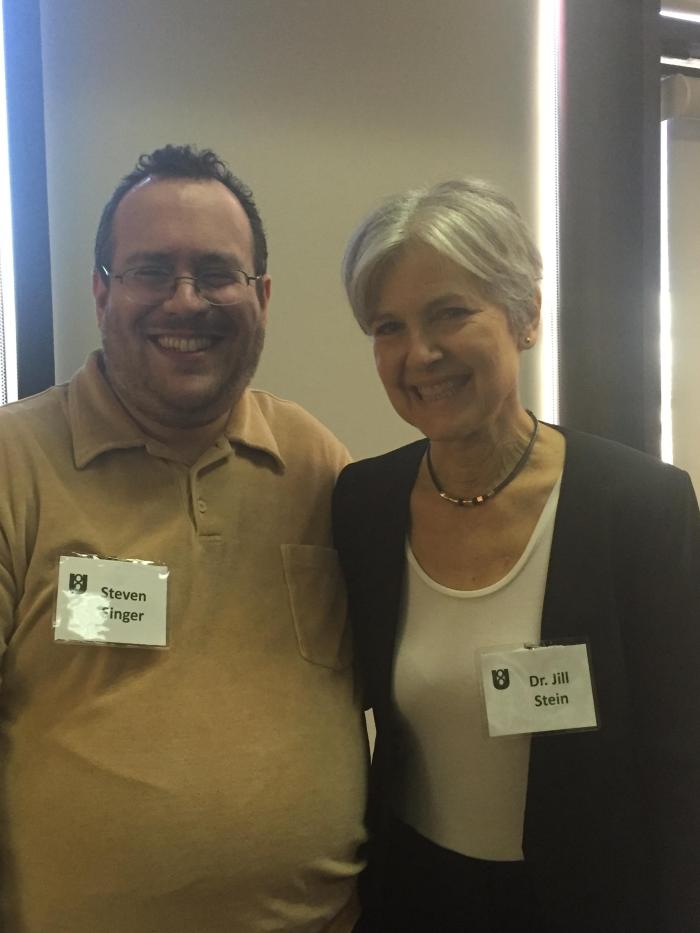
Yesterday Dr. Jill Stein gave me a hug.


Eight years ago, I was so inspired by Obama’s campaign speech in my hometown of Pittsburgh that I rushed forward along with the crowd to grab his hand. It was soft but firm with a tinge of moisturizer. Now I look at his incredibly regressive education policies and feel the need to scrub my palm.


This weekend in Philadelphia, I was at the United Opt Out Conference and saw Stein sitting in the audience.


I walked past the Green Party Presidential candidate the first time thinking I must be mistaken. Then her name tag removed all doubt.


“You’re Jill Stein!” I stuttered.


She smiled warmly, stood up and said, “You’re Steven Singer!”


I want to believe she knew who I was, but I was wearing a name tag, too.


We talked for a moment about what most of us were here for – education policy. She reaffirmed that she wanted to end all high stakes testing and school privatization.


Think of it – a presidential candidate speaking in specifics. Not “We test too much.” Not “Some charter schools are bad.” But I want to end these two perverse school policies!


And to top it all off, before she hurried off to tidy up as the time approached for her campaign speech, she game me a warm, tight hug.


Compare that to Hillary Clinton or Bernie Sanders.


As part of the Badass Teachers Association, we reached out to all the Democratic and Republican candidates on these exact same issues. The Republicans ignored us entirely, but both Democrats gave us phone calls by campaign aides.


Even then, the Democratic response was far from convivial. It mostly came down to something like “Education is important.” Well, duh.


In Sanders’ case, we had to conduct an impromptu sit-in at the Senator’s Washington office before anyone would talk to us about policy. And Hillary only started to speak in measured tones about public schools after our national teachers unions voted to endorse her – well, the leaders of those unions voted. No one ever really asked us, rank-and-file.


Moreover, when Sanders voted for the horrible Murphy Amendment of what became the Every Child Succeeds Act, several teachers including myself wrote him an open letter asking him to explain his apparent support for a Test and Punish education provision. One of his aides sent us a replysome nonsense about accountability.


And Jill Stein just gave me a hug.

The difference is huge!


When activists were holding this conference centering on the movement to Opt Out of Standardized testing, Sanders and Clinton didn’t even send campaign literature. Stein came in person and even gave a keynote address!


Don’t get me wrong. Hillary is far preferable to any Republican candidate seeking the office. I just wish her Presidential bid wasn’t funded by the very people we’re fighting against.


I love Bernie, too. I’ve even got the t-shirt to prove it. I just wish he loved us as much by throwing out a few more specifics. The general thrust of his campaign seems tailor-made to support test resistance and a fight against corporate education reform, but he rarely connects the dots with anything that we could hold him accountable for saying.


And then you have Stein, perhaps the most human politician I’ve ever met.


One look at her platform and it’s obvious she’s the best candidate for President in 2016. But is she electable?


Think about that for a moment.


What does it say about our country?


Design an excellent platform that benefits the most people, organize a movement to get your message out there, draw on the experience of experts in various fields… and you’re an incredible long shot to win the office.


The media says the same thing about Sanders as he speaks to overcapacity crowds and struggles against party politics seemingly written to hobble any populist campaign like his.


Yet Stein has no giant crowds. She has no adoring fans, no comedian on Saturday Night Live giving her friendly jibes.


She’s almost completely ignored by the media. Yet her actual policies make even a progressive like Sanders look like… well… Hillary Clinton!


For instance, Sanders wants to make college free to everyone. Stein wants to do that, too, AND erase all existing student debt.


Sanders is (kind of) against for-profit charter schools but has been vaguely supportive of Test and Punish school accountability practices. Stein is unequivocally against all forms of school privatization and high stakes standardized testing.


Sanders wants single-payer healthcare paid for by raising taxes (but net savings over all). Stein wants single-payer healthcare paid for by cutting our bloated military budget with no raise in taxes.


In fact, while Sanders is against unnecessary military action and an increase in military spending, he is in favor of keeping the $1 trillion military budget mostly intact. Stein wants to cut it by 50%, stop selling weapons to Saudi Arabia, stop giving weapons to Israel, freeze terrorist-funder’s bank accounts, end the War on Terror and engage in a policy of peace.


Moreover, Stein wants the savings from slashing our biggest federal expenditure to be used to fund a New Green Deal, creating full employment and a living wage all while transitioning to 100% clean energy by 2030!


Correct me if I’m wrong, but all of Stein’s policies sound rather sane and measured. Yet she is the one the media labels a radical and out-of-touch – if they talk about her at all.


It’s a testament to how perverted our politics have become: Sanity looks like the exact opposite. Logic and intelligence are revolutionary concepts.


And only the activists and intellectuals seem to know this is happening.


When Stein was done speaking, someone asked her the inevitable question about Ralph Nader. Wouldn’t casting a ballot for her just divide the Democratic vote and give the race to the Republicans as it did in 2000?


Her response was a bit evasive – the only time, in fact, where she seemed a bit uncomfortable.


She said that Nader wasn’t a member of the Green Party, where she is. She is engaged in building the party and the movement even beyond 2016.


On the one hand, it sounded like she was suggesting that even if she loses, it will bring real progressive issues into the limelight. However, this is not what happened when Nader lost as a third party candidate against Bush and Gore.


On the other hand, she stressed that she actually could win. About 43 million people are trapped by student debt, which she wants to unilaterally eliminate, she said. That’s a large enough chunk of the population that if they all voted for her, she would win.


It’s time for a Hail Mary moment, she said. We have to take a chance to vote for the best policies and not continue to compromise by supporting the lesser evil. Concession is the road to what we have now – continued oligarchy and global hegemony.


We need a functioning world for our children. If we don’t do something about Climate Change, the Earth may not be habitable in as little as five decades.


It’s now or never, she said.


I offer all this not as an endorsement of Stein. Nor of Sanders or Clinton (though seriously stay away from the Republicans, they’re freaking crazy).


I offer this only as food for thought.


Stein is offering us the best platform, bar none. But can we afford to vote for her? Can we afford not to?

How Radical Must We Be To Get the Schools Our Children Deserve? United Opt Out Musings

GetAttachmentThumbnail-3

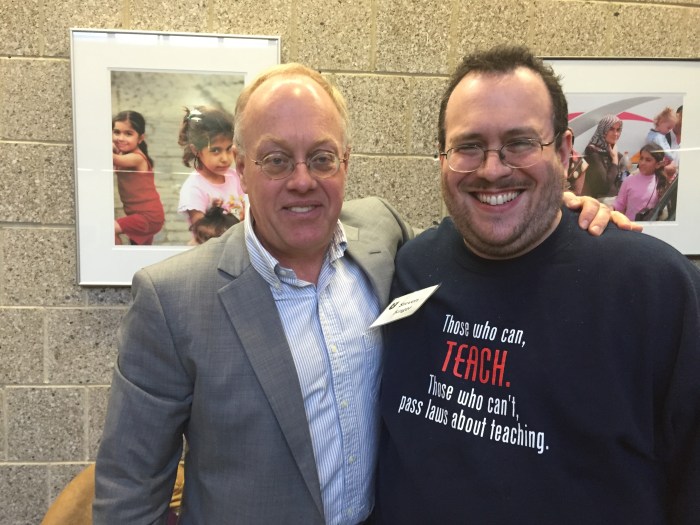
There was a point during Chris Hedges keynote address today when I could barely catch my breath.


My chest was heaving, tears were leaking from my eyes and I wasn’t sure I would be able to stop.


The Pulitzer Prize winning journalist had his audience enraptured at the United Opt Out Conference in Philadelphia Saturday morning.


I’ve read Chris before. We’ve all read Chris before. But I had never seen or heard him speak.


It was kind of like hearing a good sermon by a pastor who felt every word he said. And that really was it – Chris FELT every word.


When I’ve read Hedges’ articles on Truthdig, I’ve found myself getting angry. He stirs me up. He disturbs me, makes me feel uncomfortable. And when I heard him speak today I was surprised that he seemed to be reacting the same way to his own words.


When he talked about teaching teenage prisoners, he was emotionally invested in the story he was telling. When he criticized American neoliberal policies, he was just as angry as his audience.


The only difference was that his sorrow and rage somehow became transformed in his throat into something akin to poetry.


He turned the struggle of the oppressed into something beautiful. He transformed the hurt in my chest into something profound. He mutated my disturbance into a sense of actions-to-be.


I won’t repeat the words he said. I’d never be able to reproduce them with anything resembling his eloquence. But I will remark on one of his closing remarks because it hit me like a splash of cold water.


Rebellion, he said, is not about changing the world. It’s about changing yourself.


When you stand up for what is right, you become a better person – whether you achieve your goal or not. In a sense, it doesn’t matter if we destroy the testocracy. But in trying, we transmute ourselves into something better.


I don’t know if that’s true, but I’d like to think so.


I don’t know if we will ever destroy the system of Test and Punish, but I know I can try. I know I can put myself on the line and damn the consequences.


All weekend at the United Opt Out Conference we’ve been talking about rebellion and revolution. There’s no weak tea here in the City of Brotherly Love. No half measures. We’ve been discussing tearing the system down piece-by-piece.


A timid voice speaks up in the back of mind, “Do we really need to do all that? Do we really need revolution just to keep our public schools and make them into something worthy of our children?”


I think I’ve been trying to answer that question for a while now. Maybe a lot of us have.


In a rational country, our demands wouldn’t be so radical.


We want public schools centered on the good of all, not the profit of some. We want educationally valid curricula for our children. We want some control over the school system – both as parents and teachers.


Is that so much to ask? Is that such a lunatic request?


And as I listened to Hedges and Dr. Antonia Darder, Dave Green, Jonathan Pelto, Dr. Denisha Jones, Ceresta Smith, Yohuru Williams, Aixa Rodriguez and many, many others, I heard another timid voice begin to answer the first.


“Yes.”


The system of standardization and privatization of public education confronts students of color and impoverished students head on. They are in the front lines. Yet few people outside of activists seem willing to admit it.


Perhaps the most impressive thing about this conference has been its ability to put issues of human rights at the center of the argument. That’s the essential concept. We’re not just talking about bad education policies. We’re not just talking about schemes for billionaires to make more money. We’re talking about the systematic oppression of a group of people and the widespread complacency and complicity of the majority of the populace.


How do you combat such a monster without being revolutionary? How do you fight for your child without being a rebel?


More has happened at this conference than I can adequately put into words. I’ve met so many incredible people. Some of them I knew, some I had met before, some had only been names I had seen on my computer screen.


I will leave here Sunday feeling refreshed and energized, ready for the battles ahead.


Am I a radical?


Am I becoming a better person?


I don’t know.


But I will keep fighting.


Because I love my daughter, I love my students and I love all children everywhere.


Photo Gallery:


NOTE: This article was given a shout out on Diane Ravitch’s and Jonathan Pelto’s blogs.


United Opt Out Conference Highlights Dual Role of Technology in Education

FullSizeRender


Technology is the most powerful weapon we have against corporate education reform.


It is also our greatest foe.


Such were the remarks of Dr. Stephen Krashen at the United Opt Out Conference on Friday.


The linguist, educational researcher and activist gave the opening keynote address to hundreds of people who traveled to Philadelphia for the conference.


Krashen, who is known for his work on second language acquisition and bilingual education, has been a strong critic of the test and punish policies of the Barack Obama administration.


He warned the assembly of parents, students, teachers, professors and activists about the dangers of Competency Based Education (CBE), the next big thing in the movement to dumb down public schools.


CBE is touted as a way to reduce high stakes standardized testing by allowing students to work at their own pace while on various computer programs. However, Krashen sees this is an increase in testing.


In effect, it’s testing everyday. The computer programs used in CBE are little more than the same kinds of questions you’d see on a standardized test. An emphasis on CBE would replace a robust school curriculum with never-ending test preparation and multiple-choice assessment.


In the hands of a classroom teacher, technology can be an excellent tool to help kids learn. However, top-down policies like CBE only take away educators’ autonomy and turn them into mere facilitators of prepackaged materials of dubious quality.


He noted that the National Governors Association – an organization promoting CBE and Common Core State Standards – admits that there is no research supporting this new policy. But they’re suggesting we do it anyway. In fact, provisions to increase CBE are embedded in the new federal education law – the Every Child Succeeds Act (ESSA).


He sees this as a massive boondoggle to swipe the $600 billion we spend on technology in schools. After all, CBE will require increasingly newer computers at every school that will need to be constantly replaced as they become obsolete.


Krashen quoted Gerald Bracey: “There’s a growing technology of testing that permits us now to do in nanoseconds things we shouldn’t be doing at all.”


There is light at the end of the tunnel though.


The same technology that is being used to pervert the education system can be used to help save it.


Krashen advised activists to use the power of social media to spread the word about CBE and other Trojan Horse reforms – policies that look like they’re helping children while actually hurting them.


“The Internet is our underground,” he said, “Facebook and Twitter are our weapons.”


Though policymakers and journalists rarely listen to experts like classroom teachers, the Internet allows us to spread our message. We don’t need anyone’s permission to speak up. We are all free to do so and should do it more often.


I know many people are scared to speak up, he said, but we can all educate ourselves about what’s happening and then share it and retweet it. We need to do more of this. We need to reach a critical mass. We need to show the world the truth and that it can’t be ignored and buried under the dominant media and political narrative being sold to the public as if it were truth.


These policies, while dangerous in and of themselves, also overshadow the real needs of our school children – namely devastating, generational poverty.


When Congress passes No Child Left Unfed, No Child Without Healthcare, and No Child Left Homeless, then when can talk about No Child Left Behind and Every Child Succeeds, he said.


Dr. Martin Luther King spoke about this issue, claiming that solving poverty would in turn solve any problems with education.


Krashen’s keynote was an exciting beginning to a conference that promises to be eye-opening, exciting and energizing to the community of people fighting to take back our schools from the oligarchy.


Photo Gallery: