State Senator: Get Ready to Sue the PA Department of Education Over Common Core Testing

20110831_inq_rrxsrc31z-a

Pennsylvania State Sen. Andrew Dinniman is mad as Hell and he’s not going to take it anymore.

The West Chester Democrat is furious at the state Department of Education (PDE) over the Keystone Exams.

In February, the legislature unanimously passed a law to delay for two years using the Keystones as a graduation requirement for public school students. The exams will still be given to high school students in Algebra I, Biology and English, but passing them is not necessary to receive a diploma. During this time, the legislature is supposed to investigate alternate assessments above and beyond standardized testing.

However, Dinniman sent out an email to supporters this week claiming PDE is “blatantly ignoring the law and issuing directives to local school districts to use the exam if they want to for graduation.”

This goes against the delay, says Dinniman. The legislature is unsure requiring the Keystone Exam is a good idea, yet the state Senator contends the current administration is advising districts to move forward anyway.

Under the old law that was put on hold by the delay, if parents decided to opt their children out of standardized testing, students had to complete a Project Based Assessment. However, even though there is no test-based graduation requirement for current seniors, Dinniman says PDE still is forcing these children to complete Project Based Assessments.

“It appears that PDE is forcing the children of parents who opted out to take the Project Based Assessment, whose use is currently suspended by the legislature,” he says.

“There seems to be no respect by PDE for the rights of parents concerning their own children.”

Dinniman, who also serves as minority chair of the Senate Education Committee, has long been a critic of the Keystone Exams. He lead the charge to delay their implementation.

Now that PDE seems committed to the project despite concerns by legislators, he is asking for parents and other concerned citizens to contact him about suing the organization.

“If you know parents or organizations who might want to take PDE to court or file amicus briefs, let me know…  This is a matter of great importance. A number of us have been working for years against excessive testing and have serious concerns about Common Core.”

He will hold an open meeting for those concerned about the issue on Monday, Sept. 12, at 7:30 pm in his district office along One North Church Street in West Chester.

One of the issues at stake is the exorbitant costs of the Keystone and Pennsylvania System of School Assessment (PSSA) tests. With education budgets shrinking at the federal, state and local level, this money diverted to huge testing corporations could be better spent elsewhere.

Since 2008, the Commonwealth has spent $1 billion to proctor, grade and create new versions of the PSSA and the new Common Core-aligned Keystone Exams. Of that figure, $741 million went to Data Recognition Corporation.

Dinniman included in his email an explanation of the Commonwealth’s contract with Data Recognition Corp., a chart showing how much has been paid to the company, a list of materials PDE requested from the company but that has not yet been provided and an article written by education historian Diane Ravitch published in the New York Times explaining why these tests are troublesome.

In 2013, the state Conference of NAACP Branches issued a statement condemning the Keystone graduation requirement in extremely strong terms.

The organization called it a “present day form of Eugenics”, “a human rights violation”, “a clandestine social movement that strips children of their dignity and self worth” and that it would deprive impoverished and minority students  “of decent income, decent food, decent homes, and hopeful prospects as well as the security of justice.”

The statement can be read in full here.

In the halls of state government, Dinniman has been one of the most vocal critics of high stakes testing and national academic standards.

“I have been fighting against the use of these standardized tests as the sole determinants of high school graduation since they were first proposed by the previous [Corbett] administration in 2012.”

“Strong standards and effective assessments are needed in our schools, but they must come with the necessary resources and support to be implemented in a way that does not negatively impact both students and taxpayers,” he says.

Chester County, where Dinniman is from, has been a hotbed of testing criticism. Located in the southeastern most part of the state, parents, teachers and students publicly spoke out against the exams. Almost all school boards in the county passed resolutions opposing the Keystones and 58 superintendents and Intermediate Unit Directors up through the Philadelphia suburbs also expressed opposition.

If the delay had not been approved, this year’s seniors would have been required to pass all three Keystone Exams in order to graduate. Now the exams won’t be a graduation requirement until the 2018-19 school year.

The federal government still requires the exams be given for evaluative purposes, but it was the Republican dominated Tom Corbett administration that went the extra step of making the exams necessary to receive a diploma.

The delay is supposed to provide additional time to resolve consequences of implementing the exams. This means investigating and reporting on the following:

    • Alternative methods for students to demonstrate proficiency for graduation in addition to the Keystone Exams and project-based assessments.
    • Improving and expediting the evaluation of the project-based assessments.
    • Ensuring that students are not prohibited from participating in vocational-technical education or elective courses or programs as a requirement of supplemental instruction.

Moreover, the newly passed federal K-12 education legislation, the Every Student Succeeds Act (ESSA), allows the Commonwealth even more leeway to implement fairer and more affective means of assessment, Dinniman says.

“Until now, education policy has been largely dominated by regulations implemented by the State Board of Education in accordance with the federal government. Some of these regulations seemed to be enacted with little to no consideration of fiscal impacts or educational value,” Dinniman said.

“However, the state legislature has a Constitutional duty and responsibility to oversee and provide for ‘a thorough and efficient system of public education.’ Going forward, I believe the legislature will be more aggressive in reasserting its role in the process.”

Dinniman can be reached by phone at 610-692-2112 (District Office) and 717-787-5709 (Harrisburg Office).

He can be reached by email here.

He is on Facebook and Twitter.

Below is the full text of Dinniman’s Email:


(Source: optoutpa.blogspot.com)


To Supporters of Ending Common Core Exams in Pennsylvania:

Despite Act 1 of 2016, which suspended any use of the Keystone exams or the Project Based Assessments for graduation purposes during the two year period of 2016-18, the Pennsylvania Department of Education (PDE) is blatantly ignoring the law and issuing directives to local school districts to use the exam if they want to for graduation.

It certainly appears that PDE has shown their solid commitment to the Common Core testing process and the continued collection of data.  They don’t seem to care about or respect the law.  This is not government by the elected legislature but government by the bureaucracy.

You will be interested to learn the taxpayers of Pennsylvania, since 2008, spent $1.1 billion on these Common Core tests, with $741 million of that going to one testing company, Data Recognition Corporation (DRC).

Please view the supporting material at the following links:
1. An explanation of the Data Recognition Corp. (DRC) contracts.

2. A chart showing the DRC contracts, which come to $741,158,039.60, and the total paid to date of $440,512,625.69.

3. A listing of material requested from PDE but, as of this date, not provided.
4. A column from the July 23, 2016 New York Times providing background on these Common Core Exams, which in Pennsylvania are the Pennsylvania System of School Assessment (PSSA) and Keystone Exams.

Additionally, it appears that PDE is forcing the children of parents who opted out to take the Project Based Assessment, whose use is currently suspended by the legislature.  There seems to be no respect by PDE for the rights of parents concerning their own children.

So the question now is “what will we do about this situation?”  If you know parents or organizations who might want to take PDE to court or file amicus briefs, let me know.

In the meantime, I am having a meeting for those concerned about PDE’s actions in my district office, One North Church Street, West Chester, on Monday, September 12th, 2016 at 7:30 p.m.

This is a matter of great importance.  A number of us have been working for years against excessive testing and have serious concerns about Common Core.  Please invite your friends to join in the September 12th meeting.

Respectfully,

Andrew E. Dinniman

State Senator, 19th District

New PAC Descends on Pittsburgh Public Schools to Charterize and Take Over School Board

Screen Shot 2016-04-11 at 11.39.31 AM

Prepare yourself, Pittsburgh.

A new Political Action Committee (PAC) has descended on the ‘Burgh to further privatize our public schools and wrest control away from parents who are in favor of school reforms that actually work.

It’s called Campaign for Quality Schools, but make no mistake. The wealthy special interests behind it don’t care about quality schools – they care about quality profits for their investors.

PACs are political committees organized for the purpose of raising and spending money to elect and defeat candidates. Unlike federal PACS which can only give up to $5,000 to a candidate per election, state PACs in Pennsylvania have no spending limits. In that way, they are like federal Super PACs which also have no limits on donation size.

Besides giving an unfair advantage to special interest groups, PACS also have notoriously been used for nefarious ends. For instance, former Republican U.S. Rep. John Doolittle’s leadership PAC paid 15% to a firm that only employed his wife. One Leadership PAC purchased $2,139 in gifts from the Bose Corporation. Former Republican U.S. Rep. Richard Pombo used his leadership PAC to pay almost $23,000 in hotel bills and buy $320 in baseball tickets for donors.

And now we’ve got one in Pittsburgh with its sights on city schools.

The moneyed interests behind it want to swipe control of even more Pittsburgh schools away from the community and give them to for-profit companies in the shape of charter schools. Since charter school boards are appointed, not democratically elected, this means the decisions about how these newly charterized schools operate would be made behind closed doors out of public view. The community would have no way to hold them accountable. Likewise, this means operators could spend taxpayer money however they want with little to no oversight. They would have nearly unlimited power to reduce student services and pocket the savings as profit.

THAT’S what they mean by “Quality” schools.

The PAC is run by the usual suspects of Pittsburgh corporate school reformers.

In 2015, four of the nine Pittsburgh School Director seats were up for grabs and voters sided in all cases against candidates running on a standardization and privatization platform. One of these losers is Kirk Burkley. He lost against Lynda Wrenn for school board and now is listed as chairman of the political action committee.

Though Burkley well outspent Wrenn, voters made it clear they didn’t want the lawyer specializing in bankruptcy, restructuring and creditors rights anywhere near our public schools. He only got 19% of the vote. Apparently Pittsburghers want candidates who support well-resourced community schools, positive discipline policies with supports, etc. But a host of wealthy investors behind this PAC must feel otherwise. They know better than you and me.

The PAC’s treasurer is Cate Reed, our own Teach for America (TFA) recruiter. Perhaps she took it personally when the newly elected school board overturned a decision by its predecessors to contract with TFA for three-years and pay $750,000. This is one of the few times – if not the only time –this has happened across the nation. Reed is also a Broad Center residency recipient. Established by billionaire Eli Broad, the Broad Center runs an unaccredited training program for school leaders, where candidates learn Broad’s philosophy of school management. Broad has no education experience. He is a self-proclaimed expert, a businessman who made his billions in home-building, mortgage lending, and insurance (AIG).

On the Broad alumni page, Reed speaks about making sure every child has an opportunity to succeed, especially students of color in low income communities.

“The Broad Residency affords me the opportunity to be a part of the change I wish to see—and to use my skills to pursue my wildest dream of educational equity,” she says.

The problem she identifies is real. However, her solution is ludicrous. You don’t provide better opportunities for poor black children by making the leaders of their schools unaccountable to the public. You don’t help poor black kids by removing qualified teachers from their classrooms and replacing them with lightly trained Teach for America recruits. You don’t help poor black kids by giving them an endless series of culturally and economically biased standardized tests and ignoring the fact that they receive substantially less resources than their richer, whiter peers.

Leigh Halvorson, one of the managers of the Heinz Endowment, gave the PAC a boost soliciting donations. She sent an email in early March asking for money. I’ll post the entire email below, but here is Halverson’s description of the PAC:

“I am proud to be part of a group that is launching Campaign for Quality Schools-Pittsburgh, a bi-partisan Political Action Committee that is committed to supporting candidates of any political party who (1) believe that all children, regardless of their background can succeed; (2) embrace policies that hasten the growth of high-performing schools that serve all children; and (3) have the courage to challenge the status quo and tackle this problem with fierce urgency and determination.”

In other words, she’s looking for folks willing to (1) pay lip service to helping kids while actively working to hurt them, (2) will work to privatize more Pittsburgh schools and (3) are willing to run for office counter to the emphatic will of Pittsburgh voters who soundly rejected the corporate school reform agenda in the last election.

Halvorson continued:

“Our kick-off event on March 2nd at 5:30 pm, at the home of Cate Reed and Doug Anderson, will feature State Representative Jake Wheatley, from District 19 here in Pittsburgh who embodies these principles.”

Wheatley, a Democrat, has been a longtime supporter of charter schools and an enemy of public school teachers. He is one of only two Democrats to vote a bill out of the House Education Committee that was meant to eliminate due process for teachers. The bill has been languishing in the legislature, but if approved, it would allow teachers to be fired for almost any reason. It would eliminate the provision that teachers cannot be furloughed for “economic reasons.” (NOTE: it could come up for a vote any day now.)

Wheatley also teamed up with Republican House Speaker Mike Turzai to hold a roundtable discussion praising charter schools and the need to increase them in the city. He joined Turzai again in January for a school choice rally in Harrisburg.

Halvorson closed her email like this:

“If you are unable to attend, but would like to donate, please see the attached invite for instructions how you can do that.”

The invite asked for donations of between $50 and $250 per person.

Reed and Halvorson are both on the board of A+ Schools – Pittsburgh Community Alliance for Public Education. The organization serves an advisory position to help improve city schools. Though the organization includes people on both sides of the standardization and privatization movement, it has been co-opted in recent years by a $1 million grant from the Gates Foundation given between 2011 and 2013. Since the grant, the organization went from issuing an annual “Report to the Community” on the state of city schools to pushing for corporate education reform measures such as doing away with teacher seniority. Many disillusioned volunteers now consider it to be a paid proxy for Gates to make it appear his pet projects are supported by communities.

Like most urban districts, Pittsburgh Public Schools is struggling because of lack of resources. If you live in a poor neighborhood, your school gets less money from local taxes to help kids learn. Moreover, the district has lost almost $1 billion annually in state funding for the last five years. Living in poverty increases the need for wraparound social services, tutoring, nutrition and counseling that isn’t present for more affluent kids. But there’s no money to help them, and it’s hard for students to concentrate on school when they’re experiencing food insecurity and post traumatic stress. Likewise, state and federal education policies are giving an increasing portion of our shrinking funding to charter schools while forcing the traditional public schools to give new and more difficult standardized tests and enact unproven and developmentally inappropriate academic standards. If these corporate education reformers actually wanted to improve Pittsburgh schools, they’d focus on the real problems – not make wild attempts to grab more money for charter schools, deprofessionalize our kids’ teachers and grab power for themselves.

It’s unclear how many people showed up to the PACs kickoff fundraising event and how much money the PAC took in. But one thing is certain – consider yourself on notice, Pittsburgh.

After being defeated for school board and after the board rejected Teach for America, the corporate education reformers are preparing to strike back.

They are gathering people and resources to take the five school board seats up for re-election in 2017.

Will we let them steamroll over us with their big money and political connections or will we continue to fight for reforms that actually help our children?

It’s up to you, n’at.


Halverson’s email:

Dear friends,

The single most important civil rights issue facing our country is the disparity in our education system. We have far too many children who are trapped in persistently failing schools, Here in Pittsburgh alone, 23 of the 52 PPS schools are performing in the bottom 15% in the state. It is unacceptable. We know we can do better because we’ve seen it — transformative school exists that are proving that poverty is not destiny- and we need more of them, right here in Pittsburgh. I am proud to be part of a group that is launching Campaign for Quality Schools-Pittsburgh, a bi-partisan Political Action Committee that is committed to supporting candidates of any political party who (1) believe that all children, regardless of their background can succeed; (2) embrace policies that hasten the growth of high-performing schools that serve all children; and (3) have the courage to challenge the status quo and tackle this problem with fierce urgency and determination. Our kick-off event on March 2nd at 5:30pm, at the home of Cate Reed and Doug Anderson, will feature State Representative Jake Wheatley, from District 19 here in Pittsburgh who embodies these principles. I know for some of you, political contributions or political action is unfamiliar, so if you have questions or just want to talk further about why we believe groups like this can make a real impact on the future of our city and on behalf of our little people, don’t hesitate to reach out. My cell phone is 503.320.2384. I hope you can join us in supporting policymakers that put students and families first. Please see the attached invitation for more details and drop Cate or I a quick email if you can attend. If you are unable to attend, but would like to donate, please see the attached invite for instructions how you can do that. If you know people that should be invited to this event, please share their emails with us ASAP. Any questions can be directed to campaignqualityschoolspgh@gmail.com. I hope to see you on March 2nd.

Less Resources, Harder Tests: Common Core in the Last Days of Obama

teaching_testing


The bell hadn’t even rung to begin class yet, but Ce Ce already had enough.


She saw the pile of standardized test look-a-like sheets on the front desk and immediately asked if she could go to in-school suspension.


I’m not kidding.


She’d prefer to spend the day in silence doing homework isolated from the rest of the class than practicing high stakes testing with her peers.


And she’s not alone. This happens every year now. As assessment season gets closer, administrators push teachers to do test prep. And students revolt.


I’m not exactly sure why. Test replicas are not my favorite things to do, either, but they’re not THAT bad. I don’t think it can be my teaching since the mutiny usually happens before I’ve even begun.


It’s the testing. Pure and simple. Some students are so demoralized by the very prospect of skill-and-drill that spending one more second reading passages and filling in bubbles seems a fate worse than death.


And I can’t really blame them.


In the last two years, Pennsylvania has modified its mandatory assessments until it’s almost impossible for my students to pass.


Bureaucrats call it “raising standards,” but it’s really just making the unlikely almost unthinkable.


Impoverished students have traditionally had a harder time scoring as well as their wealthier peers. But the policy response has been to make things MORE difficult. How does that help?


Consider this: If a malnourished runner couldn’t finish the 50 yard dash, forcing him to run 100 yards isn’t raising standards. It’s piling on.


Oh. Both your arms are broken? Here. Bench press 300 lbs.


Both your feet were chopped off in an accident? Go climb Mt. Everest.


That’s what’s happening in the Keystone State and across the country. We’re adding extra layers of complexity to each assessment without regard to whether they’re developmentally appropriate or even necessary and fair to gauge individual skills.


Where Common Core State Standards have been adopted (and Pennsylvania has its own version called PA Core), annual tests have become irrationally difficult. That’s why last year’s state tests – which were the first completely aligned to PA Core – saw a steep drop off in passing scores. Students flunked it in droves.


Where the previous tests were bad, the new ones are beyond inappropriate.


Take Text Dependent Analysis (TDA). It’s something we’ve always done in language arts classes, but it’s meaning has subtly changed thanks to PA Core.


Two years ago, it used to denote that students had to refer to the text when writing essays. Now it’s come to mean something more – referring to the text (or texts) with at least two degrees of complexity.


On the Reading section of the Pennsylvania System of School Assessment (PSSA) tests, students must peruse several passages and respond in writing.


Before PA Core, middle school students might have had to read one passage and then explain what its main idea was. This would require them to cite specific examples from the text. For instance, “This passage is mostly about bears because the author writes about hunting them in the Klondike, the ways in which their habitat is affected and their hibernation instinct.” Then students would have to go into more detail highlighting sections of text that support this.


Now students have to read TWO passages and write about something that pervades BOTH but is still tremendously complex. For instance, a 6th grade example released from the state has students read a poem and a folktale about people tricking others into sharing food. Then they have to write about the theme of both pieces and analyze how it is developed in each text using specific references.


The texts concern nothing most students would find interesting and are difficult to understand for children of that age. Moreover, properly developing an essay of this type should be done over the course of several classes. But middle schoolers are expected to do this in a single testing session.


Test proctors are instructed to put aside about 80 minutes for the essay and several related multiple choice questions though, technically, students can take as long as they’d like. They could be given extended time to write for several hours if they want. But most children at this age simply don’t have that kind of stamina. They are not physically and mentally prepared to sit and concentrate like that.


It’s a task many adults would find challenging, but we’re expecting 10- and 11-year-olds to do it!


Can middle school students (ages 10-14) handle this level of complexity, especially in such a short amount of time?


Honestly, it depends on the child. Everyone matures at a different rate. However, for most of the students I have taught in over a decade of middle school experience as a Nationally Board Certified teacher with a Masters Degree in Education, it is my professional opinion that this level of mastery is out of reach.


In fact, at an in-service training, administrators at my building had the entire teaching staff attempt this essay to show us what was expected from students. The general consensus was that it was unreasonable.


Requiring this level of difficulty simply ignores children’s basic humanity. Most of my students come to me not knowing how to write a good essay. If they were all computers, I could break up everything they needed to know into small bits, give it to them piecemeal over the course of the year, and they would learn. But they are not computers – they are children.


That’s why they rebel. We’re demanding more from them than they can give.


It might be different if we met them half way. It might be more reachable if higher expectations came with additional help.


If my students had any chance to achieve at this level so early in their cognitive development, we would need to bring in a team of writing specialists, a flurry of councilors, nutritionists, and wrap around social services. However, no resources have been added to help students meet these added testing hardships. In fact, Pennsylvania has slashed school budgets by almost $1 billion annually.


All the responsibility is thrown on the underfunded schools as if the few teachers who haven’t already been furloughed can somehow perform magic.


A surgeon can’t operate without tools. Nor is he expected to do the job of nurse and physical therapist as well.


It’s a matter of less resources and harder tests, then blame teachers when it doesn’t work.


It’s not just bad policy; it’s a denial of reality.


Add to that the social, cultural and economic aspects. Lawmakers pretend everyone is starting from the same point, but this is demonstrably untrue.


I teach mostly black and brown kids at a high poverty district. Many of my students only get a hot meal at school. They’re malnourished, violence-scarred, and under-equipped. They have few books in the home. Their parents aren’t around because the adults are working multiple jobs to support them. They live in violent neighborhoods where gunshots, drive-bys and premature death are commonplace. And you think they somehow have the same chances of scoring well on standardized assessments as children without these problems!? You expect them to prioritize standardized testing!?


And after years of being subjected to child abuse as education policy, the only thing they’ve learned from testing is that they’re not good at it and they might as well not try.


Is it any wonder some of them would rather sit in our school’s version of prison than stay in class and practice test taking strategies?


We’re running up against the nature of cognition and how young minds grow. We’re ignoring the social, cultural and economic conditions in which these children live. And we’re pretending this is somehow a fair and just accounting of children’s academic skills and their teachers’ effectiveness.


Children need to be engaged. They need to see how an assignment affects their lives. They need to care. They need intrinsic motivation, which is almost impossible to find for a test that is essentially extrinsic.


Our current education policy is the equivalent of holding a gun on children and demanding they perform almost impossible tasks.


It is time to stop the violence. It’s time to end the child abuse.


But is anyone listening?

If the PA Legislature Won’t Pass a Budget, Schools Shouldn’t Give High Stakes Tests

 1408571032000-Opt-out-01

No one gives a high stakes test because he or she thinks it helps kids learn.


Public schools give tests because they are threatened by the state: give this test or we’ll withhold your funding.


In Pennsylvania, the legislature can’t be bothered to pass a budget. So lawmakers have already withheld funding.


So WHY THE HECK ARE SCHOOLS GIVING THESE TERRIBLE TESTS!!?


Pause with me a moment for a smidgen of background.


It seems the Keystone State just can’t afford its public schools.


Not when there are natural gas drillers out there that need to make an obscene profit.


Not when rich folks need another tax cut so they can buy another yacht.


Not when legislative districts are so gerrymandered that lawmakers from rich localities serving a minority of the population will never be held accountable by the majority kept safely away from them in other districts.


Nope. The Commonwealth just can’t afford to educate everyone – especially those that are poor or black or brown.


That’s why the Republican-controlled legislature just can’t compromise with Democratic Gov. Tom Wolf on a budget.


Wolf wants the state to heal almost $1 billion in annual cuts to education made 5 years ago when the GOP also had control of the Governor’s mansion. Meanwhile, the Republicans just want to put another Band-Aid on it.


And this has been going on since July.


It’s time to make some hard decisions. We’ve got to make some cuts, and I have just the place to start: high stakes testing.


Since last year when we aligned our federally mandated assessments with the PA Core (i.e. Common Core lite), we’ve seen a huge spike in failure, test anxiety and public money going to for-profit testing corporations.


It cost taxpayers $30 million to administer the Pennsylvania System of School Assessment (PSSA) tests and $20 million for the Keystone exams last year, according to Department of Education representatives.


And when you add in the 164,500 students who failed and re-tested at least once, that’s an additional $4 million.


We simply can’t afford that kind of cost with no return on the investment.


These tests don’t make children more marketable. They don’t increase graduation rates (just the opposite). They don’t provide any opportunity for teachers to use them diagnostically and thereby increase educational outcomes. They have never been shown to help students in any way.


So why are we giving them?


Sure, the federal government decided in its infinite wisdom (after receiving mountains of cash from the standardization and privatization industry) that all public schools have to give annual assessments. However, the new federal Every Child Succeeds Act (ESSA) is supposed to allow states to decide what those assessments look like.


Students get teacher-created tests in school every week. Maybe our annual assessments look like that.


Heck! We’ve heard so much self-congratulation about how the new federal law gives power back to the states, it’s time to put that to the test. Cut this parasitic line item and move on to things that actually provide value for our students and their families.


And if the state government doesn’t have the guts to do this (spoiler: it doesn’t) then maybe our 500 public school districts do.


Why are school boards sitting back patiently waiting for their Constitutionally-mandated funding to come in?


The legislature is required by its own laws to have its books in order by July 1st. That was more than 270 days ago! If lawmakers can’t do that, why should our school districts listen to anything they say?


School directors should protest, and not just with angry letters. They should publicly proclaim they aren’t going to give their neighborhood children these tests.


The way I see it, that will do one of two things:


In either case, it’s a win.


People talk a lot about state vs. federal power when the real dichotomy is between local and everything else.


No one should be making decisions about how schools generally spend their budgets except for the people who actually live there. No one has the right to tell parents how to spend money on their families. Why should anyone have the right to tell communities how to educate their kids?


Sure, some communities may make bad decisions. And so do some parents. But it’s their decisions to make.


The contrast has never been so sharp.


While partisans in Harrisburg play games with the budget, our local public schools go wanting. They depend on state money to stay afloat. By December, many districts were planning to close their doors because of lack of funds.


Gov. Wolf unilaterally released $2.5 billion to keep them afloat but that’s less than half of last year’s expenditure. Meanwhile, Wolf has already proposed his spending plan for next year while the one for the current year still hasn’t been ratified!


Even under the best circumstances, public schools should stop giving standardized tests. The parents of more than 5,000 students refused testing for their children last year in Pennsylvania, and that number is expected to increase exponentially this year. Nationwide, the parents of hundreds of thousands of students opted out of testing last year. Parents are increasingly questioning the value of unproven assessments that do nothing but enrich for-profit corporations and unfairly label the hardest-working districts as failures.


The only carrot the state and federal government has to keep schools testing has been funding. In the absence of that, it is beyond ludicrous to continue the destructive practice. It would be tantamount to selling your soul to the Devil FOR FREE! Faustian bargains are generally not smart, but without remuneration, they’re idiotic!


So there is absolutely zero reason to follow the state testing mandate. The legislature has reneged on its side of the deal. Local school districts should be free to make whatever autonomous decisions their leaders can to keep them afloat and provide the best education possible for the students in their care.


That means if the state doesn’t pass a budget, local districts shouldn’t give standardized tests.

My Daughter is Not a Widget

Father Holding Daughter's Hand

“I’m not sure public schools understand that we’re their customer—that we, the business community, are your customer. What they don’t understand is they are producing a product at the end of that high school graduation. Now is that product in a form that we, the customer, can use it? Or is it defective, and we’re not interested? American schools have got to step up the performance level—or they’re basically turning out defective products that have no future. Unfortunately, the defective products are human beings. So it’s really serious. It’s tragic. But that’s where we find ourselves today.”
Rex Tillerson, ExxonMobil CEO

My daughter just turned seven during this holiday season.

She loves to draw. She’ll take over the dinning room table and call it her office. Over the course of a single hour, she can render a complete story with full color images supporting a handwritten plot.

These narratives usually star super heroes, cartoon characters and sometimes her mommy and daddy. In these flights of fantasy, I’ve traveled to worlds lit by distant suns, been a contestant on a Food Network cooking show, and even been a karate pupil to a Teenage Mutant Ninja Turtle sensei.

That little girl is my pride and joy. I love her more than anything else in this world.

Make no mistake – She is not anyone’s product.

She is not a cog to fit into your machine. She is not merchandise, a commodity, a widget for you to judge valuable or not. She is not some THING for you to import or export. She is not a device, a gadget, a doodad, a doohickey or a dingus. She is not an implement, a utensil, a tool, or an artifact.

Her value is not extrinsic. It is intrinsic.

She is a person with a head full of ideas, a heart full of creativity and passion. She has likes and dislikes. She loves, she lives, she dreams.

And somehow Tillerson, this engineer turned CEO, thinks she’s nothing more than a commercial resource to be consumed by Big Business. He thinks her entire worth as a human being can be reduced to her market value. It doesn’t matter what she desires for herself. It only matters if she fills a very narrow need set by corporate America.

But what else should we expect from the man in charge of ExxonMobil? The corporation has a history of scandal, corruption and malfeasance going back decades.

Since the 1980s the company has been suppressing its own incredibly accurate data on climate change because that science would adversely affect the bottom line of a business that earns its money burning fossil fuels. Moreover, the company funds climate change denial groups. A study by the US Union of Concerned Scientists reports that ExxonMobil funded 29 climate change denial groups in 2004 alone. Since 1990, the report says, the company has spent more than $19 million funding groups that promote their views through publications and Web sites that are not peer reviewed by the scientific community. Need we even mention the corporation’s long history with the American Legislative Exchange Council (ALEC)?

Tillerson and Exxon have also been major boosters of the fracking industry pushing for deregulation as health concerns mount. Most recently, the organization was ordered to pay a $100,000 Environmental Protection Agency civil penalty for an illegal discharge of fluids from a Marcellus Shale natural gas well site in Lycoming County, Pennsylvania.

It’s all about profit at Exxon. The corporation’s cost cutting measures also resulted in the largest oil spill in US waters to date. Environmental impacts are still being felt in Alaska’s Prince William Sound from the 11 million gallons of oil the Exxon Valdez supertanker unintentionally poured into the ocean, coasts and forests in 1989. Subsequent spills have occurred in Brooklyn (2007), the Yellowstone River (2011), Baton Rouge (2012), and Arkansas (2013). But why should that matter? The corporation was listed as the second most profitable in the world on the Fortune 500 in 2014.

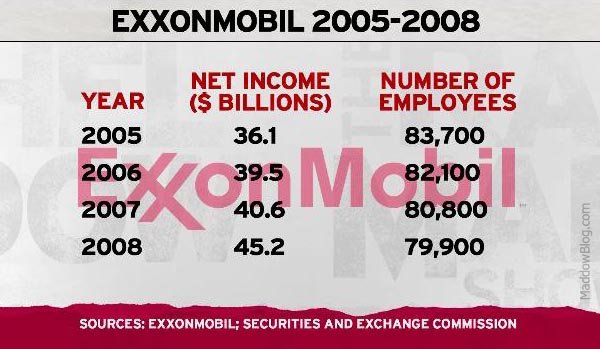
Yet Tillerson is somehow worried about American workers being up to snuff? Why? The corporation outsources a steadily increasing share of its jobs overseas. Those that it does keep in the continental US have been subject to massive downsizing efforts. As employees have decreased, corporate profits have increased. And Tillerson expects anyone to think he’s concerned about the well-being of the American worker!? Give me a break!


Exxon_Income_vs_Employment


I suppose it’s not that surprising though that someone who makes $40 million a year, himself, would expect a paycheck to be the ultimate display of personal significance. After all, he probably thinks his exorbitant salary proves that he’s very important.

Albert Einstein never made that kind of money. Heck! Neither did William Shakespeare, Dr. Martin Luther King, Marie Curie, or Abraham Lincoln. So by Tillerson’s ethos, all of these people were defective products unfit for the corporate world. Or at the very least our estimation of them is flawed.

After all, what need have we of Shakespeare’s poetry in the exercise of buying and selling? Perhaps the greatest author ever to write in the English language might find merit in the advertising department. Likewise, Dr. King’s ethic of equality might be useful in human resources. Marie Curie? She’d find gainful employment in research and development but any patents she generated would undoubtedly be held in the corporate interest. And Mr. Lincoln? Perhaps he could be useful as a low level administrator but, no, such iconoclasm as he possessed would probably not be a good fit. He’d end up freeing the wage slaves or other such unprofitable nonsense.

Is this really the American Dream? Find an occupation producing monetary wealth or else lose all claims to value? If so, how loud must history be laughing at us?

The post-Impressionist artist Van Gogh created 900 paintings and 1,100 drawings and sketches. Many of these works now adorn museums around the globe and have forever changed the way we see the world. But during his lifetime, he sold only one painting. So by Tillerman’s logic, he was a defective product, a failure.

This is the sickness of the profiteer – to be forever appraising worth but unable to see true value. It is the disease eating away at the soul of our country. It’s the same mindset that justifies anything in the name of short-term gain – credit default swaps, the housing bubble, charter schools and Common Core.

After all, Tillerson’s notorious quote above comes from an infamous article in Fortune magazine in which the CEO threatened the former governor of Pennsylvania that he’d pull ExxonMobil out of the state if the legislature didn’t adopt some form of Common Core. And so the state gave in to the whim of one man with no experience, knowledge or wisdom about how children learn. And students in more than 500 public school districts are thus constrained by this legal economic blackmail.

I am but a simple man. I don’t bring in a six-figure salary. I’m a teacher in that same public school system. I’m also the father of an elementary student. I am a man of no monetary means and thus little merit. But I say this: the Tillersons of this world are wrong. Our children are worth more than these tiny bean counter brains realize. The purpose of education is not to provide more resources for their pointless game of Monopoly.

My daughter has a life, and her education is a tool to enrich that life. It is her vehicle of understanding the world around her. It is a process to invigorate her sense of wonder. It is a method of understanding how things work and where she fits in the universe.

Yes, she will one day need to seek employment. But what she chooses as her occupation will be up to her. SHE will decide where she fits in, Mr. Tillerson, not you. SHE will decide what is valuable in her life. SHE will decide if she wants to spend her hours in the pursuit of profits or less tangible enterprises.

As such, she needs literature – not standardized tests. She needs mysteries to solve – not Common Core. She needs equitable resourcesnot charter schools. She needs teachers with advanced degrees and dedication to their jobs – not Teach for America temps.

Don’t you dare try to justify all that with some narrow economic view of monetary value. Some things have no price. My daughter is one of them.


NOTE: This article also was featured on Diane Ravitch’s blog, I did an interview about it on the Rick Smith Show, and was quoted in an article about the issue in the Washington Post.


You Can’t Win a Rigged Game – Standardized Tests as “Proof” of Failure

Kids_playing_video_games

One of my dearest high school friends was a bit of a doofus.

Who am I kidding? So was I!

One of our favorite things to do after school was plop on the coach and play shoot ‘em up video games. “Smash TV” was a particular favorite.

We’d bob and weave while clutching controllers and rapidly jamming our thumbs on the buttons.

And at such times, we‘d talk.

No great philosophical problems were solved during these mid-afternoon gaming sessions. We’d talk trash, dissing each other’s gaming skills, bragging about our own, and occasionally quizzing each other with trivia on a shared topic of interest.

We both loved movies, so my buddy used to shout out cinematic quotations and ask me to name where they came from.

“Frankly, my dear, I don’t give a damn.”

“Luke, I am your father!”

“Go ahead, punk. Make my day!”

None of these famous quotes made my buddy’s list. He preferred lines like these:

“Run!”

“Look out!”

“Holy S&*t!”

As you can imagine, I rarely got any of them right.

I’d laugh, punch him in the arm good-naturedly and go on shooting virtual enemies.

It was good dumb fun. But now – more than two decades later – my students are forced to take my buddy’s quiz – and if they don’t pass, the government is threatening to shut down their schools and fire me, their teacher.

No, learners don’t have to identify impossible movie quotes. Instead, they’re forced to answer impossibly bad multiple choice questions. But the results are pretty much the same.

In my home state, the Pennsylvania System of School Assessment (PSSA) and the Keystone Exams are high stakes versions of my buddy’s moronic quiz. The purpose isn’t to fairly assess: it’s to stump as many kids as possible.

And it’s working. For the fourth year in a row, student test scores have declined statewide. Previously, students had been doing relatively well. Why the change?

It began with budget cuts. The legislature slashed almost $1 billion every year in school funding. That means higher class sizes, less teachers, fewer electives, tutoring, nurses, services, etc. And districts like mine weren’t exactly drowning in money to begin with.

Students now have less resources, therefore they can’t prepare as well for the tests.

So what did the legislature do? Did our lawmakers fix the problem by putting back the money they had repurposed as gifts to the natural gas industry?

Heck no! They made the tests even more unnecessarily difficult.

As a result, the steady decline in test scores this year fell off a cliff!

After all, this was the first year in which the Commonwealth fully aligned every question of its mandatory testing with the Pennsylvania Core Standards – which are similar, but not identical to the Common Core standards adopted in other states.

Proficiency rates in grades 3 through 8 dropped by an average of 35.4 percent in math and 9.4 percent in English language arts on the PSSA. Nearly half of all seventh and eighth graders dropped an entire proficiency level in math in just one year.

If I made up a test like this in my own classroom, gave it to my students and got results like these, my first assumption would be that there was something horribly wrong with the test. I must have messed something up to fail so many students! Teachers are always on the lookout for unclear or bad questions on their self-created exams. The for-profit corporations that create our state-mandated tests? Not so much.

Though state Department of Education officials acknowledge the continued decline in scores, they insist problems will work themselves out in subsequent years – as if a 4-year trend is just an anomaly. Move along. Nothing to see here, folks.

My students used to make impressive gains on the tests. My principal stopped by today to give me the scores for my current students and those I taught last year. No surprise. Very few passed.

Are my students now lazier and less intelligent than those I taught four years ago? No. Students who scored well before the budget cuts, often score badly now.

Am I a worse teacher? Absolutely not. I have the same skills I did then. I spend the same amount of time at school – maybe more.

So what changed in my classroom? Lack of reconnaissance.

Teachers like myself used to know exactly what was expected of students on these assessments. We had plenty of materials with which to prepare them. Now the exams change every year – and I don’t mean just the individual questions, I mean what is tested!

Back in the day, when my buddy first shouted out, “Run!” and asked me which movie it came from, I had no idea. But after he did it long enough, I’d start to anticipate him. I’d learn that he was thinking of James Cameron’s “The Terminator.”

That’s how the PSSA’s used to be. Teachers knew how the test makers wanted kids to answer. And we could prepare them to do so. The tests didn’t accurately assess student learning even then. It was a game, but at least it was more fair.

Let’s be honest. These tests have never been particularly good. You can’t honestly expect to assess higher order thinking skills on a multiple choice test. Basic skills, maybe. But anything complex simply cannot be measured in this manner. We’ve known that for over a century!

It’s like my buddy’s movie quiz. I have little doubt that someone really did shout “Run!” in “The Terminator.” However, that same line probably appears in at least a dozen more action movies. There’s no way to determine a single correct answer. And shouting out a different quote instead like “Look out!” doesn’t help either.

So please stop the talk about “Rigor.” We’re not raising standards. We’re changing them. My buddy found a new bunch of movies from which to shout out impossible quotes. That’s all.

Anyone who wants to argue validity to these new test questions has to leap a host of hurdles to accomplish his goal.

First, one would have to prove PA Core – and by extension Common Core – Standards actually improve student learning. Good luck. It’s never been done and all the evidence is against you.

Second, one would have to gain access to an individual year’s worth of test questions. Again, good luck. They’re corporate property. The public is not allowed to see the questions. If a principal, student or teacher were to copy a question or snap a photo of a test, they could be subject to prosecution in a court of law.

Such a lack of transparency in government is a sure sign of malfeasance.

It’s almost impossible to avoid certain conclusions about this whole process. Standardized testing is designed to fail students – just like my buddy’s movie quiz was designed to stump me.

These tests constitute fake proof of inadequacy. They attempt to “prove” our public schools are failing and should, therefore, be replaced by private corporations – maybe even by subsidiaries of the same for-profit companies that make and grade these tests!

When my buddy unfairly stumped me, we both knew it was a joke. We’d laugh and play another video game.

But there’s nothing funny about this when it’s perpetrated by the state and federal government.

Pennsylvania’s standardized test scores are a farce just like the scores in every state and territory throughout the country. They’re lies told by corporations, permitted and supported by lawmakers, and swallowed whole by the media and far too much of the public.

We always seem on the verge of waking up. Tomorrow we will stop the state-sanctioned abuse of children by the testing industry. Tomorrow we’ll take responsibility for this sick system we allow.

But when will tomorrow come? I’m tired of waiting.


NOTE: This article also was quoted extensively on Diane Ravitch’s blog and published in full on the Badass Teachers Association blog.