I Doubt Hillary Clinton Plans to Close Half of All Public Schools – But She Does Want to Close Some

www.usnews.com


“This school district, and these schools throughout Iowa, are doing a better than average job. Now, I wouldn’t keep any school open that wasn’t doing a better than average job. If a school’s not doing a good job, then, you know, that may not be good for the kids.”
-Hillary Clinton

The above comments have caused a tremendous stir in the media lately.

Hillary Clinton wants to close half of all public schools!? She wants to shutter all public houses of learning that are average or below average!?

The Federalist even did some quick math and decided this means Clinton would shutter 50,000 schools. They even put that number in the headline of their article!

But hold your horses, media backlash.

I’m not really a Hillary supporter, but this has gotten a little out of hand.

Maybe I’m being too generous here, but I’m going to assume that Clinton may be a lot of things, but stupid isn’t one of them.

She made a gaffe. She said something that doesn’t make much sense mathematically. Close all schools below average? Average means 50%. That’s half of all schools.

It was a blunder, a mistake, a foot-in-the-mouth moment.

I can believe a lot about Clinton, but not that her education policy includes shuttering half of our nation’s schools.

However, don’t take my word for it. Seriously! Ask her. She should clarify what she meant. But give her a chance to do so. Don’t mob her just looking to trip her up.

I doubt I’ll vote for Hillary in the primary, but she deserves a certain modicum of respect. She is an impressive person. She’s accomplished a heck of a lot in her life under some pretty intense circumstances.

As a college student in the 1960s, she volunteered to teach reading to children in poor Boston neighborhoods. She fought to ensure voting access for African Americans and even worked at an alternative newspaper in the black community. As First Lady and in Congress, she pushed for universal pre-kindergarten, arts education, after-school tutoring, smaller class sizes and the rights of families.

And in 2008 she ran an impressive – if ultimately unsuccessful – campaign for President.

As one of the most prominent women in the nation, she’s made some enemies.

Remember that Benghazi nonsense! Conservatives have been out for her blood because an American diplomatic compound in Libya was attacked in 2012 while Clinton was Secretary of State. They’ve trumped up a crazy amount of lies and innuendo that she was somehow responsible when it was the Republican-controlled Congress that voted to reduce security at these installations.

Heck! Michael Bay has a hatched job movie coming out during this election season just to wound Clinton’s current bid for president!

So give the woman some credit. She’s proven she’s a serious-minded, intelligent and capable politician.

However, like every human being she misspeaks from time-to-time. George W. Bush couldn’t open his mouth without English teachers and grammarians hiding under the sofa.

I think this explains much of what she said in Iowa trying to consolidate votes for the first Democratic primary on Feb. 1, 2016.

It explains much – but not all.

Clinton may have fudged her math momentarily forgetting that 50% of all schools are – and always will be – below average. If tomorrow every school in the country provided the greatest education the world has ever seen, half of them would still be below average. That’s what average means.

What bothers me is that Clinton thinks we should be closing schools at all.

That’s not a slip. That’s not a blunder or a miscalculation.

She really seems to believe you can improve public education by closing schools. And THAT is much more dangerous than any nonsense about her going on a nationwide school shuttering spree – something of which she would not, by the way, even have the power to do as President.

This idea that we can close schools to improve education is one of the founding principles of corporate education reform. And it’s demonstrably untrue.

Never has a school ever been improved by being closed. Student academic outcomes do not increase when children are displaced. In fact, they suffer.

If schools are struggling, a sensible strategy would be to find out what’s wrong. What is the reason kids are having trouble reaching academic success?

Spoiler Alert: nine times out of ten the problem is disinvestment. The school doesn’t have adequate resources to meet students’ needs.
More than half of our nation’s public school children live in poverty. Their schools don’t get equitable funding with districts that serve the rich. Moreover, privatization, charterization, increased efforts at vouchers, tax breaks and school choice have segregated our schools to such a degree that these problems disproportionately affect our students of color to a much larger degree than white children.

THAT is the problem with American education. It’s been proven time and again in study after study. Yet corporate education reformers like Michelle Rhee, Campbell Brown, Bill Gates, and Andrew Cuomo continue to ignore the facts in favor of simply closing more schools. In his time as Mayor, Rahm Emanuel has closed 50 Chicago schools46 of which serve mostly black and brown students. And he’s a close Clinton friend.

It is no accident that so many of these corporatists are Democrats. The entire neoliberal wing of the party is sick with these sorts of conservative policies. And Clinton can be connected with many of them.

Since getting the support of the American Federation of Teachers (AFT) and National Education Association (NEA), Clinton’s tried to distance herself from her disaster capitalist buddies. But it isn’t working.

On the one hand, she criticized charter schools for ignoring the most difficult students. On the other, she still champions keeping privatized education in the mix.

On one hand, she thinks there should be a federal investigation of the Chicago Police Department for civil rights abuses. On the other hand, she thinks Rahm is doing a heck-of-a job.

I am deeply troubled that Clinton seems to think we can close our way to academic success. She should know better than that by now. Everyone should. It is absolutely unacceptable that any candidate with such teacher support should hold these views. Quite frankly, it’s a deal breaker.

The ball’s in your court, Hillary. You need to explain what you meant by your Iowa comments.

I admire Clinton’s bravery for actually talking about K-12 education – something her rival Bernie Sanders seems much less inclined to do. However, we all know Clinton’s endorsements by the AFT and NEA don’t represent the views of the rank-and-file. These were top down decisions made without much member input. If Hillary wants those endorsements to translate into votes, she’d better do some serious convincing.

Otherwise it won’t be schools that are shuttered. It will be her campaign.


NOTE: This article also was published on the Badass Teachers Association Blog and mentioned on Diane Ravitch’s blog.


Don’t Blame My Students For Society’s Ills

poverty LOCAL POVERTY GEE


As a public school teacher, I see many things – a multiplicity of the untold and obscure.

On a daily basis, I see the effects of rampant poverty, ignorance and child abuse. I see prejudice, racism and classism. I see sexism, homophobia and religious intolerance.

And hardly any of it comes from my students.

Despite what some people might say in the media, on Facebook or at the local watering hole, the kids are all right. It’s what we, the adults, are doing to them that’s messed up.

It’s always been in fashion for grown-ups to trash the next generation. At least since Hesiod bemoaned the loss of the Golden Age, we’ve been looking at the current crop of youngsters waiting in the wings to replace us and found them lacking. They just don’t have our drive and motivation. In my day, we had to work harder than they do. If only they’d apply themselves more.

It’s all untrue. In fact, today’s children have it harder than children of the ‘70s and ‘80s did when we were their age! Much harder!

For one thing, we didn’t have high stakes standardized tests hanging over our heads like the Sword of Damocles to the degree these youngsters do. Sure we took standardized assessments but not nearly as many nor did any of them mean as much. In Pennsylvania, the legislature is threatening to withhold my students’ diplomas if they don’t pass all of their Keystone Exams. No one blackmailed me with anything like that when I was a middle schooler. All I had to do was pass my classes. I worried about getting a high score on the SAT to get into college, but it didn’t affect whether I got to graduate. Nowadays, kids could ace every course for all 13-years of grade school (counting Kindergarten) and still conceivably only earn a certificate of attendance! Try using that for anything!

Moreover, my teachers back in the day didn’t rely on me so they could  continue being gainfully employed. The principal would evaluate them based on classroom observations from time-to-time to assess their effectiveness based on what he or she saw them doing. But if I was having a bad day during the assessment or if I just couldn’t grasp fractions or if I was feeling too depressed to concentrate – none of that would affect my teacher’s job rating. None of it would contribute to whether my teacher still had an income.

Think of how that changes the student-teacher relationship. Now kids as early as elementary school who love their teachers feel guilty on test day if they don’t understand how to answer some of the questions. Not only might their score and future academic success suffer, but their teacher might be hurt. That’s a lot of pressure for people who’ve just learned how to tie their shoes. They’re just kids! In many cases, the educator might be one of the only people they see all day who gives them a reassuring smile and listens to them. And now being unready to grasp high-level concepts that are being hurled at kids at increasingly younger ages may make them feel responsible for hurting the very people who have been there for them. It’s like putting a gun to a beloved adult’s head and saying, “Score well or your teacher gets it!” THAT’S not a good learning environment.

Finally, child poverty and segregation weren’t nearly as problematic as they are today. Sure when I went to school there were poor kids, but not nearly as many. Today more than half of all public school children live below the poverty line. Likewise, in my day public policy was to do away with segregation. Lawmakers were doing everything they could to make sure all my classes had increasing diversity. I met so many different kinds of people in my community school who I never would have known if I’d only talked with the kids on my street. But today our schools have reverted to the kind of separate but equal mentality that was supposed to be eradicated by Brown vs. Board of Education. Today we have schools for the rich and schools for the poor. We have schools for whites and schools for blacks. And the current obsession with charter schools and privatization has only exacerbated this situation. Efforts to increase school choice have merely resulted in more opportunities for white flight and fractured communities.

These are problems I didn’t face as a teenager. Yet so many adults describe this current generation as “entitled.” Entitled to what!? Less opportunity!? Entitled to paying more for college at higher interest for jobs that don’t exist!?

And don’t get me started on police shootings of young people. How anyone can blame an unarmed black kid for being shot or killed by law enforcement is beyond me.

Children today are different. Every few years their collective character changes.  Today’s kids love digital devices. They love things fast-paced, multi-tasked and self-referential. But they don’t expect anything they haven’t earned. They aren’t violent criminals. As a whole they aren’t spoiled or unfeeling or bratty. They’re just kids.

In fact, if I look around at my classes of 8th graders, I see a great many bright, creative and hard-working young people. I’m not kidding.

I teach the regular academic track Language Arts classes. I don’t teach the advanced students. My courses are filled with kids in the special education program, kids from various racial, cultural and religious backgrounds. Most of them come from impoverished families. Some live in foster homes. Some have probation officers, councilors or psychologists.

They don’t always turn in their homework. Sometimes they’re too sleepy to make it through class. Some don’t attend regularly. But I can honestly say that most of them are trying their best. How can I ask for more?

The same goes for their parents. It can be quite a challenge to get mom, dad, grandma, grandpa, brother, sister or other guardians on the phone. Parent-teacher conferences are very lonely in my room while the advanced teacher is mobbed. But I don’t generally blame the parents. In my experience, most moms and dads are doing the best they can for their kids. Many of my student’s have fathers and mothers working multiple jobs and are out of the home for the majority of the day. Many of my kids watch over their younger brothers and sisters after school, cooking meals, cleaning house and even putting themselves to bed.

I wish it wasn’t like that, but these are the fruits of our economy. When the recession hit, it took most of the well-paying jobs. What we got back was predominantly minimum wage work. Moreover, people of color have always had difficulty getting meaningful employment because of our government sanctioned racial caste system. Getting a home loan, getting an education, getting a job – all of these are harder to achieve if your skin is black or brown – the same hue as most of my students and their families.

So, yes, I wish things were different, but, no, I don’t blame my students. They’re trying their best. It’s not their fault our society doesn’t care about them. It’s not their fault that our nation’s laws – including its education policy – create a system where the odds are stacked against them.

As their teacher, it’s not my job to denigrate them. I’m here to lift them up. I offer a helping hand, not a pejorative finger.

And since many of the factors that most deeply affect education come from outside the school, I think my duty goes beyond the confines of the classroom. If I am to really help my students, I must be more than just an educator – I must be a class warrior.

So I will fight to my last breath. I will speak out at every opportunity. Because my students are not to blame for society’s ills. They are the victims of it.


NOTE: This article also was published in Wait What?, and the Badass Teachers Association Blog.


Close Reading: Myopia as a Virtue

head in book
Painting by Pawel Kuczynski


You are reading a text.

Yes. Right now.

Your eyes are scanning over symbols called letters. They are joined together into words and sentences and paragraphs to make up the total of this article.

Your brain is in the process of translating these symbols into sounds, meanings, concepts. And you are reacting to those concepts.

You’re having thoughts about what you’re reading. Maybe you’re reminded of a similar article you’ve read sometime in the past. Maybe you’re feeling a thrill of excitement at such an original introduction to an education article. Or perhaps you’re rolling your eyes and wondering why the author is such a doofus.

No matter how you look at it, reading involves complex processes. A whole bunch of stuff is going on to make it happen – all of it essential.

Yet when we evaluate reading comprehension these days, we put the focus squarely on one or two of those multifarious processes. It’s reductive, reactionary, and lame. It’s a dumbing down of the cognitive and metacognitive process. But it makes things easy to grade on a standardized test.

That’s what the fad of close reading is all about. It’s an attempt to make the mysterious and complex mind something that can easily be labeled right or wrong.

For the uninitiated, close reading is the careful, sustained interpretation of a brief passage of text in which great emphasis is put on individual words, syntax, and the order in which sentences and ideas unfold.

It’s not that close reading is unimportant. After all, it’s something good readers do. But an overemphasis on this aspect leaves out so much that is even more vital. It’s like saying the only significant part of the Hershey bar is the wrapper, or the only salient part of eating the Hershey bar is chewing. However, when I unwrap my dessert, there better be chocolate inside, and after I bite into it, I’d better not forget to swallow!

But education specialists with little to no actual classroom experience are making a killing going from school-to-school lecturing teachers about how to teach. And they’re telling us to emphasize close reading to the detriment of all else.

They’re saying we need to give our students short texts of no more than a page or two. We should have our students read these texts without any background into who wrote them or why. We should then have students answer questions that require them to go back to the text, find something and spit it back to us.

For instance:

How does the author use figurative language to develop theme?

Explain how word choice in the passage develops characterization.

Provide examples from the passage that demonstrate the author’s bias.

To the uninitiated, it looks like really important work. It’s not. This is the literary equivalent of taking out the garbage or going on a scavenger hunt. These are good things, but they are not the be-all-end-all. They don’t capture the essential reason we read – to understand.

Imagine if I asked you to go back into the part of this article you’ve already read and find one example of a North American pejorative used by the author. You could do it. You could scan back to the beginning, look through everything I wrote and find that I used the word “Doofus.”

Huzzah! You win the scavenger hunt.

Now explain why I used that word by making reference to textual evidence. You could do that, too. You could look at all the other things I’ve written so far and explain why I probably chose that word.

Congrats!

But notice what you can’t do, what these think tank clones will never ask you to do – form a substantial opinion. Not just why do you think someone else did something but what do you think about what they did?

For example:

Do you think the use of colloquialisms and slang have a place in serious education theory? Why or why not?

When was the most or least effective time you or a colleague used a colloquialism to express a complex thought? Evaluate its effectiveness.

In what ways are forbidden words more or less meaningful than those more easily sanctioned?

At its core, reading is not about discrete facts. No one picks up a piece of text to find out minute fragments of information. Instead, we’re looking for enlightenment. We don’t care so much about how the astronaut puts on the spacesuit. We want to know why she put it on in the first place. We want to know where she’s going. We want to know what it’s like and if we’d want to do something like that ourselves.

But an overemphasis on close reading ignores all this. It pretends readers are robots. It pretends reading is a mechanical process that can be easily divided into its component parts and examined discretely.

Even worse it ignores the needs of individual students. For many children in our modern world, reading of this sort is almost entirely alien to their lives. There are so many things competing for our attention these days that reading often gets neglected. Even if you love to read, it can be difficult to find the time and inclination to sit down, quiet yourself and read.

THIS is where most educators would like to focus – getting students to read at all. We want to show learners why they might want to read. We want to engage them. Demonstrate what an amazing experience a good book can be. We want to foster that look of delight in their eyes, that sense of wonder, the epiphany of literacy.

But instead we’re being told to focus on the nuts and bolts, the everyday boring hunt and seek of mechanical mentation.

Whatever you do, don’t see the forest; see the trees. Don’t look at the big picture; look exclusively to the details and don’t worry your pretty little head about making any larger meaning out of it.

This is tantamount to child abuse. We’re putting blinders on children’s minds and telling them which direction to think. We’re taking away their ownership of the reading experience. It’s no longer about what they want, what they’ve lived through, what they believe or what they see. It’s only about the author’s view – an author they probably don’t care about because they had no part in all the other crucial facets of reading. In fact, I would argue that this isn’t even really reading at all. It’s little more than  decoding. It’s a skill set fit for a corporate drone, not someone in management or any position to make valuable decisions.

It’s no wonder that these prescriptions are only leveled at public schools. Parochial, private and charter schools are specifically left out of these mandates. The same people demanding close reading for your kids want something much different for their own.

This is class warfare as education policy. It’s all about keeping down working families and lifting up the one percent.

That’s essentially what corporate education reform is all about – every tentacle of the beast is wrapped around young minds of the poor, the brown skinned, the undesirable.

But perhaps you don’t agree with me. Perhaps you have your own thoughts on this matter which may differ from mine.

Fine, I say. Good!

Yes, please think about it. Ponder these issues carefully, because while I’m championing free thought, the other side wants nothing less than your children’s complete submission to the status quo.

Feel free to give that a nice close read.

12309794_10206881389730566_1129034647191120195_o


NOTE: This article also was published on the Badass Teachers Association Blog.


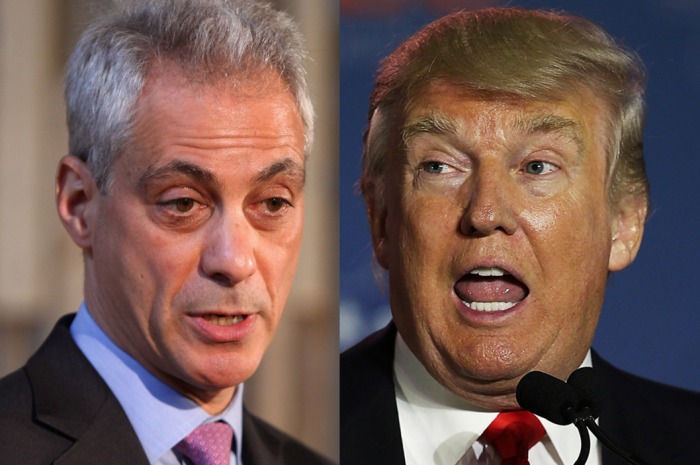
Hypocrisy: Democrats Criticize Trump but Not a Peep Against Emanuel

13-emanuel-trump.w1058.h704


So Donald Trump is a narcissistic, bigoted, fascist.

Not exactly a surprise.

He’s also the Republican front runner for President. I’ll admit to being mildly shocked by that.

However, much more astonishing are the chauvinistic and possibly illegal actions of Chicago Mayor Rahm Emanuel – and the fact that no major Democrat of note is calling him out for any of it.

Let’s review.

Trump made a name for himself during this election cycle calling Mexican immigrants rapists and murderers. Then he insulted women and the disabled. He proposes surveillance of mosques and registering all Muslims. He even incites supporters at his rallies to beat Black protesters.

And every time this happens, his poll numbers rise.

Predictably Democrats have decried this state of affairs. They have pointed their fingers accusingly at a Republican base that would champion such an odious figure for leader of the free world. And rightly so!

By contrast, Emanuel isn’t currently a candidate for anything. He’s a second term Democratic Mayor of one of the most populous cities in the country.

During that time, he has closed 50 public schools46 of which serve mostly black students. Southside residents had to resort to a month-long hunger strike to keep their last neighborhood school open. In addition, his economic policy consists of closing public health clinics for the poor and installing red light cameras to increase fines – none of which has actually boosted the economy.

But perhaps worse than all of that is the recent revelation that Emanuel’s administration with full knowledge of the Mayor may have actually covered up the police killing of an unarmed black teen!

In October, 2014, Officer Jason Van Dyke shot 17-year-old Laquan McDonald 16 times. Most of those bullets went into the teenager after he was already flat on the ground and the officer was at least 10 feet away.

As usual, the police story includes all the usual racist clichés – a trained and experienced officer of the law fears for his life from a black teen. Van Dyke says he was attacked. The dashcam video, however, shows no such thing. McDonald did not lunge at the officer. The young man was walking away when Van Dyke shot, and after he fell, the officer unloaded a barrage of bullets at his prone and seemingly helpless body.

Then the cover-up began. Emanuel allegedly was told about the incident in February, 2015, while he was in the midst of a contentious re-election bid. His administration quickly issued a $5 million settlement to McDonald’s family on the condition they keep quiet about the incident. It wasn’t until May, after Emanuel had won re-election, that an independent journalist asked for the dashcam video to be released. It took the full power of the media and a lawsuit to accomplish this. Last Thursday, a Chicago judge ordered the video be disclosed and Van Dyke was quickly charged with first degree murder.

It seems impossible to deny that Van Dyke would have been charged a year ago if not for the cover-up. The officer had already received 17 citizen complaints including that he had made racist remarks and three excessive force complaints over four years. Only Emanuel’s protection kept him out of jail.

So which is worse? Trump loudly champions prejudice and bigotry without the power to do anything about it. Emanuel protects an actual racist, stops him from being charged for what may well be a racially motivated murder, but makes no flashy public comments about it.

Yet only one of these two politicos gains the ire of the supposedly progressive and enlightened Democratic party.

How can this be? If we accept Fox News to represent a realistic presentation of the Republican platform, the party is often regressive, counterfactual, and rife with prejudice. On the other hand, media representations of the Democrats present them as the exact opposite. They propose progressive policies based on facts and a much more pluralistic view of society. They’re just much more inept at achieving this vision than their GOP counterparts.

But if that were true, how could one of their anointed, one of the most powerful Democrats in the country, a man who had been White House Chief of Staff at the beginning of President Barack Obama’s first term, a former U.S. Representative, senior adviser to President Bill Clinton, how could HE be perpetrating so many repressive, bigoted, “conservative” policies? How could so many leading Democrats support him? Why are so few criticizing him now?

It makes one question the perceived wisdom about the two parties. Is there really a difference, or are the left and the right wings just two parts of the same bird? When you look at what Democrats do – I mean when you actually examine the policies they enact when they’re in office – they really aren’t much different than those proposed by Republicans.

Perhaps there are a few far left Democrats like Bernie Sanders who actually represent a real progressive movement. Or perhaps there is no  major progressive party anymore in the United State.

We  must keep our eyes on Chicago. If there is any fight left for the soul of the Democratic party it will be here. Will the party call for Emanuel’s resignation? Or will it continue to side with one of the most regressive politicians currently holding office while it congratulates itself for condemning clownish Trump?


NOTE: This article also was published on Commondreams.org, the LA Progressive and on the Badass Teachers Association Blog.

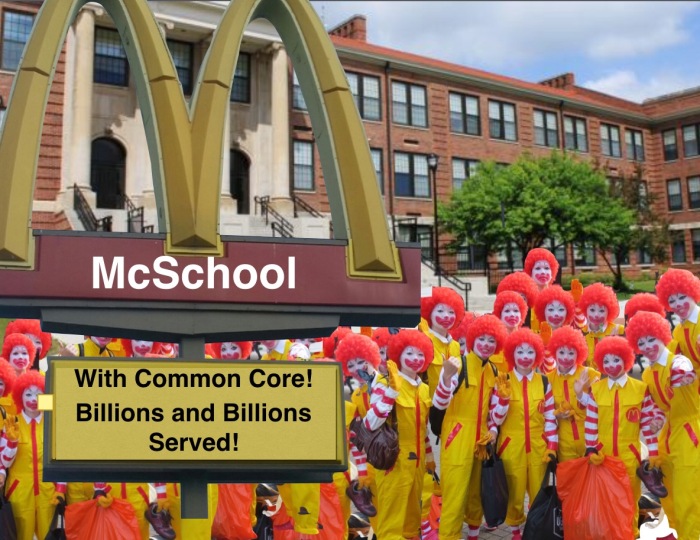
National Academic Standards – Turning Public Education into McSchools


FullSizeRender

America is obsessed with standardization.

Let’s make everything the same – neat and uniform.

It’s ironic coming from a country that’s always been so proud of its rugged individualism.

But look almost anywhere in the US of A, and you’ll see a strip mall with almost all of the same stores and fast food restaurants selling the same crusty burgers and fries left waiting for the consumer under a heat lamp.

Somehow this has become THE model for public education, as well. Corporations have convinced our lawmakers that the disposable franchise business schematic is perfect to increase student learning.

That’s where we got the idea for Common Core. All schools should teach the same things at the same times in the same ways.

It’s been a horrendous failure.

But this article isn’t about the Common Core per se. It isn’t about how the Core is unpopular, expensive, developmentally inappropriate, created by non-experts or illegal. It’s about the very idea of national academic standards. After all, if the Core is flawed, one might suggest we simply fix those flaws and institute a better set of national standards. I contend that this would be a failure, too.

The problem with standardization is that it forces us to make uniform choices. In situation A, we always do THIS. In Situation B, we always do THAT. There are some areas where this is a good thing, but education is not one of them.

For instance, we can all agree that children need to read books, but what kind of books? Should they read mostly fiction or nonfiction? Should books be limited by subjects or should they be chosen by interest? Should they be ebooks or hardcopies? Should they be organized by grade level or an individual’s reading level?

These are decisions that are best made in class by the teacher. However, when we write national standards, we’re taking away educators’ autonomy and giving it to some nameless government entity. This isn’t smart. Teachers are the scientists of the classroom. They can use their observational skills to determine what a child needs and how best to meet those needs. If we remove this, we’re forced to guess what hypothetical children will need in hypothetical situations. Even under the best of circumstances, guesses will not be as good as empiricism.

But, some will say, standards should be broad. They shouldn’t determine what children will learn in detail. They just set a framework. For instance, they’ll detail that all children should learn how to add and subtract. All children will learn how to read and write.

There is some truth to this. We can all agree to a basic framework of skills children need before graduation. However, if the framework is this broad, is it even necessary?

Do you really think there are any public schools in this country that don’t attempt to teach adding and subtracting? Are there any schools that don’t teach reading and writing?

I doubt such educational institutions exist, and even if they did, you wouldn’t need national academic standards to change them. By any definition, they would be cheating their students. If the community found out this was going on, voters would make sure things changed.

What about evolution, someone asks. This is a central scientific concept vital to a modern understanding of the field that in many places isn’t being taught in our public schools. Don’t we need national standards to ensure things like evolution are part of the curriculum?

The short answer is no.

For a moment, let me remove my ban on talking about Common Core – our current attempt at national standards. Some people defend the Core with this same argument. However, it should be noted that the Core has no science and history standards. It does nothing to ensure evolution is taught in schools.

But could we ever have standards that did ensure evolution was taught? Yes, we could.

Why don’t we? Why doesn’t Common Core explicitly address this? Because enacting such standards would take political power of a sort that doesn’t exist in this country. Too many voters oppose it. No state or federal legislature would be able to pass it.

But let’s assume for a moment that the political stars had aligned, and we could get lawmakers to vote for this. Why would they need to? This is a central theory to so many fields of science. Do we need an act of Congress to make sure all schools teach about gravity? Do we need one for Nuclear force? Friction?

You don’t need a Congressional order to teach science. If the community wants it, teachers will just do it. That’s their jobs. You can’t legislate that everyone believes in evolution. You have to convince people that it should be taught. National standards won’t change that. You can’t sneak it in under Newton’s laws of motion. We need to come to consensus as a society. As much as I truly believe evolution should be taught in schools, national standards are not going to make that happen.

Even if I were wrong, the cost would be far too high. We shouldn’t want all of our public schools to be uniform. When everyone teaches the same things, it means we leave out the same things. There is far too much to know in this world than can ever be taught or learned in one lifetime. Choices will always need to be made. The question is who should make them?

If we allow individuals to make different choices, it diversifies what people will know. Individuals will make decisions, which will become the impetus to learning, which will then become intrinsic and therefore valued. Then when you get ten people together from various parts of the country, they will each know different things but as a whole they will know so much more than any one member. If they all know the same things, as a group they are no stronger, no smarter than each separate cog. That is not good for society.

We certainly don’t want this ideal when going out to eat. We don’t want every restaurant to be the same. We certainly don’t want every restaurant to be McDonalds.

Imagine if every eatery was a burger joint. That means there would be no ethnic food. No Mexican. No Chinese. No Italian. There would be nothing that isn’t on that one limited menu. Moreover, it would all be prepared the same way. Fast food restaurants excel in consistency. A Big Mac at one McDonalds is much like a Big Mac at any other. This may be comforting but – in the long run – it would drive us insane. If our only choices to eat were on a McDonald’s Value Menu, we would all soon die of diabetes.

But this is what we seem to want of our public schools. Or do we?
There is a bait and switch going on in this argument for school standardization. When we talk about making all schools the same, we’re not talking about all schools. We’re only talking about traditional public schools. We’re not talking about charter schools, parochial schools or private schools.

How strange! The same people who champion this approach rarely send their own children to public schools. They want sameness for your children but something much different for their own.

I have never heard anyone say this approach should be applied to all schools across the board. That’s very telling. These folks want your kids to be limited to the McDonald’s Value Menu while their kids get to go to a variety of fancy restaurants and choose from a much daintier display.

If standardization were so great, why wouldn’t they want it for their own children? I think that proves how disingenuous this whole argument is. Standardization makes no one smarter. It only increases the differences between social classes.

The rich will get a diverse individualized education while the poor get the educational equivalent of a Happy Meal.

Think about it. Every generation of American that has ever gone to public school managed to get an excellent education without the need for national academic standards. Steve Jobs, Jeff Bezos, Bill Clinton, Ronald Reagan, Carl Sagan, Ruth Bader Ginsberg, Spike Lee, Larry King, and Stan Lee along with 90% of the United States population went to public school. None of them needed national academic standards to succeed.

This is a solution in search of a problem. The only reason we’re being sold the need for these standards is because it makes it easier for corporations to profit off federal, state and local tax dollars set aside for education. New standards mean new text books, new tests, new test prep materials, new software, and new computers. In the case of Common Core, it also means failing as many children as possible to secure a never ending supply of the above and an open door to privatization.

We must wake up to the lies inherent in these sorts of policies. Yes, the Common Core is horrible, but the problem goes far beyond the Common Core.

National Academic Standards are a terrible idea propagated by the 1% to turn the rest of us into barely educated subhumans and boost the bottom line.

Do you want fries with that?


NOTE: This article also was published on the Badass Teachers Association Blog and quoted extensively on Diane Ravitch’s blog.


Prejudice of Poverty: Why Americans Hate the Poor and Worship the Rich

2children


Take a breath.

Take a deep breath. Let your lungs expand. Let the air collect inside you.

Hold it.

Now exhale slowly. Feels good doesn’t it? You’d never realize there are hundreds of contaminates floating invisible in that air. Dirt, germs, pollution – all entering your body unnoticed but stopped by your immune system.

If only we had such a natural defense against prejudice. Racism, classism, xenophobia, sexism, homophobia – we take all that in with every breath, too.

It may not seem like it, but all these value judgments are inherent in American culture. They’re as much a part of life in the United States as the flag, football and apple pie. And to a greater or lesser extent, you have subconsciously accepted them to help construct your ideas of normality.

What does it mean to be a man? What does it mean to be a woman? How should black people be treated? To whom is it appropriate to be sexually attracted? What makes a person poor and why? All of these questions and so many more have been answered one way or another for us by the dominant culture. Not everyone accepts this perceived wisdom, but most of us have swallowed these solutions whole without thought, logic or criticism – and we don’t even know it’s happened.

Take our preconceptions about wealth and poverty.

Well paying jobs are drying up. Minimum wage work is becoming more common. Salaries are shrinking while productivity is increasing. Meanwhile the cost of living continues to rise as does the cost of getting an education.

Yet we still cling to the belief that all rich people deserve their wealth and all poor people deserve their poverty.

When we hear about someone on Welfare or food stamps, we sneer. The average conception is that this person is probably faking it. He or she could have earned enough to avoid public assistance, but he or she isn’t trying hard enough.

Moreover, we KNOW with a certainty that goes beyond mere empiricism that many of the poor still manage to buy the newest sneakers, have flat screen TVs and eat nothing but Porterhouse steaks.

You can hear this kind of story uttered with perfect certainty from the mouths of white, middle class people everywhere. They don’t mind helping people who are really in need, they say, but most poor folks are gaming the system.

Never once do they stop to consider that this story about impoverished individuals living better than middle class Americans is, itself, one of the most pervasive myths in our society. We know it the same way we know all Polish people are dumb, all Asians are smart and all Black people love fried chicken and watermelon.

However, none of this “knowledge” is supported by the facts. Look at the Supplemental Nutrition Assistance Program (SNAP). According to the New York Times:

Allegations of fraud, including an informal economy in which food stamps are turned into cash or used to buy liquor, gasoline or other items besides food have been used to argue that the program is out of control. In fact, the black market accounts for just over 1 percent of the total food stamp program, which is far less than fraud in other government programs like Medicare and Medicaid.

If you include erroneous payments because of mistakes on applications, overall loss to the food stamp program comes to 4%, according to the Department of Agriculture. Compare that to the 10% lost to Medicare and Medicaid – programs no one is calling to be cut or eliminated.

But figures like these don’t convince the average American. We’re so certain that all or most poor people are just lazy parasites. Everyone “knows” some low-income person they deem to be living too high for their circumstances.

And, yes, sometimes you do see an impoverished individual not wearing rags. Sometimes you do peek into an indigent person’s hovel and see new electronics or game systems.

How does this happen?

Debt.

Credit card companies are waiting in the shadows to extend a line of credit to just about anybody. It’s a safe bet for these businesses. If they give you money today, they can charge exorbitant rates of interest – even more so with the highest risk clientele. But there isn’t much risk to these corporations these days when almost anyone can take a job as a state constable or bail recovery agent to hunt down debtors and bring them to economic justice.

When you see a destitute child with new sneakers, his parents probably bought them with plastic. When you see an X-Box in a needy person’s house, chances are that wasn’t paid for in cash. They used the charge plate and will end up paying for that game system many times what it’s worth.

It’s a problem not limited to the poor. Even middle class folks are drowning up to their eyeballs in debt. As wages have decreased, people have used their credit cards to keep a standard of living they expect. But they’re paying for it with huge portions of their paychecks going to these credit card companies. Yet even though we all do this, middle class folks look down their noses at people lower down the economic ladder for doing the same thing.

In fact, they refuse to even see that obvious truth. Instead they cling to the lie that poor folks are social parasites. We even begrudge them food. Those are my tax dollars going to pay for that penurious person’s free ride, they say.

Unfortunately, we don’t stop to consider how much of our taxes are actually going to help the less fortunate.

Let’s say you make $50,000 a year. That means, you pay $36 toward food stamps. That’s ten cents a day – the same amount many charities ask to help feed starving children in Africa.

If you add all safety net programs, the cost only goes up an additional $6 a year. That doesn’t seem like a huge chunk of my taxes. Honestly, do you begrudge needy people less than the price of a meal for a family of four at Bennigan’s?

By and large, your tax bill isn’t going to the poverty-stricken. It’s going to the wealthy. Over the course of a year, you pay $6,000 for corporate welfare.

You read that right. Six K. Six grand. Six thou. Those are your tax dollars at work, too. And it’s a much larger burden on your bank account than the $42 you shell out for the poor.

What do you get for that $6,000 outlay? It includes at least $870 to direct subsidies and grants for corporations. An additional $870 goes to offset corporate taxes. Another $1,231 goes to plug holes in the federal budget from revenue lost to corporate tax havens. Oh! And don’t forget a sizable chunk for subsidies to Big Oil companies that are polluting our skies and fueling climate change and global warming.

Most of your money isn’t going to feed hungry children. It’s going to recoup losses for giant transnational corporations like Apple and GE that hide their money overseas to boost profits and avoid paying taxes for things we all need like schools, police and fire departments.

This money subsidizes giant multi-national corporations that are already making billions and billions of dollars in profit each year. In the past decade alone, corporations have doubled their profits – all while reducing their American workforces and sending jobs overseas. Yet we only complain about poor folks using food stamps and buying new sneakers on credit.

Why is that? Why does it only bother us when poor people get help and not when huge corporations do?

Part of it is the media. We’ve been convinced that big business deserves its money and poor people don’t. Another part of it is that these facts often go underreported. Movies and TV shows love portraying the parasite poor person but rarely portray the corporate leech. Outside of “It’s a Wonderful Life” and “A Christmas Carol,” the wealthy are usually portrayed in the most positive light possible and not as addicts hoarding cash they don’t need to compete with each other in a childish game of one-upmanship.

Finally, there is the racial and sexual element. By and large, corporations are run by white males. The poor are mostly black, brown and though women make up a slightly higher percentage than men, it is often conceptualized as uniquely female. Take the term Welfare Queen. Why is there no Welfare King? How telling that our conception only allows for one gender in this role!

The reality is much different. The true Welfare Queens are Big Businesses. They make unprecedented profits and avoid paying taxes on them. They have tons of cash on hand but never can seem to get enough. And if we increased the corporate tax rate to what it was in the 1950s when the Unite States was more prosperous than it has ever been, these same corporations would still be Filthy. Stinking. Rich.

So the next time you hear someone blaming the poor for gobbling up your taxes, remember the facts. First, it’s simply not true. There is no widespread fraud by the poor. They are not gaming the system. They are not putting an undue burden on the middle class. However, big business IS – in fact – cheating you out of income. Business people are getting fabulously wealthy on your dime – and even if we stopped subsidizing them, they’d still be fabulously wealthy!

Finally, don’t ignore the racial component. Would middle class Caucasians still complain so vehemently about the poor if they weren’t mostly talking about Black people, Latinos and women? I doubt it.

We may breath in these prejudices but we’re not helpless. It’s up to all of us to dispel these myths, not to let them stand, to confront them every time they come up. And, yes, I mean EVERY. TIME.

The only immune system we have as a society is education, knowledge, wisdom. And once you know the truth, don’t let anyone get away with this kind of racist, classist bullshit.


NOTE: This article also was published in the LA Progressive and on the Badass Teachers Association blog.


Blame the Victim – America’s Favorite Pastime

officer-ben-fields

I watched a little girl at school refuse to get out of her seat and get pounded by the police.

I watched a teenager in his car try to zoom away from a cop and get shot dead through the driver’s side window.

I watched all of these things and more from the safety of my cell phone. I wasn’t there in person, but I felt like I was.

And I am not alone.

It seems these two events were on everyone’s lips yesterday.

This is one of the fruits of self surveillance – the selfie, the dashcam, the youtube video. Events that would have been shrouded in the haze of he-said-she said are now public domain. The shadowy corners and back alleys are now just as flooded with spotlights as the most crowded theater on Broadway.

In some ways, that’s a really good thing. So many events that only a decade ago would have been hidden forever are now open to public view.

You’d think that would solve a lot of our society’s problems. No more secrets. No more lies. Just objective facts. THIS is what happened. No denying it. We’ll need context, but facts are facts. Now we can come together and decide with clarity what really happened, why it happened and who’s to blame.

However, things don’t always work out as you’d expect.

We can – in fact – agree on the facts but not necessarily on their meaning.

We all see the same images but we somehow don’t see the same things. The same light enters our eyes and forms the same images, but our brains process those images very differently.

We all see a little girl forcibly removed by an officer of the law. We all see a victim and a perpetrator. But which is which?

We all see a police officer exit his car, approach another vehicle which flees from him before he draws his gun and shoots. But who is to blame – the cop or the driver?

We come to different conclusions. And I think the reasons why depend on deep human truths about each of us.

Which side you take says something about you. It shows what kind of person you are, what you value, what assumptions you make about human nature.

When I watch that South Carolina police officer violently grab the little girl and throw her from the room, I focus on the child. Here is a 16-year-old black teen. She apparently was told to leave the room and refused to do so. She was wrong. But my heart won’t let me side against her.

Maybe she hit the officer. Maybe she was verbally abusive. It doesn’t matter. I don’t think a police officer – or any adult – should manhandle a child. If she had a gun, a knife or some weapon, that would be different. But she was just sitting peacefully in her seat. She probably deserved some sort of punishment for insubordination – but not one that would cause her physical harm. I’d be furious if someone treated my daughter that way. And so I am angry at this police officer and all the bystanders who took pains to ignore what was going on.

In a similar manner, when I watch another South Carolina officer approach 19-year-old Zachary Hammond’s car, I begin on the adult’s side. When the teen starts to drive away, I’m with the police officer. The teen is breaking the law. He should listen to the cop who is reasonably asking to question him. However, when the officer draws his gun, things get muddy for me. As the car drives away and the officer shoots into the window, I demand answers. All ambiguity disappears when I discover the teen was unarmed. He wasn’t pointing a gun at the officer. As you can clearly see, the car was not pointed at the cop. The adult was obviously in no danger.

The officer overstepped his bounds. Despite his claims of self defense, despite prosecutors siding with him, I cannot. It seems to me this 19-year-old boy out on a first date was victimized. Yes, he may have had drugs in his system. Yes, he may have possessed drugs with the intention of selling them. None of that justifies murder by a public servant who is charged with protecting and serving society. It may justify arrest, but it does not give the officer the right to be judge, jury and executioner. Imagine if death was the consequence for your own 19-year-old misdeeds! Far too high a price.

However, there are many who disagree. They side in both cases with the adult, with the police. And I see their point to an extent. Police have very difficult and dangerous jobs. They put their lives on the line to uphold laws that are sometimes ambiguous and of dubious value. But there needs to be limits to their authority.

What I find even more troubling is the dynamic between adults and children. Too often grown ups act as if they can do whatever they want to young people. They can touch, hit, belittle. And all in the name of discipline and order.

But maybe this says more about me than anything else. I care deeply about children. Not only am I a parent, I’m a public school teacher. I’ve devoted my life to helping young people get a good start in life. As such, I think violence against children is the most heinous thing anyone can do. It is despicable beyond words. Harming or killing an adult is bad. But do the same thing to a child and it is much worse.

This should be a shared value. It should be a tenet upon which our society is built. But instead too many of us blame the child or the parents. We’re presented with facts but lapse into assumptions about the child’s upbringing and the parents shortcomings. If the youngsters parents had done this or that, things would have been different. And – heck! – that may even be true! However, unlike our infinite surveillance of moments, the facts are not there. We have no record of mass parental neglect. We have just the opposite. In so many cases parents work multiple jobs to feed and clothe these children. They work night shifts. They take classes to improve themselves. So they can’t be present to the degree they’d like. But here we are passing the blame with nothing to support our assumptions but a feeling in our bellies. And we’re so deadly certain about it.

It’s sad really. We all can see the same events but remain unclear about the blame. We share the same senses and most of the same values. But our life experiences and prejudices make all the difference.

When an adult looks at these situations and sides against the child, I think it shows a terrible blindness. When some people look at the student roughed up in the classroom, they automatically side against her for a variety of reasons – race, gender, age, etc. among them. They have preconceptions about how black people act. Preconceptions about little girls. Preconceptions about poor children and their parents. And frankly it shows their moral judgment to be sick, diseased and untrustworthy.

Likewise, when some people see the teen gunned down in his car, they have preconceptions about the police and young people. Anyone on the other side of a police officer’s barrel is wrong simply by virtue of the direction in which he is pointing his gun, they might say. Police are defined as right. Suspects are defined as wrong. This is deeply troubling. It’s counterfactual. It’s untrue. Police are just humans, too. They can be wrong. They have been wrong. If we always assume they are correct in every situation, we are being morally lazy and willfully blind. We’re refusing to look at the facts and then judge accordingly. We stop at who is involved and not at what they did.

It’s so easy to blame the victim. It’s reassuring and safe. It means nothing is out of sorts with the world. Everything is just as it should be. Only this one person who was beaten by the police or shot dead – only that person is to blame. The social order remains intact and proper and good and justified.

It takes a kind of intellectual and moral honesty to look the world in the face and accept that which is uncomfortable but true. Sometimes those charged with protecting us actually do harm. Sometimes adults know less than children. Sometimes actions are racially motivated.

Because when we watch the world, the world looks back. We reveal ourselves. And sometimes we show the world exactly how ugly and depraved we can be as a nation.


NOTE: This article also was published on the Badass Teachers Association blog.


Department of Education SorryNotSorry About High Stakes Testing

Screen shot 2015-10-24 at 11.04.43 PM

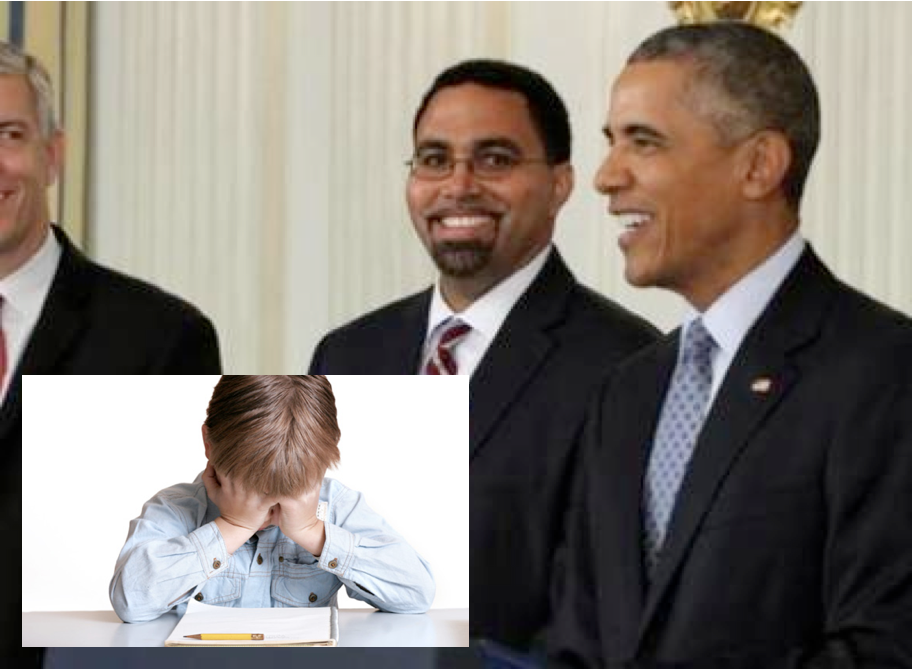
The Obama Administration must think the nation’s parents, teachers and students are pretty darn dumb.

President Barack Obama and his hand-picked Department of Education are solely responsible for the knuckle dragging academic policies strangling our public schools day in, day out. Yet instead of doing anything to reverse course to proven methods that might actually help kids learn, the department trudges out its annual apology.

It goes something like this:

Hey, Everybody! So sorry about all those high stakes tests, Common Core Standards and Value-Added teaching evaluations. We know they’re bad and we’re going to stop.

Then whatever functionary drew the shortest straw toddles back into the building and for the rest of the year things continue on exactly the same as they always have.

Let’s just pause for a moment and imagine how incredibly stupid they must think we are. I’m surprised they don’t issue public service announcements reminding us to exhale, multi-colored pamphlets on the benefits of blinking, and puppet shows instructing us how to use the potty.

The Obama Administration has had 7 years to fix this mess, and the only things they’ve done are to make it worse. Most of us voted for this so-called progressive because we thought he’d improve upon George W. Bush’s astoundingly wrongheaded school policies. But instead he doubled down on them! We hired a competent janitor but he was successful only in creating greater disorder.

We thought someone with the intelligence and grace of Barack Obama would be able to understand more than the eternal C-student Bush that you can’t ensure equity by standardized testing. That’s like trying to ensure a bathtub was filling with hot water by using nothing but Tarot Cards. The cards don’t give you an accurate reading and even if they did, you’d need to adjust the faucet at some point!

We thought a Constitutional scholar would understand that a national school curriculum violates federal law – even if you get a faux state commission to propose it and slap a new name on the thing! The federal government is allowed to do some things and state governments are allowed to do others. It’s not that hard. Moreover, armchair generals who have zero understanding of educational pedagogy, psychology, sociology and no classroom experience have no business telling teachers what they should be teaching!

We thought a political party that claims to be on educators’ side wouldn’t then turn around and initiate a witch hunt against us using poor student test scores instead of pitch forks and torches. Every independent, peer-reviewed study shows that poor kids do badly on standardized assessments and rich kids do well. Every statistician says you can’t use a test created to measure one thing (students) to measure another (teachers). Yet this is exactly what this so-called intellectual president mandates, and then he and the Democrats expect us to be there for them at the polls!?

In short, we expected a liberal Democrat, but got instead a Conservative Democrat in Name Only (DINO). He took far right ideas that Bush could barely officiate and made them much more efficient and thus much more damaging.

And every year like an alcoholic stumbling off a bar stool, the administration swears they’re not going to take another drink. Then they hire the head of Anheuser-Busch (John King) as a nutritionist. And some of us still believe them!

Just look at the crumbs they’re throwing out to us, peons!

Hey, Girl. We’re going to cut testing down to 2% of the school year.

That’s 23 hours! Almost 3 full days! Imagine if the dungeon master told you he was only going to put you on the rack for 2% of the time! Would you thank him? Maybe, but it would be a pretty half-hearted thank you.

Can the administration prove any positive value for standardized testing? I’m not asking them to trot out the tired party line about equity. I mean can they prove that testing actually helps children learn in any appreciable way? If the answer is no (and Spoiler Alert: it is!) then we shouldn’t be wasting any more time with it. Not 2%. Not 1%. ZERO PERCENT!

Moreover, Obama has been talking about reducing testing since he ran for office in 2008. America’s schools are still waiting for him to come through on that one. Maybe on his last day in office we’ll have a testing moratorium. Fingers crossed!

The department says, “The assessments must be worth taking.” No shit. That’s exactly the problem! They aren’t! And they’re shrouded in secrecy under the guise of test corporations intellectual property. How will we be able to determine they’re “worth taking”? Will you just tell us? THAT sure puts my mind at ease!

You know what assessments have been proven worth taking? The ones created by teachers. Yet these are exactly the kinds of tests that schools have been forced to cut back on. Perhaps this is what the administration has in mind. No more teacher-created tests. Let’s just have tests made by the professional test creators who have no idea what the heck they’re doing!

And speaking teachers, this one’s for you: “No standardized test should ever be given solely for educator evaluation.” It sounds like a condemnation of Value-Added Measures (VAM), of evaluating teachers on student test scores. However, it’s just the opposite. Notice the word “Solely.” We’re not going to give kids tests if we ONLY use them to evaluate their teachers. Well woop-de-do! Professional flunkies will talk to you for hours (if you pay them enough) about how great the tests we give now are at doing both! So no change in policy, just some purple prose to light on fire and blow the smoke up educators hind ends.

Perhaps worst of all is the use of English Language Learners (ELL), students with disabilities and minorities as props. We’re doing it all for them, they say. Bull! Shit!

The administration has nothing to say about fully funding the Individuals with Disabilities Education Act (IDEA). There’s nothing about sanctions on districts that don’t provide proper services for ELLs. There’s nothing about ensuring adequate, equitable and sustainable funding for all students – especially the poor and minorities. Instead the Department of Education pretends like high stakes tests are candy bars and what poor disadvantaged minority ELL disabled kid doesn’t love the soft velvety chocolate taste of a multiple choice test!?

This announcement is not reason to celebrate. It’s more of the same fake apologies soaking wet in crocodile tears and bad candor.

If Hillary Clinton wants to get elected President, she’d better do more than that. If Bernie Sanders wants a shot, he’d better do more than spout socialism about Wall Street and silence about K-12 schools.

You can only lie to our faces for so long. Despite your best attempts to trash public education in the name of saving it, we’re not so dumb as to believe any more of your evasions, deceit and dishonesty.


NOTE: This article also was published on the Badass Teachers Association blog.


White Fragility Frames the Media Narrative of the Million Man March Forward

12139070_1233888909971346_1493116541_n

White people will go a long way to avoid talking about racism.

Not only does it seem invisible to most melanin deficient folks like myself, but we refuse to acknowledge it when someone tries to bring it to our attention.

That’s not racism. There is no racism. Stop stirring up trouble.

Unless someone is wearing a white sheet and burning a cross on a black person’s lawn, most Caucasians close their eyes, stick their fingers in their ears and stay willfully blind.

Sociologists call this White Fragility, and it was on full display in the media response to the Million Man March Forward on Saturday.

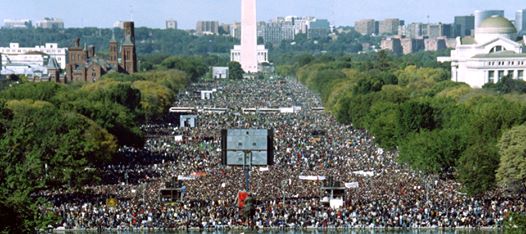
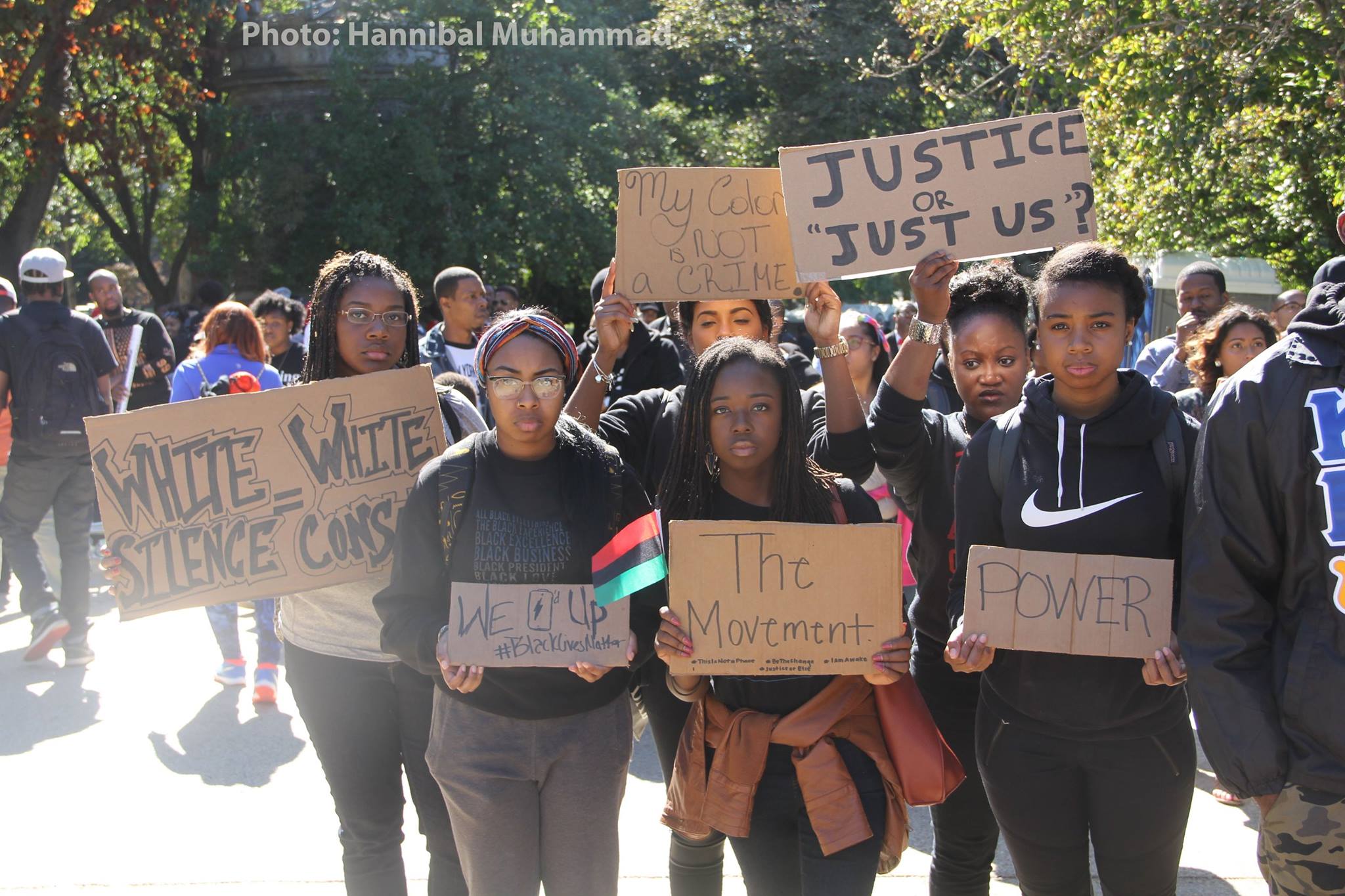
Thousands of African Americans and a smattering of people of other races and ethnicities gathered in the National Mall in Washington, D.C., to demand “Justice or Else” and commemorate the 20th anniversary of the original Million Man March.

Like during that 1995 gathering, today’s media was quick to frame the narrative in a way that silenced legitimate black concerns while benefiting White America.

First, most media outlets refused to cover the event at all. I guess to them there was nothing newsworthy going on. Just tens of thousands of black folks gathering in the nation’s capital. No saggy pants. No guns. Nothing to see here.

When the mainstream news covered it at all, it was to minimized its importance. Short articles basically saying – Here were some black people. Remember that time they did this before? In other news…

I remember the first march back in the 90s. I wasn’t there, but I remember how white folks talked about it. At first there was a genuine fear – black people with a united purpose coming together to better their social standing!? But we quickly found a way to negate everything they were doing.

How? Math.

Har! Har! Look at all those black folks gathered in front of the Capital steps. They held a Million Man March and didn’t even get a million men!

And therefore by the logic of white fragility we can ignore everything they did and said.

Institutionalized racism? Sorry not a million people!

Racial prejudice in hiring and firing employees? Not a million. Can’t hear you!

Police brutality? Come back when you’ve got more people!

12087324_1675832909318901_8512279402781528158_o

Of course it’s still a major point of contention exactly how many bodies showed up that first time. Estimates of the original rally put between 400,000 to 2 million folks on the scene. Unsurprisingly white people almost always go with the smaller number. I guess they don’t think black people can count that high.

But what if the lower estimation is true? Is there some racial math that bestows relevance on a moral crusade based only on sheer numbers? Is it okay to deny a handful of people their rights, a thousand or even a hundred thousand – but somehow a million is the tipping point where I have to say “No more”?

Even if only hundreds of thousands of people showed up, that’s something. Quite a lot, really. Doesn’t that demonstrate an attempt at racial unity, at addressing a shared list of problems? After all, how many people need to attend for White America to take them seriously?

This weekend journalists were careful not to make estimates of the number of attendees at the March Forward. But they’d subtly state that it was less well attended than the previous rally which – given the pictures I’ve seen of both events and the above mentioned disparity – seems somewhat hard to corroborate.

Still the media didn’t stop there. They found other ways to invalidate the event.

For instance, who is leading these marches? The Nation of Islam? Louis Farrakhan? Oh my! White people don’t approve of that! Therefore the whole gathering is unjustified. Poof!

Funny how that works. Black leaders must be perfect. White leaders? Not so much. George W. Bush was a C-student. Bill Clinton had extramarital affairs. Both men served as two-term presidents, and somehow the Republicans and Democrats go on.

Finally there was the rhetoric. This rally was subtitled “Justice or Else.”

That just won’t do. Angry black people demanding justice? No, white people simply will not respond to that kind of tone. If only they had been more polite about it, we might listen, but “Justice or else”!? Nope.

Any rational human being should be able to comprehend why black folks are demanding justice; They aren’t getting much of it from our courts. Unarmed black people are increasingly being murdered by the police and white citizens which prompts the debate of whether a crime has even been committed – a debate in which the answer is often, “No.”

The Black Lives Matter movement has grown because of just such concerns and the group was even represented at the rally.

But white folks – in the guise of analysis – ask what that phrase means “justice or else.” Are black people threatening to attack white people if they don’t get justice? What justice is there beyond a court of law? Do they really expect us to change our laws and hold our courts accountable?

No. Nothing to see here, folks. This throng of humanity peacefully assembling clearly has no valid points to make. Turn the cameras off. Let’s go home.

But had these thousands suddenly thrown bottles, overturned cars or started fires, the spot light would have been turned on full force.

“Another black riot,” newscasters would have proclaimed with glee. CNN would have devoted 24-hour news coverage. Expensive graphics would show the exact extent of the damage between interviews with scared white folks wondering why black people were allowed to misbehave so!

But a peaceful rally of African Americans coming together to share their pain, commemorate their history of struggle and commit to solutions?

Who cares about that? It doesn’t fit the media narrative. It doesn’t help white people ignore their black brothers and sisters problems. It doesn’t help our system of white supremacy remain invisible.

As a representative of the white race, may I make a suggestion? Could we possibly consider listening to what these people have to say? And before rejecting it out of hand, might we look at it objectively and even find a valid point or two? Could we then try to offer our black brothers and sisters a hand?

But the answer is always the same from white folks. Excuse after excuse to ignore, reject, repulse and keep our fragile white eyes firmly shut.

12105954_10106301025970309_961760835270051441_n


NOTE: This article also was published in the LA Progressive and on the Badass Teachers Association blog.


White People Need to Stop Snickering at Black Names

baby-and-parents

As a public school teacher, few things give me as much anxiety as getting my student rosters for the first time.

I look over the list of names for my incoming children and cringe.

How do I pronounce that?

Every year it never fails – there’s always at least four or five names I’ve never seen before – or at least never spelled quite like THAT!

As a white teacher in a district with a majority of black students but very few black teachers, there’s not really many people to turn to for guidance.

And if I don’t figure it out soon, I’ll be making a pretty terrible first impression. No one likes to have their name butchered, especially children, especially if an adult is doing it, especially if that adult is white.

The only solution I’ve found is to soldier on with the first day’s attendance and just try my best:

Me: Shah-NEE-Qwa?

Child: Shah-NAY-Qwa.

Me: JAY-Marcus?

Child: JAH-Marcus.

It’s uncomfortable, but I get through it and eventually learn.

However, one thing I’ve stopped doing is going to other white people for help. That’s a recipe for disaster.

It almost always turns into an exercise in subtle racism and white supremacy. No matter who the person is, no matter how kind, caring or empathetic, the reaction to unique black names is most often derision.

White people snicker and use the situation as the impetus for telling stories about other black names that they thought were even more outrageous.

It’s not that we’re trying to be hateful. I don’t think we even recognize it as racist, but it is.

We use the situation as an opportunity for bonding. THOSE people who are not like you and me – THEY name their children things like THIS! Not like you and me who name our children more respectably.

Make no mistake. This is racist behavior. We are emphasizing the otherness of an entire group of people to put ourselves over and above them.

It’s bigoted, discriminatory, prejudicial and just plain dumb.

What’s wrong with black names anyway? What about them is so unacceptable?

We act as if only European and Anglicized names are reasonable. But I don’t have to go far down my rosters to find white kids with names like Braelyn, Declyn, Jaydon, Jaxon, Gunner or Hunter. I’ve never heard white folks yucking it up over those names.

I can’t imagine why white people even expect people of color to have the same sorts of names as we do. When you pick the label by which your child will be known, you often resort to a shared cultural history. My great-great-grandfather was David, so I’ll honor his memory by calling my firstborn son the same. Jennifer is a name that’s been in my family for generations so I’ll reconnect with that history by calling my daughter by the same name.

Few black people in America share this same culture with white people. If a black man’s great-great-grandfather’s name was David, that might not be the name he was born with – it may have been chosen for him – forced upon him – by his slave master. It should be obvious why African Americans may be uncomfortable reconnecting with that history.

Many modern black names are, in fact, an attempt to reconnect with the history that was stolen from them. Names like Ashanti, Imani and Kenya have African origins. Others are religious. Names like Aaliyah, Tanisha and Aisha are traditionally Muslim. Some come from other languages such as Monique, Chantal, and Andre come from French. I can’t understand why any of that is seen as worthy of ridicule.

Still other names don’t attempt to reconnect with a lost past – they try to forge ahead and create a new future. The creativity and invention of black names is seldom recognized by White America. We pretend that creating names anew shows a lack of imagination when in reality, it shows just the opposite!

Creating something new can be as simple as taking an Anglicized name and spelling it in inventive ways. Punctuation marks also can be utilized in unusual positions to add even more distinctiveness such as in the names Mo’nique and D’Andre.

At other times, they follow a cultural pattern to signify as uniquely African American using prefixes such as La/Le, Da/De, Ra/Re, or Ja/Je and suffixes such as -ique/iqua, -isha, and -aun/-awn.

And for the ultimate in creativity, try mixing and matching various influences and techniques. For instance, LaKeisha has elements from both French and African roots. Other names like LaTanisha, DeShawn, JaMarcus, DeAndre, and Shaniqua were created in the same way.

This is something all cultures do. They evolve to meet the needs of people in a given time and place. Yet when it comes to people of color, we, white folks, whoop and guffaw at it. Heck! When we can’t find black names far enough out of our mainstream, we even make them up!

Don’t believe me? Have you heard of La-a? The story goes that a black girl was given that name and a white person asked how it was pronounced. The black woman said her name was La-DASH-ah. This is often followed by a punchline of black vernacular.

Har! Har! Har!

But it’s not even true! According to Snopes, this is a made up story. It’s the American version of a Polish joke and demonstrates how far white people will go to laugh at black culture.

The great comedy duo Key and Peele tried to call attention to this in their outstanding substitute teacher sketches. In a series of short routines, an almost exclusively white classroom gets a black substitute teacher from the inner city schools. Mr. Garvey is expecting black names, so he pronounces the students’ middle class white names as if they were African American.

Almost everyone loves this sketch. It gets universal laughs, but wait until it’s over. Too many white folks try to continue the giggles by then talking about crazy black names they’ve encountered. But that’s not at all the point Key and Peel were trying to make! They were trying to show how cultural context shapes our expectations of proper names. Mr. Garvey is worthy of our laughter because his expectations are out-of-sync with his surroundings. When we expect all African Americans to have European or Anglicized names, we’re just as out of touch as Mr. Garvey. But like Dave Chapelle’s comedy, sometimes the person laughing the loudest is getting something the comedian didn’t intend at all.

Maybe it wouldn’t be so bad if black names just generated snickers. However, white culture actually selects against people with black sounding names.

Countless studies have shown how much more difficult it is for someone with a black sounding name to get a job, a loan or an apartment than it is for someone with a white sounding name. It’s one of the most obvious features of white supremacy. You may not like black names, personally, but do these people deserve to suffer for embracing their own culture?

Moreover, having a European or Anglicized name is no guarantee of fair treatment. It certainly didn’t help Michael Brown or Freddie Gray.

If we’re really going to treat people equitably, an easy place to begin is with black names. White people, stop the laughter and giggles. I used to do it, myself, until I thought about it. Yes, I’m guilty of the same thing. But I stopped. You can, too.

It’s not the biggest thing in the world. It’s not even the most pressing thing. It’s not a matter of guilt. It’s a matter of fairness.

Because when the final role is taken of all America’s racists and bigots, do you really want your name to be on it?


NOTE: This article also was published on Everyday Feminism and the Badass Teachers Association blog.