
Unions Can’t Just Be About What We’re Allowed to Do: Social Justice Unionism

7983807401_6b0075f742_b.sm_a

If labor unions were an animal, they’d be an old hound dog napping on the porch.

They’re slow to get up and chase away burglars but they do like to howl at night.

Most of the time you don’t even know they’re around until the dinner bell rings. Then that ancient mutt is first to bolt into the kitchen to find a place at the table.

It’s kind of sad really. That faithful old dog used to be really something in his youth.

He was fierce! He’d bark at trespassers even tearing them apart if they threatened his patch of land.

Old Uncle Sam used to yell at him and even threaten the pooch with a rolled up newspaper, but that dog didn’t care. He had a sense of right and wrong, and he didn’t mind getting into deep trouble fighting for what he thought was fair.

Today, however, the only thing that really riles him is if you threaten to take away his ratty old bone.

Let’s face it. Unions have become kind of tame. They’re housebroken and not much of a threat to those people waiting in the shadows to rob us blind.

Some people say we’d be better off without them. But I don’t agree. Even a decrepit canine can act as a deterrent, and thieves sure are frightened of dogs.

Think about all unions have given us: the weekend, child labor laws, vacation time, pensions, lunch breaks, healthcare, the 8-hour day, maternity leave, safety measures, due process, sick leave and free speech protections on the job!

They didn’t get us all that by sitting politely at the table with their hands crossed. They didn’t do all that by contributing modest sums to political campaigns. They didn’t do it by obsessively protecting collective bargaining at the expense of all else.

Unions used to take to the streets. They took over the job site. They marched with signs and placards. They exercised people power.

And the government was scared of them. The President called out the army to get them back to work. Lawmakers hired mercenaries to break strikes with clubs and guns. But eventually Congress passed laws to placate them.

Unfortunately, That was a long time ago.

For decades the pendulum has been swinging against us. Federal and state laws have become increasingly restrictive. They want to tell us when we can strike and how long. They want to tell us when and if we can collect dues. And – frankly – they want to tell us to just disperse and do whatever the bosses want – because the business class has already bought and paid for our politicians.

For decades we’ve heard to their propaganda on TV, the radio and the print media. Well-paid shills have poured their poison in our ears about the evils of the labor movement. They’ve spoken these lies so often lots of people believe them.

Workers used to fight to make sure everyone got a fair deal. Now the working man has been brainwashed to focus instead on making sure no one else gets more than him. And the bosses are laughing all the way to the bank.

Union membership is at the lowest it’s been in a century. So are wages adjusted for inflation. A family of four used to be able to get by comfortably on one salary. Now it can barely make ends meet with two.

Yes. There’s no doubt about it. We need unions today more than ever.

But for unions to survive, they must change. They have to become a reflection of the membership and not just of the leaders.

During this presidential election cycle, we’ve seen our largest national unions – the National Education Association (NEA) and American Federation of Teachers (AFT) endorsing a candidate without bothering to actively poll their members. We’ve seen them speak for us on policy decisions without asking our opinions. We’ve seen them act just like the corrupt politicians who we should be fighting against.

Yes, it is time for a change. No longer can our unions be run from the top down. They must be run from the bottom up. They shouldn’t tell us what to do. We, the membership, should be giving orders to them.

Moreover, we need to stop obsessing about collective bargaining. I’m not saying that’s unimportant. But it can’t be the only thing we do.

Our unions used to be in the midst of larger social movements. We were part of the Civil Rights movement. We were part of the push for desegragation. We were part of the fight to protect children and provide them a decent education.

We need to continue that today. And in some places we are already doing that! Look to Chicago, Detroit and Philadelphia. Teachers unions in those urban areas are fighting not just for better pay and benefits but for the communities they serve. Detroit teachers en mass are calling off sick to protest horrible conditions in the schools. Chicago teachers are marching in the streets with the community to demand indictments for police murdering their black and brown students. Philadelphia teachers are supporting students who walk out of class to protest state disinvestment and toxic testing.

THIS is what unions should be doing. We should be fighting for social justice. We should be a central part of the struggle to turn the tide against corporatization, privatization and standardization of our country’s public goods. We should be marching hand-in-hand with BlackLivesMatter activists. We should be in the front lines of the fight to save our environment and replace fossil fuels with renewable energy.

We must be part of the community and not apart from it. We must share in the struggles and goals of those we serve. We must be an example of the old truism that a rising tide raises all ships. After all, the word “union” literally means together. By definition we must all be in this together or else we’re not even really a union.

And to do this we have to stop being so concerned with what they tell us we can do.

We live in a democratic society. The government gets its power from us, from our consent. That means that if there are enough of us, we trump their corrupt laws. They only get to make those laws because we say so. And court decisions – even Supreme Court decisions – mean nothing next to the court of public opinion.

The bosses buy the politicians and tell them to legislate us into a box. It’s time to break out of that box. We can’t be afraid to take our power back. We shouldn’t be afraid of our government. Our government should be afraid of us.

How do we do it? Organize.

If you belong to a union, roll up your sleeves and get active. Run for office. Convince like-minded folks to join you. Take over your local. Spread to your national.

If you don’t belong to a union, start one at your job. Talk to your co-workers. Talk about the benefits for each of you and your neighborhoods. Fight for your rights.

I know. It’s a whole lot easier to complain. Real change, though, takes real work.

We used to know these things. Somewhere along the line we forgot.

So wake up, you yeller cur dog, and get off the porch. Take to the streets.

Because the surest way to take back our country is to take back our unions.

Top 10 Reasons School Choice is No Choice

LittleKidThumbsDown

On the surface of it, school choice sounds like a great idea.

Parents will get to shop for schools and pick the one that best suits their children.

Oh! Look, Honey! This one has an exceptional music program! That one excels in math and science! The drama program at this one is first in the state!

But that’s not at all what school choice actually is.

In reality, it’s just a scam to make private schools cheaper for rich people, further erode the public school system and allow for-profit corporations to gobble up education dollars meant to help children succeed.

Here’s why:

1) Voucher programs almost never provide students with full tuition.

Voucher programs are all the rage especially among conservatives. Legislation has been proposed throughout the country taking a portion of tax dollars that would normally go to a public school and allowing parents to put it toward tuition at a private or parochial school. However, the cost of going to these schools is much higher than going to public schools. So even with your tax dollars in hand, you don’t have the money to go to these schools. For the majority of impoverished students attending public schools, vouchers don’t help. Parents still have to find more money somewhere to make this happen. Poor folks just can’t afford it. But rich folks can so let’s reduce their bill!? They thank you for letting them buy another Ferrari with money that should have gone to give poor and middle class kids get an education.

2) Charter and voucher schools don’t have to accept everyone

When you choose to go to one of these schools, they don’t have to choose to accept you. In fact, the choice is really all up to them. Does your child make good grades? Is he or she well-behaved, in the special education program, learning disabled, etc.? If they don’t like your answers, they won’t accept you. They have all the power. It has nothing to do with providing a good education for your child. It’s all about whether your child will make them look good. By contrast, public schools take everyone and often achieve amazing results with the resources they have.

3) Charter Schools are notorious for kicking out hard to teach students

Charter schools like to tout how well they help kids learn. But they also like to brag that they accept diverse students. So they end up accepting lots of children with special needs at the beginning of the year and then giving them the boot before standardized test season. That way, these students’ low scores won’t count against the charter school’s record. They can keep bragging about their high test scores without actually having to expend all the time and energy of actually teaching difficult students. Only public schools take everyone and give everyone their all.

4) Voucher and charter schools actually give parents less choice than traditional public schools

Public schools are governed by different rules than charter and voucher schools. Most public schools are run by a school board made up of duly-elected members from the community. The school board is accountable to that community. Residents have the right to be present at votes and debates, have a right to access public documents about how tax money is being spent, etc. None of this is true at most charter or voucher schools. They are run by executive boards or committees that are not accountable to parents. If you don’t like what your public school is doing, you can organize, vote for new leadership or even take a leadership role, yourself. If you don’t like what your charter or voucher school is doing, your only choice is to withdraw your child. See ya.

5) Charter Schools do no better and often much worse than traditional public schools

Pundits and profiteers love to spout euphoric about how well charter schools teach kids. But there is zero evidence behind it. That is nothing but a marketing ploy. It’s like when you’re in a bad neighborhood and walk past a dive that claims to have the best cup of coffee in the city. Yuck. Surely, some charter schools do exceptionally well. However, most charters and almost all cyber charters do worse than their public school counterparts. Fact.

6) Charters and voucher schools increase segregation

Since the 1950s and ’60s, we used to understand there was no such thing as separate but equal education. Before then we had Cadillac schools for white kids and broken down schools for black kids. The Supreme Court ruled that unconstitutional. But today we have Cadillac schools for rich and middle class kids (most of whom are white) and broken down schools for the poor (most of whom are black or brown.) After making tremendous strides to integrate schools and provide an excellent education for everyone, our public schools have been resegregated. Charter and voucher schools only make this problem worse. They either aid in white flight or leach away minority students. This just makes it easier to give some kids a leg up while keeping others down.

7) Charter and voucher schools take away funding at traditional public schools

It costs almost the same amount of money to run a school building of a given size regardless of the number of kids in it. When students leave the public schools for charter or voucher schools, the public school loses valuable resources. It now has less revenue but the same overhead. So even if you found an excellent charter or voucher school to send your child, you would be hurting the chances of every other student in the public school of having their own excellent education. This is what happens when you make schools compete for resources. Someone ends up losing out on an education.

8) Properly funding parallel school systems would be incredibly wasteful and expensive

We could fix this problem by providing adequate funding for all levels of the school system – traditional public schools, charters, voucher schools, etc. However, this would be exorbitantly expensive. We don’t adequately fund our schools now. Adding additional layers like this would mean increasing national spending exponentially – maybe by three or four times the current level. And much of that money would go to waste. Why have three fully stocked school buildings in one community when one fully stocked building would do the job? I don’t imagine residents would relish the tax hike this would require.

9) School choice takes away attention from the real problems in our public schools – poverty and funding equity

We have real problems. More than half of public school students live below the poverty line. They are already several grade levels behind their non-impoverished peers before they even enter kindergarten. They need help – tutoring, counseling, wraparound services, nutrition, etc. The predicament is even more complicated by the way we fund our schools. Throughout the country, poor districts get less money than wealthy or middle class ones. The students who go to these schools are systematically being cheated out of resources and opportunities. And instead of helping them, we’re playing a shell game with charter and voucher schools. The problem isn’t that parents don’t have several excellent choices. If they’re poor, they often don’t have one.

10) School choice is not supported by a grass roots movement. It is supported by billionaires.

The proponents of school choice will tell you that they are only doing the will of the people. This is what parents want, they say. Baloney. While there are individuals who support school choice, the overwhelming majority of money behind this movement comes from conservative billionaires actively trying to dismantle the public education system. They want to steal the public system and replace it with a private one. They don’t care about your child. They just want to steal the hundreds of billions of tax dollars we pay to educate our children. This is not philanthropy. It is a business transaction meant to screw you and your child out of your rights.

If we really want to ensure every child in this country gets an excellent education, the answer isn’t school choice. Instead, we need to commit to supporting our public school system. We all need to be in this together. Yes, our schools should look at the needs of each child and tailor education to fit appropriately. But that shouldn’t be done in parallel school systems. It should be done under the same umbrella. That way, you can’t defund and defraud one without hurting all. It can’t just be about your child. It has to be about all children.

That’s the only choice worth making.


NOTE: This article was given a shout out on Diane Ravitch’s blog and published on the Badass Teachers Association blog.


Taking Back Your Name – The Pros and Cons of Political Correctness

introduction


“What I think the political correctness debate is really about is the power to be able to define. The definers want the power to name. And the defined are now taking that power away from them.”
Toni Morrison

“Never trust anyone who says they do not see color. This means to them, you are invisible.”
Nayhyirah Waheed


Call me Steve.

Not Steven. Not Stephen. Certainly not Steveareno.

It’s a preference. My preference. My choice. And if people want to be in my good graces, they’ll comply with my wishes.

There’s nothing strange or unreasonable about this. We do it all the time – usually when we’re being introduced to someone.

“Hi. I’m Steve.”

“Nice to meet you, Steve. I’m Elisha.”

“Elisha? What a beautiful name!”

“Thank you, Steven.”

“Please. Call me Steve.”

Is there anything wrong with that? Does that stifle conversation? Does it stop people from talking freely to each other?

No. Certainly some names are hard to pronounce or – in my case – remember. But overcoming those hurdles is just common decency. It’s not too much to ask – especially if you’re going to be dealing with this person for an extended length of time.

The idea that allowing people to define themselves somehow shuts down conversation is rather strange. But it’s the essence of opposition to political correctness.

“Political correctness is tyranny with manners,” said conservative icon Charlton Heston.

I wonder if he would have felt the same if we’d called him Charlie Hessywessytone.

A more fleshed out criticism comes from President George H. W. Bush who said, “The notion of political correctness declares certain topics, certain expressions, even certain gestures off-limits. What began as a crusade for civility has soured into a cause of conflict and even censorship.”

Is that true? Is political correctness really censorship? That’s the conflation made by many conservatives and even some liberals. After all, popular Left-wing comedian Bill Maher sarcastically calls his HBO show “Politically Incorrect,” and he often rails against the practice.

There’s a kernel of truth to it. We are asked to change the way we speak. We’re asked to self-censor, but we already do this frequently without wailing against a loss of free speech.

Human beings are subject to various impulses, but as adults, we learn which ones we can act on and which we shouldn’t. I may think it would be hilarious to run into a crowded movie theater and yell, “FIRE!” However, I know that doing so – while possibly funny to a certain kind of person – would result in injuries and trauma as moviegoers stampede out of the theater. So I don’t do it. Is that censorship? Maybe. But it’s censorship with a small c.

The Hestons, Bushes and Mahers of the world seem to think political correctness is more like Capital C Censorship. But this is demonstrably false.

That kind of Censorship is the act of officials, possibly agents of the government, a corporation or some other formal bureaucracy. But political correctness has nothing to do with officials. There are no censors. There are only people who ask to be named a certain way.

A censor looks at a news report of military operations in Iraq and deletes material that would give away the army’s location. Political correctness is nothing like that. It involves someone asking others to refer to themselves THIS WAY and not THAT WAY.

The penalties for violating Censorship are official. Ask Chelsea Manning who is serving a 35-year prison sentence for doing just that. The penalties for violating political correctness are social. You may be criticized, condemned or disliked.

If you criticize Manning for releasing classified documents to Wikileaks, you’re not violating political correctness. That’s your opinion, and you’re entitled to it. However, Manning is a trans woman who is going through hormone replacement therapy. If you refer to her as “him” you are violating political correctness. You’re naming her in a way that violates her wishes. The penalty is not a prison sentence. It’s a sour look.

So political correctness is not Censorship. In some ways, the confusion comes from the term “political correctness,” itself.

Though its origins are hard to pin down, it appears to have been coined by the Soviets to mean judging “the degree of compatibility of one’s ideas or political analysis with the official party line in Moscow.” At least that’s what the International Encyclopedia of Social Studies says.

The term came to prominence in the United States in conservative writer Dinesh D’Souza’s book “Illiberal Education.” He disparaged affirmative action as a kind of political correctness that gave preference to (what he saw as) unqualified minority students over whites in college admissions.

So the first mention of the term in the USA was simply to disparage liberal political policies. It was a ham-handed way of comparing the Left with the Soviets. Yet somehow this term has become the handle by which we know simple civility. It’s kind of hard to feel positively about a concept that begins with a mountain of unearned negative connotations.

Conservatives know the power of getting to name something. It’s their go-to propaganda tactic and lets them control much of the debate. For instance, that’s why the Right loves to call Social Security an “entitlement.” There’s truth to it because you’re entitled to getting back the money you pay in, but it’s full of unearned negative connotations as if these people were somehow demanding things they don’t deserve.

In essence, political correctness shouldn’t be political at all. It’s just kindness. It’s just being a decent human being. Don’t purposefully call someone by a name they wouldn’t appreciate. Respect a person’s ownership of their own identity.

And for some people that’s hard to do. Their conceptions of things like gender, sexuality, race and religion are extremely rigid. The only way to be a man is THIS WAY. The only way to be spiritual is THAT WAY. But if they give voice to these ideas in the public square – especially in the presence of people who think differently – they will be frowned upon.

But is this really so dissimilar to the crowded movie theater? Refusing to acknowledge someone else’s identity is harmful to that person. It tramples the soul similarly to the way their body would be trampled in a stampeded exit. So you shouldn’t do it.

The result is an apparently much more tolerant society. It’s no longer okay to use racial, cultural, gender and sexual stereotypes in public. You’re forced to give other people consideration – or else face the consequences of being disliked. And on the surface, that’s a much more inviting world to live in.

However, there is a glaring problem. In some ways, this has made public discourse more antiseptic. People don’t always say what they mean in the public square. It’s not that they’ve changed the way they think about the world. They’ve just learned to keep it to themselves until they’re around like-minded individuals. They reserve their racist, classist, sexist language for use behind closed doors.

This is why when I’m at a party peopled exclusively by white folks, some partygoers may let racial epithets slip out. And we all laugh nervously to be polite. Or maybe it’s more than politeness. Maybe for some it’s to relieve the tension of such refreshing candor like taking off a girdle. Fwew! Here, at least, I can say what I really think without having to worry about people looking down on me for it!

Since such reactions occur mostly in homogeneous groups, it makes the world look much more enlightened than it really is. Pundits and policymakers look around and cheer the end of these social ills when they haven’t ended at all. They’ve merely gone underground.

And so we have an epidemic of colorblind white people who can’t see racism because of the gains of political correctness. Somehow they forget those unguarded moments. Somehow they haven’t the courage to examine their own souls. Or perhaps they don’t care.

And so we have the conundrum: which is better – to live in a world where all individuals have the right to name themselves or to live in a world where our most basic prejudices are on display for all to see?

Personally, I pick political correctness, and here’s why.

Words are important. We think in words. We use them to put together our thoughts. If we continue to respect individuals’ names in word, eventually we’ll begin to do so in thought and deed.

This isn’t mind control. It’s habit. It’s recognizing an ideal and working toward it. As Aristotle taught, the way to become a good person is to act like one. Eventually, your preferences will catch up with your habits.

I think that’s what’s happening today. Look at the children. They’re so much less prejudiced and racist than we, adults. This is because they’ve learned political correctness first. They didn’t have to unlearn some archaic white-cisgender-centrism. This is normal to them, and I think that’s a good thing.

Obviously some people will balk at this idea. They will look at this ideal as reprehensible. They want to return to a world where women were little more than property, a world where black people knew their place, where sexual identity was as simple as A or B.

But I think most of us recognize that this is not a world where we’d want to live. Modern society can be scary and confusing but trying to respect everyone as a person isn’t a bad thing. It’s consideration, concern, warmth.

Perhaps the best way to love your fellow humans is to call them by their proper names.

Gov. Rick Snyder Should Be Forced to Drink Nothing But Contaminated Flint Water for the Rest of His Life

Screen shot 2016-01-22 at 12.02.36 AM

As I write this, I have a fresh glass of ice cold water sitting next to me.

It is so clear I can see the wood grain of the the table through it. When I put it to my mouth, my lips almost go numb from the cold.

I gulp down way more than I should. In moments, it seems, the glass is empty.

Nothing satisfies like a crisp simple glass of water.

But in Flint, Michigan, that straightforward, easy pleasure can kill you.

And-or poison your children, cause learning disabilities, hearing loss, vomiting, high blood pressure, pain or numbness in the extremities, infertility or miscarriage. Among a host of other equally terrible maladies.

From the water.

Nine months ago the state officials who took over running Flint because the city was just too darn poor for self government, they shut off the flow of already treated Lake Huron water from Detroit. They replaced it with untreated raw water from the Flint River. The plan was to save money by treating this water, themselves, from a source that had been continually polluted for decades by the disappearing auto industry.

However, this noxious brew corroded the pipes, stripped out the lead and put it right into the water glasses Flint parents were using to hydrate their children.

More than 8,500 children. With high amounts of lead in their blood. Suffering untold injuries. For life.

Oh and the overwhelming majority of them are African American and/or impoverished. Whoops!

Gov. Rick Snyder has been defensively apologizing for this disaster. He knew all about it long before the taps were shut off. He even released a slew of inter-office emails about the situation where officials play pass-the-buck as Flint residents gulp down this filth from their faucets. As citizens complained about the water’s color and odor. As physicians protested it wasn’t safe for human consumption.

Even now Snyder STILL says people can safely bathe their children in this dirty, smelly, poisoned water. Just make sure the kiddos don’t drink it. In fact, he says he wouldn’t mind bathing his own grandchildren in this mess.

Yeah. Kinda takes away any sincerity from his “apology” and his statement that he’s responsible, doesn’t it?

Why isn’t this man in jail? Why is he still in the Governor’s mansion?

If we lived in a just country, this poor excuse for a human being would AT VERY LEAST be locked away in a dungeon somewhere never to sting our eyes at the sight of his repulsive face. A more appropriate punishment would be making him drink nothing but his own contaminated Flint tap water for the rest of his life as he suffers from the effects of lead poisoning – like all those thousands of children he helped poison to save a few bucks.

But no. In the America where we live, his only mistake was getting caught. And now he’s losing political points having to apologize without really doing much. Yeah, he’s called in the National Guard to help deliver bottled water. Yeah, he’s turned back on the Lake Huron water, but Flint’s pipes are already ruined so lead is still leaking into the water. Why are these poor people still being charged with a water bill for something they can’t use? No one except for Grandpa Rick Snyder would use this foul stuff for anything!

Meanwhile, Darnell Earley, the emergency manager appointed by Snyder who actually switched Flint’s water in the first place is at a new government job. He’s emergency manager of another Michigan public service – Detroit Public Schools! Dilapidated buildings, fungus growing on the walls, slime leaking from the ceiling, broken toilets – a state-provided learning environment overseen by this functionary who’s doing a heckuva job! Teachers trying to raise awareness of the situation have staged a series of “sickouts.” But Snyder’s administration still doesn’t have any money to waste on Detroit school kids – just like it didn’t have any money to provide potable water to Flint residents.

And the cycle continues. Crap gets flushed from one source to another – and I’m not talking about the Flint water system!

You can try to make justifications and excuses, but the lie gets awfully thin in Michigan. And if you think this is the only place where business trumps public welfare, you must be drinking from Snyder’s water cooler. Chicago, Philadelphia, Atlantic City, the entire island of Puerto Rico! Terrorists with government jobs are slowly dismantling our metropolitan areas, our public goods, everything that made America great!

And what the heck is being done about it? A lot of news stories, talking heads shaking their noggins and pointing their fingers everywhere except where the blame really lies.

It’s enough to drive one to drink.

Speaking of which, excuse me while I take another swig from my water glass.

Ah!

No, I don’t live in Flint. But this sure isn’t tap water. Are you kidding me?

In Pennsylvania we’ve had too many scares with Giardiasis and other bacteria in our municipal water occasionally making us sick.

I pay extra to bring this water to the house in huge jugs and put it on a machine that keeps it ice cold and refreshing anytime of the day or night.

Some people can’t afford it.

What are they to do?

Can anyone really feel safe drinking from the tap ever again?

What kind of a world is it where we can’t even trust the water?

What kind of world are we leaving for our children?

We are all a few months from becoming Flint.

It could already be happening.

Will we let it?

High Stakes Testing Doesn’t Protect Civil Rights – It Violates Them

martin-luther-king-jr-small

“Daddy, I know who that is!”

“Who is it?”

“That’s Martin Luther King.”

“That’s right, Baby! Who was he?”

“We saw a movie about him today in school. He had a dream.”

Thus began a fascinating conversation I had with my seven-year-old daughter a few days ago.

I had been going through her book bag and found a picture of Dr. King blazoned above an article about his life.

“He wanted everyone to be nice to each other,” she said.

I laughed. My first grade scholar isn’t that far off.

“He’s one of my heroes,” I said. “He means a lot to me.”

“That’s silly,” she said. “He doesn’t have any super powers.”

Before I could reply, her attention shifted to her stuffed Yoshi doll. She began to play.

One of the best things about being a parent is getting to see the world anew through the eyes of your children. My little girl offers me this vantage point everyday.

Dr. King can’t be a hero. He had no super powers.

Or did he?

“I have a dream,” he famously said, “that my four little children will one day live in a nation where they will not be judged by the color of their skin but by the content of their character.”

It’s a simple wish. A simple insight.

Or is it?

Do we do that today? Do our schools?

As a middle school teacher, I’m well aware how our public schools judge our children, and it’s not by the content of their character. It’s by their standardized test scores.

High scores mean you’re learning. Low scores mean you’re not. And if you’re not learning, that’s your teachers fault and we’re going to close your school or turn it into a charter.

What’s worse, we’re going to do it because that ensures your civil rights.

That’s the story anyway.

Ever since rewriting the federal law governing K-12 schools began to be debated in earnest by Congress, the tale was told that high stakes testing is good for minorities. It makes sure schools aren’t neglecting them.

And now that the Every Student Succeeds Act (ESSA) has been passed, well-meaning people everywhere are wondering if we’re looking out for our black and brown brothers and sister enough – do we have enough federally mandated high stakes tests? Is there enough accountability?

After all, the new law potentially returns much of the power for education policy to the states. What if states don’t give as many tests? How will state legislatures ensure black students aren’t being neglected? Why would schools actually teach black kids if we don’t threaten to close them based on test scores?

These would be laughable questions if they weren’t asked in earnest. With such frequency. Even from some civil rights organizations.

Some things to consider:

1) The ESSA does absolutely nothing to limit standardized testing.

When Congress was rewriting federal education policy, parents, educators, students and experts of every stripe asked for a reduction in testing. It didn’t happen. Exactly the same number of tests are required under the ESSA as there were before it was passed – once a year in grades 3-8 and once in high school.

2) Punishing schools doesn’t help kids learn.

Once upon a time, it was the government’s job to provide schools with adequate resources to help kids master their lessons. Now it has become the government’s job to raise an arbitrary standard and shutter or privatize schools that fall below that mark.

This may come as a surprise, but no school has ever been improved by being closed. Students who are forced to relocate don’t suddenly do better. In fact, they usually do worse academically. Moreover, there is exactly zero evidence that charter schools do better than traditional public schools. In fact, the evidence points in exactly the opposite direction.

3) Standardized tests are poor assessments to judge learning.

Standardized testing has never been shown to adequately gauge what students know, especially if the skills being assessed are complex. The only correlation that has been demonstrated consistently is between high test scores and parental wealth. In general, rich kids score well on standardized tests. Poor kids do not.

Therefore, it is absurd to demand high stakes standardized testing as a means of ensuring students’ civil rights.

Judging kids based on these sorts of assessments is not the utopia of which Dr. King dreamed. We are not judging them by the content of their character. We’re judging them by the contents of their parents bank accounts.

There are real things we could be doing to realize racial and economic equality. We could do something about crippling generational poverty that grips more than half of public school students throughout the country. We could be taking steps to stop the worsening segregation of our schools that allows the effects of test-based accountability to disproportionately strike schools serving mostly students of color. We could invest in our neediest children (many of whom are minorities) to provide nutrition, tutoring, counseling, wrap around services, smaller class sizes, and a diverse curriculum including arts and humanities.

But we’re not doing any of that.

Why?

Because we’re too concerned about continuing the policies of test and punish. We’re too concerned about making sure huge corporations continue to profit off creating, grading and providing materials to prepare for annual standardized testing.

Dr. King may not have had super powers. But from his vantage point almost 50 years in the past, he saw through the lies of today’s education reform movement.

Standardized testing doesn’t protect civil rights. It violates them.

Our school policies for the past few decades have been about denying the right to an equitable education to our poor and minority students. Though the ESSA holds promise to limit federal meddling, it does nothing to change that. And all these people who cry foul at a potential loss of federal power are either ignorant or crying crocodile tears.

It’s no wonder that hundreds of civil rights organizations oppose high stakes testing. Nor is it surprising that the media rarely reports it. And it shouldn’t be a shock to learn that the overwhelming majority of civil rights organizations who have suddenly began championing testing are those who get big donations from the philanthro-capitalists pushing this agenda.

High stakes testing is a racist and classist policy. Period.


NOTE: This article was given a shout out on Diane Ravitch’s blog and published in the Badass Teachers blog.

Gadfly’s Choice – Top 5 Blogs (By Me) You May Have Missed from 2015

Screen shot 2016-01-02 at 11.01.09 PM

There are an awful lot of great blogs out there.

Especially if you’re into education. But many are telling the same story.

You don’t hear much about it in the mass media, yet our public schools are being systematically starved to death. They’re being set up to fail while the vultures of privatization and free enterprise drool over the corpse.

Phony philanthropists offer schools fake donations with more strings attached than Pinocchio and noses twice as long. To secure these financial “gifts,” schools are forced to pay out more than they receive for reforms that ultimately benefit the benefactor more than the beneficiary.

And even when these philanthro-capitalists are absent, our government is pretending to hold schools accountable by forcing them to enact these same unproven, disproven or counter-factual policies that actually make things worse. Then when these schemes fail, lawmakers use that as a justification to close schools and gift them to for-profit companies who squeeze every ounce of profit they can from what’s left while further cheating students out of resources.

It’s a scam, a heist, a racket – and you’re paying for it with your tax dollars.

But if you’ve been reading the plethora of excellent edu-blogs out there, you already know this.

Who writes about this public school shakedown? Often it’s the same teachers, parents, professors and bonafide education experts whom policymakers have excluded from the conversation.

As a public school teacher, myself, with more than a decade in the classroom, a masters degree and a national board certification, my empiricism and experience is not valued. So like many folks burdened with real-world knowledge, I write a blog.

In only a year and a half, I’ve had more than 487,000 hits and 9, 208 followers. In my last post I listed my 10 most popular articles from 2015.

Today I propose to continue a tradition I stole from fellow blogger Russ Walsh. I present not my most popular work, but 5 articles that deserve another look. Most of these didn’t receive massive public attention, but perhaps they should.

Please enjoy your humble gadfly’s choice.


5) Prejudice of Poverty: Why Americans Hate the Poor and Worship the Rich

2children

Published: Nov. 18

Views: 5,005

Description: America is rife with myths about the poor – mainly that the impoverished deserve their poverty. If they just worked harder, they wouldn’t be poor. Moreover, it’s a scam. The rest of us pick up the slack while they lounge around at home living better than we do. These are pernicious lies told with the certainty of truths. This article is my attempt to dispel these myths with facts.

Fun Fact: In my experience, often people are afraid to say certain things because they don’t want to appear racist. However, no such fear exists about sounding prejudiced against the poor, because few realize such bigotry even exists. It does. Big time.


4) Stories about Puerto Rican Resistance to Corporate Education Reform

Parents and Children Occupy Puerto Rican School Refusing to Let Corporate Vultures Raid Its Contents

(Aug. 22 – 1,551 hits)

In Puerto Rico, Students Go On Strike to Stop Teacher Relocations

(Sept. 25 – 1,211 hits)

Puerto Rico Teachers Plan One-Day Strike to Protest Corporate Education Reform

(Nov. 15 – 634 hits)

12050457_10153301043793152_183452142_o

Published: Aug. – Nov.

Views: 3,396 TOTAL

Description: The US territory of Puerto Rico is besieged by vulture capitalists encouraging damaging rewrites to the tax code while buying and selling island debt. Meanwhile hundreds of American private equity moguls and entrepreneurs are using the Commonwealth as a tax haven. As a result, tax revenues to fund public goods like education are drying up and hundreds of schools are being closed. However, the citizenry is putting up one of the most aggressive and successful resistance campaigns against corporate education reform in this hemisphere.

Fun Fact: For a while, few people on the mainland were talking about this – certainly not in the media. That appears to be slowly changing. There is so much we can all learn from Puerto Rico. We need each other.


3) Education Does Not Cure Poverty – It Cures Ignorance

Screen shot 2015-10-17 at 11.36.22 PM

Published: Oct. 18

Views: 3,080

Description: One of the biggest lies told by our national education policymakers is that schools alone can cure poverty. We don’t need an anti-poverty campaign. We just need to ensure people get a good education. This is baloney. The purpose of learning has never been to gain wealth or even teach how to gain wealth. It is and always has been about eradicating ignorance.

Fun Fact: If more people knew this, there would be no more high stakes testing, Common Core, etc. Also I’m kind of  partial to this article because of the image I made to go along with it. Campell Brown vs. Socrates!? That always makes me smile!


2) Do Americans “Throw Money” At Their Schools? A Fair Funding Primer

Screen shot 2015-07-06 at 11.05.59 PM

Published: July 9

Views: 1,372

Description: How many times have you heard someone complain about all the money we throw at our schools? It’s dismissive nonsense. We aren’t throwing anything. We INVEST in children. That money is not a waste. In fact, it is far from adequate for the job. This post is my attempt to explain the facts behind school funding. Please share.

Fun Fact: It is so nice to have all of this information in one place. I have tweeted, emailed, and posted this article to blowhards and ignoramuses more times than I can remember. Feel free to do the same.


1) We Shall Overcome… Our Lack of Standardized Tests!?

Screen shot 2015-07-19 at 12.34.34 AM

Published: July 19

Views: 628

Description: This is the newest myth being spread about standardized testing. Somehow high stakes assessments ensure that minorities civil rights don’t get violated!? It is exactly the opposite of the truth. Yet many of the more well-funded civil rights organizations suddenly began singing this tune over the summer. My article tries to explain why.

Fun Fact: Make no mistake. Many civil rights organizations still vehemently oppose high stakes testing. If we really want to stand up for our black and brown brothers and sisters, we need to stand with them and counter this AstroTurf narrative at every turn. Testing violates their rights, not protects them.

Who’s Your Favorite Gadfly? Top 10 Blog Posts (By Me) That Enlightened, Entertained and Enraged in 2015

Screen shot 2015-12-30 at 12.57.49 AM

“Pennsylvania educator and public school advocate Steven Singer is one of the most powerful voices in the nation when it comes to speaking out for students, parents, teachers and our public schools.”
Jonathan Pelto, founder of the Education Bloggers Network


“Steven Singer wrote these five terrific posts last year. I didn’t see them when they appeared. Probably you didn’t either. You should.”
Diane Ravitch, education historian


“Your name should be Sweet Steven Singer. You are a delight.”
Karen Lewis, President of the Chicago Teachers Union

11206058_10152940020833860_7943827034975790194_n


Hello. My name is Steven Singer, and I am a gadfly.

I make no apologies for that. It’s what I set out to do when I started this blog in July of 2014.

I told myself that people were too complacent. There was no curiosity. People were too darn sure about things – especially education policy and social issues.

They knew, for instance, that standardized testing was good for children. Why? Because Obama said so. And he’s such a nice man. It’s too bad all those mean Republicans keep making him do all this bad stuff.

They also knew racism was over. After all… Obama! Right? Black President, therefore, the hundreds of years of struggle – finished! Move along. Nothing to see here.

Yet all this “knowledge” went against everything I saw daily as a public school teacher.

Standardized tests are good for children? Tell that to more than half of public school kids now living below the poverty line who don’t have the same resources as middle class or wealthy kids yet are expected to magically ace their assessments. Tell that to the kids who get hives, get sick, or throw up on test day. Tell it to the black and brown students who for some unexplainable reason almost always score lower than their white peers.

Racism is over? Tell that to all my minority students who are afraid to walk home from school because they might get followed, jumped, beaten or killed… by the police! Tell it to their parents who can’t get a home loan and have to move from one rental property to another. Tell it to the advertising executives and marketing gurus who shower my kids with images of successful white people and only represent them as criminals, thugs, athletes or rappers.

So when I started this blog, I consciously set out to piss people off. But with a purpose. To quote the original historical gadfly, Socrates, my role is, “to sting people and whip them into a fury, all in the service of truth.” It seems well suited to a school teacher. After all, Socrates was accused of “corruption of the youth.”

It’s been quite a year. When I went to the Network for Public Education conference in Chicago last April, some folks actually seemed to know who I was. “Don’t you write that Gadfly blog?” was a common question.

When I met NEA President Lily Eskelsen Garcia and AFT President Randi Weingarten, they both said, “I read your blog.” And then they looked me up and down suspiciously as if they were thinking, “THIS is the guy who writes all that stuff!? THIS is the guy giving me such a hard time!?”

Of course, I am human, too. One can’t sting and bite every day. Sometimes the things I write are met with love and approbation. Some weeks even Lily and Randi like me. Sometimes.

Education historian Diane Ravitch has given me tremendous moral support. I can’t tell you how gratifying it is to have one of your heroes appreciate your work! Her book “The Death and Life of the Great American School System” really woke me up as a new teacher. I’m also on the steering committee of the Badass Teachers Association, an organization that has changed my life for the better. The more than 56,000 people  there are my support. I would never have had the courage to start a blog or do half of the crazy things I do without their love and encouragement.

And there are so many more people I could thank: my fellow bloggers Jonathan Pelto, Peter Greene, Russ Walsh, Nancy Flanagan, Mitchell Robinson, and Yohuru Williams. Also the good people at the LA Progressive and Commondreams.org. The incredible and tireless radio host Rick Smith.

There are just too many to name. But no list of acknowledgment would be even close to completion without mentioning my most important supporter – you, my readers. Whether you’re one of the 9,190 people who get every new post delivered by email or if you otherwise contribute to the 486,000 hits my site has received so far, THANK YOU.

So in celebration of my first full year of blogging, I present to you an end of the year tradition – a Top 10 list. Out of the 90 posts I wrote in 2015, these are the ones that got the most attention. Often they incensed people into a fury. Sometimes they melted hearts. I just hope – whether you ended up agreeing with me or not – these posts made you think.

Feel free to share with family, friends, co-workers, etc. After all, I’m an equal opportunity gadfly. I always cherish the chance to buzz around a few new heads!


10) The Democrats May Have Just Aligned Themselves With Test and Punish – We Are Doomed

sanders_warren-620x412

Published: July 17, 2015
Views: 7,122

Description: It hit me like a slap in the face that almost all Senate Democrats voted to make the reauthorization of the federal law governing K-12 public schools a direct continuation of the same failing policies of the Bush and Obama years. Heroes like Bernie Sanders and Elizabeth Warren seemed to be turning their back on teachers, parents and school children. And they were stopped in their efforts by… Republicans!

Fun Fact: This story had some legs. It inspired a bunch of education advocates like myself who are also Bernie Sanders supporters to write the candidate an open letter asking him to explain his vote. His campaign eventually responded that it was about accountability!?


9) Punching Teachers in the Face – New Low in Presidential Politics

cc-600x400

Published: Aug. 3
Views: 14,735

Description: New Jersey Governor Chris Christie thought he’d run for the Republican nomination for President. He thought threatening to metaphorically punch teachers unions in the face would get him votes. It didn’t.

Fun Fact: This new low in Presidential politics came just after Donald Trump had announced he was running. Christie’s new low now seems almost quaint after Trump’s calls to tag all Muslims and monitor their Mosques. How innocent we were back in… August.


8) This Article May Be Illegal – Lifting the Veil of Silence on Standardized Testing

whistle
Published: April 18
Views: 15,818

Description: Teachers and students may be legally restrained from telling you what’s on federally mandated standardized tests, but we’re not restrained from telling you THAT we’re restrained. Is this just protecting intellectual property or direct legal intimidation of educators and children?

Fun Fact: I have not yet been arrested for writing this piece.


7) Stories about Teachers Union Endorsements of Hillary Clinton

Did the AFT Rank and File REALLY Endorse Hillary Clinton for President? If So, Release the Raw Data

(July 12 – 4,448 hits)


The NEA May Be About to Endorse Hillary Clinton Without Input From Majority of Members

(Sept. 21 – 3,873 hits)

A Handful of NEA Leaders Have Taken Another Step Toward Endorsing Hillary Clinton Despite Member Outcry

(Oct. 2 – 739 hits)

Teachers Told They’re Endorsing Hillary Clinton by NEA Leadership, Member Opinions Unnecessary

(Oct. 4 – 7,074 hits)

Screen shot 2015-09-21 at 12.23.19 AM

Published: July 12 – Oct. 4
Views: 16,134 TOTAL

Description: You expect your union to have your back. Unfortunately it seems our teachers unions were more interested in telling us who we’d be endorsing than asking us who the organizations representing us should endorse.

Fun Fact: I broke this story pretty much nationwide. News organizations like Politico were calling me to find out the scoop.


6) Why We Should Have ZERO Standardized Tests in Public Schools

Screen shot 2015-01-30 at 4.35.10 PM

Published: Jan. 30
Views: 16,443

Description: Someone had to say it. We don’t need any standardized tests. We need teacher-created tests. And that’s not nearly as crazy as some people think.

Fun Fact: This was written back when the Elementary and Secondary Education Act (ESEA) was being rewritten and naïve fools like me thought we might actually get a reduction in high stakes testing. Spoiler alert: we didn’t.


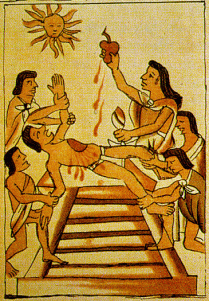
5) Atlanta Teacher RICO Conviction is Blood Sacrifice to the Testocracy

aztecshumansacrifice

Published: April 3
Views: 18,187

Description: There is something terribly wrong when we’re using laws created to stop organized crime as a means to convict  teachers cheating on standardized tests. I’m not saying cheating is right, but the mafia kills people. These were just teachers trying to keep their jobs in a system that rewards results and refuses to balance the scales, listen to research or the opinions of anyone not in the pockets of the testing and privatization industries.

Fun Fact: Watching all those seasons of “The Wire” finally came in handy.


4) Not My Daughter – One Dad’s Journey to Protect His Little Girl From Toxic Testing

FATHERS-AND-DAUGHTERS
Published: March 20
Views: 26,420

Description: How I went to my daughter’s school and demanded she not be subjected to high stakes testing in Kindergarten.

Fun Fact: They were very nice and did everything I asked. If you haven’t already, you should try it!


3) I Am Racist and (If You’re White) You Probably Are, Too

Screen shot 2015-06-02 at 1.42.34 PM

Published: June 2
Views: 28,906

Description: White folks often can’t see white privilege. This is my attempt to slap some sense into all of us. If you benefit from the system, you’re responsible to change it.

Fun Fact: Oh! The hate mail! I still get it almost every day! But I regret nothing! A black friend told me I was brave to write this. I disagreed. Anytime I want I can hide behind my complexion. She can’t.


2) I Am A Public School Teacher. Give Me All the Refugees You’ve Got

syrian_refugee_schools

Published: Nov. 19
Views: 45,196

Description: Our public schools are already places of refuge for our nation’s school children. Send me more. I’ll take them all. I’d rather they end up in my classroom than drowned by the side of a river.

Fun Fact: I got equal love and hate for this one. Some folks were afraid of terrorists. Others didn’t think we could afford it. But many told me my heart was in the right place. Lily and the folks at the NEA were especially supportive.


1) White People Need to Stop Snickering at Black Names

baby-and-parents

Published: Sept. 6
Views: 96,351

Description: Maybe we should stop laughing at black people’s names. Maybe we should try to understand why they are sometimes different.

Fun Fact: You’d have thought I threatened some people’s lives with this one! How dare I suggest people should stop mocking other people’s names! If you want to know how strong white fragility is in our country, read some of the comments! But many people thanked me for bringing up something that had bothered them for years but that they had been too polite to talk about, themselves. This is easily my most popular piece yet.