Beyoncé Upstaged by White Fragility at the Super Bowl

Pepsi Super Bowl 50 Halftime Show
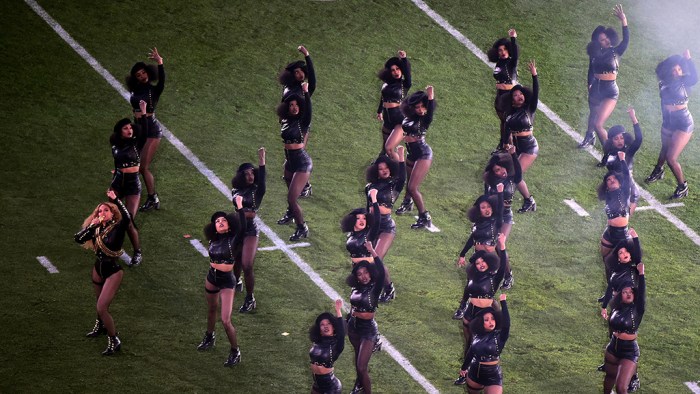
SANTA CLARA, CA – FEBRUARY 07: Beyonce performs during the Pepsi Super Bowl 50 Halftime Show at Levi’s Stadium on February 7, 2016 in Santa Clara, California. (Photo by Harry How/Getty Images)


Black women’s bodies are scary.


That’s the lesson we learned this Super Bowl Sunday.


When Beyoncé and 30 backup dancers performed a brief rendition of her new song, “Formation” during the halftime show, talking heads all over the country exploded.


Oh my God! Are those pro-black lyrics!? Are they making an allusion to the Black Panthers!? Was the music video to this song critical of overzealous police murdering black folks!?


Turn off the TV! This is too political for family entertainment!


When did we become so squeamish in this country? Can’t we all just sit back and enjoy seductive women gyrating in unison anymore?


I guess not. Not if they’re black.


Sleek female bodies in tight leather outfits displaying every curve of their anatomy – if their skin is black and their hair is Afro-ed and their fists are briefly in the air, it’s way too scary for white male libidos.


And that’s really the problem here.


Who was this performance supposed to be for? Fifty years of Super Bowl logic would suggest the target demographic was light skinned, heterosexual and possessing a penis. But these women had something to say – maybe. They had a message beyond “Look at me! I’m hot!”


How am I – as a red-blooded American male – supposed to commodify and objectify these women’s bodies if their brains are trying to convey a message that goes beyond mere consumerism?


That’s what the Super Bowl is, really. Some people say they watch it only for the commercials, but that’s all there is. It’s all a big advertisement for the American way of life.


Sit back, drink beer, eat pizza, watch an essentially meaningless contest and – whatever you do – don’t think about the way things really are. Don’t think about the problems we have and how we might fix them. Stay asleep. Watch the game and stay fast asleep.


And please don’t tell me this has nothing to do with race. If they were white girls with a message about world hunger, the outrage would be demonstrably more muted. If there’d be any outrage at all.


No. This was a direct assault on our tacit consent to be colorblind in all things. As a society we’ve silently agreed to refrain from mentioning anything about race in public.


Why are you even bringing up the fact that those dancers were black, someone is bound to ask.


My answer: because I have eyes.


Denying the pigment of their skin does no one any favors. And talking about it doesn’t denigrate them in any way. In fact, it acknowledges a key component of their being.


But Beyoncé’s performance didn’t let us forget her skin color. She made it important, and our white male society doesn’t want to admit it.

Or at least that’s what the 24-hour news cycle has made of it. Did Queen B really intend her routine to be taken as such a revolutionary display of black power? It’s hard to say.


In the actual performance, there is nothing much that is overtly political. Vaguely martial outfits? Dancing in an X-formation? A raised fist? Maybe.


The only somewhat rebellious moment occurred after they had already left the field. A few dancers held a sign offstage asking for justice for Mario Woods – a black San Francisco man gunned down by police. If you blinked, you missed it.


But the same cannot be said of the recently released music video for the song. It contains many images of black oppression from police brutality to the slow response to Hurricane Katrina. However, if you never saw the video, would you make that connection?


I didn’t. It went right over my head.


To be fair, I’d had a few.


It wasn’t until the next day that I read about the media’s hyperventilating all over it. Viewers had to actively search out the video to find any revolutionary content. Maybe that was Bey’s intent. Maybe not.


Either way, I find it hard to believe that most people’s immediate reaction was the same as that of the pundits.


At first, it was only a vocal minority that made a big deal about it. Then it snowballed into the center of our public discourse. I’m not sure why it’s gained such purchase. Maybe it’s because the halftime show always elicits strong emotions. Maybe it’s because it’s an election year. But without a doubt, a lot of folks’ white fragility is showing.


People of color are often stereotyped as having a thin skin about these issues. If black or brown folks bring it up, they’re criticized as “playing the race card.” But this situation shows how reactionary we, white people, really are.


No one decried Coldplay for starting the show with “Viva la Vida” – a song featuring the lyric, “When I Ruled the World.” People of color aren’t theorizing that the song by the whiter-than-white Chris Martin is really a Caucasian lament about the loss of white power.


“I used to rule the world

Seas would rise when I gave the word

Now in the morning I sleep alone

Sweep the streets I used to own”


Why? Because it would be just as ridiculous! Black folks have more important things to worry about – like the very things that white people are mad at Beyoncé for bringing up!

Most Charter Schools are Public Schools in Name ONLY

charterart

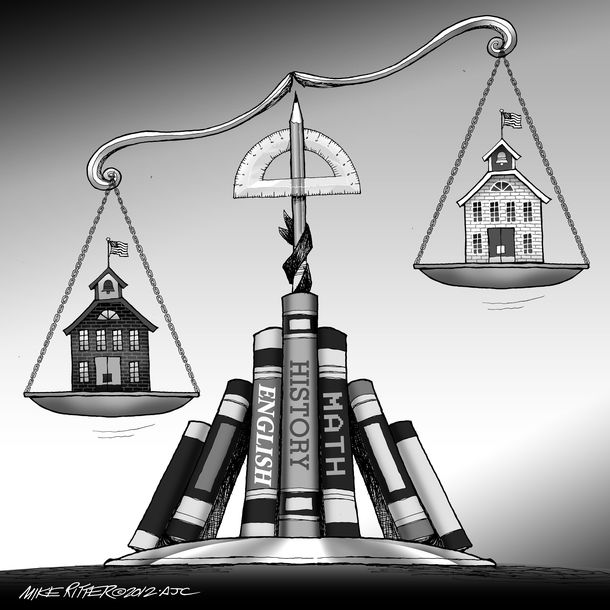
Charter schools are public schools.

But are they?

Really?

They don’t look like a duck. They don’t quack like a duck. Do you really want to serve them confit with a nice orange sauce?

Sure, charters are funded by tax dollars. However, that’s usually where the similarities end.

They don’t teach like public schools, they don’t spend their money like public schools, they don’t treat students or parents like public schools – in fact, that’s the very reason they exist – to be as unlike public schools as possible.

Advocates claim charters exist as laboratory schools. They are free to experiment and find new, better ways of doing things. Once they’ve proven their successes, these improved practices will eventually trickle down to our more traditional houses of learning.

At least, that’s the ideal behind them. But to my knowledge it’s never happened.

As a public school teacher, I can never recall being at a training where charter operators taught us how to do things better with these time-tested strategies. I do, however, recall watching excellent co-workers furloughed because my district had to meet the rising costs of payments to our local charters.

Moreover, if the freedom to experiment is so important, why not give that privilege to all public schools, not just a subset?

The reality is much different than the ideal. In the overwhelming majority of cases, charter schools are vastly inferior to their more traditional brethren. To understand why, we need to see the differences between these two kinds of learning institutions and why in every case the advantage goes to our much-maligned, long suffering traditional public schools:

1) Charters Don’t Accept all Students

Charter schools are choosey. They don’t take just any old students. They only accept the ones they want. And the ones they want are usually easy and less expensive to teach.

The process is called “Creaming” because they only pick the cream of the crop. Then when these students who are already doing well continue to do well at a charter, the administrators take all the credit. It’s as if they were saying – Look how well we teach. All these former A-students continue to get A’s here at our school. It’s really quite an achievement. (Not.)

However, sometimes the bait-and-switch isn’t so obvious. Occasionally, charters actually do accept special needs and/or difficult students – for a few months. Then when the big standardized test is coming up, they quietly give these kids the boot. That way they can claim they accept everyone but still get excellent standardized test scores.

Ironically, that’s what they mean by “School Choice.” It’s usually touted as a way of giving alternatives to parents and students. In reality, the choice only goes to administrators. Not “Which school do YOU want to attend?” but “Which students do WE want to accept to make our charter look good?”

Keep in mind, this situation is allowed by law. Charters are legally permitted to discriminate against whichever students they want.

By contrast, traditional public schools accept all students who live within the district. It doesn’t matter if children have special needs and therefore cost more to educate. If a child lives within district boarders, your neighborhood public school will take him or her in and provide the best experience possible.

Bean counters complain about poor test scores, but traditional public schools aren’t gaming the system. They aren’t weeding out difficult students. They take everyone. Administrators have no choice. This is dictated by law. Public schools are equal opportunity educators.

2) Charters Have No Transparency

Have you ever been to a school board meeting? Ever listened to school directors debate the merits of one course of action versus another? Ever looked over public documents detailing district finances and how money is spent? Ever read over bids vendors provide for services? Ever spoken at a public meeting to school directors about what you think is the best way to proceed in a given situation? Ever had a school director or two disappoint and then worked to vote him or her out of office?

At traditional public schools, you can do all of this – even if you don’t have any children in the school system! At a charter school, you’re out of luck.

Charters rarely have to tell you how they spend their money, rarely debate management decisions in public, rarely invite or even permit you a seat in the audience. Heck! They don’t have to!

Charters survive on public money, but once that money goes in those charter doors, the public never sees it again. If you don’t like how the charter is treating your child, you can remove the little dear from the school. But if a non-parent doesn’t like how they suspect the charter is spending his or her tax money, there is absolutely no recourse. You are taxed without any representation. Wars have been fought over such things. It’s hard to imagine how that can be Constitutional.

In sum, traditional public schools are like most other government organizations. They are required by law to be transparent to the public. Charter schools, however, are money pits and what goes down those gaping holes is lost forever from public view.

3) Charters Advertise

Have you ever seen those huge billboards by the side of the road trying to convince motorists to send their children to a charter chain? Ever hear a radio advertisement about how happy little kiddos are at Brand X Charter School?

Those advertisements cost money. Your money, to be exact. You paid for those commercials. And what’s more, every penny spent on those glossy advertisements is one less that actually goes to educate your child.

By contrast, traditional public schools are not allowed to advertise. All their budget dollars have to be spent on things broadly educational. They have to spend on books, teachers, building upkeep, etc.

Not only are charters allowed to keep quiet about how they spend their money, even if they told you, it doesn’t all have to be spent on the children in their care. What could possibly go wrong with that?

4) Charters Defraud the Public

Despite all their best efforts at secrecy, charter school operators have been caught in countless financial scandals in recent years. According to Integrity in Education$200 million in taxpayer money was lost, misused, or wasted in just 15 of the 42 states that have charter schools.

These aren’t mere allegations. These abuses are well documented. The report states: “Charter operators have used school funds illegally to buy personal luxuries for themselves, support their other businesses, and more.”

Mountains of evidence demonstrate fraud throughout the country: Schoolchildren defrauded in Pennsylvania; “out-of-control” charters in Michigan and Florida; rampant misspending in Ohio; bribes and kickbacks, also in Ohio; revenues directed to a for-profit company in Buffalo, NY; subpoenas for mismanaged charters in Connecticut. Heck! In California alone, $100 million in fraud losses were expected just last year.

And that’s just the fraud we can see!

I’m not saying our traditional public schools are scandal free, but nothing like this level of malfeasance has been revealed. Traditional schools are under much stricter regulations. People are actually watching to make sure nothing like these charter scandals happen at our time-tested neighborhood schools. They are much better value for your money.

5) Charters Often Get Worse Results

It all comes down to teaching and learning. When we compare the results at charters versus traditional public schools, who does better?

Bottom line: the research shows that the overwhelming majority of charter schools are no better – and often much worse than traditional public schools. This is true even of studies backed by the charter school industry, itself!

For example, a recent study by charter-friendly CREDO found that in comparison to traditional public schools “students in Ohio charter schools perform worse in both reading and mathematics.”

In a study of Chicago’s public schools, the University of Minnesota Law School found that “Sadly the charter schools, which on average score lower that the Chicago public schools, have not improved the Chicago school system, but perhaps made it even weaker.”

Another report from Data First – part of the Center for Public Education – says, “the majority of charter schools do no better or worse than traditional public schools.”

However, there is plenty of evidence of charter schools producing dismal academic results for students. For instance, a Brookings report showed low performance in Arizona’s charter schools. A District of Columbia researcher for In the Public Interest group, “could not provide a single instance in which its strategy of transferring a low-performing school to a charter management organization had resulted in academic gains for the students.” The Minnesota Star Tribune reported that “Students in most Minnesota charter schools are failing to hit learning targets and are not achieving adequate academic growth.” Over 85 percent of Ohio’s charter students were in schools graded D or F in 2012–2013. In the celebrated New Orleans charter experiment, the Investigative Fund found that “eight years after Hurricane Katrina…seventy-nine percent of RSD charters are still rated D or F by the Louisiana Department of Education.”

That’s not exactly a record of success!

Meanwhile, our traditional public schools often do a much better job.

The National Assessment of Educational Progress (NAEP) reports that U.S. math and reading skills have improved for all levels of public school students since the 1970s, with the greatest gains among minority and disadvantaged students. Other results indicate that our schools achieve even greater success when properly funded.

The facts seem pretty clear. Charter schools are not like traditional public schools at all.

Most charter schools are a losing prospect for our children and our Democracy. Yet well-funded corporate lobbying interests continue to push charters as a public policy solution while instigating the closure of an increasing number of traditional public schools.

This is like closing hospitals and opening clinics on the power of crystals, snake oil and phrenology.

We need a national moratorium on new charter schools. We need to investigate every existent charter to determine if each are providing a quality service to students and not just the charter’s corporate share holders.

We know what works, and it isn’t charter schools. Support your friendly, neighborhood, traditional public school.

Why Aren’t Public Schools Too Big To Fail?

CafptbBUEAAEKKW.jpg_large

There’s a new fad sweeping the nation.

It’s called “Educational Accountability.” Here’s how it works.

If your neighborhood school can’t afford to pay its bills, just close it.

That’s right. Don’t help. Don’t look for ways to save money. Don’t look for new revenue. Just lock the doors.

It’s fun! And everyone in the federal and state government is doing it!
It’s the saggy pants of United States education policy. It’s the virtual pet of pedagogical economics. It’s the cinnamon challenge of learning-centered legislating.

Sorry, poor urban folks. We’re closing your kids’ school. What? Your little tots are entitled to an education!? Fine! Take them to some fly-by-night charter or else they can get stuffed into a larger class at a traditional school miles away. It’s really none of my business.

Meanwhile, as government functionaries pat themselves on the back and give high fives all around, academic outcomes for these children are plummeting.

Moving to another school rarely helps kids learn. They lose all their support systems, social networks, community identity, and self esteem while spreading resources even thinner at their new location often putting it on the chopping block for the next round of closings. Or worse they’re subject to the unregulated whims of a for-profit company devoted to cutting student services in the name of increasing shareholders profits until some charter CEO shutters the building, himself, and sneaks away like a thief in the night.

But what else can we do? If a school can’t pay its bills, it’s got to go. Right?

Wrong.

Is it really so surprising that poor schools can’t pay their bills? We force them to make ends meet by relying heavily on taxes from local residents – most of whom are dead broke!

How is someone who can’t feed himself going to support a robust school system? How is someone working three minimum wage jobs going to have enough left over at the end of the week to fund a broad liberal arts education? How is someone with the wrong skin color who can’t get a home loan or a well-paying job going to provide the capitol necessary for a 21st century learning experience?

But whatever. Close the poor schools and blame it on the poor.

Tee-Hee!

Chicago, Detroit, Philadelphia, Puerto Rico – You have to admit, there’s a kind of glee about the whole prospect. It’s one of the few things that both Democrats and Republicans agree on.

In fact, they love it so much they’ve found all kinds of excuses for shuttering schools that aren’t even so obviously based on their budgets.

Look at how we evaluate schools effectiveness.

Does your school serve a mostly poor, undernourished, minority population who start kindergarten already years behind grade level? Those kids need help. They need extra assistance, tutoring, counseling, health screenings, and a whole host of wraparound services. But instead of providing any of that, we demand one factor – the school – provide everything without providing them any resources.

That’s like judging a soup kitchen by weighing its customers before you give them any soup!

My God, Man! This poor fellow is malnourished!

Yes, he came in that way.

What are you putting in that soup!?

It doesn’t matter. He hasn’t had any yet. Besides. He needs more than just soup.

Enough of your excuses! I’m closing you down!

Moreover, we use the worst possible measurements of student achievement – standardized test scores – to tell if our schools are doing a good job. Never mind that these sorts of assessments repeatedly have been shown to demonstrate parental income more than academic achievement. And surprise! Surprise! They show our poor kids have poor scores!

And just in case a few kids somehow manage to overcome the odds, we sabotage the learning they might otherwise get from their schools with top down policies like Common Core State Standards.

How does this cripple educational outcomes? By hobbling the one group most in a position to actually make a difference – teachers.

Instructional autonomy? Bye! Bye! After all, who wants to hear from the people on the ground who can empirically judge the situation, determine what needs to be done and how best to do it? Instead, we give the power to think tanks and the testing industry to decide what is taught, when and how.

Common Core has never been proven to help kids learn. In fact, most teachers despise it, saying the standards are developmentally inappropriate, ill-conceived and unwieldy. Even under the best of circumstances, why would you take someone who barely has the resources to get by and then make things MORE difficult? That’s like taking an 80-pound starving child and forcing him to lift a 200 pound barbell over his head in order to qualify for his dinner.

Put your back into it, youngster!

I’m trying, Sir, but I’m so hungry.

Just use your grit!

Grits! Yes, please. I’m famished.

So what do we do? We close their schools! That’ll show ‘em!

And somehow we call this accountability.

Would you solve a measles outbreak by closing the hospital? Would you solve a burning building by closing the fire department? Would you solve an asteroid hurtling toward Earth by closing NASA!?

NO! OF COURSE YOU WOULDN’T!

In fact, when the wealthy are at a disadvantage, we do just the opposite.
Take the banking industry.

When Wall Street crashed the economy with risky speculation and absurdly short-sighted practices, did we close the banks?

No way! We bailed them out.

Why? They were too big to fail.

If we had let them spiral into insolvency – which everyone agrees they deserved to do – it would have had too large an impact on the country. Middle class folks would have lost their savings. Retirees would have lost their pensions. Businesses throughout the nation would have closed. The economy would have come to a grinding halt.

So the federal government saved the banks.

Now clearly there should have been strings attached to this bail out. Those responsible for the crash should have been prosecuted and forced out. At very least, the banks should have had to make concessions such as more regulation and stopping the risky practices that crashed the economy in the first place. (SPOILER ALERT: That didn’t happen.)

However, the idea was sound.

But why does it only apply to the big banks? Aren’t there other areas of public life that are too big to fail? And isn’t public education one of them – perhaps the biggest one?

Heck! Unlike the banks, our schools did nothing to deserve these wholesale closures. In fact, they’ve done an amazing job with the few crumbs we force them to subsist on.

Moreover, the result of letting them shut down would be just as catastrophic for our nation as a banking collapse. Maybe more so.

If our schools fail, we won’t have educated citizens. Future generations won’t be qualified for any but the most menial of jobs. They won’t be able to navigate the media, commerce, politics, science or any domain of civic responsibility.

Without our schools, we’ll calcify the economic structure. The rich will stay rich, the poor will stay poor and there will be next to no social mobility. Our country will exist as a neo-feudal state and most of us will be relegated to little more than serfs.

Is it too cynical to suggest that this is exactly why we haven’t bailed out our schools? The overwhelming majority of our nation’s wealth is held by only 1% of the population. Disinvesting in public education is exactly the kind of thing that would ensure the status quo is maintained or perhaps even tilted further in the favor of the super rich.

Any sane society, wouldn’t let this happen. If we don’t want this nightmare scenario, it’s time to bail out our schools.

Seriously. The federal government should step in.

Provide a huge influx of cash to the poorest schools so every institution of learning can count on adequate, equitable, sustainable funding. Stop judging them based on high stakes test scores. Stop sabotaging them with social schemes like Common Core. Let the experts – the teachers – actually run their own buildings.

This is what almost every other major country in the world does. Funding is federal. Policy is local. Get with the times, America!

And you can pay for it by enacting a fair tax plan. Worldwide, American companies keep 60 percent of their cash overseas and untaxed. That’s about $1.7 trillion annually. Imagine what that kind of revenue could do for our public schools!

Imagine if we taxed risky Wall Street speculation. Imagine if we made the super rich pay their fair share with tax rates similar to those we had when our national economy was at its best – the 1950s and ‘60s.

You want to make America great again? This would do it? You champion personal responsibility? This is what responsible government would do.

After all, what’s the purpose of government if not to create a level playing field for the next generation?

Call it a bail out, if you want. Or more accurately call it being answerable to the future, taking charge, rising to meet our duties, true accountability.

Stop closing public schools. Save them.


NOTE: This article also was published in the LA Progressive.


The Theft of a Great American School: José Meléndez Ayala Elementary

Screen shot 2016-02-03 at 10.48.49 PM

They came in the early morning like thieves in the night.

The predawn chill was still in the air.

But employees of Puerto Rico’s Department of Education (DOE) were already at work closing a beloved public school.

They sneaked into José Meléndez Ayala Elementary Tuesday around 4 a.m. taking out desks, chalkboards and any equipment that could be repurposed. Then they loaded it all into trucks and zoomed off.

By the time the sun had risen, it was all over.

In the morning light, parents and children staggered to their neighborhood school in the Manatí region of the U.S. territory to find it an empty shell.

12650330_10153558452598152_2002114875_n

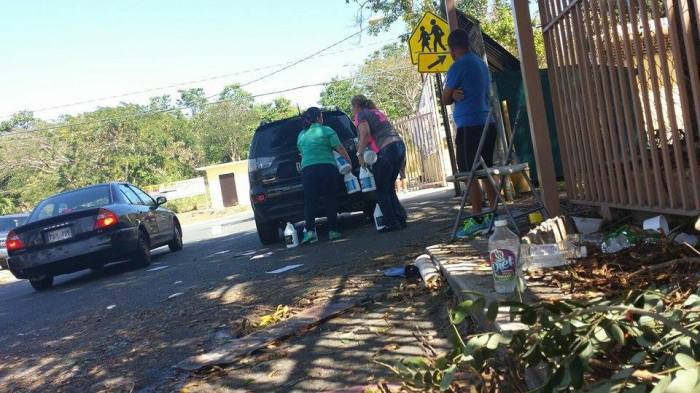
For 9 months they had been camping out in front of the building during the day to stop anyone from doing what had just been done.

“Tears were shed by parents and children. We will never forget,” says Mercedes Martinez, president of the Federación de Maestros de Puerto Rico (FMPR) – the teachers union.

Even though the school was one of 150 closed in the past 5 years, roughly 35 community members refused to let government employees step foot inside.

For about 180 days, they had kept the DOE away with placards and slogans like “This is my school and I want to defend it,” and “There is no triumph without struggle, there is no struggle without sacrifice!”

Officials hadn’t even been able to shut off the water or electricity. Until now.

The community had hoped to convince the government to reopen the school.

Screen shot 2016-02-03 at 10.47.09 PM

Parents went to Governor Alejandro García-Padilla’s mansion and spoke with his assessors, members of the legislature, the Secretary of Education Rafael Román, regional officers from the DOE, candidates for both major parties, and members of the municipal assembly.

“All stated their support except the DOE,” Martinez says. “But nothing was done.”

The municipal assembly even passed a resolution requesting the school to be reopened. It never happened.

The Commonwealth Senate sent its education committee to visit the school and inspect it. They made a recommendation to reopen it.

It never happened.

“The Secretary of Education didn’t answer,” Martinez says. “He’s behind all this.”

Manatí’s Mayor Juan Aubín Cruz Manzano may have wanted the building to use for anther purpose.

“The Secretary of Education confabulated to give it to him, as he handed him two other schools he shut down in Manatí for the mayor to use the buildings as he pleases,” Martinez says.

Perhaps most hurtful, says Martinez, is that employees of the DOE weren’t alone in looting the school.

After the DOE left, teachers from other schools came to take whatever free materials were left behind, she says. They were directed to do so by principals who had never supported the occupation.

“It was shameful,” Martinez says. “Now this building will become part of the obsolete infrastructure. Parents are demoralized.”

12650443_10153558452208152_1061368990_n

Community members whose children went to the school now have to pay to transport their kids to new schools miles away. With drastic budget cuts, these remaining schools often have class sizes of 35 students or more. Amenities like arts, music, health and physical education have typically been slashed.

The island territory’s financial woes stem from a flock of steady circling vulture capitalists encouraging damaging rewrites to the tax code while buying and selling Puerto Rican debt.

Hundreds of American private equity moguls and entrepreneurs are using the Commonwealth as a tax haven.

Since 2012, U.S. citizens who live on the island for at least 183 days a year pay minimal or no taxes, and unlike those living in Singapore or Bermuda, they get to keep their U.S. passports. After all, they’re still living in the territorial U.S. These individuals pay no local or federal capital gains taxes and no local taxes on dividend interest for 20 years. Even someone working for a mainland company who resides on the island is exempt from paying U.S. federal taxes on his salary.

12695755_10153558451663152_49828998_n

Big corporations are taking advantage of the situation, too.

Worldwide, American companies keep 60 percent of their cash overseas and untaxed. That’s about $1.7 trillion annually.

Microsoft, for instance, routes its domestic operations through Puerto Rican holdings to reduce taxes on its profits to 1.02 percent – a huge savings from the U.S. corporate tax rate of 35 percent! Over three years, Microsoft saved $4.5 billion in taxes on goods sold in the U.S. alone. That’s a savings of $4 million a day!

Meanwhile, these corporate tax savings equal much less revenue for government entities – both inside and outside of Puerto Rico – to use for public goods such as schooling.

12666292_10153558451738152_1967990747_n

Public schools get their funding from tax revenues. Less tax money means less money to pay for children’s educations. As the Puerto Rican government borrowed in an attempt to shore up budget deficits, the economy tanked.

But have no fear! In swooped Hedge Funds to buy up that debt and sell it for a profit.

When this still wasn’t enough to prop up a system suffering from years of neglect, the Hedge Fund managers demanded more school closures, firing more teachers, etc.

Wall Street greed has devoured another public school. But the battle for public education goes on.

Tania Ginés, the community leader who organized the occupation for so long says she is not defeated.

“I have decided to become the voice of those with no voice and will continue organizing parents throughout the island against any more School closings.”

“These are our schools, our children’s schools. The government of the slogan ‘Put Children First’ just demonstrated one more time that it’s just that – an attractive slogan they’re not willing to live by.”

The Teachers Federation supported the parents 100% and wants to recognize this humble community for its big heart, says Martinez.

“We want to show the world what a true revolutionary is. Che Guevara once said that the “true revolutionary is guided by a deep love feeling.’ These parents showed him to be true.”

12650276_10153558451898152_1947957478_n

12659828_10153558451693152_1837034232_n


MORE ON PUERTO RICO:

 –‘Pay Our Special Education Teachers Before Vulture Capitalists’ Demand Puerto Rican Protesters


Hundreds Gather in Puerto Rico on Martin Luther King Day Demanding Arts Education


Puerto Rico Teachers Plan One-Day Strike to Protest Corporate Education Reform


In Puerto Rico, Students Go On Strike to Stop Teacher Relocations


Parents and Children Occupy Puerto Rican School Refusing to Let Corporate Vultures Raid Its Contents

‘Pay Our Special Education Teachers Before Vulture Capitalists’ Demand Puerto Rican Protesters

GetFileAttachment-4

Every student with special needs in the United States is guaranteed a Free and Appropriate Public Education under national law.


So why has the U.S. territory of Puerto Rico stopped paying its special education teachers?


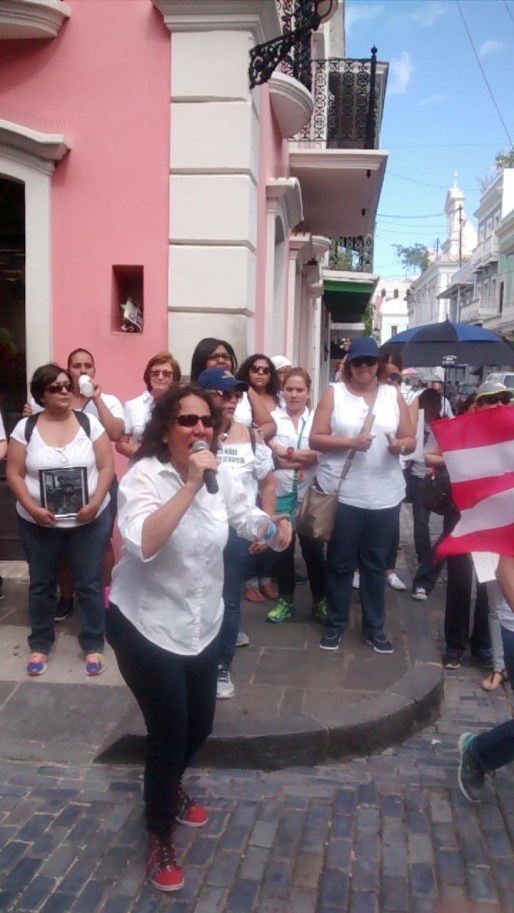
More than 100 parents, therapists, psychologist, occupational therapists, students and teachers marched on Monday to the capital in San Juan to find out.


The rally began in front of the legislature at 9 before protesters marched to the governor’s mansion at 10:30 am. Demonstrators then met with representatives of Governor Alejandro García-Padilla.

GetFileAttachment-3

The answer may be a crippling $72 billion debt. Puerto Rico is besieged by vulture capitalists encouraging damaging rewrites to the tax code while buying and selling the territory’s debt.


The Commonwealth government has been prioritizing payments to American private equity moguls instead of services for communities such as public schools.


“Our Children Before Vulture Capitalists,” proclaims one protestor’s sign.

GetFileAttachment-6

Jinnette Morales agrees with the sentiment. Morales organized the protest.


“No credit line would back up this lack of payment,” says the mother of a child with Down Syndrome.


“These therapists have been working for months without pay and if Secretary of Education Rafael Román says that he has paid them, I want to hear him say that when we take him to court.”


GetFileAttachment-5

Though the Commonwealth Department of Education hasn’t paid these professionals in up to six months, students still have been receiving services. Special education employees have been working without pay. However, that can’t continue indefinitely.


The therapists, psychologists and teachers have had enough. They simply can’t continue without an income.


So starting this week, roughly 1,200 students are without services they are guaranteed by law.

IMG_4819

“We are talking about children’s humans rights to receive an appropriate and quality education,” says Mercedes Martinez, president of the Federación de Maestros de Puerto Rico (FMPR) – the teachers union.


“Children need these therapies to progress in their development. Therefore, we stand with the workers, parents, and students and demand action from the governor of our country.”


Protesters are demanding special education employees be paid immediately so child services can continue with as little interruption as possible.


After arriving at the governor’s mansion, activists met with the governor’s attorneys.


They were told the government will eventually pay the special education teachers, says Martinez. In the meantime, officials suggested improving billing for services. Instead of having all invoices be digitized and go through corporate channels, special education teachers can provide manual bills. This will shorten the amount of time between billing and payment.


Protesters are scheduled to meet again with government officials on Thursday to pin down an exact date when payments will begin.


Until then, many demonstrators are camping out in front of the governor’s mansion vowing not to leave until the government makes good on its fiscal responsibilities to teachers and students.

GetFileAttachment

“The government needs to pay the debt with these professionals before our country’s debt,” says Martinez.


“Our children should come first.”


This monetary crisis is imported from the mainland. Legislation is being manipulated by corporate interests profiting off the chaos. Moreover, hundreds of American bankers and entrepreneurs are using the Commonwealth as a tax haven.


As a result, tax revenues are drying up while the super rich rake in profits.


Officials warn the government may be out of money to pay its bills sometime this year. Over the next five years, it may have to close nearly 600 more schools – almost half of the remaining facilities!


Of the 135 schools closed in just the last two years, Román had originally proposed shuttering 200. The remaining 65 were only kept alive because communities occupied the buildings and refused to let the government step in.


Despite Wall Street manipulation, Puerto Rican communities aren’t letting their government sell their children short. The fight goes on.


MORE ON PUERTO RICO:

Hundreds Gather in Puerto Rico on Martin Luther King Day Demanding Arts Education


Puerto Rico Teachers Plan One-Day Strike to Protest Corporate Education Reform


In Puerto Rico, Students Go On Strike to Stop Teacher Relocations


Parents and Children Occupy Puerto Rican School Refusing to Let Corporate Vultures Raid Its Contents

The Credibility Gap Between Bernie Sanders and Hillary Clinton

bernie-sanders-y-hillary-clinton

I Believe Bernie Sanders. I Don’t Believe Hillary Clinton.

Really. It’s that simple.

These two candidates vying for the Democratic nomination for the Presidency both have things going for them. But at the end of the day one of them is much more credible than the other.

They’re both career politicians.

Sanders has been a Vermont Senator for nine years, a U.S. Representative for 16 years, and Mayor of Burlington for eight years.

Clinton was Secretary of State for four years, a New York Senator for eight years, and – most famously – First Lady of the United States for eight years and of Arkansas for 11 years.

But when they speak, only Sanders seems genuine.

I know that’s a personal value judgement. Maybe it doesn’t hit you the same way.

I just don’t know how it could hit you differently.

For instance, both candidates say they’re going to keep the banking industry in check and stop the risky practices that crashed the economy under President George W. Bush. However, that same industry is Clinton’s main financial supporter while Sanders has almost nothing to do with them.

Look at the facts.

Clinton admittedly accepts a massive amount of donations from Wall Street – $824,000 from Citigroup, $760,000 from Goldman Sachs, $696,000 from JP Morgan Chase, $636,000 from Morgan Stanley and the list goes on and on. More than 760 of Clinton’s over all donors list their occupation as CEO or another form of chief executive, according to CNBC.

Meanwhile, Sanders has accepted almost nothing from Wall Street, doesn’t have a super PAC and still raises nearly as much money in donations as Clinton. Small individual contributions make up 70% of his campaign cash. His biggest contributors are from retirees, unions and progressive political organizations – $105,000 from Machinists/Aerospace Workers Union, $93,000 from the Teamsters union, $89,000 from the National Education Association.

So when Sanders says he’s going to break up the big banks and regulate Wall Street, I believe him. Apparently, they do, too, since they aren’t giving him any money.

But when Clinton says she’s going to hold Wall Street accountable, too, it’s just laughable. Why else would they be giving her all this money? Are they paying her to get tough on THEMSELVES!? As Sanders supporter Dr. Cornell West puts it, “I was born at night but not last night.”

The same thing goes for healthcare.

Both candidates say they want to reform the system to make it more affordable and fair. However, Sanders supports a single payer Medicare for all system, while Clinton supports tweaking the existing Obamacare system.

Two decades ago, Clinton agreed with Sanders. Now she receives $13.2 million in donations from the medical and insurance industry – $11.2 million when she was a Senator and $2 million since she began her presidential campaign. From 2013-2015 she received more than $2.8 million in speaking fees alone from the industry.
It’s funny how all that cash coincided with a change in her healthcare policy. She just said recently that single payer will “never, ever” happen.

By contrast, Sanders doesn’t receive sizable donations from the industry at all. Though he voted for Obamacare, he made it clear he thought it was a first step toward the better system he still supports.

So I suppose both are credible in this regard, but Sanders seems to be holding his position more because of conviction than monetary gain. Moreover, how much tweaking of the current system would Clinton really support while still in the pay of the healthcare industry?

However, it’s not all about campaign contributions.

Sanders positions have been fairly rock solid throughout his long career. Clinton’s have changed.

Look at mass incarceration – a huge problem in the United States. We have more than 2 million people incarcerated, many for low level infractions, boosting a for-profit prison industry. By contrast, China – with four times our population – only locks up 1.6 million of its citizens. The US has only 4 percent of the world population but locks away nearly a quarter of the world prison population. Thirty Seven states have higher incarceration rates than most nations, large or small.

When she was First Lady, Clinton supported her husband’s tough on crime legislation. “We need more prisons,” she said in 1994, “to keep violent offenders for as long as it takes to keep them off the streets.” Now that the devastating results of that policy have become clear, Clinton has changed her tune. “We must end the era of mass incarceration,” she said in October of 2015.

That’s quite a switch, and its fairly new. The last time she ran for president, she criticized her rival Barack Obama for being soft on crime and not committing to opening more prisons. Now on the campaign trail she tries to convince us she hates mass incarceration MORE than Obama. In 8 years, she went from a prison booster and belittling Obama for not loving prisons to a prison skeptic.

Did she just evolve on this issue? Has she finally come around to seeing things the right way? Or is she pandering to what she thinks voters want to hear?

Sanders, on the other hand, has been against mass incarceration for most of his career. He’s been speaking about the dangers of ballooning prison populations for more than a decade. As far back as 1994, he said, “Mr. Speaker, all the jails in the world, and we already imprison more people per capita than any other country, and all the executions in the world, will not make that situation right. We can create meaningful jobs, rebuilding our society, or we can build more jails.” Compare that with his statement from July of 2015: “The result of kids not being in school and kids not having jobs is that tragically, today, we in this country have more people in jail than any other country on Earth.”

This issue has become a popular rallying cry recently receiving support from people across the political spectrum. But Sanders was championing it when no one else was paying attention. Clinton has suddenly seen the light.

But it’s not even just past policy decisions.

Clinton is guarded and only seems to make statements that will get her political points. Sanders says things that are sure to loose him votes but that he apparently believes.

For instance, he recently came out in favor of the federal government being largely responsible for public school funding. As a nation, we have drastic monetary and resource inequalities in our nations schools, but no one else is talking about ways to fix it. The trend has been to cut funding. Yet Sanders is willing to put forward a common sense solution the rest of the world has proven works. It’s not bound to get him many votes, though, even from some education advocates afraid of recent federal overreaches in school policy.

Another example is religion. No presidential candidate in recent memory – perhaps ever – has openly admitted to being irreligious. Both Democrats and Republicans usually fall all over themselves to prove how pious they are in their everyday lives. Clinton, for instance, responded during this election cycle that her favorite book is the Bible. Conversely, Sanders admitted he is not a part of any organized religion, though he considers himself Jewish.

That might not get him many votes. But it is refreshingly honest. There is no reason to say something like that unless it were true.

Moreover, Sanders seems like more of genuine person than Clinton. In 1987 when he was Mayor of Burlington, Sanders recorded a folk album. Yes, folk music! It’s called “We Shall Overcome.” The late night shows have been playing it and getting laughs at his expense, but when they bring it up to Sanders, he just laughs and admits that he wasn’t much of a singer.

Can you imagine anything like that from Clinton? Sure, Bill played the saxophone, but Hillary? There is nothing so personal that has leaked to the public. Moreover, the folk song lyrics that Sanders sings are in-line with his political ideology.

Heck! The very fact that Hillary is famous for getting a $600 haircut while Sanders often lets his grey locks fly whichever way they want! It seems like Clinton is trying too hard to convince us, while Sanders is kind of like – here I am, this is me, what you see is what you get.

Ultimately questions of credibility are very personal. People will feel differently. However, looking at the facts, I find it impossible to believe Clinton’s rhetoric and impossible not to believe a good deal of Sanders’. We’ll see how voters feel as the primary elections begin today.

Unions Can’t Just Be About What We’re Allowed to Do: Social Justice Unionism

7983807401_6b0075f742_b.sm_a

If labor unions were an animal, they’d be an old hound dog napping on the porch.

They’re slow to get up and chase away burglars but they do like to howl at night.

Most of the time you don’t even know they’re around until the dinner bell rings. Then that ancient mutt is first to bolt into the kitchen to find a place at the table.

It’s kind of sad really. That faithful old dog used to be really something in his youth.

He was fierce! He’d bark at trespassers even tearing them apart if they threatened his patch of land.

Old Uncle Sam used to yell at him and even threaten the pooch with a rolled up newspaper, but that dog didn’t care. He had a sense of right and wrong, and he didn’t mind getting into deep trouble fighting for what he thought was fair.

Today, however, the only thing that really riles him is if you threaten to take away his ratty old bone.

Let’s face it. Unions have become kind of tame. They’re housebroken and not much of a threat to those people waiting in the shadows to rob us blind.

Some people say we’d be better off without them. But I don’t agree. Even a decrepit canine can act as a deterrent, and thieves sure are frightened of dogs.

Think about all unions have given us: the weekend, child labor laws, vacation time, pensions, lunch breaks, healthcare, the 8-hour day, maternity leave, safety measures, due process, sick leave and free speech protections on the job!

They didn’t get us all that by sitting politely at the table with their hands crossed. They didn’t do all that by contributing modest sums to political campaigns. They didn’t do it by obsessively protecting collective bargaining at the expense of all else.

Unions used to take to the streets. They took over the job site. They marched with signs and placards. They exercised people power.

And the government was scared of them. The President called out the army to get them back to work. Lawmakers hired mercenaries to break strikes with clubs and guns. But eventually Congress passed laws to placate them.

Unfortunately, That was a long time ago.

For decades the pendulum has been swinging against us. Federal and state laws have become increasingly restrictive. They want to tell us when we can strike and how long. They want to tell us when and if we can collect dues. And – frankly – they want to tell us to just disperse and do whatever the bosses want – because the business class has already bought and paid for our politicians.

For decades we’ve heard to their propaganda on TV, the radio and the print media. Well-paid shills have poured their poison in our ears about the evils of the labor movement. They’ve spoken these lies so often lots of people believe them.

Workers used to fight to make sure everyone got a fair deal. Now the working man has been brainwashed to focus instead on making sure no one else gets more than him. And the bosses are laughing all the way to the bank.

Union membership is at the lowest it’s been in a century. So are wages adjusted for inflation. A family of four used to be able to get by comfortably on one salary. Now it can barely make ends meet with two.

Yes. There’s no doubt about it. We need unions today more than ever.

But for unions to survive, they must change. They have to become a reflection of the membership and not just of the leaders.

During this presidential election cycle, we’ve seen our largest national unions – the National Education Association (NEA) and American Federation of Teachers (AFT) endorsing a candidate without bothering to actively poll their members. We’ve seen them speak for us on policy decisions without asking our opinions. We’ve seen them act just like the corrupt politicians who we should be fighting against.

Yes, it is time for a change. No longer can our unions be run from the top down. They must be run from the bottom up. They shouldn’t tell us what to do. We, the membership, should be giving orders to them.

Moreover, we need to stop obsessing about collective bargaining. I’m not saying that’s unimportant. But it can’t be the only thing we do.

Our unions used to be in the midst of larger social movements. We were part of the Civil Rights movement. We were part of the push for desegragation. We were part of the fight to protect children and provide them a decent education.

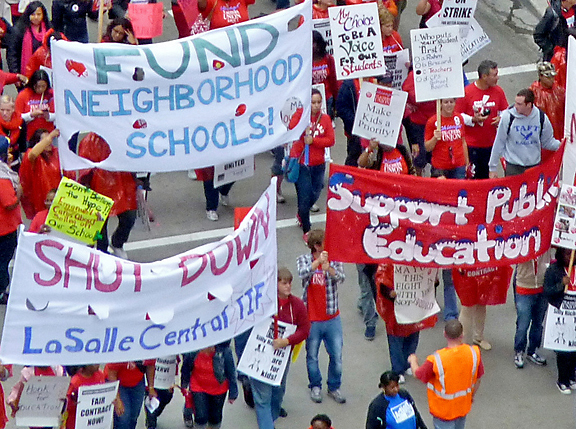
We need to continue that today. And in some places we are already doing that! Look to Chicago, Detroit and Philadelphia. Teachers unions in those urban areas are fighting not just for better pay and benefits but for the communities they serve. Detroit teachers en mass are calling off sick to protest horrible conditions in the schools. Chicago teachers are marching in the streets with the community to demand indictments for police murdering their black and brown students. Philadelphia teachers are supporting students who walk out of class to protest state disinvestment and toxic testing.

THIS is what unions should be doing. We should be fighting for social justice. We should be a central part of the struggle to turn the tide against corporatization, privatization and standardization of our country’s public goods. We should be marching hand-in-hand with BlackLivesMatter activists. We should be in the front lines of the fight to save our environment and replace fossil fuels with renewable energy.

We must be part of the community and not apart from it. We must share in the struggles and goals of those we serve. We must be an example of the old truism that a rising tide raises all ships. After all, the word “union” literally means together. By definition we must all be in this together or else we’re not even really a union.

And to do this we have to stop being so concerned with what they tell us we can do.

We live in a democratic society. The government gets its power from us, from our consent. That means that if there are enough of us, we trump their corrupt laws. They only get to make those laws because we say so. And court decisions – even Supreme Court decisions – mean nothing next to the court of public opinion.

The bosses buy the politicians and tell them to legislate us into a box. It’s time to break out of that box. We can’t be afraid to take our power back. We shouldn’t be afraid of our government. Our government should be afraid of us.

How do we do it? Organize.

If you belong to a union, roll up your sleeves and get active. Run for office. Convince like-minded folks to join you. Take over your local. Spread to your national.

If you don’t belong to a union, start one at your job. Talk to your co-workers. Talk about the benefits for each of you and your neighborhoods. Fight for your rights.

I know. It’s a whole lot easier to complain. Real change, though, takes real work.

We used to know these things. Somewhere along the line we forgot.

So wake up, you yeller cur dog, and get off the porch. Take to the streets.

Because the surest way to take back our country is to take back our unions.

Top 10 Reasons School Choice is No Choice

LittleKidThumbsDown

On the surface of it, school choice sounds like a great idea.

Parents will get to shop for schools and pick the one that best suits their children.

Oh! Look, Honey! This one has an exceptional music program! That one excels in math and science! The drama program at this one is first in the state!

But that’s not at all what school choice actually is.

In reality, it’s just a scam to make private schools cheaper for rich people, further erode the public school system and allow for-profit corporations to gobble up education dollars meant to help children succeed.

Here’s why:

1) Voucher programs almost never provide students with full tuition.

Voucher programs are all the rage especially among conservatives. Legislation has been proposed throughout the country taking a portion of tax dollars that would normally go to a public school and allowing parents to put it toward tuition at a private or parochial school. However, the cost of going to these schools is much higher than going to public schools. So even with your tax dollars in hand, you don’t have the money to go to these schools. For the majority of impoverished students attending public schools, vouchers don’t help. Parents still have to find more money somewhere to make this happen. Poor folks just can’t afford it. But rich folks can so let’s reduce their bill!? They thank you for letting them buy another Ferrari with money that should have gone to give poor and middle class kids get an education.

2) Charter and voucher schools don’t have to accept everyone

When you choose to go to one of these schools, they don’t have to choose to accept you. In fact, the choice is really all up to them. Does your child make good grades? Is he or she well-behaved, in the special education program, learning disabled, etc.? If they don’t like your answers, they won’t accept you. They have all the power. It has nothing to do with providing a good education for your child. It’s all about whether your child will make them look good. By contrast, public schools take everyone and often achieve amazing results with the resources they have.

3) Charter Schools are notorious for kicking out hard to teach students

Charter schools like to tout how well they help kids learn. But they also like to brag that they accept diverse students. So they end up accepting lots of children with special needs at the beginning of the year and then giving them the boot before standardized test season. That way, these students’ low scores won’t count against the charter school’s record. They can keep bragging about their high test scores without actually having to expend all the time and energy of actually teaching difficult students. Only public schools take everyone and give everyone their all.

4) Voucher and charter schools actually give parents less choice than traditional public schools

Public schools are governed by different rules than charter and voucher schools. Most public schools are run by a school board made up of duly-elected members from the community. The school board is accountable to that community. Residents have the right to be present at votes and debates, have a right to access public documents about how tax money is being spent, etc. None of this is true at most charter or voucher schools. They are run by executive boards or committees that are not accountable to parents. If you don’t like what your public school is doing, you can organize, vote for new leadership or even take a leadership role, yourself. If you don’t like what your charter or voucher school is doing, your only choice is to withdraw your child. See ya.

5) Charter Schools do no better and often much worse than traditional public schools

Pundits and profiteers love to spout euphoric about how well charter schools teach kids. But there is zero evidence behind it. That is nothing but a marketing ploy. It’s like when you’re in a bad neighborhood and walk past a dive that claims to have the best cup of coffee in the city. Yuck. Surely, some charter schools do exceptionally well. However, most charters and almost all cyber charters do worse than their public school counterparts. Fact.

6) Charters and voucher schools increase segregation

Since the 1950s and ’60s, we used to understand there was no such thing as separate but equal education. Before then we had Cadillac schools for white kids and broken down schools for black kids. The Supreme Court ruled that unconstitutional. But today we have Cadillac schools for rich and middle class kids (most of whom are white) and broken down schools for the poor (most of whom are black or brown.) After making tremendous strides to integrate schools and provide an excellent education for everyone, our public schools have been resegregated. Charter and voucher schools only make this problem worse. They either aid in white flight or leach away minority students. This just makes it easier to give some kids a leg up while keeping others down.

7) Charter and voucher schools take away funding at traditional public schools

It costs almost the same amount of money to run a school building of a given size regardless of the number of kids in it. When students leave the public schools for charter or voucher schools, the public school loses valuable resources. It now has less revenue but the same overhead. So even if you found an excellent charter or voucher school to send your child, you would be hurting the chances of every other student in the public school of having their own excellent education. This is what happens when you make schools compete for resources. Someone ends up losing out on an education.

8) Properly funding parallel school systems would be incredibly wasteful and expensive

We could fix this problem by providing adequate funding for all levels of the school system – traditional public schools, charters, voucher schools, etc. However, this would be exorbitantly expensive. We don’t adequately fund our schools now. Adding additional layers like this would mean increasing national spending exponentially – maybe by three or four times the current level. And much of that money would go to waste. Why have three fully stocked school buildings in one community when one fully stocked building would do the job? I don’t imagine residents would relish the tax hike this would require.

9) School choice takes away attention from the real problems in our public schools – poverty and funding equity

We have real problems. More than half of public school students live below the poverty line. They are already several grade levels behind their non-impoverished peers before they even enter kindergarten. They need help – tutoring, counseling, wraparound services, nutrition, etc. The predicament is even more complicated by the way we fund our schools. Throughout the country, poor districts get less money than wealthy or middle class ones. The students who go to these schools are systematically being cheated out of resources and opportunities. And instead of helping them, we’re playing a shell game with charter and voucher schools. The problem isn’t that parents don’t have several excellent choices. If they’re poor, they often don’t have one.

10) School choice is not supported by a grass roots movement. It is supported by billionaires.

The proponents of school choice will tell you that they are only doing the will of the people. This is what parents want, they say. Baloney. While there are individuals who support school choice, the overwhelming majority of money behind this movement comes from conservative billionaires actively trying to dismantle the public education system. They want to steal the public system and replace it with a private one. They don’t care about your child. They just want to steal the hundreds of billions of tax dollars we pay to educate our children. This is not philanthropy. It is a business transaction meant to screw you and your child out of your rights.

If we really want to ensure every child in this country gets an excellent education, the answer isn’t school choice. Instead, we need to commit to supporting our public school system. We all need to be in this together. Yes, our schools should look at the needs of each child and tailor education to fit appropriately. But that shouldn’t be done in parallel school systems. It should be done under the same umbrella. That way, you can’t defund and defraud one without hurting all. It can’t just be about your child. It has to be about all children.

That’s the only choice worth making.


NOTE: This article was given a shout out on Diane Ravitch’s blog and published on the Badass Teachers Association blog.


Taking Back Your Name – The Pros and Cons of Political Correctness

introduction


“What I think the political correctness debate is really about is the power to be able to define. The definers want the power to name. And the defined are now taking that power away from them.”
Toni Morrison

“Never trust anyone who says they do not see color. This means to them, you are invisible.”
Nayhyirah Waheed


Call me Steve.

Not Steven. Not Stephen. Certainly not Steveareno.

It’s a preference. My preference. My choice. And if people want to be in my good graces, they’ll comply with my wishes.

There’s nothing strange or unreasonable about this. We do it all the time – usually when we’re being introduced to someone.

“Hi. I’m Steve.”

“Nice to meet you, Steve. I’m Elisha.”

“Elisha? What a beautiful name!”

“Thank you, Steven.”

“Please. Call me Steve.”

Is there anything wrong with that? Does that stifle conversation? Does it stop people from talking freely to each other?

No. Certainly some names are hard to pronounce or – in my case – remember. But overcoming those hurdles is just common decency. It’s not too much to ask – especially if you’re going to be dealing with this person for an extended length of time.

The idea that allowing people to define themselves somehow shuts down conversation is rather strange. But it’s the essence of opposition to political correctness.

“Political correctness is tyranny with manners,” said conservative icon Charlton Heston.

I wonder if he would have felt the same if we’d called him Charlie Hessywessytone.

A more fleshed out criticism comes from President George H. W. Bush who said, “The notion of political correctness declares certain topics, certain expressions, even certain gestures off-limits. What began as a crusade for civility has soured into a cause of conflict and even censorship.”

Is that true? Is political correctness really censorship? That’s the conflation made by many conservatives and even some liberals. After all, popular Left-wing comedian Bill Maher sarcastically calls his HBO show “Politically Incorrect,” and he often rails against the practice.

There’s a kernel of truth to it. We are asked to change the way we speak. We’re asked to self-censor, but we already do this frequently without wailing against a loss of free speech.

Human beings are subject to various impulses, but as adults, we learn which ones we can act on and which we shouldn’t. I may think it would be hilarious to run into a crowded movie theater and yell, “FIRE!” However, I know that doing so – while possibly funny to a certain kind of person – would result in injuries and trauma as moviegoers stampede out of the theater. So I don’t do it. Is that censorship? Maybe. But it’s censorship with a small c.

The Hestons, Bushes and Mahers of the world seem to think political correctness is more like Capital C Censorship. But this is demonstrably false.

That kind of Censorship is the act of officials, possibly agents of the government, a corporation or some other formal bureaucracy. But political correctness has nothing to do with officials. There are no censors. There are only people who ask to be named a certain way.

A censor looks at a news report of military operations in Iraq and deletes material that would give away the army’s location. Political correctness is nothing like that. It involves someone asking others to refer to themselves THIS WAY and not THAT WAY.

The penalties for violating Censorship are official. Ask Chelsea Manning who is serving a 35-year prison sentence for doing just that. The penalties for violating political correctness are social. You may be criticized, condemned or disliked.

If you criticize Manning for releasing classified documents to Wikileaks, you’re not violating political correctness. That’s your opinion, and you’re entitled to it. However, Manning is a trans woman who is going through hormone replacement therapy. If you refer to her as “him” you are violating political correctness. You’re naming her in a way that violates her wishes. The penalty is not a prison sentence. It’s a sour look.

So political correctness is not Censorship. In some ways, the confusion comes from the term “political correctness,” itself.

Though its origins are hard to pin down, it appears to have been coined by the Soviets to mean judging “the degree of compatibility of one’s ideas or political analysis with the official party line in Moscow.” At least that’s what the International Encyclopedia of Social Studies says.

The term came to prominence in the United States in conservative writer Dinesh D’Souza’s book “Illiberal Education.” He disparaged affirmative action as a kind of political correctness that gave preference to (what he saw as) unqualified minority students over whites in college admissions.

So the first mention of the term in the USA was simply to disparage liberal political policies. It was a ham-handed way of comparing the Left with the Soviets. Yet somehow this term has become the handle by which we know simple civility. It’s kind of hard to feel positively about a concept that begins with a mountain of unearned negative connotations.

Conservatives know the power of getting to name something. It’s their go-to propaganda tactic and lets them control much of the debate. For instance, that’s why the Right loves to call Social Security an “entitlement.” There’s truth to it because you’re entitled to getting back the money you pay in, but it’s full of unearned negative connotations as if these people were somehow demanding things they don’t deserve.

In essence, political correctness shouldn’t be political at all. It’s just kindness. It’s just being a decent human being. Don’t purposefully call someone by a name they wouldn’t appreciate. Respect a person’s ownership of their own identity.

And for some people that’s hard to do. Their conceptions of things like gender, sexuality, race and religion are extremely rigid. The only way to be a man is THIS WAY. The only way to be spiritual is THAT WAY. But if they give voice to these ideas in the public square – especially in the presence of people who think differently – they will be frowned upon.

But is this really so dissimilar to the crowded movie theater? Refusing to acknowledge someone else’s identity is harmful to that person. It tramples the soul similarly to the way their body would be trampled in a stampeded exit. So you shouldn’t do it.

The result is an apparently much more tolerant society. It’s no longer okay to use racial, cultural, gender and sexual stereotypes in public. You’re forced to give other people consideration – or else face the consequences of being disliked. And on the surface, that’s a much more inviting world to live in.

However, there is a glaring problem. In some ways, this has made public discourse more antiseptic. People don’t always say what they mean in the public square. It’s not that they’ve changed the way they think about the world. They’ve just learned to keep it to themselves until they’re around like-minded individuals. They reserve their racist, classist, sexist language for use behind closed doors.

This is why when I’m at a party peopled exclusively by white folks, some partygoers may let racial epithets slip out. And we all laugh nervously to be polite. Or maybe it’s more than politeness. Maybe for some it’s to relieve the tension of such refreshing candor like taking off a girdle. Fwew! Here, at least, I can say what I really think without having to worry about people looking down on me for it!

Since such reactions occur mostly in homogeneous groups, it makes the world look much more enlightened than it really is. Pundits and policymakers look around and cheer the end of these social ills when they haven’t ended at all. They’ve merely gone underground.

And so we have an epidemic of colorblind white people who can’t see racism because of the gains of political correctness. Somehow they forget those unguarded moments. Somehow they haven’t the courage to examine their own souls. Or perhaps they don’t care.

And so we have the conundrum: which is better – to live in a world where all individuals have the right to name themselves or to live in a world where our most basic prejudices are on display for all to see?

Personally, I pick political correctness, and here’s why.

Words are important. We think in words. We use them to put together our thoughts. If we continue to respect individuals’ names in word, eventually we’ll begin to do so in thought and deed.

This isn’t mind control. It’s habit. It’s recognizing an ideal and working toward it. As Aristotle taught, the way to become a good person is to act like one. Eventually, your preferences will catch up with your habits.

I think that’s what’s happening today. Look at the children. They’re so much less prejudiced and racist than we, adults. This is because they’ve learned political correctness first. They didn’t have to unlearn some archaic white-cisgender-centrism. This is normal to them, and I think that’s a good thing.

Obviously some people will balk at this idea. They will look at this ideal as reprehensible. They want to return to a world where women were little more than property, a world where black people knew their place, where sexual identity was as simple as A or B.

But I think most of us recognize that this is not a world where we’d want to live. Modern society can be scary and confusing but trying to respect everyone as a person isn’t a bad thing. It’s consideration, concern, warmth.

Perhaps the best way to love your fellow humans is to call them by their proper names.

Gov. Rick Snyder Should Be Forced to Drink Nothing But Contaminated Flint Water for the Rest of His Life

Screen shot 2016-01-22 at 12.02.36 AM

As I write this, I have a fresh glass of ice cold water sitting next to me.

It is so clear I can see the wood grain of the the table through it. When I put it to my mouth, my lips almost go numb from the cold.

I gulp down way more than I should. In moments, it seems, the glass is empty.

Nothing satisfies like a crisp simple glass of water.

But in Flint, Michigan, that straightforward, easy pleasure can kill you.

And-or poison your children, cause learning disabilities, hearing loss, vomiting, high blood pressure, pain or numbness in the extremities, infertility or miscarriage. Among a host of other equally terrible maladies.

From the water.

Nine months ago the state officials who took over running Flint because the city was just too darn poor for self government, they shut off the flow of already treated Lake Huron water from Detroit. They replaced it with untreated raw water from the Flint River. The plan was to save money by treating this water, themselves, from a source that had been continually polluted for decades by the disappearing auto industry.

However, this noxious brew corroded the pipes, stripped out the lead and put it right into the water glasses Flint parents were using to hydrate their children.

More than 8,500 children. With high amounts of lead in their blood. Suffering untold injuries. For life.

Oh and the overwhelming majority of them are African American and/or impoverished. Whoops!

Gov. Rick Snyder has been defensively apologizing for this disaster. He knew all about it long before the taps were shut off. He even released a slew of inter-office emails about the situation where officials play pass-the-buck as Flint residents gulp down this filth from their faucets. As citizens complained about the water’s color and odor. As physicians protested it wasn’t safe for human consumption.

Even now Snyder STILL says people can safely bathe their children in this dirty, smelly, poisoned water. Just make sure the kiddos don’t drink it. In fact, he says he wouldn’t mind bathing his own grandchildren in this mess.

Yeah. Kinda takes away any sincerity from his “apology” and his statement that he’s responsible, doesn’t it?

Why isn’t this man in jail? Why is he still in the Governor’s mansion?

If we lived in a just country, this poor excuse for a human being would AT VERY LEAST be locked away in a dungeon somewhere never to sting our eyes at the sight of his repulsive face. A more appropriate punishment would be making him drink nothing but his own contaminated Flint tap water for the rest of his life as he suffers from the effects of lead poisoning – like all those thousands of children he helped poison to save a few bucks.

But no. In the America where we live, his only mistake was getting caught. And now he’s losing political points having to apologize without really doing much. Yeah, he’s called in the National Guard to help deliver bottled water. Yeah, he’s turned back on the Lake Huron water, but Flint’s pipes are already ruined so lead is still leaking into the water. Why are these poor people still being charged with a water bill for something they can’t use? No one except for Grandpa Rick Snyder would use this foul stuff for anything!

Meanwhile, Darnell Earley, the emergency manager appointed by Snyder who actually switched Flint’s water in the first place is at a new government job. He’s emergency manager of another Michigan public service – Detroit Public Schools! Dilapidated buildings, fungus growing on the walls, slime leaking from the ceiling, broken toilets – a state-provided learning environment overseen by this functionary who’s doing a heckuva job! Teachers trying to raise awareness of the situation have staged a series of “sickouts.” But Snyder’s administration still doesn’t have any money to waste on Detroit school kids – just like it didn’t have any money to provide potable water to Flint residents.

And the cycle continues. Crap gets flushed from one source to another – and I’m not talking about the Flint water system!

You can try to make justifications and excuses, but the lie gets awfully thin in Michigan. And if you think this is the only place where business trumps public welfare, you must be drinking from Snyder’s water cooler. Chicago, Philadelphia, Atlantic City, the entire island of Puerto Rico! Terrorists with government jobs are slowly dismantling our metropolitan areas, our public goods, everything that made America great!

And what the heck is being done about it? A lot of news stories, talking heads shaking their noggins and pointing their fingers everywhere except where the blame really lies.

It’s enough to drive one to drink.

Speaking of which, excuse me while I take another swig from my water glass.

Ah!

No, I don’t live in Flint. But this sure isn’t tap water. Are you kidding me?

In Pennsylvania we’ve had too many scares with Giardiasis and other bacteria in our municipal water occasionally making us sick.

I pay extra to bring this water to the house in huge jugs and put it on a machine that keeps it ice cold and refreshing anytime of the day or night.

Some people can’t afford it.

What are they to do?

Can anyone really feel safe drinking from the tap ever again?

What kind of a world is it where we can’t even trust the water?

What kind of world are we leaving for our children?

We are all a few months from becoming Flint.

It could already be happening.

Will we let it?