Florida Attempting to Revive the “Happy Slave” Myth as Real History

Frederick Douglass was widely considered the most photographed American in the 19th century, though he never smiled in a single portrait.

He stares out of the frame with a look of quiet dignity, but never joviality or contentment.

The reason for this is simple – he didn’t want to perpetuate the myth of the “Happy Slave.”

Douglass was born into bondage until he fled to the North at age 20. He was considered a fugitive for nine more years until 1845 when English friends raised $711.66 to buy his freedom. He was already a famous orator, author and abolitionist.

But he knew the power of a picture and how a still image of him grinning ear-to-ear might be used by slaveholders to indicate that people of color enjoyed their own servitude.

Now 158 years after the Civil War, the Florida Department of Education is trying to perpetuate that same myth with its new guidelines for Black history curriculum in public schools.

Among other things, the guidelines suggest that American slavery was not all bad because enslaved people developed skills that “could be applied for their personal benefit.” 

The guidelines say that teachers’ lessons should “examine the various duties and trades performed by slaves (e.g., agricultural work, painting, carpentry, tailoring, domestic service, blacksmithing, transportation).”

This seems like a strange thing to emphasize about people who were engaged in back-breaking, life-shortening fieldwork on the cotton, rice and sugar cane plantations. Putting the focus on the various tasks they completed seems to make slavery little more than another type of “agricultural work” – just one of many “trades.”

But we’re losing sight of the fact that it was forced labor! That seems an essential feature – a defining characteristic!

So enslaved people might acquire skills in bondage that they did not previously possess. They could sometimes become expert artisans who might earn money to buy things.

But they did not own their own bodies! They were property! That limits your buying power in kind of a major way – not to mention your humanity!

No skills, nothing you could purchase could possibly make you cherish your lack of freedom.

In his autobiography, Douglass wrote:

“I have observed this in my experience of slavery, that whenever my condition was improved, instead of its increasing my contentment, it only increased my desire to be free, and set me to thinking of plans to gain my freedom.”

People like to tell stories of enslaved people singing on the plantations to ease their load and as proof of how much they enjoyed their work.

Of this, Douglass wrote:

“Every tone was testimony against slavery, and a prayer to God for deliverance from chains. The hearing of those wild notes always depressed my spirit, and filled me with ineffable sadness. . . . To those songs I trace my first glimmering conception of the dehumanizing character of slavery. . . . The songs of the slave represent the sorrows of his heart; and he is relieved by them, only as an aching heart is relieved by its tears.”

The new education guidelines in the Sunshine state are the latest since the Stop Woke Act was enacted in July 2022. The law says discussions about race must be taught in an “objective manner” and should not be “used to indoctrinate or persuade students to a particular point of view.” It also states that students should not feel guilty for actions taken in the past by people of their same race or origin.

Florida has taken broad measures to align its education standards with Gov. Ron DeSantis’s vision of a state “where woke goes to die,” which constrains teachers to discuss race, gender and sexuality, if at all, only in a way in which the Governor would approve.

The irony is that these guidelines show exactly why teachers need to discuss these subjects more openly and freely – why authentic history MUST be taughtnot some far right fairytale vision of the past.

Not only are these guidelines insensitive at best, state policymakers do not understand the actual record. They seem to believe in Rudyard Kipling’s “white man’s burden” to colonize, civilize, and Christianize non-Europeans – that slavery was a means of protecting and bringing Africans into the civilized era.

But this is pure nonsense – what’s worse it’s antiquated nonsense.

People who were kidnapped from Africa and forced into slavery across the Atlantic were not savages who were civilized by white slavers.

These were people with their own cultures, heritages and, yes, skills.

Most Africans who were abducted to North America were from West Africa and West Central Africa.

Each regional clan or group had professions or crafts such as weaving, basket making, potting, or iron working. They grew agricultural products, made textiles, manufactured goods, music and art. They made traditional foods and had unique customs.

These skills were used by enslaved people in the American South and beyond creating many industries in the US, but their contributions were most often erased.

Take Jack Daniel’s whiskey.

Around 1850, an enslaved man named Nathan “Nearest” Green taught a white man, Jack Daniel, the art of whiskey distillation – though it would take another 150 years before this would be publicly acknowledged.

Daniel was an orphan working as a day laborer on the farm of Dan Call, a Lynchburg preacher, grocer and distiller. Daniel took an interest in the distillery and pleaded to learn the trade. Call eventually introduced him to Green, who he called “the best whiskey maker that I know of,” according to a 1967 biography, Jack Daniel’s Legacy. He instructed the enslaved man to teach the young boy his distilling process.

Green taught Daniel “sugar maple charcoal filtering” (now called the Lincoln County Process), a universally accepted critical step in the making of Tennessee whiskey. This involves filtering the whiskey through wooden charcoal chips before being placed in casks for aging. Food historians believe this was inspired by similar charcoal filtering techniques used to purify water and foods in West Africa. The process imparts a unique flavor that set Jack Daniel’s whiskey apart from its competitors.

After the Emancipation Proclamation, Daniel bought Call’s distillery, renaming it after himself. More than seven generations of the Green family worked either for or with the Jack Daniel’s brand.

It’s important to note that these were skills Green already possessed. They were not learned in bondage. They were brought with him to this country.

Another example of this would be Black cowboys.

Despite the relative lack of Black faces in Hollywood Westerns, Black men made up about 1 in 4 cowboys in the old West.

Men of color handled cattle, tamed horses, worked ranches, encountered outlaws and starred in rodeos. It’s estimated that anywhere from 5,000 to 8,000 Black cowboys were part of the legendary cattle drives of the 1800s.

Many Black cowboys developed their skills in Africa – not America. People abducted from countries such as Ghana and Gambia were already experienced in managing large herds of cattle and their abilities with animals were highly desirable.

During the Civil War, some Texas ranchers who fought with the Confederacy left enslaved people behind to maintain their ranches.

Once again these were skills brought to this country just as the people possessing them were – by force.

The Cotton Gin offers a more contentious example.

Eli Whitney, a white man, is given credit for inventing the machine that revolutionized the production of cotton by greatly speeding up the process of removing seeds from cotton fiber.

However, there is much debate about where he got the idea.

Some historians believe Catherine Greene, a woman he was living with, devised the cotton gin and Whitney merely built it and applied for the patent, since at that time women were not allowed to do this. Others believe the idea was Whitney’s but Greene played an important role as both designer and financier.

However, according to the University of Houston’s College of Engineering, Whitney got the idea from an enslaved person known to history only as Sam. Sam’s father came up with a kind of comb to get the seeds out of a cotton boll. Whitney heard about the idea and simply mechanized it.

Whether Sam or his father were able to invent the cotton gin because of skills learned in America or Africa is hard to say, but they certainly didn’t profit off of them. If they were given any remuneration, it was nothing in comparison to Whitney.

Ironically, this device made the mass cultivation of cotton profitable. The result was that the enslaved population in the United States jumped from about 250,000 around the time of the Revolutionary War to around 4 million at the time of the Civil War.

Sadly, this is far from the only example of white people getting the credit for the intellectual work of enslaved people.

Jo Anderson came up with the idea or at least co-invented a reaping machine that revolutionized agriculture. But the credit went to Cyrus McCormick, the white man who owned him.

Cutting wheat in the early 1800s was slow, difficult and labor-intensive. Workers had to walk and cut the stalks with scythes, and laborers (also called “binders”) walking behind them gathered and tied the stalks into sheaves. The reaper was a device that sheared a wide path of grain. A worker would just need to rake the cut stalks off the machine’s bed onto the ground in ready-to-bind stacks.

In the 1850s, Benjamin Montgomery invented a steamboat propeller designed for shallow water. But since he was enslaved, his invention could not be patented in his name. His owners – future Confederate President Jefferson Davis and his brother Joseph – then tried to patent the propeller in their names but the request was denied since they were not the inventors. It went unpatented.

In 1831, a freed slave named Henry Boyd invented a “Tester Bed” that used wooden side rails. However, he had to let a white man, George Porter, patent his design for him since he could not do it, himself.

Free Black men were technically allowed to patent inventions but it could be incredibly difficult to do so. Often they ended up putting patents in the names of their white lawyers to give them a better shot at acceptance.

While some of these skills may have been learned in servitude, Black people rarely got to experience the rewards they deserved for using them.

It should be achingly obvious that being kidnapped and enslaved did not in the final analysis profit Black people even if they may have occasionally learned skills or earned a little money. Any suggestion otherwise is pure fantasy.

It is a political fiction that is being revived to stop any attempts at actual justice in this country.

Though they are no longer enslaved, African Americans still suffer from the after affects of our peculiar institution. Jim Crow laws continued until the 1960s and the Civil Rights Movement. Even then policies like red lining, discriminatory hiring practices, and over-policing of Black neighborhoods continued. Though progress has been made at each step along the way, Black people still suffer from institutional racism of which Florida’s new educational guidelines are a prime example.

Just in our public education system, children of color are more likely to find themselves in under-funded schools with fewer opportunities, narrowed curriculum and subjected to evaluation by biased standardized tests. They are targeted by fly-by-night charter schools which often have no elected school boards and worse academic records than neighborhood authentic public schools.

Florida’s new guidelines are another attempt to erase the problem without fixing it – to make even stating the racial realities impossible for teachers in the classroom and thus unlikely to be learned by anyone who doesn’t experience this type of inequity first hand.

As Douglass said in a speech in Cork, Ireland:

“The people of America deprive us [Black people] of every privilege—they turn round and taunt us with our inferiority!—they stand upon our necks, they impudently taunt us, and ask the question, why we don’t stand up erect? They tie our feet, and ask us why we don’t run? That is the position of America in the present time. The laws forbid education, the mother must not teach her child the letters of the Lord’s prayer; and then while this unfortunate state of things exist they turn round and ask, why we are not moral and intelligent; and tell us, because we are not, that they have the right to enslave [us].”

It’s no wonder he did not smile in his photographs.

I doubt his expression would change much, If he were alive today and presented with Florida’s idea of Black history.


Like this post?  You might want to consider becoming a Patreon subscriber. This helps me continue to keep the blog going and get on with this difficult and challenging work.

Plus you get subscriber only extras!

Just CLICK HERE.

Patreon+Circle

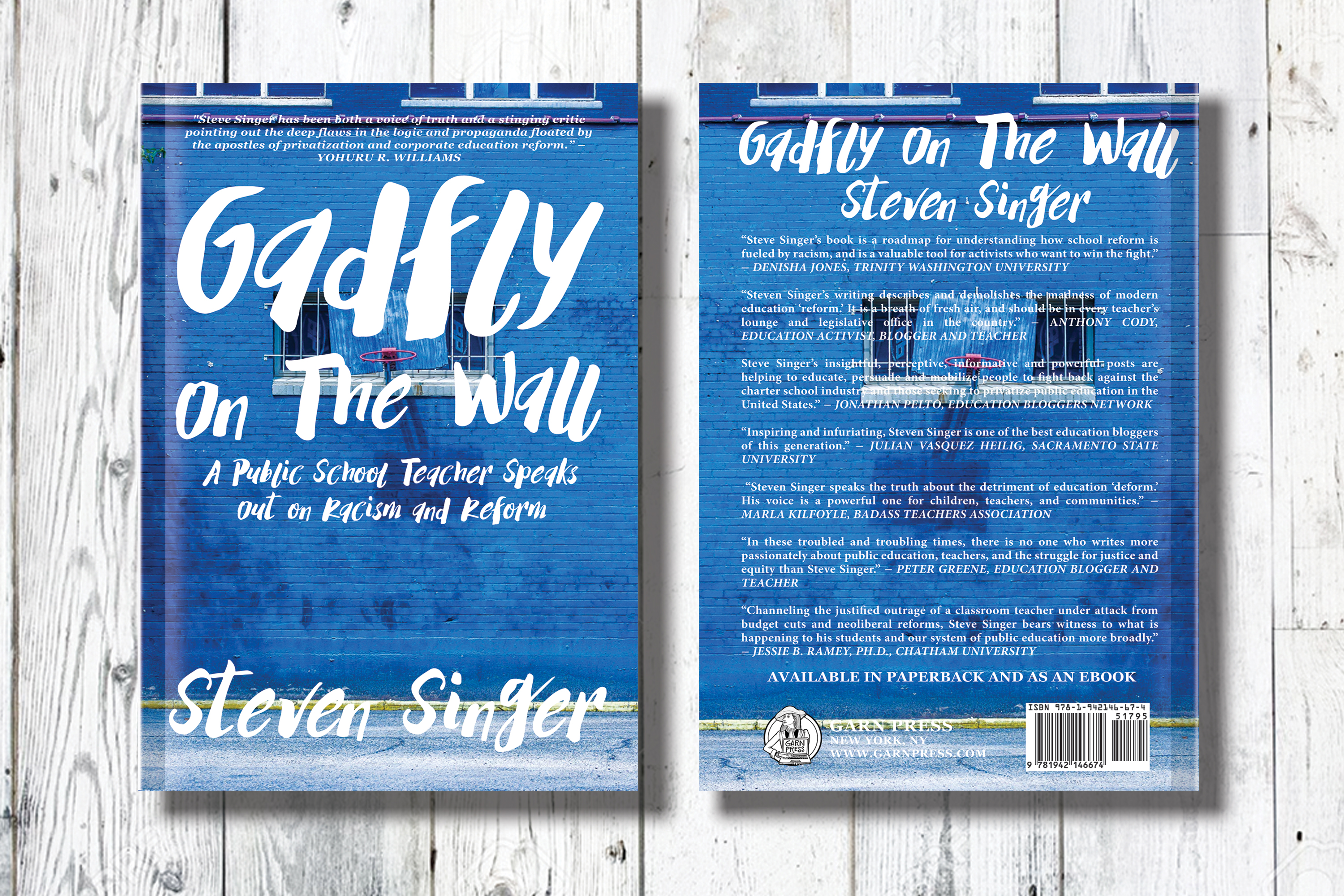
I’ve also written a book, “Gadfly on the Wall: A Public School Teacher Speaks Out on Racism and Reform,” now available from Garn Press. Ten percent of the proceeds go to the Badass Teachers Association. Check it out!

Will PA Finally Hold Cyber Charter Schools Accountable?

Pennsylvania pays more than $1 billion every year for its 14 cyber charter schools.

And overpays them by more than $450 million each year.

Now – after half a decade of legislative shenanigans – a new bill actually has the possibility of being passed to hold these types of schools accountable.

Last week House Bill 1422 passed by a vote of 122-81, with all Democrats voting for it, joined by 20 Republicans. Democratic Gov. Josh Shapiro would likely sign the legislation if it comes to his desk.

So now it goes to its biggest hurdle – the Republican-controlled Senate.

The state GOP has held up every cyber charter reform measure since the previous Democratic Gov. Tom Wolf suggested it. However, now that Democrats hold a slim majority in the House, Republicans can no longer stymie it completely.

One of the largest problems centers on the cost of doing business. Cyber charter schools educate students online via computer. So why do local public schools have to pay cyber charters the same money as brick and mortar schools to educate students living in their boundaries? Cyber charters don’t have nearly the brick and mortar – no athletic fields, busing, etc. And the physical structures they do have are much smaller. The result is underfunded public schools and cyber charters bursting with cash.

That means higher public school taxes for you and me while cyber charters spend money like it’s going out of style.

The new measure would stop that by telling public schools exactly how much they must pay cyber charters – $8,000 per student not receiving special education services. Most schools currently spend approximately $10,000.

In addition, cyber charter schools would no longer be given more funding for special education students than authentic public schools. Tuition for special education students would be aligned with the system used for authentic public school districts. These measures, alone, are expected to result in about $456 million in savings.

But that’s not all!

The legislation also seeks additional transparency, eliminating conflicts of interest and requiring cyber charters to comply with the state’s ethics and open records law as authentic public schools are already required to do. It would ban enrollment incentives, restrict advertising and event sponsorships.

Gov. Wolf’s original proposal went even further. He had asked the General Assembly to place a moratorium on new cyber charter schools and cap enrollment in low-performing charter schools until they improve. None of that appears in the current legislation.

The bill’s primary sponsor, Rep. Joe Ciresi, D-Montgomery, said the goal was not to close cyber charter programs, but to stop overfunding them. He said:

“We’re looking to put money back into the public schools and also leave the choice that’s there. We should have choice in this state. We’re asking that it’s a fair playing field.”

A lot of the prohibitions in the new legislation seem to have been inspired by real practices by current cyber charter schools like Commonwealth Charter Academy (CCA), the largest school of this type in the state.

For example, CCA spent approximately $19 million on marketing over a two-year period, including a float featuring Jerold the Bookworm for a Thanksgiving Parade.

The proposed law would prohibit all public schools from paying to sponsor public events such as parades and professional sporting events. Moreover, it would require all public schools who advertise to state that the cost of tuition and other costs are covered by taxpayer dollars.

CCA also uses tax dollars to provide $200 for monthly field trips that can be of debatable educational value. They’ve gone to petting zoos, laser tag, bowling and kayaking. A parent of a CCA student even bragged on Facebook about using these funds for Dave and Busters Arcade, a Motley Crue concert, Eagles tickets, and family vacations to Universal Studios and Disney, according to Education Voters of Pa.

The new bill would prohibit cyber charter schools from paying or reimbursing parents/guardians from educational or field trips as well as offering any cash, gifts or other incentives for enrolling or considering enrolling in a cyber charter school.

It would also force these types of schools to be more financially accountable by requiring them to approve an annual budget by June 30th each year, and make the budget available, as well as imposing fund balance limits so they couldn’t horde taxpayer money – all things already required of authentic public schools.

Charter schools – institutions that are publicly financed but often privately run and not subject to the same rules and regulations as authentic public schools – are still controversial despite the first charter school law being passed in 1991 and having spread through at least 45 states. However, only 27 states also allow CYBER charters like this – schools that teach mostly (or entirely) distance learning through the Internet.

Nationwide, Pennsylvania and Ohio have the largest cyber charter enrollment. In 2020-21, the Keystone State enrolled 61,000 students in cyber charters – and roughly 21,000 attend CCA.

A 2022 report by Children First found that of the states with cyber charters, Pennsylvania spends the most but has the “weakest systems to ensure students and taxpayers are getting their money’s worth.” Moreover, of the roughly $1 billion state taxpayers spend on these schools, several reports suggest that the money comes from the poorest districts, where cyber student academic performance is much lower than at neighboring authentic public schools. These are the students most in need of help.

Many provisions in the proposed bill read like such common sense initiatives, it’s chilling that they aren’t already in place.

The bill would require cyber charter schools to verify the residency of enrolling students, report the number of newly enrolled students and how many of those students have been identified as needing special education. Since cyber charter teachers meet with students online, they would need to visibly see and communicate with enrolled students at least once per week to verify the student’s well-being.

There are also many rules about how a cyber charter school can be governed. You could not have a school director from another school district or a trustee from another charter school serving on the board of the cyber charter school. Boards would require a quorum and a majority vote to take action. They would have to comply with the Sunshine Law, Right-to-Know Law, and the Ethics Act. Cyber charter school boards would need to have at least seven non-related members, at least one of whom must be a parent/guardian of an enrolled student.

But let’s not forget the many ways this new law would make cyber charters more transparent. Cyber charter schools could not lease a facility from a foundation or management company – unfortunately a common practice that allows the school to bill the public for a service to itself multiple times. Any conflicts of interest between the cyber charter school and a foundation or management company would need to be disclosed. Cyber charters would not be allowed to have administrators and their family members serving on the board of a charter school foundation that supports the charter school. No charter school trustee could be employed by the cyber charter school, a foundation that supports the school, or a management company that serves the school. The state Department of Education would need to have access to the records and facilities of any foundation and/or management companies associated with the school. Foundations associated with these schools would need to make budgets, tax returns and audits available.

The overwhelming majority of these regulations simply hold cyber charter schools to the same standard we already use for authentic public schools.

However, what often gets left unsaid is how terribly students do academically at cyber charters – something completely left out of this proposed legislation.

Study after study consistently shows that cyber charters are much less effective than traditional public schools – heck! They’re even less effective than brick and mortar charter schools!

A nationwide study by Stanford University found that cyber charters provide 180 days less of math instruction and 72 days less of reading instruction than traditional public schools.

Keep in mind that there are only 180 days in an average school year. So cyber charters provide less math instruction than not going to school at all.

The same study found that 88 percent of cyber charter schools have weaker academic growth than similar brick and mortar schools.

Student-to-teacher ratios average about 30:1 in online charters, compared to 20:1 for brick and mortar charters and 17:1 for traditional public schools.

Researchers concluded that these schools have an “overwhelming negative impact” on students.

And these results were duplicated almost exactly by subsequent studies from Penn State University in 2016 (enrolling a student in a Pennsylvania cyber charter school is equal to “roughly 90 fewer days of learning in reading and nearly 180 fewer days of learning in math”) and the National Education Policy Center in 2017 (cyber charters “performed significantly worse than feeder schools in both reading and math”).

The legislation being considered here does the important work of holding cyber charters financially accountable. However, there still remains the very real question of whether this type of educational institution is viable under normal circumstances.


It will be interesting to see if Republicans find even accountability a prospect worthy of a vote in the state Senate. Lobbyists for charter school networks like K12 Inc. and Connections Education have spent billions of dollars against something like this ever happening.

I guess we’ll soon see who the Commonwealth GOP really listens to – voters or corporate interests.


Like this post?  You might want to consider becoming a Patreon subscriber. This helps me continue to keep the blog going and get on with this difficult and challenging work.

Plus you get subscriber only extras!

Just CLICK HERE.

Patreon+Circle

I’ve also written a book, “Gadfly on the Wall: A Public School Teacher Speaks Out on Racism and Reform,” now available from Garn Press. Ten percent of the proceeds go to the Badass Teachers Association. Check it out!

What Can Educators Learn from “Zelda: Tears of the Kingdom”?

So there I was, stranded at the bottom of a pit in the depths.

Shadows all around me, puddles of glowing purple gloom everywhere, the burbles of monsters slowly approaching…

No time to climb out – let’s build a hover bike!

And before you know it, I was zooming up and outta there!

Until I ran out of battery and went careening back to the ground. But I was out of the pit!

“The Legend of Zelda: Tears of the Kingdom” is a really great game – even for a nearly 50-year-old public school teacher like me.

As classes dwindled down in June and the summer approached, I noticed some of my students who had finished their work bringing the game in on their portable Nintendo Switch consoles.

Like me, they were enthralled by the level of choice the newly released game presents.

Rarely is there one answer to a problem.

The previous Zelda game in the series, “Breath of the Wild” (2017), threw the doors wide by giving players an open world to explore. No longer did you have to go down a linear path of which dungeons to complete in which order to defeat the bad guy. You could go in whatever direction you wanted, doing almost anything in whatever order you pleased.

The new game takes that even further. “Tears of the Kingdom” gives you three open worlds to explore and offers you the ability to build a wide range of contraptions to create your own solutions to problems.

For example, when I was stuck in that pit, I could have tried to climb out, I could have stood my ground, or I could have built almost anything imaginable that might help.

It’s that kind of increased choice that makes this game special and of particular interest to educators.

After all, this is something many of our students enjoy doing in their free time. The game sold 10 million copies in its first three days, becoming the fastest selling Nintendo game in history. That’s roughly $700 million and growing.

This doesn’t mean edtech companies should rush in to take over. Teachers and public schools are still the best way to educate students.

But the way I see it, if teachers can make learning more intrinsic and exciting, it’s a plus. These are my three major takeaways from the experience:

1) Power of the Sandbox

There are many types of video games.

Some are focused on action – such as shooting down the most enemies. Some focus more on puzzles to solve. Yet others are focused on building things like farms or homes or even civilizations.

Sandbox games are more self-directed. The idea is to create a space where gamers can do pretty much whatever they want. There’s no imposed objective. You’re given simple tools that you can easily see how to manipulate and you’re left to decide how to use them.

It’s based on the metaphor of leaving small children in a sandbox and just letting them play.

The most popular model is the game Minecraft. In it, players are thrust into a world made entirely of blocks that can be combined and recombined to build anything they want. It’s almost like a virtual world of LEGO bricks.

Players build structures like dream homes or space ships. Some tell stories. Some recreate real or imagined structures like the Eiffel Tower or the Death Star from “Star Wars.”

While there are also dungeons you can fight through to get more materials for your creations, the main emphasis seems to be on building.

Minecraft, in itself, is a very popular game and has been so since 2011.

However, “Tears of the Kingdom” takes this a step further by making the sandbox a tool in a world with a specific objective.

Like most Zelda games, you play as a character, Link, who has to save the princess, Zelda, and the kingdom of Hyrule from a bad guy, Gannondorf. The difference is that one of your tools to do that in this game is an ability to combine certain items together into structures.

These aren’t just blocks. They can be as complex as fans or lasers.

You can try to build a flying machine, but you have to make sure the fans or rockets or whether you’re using to propel them are pointing exactly where you want them, don’t consume too much battery, etc.

It takes design, testing, a knowledge of basic physics, etc.

For example, one of my first attempts at a plane kept flipping over. The reason – my fans were placed in opposite directions so that the lift given by one was counteracted by the other. Another device only went straight up. The reason – rockets only provide lift in one direction and quickly give out.

Players can easily get lost in building things. Sometimes that can seem way more interesting than the overall objective of beating the bad guy and winning the game.

However, there are certain game objectives that help you become a better builder – give you longer battery life, etc. So the game rewards you for progressing along each route – the story objective and the sandbox.

It’s a fascinating game loop that may keep this adventure fresh with replayability long after the main objective is complete.

So how does that impact education?

We know students like self-directed learning. If they are at all interested in the subject, giving them the power of following their natural curiosity can lead to amazing results.

This is often used in STEM lessons, where kids are given an objective and various tools and told to try to figure out how to achieve that objective. Who can build the highest tower that won’t fall over? Who can build the fastest race car on this track? Who can build a boat out of cardboard and duct tape that will float longest in a swimming pool? Etc.

However, it can also be done in other disciplines. You might study how the writer Langston Hughes communicates his message in a poem like “Mother to Son” and then ask students to do the same kind of thing in their own poem. You might read several stories and poems by a single author like Edgar Allan Poe and then ask students to find similarities between the author’s work and life.

In each instance, it’s not about just giving students tools and leaving them alone to discover what to do with them. It’s up to the teacher to provide a goal or a direction in which to go. The students take it from there.

The freedom of the sandbox by itself can be thrilling to some students in certain disciplines. But it can also be terrifying. Both aspects are necessary to reach the most students. When learning can be both intrinsic but directed, that’s when students get the greatest results.

We often pretend that students can do just as well without instruction – and there can be marvelous gains by some students in this way. However, teachers are there for a reason. We know the curriculum and many avenues to understanding it. We can point students many ways to understanding that they might not discover on their own.

Games like “Tears of the Kingdom” show the importance of both choice and direction.

2) Importance of a Learning Community

One of the things I was surprised about the most in “Breath of the Wild” and this new Zelda game is the way each created an online gaming community.

In particular with “Tears”, I found several YouTubers who focused on the game and made videos about nearly every aspect of it.

There were walk-throughs of various parts of the game: how to find different armor, defeat bosses and mini-bosses, build the best things, etc. However, there were also videos focused just on individual’s personal experiences with the game and even conjectures on the lore.

It is unclear how some of the elements from the first game impact the second that the developers kept intentionally vague. The community of players stepped in to fill in these gaps with theories that would put the best literary analysis to shame.

For example, the first game was full of Sheika Shrines. In the second game, the shrines were gone from most of the same locations. Instead there were new Zonai shrines in disparate locations. Why the discrepancy? There seems to be a growing consensus that the Sheika shrines were either dismantled by the Hyrulians and/or destroyed by Gannondorf when he reawakened to begin the current upheaval.

All of this really enhances the gaming experience. Not only do you feel less isolated, but you feel validated. You’re part of the act of making meaning out of the whole experience – listening to others, adding to the conversation, etc.

For example, there are certain enemies that just scared the heck out of me – chief among them were Gloom Hands. These are puddles of slime that come out of nowhere and shoot hands out at your character that can squeeze you to death in seconds.

Then I saw several videos where YouTubers explained how Gloom Hands freaked them out, too, (some complete with funny videos of them screaming when being ambushed by these creatures) and how to deal with them.

By watching these videos, I got to be much better at the game than I would have been otherwise. Some vloggers were so calm and reassuring when they said these sorts of creatures were easy to deal with and nothing to panic over that I felt way more confident. Moreover, if I did come across something that gave me trouble, I knew where to turn for help and guidance.

How important this is in the classroom!

Teachers often fill this role, but if we can create a community in the classroom, itself, that is even better. When students can discuss assignments and help each other through obstacles, that is so much better than the teacher being the only person in a position to help.

I try to foster as much discussion as possible in my classes through Socratic Seminars and informal groups. However, if you can get small group work to function while still being focused and productive, you can increase this aspect, too.

It’s all about the classroom you can create. You need shared values, empathy and students who understand how to best interact with each other. It’s easier said than done but a worthy goal for sure.

3) The Danger of Outside Assessment

This may be the most overlooked lesson from games to the classroom.

One of the biggest differences between the gaming and school experience is whether someone is looking over your shoulder or not.

In a video game, the player decides what he or she wants to get out of the experience. Do you want to simply beat the game? Or do you want to 100% it – achieve every goal the programmers put into it.

How long you take and how much you complete is up to you.

Sometimes the gaming community can contribute to this by giving opinions about which goals are worthy of completion, etc. However, whether you have achieved everything you want and the ultimate assessment of such things are really up to the individual.

Things are different in class.

On one level, students are assessed by their teachers. They grade assignments, give tests, etc. However, this is similar to the game, itself. When you fight Gannondorf, the game tells you whether you’ve beaten him and sometimes how well this is accomplished.

For example, there are a few different endings to the game that you can get depending on how well (or completely) you achieved certain objectives.

I think that’s similar to what the classroom teacher does. It’s part of the experience taken in context and (hopefully) well understood by the student.

The difference comes from forces outside the classroom.

Students don’t just achieve grades. They are also subject to standardized tests. These are assessments created out of context of the classroom, graded by hired hands, that are used to determine how well the curriculum has been learned.

They are artificial, biased and politically motivated.

Imagine if after playing a video game someone from the government had to come in and give you a score. Imagine if they made you play another (different) game to determine how well you did on this one. Maybe you feel like you aced “Tears of the Kingdom” but they said you didn’t do so well on “MarioKart” and thus failed the experience.

Outside assessment can kill intrinsic learning. It can make everything extrinsic – will this be on the test? What do I need to pass the test? Etc.

It would poison the video game experience as it poisons the classroom one.

We only allow it because of strange outdated ideas about learning and psychology. We pretend it’s all behaviorism – students given this stimuli should produce this response. We know that’s not how the human mind works, but politics and capitalism refuse to let us move beyond it.

Someone is making money off of this and we can’t disrupt that with real reform.

Perhaps if we looked more closely at how things function in the world of video games, we’d have a better idea of how to change things for the better in the classroom.

To better understand learning, we should look to the whole child – and the whole child’s experience outside of school.

This includes Zelda, Gannondorf and Link.


Like this post?  You might want to consider becoming a Patreon subscriber. This helps me continue to keep the blog going and get on with this difficult and challenging work.

Plus you get subscriber only extras!

Just CLICK HERE.

Patreon+Circle

I’ve also written a book, “Gadfly on the Wall: A Public School Teacher Speaks Out on Racism and Reform,” now available from Garn Press. Ten percent of the proceeds go to the Badass Teachers Association. Check it out!
Absurd School Voucher Proposal Stalls PA Budget

How do you stop the other team from making a goal when you aren’t even sure your own team’s goalie will try to block the shot?

Pennsylvania House Democrats find themselves in that uncomfortable position as they refuse to pass a Republican supported 2023-24 budget on time.

The problem? School vouchers.

Democrats generally oppose them and Republicans love them. But in the commonwealth, new Gov. Josh Shapiro, ostensibly a Democrat, has let it be known that he likes vouchers under certain conditions.

So Republicans designed a bill exactly along those lines hoping that if they can get it through both legislative bodies, the Governor will give it his signature. (Under the previous Democratic administration, Gov. Tom Wolf blocked the worst the GOP could throw at him, stopping all kinds of horrible policies from getting through.)

A budget encrusted with voucher giveaways passed the Republican-controlled Senate on Thursday, but the House – where Democrats now hold a slim majority – refused to go along with it.

So Republicans are holding the entire budget hostage. As usual.

In a time when the state is flush with cash from inflation-juiced tax collections and federal pandemic subsidies, legislators still couldn’t pass a budget on time.

And it all comes down to our schizophrenic education policies.

Fact: the Commonwealth shortchanges public school students.

The state Supreme Court said so after an 8 year legal battle.

Now lawmakers in Harrisburg are rushing to fix the problem by tearing public schools apart and giving the pieces to private and parochial schools.

It’s called the Lifeline Scholarship Program – throw a lifeline of $100 million to failing edu-businesses and religious indoctrination centers on the excuse that that will somehow help kids from impoverished neighborhoods.

You could just increase funding at the poorest public schools – but that would make too much sense.

Better to give taxpayer money to private interests with little to no accountability or track record and just hope it works!

During the election, Shapiro admitted he liked the concept of these kinds of vouchers, but back then the only other choice was Doug Mastriano, a raving MAGA insurrectionist Republican. The Democrat could have said he had developed a taste for human flesh and he would have been the better alternative.

This means only the slim Democratic majority is left to uphold public schools over this wrongheaded policy nightmare.

House Democrats swear the bill is destined to fail.

House Majority Leader Matt Bradford, D-Montgomery, put it this way:

“There are not the votes for it. It’s not coming up, and if it comes up, it will be defeated.”

This seems to be the case. Yesterday, the House Rules Committee voted against sending the tuition voucher bill to the full House for a vote. So it is not scheduled for a vote at all.

However, now that the June 30th deadline has been blown, lawmakers probably will try to use this newest school voucher bid as a bargaining chip to get a spending plan – any spending plan – passed. This could drag on for months – it certainly has in the past.

The current voucher iteration is a taxpayer funded tuition subsidy for students attending private schools.

Under this bill, students in the lowest 15% of schools in the commonwealth (as determined by standardized test scores) would be eligible.

So what’s wrong with school vouchers?

  1) Vouchers have nothing to do with helping kids escape struggling public schools.  

   School vouchers overwhelmingly go to kids who already attend private or parochial schools.

This is true even when the law explicitly stipulates the money should only go to poor and needy children.  

In the states that have released their data, more than three quarters of families who apply for vouchers for their children already send their kids to private schools. That’s 75% of voucher students in Wisconsin, 80% in Arizona, and 89% in New Hampshire. So these kids didn’t need our tax dollars in the first place.  We’re just paying for services they’re already receiving.

 Moreover, the very idea is absurd. If the school where the student is enrolled is struggling, why wouldn’t you simply invest in that school to make it better and fix the underlying problem? Why disrupt children’s educations by moving them to another school in another system that is entirely unproven, itself? 

2) Using taxpayer money to send your child to a private or parochial school has got nothing to do with getting a quality education.  

  If we look at the facts, using a school voucher to go from a public school to a private one actually hurts kids academically.  

  Large-scale independent studies in Indiana, Louisiana, Ohio and Washington, D.C., show that students who used vouchers were as negatively impacted as if they had experienced a natural disaster. Their standardized test scores went down as much or more than students during the Covid-19 pandemic or Hurricane Katrina in 2005.  

 This should come as no surprise. When we give children school vouchers, we’re removing their support systems already in place.

  They lose the friends, teachers, and communities where they grew up. It’s like yanking a sapling from out of the ground and transplanting it to another climate with another type of soil which may not be suited to it at all.  


   3) Vouchers have nothing to do with more efficient schools.  

  Let’s get one thing straight – voucher schools are businesses, often new businesses just opening up. And like any other start-up, the failure rate is extremely high. According to Forbes, 90% of start-ups fail – often within the first few years.  

 The same is true here. Like charter schools (another privatized education scheme), most voucher schools close in the first few years after they open. In Wisconsin, for example, 41% of voucher-receiving schools have opened and subsequently closed since public funding began in the early 1990s.  

  Yet when they close, they take our tax dollars with them leaving less funding available to educate all kids in the community.  

 Public schools, by contrast, are community institutions that usually last (and have been around) for generations. Their goal isn’t profit – it’s providing a quality education

  4) Vouchers have nothing to do with freedom or choice.  

   Unless it’s the choice to be a bigot and indoctrinate your child into your own bigotry. 

      Vouchers are about exclusion – who gets to attend these PRIVATE schools –  and indoctrination – what nonsense they can teach that public schools cannot.  

   Private schools can and do discriminate against children based on religion, race, gender, sexuality, special needs – you name it – even if those schools take public money.   

  For example, in Florida, Grace Christian School, a private institution that refuses to enroll LGBTQ kids has received $1.6 million so far in taxpayer funding. In Indiana, more than $16 million has gone to schools banning LGBTQ kids—or even kids with LGBTQ parents! That’s roughly 1 out of every 10 private schools in the state with just this one discriminatory enrollment.  

   Meanwhile thousands of parochial schools that receive public funding use textbooks provided by The American Christian Education (ACE) group. This includes the A Beka Book and Bob Jones University Press textbooks. A Beka publishers, in particular, reported that about 9,000 schools nationwide purchase their textbooks.  

    In their pages you’ll find glowing descriptions of the Ku Klux Klan, how the massacre of Native Americans saved many souls, African slaves had really good lives, homosexuals are no better than rapists and child molesters, and progressive attempts at equal rights such as Brown vs. Board of Education were illegal and misguided. You know – all the greatest Trump/MAGA hits!  

  Call me crazy, but I don’t think that’s a curriculum worthy of taxpayer dollars. I think if you’re going to take public money, you should have to accept all of the public, and you shouldn’t be allowed to teach counterfactual claims and prejudice as if they were fact.  

To be fair, this voucher program is not supposed to take money directly from the public system – one of Shapiro’s requirements for his support – but the money has to come from somewhere.

The state treasury would be responsible for managing the program, and it can’t just print money. This is taxpayer funding. We won’t allocate the money to support the schools we have, but we’re willing to send $100 million to schools we have no responsibility for now!? With no fiscal accountability!?

Lots of other states have enacted vouchers like this and surprise, surprise! The program expands enormously. For instance, in New Hampshire, voucher supporters predicted their program would cost taxpayers about $130,000, but within two years the cost had ballooned to more than $14 million.

Pennsylvania schools have monetary needs – but this voucher program is not one of them.

Lawmakers have been tasked by the state Supreme Court with increasing education funding.

That’s education funding for public schools – PUBLIC. Schools.

If they want to give away our tax dollars to their buddies in the private education industry or support religious indoctrination, that’s a different matter entirely.

And shame on Shapiro for giving the most reckless policymakers in the commonwealth on the other side of the aisle hope that these shenanigans will work.


Like this post?  You might want to consider becoming a Patreon subscriber. This helps me continue to keep the blog going and get on with this difficult and challenging work.

Plus you get subscriber only extras!

Just CLICK HERE.

Patreon+Circle

I’ve also written a book, “Gadfly on the Wall: A Public School Teacher Speaks Out on Racism and Reform,” now available from Garn Press. Ten percent of the proceeds go to the Badass Teachers Association. Check it out!