If You Don’t Want Teachers to be Saviors, Don’t Put Them on a Cross 


At the end of the school year, I like to show my 8th grade students the movie “Freedom Writers.” 


It’s a good culminating film for the class because many of the subjects and texts we read are mentioned by the characters – “The Diary of Anne Frank,” “To Kill a Mockingbird,” the civil rights movement, journal writing, etc.  


It reinforces the relationship between historical narratives and the fight for human rights as well as underlines the importance of raising your own voice


However, it is also a movie that has come under fire for perpetuating the white savior trope.  


The film is based on the true story of Erin Gruwell, a white middle class woman, who taught inner city children to find their own voices by writing about their lives in Freedom Writer journals. 


The biggest problem seems to be that in the film the teacher takes on more jobs to afford supplies, spends time putting together field trips, and even ends up losing her marriage so her students’ needs will be met in the classroom. 


Is she a white savior transforming, saving and redeeming the lives of her students through her own personal sacrifices?  


Is this essentially a feel good story about a white person saving otherwise irredeemable brown skinned children?  


Honestly, I don’t think so. I suppose the answer depends on how much the students’ success should be attributed to the sacrifices of their teacher, and how uncomfortable we should be by the fact that she’s white while her students are predominately children of color. 


Is there something wrong with these kids? Absolutely not. Stereotypes aside, their problems arise from the circumstances in which they live more than anything else. 


But if I’m being truthful, I have to admit these are tough questions, even more so when we’re asking them about real teachers and students. After all, I show the movie to my students because we’re in a somewhat similar relationship. They have many analogous experiences and I try to teach them using some corresponding texts and methods.  


And am I not also a white teacher with a class of mostly black and brown children? 


How often are people in my own position labelled white saviors? And what part of that label is denigration and what part valid criticism? 


On the one hand, there are legitimate challenges born out of this situation. 


About eight-in-ten U.S. public school teachers (79%) identified as White (non-Hispanic) during the 2017-18 school year, according to the National Center for Education Statistics (NCES). Fewer than one-in-ten teachers were Black (7%), Hispanic (9%) or Asian American (2%). So this situation is pretty much the norm – most students of color have white teachers. 


This is challenging because study after study shows white teachers bring their biases with them to the classroom. They often have lower expectations for students of color, which greatly affects their students’ motivation and achievement. This may even impact expulsion and discipline rates as well as other facets of students’ academic experiences. 


With the constant emphasis on standardized test scores and the testing gap, it is easy to fall into the trap of seeing students of color as less than. After all, children of color in general do not score as well as richer whiter kids. So teachers are encouraged to look at the situation as one in which they can act on their students and MAKE them have higher scores simply by giving the right test prep and forcing their students to do these boring and extrinsic assignments by using increasingly punitive inducements.  


However, I do not think it is correct to characterize this as being a white savior. I think it is being a colonizer, and I have seen the same kinds of attitudes and actions from people of various races and ethnicities.  


In my own admittedly limited experience, the most test obsessed teachers and administrators I have ever know have been people of color – almost as if they were trying to make a point about their own racial identity by raising test scores of the children in their charge.  


The problem is that the testing gap has nothing to do with any deficiency in black and brown students. It comes from biased and unfair questions which are based more on privilege and culture than authentic academic ability.  


The problem with being a colonizer is that it enforces a prejudicial status quo. So raising test scores (even if you’re successful) does little to help people of color. It simply justifies making them jump through biased and unfair hoops in the first place with the excuse, “See? They did it. Why can’t you?” 


In this way, I agree with, Dr. Christopher Emdin, an associate professor at Columbia University’s Teachers College, who advised educators in his book “For White Folks Who Teach in the Hood…and the Rest of Y’all Too”: 


“You are there not as a savior, but as a revolutionary.” 


Teachers should be openly antiracist – especially white teachers. As difficult as it can be sometimes, we must not allow racism to become a taboo topic – something to be whispered about but never spoken of by name. We need to have the uncomfortable conversations. We need to read texts by people of color and honor every student’s race and culture. We need to prize difference and examine our own reactions to it. 


However, as I said I do not think the issue here is saviorism.  


That is something completely different though just as harmful. 


Regardless of race or ethnicity, teachers are forced to be martyrs .  


You can criticize Gruwell’s story because of all she gives up for her students, but that is kind of what teachers are obliged to do if they want to accomplish even a smidgen of their responsibilities.  


In fact, it is almost impossible to be a teacher – especially a teacher of predominantly black and brown students – and not be viciously coerced to sacrifice yourself.  


For example, more than 90 percent of educators use their own money to buy school supplies for their students, according to a survey from the National Education Association (NEA).
 
An analysis from My eLearning World showed teachers for the 2022-2023 school year spent an average of $820.14 on classroom supplies.  


However, educators cannot deduct even half of that cost from their taxes.  


Why do teachers do this? Because schools don’t purchase what kids need. So – especially in impoverished areas – educators are left with the choice of watching students do without or simply meeting that need, themselves.  


Almost every aspect of teaching involves some kind of sacrificial trade off like this.  

You can have a classroom with bare walls or you can buy and put up your own decorations to make it a welcoming environment for students. You can try to get kids up to your school’s meager library (assuming one even exists with a full-time librarian to keep books in stock) or you can just purchase your own classroom library.


Heck! There are only about 40 minutes or so in most teachers’ day to plan their lessons and grade student work. That’s not nearly enough time. Just to get the bare minimum done, educators have to spend hours and hours extra daily without pay.  


Moreover, teachers salaries are not commensurate with other professionals. They are paid 20% less than other college-educated workers with similar experience, and a 2020 survey found that 67% of teachers have or had a second job to make ends meet

You want more teachers of color to enter the profession? Then stop making privilege a prerequisite to apply!


This is why so many teachers are leaving the profession. They don’t want to be sacrificial offerings anymore.


The entire country is in the midst of a national educator walk out. Teachers are refusing to stay in the classroom due to poor salary, poor working conditions, heavy expectations and lack of tools or respect. 
After decades of neglect only made worse by the Covid-19 pandemic, we’re missing almost a million teachers. 


Nationwide, we only have about 3.2 million teachers left


Finding replacements has been difficult. Across the country, an average of one educator is hired for every two jobs available. 


And you want to complain that teachers are acting like saviors!?  


Fine! Stop giving us two pieces of wood and some nails!  


While there is a legitimate caution behind the white savior teacher trope, it is mischaracterized and misused in order to gaslight educators to simply take the abuse and be quiet.  


Yes, educators need to stop defending the status quo. We need to examine our biases and embrace racial and cultural differences. We need to actively work to tear down systems of oppression even in our educational system. 


But we also need to reform those systems so they don’t require us to self immolate. We need an education system that actually provides enough resources to students so that their teachers don’t need to jump on the pyre to keep them warm. 


These are two sides of the same coin. The same system that oppresses children of color by withholding enough compels teachers to become saviors. The one is built upon the other.  


Civil rights activists need to do a better job recognizing this and speaking out against it.


As activist Lilla Watson famously said: 


“If you have come here to help me, you are wasting your time. But if you have come because your liberation is bound up with mine, then let us work together.” 


Like this post?  You might want to consider becoming a Patreon subscriber. This helps me continue to keep the blog going and get on with this difficult and challenging work.

Plus you get subscriber only extras!

Just CLICK HERE.

Patreon+Circle

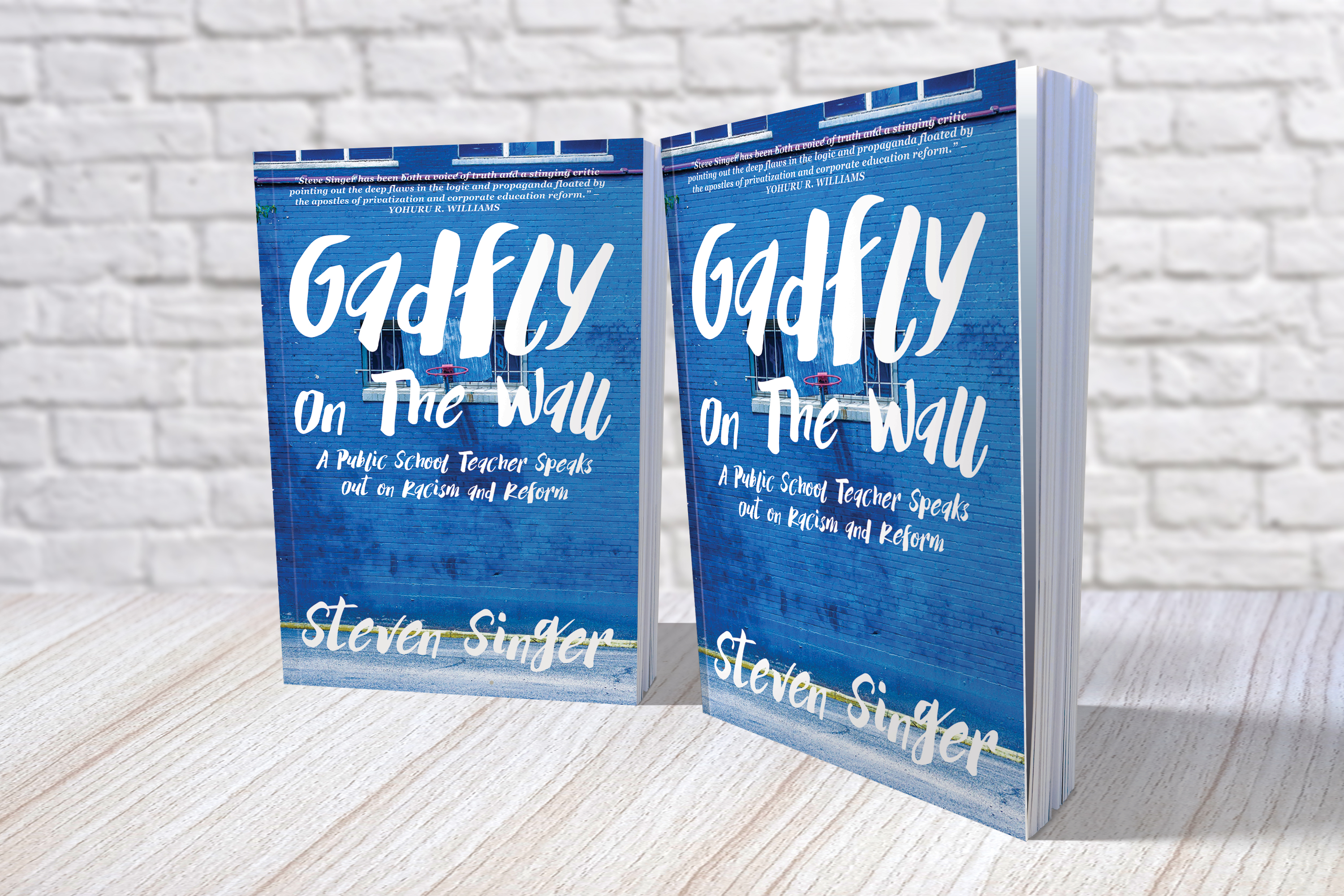
I’ve also written a book, “Gadfly on the Wall: A Public School Teacher Speaks Out on Racism and Reform,” now available from Garn Press. Ten percent of the proceeds go to the Badass Teachers Association. Check it out!

Student Projects are Better Than Tests 


The class was silent. 


Students were hunched over their desks writing on paper, looking in books, consulting planners.  


I stood among them ready to help but surprised at the change that had overcome them.  


Maybe 10 minutes before I had heard groans, complaints and the kind of whining you only get from students at the end of the year.  


“Do we have to keep doing work!?” 


“Can’t we just watch a movie!?” 


“Ms. X- isn’t doing anything with her students!” 


And then I dropped the bomb on them.  


We had less than 3 weeks left in the school year. We had just finished our last text. In 8th grade that was “To Kill a Mockingbird” by Harper Lee. In 7th grade it was “Silent to the Bone” by E.L. Konigsburg.  


Now was the time for the infamous final project.  


Some kids asked me about it at the beginning of the year having heard about it from a brother or sister who had already graduated from my class. 


“Mr. Singer,” they’d say, “Is it true you give a 1,000 point project at the end of the year?” 


I’d laugh and ask who told them that, or if that sounded credible.  


“Do you really think I’d give a 1,000 point project!?” I’d say in my most incredulous voice, and they’d usually laugh along with me.  


But some of them still believed it.  


That was nearly 9 months ago. Yet it all came flooding back when I passed out the assignment sheet.  


In the world of education there are few truths more self-evident than this


Projects are better than tests. 


Just think about it for a minute. 


On the one hand you have a project – an extended group of related assignments demonstrating learning and culminating in a product of some sort – a paper, a poster, a movie, a presentation or some mix of these. 


On the other hand you have a test – a quick snapshot of skills taken out of context.  


Which do you think is the better assessment? 


Imagine a musician.  


You could have her answers questions about notation, rhythm and theory…. Or you could just have her play music.  


Which would best demonstrate that she can play? 


It’s the same with other subjects.  


Take a test on reading – or actually read.  


Take a test on writing – or actually write.  


Take a test on math – or actually….  


You get the picture.  


And so did my students.  


I place a huge emphasis on writing in my English Language Arts classes. In 8th grade, my students have already written at least a dozen single paragraph and two multi-paragraph essays. So they’re pretty familiar with the format. I try to get them to internalize it so that it’s almost second nature.  


So when the final project comes along, it’s really a culmination of everything we’ve done.  


In Harper Lee’s book, there is the symbol of the mockingbird: 


“Your father’s right,” she said. “Mockingbirds don’t do one thing but make music for us to enjoy. They don’t eat up people’s gardens, don’t nest in corncribs, they don’t do one thing but sing their hearts out for us. That’s why it’s a sin to kill a mockingbird.” 


We already discussed how several characters in the book could count as mockingbirds – Tom Robinson, Atticus Finch, Boo Radley, etc.  


So I have students write about mockingbirds in all of the texts we’ve read this year. That includes “The Outsiders” by S. E. Hinton, “The Diary of Anne Frank” and several short stories.  


In 7th grade, we’re at a slightly different place. 


At the end of the year, students have written nearly as many single paragraph essays but no multi-paragraph ones yet. I use the final project to introduce them to the concept and explain how it’s the culmination of what we’ve done before.  


Students write about characters that they like from all the stories we’ve read throughout the year. These would be characters from texts as diverse as the one by Konigsburg, “The Giver” by Lois Lowery, “A Christmas Carol” by Charles Dickens and several short stories.  


As projects go, it’s kind of narrow.  


In the past, I’ve had students make movies together interviewing various characters from their texts. I’ve had them design posters extolling various aspects of the Civil Rights movement. I’ve had them design graphics explaining the difference between internal and external conflict.  


But this is the end of the year – time to keep it simple.  


There’s actually a lot of research supporting this kind of assessment. 


Two separate studies were published by Lucas Education Research with Michigan State University (MSU), the University of Southern California (USC), and the University of Michigan. Researchers took either high school students or third graders and put them through a Project Based Learning (PBL) curriculum. 


The high school experiment conducted by MSU and USC involved 6,000 students in science and humanities from 114 schools about half of which were from low-income households. Students who were taught Advanced Placement (AP) U.S. Government and Politics and AP Environmental Science with a PBL approach outperformed their peers on AP exams by 8 percentage points in the first year and were more likely to earn a passing score of 3 or above, giving them a chance to receive college credit. In the second year, the gap widened to 10 percentage points. One key finding of the study, which included large urban school districts, was that the higher scores were seen among both students of color and those from lower-income households. 


The experiment with third-graders produced similar results. Students from a variety of backgrounds in PBL classrooms scored 8 percentage points higher than peers on a state science test. These results held regardless of a student’s reading level. 


In some ways, this should be obvious.  


When you put assessment in context it is more accurate. When you divorce it from its academic context (as you do with tests) it’s more abstract and less accurate. 


The problem is one of time and ease of execution. 


Put simply – tests are easy to give and grade. Projects are difficult.  


Even designing a good project can take lots of trial and error. Tests are often prepackaged and easy to design – you just have questions clustered around whatever skills you were hoping students would learn. 


It is very difficult for teachers to design entire courses with projects at every step of the way. Some might say it isn’t even desirable since such a course would probably not be able to cover as much material as traditional curriculum and it is generally preferable to use different modes of assessment in a single course. Let’s not forget that some students excel at tests and would suffer academically if the only kind of assessments were project based.  


My personal philosophy is one of moderation. Use projects when you can and when appropriate – but not always. And if you’re going to test, a teacher created assessment is orders of magnitude more valuable than a standardized one. 


And in terms of projects, the best is at the end. What better way to demonstrate the cumulative learning of a course than through a cumulative project?  


My students seem to agree. 


After the initial anxiety of such a hefty project, my kids in both grades settle down pretty quickly and get to work. I think they find the project comfortable because they’ve been exposed to almost every part of it before. This just brings it all together under one project.  


It’s the opposite of learned helplessness. Students already know they can do it. All they have to do is step up and get it done. 


That’s also why I make the project worth such a huge amount of points.  


I already double points for the last grading period. Doing that and having such a hefty final project sends the message to kids that they can’t slack off now. The work they do in the closing days of school will have an outsized impact on their grade. If kids care at all about that – and most still do in middle school – they’ll make the effort.  


It also helps fill the last few days and weeks with a focus on process. Nothing has to be memorized. Nothing is beyond anyone’s ability. We’re going to work together – each student and me – to make sure the final project gets done.  


Usually they accomplish it with flying colors.  


It’s something they often remember and pass on in legend to their younger siblings who bring it up in hushed tones when they enter my classroom for the first time. 


Like this post?  You might want to consider becoming a Patreon subscriber. This helps me continue to keep the blog going and get on with this difficult and challenging work.

Plus you get subscriber only extras!

Just CLICK HERE.

Patreon+Circle

I’ve also written a book, “Gadfly on the Wall: A Public School Teacher Speaks Out on Racism and Reform,” now available from Garn Press. Ten percent of the proceeds go to the Badass Teachers Association. Check it out!
 

I Teach Banned Books   


If you want people to do something, forbid them from doing it.  


As a middle school language arts teacher, that’s always worked for me.   


Many of my students are reluctant readers.  


If a text is longer than a Tweet or a YouTube description, most of them would rather skip it.  


And when it comes to books, many of them wouldn’t intentionally crack one open under any circumstances.  


Unless you tell them not to.   


Unless you point out a specific book on the shelf and say it’s off limits.   


Unless you open it up right in front of them before quickly snatching it away and saying, “Oops! I forgot! We can’t read that one!”  


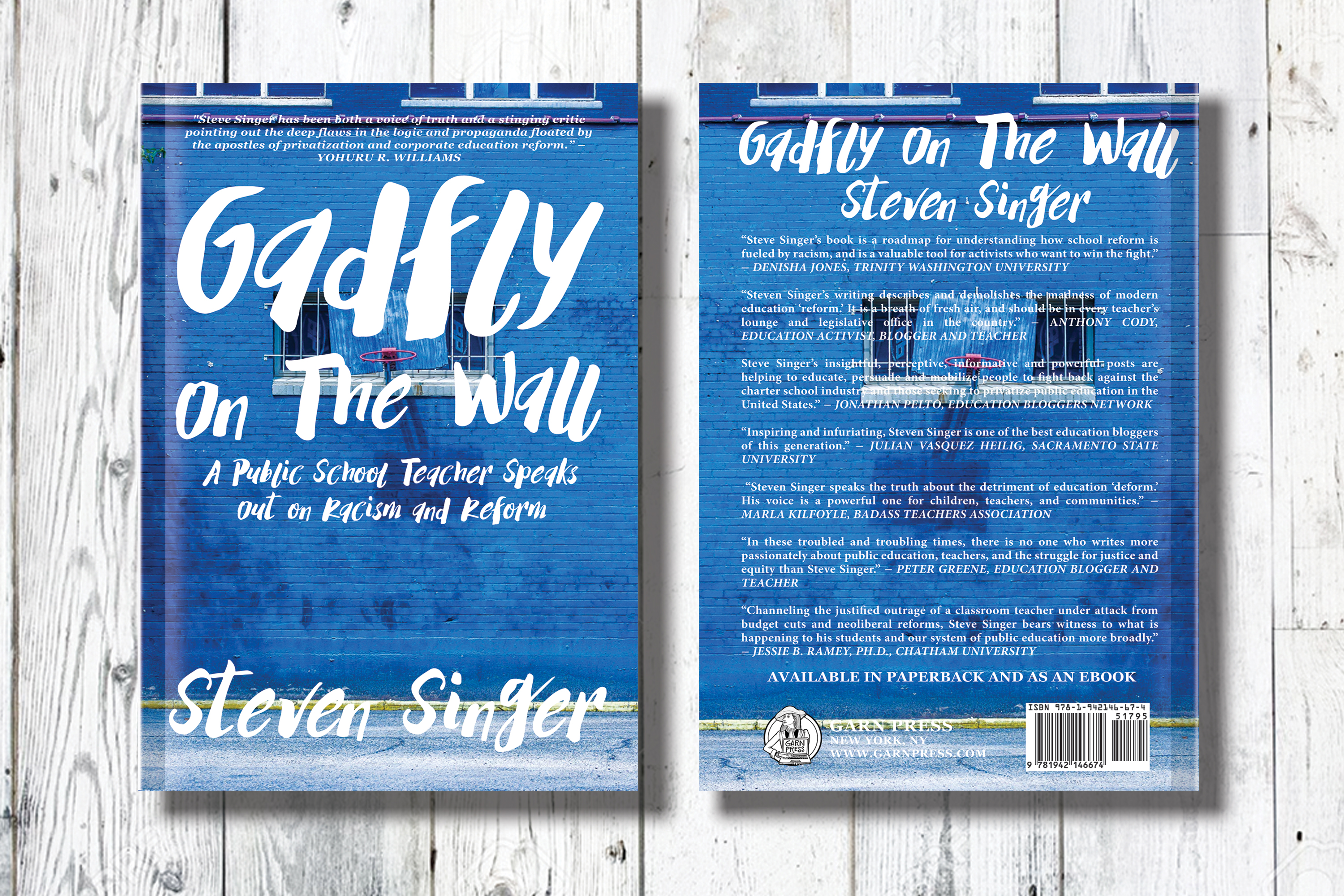
So most of my curriculum is made up of banned books.  


The Giver, Silent to the Bone, The Diary of Anne Frank, To Kill a Mockingbird – all forbidden in one place or another.   


Just not in my district.   


In fact, my school board has included each of these books on the approved reading list.


That doesn’t mean I have to use them.  


Language Arts teachers like me have a few different options at each grade level. And some of us actively avoid the more controversial texts to keep out of trouble.   


But not me.   


I go right for these taboo, prohibited, and oh so naughty books – for very good reasons


The Giver

  
Take “The Giver” by Lois Lowry.  


It’s almost the poster child for why we shouldn’t ban books in the first place. The story is set in a dystopian society where everyone is raised to be the same and people are discouraged from questioning things or having deep feelings.  


The book is most often challenged because parents don’t want their children to have to wrestle with its deep social criticism.  


When it first came under fire, Lowry responded thusly


”Submitting to censorship is to enter the seductive world of ‘The Giver’: the world where there are no bad words and no bad deeds. But it is also the world where choice has been taken away and reality distorted. And that is the most dangerous world of all.”  


However, not everyone is willing to let children think through these issues themselves – and what a bundle of issues Lowry presents! 


In the plot, she mentions sex, infanticide, suicide, starvation, and euthanasia.   


Nothing is graphic or developmentally inappropriate for middle schoolers, but the very idea of children thinking about S-E-X and challenging authority is enough to put it afoul of some censors.  


Which is exactly why my students love it.   


Too often teachers give students short passages taken from standardized tests where the only reason to read is to hunt for multiple choice answers. It’s dry, boring and meaningless to their everyday lives. 


That’s why they enjoy books like “The Giver” so much. This isn’t just for a grade. It’s reading something worth taking the time to consider, something that gets under their skin and makes them want to think.  


They’re at an age (12-14) when they’re starting to find their own place in society and struggling to understand adult issues like reproduction and romantic attachment. Making these topics explicit and being able to talk through them in the safety of the classroom can be liberating – and worth the effort to decode.   


That is – if you accept that children are little human beings who deserve the chance to consider these things aloud.  

Silent to the Bone

  
And speaking of adult issues, there’s the other comprehensive novel I teach in 7th grade – “Silent to the Bone” by E. L. Konigsburg.  


It’s a classic detective story where the characters try to discover why a young teen, Branwell, refuses to speak after his baby sister suffers a potentially life threatening injury.   


The plot grabs readers from the beginning and students find themselves really invested in unraveling the mystery. But to do so they come face-to-face with topics ranging from family, divorce, death, bigotry, sexuality and exploitation.   


It’s not about finding textual details to satisfy the number crunchers at Data Recognition Corp. or NCS Pearson Inc. It’s about getting textual to better understand what happened in the plot and why. 


Again the narrative is written for middle school readers but the concepts get them thinking and enthusiastic.  


As we come to the big reveal, I’ve had students turn to me with huge smiles saying they can’t believe we’re actually reading about this stuff in school.  


In an age where they usually communicate with emojis, I’m just glad that they’re reading. 


It can get uncomfortable, but by the end I definitely feel like I’ve reached them.

The Diary of Anne Frank


Speaking of uncomfortable, one of the hardest books I teach in 8th grade is “The Diary of Anne Frank.”


It’s not that the text is so difficult, but as a person of Jewish ancestry, I find it personally harrowing to relive this story every year.  


The plot centers on Anne, a historical Jewish girl in 1940s Amsterdam who with her family and others hid from the Nazis before eventually being captured and dying in a concentration camp. 


Like most teachers, I eschew the actual diary for the play version by Frances Goodrich and Albert Hackett.  


At first glance, it’s hard to imagine why this book would be banned. After all, it’s a true story of the Holocaust written by one of the people who lived it.   


However, there are an increasing number of people in this country these days who want to deny that the Holocaust even happened or claim that it was exaggerated. It’s hard to do that with a witness staring you in the face – even if that witness is just the book she left behind.  


Usually the text is challenged not on the basis of its plot so much as its sexual frankness. Not that there is much sex going on with people hiding above a factory in WWII. But the character of Anne is so real, she writes about everything including what it’s like to become a mature woman.   


For example, in Act II, scene 1, she mentions getting her period for the first time:  


“There is one great change, however. A change within myself. I read somewhere that girls of my age don’t feel quite certain of themselves. That they become quiet within and begin to think of the miracle that is taking place in their bodies. I think what is happening to me is so wonderful… not only what can be seen, but what is taking place inside. Each time it has happened I have the feeling that I have a sweet secret… and in spite of any pain, I long for that time when I shall feel that secret within me again.” 


My students often read over this passage without comment. I usually have to draw their attention to it and ask them what Anne is talking about before someone gets it.   


You might be surprised at how freeing this kind of discourse is. Menstruation is a natural part of life for nearly half the population, but it’s something we don’t often talk about.   


It’s not central to the story and Anne certainly goes into greater detail in her actual diary. However, even this little digression goes to further humanize her and make her relatable, especially to people like my students who are nearly the same age she was when she wrote it. 


She becomes so much more than a victim. She’s someone we know – inside and out.


To Kill a Mockingbird

 
The most challenged book I teach is “To Kill a Mockingbird” by Harper Lee.  


It tells the story of Atticus Finch, a white lawyer in the 1930s Alabama who defends Tom Robinson, a black man, of a crime he did not commit. The story is told from the point of view of the lawyer’s children who go from blissful naivety to uncomfortable understanding. 


In the past, people used to object most often to the book’s language since it makes liberal use of the N-word.  


It’s still an issue, and I make sure not to have myself or any of the students read these parts aloud. We only hear it on an audiobook as we follow along in the text. And even this only comes after we discuss how hurtful that word is. 


However, the language isn’t the book’s biggest sticking point today. It’s more often objected to these days on the basis of white saviorism. Critics complain that the narrative should be centered on Tom, the black man accused of the crime, and not Atticus, the defense attorney and his children.  


What makes this particularly troubling is the critics have a point. If the story is about racism, wouldn’t it be better to focus on the target of that racism?  


They suggest the book be replaced by more modern novels that center such a narrative appropriately – something like “The Hate U Give” by Angie Thomas (itself, a frequently challenged book). 


However, in the final analysis, I disagree.  


As good a book as Thomas’s is, it just isn’t as well-written or multifarious as Lee’s.  


Thomas reveals a lot about racism and the fight against it in today’s world, and her book is certainly worth reading. But it is a mistake to think that racism is only about people of color. White people are the cause of racism. White people have a responsibility to tear down the systems of white supremacy.

By the end of the book, my whole class – regardless of race – is devastated by what happens to Tom and furious at the injustice he experiences. To be honest, that might not happen to the same degree in a book that signals its message right from the beginning.  


“Mockingbird” starts quietly. It doesn’t even appear to have anything to do with racism at the beginning. We slowly get acclimated to this world, this time and place before prejudice creeps into view and surprises us. 


In my classroom, the book allows us to discuss so many intersectional issues – gender, economics, belief systems, etc. Plus it gives my students more cultural capital than other texts would. Having read “Mockingbird” allows them to understand more and talk to more people than other more modern books. 


If they haven’t already, when they go to the high school, they’ll read novels centered on blackness. Their education and discussion of this issue would be incomplete without them. But I don’t think we need to stop reading such a classic as “Mockingbird” that was, itself, part of the civil rights movement.  


In any case, the school board has not approved any similar texts at that grade level. If I put aside “Mockingbird,” it would mean not discussing the issue at all. I think that would be much worse. 


Conclusions

So this is how I teach. 


I know there are some adults out there who would rather my students not read these books.  


I know some grownups would rather my kids not think about these things and not come to their own conclusions.  


They’d rather children be seen and not heard – like furniture.  


But my students know it, too. And they’d rather be treated like actual human beings – even if that means… yuck… reading.

Now don’t get me wrong. I’d much rather decision makers put no restrictions on which books students can and cannot read. Even trash like Hitler’s “Mein Kampf” shouldn’t be forbidden. I make sure to tell my students that it’s readily available in the library but not recommended.  

Children should not be restricted to only some ideas. They will come into contact with all kinds as they grow older. They need the skill to sort through them and decide for themselves their value.  

In my experience the bigger threat isn’t prohibition, it’s indifference. 

 
As Ray Bradbury famously said, “You don’t have to burn books to destroy a culture. Just get people to stop reading them.” 


Focusing on banned books helps me keep reading real and relevant in my classroom.  


Like this post?  You might want to consider becoming a Patreon subscriber. This helps me continue to keep the blog going and get on with this difficult and challenging work.

Plus you get subscriber only extras!

Just CLICK HERE.

Patreon+Circle

I’ve also written a book, “Gadfly on the Wall: A Public School Teacher Speaks Out on Racism and Reform,” now available from Garn Press. Ten percent of the proceeds go to the Badass Teachers Association. Check it out!
‘The Diary of Anne Frank’ Has Never Been More Important Than It is Today

thumbnail_maxresdefault


The biggest mistake people make about “The Diary of Anne Frank” is to assume it’s about a little dead girl.


It’s not.


Anne Frank is not dead.


Not in 1945. Not in 2019.


Anne was a Dutch Jew hiding from the Nazis with her family and four others in a loft above her father’s former factory in Amsterdam.


The teenager is the most famous victim of the Holocaust, but her story doesn’t end when she succumbed to typhus in the Bergen-Belsen concentration camp in the closing days of WWII.


Because it’s a story that never ends.


Her physical self may be gone, but her spirit remains.


In the 1990s, she was a Muslim Bosniak child killed by Christian Serbs in the former Yugoslavia.


In the 2000s, she was a Christian Darfuri in Western Sudan killed by Arab militias.


A decade ago, she was a Palestinian toddler torn to pieces on the West Bank – a victim of Israeli bombs.


And, yes, today she is a brown skinned Central American girl fleeing from violence to the United States only to be forcibly separated from her family and thrown in a cage.


Not only is Anne Frank not dead, she is more alive than most people who draw breath, whose hearts still pump blood, whose eyes shrink from the violence, prejudice and hatred all around them.


Perhaps that’s why it is so hard to teach her Diary in my 8th grade class.


It’s not a particularly difficult book.


Her prose is uncomplicated. Her ideas clear.


In fact, she jumps right off the page and into the classroom.


But that’s what makes her so difficult for me, the teacher.


Every year I help bring her to life for my students. And I suffer her loss all over again each time.


I think everyone sees something different in Anne.


My students see themselves in her. Or they see their friends or siblings.


Her problems are their problems. They, too, can feel closer to one parent than another.


They, too, can hate to be compared with a “perfect” sibling.


They, too, feel all the emotions and frustrations of growing up – the confusion, passion and hurt.


For me, though, it is different.


I don’t see Anne primarily as myself. I see her as my daughter. Or perhaps I see my daughter in her.


A precocious child hunched over a book scribbling away her deepest thoughts? Sounds like my precious 10-year-old drawing her comic books, or writing her stories, or acting out melodramas with her dolls and stuffed animals.


I want to take her somewhere safe, to keep her away from the Nazis, to conceal her from all the evil in the world.


After teaching the book for almost a decade and a half, it was only this year that I hit upon a new perspective. I realized that if Anne had survived, she would be almost the same age as my grandmother.


And for a moment, an image of her was almost superimposed over my Grandma Ce Ce. There she was – a physical Anne, a living person. But then it was gone.


When speaking about her to my students, I try to be extremely careful of their feelings. I make it exceedingly clear from the very beginning where her physical life ends.


She and her family are in hiding for 25 months before the Nazis find and send them to concentration camps. Only her father, Otto Frank, is left.


I don’t want any of that to be a surprise.


Yet it is.


Every time.


My classes stare back at me with shocked expressions when we reach the last page.


That can’t be the end. There has to be more.


So we read first hand accounts of Anne in the camp.


But that can’t be all, either. Can it?


So we learn about her legacy – about the Anne Frank House, the Academy Award winning film, and how her book is an international best seller.


Somehow her spirit still refuses to die.


I think it’s because she has become more than just a victim. More even than a single physical person.


We know that 6 million Jews died in the Holocaust. We know that 5 million non-Jews were also killed. But no matter how many documentaries we see, or how many pictures we look at – none of them come alive in quite the same way as Anne.


She is a face for these faceless.


She irreparably humanizes the other.


Once you read her Diary, you can’t forget that smiling little girl whose light was so suddenly snuffed out.


We can go numb at the numbers – the sheer scale of these atrocities.


But with Anne, it becomes something personal.


On Dec. 24, 1943, Anne wrote:


“I sometimes wonder if anyone will ever understand what I mean, if anyone will ever overlook my ingratitude and not worry about whether or not I’m Jewish and merely see me as a teenager badly in need of some good, plain fun.


We see you, Anne.


And because we do, we see beyond you, too.


We see you in the continuing horrors of our age.


Because your death is never in the past tense. It is always present.


Your eyes look out at us through the victims of our day, too.


And your words ring in our ears:


“What is done cannot be undone, but one can prevent it happening again.” (May 7, 1944)


We have not prevented it.


It continues.


Hatred and prejudice and murder echo through our human interactions.


All while the history fades.


According to a 2018 study, only 22 percent of millennials say they’ve even heard of the Holocaust.


I don’t think any of those young adults read your Diary, because my students remember you.


That’s why I’ll never stop teaching your story.


In the vain hope that by remembering you, they’ll see your eyes on the faces of all the future’s would-be victims.


In the vain hope that caring about you will help them care about the faceless strangers, the propagandized others.


In the vain hope that knowing your face will force their eyes to see – actually see – the faces of those who are demonized and dehumanized so someone will care when the boot comes down on their visage.


So that someone will stop the boot from ever coming down again.


In one of her last entries, on July 15, 1944, Anne wrote:


“I must uphold my ideals, for perhaps the time will come when I shall be able to carry them out.”


That time has come for us all.


Anne’s Diary remains to remind us – a clarion call to empathy and action.


Like this post? I’ve written a book, “Gadfly on the Wall: A Public School Teacher Speaks Out on Racism and Reform,” now available from Garn Press. Ten percent of the proceeds go to the Badass Teachers Association. Check it out!

book-4


I May Have Just Been Murdered By House Republicans

couple


I may be dead already.


And House Republicans may be the ones who killed me.


With the passage of a healthcare bill they, themselves, haven’t read – haven’t studied – haven’t thoughtfully considered in any way – it seems they’ve opened the door for insurance companies to deny people coverage due to pre-existing conditions.


I have one.


I’ve had two small heart attacks this year.


So I sit here stunned at the news on my computer feeling very much at a loss.


People have legitimate political differences, but this… it’s just beyond anything I’ve ever experienced personally.


There are people who count on me – my daughter, my wife, my students. I’m not so vain as to imagine that they can’t get along without me, but my loss will hurt them. I think at the very least they’ll miss me.


I’m 43-years-old. I’ve lived a good life. I just never expected to be abandoned in such a way by a society I’d always thought was more humane.


But if this legislation becomes the law of the land, what will I do?


I take six or seven pills a day to control my cholesterol, keep the stints in my heart clean, control my blood pressure, slow my heartbeat, etc. Without them, I almost certainly will have another heart attack. Yet I have no idea how I could possibly afford to take them without insurance.


And if I get sick, I won’t be able to work. I’ll bring in even less money. I won’t be able to help support my family. I’ll end up being a liability, a burden.


House Republicans have to know there are people out there like me. There have to be a lot of people in even worse shape than I am.


Are they really going to just let all of us die?


I had hoped to see my daughter grow up. She’s only 8-years-old, the most precious person in my life. No one is more full of energy, more vivacious and joyful. She loves to draw and write short stories. She pretends to be a teacher just like her father and gives her stuffed animals assignments.


I guess I’ll never get to see the person she becomes. I’ll never find out if she goes to college, if she finds love, if she has children of her own.


Can it really all come down to this?


My wife and I have been through a lot together. We met back in high school. Before I became a public school teacher, we worked together at various local newspapers. She supports me when I can’t go on. I hope I am able to give her back even a fraction of the strength she lends me.


Does this mean we’ll have to say goodbye, and so much sooner than I ever imagined?


My middle school students and I just finished reading “The Diary of Anne Frank.” When we closed the book, there were some tears shed. I passed around the tissues, and we discussed how we felt. Many of them expressed anger that some people could hold others’ lives so cheaply as the Nazis did Anne and her family. Are House Republicans guilty of a similar crime? They aren’t rounding anyone up to send to death camps, but they’re apparently content to let many of us just die.


The pundits tell me I have nothing to worry about. The bill won’t pass the Senate, they say. And even if it does, the President would be breaking every campaign promise he ever made, if he signs it.


So what else is new?


This is the world we live in now.


It’s not the country I was born into. It’s a cold place. A heartless reality.


Perhaps tomorrow I’ll gather the strength to resist, to call my Congressperson again, to protest, to organize.


But as for today…


I can’t even.


So I’ll head home, and give my family a big hug, spend whatever time I can with them.


Because if my life now depends on the compassion of Republican lawmakers, I may not have much of it left.