The Alt Right Has a Friend in Common Core


Andrew-Knight-holds-a-sign-of-Pepe-the-frog-unlikely-alt-right-icon.-JOSH-EDELSONAFPGetty-Images


Let’s say you’re a modern-day hipster Nazi.


You’re bummed out.


No one wants to hang out with you because of your bald head and your red suspenders and your commitment to the ideals of a defeated and disgraced totalitarian regime.


What are you to do?


REBRAND, son!


It’s simple.


No more National Socialist German Workers Party! That sounds too pinko!


Now you’re simply a member of the Alt Right!


It’s not racist! You’re just committed to traditional attitudes and values — if those traditional attitudes and values come from 1945 Berlin!


Heck, you don’t even have to call yourself Alt Right.


You can call yourself a White Identitarian.


You aren’t over-concerned with any one side of the political spectrum or other. You just strongly identify with whiteness — and by extension increasing the political power of white people at the expense of all others.


That’s all.


It should be obvious that this isn’t merely rebranding. It’s propaganda.


In today’s fast paced information age – where every fact is merely a Google away – that can be hard to get away with – UNLESS


Unless you already have a readymade tool to protect propaganda from the kind of informed critical thought that can pop it like a bubble. Something to insolate the ignorance and keep out the enlightened analysis.


I am, of course, talking about Common Core.


What!?


How does Common Core have anything to do with white nationalism?


Common Core is just a set of academic standards for what should be taught in public schools adopted by 42 of 50 states.


Academic standards aren’t political. Are they?


Actually, they are. Quite political.


Just take a look at how the standards came to be adopted in the first place.


The Obama administration bribed and coerced the states to adopt these standards before many of them were even done being written.


Hold your horses. The Obama administration!? That doesn’t sound exactly like a friend of the Third Reich.


And it wasn’t.


It was a friend to big business.


When first created, these standards weren’t the result of a real educational need, nor were they written by classroom educators and psychologists. They were written by the standardized testing industry as a ploy to get federal, state and local governments to recommit to standardized testing through buying new tests, new text books, new software and new remediation materials.


It was a bipartisan effort supported by the likes of Obama, the Clintons and Bill Gates on the left and Jeb Bush, Betsy DeVos and Bobby Jindal on the right.


After Obama’s success pushing them down our collective throats, many Republicans vocally decried the standards – often while quietly supporting them.


That’s why after all this time very few state legislatures have repealed them despite being controlled predominantly by Republicans.


Okay, so what does this have to do with the Alt Right?


People like Steve Bannon and Donald Trump are engaged in redefining the conservative movement. Instead of circulating ideas with a merely racist and classist undertone, they want to make those subtleties more explicit.


Most aren’t about to hop out of the closet and declare themselves open Nazis or members of the Hitler fan club, but they want to make it clear exactly how wunderbar the Fuhrer’s ideals are with a wink and a smirk.


For instance, Trump’s campaign slogan: Make America Great Again.


When exactly was America great? When white people had unchallenged political and social power and minorities and people of color knew their place. That’s when.


This is obvious to some of us, but we face a real obstacle making it obvious to others.


And that obstacle is Common Core.


A generation of Americans have been brought up with these shoddy academic standards that don’t develop critical thinking but actively suppress it.


For instance, take the absurd ravings of the Core’s chief writer – and current head of the College Board – David Coleman.


Going counter to the thinking of nearly every expert on literacy, he emphasized cold or close reading over reading text in context.


In particular, he said:


“Do you know the two most popular forms of writing in the American high school today?…It is either the exposition of a personal opinion or the presentation of a personal matter. The only problem, forgive me for saying this so bluntly, the only problem with these two forms of writing is as you grow up in this world you realize people don’t really give a shit about what you feel or think… It is a rare working environment that someone says, “Johnson, I need a market analysis by Friday but before that I need a compelling account of your childhood.”


Later, he added:


“The most popular 3rd grade standard in American today…is what is the difference between a fable, a myth, a tale, and a legend? The only problem with that question is that no one knows what the difference is and no one probably cares what the difference is either.”


And finally:


“This close reading approach forces students to rely exclusively on the text instead of privileging background knowledge, and levels the playing field for all students.”


However, Coleman was dead wrong on all counts.


What you think and feel IS important. The requirements of the corporate world ARE NOT the only reasons to teach something. Being able to distinguish between similar but different concepts IS important. And context is ABSOLUTELY ESSENTIAL to understanding!


For instance, today’s spin doctor Nazis soon realized that you can’t go goose stepping down main street blindly espousing how much better it is to be white — better than, say, being black or Jewish.


But you can hang up posters in college campuses that say the same sort of thing in a cutesy, passive aggressive way. For instance: “It’s okay to be white.”


If we look just at the text, as Coleman advises, we see a rather innocuous statement.


There’s nothing racist here. It’s just a simple statement that being white is also acceptable.


However, if we add back the context, we find an indirect racial undertone.


These posters weren’t put up willy nilly. They were hung on college campuses where white nationalists wearing MAGA hats were recruiting. They were pasted over Black Lives Matter posters, accompanying drawings of Donald Trump.
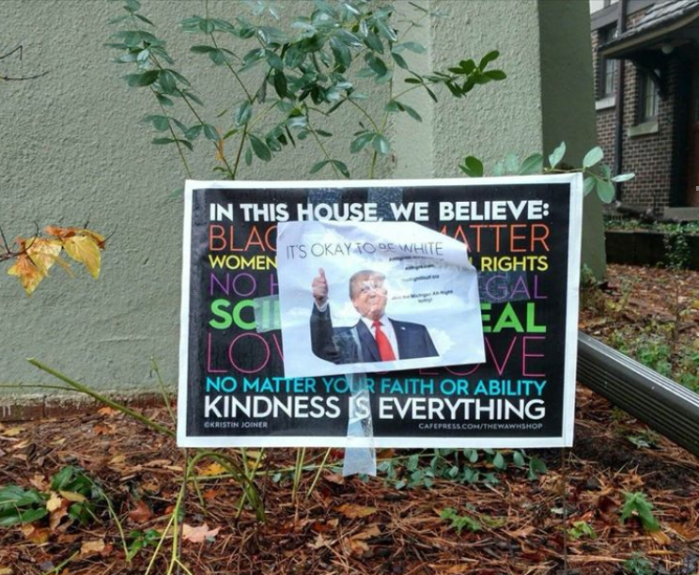
 

aposter1


In context, then, this statement doesn’t just mean “It’s okay to be white.” It means “It’s okay to be pro-white supremacist, to be pro-white power.”


And that brings up two other examples.


MAGA – Make America Great Again.


Take it out of context and it’s innocuous. It just means to increase the abstract greatness of the country to what it was at some unspecified time in the past.


However, if we put that statement in the context of the Trump campaign and its xenophobia, homophobia, Islamophobia, transphobia, etc. — then it’s meaning becomes clear. As noted above, it’s an ode to white power and nostalgia for greater white privilege.


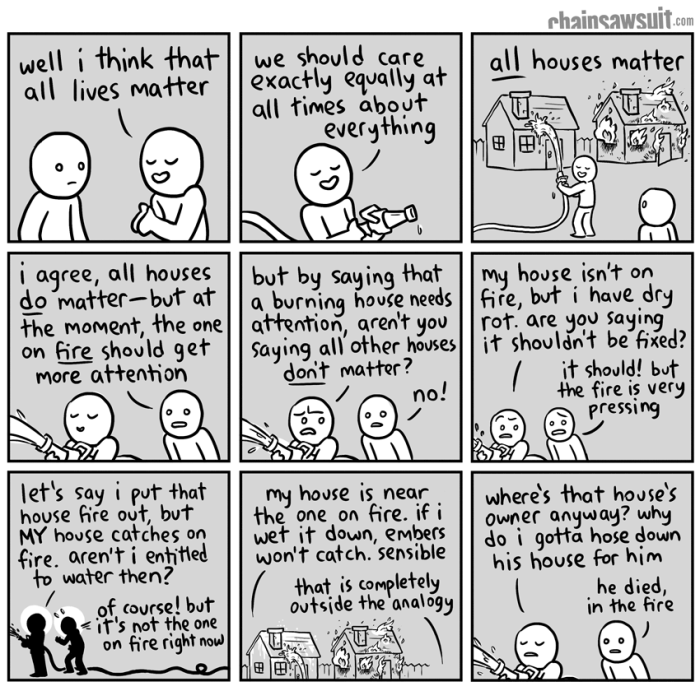
And “Black Lives Matter”? Why do many of these same Identitarians take exception to that slogan and the movement behind it?


The Alt Right says BLM is reverse racist. They claim the name BLM means “ONLY black lives matter.”


Context tells us differently.


The BLM group was formed in response to the indiscriminate murder of people of color and those who committed these crimes not behind held accountable. Officer Darren Wilson not indicted for killing Michael Brown. Officer Daniel Pantaleo not indicted for killing Eric Garner. Officers Timothy Loehmann and Frank Garmback not indicted for killing Tamir Rice. And on and on.


Yet the Alt Right is allowed to mischaracterize a simple call for peace as if it identified a terrorist organization.


Why? Because context has been banished from the building.
 

20160707_allhousesredux


I’m not saying that Common Core has caused these problems, but it has allowed them.


I doubt this is what Coleman, who is Jewish, intended.


But whenever you water down critical thinking – even if it’s for purely practical ends – you end up hurting everyone.


The best societies praise intellect and tolerance.


For all their faults, our founders knew this. That’s why they emphasized the importance of public education.


If we had ensured everyone in the country had access to the best possible education, this modern Nazi subculture wouldn’t be able to make as much headway as it has.


This is yet another way that our obsession with unrestrained capitalism, neoliberalism and plutocracy has put us on a road that may end in fascism.


The Lone Voice of Dissent Against Standardized Testing

Businesswoman shouting through the megaphone in the open air.


Everybody wants to fight the good fight.


Until the battle begins.


Then many of us are all too ready to give in to what was intolerable just a moment before.


To paraphrase Thomas Paine:


These are the times that try men’s souls. The summer soldier and the sunshine patriot will, in times of crisis, shrink from service, but those who stand up in time of need deserve the love and thanks of every man and woman.


I see this almost every day in our schools.


Ask nearly any teacher what they think about high stakes standardized testing, and they’ll complain until they’re blue in the face.


They’ll give you gripes and grievances galore.


The tests take too long. They’re not valid assessments. They narrow the curriculum. They’re dumbing down the teaching profession and ripping away our autonomy.


To which I say – Amen, Sister!


Standardized tests more accurately measure economics than academics – poor kids generally fail and rich kids pass. They’re culturally biased, poorly put together, unscientifically graded and demonstrate a gobbsmacking conflict of interest.


Two conflicts of interest, actually.


First, the people who make the tests, grade the tests and thus have a financial interest in failing the most students possible because that means we have to buy more remediation material which they also conveniently sell.


Second, these test scores are used by the school privatization industry to unfairly label public schools failures so they can more easily sell fly-by-night charter and voucher schools.


So, yeah. Almost all of us agree standardized testing sucks.


But when there’s an administrator present, I too often find I’m the only one willing to speak that truth. My colleagues, who are pleased as punch to gripe in private, suddenly go quiet in the presence of their superiors.


What’s worse, some of them don’t just stay quiet – they offer arguments to support whatever nonsensical test-based solution our boss has in mind today.


Let’s say an administrator suggests we do something about the handful of students who opt out of standardized tests.


We could just respect the rights of parents who have handed in their written intention to opt their children out under a religious exemption – the only option in Pennsylvania. Or we could do as the administrator suggests and force kids who’ve been opted out to take a standardized look-a-like assessment.


I hear something like that, and I’m on my feet ready to fight.


But I find myself standing there alone.


“You can’t do that,” I say.


“It violates state law. In particular, Pennsylvania Code Title 22 Chapter 4, section 4.4.


(Okay, I had to look up the particulars later, but I made sure the administrator got them.)


Consider subsection (d) (4). And I quote:


If upon inspection of a State assessment parents or guardians find the assessment to be in conflict with their religious belief and wish their students to be excused from the assessment, the right of the parents or guardians will not be denied…”


Or how about subsection (d) (3):


“School entities shall adopt policies to assure that parents or guardians [have]… (3) The right to have their children excused from specific instruction that conflicts with their religious beliefs, upon receipt by the school entity of a written request from the parent or guardians.” (Emphasis mine)


In other words, parents have a right to excuse their children from the tests and/or instruction such as test look-a-likes.


If we go forward with requiring students who are opted out to take tests that are just like the ones their parents instructed us NOT to give, we will be violating parents’ rights under state law.”


That seems pretty airtight to me.


But the administrator disagrees.


And I look around at the assembled mass of workaday teachers for support.


Not a peep.


Instead I get this:


-We’re being evaluated on these standardized tests, we have to make sure kids take them seriously.


-I see where you’re coming from but we have to do something about these kids who are opting out just to get out of doing the work. They don’t have any real intellectual objection. They’re just lazy.


-We’ve got to do something about grade inflation.


Oh. Em. Gee.


Yet after the meeting, some of them cautiously walk up to me asking my opinion of what went down.


YOU DON’T WANT TO HEAR MY OPINION RIGHT NOW!


Take my word for it.


Tomorrow or the next day or the next week, they’ll be complaining again.


I’ve seen some of these people reduced to tears by administrators unfairly manipulating them based on their students’ test scores.


Yet none of them have the guts to stand up and be counted when the moment comes.


I say again – everyone wants to fight. But no one wants to do the fighting.


They want someone else to do it for them.


Does that make you angry?


It makes me furious.


But if you feel that way, you’ve got to do something about it.


You think teachers are too cowardly? What have YOU done to fight corporate education reform today?


You think too many administrators are quislings. You think the lawmakers are bought and sold. You think the public schools are under attack.


Well, get off your ass and do something.


I am tired of being the lone voice of dissent here.


All across the country there are people like me – people willing to stand up and fight.


But it’s a big country, and we’re usually spread pretty thin.


We need people willing to put their money where their mouths are – right here, in our hometowns.


Put up or shut up, America.


Do you want a school system that serves the needs of children?


You’ve got to make it happen.


I can’t do this all by myself.

Economists Don’t Know Crap About Education

3c19197


I hate to be blunt here, but economists need to shut the heck up.


Never has there been a group more concerned about the value of everything that was more incapable of determining anything’s true worth.


They boil everything down to numbers and data and never realize that the essence has evaporated away.


I’m sorry but every human interaction isn’t reducible to a monetary transaction. Every relationship isn’t an equation.


Some things are just intrinsically valuable. And that’s not some mystical statement of faith – it’s just what it means to be human.


Take education.


Economists love to pontificate on every aspect of the student experience – what’s most effective – what kinds of schools, which methods of assessment, teaching, curriculum, technology, etc. Seen through that lens, every tiny aspect of schooling becomes a cost analysis.


And, stupid us, we listen to them as if they had some monopoly on truth.


But what do you expect from a society that worships wealth? Just as money is our god, the economists are our clergy.


How else can you explain something as monumentally stupid as Bryan Caplan’s article published in the LA Times “What Students Know That Experts Don’t: School is All About Signaling, Not Skill-Building”?


In it, Caplan, a professor of economics at George Mason University, theorizes why schooling is pointless and thus education spending is a waste of money.


It would be far better in Caplan’s view to use that money to buy things like… oh… his new book “The Case Against Education: Why the Education System Is a Waste of Time and Money.”


His argument goes something like this: the only value of an education is getting a job after graduation.


Businesses only care about school because they think it signifies whether prospective employees will be good or bad at their jobs. And students don’t care about learning – they only care about appearing to have learned something to lure prospective employers. Once you’re hired, if you don’t have the skills, employers have an incentive to give you on the job training. Getting an education is just about getting a foot in the door. It’s all just a charade.


Therefore, we should cut education funding and put kids to work in high school where they can learn how to do the jobs they’ll need to survive.


No wonder economics is sometimes called “The Dismal Science.” Can you imagine having such a dim view of the world where THAT load of crap makes sense?


We’re all just worker drones and education is the human equivalent of a mating dance or brilliant plumage – but instead of attracting the opposite sex, we’re attracting a new boss.


Bleh! I think I just threw up in my mouth a little bit.


This is what comes of listening to economists on a subject they know nothing about.


I’m a public school teacher. I am engaged in the act of learning on a daily basis. And let me tell you something – it’s not about merely signifying.


I teach 7th and 8th grade language arts. My students aren’t simply working to appear literate. They’re actually attempting to express themselves in words and language. Likewise, my students aren’t just working to appear as if they can comprehend written language. They’re actually trying to read and understand what the author is saying.


But that’s only the half of it.


Education isn’t even just the accumulation of skills. Students aren’t hard drives and we’re not simply downloading information and subroutines into their impressionable brains.


Students are engaged in the activity of becoming themselves.


Education isn’t a transaction – it’s a transformation.


When my students read “The Diary of Anne Frank” or To Kill a Mockingbird, for example, they become fundamentally different people. They gain deep understandings about what it means to be human, celebrating social differences and respecting human dignity.


When my students write poetry, short fiction and essays, they aren’t merely communicating. They’re compelled to think, to have an informed opinion, to become conscious citizens and fellow people.


They get grades – sure – but what we’re doing is about so much more than A-E, advanced, proficient, basic or below basic.


When the year is over, they KNOW they can read and understand complex novels, plays, essays and poems. The maelstrom of emotions swirling round in their heads has an outlet, can be shared, examined and changed.


Caplan is selling all of that short because he sees no value in it. He argues from the lowest common denominator – no, he argues from the lowest actions of the lowest common denominator to extrapolate a world where everything is neatly quantifiable.


It’s not hard to imagine why an economist would be seduced by such a vision. He’s turned the multi-color world into black and white hues that best suit his profession.


In a way, I can’t blame him for that. For a carpenter, I’m sure most problems look like a hammer and a nail. For a surgeon, everything looks like a scalpel and sutures.


But shame on us for letting one field’s myopia dominate the conversation.


No one seems all that interested in my economic theories about how to maximize gross domestic product. And why would they? I’m not an economist.


However, it’s just as absurd to privilege the ramblings of economists on education. They are just as ignorant – perhaps more so.


It is a symptom of our sick society.


We turn everything into numbers and pretend they can capture the reality around us.


This works great for measuring angles or determining the speed of a rocket. But it is laughably unequipped to measure interior states and statements of real human value.


That’s why standardized tests are inadequate.


It’s why value added teacher evaluations are absurd. It’s why Common Core is poppycock.


Use the right tool for the right job.


If you want to measure production and consumption or the transfer of wealth, call an economist.


If you want to understand education, call a teacher.

When Will It Happen Here?


classroom


It could happen at anytime in my classroom.


The thing we’ve all been dreading.


A hasty announcement of lock down. An unexpected fire alarm. The sounds of shouting, running feet and… gunshots.


The lights could go out. The door could burst in.


There’s really very little we could do.


My room has no windows. No closets. Nowhere to hide.


These are the thoughts going through my head as my students sit at their desks during homeroom this morning.


Jayden is taking off his hoodie before the principal catches him out of dress code.


Alaina is pestering me for a pass to the library.


Darnell is surreptitiously munching on a pixie stick stashed in his book bag.


It’s all so mundane, so subdued, so quiet.


A few kids are on the computers in the back, others at their desks reading books, writing papers, or listening to music on their iPads.


But there’s very little conversation.


The class of middle schoolers is restrained, thoughtful – which is unusual for children of 12 or 13.


I sit slumped at my desk – exhausted though I haven’t even taught my first class yet.


The news from last night still plays in my head.


Seventeen people killed by an expelled student at a high school in Parkland, Florida.


Or was it two killed in Kentucky?


How long was it since the last one?


And now here we are – back in the line of fire.


I can’t help but think about my daughter somewhere across town. She’s probably just entering her third grade classroom maybe munching on the remains of a candy heart from Valentine’s Day. Just like me and my students, she’s in the cross hairs.


But what can we do about it?


I can’t hold her out of school forever. I can’t quit my job and work from home. Even if I could, there’s absolutely nothing I can do for the twenty children quietly sitting at their desks in the room with me, abiding the rules of a society too broken to protect us.


After last night, it feels like things have changed somehow.


There have been 18 school shootings so far this year. And it’s only February. Most have resulted in zero injuries.


Of those where people were hurt, the person most in danger was the shooter. But I can’t stop thinking about those cases where a hunter came to school to kill children and teachers.


As an educator, I’ve been taught how to handle just about every situation.


If one of my children acts out, or doesn’t hand in her homework, or even throws up – I know what to do.


But none of my training has prepared me to out teach a semiautomatic weapon.


I can’t differentiate past a bullet.


There is no paperwork that will invalidate the gunpowder or slow the endless rounds through whatever they come into contact.


If someone comes to school with a gun and a will to kill, I will be little more than a target.


But don’t get me wrong.


This doesn’t mean society should gift me a handgun to keep in my desk next to the chalk.


I am not a law enforcement officer or an action hero. I’m a teacher.


You don’t want me returning fire at every mindless bureaucratic hitch in the schedule. You want me assigning essays and chapter readings. You don’t want me keeping a gun out of reach of curious youngsters always at my desk and in my personal space. You want me safeguarding student assignments and – heck – my cell phone that kids keep trying to snatch and look through my camera roll.


What we need is real gun control legislation.


We need an assault weapons ban.


We need to close the gun show loophole.


We need buyback programs to get the mountains of firearms off the streets and out of the arsenals of a handful of paranoid “survivalists”.


In short, we need lawmakers willing to make laws.


We need legislators who will represent the overwhelming majority of the public and take sensible action to protect the people of this country.


What we don’t need are the trolls who hijack every conversation arguing the semantics of the term “assault rifle” or “terrorist.”


We don’t need weak politicians cautioning against “politicizing” mass shootings because the violence is too fresh.


We don’t need anyone’s thoughts and prayers.


We need action.


And we need it yesterday.


Some people are calling on teachers to take action to force our lawmakers to finally do something.


They suggest a national teachers strike on May 1st – May Day – if Congress refuses to act.


That sounds like a good idea to me.


I’m game.


But we need more than that.


We need everyone who feels the same way to join in the fight.


Parents, children, grandparents, principals, police, firefighters, soldiers and nurses – the multitudinous faces of America must come together to fight this monstrosity as one.


I may sit in that classroom.


My students and my daughter may be in danger.


But America must be the shield.


America must rise up and protect our future.


WE must take charge.


Otherwise, it is not a case of can it happen here.


It is a case of when.

Why I Teach

https___blueprint-api-production.s3.amazonaws.com_uploads_card_image_488464_d6180c5d-946d-4770-9d02-091555a03a3b

Every year it’s the same nightmare.

I’m in front of a class of middle school students who aren’t paying any attention to me.

I point to the board, stamp my foot, even scream in vain.

But the children keep acting up – throwing pencils, swearing, hurting each other’s feelings.

It’s like I’m invisible.

And then I wake up.

Every teacher probably has a similar dream the night before their first day with students.

It’s a dream of impotence and redundancy.

Kind of like the businessmen and their political puppets claim we, teachers, are every day.

But the reality is much different.

Kids come bouncing in to my room, bristling with energy, half concealed hopes and fears.

Before they come in, I’m full of doubt: Can I still do this for another year? Will I be able to keep up with the work load? Will I be able to accommodate all the extra services for every special education student in my mainstreamed classroom? Do I have enough desks, pencils, paper? Have I planned enough for the first week? Will I be able to keep students interested, entertained, disciplined, engaged, working, inspired?

But the second the kids enter the classroom – literally the exact second – all my doubts disappear.

There’s no time.

I have more than two dozen children to see to at any given moment – and their needs outweigh any of mine.

It wasn’t until about halfway through the day that I even had an instant to myself to stop, breathe and reflect.

After my first bathroom break in more than 3 hours, then grabbing my lunch and collapsing into a seat- the first time I’m off my feet with no anxious little faces looking up to me – I think back on my day and realize – I absolutely love this!

No, really.

My feet hurt, my temples throb from making a hundred tiny decisions every 40 minutes, my body feels like it’s already been through a war… But there is no place in the world I would rather be.

Look what I’ve already accomplished today!

I took about 50 anxious human beings and made them feel like it was going to be okay.

I made 50 faces smile, sigh and relax.

I worked for hours on a new syllabus last week with manga graphics and punchy repartee, and when the kids got it today, they knew this class wasn’t going to be boring. I planned some ice breaker games to get them focused on our budding community of learners. I modeled how we can interact and still respect each other.

And in return I heard: “This is the best class!” “Mr. Singer is my favorite teacher!” “I don’t like to read or write but I’m really looking forward to doing your homework!”

How can you hear such things and not come away energized and new? How can you see such things and not feel a warm glow in your heart?

One of my first assignments is to have students write a letter about themselves. It’s now day 3 and I’m sitting at my desk reading through them.

It’s heartbreak city. Dead or absent parents, lost friends and pets, moving from place-to-place, older brothers and sisters serving as caregivers, pledges to work hard this year and make some missing adult proud. I find myself tearing up and writing supportive comments: “That’s so sad.” “I hope you like it here.” “You’ve already made me proud.”

I go through my Individual Education Plans and see a catalogue of hurt and trauma. Babies, they’re just babies, and they’ve gone through more than I have in my whole life. And I’m more than three times their age!

How can I not come to school every day and give my very best?

A public school is more than a building to me. It’s a temple to humanity. It’s where we go to offer ourselves to other people.

Every action, every thought spent on these children is holy. The tiniest gesture is magnified through infinite time and space. When I help a child gain confidence in her reading, I help not just her. I help everyone she will ever come into contact with –her co-workers, her friends, family, even her own children if she someday has some.

It’s humbling. Amazing. Staggering.

Where else can you see the accumulated hurt of the world and actually make a dent in it? Where else can you reach out not just to a cause or an idea but to a living person?

I’m lucky. I am so lucky. My circumstances allowed me to do whatever I wanted with my life.

I could have become a doctor or a lawyer. I could have gone into business and made a whole mess of money. But I never wanted any of that. I wanted to make a difference. I wanted to help people.

I remember the pitying looks peers would give me in my 20s. What a waste, they seemed to say. But I’ve never regretted it.

This is what I was meant to do. It’s the only thing I ever could and still respect myself.

Some folks will tell you teaching is about numbers and data. Increase these test scores. Cut costs by this much. Boost profits, escalate the graph, maximize effectiveness.

These people are fools.

Teaching has nothing to do with any of that. It’s about the children. Being there for them. Being an active part of eternity.

Thankful eyes, delighted smiles, joyous laughter. Ameliorating hurt. Igniting a tiny candle whose light will grow to encompass sights I will never see.

That’s why I teach.