We’re making murals of artists from the Harlem Renaissance. We’re jamming to jazz, blues, R&B and hip hop. We’re reading excerpts from the “Autobiography of Malcolm X.” We’re writing journals about what it means to be the people we are and to come from wherever we come from.
In short, we’re having a lot of fun.
But each child responds differently to the siren call of Black History – especially when the person making the call is a white teacher, like me.
Today I asked my classes of 7th grade students – most of whom are impoverished and/or minorities – “Would you like to talk about some Black History?”
And the responses I got were all over the place.
Some of the children enthusiastically took to their feet with a robust “Yeah!”
Others nodded. Some were merely quiet as if they didn’t think I were asking a real question. And some honestly ventured “No.”
In one class, a white student got so upset at the suggestion we spend valuable class time on Black History that he fell to the floor and almost hide under the table.
I’ll admit I was somewhat shocked by that.
What was he so reticent about? I mean I know the kid. He loves black culture. We all do. What does he have against learning about black people?
He’s a big heavy metal fan. What’s heavy metal without Jimi Hendrix?
He loves standup comedy. What’s standup comedy without Richard Pryor, Eddie Murphy or – heck – even Steve Harvey?
And didn’t I see him the other day watching the preview to Marvel’s “Black Panther” with baited breath?
“What’s wrong?” I asked him on the floor.
“Mr. Singer, I really don’t want to learn about Black History.”
And it was on the tip of my tongue, but I didn’t say it – “Dude, if anyone needs to learn Black History, it’s you.”
I patted him on the back and told him he’d survive. But I let him stay on the floor.
The kids were almost hypnotized. I’m not sure if it was the images from the movie “Selma,” the gorgeous singing and piano playing or the unexpected joy of hearing someone rapping in class.
When it was over, most of them couldn’t wait to talk about a few well-chosen people of color.
We started with the black power fist from the 1968 Olympics, talked about Tommie Smith and John Carlos, why they did what they did and even how it related to modern day protests like those initiated by Colin Kaepernick.
In short, it would be difficult to find a more productive 20-30 minutes. Kids were engaged and thoughtful, many looking up further details on their iPads as the bell rang and they left the room.
All except the white child on the floor.
He had participated in the discussion – reluctantly. But he hadn’t moved from his cave.
“Can I talk to you, Mr. Singer?” he said.
I told him, “Sure.” And he went on to tell me the kinds of things his grandparents say about black people.
He told me about their virulent opposition to Kaepernick, how they though black people were just whining about nothing and that racism had been over for fifty years.
It’s a hard position to be put in by a student.
You don’t want to contradict their folks, but you can’t let untruths pass by either.
I asked him what he thought about it. He wasn’t so sure.
So I told him just to think about what we had said. I asked him to keep an open mind.
For instance, I said, if Kaepernick shouldn’t take a knee during the National Anthem, when should he protest?
“How about with a sign in the street?” he said.
To which I responded that black people have done that and been told that was just as unacceptable.
By this time another student came back into the room and walked up to us. She was a white girl who’s usually very quiet.
“Mr. Singer, thank you for talking with us about all that stuff today,” she said.
I told her she was welcome and asked her what she thought about it.
“I just wish all this stuff wasn’t happening,” she said.
I asked her to elaborate.
“I mean that black power fist thing you showed us, that was like a hundred years ago.”
“Fifty years,” I corrected and she repeated me.
“And it’s still happening,” she said. “I just don’t understand why. Why can’t we all just live in peace?”
I smiled at her and the boy who had been quietly listening.
We spoke a bit further and they walked off together in deep conversation.
There are many great reasons to talk about Black History.
Allowing kids to think for themselves means allowing them to come to conclusions you might not agree with.
The boy from my class might come in next week further convinced of his grandparents’ prejudice. Or he might not. But I suspect he will have thought about it some.
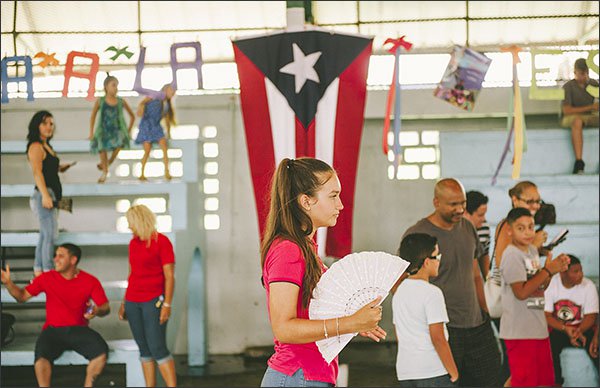
Roughly 25,000 students are leaving with that number expected to swell to 54,000 in four years. And that’s after an 11-year recession already sent 78,000 students seeking refuge elsewhere.
So what do you do to stop the flow of refugees fleeing the island? What do you do to fix your storm damaged schools? What do you do to ensure all your precious children are safe and have the opportunity to learn?
And it means fewer choices for children who will have to apply at schools all over the island and hope one accepts them. Unlike public schools, charter and voucher schools pick and choose whom to enroll.
The results have been an abysmal academic record, the loss of black teachers, black neighborhoods, cultural heritage and in its place support for a status quo that just doesn’t care to provide the proper resources to students of color.
If the Governor and his wealthy backers have their way, Puerto Rico will be yet another ghettoized colony gobbled up by industry.
However, the people aren’t going to let this happen without a fight.
Mercedes Martinez, President of the Federacion de Maestros of Puerto Rico, an island teacher’s union, released the following statement:
“Dear comrades in the diaspora, now more than ever we need your unconditional solidarity.
Governor Roselló just announced his plan to shut down 307 schools, implement charter schools and vouchers. Disaster capitalism at its best. Added to the announcement of the privatization of PREPA. [Puerto Rico Electric Power Authority]
The way to victory is already paved, organized and militant resistance, concrete proposals to improve the public goods that we have, unity and organization. Be our voice in the states and let the world know that corporate reformers want to make PR the next New Orleans as they did after Katrina.
The hurricane has been the perfect storm and excuse for them to advance their plans. Today the so called “educational reform” will be sent to the legislature.
We will give the hardest fight of our lives, and we will triumph. Send letters and videos of support with our struggle. Teachers United, will never be defeated!
Lucha sí”
I don’t know about you, but I stand with these brave teachers, parents and their students.
I may live in Pennsylvania, my skin may be white, but I do not support the theft of Puerto Rico’s schools.
They deserve the choice to guide their own destinies.
Teachers’ opposition to the move comes even though the Governor is proposing a $1,500 raise for all educators. Martinez says it could come to a general strike.
Their cause has hope on its side – especially in blocking the proposed school vouchers.
The Governor’s voucher proposal wouldn’t go into effect until the 2019-20 school year. However, the Puerto Rico Supreme Court struck down a similar program in 1994 when the current governor’s father, Pedro Rossello – himself a former governor – tried to push it through. The court ruled the island’s constitution forbids public money being used to fund privately run schools.
From this day forward, let us always remember what they did to New Orleans. Let us remember what they are trying to do to Puerto Rico.
Corporate school reform is not about making better schools. If it was, you would see plans like this being proposed in Beverly Hills and rich white neighborhoods across the country.
In this article, I’m going to try to explain in the most simple terms I know the reality of segregation in our schools, how it got there and the various forms it takes.
I do this not because I am against public education. On the contrary, I am a public school teacher and consider myself a champion of what our system strives to be but has never yet realized. I do this because until we recognize what we are doing and what many in power are working hard to ensure we will continue doing and in fact exacerbate doing, we will never be able to rid ourselves of a racist, classist disease we are inflicting on ourselves and on our posterity.
America, the Segregated
It’s never been one monolithic program. It’s always been several co-existing parallel social structures functioning together in tandem that create the society in which we live.
I’m reminded of possibly the best description of American segregation on record, the words of the late great African American author James Baldwin who said the following on the Dick Cavett Show in 1968:
“I don’t know what most white people in this country feel. But I can only conclude what they feel from the state of their institutions. I don’t know if white Christians hate Negroes or not, but I know we have a Christian church that is white and a Christian church that is black. I know, as Malcolm X once put it, the most segregated hour in American life is high noon on Sunday.
That says a great deal for me about a Christian nation. It means I can’t afford to trust most white Christians, and I certainly cannot trust the Christian church.
“I don’t know whether the labor unions and their bosses really hate me — that doesn’t matter — but I know I’m not in their union. I don’t know whether the real estate lobby has anything against black people, but I know the real estate lobby is keeping me in the ghetto. I don’t know if the board of education hates black people, but I know the textbooks they give my children to read and the schools we have to go to.
“Now this is the evidence. You want me to make an act of faith, risking myself, my wife, my woman, my sister, my children on some idealism which you assure me exists in America, which I have never seen.”
As Baldwin states, there are many different ways to keep black people segregated. There are many different flavors of the same dish, many different strains of the same disease.
We can say we’re against it, but what we say doesn’t matter unless it is tied to action.
You can say you’re in favor of equity between black and white people all day long, but if the policies you support don’t accomplish these things, you might as well wear a white hood and burn a cross on a black person’s lawn. It would at least be more honest.
Segregated Schools
In terms of public education, which is the area I know most about and am most concerned with here, our schools are indeed set up to be segregated.
If there is one unstated axiom of our American Public School System it is this: the worst thing in the world would be black and white children learning together side-by-side.
They point to inequalities they, themselves, helped create and use them to push for a system that would create even worse inequality. They point to the segregation that they, themselves, helped install and use it as an excuse to push even more segregation.
And they do so by controlling the media and the narrative. They call themselves reformers when they’re really vandals and obstructionists looking to subvert the best in our system in order to maximize the worst.
School Segregation Today
Sure we don’t have very many all white or all black schools like we did before Brown v. Board. Instead we have schools that are just predominantly one race or another.
ALL kids are not divided by race. Just MOST of them.
White people and black people tend to live in different neighborhoods. Some of this is a choice. After a history of white oppression and racial strife, people on both sides of the divide would rather live among those with whom they identify.
Black people don’t want to deal with the possibility of further deprivations. White people fear retaliation.
However, white people generally enjoy a higher socio-economic status than black people, so there is some push back from black folks who can afford to live in whiter neighborhoods and thus enjoy the benefits of integration – bigger homes, less crowding, less crime, access to more green spaces, etc. But even when there is a desire, moving to a white neighborhood can be almost impossible.
State and federal laws, local ordinances, banking policies and persistent prejudice stand in the way.
In short, red lining still exists.
Real estate agents and landlords still divide up communities based on whom they’re willing to sell or rent to.
And this is just how white people want it.
They’re socialized to fear and despise blackness and to cherish a certain level of white privilege for themselves and their families.
And if we live apart, it follows that we learn apart.
The system is set up to make this easy. Yet it is not uncomplicated. There is more than one way to sort and separate children along racial and class lines in a school system.
There are several ways to accomplish school segregation. It comes in multiple varieties, a diversity of flavors, all of which achieve the same ends, just in different ways.
By my reckoning, there are at least three distinct paths to effectively segregate students. We shall look at each in turn:
Put the white neighborhoods in District A and the black ones in District B. It’s kind of like gerrymandering, but instead of hording political power for partisan lawmakers, you’re putting your finger on the scale to enable academic inequality.
However, sometimes you can’t do that. Sometimes you don’t have the power to determine the makeup for entire districts. Instead, you can do almost the same thing for schools within a single district.
That means the whiter districts get higher paid and more experienced teachers. It means they have broader curriculum, more extracurricular activities, a more robust library, more well-trained nursing staff, more advanced placement courses, etc.
Fewer funds mean fewer resources, fewer opportunities, more challenges to achieve at the same level that white students take for granted. A budget is often the strongest support for white supremacy in a given community or society as a whole. In fact, if you want to know how racist your community is, read its school budget. You want accountability? Start there.
The same holds even when segregation is instituted not at the district level but at the level of the school building.
It may sound ridiculous but this is exactly what happens much of the time. You have gorgeous new buildings with first class facilities in the suburban areas and run down crumbling facilities in the urban ones – even if the two are only separated geographically by a few miles.
Like any parasite, charter and voucher schools only survive in the proper environment. It usually looks like this.
Sometimes no matter how you draw the district lines or how you appropriate the buildings, you end up with a black majority and a white minority. That’s a situation white parents find simply intolerable.
White children must be kept separate and given all the best opportunities even if that means taking away the same for black children.
Once again, this creates the opportunity for a resource gap. The charter and voucher schools suck away needed funds from the public schools and then are subsidized even further by white parents.
The quality of education provided at these institutions is sometimes better – it’s often worse. But that’s beside the point. It’s not about quality. It’s about kind. It’s about keeping the white kids separate and privileged. It’s about saving them from the taint of black culture and too close of an association with black people.
Second, the situation can work in reverse. Instead of dividing the whites from the blacks, it divides the blacks from the whites.
This happens most often in districts where the divide is closer to equal – let’s say 60% one race and 40% another. Charter and voucher schools often end up gobbling up the minority students and leaving the white ones in the public school. So instead of white privatized and black public schools, you get the opposite.
And make no mistake – this is a precarious position for minority students to be in. Well meaning black parents looking to escape an underfunded public school system jump to an even more underfunded privatized system that is just waiting to prey on their children.
Unlike public schools, charter and voucher institutions are allowed to pocket some of their funding as profit. That means they can reduce services and spending on children anytime they like and to any degree. Moreover, as businesses, their motives are not student centered but economically driven. They cherry pick only the best and brightest students because they cost less to educate. They often enact zero tolerance discipline policies and run themselves more like prisons than schools. And at any time unscrupulous administrators who are under much less scrutiny than those at public schools can more easily steal student funding, close the school and run, leaving children with no where to turn but the public school they fled from in the first place and weakened by letting privatized schools gobble up the money.
The result is a public school system unnaturally bleached of color and a privatized system where minority parents are tricked into putting their children at the mercy of big business.
3) Tracking
But that’s not all. There is still another way to racially segregate children. Instead of putting them in different districts or different schools, you can just ensure they’ll be in different classes in the same school.
However, it most often results in further stratifying students socially, economically and racially.
Here’s how it works.
Often times when you have a large enough black minority in your school or district, the white majority does things to further horde resources even within an individual school building or academic department.
In such cases, the majority of the white population is miraculously given a “gifted” designation and enrolled in the advanced placement classes while the black children are left in the academic or remedial track.
It enables bleaching the advanced courses and melanin-izing the others. This means administration can justify giving more resources to white students than blacks – more field trips, more speakers, more STEAM programs, more extracurriculars, etc.
And if a white parent complains to the principal that her child has not been included in the gifted program, if her child has even a modicum of ability in the given subject, more often than not that white child is advanced forward to the preferential class.
CONCLUSIONS
Segregation is a deep problem in our public school system. But it cannot be solved by privatization.
In fact, privatization exacerbates it.
Nor is public education, itself, a panacea. Like any democratic practice, it requires participation and the economic and social mobility to be able to participate as equals.
Schools are the product of the societies that create them. An inequitable society will create inequitable schools.
Segregation has haunted us since before the foundation of our nation.
They don’t want their children to be educated among black students – maybe SOME black students, maybe the best of the best black students, but certainly not the average run of the mill brown-skinned child.
This has to stop.
There are plenty of benefits even for white students in an integrated education. It provides them a more accurate world-view and helps them become empathetic and prize difference.
It was a year that frankly I wasn’t sure I’d survive.
But I did. We did. Together.
I think if there’s any lesson from the last 365 days, it’s that: We can endure anything if we stay united.
We’ve taken down titans of industry simply by acts of belief. When women came forward with credible tales of abuse, for the first time we – as a society – actually believed them.
We’ve taken down the most morally repugnant child abusers with designs on national office simply by supporting the black vote. And no matter how much power tried to disenfranchise our brothers and sisters of color, we stood by them and made sure their voices were heard.
These are the kinds of things we need more of in the New Year.
If you take all the “minorities” in this country – minorities of gender, race, sexuality, creed, religion, etc. – if you add us all together, we actually are the majority!
When you add white people of conscience with black people, Latinos and Hispanics, LGBTs, women, Muslims, and every other historically disenfranchised group, we have the upper hand. And when you compare economic disparities of the 99% vs the 1% or poor vs rich, it’s not even close!
And I’m not talking about some time in the future. I’m talking about right now!
All we need to do is stand together and fight for each other.
So as 2018 is about to dawn, I am filled with hope for the future. A truly amazing year may be about to dawn. It’s all up to us.
In the meantime, I take my last look over my shoulder at the year that was.
As an education blogger, I write an awful lot of articles, 119 articles so far this year. In fact, this piece – which will probably be my last of the year – brings me to 120!
I’ve already published a countdown of my most popular articles. If you missed it, you can still read it here.
However, as is my custom, I like to do one final sweep of my annual output counting down honorable mentions. These are the top five articles that maybe didn’t get as many readers, but that I think deserve a second look.
I hope you enjoy my top 5 hidden gems before I place them in the Gadfly vault and begin the hard work of making 2018 a better tomorrow:
Description: Standardized testing is often championed by people who claim to be free market capitalists. Yet it struck me that there was nothing free about the market being perpetrated on public schools when it comes to high stakes tests. Schools don’t give these tests because anyone in these districts actually thinks they help students learn. We do it because we’re forced by federal and state governments. It’s a racket, and in this article I explain exactly how and why.
“When I read this post by Steven Singer, I was so excited that I thought about devoting an entire day to it. Like posting it and posting nothing else for the entire day. Or posting this piece over and over all day to make sure you read it. It is that important.
Steven’s post explains two different phenomena. First, why is standardized testing so ubiquitous? What does it have a death grip on public education?
Second, in the late 1990s, when I was often in D.C., I noticed that the big testing companies had ever-present lobbyists to represent their interests. Why? Wasn’t the adoption of tests a state and local matter? NCLB changed all that, Race to the Top made testing even more consequential, and the new ESSA keeps up the mandate to test every child every year from grades 3-8. No other country does this? Why do we?”
Description: According to landmark research by Dan Goldhaber and James Coleman, only about 9 percent of student achievement is attributable to teachers. The entire school experience only accounts for 20%. By far, the largest variable is out of school factors, which accounts for 60% of a student’s success. Yet we insist on holding teachers accountable for nearly 100% of it. We demand our teachers be superhuman, give them next to zero support, and then get indignant when they can’t do it all alone. Sorry, folks, I’m just a human being.
Fun Fact: Our expectations for teachers are ridiculous. We want them to do everything and then we blame them for acting like saviors. I think it’s vital that people acknowledge this impossible situation we put educators in and start to take more social responsibility. Your schools won’t get better until you do something about it. Stop complaining and get to work. That means voting for lawmakers who support public education. That means attending school board meetings. That means holding the decision makers responsible. Not just taking advantage of an easy scapegoat.
Description: What does a teacher think about when he or she is forced to give a standardized test? This article is my attempt to capture the no-win situation that our society forces on teachers every year. Apparently we must choose between doing things that we know are harmful to our students or taking a stand and possibly losing our jobs. You become a teacher to help children and then find that harming them is in the job description. Is this really what society wants of us?
Fun Fact: This article resonated deeply with some readers. In fact, a theater group in Ithaca, NY, Civic Ensemble, was so inspired by it that they used my article as the basis for a scene in a play made up of teacher’s real life stories about the profession. The play was called “The Class Divide.” You can watch a video of a practice performance of my scene here.
Description: A lot has been written about why charter and voucher schools are bad for parents, students and society. Less has been written about the ways that public schools do better than privatized education. This was my attempt to illuminate the ways public schools are better. They attract better teachers, have a more robust sense of community, have more educational options, have greater diversity, are more fiscally responsible – and that’s just the first five!
Fun Fact: When you list all the ways public schools are better than privatized ones, it becomes hard to imagine why they’re struggling. Public schools are clearly the best choice. The fact that they are being sabotaged by the privatization industry and their creatures in government is inescapable.
Description: When you ask racists why they oppose racial equity, the number one reason they give is the feeling that equity is a zero sum game. If black people are put on an equal footing with white people, then white people will ultimately lose out. This is patently untrue. White people will lose supremacy over other races, but they need not become subservient or lose their own rights. We can champion fairness for all without doing ourselves harm.
Fun Fact: This article kind of died on the vine, but I’m still proud of it. I think it is one of my best this year expressing my own thoughts and feelings about antiracism. I just wish more people had read it, because it sounds like this is an idea that more white people need to hear. We can only build a better world hand-in-hand.
This wasn’t the first year I’ve done a countdown of the year’s greatest hits. I usually write one counting down my most popular articles (like the one you just read from 2017) and one listing articles that I thought deserved a second look. Here are all my end of the year articles since I began this crazy journey in 2014:
So it was almost Christmas break and my middle school students were shuffling in to homeroom.
One of the girls turns to me and says, “Mr. Singer, am I okay to wear this?”
Hold up. I teach English.
I am not a fashionista or even particularly clothes conscious. So this question took me by surprise.
In the split second it took me to comprehend what she was asking and focus my eyes on the girl, I was expecting she might have on something too revealing or perhaps had an inappropriate slogan on her shirt or a marijuana leaf.
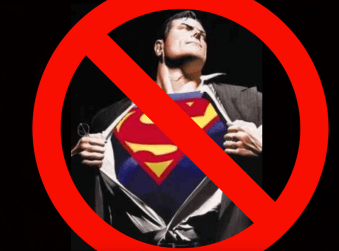
But no. She had on a simple blue long sleeve sweater with a red Superman symbol in the middle.
I was about to say that what she was wearing was perfectly acceptable, but then I remembered the dress code.
It was a new directive from the school board, and it was – frankly – a horror show.
We used to have a perfectly fine dress code that only made students refrain from clothing that was dangerous, inappropriate or sexually explicit. But then someone on the board heard about a neighboring district that modeled itself after a private school academy – so they had to do the same thing here.
It was beyond stupid. Only certain colors were allowed. Only certain kinds of clothing. No designs on t-shirts. And on and on.
I frankly paid no attention to it. But administrators did.
Though they rarely punished students for being late to class, improperly using cell phones or dropping an f- bomb, they swept through the building every morning to make sure every student was undeniably in dress code – to the letter.
And if a child was wearing a verboten item of clothing! Heaven forbid! That child was sent to in-school suspension for the remainder of the day unless a parent brought a change of clothing.
The same students would sit in “The Box” for days or weeks while their education was in suspended animation because they just couldn’t figure out which clothes the school board considered to be appropriate. (Or more likely they wanted a vacation from class.)
So when this girl – let’s call her Amy – asked me about her outfit, it was a pretty serious question.
And a difficult one.
Normally the Superman symbol would violate dress code, but I remembered that since it was only a few days before the holiday break, as an extra treat, students had been allowed to wear an “ugly Christmas sweater.” It was either that or conform to the usual dress code.
So all around me children were wearing fluffy red and green yarn creations sporting snowmen, Christmas trees and Santas.
But Amy was wearing a big red S.
By any definition, that’s not a Christmas sweater, and if the administrators wanted to take a hard line on the rules – and they usually did – she was out of dress code.
I told her what I thought. I said I had no personal problem with it and wouldn’t report her to the principal, but if she had a change of clothes, she might want to consider using them.
She didn’t.
And even if she did, it was too late. An administrator barreled into the room and proceeded to examine each child’s clothing.
Amy took her backpack and put it on backwards so that it covered her chest and the offending S.
Even that didn’t work.
When the administrator got to her, he asked to see what was under her backpack. She sighed and showed him.
But miraculously he said, “Okay,” and moved on.
Amy and I both breathed a sigh of relief. She was saved and wouldn’t have to spend the rest of the day in our school’s version of prison.
Before we could get too comfortable though, the hushed silence was broken when the administrator started screaming at another girl in the back of the room.
“That is not in dress code, and you know that’s not a Christmas sweater!” he screamed, cords standing out on his neck.
“How many times have I told you, but you think you can get away with anything…” and he continued to yell at her as she stomped out into the hall and presumably her locker.
And as she left, I saw that he was right. The girl he was yelling at – let’s call her Jada – was not wearing a Christmas sweater. She was wearing a plain gray and white flannel shirt. I don’t know how or why, but I guess that violated the dress code.
And for this offense she spent the day in in-school suspension.
I guess that’s not really Earth shattering, but it really bothered me.
It just seemed so unfair.
Jada was by no means a perfect student. But neither was Amy.
They both frequently broke rules and did pretty much what they wanted. They both could get an attitude, be catty, and mean.
However there was one distinguishing difference between them that immediately jumped to your attention – the color of their skins.
Amy was lily white. Jada was chocolate brown.
Now I’m not saying this administrator – who was white, by the way – was a virulent racist. I don’t know what went on inside his mind or heart.
In fact, I’d always thought of him as a fair-minded person who did his best to be impartial and treat students equally.
However, here was a case where he got it dead wrong.
Did he let Amy go because she was white? I don’t know. Did he come down on Jada because she was black? I don’t know.
My guess is that he was moving in a fog. He went to at least half of all the homerooms in the building checking each child to make sure they were in dress code. For some reason, when he looked at Amy, what he saw didn’t set off alarm bells. When he looked at Jada, it did.
Perhaps he remembered that Amy’s dad was a local cop and he didn’t relish having to call the police station to tell the officer that his daughter needed a change of clothes. Perhaps when he looked at Jada he was reminded of all the times she had been written up or defiant.
I accept that they are necessary in a public school setting.
It’s difficult to teach if students parts are hanging out, if they’re displaying coded messages on their chests, have advertising or rude statements on their clothing.
I once reported a girl for wearing a shirt that said “WTF.” She didn’t realize that I knew what the acronym meant. Another time I reported a student for wearing flip-flops. They were dangerous because kids could trip and fall but also the incessant slapping of plastic against heels drives me bonkers.
But other than that, I rarely get involved in dress codes.
Frankly, I think too strict a restriction on what students wear and too stringent enforcement of such policies does more harm than good.
It’s the school equivalent of broken windows policing. Instead of lowering crime by cracking down on the little stuff, too punitive severity in a dress code teaches kids that rules are arbitrary. Moreover, it creates fear and distrust of authority figures.
And – intentionally or not – it is a mechanism for enforcing white privilege.
Anytime I’ve had to oversee in-school suspension, there have been a disproportionate number of students of color in there for dress code violations than white students.
I know that’s not scientific, but it’s the data that I have.
If that makes you feel good? Great! But that’s not why you should do it.
Some may suggest motivations don’t matter. But they do.
Our reasons for acting in certain ways have subtle effects on what we do and how we do them.
For example, a well-meaning white person might want to engage in a multi-racial discussion group on the issues of racism and prejudice.
Good idea.
But that same well-meaning white person might think a proper topic of conversation in such a group might be how difficult it is for white people to find an acceptable descriptor for black people.
Should I call them black? African American? People of color? What’s correct? No matter what I do I might get called racist. Yet black people can call each other the N-word and no one says anything.
Um. Okay. I can see how this causes confusion. Sometimes I’m uncertain if a certain descriptor will cause offense, too. But my struggle with finding the right word isn’t equivalent to black people calling each other the N-word. Nor is it an occasion to denigrate black folks for coopting a term historically used as a put down and turning it into something altogether positive and new.
The point of communication between racial groups isn’t to throw shade on their cultural norms or even to find an acceptable term with which to label each other. It’s to find ways to work together to equalize everyone’s rights.
But that doesn’t mean you know from the inside what it’s like.
Even if you’ve been the object of hate because of your religion, nationality, sexuality, social class or any other reason, you don’t quite know what it’s like in this context.
You can and should sympathize. You can and should feel empathy. But you are not the expert here, and you shouldn’t set yourself up as one.
Which brings me to a criticism I sometimes hear about myself: what business do white people have being engaged in this fight at all?
I’m white, after all. What gives me the right to talk about racism?
Well, first of all, it depends on who I’m talking to – who’s my audience.
I never deign to speak down to people of color about the system they live under. I’m not trying to explain oppression to the oppressed.
We need to demilitarize law enforcement. We need new training programs that emphasize de-escalation of violence – not a shoot-first-ask questions-later mentality.
And it’s hard to focus on that when racism and prejudice get in the way. We need to fix racism first. Only then can we address the root issue.
Instead we’d have schools that serve everyone – a broad mix of cultures, races and ethnicities all properly resourced and offering a broad range of curriculum and extra-curricular activities.
There’s one thing you have to understand. Racism isn’t an ideology. It’s a sickness. It’s a virus that blinds people to real truths about the world and makes them more prone to holding views that are just plain wrong.
The same with sexism, anti-Semitism, homophobia and a plethora of modern day maladies that should have gone the way of small pox and polio.
Do you want to get into college just because you’re white?
Do you want to get a job just because of the hue of your epidermis?
Do you want the sum total of your value as a human being to be dependent on the way light reflects off your skin?
I don’t.
I’m white, and I don’t want that for me or my posterity.
I want people to judge me for me – not some preconceived notion of who I am based on culturally received generalities and the amount of melanin in my outermost cells.
Fuck that shit.
I’m me. And if that’s not good enough for anyone they can just go and jump in the river.
I don’t need white supremacy. And I don’t want it.
White will no longer be considered normal. Neither will male.
It’s just another way to be – no better or worse than any other.
That doesn’t mean being ashamed of your whiteness. Hell. We can revel in it.
Imagine reconnecting with all the messy ethnicities we’ve plastered over to claim this homogenous white overclass! Imagine being Polish again, and Czech and German and Scandinavian and so many other nationalities that we barely connect with because we don’t want to draw attention to ourselves as anything other than white — That’s me. Just white. Plain white. Nothing to see here. White.
We’ve had to sacrifice a whole lot to get that status. But we don’t have to keep sacrificing. We can be who we are, too.
The Alt-Right Nazis are out there in the streets chanting, “You will not replace us.”
How about we replace ourselves.
Why don’t we redefine who we are as – who we are.
Not homogenous. Not white. But specific human beings belonging to various cultural, ethnic and religious groups and societies.
Human beings all taking part in the symphony of homo sapia, engaged in a robust love of all things people and a recognition that all people are human.
Think for a moment what that truly means.
Take a deep breath.
Let it in. Let it out.
It means letting go of this irrational fear that anti-racism is anti-white.
So, let me say it again – no. Black progress will not come at white expense. Nor will female progress or anyone’s progress.
On the one hand, we’re one of the first modern Democracies, a product of Enlightenment thinking and unabashed pluralism and cultural diversity.
On the other, we’ve built our entire society on a cast system that is the basis of our economics, politics and cultural mores.
We’re the land of Benjamin Franklin, the Wright brothers, Duke Ellington, Toni Morrison, and Sandra Day O’Connor.
But we’re also the land of Andrew Jackson, Jefferson Davis, Charles Lindberg, Bull Connor, and David Duke.
Tolerance and love are as American as apple pie. But so are racism, sexism, prejudice and anti-Semitism.
“It is not as though the United States is the land of opportunity, or a hypocritical racist state,” says sociologist John Skrentny. “It is one or both, depending on context.”
To which I reply, “Hell, yes, it is! Where have you been the last 241 years!?”
We base our salary scales on genitalia! You think we’re really so freaking advanced!?
The shade of your epidermis determines the likelihood of police arresting you, charging you, even killing you regardless of your having a weapon, whether you resist arrest or simply lay on the ground with your hands in the air.
Regardless of the evidence, if you’re convicted, the length and severity of the sentence are all partially determined by the amount of melanin in your skin. The cultural derivation of the name on your resume determines the likelihood of employers calling you back for an interview. In many places, your rights are legislated based on whom you love.
Our schools are segregated. Our taxes are levied most heavily on those with the least means to pay. Our prisons house more black people today than did slave plantations in the 1860s.
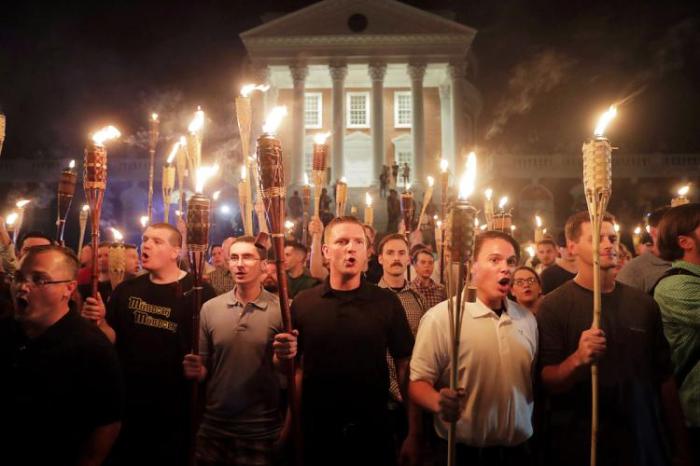
Yet a bunch of white dudes carrying Tiki torches shouting hate filled puns (“Jew will not replace us”? Seriously?) somehow doesn’t compute?
Come on.
This is America.
Racism and prejudice are not threats smuggled in past border security. They’ve always been here. At least since Europeans came offering trade and peace with one hand and guns and smallpox with the other.
The land of the free was stolen from the Native Americans. Our national wealth was built on the backs of slaves. Our laws and electoral system were built to empower one group at the expense of others.
Yet reformations in this process are rarely met with celebration. Instead of memorializing the end of slavery, we embrace the institution with fond remembrance.
Nor did prejudice and bigotry end when Rosa Parks refused to give up her seat, after Brown vs. Board, the Voting Rights Act, Freedom Rides, sit-ins or civil rights protests.
America has always been a place hostile to the under privileged, the second sex, religious dissenters, the brown skinned.
At most, we had become less confrontational in recent years, but we never really changed our core values, our social structures, who has power and who does not.
During my lifetime, people started to equate having a black President with the end of racism. Somehow they ignored the everyday reality for most black people.
They ignored the constant prejudice against the poor, the continued bigotry against LGBTs, the Islamophobia, the increase in hate crimes.
If there has been any change during the past eight months, it hasn’t been with the degree to which Americans are prejudiced. It’s the degree with which we’re willing to hide it.
Whereas before racists would claim to be colorblind, that their actions were completely devoid of racial bias, today they sigh and repeat the dusty slogans of Jim Crow Alabama or 1930s Berlin.
And somehow people are actually surprised about this.
It’s because too many of us have swallowed the lies about living in a post-racial society.
You thought we were beyond all that. It was a brave new world, morning in America, and we were finally treating everyone equally – unless you looked at what we were actually doing.
Mainly this is the reaction you get from white people. They rub their eyes and just can’t believe it.
You don’t see this too often from people of color, Muslims, LGBTs and some Jews. Why? Because they never had the luxury to ignore it.
That’s what we white folks have been doing since the beginning.
Whenever these issues come up, we have a knee jerk reaction to minimize it.
Things aren’t that bad. You’re just blowing it out of proportion.
But, no. I’m not.
That’s why you’re so damn shocked, son.
You haven’t been looking reality square in the face.
So when we’ve got undeniable video footage of angry white males (mostly) marching through Southern streets brandishing swastikas and assault rifles, it catches many white folks off guard.
They’re not prepared for it – because they haven’t been doing their homework.
We’ve been living in a bubble. Especially those living in major metropolitan areas.
That kind of thing never happens around here, right?
Of course it does!
Just because you live above the Mason Dixon Line doesn’t mean you’re safe.
You have a black friend, you like authentic Mexican food and you laugh while watching “Modern Family.”
But you haven’t opened your eyes to the reality outside your door.
You send your kids to private school or live in a mostly upper class white district. You have an exclusive gym membership that keeps out the riff-raff. You work in an office where that one token person of color makes you feel sophisticated and open-minded.
You’ve got to wake up.
You’ve got to educate yourself about race and class in America.
Because those people you saw in Charlottesville aren’t an anomaly.
They are an authentic part of this country, and if you don’t like it, you have to do something about it.
You can’t hide behind denial.
You have to take a stand, pick a side, and be counted.
Because one day soon, the torches will be outside your door.
You have to decide now – do you want to brandish or extinguish them?
Even when he lies – which is often – he’s no good at it. His real motives are plain as the weave on his head.
Under Obama, they could do almost the same things, but at least Barack would apologize for it. He’d clothe it in the language of civil rights and make it sound all noble. He’d excuse systemic inequality as the deserved results of competition.
Imagine sincerely believing that poor black kids deserve to go to schools that aren’t controlled by school boards but instead by unelected bureaucrats. Imagine thinking the color of your skin should determine whether you have a say in your child’s education. White folks get to elect the people running their schools, but not black folks. And you know what, it’s for their own good, say the reformers!
Imagine thinking that the amount of melanin in your skin should determine whether your schools are transparent or not – whether they’re required to have open records, open meetings, even whether they have to follow the same safety protocols and regulations as traditional public schools!
WHITE SCHOOLS – not for profit, spend the budget all on the students. BLACK SCHOOLS – CA-CHING! CA-CHING!
And when it comes to voucher schools, imagine selling a tax cut to a wealthy family as if it somehow benefited poor folks. Letting the Walton’s pocket a few thousand from their kids exclusive private school tuition doesn’t help Ma and Pa Six Pack. Nor does offering a discount to the kind of parochial schools that brainwash kids into thinking that evolution is evil, climate change is a Chinese conspiracy, and slavery was just God’s will.
Imagine pushing standardized tests as if they were a technological breakthrough. They’ve been around since at least China’s Han Dynasty (206 BC – 220 AD). If that’s cutting edge, I think you’ll like my new APP. It’s called The Wheel!
I couldn’t do it with a straight face. But they did!
And it worked! For a little while.
Now their whole pyramid scheme is just too damn clear. Make the kids take unfair, biased tests that will show how few resources poor black kids get and then use that as a justification for giving them fewer resources, closing their schools and privatizing them. No one’s even tried a scam that blatant since Bernie Madoff went to prison!
Racism pays, folks! Prejudice pays! Because the majority doesn’t mind so much when you take advantage of the underprivileged. That’s why they’re underprivileged in the first place!
And when people like me speak out against them, the best they can do are Ad hominem attacks – you’re too white to question policy affecting black people, or your friends are black but (somehow) not black enough. Today I actually read a response to an article I wrote that came down to these insightful criticisms – Nu-uh! And How dare you! Which we can add to their response to criticisms that charter schools increase segregation – I know you are but what am I?
The folks at the Education Post, a propaganda network passing off most of this nonsense as if it were legitimate news and funded by $12 million from the Broads, the Waltons and other usual suspects, they must really be desperate.
They’ve sold their souls to the Devil and may not even get a good return on the investment.
You see, they’re betting that by the time the Trump zeppelin explodes, their policies will be irreversible.
The problem is that he’s been extremely ineffective. He’s pushing their agenda, but isn’t getting much done.
“Not everything that can be faced can be changed. But nothing can be changed until it is faced.”
–James Baldwin
“I have a great relationship with the blacks. I’ve always had a great relationship with the blacks.”
–Donald Trump
Mariah’s eyes were wide as dinner plates.
She covered her mouth with her journal and pointed at the wipe board at the front of the room.
On it, I had written my question for the day. It’s how I usually begin class for my 8th grade students.
It read:
“Some movies and books like “To Kill a Mockingbird” describe what life was like in the South before the civil rights movement. To do so, they use the N-Word. Is it ever okay to us the N-Word? Why or why not? When might it be appropriate if at all? Why?”
I guess I’ve been teaching this for too long, because I didn’t expect Mariah’s reaction.
Not that was she alone. Several of my mostly impoverished and black students were looking around at each other in shock.
Kendra even said under her breath, “I don’t want to do this.”
We had just begun reading the novel yesterday. I thought it was time to address this issue before we were confronted with the word in the text.
In all of my classes that day, students had been interested in the query. But never had any of them reacted this way.
One student raised her hand and asked, “Which word are you talking about?”
I said, “I don’t want to say it, but it starts with an N and rhymes with trigger. Do you know what I’m getting at?”
They knew. Yet in removing doubt, I had only reinforced their outrage.
I thought maybe if they tried to write an answer first, it might help them organize their thoughts and maybe comprehend the point of the lesson. But they wouldn’t be directed back to the page.
Latrell was particularly upset. “It’s not always just words against black people,” he said. “How would you like it if we talked about words against white people?”
There were grumbles of agreement.
So there it was.
My white skin was the impediment. Here I was, a white man telling mostly black students to think about the appropriateness of the N-Word. I wasn’t trying to express an opinion of my own one way or the other. I wanted them to express their opinions.
But I had taken it for granted that asking them the question was appropriate in the first place.
I had forgotten that you can’t talk about racism with just anyone. It’s the same with sexual violence or abuse or a host of other topics that are deeply personal.
You need a relationship, the recognition of shared values and the promise of safety.
I assumed that I already had provided that for my students. In most classes that understanding seemed to be there. But for whatever reason, these students didn’t feel comfortable talking about this with me.
And I get it.
It’s the confluence of skin and history. No matter what I do, no matter what I say, I will always resemble the oppressor to some people. In the age of the Donald, it’s only gotten worse.
Building walls, casual misogyny, rushed deportations, religious intolerance – all are at the forefront of our modern social discourse now. These are matters not hidden under euphemisms or disguised as well-meaning public policy. They’re commands from on high, dictates coming from a mouth in a face that looks much like mine.
No wonder these kids didn’t want to talk about hate speech with me. I resemble the personification of hate speech.
I’ve been teaching “Mockingbird” for over a decade, but this was the first time in years that I paused not knowing what to do.
Should I force the issue and push forward? Should I give in and try to read the novel without the discussion? Should I put the book away altogether and find something else to teach?
I decided to get more information.
I asked the students to tell me how they felt. I asked them to explain what they were feeling.
Many were angry with me for even asking. They accused me of being racist. They tried to make me angry and blow up the lesson.
But I swallowed my pride and just let them talk.
After each statement, I repeated what I took them to be saying and asked if that was correct.
At first, many students didn’t even seem to be certain what they meant. When I repeated it to them, they shook their heads or said they weren’t sure.
Kendra spoke, “Mr. Singer, you tell me. Why are we talking about this? It don’t do nothing.”
I said, “Can we all agree that racism is a bad thing?”
But she deflected.
“Why’s it always got to be about black people? Other people experience racism,” she said.
And I agreed. I reminded them that we had just finished reading “The Diary of Anne Frank.” I asked why we had read it.
At first the loudest students said they didn’t know, but then Eva said it was to try to make sure nothing like the Holocaust ever happened again.
I nodded, and repeated my original question, “So can we all agree racism is bad? Raise your hand if you think racism is bad.”
They all raised their hands.
“Okay,” I said. “Then how do we stop it if we can’t talk about it?”
Kendra responded, “Mr. Singer, when we leave this class, none of this is going to matter. People are still going to be racist. Cops still gonna’ kill little black kids. People like you still gonna’ push people like me out.”
Others chimed in with similar comments.
I nodded, and said, “You’re right.”
That silenced them.
“You’re right, Kendra,” I said. “Maybe we can’t stop racism with what we say in here. Maybe no one can. But the hope is that if we talk about it, we’ll reduce it, we’ll cut it down to size. What do you think? Do you think we can take all the racism in the world and cut it down even by just a little bit?”
She didn’t say anything.
No one did. But hands were raised in the air. No one was shouting. No one seemed angry. Several students wanted to talk, and they were looking to me to organize the discussion.
So I let them talk.
All the time I had scheduled to write the journal fell through the hour glass and then some.
And when the discussion was petering out, I promised them that I would be available after class if anyone wanted to continue talking about it.
Then we picked up the book and continued reading.
I don’t know if it was the best class I’ve ever taught.
It was disturbing and uncomfortable.
I don’t see myself as anyone’s savior. But I’m there to help. I had hoped my students knew that.
But as a public school teacher, you learn not to take anything students do personally. They’re all going through a struggle you know little about.
I don’t want them to see me as an adversary. I want them to see me as a fellow traveler, as someone on their side.
But so much has changed in the last 100 days.
It’s a different world.
Racism and prejudice are no longer at the same remove. They never went away, but now they’re an unspoken presence coiled at our feet – constantly.
I have no answers. I ask questions and try to get my students to think about their own answers.
I just hope we’ll continue to have the courage to try.
















 gadflyonthewallblog