Why Were So Many Education Reformers Bad Students?


Screen shot 2015-09-12 at 7.33.08 AM

Bad students often hate school.

Not exactly shocking, I know.

But perhaps more surprising is the pattern of low, sloppy or inconsistent academic achievement by so many of those adults who consider themselves education reformers, particularly corporate school reformers.

Our ideas of school are certainly formed during our years in it. Those working so diligently to destroy the public school system and reshape it to resemble the business model are so often people who didn’t fit in. They earned low grades or only excelled in subjects they really liked. Perhaps school failed them or perhaps they failed school. There’s no way to know for sure since school records are almost always kept private. But details do trickle through and display a clear pattern – a pattern that certainly gives the appearance of an ulterior motive.

Are these former bad students more interested in fixing the perceived problems they see with the system? Or are they consciously or unconsciously seeking revenge against a system that found them to be inadequate?

Take Scott Walker.

The Wisconsin Governor-cum-Presidential candidate has been one of the most virulent enemies of public education and public school teachers in the past decade.

But when he was a lowly student, he wasn’t anywhere near the head of the class. His grade school years are mostly shrouded in mystery, but his college career is ablaze in controversy.

He claims to have been a solid C-student with a 2.59 grade point average. Contemporaries say it was closer to a 2.3.

“I had some classes I was more interested in than others, I suppose,” he admits.

In any case, college wasn’t for him. He attended Marquette University for almost four full years before dropping out. He only had a year or more to go before earning a bachelors degree.

Why did he quit? Numerous contemporaries allege he was expelled for cheating in student government. Walker says he simply accepted a full-time job and had to devote his time there.

The facts are these: Walker unsuccessfully ran for student body president with a tumultuous campaign. He was found guilty of campaigning a week early thereby losing campaign privileges at one facility and a day of campaigning at another.
When the student paper endorsed his opponent, the edition mysteriously vanished from the stands. Students reported seeing Walker staff taking almost all of the papers and replacing them with campaign literature against his opponent.

An investigation was conducted but the university refuses to release it saying the results are either private or have been destroyed.

However, the university denies that Walker was ever in bad standing or that he had been expelled.

The matter could easily be cleared up if Walker released his academic records to the public, but unlike most Presidential candidates of either major political party, he refuses to do so. (All while continuing to criticize President Barrack Obama for not releasing a birth certificate that the President clearly released to the public.)

Not exactly student of the year. Nor would the preacher’s son ever win “Most Ethical” in the student superlative section of his college yearbook.

It’s easy to see why someone who had such difficulty in college would spend so much time as Governor attacking that world.

He reduced state funding to Wisconsin colleges by 13% and then mandated they freeze tuition for 4 years. He recommending replacing University of Wisconsin leadership with a private authority governed by his own appointees. He proposed the university change its fundamental commitment from “a search for truth” to the goal of workforce readiness.

That’ll show ‘em, I guess.

But he didn’t just attack post-secondary education. He went after high, middle and elementary schools, too. He signed a law mandating high stakes reading testing begin in kindergarten. That’s right – kindergarten! Teachers and principals, of course, had to be evaluated based on these scores. Oh and don’t forget the massive school budget cuts.

He also presided over the largest roll back of collective bargaining rights in state history – and who make up the biggest unions? Teachers. Other working people are just more grist for the mill of his petty power trip.

If Walker had studied harder, spent less time on extra-curricular politics and finished his degree – I wonder if he wouldn’t have such animosity towards education. Maybe then he wouldn’t spend his days congratulating himself for hobbling colleges and public schools while trampling on workers rights.

Moving from politics to punditry, few people have devoted their careers to destroying the teaching profession as much as former anchorperson Campbell Brown.

Since being quietly let go from CNN when her news program was cancelled for low ratings, Brown has become an outspoken corporate education reformer. School choice, the destruction of teacher tenure and labor unions – there are few supply side education ideas she doesn’t support. Most notably, she serves on the board of directors for the infamous Success Academy Charter Schools – a system that uses student humiliation to ensure children swallow a curriculum consisting almost entirely of standardized test prep. Moreover, her husband, Dan Senor, is on the board of StudentsFirstNY, a corporate school reform organization affiliated with Michelle Rhee.

How anyone so personally invested in the factory schools model could possibly claim she was impartial enough to serve in a journalistic capacity on this matter is beyond belief. But that’s just what Brown does. This summer she even co-founded The Seventy Four – a news site dedicated to covering education. She claims it’s all “non-partisan” and “non-profit.” Ha! Her husband is a former adviser to the Romney campaign and spokesman for the Bush administration’s Coalition Provisional Authority in Iraq! Her “news” site is like Fox News for schools – which given the supply side bias of MOST news organizations is really saying something!

Is it any surprise that when Brown was in school, herself, she wasn’t exactly honor roll material?

She describes herself as a “terrible student” in Catholic school, but immediately justifies her academic performance by saying the teachers were awful, too. Since she had such a horrible parochial school experience, it’s a wonder she reserves her rancor for the public school system where she has little first hand knowledge. A child of privilege, Brown was a private school girl.

At Virginia’s elite Madeira School, she was kicked out for sneaking off campus for a party. She eventually earned a GED, and briefly attended Louisiana State University before waitressing in Colorado and enrolling in a Catholic college in Denver. It was there that a priest who taught political philosophy finally reached her. She eventually earned a B.S. in political science.

It was a long, difficult academic road for Brown. I wonder how she would have done at Success Academy where mostly poor Black and Hispanic students must sit with hands clasped and eyes following the speaker; where reading passages must be neatly annotated with a main idea; where her teachers would be inexperienced drones forced to work 11-hour days and face high turnover.

Something tells me as a student she’d find those teachers just “awful,” too. It’s a hard thing to take responsibility for one’s own actions especially as a child. If only the teacher had taught me better, if only I had gone to the good school, if only someone had done this or that. Poor little rich girl.

Now Brown is a professional at casting blame on our public school system in favor of unproven or disastrous education models. She’s come from the back of the class to the front – where she can criticize and wag her finger.

But to do the most damage to the school system, you need to be more than a politician or a pundit – you need to be an ideologue. And you need so much cash you don’t now what to do with it all.

No one has had a greater negative impact on public education than Bill Gates and his billions in so-called philanthropic contributions. As one of the richest men in the world, he has steered the course of education policy away from research-based policies to a business-minded approach favored by corporate raiders.

Common Core State Standards would not exist without his backing and financial bribery of federal and state governments. The man of ideas who instinctively understands the world of computers extends his hubris to encase all subjects. For clearly, what is true of a network of calculating machines must be true of young minds. Gates knows best, and where he is contradicted by one peer-reviewed study, he can pay for several independent ones to back up his pet ideas.

But whatever you say of Gates, he differs dramatically from Walker and Brown. Gates is clearly brilliant. He was a National Merit Scholar who scored a 1590 out of 1600 on his SATs. One would think his academic record must be impeccable. But one would be wrong.

While he excelled in subjects he cared about, he neglected others that weren’t immediately interesting. According to a college friend:

Gates was a typical freshman in many ways, thrown off pace by the new requirements and a higher level of competition. He skipped classes, spent days on end in the computer lab working on his own projects, played poker all night, and slept in a bed without sheets when he did go
 to bed. Other students recall that he often went without sleep for 18 to 36 hours.

Even at Harvard, Gates continued his pattern of 
getting good grades in the subjects he liked and disdaining those that were of little interest. His heart didn’t seem to be in his studies. Gates joined few college activities unless his friend Steve Ballmer dragged him off to a party.

School was of little interest to him. He dropped out of Harvard before getting a degree to start his computer software company.

Some tell it as a story of an eccentric’s unstoppable rise, but few tarry long enough to remark on the privilege from which Gates emerged. He didn’t have a public school education. He attended an elite preparatory school since he was 13. Once again someone with such little experience of public school is a self-appointed expert in reforming it.

His parents also instilled in him a peculiar marker for success. In his home, the family encouraged competition. One visitor reported, “it didn’t matter whether it was hearts or pickleball or swimming to the dock … there was always a reward for winning and there was always a penalty for losing.” How interesting that this same philosophy has become Gate’s vision for all school children! Schools must compete against each other for resources and the losers get shut down. Yet what irony that his own personal success relies on ignoring his weaknesses and focusing solely on his successes! We excuse the inconsistent grades and dropping out of college. But would Gates-backed education policies do the same for other children?

Gates, the student, easily might have wilted under the education policies of Gates, the edu-preneur. How hard it is to see oneself clearly. How hard to admit one has limitations. Especially when one is brilliant in one narrow field and has too much money and free time.

And so the enemies of America’s public education system gather round. Many of them may have axes to grind. Of course this doesn’t hold in every case. New Jersey Governor Chris Christie, for example, is no friend to schools. Yet by all accounts he personally had a relatively trouble free academic experience.

However, the case holds often enough to be instructive. An awful lot of C-students think corporate education reform is needed to fix our schools. Heck! Most of these policies come from No Child Left Behind legislation proposed by the most infamous C-student in American history – President George W. Bush!

These kinds of psychological conflicts of interest should give us pause. Do we really want to support such personal crusades? Should all the power of public policy really back the revenge of indifferent students?

Corporate education reform policies don’t work. They never have worked. They’re destroying our system of public education.

Doesn’t there come a time when you have to get over your personal childhood traumas and pay attention to the facts?


NOTE: This article also was mentioned on Diane Ravitch’s blog and published in the LA Progressive and the Badass Teachers Association blog.


Teachers Offer to Work for Free to Save Their School

Screen shot 2015-08-29 at 1.58.26 AM

Lawmakers have failed Chester Upland School District.

And now it’s up to teachers and professional staff to save the day.

For two decades, the Pennsylvania legislature hasn’t fulfilled its duty to equitably fund the public school district. Neither has the federal government. Instead, they left the impoverished school just 20 miles west of Philadelphia to survive on the drip of local property taxes from residents who, themselves, don’t have two pennies to rub together.

Moreover, our lawmakers not only permitted but encouraged three privately run charter schools to come to Delaware County and suck away whatever funds they could from the district while shortchanging student services at their privatized facilities.

And even worse, our elected officials drew up legislation allowing these charters to gobble up more funding from the district than the public school is allowed to spend on its own students.

Surprise! It didn’t work!

So the state put the school in receivership, taking away control from local tax payers so unelected bureaucrats could fix all the problems.

Surprise! That didn’t work, either!

And now state and local officials say there isn’t enough money left in the district’s piggy bank to make payroll by the time the school’s 3,300 students are scheduled to arrive on Wednesday.

In such situations, there’s only one thing to do: close the school. Bus the kids to neighboring districts and any charter or cyber schools willing to take them.

No more Chester Uplands. Another neighborhood school bites the dust.

But the district’s more than 300 employees refused to let that happen.

The dreaded teachers union held a meeting and decided to what? Hold a strike? Demand more pay?

No. The 200 members voted unanimously to work without pay as the school year begins – and the district’s secretaries, bus drivers, janitors and administrators joined them.

Sadly, this is the second time the union came to this decision. In 2012 the district was in similar straights but a federal judge forced the state to cough up a few bucks only a few days after the school year began.

To be fair, Gov. Wolf has tried to help the struggling district more than his predecessor. His administration supported a plan to eliminate the district’s $22 million spending deficit by reducing payments to charter and cyber schools so they actually reflect the cost of the services they provide.

The plan called for capping payments to cyber schools at $5,950 per student. After all, schools where students attend class on-line don’t have nearly the overhead of brick-and-mortar districts. Why pay them more than the actual cost?

The plan also would reduce reimbursements for special education students at brick-and-mortar charter schools from $40,000 to $16,000 per student. After all, if the public school only spends this much for these services, why permit charter schools to demand more than twice that amount – more than any other district in the state receives?

These proposals didn’t come out of thin air. Both changes were consistent with recommendations by two bipartisan school funding commissions.

However, County Judge Chad F. Kenney denied the measure because it would do nothing to pay back the district’s charter schools an additional $8 million it already owes.

So to sum up – teachers are willing to work pro bono for the community’s children. They’re willing to put their own lives and families at risk to ensure their neighborhood school has more time to find a solution to its financial woes.

And charter schools? They want their money! Pay up, bitch!

If nothing is done to fix the problem, Chester Uplands deficit is expected to reach $48 million by the end of the year. Wolf and other state officials are scrambling to come up with a new plan.

Meanwhile, the problem is spreading from the Chester Upland District across the entire Commonwealth. Public schools are tightening their belts because the legislature is more than 50 days late passing a state budget. The major sticking point? School funding!

Republicans refuse to heal long-standing education cuts from the previous GOP administration while Democrats support an increase.

As lawmakers bicker, schools across the state are forced to dip into their reserves to keep their doors open. Public schools were required by law to complete their spending plans months ago making educated guesses how much they’d get from the state. Without that money coming in, they’re surviving on their rainy day funds – and as usual storm clouds are pouring on our schools.

Districts serving poor communities often don’t have much left over to continue running while Harrisburg plays political games. If something isn’t done soon, Chester Upland could be the first in a series of dominoes set to topple down.

The only thing keeping these districts afloat is the hard work and good will of their teachers and staff.


A GOFundMe has been set up to help Chester Upland staff.

If you’re able to, please donate whatever you can to the 300 teachers and staff of Chester Upland School District in Eastern Pennsylvania.  Please help these heroic people make ends meet during this time they’re working pro bono.

NOTE: This article also was published on the Badass Teachers Association blog.

Parents and Children Occupy Puerto Rican School Refusing to Let Corporate Vultures Raid Its Contents

Screen shot 2015-08-22 at 9.09.36 AM

For more than 80 days, about 35 parents and children have been camping out in front of their neighborhood school in the U.S. Territory of Puerto Rico.

The Commonwealth government closed the Jose Melendez de Manati school along with more than 150 others over the last 5 years.

But the community is refusing to let them loot it.

They hope to force lawmakers to reopen the facility.

Department of Education officials have been repeatedly turned away by protesters holding placards with slogans like “This is my school and I want to defend it,” and “There is no triumph without struggle, there is no struggle without sacrifice!”

Officials haven’t even been able to shut off the water or electricity or even set foot inside the building.

The teachers union – the Federación de Maestros de Puerto Rico (FMPR) – has called for a mass demonstration of parents, students and teachers on Sunday, Aug. 23. Protesters in the capital of San Juan will begin a march at 1 p.m. from Plaza Colón to La Fortaleza (the Governor’s residence).

11212175_538567642948296_6542092169551987830_o

The schools being closed are all in low income areas, said union president Mercedes Martinez. “This is detrimental to education, because the necessities of the community, the investment in infrastructure in recent years, the technology, have not been taken into consideration, and neither the parents nor the teachers have been consulted.”

The Jose Melendez de Manati school, for instance, served students 92% of whom live in poverty.

Now that the building has been closed, parents say they can’t afford the cost to transport their children to a new school miles away. And those schools that remain open have been forced to make drastic cuts to remain functional. Class sizes have ballooned to 35 students or more. Amenities like arts, music, health and physical education have typically been slashed.

Why?

The island territory is besieged by vulture capitalists encouraging damaging rewrites to the tax code while buying and selling Puerto Rican debt.

Hundreds of American private equity moguls and entrepreneurs are using the Commonwealth as a tax haven.

Since 2012, U.S. citizens who live on the island for at least 183 days a year pay minimal or no taxes, and unlike those living in Singapore or Bermuda, they get to keep their U.S. passports. After all, they’re still living in the territorial U.S. These individuals pay no local or federal capital gains taxes and no local taxes on dividend interest for 20 years. Even someone working for a mainland company who resides on the island is exempt from paying U.S. federal taxes on his salary.

puerto_rico_teachers_strike.jpg_1718483346

Big corporations are taking advantage of the situation, too.

Worldwide, American companies keep 60 percent of their cash overseas and untaxed. That’s about $1.7 trillion annually.

Microsoft, for instance, routes its domestic operations through Puerto Rican holdings to reduce taxes on its profits to 1.02 percent – a huge savings from the U.S. corporate tax rate of 35 percent! Over three years, Microsoft saved $4.5 billion in taxes on goods sold in the U.S. alone. That’s a savings of $4 million a day!

Meanwhile, these corporate tax savings equal much less revenue for government entities – both inside and outside of Puerto Rico – to use for public goods such as schooling.

Public schools get their funding from tax revenues. Less tax money means less money to pay for children’s educations. As the Puerto Rican government borrowed in an attempt to shore up budget deficits, the economy tanked.

But have no fear! In swooped Hedge Funds to buy up that debt and sell it for a profit.

When this still wasn’t enough to prop up a system suffering from years of neglect, the Hedge Fund managers demanded more school closures, firing more teachers, etc.

Of course, this is only one interpretation of events.

If you ask Wall Street moguls, they’ll blame the situation on declining student enrollment. And they have a point.

Some 450,000 people have left the island in the last decade as the economy suffered an 8-year depression.

There were 423,000 students in the Puerto Rican school system in 2013. That’s expected to drop to 317,000 by 2020.

But is this the cause of the island’s problems or a symptom?

Unfortunately, things look to get much worse before they’ll get any better.

The government warns it may be out of money to pay its bills by as early as 2016. Over the next five years, it may have to close nearly 600 more schools – almost half of the remaining facilities!

Right on cue, Senate President Eduardo Bhatia is proposing corporate education reform methods to justify these draconian measures. This includes privatizing the school system, tying teacher evaluations to standardized test scores and increasing test-based accountability.

“Our interest is to promote transparency and flow of data through the implementation of a standardized measurement and accountability system for all agencies,” Bhatia said, adding that the methodology has been successful in such cities as Chicago.

Despite such overwhelming opposition, protesters are taking the fight to the capitol. “Tax the Rich!” is a popular slogan on signs for Sunday’s march.

11029506_1679179132316825_4270916741405376334_n

“It’s unacceptable that the rich and powerful that created our crisis are the ones asking the working class for more sacrifices,” said Martinez.

“The foreign companies that pay no taxes or a less amount to evade paying their due in contributions – impose a tax on them now!”

This is just a beginning, she adds. Stronger actions will be coming.

In the meantime, those brave parents and children still refuse to give up their shuttered school.

They dream of a day when that empty building once again rings with the laughter of students and the instruction of teachers.

In a country being used by the wealthy to increase their already swollen bank statements, is that really so much to ask?


You can show your solidarity with these Puerto Rican protestors by spreading the word through social media. Post a picture of yourself with a sign saying you’re with them in their fight. Tweet the Commonwealth Secretary of Education @Rafaelroman6. Use the hashtags #EducacionEnPR #SOSdocente.

NOTE: This article was mentioned on Diane Ravich’s blog and was also published on CommonDreams.org and the Badass Teachers Association blog.

Black Schools Matter – Chicago Protesters Go on Hunger Strike to Save Their Last Neighborhood School

11049569_829908000464142_2624846350042095332_n

Somewhere in Chicago tonight, Mayor Rahm Emanuel may be sitting down to his favorite desert – warm pecan pie with vanilla ice cream.

Across the city in the South Side neighborhood of Bronzeville, 11 parents, teachers and community members aren’t eating so well. Their meal – a few sips of coconut water to keep their strength up.

These brave men and women are on the third day of a hunger strike to save their last open enrollment public school.

If the Emanuel administration has its way, this mostly black community will have to choose between sending their children to a failing charter school or a failing public school run by a private company – all while the neighborhood’s historic Walter H. Dyett High School is closed.

Nat King Cole, Dinah Washington, Red Fox and Bo Diddley are all alumni of Dyett.

Why close such a vibrant connection to the community’s proud past?

The unelected Board of Education voted in 2012 to phase out the school because of low standardized test scores and dropping graduation rates.

It’s the same excuse lawmakers used in 1988 to take away local control from Chicago residents throughout the city. Most Americans have the right to vote for the people who run their local public schools. But not in Chicago, Philadelphia, New Orleans or many other places dark complected people live. The poorer the people and the darker their skin, the more likely the state will swipe away their right to self government on the excuse that their neglected and underfunded schools are “failing.”

Chicago, the third largest district in the country, is a prime example of this kind of disaster capitalism.

While schools in wealthier neighborhoods had all the amenities, Dyett students had no honors or AP classes and no art or music. Even physical education classes had to be taken on-line.

No wonder test scores were low! These children didn’t have nearly the same resources as other richer, whiter kids.

Despite such unfair challenges, academics were actually improving prior to the board’s decision to shutter the school.

In 2008, there was a 30% increase in students graduating. The improvement was so spectacular it was even recognized by then Mayor Richard Daley and Chicago Schools CEO Arne Duncan (soon to be U.S. Secretary of Education).

Likewise, in 2009, a community program helped decrease out of school suspensions by 40%.

However, by the time Emanuel took office, this wasn’t enough for the city’s Board of Education – all of whom are appointed by the mayor.

Emanuel has already shuttered 50 Chicago City Schools46 of which served mostly black students.

But not Dyett. At least, not yet.

The South Side community has been fighting to change the board’s decision for years. About 7 months ago, it seemed to have some success.

Eleven community members chained themselves to a statue of George Washington outside Emanuel’s office demanding the board reconsider. It did. But once the protesters removed themselves, the board decided to take bids on how to keep the school open.

Three plans were submitted – two to privatize and one to keep it an open enrollment public school.

That last plan submitted by the community, itself, would transform the facility into the Dyett Global Leadership and Green Technology High School. This would be a district run school for up to 600 students mostly from the Bronzeville area.

The plans to charterize the school have strengths and weaknesses, but the biggest problem with both privatization schemes is they disconnect the new school from the community and its history.

If either charter school plan is enacted, Bronzeville children may or may not be able to attend it. They could apply, but the entire student body will be selected by lottery. So it’s a roll of the dice whether they could go to their neighborhood school.

Community children not selected would be sent to Phillips Academy – a public school being run by a private management team. Phillips has a worse academic record than Dyett did in it’s darkest days. In 2012, less than 1% of Phillips students passed the state math test and just 8% passed the reading test.

Student prospects aren’t much better at a new charter school. Countless studies – even the Walton Family Foundation-funded CREDO study – have shown charter schools don’t provide better educational outcomes than traditional public schools. In many instances, they do much worse. And students uprooted from community schools rarely improve academically. However, Emanuel and other policymakers like him continue to push for the creation of more charters despite any track record of success or justification beyond increasing the corporate profits of the companies running them.

The best solution seems to be the plan created by and for the Bronzeville community to keep a public school in place. But when a public hearing was abruptly cancelled this month, they suspected the worst – the board was trying to sidestep a democratic vote.

That’s when community members started the hunger strike.

Protesters vow not to eat unless there is an emergency meeting on Dyett and a final vote taken.

The activists say they’re starting to feel tired and a bit light headed but severe hunger has not set in yet. They are getting daily checkups from a nurse to ensure they’re healthy enough to continue.

Meanwhile, where is the national media?

The Rev. Jesse Jackson visited the hunger strikers Tuesday and vowed to join them in their quest for justice.

But even this hasn’t brought national attention.

How typical! While black schools are closed and black communities gutted, White America yawns and the band plays on.

But some of us are committed to the idea that black lives matter.

Black schools matter.

Black communities matter.

Are you?


If you would like to help, you can call Mayor Rahm Emanuel at (312) 744-3307 and Alderman Will Burns at (773) 536-8103 and ask them to support the Dyett Global Leadership and Green Technology High School.

You can also tweet in solidarity to the hunger strikers using the hashtags #SaveDyett#WeAreDyett and #FightForDyett. Finally, you’re invited to email the protesters at info@reclaimourschools.org and let them know you stand with them and would like updates on their progress.

NOTE: This article also was published in the LA Progressive, on CommonDreams.org and on the Badass Teachers Association blog.

Down and Out and Lobbying for Public Education

 image

Let’s get one thing straight right from the start.

I’m no lobbyist.

I’m just a private citizen who’s sick of seeing his tax dollars swallowed up by big corporations under the guise of educational accountability.

I’m just a public school teacher who’s tired of his profession being demonized by policymakers and media talking heads alike.

And I’m just a father who’s worried that his daughter won’t get the same comprehensive public education he received as a child.

No one paid me. In fact, I bankrolled myself.

So like more than 300 members of the Badass Teachers Association (BATS), I came to Washington, D.C., to speak with my Congresspeople.

And what a day it was!

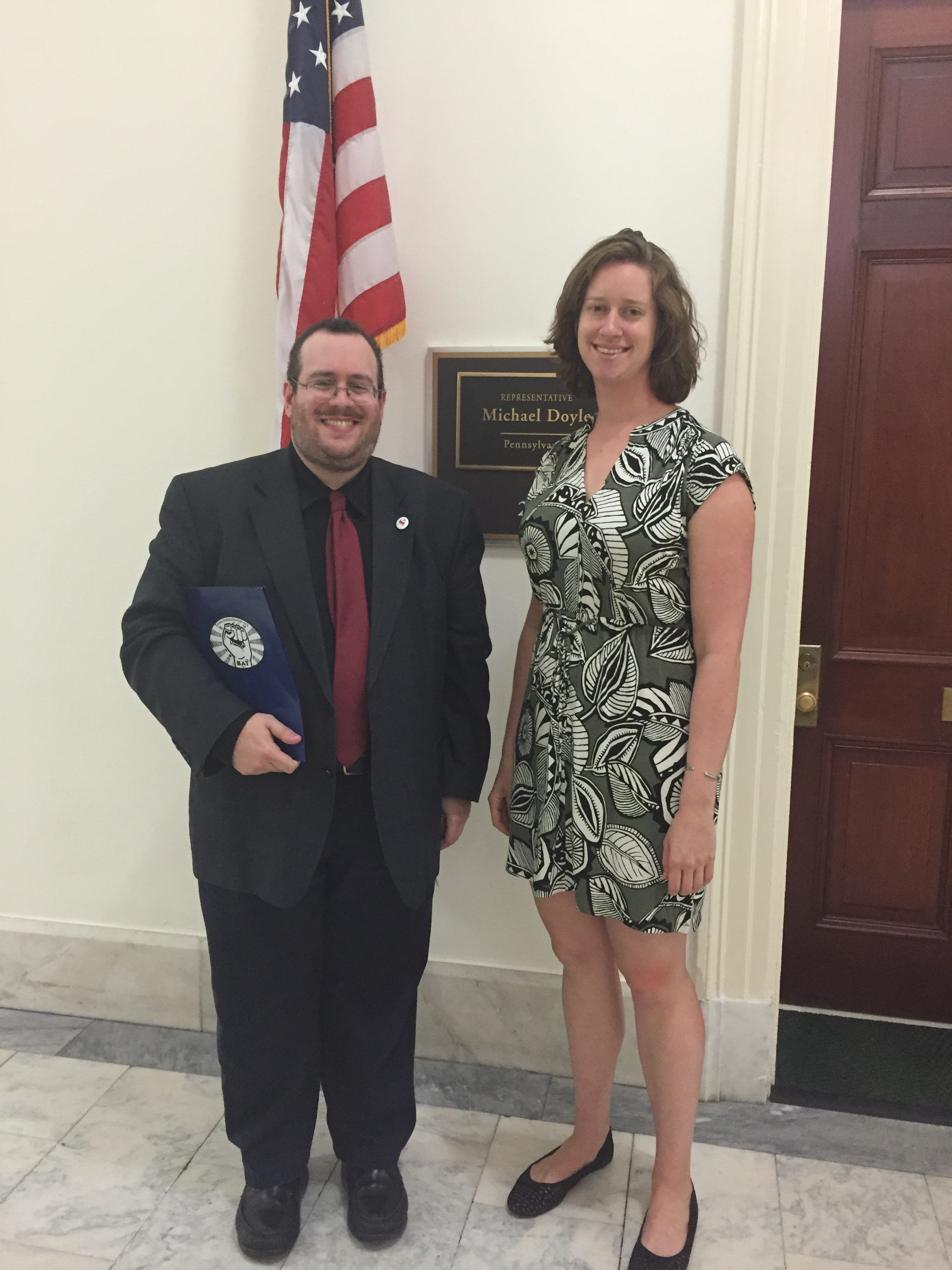
I met with Senators Pat Toomey (R-PA), Bob Casey (D-PA) and Corey Booker (D-NJ). I met with U.S. Reps Mike Doyle (D-PA) and Chris Smith (R-NJ).

Well, actually I met with their legislative aides.

None of the actual lawmakers made time to sit down with a flesh and blood teacher.

In one case, a legislator seemingly went out of his way to avoid me.

image

While sitting on the couch in Doyle’s office, he came out of a room to the left of me, asked his secretary for packing tape and then told her he was leaving for the day. It was 2:47 p.m. on Friday.

And they say teachers have easy hours!

I can’t say whether he was actively avoiding me. I made an appointment to see him, but it was never specified if I’d be meeting with him in person or if I’d be with his aide.

For all I know his staff never let him know I was a constituent sitting there on his couch in a suit and tie with a folder perched on my lap. But it didn’t feel good.

Maybe I should have said something. “Congressman Doyle! May I have a moment?”

But I frankly couldn’t believe this was happening. Moreover, he looks a lot different in a purple Hawaiian shirt than he does in all his press photos wearing a suit. I had to check his picture on my phone to make sure I was really seeing this correctly.

I was.

Still the meetings I had with these kids helping my legislators decide public policy were actually quite productive.

Without exception these youngsters were friendly, polite and knowledgeable. They seemed receptive to new ideas, were eager to hear my point of view, asked intelligent questions and were honest about where their bosses sometimes disagreed with me.

In Sen. Toomey’s office his assistants even asked if I was THAT Steven Singer.

“Who?” I said.

And they told me about a famous advertising campaign in eastern PA where a jeweler’s competitors are seen to complain “I HATE STEVEN SINGER.”

I laughed and told them it wasn’t me, but inside I wondered if that might explain the difficulty I had in some circumstances making these appointments. Maybe congressional staff thought I was pranking them. “Steven Singer wants an appointment!? Yeah! I’ll schedule it right after we see Mickey Mouse!”

image

I first met with Devorah Goldman, Toomey’s legislative correspondent on education and other issues. She’d only been on the job for about a year, but her qualifications included a degree in social work and she had worked in a public school resource center.

She was a very good listener. She heard me out as I spoke about a homeless student in my classes this year. She listened as I explained why Common Core is bad policy, why we need equitable school funding, an end to high stakes standardized tests, reigning in charter schools and voucher systems, and an end to judging teachers based on their students’ test scores.

Her boss isn’t exactly known as an education advocate. But she said he would agree with most of what I had said.

The main area of dispute would be charter schools. Toomey is in favor of expanding them so students can escape “failing schools.”

I explained that it was bad policy to try to save some students and let others fall behind. We need to make sure ALL our schools do an excellent job. Moreover, the Senator’s metric for determining which schools are failing is faulty at best.

I explained that traditional public schools often outperformed charter schools, which lack transparency and accountability and are wasting taxpayers dollars.

“We’ll just have to disagree on that point,” she said without explanation.

But she agreed to continue to take input from me and the BATS in the future.

image

At Doyle’s office, I eventually sat down with Hannah Malvin, a political science major who, at least, is from the Pittsburgh area – her boss’ legislative district.

She listened intently to my tales of education woe, even asking follow up questions. But she was surprised I supported the reauthorization of the Elementary and Secondary Education Act (ESEA).

Even the strongest supporters of the rewrite of the federal law that governs K-12 schools would admit it isn’t perfect. However, I would contend that the new version being cobbled together by the House and the Senate appears to be a slight improvement over what we have now – No Child Left Behind (NCLB).

Some educators think even this rewrite doesn’t go far enough to scale back standardized testing (and I sympathize but do not agree with that position). However, Malvin said Doyle had issues with it because it scaled back too much.

This was the issue I heard from Democrats all day. There isn’t enough accountability in the ESEA rewrite. How will we know which schools need extra help, they asked again-and-again.

I tried to explain that all they had to do was look at per-pupil spending. It’s no mystery which kids aren’t getting enough resources. It’s all right there on a ledger.

To her credit she heard me out and agreed to continue to dialogue with me on this subject in the future.

Next, I met up with some fellow teacher lobbyists from New Jersey and we dropped in unannounced on Booker’s office.

It’s not that we didn’t try to make an appointment. His staff never returned our calls and emails.

In fact, last week a fellow teacher not with us on Capitol Hill, Michele Miller,  even got into a scuffle with Booker on Twitter about elementary school funding. He told her to call his office and he would talk to her in detail.

To my knowledge, he never did. However, she was connected by phone to one of his aides. I’m told this is just modus operandi for Booker – strong talk in a public forum but shying away when the cameras aren’t rolling.

In any case, Booker’s senior education and health policy adviser Ashley Eden agreed to talk with us when we showed up to the office. Though her background isn’t in education, I can’t recall exactly what it is in. I do remember she has been doing this sort of legislative work for lawmakers for about 4 years – longer than any other aide we met.

She immediately made us feel welcome and found many areas of agreement. Bookers’ major point of contention – like fellow Democrat Doyle – was accountability.

How do we know which kids need help without giving them standardized tests?

Groan. But at least I had reinforcements: BATS Assistant Manager Melissa Tomlinson and retired NJ teacher extraordinaire Elizabeth DeMarco.

image

Perhaps the most telling moment of the entire conversation was when Eden said Booker just had to back standardized testing because every Civil Rights organization wanted it. She even criticized the New Jersey Education Association (NJEA) for not supporting black and brown students.

We stopped her right there. No. Every Civil Rights organization does NOT support testing. Journey for Justice – a coalition of 38 such organizations, in conjunction with 175 additional likeminded groups wrote to both the House and Senate asking to eliminate testing. Didn’t Sen. Booker see the letter?

Suddenly she remembered it.

She said she read it real quickly and didn’t like one sentence in it so she ignored it.

Which sentence?

Something about expecting poor and minority students to do badly on tests.

I explained that it has nothing to do with thinking these children can’t achieve at the same level as other children. It’s a matter of resources. If Sen. Booker was in a foot race against someone in a Monster Truck, I’d vote on the truck. Doesn’t mean Booker can’t run or that he might not even win. But the smart money is on Big Foot.

I joined the two ladies for their meeting with Smith as well.

His legislative assistant, Katherine Talalas, was perhaps the most knowledgeable aide with whom we talked. Her mother is a special education teacher, her brother is a paraprofessional working in a public school and she went to law school focusing on education issues.

She also took more written notes than any other assistant. With her nothing seemed canned. It was a real conversation about what her boss had done to help special education students and how he might continue to help in the future.

image

I was on my own again to meet with Sen. Casey’s aide, Jared Solomon.

This was one of the most fascinating and perplexing conversations I had all day.

He was warm, friendly, and had a depth of knowledge that was a bit more political than school-centered.

He agreed with almost everything I said. Casey supports 95% of the things that are important to me in education.

I could have smiled and walked away happy, but Solomon was so gregarious he kept talking. We shared our backgrounds.

He proudly admitted that he had been a Teach for America (TFA) recruit. He worked two years in a Baltimore public school and then left. He knew it wasn’t going to be his permanent job. He was emulating his parents who had joined the Peace Corps. He did TFA because he wanted the experience.

Then he moved to the administrative offices of Michelle Rhee’s Washington, D.C., Public Schools.

He only worked there two years – only one of which was under Rhee’s administration – but he respected what they had done. He said he disagreed with 80% of their policies and even quit because he was tired of being blamed for practices with which he didn’t agree. But, he added, the people in Rhee’s administration worked harder than anyone he knew, and he thought they really had the best interests of the kids at heart.

I’m tempted to chalk it up to the same feeling the incredible blogger Jennifer Berkshire (a.k.a. Edushyster) says she gets when she interviews many corporate school reformers. We may disagree with them, but they really do believe this stuff.

But something happened that doesn’t sit well with me. In an unguarded moment of a more than hour-long conversation, Solomon pulled the same stunt Eden did for Sen. Booker. He said all the Civil Rights groups were crying out for testing. But when I called him out on it, he immediately took it back. It was like he, too, knew this was untrue. It was a talking point, quickly to be conceded if called out and then move on to another argument.

I frankly don’t know what to make of it. The arguments are too similar among Democrats and Republicans to shrug off. Each is speaking from a party line script. That can’t just be a coincidence.

And why would Casey, a legislator who supposedly agrees with me 95% of the time on education, hire as his education expert someone who was actively involved in many of the practices that go directly against his beliefs? Why would someone like Solomon, who was part of the corporate education reform movement, really be on my side against these policies?

It’s befuddling to say the least.

Now that it’s all over, I’m so glad I did this.

Will this change the nation’s education policies? Probably not.

But I am only one of hundreds of people who climbed Capitol Hill in the last two days and met with more than 52 federal legislators to fight against the standardization and privatization of education.

And tomorrow we, BATS, will hold a Teachers Congress to further solidify our goals and decide where the great ship of real positive school change should go.

I am so looking forward to it.

But this teacher, soon-to-be BAT Congressman, needs to go to bed.

Here’s to a brilliant tomorrow for our children.


NOTE: This article also was published on the Badass Teachers Association blog.

Do Americans “Throw Money” At Their Schools? A Fair Funding Primer

Screen shot 2015-07-06 at 11.05.59 PM

“Don’t throw money at schools.”

It’s a common rejoinder when lobbying for an increase in public education budgets.

You offer facts why schools need it: both the state and federal government continue to reduce K-12 funds, class sizes are increasing, the curriculum is being narrowed, buildings are crumbling – real world consequences to spending deficits.

And some guy (it’s often a dude) stands up with a cock-eyed grin and says, “You know, we really need to stop throwing money at schools.”

And he pauses as if we all need a moment to take that in.

Is there anything to this? We hear it often enough, but does he have a point?

Let’s see.

“Don’t throw money at schools.”

First, is it true? Is anyone actually throwing money at our schools?

I’ve worked as a public school teacher for over a decade. To my great disappointment never once has anyone hurled greenbacks through a window in my building. I have never had to dodge, duck or otherwise exercise gymnastics to avoid being thunked in the head by a stack of airborne bills.

Origami ninja stars made out of $100 notes do not routinely fly through the air in my classroom. No government representative has ever shown up in the auditorium during a professional development and said, “Yeah baby! Let’s make it rain!” before showering my coworkers and myself in Benjamin’s.

No. This has never happened. Not even coins. More change is thrown at the fountain in my local mall than at any public school where I’ve ever worked.

At this point, you’re probably saying, but, Steven, that’s not what this guy meant. He wasn’t implying someone literally tossed bills at foundations of learning. He was just being colorful.

To which I respond: was he? Because there are lots of ways to phrase that idea. He simply could have said, “We shouldn’t increase education funding.”

He could have said, “We need to spend school money more wisely before increasing it.”

He could have said, “Additional learning revenues are a waste because schools do such a bad job.”

He could have said, “We spend too much on education already.”

He could have said, “Kids don’t deserve more of my cash.”

But he didn’t say any of those things. Instead he conjured an image out of a Roman orgy or a rap video. He purposefully tried to frame this as a ridiculous situation. He wasn’t just trying to make an argument. He wanted to paint anyone who could possibly disagree with him as a fool.

“Can you believe these guys crying about public school funding?” he implied. “They’re having money thrown at them and they actually want more!?”

So before we even start to study the content of his phrase, we must remember it’s coated in bias and malicious intent. He is not really calling for a rational argument. He is appealing to emotions – most probably the emotions of those listening to the debate.

But we cannot sink to his level. We need reasons.

This is difficult because it’s not entirely clear what exactly he was getting at. Let’s examine what his statement might mean in plain English and try to determine if – underneath all this spin – he has a point or not.

Here are some possibilities.

1) “We need to spend education money more wisely before increasing it.”

This might be what he intended to say. And if so, he does have a bit of a point.

There is a problem with how school funding is spent. There is waste and misappropriation. At the local level, school boards and administrators do not always do things in the most efficient manner. But you could say the same thing at every level of democratic government. Fascist states have much less waste. Shall we just burn up the Constitution, then?

At the state and federal level, the problem is compounded by the ignorance of those allowed to write our laws. Education policy is rarely made by those who know what they’re talking about, thus funding often is wasted on useless initiatives. Common Core, standardized testing, punitive accountability systems – these were all created by business interests without regard to educational validity or efficacy and – as such – waste taxpayer money that could be better spent on things that would actually help children learn.

And speaking of waste, may I introduce you to charter schools? Favored by lawmakers yet rocked by fiscal scandals, charters are legal means of sucking up tax dollars for a profit. While public schools have to account for every penny spent and prove funds went to better the educations of real live students, charters are not just permitted but encouraged to withhold some tax money from going to student services and instead bolstering administrators’ bank accounts. Anyone who speaks of fiscal accountability in education yet is in favor of its further privatization is either disingenuous or in need of a basic math course!

The solution, however, is not to withhold additional funding. The solution is more oversight. And I don’t mean only government oversight and regulations. I mean oversight by the public.

Democracy only works if people participate. People need to push for transparency and less wasteful policies. They need to educate themselves about what’s going on. They need to investigate. They need to lobby, protest, and criticize. They need to vote. And they need a free and interested media to give them the facts to make smart decisions.

Clearly we’re lacking some of these things today. But that’s a national problem not limited to education funding.

In the meantime, we can’t wait for a perfect government before increasing school spending. Our children need help now!

If we do nothing, we doom another generation to getting less than they deserve, less than what we could have provided. Why? Because we were afraid some of it wouldn’t reach them!?

A deep sea diver with a kink in his air hose, doesn’t shrug and turn off his oxygen. He turns it up!

2) “Additional learning revenues are a waste because schools do such a bad job.”

This might have been his criticism. Let’s look at the facts.

International comparisons of national school systems are all the rage in political circles. And raw data suggests that children from the United States are not at the top. We are somewhere in the middle.

That’s all true. But what pundits refrain from admitting is that it’s been true for a long time – in fact, for as long as we’ve been making these types of comparisons. Our schools have not gotten worse. They have stayed the same.

This brings up an important issue. How does one compare national school systems to each other, anyway? What do we use to make these comparisons? Income prospects? Student portfolios? Measures of critical thinking? Classroom grades?

No. We use standardized test scores – the PISA test to be exact.

However, we’ve known for decades that standardized tests are poor measures of academic success. Bubble tests can assess simple things but nothing complex. After all, they’re scored based on answers to multiple choice questions. In fact, the only thing they seem to measure with any degree of accuracy is the parental income of the test-taker. Kids from rich families score well, and poor kids score badly.

So these comparisons are suspect.

But even if we accept them, we are leaving out a very important factor: Poverty.

Virtually all of the top scoring countries taking the PISA exam have much less child poverty than the U.S. As we’ve seen, this will boost their scores. If we adjust our scores for poverty, our students jump to the top of the list.

Let me repeat that: U.S. students do the best in the world on international tests – IF THEY ARE NOT POOR.

Moreover, the U.S. education system does something that many international systems do not. We educate everyone! Foreign systems often weed children out by high school. They don’t let every child get 13 years of grade school (counting kindergarten). They only school their highest achievers.

So when we compare ourselves to these countries, we’re comparing ALL of our students to only SOME theirs – their best academic pupils, to be exact. Yet we still hold our own given these handicaps!

In short, U.S. public schools do an excellent job educating children. They overcome incredible obstacles to achieve near miraculous ends often with very few resources.

Imagine what they could achieve if our schools were properly funded.

3) “We spend too much on education already.”

This one is a favorite of politicians of both parties. We already spend a lot on education. Some lawmakers and media personalities go so far as to claim that we spend more than any other country in the world.

Is that true? No.

We are near the top, but according to the most recent OECD study, four countries – Austria, Luxembourg, Norway and Switzerland – spend more.

Additionally, the study was released in 2014 but used data from 2011. Since that time, the U.S. has cut its school spending by leaps and bounds while most other advanced nations have been increasing it. Look for many more countries to pass us up when the next study is released.

But even using current figures, there are troubling social, economic and political differences between nations that impact how school funding needs to be spent. While most advanced countries spend their education budgets on actual instruction, the United States mandates public schools use a larger portion of their budgets on things outside the classroom.

For example, many international schools don’t have metal detectors or security staff. Given the U.S. problem with mass shootings and gun violence, our schools need to spend a significant portion of their monies in this way. I’m not suggesting we stop. Clearly we need to continue these practices, but that’s less money to help kids learn.

In addition, unfunded legislative mandates and court decisions have made U.S. public schools responsible for many things that international schools are not. About one third of all budget increases in recent years has gone to support special education students; 8 percent went to dropout prevention programs, alternative instruction, and counseling aimed at keeping students in school; another 8 percent went to expand school lunch programs; and so forth. Very few additional dollars were provided for needs associated with basic instruction.

Again, I’m not saying we should stop. Given our national epidemic of child poverty – an epidemic not shared by other advanced nations – we have to address these adjacent issues. But without additional funding, we’re letting the very heart of our schools – the classroom – go to waste while other countries are providing significantly more support.

Unfortunately, the problem doesn’t end there. Not only does the U.S. have unique problems that other nations do not share, we also are unique in how we allocate the funding we already have. And this difference only worsens the problem and increases the need for more money.

While most advanced countries divide their education dollars evenly between students, the United States does not. Some students get more, some get less. It all depends on local wealth.

The average per pupil expenditure for U.S. secondary students is $12,731. But that figure is deceiving. It is an average. Some kids get much more. Many get much less. It all depends on where you live. If your home is in a rich neighborhood, more money is spent on your education than if you live in a poor neighborhood.

The U.S. is one of the only countries in the world – if not probably the ONLY country – that funds schools based largely on local taxes. Other developed nations either equalize funding or provide extra money for kids in need. In the Netherlands, for example, national funding is provided to all schools based on the number of pupils enrolled. But for every guilder allocated to a middle-class Dutch child, 1.25 guilders are allocated for a lower-class child and 1.9 guilders for a minority child – exactly the opposite of the situation in the U.S.

So even though we spend more than many countries, we spend it so unevenly that poor and minority children are being left out.

Therefore, we have a choice: either do away with funding based on local property taxes or increase funding to poor school districts – or both.

4) “Kids don’t deserve more of my cash.”

Dollars to doughnuts, this is probably what he really means.

The United States has a moral failing. And we’re proud of it. We call it libertarianism. It means – Screw you! I’ve got mine.

We don’t care about helping others, we don’t care about the common good, we only look out for ourselves and our immediate friends and families. Everyone else can eat crap and die.

It’s ethical immaturity and, frankly, there’s not much you can say to someone who feels this way except that you disagree.

At most you can try to appeal to his self interest. Do you really want to live in a society full of uneducated people? Do you really want your kids to grow up in a world like that?

But that’s as far as it goes. You can’t help emotionally and intellectually stunted people – especially adults. Most children go through this phase. Some never grow out of it.

The good news is that most of us aren’t so far gone. If you can show that our interlocutor’s statement really comes down to this, you may be able to convince some people to agree with you simply because no one wants to be such an odious troll.

You need to pull back the curtain and show the truth.

How do we best spend these education dollars? How do we raise the money? Those are valid questions, but only a truly horrible person simply refuses to help children learn.

Because we’re not “throwing money” at schools. We’re throwing certain kids away.


NOTE: This article also was published in the LA Progressive, Commondreams.org and on the Badass Teachers Association blog.

Selling the Big Lies About Schools and Teachers on Sci-Fi Fantasy TV

Screen shot 2015-06-18 at 10.58.36 AM

“The media’s the most powerful entity on earth. They have the power to make the innocent guilty and to make the guilty innocent, and that’s power. Because they control the minds of the masses.”
Malcolm X

I’m with Brother Malcolm on this.

The media matters. And not just the news.

We learn what is real from the stories we tell ourselves and allow to be told about us. We construct our view of reality based on fairy tales, soap operas, rap lyrics and energy drink commercials.

There are cultural truths left unspoken that govern the very way we think. When the media speaks, we listen.

How dangerous, then, that we allow money to write the script. We let the 1% define who is an enemy and who is a friend. It’s no surprise that this almost always aligns with their interests.

As a public school teacher, I am an enemy of the plutocracy. I dare to teach children – even poor children, especially poor children – that knowledge is free. I stand in the way of the monetization of our schools. So I am a frequent target of attack.

It happened most recently in such a subtle way you might not even notice it. Wall Street bankers and hedge fund managers briefly shifting the narrative of science fiction/fantasy to increase the bottom line.

Marvel Studios is often concerned with escapism. But this season, two of its television shows – Marvel’s Agents of Shield and Daredevil – offered brief propaganda amid the comic book action.

Agents of Shield is a superhero/spy drama that connects the production company’s big budget blockbuster films – Iron Man, Thor, The Avengers, etc. It follows the escapades of a well-meaning intelligence agency made up of folks without super powers trying to deal with a world where super heroes are becoming more common.

This season on the ABC drama, one of the major arcs focused on Skye, a young woman just getting used to her super powers, and her quest to find her mother and father both of whom had abandoned her as a baby.

When she finally meets her dad, Cal, he is a mentally unbalanced enemy of Shield . However, as time goes on, Skye begins to see a nicer side to him.

In episode 2X18 “Frenemy of my Enemy,” the two spend the day together walking around Milwaukie and have a conversation about why she had been deserted as an infant. It was all rather interesting until they walked through a puddle of stinking corporate school reform.

Cal talks about how he and Skye’s mom had planned to raise her before they were thwarted by the evil Hydra organization. He talks about the nice middle class suburb where he had bought a home. He talks about the cute local businesses. And to show what an awe shucks great dad he might have been, he rhapsodizes about a really good local charter school where they were going to send her.

Skye: So, you had a … you had a practice here?

Cal: Yeah, before I met your mother.

Skye: She was a doctor, too?

Cal: Studying to be one. She had a natural gift for it … compassionate, beyond intelligent, wise … always five steps ahead of me. She wanted to finish med school here. Oh, and there was this great, little charter school just around the corner.

Skye: A charter school for medicine?

Cal: What? [Chuckling] Oh, no, not for her … for you. Oh, it was gonna’ be perfect. I was gonna’ drop you off every morning and pick you up, help you with your science fair project … the volcano, because who doesn’t love a volcano, right? We’d go to the father-daughter dances together, get ice cream. Ah, the life we could have had … should have had…

A charter school!?

Are you freaking kidding me!?

First of all, let’s talk continuity error. The first charter school law wasn’t even passed until 1991 in Minnesota. Skye was born in 1988. There were no charter schools in existence when Cal was musing about sending his infant daughter to one. Moreover, Wisconsin didn’t allow charter schools until 1993, long after Skye was separated from her parents!

But putting aside issues of believability (This is a show where people have super powers, after all) the charter school reference is hardly organic. It’s used as an emotional shorthand to show that Cal was a good father once. And you know what else is all warm and fuzzy? Those plucky charter schools. Shouldn’t you consider enrolling your child in one today?

However, charter schools have a terrible academic record. They either do no better than traditional public schools or – in most cases – much worse. In fact, for-profit charters are notorious because – unlike public schools – they don’t have to spend all of their budgets on kids. They’re big business producing huge profits for investors at the expense of student learning. Just google “charter school scandals.”

I guess it shouldn’t be a surprise that some of that lucrative taxpayer money may be finding its way into Marvel’s coffers to buy advertising space on Agents of Shield.

Product placement: drinking a Coke, driving a Toyota and – now – if only daddy could have sent me to a charter school.

Instead Skye had to deal with a life in an orphanage, at foster homes and – yuck! – the public school system!

Even worse, though, is the outright libel on Daredevil, a show delivered streaming on Netflix.

Most of the time it’s a pretty good action thriller about a blind lawyer who moonlights as a vigilante superhero fighting crime. (Yeah. He has superpowers, too, kinda.)

One of the supporting characters is Ben Urich, a grizzled seen-it-all investigative reporter. While New York’s Hell’s Kitchen is being taken over by the evil businessman, Wilson Fisk, some of Daredevil’s friends try to convince Urich to write about Fisk in the newspaper.

In episode 1X04 “In The Blood,” Urich warns feisty secretary Karen Page about how dangerous it is to go after nefarious evil organizations – like the mob, corporate polluters, the VA and – gasp – the teachers union!

Karen goads him by saying, “I read every big story with your byline. The VA kickbacks, toxic runoff, the Teachers Union scandal. Hell, you pretty much brought down the Italian mob back when I was in diapers. What ever happened to that reporter, Mr. Urich?”

(Later)

Ben Urich: You said you read a bunch of my articles. Remember the one about the, uh the runoff? What that company was dumping into the river?

Karen Page: Yeah, sure.

Ben Urich: Fished the guy that tipped me off out of that same river a month later. And that fella trying to clean up the Teachers Union? Moved out of state after flyers went up saying he was a pedophile. They underestimated what people in power will do to stay there.

So in the Marvel Universe, the ultimate evils are Red Skull, Loki, Thanos and public school teachers.

I’ve got to tell you my union must really be slacking. We never seem to get to world domination at our meetings.

I pay my dues. How come I’ve never gotten to whack anyone? Why haven’t any of our members – who by law can’t have a criminal record to work with children – why haven’t any of us ever slandered each other as pedophiles? All we do is talk about how to make our school better for both the students and our members.

But those big corporations drooling all over themselves at the prospect of privatizing public education dollars sure do hate us. We’re the last line of defense stopping them from stealing from the piggy bank of tax money put aside to educate your child.

So it’s no wonder some of their shadowy money donated by multi-billionaires like the Koch Brothers and the Walton family probably made its way into Marvel’s bank account.

I can’t prove that Marvel Studios took a cent to write either of those episodes. The Daredevil script was written by Joe Pokaski, a television writer for other genre shows like Heroes and also a Marvel comic book author. The Shield episode was written by Monica Owusu-Breen, one of the show’s co-executive producers. She also has a long career writing for television.

Maybe they each just have personal axes to grind.

Or maybe vampire organizations trying to bleed public money into their bank books might use some of that blood money to soften their image and take down their enemies.

Hey, Daredevil! Hey, Agents of Shield! Maybe if you really want to root out evil, your next mission should be at Marvel Studios! Because making nefarious charter schools look just swell and attacking school teachers – that’s not something heroes do.


NOTES:

“The mass media serve as a system for communicating messages and symbols to the general populace. It is their function to amuse, entertain, and inform, and to inculcate individuals with the values, beliefs, and codes of behavior that will integrate them into the institutional structures of the larger society. In a world of concentrated wealth and major conflicts of class interest, to fulfill this role requires systematic propaganda.”
Noam Chomsky & Edward S. Herman
Manufacturing Consent

“Make the lie big, make it simple, keep saying it, and eventually they will believe it.”
Adolph Hitler


-This article also was published on the Badass Teacher Association Blog.

-The article inspired fellow blogger Peter Greene to write a post, “Privatizer Product Placement,” asking readers to contact Marvel Studios and ask the company to stop putting anti-school propaganda in its TV shows.

WANTED: Progressive Candidate With the Guts to Stand Up For Public Education

weird-help-wanted-9

Wanted:

Progressive presidential candidate.

MUST SUPPORT PUBLIC EDUCATION.

No. Not just the words. Not as a soundbite. Must actually support policies that help public schools – not tear them apart and sell them away piece-by-piece while you smile and brag about how much you support education.

This means you must:

1) Repudiate and Vow to Repeal Common Core State Standards

-Must know how they were created by unqualified partisans with little input from real educators.

-Cash strapped states were coerced into accepting them – in many cases even before they were done being written – as a condition for increased funding.

-They have never been proven to help kids learn and are in fact a massive social experiment at taxpayers’ expense and students’ peril.

-They are a huge payday for the testing and test prep industry who provide the new standardized assessments and new textbooks necessary for their implementation.

-They are developmentally inappropriate, demanding all students to learn at the same rate and at a time frame that is inconsistent with the way children cognitively develop.

2) End Annual Standardized Testing

-Must promise to end policies forcing public schools to give standardized tests in reading and math to all students in grades 3-8 and once in high school. Ideally, standardized tests should be completely eliminated.

-Must understand that standardized tests are poor assessments that have never been proven to measure academic achievement. However, they do an excellent job of demonstrating a student’s parental income – rich kids do well, poor kids less so.

-Must realize these tests are nothing but a money-maker for private industry and are used as an excuse to close under-funded schools predominantly serving children of color.

MUST REPUDIATE THE MEDIA NARRATIVE OF FAILING SCHOOLS, which is not supported by facts and merely the propaganda of an industry feeding off of our public taxes and children’s misery.

3) Stop the Expansion of Charter Schools

-Must understand how for-profit charters siphon away public money for use as private profits. Charters reduce services for children to increase the bottom line.

-Must vow to protect funding meant for traditional public schools that is lost when charters open in the district.

-Must know that no research has ever shown charters to be better than public schools, and many studies have shown them to be drastically worse.

-Must appreciate the lack of transparency charters are afforded feeds the growing plague of national charter financial scandals.

4) Work to Stop School Segregation

-Our public schools are more segregated now than they were before Brown vs. Board of Education 60 years ago. This is intolerable and makes it easy to disenfranchise students of color.

-Must not only recognize this, but have a plan to solve the problem.

5) Promise to Increase Public School Funding – Especially to the Poorest Districts

-Must understand that nationwide, rich schools spend on average 15.6% more than high poverty schools. Being born poor should not mean you get a worse education. In fact, impoverished students have greater needs than wealthy ones. It costs MORE to educate them.

-Must champion an effective plan to address funding inequalities with an emphasis an equity.

6) Have a Plan to Address Child Poverty

-Must understand that more than half of public school students live below the poverty line.

-Must have an effective plan to help children, parents and families rise out of poverty.

7) Allow Teachers Autonomy and Recognize Them as Professionals

-Must support letting teachers run their own classrooms, champion teacher-created tests over standardized ones – in short, LET TEACHERS TEACH.

-Must vow to eliminate any so-called teacher accountability programs that evaluate educators based on student test scores. Let teachers be evaluated by their own administrators based on classroom observations.

8) Stop Supporting Teach For America

-Must admit six weeks training for college graduates without education degrees is not good preparation to become classroom teachers. All students deserve a teacher with a 4-year degree specializing in education.

-Must condemn valuing TFA recruits who have only promised to be in the classroom for two years over teachers who have devoted their whole lives to their students.

9) Repudiate Any So-called School Choice or Voucher Programs

-Must understand that these policies are often backdoor support for the unconstitutional practice of spending public money on religious or parochial schools.

-Must recognize these policies are another attempt by private industry to convert public taxes into profits. Private schools are not subject to the same regulations as public entities and as such can freely use tax money in more nefarious ways.

-Must acknowledge that school choice is a sham – sending children to schools without public school boards paradoxically reduces the choice parents have over how the school is run.

-Public schools must remain public. Policies allowing for choice among schools – if done fairly – would increase the cost of public education exponentially. It is a much more efficient policy and less open to fraud if we instead ensure every student has a quality education. We need one excellent education system – not multiple ones.

10) Support the Right of Workers to Unionize

-Must support policies to make it easier for private citizens to exercise their collective bargaining rights. Period.


I would be willing to vote for any candidate who met all of these requirements regardless of race, gender, sexual orientation, background or party affiliation.

That’s right. This job need not be filled by a Democrat. Any party will do. I am sick of being offered false progressives under a Democratic banner.

And Hillary Clinton coming right out of the gate praising Common Core may have been the last straw.

Why vote for her over Jeb Bush when they support THE SAME THING!?

No. I will not vote Democrat just because. Never, never again.

If they want my vote, they will have to meet my job application. I will vote to hire the best candidate. Whoever that is.

And I bet I’m not alone.

The education vote is no longer a gimme for the Democrats.

Progressive education candidates? Are you out there?


NOTE: This article was additionally published on the Badass Teachers Association blog.

Teach for America – What a Stupid Idea! (Or is it?)

im_with_stupid_button_busy_beaver_button_museum

Welcome to the Hall of Stupid Ideas!

I’ll be your guide through this section of the museum.

Moving past the hall of phrenology, past the flat earth wing and the newly renovated rotunda of climate change denial, we come to one of my favorite displays – Teach for America or TFA.

This really is a very dumb idea.

Imagine, if you will, a country besieged by an education crisis! In this case, a shortage of teachers.

To meet the needs of this deficiency, we hire a slew of poorly trained college grads to fill-in the gaps.

Sounds nice, doesn’t it?

Young go-getters ready to take a stand and help the country by devoting themselves to our little children.

Yet it’s just so much bullshit.

You see the problem is real. We DO need more teachers – especially at our poorest schools. However, the same people who are promoting TFA are the ones who caused this shortage in the first place.

As public school budgets are slashed at both the state and federal level, local districts are forced to furlough more-and-more educators. Students are stuffed into larger classes and forced to do without the arts, foreign languages, technology courses, anything that isn’t on our federally mandated standardized tests.

So there IS a real shortage of teachers in the classroom, but there is NO shortage of unemployed teachers.

More than 300,000 teachers are out of work. These are people with at least a bachelors degree in education – many of whom have even more experience in the classroom actually teaching kids.

You might think that we could just allocate funding and hire them! Right!?

Wouldn’t that be better?

We could fill our public schools with dedicated education professionals instead of lightly trained temps.

Because this is what Teach for America is providing. TFA recruits get 5 weeks training and only have to sign on for a two-year commitment.

So those advocating for TFA insist it’s somehow better to give a child an instructor who has a few weeks training versus someone with a 4-or-5-year degree and who has real life experience on the job!

It’s staggering isn’t it?

Now this would never fly in most neighborhoods. Imagine trying to convince the rich that their children would be best served by this kind of scheme. They’d riot!

But this scam is almost exclusively perpetrated in poor neighborhoods because that’s where our state and federal governments cut funding. In rich neighborhoods, they can just raise local property taxes to give their children all the best that money can buy. In poor neighborhoods, this isn’t an option. They rely on state and federal tax dollars to give their kids a fair start in life so they can equally compete in the job market.

Well, the joke’s on you, poor people!

Rich folks are selling you substandard teachers and pretending like it’s philanthropy!

You’d think this scheme would be laughed out of existence but many national news sources praise it to the sky! They even make excuses when research proves how ineffective the whole scheme is!

Take this report from March 2015 concluding that students taught by TFA recruits score no better on standardized tests than those of traditional teachers.

Time Magazine – yes, THAT Time Magazinepublished an article claiming that this proved TFA was a success!

Look! It’s just as effective as bachelor-degree-holding-teachers!

However, all it really shows is that judging an instructor – whether TFA or not – based on student test scores is ridiculous!

(Yes,Value-Added Measures are coming up later in the tour. But I’m getting ahead of myself!)

Standardized test scores have been shown time-and-again to measure the student’s parental income – not academic abilities.

So you would expect poor students to have lower test scores than rich students – no matter how well-trained their instructors are!

Which leaves us with motivation. Why would anyone still advocate for TFA?

Answer: because it’s actually not a dumb idea at all!

It’s an evil one!

The whole point of this sham is to serve the needs of the privatization movement.

Investors want to change public education into a cash cow. They want to alter the rules so that corporations running districts can cut services for children and use the extra cash for profits.

And that starts with teachers.

If we allow privatizers to replace well-prepared and trained teachers with lightly trained temps, we can reduce the salaries we pay instructors. We delegitimize the profession. We redefine the job “teacher.” It’s no longer a highly-trained professional. It’s something anyone can do from off the street – thus we can pay poverty wages.

And the savings from cutting salaries can all go into our corporate pockets!

This kind of flim-flam would never be allowed with our present crop of highly trained professionals because many of them belong to labor unions. We have to give them the boot so we can exterminate their unions and thus provide easy pickings for the profiteers.

There’s no question that this scheme is bad for children.

But that’s not the point for TFA advocates. It’s all about money.

I guess this is as good a time as any to reveal the name of the wing we’ve just entered – Corporate Education Reform!

Here we’ll see many more exhibits displaying ideas that appear just as stupid as TFA but are really as intelligent as they are immoral.

What’s that, little boy? Who’s that man pictured above the archway? That’s Bill Gates.

Step right this way to the Common Core display…


Movie Extra:

-This article also appeared in the LA Progressive and on the Badass Teachers Association blog.

It’s a Badass Film Festival! Closeup on Corporate School Reform!

11025643_1787964744761514_7757764095588311307_n

I blog.

I write.

I look at the devastation, the hopes and promise of our public school system, and I report it to the world.

It seems a futile pursuit some days. Does anyone actually read this stuff? Or am I just talking to myself?

The hit counter tells me that, yes, indeed, there are people out there clicking on my humble little gadflyonthewallblog. Comments appear under my Facebook posts. My tweets get retweeted. Followers and friends multiply.

But I wonder sometimes about all the sets of eyes that see a block of text under my name and just keep on scrolling.

Would the minds connected to those eyes have understood? Would they have been spurred to action? Might they have been just the people we need to turn the tide and take back our education system?

And I answer: maybe.

So today’s entry is an attempt to get those roving, impatient orbs to stop, look and see.

Because today I bring not just words but pictures. Movies, in fact.

But first some background.

This whole enterprise began by accident. My school district received a $360,000 donation from Apple and Bill Campbell so every student could have an iPad for use in class.

The program will be rolled out next year, but teachers have already been given devices and some minimal training.

We were encouraged to play around with the devices to find applications for our students next year. One such app we were told to explore was iMovie.

I made a brief preview trailer for S.E. Hinton’s “The Outsiders” – one of the novels my students read. I thought it might make a good lesson on theme for next year’s kids.

However, in doing the assignment, I wondered what it might look like if I made a similar short movie about corporate education reform. After all, I spend a lot of my off hours writing about it. Why not try another medium?

Let me be clear. I did NOT use school equipment. I have my own personal iPad at home. It’s not nearly as nice as the ones the students will be using. In fact, I had to pay for a few upgrades to get it up to similar specs.

But once I did, it was a simple matter to make the “OPT OUT OF STANDARDIZED TESTING” movie you see here:

The newest version of the program provides several short preview templates in various movie genres. All you have to do is insert pictures or video and change the text to suit your purposes. In some cases, I had to extend the templates so they’d fit the topic I was tackling.

I was kind of tickled by the result so I shared it with my fellows at the Badass Teachers Association. I serve on the Leadership Team. And in a moment of whimsy I had designated my film a production of “Badass Films.”

They seemed really taken with it. They loved the idea of having our own film studio – even if it was just a hand-held Apple device.

With the power of an organization representing more than 54,000 people, they promoted my first little film on their YouTube channel. They pushed it out on twitter and facebook. Even Education Historian Diane Ravich gave it a push and a very kind review.

They asked me to make more. I did.

My fellow BATS helped me decide on topics, made suggestions for revisions, helped provide photos and even made a kick ass mock movie poster for each film!

And every day they’d send out into the ether a reminder that Badass Films is coming soon!

I hope you enjoy them.

Without further ado, here are the remaining 12 Badass Films:


COMMON CORE

On YouTube


CHARTER SCHOOL TREASURE HUNT

On YouTube


V.A.M. SHAM

On YouTube


SCHOOL TO PRISON PIPELINE

On YouTube


SOCIAL JUSTICE

On YouTube


TEACH FOR AMERICA

On YouTube


TEACHERS UNIONS

On YouTube


TEACHER TENURE

On YouTube


PENSION THEFT

On YouTube


SCHOOL “CHOICE”?

On YouTube


BADASS TEACHERS ASSOCIATION

On YouTube


G.E.R.M. – Global Education Reform Movement

On YouTube


So there you have it. Badass Films.

I’m hoping these short videos can serve as a primer for our fight against the standardization and privatization movement.

People who wouldn’t sit to read an entire blog entry might stop long enough to watch a less than 2 minute film. And – hey – videos are like potato chips – you can’t stop at just one!

Some might criticize this project as being shallow. How can you really explain a topic like the School to Prison Pipeline or even Common Core in such a short span?

Well, you can’t. But these are meant to be attention-getters. I only hope they’ll spark interest. There are so many sources for more information – many of them previous articles published on this very blog!

I’d love to hear your thoughts. How did I do? Are these films successful? Will they help the fight against factory schools?

Feel free to leave a comment and certainly to share this blog or any of the individual videos.

Special thanks to all the BATS who helped bring this project to completion. You earn the name “Badass” every day!

As for me? I will continue to write.

To blog.

And – when possible – make movies.


This article was also published on the Badass Teachers Association blog.