We Shall Overcome… Our Lack of Standardized Tests!?

Screen shot 2015-07-19 at 12.34.34 AM

Civil Rights groups have long championed the needs of people of color, women and minorities.

Segregated schools, voting rights, police brutality – all of these have been the subject of long and brutal fights for equality.

Perhaps the strangest turn in 2015 has been the fight for standardized testing.

That’s right. Organizations that you’d expect to see fighting against racism have been clamoring for access to multiple choice bubble exams.

In fact, the Democrats have used this as an excuse for their failed attempts to keep the much maligned Test and Punish policies of Presidents George W. Bush and Barack Obama in the rewrite of the Elementary and Secondary Education Act (ESEA).

The law – currently called No Child Left Behind (NCLB) – is a testing corporation’s dream filled with policies that have been failing our children for 13 years. Unsurprisingly, teachers, parents and students are demanding relief.

But do Civil Rights groups who fought against unfair testing as a prerequisite to vote now really demand unfair testing as a prerequisite for a high school diploma?

The answer is yes and no.

SOME Civil Rights groups have demanded more testing, and others have demanded LESS.

The Journey for Justice Alliance (JJA), a group made up of 38 organizations of Black and Brown parents and students in 23 states, wrote Congress an open letter in July asking for an end to high stakes testing. And the JJA wasn’t alone. The alliance was joined by 175 other national and local grassroots community, youth and civil rights organizations who signed on to the letter to “…call on the U.S. Congress to pass an ESEA reauthorization without requiring the regime of oppressive, high stakes, standardized testing and sanctions that have recently been promoted as civil rights provisions within ESEA.”

However, the JJA’s call has been largely ignored by lawmakers and the media. A much smaller coalition of Civil Rights organizations in favor of testing, on the other hand, has been given so much press you’d be excused if you thought they represented the entire activist community.

Yes, 19 Civil Rights organizations wrote to Congress in January, 2015, asking lawmakers to preserve annual testing.

However, 11 Civil Rights groups – many of them the exact same groups – wrote to Obama in October, 2014, asking him to reduce standardized testing.

What happened in less than 3 months, to change their minds?

It’s hard to say, but in October the prospect of rewriting the ESEA – the federal law that governs K-12 schools – seemed impossible. Neither Democrats nor Republicans could find any common ground. It looked like the law – which was last reauthorized in 2007 – would be pushed aside until at least the next president was sworn in.

But then like magic when the political situation changed and reauthorization seemed like it might actually happen, suddenly a coalition of Civil Rights organizations found their love for standardized testing.

It seems highly unlikely that these two events are unrelated.

But why would these organizations change their tune so quickly?

One very real possibility is money.

Most of the groups now backing standardized assessments accept huge sums of money from one of the richest men in the world – Bill Gates. And Bill loves standardized tests.

In many ways, his business profits from them. Common Core State Standards (CCSS) wouldn’t exist without his backing, and they depend on standardized tests. Moreover, most states give these assessments on computers – many of which have Microsoft emblazoned on the hard drive. And this doesn’t even count the test preparation software sold to help students get higher test scores.

The sad fact is that standardized testing is big business in this country. Everyone from book publishers to software manufacturers to professional development providers to for-profit prisons depend on the continuation of the testocracy.

And many of these Civil Rights groups would be crippled without that Gates funding. Others seem more like think tanks that really have nothing to do with Civil Rights.

Take Education Trust – an advocacy group that helped create NCLB and CCSS. It should be no surprise the organization took $49 million from Gates and thinks bubble tests are just wonderful.

However, even laudable groups like the United Negro College Fund (UNCF) owe Gates a debt.

UNCF took more than $1.5 billion from Gates. Ostensibly that money is supposed to go to scholarships. And there’s nothing wrong with that. But how could the organization go against the wishes of perhaps its biggest donor? The consequences could be disastrous for UNCF’s entirely worthy mission.

One can imagine administrators stuck between a rock and a hard place having to compromise their stance against testing in order to continue helping people of color fulfill their dreams of going to college.

Other suddenly pro-test organizations taking money from Gates include: La Raza, The Leadership Conference, National Urban League, and Children Defense Fund.

And that’s only the half of it.

To make matters worse, standardized tests don’t enhance students’ Civil Rights. They violate them.

Test scores are used as an excuse to continue spending less money on poor schools who serve mostly minority populations.

Proponents say these assessments hold schools accountable for providing children with a quality education. But how can you provide an education of equal quality with a rich school when you don’t receive even close to the same amount of funding to begin with?

Moreover, test scores have been shown countless times to be poor indicators of academic success. They are, however, excellent predictors of parental income. Poor kids score low. Rich kids score high. So when we take away funding based on low test scores and increase it based on high test scores, we only reinforce the status quo and compound the hurt against people of color.

But this sudden public mea culpa from some Civil Rights organizations is being used by political pundits to justify continuing the practices that would make Martin Luther King, Jr., turn in his grave.

And it’s not over. As Congress continues to hobble together a new version of the ESEA, politicians – mostly Democrats – are bound to lobby for as much federally mandated testing as possible. Even Obama has promised to veto the bill if it doesn’t contain enough love for the testing industry.

It’s up to education voters to educate themselves on the subject and demand real Civil Rights reforms.

End the system of Test and Punish.

Remove or reduce standardized testing from our schools.

Provide equitable funding for schools serving impoverished children.

And give our students of color a fighting chance to achieve the American Dream.


NOTE: This article also was published in the LA Progressive and on the Badass Teachers Association blog.

The Democrats May Have Just Aligned Themselves With Test and Punish – We Are Doomed

sanders_warren-620x412

Almost every Democrat in the US Senate just voted to keep Test and Punish.

But Republicans defeated them.

I know. I feel like I just entered a parallel universe, too. But that’s what happened.

Some facts:

No Child Left Behind (NCLB) is a disaster.

It took the Elementary and Secondary Education Act (ESEA) – a federal law designed to ensure all schools get equitable resources and funding – and turned it into a law about standardized testing and punishing schools that don’t measure up.

This was a Republican policy proposed by President George W. Bush.

But now that the ESEA is being rewritten, those pushing to keep the same horrendous Bush era policies are the Democrats.

Almost all of the Democrats!

That includes so-called far left Dems like Bernie Sanders and Elizabeth Warren!

It comes down to the Murphy Amendment, a Democratically sponsored change to the ESEA.

This provision was an attempt to keep as many Test and Punish policies as possible in the Senate rewrite.

The amendment, “reads more like NCLB, with its detailed prescription for reporting on student test results, for ‘meaningfully differentiating among all public schools’ (i.e., grading schools), including publicly identifying the lowest five percent, and, among interventions, potentially firing staff and offering students the option to transfer to other schools and using part of the budget to pay for the transportation,” according to blogger Mercedes Schneider.

Education historian Diane Ravich adds, “This amendment would have enacted tough, federal-mandated accountability, akin to setting up an ‘achievement school district’ in every state.”

Thankfully it was voted down. The ESEA will probably not be affected. The rewrite was passed by both the House and Senate without these provisions. Once the two versions of the bill are combined, it is quite possible – maybe even probable – that we’ll have a slight improvement on NCLB. Sure there is plenty of crap in it and plenty of lost opportunities, but the ESEA rewrite looks to be a baby step in the right direction.

The problem is this: the failed Murphy Amendment shows the Democrats’ education vision. Almost all of them voted for it. Warren even co-sponsored it!

When it was defeated and the Senate approved the ESEA rewrite, Warren released a statement expressing her disapproval. But if you didn’t know about the Murphy Amendment, you could have read her criticisms quite differently.

She says the (ESEA rewrite) “eliminates basic, fundamental safeguards to ensure that federal dollars are actually used to improve both schools and educational outcomes for those students who are often ignored.”

That sounds good until you realize what she means. “Educational outcomes” mean test scores. She’s talking about test-based accountability. She is against the ESEA rewrite because it doesn’t necessarily put strings on schools’ funding based on standardized test scores like NCLB.

She continues, “Republicans have blocked every attempt to establish even minimum safeguards to ensure that money would be used effectively. I am deeply concerned that billions in taxpayer dollars will not actually reach those schools and students who need them the most…”

She is upset because Republicans repeatedly stripped away federal power to Test and Punish schools. The GOP gave that power to the states. So Warren is concerned that somewhere in this great nation there may be a state or two that decides NOT to take away funding if some of their schools have bad test scores! God forbid!

And Warren’s about as far left as they come!

What about liberal lion Bernie Sanders? I’d sure like an explanation for his vote.

It makes me wonder if when he promised to “end No Child Left Behind,” did he mean the policies in the bill or just the name!?

The Democrats seem to be committed to the notion that the only way to tell if a school is doing a good job is by reference to its test scores. High test scores – good school. Bad test scores – bad school.

This is baloney! Test scores show parental income, not academic achievement. Virtually every school with low test scores serves a majority of poor children. Virtually every school with high test scores serves rich kids.

Real school accountability would be something more akin to the original vision of the ESEA – making sure each district had what it needs to give kids the best education possible. This means at least equalizing funding to poverty schools so they have the same resources as wealthy ones. Even better would be ending our strange reliance on local property taxes to provide the majority of district monies.

But the Dems won’t hear it. The Murphy Amendment seems to show that they’re committed to punishing poor schools and rewarding rich ones.

I really hope I’m wrong about this. Please, anyone out there, talk me down!

Up until now I’ve always been with the Democrats because they had better – though still bad – education policies than the Republicans. I’m not sure I can say that anymore. In fact, it may be just the opposite.

Which party is most committed to ending Common Core? The Republicans!

Which party has championed reducing federal power over our schools and giving us a fighting chance at real education reforms? Republicans!

Which party more often champion’s parental rights over the state? Republicans!

Sure, most of them still love vouchers and charter schools. But increasingly so do the Democrats.

This vote has me rethinking everything.

Our country’s education voters may have just been abandoned by their longest ally.

Where do we go from here?


NOTE: This article also was published on Commondreams.org and on the Badass Teachers Association blog. It was also mentioned in the Washington Post.

In ESEA Debate, Education is Caught in the Middle Between the State and Fed

middle-dog-300

Watching Congress debate national education policy is a bit like going to a tennis match and finding a truck and tractor pull has erupted.

“Isn’t this supposed to be about how to make our schools better?” I want to scream.

“No!” someone yells from the stands. “This is about States’ Rights vs. the Fed. Go, States!”

Face palm.

The current brouhaha centers around the Elementary and Secondary Education Act (ESEA), the federal law that governs K-12 schools.

The present version, called No Child Left Behind (NCLB), is a thorough disaster. Thankfully Congress is trying to rewrite the legislation.

However, in doing so the emphasis has been less on making things better and more on deciding who gets to make decisions about schools.

Republican President George W. Bush greatly increased federal control with NCLB, something Democratic President Barack Obama has continued through his education policies.

These days, the GOP has done a 180 and is the champion of states rights to make their own education policies.

Given the Obama administration’s continued emphasis on standardized testing, punitive accountability systems and top down education standards, a move away from federalism seems completely justified.

But this is becoming the heart of the debate even at the expense of children, parents and teachers.

Take Opt Out.

NCLB allows parents to opt their children out of standardized testing, but school districts can be punished for it. If more than 5% of the students in a district don’t take the federally mandated tests for whatever reason (including parental opt out), the district’s Title I funding is put in jeopardy.

In many parts of the country, parents are refusing to subject their children to these tests anyway. They are voting with their feet. They are telling our lawmakers they do not want their children to take standardized tests so often – or in many cases – at all.

The good news is that BOTH of the two drafts of the ESEA allow for parental Opt Outs. However, who gets to decide if doing so will penalize your school?

The House version says that opting out will not hurt your district. Period. But the Senate version leaves the matter up to the states. State legislatures get to decide if withholding your child from standardized testing will have punitive consequences for your district.

This is absurd.

It’s not a matter of States’ Rights vs. the Fed. It’s a matter of parental rights.

As a parent, I should have final say over what my child does or does not have to do in school. There may be limits in extreme circumstances (i.e. vaccines) and in terms of content (i.e. science, history), but in general the rights of parents and children should trump all others.

Ironically the parents who shield their children the most from standardized testing are those who champion it for everyone else. Secretary of Education Arne Duncan is sending his children to a Chicago private school that does not use standardized tests. Likewise, Obama’s children attend a private school free from the influence of his education policies. Same with corporate education reform cheerleaders Governors Chris Christie and Rahm Emanuel.

So many cooks who refuse to eat their own cooking!

But to return to the ESEA, pundits are lauding the Senate Opt Out restriction as a selling point between the versions of the proposed law. The House version has a better Opt Out provision, so you can choose it.

However, it is also poisoned from the start because (unlike the Senate version) it includes a backdoor voucher provision. Called Title I Portability, the House bill essentially would suck up funding now given to impoverished districts and spit it back into the lap of richer ones. Poor kids need additional funding because they go to poor schools that have less money to spend educating them. If a poor child goes to a rich school, she doesn’t need additional funding – the school already spends more to educate her than a poor district ever could. But the issue is a bit of a nonstarter anyway because Obama already has promised to veto any bill containing it.

So the only option is the Senate version, and they just sunk a big turd in it.

But like any factory farm sausage, you often have to learn to accept a few unsavory morsels in with the meat. Even if the final bill includes this Senate provision, it will be an improvement over NCLB. Punishing schools for parental opt outs is the status quo. If even a few  states decide not to punish their schools because of parents choices, that will be a step in the right direction.

It’s just so frustrating to watch our myopic Congresspeople take such baby steps forward.

Why would anyone try to override parental concerns about testing?

Many legislators worry if all students aren’t tested, there will be no way to determine if school districts are properly educating students.

But that is exactly the point!

Standardized testing does not show how well a school is functioning! It only shows how many poor students go to the school. Rich kids score well; poor kids score badly. And academics? There are so many better means of assessing them than multiple choice exams graded on a curve!

If lawmakers really wanted to ensure all students were getting a quality education, they’d hold BOTH the state and federal governments accountable for equitably funding our schools. No more funding based on local wealth. No more poor kids getting less funding than rich kids. No more kids doing without because mommy and daddy have lousy paying jobs.

Parents, children and educators have been crying out to lawmakers about the injustice of using high stakes tests as means of punishing schools for the poverty of their students. THIS is what needs to change. THIS is the essential reform we’re crying out to be enacted!

But no one’s listening. All they care about is which team is winning – Team State or Team Fed.


NOTE: This article also was published on the Badass Teachers Association Blog and it was mentioned in the Washington Post.

Did AFT Rank and File REALLY Endorse Hillary Clinton for President? If So, Release the Raw Data

uptown-hillary-clinton

I have nothing against Hillary Clinton.

Heck! I might even vote for her in the coming Presidential race. Maybe…

But the American Federation of Teachers (AFT) endorsement of the former First Lady is strange in many ways.

First, it’s awfully early. The initial Democratic primaries aren’t scheduled for half a year yet – February of 2016 to be exact. And the general election isn’t until Nov. 8, 2016 – more than a year away.

Second, the manner in which this endorsement was reached is somewhat mysterious.

This much seems certain:

1) The AFT executive board invited all of the candidates to meet with them and submit to an interview. No Republican candidates responded.

2) Democrats including Bernie Sanders, Martin O’Malley and Clinton were interviewed in private.

3) The executive committee voted to endorse Clinton.

4) NOW the interviews are scheduled to be released to the public.

This is a perplexing timetable. Why would the AFT endorse BEFORE releasing the interviews? Ostensibly, the executive council used these interviews to help make its decision. Shouldn’t that same information have been available to rank and file members of the union before an endorsement was made?

Which brings up another question: were AFT members asked AT ALL about who to endorse before the executive council made the final decision?

According to the AFT press release, they were:

The AFT has conducted a long, deliberative process to assess which candidate would best champion the issues of importance to our members, their families and communities. Members have been engaged online, through the “You Decide” website, through several telephone town halls, and through multiple surveys—reaching more than 1 million members.

Additionally, over the past few weeks, the AFT has conducted a scientific poll of our membership on the candidates and key issues. The top issues members raised were jobs and the economy and public education. Seventy-nine percent of our members who vote in Democratic primaries said we should endorse a candidate. And by more than a 3-to-1 margin, these members said the AFT should endorse Clinton.

So the AFT claims union members said to endorse Clinton on-line, on telephone town halls, surveys and a scientific poll of membership.

But did they really?

Clinton may be the Democratic frontrunner, but she isn’t a favorite for a lot of teachers. Chiefly this is because her education positions are not that great. Sure, she’s better than every Republican running so far. But she has stiff competition in the Democratic field – especially from Sanders.

If Clinton had come out against Common Core, standardized testing and using student test scores to evaluate teachers effectiveness, I wouldn’t question the AFT’s endorsement at all. But she has been rather supportive of these issues – just like our current President, Barack Obama.

Teachers are fed up with Obama’s education policies. Why would they overwhelmingly endorse someone for President who seems bound and determined to continue them?

So I hope I’ll be excused if I ask for a bit more proof than a press release.

Where exactly are the polls, surveys, etc. that show the Clinton support AFT leadership claims?

For instance, which polls produced which results? The press release says AFT members prefer Clinton 3-1. But even if Clinton came out on top consistently, surely the results weren’t identical on every poll. Maybe she got 75% on one and 65% on another.

The AFT hasn’t released everything, but the organization’s website gives us a memo about ONE of these phone surveys. This national survey of membership planning to vote in Democratic primaries found 67% picked Clinton. However, only 1,150 members participated! That’s a far cry from the more than 1 million cited in the press release.

Moreover, there is no mention of what questions were asked. For instance, there is a world of difference between “Who would make the best President?” and “Who is most electable?” Is it possible there was selection bias present in the questions used to make this determination?

But that’s only one survey. Where is the rest of the data? Where is the raw information from this survey? Where is the data from all these other outreach attempts and on-line activities? How many took phone surveys? How many took on-line surveys? And what were the results in each case?

If union members really did endorse Clinton, that’s fine. But many of us would like to see the proof.

I’m not a member of the AFT, but I’m on the mailing list. I never received any survey.

A lot of my friends are AFT members, but none of them recall any survey.

As a member of numerous education and teaching groups, I know of no one else who admits to being polled either. In fact, I haven’t been able to find ANYONE who was polled on this issue!

I admit that’s not exactly scientific. But that’s why I want to see the data! Blind me with science, AFT!

I believe in teachers. I believe in Unions. I believe in Democracy.

Please release the raw data, AFT, so I can believe in this endorsement, too.


NOTE: This article also was published on the Badass Teachers Association blog.

Do Americans “Throw Money” At Their Schools? A Fair Funding Primer

Screen shot 2015-07-06 at 11.05.59 PM

“Don’t throw money at schools.”

It’s a common rejoinder when lobbying for an increase in public education budgets.

You offer facts why schools need it: both the state and federal government continue to reduce K-12 funds, class sizes are increasing, the curriculum is being narrowed, buildings are crumbling – real world consequences to spending deficits.

And some guy (it’s often a dude) stands up with a cock-eyed grin and says, “You know, we really need to stop throwing money at schools.”

And he pauses as if we all need a moment to take that in.

Is there anything to this? We hear it often enough, but does he have a point?

Let’s see.

“Don’t throw money at schools.”

First, is it true? Is anyone actually throwing money at our schools?

I’ve worked as a public school teacher for over a decade. To my great disappointment never once has anyone hurled greenbacks through a window in my building. I have never had to dodge, duck or otherwise exercise gymnastics to avoid being thunked in the head by a stack of airborne bills.

Origami ninja stars made out of $100 notes do not routinely fly through the air in my classroom. No government representative has ever shown up in the auditorium during a professional development and said, “Yeah baby! Let’s make it rain!” before showering my coworkers and myself in Benjamin’s.

No. This has never happened. Not even coins. More change is thrown at the fountain in my local mall than at any public school where I’ve ever worked.

At this point, you’re probably saying, but, Steven, that’s not what this guy meant. He wasn’t implying someone literally tossed bills at foundations of learning. He was just being colorful.

To which I respond: was he? Because there are lots of ways to phrase that idea. He simply could have said, “We shouldn’t increase education funding.”

He could have said, “We need to spend school money more wisely before increasing it.”

He could have said, “Additional learning revenues are a waste because schools do such a bad job.”

He could have said, “We spend too much on education already.”

He could have said, “Kids don’t deserve more of my cash.”

But he didn’t say any of those things. Instead he conjured an image out of a Roman orgy or a rap video. He purposefully tried to frame this as a ridiculous situation. He wasn’t just trying to make an argument. He wanted to paint anyone who could possibly disagree with him as a fool.

“Can you believe these guys crying about public school funding?” he implied. “They’re having money thrown at them and they actually want more!?”

So before we even start to study the content of his phrase, we must remember it’s coated in bias and malicious intent. He is not really calling for a rational argument. He is appealing to emotions – most probably the emotions of those listening to the debate.

But we cannot sink to his level. We need reasons.

This is difficult because it’s not entirely clear what exactly he was getting at. Let’s examine what his statement might mean in plain English and try to determine if – underneath all this spin – he has a point or not.

Here are some possibilities.

1) “We need to spend education money more wisely before increasing it.”

This might be what he intended to say. And if so, he does have a bit of a point.

There is a problem with how school funding is spent. There is waste and misappropriation. At the local level, school boards and administrators do not always do things in the most efficient manner. But you could say the same thing at every level of democratic government. Fascist states have much less waste. Shall we just burn up the Constitution, then?

At the state and federal level, the problem is compounded by the ignorance of those allowed to write our laws. Education policy is rarely made by those who know what they’re talking about, thus funding often is wasted on useless initiatives. Common Core, standardized testing, punitive accountability systems – these were all created by business interests without regard to educational validity or efficacy and – as such – waste taxpayer money that could be better spent on things that would actually help children learn.

And speaking of waste, may I introduce you to charter schools? Favored by lawmakers yet rocked by fiscal scandals, charters are legal means of sucking up tax dollars for a profit. While public schools have to account for every penny spent and prove funds went to better the educations of real live students, charters are not just permitted but encouraged to withhold some tax money from going to student services and instead bolstering administrators’ bank accounts. Anyone who speaks of fiscal accountability in education yet is in favor of its further privatization is either disingenuous or in need of a basic math course!

The solution, however, is not to withhold additional funding. The solution is more oversight. And I don’t mean only government oversight and regulations. I mean oversight by the public.

Democracy only works if people participate. People need to push for transparency and less wasteful policies. They need to educate themselves about what’s going on. They need to investigate. They need to lobby, protest, and criticize. They need to vote. And they need a free and interested media to give them the facts to make smart decisions.

Clearly we’re lacking some of these things today. But that’s a national problem not limited to education funding.

In the meantime, we can’t wait for a perfect government before increasing school spending. Our children need help now!

If we do nothing, we doom another generation to getting less than they deserve, less than what we could have provided. Why? Because we were afraid some of it wouldn’t reach them!?

A deep sea diver with a kink in his air hose, doesn’t shrug and turn off his oxygen. He turns it up!

2) “Additional learning revenues are a waste because schools do such a bad job.”

This might have been his criticism. Let’s look at the facts.

International comparisons of national school systems are all the rage in political circles. And raw data suggests that children from the United States are not at the top. We are somewhere in the middle.

That’s all true. But what pundits refrain from admitting is that it’s been true for a long time – in fact, for as long as we’ve been making these types of comparisons. Our schools have not gotten worse. They have stayed the same.

This brings up an important issue. How does one compare national school systems to each other, anyway? What do we use to make these comparisons? Income prospects? Student portfolios? Measures of critical thinking? Classroom grades?

No. We use standardized test scores – the PISA test to be exact.

However, we’ve known for decades that standardized tests are poor measures of academic success. Bubble tests can assess simple things but nothing complex. After all, they’re scored based on answers to multiple choice questions. In fact, the only thing they seem to measure with any degree of accuracy is the parental income of the test-taker. Kids from rich families score well, and poor kids score badly.

So these comparisons are suspect.

But even if we accept them, we are leaving out a very important factor: Poverty.

Virtually all of the top scoring countries taking the PISA exam have much less child poverty than the U.S. As we’ve seen, this will boost their scores. If we adjust our scores for poverty, our students jump to the top of the list.

Let me repeat that: U.S. students do the best in the world on international tests – IF THEY ARE NOT POOR.

Moreover, the U.S. education system does something that many international systems do not. We educate everyone! Foreign systems often weed children out by high school. They don’t let every child get 13 years of grade school (counting kindergarten). They only school their highest achievers.

So when we compare ourselves to these countries, we’re comparing ALL of our students to only SOME theirs – their best academic pupils, to be exact. Yet we still hold our own given these handicaps!

In short, U.S. public schools do an excellent job educating children. They overcome incredible obstacles to achieve near miraculous ends often with very few resources.

Imagine what they could achieve if our schools were properly funded.

3) “We spend too much on education already.”

This one is a favorite of politicians of both parties. We already spend a lot on education. Some lawmakers and media personalities go so far as to claim that we spend more than any other country in the world.

Is that true? No.

We are near the top, but according to the most recent OECD study, four countries – Austria, Luxembourg, Norway and Switzerland – spend more.

Additionally, the study was released in 2014 but used data from 2011. Since that time, the U.S. has cut its school spending by leaps and bounds while most other advanced nations have been increasing it. Look for many more countries to pass us up when the next study is released.

But even using current figures, there are troubling social, economic and political differences between nations that impact how school funding needs to be spent. While most advanced countries spend their education budgets on actual instruction, the United States mandates public schools use a larger portion of their budgets on things outside the classroom.

For example, many international schools don’t have metal detectors or security staff. Given the U.S. problem with mass shootings and gun violence, our schools need to spend a significant portion of their monies in this way. I’m not suggesting we stop. Clearly we need to continue these practices, but that’s less money to help kids learn.

In addition, unfunded legislative mandates and court decisions have made U.S. public schools responsible for many things that international schools are not. About one third of all budget increases in recent years has gone to support special education students; 8 percent went to dropout prevention programs, alternative instruction, and counseling aimed at keeping students in school; another 8 percent went to expand school lunch programs; and so forth. Very few additional dollars were provided for needs associated with basic instruction.

Again, I’m not saying we should stop. Given our national epidemic of child poverty – an epidemic not shared by other advanced nations – we have to address these adjacent issues. But without additional funding, we’re letting the very heart of our schools – the classroom – go to waste while other countries are providing significantly more support.

Unfortunately, the problem doesn’t end there. Not only does the U.S. have unique problems that other nations do not share, we also are unique in how we allocate the funding we already have. And this difference only worsens the problem and increases the need for more money.

While most advanced countries divide their education dollars evenly between students, the United States does not. Some students get more, some get less. It all depends on local wealth.

The average per pupil expenditure for U.S. secondary students is $12,731. But that figure is deceiving. It is an average. Some kids get much more. Many get much less. It all depends on where you live. If your home is in a rich neighborhood, more money is spent on your education than if you live in a poor neighborhood.

The U.S. is one of the only countries in the world – if not probably the ONLY country – that funds schools based largely on local taxes. Other developed nations either equalize funding or provide extra money for kids in need. In the Netherlands, for example, national funding is provided to all schools based on the number of pupils enrolled. But for every guilder allocated to a middle-class Dutch child, 1.25 guilders are allocated for a lower-class child and 1.9 guilders for a minority child – exactly the opposite of the situation in the U.S.

So even though we spend more than many countries, we spend it so unevenly that poor and minority children are being left out.

Therefore, we have a choice: either do away with funding based on local property taxes or increase funding to poor school districts – or both.

4) “Kids don’t deserve more of my cash.”

Dollars to doughnuts, this is probably what he really means.

The United States has a moral failing. And we’re proud of it. We call it libertarianism. It means – Screw you! I’ve got mine.

We don’t care about helping others, we don’t care about the common good, we only look out for ourselves and our immediate friends and families. Everyone else can eat crap and die.

It’s ethical immaturity and, frankly, there’s not much you can say to someone who feels this way except that you disagree.

At most you can try to appeal to his self interest. Do you really want to live in a society full of uneducated people? Do you really want your kids to grow up in a world like that?

But that’s as far as it goes. You can’t help emotionally and intellectually stunted people – especially adults. Most children go through this phase. Some never grow out of it.

The good news is that most of us aren’t so far gone. If you can show that our interlocutor’s statement really comes down to this, you may be able to convince some people to agree with you simply because no one wants to be such an odious troll.

You need to pull back the curtain and show the truth.

How do we best spend these education dollars? How do we raise the money? Those are valid questions, but only a truly horrible person simply refuses to help children learn.

Because we’re not “throwing money” at schools. We’re throwing certain kids away.


NOTE: This article also was published in the LA Progressive, Commondreams.org and on the Badass Teachers Association blog.

Playing Games With Our Children’s Future: A Pennsylvania Budget Parable

Yellow-car-with-elephant-driver

So let’s say I have this friend.

Let’s call her Ellie.

Ellie borrowed my car last week without my permission. She went off-roading and flattened all my tires.

So I’m understandably mad at Ellie, but we’ve been friends for a long time. In fact, we have plans to go on a road trip next weekend.

So I tell Ellie I’m not going to go with her unless she pays for new tires.

Sounds fair, right? And she agrees.

Well the day of the trip arrives, and Ellie shows up with my car. We tow it to the garage and the auto technician puts on brand new Michelins.

I turn to Ellie and say, “May I please have money for the tires now?”

She says, “Yeah. I already paid for them. I filled up the car with gas before we got here.”

“Wait a minute!” I reply. “You promised to pay for new tires!”

“I did,” she reassures me. “I used the tire money to fill up the tank.”

“But the technician still needs money for the tires?”

“Yep.”

“Do you have any extra money to pay him with?”

“No. And you should be thanking me. I filled up the entire tank. It was on empty. I gave you more tire money than I’ve ever given you before. I’m not giving you another penny.”

Do you have a friend like Ellie?

Well everyone in Pennsylvania does. As the license plate used to say, “You’ve got a friend in Pennsylvania,” and her name is Ellie. Ellie Phont.

She’s your Republican party, everyone!

And she’s been pulling shit like this for years.

She slashes money for public schools but pays for pensions. And she’s suddenly thinks she increased school funding!

It was the common refrain under Gov. Tom Corbett, and tax payers liked it so much we rode him out of town on a rail.

Now we have a new Democratic governor, Tom Wolf, but the state House and Senate are still overflowing with Ellies!

In 4 years, Corbett and his GOP legislature slashed almost $1 billion a year from K-12 public schools. We lost 25,000 teachers70% of schools cut staff and increased class size. Kids lost music, arts, sports, extra curriculars, nurses, councilors, etc.

So this year, Wolf suggested we put that money back. Ellie refused.

Instead, she suggested adding $120 million. Not bad, but not nearly what she and Corbett sliced out of our children’s education.

Unfortunately, Ellie is still being Ellie.

Of that $120 million, $87 million would go to Social Security and $25 million would go to pension obligations.

Schools would get just enough to give every public school student in the Commonwealth a whooping 3 extra cents a year!

Oh Ellie! It’s the tires all over again!

Well, Gov. Wolf isn’t putting up with her crap. He vetoed the budget she passed.

In addition, it’s a budget that:

  • creates a $3 billion deficit.
  • doesn’t tax natural gas drillers (something every other state abundant in gas does.)
  • offers no property tax relief.

Poor Ellie. She looks so sad. How could she have known mean old Gov. Wolf would ruin her fun (Except that he told her he would do this if she tried anymore of her nonsense)?

So she turns to all her friends – all her friends in Pennsylvania.

With tear streaked eyes she cries about how much money she wanted to add to schools. She cries about how much her typical Ellie schemes would help the Commonwealth.

Now that the budget’s been vetoed, Ellie will have to come back to work on her vacation. She’ll have to sit down with Wolf and come to some sort of compromise.

And the taxpayers? We’re in the same position as the hypothetical narrator above with the busted tires.

Are we going to let Ellie get away with just filling up the tank? Or are we going to force her to do what’s right and pay for those darn tires she destroyed!?

It’s up to you, Pennsylvania.

But I, for one, am tired of her bullshit.


If you’re state representative or senator is an Ellie, please get on the phone, send an email, and/or make an appointment to tell her to stop playing games with our children’s future.

You Can’t Solve Prejudice With a Cookie-Cutter: Celebrate Diversity

057 soft chocolate chip cookies for blog

If America was a cookie, it would probably be chocolate chip.

Sure it’s mostly dough, but the chips are what give it flavor!

I mean, come on! Who wants a plain sugar cookie!? Yuck!

Maybe that’s what they meant all those years ago when they described us as a melting pot. All these different races and nationalities blending together to form a delicious whole.

However, some flavors just don’t mix – or at very least are slow to come together.

In fact, since the very beginning, much of America has been obsessed with ensuring we DON’T mix! Chips and dough can’t melt together! We must preserve the purity of the batter. In fact, let’s send those chips back to Belgium!

But times have changed. We’ve tried to legislate our way to equality. Voting Rights Acts. Anti-Segregation Acts. Non-Discrimination Laws. But the legal system is far from perfect, and it can only do so much. If we’re really going to become one big tasty treat, we’ve got to do something about it – each and every one of us.

So how do we all come together? What should be our goal?

For some people, the answer is silence. We shouldn’t talk about this stuff at all.

There’s very little scientific justification for categorizing ourselves into different races, anyway. Just button your lip and it will all go away.

To which I say, yeah, many things such as race, nationality, even sexuality are to a large extent man-made. They’re the product of culture and society, but that doesn’t make them unreal. They’re totems, archetypes, symbols we use to navigate the social universe. If you think a social constraint is unreal, try violating it.

Moreover, ignoring inequality won’t solve it. That only ensures that the status quo continues to reproduce itself.

In short, if we don’t talk about prejudice, we’ll never get over it. Our biases will never go away.

Other folks – many with the best of intentions – think not that our differences are unreal, but that we should ignore them. Don’t talk about us and them. It’s all just us.

No more twitter campaigns proclaiming #AllChipsMatter. We should instead join hands and proclaim #AllIngredientsMatter.

And I do see your point. We are all important regardless of race, nationality, gender, religion, sexual orientation, etc. But is this really the best way to come together as a nation? If all of us taste the same, we’ll certainly be one – one bland and lousy confection sitting in the bakery that no one in their right mind would really want to eat.

Homogenization has its strengths. Look at white folks. We used to be very different. Czech, Slovak, German, Russian, etc. Now we’re one indistinguishable whole. Sometimes we venture outside of that label for a few hours to celebrate some ethnic festival, but most of the time we’re just white, White, WHITE. Having a beer and a Wiener Schnitzel during Oktoberfest doesn’t change how you usually identify and how you are identified in the world.

But something has been lost here. You can only be blind to the differences in people if you wipe away the rough edges. People become less distinct, more similar. That’s not the best way to be.

There’s another way.

Instead of ignoring the differences between people, we should embrace them. Don’t hide your nationality, your race, etc. Celebrate them!

I am the proud product of this culture! I am the son or daughter of this type of person! I love this! I believe that! I am not just anyone – I am ME!

There is a danger when anyone suggests conformity as a way to fight racism, sexism or any form of prejudice. It puts the responsibility on those who are different. If you don’t want to be discriminated against, YOU need to conform.

I think this is wrong. You have the right to be yourself. Instead it is the responsibility of those who would discriminate to STOP.

If you’re racist, YOU need to stop.

If you’re sexist, YOU need to stop.

If you’re homophobic, YOU need to stop.

And so on.

This isn’t as easy as it sounds. You can’t just walk it off. Prejudice is the result of years of enculturation, socialization and bigotry. It takes time. It takes a loving heart. But most of all it takes two very important things that few people in America have truly achieved:

1) Willingness to try.

2) Acknowledging that there is a problem in the first place.

That’s where we are today.

Very few people exist in the United States without some prejudice. People feel uncomfortable around those unlike themselves. We have preconceptions about how certain people will act. We think we know better how other people should live their lives.

These are all prejudices. And what’s worse, many of them are actually unconscious. I didn’t even recognize that I got nervous around black people – and now that I do, I don’t want to feel that way. I know it’s not justified, but I still can’t help the feeling!

So there is much to be done here in the USA to make us the best we could be. And it is our job to do that work.

Because the cookie of America has lots of cracks in it and more than a few nuts.

Pennsylvania GOP Lawmakers Demand Seniority For Themselves But Deny It For Teachers

Screen shot 2015-06-25 at 12.43.45 AM

Seniority.

Somehow it’s great for legislators, but really bad for people like public school teachers.

At least that was the decision made by Republican lawmakers in the Pennsylvania House Tuesday. They voted along party lines to allow schools to furlough educators without considering seniority.

But the House’s own leadership structure is largely based on seniority!

Hypocrisy much?

Most legislative bodies in the United States from the federal government on down to the state level give extra power to lawmakers based on how long they’ve been there.

Everything from preferential treatment for committee assignments to better office space and even seating closer to the front of the assembly is often based on seniority. Leadership positions are usually voted on, but both Republicans and Democrats traditionally give these positions to the most senior members.

And these same folks have the audacity to look down their noses at public school teachers for valuing the same thing!?

As Philadelphia Representative James Roebuck, ranking Democrat on the House Education Committee, said, “If it’s wrong for teachers, why is it right for us?”

If passed by the state Senate and signed by the Governor, the law would allow public schools to lay off teachers based on the state’s new and highly controversial teacher evaluation system.

Teachers with a “failing” ranking would go first, then those with a “needs Improvement,” label.

This system is largely untested and relies heavily on student standardized test scores. There is no evidence it fairly evaluates teachers, and lawsuits certainly would be in the wings if furloughs were made based on such a flimsy excuse.

Value-Added Measures such as these have routinely been criticized by statisticians as “junk science.”

It’s kind of like giving legal favor to the management practices of Darth Vader. In “The Empire Strikes Back,” when one of his minions displeased him, he choked them to death with the Force.

No second chances. No retraining. No due process. One misplaced foot and you’re gone.

Pennsylvania’s proposed method isn’t quite so harsh, but it’s essentially the same. You’re fired because of this flimsy teaching evaluation that has no validity and can really say whatever management wants it to say.

Technically, things like salary are not allowed to be considered, but given the unscientific and unproven nature of this evaluation system, management could massage evaluations to say anything. Administrators didn’t mean to fire the teachers with the highest salaries but those voodoo teaching evaluations said they were “failing.” What are you gonna’ do? OFF WITH THEIR HEADS!

While seniority is not a perfect means of selecting who gets laid off, at least it’s impartial. Moreover, teachers who have lasted in the classroom longest almost always are highly skilled. You don’t last in the classroom if you can’t hack it.

Being a public school teacher is a highly political job. Your boss is the school board and members are elected by the community. While many school directors have the best interests of their districts at heart, favoritism, nepotism and political agendas are not unknown. Teachers need protections from the ill-winds of politics so they can be treated fairly and best serve their students. Otherwise, it would be impossible – for instance – to fairly grade a school director’s child in your class without fear of reprisal.

As it stands, state school code specifically mandates layoffs to be made in reverse seniority order, also known as “first in, last out.” Pennsylvania is one of six states that calls for this to be the sole factor in school layoff decisions.

It’s unclear how the legislature could pass a law that contradicts the school code without specifically voting to alter the code which governs the Commonwealth’s public schools.

Moreover, it may be illegal on several additional counts. Public school districts have work contracts with their teachers unions. The state can’t jump in and void those contracts between two independent parties when both agreed to the terms of those contracts. Not unless there was some legal precedent or unconstitutionality or violation of human rights or SOMETHING!

Get our your pocketbooks, Pennsylvanians. If this law is somehow enacted, you’re going to be paying for years of court challenges.

And speaking of flushing money down the toilet, the law also allows school districts to furlough employees for financial reasons. At present, layoffs are allowed only when enrollment drops or by cutting programs wholesale.

This is especially troubling given the legislature’s failure the past four years to fairly fund its public schools. Ninety percent of school districts have had to cut staff in recent years, either through attrition or furlough, according to the Pennsylvania Association of School Administrators.

So this law makes it easier to rob poorer schools of funding. If it were enacted, districts could fire teachers and reduce programs to pinch pennies. Now they are constrained to keep the highest possible level of quality for students regardless of funding shortfalls. This puts them at odds with the legislature and forces them to demand fair funding for their districts. Under this new law, school boards could more easily ensure that some students get a higher quality education than others in the same district!

Oh! We increased class size for the struggling students (most of whom are poor and minorities) but decreased it for the advanced classes (most of whom are rich and white).

Finally, we get to the issue of viability. Will the state Senate pass this bill?

Maybe.

The House passed it without a single Democrat voting in favor. The Senate is likewise controlled by the GOP. However, Gov. Tom Wolf is a Democrat and has said he’s against it. Seniority issues, he said, should be negotiated through the local collective bargaining process.

So once again we have partisan politics reigning over our public schools – Republicans actively trying to sabotage our public schools and fire their way to the top! Democrats vainly trying to hold the line.

Couldn’t we all just agree to value our public schools and public school teachers?

Or at very least couldn’t we all agree to give others the same benefits we demand for ourselves?

You know. Things like seniority!

Selling the Big Lies About Schools and Teachers on Sci-Fi Fantasy TV

Screen shot 2015-06-18 at 10.58.36 AM

“The media’s the most powerful entity on earth. They have the power to make the innocent guilty and to make the guilty innocent, and that’s power. Because they control the minds of the masses.”
Malcolm X

I’m with Brother Malcolm on this.

The media matters. And not just the news.

We learn what is real from the stories we tell ourselves and allow to be told about us. We construct our view of reality based on fairy tales, soap operas, rap lyrics and energy drink commercials.

There are cultural truths left unspoken that govern the very way we think. When the media speaks, we listen.

How dangerous, then, that we allow money to write the script. We let the 1% define who is an enemy and who is a friend. It’s no surprise that this almost always aligns with their interests.

As a public school teacher, I am an enemy of the plutocracy. I dare to teach children – even poor children, especially poor children – that knowledge is free. I stand in the way of the monetization of our schools. So I am a frequent target of attack.

It happened most recently in such a subtle way you might not even notice it. Wall Street bankers and hedge fund managers briefly shifting the narrative of science fiction/fantasy to increase the bottom line.

Marvel Studios is often concerned with escapism. But this season, two of its television shows – Marvel’s Agents of Shield and Daredevil – offered brief propaganda amid the comic book action.

Agents of Shield is a superhero/spy drama that connects the production company’s big budget blockbuster films – Iron Man, Thor, The Avengers, etc. It follows the escapades of a well-meaning intelligence agency made up of folks without super powers trying to deal with a world where super heroes are becoming more common.

This season on the ABC drama, one of the major arcs focused on Skye, a young woman just getting used to her super powers, and her quest to find her mother and father both of whom had abandoned her as a baby.

When she finally meets her dad, Cal, he is a mentally unbalanced enemy of Shield . However, as time goes on, Skye begins to see a nicer side to him.

In episode 2X18 “Frenemy of my Enemy,” the two spend the day together walking around Milwaukie and have a conversation about why she had been deserted as an infant. It was all rather interesting until they walked through a puddle of stinking corporate school reform.

Cal talks about how he and Skye’s mom had planned to raise her before they were thwarted by the evil Hydra organization. He talks about the nice middle class suburb where he had bought a home. He talks about the cute local businesses. And to show what an awe shucks great dad he might have been, he rhapsodizes about a really good local charter school where they were going to send her.

Skye: So, you had a … you had a practice here?

Cal: Yeah, before I met your mother.

Skye: She was a doctor, too?

Cal: Studying to be one. She had a natural gift for it … compassionate, beyond intelligent, wise … always five steps ahead of me. She wanted to finish med school here. Oh, and there was this great, little charter school just around the corner.

Skye: A charter school for medicine?

Cal: What? [Chuckling] Oh, no, not for her … for you. Oh, it was gonna’ be perfect. I was gonna’ drop you off every morning and pick you up, help you with your science fair project … the volcano, because who doesn’t love a volcano, right? We’d go to the father-daughter dances together, get ice cream. Ah, the life we could have had … should have had…

A charter school!?

Are you freaking kidding me!?

First of all, let’s talk continuity error. The first charter school law wasn’t even passed until 1991 in Minnesota. Skye was born in 1988. There were no charter schools in existence when Cal was musing about sending his infant daughter to one. Moreover, Wisconsin didn’t allow charter schools until 1993, long after Skye was separated from her parents!

But putting aside issues of believability (This is a show where people have super powers, after all) the charter school reference is hardly organic. It’s used as an emotional shorthand to show that Cal was a good father once. And you know what else is all warm and fuzzy? Those plucky charter schools. Shouldn’t you consider enrolling your child in one today?

However, charter schools have a terrible academic record. They either do no better than traditional public schools or – in most cases – much worse. In fact, for-profit charters are notorious because – unlike public schools – they don’t have to spend all of their budgets on kids. They’re big business producing huge profits for investors at the expense of student learning. Just google “charter school scandals.”

I guess it shouldn’t be a surprise that some of that lucrative taxpayer money may be finding its way into Marvel’s coffers to buy advertising space on Agents of Shield.

Product placement: drinking a Coke, driving a Toyota and – now – if only daddy could have sent me to a charter school.

Instead Skye had to deal with a life in an orphanage, at foster homes and – yuck! – the public school system!

Even worse, though, is the outright libel on Daredevil, a show delivered streaming on Netflix.

Most of the time it’s a pretty good action thriller about a blind lawyer who moonlights as a vigilante superhero fighting crime. (Yeah. He has superpowers, too, kinda.)

One of the supporting characters is Ben Urich, a grizzled seen-it-all investigative reporter. While New York’s Hell’s Kitchen is being taken over by the evil businessman, Wilson Fisk, some of Daredevil’s friends try to convince Urich to write about Fisk in the newspaper.

In episode 1X04 “In The Blood,” Urich warns feisty secretary Karen Page about how dangerous it is to go after nefarious evil organizations – like the mob, corporate polluters, the VA and – gasp – the teachers union!

Karen goads him by saying, “I read every big story with your byline. The VA kickbacks, toxic runoff, the Teachers Union scandal. Hell, you pretty much brought down the Italian mob back when I was in diapers. What ever happened to that reporter, Mr. Urich?”

(Later)

Ben Urich: You said you read a bunch of my articles. Remember the one about the, uh the runoff? What that company was dumping into the river?

Karen Page: Yeah, sure.

Ben Urich: Fished the guy that tipped me off out of that same river a month later. And that fella trying to clean up the Teachers Union? Moved out of state after flyers went up saying he was a pedophile. They underestimated what people in power will do to stay there.

So in the Marvel Universe, the ultimate evils are Red Skull, Loki, Thanos and public school teachers.

I’ve got to tell you my union must really be slacking. We never seem to get to world domination at our meetings.

I pay my dues. How come I’ve never gotten to whack anyone? Why haven’t any of our members – who by law can’t have a criminal record to work with children – why haven’t any of us ever slandered each other as pedophiles? All we do is talk about how to make our school better for both the students and our members.

But those big corporations drooling all over themselves at the prospect of privatizing public education dollars sure do hate us. We’re the last line of defense stopping them from stealing from the piggy bank of tax money put aside to educate your child.

So it’s no wonder some of their shadowy money donated by multi-billionaires like the Koch Brothers and the Walton family probably made its way into Marvel’s bank account.

I can’t prove that Marvel Studios took a cent to write either of those episodes. The Daredevil script was written by Joe Pokaski, a television writer for other genre shows like Heroes and also a Marvel comic book author. The Shield episode was written by Monica Owusu-Breen, one of the show’s co-executive producers. She also has a long career writing for television.

Maybe they each just have personal axes to grind.

Or maybe vampire organizations trying to bleed public money into their bank books might use some of that blood money to soften their image and take down their enemies.

Hey, Daredevil! Hey, Agents of Shield! Maybe if you really want to root out evil, your next mission should be at Marvel Studios! Because making nefarious charter schools look just swell and attacking school teachers – that’s not something heroes do.


NOTES:

“The mass media serve as a system for communicating messages and symbols to the general populace. It is their function to amuse, entertain, and inform, and to inculcate individuals with the values, beliefs, and codes of behavior that will integrate them into the institutional structures of the larger society. In a world of concentrated wealth and major conflicts of class interest, to fulfill this role requires systematic propaganda.”
Noam Chomsky & Edward S. Herman
Manufacturing Consent

“Make the lie big, make it simple, keep saying it, and eventually they will believe it.”
Adolph Hitler


-This article also was published on the Badass Teacher Association Blog.

-The article inspired fellow blogger Peter Greene to write a post, “Privatizer Product Placement,” asking readers to contact Marvel Studios and ask the company to stop putting anti-school propaganda in its TV shows.

Why Are Black People So Nonviolent? And Why Aren’t Whites?

th

If hate were a sport, I’d bet on white.

Really. We’re good at it.

White people have been hating, brutalizing and killing people way more effectively than black people for – well – ever.

Don’t be modest, Caucasians. The Holocaust, ethnic cleansing, colonization of Africa and the Caribbean, American slavery, Native American Genocide, Jim Crow – we’re the world freakin’ champions!

But somehow in the media it’s the black man who is portrayed as the savage.

It’s just not fair. We white folks are so much better at race-based aggression than our darker complected brothers.

Just this Wednesday a white guy walked into a historic African American Church in South Carolina, was accepted as part of the service, stayed for about an hour before shouting a spiteful message and gunning down several parishioners!

Now that’s some hate right there!

But at first the people on my TV refused to give us white folks credit. They were questioning everything from the killer’s motives to his race! As if this had to be a black man in white face persecuting the faithful! Not some kind of hate crime!

Maybe it shouldn’t be surprising that the media narrative always runs counter to the truth of the violent white man and in favor of the myth of the savage black man.

Whenever anyone brings up race and violence, the first thing people mention is crime.

There is more black-on-black crime than white-on-black crime, they say. And they’re correct!

According to a 2013 FBI Uniform Crime Report, when it comes to murder, 90 percent of black victims were killed by black offenders.

However, what people fail to mention is that according to the very same report, 83 percent of white victims were killed by white offenders, too.

These numbers don’t show black people are more violent than white people. They show that BOTH white and black people would rather kill within their own race.

Screen shot 2015-06-18 at 10.33.37 PM

In terms of raw numbers, black people and white people actually commit about the same number of murders. But you wouldn’t know that from the media.

I don’t know why these media types aren’t wringing their hands over the spurt of white violence in this country instead of spending valuable broadcasting minutes exclusively on black people.

You’d almost think they were biased or something, trying to spin the truth, tell you a story that wasn’t entirely factual.

And speaking of bad arguments, this one has suddenly shifted.

We started talking about race-based aggression and we suddenly shifted to all violence. Let’s get back to hate crimes, because that’s really the area where white people excel.

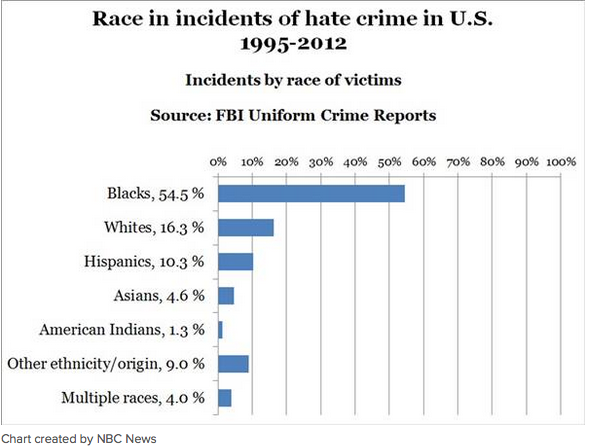
The FBI is charged under the Hate Crime Statistics Act with compiling statistics on spite-based legal transgressions. In its most recent report, for 2013, hate crimes based on race are far more numerous than any other kind.

Screen shot 2015-06-18 at 10.28.45 PM

Moreover, bias-motivated infractions against black folks far exceed those against white people.

According to the FBI statistics, 54.5 percent of the reported single-bias hate crimes that were racially motivated in 2013 targeted blacks. Only 16.3% target whites.

Screen shot 2015-06-18 at 10.28.26 PM

But you really didn’t need an FBI report to tell you that, did you? American history is littered with the bodies of beaten and brutalized people of color. You could make a very convincing argument that these dead souls make up the foundation of our country. Would our economy really have been so robust without the free labor of all those slaves? Heck! Would we even have a country at all if we hadn’t murdered all those indigenous peoples in the first place?

I know. You’re going to say that other predominately white countries have violent histories, too. And you’d be right. But notice the difference in our attitudes about it today!

Historically, Germany is no slacker when it comes to racial violence, but is there any government building in the German Republic today that continues to fly a Nazi flag? Absolutely not. In fact, it is illegal to do so.

By contrast, in America we love the stars and bars of the Confederate flag. It still waves proudly over the South Carolina capital building. (But I’m sure that has nothing to do with the violence we saw at that Charleston church I mentioned earlier!)

So let’s put it to rest. When it comes to hate crimes, white folks kill! But don’t feel too bad, black folks. There are things you’re good at, too. Like nonviolent resistance.

Heck! You’re amazing at that!

Langston Hughes wrote, “Negroes – Sweet and docile, Meek, humble, and kind: Beware the day – They change their mind.”

After all this time, black people have very rarely used violence as a means to achieve their ends, to try to secure the rights and freedoms white America guards so jealously.

In just the past year or so, unarmed black folks have been assaulted or killed for holding toy guns, being suspected of selling loose cigarettes, listening to music at a gas station, asking for help after a car accident, wearing hoodies, wearing bikinis, running, and now just going to church!

And the response from the black community has been pretty darn nonviolent. Yeah there’s been some shouting and looting, but very little beating or killing.

White folks, can you imagine having to undergo such indignity on a daily basis and NOT responding in kind!?

No wonder a blonde white girl from a Christian fundamentalist home darkened her skin, curled her hair and tried to pass as black! Sometimes – often really – it’s darn embarrassing to be white! Black folks have the moral high ground.

Somehow they live in an American society that heaps hatred on their every move and they respond with dignity and perseverance.

So why are black people so nonviolent?

Damned if I know! But I wish us white folks would take a lesson from them.


NOTE: This article also was published on the Badass Teachers Association blog.



UPDATE: There has been a criticism of this article I’d like to address. I have claimed, “In terms of raw numbers, black people and white people actually commit about the same number of murders.” Some say this works against my argument that black people are less violent than white people. After all, there are fewer black people in the country, yet they commit about the same number of murders as white people. Doesn’t that make them more violent?


I think if you factor in poverty, the numbers wash. After all, poor people are generally more violent than those in better circumstances. Since most black people experience higher levels of poverty than most white people, we can only expect higher proportions of murders from them. When your options are limited between working several minimum wage jobs to squeak by or to engage in the drug trade for a higher income bracket, well it’s not surprising. If black folks weren’t subjected to such high poverty rates, we would expect the black murder rate to plummet.


I know some readers won’t accept that answer. And if so, fine. However, this doesn’t affect at all my assertion that black people commit a fraction of the country’s hate crimes. Whether you look at it proportionately or numerically, white folks are MUCH more likely to commit hate crimes than black folks. I think that’s significant.


However, I have received enough correspondence from readers of this article to know that many don’t care. This article has been surprisingly popular. It still gets hundreds of hits every week. Unfortunately, many of the people who seem to find it appear to be those with an axe to grind. WordPress allows me to see what readers type into a search engine to find this article. I can see what sites lead you here. I know that white supremacists and far right conservatives are loving this article as an example of “liberal, white self hate.” The responses to this article in some of the darker corners of the Internet have been as hilarious as they are badly argued. It appears that some people are so committed to the idea that black people are violent that nothing anyone says could convince them otherwise. Moreover, they are so enamored with white violence that they see it as evidence of white superiority or else they try to argue it away as being perpetrated by people who are not truly white.


To those people I have only pity. Love is stronger than hate. I honestly hope that one day you will understand.