Meanwhile Clinton’s main competition for the Democratic nomination, Bernie Sanders, remains silent on K-12 public education. He’s a favorite among teachers but he hasn’t really articulated much of an education policy at all.
Her connections to this movement have not weakened. Just this week, #TeachStrong – an education reform organization – was launched with ties to Clinton. The group is organized by the Center for American Progress (CAP) – a think tank long affiliated with both Hillary and Bill. Husband and wife have hired numerous staffers from this organization and have championed policies that originated behind CAP’s closed doors. Many education observers are theorizing that the #TeachStrong initiatives which blame teachers and try to make their lives more difficult will eventually become Clinton’s education policies if she becomes President.
By contrast, Sanders would seem to be well suited to oppose these corporate-driven school reforms. He’s anti-privatization, anti-Wall Street and pro-worker. His vitriol against the banking industry and the 1% using tax loopholes to avoid paying their fair share would only be enhanced if he included corporate school reformers on his hit list. These are, after all, most of the same people he’s already going after just for different reasons. Unfortunately, he has yet to embrace public schools. Up to this week, both he and Clinton favored only pre-kindergarten and college support. Now she has started talking about K-12, but Sanders’ lips remain buttoned.
Perhaps this is because he thinks education voters have already sided with Clinton. The largest teachers unions – The National Education Association (NEA) and the American Federation of Teachers (AFT) – both endorsed Clinton in the primary. However, in each case these endorsements were highly controversial coming mainly from union leaders without much or any involvement from rank and file members.
Clinton seems to know that top-down endorsements alone won’t get her votes. She needs to win the hearts and minds of membership, and she seems to be committed to doing just that. Her education comments may not be entirely satisfactory, her connections may be highly unsavory, and her history may be deeply disturbing, but at least she’s making the effort to reach out to voters who care about the education system.
Sanders, where are you? You’re a Democratic Socialist. You say you’re committed to the public good. What is a greater public good than public schools? The education vote is by no means decided. It remains on the table for either candidate to take.
Personally, I don’t think Clinton is a good choice to come to education’s rescue. No matter what she says, I just don’t trust her. Someone who champions privatization isn’t going to save us from for-profit charter schools. Someone who is in bed with the testing industry isn’t going to reduce standardized testing. Someone who helped establish Common Core isn’t going to repeal it.
But if I’m honest, Sanders has skeletons in his closet, too. In the Senate he voted to expand charter school funding, voted for No Child Left Behind and most recently voted to keep test and punish policies in the Elementary and Secondary Education Act. However, given everything else he espouses, all these votes seem like anomalies. While Hillary looks like a seasoned professional who knows exactly what she’s doing in education circles, Bernie seems like a bumbling amateur who keeps making mistakes. It appears all he needs is a good talking to, someone to explain how our interests and his align perfectly. (Call me maybe!)
Of course, there is another possibility. Perhaps Sanders is against us as much as Clinton. Perhaps there is no major politician out there who has any interest in saving our schools.
Perhaps we really are alone.
In that case, maybe we shouldn’t wait for major politicians to come to us. Maybe we should consider supporting someone who is honestly in favor of us but does not yet have much political clout.
In the meantime I find myself waiting impatiently for Sanders to make his move. But I won’t wait forever. If he wants my vote – and the votes of hundreds of thousands of parents and teachers – he’s going to have to make his case.
The very idea that we need the same academic standards in public schools from coast-to-coast is unpopular, expensive, ineffective and politically suicidal.
The Wall Street Journal reports at least $7 billion taxpayer dollars have been wasted implementing this plan, and it would cost significantly more to finish the job.
“Five years into the biggest transformation of U.S. public education in recent history, Common Core is far from common. Though 45 states initially adopted the shared academic standards in English and math, seven have since repealed or amended them. Among the remaining 38, big disparities remain in what and how students are taught, the materials and technology they use, the preparation of teachers and the tests they are given. A dozen more states are considering revising or abandoning Common Core.”
Meanwhile public support drops precipitously with each passing year. Less than half of all Americans – 49% – and only 40% of teachers now favor the policy. That’s a drop of 16% among the general population since 2013. But even more surprising is the plummeting backing from teachers. Advocacy has dropped 36 points from two years ago when three quarters of educators approved of the change. This is especially damning because of all social groups, teachers know the Core the best.
In political circles lawmakers who used to champion these standards now take pains to distance themselves from them. Politicians as diverse as Jeb Bush and Hillary Clinton now claim they either never supported the policy in the first place or that it’s a good idea that has been badly implemented. Support among Republicans – who initially favored the plan much more than Democrats – has practically vanished.
The writing is on the wall. Common Core is sinking fast.
Yet there remains a minority of real live educators who will cheerfully direct you away from the lifeboats even as the ship of our public schools lists dangerously to port. Despite everything going on around them, they cling to this disastrous policy blunder despite the harshest criticisms.
It’s strange.
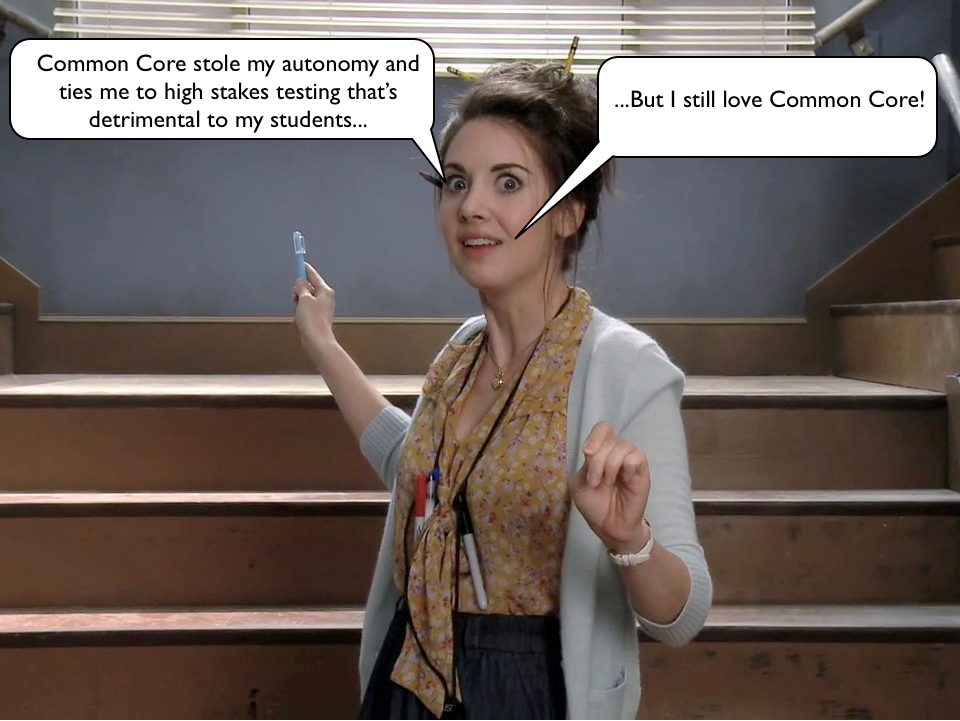
By and large, Common Core wasn’t created by teachers. It was forced on us by policymakers, functionaries and corporations. It usurps our autonomy. It overrides our judgment. And it ties us to practices that almost all of us think are detrimental to our students. But some of us still think it’s the bees knees.
The only explanation I can come up with is Stockholm syndrome. The phenomena, also called capture-bonding, occurs when hostages empathize with their captors. Kidnapping victims sometimes feel sorry for the very people who abducted them. Something similar seems to be happening with the few hardcore supporters of Common Core that are left.
For instance, regardless of the public relations efforts being spewed by corporate America, Common Core was not created by teachers. It’s shocking that this fact is still disputed. It is easily verifiable.
Here it is from the National Governors Association – these 24 people wrote the first draft of the standards. And these 101 people revised them. None of these people were currently employed as a K-12 classroom teacher. Moreover, very few of them even had K-12 classroom experience at some distant point in their careers. Even less had experience at the middle school or elementary level. Less than that had experience in special education or with English Language Learners.
Therefore saying Common Core was created by teachers is incredibly disingenuous. It’s like taking a single speck from a beef bullion cube and calling it a filet mignon. Something resembling a cow may have been present at one point, but add water and you couldn’t exactly call the flavor beefy.
The overwhelming majority of Common Core authors are identified as working for the testing industry – specifically the College Board and ACT. The second largest group worked for Achieve, a Washington think tank. Others worked exclusively at the college or university level.
Yet there remain a small cadre of real life K-12 teachers who still champion this product. Think about what that means.
They prefer a prepackaged set of academic standards to what they would come up with on their own or with their colleagues. They prefer to give up their own professional judgment based on years of experience, degree certifications and professional development in favor of something handed down to them from the testing corporations and policy wonks. They would rather be told what to do by people with far less experience than to make their own decisions about how to do their own jobs.
Even if everything in the Core was hunky dory, I’d have a problem with that. Call it self-respect. Call it professional pride. I did not get into this field to become anyone’s worker drone. Being a teacher is not on par with being a greeter at Walmart. We need to make complex decisions about how best to educate children every moment of every day. That’s not a mcjob.
This doesn’t mean all the standards contained in the Core are garbage. There are certainly some things in there that promote learning. However, as educators have become more familiar with the contents, glaring mistakes have become apparent – standards that are age inappropriate, too specific, not specific enough, unduly restrictive, and just plain weird. If only there were some objective means of telling the wheat from the chaff.
But there is.
We could have tested the standards to see if they actually aided in comprehension. We could have field tested the product – tried it out in a small scale and then assessed its effectiveness. You would expect any new commodity to go through rigorous research and development. Only a fool would just throw new merchandise out there without any idea if it would work.
Welcome to Fool Nation – population you. That’s where your tax dollars went. Your government spent billions on something completely untried and unproven. And guess what!? It didn’t work.
I have a major problem with that. As a teacher, I am appalled that I am being forced to institute something so careless into my classroom. If the legislature suddenly thought all children should be forced to pour lemon juice on their heads before reading a book, I’d jolly well need a good reason to do it before I started squeezing citrus on top of my classes. But that’s kind of what they did, and they even charged the taxpayers for all the lemons!
High stakes assessments do not promote learning. They narrow the curriculum and punish the neediest students for – in fact – being needy. It’s a proven fact: rich children generally score well and poor children score badly. These are terrible measurements of children’s academic success.
And most folks left on the dwindling bench of Common Core cheerleaders agree! They don’t like testing either! Yet so many times I’ve heard these people say, “I hate the testing but I love the Common Core!”
What!? They’re intimately connected.
Common Core was designed to be assessed by standardized tests. In fact, the standards attempt to make what is taught more representative of what is tested. For instance, most passages on Reading assessments are nonfiction. Therefore, Common Core says most of the reading done in school should be nonfiction. The tests emphasize cold reads. Therefore, the Core says teachers should make their students do more cold reads.
And yet Core advocates only find fault with the tests!? How can you say ‘I don’t like the tests but I like teaching to the tests I don’t like’?
It’s absurd.
And speaking of cognitive dissonance, why are we designing our curriculum backwards from the tests in the first place? Shouldn’t we be designing the tests based on the curriculum? Shouldn’t our assessments be made to prove that students are prepared for real life and not simply that they’re prepared to take the tests?
Bizarrely, all this remains a mystery to the few Common Core standard-bearers left in our classrooms. They want their Common Core. Yes, it was forced on them by bureaucrats. Yes, it’s never been proven to work. Yes, it’s intimately connected to the same standardized testing they hate. But they just can’t get enough of that Core.
Still, don’t be too hard on them. Everyday more of these folks are waking up. Every day more of them discover they are living in The Matrix. Reality is not as it seemed.
Perhaps it will just take more time. Or a strict regime of psychoanalysis, mediation and special pharmaceuticals.
But one day the Common Core will breath its last, and we’ll need everyone to help undo the damage.
I met Rick Smith for the first time in person this summer in Washington, D.C.
He had traveled to our nation’s capital to cover the Badass Teachers Association (BATs) Congress of which I was a member. Though I’d seen pictures and videos of him and even been on his daily radio show a handful of times, I was surprised to see him standing there in the lobby. He looked exactly like his pictures.
Often when you meet someone like that in the flesh, you get a glimpse behind the mask at how much the persona differs from the person. For example, when I was a journalist and interviewed Marvin Hamlisch, he was much more the cranky old man than the consummate showman.
But Rick was just… Rick. Faded denim, golf shirt, tousled hair under a ball cap.
He treated me to breakfast in the hotel restaurant and we talked about politics, activism and education. In a way it was like being on his show except there was no audience. Maybe he didn’t speak as loud and didn’t feel the need to explain the background of a subject for listeners at home, no station identification, but other than that it was pretty much the same.
He’s the real deal. What you see – or usually hear – is what you get.
I remember thanking him for trucking all the way from northern Pennsylvania to be here with us. He wasn’t getting anything extra for this. We certainly didn’t have any money to pay him. Rick was actually interested in hearing what teachers like me had to say.
We had congregated here in the capital to lobby our lawmakers and discuss among ourselves how to change our national education policy into something more student centered and less privatized, corporatized and standardized. And Rick wanted to showcase it on his show. He wanted to be there, to see what we were doing, ask us questions and put it all on the air for listeners across the country.
And – of course – he bought me breakfast.
As I was making my way through a waffle, Rick dropped the bomb on me.
He wanted to know if there was more to this story – if there was enough information for a weekly radio segment.
I carefully swallowed and told him that there was.
And here’s a guy with his own radio show and podcast who is actually interested in what educators think!
We shook hands, made plans and another trip to the buffet.
Now it’s been a little more than two months since the “BATs Radio – This Week in Education” segment premiered. Every week – usually airing Mondays at 5 p.m. Eastern – Rick has two guests chosen by the BATs. And wow! Have we had some amazing interviews!
New Orleans parent Karran Harper Royal explained how the Obama administration’s privatization scheme has systematically destroyed public schools in the Big Easy. Wayne Au talked about what it was like to be one of the appellants in the Washington State Supreme Court Case that found charter schools to be unconstitutional. New York parent Karen Sprowal described how the Success Academy charter school had trampled her child’s rights. Jeanette Taylor-Ramann explained what pushed her and several other Chicago parents and teachers to go on a hunger strike to save their last neighborhood school. Puerto Rican teachers union president Mercedes Martinez informed us of the massive island revolt against privatizers in our US territory.
I am so thankful to Rick for making this a reality. Teacher, parent and student voices are getting through the media embargo. We’re being heard. It’s unfiltered news! It’s what’s happening at street level.
This wouldn’t be getting out there so prominently if Rick weren’t interested, if he didn’t think it was something his listeners were interested in hearing. He gives up a significant chunk of his weekends to do it. He gives up time with his family, his children, to bring this to the public.
I can’t express how much that means to me and the more than 56,000 members of BATs.
I remember thanking Rick at the end of that first breakfast meeting and I’ll never forget what he said.
“This is what we do, Steven,” he said. “We’re activists first.”
That’s why Rick Smith is a true progressive hero.
NOTE:
You can hear the BATs Radio – This Week in Education segment most Mondays at 5 p.m. Eastern on the Rick Smith Show. The entire progressive talk show airs weekdays from 3 – 6 p.m. on several radio stations and on-line.
All BATs Radio interviews are archived here in case you missed them.
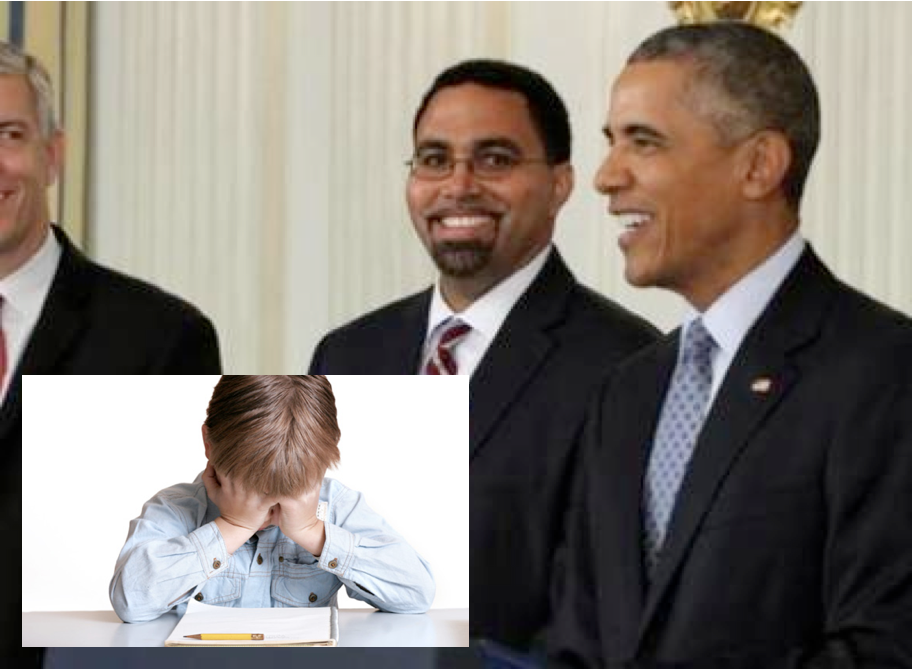
Hey, Everybody! So sorry about all those high stakes tests, Common Core Standards and Value-Added teaching evaluations. We know they’re bad and we’re going to stop.
Then whatever functionary drew the shortest straw toddles back into the building and for the rest of the year things continue on exactly the same as they always have.
Let’s just pause for a moment and imagine how incredibly stupid they must think we are. I’m surprised they don’t issue public service announcements reminding us to exhale, multi-colored pamphlets on the benefits of blinking, and puppet shows instructing us how to use the potty.
The Obama Administration has had 7 years to fix this mess, and the only things they’ve done are to make it worse. Most of us voted for this so-called progressive because we thought he’d improve upon George W. Bush’s astoundingly wrongheaded school policies. But instead he doubled down on them! We hired a competent janitor but he was successful only in creating greater disorder.
We thought someone with the intelligence and grace of Barack Obama would be able to understand more than the eternal C-student Bush that you can’t ensure equity by standardized testing. That’s like trying to ensure a bathtub was filling with hot water by using nothing but Tarot Cards. The cards don’t give you an accurate reading and even if they did, you’d need to adjust the faucet at some point!
We thought a Constitutional scholar would understand that a national school curriculum violates federal law – even if you get a faux state commission to propose it and slap a new name on the thing! The federal government is allowed to do some things and state governments are allowed to do others. It’s not that hard. Moreover, armchair generals who have zero understanding of educational pedagogy, psychology, sociology and no classroom experience have no business telling teachers what they should be teaching!
In short, we expected a liberal Democrat, but got instead a Conservative Democrat in Name Only (DINO). He took far right ideas that Bush could barely officiate and made them much more efficient and thus much more damaging.
And every year like an alcoholic stumbling off a bar stool, the administration swears they’re not going to take another drink. Then they hire the head of Anheuser-Busch (John King) as a nutritionist. And some of us still believe them!
Just look at the crumbs they’re throwing out to us, peons!
Hey, Girl. We’re going to cut testing down to 2% of the school year.
That’s 23 hours! Almost 3 full days! Imagine if the dungeon master told you he was only going to put you on the rack for 2% of the time! Would you thank him? Maybe, but it would be a pretty half-hearted thank you.
Can the administration prove any positive value for standardized testing? I’m not asking them to trot out the tired party line about equity. I mean can they prove that testing actually helps children learn in any appreciable way? If the answer is no (and Spoiler Alert: it is!) then we shouldn’t be wasting any more time with it. Not 2%. Not 1%. ZERO PERCENT!
The department says, “The assessments must be worth taking.” No shit. That’s exactly the problem! They aren’t! And they’re shrouded in secrecy under the guise of test corporations intellectual property. How will we be able to determine they’re “worth taking”? Will you just tell us? THAT sure puts my mind at ease!
You know what assessments have been proven worth taking? The ones created by teachers. Yet these are exactly the kinds of tests that schools have been forced to cut back on. Perhaps this is what the administration has in mind. No more teacher-created tests. Let’s just have tests made by the professional test creators who have no idea what the heck they’re doing!
And speaking teachers, this one’s for you: “No standardized test should ever be given solely for educator evaluation.” It sounds like a condemnation of Value-Added Measures (VAM), of evaluating teachers on student test scores. However, it’s just the opposite. Notice the word “Solely.” We’re not going to give kids tests if we ONLY use them to evaluate their teachers. Well woop-de-do! Professional flunkies will talk to you for hours (if you pay them enough) about how great the tests we give now are at doing both! So no change in policy, just some purple prose to light on fire and blow the smoke up educators hind ends.
This announcement is not reason to celebrate. It’s more of the same fake apologies soaking wet in crocodile tears and bad candor.
If Hillary Clinton wants to get elected President, she’d better do more than that. If Bernie Sanders wants a shot, he’d better do more than spout socialism about Wall Street and silence about K-12 schools.
You can only lie to our faces for so long. Despite your best attempts to trash public education in the name of saving it, we’re not so dumb as to believe any more of your evasions, deceit and dishonesty.
He’s a 13-year-old African American with too much energy and not enough self-control.
He’s often angry and out of his seat. He’s usually in trouble. But today he’s sitting forward in his chair with his hand raised high and a look on his face like he’ll explode if I don’t pick him right this second.
Yet according to a new study, America’s students don’t succeed as well academically if they have access to computers at school.
How can this be?
How can exposure to new technologies cause a nation of young people to fail at a system supposedly designed to prepare them for the jobs of the future?
The organization studied 15-year-olds across 31 nations and regions from 2012. The study just released in September even controlled for income and race.
Yet here in my classroom I see the exact opposite. Computer use increases my students test scores – on my teacher-created tests.
Melvin’s movie was ready. He had been tasked with explaining the differences between external and internal conflict. I pressed play.
High adrenaline music poured from the speakers. Pictures flashed across the screen of boxers and football players.
“This is external conflict,” came rushing forward followed by a brief definition. Then an image of Homer Simpson with an angel and devil on his shoulders. “This is internal conflict,” came zooming by our eyes.
The film might not win any Academy Awards, but it was pretty impressive work for 40 minutes of class time and however long Melvin decided to spend at home.
It’s the kind of thing my students never could have done before they each had ipads. And when they took my test, few of them got the questions wrong about conflict.
Yet according to the OECD, I was somehow hurting my students academically!?
I used to have eight computers in my classroom, but they were slowly becoming obsolete and inoperable. Some days they functioned best as extra illumination if we shut out the overhead light to show a movie.
The one lab in the building that had new devices was reserved almost exclusively for a drill and kill test prep program we had received a state grant to operate. THIS was the apex of school technology – answering multiple choice look-a-like questions. It bored students to tears and didn’t even accomplish the stipulated goal of increasing standardized test scores. Yet we were blackmailed by the state government into initiating the program so we could gain additional funding to keep the school operational.
However, the best use of technology is something quite different.
This year my district received a gift of ipads for all the students, and it’s changed everything. No longer do I have to beg and plead to get computer lab time for real high tech lessons. I don’t need it. The technology is already in the classroom in the palm of their hands.
But policymakers clutching their pearls because of this study have already began to make changes to international school curriculum. Schools in Asia have begun cutting back on student computer time. Should America follow suit?
Absolutely not.
The problem clearly is not computers. It’s the antiquated method we use to measure success.
But the world hasn’t. We’ve moved on a bit since the Han Dynasty. We no longer live in a medieval society of peasants and noblemen where the height of technology is an abacus. We live in an ever-changing interconnected global community where a simple search engine provides more information than could be stored in a thousand Libraries at Alexandria.
How can we possibly hope to rely on the same assessments as the ancients? Heck! Even as far back as 970 AD, standardized testing was criticized as being inadequate.
But what I’m seeing in my classroom primarily is an opportunity – not a danger. Students like Melvin are more engaged and willing to take chances. They have greater freedom, intrinsic motivation and excitement about learning.
Many times when sharing Keynote presentations, after one or two, students ask to have their work back so they can improve them. That doesn’t happen with test prep.
They often elect to take ipad assignments to lunch and work on them between bites. That doesn’t happen with Pearson worksheets.
I’m not saying it’s easy. It’s up to me, my colleagues and administration to ensure technology is used to its full potential. Never should these devices be time fillers or babysitters. Nor can they ever replace the guidance of a thoughtful, creative educator to determine their best use. Teachers need to create and assign lessons that promote creativity and critical thinking skills.
Education professionals are constantly advised to individualize their lessons to meet the needs of diverse learners. Technology allows them a unique opportunity to do so. With district ipads I can talk to an English Language Learner in his own language. A struggling reader can have the device read test questions aloud. A student with poor motor control can type journal responses and have his writing be understood.
And these opportunities for enrichment don’t even need to be planned ahead of time. For instance, when discussing a short story about a character that was exceedingly proud, one of my students brought up the Seven Deadly Sins. She wasn’t exactly sure what they were or how exactly they related to pride, but one of her classmates quickly looked it up on her ipad. Then another found a medieval woodcarving to which someone else found a related manga text. The subsequent discussion was much deeper and relevant to these children’s lives than it would have been otherwise. And none of it was pre-packed, planned or standardized. It was individualized.
This is really no surprise. Administrators in charter or private schools aren’t asking themselves if they should close their computer labs and put their devices on ebay. They know the value technology can provide in the classroom, but they aren’t constrained by high stakes testing.
Even rich public schools don’t have to worry to the same degree because their students already score well on federally mandated assessments – after all, standardized tests are designed to favor children with wealthy parents over those from impoverished or minority backgrounds. It’s only in poor school districts where technology is either second hand or a charitable donation that administrators and school directors are being pressured to cut back.
As usual, best practices for the privileged become questionable when applied to the poor and minorities. You want technology? Prove it will boost your test scores!
It’s nonsense.
Think about it. Even the best use of computers won’t boost standardized scores. Computer skills aren’t on the tests.
I wonder what Bill Gates thinks of this report. The Microsoft co-founder is also one of the biggest advocates for school standardization. If he had to pick between his two favorite children, which would he choose – laptops or Common Core tests? Maybe we needn’t wonder. His own children go to a private school with no standardization and a plethora of technology.
If we really want to prepare the next generation for the jobs of the future, we need to scrap high stakes testing. We need to invest in MORE technology, not less. We need to ensure technological lessons are being overseen by trained educators and the devices aren’t used as a babysitting tool. As such, we need to provide teachers with support and professional development so they can best take advantage of the technology they have.
America can prepare its children for the world’s high level management and administrative positions or we can prepare them to do only menial work that will soon by replaced by machines.
One of my dearest high school friends was a bit of a doofus.
Who am I kidding? So was I!
One of our favorite things to do after school was plop on the coach and play shoot ‘em up video games. “Smash TV” was a particular favorite.
We’d bob and weave while clutching controllers and rapidly jamming our thumbs on the buttons.
And at such times, we‘d talk.
No great philosophical problems were solved during these mid-afternoon gaming sessions. We’d talk trash, dissing each other’s gaming skills, bragging about our own, and occasionally quizzing each other with trivia on a shared topic of interest.
We both loved movies, so my buddy used to shout out cinematic quotations and ask me to name where they came from.
“Frankly, my dear, I don’t give a damn.”
“Luke, I am your father!”
“Go ahead, punk. Make my day!”
None of these famous quotes made my buddy’s list. He preferred lines like these:
“Run!”
“Look out!”
“Holy S&*t!”
As you can imagine, I rarely got any of them right.
I’d laugh, punch him in the arm good-naturedly and go on shooting virtual enemies.
No, learners don’t have to identify impossible movie quotes. Instead, they’re forced to answer impossibly bad multiple choice questions. But the results are pretty much the same.
It began with budget cuts. The legislature slashed almost $1 billion every year in school funding. That means higher class sizes, less teachers, fewer electives, tutoring, nurses, services, etc. And districts like mine weren’t exactly drowning in money to begin with.
Students now have less resources, therefore they can’t prepare as well for the tests.
So what did the legislature do? Did our lawmakers fix the problem by putting back the money they had repurposed as gifts to the natural gas industry?
Heck no! They made the tests even more unnecessarily difficult.
As a result, the steady decline in test scores this year fell off a cliff!
After all, this was the first year in which the Commonwealth fully aligned every question of its mandatory testing with the Pennsylvania Core Standards – which are similar, but not identical to the Common Core standards adopted in other states.
Proficiency rates in grades 3 through 8 dropped by an average of 35.4 percent in math and 9.4 percent in English language arts on the PSSA. Nearly half of all seventh and eighth graders dropped an entire proficiency level in math in just one year.
If I made up a test like this in my own classroom, gave it to my students and got results like these, my first assumption would be that there was something horribly wrong with the test. I must have messed something up to fail so many students! Teachers are always on the lookout for unclear or bad questions on their self-created exams. The for-profit corporations that create our state-mandated tests? Not so much.
Though state Department of Education officials acknowledge the continued decline in scores, they insist problems will work themselves out in subsequent years – as if a 4-year trend is just an anomaly. Move along. Nothing to see here, folks.
My students used to make impressive gains on the tests. My principal stopped by today to give me the scores for my current students and those I taught last year. No surprise. Very few passed.
Are my students now lazier and less intelligent than those I taught four years ago? No. Students who scored well before the budget cuts, often score badly now.
Am I a worse teacher? Absolutely not. I have the same skills I did then. I spend the same amount of time at school – maybe more.
So what changed in my classroom? Lack of reconnaissance.
Teachers like myself used to know exactly what was expected of students on these assessments. We had plenty of materials with which to prepare them. Now the exams change every year – and I don’t mean just the individual questions, I mean what is tested!
Back in the day, when my buddy first shouted out, “Run!” and asked me which movie it came from, I had no idea. But after he did it long enough, I’d start to anticipate him. I’d learn that he was thinking of James Cameron’s “The Terminator.”
That’s how the PSSA’s used to be. Teachers knew how the test makers wanted kids to answer. And we could prepare them to do so. The tests didn’t accurately assess student learning even then. It was a game, but at least it was more fair.
It’s like my buddy’s movie quiz. I have little doubt that someone really did shout “Run!” in “The Terminator.” However, that same line probably appears in at least a dozen more action movies. There’s no way to determine a single correct answer. And shouting out a different quote instead like “Look out!” doesn’t help either.
So please stop the talk about “Rigor.” We’re not raising standards. We’re changing them. My buddy found a new bunch of movies from which to shout out impossible quotes. That’s all.
Anyone who wants to argue validity to these new test questions has to leap a host of hurdles to accomplish his goal.
First, one would have to prove PA Core – and by extension Common Core – Standards actually improve student learning. Good luck. It’s never been done and all the evidence is against you.
Second, one would have to gain access to an individual year’s worth of test questions. Again, good luck. They’re corporate property. The public is not allowed to see the questions. If a principal, student or teacher were to copy a question or snap a photo of a test, they could be subject to prosecution in a court of law.
Such a lack of transparency in government is a sure sign of malfeasance.
These tests constitute fake proof of inadequacy. They attempt to “prove” our public schools are failing and should, therefore, be replaced by private corporations – maybe even by subsidiaries of the same for-profit companies that make and grade these tests!
When my buddy unfairly stumped me, we both knew it was a joke. We’d laugh and play another video game.
But there’s nothing funny about this when it’s perpetrated by the state and federal government.
Pennsylvania’s standardized test scores are a farce just like the scores in every state and territory throughout the country. They’re lies told by corporations, permitted and supported by lawmakers, and swallowed whole by the media and far too much of the public.
We always seem on the verge of waking up. Tomorrow we will stop the state-sanctioned abuse of children by the testing industry. Tomorrow we’ll take responsibility for this sick system we allow.
But when will tomorrow come? I’m tired of waiting.
But perhaps more surprising is the pattern of low, sloppy or inconsistent academic achievement by so many of those adults who consider themselves education reformers, particularly corporate school reformers.
Our ideas of school are certainly formed during our years in it. Those working so diligently to destroy the public school system and reshape it to resemble the business model are so often people who didn’t fit in. They earned low grades or only excelled in subjects they really liked. Perhaps school failed them or perhaps they failed school. There’s no way to know for sure since school records are almost always kept private. But details do trickle through and display a clear pattern – a pattern that certainly gives the appearance of an ulterior motive.
Are these former bad students more interested in fixing the perceived problems they see with the system? Or are they consciously or unconsciously seeking revenge against a system that found them to be inadequate?
But when he was a lowly student, he wasn’t anywhere near the head of the class. His grade school years are mostly shrouded in mystery, but his college career is ablaze in controversy.
He claims to have been a solid C-student with a 2.59 grade point average. Contemporaries say it was closer to a 2.3.
“I had some classes I was more interested in than others, I suppose,” he admits.
In any case, college wasn’t for him. He attended Marquette University for almost four full years before dropping out. He only had a year or more to go before earning a bachelors degree.
Why did he quit? Numerous contemporaries allege he was expelled for cheating in student government. Walker says he simply accepted a full-time job and had to devote his time there.
The facts are these: Walker unsuccessfully ran for student body president with a tumultuous campaign. He was found guilty of campaigning a week early thereby losing campaign privileges at one facility and a day of campaigning at another.
When the student paper endorsed his opponent, the edition mysteriously vanished from the stands. Students reported seeing Walker staff taking almost all of the papers and replacing them with campaign literature against his opponent.
An investigation was conducted but the university refuses to release it saying the results are either private or have been destroyed.
However, the university denies that Walker was ever in bad standing or that he had been expelled.
The matter could easily be cleared up if Walker released his academic records to the public, but unlike most Presidential candidates of either major political party, he refuses to do so. (All while continuing to criticize President Barrack Obama for not releasing a birth certificate that the President clearly released to the public.)
Not exactly student of the year. Nor would the preacher’s son ever win “Most Ethical” in the student superlative section of his college yearbook.
It’s easy to see why someone who had such difficulty in college would spend so much time as Governor attacking that world.
He reduced state funding to Wisconsin colleges by 13% and then mandated they freeze tuition for 4 years. He recommending replacing University of Wisconsin leadership with a private authority governed by his own appointees. He proposed the university change its fundamental commitment from “a search for truth” to the goal of workforce readiness.
He also presided over the largest roll back of collective bargaining rights in state history – and who make up the biggest unions? Teachers. Other working people are just more grist for the mill of his petty power trip.
If Walker had studied harder, spent less time on extra-curricular politics and finished his degree – I wonder if he wouldn’t have such animosity towards education. Maybe then he wouldn’t spend his days congratulating himself for hobbling colleges and public schools while trampling on workers rights.
Moving from politics to punditry, few people have devoted their careers to destroying the teaching profession as much as former anchorperson Campbell Brown.
Since being quietly let go from CNN when her news program was cancelled for low ratings, Brown has become an outspoken corporate education reformer. School choice, the destruction of teacher tenure and labor unions – there are few supply side education ideas she doesn’t support. Most notably, she serves on the board of directors for the infamous Success Academy Charter Schools – a system that uses student humiliation to ensure children swallow a curriculum consisting almost entirely of standardized test prep. Moreover, her husband, Dan Senor, is on the board of StudentsFirstNY, a corporate school reform organization affiliated with Michelle Rhee.
How anyone so personally invested in the factory schools model could possibly claim she was impartial enough to serve in a journalistic capacity on this matter is beyond belief. But that’s just what Brown does. This summer she even co-founded The Seventy Four – a news site dedicated to covering education. She claims it’s all “non-partisan” and “non-profit.” Ha! Her husband is a former adviser to the Romney campaign and spokesman for the Bush administration’s Coalition Provisional Authority in Iraq! Her “news” site is like Fox News for schools – which given the supply side bias of MOST news organizations is really saying something!
Is it any surprise that when Brown was in school, herself, she wasn’t exactly honor roll material?
She describes herself as a “terrible student” in Catholic school, but immediately justifies her academic performance by saying the teachers were awful, too. Since she had such a horrible parochial school experience, it’s a wonder she reserves her rancor for the public school system where she has little first hand knowledge. A child of privilege, Brown was a private school girl.
At Virginia’s elite Madeira School, she was kicked out for sneaking off campus for a party. She eventually earned a GED, and briefly attended Louisiana State University before waitressing in Colorado and enrolling in a Catholic college in Denver. It was there that a priest who taught political philosophy finally reached her. She eventually earned a B.S. in political science.
It was a long, difficult academic road for Brown. I wonder how she would have done at Success Academy where mostly poor Black and Hispanic students must sit with hands clasped and eyes following the speaker; where reading passages must be neatly annotated with a main idea; where her teachers would be inexperienced drones forced to work 11-hour days and face high turnover.
Something tells me as a student she’d find those teachers just “awful,” too. It’s a hard thing to take responsibility for one’s own actions especially as a child. If only the teacher had taught me better, if only I had gone to the good school, if only someone had done this or that. Poor little rich girl.
Now Brown is a professional at casting blame on our public school system in favor of unproven or disastrous education models. She’s come from the back of the class to the front – where she can criticize and wag her finger.
But to do the most damage to the school system, you need to be more than a politician or a pundit – you need to be an ideologue. And you need so much cash you don’t now what to do with it all.
Common Core State Standards would not exist without his backing and financial bribery of federal and state governments. The man of ideas who instinctively understands the world of computers extends his hubris to encase all subjects. For clearly, what is true of a network of calculating machines must be true of young minds. Gates knows best, and where he is contradicted by one peer-reviewed study, he can pay for several independent ones to back up his pet ideas.
But whatever you say of Gates, he differs dramatically from Walker and Brown. Gates is clearly brilliant. He was a National Merit Scholar who scored a 1590 out of 1600 on his SATs. One would think his academic record must be impeccable. But one would be wrong.
While he excelled in subjects he cared about, he neglected others that weren’t immediately interesting. According to a college friend:
Gates was a typical freshman in many ways, thrown off pace by the new requirements and a higher level of competition. He skipped classes, spent days on end in the computer lab working on his own projects, played poker all night, and slept in a bed without sheets when he did go to bed. Other students recall that he often went without sleep for 18 to 36 hours.
Even at Harvard, Gates continued his pattern of getting good grades in the subjects he liked and disdaining those that were of little interest. His heart didn’t seem to be in his studies. Gates joined few college activities unless his friend Steve Ballmer dragged him off to a party.
School was of little interest to him. He dropped out of Harvard before getting a degree to start his computer software company.
Some tell it as a story of an eccentric’s unstoppable rise, but few tarry long enough to remark on the privilege from which Gates emerged. He didn’t have a public school education. He attended an elite preparatory school since he was 13. Once again someone with such little experience of public school is a self-appointed expert in reforming it.
His parents also instilled in him a peculiar marker for success. In his home, the family encouraged competition. One visitor reported, “it didn’t matter whether it was hearts or pickleball or swimming to the dock … there was always a reward for winning and there was always a penalty for losing.” How interesting that this same philosophy has become Gate’s vision for all school children! Schools must compete against each other for resources and the losers get shut down. Yet what irony that his own personal success relies on ignoring his weaknesses and focusing solely on his successes! We excuse the inconsistent grades and dropping out of college. But would Gates-backed education policies do the same for other children?
Gates, the student, easily might have wilted under the education policies of Gates, the edu-preneur. How hard it is to see oneself clearly. How hard to admit one has limitations. Especially when one is brilliant in one narrow field and has too much money and free time.
However, the case holds often enough to be instructive. An awful lot of C-students think corporate education reform is needed to fix our schools. Heck! Most of these policies come from No Child Left Behind legislation proposed by the most infamous C-student in American history – President George W. Bush!
These kinds of psychological conflicts of interest should give us pause. Do we really want to support such personal crusades? Should all the power of public policy really back the revenge of indifferent students?
When we described how the definition of school accountability has changed from holding lawmakers accountable to holding teachers accountable, he talked about the sad scapegoating of the profession.
And he admitted that in today’s environment where nothing is counted a success unless it generates a high test score, he would have been lost and probably would have dropped out.
Which brings me to the third strangest thing – Miller isn’t playing partisan politics. As a Democrat, he isn’t blaming everything on the Republicans.
“This is a bipartisan issue,” he said. There’s no reason why both parties can’t agree on what needs to be done to help our schools.
So why doesn’t the legislature do more?
Ignorance. “There’s a low level of analysis of bills down there (in Harrisburg).” Local government usually does a better job.
There’s a lot of good will in the capital, he says. “Most legislators aren’t trying to cause a problem.” They want to try to achieve something, but if those experiments fail, the consequences are dramatic, long lasting and hard to correct.
“He was always polite to me, “ Miller says. “He just didn’t talk.” He wasn’t approachable.
By contrast, Gov. Tom Wolf comes to you. Miller recalls walking in to his own Harrisburg office and Wolf was sitting there waiting for him because he had something he wanted to talk about. Wolf is well liked, even among Republicans. They might not agree with the new Democratic governor, but they have to admit he has the best interests of the state at heart.
Perhaps its Miller’s infinite good will that’s propelled the Democrat with only two years in state office to the House Education Committee.
Republicans have dominated state education policy for years. They still do. But in Miller we have someone who actually has a say in one of the most critical areas in the state. And he knows what he’s talking about, takes time to meet with real live educators and sympathizes with our cause.
Which brings me to perhaps the strangest aspect of the whole meeting – Miller’s analysis why more isn’t being done to combat the testing industry.
“The groundswell isn’t there,” he said. “You’re still the fringe.”
He praised teachers unions like the Pennsylvania State Education Association (PSEA) for being excellent advocates. He said lawmakers get all their emails, but the emphasis seems to be maintaining pension benefits. He understood why this is so, but the issues we were talking about didn’t seem to register on most legislators radar.
Heck! If we’re all dangling on the outer edge, who’s in the middle? Where’s the mainstream?
Perhaps its just a matter of perception. Maybe the other side just has better public relations.
If so, it’s up to us to spread the word until all of us counterculture anti-standardization and anti-privatization folks are seen for where we really are – at the axis of real school reform.
Thank you to Meagan O’Toole for setting up the meeting. Thank you, Ben Lander, Yvette Robinson Logan, Mary Cay Rojtas-Milliner, Susan Olsen, and Roslyn Stulga for speaking out for your students and profession. And most of all thank you, Rep. Miller, for meeting with classroom teachers to talk about what’s going on in our state’s public schools and actually listening to our stories and advice.
In education circles, it’s a buzzword meaning opposite things to opposite people. And determined in opposite ways.
Ask a representative of the standardized testing industry, and more than likely he’ll tell you accountability means making sure public schools actually teach students – especially the poor and minorities. And the only way to determine this is through repeated, rigid, standardized assessments. Let’s call that TEACHER ACCOUNTABILITY.
On the other hand, determining LAWMAKER ACCOUNTABILITY is easy. Just compare school budgets. Greater than and less than. You’ll find that none of our lawmakers provide equitable funding. Rich kids in wealthy districts get Cadillac funding while poor and minority kids in impoverished districts get bicycle funding. Strangely, this is never discussed.
Moreover, none of this relies on opinion. All it takes is empirical evidence to see the truth. Lawmakers are not accountable at all. Teachers are accountable for too much and judged by unscientific and untrustworthy methods.
Unfortunately, few politicians have fully figured this out yet. Even you, Bernie.
However, under President George W. Bush and throughout the Obama years, it’s become about punishing teachers and schools for low standardized test scores – TEACHER ACCOUNTABILITY.
And the champions of TEACHER ACCOUNTABILITY this summer have been primarily Democrats including liberal lions like Elizabeth Warren and Sanders.
That’s why a group of respected education professionals and union leaders (including myself) wrote an open letter to Sanders asking him to please explain, himself.
We aren’t exactly a hostile crowd. We like a bunch of things that Sanders represents in his presidential campaign. We want to support him, but we need to know why he voted to keep the worst aspects of the current law.
And Bernie answered! Or his staff did.
I’ll reproduce the entire letter we received from staffer Phil Fiermonte below this blog. But first I want to focus on Bernie’s specific reasons for voting in favor of the Murphy Amendment:
As you mentioned, Senator Murphy introduced an amendment on the Senate floor that would have required states to hold schools accountable for the academic performance of low-income, minority and disabled students. Senator Sanders voted for this amendment because he believes states must do more to protect every student’s right to a quality education, and that from a civil right’s perspective, the federal government has an important role to play in protecting low-income, minority and disabled children. As you pointed out, the mechanism this amendment would have used to identify struggling schools resembles the failed policies of No Child Left Behind. This was a significant concern to the Senator, and one that he shared with the sponsors of the amendment.
Senator Sanders cast his vote on this amendment to express his disapproval with aspects of the bill that were insisted upon by Chairman Alexander and Senate Republicans and that do not reflect the best interests of vulnerable populations, or a progressive view on the distribution of education resources. He has made clear to Chairman Alexander, Ranking Member Murray, and Senate Leadership that his vote was not an endorsement of the accountability mechanism included in the amendment, but rather as a statement of his intent that other measures must be put in place to protect low-income, minority and disabled students.
So Sanders voted for the Murphy Amendment for these reasons:
He was mad that there is nothing about LAWMAKER ACCOUNTABILITY in the ESEA.
He believes in TEACHER ACCOUNTABILITY – at least in part. He thinks the federal government needs to make sure teachers and schools are actually educating kids, BUT he doesn’t believe standardized tests are the best way of determining this.
However, I don’t see how voting for an amendment you don’t believe in is going to make a point about something entirely unrelated. How would voting for the Murphy Amendment get us LAWMAKER ACCOUNTABILITY? The Amendment had nothing to do with that. There are places for it in the ESEA but this amendment was focused almost entirely on TEACHER ACCOUNTABILITY.
Was Sanders trying to convince Republicans to add LAWMAKER ACCOUNTABILITY elsewhere in the bill by voting against them on TEACHER ACCOUNTABILITY here? That seems a stretch. Both parties appear to love TEACHER ACCOUNTABILITY, but during this ESEA process the Republicans have been more concerned with stripping the federal government of its power over education. It’s not that they don’t like TEACHER ACCOUNTABILITY, they just want to leave it up to the states.
Then we come to Sander’s position on TEACHER ACCOUNTABILITY. He’s certainly right that schools need to teach students. However, as a public school teacher, I find it ludicrous to think that there are any schools out there that don’t.
Are there really schools in our country that don’t even TRY to educate their students? Really!? Are there hospitals that don’t try to heal their patients? Are there defense attorneys who don’t try to defend their clients? Are their airlines that don’t even try to get passengers to their destinations?
It’s absurd. Certainly if there were such places, we should do something about them, but the fact that our education policies are obsessed with something that almost never happens is asinine. It’s like going to Ireland and spending the majority of your vacation budget looking for a leprechaun! (At least, this doesn’t happen in non-cyber, non-charter, not-for-profit traditional public schools. But I digress…)
Then we get to Bernie’s suggestion that he’s against using standardized tests to measure if schools are functioning properly. At least here he is justified. But how will voting for the exact thing you’re against get you what you want? It boggles the mind. I want Pizza, that’s why I’m voting for chicken. Huh!?
However, Sanders is responsible for an innovation in the ESEA along just these lines. He proposed a 7-state pilot program that would allow TEACHER ACCOUNTABILITY to be determined on more holistic methods than test scores. Schools could use multiple measures such as student portfolios, classroom projects, or other means to be determined by the states.
This could be a step forward. But even under the best of circumstances, it is limited to a maximum of 7 states. It’s not a long term solution. The majority of the country could still be stuck with test and punish.
So we’re left with some good news and bad news.
GOOD NEWS: Bernie actually took teachers open letter seriously enough to have a staffer answer it. That’s something. I’m sure there are plenty of presidential candidates who wouldn’t even do that much.
GOOD NEWS: Bernie has some thoughtful ideas on education. His pilot program holds – limited – promise. He understands that the measures usually prescribed to determine TEACHER ACCOUNTABILITY are bogus.
GOOD NEWS: Bernie acknowledges that LAWMAKER ACCOUNTABILITY is important and says he’d like to address it.
BAD NEWS: He doesn’t mind focusing on TEACHER ACCOUNTABILITY when there is very little need for it. Moreover, TEACHER ACCOUNTABILITY without LAWMAKER ACCOUNTABILITY is actually harmful. Imagine if NASCAR fired a driver because the Pit Crew didn’t gas up the car. If schools have inadequate money and resources, putting a gun to all the teachers heads isn’t going to help.
BAD NEWS: Some of his answers don’t make sense.
BAD NEWS: He isn’t addressing us personally. Will it take teachers storming his campaign speeches and swiping the microphone before he does more than limited reforms and pays us lip service? It’s one thing to say #BlackLivesMatter. It’s another to make sure our black and brown kids get an equitable education.
The following letter was sent to Arthur Goldstein, one of the teachers who signed the original open letter to Bernie Sanders:
Sen. Sanders views on the Every Child Achieves Act, standardized testing, and school accountability Rand Wilson Add to contacts 4:59 PM Keep this message at the top of your inbox To: Arthur Goldstein Cc: Philip Fiermonte, Cwa Cohen laborforbernie2016@gmail.com
Dear Brother Goldstein:
Senator Sanders has asked me to respond to your email, and share his views on the Every Child Achieves Act, standardized testing, and school accountability.
As you know, Senator Sanders has long opposed the blame-and-shame approach to school accountability embodied in No Child Left Behind. He voted against No Child Left Behind in 2001 because he believed then, as he does now, that the legislation’s narrow focus on standardized test scores ignores a broad range of factors that determine how well a school is meeting the needs of its students. Since the passage of this legislation, we have seen the devastating impact that high stakes standardized testing has had on schools all over the country. In the Senator’s home state of Vermont, nearly every school is identified as “failing,” and is threatened with increasingly proscriptive federally-determined interventions.
No Child Left Behind’s narrow focus on standardized test scores has tragically led to a significant culture shift in our nation’s schools. An obsession with testing and test preparation has taken over in countless school districts in America, and educators are being forced to dedicate hours of class time getting students ready for exams rather than teaching them new material, or strengthening essential skills and qualities like critical thinking, teamwork, and problem solving. And the worst thing is that students from low-income, urban school districts spend more time in test preparation than students from the suburbs. These hours and hours of test preparation have no educational value, and the fact that poor and minority students are disproportionately subjected to test prep at the expense of lesson time is a huge problem that must be addressed.
Last month, the senate passed the Every Child Achieves Act, which would fundamentally reform No Child Left Behind, and end its system of high stakes testing and draconian interventions. Senator Sanders supports this legislation, and believes it represents a very important step forward.
As a member of the Senate Committee on Health, Education, Labor and Pensions, the Senator had an opportunity to shape this legislation at every stage of its development. For example, he was one of the leading advocates on committee for the inclusion of a “multiple measure” accountability system that allowed states to include factors other than test scores when determining a school’s effectiveness.
In addition, he worked to provide states with significant flexibility when it comes to assessment. This legislation includes a provision written by Senator Sanders that would create a groundbreaking alternative assessment pilot program which would allow states to implement alternatives to standardized testing. If the legislation passes, these new assessments would eventually reduce the number of statewide tests children are forced to take, while providing educators with timely information on student performance.
However, this legislation is far from perfect, and there are several aspects of the Every Child Achieves Act that have caused the Senator great concern. For example, there is no requirement that states focus resources or attention on schools that are meeting the needs of middle class children, but not meeting the needs of minority, low-income and disabled children. In addition, the Senator is concerned that the bill does nothing to address resource equity, and was deeply disappointed when an amendment offered by Senators Kirk, Baldwin, Reed and Brown to address resource equity failed on the Senate floor.
As you mentioned, Senator Murphy introduced an amendment on the Senate floor that would have required states to hold schools accountable for the academic performance of low-income, minority and disabled students. Senator Sanders voted for this amendment because he believes states must do more to protect every student’s right to a quality education, and that from a civil right’s perspective, the federal government has an important role to play in protecting low-income, minority and disabled children. As you pointed out, the mechanism this amendment would have used to identify struggling schools resembles the failed policies of No Child Left Behind. This was a significant concern to the Senator, and one that he shared with the sponsors of the amendment.
Senator Sanders cast his vote on this amendment to express his disapproval with aspects of the bill that were insisted upon by Chairman Alexander and Senate Republicans and that do not reflect the best interests of vulnerable populations, or a progressive view on the distribution of education resources. He has made clear to Chairman Alexander, Ranking Member Murray, and Senate Leadership that his vote was not an endorsement of the accountability mechanism included in the amendment, but rather as a statement of his intent that other measures must be put in place to protect low-income, minority and disabled students.
As congressional leaders move toward the next step in consideration of this bill – negotiating differences with the House – Senator Sanders has urged the future leaders of the conference committee to include protections for low-income, minority and disabled students, and to do so in a way that addresses the needs of the whole child. We must ensure low-income, minority and disabled children have the same access to educational resources that their wealthy suburban peers have. In addition, we must ensure that struggling students have access to adequate supports including health, mental health and nutrition services and after school programs that help level the playing field.
For many years, educators across the country have been the loudest, strongest voices against the corporatization of our nation’s education system and for the increased funding and wraparound services that will make a difference for our children. This is a fight that Senator Sanders has been waging at the national level for 25 years, and one that he will continue to pursue.
Sincerely.
Phil Fiermonte
Bernie 2016
NOTE:This article also was published in the LA Progressive.
“We need to change accountability for schools to be more holistic. My greatest frustration is that I can’t do it fast enough.”
–Pedro Rivera, Pennsylvania’s Education Secretary
Parents, you can.
It doesn’t matter where you live. It doesn’t matter what laws are on the books. It doesn’t matter if your state is controlled by Democrats, Republicans or some combination thereof.
No government – not federal, state or local – can trample your parental rights. If you don’t want your child to be evaluated based on standardized tests, your child doesn’t have to be. And if a majority of parents nationwide make this decision, the era of standardized testing comes to an end. Period.
It has already begun.
Across the nation last school year, parents decided to opt their children out of standardized testing in historic numbers. The government noticed and functionaries from New York to California and all places in between are scrambling to deal with it.
In the Empire State one in five students didn’t take federally mandated standardized tests. State education commissioner Mary Ellen Elia responded yesterday by threatening sanctions against schools this year with high opt out numbers. In short, if in the coming year too many kids don’t take the test in a given school, the state will withhold funding.
It’s a desperate move. If the public doesn’t like what its duly elected officials and their functionaries are doing, those same officials and functionaries are vowing to punish the public. But wait. Don’t those people work for the public? Isn’t it their job to do our will? It’s not our job to do theirs.
The message was received a bit better in U.S. Congress where the Elementary and Secondary Education Act (ESEA) is being reauthorized. Two drafts of the law that governs K-12 public schools were approved – one in the House and one in the Senate. And both specifically allow parents to opt their children out of standardized testing. But can schools be punished for it?
The House version says no. The Senate version says it’s up to each state legislature.
These bills are being combined before being presented to President Obama for his signature. If he doesn’t veto the result, one might assume that at worst the issue will become each state’s prerogative.
But you’d be wrong. The state has as much business deciding this matter as does the fed – which is none. This is a parental rights issue. No one has the right to blackmail parents to fall in line with any government education policy. It’s the other way around.
In my own state of Pennsylvania, opt out numbers this year were not as dramatic as in New York, but they still sent a message to state government.
The number of students opted out of state tests tripled in 2015, according to data from the Pennsylvania Department of Education. PSSA math opt-outs rose to 3,270 students from 1,064 in 2014. PSSA English language arts opt-outs rose to 3,245 from 1,068. Those are the largest jumps in the nine years of available data.
And it’s not only parents who are concerned. Teachers continue to speak out against high stakes standardized tests.
Thousands of teachers have told State Education Secretary Pedro Rivera that school accountability needs to be less about test scores and more about reading levels, attendance, school climate, and other measures, he said. They have concerns about graduation requirements and the state’s current system of evaluating schools.
It’s not like these criticism are new. Education experts have been voicing them since at least 1906 when the New York State Department of Education advised the legislature as follows:
“It is a very great and more serious evil to sacrifice systematic instruction and a comprehensive view of the subject for the scrappy and unrelated knowledge gained by students who are persistently drilled in the mere answering of questions issued by the Education Department or other governing bodies.”
-Sharon L. Nichols and David Berliner, Collateral Damage: How High Stakes Testing Corrupts America’s Schools, 2007
Corporate education reformers complain that testing is necessary to hold schools accountable. However, the results are not trustworthy, according to the Pennsylvania Department of Education, itself! In 2011 and now again in 2015, officials are cautioning against using test scores to compare student achievement from year-to-year.
“The 2015 assessment should not and cannot be compared to the 2014 and 2013 assessment,” Rivera said. “It’s apples and oranges. Schools are still working on aligning curriculum to standards. They’re still catching up to teaching what we’re assessing.”
Each year students and teachers are told to hit a moving target, which was the reason also cited for caution four years ago.
While Rivera laments the issue and his inability to change anything soon within the government bureaucracy, parents are not thus encumbered.
All you have to do to save your child from being part of this outdated and destructive system is opt out.
But don’t stop there. Talk to other parents. Talk to classroom teachers. Organize informational get-togethers. Go to the PTA and school board meetings. Get others to join you.
And if the government threatens to withhold funding, lawyers are waiting in the wings to start the class action suits. Withholding taxpayer money expressly put aside to educate children because those same taxpayers disagree with government education policy!? Just try us!
Governments are tools but we hold the handles. If enough of us act this year, there will be no testing next year. Functionaries can threaten and foam at the mouth, but we are their collective boss. If they won’t do what we want them to do, we have the power to boot them out.
A multi-billion dollar industry has sprung up around high stakes standardized testing. Lobbying dollars flow from their profit margins into the pockets of our politicians. But we are more powerful.
Because you can’t serve your corporate masters if you are voted out of office.








 gadflyonthewallblog
