
If School Computer Use Reduces Standardized Test Scores, Doesn’t That Prove the Tests are Inadequate?

ipad-kids

Melvin’s hand is up.

He’s a 13-year-old African American with too much energy and not enough self-control.

He’s often angry and out of his seat. He’s usually in trouble. But today he’s sitting forward in his chair with his hand raised high and a look on his face like he’ll explode if I don’t pick him right this second.

So I do.

“Mr. Singer! Can I show my imovie now!?”

This is a first. He hasn’t turned in a lick of homework all month.

“Wow! You’re really excited about this, aren’t you?” I say.

“Yeah,” he responds. “I was up all night finishing it.”

I start to doubt this, but he does look awfully tired underneath that urgent need to share.

Airdrop it to me from your ipad,” I say, “and I’ll put it up on the SMART Board.”

This takes a few minutes.

Let’s face it.

We live in a world of high technology.

Our cell phones have more computing power than the Apollo missions to the moon.

The best, high paying jobs opening up on the world stage require increasing levels of computer literacy.

Yet according to a new study, America’s students don’t succeed as well academically if they have access to computers at school.

How can this be?

How can exposure to new technologies cause a nation of young people to fail at a system supposedly designed to prepare them for the jobs of the future?

Doesn’t real world experience usually make you better prepared?

A future chef would be helped by more time in the kitchen.

A future doctor would be helped by more access to dissection.

But a future computer-user is hurt by more time at a computer!?

Something is very wrong here.

But according to a new study by the Organization for Economic Cooperation and Development (OECD), students who use computers more at school earn both lower reading and math scores on the Program for International Student Assessment (PISA).

The organization studied 15-year-olds across 31 nations and regions from 2012. The study just released in September even controlled for income and race.

Yet here in my classroom I see the exact opposite. Computer use increases my students test scores – on my teacher-created tests.

Melvin’s movie was ready. He had been tasked with explaining the differences between external and internal conflict. I pressed play.

High adrenaline music poured from the speakers. Pictures flashed across the screen of boxers and football players.

“This is external conflict,” came rushing forward followed by a brief definition. Then an image of Homer Simpson with an angel and devil on his shoulders. “This is internal conflict,” came zooming by our eyes.

The film might not win any Academy Awards, but it was pretty impressive work for 40 minutes of class time and however long Melvin decided to spend at home.

It’s the kind of thing my students never could have done before they each had ipads. And when they took my test, few of them got the questions wrong about conflict.

Yet according to the OECD, I was somehow hurting my students academically!?

Even in my high poverty district, students have always had access to technology. But the nature of that technology and how we use it has changed dramatically this school year.

I used to have eight computers in my classroom, but they were slowly becoming obsolete and inoperable. Some days they functioned best as extra illumination if we shut out the overhead light to show a movie.

Still, I tried to incorporate technology into my lessons. I used to have my students make their own Webpages, but reserving time in the computer lab became almost impossible. And even then, the district couldn’t afford to keep the devices in the lab updated enough to run anything but the most rudimentary software.

The one lab in the building that had new devices was reserved almost exclusively for a drill and kill test prep program we had received a state grant to operate. THIS was the apex of school technology – answering multiple choice look-a-like questions. It bored students to tears and didn’t even accomplish the stipulated goal of increasing standardized test scores. Yet we were blackmailed by the state government into initiating the program so we could gain additional funding to keep the school operational.

THIS is the kind of technology use you’ll find at most poor schools like mine. And it’s one of the reasons the authors of the OECD study came to their conclusion. It’s also one of the reasons why teachers like me have been skeptical of technological initiatives offered to impoverished districts.

However, the best use of technology is something quite different.

This year my district received a gift of ipads for all the students, and it’s changed everything. No longer do I have to beg and plead to get computer lab time for real high tech lessons. I don’t need it. The technology is already in the classroom in the palm of their hands.

But policymakers clutching their pearls because of this study have already began to make changes to international school curriculum. Schools in Asia have begun cutting back on student computer time. Should America follow suit?

Absolutely not.

The problem clearly is not computers. It’s the antiquated method we use to measure success.

Standardized testing has been around since 206 BC as an assessment for civil servants in ancient China. The same process spread to England in the 19th Century and then to the United States during WWI. Through all that time, the main process of rewarding rote learning through multiple choice questioning has remained the same.

But the world hasn’t. We’ve moved on a bit since the Han Dynasty. We no longer live in a medieval society of peasants and noblemen where the height of technology is an abacus. We live in an ever-changing interconnected global community where a simple search engine provides more information than could be stored in a thousand Libraries at Alexandria.

How can we possibly hope to rely on the same assessments as the ancients? Heck! Even as far back as 970 AD, standardized testing was criticized as being inadequate.

But a global multi-billion dollar industry relies on these primitive assessments. It’s the basis of an exceedingly lucrative business model.

So it shouldn’t be surprising that the same people who promise standardized testing and Common Core will best prepare students to be college and career ready are passing the blame.

They claim this report isn’t an indictment of their cash cow industry. It’s a warning against over-reliance on computers. And, yes, they’re right that technology is not a panacea. The mere presence of a computer won’t make a child smarter. Likewise, the mere presence of a book won’t make a person wiser. One must know how to use said computer and book.

But what I’m seeing in my classroom primarily is an opportunity – not a danger. Students like Melvin are more engaged and willing to take chances. They have greater freedom, intrinsic motivation and excitement about learning.

Many times when sharing Keynote presentations, after one or two, students ask to have their work back so they can improve them. That doesn’t happen with test prep.

They often elect to take ipad assignments to lunch and work on them between bites. That doesn’t happen with Pearson worksheets.

I’m not saying it’s easy. It’s up to me, my colleagues and administration to ensure technology is used to its full potential. Never should these devices be time fillers or babysitters. Nor can they ever replace the guidance of a thoughtful, creative educator to determine their best use. Teachers need to create and assign lessons that promote creativity and critical thinking skills.

Education professionals are constantly advised to individualize their lessons to meet the needs of diverse learners. Technology allows them a unique opportunity to do so. With district ipads I can talk to an English Language Learner in his own language. A struggling reader can have the device read test questions aloud. A student with poor motor control can type journal responses and have his writing be understood.

And these opportunities for enrichment don’t even need to be planned ahead of time. For instance, when discussing a short story about a character that was exceedingly proud, one of my students brought up the Seven Deadly Sins. She wasn’t exactly sure what they were or how exactly they related to pride, but one of her classmates quickly looked it up on her ipad. Then another found a medieval woodcarving to which someone else found a related manga text. The subsequent discussion was much deeper and relevant to these children’s lives than it would have been otherwise. And none of it was pre-packed, planned or standardized. It was individualized.

This is really no surprise. Administrators in charter or private schools aren’t asking themselves if they should close their computer labs and put their devices on ebay. They know the value technology can provide in the classroom, but they aren’t constrained by high stakes testing.

Even rich public schools don’t have to worry to the same degree because their students already score well on federally mandated assessments – after all, standardized tests are designed to favor children with wealthy parents over those from impoverished or minority backgrounds. It’s only in poor school districts where technology is either second hand or a charitable donation that administrators and school directors are being pressured to cut back.

As usual, best practices for the privileged become questionable when applied to the poor and minorities. You want technology? Prove it will boost your test scores!

It’s nonsense.

Think about it. Even the best use of computers won’t boost standardized scores. Computer skills aren’t on the tests.

Nor could these things ever be assessed effectively in this manner.

Yet such skills are exactly what education researchers tell us demonstrate the deepest levels of understanding and an ability to meet the demands of the best jobs of the future.

I wonder what Bill Gates thinks of this report. The Microsoft co-founder is also one of the biggest advocates for school standardization. If he had to pick between his two favorite children, which would he choose – laptops or Common Core tests? Maybe we needn’t wonder. His own children go to a private school with no standardization and a plethora of technology.

There comes a time when you have to admit the truth staring you in the face: standardized tests are poor measures of academic achievement. They are suitable only for turning our children into factory drones. They are for pawns, patsies and robots.

If we really want to prepare the next generation for the jobs of the future, we need to scrap high stakes testing. We need to invest in MORE technology, not less. We need to ensure technological lessons are being overseen by trained educators and the devices aren’t used as a babysitting tool. As such, we need to provide teachers with support and professional development so they can best take advantage of the technology they have.

America can prepare its children for the world’s high level management and administrative positions or we can prepare them to do only menial work that will soon by replaced by machines.

Computers do the former. Tests the latter.

Choose.


NOTE: This article also was published on the Badass Teachers Association blog.


You Can’t Win a Rigged Game – Standardized Tests as “Proof” of Failure

Kids_playing_video_games

One of my dearest high school friends was a bit of a doofus.

Who am I kidding? So was I!

One of our favorite things to do after school was plop on the coach and play shoot ‘em up video games. “Smash TV” was a particular favorite.

We’d bob and weave while clutching controllers and rapidly jamming our thumbs on the buttons.

And at such times, we‘d talk.

No great philosophical problems were solved during these mid-afternoon gaming sessions. We’d talk trash, dissing each other’s gaming skills, bragging about our own, and occasionally quizzing each other with trivia on a shared topic of interest.

We both loved movies, so my buddy used to shout out cinematic quotations and ask me to name where they came from.

“Frankly, my dear, I don’t give a damn.”

“Luke, I am your father!”

“Go ahead, punk. Make my day!”

None of these famous quotes made my buddy’s list. He preferred lines like these:

“Run!”

“Look out!”

“Holy S&*t!”

As you can imagine, I rarely got any of them right.

I’d laugh, punch him in the arm good-naturedly and go on shooting virtual enemies.

It was good dumb fun. But now – more than two decades later – my students are forced to take my buddy’s quiz – and if they don’t pass, the government is threatening to shut down their schools and fire me, their teacher.

No, learners don’t have to identify impossible movie quotes. Instead, they’re forced to answer impossibly bad multiple choice questions. But the results are pretty much the same.

In my home state, the Pennsylvania System of School Assessment (PSSA) and the Keystone Exams are high stakes versions of my buddy’s moronic quiz. The purpose isn’t to fairly assess: it’s to stump as many kids as possible.

And it’s working. For the fourth year in a row, student test scores have declined statewide. Previously, students had been doing relatively well. Why the change?

It began with budget cuts. The legislature slashed almost $1 billion every year in school funding. That means higher class sizes, less teachers, fewer electives, tutoring, nurses, services, etc. And districts like mine weren’t exactly drowning in money to begin with.

Students now have less resources, therefore they can’t prepare as well for the tests.

So what did the legislature do? Did our lawmakers fix the problem by putting back the money they had repurposed as gifts to the natural gas industry?

Heck no! They made the tests even more unnecessarily difficult.

As a result, the steady decline in test scores this year fell off a cliff!

After all, this was the first year in which the Commonwealth fully aligned every question of its mandatory testing with the Pennsylvania Core Standards – which are similar, but not identical to the Common Core standards adopted in other states.

Proficiency rates in grades 3 through 8 dropped by an average of 35.4 percent in math and 9.4 percent in English language arts on the PSSA. Nearly half of all seventh and eighth graders dropped an entire proficiency level in math in just one year.

If I made up a test like this in my own classroom, gave it to my students and got results like these, my first assumption would be that there was something horribly wrong with the test. I must have messed something up to fail so many students! Teachers are always on the lookout for unclear or bad questions on their self-created exams. The for-profit corporations that create our state-mandated tests? Not so much.

Though state Department of Education officials acknowledge the continued decline in scores, they insist problems will work themselves out in subsequent years – as if a 4-year trend is just an anomaly. Move along. Nothing to see here, folks.

My students used to make impressive gains on the tests. My principal stopped by today to give me the scores for my current students and those I taught last year. No surprise. Very few passed.

Are my students now lazier and less intelligent than those I taught four years ago? No. Students who scored well before the budget cuts, often score badly now.

Am I a worse teacher? Absolutely not. I have the same skills I did then. I spend the same amount of time at school – maybe more.

So what changed in my classroom? Lack of reconnaissance.

Teachers like myself used to know exactly what was expected of students on these assessments. We had plenty of materials with which to prepare them. Now the exams change every year – and I don’t mean just the individual questions, I mean what is tested!

Back in the day, when my buddy first shouted out, “Run!” and asked me which movie it came from, I had no idea. But after he did it long enough, I’d start to anticipate him. I’d learn that he was thinking of James Cameron’s “The Terminator.”

That’s how the PSSA’s used to be. Teachers knew how the test makers wanted kids to answer. And we could prepare them to do so. The tests didn’t accurately assess student learning even then. It was a game, but at least it was more fair.

Let’s be honest. These tests have never been particularly good. You can’t honestly expect to assess higher order thinking skills on a multiple choice test. Basic skills, maybe. But anything complex simply cannot be measured in this manner. We’ve known that for over a century!

It’s like my buddy’s movie quiz. I have little doubt that someone really did shout “Run!” in “The Terminator.” However, that same line probably appears in at least a dozen more action movies. There’s no way to determine a single correct answer. And shouting out a different quote instead like “Look out!” doesn’t help either.

So please stop the talk about “Rigor.” We’re not raising standards. We’re changing them. My buddy found a new bunch of movies from which to shout out impossible quotes. That’s all.

Anyone who wants to argue validity to these new test questions has to leap a host of hurdles to accomplish his goal.

First, one would have to prove PA Core – and by extension Common Core – Standards actually improve student learning. Good luck. It’s never been done and all the evidence is against you.

Second, one would have to gain access to an individual year’s worth of test questions. Again, good luck. They’re corporate property. The public is not allowed to see the questions. If a principal, student or teacher were to copy a question or snap a photo of a test, they could be subject to prosecution in a court of law.

Such a lack of transparency in government is a sure sign of malfeasance.

It’s almost impossible to avoid certain conclusions about this whole process. Standardized testing is designed to fail students – just like my buddy’s movie quiz was designed to stump me.

These tests constitute fake proof of inadequacy. They attempt to “prove” our public schools are failing and should, therefore, be replaced by private corporations – maybe even by subsidiaries of the same for-profit companies that make and grade these tests!

When my buddy unfairly stumped me, we both knew it was a joke. We’d laugh and play another video game.

But there’s nothing funny about this when it’s perpetrated by the state and federal government.

Pennsylvania’s standardized test scores are a farce just like the scores in every state and territory throughout the country. They’re lies told by corporations, permitted and supported by lawmakers, and swallowed whole by the media and far too much of the public.

We always seem on the verge of waking up. Tomorrow we will stop the state-sanctioned abuse of children by the testing industry. Tomorrow we’ll take responsibility for this sick system we allow.

But when will tomorrow come? I’m tired of waiting.


NOTE: This article also was quoted extensively on Diane Ravitch’s blog and published in full on the Badass Teachers Association blog.

Why Were So Many Education Reformers Bad Students?


Screen shot 2015-09-12 at 7.33.08 AM

Bad students often hate school.

Not exactly shocking, I know.

But perhaps more surprising is the pattern of low, sloppy or inconsistent academic achievement by so many of those adults who consider themselves education reformers, particularly corporate school reformers.

Our ideas of school are certainly formed during our years in it. Those working so diligently to destroy the public school system and reshape it to resemble the business model are so often people who didn’t fit in. They earned low grades or only excelled in subjects they really liked. Perhaps school failed them or perhaps they failed school. There’s no way to know for sure since school records are almost always kept private. But details do trickle through and display a clear pattern – a pattern that certainly gives the appearance of an ulterior motive.

Are these former bad students more interested in fixing the perceived problems they see with the system? Or are they consciously or unconsciously seeking revenge against a system that found them to be inadequate?

Take Scott Walker.

The Wisconsin Governor-cum-Presidential candidate has been one of the most virulent enemies of public education and public school teachers in the past decade.

But when he was a lowly student, he wasn’t anywhere near the head of the class. His grade school years are mostly shrouded in mystery, but his college career is ablaze in controversy.

He claims to have been a solid C-student with a 2.59 grade point average. Contemporaries say it was closer to a 2.3.

“I had some classes I was more interested in than others, I suppose,” he admits.

In any case, college wasn’t for him. He attended Marquette University for almost four full years before dropping out. He only had a year or more to go before earning a bachelors degree.

Why did he quit? Numerous contemporaries allege he was expelled for cheating in student government. Walker says he simply accepted a full-time job and had to devote his time there.

The facts are these: Walker unsuccessfully ran for student body president with a tumultuous campaign. He was found guilty of campaigning a week early thereby losing campaign privileges at one facility and a day of campaigning at another.
When the student paper endorsed his opponent, the edition mysteriously vanished from the stands. Students reported seeing Walker staff taking almost all of the papers and replacing them with campaign literature against his opponent.

An investigation was conducted but the university refuses to release it saying the results are either private or have been destroyed.

However, the university denies that Walker was ever in bad standing or that he had been expelled.

The matter could easily be cleared up if Walker released his academic records to the public, but unlike most Presidential candidates of either major political party, he refuses to do so. (All while continuing to criticize President Barrack Obama for not releasing a birth certificate that the President clearly released to the public.)

Not exactly student of the year. Nor would the preacher’s son ever win “Most Ethical” in the student superlative section of his college yearbook.

It’s easy to see why someone who had such difficulty in college would spend so much time as Governor attacking that world.

He reduced state funding to Wisconsin colleges by 13% and then mandated they freeze tuition for 4 years. He recommending replacing University of Wisconsin leadership with a private authority governed by his own appointees. He proposed the university change its fundamental commitment from “a search for truth” to the goal of workforce readiness.

That’ll show ‘em, I guess.

But he didn’t just attack post-secondary education. He went after high, middle and elementary schools, too. He signed a law mandating high stakes reading testing begin in kindergarten. That’s right – kindergarten! Teachers and principals, of course, had to be evaluated based on these scores. Oh and don’t forget the massive school budget cuts.

He also presided over the largest roll back of collective bargaining rights in state history – and who make up the biggest unions? Teachers. Other working people are just more grist for the mill of his petty power trip.

If Walker had studied harder, spent less time on extra-curricular politics and finished his degree – I wonder if he wouldn’t have such animosity towards education. Maybe then he wouldn’t spend his days congratulating himself for hobbling colleges and public schools while trampling on workers rights.

Moving from politics to punditry, few people have devoted their careers to destroying the teaching profession as much as former anchorperson Campbell Brown.

Since being quietly let go from CNN when her news program was cancelled for low ratings, Brown has become an outspoken corporate education reformer. School choice, the destruction of teacher tenure and labor unions – there are few supply side education ideas she doesn’t support. Most notably, she serves on the board of directors for the infamous Success Academy Charter Schools – a system that uses student humiliation to ensure children swallow a curriculum consisting almost entirely of standardized test prep. Moreover, her husband, Dan Senor, is on the board of StudentsFirstNY, a corporate school reform organization affiliated with Michelle Rhee.

How anyone so personally invested in the factory schools model could possibly claim she was impartial enough to serve in a journalistic capacity on this matter is beyond belief. But that’s just what Brown does. This summer she even co-founded The Seventy Four – a news site dedicated to covering education. She claims it’s all “non-partisan” and “non-profit.” Ha! Her husband is a former adviser to the Romney campaign and spokesman for the Bush administration’s Coalition Provisional Authority in Iraq! Her “news” site is like Fox News for schools – which given the supply side bias of MOST news organizations is really saying something!

Is it any surprise that when Brown was in school, herself, she wasn’t exactly honor roll material?

She describes herself as a “terrible student” in Catholic school, but immediately justifies her academic performance by saying the teachers were awful, too. Since she had such a horrible parochial school experience, it’s a wonder she reserves her rancor for the public school system where she has little first hand knowledge. A child of privilege, Brown was a private school girl.

At Virginia’s elite Madeira School, she was kicked out for sneaking off campus for a party. She eventually earned a GED, and briefly attended Louisiana State University before waitressing in Colorado and enrolling in a Catholic college in Denver. It was there that a priest who taught political philosophy finally reached her. She eventually earned a B.S. in political science.

It was a long, difficult academic road for Brown. I wonder how she would have done at Success Academy where mostly poor Black and Hispanic students must sit with hands clasped and eyes following the speaker; where reading passages must be neatly annotated with a main idea; where her teachers would be inexperienced drones forced to work 11-hour days and face high turnover.

Something tells me as a student she’d find those teachers just “awful,” too. It’s a hard thing to take responsibility for one’s own actions especially as a child. If only the teacher had taught me better, if only I had gone to the good school, if only someone had done this or that. Poor little rich girl.

Now Brown is a professional at casting blame on our public school system in favor of unproven or disastrous education models. She’s come from the back of the class to the front – where she can criticize and wag her finger.

But to do the most damage to the school system, you need to be more than a politician or a pundit – you need to be an ideologue. And you need so much cash you don’t now what to do with it all.

No one has had a greater negative impact on public education than Bill Gates and his billions in so-called philanthropic contributions. As one of the richest men in the world, he has steered the course of education policy away from research-based policies to a business-minded approach favored by corporate raiders.

Common Core State Standards would not exist without his backing and financial bribery of federal and state governments. The man of ideas who instinctively understands the world of computers extends his hubris to encase all subjects. For clearly, what is true of a network of calculating machines must be true of young minds. Gates knows best, and where he is contradicted by one peer-reviewed study, he can pay for several independent ones to back up his pet ideas.

But whatever you say of Gates, he differs dramatically from Walker and Brown. Gates is clearly brilliant. He was a National Merit Scholar who scored a 1590 out of 1600 on his SATs. One would think his academic record must be impeccable. But one would be wrong.

While he excelled in subjects he cared about, he neglected others that weren’t immediately interesting. According to a college friend:

Gates was a typical freshman in many ways, thrown off pace by the new requirements and a higher level of competition. He skipped classes, spent days on end in the computer lab working on his own projects, played poker all night, and slept in a bed without sheets when he did go
 to bed. Other students recall that he often went without sleep for 18 to 36 hours.

Even at Harvard, Gates continued his pattern of 
getting good grades in the subjects he liked and disdaining those that were of little interest. His heart didn’t seem to be in his studies. Gates joined few college activities unless his friend Steve Ballmer dragged him off to a party.

School was of little interest to him. He dropped out of Harvard before getting a degree to start his computer software company.

Some tell it as a story of an eccentric’s unstoppable rise, but few tarry long enough to remark on the privilege from which Gates emerged. He didn’t have a public school education. He attended an elite preparatory school since he was 13. Once again someone with such little experience of public school is a self-appointed expert in reforming it.

His parents also instilled in him a peculiar marker for success. In his home, the family encouraged competition. One visitor reported, “it didn’t matter whether it was hearts or pickleball or swimming to the dock … there was always a reward for winning and there was always a penalty for losing.” How interesting that this same philosophy has become Gate’s vision for all school children! Schools must compete against each other for resources and the losers get shut down. Yet what irony that his own personal success relies on ignoring his weaknesses and focusing solely on his successes! We excuse the inconsistent grades and dropping out of college. But would Gates-backed education policies do the same for other children?

Gates, the student, easily might have wilted under the education policies of Gates, the edu-preneur. How hard it is to see oneself clearly. How hard to admit one has limitations. Especially when one is brilliant in one narrow field and has too much money and free time.

And so the enemies of America’s public education system gather round. Many of them may have axes to grind. Of course this doesn’t hold in every case. New Jersey Governor Chris Christie, for example, is no friend to schools. Yet by all accounts he personally had a relatively trouble free academic experience.

However, the case holds often enough to be instructive. An awful lot of C-students think corporate education reform is needed to fix our schools. Heck! Most of these policies come from No Child Left Behind legislation proposed by the most infamous C-student in American history – President George W. Bush!

These kinds of psychological conflicts of interest should give us pause. Do we really want to support such personal crusades? Should all the power of public policy really back the revenge of indifferent students?

Corporate education reform policies don’t work. They never have worked. They’re destroying our system of public education.

Doesn’t there come a time when you have to get over your personal childhood traumas and pay attention to the facts?


NOTE: This article also was mentioned on Diane Ravitch’s blog and published in the LA Progressive and the Badass Teachers Association blog.

Down and Out and Lobbying for Public Education

 image

Let’s get one thing straight right from the start.

I’m no lobbyist.

I’m just a private citizen who’s sick of seeing his tax dollars swallowed up by big corporations under the guise of educational accountability.

I’m just a public school teacher who’s tired of his profession being demonized by policymakers and media talking heads alike.

And I’m just a father who’s worried that his daughter won’t get the same comprehensive public education he received as a child.

No one paid me. In fact, I bankrolled myself.

So like more than 300 members of the Badass Teachers Association (BATS), I came to Washington, D.C., to speak with my Congresspeople.

And what a day it was!

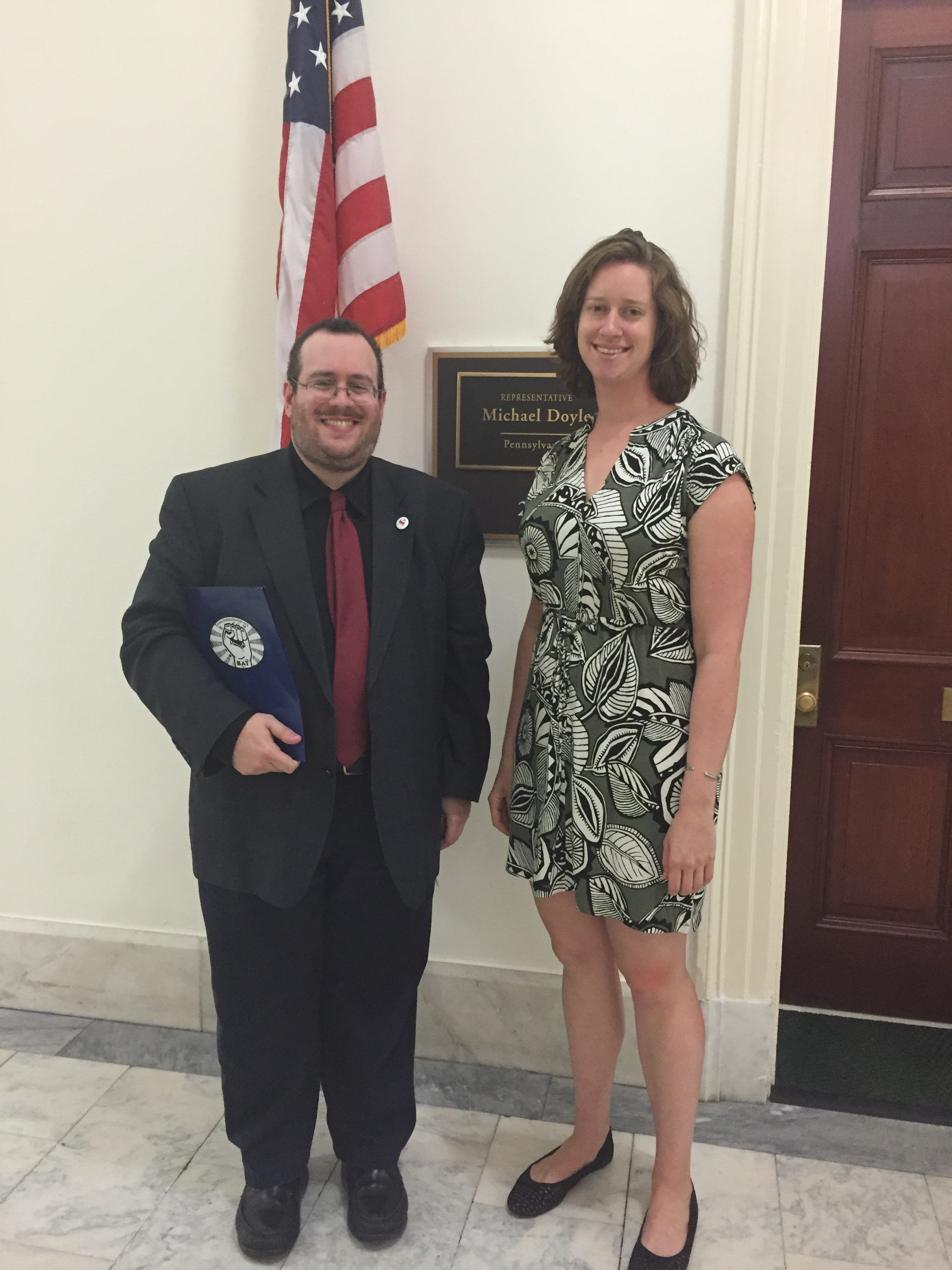
I met with Senators Pat Toomey (R-PA), Bob Casey (D-PA) and Corey Booker (D-NJ). I met with U.S. Reps Mike Doyle (D-PA) and Chris Smith (R-NJ).

Well, actually I met with their legislative aides.

None of the actual lawmakers made time to sit down with a flesh and blood teacher.

In one case, a legislator seemingly went out of his way to avoid me.

image

While sitting on the couch in Doyle’s office, he came out of a room to the left of me, asked his secretary for packing tape and then told her he was leaving for the day. It was 2:47 p.m. on Friday.

And they say teachers have easy hours!

I can’t say whether he was actively avoiding me. I made an appointment to see him, but it was never specified if I’d be meeting with him in person or if I’d be with his aide.

For all I know his staff never let him know I was a constituent sitting there on his couch in a suit and tie with a folder perched on my lap. But it didn’t feel good.

Maybe I should have said something. “Congressman Doyle! May I have a moment?”

But I frankly couldn’t believe this was happening. Moreover, he looks a lot different in a purple Hawaiian shirt than he does in all his press photos wearing a suit. I had to check his picture on my phone to make sure I was really seeing this correctly.

I was.

Still the meetings I had with these kids helping my legislators decide public policy were actually quite productive.

Without exception these youngsters were friendly, polite and knowledgeable. They seemed receptive to new ideas, were eager to hear my point of view, asked intelligent questions and were honest about where their bosses sometimes disagreed with me.

In Sen. Toomey’s office his assistants even asked if I was THAT Steven Singer.

“Who?” I said.

And they told me about a famous advertising campaign in eastern PA where a jeweler’s competitors are seen to complain “I HATE STEVEN SINGER.”

I laughed and told them it wasn’t me, but inside I wondered if that might explain the difficulty I had in some circumstances making these appointments. Maybe congressional staff thought I was pranking them. “Steven Singer wants an appointment!? Yeah! I’ll schedule it right after we see Mickey Mouse!”

image

I first met with Devorah Goldman, Toomey’s legislative correspondent on education and other issues. She’d only been on the job for about a year, but her qualifications included a degree in social work and she had worked in a public school resource center.

She was a very good listener. She heard me out as I spoke about a homeless student in my classes this year. She listened as I explained why Common Core is bad policy, why we need equitable school funding, an end to high stakes standardized tests, reigning in charter schools and voucher systems, and an end to judging teachers based on their students’ test scores.

Her boss isn’t exactly known as an education advocate. But she said he would agree with most of what I had said.

The main area of dispute would be charter schools. Toomey is in favor of expanding them so students can escape “failing schools.”

I explained that it was bad policy to try to save some students and let others fall behind. We need to make sure ALL our schools do an excellent job. Moreover, the Senator’s metric for determining which schools are failing is faulty at best.

I explained that traditional public schools often outperformed charter schools, which lack transparency and accountability and are wasting taxpayers dollars.

“We’ll just have to disagree on that point,” she said without explanation.

But she agreed to continue to take input from me and the BATS in the future.

image

At Doyle’s office, I eventually sat down with Hannah Malvin, a political science major who, at least, is from the Pittsburgh area – her boss’ legislative district.

She listened intently to my tales of education woe, even asking follow up questions. But she was surprised I supported the reauthorization of the Elementary and Secondary Education Act (ESEA).

Even the strongest supporters of the rewrite of the federal law that governs K-12 schools would admit it isn’t perfect. However, I would contend that the new version being cobbled together by the House and the Senate appears to be a slight improvement over what we have now – No Child Left Behind (NCLB).

Some educators think even this rewrite doesn’t go far enough to scale back standardized testing (and I sympathize but do not agree with that position). However, Malvin said Doyle had issues with it because it scaled back too much.

This was the issue I heard from Democrats all day. There isn’t enough accountability in the ESEA rewrite. How will we know which schools need extra help, they asked again-and-again.

I tried to explain that all they had to do was look at per-pupil spending. It’s no mystery which kids aren’t getting enough resources. It’s all right there on a ledger.

To her credit she heard me out and agreed to continue to dialogue with me on this subject in the future.

Next, I met up with some fellow teacher lobbyists from New Jersey and we dropped in unannounced on Booker’s office.

It’s not that we didn’t try to make an appointment. His staff never returned our calls and emails.

In fact, last week a fellow teacher not with us on Capitol Hill, Michele Miller,  even got into a scuffle with Booker on Twitter about elementary school funding. He told her to call his office and he would talk to her in detail.

To my knowledge, he never did. However, she was connected by phone to one of his aides. I’m told this is just modus operandi for Booker – strong talk in a public forum but shying away when the cameras aren’t rolling.

In any case, Booker’s senior education and health policy adviser Ashley Eden agreed to talk with us when we showed up to the office. Though her background isn’t in education, I can’t recall exactly what it is in. I do remember she has been doing this sort of legislative work for lawmakers for about 4 years – longer than any other aide we met.

She immediately made us feel welcome and found many areas of agreement. Bookers’ major point of contention – like fellow Democrat Doyle – was accountability.

How do we know which kids need help without giving them standardized tests?

Groan. But at least I had reinforcements: BATS Assistant Manager Melissa Tomlinson and retired NJ teacher extraordinaire Elizabeth DeMarco.

image

Perhaps the most telling moment of the entire conversation was when Eden said Booker just had to back standardized testing because every Civil Rights organization wanted it. She even criticized the New Jersey Education Association (NJEA) for not supporting black and brown students.

We stopped her right there. No. Every Civil Rights organization does NOT support testing. Journey for Justice – a coalition of 38 such organizations, in conjunction with 175 additional likeminded groups wrote to both the House and Senate asking to eliminate testing. Didn’t Sen. Booker see the letter?

Suddenly she remembered it.

She said she read it real quickly and didn’t like one sentence in it so she ignored it.

Which sentence?

Something about expecting poor and minority students to do badly on tests.

I explained that it has nothing to do with thinking these children can’t achieve at the same level as other children. It’s a matter of resources. If Sen. Booker was in a foot race against someone in a Monster Truck, I’d vote on the truck. Doesn’t mean Booker can’t run or that he might not even win. But the smart money is on Big Foot.

I joined the two ladies for their meeting with Smith as well.

His legislative assistant, Katherine Talalas, was perhaps the most knowledgeable aide with whom we talked. Her mother is a special education teacher, her brother is a paraprofessional working in a public school and she went to law school focusing on education issues.

She also took more written notes than any other assistant. With her nothing seemed canned. It was a real conversation about what her boss had done to help special education students and how he might continue to help in the future.

image

I was on my own again to meet with Sen. Casey’s aide, Jared Solomon.

This was one of the most fascinating and perplexing conversations I had all day.

He was warm, friendly, and had a depth of knowledge that was a bit more political than school-centered.

He agreed with almost everything I said. Casey supports 95% of the things that are important to me in education.

I could have smiled and walked away happy, but Solomon was so gregarious he kept talking. We shared our backgrounds.

He proudly admitted that he had been a Teach for America (TFA) recruit. He worked two years in a Baltimore public school and then left. He knew it wasn’t going to be his permanent job. He was emulating his parents who had joined the Peace Corps. He did TFA because he wanted the experience.

Then he moved to the administrative offices of Michelle Rhee’s Washington, D.C., Public Schools.

He only worked there two years – only one of which was under Rhee’s administration – but he respected what they had done. He said he disagreed with 80% of their policies and even quit because he was tired of being blamed for practices with which he didn’t agree. But, he added, the people in Rhee’s administration worked harder than anyone he knew, and he thought they really had the best interests of the kids at heart.

I’m tempted to chalk it up to the same feeling the incredible blogger Jennifer Berkshire (a.k.a. Edushyster) says she gets when she interviews many corporate school reformers. We may disagree with them, but they really do believe this stuff.

But something happened that doesn’t sit well with me. In an unguarded moment of a more than hour-long conversation, Solomon pulled the same stunt Eden did for Sen. Booker. He said all the Civil Rights groups were crying out for testing. But when I called him out on it, he immediately took it back. It was like he, too, knew this was untrue. It was a talking point, quickly to be conceded if called out and then move on to another argument.

I frankly don’t know what to make of it. The arguments are too similar among Democrats and Republicans to shrug off. Each is speaking from a party line script. That can’t just be a coincidence.

And why would Casey, a legislator who supposedly agrees with me 95% of the time on education, hire as his education expert someone who was actively involved in many of the practices that go directly against his beliefs? Why would someone like Solomon, who was part of the corporate education reform movement, really be on my side against these policies?

It’s befuddling to say the least.

Now that it’s all over, I’m so glad I did this.

Will this change the nation’s education policies? Probably not.

But I am only one of hundreds of people who climbed Capitol Hill in the last two days and met with more than 52 federal legislators to fight against the standardization and privatization of education.

And tomorrow we, BATS, will hold a Teachers Congress to further solidify our goals and decide where the great ship of real positive school change should go.

I am so looking forward to it.

But this teacher, soon-to-be BAT Congressman, needs to go to bed.

Here’s to a brilliant tomorrow for our children.


NOTE: This article also was published on the Badass Teachers Association blog.

We Shall Overcome… Our Lack of Standardized Tests!?

Screen shot 2015-07-19 at 12.34.34 AM

Civil Rights groups have long championed the needs of people of color, women and minorities.

Segregated schools, voting rights, police brutality – all of these have been the subject of long and brutal fights for equality.

Perhaps the strangest turn in 2015 has been the fight for standardized testing.

That’s right. Organizations that you’d expect to see fighting against racism have been clamoring for access to multiple choice bubble exams.

In fact, the Democrats have used this as an excuse for their failed attempts to keep the much maligned Test and Punish policies of Presidents George W. Bush and Barack Obama in the rewrite of the Elementary and Secondary Education Act (ESEA).

The law – currently called No Child Left Behind (NCLB) – is a testing corporation’s dream filled with policies that have been failing our children for 13 years. Unsurprisingly, teachers, parents and students are demanding relief.

But do Civil Rights groups who fought against unfair testing as a prerequisite to vote now really demand unfair testing as a prerequisite for a high school diploma?

The answer is yes and no.

SOME Civil Rights groups have demanded more testing, and others have demanded LESS.

The Journey for Justice Alliance (JJA), a group made up of 38 organizations of Black and Brown parents and students in 23 states, wrote Congress an open letter in July asking for an end to high stakes testing. And the JJA wasn’t alone. The alliance was joined by 175 other national and local grassroots community, youth and civil rights organizations who signed on to the letter to “…call on the U.S. Congress to pass an ESEA reauthorization without requiring the regime of oppressive, high stakes, standardized testing and sanctions that have recently been promoted as civil rights provisions within ESEA.”

However, the JJA’s call has been largely ignored by lawmakers and the media. A much smaller coalition of Civil Rights organizations in favor of testing, on the other hand, has been given so much press you’d be excused if you thought they represented the entire activist community.

Yes, 19 Civil Rights organizations wrote to Congress in January, 2015, asking lawmakers to preserve annual testing.

However, 11 Civil Rights groups – many of them the exact same groups – wrote to Obama in October, 2014, asking him to reduce standardized testing.

What happened in less than 3 months, to change their minds?

It’s hard to say, but in October the prospect of rewriting the ESEA – the federal law that governs K-12 schools – seemed impossible. Neither Democrats nor Republicans could find any common ground. It looked like the law – which was last reauthorized in 2007 – would be pushed aside until at least the next president was sworn in.

But then like magic when the political situation changed and reauthorization seemed like it might actually happen, suddenly a coalition of Civil Rights organizations found their love for standardized testing.

It seems highly unlikely that these two events are unrelated.

But why would these organizations change their tune so quickly?

One very real possibility is money.

Most of the groups now backing standardized assessments accept huge sums of money from one of the richest men in the world – Bill Gates. And Bill loves standardized tests.

In many ways, his business profits from them. Common Core State Standards (CCSS) wouldn’t exist without his backing, and they depend on standardized tests. Moreover, most states give these assessments on computers – many of which have Microsoft emblazoned on the hard drive. And this doesn’t even count the test preparation software sold to help students get higher test scores.

The sad fact is that standardized testing is big business in this country. Everyone from book publishers to software manufacturers to professional development providers to for-profit prisons depend on the continuation of the testocracy.

And many of these Civil Rights groups would be crippled without that Gates funding. Others seem more like think tanks that really have nothing to do with Civil Rights.

Take Education Trust – an advocacy group that helped create NCLB and CCSS. It should be no surprise the organization took $49 million from Gates and thinks bubble tests are just wonderful.

However, even laudable groups like the United Negro College Fund (UNCF) owe Gates a debt.

UNCF took more than $1.5 billion from Gates. Ostensibly that money is supposed to go to scholarships. And there’s nothing wrong with that. But how could the organization go against the wishes of perhaps its biggest donor? The consequences could be disastrous for UNCF’s entirely worthy mission.

One can imagine administrators stuck between a rock and a hard place having to compromise their stance against testing in order to continue helping people of color fulfill their dreams of going to college.

Other suddenly pro-test organizations taking money from Gates include: La Raza, The Leadership Conference, National Urban League, and Children Defense Fund.

And that’s only the half of it.

To make matters worse, standardized tests don’t enhance students’ Civil Rights. They violate them.

Test scores are used as an excuse to continue spending less money on poor schools who serve mostly minority populations.

Proponents say these assessments hold schools accountable for providing children with a quality education. But how can you provide an education of equal quality with a rich school when you don’t receive even close to the same amount of funding to begin with?

Moreover, test scores have been shown countless times to be poor indicators of academic success. They are, however, excellent predictors of parental income. Poor kids score low. Rich kids score high. So when we take away funding based on low test scores and increase it based on high test scores, we only reinforce the status quo and compound the hurt against people of color.

But this sudden public mea culpa from some Civil Rights organizations is being used by political pundits to justify continuing the practices that would make Martin Luther King, Jr., turn in his grave.

And it’s not over. As Congress continues to hobble together a new version of the ESEA, politicians – mostly Democrats – are bound to lobby for as much federally mandated testing as possible. Even Obama has promised to veto the bill if it doesn’t contain enough love for the testing industry.

It’s up to education voters to educate themselves on the subject and demand real Civil Rights reforms.

End the system of Test and Punish.

Remove or reduce standardized testing from our schools.

Provide equitable funding for schools serving impoverished children.

And give our students of color a fighting chance to achieve the American Dream.


NOTE: This article also was published in the LA Progressive and on the Badass Teachers Association blog.

The Democrats May Have Just Aligned Themselves With Test and Punish – We Are Doomed

sanders_warren-620x412

Almost every Democrat in the US Senate just voted to keep Test and Punish.

But Republicans defeated them.

I know. I feel like I just entered a parallel universe, too. But that’s what happened.

Some facts:

No Child Left Behind (NCLB) is a disaster.

It took the Elementary and Secondary Education Act (ESEA) – a federal law designed to ensure all schools get equitable resources and funding – and turned it into a law about standardized testing and punishing schools that don’t measure up.

This was a Republican policy proposed by President George W. Bush.

But now that the ESEA is being rewritten, those pushing to keep the same horrendous Bush era policies are the Democrats.

Almost all of the Democrats!

That includes so-called far left Dems like Bernie Sanders and Elizabeth Warren!

It comes down to the Murphy Amendment, a Democratically sponsored change to the ESEA.

This provision was an attempt to keep as many Test and Punish policies as possible in the Senate rewrite.

The amendment, “reads more like NCLB, with its detailed prescription for reporting on student test results, for ‘meaningfully differentiating among all public schools’ (i.e., grading schools), including publicly identifying the lowest five percent, and, among interventions, potentially firing staff and offering students the option to transfer to other schools and using part of the budget to pay for the transportation,” according to blogger Mercedes Schneider.

Education historian Diane Ravich adds, “This amendment would have enacted tough, federal-mandated accountability, akin to setting up an ‘achievement school district’ in every state.”

Thankfully it was voted down. The ESEA will probably not be affected. The rewrite was passed by both the House and Senate without these provisions. Once the two versions of the bill are combined, it is quite possible – maybe even probable – that we’ll have a slight improvement on NCLB. Sure there is plenty of crap in it and plenty of lost opportunities, but the ESEA rewrite looks to be a baby step in the right direction.

The problem is this: the failed Murphy Amendment shows the Democrats’ education vision. Almost all of them voted for it. Warren even co-sponsored it!

When it was defeated and the Senate approved the ESEA rewrite, Warren released a statement expressing her disapproval. But if you didn’t know about the Murphy Amendment, you could have read her criticisms quite differently.

She says the (ESEA rewrite) “eliminates basic, fundamental safeguards to ensure that federal dollars are actually used to improve both schools and educational outcomes for those students who are often ignored.”

That sounds good until you realize what she means. “Educational outcomes” mean test scores. She’s talking about test-based accountability. She is against the ESEA rewrite because it doesn’t necessarily put strings on schools’ funding based on standardized test scores like NCLB.

She continues, “Republicans have blocked every attempt to establish even minimum safeguards to ensure that money would be used effectively. I am deeply concerned that billions in taxpayer dollars will not actually reach those schools and students who need them the most…”

She is upset because Republicans repeatedly stripped away federal power to Test and Punish schools. The GOP gave that power to the states. So Warren is concerned that somewhere in this great nation there may be a state or two that decides NOT to take away funding if some of their schools have bad test scores! God forbid!

And Warren’s about as far left as they come!

What about liberal lion Bernie Sanders? I’d sure like an explanation for his vote.

It makes me wonder if when he promised to “end No Child Left Behind,” did he mean the policies in the bill or just the name!?

The Democrats seem to be committed to the notion that the only way to tell if a school is doing a good job is by reference to its test scores. High test scores – good school. Bad test scores – bad school.

This is baloney! Test scores show parental income, not academic achievement. Virtually every school with low test scores serves a majority of poor children. Virtually every school with high test scores serves rich kids.

Real school accountability would be something more akin to the original vision of the ESEA – making sure each district had what it needs to give kids the best education possible. This means at least equalizing funding to poverty schools so they have the same resources as wealthy ones. Even better would be ending our strange reliance on local property taxes to provide the majority of district monies.

But the Dems won’t hear it. The Murphy Amendment seems to show that they’re committed to punishing poor schools and rewarding rich ones.

I really hope I’m wrong about this. Please, anyone out there, talk me down!

Up until now I’ve always been with the Democrats because they had better – though still bad – education policies than the Republicans. I’m not sure I can say that anymore. In fact, it may be just the opposite.

Which party is most committed to ending Common Core? The Republicans!

Which party has championed reducing federal power over our schools and giving us a fighting chance at real education reforms? Republicans!

Which party more often champion’s parental rights over the state? Republicans!

Sure, most of them still love vouchers and charter schools. But increasingly so do the Democrats.

This vote has me rethinking everything.

Our country’s education voters may have just been abandoned by their longest ally.

Where do we go from here?


NOTE: This article also was published on Commondreams.org and on the Badass Teachers Association blog. It was also mentioned in the Washington Post.
Did AFT Rank and File REALLY Endorse Hillary Clinton for President? If So, Release the Raw Data

uptown-hillary-clinton

I have nothing against Hillary Clinton.

Heck! I might even vote for her in the coming Presidential race. Maybe…

But the American Federation of Teachers (AFT) endorsement of the former First Lady is strange in many ways.

First, it’s awfully early. The initial Democratic primaries aren’t scheduled for half a year yet – February of 2016 to be exact. And the general election isn’t until Nov. 8, 2016 – more than a year away.

Second, the manner in which this endorsement was reached is somewhat mysterious.

This much seems certain:

1) The AFT executive board invited all of the candidates to meet with them and submit to an interview. No Republican candidates responded.

2) Democrats including Bernie Sanders, Martin O’Malley and Clinton were interviewed in private.

3) The executive committee voted to endorse Clinton.

4) NOW the interviews are scheduled to be released to the public.

This is a perplexing timetable. Why would the AFT endorse BEFORE releasing the interviews? Ostensibly, the executive council used these interviews to help make its decision. Shouldn’t that same information have been available to rank and file members of the union before an endorsement was made?

Which brings up another question: were AFT members asked AT ALL about who to endorse before the executive council made the final decision?

According to the AFT press release, they were:

The AFT has conducted a long, deliberative process to assess which candidate would best champion the issues of importance to our members, their families and communities. Members have been engaged online, through the “You Decide” website, through several telephone town halls, and through multiple surveys—reaching more than 1 million members.

Additionally, over the past few weeks, the AFT has conducted a scientific poll of our membership on the candidates and key issues. The top issues members raised were jobs and the economy and public education. Seventy-nine percent of our members who vote in Democratic primaries said we should endorse a candidate. And by more than a 3-to-1 margin, these members said the AFT should endorse Clinton.

So the AFT claims union members said to endorse Clinton on-line, on telephone town halls, surveys and a scientific poll of membership.

But did they really?

Clinton may be the Democratic frontrunner, but she isn’t a favorite for a lot of teachers. Chiefly this is because her education positions are not that great. Sure, she’s better than every Republican running so far. But she has stiff competition in the Democratic field – especially from Sanders.

If Clinton had come out against Common Core, standardized testing and using student test scores to evaluate teachers effectiveness, I wouldn’t question the AFT’s endorsement at all. But she has been rather supportive of these issues – just like our current President, Barack Obama.

Teachers are fed up with Obama’s education policies. Why would they overwhelmingly endorse someone for President who seems bound and determined to continue them?

So I hope I’ll be excused if I ask for a bit more proof than a press release.

Where exactly are the polls, surveys, etc. that show the Clinton support AFT leadership claims?

For instance, which polls produced which results? The press release says AFT members prefer Clinton 3-1. But even if Clinton came out on top consistently, surely the results weren’t identical on every poll. Maybe she got 75% on one and 65% on another.

The AFT hasn’t released everything, but the organization’s website gives us a memo about ONE of these phone surveys. This national survey of membership planning to vote in Democratic primaries found 67% picked Clinton. However, only 1,150 members participated! That’s a far cry from the more than 1 million cited in the press release.

Moreover, there is no mention of what questions were asked. For instance, there is a world of difference between “Who would make the best President?” and “Who is most electable?” Is it possible there was selection bias present in the questions used to make this determination?

But that’s only one survey. Where is the rest of the data? Where is the raw information from this survey? Where is the data from all these other outreach attempts and on-line activities? How many took phone surveys? How many took on-line surveys? And what were the results in each case?

If union members really did endorse Clinton, that’s fine. But many of us would like to see the proof.

I’m not a member of the AFT, but I’m on the mailing list. I never received any survey.

A lot of my friends are AFT members, but none of them recall any survey.

As a member of numerous education and teaching groups, I know of no one else who admits to being polled either. In fact, I haven’t been able to find ANYONE who was polled on this issue!

I admit that’s not exactly scientific. But that’s why I want to see the data! Blind me with science, AFT!

I believe in teachers. I believe in Unions. I believe in Democracy.

Please release the raw data, AFT, so I can believe in this endorsement, too.


NOTE: This article also was published on the Badass Teachers Association blog.

Do Americans “Throw Money” At Their Schools? A Fair Funding Primer

Screen shot 2015-07-06 at 11.05.59 PM

“Don’t throw money at schools.”

It’s a common rejoinder when lobbying for an increase in public education budgets.

You offer facts why schools need it: both the state and federal government continue to reduce K-12 funds, class sizes are increasing, the curriculum is being narrowed, buildings are crumbling – real world consequences to spending deficits.

And some guy (it’s often a dude) stands up with a cock-eyed grin and says, “You know, we really need to stop throwing money at schools.”

And he pauses as if we all need a moment to take that in.

Is there anything to this? We hear it often enough, but does he have a point?

Let’s see.

“Don’t throw money at schools.”

First, is it true? Is anyone actually throwing money at our schools?

I’ve worked as a public school teacher for over a decade. To my great disappointment never once has anyone hurled greenbacks through a window in my building. I have never had to dodge, duck or otherwise exercise gymnastics to avoid being thunked in the head by a stack of airborne bills.

Origami ninja stars made out of $100 notes do not routinely fly through the air in my classroom. No government representative has ever shown up in the auditorium during a professional development and said, “Yeah baby! Let’s make it rain!” before showering my coworkers and myself in Benjamin’s.

No. This has never happened. Not even coins. More change is thrown at the fountain in my local mall than at any public school where I’ve ever worked.

At this point, you’re probably saying, but, Steven, that’s not what this guy meant. He wasn’t implying someone literally tossed bills at foundations of learning. He was just being colorful.

To which I respond: was he? Because there are lots of ways to phrase that idea. He simply could have said, “We shouldn’t increase education funding.”

He could have said, “We need to spend school money more wisely before increasing it.”

He could have said, “Additional learning revenues are a waste because schools do such a bad job.”

He could have said, “We spend too much on education already.”

He could have said, “Kids don’t deserve more of my cash.”

But he didn’t say any of those things. Instead he conjured an image out of a Roman orgy or a rap video. He purposefully tried to frame this as a ridiculous situation. He wasn’t just trying to make an argument. He wanted to paint anyone who could possibly disagree with him as a fool.

“Can you believe these guys crying about public school funding?” he implied. “They’re having money thrown at them and they actually want more!?”

So before we even start to study the content of his phrase, we must remember it’s coated in bias and malicious intent. He is not really calling for a rational argument. He is appealing to emotions – most probably the emotions of those listening to the debate.

But we cannot sink to his level. We need reasons.

This is difficult because it’s not entirely clear what exactly he was getting at. Let’s examine what his statement might mean in plain English and try to determine if – underneath all this spin – he has a point or not.

Here are some possibilities.

1) “We need to spend education money more wisely before increasing it.”

This might be what he intended to say. And if so, he does have a bit of a point.

There is a problem with how school funding is spent. There is waste and misappropriation. At the local level, school boards and administrators do not always do things in the most efficient manner. But you could say the same thing at every level of democratic government. Fascist states have much less waste. Shall we just burn up the Constitution, then?

At the state and federal level, the problem is compounded by the ignorance of those allowed to write our laws. Education policy is rarely made by those who know what they’re talking about, thus funding often is wasted on useless initiatives. Common Core, standardized testing, punitive accountability systems – these were all created by business interests without regard to educational validity or efficacy and – as such – waste taxpayer money that could be better spent on things that would actually help children learn.

And speaking of waste, may I introduce you to charter schools? Favored by lawmakers yet rocked by fiscal scandals, charters are legal means of sucking up tax dollars for a profit. While public schools have to account for every penny spent and prove funds went to better the educations of real live students, charters are not just permitted but encouraged to withhold some tax money from going to student services and instead bolstering administrators’ bank accounts. Anyone who speaks of fiscal accountability in education yet is in favor of its further privatization is either disingenuous or in need of a basic math course!

The solution, however, is not to withhold additional funding. The solution is more oversight. And I don’t mean only government oversight and regulations. I mean oversight by the public.

Democracy only works if people participate. People need to push for transparency and less wasteful policies. They need to educate themselves about what’s going on. They need to investigate. They need to lobby, protest, and criticize. They need to vote. And they need a free and interested media to give them the facts to make smart decisions.

Clearly we’re lacking some of these things today. But that’s a national problem not limited to education funding.

In the meantime, we can’t wait for a perfect government before increasing school spending. Our children need help now!

If we do nothing, we doom another generation to getting less than they deserve, less than what we could have provided. Why? Because we were afraid some of it wouldn’t reach them!?

A deep sea diver with a kink in his air hose, doesn’t shrug and turn off his oxygen. He turns it up!

2) “Additional learning revenues are a waste because schools do such a bad job.”

This might have been his criticism. Let’s look at the facts.

International comparisons of national school systems are all the rage in political circles. And raw data suggests that children from the United States are not at the top. We are somewhere in the middle.

That’s all true. But what pundits refrain from admitting is that it’s been true for a long time – in fact, for as long as we’ve been making these types of comparisons. Our schools have not gotten worse. They have stayed the same.

This brings up an important issue. How does one compare national school systems to each other, anyway? What do we use to make these comparisons? Income prospects? Student portfolios? Measures of critical thinking? Classroom grades?

No. We use standardized test scores – the PISA test to be exact.

However, we’ve known for decades that standardized tests are poor measures of academic success. Bubble tests can assess simple things but nothing complex. After all, they’re scored based on answers to multiple choice questions. In fact, the only thing they seem to measure with any degree of accuracy is the parental income of the test-taker. Kids from rich families score well, and poor kids score badly.

So these comparisons are suspect.

But even if we accept them, we are leaving out a very important factor: Poverty.

Virtually all of the top scoring countries taking the PISA exam have much less child poverty than the U.S. As we’ve seen, this will boost their scores. If we adjust our scores for poverty, our students jump to the top of the list.

Let me repeat that: U.S. students do the best in the world on international tests – IF THEY ARE NOT POOR.

Moreover, the U.S. education system does something that many international systems do not. We educate everyone! Foreign systems often weed children out by high school. They don’t let every child get 13 years of grade school (counting kindergarten). They only school their highest achievers.

So when we compare ourselves to these countries, we’re comparing ALL of our students to only SOME theirs – their best academic pupils, to be exact. Yet we still hold our own given these handicaps!

In short, U.S. public schools do an excellent job educating children. They overcome incredible obstacles to achieve near miraculous ends often with very few resources.

Imagine what they could achieve if our schools were properly funded.

3) “We spend too much on education already.”

This one is a favorite of politicians of both parties. We already spend a lot on education. Some lawmakers and media personalities go so far as to claim that we spend more than any other country in the world.

Is that true? No.

We are near the top, but according to the most recent OECD study, four countries – Austria, Luxembourg, Norway and Switzerland – spend more.

Additionally, the study was released in 2014 but used data from 2011. Since that time, the U.S. has cut its school spending by leaps and bounds while most other advanced nations have been increasing it. Look for many more countries to pass us up when the next study is released.

But even using current figures, there are troubling social, economic and political differences between nations that impact how school funding needs to be spent. While most advanced countries spend their education budgets on actual instruction, the United States mandates public schools use a larger portion of their budgets on things outside the classroom.

For example, many international schools don’t have metal detectors or security staff. Given the U.S. problem with mass shootings and gun violence, our schools need to spend a significant portion of their monies in this way. I’m not suggesting we stop. Clearly we need to continue these practices, but that’s less money to help kids learn.

In addition, unfunded legislative mandates and court decisions have made U.S. public schools responsible for many things that international schools are not. About one third of all budget increases in recent years has gone to support special education students; 8 percent went to dropout prevention programs, alternative instruction, and counseling aimed at keeping students in school; another 8 percent went to expand school lunch programs; and so forth. Very few additional dollars were provided for needs associated with basic instruction.

Again, I’m not saying we should stop. Given our national epidemic of child poverty – an epidemic not shared by other advanced nations – we have to address these adjacent issues. But without additional funding, we’re letting the very heart of our schools – the classroom – go to waste while other countries are providing significantly more support.

Unfortunately, the problem doesn’t end there. Not only does the U.S. have unique problems that other nations do not share, we also are unique in how we allocate the funding we already have. And this difference only worsens the problem and increases the need for more money.

While most advanced countries divide their education dollars evenly between students, the United States does not. Some students get more, some get less. It all depends on local wealth.

The average per pupil expenditure for U.S. secondary students is $12,731. But that figure is deceiving. It is an average. Some kids get much more. Many get much less. It all depends on where you live. If your home is in a rich neighborhood, more money is spent on your education than if you live in a poor neighborhood.

The U.S. is one of the only countries in the world – if not probably the ONLY country – that funds schools based largely on local taxes. Other developed nations either equalize funding or provide extra money for kids in need. In the Netherlands, for example, national funding is provided to all schools based on the number of pupils enrolled. But for every guilder allocated to a middle-class Dutch child, 1.25 guilders are allocated for a lower-class child and 1.9 guilders for a minority child – exactly the opposite of the situation in the U.S.

So even though we spend more than many countries, we spend it so unevenly that poor and minority children are being left out.

Therefore, we have a choice: either do away with funding based on local property taxes or increase funding to poor school districts – or both.

4) “Kids don’t deserve more of my cash.”

Dollars to doughnuts, this is probably what he really means.

The United States has a moral failing. And we’re proud of it. We call it libertarianism. It means – Screw you! I’ve got mine.

We don’t care about helping others, we don’t care about the common good, we only look out for ourselves and our immediate friends and families. Everyone else can eat crap and die.

It’s ethical immaturity and, frankly, there’s not much you can say to someone who feels this way except that you disagree.

At most you can try to appeal to his self interest. Do you really want to live in a society full of uneducated people? Do you really want your kids to grow up in a world like that?

But that’s as far as it goes. You can’t help emotionally and intellectually stunted people – especially adults. Most children go through this phase. Some never grow out of it.

The good news is that most of us aren’t so far gone. If you can show that our interlocutor’s statement really comes down to this, you may be able to convince some people to agree with you simply because no one wants to be such an odious troll.

You need to pull back the curtain and show the truth.

How do we best spend these education dollars? How do we raise the money? Those are valid questions, but only a truly horrible person simply refuses to help children learn.

Because we’re not “throwing money” at schools. We’re throwing certain kids away.


NOTE: This article also was published in the LA Progressive, Commondreams.org and on the Badass Teachers Association blog.

The School-to-Prison Pipeline: Turning Kids into Cash

Screen shot 2015-06-07 at 10.34.48 PM
For too many children, public school is just a “GO DIRECTLY TO JAIL” card.

Do not pass GO. Do not collect $200.

The institution that should be raising kids to the skies is chaining them to the ground.

It’s called the School-to-Prison Pipeline, and it disproportionately affects students of color and the poor.

School policy at the highest levels is designed to sort and rank students. Some go to the college track. Some go to the industrial track. And even more end up on the prison track.

We actually have procedures that prepare certain children for life behind bars.

Why? Because people make money from it.

Think about it. The United States represents only 4.4% of the world population but we house 22% of the world’s prisoners. We’re the number one jailor!

It’s not that our citizens are out of control. It’s not a rise in violent crime. In fact, the crime rate has decreased to 1970s levels.

But instead someone has found a way to convert prisoners into cash.

Since the 1980s, we’ve been handing over our prison system to private companies to run for a profit.

The number of inmates in privatized prisons has increased by 44% in the last decade alone, according to a 2013 Bloomberg report.

This creates a market. Without a steady stream of prisoners, these institutions would go bankrupt. And corporations such as Corrections Corporation of America and The GEO Group spend tons of cash lobbying our government to ensure just that.

It’s no accident that our national education policy meets the needs of the for-profit prison industry.

Look at the so-called education reforms of the last decade: increasing standardization, efforts to close schools serving poor and minority children, cutting school budgets and narrowing the curriculum. All of these serve to push kids out of school and into the streets where they are more likely to engage in criminal activity and enter the criminal justice system.

Federal education policy – whether it be No Child Left Behind or Race to the Top – continually doubles down on privatization and standardization. These policies consistently have failed to produce academic gains but are offered as the only possible solution in school reform initiatives.

Question: Why do we keep enacting the same failed policies?

Answer: Because they are not MEANT to succeed. They are meant to fail a certain percentage, race and economic bracket.

If we had effective education procedures that increased academic success, we wouldn’t have enough prisoners to feed our for-profit prisons. Lawmakers would loose valuable lobbying revenue.

Call it what you will – misplaced priorities, profiteering or an outright scam. But the reform-to-profit cycle is advocated, perpetrated and championed by the most prominent figures in the so-called education reform movement.

Take Bill Gates – the monetary force behind Common Core State Standards (CCSS), one of the leading policies in education.

The Bill and Melinda Gates Foundation also is an investor in The GEO Group – one of the biggest for-profit prison providers in the country. It’s most recent tax filing (2013) shows a more than $2 million investment.

Nominally a philanthropic organization, the Gates Foundation refuses to admit if it still backs the industry or by how much. Sure Gates underwriting is just a drop in the bucket, but it proves how the organization’s interest is economic and not charitable. It is one of a herd of Trojan horses stampeding over the cries of critics under a banner of largesse.

Likewise, Common Core essentially isn’t concerned with increasing the quality of children’s education. CCSS has never been proven to be effective and is – in fact – developmentally inappropriate. But it’s touted as a panacea to a host of ills when its real concern is to continue fortifying the prison machine.

We live in a country where more than half of the children attending public school live below the poverty line. They need proper nutrition, social assistance, tutoring, counseling and a host of wrap around services. But instead they get so-called “higher” academic standards and standardized tests.

It’s like a sporting goods store withholding wheelchairs to the Special Olympics and instead donating extra hurdles – all the while claiming it was trying to help participants become better hoppers!

Even worse, these standards aren’t actually better. They’re just confusing, ignorant and ill-conceived. After all, they weren’t developed by educators. They were made by ideologues who admit they were unqualified for the task.

Was this a huge mistake? No. These standards and the associated bubble tests that drive them do exactly what they were meant to do.

They increase the numbers of failing students. They push more kids out of school and into the waiting arms of the prison industry.

And when kids have difficulty sitting through the hours, days, and months of test prep that are increasingly replacing a well-rounded curriculum, they face unfair discipline practices.

We treat misbehaving kids like little criminals.

Can’t sit still in class? Can’t keep quiet? Can’t control your frustration?

Out you go! Detentions, suspensions, expulsions!

We have zero tolerance for your childish behavior – even if you are still a child.

And unsurprisingly the majority of the children who are crushed by the hammer of discipline have dark skin.

Let me be clear. I’m not saying that misbehaving children shouldn’t be disciplined. Far from it.

But we need to stop criminalizing their misbehavior.

If we can’t provide them with schools that teach in a developmentally appropriate manner – it’s not the children who are misbehaving. It’s us! The school system!

Moreover, when a child has a problem conforming to the norm, our first reaction shouldn’t be punishment. It should be understanding. The goal should be to find ways to change the negative behavior, not weed the kid out of the system.

But this means treating children as ends not means.

We have to care about their well-being. They have to be more than just piggy banks for big business.

Otherwise, it is our sick society that really deserves to be sent to jail.


NOTE: This article also appeared in the LA Progressive, ConversationED and the Badass Teachers Association blog.

Common Core Does Not Cure Student Mobility

Common-Core

We have real problems.

We need real solutions.

But we get deceptions instead. And if anyone tries to complain, they get blamed for trying to avoid solving the problem!

Take Common Core.

Badly designed, unproven, flying in the face of human psychology. It is all that and more.

However, there’s a good reason for its existence – student mobility.

We have too many children attending our public schools that don’t stay put. They move from district-to-district and therefore miss valuable instruction.

And that’s no deception.

This is a real problem that we need to do something to fix. But before any experts in the field – psychologists, sociologists, or (God forbid!) educators – can speak, billionaire philanthropists chime in with Common Core.

If we just had national standards for each grade level in each core subject, they say, it would greatly reduce the amount of material transient students miss.

If an 8th grade student at School A moves to School B, for instance, Common Core would ensure that he misses virtually nothing. Both schools would be teaching the same thing.

Good try. But it doesn’t work.

Common Core only ensures that the same standards are taught in each school during a single year. If a transfer student’s old teacher hasn’t gotten to something yet and his new teacher has already covered it, he might miss the concept entirely – even with Common Core.

Take it from me.

I am a teacher in a state that has adopted Common Core-look-alike standards. I get many transfer students from Common Core states. There is a definite and often profound gap in their grasp of the material.

Pause for a moment and digest that.

Common Core – as it is now – does not solve the problem of student mobility.

However, if we reinterpret that concept, if we appeal to the spirit of the Core, we may find a “solution” to this problem. And in some places this has already begun.

Our billionaire philanthropist friend might look at this problem and say, we need to further homogenize the curriculum at both schools. Educators at both districts should teach the exact same things at the exact same times. On Sept 12, all 8th grade instructors should teach about figurative language. On Sept 13, there will be a lesson on text structures, and so on.

In fact, having the same curriculum at two schools is not enough. We need to coordinate the curriculum at ALL public schools.

But even if we do that at our public schools, there will be gaps for transient students. A student who left School A after Sept. 12 would have had a lesson on figurative language, but what form did the lesson take? It may have been ineffective. Perhaps the text used by the teacher was subpar. Perhaps the teacher didn’t explain the lesson sufficiently. There is just too much room for human error.

What we need, explains the philanthropist – who incidentally made his billions designing computer systems and is not known for mastery of the human psyche – what we need is uniformity. In short, we need scripted lessons.

Then-and-only-then will transient students miss the least possible curriculum moving from one school to another.

Of course this assumes the move from School A to School B is nearly instantaneous. Day 1 you’re at the old school. Day 2 you’re at the new school. But this rarely happens. Under the best circumstances it can take a week or two. Realistically, I’ve seen students who have been out of school months even a whole academic year between moves.

Yes, Mr. Gate…  – I mean the philanthropist – may admit reluctantly, transient students will still inevitably miss some school work. The transition from School A to School B may take a couple days, maybe months, but scripted lessons will reduce the gap to the absolute minimum.

And here, he may be correct.

Common Core taken to its logical and extreme conclusion – scripted lessons – may solve student mobility.

Or so it seems.

But is the cure worse than the disease?

If all public school students have scripted, uniform, standardized lessons, what will happen to the quality of those lessons?

As the holder of a masters degree in education, as a recipient of a National Board Certification in teaching, as a teacher with over a decade of experience in the classroom, I say this: the quality of education will plummet under these conditions.

Everyone will suffer – transient students, non-transient students, EVERYONE.

The best possible learning environment is NOT one in which teachers read from a script. It is NOT one where teachers stick to the lesson plan come Hell or high water. It is NOT one where the educator has little to no say in what she is teaching.

It is important to have academic standards, just as it’s important to have lesson plans. However, these MUST be created by the teachers, themselves. Otherwise they imprison instructors in straight jackets and make them less – not more – effective.

Anyone who has spent any time in front of a class knows that good instruction necessitates instant changes in the lesson to meet the needs of your students. You can plan – and you should plan – but you have to be free to move beyond it.

For instance, if you’re teaching students how to write a complete sentence and you have some children who do not understand what a subject and a verb are, you need to adapt. Immediately. On the spot. Otherwise, your lesson will fail.

If you’re asking your students to perform a close read of a science text and they cannot read, you must adapt. Immediately. That very second. Or else you’re just wasting everyone’s time.

Rigid academic standards cannot do this. Sacrosanct lesson plans cannot do this. Only teachers can.

This is one of the major areas where Common Core fails.

But what of our transient students? Won’t we fail them if we repeal Common Core?

No. There is a better way. But more on that in a moment.

Say Common Core is the only way. Say scripted curriculum is the only manner in which to meet their needs. It would still be better to get rid of Common Core to meet the needs of the non-transients. Moreover, even transient children will benefit, because the education they receive when they are in a given school will be of a higher quality than the minimally interrupted lessons they’d receive with national academic standards and scripted lessons.

However, let us return to the better solution. Because there is one, and it is easy to see when you aren’t blinded by billionaire’s pet projects.

Instead of homogenizing everyone’s schools to help transient students, reduce the instances of transience.

That’s right. Reduce student mobility.

Stop so many children from moving from school-to-school.

That’s impossible, whines our billionaire savior.

No. It’s not.

You may never be able to stop every student from moving between schools, but you can greatly reduce it.

All it takes is an examination of the root causes.

Why are so many students transient?

It turns out this is a symptom of a larger problem affecting the majority of our public school students. If you can help alleviate this problem – even slightly – you’d greatly increase students’ chances of success.

That problem? Child poverty.

Students don’t move around to see the world. They do it because their parents can’t get a job or can’t afford to live where they are.

If you undertook programs to create more jobs for their parents, you would decrease student mobility. If you provided cheap, safe, stable housing, you would decrease mobility. If you started social programs to bring transients into a community and stop them from being eternal outsiders, many more of them would put down roots.

And if you helped reduce child poverty, you would actually increase the quality of education most children are receiving – even the ones not constantly on the move.

We used to understand that poverty isn’t a defect of character – it’s a product of circumstance. We used to understand that most poor people aren’t to blame for their own poverty. We used to understand that a helping hand is better than a pointed finger.

Common Core is just another great lie told to obscure these simple truths.

Student mobility is just another excuse given to justify this lie.

The time for deceptions and half-truths has passed. Instead, we need to roll up our sleeves and actually do something about poverty.

It’s time to leave Common Core to the pages of history’s failed social engineering experiments.

Because we don’t need national academic standards.

We need a shared morality.


NOTE: Thank you to all my readers who responded to my article “Data Abuse – When Transient Kids Fall Through the Cracks of Crunched Numbers.” Today’s article is the result of your efforts to push me to revisit this subject. Being a blogger isn’t just about writing articles and putting them out there. It’s also about creating a community and entering into a dialogue. I am so grateful to the people who read what I write and engage with it. I can’t do this without you.

-This article also was published in the LA Progressive and on the Badass Teachers Association blog.