A Handful of NEA Leaders Have Taken Another Step Toward Endorsing Hillary Clinton Despite Member Outcry

Hillary+Clinton+Holds+Final+Primary+Night+rTo14WGvP_Gl

“We are what Democracy looks like.”

With those words, Lily Eskelsen Garcia took the reigns of the National Education Association (NEA) as President in 2014.

A little more than a year later, the NEA is set to prove those words false by endorsing a candidate for the 2016 Presidential Primaries without input from the rank and file.

Despite vocal opposition from thousands of members of the largest union in the country, the NEA Political Action Committee (PAC) Council voted to endorse Hillary Clinton.

The council of 74 educators from the organization’s political arm voted Thursday. The NEA Board of Directors is expected to make a final decision on Saturday.

Despite Garcia’s fierce rhetoric, the decision is being made by a handful of union leaders with next to no input from the more than 3 million members.

Many details of the vote, itself, are shrouded in secrecy and bad math.

Numerous sources in the NEA say the PAC council voted 82% in favor and 18% against. However, these figures are suspect. Two of the largest state delegations – California and New Jersey – abstained. The percentages being touted by PAC Council representatives do not seem to take that into account. The actual total should be somewhat closer.

When the Board of Directors votes later this week, at least 58% will be needed to give Clinton the organization’s endorsement.

However, the main body of representatives – the Representative Assembly (RA) – will be excluded from voting. The larger RA’s say is unnecessary according to NEA by-laws to give an endorsement in the primary election. However, the RA will get to vote on an endorsement in the general election when the field is narrowed to only two major candidates.

Any additional outreach to card carrying educators and other dues paying members is apparently not needed or desired.

Opposition to this much anticipate vote has been mounting. State chapters in New Jersey, Massachusetts and Vermont have come out publicly against the Clinton endorsement. However, when it came to a vote in the PAC Council, New Jersey abstained instead of voting the measure down. Moreover, the California chapter has been riddled with outspoken critics of the endorsement, yet they only pushed the state delegation to another abstention.

Ohio and Massachusetts delegations voted against it, but full tallies of the roll call vote could not immediately be determined.

Those in-favor of the endorsement claim Clinton is the most electable candidate who supports positive education policies. However, even Garcia is reported to have admitted that Bernie Sanders has better education positions.

While some opposing the endorsement clearly favor Sanders, many oppose any endorsement so early in the race before even the first Democratic debate.

Clinton and Sanders are polling neck-and-neck in the first two Democratic primary states. A Clinton endorsement could give her a much needed edge over her political rival.

Meanwhile as labor unions are attacked on all sides, it seems the biggest opponent to union Democracy may come from inside these organizations, themselves.


NOTE: This article also was published on the Badass Teachers Association blog.


Stopgap Budget a 4-inch Crap Sandwich for Pennsylvanians Who Rejected a Footlong

4026174118_390de03813_z

If you won’t pass 12 months of our crappy budget, pass 4 months of it.

That’s the plan of Pennsylvania Republicans to swindle voters into accepting lower expectations out of state government.

While Governor Wolf talks compromise, GOP lawmakers stamp their feet, cross their arms and pretend that’s somehow doing their jobs.

Three months passed the deadline for a year-long state spending plan, Republicans in both the House and Senate pushed through a stopgap budget along party lines that could only see the light of day because of their numerical majority.

Gov. Wolf vetoed their year-long budget in June because it failed to fix the damage of four years of budget cuts to essential public services like education. Now Republicans are demanding he accept four months of the same and we’ll talk about the rest later.

Wolf is expected to veto this stopgap measure on Monday.

But this doesn’t mean the newly-elected Democratic governor is unwilling to compromise. That’s all he’s been trying to do for the passed 90 days! He’s offered major concessions to the GOP including proposals for private management of the state liquor system and limits to traditional pensions for future state and public school workers.

The response? Nothing.

I guess Republicans don’t get how compromise is supposed to work. One side gives up something and then the other side does the same until both parties can meet in the middle. But in Harrisburg it’s been all give from the governor and nothing from the Republican legislature.

‘Give us everything we want for 4 months’ is not a compromise!

This is what happens when you let billionaires buy our government. You get a state of gerrymandered districts. The majority of residents voted for Wolf because he promised to overturn these Republican policies, but with the state chopped up into voting districts along party lines, the GOP gains a majority in the legislature though they do not have a numerical one of residents. And this Republican majority relies on the votes of Tea Party ideologues who will accept no discussion, no bargaining, no give-and-take.

That’s exactly what the 1% funding these stubborn legislators want. The super rich lounging behind their thick walls and glittering gates want the rest of us to become fed up with our government. They want us to give up on Democratic process as a way to ensure public goods. They are sabotaging our oldest and most revered institutions to prove to us how badly they work.

You see, they don’t care about public goods because these things don’t directly impact them. Why should they care if our public schools are dying of starvation? Their kids don’t go to public schools.

Moreover, if we actually go with Gov. Wolf’s proposed budget and fund elementary, middle and high schools, the rich will have to help pay for it. They’ll have to pay their fair share. That’s something these leeches will never do willingly.

For four years under the previous Republican governor our public schools had been put on a starvation diet cutting almost $1 billion a year from a system that already was one of the least equitable in the country.

Public schools are funded mostly by state and local governments. If you ranked all 50 states in the country by which ones shoulders the highest burden of education costs, Pennsylvania comes in 45th. The Commonwealth only pays 36.1% of the bill – far below the national average of 45.5%. Wolf wants to bring that up to 50%, but when it comes to doing right by children, Republicans apparently are fine with being below average.

But exactly how low can you go?

Not only does the Commonwealth skimp on all its children, it gives up on the poor. The money train makes long luxurious stops at rich districts but barely even comes to a halt at poor ones before chugging on down the line.

We spend less on our poor students compared to our rich ones than ANY OTHER STATE! When it comes to cheating impoverished kids out of an education, we’re number one!

Nationwide, rich schools already spend on average 15.6% more than high poverty schools. But in Pennsylvania, the difference is 33%!

We are systematically short-changing our neediest children year-after-year, and instead of fixing that, Republicans demand another 4 months of neglect!

But as lawmakers bicker, without a state budget, schools aren’t getting the funding they had expected. From Philadelphia to Pittsburgh, poor schools are forced to dip into their reserves to keep their doors open.

Districts were required by law to complete their spending plans months ago making educated guesses how much they’d get from the state. Without that money coming in, they’re surviving on their rainy day funds – and as usual storm clouds are pouring on our schools.

Districts serving poor communities often don’t have much left over to continue running while Harrisburg plays political games. If something isn’t done soon, poor districts might not be able to continue functioning.

And that’s just what Republicans are expecting.

Look at all the damage the Democrats are doing by not accepting our stopgap budget, they say. Sure! Our spending plan shortchanges these kids, but at least it gives them something! Can you really be so hard hearted that you’ll deny them anything at all!?

So our state politics has come down to a desperate game of chicken. Can our schools hold out while the Democrats try to bargain for a better deal? Will the public realize it’s really Republicans who are being unreasonable?

Does anyone care anymore? Has everyone just checked out because the whole situation is too ugly to watch?

I mean you can eat a crap sandwich if you don’t have to see yourself doing it.

The NEA May Be About to Endorse Hillary Clinton Without Input From Majority of Members

Screen shot 2015-09-21 at 12.23.19 AM

The largest labor union in the United States may be about to endorse Hillary Clinton for President without a poll of its membership.

Leadership at the National Education Association (NEA) has been making troubling moves toward endorsing Clinton that could commit the organization to supporting the Democratic presidential hopeful with no regard for the wishes of its 3.2 million members.

An endorsement could come as early as Oct. 2-3 when President Lily Eskelsen Garcia is expected to propose a primary endorsement of Clinton at the NEA Board meeting, according to multiple NEA sources. Then the PAC council would vote. If approved, it would go to the board for a final decision.

However, since this is only an endorsement for the primary election, the matter would not need to go before the Representative Assembly (RA). In effect, the move could sidestep the voices of the RA’s 8,000 delegates representing state and local affiliates, student members, retired members, and other segments of the united education profession.

The decision would be made by a handful of leaders and the PAC council. Though there are thousands of PAC council votes, they are distributed by the amount of money raised by each state’s members. This means that little states like Delaware – where members donate greatly – have a larger vote relative to their membership than other states.

The voices of the great majority of members would be silenced.

Already leadership at the highest levels seems to be trying to consolidate Clinton support.

Last Wednesday NEA Directors were invited to an hour-long conference call with Clinton. Few directors were allowed to ask questions and only if those questions had been submitted in advance.

After Clinton left the call, only three state presidents had a moment to speak; all gave positive reflections on Clinton and how she supports teachers and public education.

Despite the fact that several Democrats have been courting the NEA’s endorsement, only Clinton was invited to this call.

Last summer, the NEA invited all presidential candidates to participate in the union’s endorsement process. Only Clinton, Martin O’Malley, and Bernie Sanders did so. Each made a video statement that was shown at the summer’s RA meeting and posted by many to their local groups. Though more candidates have entered the race since then, none have chosen to interview with the NEA.

Ironically, at the same RA meeting, the assembly voted specifically NOT to ignore rank and file membership before endorsing a Presidential candidate. New Business Item 79 states:

NEA, as an organization, will actively engage in conversation and outreach on the NEA endorsement process with all 2016 Presidential campaigns prior to the consideration of a primary recommendation.

It seems if the leadership goes through with the primary endorsement as outlined above, they may be violating NBI 79.

The move is doubly troubling because of the strong-armed manner in which the American Federation of Teachers (AFT) endorsed Clinton in July.

Though the AFT Executive Board voted to endorse Clinton, there is little evidence it did so after adequately gauging members opinions through claimed multiple surveys and telephone town halls. The move caused an uproar and claims the AFT endorsed too early and without rank and file support.

Despite politics at the national level of the NEA, some state affiliates have already made endorsements. For instance, Vermont NEA already endorsed Sanders, their state’s Senator.

“We want to let the whole country in on what we in Vermont have long known,” Vermont NEA president Martha Allen said in a statement. “Bernie’s core values are in line with ours: He is pro-family, pro-worker, pro-education and pro-labor and we believe the time has come for his vision to become a national reality.”

Alternatively, the New Hampshire NEA endorsed Clinton in September. Scott McGilvray, NEA-NH president, called Clinton a “tireless fighter” for students and teachers.

However, Sanders is gaining on Clinton in the polls in the first two primary states. A new Monmouth University poll of likely Democratic voters in New Hampshire gives Sanders the lead over Clinton by a 43-36 margin. Sanders also leads Clinton in Iowa by a 41-40 margin. This is a huge gain from July when Clinton was beating Sanders by 49-25 in that state.

A major endorsement from a union the size of the NEA at this time might give Clinton the boost she needs to solidify her front runner status.

Whatever happens, no matter who the NEA decides to endorse, if anyone, it should be someone leadership can demonstratively prove has the support of the majority of its members.


NOTE: This article also was published on the LA Progressive and the Badass Teachers Association Blog

Why Were So Many Education Reformers Bad Students?


Screen shot 2015-09-12 at 7.33.08 AM

Bad students often hate school.

Not exactly shocking, I know.

But perhaps more surprising is the pattern of low, sloppy or inconsistent academic achievement by so many of those adults who consider themselves education reformers, particularly corporate school reformers.

Our ideas of school are certainly formed during our years in it. Those working so diligently to destroy the public school system and reshape it to resemble the business model are so often people who didn’t fit in. They earned low grades or only excelled in subjects they really liked. Perhaps school failed them or perhaps they failed school. There’s no way to know for sure since school records are almost always kept private. But details do trickle through and display a clear pattern – a pattern that certainly gives the appearance of an ulterior motive.

Are these former bad students more interested in fixing the perceived problems they see with the system? Or are they consciously or unconsciously seeking revenge against a system that found them to be inadequate?

Take Scott Walker.

The Wisconsin Governor-cum-Presidential candidate has been one of the most virulent enemies of public education and public school teachers in the past decade.

But when he was a lowly student, he wasn’t anywhere near the head of the class. His grade school years are mostly shrouded in mystery, but his college career is ablaze in controversy.

He claims to have been a solid C-student with a 2.59 grade point average. Contemporaries say it was closer to a 2.3.

“I had some classes I was more interested in than others, I suppose,” he admits.

In any case, college wasn’t for him. He attended Marquette University for almost four full years before dropping out. He only had a year or more to go before earning a bachelors degree.

Why did he quit? Numerous contemporaries allege he was expelled for cheating in student government. Walker says he simply accepted a full-time job and had to devote his time there.

The facts are these: Walker unsuccessfully ran for student body president with a tumultuous campaign. He was found guilty of campaigning a week early thereby losing campaign privileges at one facility and a day of campaigning at another.
When the student paper endorsed his opponent, the edition mysteriously vanished from the stands. Students reported seeing Walker staff taking almost all of the papers and replacing them with campaign literature against his opponent.

An investigation was conducted but the university refuses to release it saying the results are either private or have been destroyed.

However, the university denies that Walker was ever in bad standing or that he had been expelled.

The matter could easily be cleared up if Walker released his academic records to the public, but unlike most Presidential candidates of either major political party, he refuses to do so. (All while continuing to criticize President Barrack Obama for not releasing a birth certificate that the President clearly released to the public.)

Not exactly student of the year. Nor would the preacher’s son ever win “Most Ethical” in the student superlative section of his college yearbook.

It’s easy to see why someone who had such difficulty in college would spend so much time as Governor attacking that world.

He reduced state funding to Wisconsin colleges by 13% and then mandated they freeze tuition for 4 years. He recommending replacing University of Wisconsin leadership with a private authority governed by his own appointees. He proposed the university change its fundamental commitment from “a search for truth” to the goal of workforce readiness.

That’ll show ‘em, I guess.

But he didn’t just attack post-secondary education. He went after high, middle and elementary schools, too. He signed a law mandating high stakes reading testing begin in kindergarten. That’s right – kindergarten! Teachers and principals, of course, had to be evaluated based on these scores. Oh and don’t forget the massive school budget cuts.

He also presided over the largest roll back of collective bargaining rights in state history – and who make up the biggest unions? Teachers. Other working people are just more grist for the mill of his petty power trip.

If Walker had studied harder, spent less time on extra-curricular politics and finished his degree – I wonder if he wouldn’t have such animosity towards education. Maybe then he wouldn’t spend his days congratulating himself for hobbling colleges and public schools while trampling on workers rights.

Moving from politics to punditry, few people have devoted their careers to destroying the teaching profession as much as former anchorperson Campbell Brown.

Since being quietly let go from CNN when her news program was cancelled for low ratings, Brown has become an outspoken corporate education reformer. School choice, the destruction of teacher tenure and labor unions – there are few supply side education ideas she doesn’t support. Most notably, she serves on the board of directors for the infamous Success Academy Charter Schools – a system that uses student humiliation to ensure children swallow a curriculum consisting almost entirely of standardized test prep. Moreover, her husband, Dan Senor, is on the board of StudentsFirstNY, a corporate school reform organization affiliated with Michelle Rhee.

How anyone so personally invested in the factory schools model could possibly claim she was impartial enough to serve in a journalistic capacity on this matter is beyond belief. But that’s just what Brown does. This summer she even co-founded The Seventy Four – a news site dedicated to covering education. She claims it’s all “non-partisan” and “non-profit.” Ha! Her husband is a former adviser to the Romney campaign and spokesman for the Bush administration’s Coalition Provisional Authority in Iraq! Her “news” site is like Fox News for schools – which given the supply side bias of MOST news organizations is really saying something!

Is it any surprise that when Brown was in school, herself, she wasn’t exactly honor roll material?

She describes herself as a “terrible student” in Catholic school, but immediately justifies her academic performance by saying the teachers were awful, too. Since she had such a horrible parochial school experience, it’s a wonder she reserves her rancor for the public school system where she has little first hand knowledge. A child of privilege, Brown was a private school girl.

At Virginia’s elite Madeira School, she was kicked out for sneaking off campus for a party. She eventually earned a GED, and briefly attended Louisiana State University before waitressing in Colorado and enrolling in a Catholic college in Denver. It was there that a priest who taught political philosophy finally reached her. She eventually earned a B.S. in political science.

It was a long, difficult academic road for Brown. I wonder how she would have done at Success Academy where mostly poor Black and Hispanic students must sit with hands clasped and eyes following the speaker; where reading passages must be neatly annotated with a main idea; where her teachers would be inexperienced drones forced to work 11-hour days and face high turnover.

Something tells me as a student she’d find those teachers just “awful,” too. It’s a hard thing to take responsibility for one’s own actions especially as a child. If only the teacher had taught me better, if only I had gone to the good school, if only someone had done this or that. Poor little rich girl.

Now Brown is a professional at casting blame on our public school system in favor of unproven or disastrous education models. She’s come from the back of the class to the front – where she can criticize and wag her finger.

But to do the most damage to the school system, you need to be more than a politician or a pundit – you need to be an ideologue. And you need so much cash you don’t now what to do with it all.

No one has had a greater negative impact on public education than Bill Gates and his billions in so-called philanthropic contributions. As one of the richest men in the world, he has steered the course of education policy away from research-based policies to a business-minded approach favored by corporate raiders.

Common Core State Standards would not exist without his backing and financial bribery of federal and state governments. The man of ideas who instinctively understands the world of computers extends his hubris to encase all subjects. For clearly, what is true of a network of calculating machines must be true of young minds. Gates knows best, and where he is contradicted by one peer-reviewed study, he can pay for several independent ones to back up his pet ideas.

But whatever you say of Gates, he differs dramatically from Walker and Brown. Gates is clearly brilliant. He was a National Merit Scholar who scored a 1590 out of 1600 on his SATs. One would think his academic record must be impeccable. But one would be wrong.

While he excelled in subjects he cared about, he neglected others that weren’t immediately interesting. According to a college friend:

Gates was a typical freshman in many ways, thrown off pace by the new requirements and a higher level of competition. He skipped classes, spent days on end in the computer lab working on his own projects, played poker all night, and slept in a bed without sheets when he did go
 to bed. Other students recall that he often went without sleep for 18 to 36 hours.

Even at Harvard, Gates continued his pattern of 
getting good grades in the subjects he liked and disdaining those that were of little interest. His heart didn’t seem to be in his studies. Gates joined few college activities unless his friend Steve Ballmer dragged him off to a party.

School was of little interest to him. He dropped out of Harvard before getting a degree to start his computer software company.

Some tell it as a story of an eccentric’s unstoppable rise, but few tarry long enough to remark on the privilege from which Gates emerged. He didn’t have a public school education. He attended an elite preparatory school since he was 13. Once again someone with such little experience of public school is a self-appointed expert in reforming it.

His parents also instilled in him a peculiar marker for success. In his home, the family encouraged competition. One visitor reported, “it didn’t matter whether it was hearts or pickleball or swimming to the dock … there was always a reward for winning and there was always a penalty for losing.” How interesting that this same philosophy has become Gate’s vision for all school children! Schools must compete against each other for resources and the losers get shut down. Yet what irony that his own personal success relies on ignoring his weaknesses and focusing solely on his successes! We excuse the inconsistent grades and dropping out of college. But would Gates-backed education policies do the same for other children?

Gates, the student, easily might have wilted under the education policies of Gates, the edu-preneur. How hard it is to see oneself clearly. How hard to admit one has limitations. Especially when one is brilliant in one narrow field and has too much money and free time.

And so the enemies of America’s public education system gather round. Many of them may have axes to grind. Of course this doesn’t hold in every case. New Jersey Governor Chris Christie, for example, is no friend to schools. Yet by all accounts he personally had a relatively trouble free academic experience.

However, the case holds often enough to be instructive. An awful lot of C-students think corporate education reform is needed to fix our schools. Heck! Most of these policies come from No Child Left Behind legislation proposed by the most infamous C-student in American history – President George W. Bush!

These kinds of psychological conflicts of interest should give us pause. Do we really want to support such personal crusades? Should all the power of public policy really back the revenge of indifferent students?

Corporate education reform policies don’t work. They never have worked. They’re destroying our system of public education.

Doesn’t there come a time when you have to get over your personal childhood traumas and pay attention to the facts?


NOTE: This article also was mentioned on Diane Ravitch’s blog and published in the LA Progressive and the Badass Teachers Association blog.

We Are All on the Lunatic Fringe – The Centerless Battle Against Corporate Education Reform

cliff_hanging

It was one of the strangest meetings I’ve ever had with a state legislator.

Why?

First of all, we were all teachers.

Even the legislator. Even his Aide!

Pennsylvania State Rep. Dan Miller (D-Mt. Lebanon) had been a history teacher before he sought a law degree and higher office.

His aide had been a Pittsburgh Public School teacher before she was furloughed and found a place in the representative’s office.

And, of course, there were the seven of us – all teachers at my school district.

We crowded together in his tiny district office to talk about how standardized testing is destroying public schools.

Which brings me to the second strangest thing – Rep. Miller didn’t just agree with us, he did so knowledgeably.

I’ve sat across a table from an awful lot of lawmakers, and they almost always try to find common ground. Disingenuously.

Sure! I agree teachers are important! That’s why we need to fire more of them!

You bet neighborhood schools are vital! That’s why I want to close all the public schools and replace them with charters!

Uh-huh! School funding is critical but not more so than classroom teachers. That’s why we’re cutting your budgets! We want to see what you can do!

None of that at Rep. Miller’s office.

When we brought up how important it is to allow parents throughout the Commonwealth to opt their children out of standardized tests without penalizing their school districts, he praised parent rights.

When we described how the definition of school accountability has changed from holding lawmakers accountable to holding teachers accountable, he talked about the sad scapegoating of the profession.

And when we told him about how standardized testing is failing our students, he told us how it would have failed him if he were a student today.

“I wasn’t a very good student,” Miller admitted. He loved history and aced that class consistently, but he barely squeaked by in most other subjects.

The first book he read all the way through was “North and South” by Elizabeth Gaskell – in 11th grade! Why? Because it interested him. “Jane Eyre”? Not so much.

And he admitted that in today’s environment where nothing is counted a success unless it generates a high test score, he would have been lost and probably would have dropped out.

Which brings me to the third strangest thing – Miller isn’t playing partisan politics. As a Democrat, he isn’t blaming everything on the Republicans.

“This is a bipartisan issue,” he said. There’s no reason why both parties can’t agree on what needs to be done to help our schools.

So why doesn’t the legislature do more?

Ignorance. “There’s a low level of analysis of bills down there (in Harrisburg).” Local government usually does a better job.

The representative’s teaching background gives him an edge, he says, but most legislators simply don’t have that knowledge base to draw on.

There’s a lot of good will in the capital, he says. “Most legislators aren’t trying to cause a problem.” They want to try to achieve something, but if those experiments fail, the consequences are dramatic, long lasting and hard to correct.

He even talks well of our Republican ex-Governor Tom Corbett, whose education policies – in my opinion – have crippled the state’s schools.

“He was always polite to me, “ Miller says. “He just didn’t talk.” He wasn’t approachable.

By contrast, Gov. Tom Wolf comes to you. Miller recalls walking in to his own Harrisburg office and Wolf was sitting there waiting for him because he had something he wanted to talk about. Wolf is well liked, even among Republicans. They might not agree with the new Democratic governor, but they have to admit he has the best interests of the state at heart.

Perhaps its Miller’s infinite good will that’s propelled the Democrat with only two years in state office to the House Education Committee.

Republicans have dominated state education policy for years. They still do. But in Miller we have someone who actually has a say in one of the most critical areas in the state. And he knows what he’s talking about, takes time to meet with real live educators and sympathizes with our cause.

Which brings me to perhaps the strangest aspect of the whole meeting – Miller’s analysis why more isn’t being done to combat the testing industry.

“The groundswell isn’t there,” he said. “You’re still the fringe.”

He praised teachers unions like the Pennsylvania State Education Association (PSEA) for being excellent advocates. He said lawmakers get all their emails, but the emphasis seems to be maintaining pension benefits. He understood why this is so, but the issues we were talking about didn’t seem to register on most legislators radar.

It’s bizarre.

If true, there are a heck of a lot of folks on the fringe.

Rep. Miller, himself, for one.

The majority of public school teachers, too.

And the more than three thousand Pennsylvania students whose parents opted them out of standardized testing last year – they’re on the lunatic fringe.

Heck! If we’re all dangling on the outer edge, who’s in the middle? Where’s the mainstream?

Perhaps its just a matter of perception. Maybe the other side just has better public relations.

If so, it’s up to us to spread the word until all of us counterculture anti-standardization and anti-privatization folks are seen for where we really are – at the axis of real school reform.


Thank you to Meagan O’Toole for setting up the meeting. Thank you, Ben Lander, Yvette Robinson Logan, Mary Cay Rojtas-Milliner, Susan Olsen, and Roslyn Stulga for speaking out for your students and profession. And most of all thank you, Rep. Miller, for meeting with classroom teachers to talk about what’s going on in our state’s public schools and actually listening to our stories and advice.

Bernie Sanders Explains Puzzling Education Vote – It’s Because Accountability

Screen shot 2015-08-15 at 3.24.57 AM
Photo: Alex Garland

When teachers asked, Bernie Sanders answered.

Why, Bernie? Why did you vote this summer against everything you seem to stand for on education policy?

You stood against President George W. Bush’s disastrous No Child Left Behind legislation in 2001. Why did you vote for almost the same thing in 2015?

The answer is in from the Vermont Senator turned Democratic Presidential Candidate, but it’s not entirely satisfactory.

The short version: Accountability.

In education circles, it’s a buzzword meaning opposite things to opposite people. And determined in opposite ways.

Ask a representative of the standardized testing industry, and more than likely he’ll tell you accountability means making sure public schools actually teach studentsespecially the poor and minorities. And the only way to determine this is through repeated, rigid, standardized assessments. Let’s call that TEACHER ACCOUNTABILITY.

Ask a real live educator, and more than likely she’ll tell you it means making sure local, state and federal governments actually provide the funding and resources necessary to teach studentsespecially the poor and minorities. And the best way to determine this is simple math. Let’s call that LAWMAKER ACCOUNTABILITY.

These seem to be the central disagreements: Are lawmakers providing equitable resources to all our public schools or are teachers just not doing their jobs? Are student test scores the best way to measure accountability or should we rely on something as rock solid as elementary math?

TEACHER ACCOUNTABILITY is hard to determine. You have to spend billions of taxpayer dollars buying tests, scoring tests and on test prep materials. And then you have to ignore all the evidence that this proves nothing. You could instead just poke your head into any public school across the nation and actually see teachers working their butts off. Heck! You could stop in after school hours and count the numbers of teachers still at work and tabulate the amount of their own cash they spend on class materials. But that won’t work – there isn’t an industry profiting off you using your own eyes and brain.

On the other hand, determining LAWMAKER ACCOUNTABILITY is easy. Just compare school budgets. Greater than and less than. You’ll find that none of our lawmakers provide equitable funding. Rich kids in wealthy districts get Cadillac funding while poor and minority kids in impoverished districts get bicycle funding. Strangely, this is never discussed.

Moreover, none of this relies on opinion. All it takes is empirical evidence to see the truth. Lawmakers are not accountable at all. Teachers are accountable for too much and judged by unscientific and untrustworthy methods.

Unfortunately, few politicians have fully figured this out yet. Even you, Bernie.

This summer it’s all come down to a series of votes on the Elementary and Secondary Education Act (ESEA).

The law the governs K-12 public schools was written in 1965 to ensure all schools received the proper resourcesLAWMAKER ACCOUNTABILITY.

However, under President George W. Bush and throughout the Obama years, it’s become about punishing teachers and schools for low standardized test scores – TEACHER ACCOUNTABILITY.

And the champions of TEACHER ACCOUNTABILITY this summer have been primarily Democrats including liberal lions like Elizabeth Warren and Sanders.

LAWMAKER ACCOUNTABILITY? No one’s talking that.

Most troubling is the Murphy Amendment – an attempt to double down on TEACHER ACCOUNTABILITY. Keep testing and punishing because it’s working soooo well. Thankfully, the move was defeated by Senate Republicans. But Sanders and Warren both voted for it. Warren even co-sponsored it!

That’s why a group of respected education professionals and union leaders (including myself) wrote an open letter to Sanders asking him to please explain, himself.

We aren’t exactly a hostile crowd. We like a bunch of things that Sanders represents in his presidential campaign. We want to support him, but we need to know why he voted to keep the worst aspects of the current law.

And Bernie answered! Or his staff did.

I’ll reproduce the entire letter we received from staffer Phil Fiermonte below this blog. But first I want to focus on Bernie’s specific reasons for voting in favor of the Murphy Amendment:

As you mentioned, Senator Murphy introduced an amendment on the Senate floor that would have required states to hold schools accountable for the academic performance of low-income, minority and disabled students. Senator Sanders voted for this amendment because he believes states must do more to protect every student’s right to a quality education, and that from a civil right’s perspective, the federal government has an important role to play in protecting low-income, minority and disabled children. As you pointed out, the mechanism this amendment would have used to identify struggling schools resembles the failed policies of No Child Left Behind. This was a significant concern to the Senator, and one that he shared with the sponsors of the amendment.

Senator Sanders cast his vote on this amendment to express his disapproval with aspects of the bill that were insisted upon by Chairman Alexander and Senate Republicans and that do not reflect the best interests of vulnerable populations, or a progressive view on the distribution of education resources. He has made clear to Chairman Alexander, Ranking Member Murray, and Senate Leadership that his vote was not an endorsement of the accountability mechanism included in the amendment, but rather as a statement of his intent that other measures must be put in place to protect low-income, minority and disabled students.

So Sanders voted for the Murphy Amendment for these reasons:

  1. He was mad that there is nothing about LAWMAKER ACCOUNTABILITY in the ESEA.
  2. He believes in TEACHER ACCOUNTABILITY – at least in part. He thinks the federal government needs to make sure teachers and schools are actually educating kids, BUT he doesn’t believe standardized tests are the best way of determining this.

Okay. First of all, he has a point. There is next to nothing in the whole ESEA rewrite about LAWMAKER ACCOUNTABILITY. When I was on Capitol Hill earlier this summer lobbying my lawmakers on this very issue, in general the Democrats blamed the Republicans and the Republicans changed the subject.

However, I don’t see how voting for an amendment you don’t believe in is going to make a point about something entirely unrelated. How would voting for the Murphy Amendment get us LAWMAKER ACCOUNTABILITY? The Amendment had nothing to do with that. There are places for it in the ESEA but this amendment was focused almost entirely on TEACHER ACCOUNTABILITY.

Was Sanders trying to convince Republicans to add LAWMAKER ACCOUNTABILITY elsewhere in the bill by voting against them on TEACHER ACCOUNTABILITY here? That seems a stretch. Both parties appear to love TEACHER ACCOUNTABILITY, but during this ESEA process the Republicans have been more concerned with stripping the federal government of its power over education. It’s not that they don’t like TEACHER ACCOUNTABILITY, they just want to leave it up to the states.

Then we come to Sander’s position on TEACHER ACCOUNTABILITY. He’s certainly right that schools need to teach students. However, as a public school teacher, I find it ludicrous to think that there are any schools out there that don’t.

Are there really schools in our country that don’t even TRY to educate their students? Really!? Are there hospitals that don’t try to heal their patients? Are there defense attorneys who don’t try to defend their clients? Are their airlines that don’t even try to get passengers to their destinations?

It’s absurd. Certainly if there were such places, we should do something about them, but the fact that our education policies are obsessed with something that almost never happens is asinine. It’s like going to Ireland and spending the majority of your vacation budget looking for a leprechaun! (At least, this doesn’t happen in non-cyber, non-charter, not-for-profit traditional public schools. But I digress…)

Then we get to Bernie’s suggestion that he’s against using standardized tests to measure if schools are functioning properly. At least here he is justified. But how will voting for the exact thing you’re against get you what you want? It boggles the mind. I want Pizza, that’s why I’m voting for chicken. Huh!?

However, Sanders is responsible for an innovation in the ESEA along just these lines. He proposed a 7-state pilot program that would allow TEACHER ACCOUNTABILITY to be determined on more holistic methods than test scores. Schools could use multiple measures such as student portfolios, classroom projects, or other means to be determined by the states.

This could be a step forward. But even under the best of circumstances, it is limited to a maximum of 7 states. It’s not a long term solution. The majority of the country could still be stuck with test and punish.

So we’re left with some good news and bad news.

GOOD NEWS: Bernie actually took teachers open letter seriously enough to have a staffer answer it. That’s something. I’m sure there are plenty of presidential candidates who wouldn’t even do that much.

GOOD NEWS: Bernie has some thoughtful ideas on education. His pilot program holds – limited – promise. He understands that the measures usually prescribed to determine TEACHER ACCOUNTABILITY are bogus.

GOOD NEWS: Bernie acknowledges that LAWMAKER ACCOUNTABILITY is important and says he’d like to address it.

BAD NEWS: He doesn’t mind focusing on TEACHER ACCOUNTABILITY when there is very little need for it. Moreover, TEACHER ACCOUNTABILITY without LAWMAKER ACCOUNTABILITY is actually harmful. Imagine if NASCAR fired a driver because the Pit Crew didn’t gas up the car. If schools have inadequate money and resources, putting a gun to all the teachers heads isn’t going to help.

BAD NEWS: Some of his answers don’t make sense.

BAD NEWS: He isn’t addressing us personally. Will it take teachers storming his campaign speeches and swiping the microphone before he does more than limited reforms and pays us lip service? It’s one thing to say #BlackLivesMatter. It’s another to make sure our black and brown kids get an equitable education.


The following letter was sent to Arthur Goldstein, one of the teachers who signed the original open letter to Bernie Sanders:

Sen. Sanders views on the Every Child Achieves Act, standardized testing, and school accountability 
Rand Wilson Add to contacts 4:59 PM Keep this message at the top of your inbox 
To: Arthur Goldstein Cc: Philip Fiermonte, Cwa Cohen 
laborforbernie2016@gmail.com

Dear Brother Goldstein:

Senator Sanders has asked me to respond to your email, and share his views on the Every Child Achieves Act, standardized testing, and school accountability.

As you know, Senator Sanders has long opposed the blame-and-shame approach to school accountability embodied in No Child Left Behind. He voted against No Child Left Behind in 2001 because he believed then, as he does now, that the legislation’s narrow focus on standardized test scores ignores a broad range of factors that determine how well a school is meeting the needs of its students. Since the passage of this legislation, we have seen the devastating impact that high stakes standardized testing has had on schools all over the country. In the Senator’s home state of Vermont, nearly every school is identified as “failing,” and is threatened with increasingly proscriptive federally-determined interventions.

No Child Left Behind’s narrow focus on standardized test scores has tragically led to a significant culture shift in our nation’s schools. An obsession with testing and test preparation has taken over in countless school districts in America, and educators are being forced to dedicate hours of class time getting students ready for exams rather than teaching them new material, or strengthening essential skills and qualities like critical thinking, teamwork, and problem solving. And the worst thing is that students from low-income, urban school districts spend more time in test preparation than students from the suburbs. These hours and hours of test preparation have no educational value, and the fact that poor and minority students are disproportionately subjected to test prep at the expense of lesson time is a huge problem that must be addressed.

Last month, the senate passed the Every Child Achieves Act, which would fundamentally reform No Child Left Behind, and end its system of high stakes testing and draconian interventions. Senator Sanders supports this legislation, and believes it represents a very important step forward.

As a member of the Senate Committee on Health, Education, Labor and Pensions, the Senator had an opportunity to shape this legislation at every stage of its development. For example, he was one of the leading advocates on committee for the inclusion of a “multiple measure” accountability system that allowed states to include factors other than test scores when determining a school’s effectiveness.

In addition, he worked to provide states with significant flexibility when it comes to assessment. This legislation includes a provision written by Senator Sanders that would create a groundbreaking alternative assessment pilot program which would allow states to implement alternatives to standardized testing. If the legislation passes, these new assessments would eventually reduce the number of statewide tests children are forced to take, while providing educators with timely information on student performance.

However, this legislation is far from perfect, and there are several aspects of the Every Child Achieves Act that have caused the Senator great concern. For example, there is no requirement that states focus resources or attention on schools that are meeting the needs of middle class children, but not meeting the needs of minority, low-income and disabled children. In addition, the Senator is concerned that the bill does nothing to address resource equity, and was deeply disappointed when an amendment offered by Senators Kirk, Baldwin, Reed and Brown to address resource equity failed on the Senate floor.

As you mentioned, Senator Murphy introduced an amendment on the Senate floor that would have required states to hold schools accountable for the academic performance of low-income, minority and disabled students. Senator Sanders voted for this amendment because he believes states must do more to protect every student’s right to a quality education, and that from a civil right’s perspective, the federal government has an important role to play in protecting low-income, minority and disabled children. As you pointed out, the mechanism this amendment would have used to identify struggling schools resembles the failed policies of No Child Left Behind. This was a significant concern to the Senator, and one that he shared with the sponsors of the amendment.

Senator Sanders cast his vote on this amendment to express his disapproval with aspects of the bill that were insisted upon by Chairman Alexander and Senate Republicans and that do not reflect the best interests of vulnerable populations, or a progressive view on the distribution of education resources. He has made clear to Chairman Alexander, Ranking Member Murray, and Senate Leadership that his vote was not an endorsement of the accountability mechanism included in the amendment, but rather as a statement of his intent that other measures must be put in place to protect low-income, minority and disabled students.

As congressional leaders move toward the next step in consideration of this bill – negotiating differences with the House – Senator Sanders has urged the future leaders of the conference committee to include protections for low-income, minority and disabled students, and to do so in a way that addresses the needs of the whole child. We must ensure low-income, minority and disabled children have the same access to educational resources that their wealthy suburban peers have. In addition, we must ensure that struggling students have access to adequate supports including health, mental health and nutrition services and after school programs that help level the playing field.

For many years, educators across the country have been the loudest, strongest voices against the corporatization of our nation’s education system and for the increased funding and wraparound services that will make a difference for our children. This is a fight that Senator Sanders has been waging at the national level for 25 years, and one that he will continue to pursue.

Sincerely.
Phil Fiermonte
Bernie 2016


NOTE: This article also was published in the LA Progressive.

“Talking Crap” Focus on Teacher Bathroom Breaks Misses the Point on Problems Impacting Teachers

stressed-teacher

By Yohuru Williams and Steven Singer

Nearly 18 years ago in his 1997 State of the Union address, President Bill Clinton urged Americans to prioritize education. He suggested beginning with building respect for the teaching profession. To “have the best schools,” he observed, “we must have the best teachers.” He continued, “most of us in this chamber would not be here tonight without the help of those teachers.”

Despite Clinton’s eloquence, respect for the teaching profession steadily declined due primarily to a narrative of failure constructed by the proponents of corporate education reform. They consistently blame the power of teachers’ unions and teacher tenure for society’s woes. They use both as a justification to construct a multi-billion dollar industry to standardize and privatize our public schools.

For the most part, the mainstream media has been reluctant to challenge this narrative and point to the real obstacles that exist for teachers. Such is the case with a recent article in The Atlantic by Alia Wong entitled “Using the Restroom – a Privilege If You’re a Teacher” that completely misses the point of a recent survey highlighting some of the substantive issues facing the nation’s teachers.

Tens of thousands of professionals responded to the 2015 survey. The survey was conducted collaboratively by two groups: the Badass Teachers Association, a grassroots network of more than 55,000 educators, parents and students and the American Federation of Teachers, the nation’s second largest teachers union. The survey yielded shocking results that powerfully illustrate the collateral damage of the “test and punish” environment engulfing public education. This includes such serious allegations regarding workplace conditions that it prompted a meeting between the authors and the U.S. Department of Education. A team of educators working with both BATS and the AFT launched the 80 plus question survey in April. Some 91,000 public school teachers responded and 31,000 completed the survey. The unprecedented response revealed that there are indeed major problems with our current education policy and its impact on education practitioners.

Perhaps, the most startling revelation from the survey is what prompted it to be conducted in the first place – the increasing incidence of teachers and administrators who committed suicide due to bullying and abuses stemming from national school policy and other work place stressors. These are often the hidden casualties in the war on public education.

In October of 2010, for example, a California elementary school teacher named Rigoberto Ruelas, Jr. took his own life after the Los Angeles Times published a report labeling him a “less effective teacher.” Despite the fact that students and parents praised Ruelas, who taught in one of poorest schools in his district and who also was born, raised and continued to live in area where his school was located, the Times targeted him among other so-called “less effective” teachers as part of a major propaganda campaign. Publishing their names and ranking them according to their students’ test scores was supposed to encourage “reform”.

The Ruelas case is far from an isolated incident. Just last month, a New York City principal under investigation for altering Common Core test scores, killed herself by jumping in front of a subway car.

If U.S. teachers are the proverbial canary in the coalmine, then we may already be too late. Pressures related to high stakes testing are not the only stresses educators face. Teachers also reported significant bullying and hostility from city officials and administrators. Equally disturbing were reports concerning the infamous teacher jails where educators can languish for months under conditions, leaving them “broken, depressed,” and “suicidal, according to one California teacher observer. Statements recently made by New Jersey Governor and Republican Presidential Candidate Chris Christie reveals the scope of the problem. He said he would like to punch the national teachers union in the face. Rather than enjoying esteem as valued members of the communities they serve, educators have become convenient scapegoats. They fight on multiple fronts to provide their students a superior education and make a stable living.

It’s no wonder 73 percent of teachers in the Quality of Work Life Survey said they often find themselves stressed at work.

More than half of those surveyed, 55%, highlighted the “negative portrayal of teachers and school employees in the media” as a source of stress. The pejorative portrayal of teachers in a publication like The Atlantic is especially problematic. That a national periodical elected to do a piece on the survey but limit its scope to toilet restrictions trivializes other results. It’s not that this isn’t an important factor, but Wong’s coverage of other pertinent issues get short shrift. In her words educators tend to be, “known for their tendency to complain about and perhaps over-exaggerate their stress levels.”

To be fair, Wong eventually deleted that remark from subsequent editions of the article. However, she cautioned her readers to be skeptical of the survey because of potential bias. It’s a survey of teachers conducted by teachers. This is an odd critique however given the survey takers expressed intent to use the data collected as a means to spur the Department of Education to conduct a full scientific survey of the profession and then take appropriate action to rectify these concerns.

Rather than reporting squarely on the survey, Wong picked over the evidence. Rather than heeding the call that there is a real need for a much larger and more focused study of these problems, she either ignored or debunked its claims. Rather than treat educators as professionals, she belittled them.

Wong is not a bad journalist. Like most people, she has bought into the notion that teachers don’t know how good they have it. The public still doesn’t understand why teachers have “summers off.” They still misunderstand tenure to mean “a job for life” when it’s really only a guarantee of due process. Instead of helping the public better understand these issues, Wong and other representatives of the media often become entangled in the snare of the same myths.

Once again those entrusted with the most important job of preparing the next generation through our system of public education are losing a public relations campaign that can’t or won’t distinguish truth from falsity.

In short, our problems are much worse than inadequate bathroom time. We’re turning our public schools into factories and blaming teachers when it doesn’t work. We’re allowing billionaire philanthropists to set education policy but holding educators accountable for the results. We’re segregating our schools, providing Cadillac funding for the rich and bicycle funding for the poor and minorities but expecting teachers to somehow make up the difference. We’re letting corporate raiders run charter schools with no transparency or accountability and when that proves a disaster, we point our fingers at teachers. The result is a nation of frustrated educators who are increasingly leaving the profession in droves. “The average teacher,” writer Robert Brault once observed, “explains complexity” while “the gifted teacher reveals simplicity.” The data collected from the teacher survey reveals the complexity of the issues facing public education but they also highlight a simple truth. For if the survey is indeed accurate in illustrating just how debilitating these issues are to adults, we can only imagine what it’s doing to our children.


Yohuru Williams is an author, Dean, Professor of History and Black Studies, and education activist. Steven Singer is a husband, father, teacher, and blogger, education advocate. Both are members of the Badass Teachers Association.

williams-singer


NOTE: This article also was published in the LA Progressive and on the Badass Teachers Association Blog.

Punching Teachers in the Face – a New Low in Presidential Politics.

cc-600x400

Chris Christie wants to punch me in the face.

Gosh!

I’ve never even met the man. I don’t even live in New Jersey!

But in an interview, the Republican presidential candidate told the media that the national teachers union deserves a punch in the face.

Gulp. I guess that means me.

After all, I AM a public school teacher. I DO belong to one of those nefarious teachers unions.

I must deserve it. My colleagues – most of whom are women – and I must be asking for the NJ Governor to bop us on the nose.

Well come on, Governor. Hit me with your best shot!

One day historians may look back on Christie’s statement as a new low in electioneering. And this campaign season, that’s really saying something!

A candidate from one of the major political parties actually thinks threatening teachers with physical violence will gain him votes.

Why?

Look at it from his point of view. Christie is one of 17 Republicans running against each other for the party’s nomination. The first GOP debate is coming up and they’re only going to let the top 10 Republican candidates participate. And Christie’s popularity is low enough that he might get left out in the cold.

What’s a guy to do? Well the frontrunner, Donald Trump, earned his lead by saying the most outrageous things he could think of – namely that Mexican immigrants are rapists and thieves. And – WOOSH! – up went his poll numbers! Mike Huckabee compared the Iran deal to the Holocaust and watched his poll numbers rise, too.

Heck! If it worked for them, might as well try the same thing, Christie style! Let’s punch teachers!

This is strange for two reasons: (1) the governor of a populous state is actually resorting to the schoolyard rhetoric of an 8-year-old to characterize his presidential policy, and (2) who he’s targeting.

Can you imagine a U.S. President – not a candidate but a duly elected Commander-in-Chief – speaking to the nation this way?

“Today the state of our union is strong because my administration has punched the teachers in the face. We’ve also thrown welfare moms off the top ropes, put illegal immigrants in a sleeper hold and kicked planned parenthood in the groin!”

But notice that Christie isn’t talking this way about Welfare, Immigration or Abortion. As usual, he’s saving his most bitter rancor for teachers.

Can you imagine him speaking like this about any other public employee? Would he challenge postal workers to a knife fight? Would he threaten to pistol whip firefighters? Would he dare promise to drop kick police officers?

No way! For some reason educators really bug him – always have. He has a reputation for shouting down and bullying teachers in his state.

A psychologist might easily look at Christie and say he’s overcompensating.

A 52-year-old who probably couldn’t beat up an egg with an egg beater continues to talk as if he’s a street tough. A grown man who is still apparently intimidated by people with any kind of learning or book smarts continues to attack education and educators.

It would be pathetic if the stakes weren’t so high.

Ultimately the success or failure of such tactics is up to the voters. Do they really want presidential candidates to talk this way?

Once upon a time, politicians ran for office based on what they were going to do for you once they won. Now they generate as much contrived reality TV drama as they can in the hopes this will get a nation of couch potatoes to go to the polls.

It’s as if campaign managers are taking their cues from the most thriving kind of democracy we have left – the televised kind. They’re emulating shows like American Idol or American’s Got Talent. Make a big noise, put on a freak show and try to start a fight. We used to justify this as truth. Remember one of the first shows in the genre, The Real World, used to begin every episode with the line, “What happens when people stop being polite and start being real?”

But it was never real. It was always pre-packed, pre-planned, pre-arranged crap that could only exist because we pretended that’s how people really act!

Now that’s how we run for president.

We used to have Kim Kardashian, Kate Gosselin and Snookie.

Now we have Donald Trump, Mike Huckabee and Chris Christie.

Cynics say these kinds of shenanigans will just serve to make far right ideologues like Jeb Bush look increasingly rational because they have more self control.

But I wonder if these are really optimists. Given the choice between the fake adult and the clown, the public may pick the clown.

Politics may really have sunk that low.

If only we had spent more time listening to our teachers instead of punching them.


NOTE: This article also was mentioned on Diane Ravich’s blog and published in the LA Progressive and on the Badass Teachers Association Blog.

Down and Out and Lobbying for Public Education

 image

Let’s get one thing straight right from the start.

I’m no lobbyist.

I’m just a private citizen who’s sick of seeing his tax dollars swallowed up by big corporations under the guise of educational accountability.

I’m just a public school teacher who’s tired of his profession being demonized by policymakers and media talking heads alike.

And I’m just a father who’s worried that his daughter won’t get the same comprehensive public education he received as a child.

No one paid me. In fact, I bankrolled myself.

So like more than 300 members of the Badass Teachers Association (BATS), I came to Washington, D.C., to speak with my Congresspeople.

And what a day it was!

I met with Senators Pat Toomey (R-PA), Bob Casey (D-PA) and Corey Booker (D-NJ). I met with U.S. Reps Mike Doyle (D-PA) and Chris Smith (R-NJ).

Well, actually I met with their legislative aides.

None of the actual lawmakers made time to sit down with a flesh and blood teacher.

In one case, a legislator seemingly went out of his way to avoid me.

image

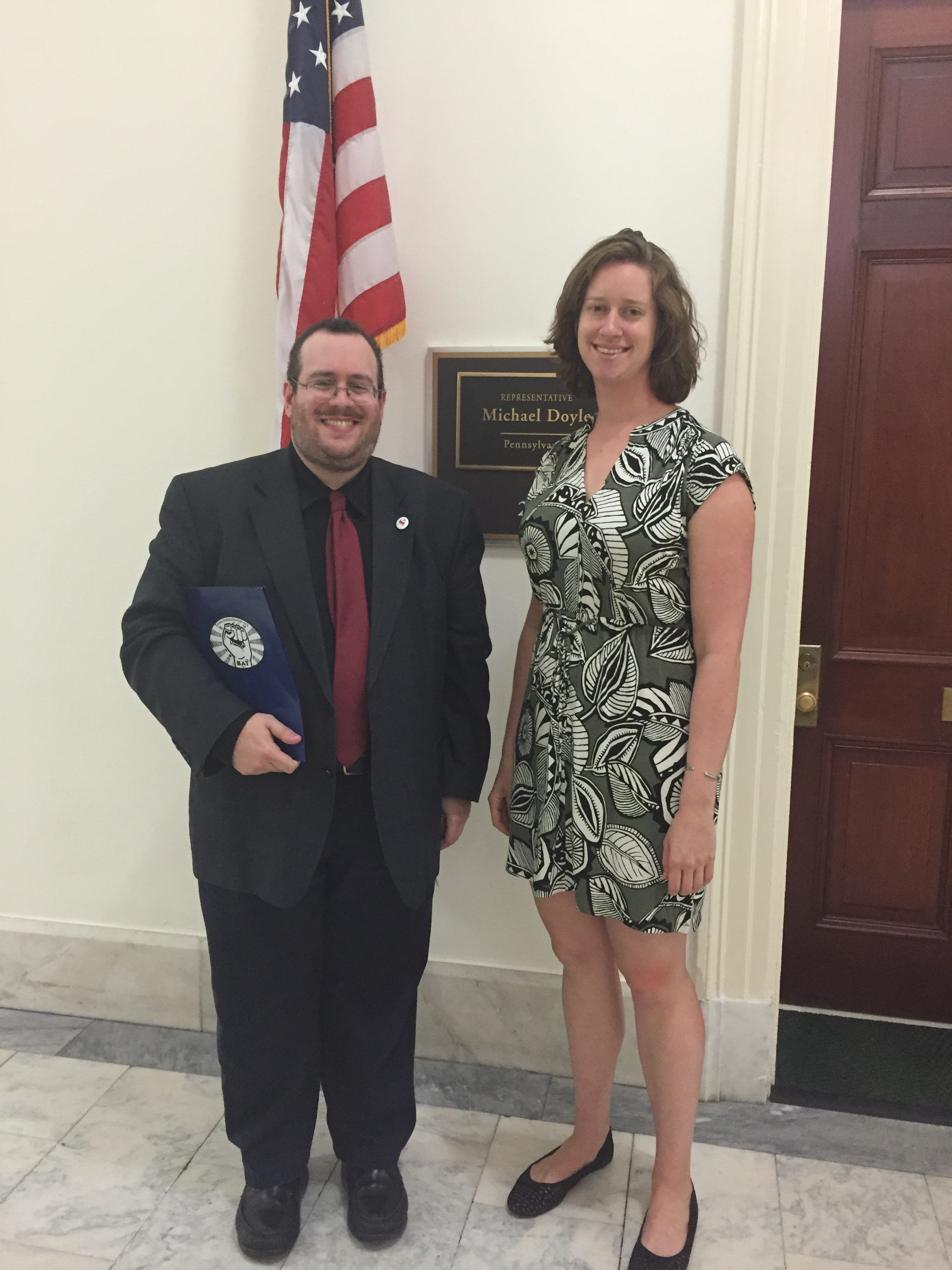
While sitting on the couch in Doyle’s office, he came out of a room to the left of me, asked his secretary for packing tape and then told her he was leaving for the day. It was 2:47 p.m. on Friday.

And they say teachers have easy hours!

I can’t say whether he was actively avoiding me. I made an appointment to see him, but it was never specified if I’d be meeting with him in person or if I’d be with his aide.

For all I know his staff never let him know I was a constituent sitting there on his couch in a suit and tie with a folder perched on my lap. But it didn’t feel good.

Maybe I should have said something. “Congressman Doyle! May I have a moment?”

But I frankly couldn’t believe this was happening. Moreover, he looks a lot different in a purple Hawaiian shirt than he does in all his press photos wearing a suit. I had to check his picture on my phone to make sure I was really seeing this correctly.

I was.

Still the meetings I had with these kids helping my legislators decide public policy were actually quite productive.

Without exception these youngsters were friendly, polite and knowledgeable. They seemed receptive to new ideas, were eager to hear my point of view, asked intelligent questions and were honest about where their bosses sometimes disagreed with me.

In Sen. Toomey’s office his assistants even asked if I was THAT Steven Singer.

“Who?” I said.

And they told me about a famous advertising campaign in eastern PA where a jeweler’s competitors are seen to complain “I HATE STEVEN SINGER.”

I laughed and told them it wasn’t me, but inside I wondered if that might explain the difficulty I had in some circumstances making these appointments. Maybe congressional staff thought I was pranking them. “Steven Singer wants an appointment!? Yeah! I’ll schedule it right after we see Mickey Mouse!”

image

I first met with Devorah Goldman, Toomey’s legislative correspondent on education and other issues. She’d only been on the job for about a year, but her qualifications included a degree in social work and she had worked in a public school resource center.

She was a very good listener. She heard me out as I spoke about a homeless student in my classes this year. She listened as I explained why Common Core is bad policy, why we need equitable school funding, an end to high stakes standardized tests, reigning in charter schools and voucher systems, and an end to judging teachers based on their students’ test scores.

Her boss isn’t exactly known as an education advocate. But she said he would agree with most of what I had said.

The main area of dispute would be charter schools. Toomey is in favor of expanding them so students can escape “failing schools.”

I explained that it was bad policy to try to save some students and let others fall behind. We need to make sure ALL our schools do an excellent job. Moreover, the Senator’s metric for determining which schools are failing is faulty at best.

I explained that traditional public schools often outperformed charter schools, which lack transparency and accountability and are wasting taxpayers dollars.

“We’ll just have to disagree on that point,” she said without explanation.

But she agreed to continue to take input from me and the BATS in the future.

image

At Doyle’s office, I eventually sat down with Hannah Malvin, a political science major who, at least, is from the Pittsburgh area – her boss’ legislative district.

She listened intently to my tales of education woe, even asking follow up questions. But she was surprised I supported the reauthorization of the Elementary and Secondary Education Act (ESEA).

Even the strongest supporters of the rewrite of the federal law that governs K-12 schools would admit it isn’t perfect. However, I would contend that the new version being cobbled together by the House and the Senate appears to be a slight improvement over what we have now – No Child Left Behind (NCLB).

Some educators think even this rewrite doesn’t go far enough to scale back standardized testing (and I sympathize but do not agree with that position). However, Malvin said Doyle had issues with it because it scaled back too much.

This was the issue I heard from Democrats all day. There isn’t enough accountability in the ESEA rewrite. How will we know which schools need extra help, they asked again-and-again.

I tried to explain that all they had to do was look at per-pupil spending. It’s no mystery which kids aren’t getting enough resources. It’s all right there on a ledger.

To her credit she heard me out and agreed to continue to dialogue with me on this subject in the future.

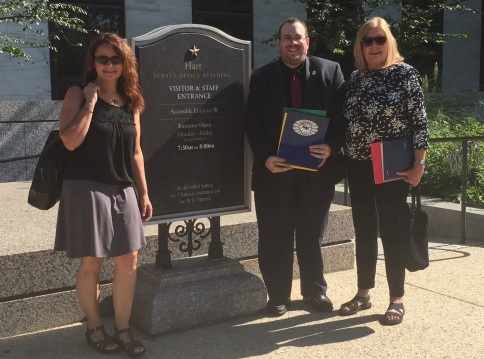
Next, I met up with some fellow teacher lobbyists from New Jersey and we dropped in unannounced on Booker’s office.

It’s not that we didn’t try to make an appointment. His staff never returned our calls and emails.

In fact, last week a fellow teacher not with us on Capitol Hill, Michele Miller,  even got into a scuffle with Booker on Twitter about elementary school funding. He told her to call his office and he would talk to her in detail.

To my knowledge, he never did. However, she was connected by phone to one of his aides. I’m told this is just modus operandi for Booker – strong talk in a public forum but shying away when the cameras aren’t rolling.

In any case, Booker’s senior education and health policy adviser Ashley Eden agreed to talk with us when we showed up to the office. Though her background isn’t in education, I can’t recall exactly what it is in. I do remember she has been doing this sort of legislative work for lawmakers for about 4 years – longer than any other aide we met.

She immediately made us feel welcome and found many areas of agreement. Bookers’ major point of contention – like fellow Democrat Doyle – was accountability.

How do we know which kids need help without giving them standardized tests?

Groan. But at least I had reinforcements: BATS Assistant Manager Melissa Tomlinson and retired NJ teacher extraordinaire Elizabeth DeMarco.
image

Perhaps the most telling moment of the entire conversation was when Eden said Booker just had to back standardized testing because every Civil Rights organization wanted it. She even criticized the New Jersey Education Association (NJEA) for not supporting black and brown students.

We stopped her right there. No. Every Civil Rights organization does NOT support testing. Journey for Justice – a coalition of 38 such organizations, in conjunction with 175 additional likeminded groups wrote to both the House and Senate asking to eliminate testing. Didn’t Sen. Booker see the letter?

Suddenly she remembered it.

She said she read it real quickly and didn’t like one sentence in it so she ignored it.

Which sentence?

Something about expecting poor and minority students to do badly on tests.

I explained that it has nothing to do with thinking these children can’t achieve at the same level as other children. It’s a matter of resources. If Sen. Booker was in a foot race against someone in a Monster Truck, I’d vote on the truck. Doesn’t mean Booker can’t run or that he might not even win. But the smart money is on Big Foot.

I joined the two ladies for their meeting with Smith as well.

His legislative assistant, Katherine Talalas, was perhaps the most knowledgeable aide with whom we talked. Her mother is a special education teacher, her brother is a paraprofessional working in a public school and she went to law school focusing on education issues.

She also took more written notes than any other assistant. With her nothing seemed canned. It was a real conversation about what her boss had done to help special education students and how he might continue to help in the future.

image

I was on my own again to meet with Sen. Casey’s aide, Jared Solomon.

This was one of the most fascinating and perplexing conversations I had all day.

He was warm, friendly, and had a depth of knowledge that was a bit more political than school-centered.

He agreed with almost everything I said. Casey supports 95% of the things that are important to me in education.

I could have smiled and walked away happy, but Solomon was so gregarious he kept talking. We shared our backgrounds.

He proudly admitted that he had been a Teach for America (TFA) recruit. He worked two years in a Baltimore public school and then left. He knew it wasn’t going to be his permanent job. He was emulating his parents who had joined the Peace Corps. He did TFA because he wanted the experience.

Then he moved to the administrative offices of Michelle Rhee’s Washington, D.C., Public Schools.

He only worked there two years – only one of which was under Rhee’s administration – but he respected what they had done. He said he disagreed with 80% of their policies and even quit because he was tired of being blamed for practices with which he didn’t agree. But, he added, the people in Rhee’s administration worked harder than anyone he knew, and he thought they really had the best interests of the kids at heart.

I’m tempted to chalk it up to the same feeling the incredible blogger Jennifer Berkshire (a.k.a. Edushyster) says she gets when she interviews many corporate school reformers. We may disagree with them, but they really do believe this stuff.

But something happened that doesn’t sit well with me. In an unguarded moment of a more than hour-long conversation, Solomon pulled the same stunt Eden did for Sen. Booker. He said all the Civil Rights groups were crying out for testing. But when I called him out on it, he immediately took it back. It was like he, too, knew this was untrue. It was a talking point, quickly to be conceded if called out and then move on to another argument.

I frankly don’t know what to make of it. The arguments are too similar among Democrats and Republicans to shrug off. Each is speaking from a party line script. That can’t just be a coincidence.

And why would Casey, a legislator who supposedly agrees with me 95% of the time on education, hire as his education expert someone who was actively involved in many of the practices that go directly against his beliefs? Why would someone like Solomon, who was part of the corporate education reform movement, really be on my side against these policies?

It’s befuddling to say the least.

Now that it’s all over, I’m so glad I did this.

Will this change the nation’s education policies? Probably not.

But I am only one of hundreds of people who climbed Capitol Hill in the last two days and met with more than 52 federal legislators to fight against the standardization and privatization of education.

And tomorrow we, BATS, will hold a Teachers Congress to further solidify our goals and decide where the great ship of real positive school change should go.

I am so looking forward to it.

But this teacher, soon-to-be BAT Congressman, needs to go to bed.

Here’s to a brilliant tomorrow for our children.


NOTE: This article also was published on the Badass Teachers Association blog.

A Brief Lesson in Pennsylvania Budget Math: a VLOG

Screen shot 2015-07-21 at 12.49.56 AM

WATCH THE VLOG BELOW:

Welcome to my first (and possibly last) VLOG or Video Log. If you haven’t already, please click on the video above, grab some popcorn and enjoy A Brief Lesson in Pennsylvania Budget Math.

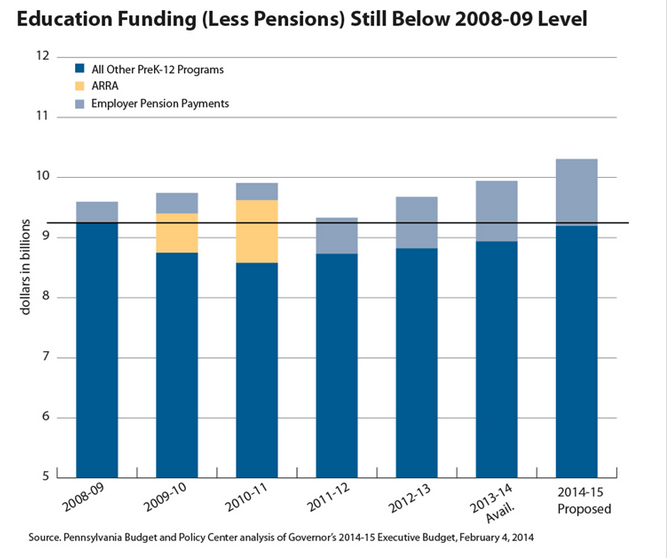
Our state budget impasse continues to grow. The Republican-controlled legislature refuses to replace the almost $1 billion in annual education funding lawmakers removed 4 years ago. Democratic Governor Tom Wolf refuses to accept a spending plan that shortchanges our school children.

This is my attempt to bring clarity to the situation so ANYONE could understand what was at stake and maybe see through some of the half truths and misdirections surrounding the issue. After all, who better than a public school teacher to explain to Republicans why they need to fund our schools?

Basically, the whole video can be summarized in this graph from the Pennsylvania Budget and Policy Center:

Screen shot 2015-07-20 at 11.08.50 PM

For more information, please check out these other fine Gadfly on the Wall Blog articles:


NOTE: This article also was published on the Badass Teachers Association blog.