While Hillary Clinton Courts Teachers, Bernie Sanders May Have Conceded The Education Vote

hillary_clinton_bernie_sanders_ap_img

Hillary Clinton has made huge strides this week courting education voters. The Democratic Presidential candidate made a statement critical of scandal ridden charter schools. She also met with educators to answer questions in a closed door meeting.

Meanwhile Clinton’s main competition for the Democratic nomination, Bernie Sanders, remains silent on K-12 public education. He’s a favorite among teachers but he hasn’t really articulated much of an education policy at all.

Parents, educators and students are looking for a candidate with the guts to turn away from the destructive school policies of the last two presidents. Both George W. Bush and Barack Obama have increased privatization and standardized testing while reducing teacher and community autonomy. Instead of helping alleviate an epidemic of child poverty, they have blamed the problem on schools and teachers while starving them of the funding they need to succeed.

Frankly, moving away from these corporate education reform policies is a bad fit for Clinton. Her past education positions have been almost identical to that of the Obama administration. She’s been a strong advocate for charter schools and Common Core. She receives hefty support from wealthy corporate school reformers like Eli Broad, George Soros, Bill and Melinda Gates and the Walton family. After all, her first major policy achievement was her 1983 campaign to establish accountability-based school reform in Arkansas when her husband was Governor.

Her connections to this movement have not weakened. Just this week, #TeachStrong – an education reform organization – was launched with ties to Clinton. The group is organized by the Center for American Progress (CAP) – a think tank long affiliated with both Hillary and Bill. Husband and wife have hired numerous staffers from this organization and have championed policies that originated behind CAP’s closed doors. Many education observers are theorizing that the #TeachStrong initiatives which blame teachers and try to make their lives more difficult will eventually become Clinton’s education policies if she becomes President.

By contrast, Sanders would seem to be well suited to oppose these corporate-driven school reforms. He’s anti-privatization, anti-Wall Street and pro-worker. His vitriol against the banking industry and the 1% using tax loopholes to avoid paying their fair share would only be enhanced if he included corporate school reformers on his hit list. These are, after all, most of the same people he’s already going after just for different reasons. Unfortunately, he has yet to embrace public schools. Up to this week, both he and Clinton favored only pre-kindergarten and college support. Now she has started talking about K-12, but Sanders’ lips remain buttoned.

Perhaps this is because he thinks education voters have already sided with Clinton. The largest teachers unions – The National Education Association (NEA) and the American Federation of Teachers (AFT) – both endorsed Clinton in the primary. However, in each case these endorsements were highly controversial coming mainly from union leaders without much or any involvement from rank and file members.

Clinton seems to know that top-down endorsements alone won’t get her votes. She needs to win the hearts and minds of membership, and she seems to be committed to doing just that. Her education comments may not be entirely satisfactory, her connections may be highly unsavory, and her history may be deeply disturbing, but at least she’s making the effort to reach out to voters who care about the education system.

Sanders, where are you? You’re a Democratic Socialist. You say you’re committed to the public good. What is a greater public good than public schools? The education vote is by no means decided. It remains on the table for either candidate to take.

Personally, I don’t think Clinton is a good choice to come to education’s rescue. No matter what she says, I just don’t trust her. Someone who champions privatization isn’t going to save us from for-profit charter schools. Someone who is in bed with the testing industry isn’t going to reduce standardized testing. Someone who helped establish Common Core isn’t going to repeal it.

But if I’m honest, Sanders has skeletons in his closet, too. In the Senate he voted to expand charter school funding, voted for No Child Left Behind and most recently voted to keep test and punish policies in the Elementary and Secondary Education Act. However, given everything else he espouses, all these votes seem like anomalies. While Hillary looks like a seasoned professional who knows exactly what she’s doing in education circles, Bernie seems like a bumbling amateur who keeps making mistakes. It appears all he needs is a good talking to, someone to explain how our interests and his align perfectly. (Call me maybe!)

Of course, there is another possibility. Perhaps Sanders is against us as much as Clinton. Perhaps there is no major politician out there who has any interest in saving our schools.

Perhaps we really are alone.

In that case, maybe we shouldn’t wait for major politicians to come to us. Maybe we should consider supporting someone who is honestly in favor of us but does not yet have much political clout.

What say you, Dr. Jill Stein?

In the meantime I find myself waiting impatiently for Sanders to make his move. But I won’t wait forever. If he wants my vote – and the votes of hundreds of thousands of parents and teachers – he’s going to have to make his case.

Otherwise, we’ll look somewhere else.


NOTE: This article also was published on the Badass Teachers Association blog.


Stockholm Syndrome – The Only Reason Any Teachers Still Support Common Core

Screen shot 2015-11-05 at 11.06.26 PM

Common Core is dying a well-deserved death.

The very idea that we need the same academic standards in public schools from coast-to-coast is unpopular, expensive, ineffective and politically suicidal.

The Wall Street Journal reports at least $7 billion taxpayer dollars have been wasted implementing this plan, and it would cost significantly more to finish the job.

“Five years into the biggest transformation of U.S. public education in recent history, Common Core is far from common. Though 45 states initially adopted the shared academic standards in English and math, seven have since repealed or amended them. Among the remaining 38, big disparities remain in what and how students are taught, the materials and technology they use, the preparation of teachers and the tests they are given. A dozen more states are considering revising or abandoning Common Core.”

Meanwhile public support drops precipitously with each passing year. Less than half of all Americans – 49% – and only 40% of teachers now favor the policy. That’s a drop of 16% among the general population since 2013. But even more surprising is the plummeting backing from teachers. Advocacy has dropped 36 points from two years ago when three quarters of educators approved of the change. This is especially damning because of all social groups, teachers know the Core the best.

In political circles lawmakers who used to champion these standards now take pains to distance themselves from them. Politicians as diverse as Jeb Bush and Hillary Clinton now claim they either never supported the policy in the first place or that it’s a good idea that has been badly implemented. Support among Republicans – who initially favored the plan much more than Democrats – has practically vanished.

The writing is on the wall. Common Core is sinking fast.

Yet there remains a minority of real live educators who will cheerfully direct you away from the lifeboats even as the ship of our public schools lists dangerously to port. Despite everything going on around them, they cling to this disastrous policy blunder despite the harshest criticisms.

It’s strange.

By and large, Common Core wasn’t created by teachers. It was forced on us by policymakers, functionaries and corporations. It usurps our autonomy. It overrides our judgment. And it ties us to practices that almost all of us think are detrimental to our students. But some of us still think it’s the bees knees.

The only explanation I can come up with is Stockholm syndrome. The phenomena, also called capture-bonding, occurs when hostages empathize with their captors. Kidnapping victims sometimes feel sorry for the very people who abducted them. Something similar seems to be happening with the few hardcore supporters of Common Core that are left.

For instance, regardless of the public relations efforts being spewed by corporate America, Common Core was not created by teachers. It’s shocking that this fact is still disputed. It is easily verifiable.

Here it is from the National Governors Associationthese 24 people wrote the first draft of the standards. And these 101 people revised them. None of these people were currently employed as a K-12 classroom teacher. Moreover, very few of them even had K-12 classroom experience at some distant point in their careers. Even less had experience at the middle school or elementary level. Less than that had experience in special education or with English Language Learners.

Therefore saying Common Core was created by teachers is incredibly disingenuous. It’s like taking a single speck from a beef bullion cube and calling it a filet mignon. Something resembling a cow may have been present at one point, but add water and you couldn’t exactly call the flavor beefy.

The overwhelming majority of Common Core authors are identified as working for the testing industry – specifically the College Board and ACT. The second largest group worked for Achieve, a Washington think tank. Others worked exclusively at the college or university level.

Yet there remain a small cadre of real life K-12 teachers who still champion this product. Think about what that means.

They prefer a prepackaged set of academic standards to what they would come up with on their own or with their colleagues. They prefer to give up their own professional judgment based on years of experience, degree certifications and professional development in favor of something handed down to them from the testing corporations and policy wonks. They would rather be told what to do by people with far less experience than to make their own decisions about how to do their own jobs.

Even if everything in the Core was hunky dory, I’d have a problem with that. Call it self-respect. Call it professional pride. I did not get into this field to become anyone’s worker drone. Being a teacher is not on par with being a greeter at Walmart. We need to make complex decisions about how best to educate children every moment of every day. That’s not a mcjob.

This doesn’t mean all the standards contained in the Core are garbage. There are certainly some things in there that promote learning. However, as educators have become more familiar with the contents, glaring mistakes have become apparent – standards that are age inappropriate, too specific, not specific enough, unduly restrictive, and just plain weird. If only there were some objective means of telling the wheat from the chaff.

But there is.

We could have tested the standards to see if they actually aided in comprehension. We could have field tested the product – tried it out in a small scale and then assessed its effectiveness. You would expect any new commodity to go through rigorous research and development. Only a fool would just throw new merchandise out there without any idea if it would work.

Welcome to Fool Nation – population you. That’s where your tax dollars went. Your government spent billions on something completely untried and unproven. And guess what!? It didn’t work.

I have a major problem with that. As a teacher, I am appalled that I am being forced to institute something so careless into my classroom. If the legislature suddenly thought all children should be forced to pour lemon juice on their heads before reading a book, I’d jolly well need a good reason to do it before I started squeezing citrus on top of my classes. But that’s kind of what they did, and they even charged the taxpayers for all the lemons!

However, the strangest part of this whole concern is standardized testing. Here at least we have agreement. Almost everyone says its out of control. We give too many tests. But many teachers go even further questioning these tests effectiveness at all.

High stakes assessments do not promote learning. They narrow the curriculum and punish the neediest students for – in fact – being needy. It’s a proven fact: rich children generally score well and poor children score badly. These are terrible measurements of children’s academic success.

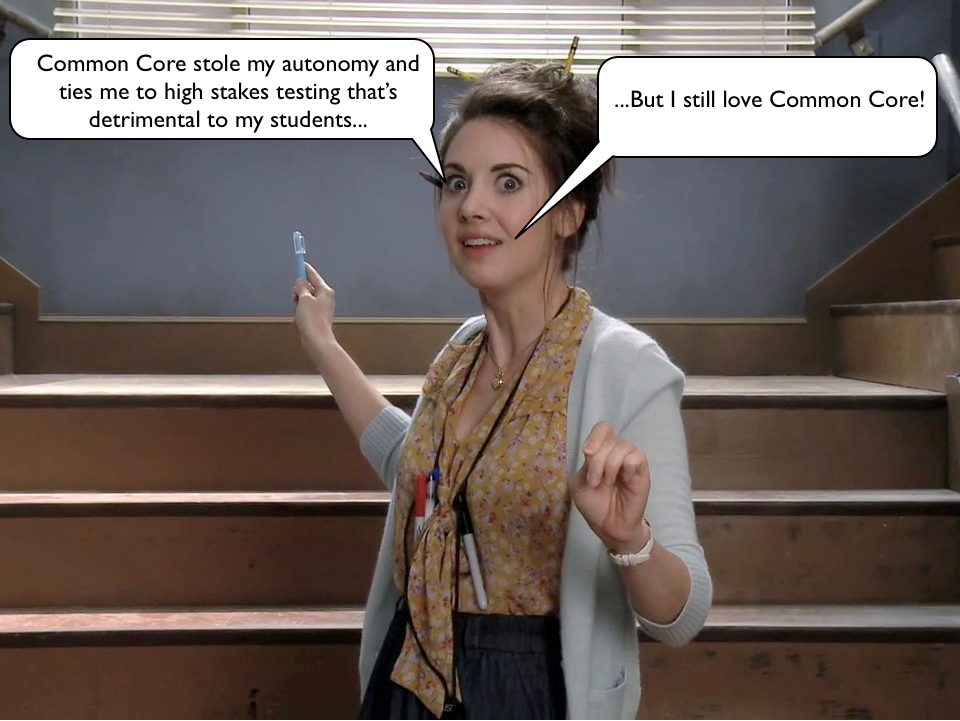
And most folks left on the dwindling bench of Common Core cheerleaders agree! They don’t like testing either! Yet so many times I’ve heard these people say, “I hate the testing but I love the Common Core!”

What!? They’re intimately connected.

Common Core was designed to be assessed by standardized tests. In fact, the standards attempt to make what is taught more representative of what is tested. For instance, most passages on Reading assessments are nonfiction. Therefore, Common Core says most of the reading done in school should be nonfiction. The tests emphasize cold reads. Therefore, the Core says teachers should make their students do more cold reads.

And yet Core advocates only find fault with the tests!? How can you say ‘I don’t like the tests but I like teaching to the tests I don’t like’?

It’s absurd.

And speaking of cognitive dissonance, why are we designing our curriculum backwards from the tests in the first place? Shouldn’t we be designing the tests based on the curriculum? Shouldn’t our assessments be made to prove that students are prepared for real life and not simply that they’re prepared to take the tests?

Bizarrely, all this remains a mystery to the few Common Core standard-bearers left in our classrooms. They want their Common Core. Yes, it was forced on them by bureaucrats. Yes, it’s never been proven to work. Yes, it’s intimately connected to the same standardized testing they hate. But they just can’t get enough of that Core.

Still, don’t be too hard on them. Everyday more of these folks are waking up. Every day more of them discover they are living in The Matrix. Reality is not as it seemed.

Perhaps it will just take more time. Or a strict regime of psychoanalysis, mediation and special pharmaceuticals.

But one day the Common Core will breath its last, and we’ll need everyone to help undo the damage.


NOTE: This article also was published on the Badass Teachers Association blog.


Department of Education SorryNotSorry About High Stakes Testing

Screen shot 2015-10-24 at 11.04.43 PM

The Obama Administration must think the nation’s parents, teachers and students are pretty darn dumb.

President Barack Obama and his hand-picked Department of Education are solely responsible for the knuckle dragging academic policies strangling our public schools day in, day out. Yet instead of doing anything to reverse course to proven methods that might actually help kids learn, the department trudges out its annual apology.

It goes something like this:

Hey, Everybody! So sorry about all those high stakes tests, Common Core Standards and Value-Added teaching evaluations. We know they’re bad and we’re going to stop.

Then whatever functionary drew the shortest straw toddles back into the building and for the rest of the year things continue on exactly the same as they always have.

Let’s just pause for a moment and imagine how incredibly stupid they must think we are. I’m surprised they don’t issue public service announcements reminding us to exhale, multi-colored pamphlets on the benefits of blinking, and puppet shows instructing us how to use the potty.

The Obama Administration has had 7 years to fix this mess, and the only things they’ve done are to make it worse. Most of us voted for this so-called progressive because we thought he’d improve upon George W. Bush’s astoundingly wrongheaded school policies. But instead he doubled down on them! We hired a competent janitor but he was successful only in creating greater disorder.

We thought someone with the intelligence and grace of Barack Obama would be able to understand more than the eternal C-student Bush that you can’t ensure equity by standardized testing. That’s like trying to ensure a bathtub was filling with hot water by using nothing but Tarot Cards. The cards don’t give you an accurate reading and even if they did, you’d need to adjust the faucet at some point!

We thought a Constitutional scholar would understand that a national school curriculum violates federal law – even if you get a faux state commission to propose it and slap a new name on the thing! The federal government is allowed to do some things and state governments are allowed to do others. It’s not that hard. Moreover, armchair generals who have zero understanding of educational pedagogy, psychology, sociology and no classroom experience have no business telling teachers what they should be teaching!

We thought a political party that claims to be on educators’ side wouldn’t then turn around and initiate a witch hunt against us using poor student test scores instead of pitch forks and torches. Every independent, peer-reviewed study shows that poor kids do badly on standardized assessments and rich kids do well. Every statistician says you can’t use a test created to measure one thing (students) to measure another (teachers). Yet this is exactly what this so-called intellectual president mandates, and then he and the Democrats expect us to be there for them at the polls!?

In short, we expected a liberal Democrat, but got instead a Conservative Democrat in Name Only (DINO). He took far right ideas that Bush could barely officiate and made them much more efficient and thus much more damaging.

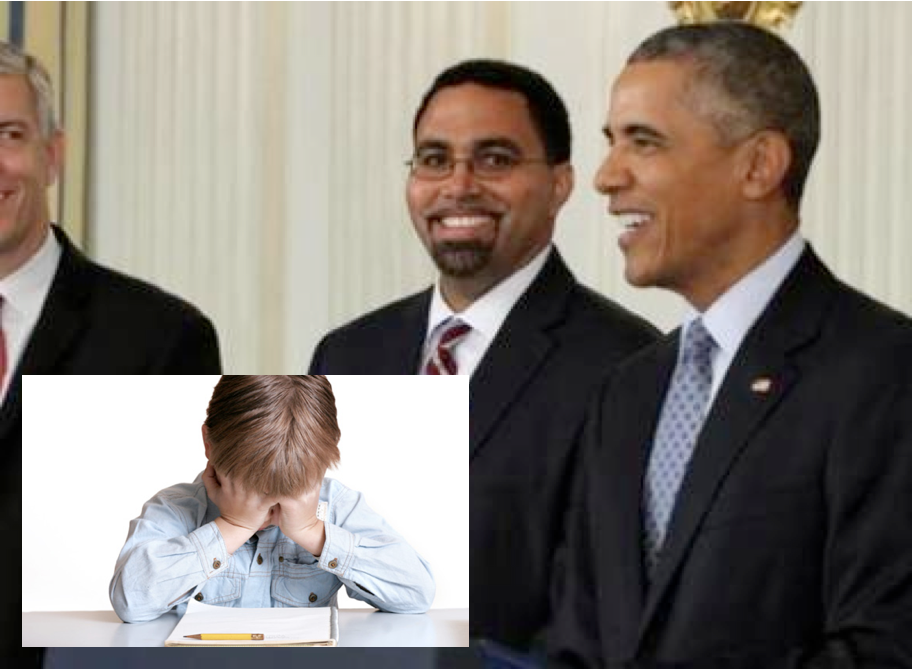
And every year like an alcoholic stumbling off a bar stool, the administration swears they’re not going to take another drink. Then they hire the head of Anheuser-Busch (John King) as a nutritionist. And some of us still believe them!

Just look at the crumbs they’re throwing out to us, peons!

Hey, Girl. We’re going to cut testing down to 2% of the school year.

That’s 23 hours! Almost 3 full days! Imagine if the dungeon master told you he was only going to put you on the rack for 2% of the time! Would you thank him? Maybe, but it would be a pretty half-hearted thank you.

Can the administration prove any positive value for standardized testing? I’m not asking them to trot out the tired party line about equity. I mean can they prove that testing actually helps children learn in any appreciable way? If the answer is no (and Spoiler Alert: it is!) then we shouldn’t be wasting any more time with it. Not 2%. Not 1%. ZERO PERCENT!

Moreover, Obama has been talking about reducing testing since he ran for office in 2008. America’s schools are still waiting for him to come through on that one. Maybe on his last day in office we’ll have a testing moratorium. Fingers crossed!

The department says, “The assessments must be worth taking.” No shit. That’s exactly the problem! They aren’t! And they’re shrouded in secrecy under the guise of test corporations intellectual property. How will we be able to determine they’re “worth taking”? Will you just tell us? THAT sure puts my mind at ease!

You know what assessments have been proven worth taking? The ones created by teachers. Yet these are exactly the kinds of tests that schools have been forced to cut back on. Perhaps this is what the administration has in mind. No more teacher-created tests. Let’s just have tests made by the professional test creators who have no idea what the heck they’re doing!

And speaking teachers, this one’s for you: “No standardized test should ever be given solely for educator evaluation.” It sounds like a condemnation of Value-Added Measures (VAM), of evaluating teachers on student test scores. However, it’s just the opposite. Notice the word “Solely.” We’re not going to give kids tests if we ONLY use them to evaluate their teachers. Well woop-de-do! Professional flunkies will talk to you for hours (if you pay them enough) about how great the tests we give now are at doing both! So no change in policy, just some purple prose to light on fire and blow the smoke up educators hind ends.

Perhaps worst of all is the use of English Language Learners (ELL), students with disabilities and minorities as props. We’re doing it all for them, they say. Bull! Shit!

The administration has nothing to say about fully funding the Individuals with Disabilities Education Act (IDEA). There’s nothing about sanctions on districts that don’t provide proper services for ELLs. There’s nothing about ensuring adequate, equitable and sustainable funding for all students – especially the poor and minorities. Instead the Department of Education pretends like high stakes tests are candy bars and what poor disadvantaged minority ELL disabled kid doesn’t love the soft velvety chocolate taste of a multiple choice test!?

This announcement is not reason to celebrate. It’s more of the same fake apologies soaking wet in crocodile tears and bad candor.

If Hillary Clinton wants to get elected President, she’d better do more than that. If Bernie Sanders wants a shot, he’d better do more than spout socialism about Wall Street and silence about K-12 schools.

You can only lie to our faces for so long. Despite your best attempts to trash public education in the name of saving it, we’re not so dumb as to believe any more of your evasions, deceit and dishonesty.


NOTE: This article also was published on the Badass Teachers Association blog.


Education Does Not Cure Poverty – It Cures Ignorance

Screen shot 2015-10-17 at 11.36.22 PM

What good is an education?

Will it get you money? Will it make you rich?

No. Not really.

And that’s one of the biggest problems with American public school policy of the last 15 years. It misunderstands the purpose of the very thing it purports to promote.

Poverty is skyrocketing. It’s been on the rise for at least three decades, but since the economy collapsed in 2008, the ranks of the poor have swollen like an untreated wound left to fester and rot.

We could be doing something about that. We could be working on a jobs package – on something to get people back to work. Instead we crowd around unemployment data and clap each other on the back because on paper it looks like we’ve overcome this obstacle.

Unfortunately, we haven’t.

Since President Barack Obama took office, there have been less people out of work than during the disastrous Bush years. However, most new jobs created since the crash only pay minimum wage. The good jobs are drying up and being replaced by poverty wage employment. And that’s not even counting the hordes of people who’ve given up even looking for a job but don’t merit a mention in these Pollyanna publications!

So how do we truly answer this dilemma? How do we get America back to work?

According to our policymakers, through magic.

Provide people more training, they say. Make sure those out of work obtain new skills and the next generation receives a rigorous education.

It’s the kind of solution our grandparents – who lived through the Great Depression – would have laughed to silence. Give someone a book, put them in a school, place them before a teacher and – POOF – they’ll be able to get one of the nonexistent well paying jobs that – may I repeat – DON’T EXIST!

It’s not that we have an unskilled workforce. We have more people than ever with Doctorates and Masters degrees living on food stamps. The problem is lack of well paying jobs. We’ve tax sheltered, down sized, and corporatized America into a land where the rich play Monopoly with all our cash while the rest of us subsist on McJobs.

Claiming that education alone can resolve this problem is like saying all a starving person really needs is a fork and spoon. But that won’t help if he has nothing to eat!

It should be no surprise that those championing our school system as a silver bullet to our jobless nation speak out of both sides of their mouths. On the one hand, they say, education can save us. On the other, they say, if education was better we wouldn’t need saving. And since they’re almost exclusively employed by the same people who gobbled up all the jobs in the first place and then spat them out to China, it’s a travesty that anyone listens to them.

They’re not offering a solution. They’re making a last ditch effort to clear the board of any remaining public money – education dollars.

If only the teachers had taught us better, they say, we’d all be able to have a corner office in the sky. But since those evil, lazy educators are doing such a bad job, we need to close as many schools as possible to save those kids. And then we can privatize them and swipe even more of that sweet, sweet public money to the 1% who can run charter schools and cut student services while scarfing up the rest as yummy profit.

To prove this thesis, policymakers force untested and irrational reforms on public schools – standardized testing, computerized test prep, Common Core. When none of this works (as planned), they simply blame the educators who never wanted any of this in the first place. But it helps us serve up teachers on a silver platter as the scapegoat of the day.

These so-called reforms solve nothing – they just make things worse.

Furthermore, they’re a distraction, smoke and mirrors so we won’t see the real issue of how we’re being swindled by the 1%. After all, THEY were the ones who got us into this mess in the first place! They were the ones who crashed the economy – not Mrs. Jones, the local science teacher.

We should know this already. It’s out in the open and easy to see. The media is not doing its job of reporting the truth. The public is being dazzled by propaganda that appeals to our basest selves. But most importantly, we’re being fooled because we no longer remember what education is for!

Even under the best of circumstances, education does not make someone rich. That’s not it’s goal. It never has been. Education seeks to enrich people’s minds, not their bank accounts.

Yes, there is a relationship between the two, but its several steps removed. A well educated person may be able to more easily obtain money than an uneducated one. She may be more prepared for a well-paying job. However, being prepared is rarely what makes someone rich.

People gain wealth most often by inheriting it (See Paris Hilton, Bill Marriott, Mitt Romney and Donald Trump). Others get money by cheating the public out of it. This takes a person with a weak moral code, not necessarily strong book smarts. For instance, look to the Walmart model of selling groceries cheaply by paying poverty wages to employees who then must rely on the federal government to survive and thus can only afford to shop at Walmart. That’s not smart. It’s sociopathic. Anyone could have thought that up, but it takes a person with a stunted conception of the value of other people to actually do it.

More important than a college degree are connections. The Rich know the right people. They have contacts in high places with whom they can barter for lucrative tips, jobs and partnerships. They have friends on Wall Street who can tip them off when a stock is about to rise or fall. They know editors at prominent papers who have no problem changing the headlines to match a preconceived narrative rather than the facts on the ground.

Again, that doesn’t require all A’s on your report card. It’s the result of a lottery of birth, social standing and an undeveloped sense of fairness.

There are some people who actually do gain riches on the merits of their intellects. But they are few and far between. Even among them there is a large portion who are more lucky than genius. I love Ben and Jerry’s ice cream, but it doesn’t take an Einstein to come up with it. Sometimes the gods of finance just smile on hippy dippy flavors with fun names.

Since the ancient world, thinkers have postulated that the purpose of education is not to increase material gain – it is to become a better person. The Ancient Greeks believed that there is value in knowledge and wisdom that doesn’t translate into gold. Aristotle called it eudaimonia or human flourishing. The best life includes wisdom.

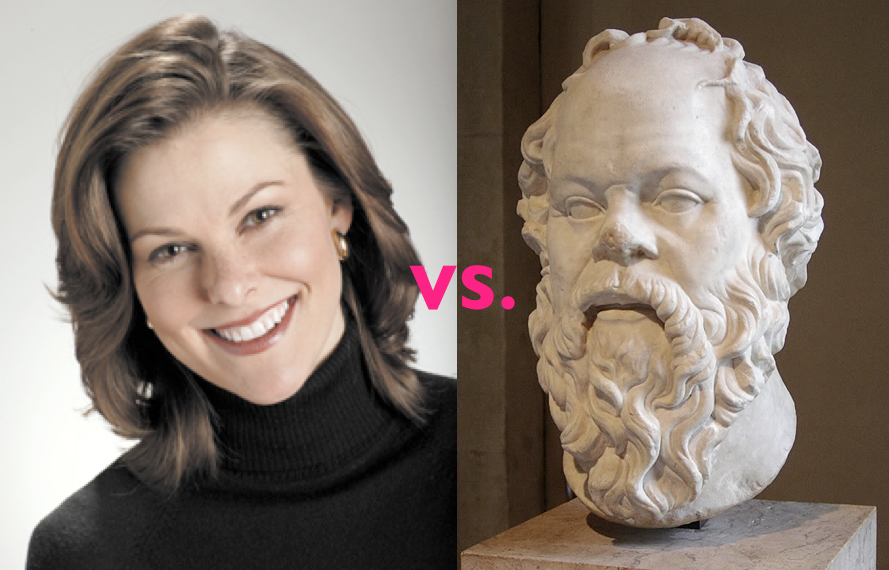
This builds on the philosophy of Socrates – one of the founders of Western thought – who famously said, “The unexamined life is not worth living.” We have strayed far from these ideals. Today we might say the unreciprocated action is unworth doing. If something doesn’t translate into cold, hard cash, it is considered weak, a wasted effort. Even philanthropy has become a way to gain control over the industry you’re ostensibly trying to help. (See Bill Gates immense influence on Education policy.)

In their hearts, most teachers would side with Aristotle and Socrates over the Waltons and Gates’. And that’s why our corporate masters look down on us. We represent an ethos that they have abandoned and tried to destroy.

They tell themselves the fairy tale that wisdom means cheating others out of money. The removal of ignorance, they say, is the removal of any obstacles toward clawing and punching your way to the top.

But true wisdom recognizes that people are more than mere animals. We do not need to continue the Darwinian struggle of survival of the fittest among ourselves. We can cooperate. We can value each others lives. We can love.

If people valued this kind of knowledge over money, what would happen to the rich? Wouldn’t it prove that they have wasted their lives betraying and manipulating the less fortunate? Wouldn’t it reveal the poverty of their souls?

Because if people were truly educated, they would see these sick, twisted individuals for whom they really are. And we would demand justice. Not so that we could replace these penny-ante tycoons with our own wealth addiction. But instead so that we could all live in peace and bask in the joy of knowledge, compassion and an unending quest to chip away at our own ignorance.


NOTE: This article also was published in the LA Progressive and on the Badass Teachers Association blog.


Near Silence on Education at First Democratic Debate

11dd341d_GettyImages-492526072.xxxlarge_2x

None.

Null.

Nada.

That’s how many questions CNN anchors asked presidential hopefuls about America’s public schools at the first Democratic Debate.

Imagine if Anderson Cooper and company had been silent on Climate Change. The candidates would have brought it up anyway. Bernie Sanders actually did talk about the threat to the environment when asked a question about national defense.

Imagine if moderators had no questions about gun violence. Candidates competed with each other to demonstrate which took a stronger stance against the National Rifle Association.

Imagine if no one asked about finance reform. On that stage each candidate tried to position his or herself as the new sheriff of Wall Street.

But when it comes to one of the most important issues of the day – our children’s struggling schools – the media apparently thought it was of no interest to the viewing public.

Admittedly both Hillary Clinton and Sanders briefly brought it up when asked about other things.

Clinton said we need universal pre-kindergarten and good schools. However, she neglected to say what those good schools would look like.

It’s almost like saying nothing at all. EVERYONE wants good schools – Even dunderheads like Chris Christie, Jeb Bush and Donald Trump! But their ideas of good schools differ greatly from that of most parents, teachers and students. McCharter schools for the poor and Cadillac campuses for the rich isn’t exactly what real progressives have in mind.

And universal pre-k? Great! But that’s kind of the flavor of the month. Who really disagrees that we should help toddlers prepare for school? It’s like asking, “Who wants ice cream?” in a room full of little kids on a hot day. EVERYONE wants ice cream – even the kids who are lactose intolerant!

Sanders took a second in a diatribe about social services to mention the need to fund schools. However, he didn’t say a thing about equity or if that funding would have strings attached. President Obama talked about funding schools, too, when he was running for president in 2008. Once he got into office those education dollars came at the cost of accepting untested and developmentally inappropriate Common Core State Standards. And equity meant closing poor schools to save them.

I wonder if CNN would have felt more pressure to ask even a single token education question if the largest national teachers unions hadn’t already endorsed Clinton. Both the American Federation of Teachers representing 1.5 million members and the National Education Association representing 3 million members have backed Clinton.

Well, leadership has. Member outreach, polling, even voting by the organizations largest representative boards has been almost entirely absent.

But now that teachers have been pigeonholed in Clinton’s camp, what’s the point of asking education questions? In the public eye educators have already chosen their candidate. Why would they need to hear Clinton’s thoughts on education policy? Why hear her opponents thoughts? Their minds are made up.

Meanwhile, the Obama administration continues to run roughshod over teachers concerns. For 7 years education professionals from all walks of life have complained about the administration’s failing school policies and its buffoonish education secretary Arne Duncan. But now that Duncan is leaving, the President replaces him with John King – ex-New York State Commissioner of Education who enraged parents so much he was run out of the state on a rail.

The media just doesn’t care about public education. Nine times out of ten if they even print a story about schools, it’s a puff piece spin doctoring a school reform policy that isn’t working, never has been working and is – in fact – making things much worse for our nation’s students. Otherwise it’s an expose of how teachers can’t make these horrendous policies work so its their fault and don’t even glance at the ballooning child poverty rate – that’s completely irrelevant to the issue of all these lazy teachers who can’t be fired because we’d have to prove they’re bad first.

And what of the candidates? Do they care about public education?

The Democrats say they do and then zip their lips. They might make positive noises about preschool or universities – especially when it comes to funding. But they have next to nothing to say about K-12 schools. When the issue comes up, they deflect to toddlers or the college campus.

Meanwhile Republicans can’t contain their glee about mentioning teachers during debates and stump speeches. They want prospective voters to know that conservative types like them want to punch teachers in the face. During the first Republican debate, at least half of the candidates in that crowded boasted how much they stood up to the teachers unions.

And so there you have it, folks. That’s what passes for a substantive Democratic debate of all the important issues of the day. Now voters can make an informed decision in the primaries. There will be a few more debates, but they’ll probably be no different than this one.

And if you actually care about public schools, if you have children in the system, or derive your livelihood from it, or even if you just don’t want to live in a society of uneducated dummies – you’d be better served using Tarot cards to determine where the Democrats stand on this issue.


NOTE: This article also was quoted extensively on Diane Ravitch’s blog and published by Commondreams.org and on the Badass Teachers Association blog.


If School Computer Use Reduces Standardized Test Scores, Doesn’t That Prove the Tests are Inadequate?

ipad-kids

Melvin’s hand is up.

He’s a 13-year-old African American with too much energy and not enough self-control.

He’s often angry and out of his seat. He’s usually in trouble. But today he’s sitting forward in his chair with his hand raised high and a look on his face like he’ll explode if I don’t pick him right this second.

So I do.

“Mr. Singer! Can I show my imovie now!?”

This is a first. He hasn’t turned in a lick of homework all month.

“Wow! You’re really excited about this, aren’t you?” I say.

“Yeah,” he responds. “I was up all night finishing it.”

I start to doubt this, but he does look awfully tired underneath that urgent need to share.

Airdrop it to me from your ipad,” I say, “and I’ll put it up on the SMART Board.”

This takes a few minutes.

Let’s face it.

We live in a world of high technology.

Our cell phones have more computing power than the Apollo missions to the moon.

The best, high paying jobs opening up on the world stage require increasing levels of computer literacy.

Yet according to a new study, America’s students don’t succeed as well academically if they have access to computers at school.

How can this be?

How can exposure to new technologies cause a nation of young people to fail at a system supposedly designed to prepare them for the jobs of the future?

Doesn’t real world experience usually make you better prepared?

A future chef would be helped by more time in the kitchen.

A future doctor would be helped by more access to dissection.

But a future computer-user is hurt by more time at a computer!?

Something is very wrong here.

But according to a new study by the Organization for Economic Cooperation and Development (OECD), students who use computers more at school earn both lower reading and math scores on the Program for International Student Assessment (PISA).

The organization studied 15-year-olds across 31 nations and regions from 2012. The study just released in September even controlled for income and race.

Yet here in my classroom I see the exact opposite. Computer use increases my students test scores – on my teacher-created tests.

Melvin’s movie was ready. He had been tasked with explaining the differences between external and internal conflict. I pressed play.

High adrenaline music poured from the speakers. Pictures flashed across the screen of boxers and football players.

“This is external conflict,” came rushing forward followed by a brief definition. Then an image of Homer Simpson with an angel and devil on his shoulders. “This is internal conflict,” came zooming by our eyes.

The film might not win any Academy Awards, but it was pretty impressive work for 40 minutes of class time and however long Melvin decided to spend at home.

It’s the kind of thing my students never could have done before they each had ipads. And when they took my test, few of them got the questions wrong about conflict.

Yet according to the OECD, I was somehow hurting my students academically!?

Even in my high poverty district, students have always had access to technology. But the nature of that technology and how we use it has changed dramatically this school year.

I used to have eight computers in my classroom, but they were slowly becoming obsolete and inoperable. Some days they functioned best as extra illumination if we shut out the overhead light to show a movie.

Still, I tried to incorporate technology into my lessons. I used to have my students make their own Webpages, but reserving time in the computer lab became almost impossible. And even then, the district couldn’t afford to keep the devices in the lab updated enough to run anything but the most rudimentary software.

The one lab in the building that had new devices was reserved almost exclusively for a drill and kill test prep program we had received a state grant to operate. THIS was the apex of school technology – answering multiple choice look-a-like questions. It bored students to tears and didn’t even accomplish the stipulated goal of increasing standardized test scores. Yet we were blackmailed by the state government into initiating the program so we could gain additional funding to keep the school operational.

THIS is the kind of technology use you’ll find at most poor schools like mine. And it’s one of the reasons the authors of the OECD study came to their conclusion. It’s also one of the reasons why teachers like me have been skeptical of technological initiatives offered to impoverished districts.

However, the best use of technology is something quite different.

This year my district received a gift of ipads for all the students, and it’s changed everything. No longer do I have to beg and plead to get computer lab time for real high tech lessons. I don’t need it. The technology is already in the classroom in the palm of their hands.

But policymakers clutching their pearls because of this study have already began to make changes to international school curriculum. Schools in Asia have begun cutting back on student computer time. Should America follow suit?

Absolutely not.

The problem clearly is not computers. It’s the antiquated method we use to measure success.

Standardized testing has been around since 206 BC as an assessment for civil servants in ancient China. The same process spread to England in the 19th Century and then to the United States during WWI. Through all that time, the main process of rewarding rote learning through multiple choice questioning has remained the same.

But the world hasn’t. We’ve moved on a bit since the Han Dynasty. We no longer live in a medieval society of peasants and noblemen where the height of technology is an abacus. We live in an ever-changing interconnected global community where a simple search engine provides more information than could be stored in a thousand Libraries at Alexandria.

How can we possibly hope to rely on the same assessments as the ancients? Heck! Even as far back as 970 AD, standardized testing was criticized as being inadequate.

But a global multi-billion dollar industry relies on these primitive assessments. It’s the basis of an exceedingly lucrative business model.

So it shouldn’t be surprising that the same people who promise standardized testing and Common Core will best prepare students to be college and career ready are passing the blame.

They claim this report isn’t an indictment of their cash cow industry. It’s a warning against over-reliance on computers. And, yes, they’re right that technology is not a panacea. The mere presence of a computer won’t make a child smarter. Likewise, the mere presence of a book won’t make a person wiser. One must know how to use said computer and book.

But what I’m seeing in my classroom primarily is an opportunity – not a danger. Students like Melvin are more engaged and willing to take chances. They have greater freedom, intrinsic motivation and excitement about learning.

Many times when sharing Keynote presentations, after one or two, students ask to have their work back so they can improve them. That doesn’t happen with test prep.

They often elect to take ipad assignments to lunch and work on them between bites. That doesn’t happen with Pearson worksheets.

I’m not saying it’s easy. It’s up to me, my colleagues and administration to ensure technology is used to its full potential. Never should these devices be time fillers or babysitters. Nor can they ever replace the guidance of a thoughtful, creative educator to determine their best use. Teachers need to create and assign lessons that promote creativity and critical thinking skills.

Education professionals are constantly advised to individualize their lessons to meet the needs of diverse learners. Technology allows them a unique opportunity to do so. With district ipads I can talk to an English Language Learner in his own language. A struggling reader can have the device read test questions aloud. A student with poor motor control can type journal responses and have his writing be understood.

And these opportunities for enrichment don’t even need to be planned ahead of time. For instance, when discussing a short story about a character that was exceedingly proud, one of my students brought up the Seven Deadly Sins. She wasn’t exactly sure what they were or how exactly they related to pride, but one of her classmates quickly looked it up on her ipad. Then another found a medieval woodcarving to which someone else found a related manga text. The subsequent discussion was much deeper and relevant to these children’s lives than it would have been otherwise. And none of it was pre-packed, planned or standardized. It was individualized.

This is really no surprise. Administrators in charter or private schools aren’t asking themselves if they should close their computer labs and put their devices on ebay. They know the value technology can provide in the classroom, but they aren’t constrained by high stakes testing.

Even rich public schools don’t have to worry to the same degree because their students already score well on federally mandated assessments – after all, standardized tests are designed to favor children with wealthy parents over those from impoverished or minority backgrounds. It’s only in poor school districts where technology is either second hand or a charitable donation that administrators and school directors are being pressured to cut back.

As usual, best practices for the privileged become questionable when applied to the poor and minorities. You want technology? Prove it will boost your test scores!

It’s nonsense.

Think about it. Even the best use of computers won’t boost standardized scores. Computer skills aren’t on the tests.

Nor could these things ever be assessed effectively in this manner.

Yet such skills are exactly what education researchers tell us demonstrate the deepest levels of understanding and an ability to meet the demands of the best jobs of the future.

I wonder what Bill Gates thinks of this report. The Microsoft co-founder is also one of the biggest advocates for school standardization. If he had to pick between his two favorite children, which would he choose – laptops or Common Core tests? Maybe we needn’t wonder. His own children go to a private school with no standardization and a plethora of technology.

There comes a time when you have to admit the truth staring you in the face: standardized tests are poor measures of academic achievement. They are suitable only for turning our children into factory drones. They are for pawns, patsies and robots.

If we really want to prepare the next generation for the jobs of the future, we need to scrap high stakes testing. We need to invest in MORE technology, not less. We need to ensure technological lessons are being overseen by trained educators and the devices aren’t used as a babysitting tool. As such, we need to provide teachers with support and professional development so they can best take advantage of the technology they have.

America can prepare its children for the world’s high level management and administrative positions or we can prepare them to do only menial work that will soon by replaced by machines.

Computers do the former. Tests the latter.

Choose.


NOTE: This article also was published on the Badass Teachers Association blog.


You Can’t Win a Rigged Game – Standardized Tests as “Proof” of Failure

Kids_playing_video_games

One of my dearest high school friends was a bit of a doofus.

Who am I kidding? So was I!

One of our favorite things to do after school was plop on the coach and play shoot ‘em up video games. “Smash TV” was a particular favorite.

We’d bob and weave while clutching controllers and rapidly jamming our thumbs on the buttons.

And at such times, we‘d talk.

No great philosophical problems were solved during these mid-afternoon gaming sessions. We’d talk trash, dissing each other’s gaming skills, bragging about our own, and occasionally quizzing each other with trivia on a shared topic of interest.

We both loved movies, so my buddy used to shout out cinematic quotations and ask me to name where they came from.

“Frankly, my dear, I don’t give a damn.”

“Luke, I am your father!”

“Go ahead, punk. Make my day!”

None of these famous quotes made my buddy’s list. He preferred lines like these:

“Run!”

“Look out!”

“Holy S&*t!”

As you can imagine, I rarely got any of them right.

I’d laugh, punch him in the arm good-naturedly and go on shooting virtual enemies.

It was good dumb fun. But now – more than two decades later – my students are forced to take my buddy’s quiz – and if they don’t pass, the government is threatening to shut down their schools and fire me, their teacher.

No, learners don’t have to identify impossible movie quotes. Instead, they’re forced to answer impossibly bad multiple choice questions. But the results are pretty much the same.

In my home state, the Pennsylvania System of School Assessment (PSSA) and the Keystone Exams are high stakes versions of my buddy’s moronic quiz. The purpose isn’t to fairly assess: it’s to stump as many kids as possible.

And it’s working. For the fourth year in a row, student test scores have declined statewide. Previously, students had been doing relatively well. Why the change?

It began with budget cuts. The legislature slashed almost $1 billion every year in school funding. That means higher class sizes, less teachers, fewer electives, tutoring, nurses, services, etc. And districts like mine weren’t exactly drowning in money to begin with.

Students now have less resources, therefore they can’t prepare as well for the tests.

So what did the legislature do? Did our lawmakers fix the problem by putting back the money they had repurposed as gifts to the natural gas industry?

Heck no! They made the tests even more unnecessarily difficult.

As a result, the steady decline in test scores this year fell off a cliff!

After all, this was the first year in which the Commonwealth fully aligned every question of its mandatory testing with the Pennsylvania Core Standards – which are similar, but not identical to the Common Core standards adopted in other states.

Proficiency rates in grades 3 through 8 dropped by an average of 35.4 percent in math and 9.4 percent in English language arts on the PSSA. Nearly half of all seventh and eighth graders dropped an entire proficiency level in math in just one year.

If I made up a test like this in my own classroom, gave it to my students and got results like these, my first assumption would be that there was something horribly wrong with the test. I must have messed something up to fail so many students! Teachers are always on the lookout for unclear or bad questions on their self-created exams. The for-profit corporations that create our state-mandated tests? Not so much.

Though state Department of Education officials acknowledge the continued decline in scores, they insist problems will work themselves out in subsequent years – as if a 4-year trend is just an anomaly. Move along. Nothing to see here, folks.

My students used to make impressive gains on the tests. My principal stopped by today to give me the scores for my current students and those I taught last year. No surprise. Very few passed.

Are my students now lazier and less intelligent than those I taught four years ago? No. Students who scored well before the budget cuts, often score badly now.

Am I a worse teacher? Absolutely not. I have the same skills I did then. I spend the same amount of time at school – maybe more.

So what changed in my classroom? Lack of reconnaissance.

Teachers like myself used to know exactly what was expected of students on these assessments. We had plenty of materials with which to prepare them. Now the exams change every year – and I don’t mean just the individual questions, I mean what is tested!

Back in the day, when my buddy first shouted out, “Run!” and asked me which movie it came from, I had no idea. But after he did it long enough, I’d start to anticipate him. I’d learn that he was thinking of James Cameron’s “The Terminator.”

That’s how the PSSA’s used to be. Teachers knew how the test makers wanted kids to answer. And we could prepare them to do so. The tests didn’t accurately assess student learning even then. It was a game, but at least it was more fair.

Let’s be honest. These tests have never been particularly good. You can’t honestly expect to assess higher order thinking skills on a multiple choice test. Basic skills, maybe. But anything complex simply cannot be measured in this manner. We’ve known that for over a century!

It’s like my buddy’s movie quiz. I have little doubt that someone really did shout “Run!” in “The Terminator.” However, that same line probably appears in at least a dozen more action movies. There’s no way to determine a single correct answer. And shouting out a different quote instead like “Look out!” doesn’t help either.

So please stop the talk about “Rigor.” We’re not raising standards. We’re changing them. My buddy found a new bunch of movies from which to shout out impossible quotes. That’s all.

Anyone who wants to argue validity to these new test questions has to leap a host of hurdles to accomplish his goal.

First, one would have to prove PA Core – and by extension Common Core – Standards actually improve student learning. Good luck. It’s never been done and all the evidence is against you.

Second, one would have to gain access to an individual year’s worth of test questions. Again, good luck. They’re corporate property. The public is not allowed to see the questions. If a principal, student or teacher were to copy a question or snap a photo of a test, they could be subject to prosecution in a court of law.

Such a lack of transparency in government is a sure sign of malfeasance.

It’s almost impossible to avoid certain conclusions about this whole process. Standardized testing is designed to fail students – just like my buddy’s movie quiz was designed to stump me.

These tests constitute fake proof of inadequacy. They attempt to “prove” our public schools are failing and should, therefore, be replaced by private corporations – maybe even by subsidiaries of the same for-profit companies that make and grade these tests!

When my buddy unfairly stumped me, we both knew it was a joke. We’d laugh and play another video game.

But there’s nothing funny about this when it’s perpetrated by the state and federal government.

Pennsylvania’s standardized test scores are a farce just like the scores in every state and territory throughout the country. They’re lies told by corporations, permitted and supported by lawmakers, and swallowed whole by the media and far too much of the public.

We always seem on the verge of waking up. Tomorrow we will stop the state-sanctioned abuse of children by the testing industry. Tomorrow we’ll take responsibility for this sick system we allow.

But when will tomorrow come? I’m tired of waiting.


NOTE: This article also was quoted extensively on Diane Ravitch’s blog and published in full on the Badass Teachers Association blog.

Why Were So Many Education Reformers Bad Students?


Screen shot 2015-09-12 at 7.33.08 AM

Bad students often hate school.

Not exactly shocking, I know.

But perhaps more surprising is the pattern of low, sloppy or inconsistent academic achievement by so many of those adults who consider themselves education reformers, particularly corporate school reformers.

Our ideas of school are certainly formed during our years in it. Those working so diligently to destroy the public school system and reshape it to resemble the business model are so often people who didn’t fit in. They earned low grades or only excelled in subjects they really liked. Perhaps school failed them or perhaps they failed school. There’s no way to know for sure since school records are almost always kept private. But details do trickle through and display a clear pattern – a pattern that certainly gives the appearance of an ulterior motive.

Are these former bad students more interested in fixing the perceived problems they see with the system? Or are they consciously or unconsciously seeking revenge against a system that found them to be inadequate?

Take Scott Walker.

The Wisconsin Governor-cum-Presidential candidate has been one of the most virulent enemies of public education and public school teachers in the past decade.

But when he was a lowly student, he wasn’t anywhere near the head of the class. His grade school years are mostly shrouded in mystery, but his college career is ablaze in controversy.

He claims to have been a solid C-student with a 2.59 grade point average. Contemporaries say it was closer to a 2.3.

“I had some classes I was more interested in than others, I suppose,” he admits.

In any case, college wasn’t for him. He attended Marquette University for almost four full years before dropping out. He only had a year or more to go before earning a bachelors degree.

Why did he quit? Numerous contemporaries allege he was expelled for cheating in student government. Walker says he simply accepted a full-time job and had to devote his time there.

The facts are these: Walker unsuccessfully ran for student body president with a tumultuous campaign. He was found guilty of campaigning a week early thereby losing campaign privileges at one facility and a day of campaigning at another.
When the student paper endorsed his opponent, the edition mysteriously vanished from the stands. Students reported seeing Walker staff taking almost all of the papers and replacing them with campaign literature against his opponent.

An investigation was conducted but the university refuses to release it saying the results are either private or have been destroyed.

However, the university denies that Walker was ever in bad standing or that he had been expelled.

The matter could easily be cleared up if Walker released his academic records to the public, but unlike most Presidential candidates of either major political party, he refuses to do so. (All while continuing to criticize President Barrack Obama for not releasing a birth certificate that the President clearly released to the public.)

Not exactly student of the year. Nor would the preacher’s son ever win “Most Ethical” in the student superlative section of his college yearbook.

It’s easy to see why someone who had such difficulty in college would spend so much time as Governor attacking that world.

He reduced state funding to Wisconsin colleges by 13% and then mandated they freeze tuition for 4 years. He recommending replacing University of Wisconsin leadership with a private authority governed by his own appointees. He proposed the university change its fundamental commitment from “a search for truth” to the goal of workforce readiness.

That’ll show ‘em, I guess.

But he didn’t just attack post-secondary education. He went after high, middle and elementary schools, too. He signed a law mandating high stakes reading testing begin in kindergarten. That’s right – kindergarten! Teachers and principals, of course, had to be evaluated based on these scores. Oh and don’t forget the massive school budget cuts.

He also presided over the largest roll back of collective bargaining rights in state history – and who make up the biggest unions? Teachers. Other working people are just more grist for the mill of his petty power trip.

If Walker had studied harder, spent less time on extra-curricular politics and finished his degree – I wonder if he wouldn’t have such animosity towards education. Maybe then he wouldn’t spend his days congratulating himself for hobbling colleges and public schools while trampling on workers rights.

Moving from politics to punditry, few people have devoted their careers to destroying the teaching profession as much as former anchorperson Campbell Brown.

Since being quietly let go from CNN when her news program was cancelled for low ratings, Brown has become an outspoken corporate education reformer. School choice, the destruction of teacher tenure and labor unions – there are few supply side education ideas she doesn’t support. Most notably, she serves on the board of directors for the infamous Success Academy Charter Schools – a system that uses student humiliation to ensure children swallow a curriculum consisting almost entirely of standardized test prep. Moreover, her husband, Dan Senor, is on the board of StudentsFirstNY, a corporate school reform organization affiliated with Michelle Rhee.

How anyone so personally invested in the factory schools model could possibly claim she was impartial enough to serve in a journalistic capacity on this matter is beyond belief. But that’s just what Brown does. This summer she even co-founded The Seventy Four – a news site dedicated to covering education. She claims it’s all “non-partisan” and “non-profit.” Ha! Her husband is a former adviser to the Romney campaign and spokesman for the Bush administration’s Coalition Provisional Authority in Iraq! Her “news” site is like Fox News for schools – which given the supply side bias of MOST news organizations is really saying something!

Is it any surprise that when Brown was in school, herself, she wasn’t exactly honor roll material?

She describes herself as a “terrible student” in Catholic school, but immediately justifies her academic performance by saying the teachers were awful, too. Since she had such a horrible parochial school experience, it’s a wonder she reserves her rancor for the public school system where she has little first hand knowledge. A child of privilege, Brown was a private school girl.

At Virginia’s elite Madeira School, she was kicked out for sneaking off campus for a party. She eventually earned a GED, and briefly attended Louisiana State University before waitressing in Colorado and enrolling in a Catholic college in Denver. It was there that a priest who taught political philosophy finally reached her. She eventually earned a B.S. in political science.

It was a long, difficult academic road for Brown. I wonder how she would have done at Success Academy where mostly poor Black and Hispanic students must sit with hands clasped and eyes following the speaker; where reading passages must be neatly annotated with a main idea; where her teachers would be inexperienced drones forced to work 11-hour days and face high turnover.

Something tells me as a student she’d find those teachers just “awful,” too. It’s a hard thing to take responsibility for one’s own actions especially as a child. If only the teacher had taught me better, if only I had gone to the good school, if only someone had done this or that. Poor little rich girl.

Now Brown is a professional at casting blame on our public school system in favor of unproven or disastrous education models. She’s come from the back of the class to the front – where she can criticize and wag her finger.

But to do the most damage to the school system, you need to be more than a politician or a pundit – you need to be an ideologue. And you need so much cash you don’t now what to do with it all.

No one has had a greater negative impact on public education than Bill Gates and his billions in so-called philanthropic contributions. As one of the richest men in the world, he has steered the course of education policy away from research-based policies to a business-minded approach favored by corporate raiders.

Common Core State Standards would not exist without his backing and financial bribery of federal and state governments. The man of ideas who instinctively understands the world of computers extends his hubris to encase all subjects. For clearly, what is true of a network of calculating machines must be true of young minds. Gates knows best, and where he is contradicted by one peer-reviewed study, he can pay for several independent ones to back up his pet ideas.

But whatever you say of Gates, he differs dramatically from Walker and Brown. Gates is clearly brilliant. He was a National Merit Scholar who scored a 1590 out of 1600 on his SATs. One would think his academic record must be impeccable. But one would be wrong.

While he excelled in subjects he cared about, he neglected others that weren’t immediately interesting. According to a college friend:

Gates was a typical freshman in many ways, thrown off pace by the new requirements and a higher level of competition. He skipped classes, spent days on end in the computer lab working on his own projects, played poker all night, and slept in a bed without sheets when he did go
 to bed. Other students recall that he often went without sleep for 18 to 36 hours.

Even at Harvard, Gates continued his pattern of 
getting good grades in the subjects he liked and disdaining those that were of little interest. His heart didn’t seem to be in his studies. Gates joined few college activities unless his friend Steve Ballmer dragged him off to a party.

School was of little interest to him. He dropped out of Harvard before getting a degree to start his computer software company.

Some tell it as a story of an eccentric’s unstoppable rise, but few tarry long enough to remark on the privilege from which Gates emerged. He didn’t have a public school education. He attended an elite preparatory school since he was 13. Once again someone with such little experience of public school is a self-appointed expert in reforming it.

His parents also instilled in him a peculiar marker for success. In his home, the family encouraged competition. One visitor reported, “it didn’t matter whether it was hearts or pickleball or swimming to the dock … there was always a reward for winning and there was always a penalty for losing.” How interesting that this same philosophy has become Gate’s vision for all school children! Schools must compete against each other for resources and the losers get shut down. Yet what irony that his own personal success relies on ignoring his weaknesses and focusing solely on his successes! We excuse the inconsistent grades and dropping out of college. But would Gates-backed education policies do the same for other children?

Gates, the student, easily might have wilted under the education policies of Gates, the edu-preneur. How hard it is to see oneself clearly. How hard to admit one has limitations. Especially when one is brilliant in one narrow field and has too much money and free time.

And so the enemies of America’s public education system gather round. Many of them may have axes to grind. Of course this doesn’t hold in every case. New Jersey Governor Chris Christie, for example, is no friend to schools. Yet by all accounts he personally had a relatively trouble free academic experience.

However, the case holds often enough to be instructive. An awful lot of C-students think corporate education reform is needed to fix our schools. Heck! Most of these policies come from No Child Left Behind legislation proposed by the most infamous C-student in American history – President George W. Bush!

These kinds of psychological conflicts of interest should give us pause. Do we really want to support such personal crusades? Should all the power of public policy really back the revenge of indifferent students?

Corporate education reform policies don’t work. They never have worked. They’re destroying our system of public education.

Doesn’t there come a time when you have to get over your personal childhood traumas and pay attention to the facts?


NOTE: This article also was mentioned on Diane Ravitch’s blog and published in the LA Progressive and the Badass Teachers Association blog.

“Talking Crap” Focus on Teacher Bathroom Breaks Misses the Point on Problems Impacting Teachers

stressed-teacher

By Yohuru Williams and Steven Singer

Nearly 18 years ago in his 1997 State of the Union address, President Bill Clinton urged Americans to prioritize education. He suggested beginning with building respect for the teaching profession. To “have the best schools,” he observed, “we must have the best teachers.” He continued, “most of us in this chamber would not be here tonight without the help of those teachers.”

Despite Clinton’s eloquence, respect for the teaching profession steadily declined due primarily to a narrative of failure constructed by the proponents of corporate education reform. They consistently blame the power of teachers’ unions and teacher tenure for society’s woes. They use both as a justification to construct a multi-billion dollar industry to standardize and privatize our public schools.

For the most part, the mainstream media has been reluctant to challenge this narrative and point to the real obstacles that exist for teachers. Such is the case with a recent article in The Atlantic by Alia Wong entitled “Using the Restroom – a Privilege If You’re a Teacher” that completely misses the point of a recent survey highlighting some of the substantive issues facing the nation’s teachers.

Tens of thousands of professionals responded to the 2015 survey. The survey was conducted collaboratively by two groups: the Badass Teachers Association, a grassroots network of more than 55,000 educators, parents and students and the American Federation of Teachers, the nation’s second largest teachers union. The survey yielded shocking results that powerfully illustrate the collateral damage of the “test and punish” environment engulfing public education. This includes such serious allegations regarding workplace conditions that it prompted a meeting between the authors and the U.S. Department of Education. A team of educators working with both BATS and the AFT launched the 80 plus question survey in April. Some 91,000 public school teachers responded and 31,000 completed the survey. The unprecedented response revealed that there are indeed major problems with our current education policy and its impact on education practitioners.

Perhaps, the most startling revelation from the survey is what prompted it to be conducted in the first place – the increasing incidence of teachers and administrators who committed suicide due to bullying and abuses stemming from national school policy and other work place stressors. These are often the hidden casualties in the war on public education.

In October of 2010, for example, a California elementary school teacher named Rigoberto Ruelas, Jr. took his own life after the Los Angeles Times published a report labeling him a “less effective teacher.” Despite the fact that students and parents praised Ruelas, who taught in one of poorest schools in his district and who also was born, raised and continued to live in area where his school was located, the Times targeted him among other so-called “less effective” teachers as part of a major propaganda campaign. Publishing their names and ranking them according to their students’ test scores was supposed to encourage “reform”.

The Ruelas case is far from an isolated incident. Just last month, a New York City principal under investigation for altering Common Core test scores, killed herself by jumping in front of a subway car.

If U.S. teachers are the proverbial canary in the coalmine, then we may already be too late. Pressures related to high stakes testing are not the only stresses educators face. Teachers also reported significant bullying and hostility from city officials and administrators. Equally disturbing were reports concerning the infamous teacher jails where educators can languish for months under conditions, leaving them “broken, depressed,” and “suicidal, according to one California teacher observer. Statements recently made by New Jersey Governor and Republican Presidential Candidate Chris Christie reveals the scope of the problem. He said he would like to punch the national teachers union in the face. Rather than enjoying esteem as valued members of the communities they serve, educators have become convenient scapegoats. They fight on multiple fronts to provide their students a superior education and make a stable living.

It’s no wonder 73 percent of teachers in the Quality of Work Life Survey said they often find themselves stressed at work.

More than half of those surveyed, 55%, highlighted the “negative portrayal of teachers and school employees in the media” as a source of stress. The pejorative portrayal of teachers in a publication like The Atlantic is especially problematic. That a national periodical elected to do a piece on the survey but limit its scope to toilet restrictions trivializes other results. It’s not that this isn’t an important factor, but Wong’s coverage of other pertinent issues get short shrift. In her words educators tend to be, “known for their tendency to complain about and perhaps over-exaggerate their stress levels.”

To be fair, Wong eventually deleted that remark from subsequent editions of the article. However, she cautioned her readers to be skeptical of the survey because of potential bias. It’s a survey of teachers conducted by teachers. This is an odd critique however given the survey takers expressed intent to use the data collected as a means to spur the Department of Education to conduct a full scientific survey of the profession and then take appropriate action to rectify these concerns.

Rather than reporting squarely on the survey, Wong picked over the evidence. Rather than heeding the call that there is a real need for a much larger and more focused study of these problems, she either ignored or debunked its claims. Rather than treat educators as professionals, she belittled them.

Wong is not a bad journalist. Like most people, she has bought into the notion that teachers don’t know how good they have it. The public still doesn’t understand why teachers have “summers off.” They still misunderstand tenure to mean “a job for life” when it’s really only a guarantee of due process. Instead of helping the public better understand these issues, Wong and other representatives of the media often become entangled in the snare of the same myths.

Once again those entrusted with the most important job of preparing the next generation through our system of public education are losing a public relations campaign that can’t or won’t distinguish truth from falsity.

In short, our problems are much worse than inadequate bathroom time. We’re turning our public schools into factories and blaming teachers when it doesn’t work. We’re allowing billionaire philanthropists to set education policy but holding educators accountable for the results. We’re segregating our schools, providing Cadillac funding for the rich and bicycle funding for the poor and minorities but expecting teachers to somehow make up the difference. We’re letting corporate raiders run charter schools with no transparency or accountability and when that proves a disaster, we point our fingers at teachers. The result is a nation of frustrated educators who are increasingly leaving the profession in droves. “The average teacher,” writer Robert Brault once observed, “explains complexity” while “the gifted teacher reveals simplicity.” The data collected from the teacher survey reveals the complexity of the issues facing public education but they also highlight a simple truth. For if the survey is indeed accurate in illustrating just how debilitating these issues are to adults, we can only imagine what it’s doing to our children.


Yohuru Williams is an author, Dean, Professor of History and Black Studies, and education activist. Steven Singer is a husband, father, teacher, and blogger, education advocate. Both are members of the Badass Teachers Association.

williams-singer


NOTE: This article also was published in the LA Progressive and on the Badass Teachers Association Blog.

Down and Out and Lobbying for Public Education

 image

Let’s get one thing straight right from the start.

I’m no lobbyist.

I’m just a private citizen who’s sick of seeing his tax dollars swallowed up by big corporations under the guise of educational accountability.

I’m just a public school teacher who’s tired of his profession being demonized by policymakers and media talking heads alike.

And I’m just a father who’s worried that his daughter won’t get the same comprehensive public education he received as a child.

No one paid me. In fact, I bankrolled myself.

So like more than 300 members of the Badass Teachers Association (BATS), I came to Washington, D.C., to speak with my Congresspeople.

And what a day it was!

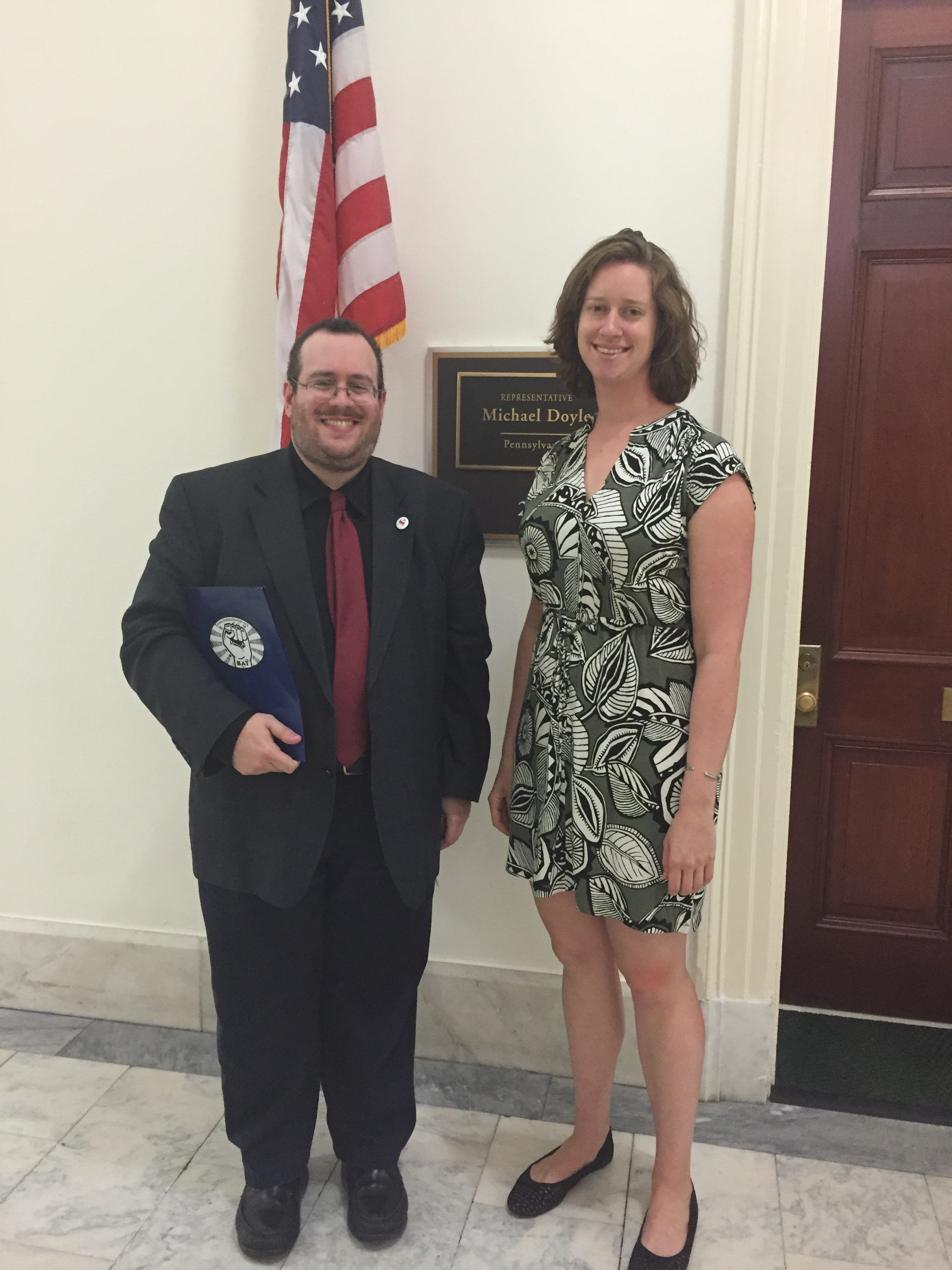
I met with Senators Pat Toomey (R-PA), Bob Casey (D-PA) and Corey Booker (D-NJ). I met with U.S. Reps Mike Doyle (D-PA) and Chris Smith (R-NJ).

Well, actually I met with their legislative aides.

None of the actual lawmakers made time to sit down with a flesh and blood teacher.

In one case, a legislator seemingly went out of his way to avoid me.

image

While sitting on the couch in Doyle’s office, he came out of a room to the left of me, asked his secretary for packing tape and then told her he was leaving for the day. It was 2:47 p.m. on Friday.

And they say teachers have easy hours!

I can’t say whether he was actively avoiding me. I made an appointment to see him, but it was never specified if I’d be meeting with him in person or if I’d be with his aide.

For all I know his staff never let him know I was a constituent sitting there on his couch in a suit and tie with a folder perched on my lap. But it didn’t feel good.

Maybe I should have said something. “Congressman Doyle! May I have a moment?”

But I frankly couldn’t believe this was happening. Moreover, he looks a lot different in a purple Hawaiian shirt than he does in all his press photos wearing a suit. I had to check his picture on my phone to make sure I was really seeing this correctly.

I was.

Still the meetings I had with these kids helping my legislators decide public policy were actually quite productive.

Without exception these youngsters were friendly, polite and knowledgeable. They seemed receptive to new ideas, were eager to hear my point of view, asked intelligent questions and were honest about where their bosses sometimes disagreed with me.

In Sen. Toomey’s office his assistants even asked if I was THAT Steven Singer.

“Who?” I said.

And they told me about a famous advertising campaign in eastern PA where a jeweler’s competitors are seen to complain “I HATE STEVEN SINGER.”

I laughed and told them it wasn’t me, but inside I wondered if that might explain the difficulty I had in some circumstances making these appointments. Maybe congressional staff thought I was pranking them. “Steven Singer wants an appointment!? Yeah! I’ll schedule it right after we see Mickey Mouse!”

image

I first met with Devorah Goldman, Toomey’s legislative correspondent on education and other issues. She’d only been on the job for about a year, but her qualifications included a degree in social work and she had worked in a public school resource center.

She was a very good listener. She heard me out as I spoke about a homeless student in my classes this year. She listened as I explained why Common Core is bad policy, why we need equitable school funding, an end to high stakes standardized tests, reigning in charter schools and voucher systems, and an end to judging teachers based on their students’ test scores.

Her boss isn’t exactly known as an education advocate. But she said he would agree with most of what I had said.

The main area of dispute would be charter schools. Toomey is in favor of expanding them so students can escape “failing schools.”

I explained that it was bad policy to try to save some students and let others fall behind. We need to make sure ALL our schools do an excellent job. Moreover, the Senator’s metric for determining which schools are failing is faulty at best.

I explained that traditional public schools often outperformed charter schools, which lack transparency and accountability and are wasting taxpayers dollars.

“We’ll just have to disagree on that point,” she said without explanation.

But she agreed to continue to take input from me and the BATS in the future.

image

At Doyle’s office, I eventually sat down with Hannah Malvin, a political science major who, at least, is from the Pittsburgh area – her boss’ legislative district.

She listened intently to my tales of education woe, even asking follow up questions. But she was surprised I supported the reauthorization of the Elementary and Secondary Education Act (ESEA).

Even the strongest supporters of the rewrite of the federal law that governs K-12 schools would admit it isn’t perfect. However, I would contend that the new version being cobbled together by the House and the Senate appears to be a slight improvement over what we have now – No Child Left Behind (NCLB).

Some educators think even this rewrite doesn’t go far enough to scale back standardized testing (and I sympathize but do not agree with that position). However, Malvin said Doyle had issues with it because it scaled back too much.

This was the issue I heard from Democrats all day. There isn’t enough accountability in the ESEA rewrite. How will we know which schools need extra help, they asked again-and-again.

I tried to explain that all they had to do was look at per-pupil spending. It’s no mystery which kids aren’t getting enough resources. It’s all right there on a ledger.

To her credit she heard me out and agreed to continue to dialogue with me on this subject in the future.

Next, I met up with some fellow teacher lobbyists from New Jersey and we dropped in unannounced on Booker’s office.

It’s not that we didn’t try to make an appointment. His staff never returned our calls and emails.

In fact, last week a fellow teacher not with us on Capitol Hill, Michele Miller,  even got into a scuffle with Booker on Twitter about elementary school funding. He told her to call his office and he would talk to her in detail.

To my knowledge, he never did. However, she was connected by phone to one of his aides. I’m told this is just modus operandi for Booker – strong talk in a public forum but shying away when the cameras aren’t rolling.

In any case, Booker’s senior education and health policy adviser Ashley Eden agreed to talk with us when we showed up to the office. Though her background isn’t in education, I can’t recall exactly what it is in. I do remember she has been doing this sort of legislative work for lawmakers for about 4 years – longer than any other aide we met.

She immediately made us feel welcome and found many areas of agreement. Bookers’ major point of contention – like fellow Democrat Doyle – was accountability.

How do we know which kids need help without giving them standardized tests?

Groan. But at least I had reinforcements: BATS Assistant Manager Melissa Tomlinson and retired NJ teacher extraordinaire Elizabeth DeMarco.
image

Perhaps the most telling moment of the entire conversation was when Eden said Booker just had to back standardized testing because every Civil Rights organization wanted it. She even criticized the New Jersey Education Association (NJEA) for not supporting black and brown students.

We stopped her right there. No. Every Civil Rights organization does NOT support testing. Journey for Justice – a coalition of 38 such organizations, in conjunction with 175 additional likeminded groups wrote to both the House and Senate asking to eliminate testing. Didn’t Sen. Booker see the letter?

Suddenly she remembered it.

She said she read it real quickly and didn’t like one sentence in it so she ignored it.

Which sentence?

Something about expecting poor and minority students to do badly on tests.

I explained that it has nothing to do with thinking these children can’t achieve at the same level as other children. It’s a matter of resources. If Sen. Booker was in a foot race against someone in a Monster Truck, I’d vote on the truck. Doesn’t mean Booker can’t run or that he might not even win. But the smart money is on Big Foot.

I joined the two ladies for their meeting with Smith as well.

His legislative assistant, Katherine Talalas, was perhaps the most knowledgeable aide with whom we talked. Her mother is a special education teacher, her brother is a paraprofessional working in a public school and she went to law school focusing on education issues.

She also took more written notes than any other assistant. With her nothing seemed canned. It was a real conversation about what her boss had done to help special education students and how he might continue to help in the future.

image

I was on my own again to meet with Sen. Casey’s aide, Jared Solomon.

This was one of the most fascinating and perplexing conversations I had all day.

He was warm, friendly, and had a depth of knowledge that was a bit more political than school-centered.

He agreed with almost everything I said. Casey supports 95% of the things that are important to me in education.

I could have smiled and walked away happy, but Solomon was so gregarious he kept talking. We shared our backgrounds.

He proudly admitted that he had been a Teach for America (TFA) recruit. He worked two years in a Baltimore public school and then left. He knew it wasn’t going to be his permanent job. He was emulating his parents who had joined the Peace Corps. He did TFA because he wanted the experience.

Then he moved to the administrative offices of Michelle Rhee’s Washington, D.C., Public Schools.

He only worked there two years – only one of which was under Rhee’s administration – but he respected what they had done. He said he disagreed with 80% of their policies and even quit because he was tired of being blamed for practices with which he didn’t agree. But, he added, the people in Rhee’s administration worked harder than anyone he knew, and he thought they really had the best interests of the kids at heart.

I’m tempted to chalk it up to the same feeling the incredible blogger Jennifer Berkshire (a.k.a. Edushyster) says she gets when she interviews many corporate school reformers. We may disagree with them, but they really do believe this stuff.

But something happened that doesn’t sit well with me. In an unguarded moment of a more than hour-long conversation, Solomon pulled the same stunt Eden did for Sen. Booker. He said all the Civil Rights groups were crying out for testing. But when I called him out on it, he immediately took it back. It was like he, too, knew this was untrue. It was a talking point, quickly to be conceded if called out and then move on to another argument.

I frankly don’t know what to make of it. The arguments are too similar among Democrats and Republicans to shrug off. Each is speaking from a party line script. That can’t just be a coincidence.

And why would Casey, a legislator who supposedly agrees with me 95% of the time on education, hire as his education expert someone who was actively involved in many of the practices that go directly against his beliefs? Why would someone like Solomon, who was part of the corporate education reform movement, really be on my side against these policies?

It’s befuddling to say the least.

Now that it’s all over, I’m so glad I did this.

Will this change the nation’s education policies? Probably not.

But I am only one of hundreds of people who climbed Capitol Hill in the last two days and met with more than 52 federal legislators to fight against the standardization and privatization of education.

And tomorrow we, BATS, will hold a Teachers Congress to further solidify our goals and decide where the great ship of real positive school change should go.

I am so looking forward to it.

But this teacher, soon-to-be BAT Congressman, needs to go to bed.

Here’s to a brilliant tomorrow for our children.


NOTE: This article also was published on the Badass Teachers Association blog.