Puerto Rico Teachers Plan One-Day Strike to Protest Corporate Education Reform

11214329_10153183230456981_1552435887463960982_n

Welcome to sunny Puerto Rico.

The ocean is a gorgeous cerulean blue. Palm trees wave gently in the salty breeze. And in the distance you can hear percussion, horns and singing.

The protest has begun.

12242864_10153398609583152_567773654_o

Residents of this United States territory have been fighting freshman Governor Alejandro García Padilla’s efforts to close public schools, privatize those left and shackle teachers to the same corporate education reform schemes that are crippling schools on the mainland.

This Tuesday island educators are asking parents not to send their children to school. Teachers plan to conduct a one-day strike to protest legislation that could be passed the same day to further cripple the Commonwealth’s public education system.

“On November 17th we’ll be giving our lesson’s outside our classrooms,” says Mercedes Martinez, president of the Federación de Maestros de Puerto Rico, the teachers union.

“We’ll be in front of our schools early in the morning and at 10:00 a.m. will march from Congress to the Governor’s Mansion in San Juan. This is one of many activities that we’ll perform in defense of public education. We will not accept these precarious impositions and will fight back.”

12212114_10153398609843152_2007230691_n

The protest is in response to Project 1456 which would close more than 380 public schools. The government has already closed 150 schools in the past 5 years.

This would force many students into even more overcrowded classrooms. Thousands of children would have to be relocated to schools far from their homes.

But that’s not all.

The proposed legislation would also privatize 15% of those schools left standing. Unlike the mainland, Puerto Rico has no charter schools. Teachers went on a 10-day strike in 2008 which only ended after the island Secretary of Education Rafael Aragunde signed an agreement promising not to open any charters.

12226476_10153398609693152_1059022729_n

If privatized schools opened on the island, parents might have to pay an additional fee for services they now enjoy for free. Amenities like lunches and even tuition may have to be subsidized by parents out of pocket.

Moreover, it would collapse the teachers retirement system, Martinez says. Charter schools would not deduct employees payments to the pension system so it might not be able to remain solvent.

Project 1456 would harm teachers in another way, too. It would enact a punitive evaluation system where 20% of educators value would be based on students standardized test scores. Any teacher with a 79% or less would have two years to improve or be fired.

“Teachers will have no rights,” Martinez says.

12231352_10153398610428152_1685357633_n

The proposed legislation has already been approved by the Commonwealth Senate. It’s main author Sen. Eduardo Bhatia is pushing for the House to fast track it for approval.

Discussions began in the House last week.

Protesters were there on Wednesday. They stood up in the government chamber and walked out en mass when it was brought up for discussion. Eighteen of them wore white T-shirts spelling out the message “Our Schools Are Not For Sale.”

12095142_10153786665063035_3426408204355682730_o

Inside the House, presidents of private universities testified in favor of the measure.

“Obviously they want to become administrators of charter schools on our island,” Martinez says.

Outside the building, protesters held their own emblematic hearing on the matter. Community members, teachers and parents testified in the open air about how this legislation would hurt children. They ended with a symbolic vote against it.

12233087_10153398610653152_624717262_n
Puerto Ricans are not alone in this fight.

Jitu Brown, a community organizer from Chicago and Director of Journey for Justice Alliance traveled there to stand in solidarity with those fighting for their schools. Brown participated in a 34-day hunger strike in his hometown a month ago to protest Mayor Rahm Emanuel’s plan to close the last open enrollment school in his neighborhood.

“This beautiful, breathtaking place is marred by ugly U.S colonialism and privatization of public services on steroids!” says Brown of Puerto Rico.

“I was blessed to spend time with powerful people fighting for a better world. Big ups to your warrior spirit, discipline and hospitality! Where we struggle, we can win! If we don’t struggle, we are guaranteed to lose.”

12243064_10153183230516981_9040874307608479627_n

The plight of Puerto Rican communities also inspired support from the Badass Teachers Association, a group of more than 56,000 educators, parents, students and activists.

“The Badass Teachers Association stands in strong solidarity with our brothers and sisters in Puerto Rico who are fighting for the very foundation of their democracy – the survival of their public school system which is under assault by the 1% who seek to close it up and deny Puerto Rican children a right to an education,” says Executive Director Marla Kilfoyle.

Protesters are getting the word out. They’ve already handed out thousands of fliers. Today they plan to drive in a large caravan across the island.

“We’ve got a bunch of cars with sound equipment,” Martinez says.

“We will go to all the communities near our schools in different regions asking parents to support the strike on the 17th.”

12233347_10153398610098152_2099123130_n

Much of the the island’s financial woes are imported from the mainland. Puerto Rico is besieged by vulture capitalists encouraging damaging rewrites to the tax code while buying and selling the territory’s debt.

Hundreds of American private equity moguls and entrepreneurs are using the Commonwealth as a tax haven.

As a result, tax revenues to fund public goods like education are drying up while the super rich rake in profits.

Officials warn the government may be out of money to pay its bills by as early as 2016. Over the next five years, it may have to close nearly 600 more schools – almost half of the remaining facilities!

12208352_10153183230836981_3863947130415132926_n

“That’s why the Teacher’s Federation and other teacher unions allied together to fight back against the attack on our education system,” Martinez says.

“As you can see, we’ve been busy.”

If Project 1456 is passed by the House, the union is considering a general strike.

12268501_10153398610318152_1824591574_o

Of the 135 schools closed in just the last two years, Commonwealth Secretary of Education Rafael Román had originally proposed shuttering 200. The remaining 65 were only kept alive because communities occupied the buildings and refused to let the government step in.

Protesters stormed the Senate in October when Bhatia first introduced Project 1456.

“Senators decided to approve it without discussion because they did not want to listen to teachers chants and indignation,” says Martinez.

“Senator Bhatia has become the symbol for privatization under this administration. He has never been in a public School. He has no bond with it. He’s a demagogue.”


NOTE: This article also was published on the Badass Teachers Association blog.


Rick Smith – Smuggling Teachers Voices Through the Media Embargo

FullSizeRender

I met Rick Smith for the first time in person this summer in Washington, D.C.

He had traveled to our nation’s capital to cover the Badass Teachers Association (BATs) Congress of which I was a member. Though I’d seen pictures and videos of him and even been on his daily radio show a handful of times, I was surprised to see him standing there in the lobby. He looked exactly like his pictures.

Often when you meet someone like that in the flesh, you get a glimpse behind the mask at how much the persona differs from the person. For example, when I was a journalist and interviewed Marvin Hamlisch, he was much more the cranky old man than the consummate showman.

But Rick was just… Rick. Faded denim, golf shirt, tousled hair under a ball cap.

He treated me to breakfast in the hotel restaurant and we talked about politics, activism and education. In a way it was like being on his show except there was no audience. Maybe he didn’t speak as loud and didn’t feel the need to explain the background of a subject for listeners at home, no station identification, but other than that it was pretty much the same.

He’s the real deal. What you see – or usually hear – is what you get.

I remember thanking him for trucking all the way from northern Pennsylvania to be here with us. He wasn’t getting anything extra for this. We certainly didn’t have any money to pay him. Rick was actually interested in hearing what teachers like me had to say.

We had congregated here in the capital to lobby our lawmakers and discuss among ourselves how to change our national education policy into something more student centered and less privatized, corporatized and standardized. And Rick wanted to showcase it on his show. He wanted to be there, to see what we were doing, ask us questions and put it all on the air for listeners across the country.

And – of course – he bought me breakfast.

As I was making my way through a waffle, Rick dropped the bomb on me.

He wanted to know if there was more to this story – if there was enough information for a weekly radio segment.

I carefully swallowed and told him that there was.

We’re living at a time when what’s best for school children isn’t decided by parents or educators. It’s decided by lawmakers, policy wonks, billionaire philanthropists and corporate CEOs with oodles of cash to bribe others to see things their way. Teachers, parents and students are taking to the streets to protest high stakes standardized tests, Common Core, value-added evaluations, charter schools, Teach for America and a host of other corporate education reform policies.

But few in the media seem to be listening.

In the last year, only nine percent of guests discussing education on evening cable news were educators. Yet tech millionaires attempts to dismantle teacher tenure are championed by the likes of Time Magazine. Former CNN anchor Campbell Brown creates a so-called “non-partisan” news site to cheerlead privatization and demonize teachers. At the Republican Presidential debates, candidates fall over each other for the chance to “punch teachers in the face,” while the Democratic Presidential candidates have zero to say about K-12 schools.

And here’s a guy with his own radio show and podcast who is actually interested in what educators think!

We shook hands, made plans and another trip to the buffet.

Now it’s been a little more than two months since the “BATs Radio – This Week in Education” segment premiered. Every week – usually airing Mondays at 5 p.m. Eastern – Rick has two guests chosen by the BATs. And wow! Have we had some amazing interviews!

When the National Education Association (NEA) made the controversial move to endorse Hillary Clinton despite a lack of member outreach, we had history teacher and NEA Board of Directors member Tripp Jeffers on the show. Before the vote, Tripp asked Clinton about her ties to corporate education reformers.

We had New York teacher and Co-Director of BATs Action Committee Michael Flanagan on to talk first hand about what a dismal job our new US Secretary of Education John King had done as Chancellor of New York State Education.

New Orleans parent Karran Harper Royal explained how the Obama administration’s privatization scheme has systematically destroyed public schools in the Big Easy. Wayne Au talked about what it was like to be one of the appellants in the Washington State Supreme Court Case that found charter schools to be unconstitutional. New York parent Karen Sprowal described how the Success Academy charter school had trampled her child’s rights. Jeanette Taylor-Ramann explained what pushed her and several other Chicago parents and teachers to go on a hunger strike to save their last neighborhood school. Puerto Rican teachers union president Mercedes Martinez informed us of the massive island revolt against privatizers in our US territory.

And more and more and more! And it’s only been 8 weeks!

I am so thankful to Rick for making this a reality. Teacher, parent and student voices are getting through the media embargo. We’re being heard. It’s unfiltered news! It’s what’s happening at street level.

This wouldn’t be getting out there so prominently if Rick weren’t interested, if he didn’t think it was something his listeners were interested in hearing. He gives up a significant chunk of his weekends to do it. He gives up time with his family, his children, to bring this to the public.

I can’t express how much that means to me and the more than 56,000 members of BATs.

I remember thanking Rick at the end of that first breakfast meeting and I’ll never forget what he said.

“This is what we do, Steven,” he said. “We’re activists first.”

That’s why Rick Smith is a true progressive hero.


NOTE:

You can hear the BATs Radio – This Week in Education segment most Mondays at 5 p.m. Eastern on the Rick Smith Show. The entire progressive talk show airs weekdays from 3 – 6 p.m. on several radio stations and on-line.

All BATs Radio interviews are archived here in case you missed them.

There are also a plethora of fascinating interviews from the BAT Congress on the Rick Smith Show Website.

This article also was published on the Badass Teachers Association blog.

Did AFT Rank and File REALLY Endorse Hillary Clinton for President? If So, Release the Raw Data

uptown-hillary-clinton

I have nothing against Hillary Clinton.

Heck! I might even vote for her in the coming Presidential race. Maybe…

But the American Federation of Teachers (AFT) endorsement of the former First Lady is strange in many ways.

First, it’s awfully early. The initial Democratic primaries aren’t scheduled for half a year yet – February of 2016 to be exact. And the general election isn’t until Nov. 8, 2016 – more than a year away.

Second, the manner in which this endorsement was reached is somewhat mysterious.

This much seems certain:

1) The AFT executive board invited all of the candidates to meet with them and submit to an interview. No Republican candidates responded.

2) Democrats including Bernie Sanders, Martin O’Malley and Clinton were interviewed in private.

3) The executive committee voted to endorse Clinton.

4) NOW the interviews are scheduled to be released to the public.

This is a perplexing timetable. Why would the AFT endorse BEFORE releasing the interviews? Ostensibly, the executive council used these interviews to help make its decision. Shouldn’t that same information have been available to rank and file members of the union before an endorsement was made?

Which brings up another question: were AFT members asked AT ALL about who to endorse before the executive council made the final decision?

According to the AFT press release, they were:

The AFT has conducted a long, deliberative process to assess which candidate would best champion the issues of importance to our members, their families and communities. Members have been engaged online, through the “You Decide” website, through several telephone town halls, and through multiple surveys—reaching more than 1 million members.

Additionally, over the past few weeks, the AFT has conducted a scientific poll of our membership on the candidates and key issues. The top issues members raised were jobs and the economy and public education. Seventy-nine percent of our members who vote in Democratic primaries said we should endorse a candidate. And by more than a 3-to-1 margin, these members said the AFT should endorse Clinton.

So the AFT claims union members said to endorse Clinton on-line, on telephone town halls, surveys and a scientific poll of membership.

But did they really?

Clinton may be the Democratic frontrunner, but she isn’t a favorite for a lot of teachers. Chiefly this is because her education positions are not that great. Sure, she’s better than every Republican running so far. But she has stiff competition in the Democratic field – especially from Sanders.

If Clinton had come out against Common Core, standardized testing and using student test scores to evaluate teachers effectiveness, I wouldn’t question the AFT’s endorsement at all. But she has been rather supportive of these issues – just like our current President, Barack Obama.

Teachers are fed up with Obama’s education policies. Why would they overwhelmingly endorse someone for President who seems bound and determined to continue them?

So I hope I’ll be excused if I ask for a bit more proof than a press release.

Where exactly are the polls, surveys, etc. that show the Clinton support AFT leadership claims?

For instance, which polls produced which results? The press release says AFT members prefer Clinton 3-1. But even if Clinton came out on top consistently, surely the results weren’t identical on every poll. Maybe she got 75% on one and 65% on another.

The AFT hasn’t released everything, but the organization’s website gives us a memo about ONE of these phone surveys. This national survey of membership planning to vote in Democratic primaries found 67% picked Clinton. However, only 1,150 members participated! That’s a far cry from the more than 1 million cited in the press release.

Moreover, there is no mention of what questions were asked. For instance, there is a world of difference between “Who would make the best President?” and “Who is most electable?” Is it possible there was selection bias present in the questions used to make this determination?

But that’s only one survey. Where is the rest of the data? Where is the raw information from this survey? Where is the data from all these other outreach attempts and on-line activities? How many took phone surveys? How many took on-line surveys? And what were the results in each case?

If union members really did endorse Clinton, that’s fine. But many of us would like to see the proof.

I’m not a member of the AFT, but I’m on the mailing list. I never received any survey.

A lot of my friends are AFT members, but none of them recall any survey.

As a member of numerous education and teaching groups, I know of no one else who admits to being polled either. In fact, I haven’t been able to find ANYONE who was polled on this issue!

I admit that’s not exactly scientific. But that’s why I want to see the data! Blind me with science, AFT!

I believe in teachers. I believe in Unions. I believe in Democracy.

Please release the raw data, AFT, so I can believe in this endorsement, too.


NOTE: This article also was published on the Badass Teachers Association blog.

Pennsylvania GOP Lawmakers Demand Seniority For Themselves But Deny It For Teachers

Screen shot 2015-06-25 at 12.43.45 AM

Seniority.

Somehow it’s great for legislators, but really bad for people like public school teachers.

At least that was the decision made by Republican lawmakers in the Pennsylvania House Tuesday. They voted along party lines to allow schools to furlough educators without considering seniority.

But the House’s own leadership structure is largely based on seniority!

Hypocrisy much?

Most legislative bodies in the United States from the federal government on down to the state level give extra power to lawmakers based on how long they’ve been there.

Everything from preferential treatment for committee assignments to better office space and even seating closer to the front of the assembly is often based on seniority. Leadership positions are usually voted on, but both Republicans and Democrats traditionally give these positions to the most senior members.

And these same folks have the audacity to look down their noses at public school teachers for valuing the same thing!?

As Philadelphia Representative James Roebuck, ranking Democrat on the House Education Committee, said, “If it’s wrong for teachers, why is it right for us?”

If passed by the state Senate and signed by the Governor, the law would allow public schools to lay off teachers based on the state’s new and highly controversial teacher evaluation system.

Teachers with a “failing” ranking would go first, then those with a “needs Improvement,” label.

This system is largely untested and relies heavily on student standardized test scores. There is no evidence it fairly evaluates teachers, and lawsuits certainly would be in the wings if furloughs were made based on such a flimsy excuse.

Value-Added Measures such as these have routinely been criticized by statisticians as “junk science.”

It’s kind of like giving legal favor to the management practices of Darth Vader. In “The Empire Strikes Back,” when one of his minions displeased him, he choked them to death with the Force.

No second chances. No retraining. No due process. One misplaced foot and you’re gone.

Pennsylvania’s proposed method isn’t quite so harsh, but it’s essentially the same. You’re fired because of this flimsy teaching evaluation that has no validity and can really say whatever management wants it to say.

Technically, things like salary are not allowed to be considered, but given the unscientific and unproven nature of this evaluation system, management could massage evaluations to say anything. Administrators didn’t mean to fire the teachers with the highest salaries but those voodoo teaching evaluations said they were “failing.” What are you gonna’ do? OFF WITH THEIR HEADS!

While seniority is not a perfect means of selecting who gets laid off, at least it’s impartial. Moreover, teachers who have lasted in the classroom longest almost always are highly skilled. You don’t last in the classroom if you can’t hack it.

Being a public school teacher is a highly political job. Your boss is the school board and members are elected by the community. While many school directors have the best interests of their districts at heart, favoritism, nepotism and political agendas are not unknown. Teachers need protections from the ill-winds of politics so they can be treated fairly and best serve their students. Otherwise, it would be impossible – for instance – to fairly grade a school director’s child in your class without fear of reprisal.

As it stands, state school code specifically mandates layoffs to be made in reverse seniority order, also known as “first in, last out.” Pennsylvania is one of six states that calls for this to be the sole factor in school layoff decisions.

It’s unclear how the legislature could pass a law that contradicts the school code without specifically voting to alter the code which governs the Commonwealth’s public schools.

Moreover, it may be illegal on several additional counts. Public school districts have work contracts with their teachers unions. The state can’t jump in and void those contracts between two independent parties when both agreed to the terms of those contracts. Not unless there was some legal precedent or unconstitutionality or violation of human rights or SOMETHING!

Get our your pocketbooks, Pennsylvanians. If this law is somehow enacted, you’re going to be paying for years of court challenges.

And speaking of flushing money down the toilet, the law also allows school districts to furlough employees for financial reasons. At present, layoffs are allowed only when enrollment drops or by cutting programs wholesale.

This is especially troubling given the legislature’s failure the past four years to fairly fund its public schools. Ninety percent of school districts have had to cut staff in recent years, either through attrition or furlough, according to the Pennsylvania Association of School Administrators.

So this law makes it easier to rob poorer schools of funding. If it were enacted, districts could fire teachers and reduce programs to pinch pennies. Now they are constrained to keep the highest possible level of quality for students regardless of funding shortfalls. This puts them at odds with the legislature and forces them to demand fair funding for their districts. Under this new law, school boards could more easily ensure that some students get a higher quality education than others in the same district!

Oh! We increased class size for the struggling students (most of whom are poor and minorities) but decreased it for the advanced classes (most of whom are rich and white).

Finally, we get to the issue of viability. Will the state Senate pass this bill?

Maybe.

The House passed it without a single Democrat voting in favor. The Senate is likewise controlled by the GOP. However, Gov. Tom Wolf is a Democrat and has said he’s against it. Seniority issues, he said, should be negotiated through the local collective bargaining process.

So once again we have partisan politics reigning over our public schools – Republicans actively trying to sabotage our public schools and fire their way to the top! Democrats vainly trying to hold the line.

Couldn’t we all just agree to value our public schools and public school teachers?

Or at very least couldn’t we all agree to give others the same benefits we demand for ourselves?

You know. Things like seniority!

The Only Teaching Evaluation That Matters

Screen shot 2015-06-12 at 10.40.16 PM

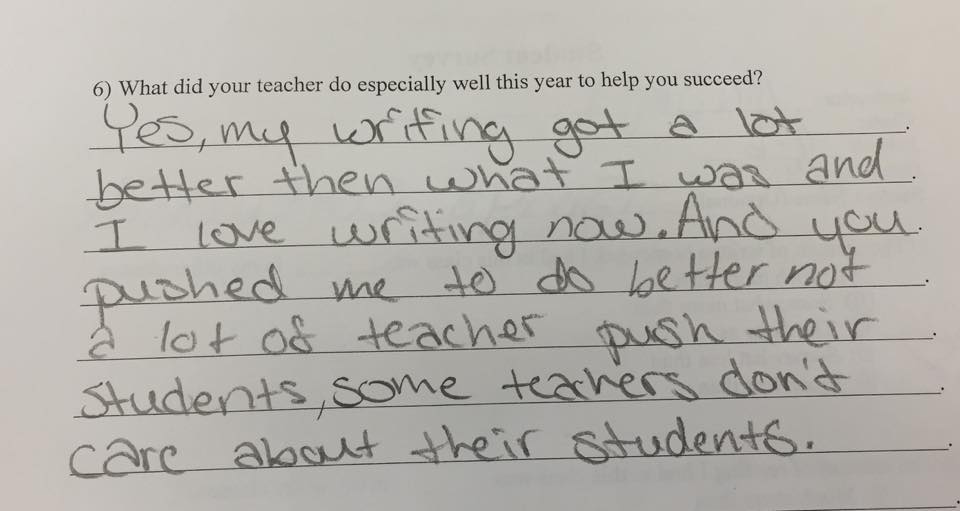
“Yes, my writing got a lot better than what I was, and I love writing now. And you pushed me to do better. Not a lot of teachers push their students, some teachers don’t care about their students.”

11280008_10153046535243860_104612156_n

One of my 8th graders wrote that to me on the last day of school.

I had asked her class to fill out an anonymous survey about my teaching. I said that all year I get to grade THEM, but this was their chance to grade ME.

I made sure to explain that they didn’t need to put their names on it. This would not be graded. Spelling and grammar didn’t count. The only thing I wanted was honesty.

I told them I wouldn’t personally collect the surveys. They should NOT hand them to me; they should put them in a pile on the desk by the door when they leave. I promised I wouldn’t even look at what they’d written until class was over. That way they could feel free to write whatever they wanted. If I did something bad or there was some way I could improve, I wanted them to tell me. If I did something exceptionally well, they should tell me that, too.

“Please help me become a better teacher,” I said.

As an 8th grade public school educator, I get evaluated a lot. I’ve spent countless hours gathering evidence that I’m “proficient” at my job.

I’ve had to endure formal observations, informal observations, H.E.A.T. observations, Student Learning Objectives (SLOs), written explanations of specific lessons with appeals to which Common Core standards I would be teaching – and there always seems to be a new one added to this list next year.

But I’ve been giving a version of this simple student survey to my classes on the last day of school for over a decade.

It’s not something I’m required to do. I don’t share the results with administration. The responses don’t go on file, increase my pay or get recorded in the newspaper. They don’t become part of the district’s ranking in the Business Times. No one is going to withhold funding from my district or close my building and convert it into a charter school based on these results. No one ever will be on television decrying the state of public education referencing these surveys. They are low stakes, class-based, teacher-centered and personal.

But I do this because I think it actually gives me useful information. I really want to know what my students think. That’s one of the things that truly drives my instruction. Not politically motivated standards monetarily incentivized and adopted before they were even completely written. Not standardized tests that measure little more than parental income. Not the latest fad handed down by the superintendent. Not a threat shouted at us through an email or at a faculty meeting.

No. I’m motivated by my kids in the classroom and the answer to the question, “Have I helped you learn?”

The survey is quite simple really. It’s two-sided.

On the front page are 5 multiple choice questions:

1) The amount of written homework I had in this class was                             in my other classes.

A) much more than
B) Somewhat more than
C) The same as
D) Somewhat less than
E) Much less than

2) The amount of reading I had in this class was                                in my other classes.

A) much more than
B) Somewhat more than
C) The same as
D) Somewhat less than
E) Much less than

3) The amount of studying I did for this class was                                 in my other classes.

A) much more than
B) Somewhat more than
C) The same as
D) Somewhat less than
E) Much less than

4) I received                                    instruction and comments on my written work.

A) much more than enough
B) Somewhat more than enough
C) Just enough
D) Somewhat less than enough
E) Much less than enough

5) In this class, I learned                                         in my other classes.

A) much more than
B) Somewhat more than
C) The same as
D) Somewhat less than
E) Much less than

When it comes to homework, students almost always say I give too much. The majority (68%) gave me an A or B.

I only require about an hour of extra-class work a week. I don’t think that’s too bad. However, many teachers give less or none. I go back and forth on the value of homework, myself, but I know that once my students get to 9th grade, they’ll have a tremendous load of it. I figure if I don’t prepare them for that, I’m doing them a disservice. So an avalanche of (one hour a week) homework it remains.

Likewise, kids often say I give a lot of reading. A language arts class should give a substantial amount of reading. So I’m glad most kids (69%) give me an A or B. I require my students to read one self-selected book a month. I don’t think that’s too burdensome. If the book is too tough or boring – hey! You picked it! Pick another one. I also provide them with 15 minutes per day to read in class.

Studying is not something I emphasize. But students are almost evenly divided whether I require too much, just enough or too little. I’m not big on having kids memorize something and then regurgitate that on a test. I’d rather spend time getting them to take good notes that they can use on the test. I’m a big fan of open notes or open book tests. But I hardly ever use the word “Test.” I give frequent short quizzes. I think tests (and even quizzes) are limited evaluation tools. I’d much rather assign a multi-day project. That tells me much more than a brief snapshot of what students were thinking at any one given point in time.

I do assign a lot of essays so I’m always anxious to know if I’ve given enough written feedback. The research seems to show that if you mark every error on an essay, you get diminishing returns. You discourage students. So instead I try to focus on a few trouble areas we’ve already discussed per essay. And students seem to appreciate it. Most of my kids (85%) gave me an A or B or C in this area.

Then comes the cumulative question. How much did you learn? I used to have my classes assign me a letter grade A-E. However, answers were all over the place. When I compared the results with surveys from students who had revealed their identities, I found that kids usually gave me the same grade they received in my class. A-students gave me As. C-students gave me Cs, and so on.

When I changed the question to “how much have you learned?” the results changed drastically. Most students (84%) gave me an A or B. Yes, that’s the result I’m aiming for, but I think it’s a more honest answer, too. It doesn’t focus on grades. It focuses on each child’s assessment of his or her own progress. That’s really what I want to know.

But this side of the survey still provides very limited answers. It is multiple choice, after all. It’s useful for a brief overview but not very deep.

The second side of my questionnaire only has two open-ended queries. Students can write as much or as little as they want to the following questions:

6) What did your teacher do especially well this year to help you succeed?

7) In what areas can your teacher improve his/her instruction?

To be honest, when looking at the surveys, I usually skip right to these questions. This is what I want to see – not a bunch of alphabet soup. I want to know what they really think.

What have I done well? Here are some answers from this year’s kids:

-He understood the learning abilities of certain students and helped them to the best of his ability.

11122062_10153046535213860_65835541_n

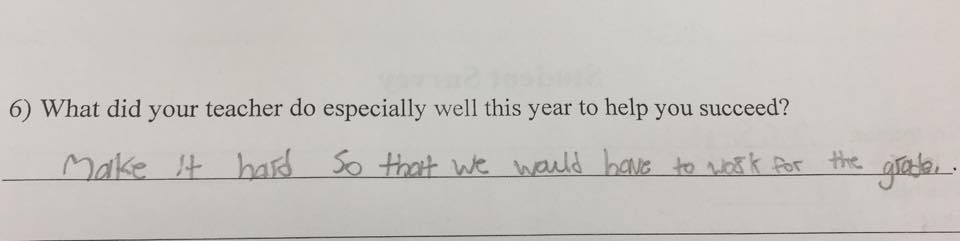
-You made it hard so that we would have to work for the grade.

11208874_10153046535223860_1052817053_n

-Before we could ask him for help, he asked us if we needed help. He’d help everyone, even the person who didn’t ask for it.

11310977_10153046535218860_807785160_n

-He was really good at explaining and pushed me to never give up. Therefore, Mr. Singer is one of my favorite teachers.

11329696_10153046535238860_1253356423_n

-Well, I didn’t like as much work as he was giving us, but then I understood he was trying to help us with our grades and trying to make our grades higher.

11348779_10153046535183860_857789294_n

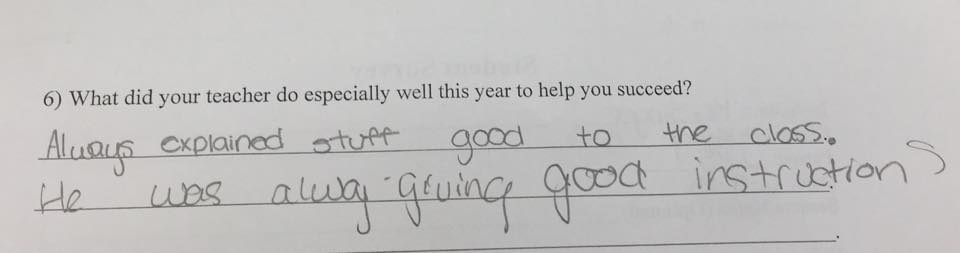
-Always explained stuff good in class. He was always giving good instructions.

11358887_10153046535198860_689871876_n

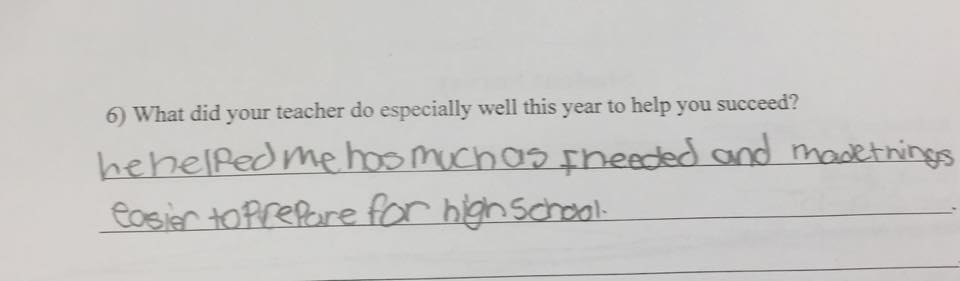
-He helped me as much as I needed and made things easier to prepare for high school.

11418417_10153046535203860_1321510136_n

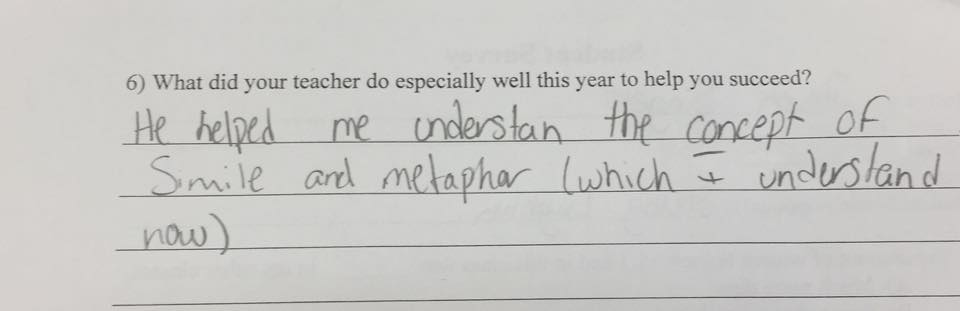
-He helped me understand the concept of simile and metaphor (which I understand now)

11420058_10153046535208860_229100346_n
-What my teacher especially helped me do to succeed is writing essays.

FullSizeRender

I was just floored by these responses. Talk about data I can use! But there was one answer that stood out above even these:

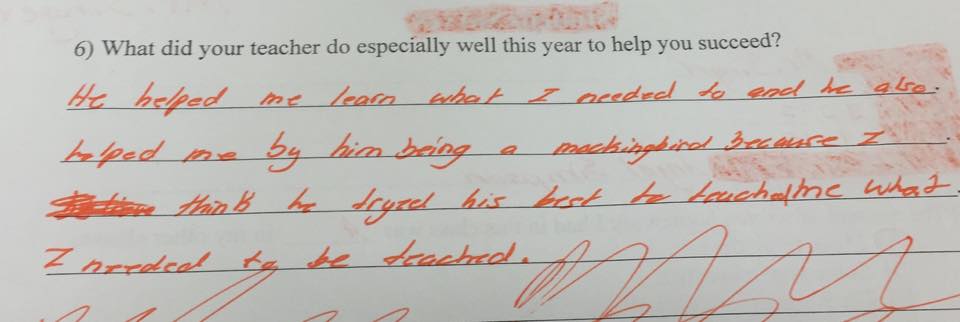
-He helped me learn what I needed to do and he helped me by being a mockingbird because I think he tried his best to teach me what I needed to be taught.

11280625_10153046535248860_1666870003_n

No, she wasn’t literally calling me a bird. She was relating me to our last novel – To Kill a Mockingbird. In the text, some characters are innocent victims. They try to help others but come under fire because of it. The author, Harper Lee, symbolizes them as “mockingbirds.” These include: Tom Robinson, the black man wrongly accused of rape; Atticus Finch, the lawyer standing up for a fair trial despite social criticism; Arthur “Boo” Radely, the recluse who saved lives at the expense of his privacy.

And here my sweet little student was including ME in this venerable list!

That choked me up a bit I can tell you.

When it comes to areas for improvement, my students aren’t the most forthcoming. Answers include:

-I don’t think he needs to because he already does his best to teach us kids what we need to be taught and his instruction is easy to understand.

11418657_10153046535193860_238476660_n
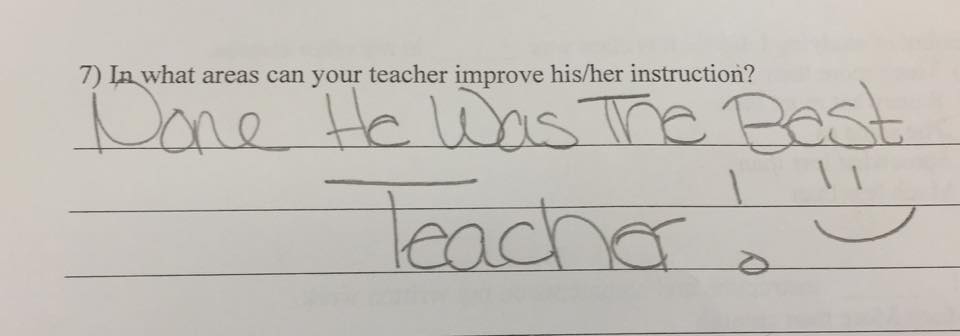
-None. He was the best teacher! 🙂

11419982_10153046535228860_393598543_n

I appreciate the approbation but I wouldn’t mind constructive criticism. I do get complaints about the amount of homework and writing I assign. I also get requests for more free time.

I think if I wasn’t in the room when students took the survey, I might get more criticism. Ideally, I would leave the room for the last 15 minutes of the class, and kids could fill out their surveys. However, this is impractical. I don’t see how I could arrange it given the current climate, lack of subs and skeleton crew staff.

These surveys have given me much to think about over the summer. Maybe I should try to include more group work in next year’s class. Maybe I should revisit the homework situation.

But as June turns to July and then August, I know I’ll be thinking about all that happened this school year.

Some kids came in and out of shelters and juvenile detention. Some were present at a shooting at the local mall. Parents and I had to fight administration over valuing standardized test scores over classroom grades for student placement. The School board enacted a pointless student uniform policy. Students were demoralized and angry over national racial tensions involving Michael Brown, Eric Garner and the Baltimore uprising. Teachers had an active shooter drill for the first time as part of our professional development.

But most of all I’ll think about my students – well, no longer mine – off to the high school and bigger, better things.

For a brief moment I was an important part of their lives and they were an important part of mine. I’ll forget their names. (It’s like my mind is making space for the new ones I’ll have to learn.) But I’ll never forget their struggles and triumphs.

It’s easy to lose sight with all the privatizers and standardizers trying to dismantle our public schools. But even with all the political nonsense, selfishness and small-mindedness, teaching is the best job in the world.

Yes, it really is!

Every day I get a chance to positively impact dozens of lives!

I am truly blessed.

That’s what these surveys tell me.

And that’s why they’re the only evaluation that really matters.


NOTE: Here is a copy of the survey I use in class.

Student Survey

-This article also was published on the Badass Teachers Association blog.

Data Abuse – When Transient Kids Fall Through the Cracks of Crunched Numbers

Screen shot 2015-05-16 at 9.13.34 AM

I was teaching my classes.

I was grading assignments.

I was procrastinating.

I should have been working on my class rosters.

My principals wanted me to calculate percentages for every student I had taught that year and submit them to the state.

How long had each student been in my grade book? What percentage of the year was each learner in my class before they took their standardized tests?

If I didn’t accurately calculate this in the next few days, the class list generated by the computer would become final, and my evaluation would be affected.

But there I was standing before my students doing nothing of any real value – teaching.

I was instructing them in the mysteries of subject-verb agreement. We were designing posters about the Civil Rights movement. I was evaluating their work and making phone calls home.

You know – goofing off.

I must not have been the only one. Kids took a half-day and the district let us use in-service time to crunch our numbers.

Don’t get me wrong. We weren’t left to the wolves. Administrators were very helpful gathering data, researching exact dates for students entering the building and/or transferring schools. Just as required by the Commonwealth of Pennsylvania.

But it was in the heat of all this numerological chaos that I saw something in the numbers no one else seemed to be looking for.

Many of my students are transients. An alarming number of my kids haven’t been in my class the entire year. They either transferred in from another school, transferred out, or moved into my class from another one.

A few had moved from my academic level course to the honors level Language Arts class. Many more had transferred in from special education courses.

In total, these students make up 44% of my roster.

“Isn’t that significant?” I wondered.

I poked my head in to another teacher’s room.

“How many transient students are on your roster?” I asked.

She told me. I went around from room-to-room asking the same question and comparing the answers.

A trend emerged.

Most teachers who presided over lower level classes (like me) had about the same percentage of transients – approximately 40%. Teachers who taught the advanced levels had a much lower amount – 10% or below.

Doesn’t that mean something?

Imagine if you were giving someone simple instructions. Let’s say you were trying to tell someone how to make a peanut butter and jelly sandwich. But in the middle of your instruction, a student has to leave the room and go right next door where someone is already in the middle of trying to explain how to do the same thing.

Wouldn’t that affect how well a student learned?

If someone was trying to give me directions how to get somewhere under those circumstances, I’m willing to bet I’d get lost.

And this assumes the break between Teacher A and Teacher B is minimal, the instruction is disrupted at the same point and both teachers are even giving instruction on the exact same topics.

None of that is usually true.

I did some more digging. Across the entire building, 20% of our students left the district in the course of this school year. About 17% entered mid-year. So at least 37% of our students were transients. That’s 130 children.

The trend holds district wide. Some schools have more or less transients, but across the board 35% – 40% of our students pop in and out over the year.

Taking an even broader view, student mobility is a national problem. Certainly the percentage of student transience varies from district to district, but it is generally widespread.

Nationally, about 13 percent of students change schools four or more times between kindergarten and eighth grade, according to a 2010 Government Accountability Office analysis. One-third of fourth graders, 19 percent of eighth graders, and 10 percent of twelfth graders changed schools at least once over two years, according to the 1998 National Assessment of Educational Progress (NEAP).

And it gets worse if we look at it over a student’s entire elementary or secondary career. In fact, more students moved than remained in a single school, according to a national longitudinal study of eighth graders.

This problem is even more widespread among poor and minority students. The type of school is also a factor. Large, predominantly minority, urban school districts attract the most student mobility. In Chicago public schools, for instance, only about 47 percent of students remained in the same school over a four-year period. Fifteen percent of the schools lost at least 30 percent of their students in only one year.

And this has adverse affects on children both academically and psychologically.

Several studies at both the elementary and secondary levels conclude student mobility decreases test scores and increases the drop out rate.

A 1990s Baltimore study found, “each additional move” was associated with a .11 standard deviation in reading achievement. A similar 1990s Chicago study concluded that students with four or more moves had a .39 standard deviation. Highly mobile students were as much as four months behind their peers academically in fourth grade and as much as a full year behind by sixth grade, according to a 1993 Chicago study by David Kerbow.

It just makes sense. These students have to cope with starting over – fitting in to a new environment. They have to adjust to new peers and social requirements.

Moreover, transients have an increased likelihood of misbehaving and participating in violence. After all, it’s easier to act out in front of strangers.

What causes this problem? Most often it is due to parental job insecurity.

Parents can’t keep employment or jobs dry up resulting in the need to move on to greener pastures.

In my own district, one municipality we serve is mostly made up of low-cost housing, apartments and slums. It is a beacon  for mobility. Few people who haven’t lived here their whole lives put down roots. We’re just another stop on a long and winding road.

“We should be doing something about this,” I thought.

Our legislators should help promote job security. We should make it easier to afford quality housing. We should try to encourage new-comers to become part of the community instead of remain eternal outsiders.

At our schools, we need resources to help this population make the necessary adjustments. We should encourage them to participate in extra-curricular activities, provide counseling and wraparound services.

But we don’t do any of that.

Instead, we gather mountains of data.

We sort and sift, enter it into a computer and press “submit.”

And off it goes to the Pennsylvania Value Added Assessment System (PVAAS).

We don’t use it to help kids.

We use it to blame school teachers for things beyond their control.

Data has value but that doesn’t mean all data is valuable.

We need to know what we’re looking for, what it means and how to use it to make our world a better place.

Otherwise it’s just a waste of precious class time.

And an excuse to continue ignoring all the children who fall through the cracks.


NOTE: This article also was published on the LA School Report and the Badass Teachers Association blog.
It’s Not Nothing: Why I Support the ‘Every Child Achieves Act’

not-perfect1

No more federal intervention.

No more reducing schools to a number.

That’s the promise of the Every Child Achieves Act (ECAA).

Sure, it’s not perfect. But this Senate proposed rewrite of the Elementary and Secondary Education Act (ESEA) could do a lot of good – even if it includes some bad.

Imagine it.

States would be in control of their own public schools. The U.S. Department of Education and its appointed Secretary would lose much of their power to impose unfunded federal mandates.

For example, the federal government could no longer force states to tie teacher evaluations to student test scores. It could no longer force states to adopt Common Core or Common Core look-a-like standards. It could no longer label high poverty schools “Failing” and then demand they be closed.

That’s not nothing.

But to realize these goals, we may have to compromise.

This federal law (currently known as No Child Left Behind) governs K-12 public schools. It has to be reauthorized.

We tried in 2007, but no one could agree. So the Obama administration took over – offering states a waiver from the worst consequences of the current disastrous law if they just doubled down on those same failing policies.

The result? Seven years of continued educational failure. Policies to privatize, punish the poor and enrich profiteers.

And now we have another chance to reauthorize the law!

We can change course! We can right the ship! We can get our heads out of our collective asses and actually do what’s right for our children!

But this is politics. It’s never that simple.

We have a divided Congress. We have a President who never met a corporate school reform scheme he didn’t like.

But we also have a citizenry who is fed up with all the bullshit. People are demanding change.

We have a real opportunity. If we can seal the deal, a generation of children will be the better for it. If not, the current calamitous law will stay in place for at least 7 more years.

That’s just unacceptable.

The biggest flaw in this proposed act is that it keeps annual testing in place. If approved in its current form, public schools would still have to give standardized tests to children in grades 3-8 and once in high school.

If you’re like me, you just threw up in your mouth a little bit.

However, supporting ECAA doesn’t have to mean supporting testing. There is an amendment proposed by Senator Jon Tester (D-Montana) that would replace annual testing with assessments only once at the elementary, middle and high school levels.

Yes. It’s not enough. We really should have zero standardized tests in our schools. If we have to accept Grade Span Testing – as Tester’s proposal is called – it should be done by a random sample. Don’t test all kids. Just test some small group and extrapolate their scores to the whole.

But Tester’s amendment is not nothing.

Even if it weren’t approved – even if all schools are mandated to continue annual testing as is – the ECAA requires no minimum length for those tests.

How many questions do we need to have on our exams? How many sections? Right now, most states have three sections in both Reading and Math of around 30-40 questions each.

If I’m reading this correctly, it’s conceivable that states that disagree with standardized testing could give assessments of only one section with only one question.

Talk about opting out!

That’s not nothing.

Moreover, the proposed law does not require states to continue evaluating teachers based on student test scores. States are free to stop using the same junk science evaluations currently championed by U.S. Secretary of Education Arne Duncan or not. It’s totally up to the states.

That’s not nothing.

If the proposed act were passed, Common Core State Standards (CCSS) would lose much of their backing.

We all know the sad story of how these supposedly “state” standards were pushed on states from the federal government. We know how states were bribed with federal money to enact these standards before many of them had even finished being written. We know how the U.S. Department of Education has required states to either adopt CCSS or come up with their own academic standards. Moreover, any state that decides to go its own way and write its own standards must then have these standards approved by the federal government, thereby ensuring that regardless of the name you slap on them, they are usually Common Core lite.

However, the ACAA removes the requirement that state standards need federal approval. Therefore, it allows states to actually lead their own quest for real, consequential standards. They no longer have to follow in the footsteps of CCSS. They can set their own agenda.

That’s not nothing.

The proposed act also improves the situation for at risk students. It would establish appropriate class size, specifically in low-income areas. It would give clear/expanded rights to homeless children so they could continue attending their original schools. It would allow English Language Learners to appropriately remain in their classes longer. It would continue Head Start and Early Start programs. It would provide adequate support for gifted and talented students. It would add early intervention services and support early childhood programs.

That’s not nothing.

But the ACAA isn’t the only version of the rewrite being considered. The House has it’s own version called HR 5 or the Student Success Act (SSA).

The biggest difference between the two is Title I Portability – the House version allows it, the Senate one does not.

Currently Title I funds are allocated by the federal government to states each year based on the numbers of children living in poverty in each district. The goal is to provide billions of dollars to poor schools to help them meet students’ needs often left neglected because of lack of local tax revenue.

Title I portability found in the SSA would mandate this money follow the students instead of going to districts. That would be a budgetary and economic nightmare. It would decrease money going to poor schools and increase funds going to rich districts. It would pave the way for nefarious and misnamed “school choice” measures.

That’s why the Senate ECAA is better. It doesn’t allow this wrongheaded scheme.

That’s not nothing.

But – I know – you’re still pinning for that one pristine act that would right all the wrongs of the current law.

Me, too.

In dreams, we can get everything we want.

In waking life, we sometimes have to compromise and accept less.

But at least here you get SOMETHING!

Quite a lot actually.

And as we support the general outline of the ACAA, we can push to make it better by adopting the Tester Amendment and other improvements that may come along the way.

We have to be realistic. A perfect law probably wouldn’t get through Congress. Our lawmakers just wouldn’t vote for it. They couldn’t agree.

We’d be where we were in 2007.

And that would mean more of the status quo.

I can accept the problems with the ACAA, but I cannot accept that.


Please consider joining the Badass Teachers Association in writing your Congresspeople to approve the ACAA with the Tester Amendment.

NOTE: This article also has appeared in the La Progressive, the Badass Teachers Association Blog and was written about on Diane Ravich’s blog.

Fight Corporate Education Reform and Meme It!

20-beach-sea-photography

Sometimes words alone aren’t enough.

Has this ever happened to you? You’re arguing with someone and just not able to get your point across. You know if you could just show them the picture in your brain, they’d understand what you meant with the force of a bullet. But lacking psychic abilities, you’re reduced to the efforts of your poor twisted, tangled tongue.

That’s where memes make all the difference.

A meme is “an idea, behavior, or style that spreads from person to person within a culture.” Though originally coined as a term to describe genes, the expression has expanded to encompass anything that can carry ideas from one mind to another with a mimicked theme.

I know that sounds daunting, but you’ve probably seen hundreds or thousands of memes already. At least half of the images on Facebook and Twitter are memes – Grumpy Cat, Condescending Wonka, One Does Not Simply, Conspiracy Keanu and enough facepalms to break your jaw.

As a meme-maker, myself, I’ve been surprised that some of my efforts have taken on lives of their own. By no means am I a master at the art, but a few of my 50 plus memes have been surfing the Internet on their own for a year or more. I’ll go on a nationwide education organization’s Facebook page and see my little meme staring back at me. “Hi, Daddy!”

I leave you with an experiment. Here is a collection of some of my favorite creations. I’ve limited myself here to memes on the subject of education. I’ve also organized them to some degree based on subtopics.

Please feel free to browse. If you see a meme that you like – that helps make your point about the errors of corporate education reform – you have my blessing to take it. Post it on your Facebook page, in a tweet, on Tumbler, whatever you please. Send my little message off again into the great sea of interconnected webs and communication nets. Maybe one day it’ll return to me.

Happy shopping!


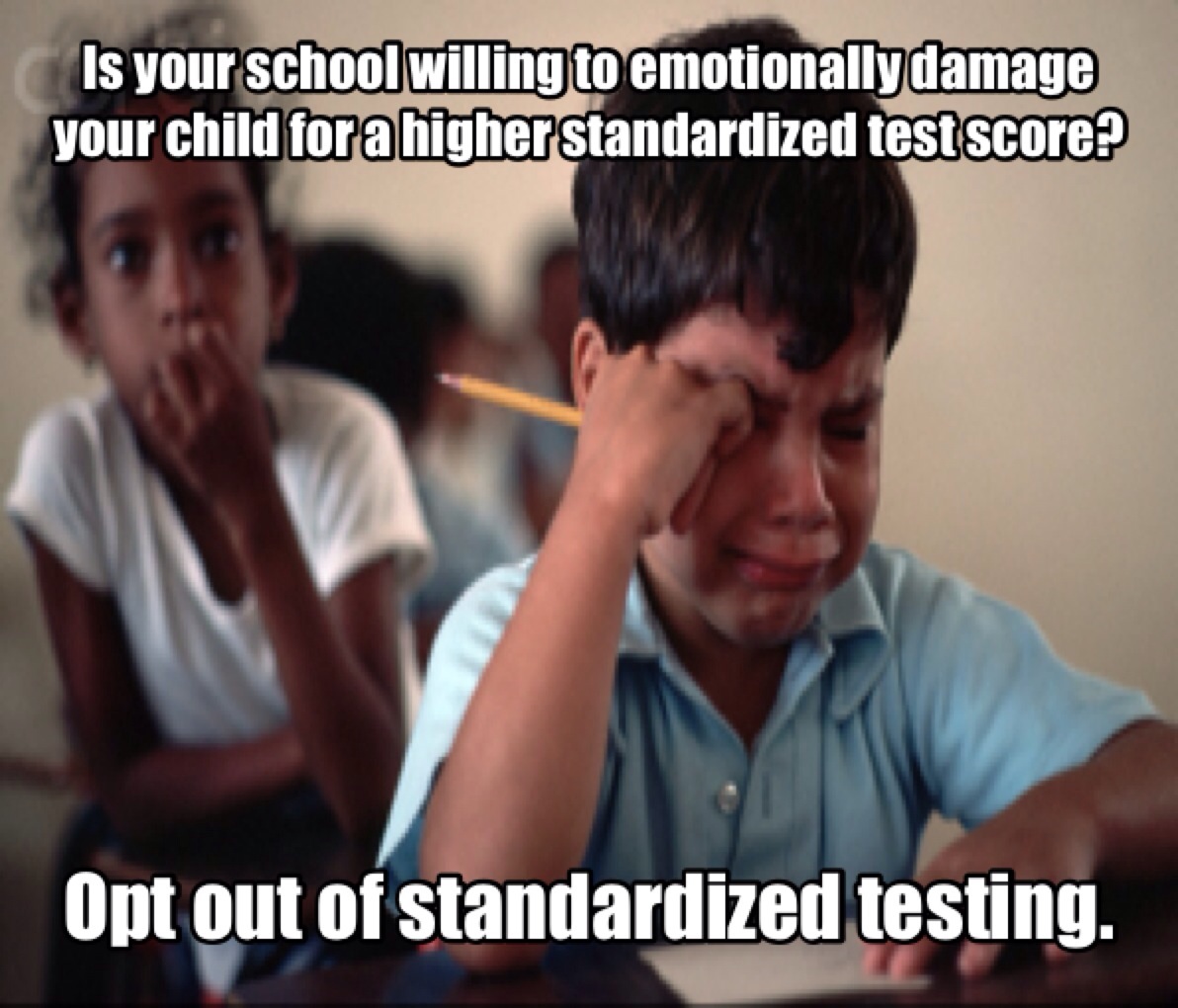
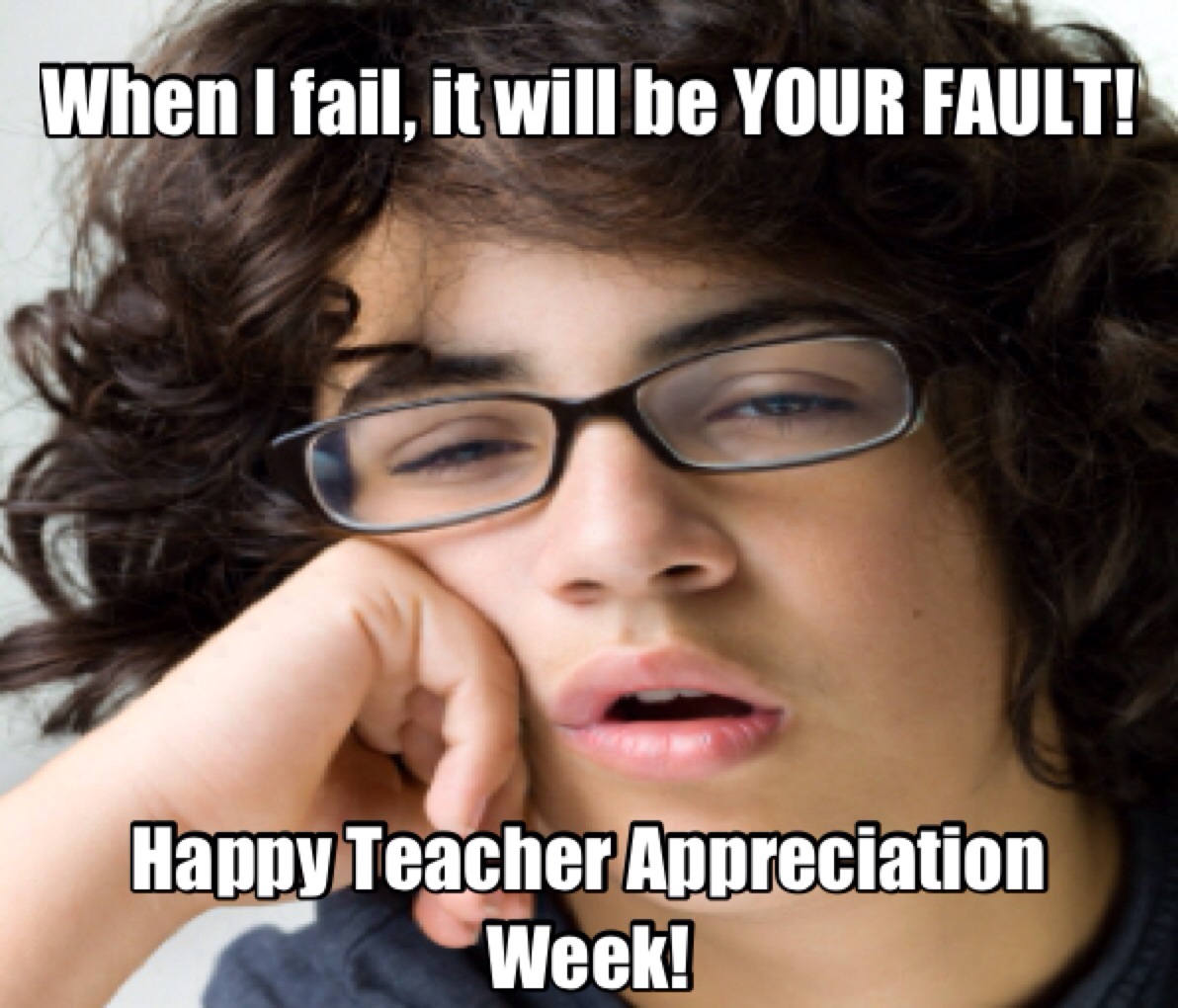
STANDARDIZED TESTING
1
IMG_0975.JPG

2
IMG_2013.JPG

3
IMG_1262.JPG

4
IMG_1782.JPG

5
IMG_1903.JPG

BUDGETS
6
IMG_1764.JPG

7

IMG_2040.JPG

8
IMG_0559.JPG

COMMON CORE
9
IMG_1972.JPG

10
IMG_1295.JPG

11
IMG_1710.JPG

TENURE

12
IMG_1800.JPG

13
IMG_1696.JPG
14
IMG_1603.JPG

VALUE-ADDED MEASURES (VAM)

15
IMG_1489.JPG

16
IMG_1106.JPG

17
IMG_0476.JPG

CORPORATE EDUCATION REFORM

18
IMG_1817.JPG

19
IMG_1492.JPG

20
IMG_0901.JPG

ACCOUNTABILITY

21
IMG_2023.JPG

22
IMG_2101.JPG

23
IMG_1072.JPG

PENNSYLVANIA ISSUES
24
IMG_1793.JPG

25
IMG_1776.JPG

26
IMG_1222.JPG
27
IMG_0919.JPG
28
IMG_1420.JPG

MISCELLANEOUS

29
IMG_1927.JPG

30
IMG_1891.JPG

31
IMG_1950.JPG

32
IMG_1392.JPG

33
IMG_1446.JPG

34
IMG_1912.JPG

Franz Kafka and the Metamorphosis of Teacher Evaluations

kafka-drawing-251x300

One morning, when Mr. K woke from troubled dreams, he found himself transformed in his classroom into a horrible insect.


He lay on his segmented brown belly propped against his teachers desk. He had fallen asleep trying to grade English papers again.


His armor-like back ached and wiry thin antennae kept bobbing into view like stray hairs. If he lifted his head a little, he could see his many tiny legs waving about helplessly each holding a pen or pencil.


“What’s happened to me?” he thought.


It wasn’t a dream.


“Oh well.” he shrugged, “I have papers to grade,” and he began to attack the pile of high school essays on literary surrealism.


But before he could even finish the first one, the Commandant sauntered in. At least she liked to call herself that. She was really just a first year principal. Last year she had taught in a classroom right down the hall.


“Mr. K! What is this!?” she demanded.


“You used to call me Franz…”


He was shocked when he heard his own voice answering, it could hardly be recognized as the voice he had had before. As if from deep inside him, there was a painful and uncontrollable squeaking mixed in with it. Mr. K had wanted to give a full answer and explain everything, but before he could finish, the Commandant said, “You haven’t turned in your pre-observation report for your value-added evaluation.”


“Um, yes, I did. I emailed it to you yesterday.”


“You haven’t made references to Danielson’s framework or which Common Core State Standards you’ll be teaching to… How am I going to fairly evaluate your teaching if you don’t make explicit reference to pedagogues like Danielson… and Gates?”


“Half of my evaluation is supposed to come from observation. Couldn’t you just observe me? I told you what I was going to be teaching. Isn’t that enough? I have papers to grade.”


“Of course not, Mr. K! This is a teaching evaluation! Not a grading evaluation!”


“But my students worked all week on these papers. I need to make comments so they can revise them.”


“Do students get a chance to revise their essays on our state mandated standardized writing test?”


“Not really…”


“Then just give them an Advanced, Proficient, Basic or Below Basic and move on to the important work – your evaluation.”


“I thought teaching was the important work.”


“Certainly not. We’re in the evaluation business. We evaluate the students work on their standardized tests so we can tell how well their teachers are performing. That’s the other half of your evaluation, Mr. K – your students’ test scores.”


“But that doesn’t make sense. You can’t evaluate teachers based on a test made to evaluate students. That’s like judging the sturdiness of your shoes based on the sturdiness of your socks.”


“Sure we can! It’s a practice championed by US Secretary of Education Arne Duncan, himself!”


“But he has no education background. He’s just a CEO. And even he said schools could put the brakes on it for another year.”


“Time is money, Mr. K.”


“No it isn’t. Look. Most VAM studies have shown that teachers account for only about 1% to 14% of variability in test scores.”


“Come, come, Mr. K! You sell yourself short. Having an effective teacher is the most important factor in a child’s academic success!”


“Yes, having a good teacher is the most important factor IN THE SCHOOL BUILDING. But variation in test scores is attributable to factors outside of the teacher’s control such as student and family background, poverty, curriculum, resources, class size, motivation, attendance, health… Shall I go on?”


“Nonsense!”


“Really? You want to evaluate me based on test scores for students some of whom I may not even teach?”


“Yes.”


“I teach the lower level Language Arts students. I have more children with disabilities and English Language Learners so my students scores – even their progress – will be lower than their peers because they face greater learning challenges. That’s fair?”


“Maybe next year we’ll give you the gifted classes.”


“That’s worse! How can you judge me on progress when the gifted children have already reached an academic ceiling?”


“You’ve got nothing but excuses, Mr. K, and as they say at my old alma mater, Teach for America, ‘There are no shortcuts. There are no excuses.’”


“That’s rich coming from an organization that trains teachers in 5 weeks. Let me ask you a question, Ms. Commandant. Has VAM ever been shown to accurately evaluate teacher performance?”


“Uh. No, but…”


“Has its use ever been shown to increase student learning?”


“No, but…”


“Is it endorsed by the nation’s leading scholarly organizations like, say, The American Statistical Association?”


“No, I think the words ‘junk science’ were even thrown about…”


“And you think that you can determine whether I get to keep my job or not based on this deeply flawed methodology? Do you want to be sued for wrongful termination?”


“Sued!? Oh goodie! We get to hold a trial!”


“What?”


“All done. Let’s bring in the machine from the penal colony.”


“Wait, but… What did I do wrong?”


“You’ll see. The nature of your crime will be slowly carved into your back over a period of 12 hours.”


“Won’t that be excruciatingly painful?”


“Blame tenure. If it wasn’t for due process rights I wouldn’t even have to do that much.”


“Great. Didn’t you notice I’ve turned into a giant insect and have a thick layer of chitin across my shoulders?”


“Mr. K, I’m an administrator! I notice everything!”


And the moral of the story is… No one knows. Common Core requires us to read more nonfiction texts.


(rim shot)


FIN