
Parents and Children Occupy Puerto Rican School Refusing to Let Corporate Vultures Raid Its Contents

Screen shot 2015-08-22 at 9.09.36 AM

For more than 80 days, about 35 parents and children have been camping out in front of their neighborhood school in the U.S. Territory of Puerto Rico.

The Commonwealth government closed the Jose Melendez de Manati school along with more than 150 others over the last 5 years.

But the community is refusing to let them loot it.

They hope to force lawmakers to reopen the facility.

Department of Education officials have been repeatedly turned away by protesters holding placards with slogans like “This is my school and I want to defend it,” and “There is no triumph without struggle, there is no struggle without sacrifice!”

Officials haven’t even been able to shut off the water or electricity or even set foot inside the building.

The teachers union – the Federación de Maestros de Puerto Rico (FMPR) – has called for a mass demonstration of parents, students and teachers on Sunday, Aug. 23. Protesters in the capital of San Juan will begin a march at 1 p.m. from Plaza Colón to La Fortaleza (the Governor’s residence).

11212175_538567642948296_6542092169551987830_o

The schools being closed are all in low income areas, said union president Mercedes Martinez. “This is detrimental to education, because the necessities of the community, the investment in infrastructure in recent years, the technology, have not been taken into consideration, and neither the parents nor the teachers have been consulted.”

The Jose Melendez de Manati school, for instance, served students 92% of whom live in poverty.

Now that the building has been closed, parents say they can’t afford the cost to transport their children to a new school miles away. And those schools that remain open have been forced to make drastic cuts to remain functional. Class sizes have ballooned to 35 students or more. Amenities like arts, music, health and physical education have typically been slashed.

Why?

The island territory is besieged by vulture capitalists encouraging damaging rewrites to the tax code while buying and selling Puerto Rican debt.

Hundreds of American private equity moguls and entrepreneurs are using the Commonwealth as a tax haven.

Since 2012, U.S. citizens who live on the island for at least 183 days a year pay minimal or no taxes, and unlike those living in Singapore or Bermuda, they get to keep their U.S. passports. After all, they’re still living in the territorial U.S. These individuals pay no local or federal capital gains taxes and no local taxes on dividend interest for 20 years. Even someone working for a mainland company who resides on the island is exempt from paying U.S. federal taxes on his salary.

puerto_rico_teachers_strike.jpg_1718483346

Big corporations are taking advantage of the situation, too.

Worldwide, American companies keep 60 percent of their cash overseas and untaxed. That’s about $1.7 trillion annually.

Microsoft, for instance, routes its domestic operations through Puerto Rican holdings to reduce taxes on its profits to 1.02 percent – a huge savings from the U.S. corporate tax rate of 35 percent! Over three years, Microsoft saved $4.5 billion in taxes on goods sold in the U.S. alone. That’s a savings of $4 million a day!

Meanwhile, these corporate tax savings equal much less revenue for government entities – both inside and outside of Puerto Rico – to use for public goods such as schooling.

Public schools get their funding from tax revenues. Less tax money means less money to pay for children’s educations. As the Puerto Rican government borrowed in an attempt to shore up budget deficits, the economy tanked.

But have no fear! In swooped Hedge Funds to buy up that debt and sell it for a profit.

When this still wasn’t enough to prop up a system suffering from years of neglect, the Hedge Fund managers demanded more school closures, firing more teachers, etc.

Of course, this is only one interpretation of events.

If you ask Wall Street moguls, they’ll blame the situation on declining student enrollment. And they have a point.

Some 450,000 people have left the island in the last decade as the economy suffered an 8-year depression.

There were 423,000 students in the Puerto Rican school system in 2013. That’s expected to drop to 317,000 by 2020.

But is this the cause of the island’s problems or a symptom?

Unfortunately, things look to get much worse before they’ll get any better.

The government warns it may be out of money to pay its bills by as early as 2016. Over the next five years, it may have to close nearly 600 more schools – almost half of the remaining facilities!

Right on cue, Senate President Eduardo Bhatia is proposing corporate education reform methods to justify these draconian measures. This includes privatizing the school system, tying teacher evaluations to standardized test scores and increasing test-based accountability.

“Our interest is to promote transparency and flow of data through the implementation of a standardized measurement and accountability system for all agencies,” Bhatia said, adding that the methodology has been successful in such cities as Chicago.

Despite such overwhelming opposition, protesters are taking the fight to the capitol. “Tax the Rich!” is a popular slogan on signs for Sunday’s march.

11029506_1679179132316825_4270916741405376334_n

“It’s unacceptable that the rich and powerful that created our crisis are the ones asking the working class for more sacrifices,” said Martinez.

“The foreign companies that pay no taxes or a less amount to evade paying their due in contributions – impose a tax on them now!”

This is just a beginning, she adds. Stronger actions will be coming.

In the meantime, those brave parents and children still refuse to give up their shuttered school.

They dream of a day when that empty building once again rings with the laughter of students and the instruction of teachers.

In a country being used by the wealthy to increase their already swollen bank statements, is that really so much to ask?


You can show your solidarity with these Puerto Rican protestors by spreading the word through social media. Post a picture of yourself with a sign saying you’re with them in their fight. Tweet the Commonwealth Secretary of Education @Rafaelroman6. Use the hashtags #EducacionEnPR #SOSdocente.

NOTE: This article was mentioned on Diane Ravich’s blog and was also published on CommonDreams.org and the Badass Teachers Association blog.

Bending Toward Justice: BATS Congress and the Fight Against Corporate Education Reform Taking Back the Power of Teachers

Screen shot 2015-07-30 at 8.32.22 PM

(NOTE: This article was written by Yohuru Williams and Steven Singer)

Be the change that you wish to see in the world.—Mahatma Gandhi

Nearly a year ago today, I joined an inspiring band of intrepid activists who made their way to the nation’s capital to protest the impact of high stakes testing and corporate education reform. We arrived with the genuine hope that a demonstration at the Department of Education might encourage a national discussion about what many have rightfully identified as the destruction of public education.

After a long day of speeches and activities, a representative from the Department came out and asked for a meeting. After being ushered through security, a small contingent of protesters and I travelled upstairs where we were hustled into a small conference room. After a few minutes, Secretary Arne Duncan joined us. He stayed for only a few minutes, sometimes listening, but mostly politely but firmly pushing back and evading our grievances. It was clear that we had come to the wrong place.

After he departed, Arne’s staff pressed us for solutions. I suggested a National Teacher Congress that would allow real teachers, from across the nation, and from all backgrounds and districts, to convene in Washington to earnestly discuss and explore solutions. Arne’s aides perked up. “What a fantastic idea,” one his staffers chimed in. In abstract it was, but as we debated it in the weeks following the protest it was clear that we needed something stronger. We felt acknowledged for sure, but certainly not heard. For all the power projected on him, Arne is a functionary and we determined that we needed to go after the persons and entities on whose behalf he functioned.

In the months that followed my idea of a Teachers Congress morphed into a week of lobbying to educate elected officials about the detrimental impact of corporate education exacerbated by rampant racism and poverty. The idea of a National Badass Teachers Association (BATs) Congress was born.

On Saturday, July 24, 2015 I reprised my role as keynote speaker as part of that Congress, but the real action had already taken place as my fellow BAT and edu-blogger Steven Singer of Pennsylvania chronicles below. The BATs returned to DC, not to revisit history but to continue our mission of creating real opportunity and equity in the nation’s schools. For even as we all firmly believe, as the Reverend Dr. King once expressed that the arc of the universe bends towards justice, we also acknowledge that sometimes you have to push at its base to help it’s curvature along. —Yohuru Williams

Steven Singer:

We came to Washington, D.C., in ones, twos and threes.

We came by the carload. On the train. In transcontinental flights. Even walked.

No mass uprising. No angry rhetoric. No fists shaking.

No corporate funding. No thick rolls of bills. Just whatever jingling change we could spare for travel, room and board.

We occupied the Capitol stuffed overcapacity in hotel rooms, sometimes sleeping on the floor or even in the hall.

Not ideologues, not Democrats, not Republicans – just parents, teachers, students, people.

Who are we? We are the Badass Teachers Association. And we came to be heard.

Last year we stood outside the U.S. Department of Education to air our grievances. We spoke to those walls, we spoke to each other and the open air. We spoke with such volume, the doors opened and we were invited inside.

And in the presence of The Powerful, we didn’t stumble, we didn’t lose our courage, we told the truth to their disbelieving faces.

Our public schools are not failing. YOU are failing our public schools.

Your policies are poisonous. Your testing is treasonous. Your facts are fallacious. Your designs are dangerous. Your ideas imperious. Your lectures libelous. Your measures malicious. Your networks nefarious. Your rigor ridiculous. Your standards suspicious.

Secretary Duncan, next year you should convene a congress of teachers. They would tell you what needs to be done.


And we meant it.

We didn’t wait for permission. We didn’t wait for an invitation. We gathered our own power, gathered our selves and this year became the Badass Teachers Congress.

For two days we marched up Capitol Hill and into the halls of the House and Senate. We made appointments months in advance to sit down with our legislators, and if they wouldn’t meet with us, we sat down with their aides, and if they wouldn’t commit to a meeting, we showed up anyway.

We told them the truth. Right to their faces if they were brave enough to face us.

We didn’t wait for education policy to be directed by education experts. We presented our expertise, offered it freely, shook hands, smiled and looked them right in the eye.

But we didn’t stop there. Telling Congress is one thing. We BECAME a Congress.

We drew on our own first hand experiences of the failure of national education policy. We drew on research, peer-reviewed studies, the fruits of universities and colleges – real, unmanipulated data.

And we came up with resolutions.

We acknowledged that our labor unions sometimes fail to live up to their promise. But we didn’t throw them away. We devised ways to strengthen them, to increase their power to empower and make them more like us.

We shared our fear of being the lone dissenting voice and planned ways to overcome ourselves and speak up for our children and communities even if our voices shake.

We acknowledged our national history of racism, sexism, and prejudice. And we didn’t allow our many different shades of skin to provide offense, we didn’t allow our various cultures, ethnicities, religions and sexualities to become a burden. We drew on our differences as a strength and committed ourselves to acknowledging the ways we have been disenfranchised. We decided on a path of love and acceptance even if that path might take us to places that make us uncomfortable, we’d go there together.

We resolved to continue protecting teachers from toxic work environments that far too often become abusive. Too many of our colleagues have taken their own lives due to the toll of this job. We are the last line of defense between children and people who would sooner sell their futures for a few pieces of silver. And finally the problem is being recognized and steps are being taken – slowly – to help.

In short, we did what The Powerful least expected or wanted. We held each other up. We recognized our own power and vision. We organized, made plans and set the course for our future.

In the weeks that follow, more details will emerge. We’re still examining the incredible input, ideas and information. So much happened, it’s hard for any one person to encapsulate it all.

But of this you can be sure.

We are the Badass Teachers Association.

We are not waiting to be invited anywhere. We are not asking permission. We are taking control of our own destinies.

And we will be back.


 About the Authors:

Yohuru Williams is an author, Professor of History and Black Studies, and education activist. Steven Singer is a husband, father, teacher, and blogger, education advocate. Both are members of the Badass Teachers Association.

williams-singerNOTE: This article also was published in the LA Progressive.

Down and Out and Lobbying for Public Education

 image

Let’s get one thing straight right from the start.

I’m no lobbyist.

I’m just a private citizen who’s sick of seeing his tax dollars swallowed up by big corporations under the guise of educational accountability.

I’m just a public school teacher who’s tired of his profession being demonized by policymakers and media talking heads alike.

And I’m just a father who’s worried that his daughter won’t get the same comprehensive public education he received as a child.

No one paid me. In fact, I bankrolled myself.

So like more than 300 members of the Badass Teachers Association (BATS), I came to Washington, D.C., to speak with my Congresspeople.

And what a day it was!

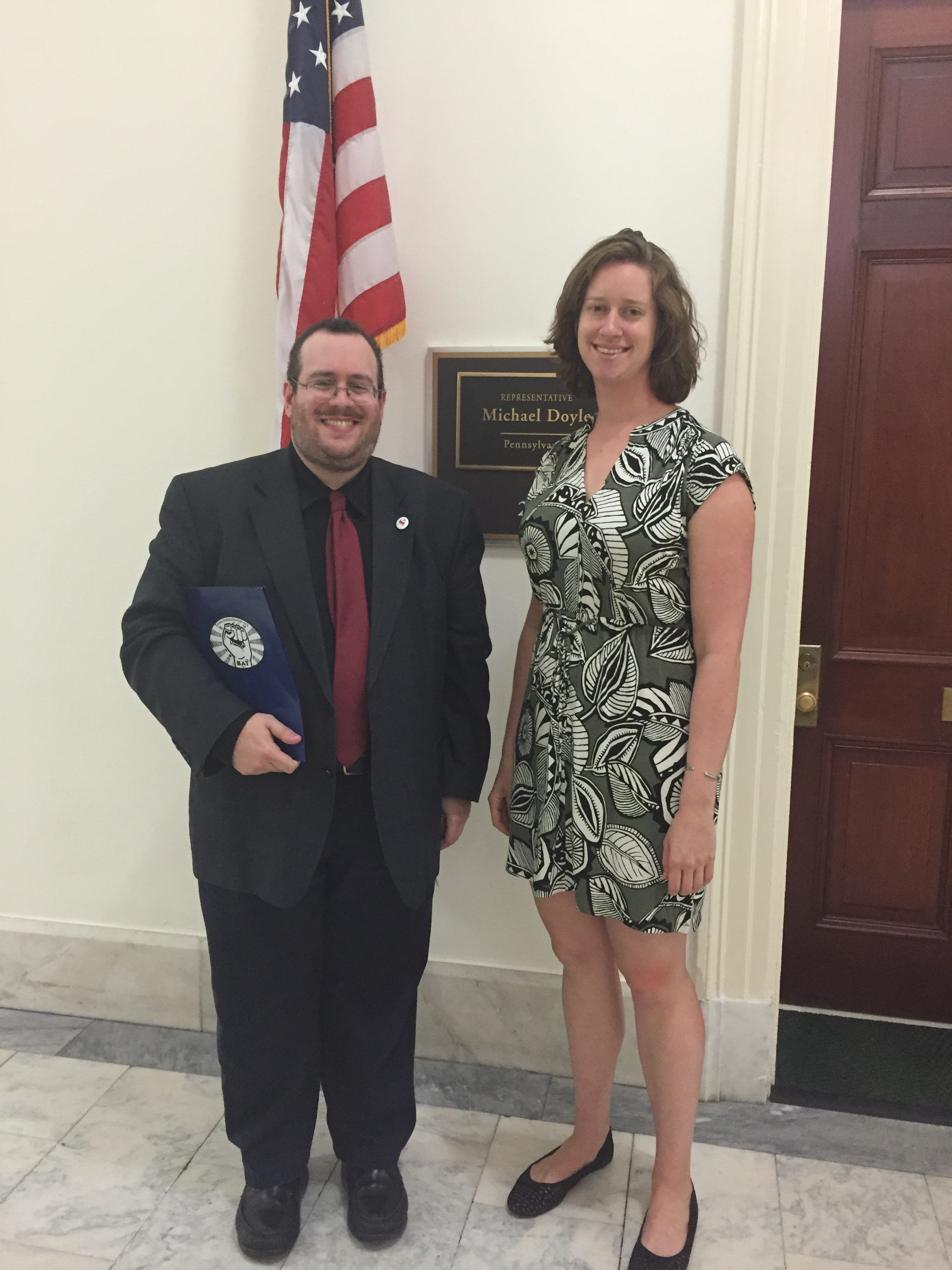
I met with Senators Pat Toomey (R-PA), Bob Casey (D-PA) and Corey Booker (D-NJ). I met with U.S. Reps Mike Doyle (D-PA) and Chris Smith (R-NJ).

Well, actually I met with their legislative aides.

None of the actual lawmakers made time to sit down with a flesh and blood teacher.

In one case, a legislator seemingly went out of his way to avoid me.

image

While sitting on the couch in Doyle’s office, he came out of a room to the left of me, asked his secretary for packing tape and then told her he was leaving for the day. It was 2:47 p.m. on Friday.

And they say teachers have easy hours!

I can’t say whether he was actively avoiding me. I made an appointment to see him, but it was never specified if I’d be meeting with him in person or if I’d be with his aide.

For all I know his staff never let him know I was a constituent sitting there on his couch in a suit and tie with a folder perched on my lap. But it didn’t feel good.

Maybe I should have said something. “Congressman Doyle! May I have a moment?”

But I frankly couldn’t believe this was happening. Moreover, he looks a lot different in a purple Hawaiian shirt than he does in all his press photos wearing a suit. I had to check his picture on my phone to make sure I was really seeing this correctly.

I was.

Still the meetings I had with these kids helping my legislators decide public policy were actually quite productive.

Without exception these youngsters were friendly, polite and knowledgeable. They seemed receptive to new ideas, were eager to hear my point of view, asked intelligent questions and were honest about where their bosses sometimes disagreed with me.

In Sen. Toomey’s office his assistants even asked if I was THAT Steven Singer.

“Who?” I said.

And they told me about a famous advertising campaign in eastern PA where a jeweler’s competitors are seen to complain “I HATE STEVEN SINGER.”

I laughed and told them it wasn’t me, but inside I wondered if that might explain the difficulty I had in some circumstances making these appointments. Maybe congressional staff thought I was pranking them. “Steven Singer wants an appointment!? Yeah! I’ll schedule it right after we see Mickey Mouse!”

image

I first met with Devorah Goldman, Toomey’s legislative correspondent on education and other issues. She’d only been on the job for about a year, but her qualifications included a degree in social work and she had worked in a public school resource center.

She was a very good listener. She heard me out as I spoke about a homeless student in my classes this year. She listened as I explained why Common Core is bad policy, why we need equitable school funding, an end to high stakes standardized tests, reigning in charter schools and voucher systems, and an end to judging teachers based on their students’ test scores.

Her boss isn’t exactly known as an education advocate. But she said he would agree with most of what I had said.

The main area of dispute would be charter schools. Toomey is in favor of expanding them so students can escape “failing schools.”

I explained that it was bad policy to try to save some students and let others fall behind. We need to make sure ALL our schools do an excellent job. Moreover, the Senator’s metric for determining which schools are failing is faulty at best.

I explained that traditional public schools often outperformed charter schools, which lack transparency and accountability and are wasting taxpayers dollars.

“We’ll just have to disagree on that point,” she said without explanation.

But she agreed to continue to take input from me and the BATS in the future.

image

At Doyle’s office, I eventually sat down with Hannah Malvin, a political science major who, at least, is from the Pittsburgh area – her boss’ legislative district.

She listened intently to my tales of education woe, even asking follow up questions. But she was surprised I supported the reauthorization of the Elementary and Secondary Education Act (ESEA).

Even the strongest supporters of the rewrite of the federal law that governs K-12 schools would admit it isn’t perfect. However, I would contend that the new version being cobbled together by the House and the Senate appears to be a slight improvement over what we have now – No Child Left Behind (NCLB).

Some educators think even this rewrite doesn’t go far enough to scale back standardized testing (and I sympathize but do not agree with that position). However, Malvin said Doyle had issues with it because it scaled back too much.

This was the issue I heard from Democrats all day. There isn’t enough accountability in the ESEA rewrite. How will we know which schools need extra help, they asked again-and-again.

I tried to explain that all they had to do was look at per-pupil spending. It’s no mystery which kids aren’t getting enough resources. It’s all right there on a ledger.

To her credit she heard me out and agreed to continue to dialogue with me on this subject in the future.

Next, I met up with some fellow teacher lobbyists from New Jersey and we dropped in unannounced on Booker’s office.

It’s not that we didn’t try to make an appointment. His staff never returned our calls and emails.

In fact, last week a fellow teacher not with us on Capitol Hill, Michele Miller,  even got into a scuffle with Booker on Twitter about elementary school funding. He told her to call his office and he would talk to her in detail.

To my knowledge, he never did. However, she was connected by phone to one of his aides. I’m told this is just modus operandi for Booker – strong talk in a public forum but shying away when the cameras aren’t rolling.

In any case, Booker’s senior education and health policy adviser Ashley Eden agreed to talk with us when we showed up to the office. Though her background isn’t in education, I can’t recall exactly what it is in. I do remember she has been doing this sort of legislative work for lawmakers for about 4 years – longer than any other aide we met.

She immediately made us feel welcome and found many areas of agreement. Bookers’ major point of contention – like fellow Democrat Doyle – was accountability.

How do we know which kids need help without giving them standardized tests?

Groan. But at least I had reinforcements: BATS Assistant Manager Melissa Tomlinson and retired NJ teacher extraordinaire Elizabeth DeMarco.

image

Perhaps the most telling moment of the entire conversation was when Eden said Booker just had to back standardized testing because every Civil Rights organization wanted it. She even criticized the New Jersey Education Association (NJEA) for not supporting black and brown students.

We stopped her right there. No. Every Civil Rights organization does NOT support testing. Journey for Justice – a coalition of 38 such organizations, in conjunction with 175 additional likeminded groups wrote to both the House and Senate asking to eliminate testing. Didn’t Sen. Booker see the letter?

Suddenly she remembered it.

She said she read it real quickly and didn’t like one sentence in it so she ignored it.

Which sentence?

Something about expecting poor and minority students to do badly on tests.

I explained that it has nothing to do with thinking these children can’t achieve at the same level as other children. It’s a matter of resources. If Sen. Booker was in a foot race against someone in a Monster Truck, I’d vote on the truck. Doesn’t mean Booker can’t run or that he might not even win. But the smart money is on Big Foot.

I joined the two ladies for their meeting with Smith as well.

His legislative assistant, Katherine Talalas, was perhaps the most knowledgeable aide with whom we talked. Her mother is a special education teacher, her brother is a paraprofessional working in a public school and she went to law school focusing on education issues.

She also took more written notes than any other assistant. With her nothing seemed canned. It was a real conversation about what her boss had done to help special education students and how he might continue to help in the future.

image

I was on my own again to meet with Sen. Casey’s aide, Jared Solomon.

This was one of the most fascinating and perplexing conversations I had all day.

He was warm, friendly, and had a depth of knowledge that was a bit more political than school-centered.

He agreed with almost everything I said. Casey supports 95% of the things that are important to me in education.

I could have smiled and walked away happy, but Solomon was so gregarious he kept talking. We shared our backgrounds.

He proudly admitted that he had been a Teach for America (TFA) recruit. He worked two years in a Baltimore public school and then left. He knew it wasn’t going to be his permanent job. He was emulating his parents who had joined the Peace Corps. He did TFA because he wanted the experience.

Then he moved to the administrative offices of Michelle Rhee’s Washington, D.C., Public Schools.

He only worked there two years – only one of which was under Rhee’s administration – but he respected what they had done. He said he disagreed with 80% of their policies and even quit because he was tired of being blamed for practices with which he didn’t agree. But, he added, the people in Rhee’s administration worked harder than anyone he knew, and he thought they really had the best interests of the kids at heart.

I’m tempted to chalk it up to the same feeling the incredible blogger Jennifer Berkshire (a.k.a. Edushyster) says she gets when she interviews many corporate school reformers. We may disagree with them, but they really do believe this stuff.

But something happened that doesn’t sit well with me. In an unguarded moment of a more than hour-long conversation, Solomon pulled the same stunt Eden did for Sen. Booker. He said all the Civil Rights groups were crying out for testing. But when I called him out on it, he immediately took it back. It was like he, too, knew this was untrue. It was a talking point, quickly to be conceded if called out and then move on to another argument.

I frankly don’t know what to make of it. The arguments are too similar among Democrats and Republicans to shrug off. Each is speaking from a party line script. That can’t just be a coincidence.

And why would Casey, a legislator who supposedly agrees with me 95% of the time on education, hire as his education expert someone who was actively involved in many of the practices that go directly against his beliefs? Why would someone like Solomon, who was part of the corporate education reform movement, really be on my side against these policies?

It’s befuddling to say the least.

Now that it’s all over, I’m so glad I did this.

Will this change the nation’s education policies? Probably not.

But I am only one of hundreds of people who climbed Capitol Hill in the last two days and met with more than 52 federal legislators to fight against the standardization and privatization of education.

And tomorrow we, BATS, will hold a Teachers Congress to further solidify our goals and decide where the great ship of real positive school change should go.

I am so looking forward to it.

But this teacher, soon-to-be BAT Congressman, needs to go to bed.

Here’s to a brilliant tomorrow for our children.


NOTE: This article also was published on the Badass Teachers Association blog.

A Brief Lesson in Pennsylvania Budget Math: a VLOG

Screen shot 2015-07-21 at 12.49.56 AM

WATCH THE VLOG BELOW:

Welcome to my first (and possibly last) VLOG or Video Log. If you haven’t already, please click on the video above, grab some popcorn and enjoy A Brief Lesson in Pennsylvania Budget Math.

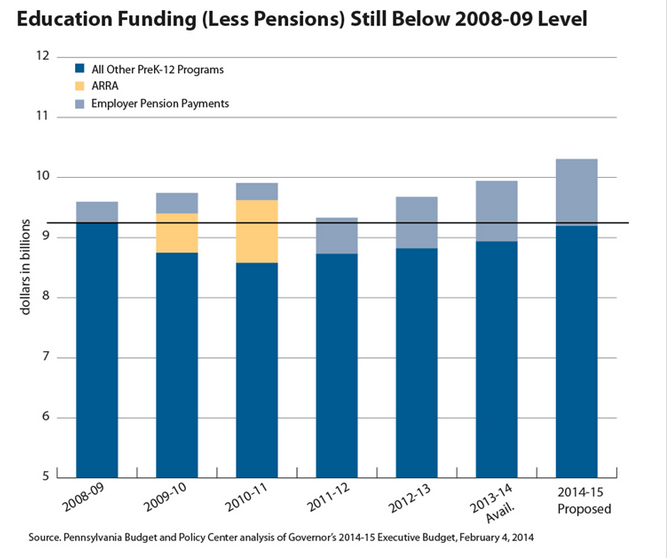
Our state budget impasse continues to grow. The Republican-controlled legislature refuses to replace the almost $1 billion in annual education funding lawmakers removed 4 years ago. Democratic Governor Tom Wolf refuses to accept a spending plan that shortchanges our school children.

This is my attempt to bring clarity to the situation so ANYONE could understand what was at stake and maybe see through some of the half truths and misdirections surrounding the issue. After all, who better than a public school teacher to explain to Republicans why they need to fund our schools?

Basically, the whole video can be summarized in this graph from the Pennsylvania Budget and Policy Center:

Screen shot 2015-07-20 at 11.08.50 PM

For more information, please check out these other fine Gadfly on the Wall Blog articles:


NOTE: This article also was published on the Badass Teachers Association blog.

The Democrats May Have Just Aligned Themselves With Test and Punish – We Are Doomed

sanders_warren-620x412

Almost every Democrat in the US Senate just voted to keep Test and Punish.

But Republicans defeated them.

I know. I feel like I just entered a parallel universe, too. But that’s what happened.

Some facts:

No Child Left Behind (NCLB) is a disaster.

It took the Elementary and Secondary Education Act (ESEA) – a federal law designed to ensure all schools get equitable resources and funding – and turned it into a law about standardized testing and punishing schools that don’t measure up.

This was a Republican policy proposed by President George W. Bush.

But now that the ESEA is being rewritten, those pushing to keep the same horrendous Bush era policies are the Democrats.

Almost all of the Democrats!

That includes so-called far left Dems like Bernie Sanders and Elizabeth Warren!

It comes down to the Murphy Amendment, a Democratically sponsored change to the ESEA.

This provision was an attempt to keep as many Test and Punish policies as possible in the Senate rewrite.

The amendment, “reads more like NCLB, with its detailed prescription for reporting on student test results, for ‘meaningfully differentiating among all public schools’ (i.e., grading schools), including publicly identifying the lowest five percent, and, among interventions, potentially firing staff and offering students the option to transfer to other schools and using part of the budget to pay for the transportation,” according to blogger Mercedes Schneider.

Education historian Diane Ravich adds, “This amendment would have enacted tough, federal-mandated accountability, akin to setting up an ‘achievement school district’ in every state.”

Thankfully it was voted down. The ESEA will probably not be affected. The rewrite was passed by both the House and Senate without these provisions. Once the two versions of the bill are combined, it is quite possible – maybe even probable – that we’ll have a slight improvement on NCLB. Sure there is plenty of crap in it and plenty of lost opportunities, but the ESEA rewrite looks to be a baby step in the right direction.

The problem is this: the failed Murphy Amendment shows the Democrats’ education vision. Almost all of them voted for it. Warren even co-sponsored it!

When it was defeated and the Senate approved the ESEA rewrite, Warren released a statement expressing her disapproval. But if you didn’t know about the Murphy Amendment, you could have read her criticisms quite differently.

She says the (ESEA rewrite) “eliminates basic, fundamental safeguards to ensure that federal dollars are actually used to improve both schools and educational outcomes for those students who are often ignored.”

That sounds good until you realize what she means. “Educational outcomes” mean test scores. She’s talking about test-based accountability. She is against the ESEA rewrite because it doesn’t necessarily put strings on schools’ funding based on standardized test scores like NCLB.

She continues, “Republicans have blocked every attempt to establish even minimum safeguards to ensure that money would be used effectively. I am deeply concerned that billions in taxpayer dollars will not actually reach those schools and students who need them the most…”

She is upset because Republicans repeatedly stripped away federal power to Test and Punish schools. The GOP gave that power to the states. So Warren is concerned that somewhere in this great nation there may be a state or two that decides NOT to take away funding if some of their schools have bad test scores! God forbid!

And Warren’s about as far left as they come!

What about liberal lion Bernie Sanders? I’d sure like an explanation for his vote.

It makes me wonder if when he promised to “end No Child Left Behind,” did he mean the policies in the bill or just the name!?

The Democrats seem to be committed to the notion that the only way to tell if a school is doing a good job is by reference to its test scores. High test scores – good school. Bad test scores – bad school.

This is baloney! Test scores show parental income, not academic achievement. Virtually every school with low test scores serves a majority of poor children. Virtually every school with high test scores serves rich kids.

Real school accountability would be something more akin to the original vision of the ESEA – making sure each district had what it needs to give kids the best education possible. This means at least equalizing funding to poverty schools so they have the same resources as wealthy ones. Even better would be ending our strange reliance on local property taxes to provide the majority of district monies.

But the Dems won’t hear it. The Murphy Amendment seems to show that they’re committed to punishing poor schools and rewarding rich ones.

I really hope I’m wrong about this. Please, anyone out there, talk me down!

Up until now I’ve always been with the Democrats because they had better – though still bad – education policies than the Republicans. I’m not sure I can say that anymore. In fact, it may be just the opposite.

Which party is most committed to ending Common Core? The Republicans!

Which party has championed reducing federal power over our schools and giving us a fighting chance at real education reforms? Republicans!

Which party more often champion’s parental rights over the state? Republicans!

Sure, most of them still love vouchers and charter schools. But increasingly so do the Democrats.

This vote has me rethinking everything.

Our country’s education voters may have just been abandoned by their longest ally.

Where do we go from here?


NOTE: This article also was published on Commondreams.org and on the Badass Teachers Association blog. It was also mentioned in the Washington Post.

In ESEA Debate, Education is Caught in the Middle Between the State and Fed

middle-dog-300

Watching Congress debate national education policy is a bit like going to a tennis match and finding a truck and tractor pull has erupted.

“Isn’t this supposed to be about how to make our schools better?” I want to scream.

“No!” someone yells from the stands. “This is about States’ Rights vs. the Fed. Go, States!”

Face palm.

The current brouhaha centers around the Elementary and Secondary Education Act (ESEA), the federal law that governs K-12 schools.

The present version, called No Child Left Behind (NCLB), is a thorough disaster. Thankfully Congress is trying to rewrite the legislation.

However, in doing so the emphasis has been less on making things better and more on deciding who gets to make decisions about schools.

Republican President George W. Bush greatly increased federal control with NCLB, something Democratic President Barack Obama has continued through his education policies.

These days, the GOP has done a 180 and is the champion of states rights to make their own education policies.

Given the Obama administration’s continued emphasis on standardized testing, punitive accountability systems and top down education standards, a move away from federalism seems completely justified.

But this is becoming the heart of the debate even at the expense of children, parents and teachers.

Take Opt Out.

NCLB allows parents to opt their children out of standardized testing, but school districts can be punished for it. If more than 5% of the students in a district don’t take the federally mandated tests for whatever reason (including parental opt out), the district’s Title I funding is put in jeopardy.

In many parts of the country, parents are refusing to subject their children to these tests anyway. They are voting with their feet. They are telling our lawmakers they do not want their children to take standardized tests so often – or in many cases – at all.

The good news is that BOTH of the two drafts of the ESEA allow for parental Opt Outs. However, who gets to decide if doing so will penalize your school?

The House version says that opting out will not hurt your district. Period. But the Senate version leaves the matter up to the states. State legislatures get to decide if withholding your child from standardized testing will have punitive consequences for your district.

This is absurd.

It’s not a matter of States’ Rights vs. the Fed. It’s a matter of parental rights.

As a parent, I should have final say over what my child does or does not have to do in school. There may be limits in extreme circumstances (i.e. vaccines) and in terms of content (i.e. science, history), but in general the rights of parents and children should trump all others.

Ironically the parents who shield their children the most from standardized testing are those who champion it for everyone else. Secretary of Education Arne Duncan is sending his children to a Chicago private school that does not use standardized tests. Likewise, Obama’s children attend a private school free from the influence of his education policies. Same with corporate education reform cheerleaders Governors Chris Christie and Rahm Emanuel.

So many cooks who refuse to eat their own cooking!

But to return to the ESEA, pundits are lauding the Senate Opt Out restriction as a selling point between the versions of the proposed law. The House version has a better Opt Out provision, so you can choose it.

However, it is also poisoned from the start because (unlike the Senate version) it includes a backdoor voucher provision. Called Title I Portability, the House bill essentially would suck up funding now given to impoverished districts and spit it back into the lap of richer ones. Poor kids need additional funding because they go to poor schools that have less money to spend educating them. If a poor child goes to a rich school, she doesn’t need additional funding – the school already spends more to educate her than a poor district ever could. But the issue is a bit of a nonstarter anyway because Obama already has promised to veto any bill containing it.

So the only option is the Senate version, and they just sunk a big turd in it.

But like any factory farm sausage, you often have to learn to accept a few unsavory morsels in with the meat. Even if the final bill includes this Senate provision, it will be an improvement over NCLB. Punishing schools for parental opt outs is the status quo. If even a few  states decide not to punish their schools because of parents choices, that will be a step in the right direction.

It’s just so frustrating to watch our myopic Congresspeople take such baby steps forward.

Why would anyone try to override parental concerns about testing?

Many legislators worry if all students aren’t tested, there will be no way to determine if school districts are properly educating students.

But that is exactly the point!

Standardized testing does not show how well a school is functioning! It only shows how many poor students go to the school. Rich kids score well; poor kids score badly. And academics? There are so many better means of assessing them than multiple choice exams graded on a curve!

If lawmakers really wanted to ensure all students were getting a quality education, they’d hold BOTH the state and federal governments accountable for equitably funding our schools. No more funding based on local wealth. No more poor kids getting less funding than rich kids. No more kids doing without because mommy and daddy have lousy paying jobs.

Parents, children and educators have been crying out to lawmakers about the injustice of using high stakes tests as means of punishing schools for the poverty of their students. THIS is what needs to change. THIS is the essential reform we’re crying out to be enacted!

But no one’s listening. All they care about is which team is winning – Team State or Team Fed.


NOTE: This article also was published on the Badass Teachers Association Blog and it was mentioned in the Washington Post.

Do Americans “Throw Money” At Their Schools? A Fair Funding Primer

Screen shot 2015-07-06 at 11.05.59 PM

“Don’t throw money at schools.”

It’s a common rejoinder when lobbying for an increase in public education budgets.

You offer facts why schools need it: both the state and federal government continue to reduce K-12 funds, class sizes are increasing, the curriculum is being narrowed, buildings are crumbling – real world consequences to spending deficits.

And some guy (it’s often a dude) stands up with a cock-eyed grin and says, “You know, we really need to stop throwing money at schools.”

And he pauses as if we all need a moment to take that in.

Is there anything to this? We hear it often enough, but does he have a point?

Let’s see.

“Don’t throw money at schools.”

First, is it true? Is anyone actually throwing money at our schools?

I’ve worked as a public school teacher for over a decade. To my great disappointment never once has anyone hurled greenbacks through a window in my building. I have never had to dodge, duck or otherwise exercise gymnastics to avoid being thunked in the head by a stack of airborne bills.

Origami ninja stars made out of $100 notes do not routinely fly through the air in my classroom. No government representative has ever shown up in the auditorium during a professional development and said, “Yeah baby! Let’s make it rain!” before showering my coworkers and myself in Benjamin’s.

No. This has never happened. Not even coins. More change is thrown at the fountain in my local mall than at any public school where I’ve ever worked.

At this point, you’re probably saying, but, Steven, that’s not what this guy meant. He wasn’t implying someone literally tossed bills at foundations of learning. He was just being colorful.

To which I respond: was he? Because there are lots of ways to phrase that idea. He simply could have said, “We shouldn’t increase education funding.”

He could have said, “We need to spend school money more wisely before increasing it.”

He could have said, “Additional learning revenues are a waste because schools do such a bad job.”

He could have said, “We spend too much on education already.”

He could have said, “Kids don’t deserve more of my cash.”

But he didn’t say any of those things. Instead he conjured an image out of a Roman orgy or a rap video. He purposefully tried to frame this as a ridiculous situation. He wasn’t just trying to make an argument. He wanted to paint anyone who could possibly disagree with him as a fool.

“Can you believe these guys crying about public school funding?” he implied. “They’re having money thrown at them and they actually want more!?”

So before we even start to study the content of his phrase, we must remember it’s coated in bias and malicious intent. He is not really calling for a rational argument. He is appealing to emotions – most probably the emotions of those listening to the debate.

But we cannot sink to his level. We need reasons.

This is difficult because it’s not entirely clear what exactly he was getting at. Let’s examine what his statement might mean in plain English and try to determine if – underneath all this spin – he has a point or not.

Here are some possibilities.

1) “We need to spend education money more wisely before increasing it.”

This might be what he intended to say. And if so, he does have a bit of a point.

There is a problem with how school funding is spent. There is waste and misappropriation. At the local level, school boards and administrators do not always do things in the most efficient manner. But you could say the same thing at every level of democratic government. Fascist states have much less waste. Shall we just burn up the Constitution, then?

At the state and federal level, the problem is compounded by the ignorance of those allowed to write our laws. Education policy is rarely made by those who know what they’re talking about, thus funding often is wasted on useless initiatives. Common Core, standardized testing, punitive accountability systems – these were all created by business interests without regard to educational validity or efficacy and – as such – waste taxpayer money that could be better spent on things that would actually help children learn.

And speaking of waste, may I introduce you to charter schools? Favored by lawmakers yet rocked by fiscal scandals, charters are legal means of sucking up tax dollars for a profit. While public schools have to account for every penny spent and prove funds went to better the educations of real live students, charters are not just permitted but encouraged to withhold some tax money from going to student services and instead bolstering administrators’ bank accounts. Anyone who speaks of fiscal accountability in education yet is in favor of its further privatization is either disingenuous or in need of a basic math course!

The solution, however, is not to withhold additional funding. The solution is more oversight. And I don’t mean only government oversight and regulations. I mean oversight by the public.

Democracy only works if people participate. People need to push for transparency and less wasteful policies. They need to educate themselves about what’s going on. They need to investigate. They need to lobby, protest, and criticize. They need to vote. And they need a free and interested media to give them the facts to make smart decisions.

Clearly we’re lacking some of these things today. But that’s a national problem not limited to education funding.

In the meantime, we can’t wait for a perfect government before increasing school spending. Our children need help now!

If we do nothing, we doom another generation to getting less than they deserve, less than what we could have provided. Why? Because we were afraid some of it wouldn’t reach them!?

A deep sea diver with a kink in his air hose, doesn’t shrug and turn off his oxygen. He turns it up!

2) “Additional learning revenues are a waste because schools do such a bad job.”

This might have been his criticism. Let’s look at the facts.

International comparisons of national school systems are all the rage in political circles. And raw data suggests that children from the United States are not at the top. We are somewhere in the middle.

That’s all true. But what pundits refrain from admitting is that it’s been true for a long time – in fact, for as long as we’ve been making these types of comparisons. Our schools have not gotten worse. They have stayed the same.

This brings up an important issue. How does one compare national school systems to each other, anyway? What do we use to make these comparisons? Income prospects? Student portfolios? Measures of critical thinking? Classroom grades?

No. We use standardized test scores – the PISA test to be exact.

However, we’ve known for decades that standardized tests are poor measures of academic success. Bubble tests can assess simple things but nothing complex. After all, they’re scored based on answers to multiple choice questions. In fact, the only thing they seem to measure with any degree of accuracy is the parental income of the test-taker. Kids from rich families score well, and poor kids score badly.

So these comparisons are suspect.

But even if we accept them, we are leaving out a very important factor: Poverty.

Virtually all of the top scoring countries taking the PISA exam have much less child poverty than the U.S. As we’ve seen, this will boost their scores. If we adjust our scores for poverty, our students jump to the top of the list.

Let me repeat that: U.S. students do the best in the world on international tests – IF THEY ARE NOT POOR.

Moreover, the U.S. education system does something that many international systems do not. We educate everyone! Foreign systems often weed children out by high school. They don’t let every child get 13 years of grade school (counting kindergarten). They only school their highest achievers.

So when we compare ourselves to these countries, we’re comparing ALL of our students to only SOME theirs – their best academic pupils, to be exact. Yet we still hold our own given these handicaps!

In short, U.S. public schools do an excellent job educating children. They overcome incredible obstacles to achieve near miraculous ends often with very few resources.

Imagine what they could achieve if our schools were properly funded.

3) “We spend too much on education already.”

This one is a favorite of politicians of both parties. We already spend a lot on education. Some lawmakers and media personalities go so far as to claim that we spend more than any other country in the world.

Is that true? No.

We are near the top, but according to the most recent OECD study, four countries – Austria, Luxembourg, Norway and Switzerland – spend more.

Additionally, the study was released in 2014 but used data from 2011. Since that time, the U.S. has cut its school spending by leaps and bounds while most other advanced nations have been increasing it. Look for many more countries to pass us up when the next study is released.

But even using current figures, there are troubling social, economic and political differences between nations that impact how school funding needs to be spent. While most advanced countries spend their education budgets on actual instruction, the United States mandates public schools use a larger portion of their budgets on things outside the classroom.

For example, many international schools don’t have metal detectors or security staff. Given the U.S. problem with mass shootings and gun violence, our schools need to spend a significant portion of their monies in this way. I’m not suggesting we stop. Clearly we need to continue these practices, but that’s less money to help kids learn.

In addition, unfunded legislative mandates and court decisions have made U.S. public schools responsible for many things that international schools are not. About one third of all budget increases in recent years has gone to support special education students; 8 percent went to dropout prevention programs, alternative instruction, and counseling aimed at keeping students in school; another 8 percent went to expand school lunch programs; and so forth. Very few additional dollars were provided for needs associated with basic instruction.

Again, I’m not saying we should stop. Given our national epidemic of child poverty – an epidemic not shared by other advanced nations – we have to address these adjacent issues. But without additional funding, we’re letting the very heart of our schools – the classroom – go to waste while other countries are providing significantly more support.

Unfortunately, the problem doesn’t end there. Not only does the U.S. have unique problems that other nations do not share, we also are unique in how we allocate the funding we already have. And this difference only worsens the problem and increases the need for more money.

While most advanced countries divide their education dollars evenly between students, the United States does not. Some students get more, some get less. It all depends on local wealth.

The average per pupil expenditure for U.S. secondary students is $12,731. But that figure is deceiving. It is an average. Some kids get much more. Many get much less. It all depends on where you live. If your home is in a rich neighborhood, more money is spent on your education than if you live in a poor neighborhood.

The U.S. is one of the only countries in the world – if not probably the ONLY country – that funds schools based largely on local taxes. Other developed nations either equalize funding or provide extra money for kids in need. In the Netherlands, for example, national funding is provided to all schools based on the number of pupils enrolled. But for every guilder allocated to a middle-class Dutch child, 1.25 guilders are allocated for a lower-class child and 1.9 guilders for a minority child – exactly the opposite of the situation in the U.S.

So even though we spend more than many countries, we spend it so unevenly that poor and minority children are being left out.

Therefore, we have a choice: either do away with funding based on local property taxes or increase funding to poor school districts – or both.

4) “Kids don’t deserve more of my cash.”

Dollars to doughnuts, this is probably what he really means.

The United States has a moral failing. And we’re proud of it. We call it libertarianism. It means – Screw you! I’ve got mine.

We don’t care about helping others, we don’t care about the common good, we only look out for ourselves and our immediate friends and families. Everyone else can eat crap and die.

It’s ethical immaturity and, frankly, there’s not much you can say to someone who feels this way except that you disagree.

At most you can try to appeal to his self interest. Do you really want to live in a society full of uneducated people? Do you really want your kids to grow up in a world like that?

But that’s as far as it goes. You can’t help emotionally and intellectually stunted people – especially adults. Most children go through this phase. Some never grow out of it.

The good news is that most of us aren’t so far gone. If you can show that our interlocutor’s statement really comes down to this, you may be able to convince some people to agree with you simply because no one wants to be such an odious troll.

You need to pull back the curtain and show the truth.

How do we best spend these education dollars? How do we raise the money? Those are valid questions, but only a truly horrible person simply refuses to help children learn.

Because we’re not “throwing money” at schools. We’re throwing certain kids away.


NOTE: This article also was published in the LA Progressive, Commondreams.org and on the Badass Teachers Association blog.
Playing Games With Our Children’s Future: A Pennsylvania Budget Parable

Yellow-car-with-elephant-driver

So let’s say I have this friend.

Let’s call her Ellie.

Ellie borrowed my car last week without my permission. She went off-roading and flattened all my tires.

So I’m understandably mad at Ellie, but we’ve been friends for a long time. In fact, we have plans to go on a road trip next weekend.

So I tell Ellie I’m not going to go with her unless she pays for new tires.

Sounds fair, right? And she agrees.

Well the day of the trip arrives, and Ellie shows up with my car. We tow it to the garage and the auto technician puts on brand new Michelins.

I turn to Ellie and say, “May I please have money for the tires now?”

She says, “Yeah. I already paid for them. I filled up the car with gas before we got here.”

“Wait a minute!” I reply. “You promised to pay for new tires!”

“I did,” she reassures me. “I used the tire money to fill up the tank.”

“But the technician still needs money for the tires?”

“Yep.”

“Do you have any extra money to pay him with?”

“No. And you should be thanking me. I filled up the entire tank. It was on empty. I gave you more tire money than I’ve ever given you before. I’m not giving you another penny.”

Do you have a friend like Ellie?

Well everyone in Pennsylvania does. As the license plate used to say, “You’ve got a friend in Pennsylvania,” and her name is Ellie. Ellie Phont.

She’s your Republican party, everyone!

And she’s been pulling shit like this for years.

She slashes money for public schools but pays for pensions. And she’s suddenly thinks she increased school funding!

It was the common refrain under Gov. Tom Corbett, and tax payers liked it so much we rode him out of town on a rail.

Now we have a new Democratic governor, Tom Wolf, but the state House and Senate are still overflowing with Ellies!

In 4 years, Corbett and his GOP legislature slashed almost $1 billion a year from K-12 public schools. We lost 25,000 teachers70% of schools cut staff and increased class size. Kids lost music, arts, sports, extra curriculars, nurses, councilors, etc.

So this year, Wolf suggested we put that money back. Ellie refused.

Instead, she suggested adding $120 million. Not bad, but not nearly what she and Corbett sliced out of our children’s education.

Unfortunately, Ellie is still being Ellie.

Of that $120 million, $87 million would go to Social Security and $25 million would go to pension obligations.

Schools would get just enough to give every public school student in the Commonwealth a whooping 3 extra cents a year!

Oh Ellie! It’s the tires all over again!

Well, Gov. Wolf isn’t putting up with her crap. He vetoed the budget she passed.

In addition, it’s a budget that:

  • creates a $3 billion deficit.
  • doesn’t tax natural gas drillers (something every other state abundant in gas does.)
  • offers no property tax relief.

Poor Ellie. She looks so sad. How could she have known mean old Gov. Wolf would ruin her fun (Except that he told her he would do this if she tried anymore of her nonsense)?

So she turns to all her friends – all her friends in Pennsylvania.

With tear streaked eyes she cries about how much money she wanted to add to schools. She cries about how much her typical Ellie schemes would help the Commonwealth.

Now that the budget’s been vetoed, Ellie will have to come back to work on her vacation. She’ll have to sit down with Wolf and come to some sort of compromise.

And the taxpayers? We’re in the same position as the hypothetical narrator above with the busted tires.

Are we going to let Ellie get away with just filling up the tank? Or are we going to force her to do what’s right and pay for those darn tires she destroyed!?

It’s up to you, Pennsylvania.

But I, for one, am tired of her bullshit.


If you’re state representative or senator is an Ellie, please get on the phone, send an email, and/or make an appointment to tell her to stop playing games with our children’s future.

The School-to-Prison Pipeline: Turning Kids into Cash

Screen shot 2015-06-07 at 10.34.48 PM
For too many children, public school is just a “GO DIRECTLY TO JAIL” card.

Do not pass GO. Do not collect $200.

The institution that should be raising kids to the skies is chaining them to the ground.

It’s called the School-to-Prison Pipeline, and it disproportionately affects students of color and the poor.

School policy at the highest levels is designed to sort and rank students. Some go to the college track. Some go to the industrial track. And even more end up on the prison track.

We actually have procedures that prepare certain children for life behind bars.

Why? Because people make money from it.

Think about it. The United States represents only 4.4% of the world population but we house 22% of the world’s prisoners. We’re the number one jailor!

It’s not that our citizens are out of control. It’s not a rise in violent crime. In fact, the crime rate has decreased to 1970s levels.

But instead someone has found a way to convert prisoners into cash.

Since the 1980s, we’ve been handing over our prison system to private companies to run for a profit.

The number of inmates in privatized prisons has increased by 44% in the last decade alone, according to a 2013 Bloomberg report.

This creates a market. Without a steady stream of prisoners, these institutions would go bankrupt. And corporations such as Corrections Corporation of America and The GEO Group spend tons of cash lobbying our government to ensure just that.

It’s no accident that our national education policy meets the needs of the for-profit prison industry.

Look at the so-called education reforms of the last decade: increasing standardization, efforts to close schools serving poor and minority children, cutting school budgets and narrowing the curriculum. All of these serve to push kids out of school and into the streets where they are more likely to engage in criminal activity and enter the criminal justice system.

Federal education policy – whether it be No Child Left Behind or Race to the Top – continually doubles down on privatization and standardization. These policies consistently have failed to produce academic gains but are offered as the only possible solution in school reform initiatives.

Question: Why do we keep enacting the same failed policies?

Answer: Because they are not MEANT to succeed. They are meant to fail a certain percentage, race and economic bracket.

If we had effective education procedures that increased academic success, we wouldn’t have enough prisoners to feed our for-profit prisons. Lawmakers would loose valuable lobbying revenue.

Call it what you will – misplaced priorities, profiteering or an outright scam. But the reform-to-profit cycle is advocated, perpetrated and championed by the most prominent figures in the so-called education reform movement.

Take Bill Gates – the monetary force behind Common Core State Standards (CCSS), one of the leading policies in education.

The Bill and Melinda Gates Foundation also is an investor in The GEO Group – one of the biggest for-profit prison providers in the country. It’s most recent tax filing (2013) shows a more than $2 million investment.

Nominally a philanthropic organization, the Gates Foundation refuses to admit if it still backs the industry or by how much. Sure Gates underwriting is just a drop in the bucket, but it proves how the organization’s interest is economic and not charitable. It is one of a herd of Trojan horses stampeding over the cries of critics under a banner of largesse.

Likewise, Common Core essentially isn’t concerned with increasing the quality of children’s education. CCSS has never been proven to be effective and is – in fact – developmentally inappropriate. But it’s touted as a panacea to a host of ills when its real concern is to continue fortifying the prison machine.

We live in a country where more than half of the children attending public school live below the poverty line. They need proper nutrition, social assistance, tutoring, counseling and a host of wrap around services. But instead they get so-called “higher” academic standards and standardized tests.

It’s like a sporting goods store withholding wheelchairs to the Special Olympics and instead donating extra hurdles – all the while claiming it was trying to help participants become better hoppers!

Even worse, these standards aren’t actually better. They’re just confusing, ignorant and ill-conceived. After all, they weren’t developed by educators. They were made by ideologues who admit they were unqualified for the task.

Was this a huge mistake? No. These standards and the associated bubble tests that drive them do exactly what they were meant to do.

They increase the numbers of failing students. They push more kids out of school and into the waiting arms of the prison industry.

And when kids have difficulty sitting through the hours, days, and months of test prep that are increasingly replacing a well-rounded curriculum, they face unfair discipline practices.

We treat misbehaving kids like little criminals.

Can’t sit still in class? Can’t keep quiet? Can’t control your frustration?

Out you go! Detentions, suspensions, expulsions!

We have zero tolerance for your childish behavior – even if you are still a child.

And unsurprisingly the majority of the children who are crushed by the hammer of discipline have dark skin.

Let me be clear. I’m not saying that misbehaving children shouldn’t be disciplined. Far from it.

But we need to stop criminalizing their misbehavior.

If we can’t provide them with schools that teach in a developmentally appropriate manner – it’s not the children who are misbehaving. It’s us! The school system!

Moreover, when a child has a problem conforming to the norm, our first reaction shouldn’t be punishment. It should be understanding. The goal should be to find ways to change the negative behavior, not weed the kid out of the system.

But this means treating children as ends not means.

We have to care about their well-being. They have to be more than just piggy banks for big business.

Otherwise, it is our sick society that really deserves to be sent to jail.


NOTE: This article also appeared in the LA Progressive, ConversationED and the Badass Teachers Association blog.

Broken Promises! Pennsylvania Republicans Ready to Renege on Pension Deal Even if It Means Breaking the Law

 F91E3E25-2DD6-4B65-A7D488D759E216F2

Pennsylvania lawmakers are considering breaking the law.

In fact, they may have already done it.

The reason? Pension debt.

The Commonwealth owes an estimated $50 million in unpaid pension obligations to state employees.

Instead of doing the responsible thing and paying off the state debt, Republican legislators are trying to rip up the bill and pay whatever they want.

If you or I did that, they’d put us in jail. But I guess the rules are different in Harrisburg.

As a public school employee, I work for the commonwealth. So do the state’s troopers, judges, university staff, etc. When I took this job, I signed a contract. I agreed to certain things (i.e. teaching, keeping up my certification, etc.) if the state agreed to certain things (i.e. pay, benefits, etc.).

But now GOP lawmakers – I don’t mean to be partisan but it is ONLY Republicans – want to renege on that deal.

Let’s say I came into school one day and said, “You know what? I just don’t feel like teaching today. But you still have to pay me.” No reasonable person would expect the state to cut me a check.

I need to live up to my end of the bargain. Otherwise, the state doesn’t have to give me one dollar.

And I have no problem with that. I love teaching. There’s nothing else I’d rather do.

But the state has to live up to its end, too. That goes beyond common sense. It’s one of the key principals of any civilized society. Each party to a contract has to abide by the agreement.

That’s really the issue – breach of contract. Legislators want to reduce benefits for both new employees – which is shortsighted but legal – and current employees – which has NEVER been permissible.

This isn’t just my interpretation. When lawmakers in Oregon and Illinois tried to rip up their state employee pensions, their state Supreme Courts ruled it unconstitutional.

State constitutions in both Oregon and Illinois specifically prohibit violation of contracts. Pennsylvania’s state constitution has an almost identical provision.

1+1=2.

That is not serious lawmaking. It’s theater.

This legislation has already passed the state Senate with all Democrats and one Republican voting against it. If it somehow were to pass the state House (which is by no means a sure thing) and if Gov. Wolf signed it into law (which he has said he would NOT do), it would go straight to court.

There would be no cost savings. In fact, the state would have to spend additional taxpayer money to defend legislators’ disdain for their own laws and 370,000 state workers.

So why do it?

Politics.

Gov. Wolf has proposed a budget that would right the wrongs of the previous Republican administration. Among other things, Wolf would restore $1 billion in annual cuts to public schools.

With this, we could reduce class size by rehiring the 25,000 teachers we unnecessarily sacked four years ago. We could ensure all children get arts, music, science labs, foreign languages, sports and extra-curricular activities. Even amenities like school nurses and guidance counselors could be restored.

But from the moment the governor made this promise, Republicans have vowed to oppose it. They had no problem four years ago voting to cripple our state education system. The result: Pennsylvania has the most inequitable school spending in the nation.

The commonwealth spends only 36.1% of the cost to educate students. That’s far below the national average of 45.5%, and ranks 45th in the country. The remaining cost is absorbed by local property taxes. Not only does this put an enormous tax burden on residents, it ensures schools in richer communities are better funded than those in poorer ones.

In fact, Pennsylvania has the worst disparity in the nation between dollars spent on rich vs. poor children.

But our Republican lawmakers are refusing to do anything about that…

Unless!

Unless the Democrats allow them to pilfer state workers pensions.

Republicans are holding the budget hostage to this criminal pension scheme.

Realistically, they need no help in the House and Senate. They control both bodies and in theory could pass whatever they want. However, this is the first year we have a Democrat in the governor’s mansion, so they need to bargain with him.

Funny when Republicans controlled both the executive and legislative branches, they didn’t have the guts to do this alone. Once it failed, who would they have had to blame?

That’s the reason for this elaborate hoax of a bill. They know it’s illegal. They know it won’t make it through court. They know it won’t save the state a dime because it will never be enacted.

But they are putting on a show for the voters.

Look how hard we tried to save the state money, but the Democrats (i.e. Wolf) wouldn’t let us do it. Look how hard we tried to increase school spending, but the Democrats (i.e. Wolf) wouldn’t pass our pension bill so we just couldn’t do it.

Excuse me while I go vomit all over myself!

How did we get in such a situation?

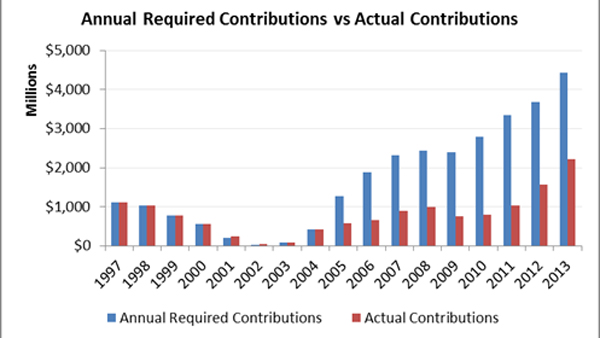
Basically, the legislature stopped paying the bills for 17 years.

pa_required_vs_actual_contributions_pew_600

Both the state government and commonwealth employees are responsible for paying into the pension system. And state workers made all their payments. They put aside 7.5% of their salaries every year to pay for their retirement.

But the legislature didn’t make its payments. It pushed them off to the future, and now that the future’s here, lawmakers have the gall to act like they have no idea where this cost is coming from!?

You ran up the bill! Time to pay! But instead of doing that, you blame the hardworking men and women who do all the state’s actual J.O.B.’s. And you practice Al-Qaeda tactics against labor, teachers and students!

Is that too harsh?

Who else holds people hostage to their demands?

This is terrorism as governmental policy. Our course of action should be the same with guerrilla extremists at home as it is with those on foreign soil: We don’t bargain with fanatics.

Gov. Wolf has a plan to pay off the pension debt. It’s nothing fancy. It’s the same kind of advice you might get from your accountant – or your mom. Refinance, reduce costs elsewhere and pay your bills.

That’s certainly a more sound strategy than holding a knife to workers and kids.


If you live in the commonwealth, please write your Senator and State Representative asking them not to support the GOP pension plan and to pass Gov. Wolf’s budget.

NOTE: This article was also published on the Badass Teachers Association blog. I also talked at length about this subject on the Rick Smith Show.

BONUS VIDEO:

https://www.youtube.com/watch?v=JhUPs6SJQMc