I am a Public School Teacher. Give Me All the Refugees You’ve Got!

syrian_refugee_schools

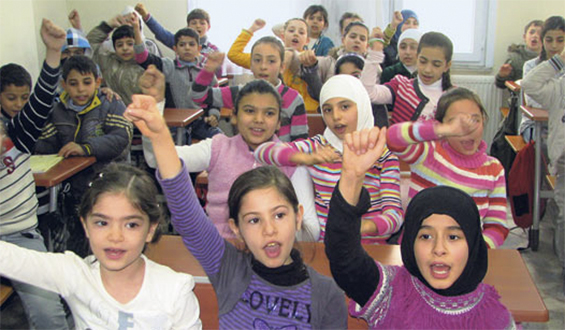
Come into my classroom any day of the week and you’ll see refugees.

That little Iraqi boy slumped over a book written in Arabic while the rest of the class reads the same story in English. Those twin girls blinking back memories of the Bosnian War as they try to underline possessive nouns on an English worksheet. That brown-skinned boy compulsively rocking back-and-forth in his seat fighting back tears wondering when his dad is going to come home from prison.

Every day, every hour, every minute our public schools are places of refuge for children seeking asylum, fugitives, emigres, exiles, the lost, the displaced, dear hearts seeking a kind word and a caring glance.

Some may shudder or sneer at the prospect of giving shelter to people in need, but that is the reality in our public schools. In the lives of many, many children we provide the only stability, the only safety, the only love they get all day.

And, yes, I do mean love. I love my students. Each and every one of them. Sometimes they are far from lovable. Sometimes they look at me with distrust. They bristle at assignments. They jump when redirected. But those are the ones I try to love the most, because they are the ones most in need.

I told a friend once that I had a student who had escaped from Iraq. His parents had collaborated with the U.S. military and received death threats for their efforts. So he and his family fled to my hometown so far away from his humid desert heartland.

I told her how difficult it was trying to communicate with a student who spoke hardly any English. I complained about budget cuts that made it next to impossible to get an English Language Learner (ELL) instructor to help me more than once a week. And her response was, “Do you feel safe teaching this kid?”

Do I feel safe? The question had never occurred to me. Why wouldn’t I feel safe? I don’t expect ISIS to track him down across the Atlantic Ocean to my class. Nor do I expect this sweet little guy is going to do anything to me except practice his English.

In one of my first classrooms, I had a dozen refugees from Yugoslavia. They had escaped from Slobadan Milosevic’s ethnic cleansing. Yet you’d never know unless they told you. They were some of the most well-behaved, thoughtful, intelligent children I’ve had the pleasure to teach. They were always smiling, so happy to be here. They approached every assignment with a seriousness well beyond their years.

But sometimes you’d see a shadow cross their faces. Rarely you’d hear them whispering among themselves. I was so new I didn’t know any better but to come down on them. But later they told me what they had been talking about, what they had been thinking about – how Henry V’s military campaign brought back memories. They taught me that day. Every year I learn so much from my children.

My high poverty school doesn’t get a lot of refugees from overseas these days. But we’re overwhelmed with exiles from our own neighborhood. I can’t tell you how many children I’ve had in class who start off the year at one house and then move to another. I can’t tell you how many come to school bruised and beaten. I can’t tell you how many ask a moment of my time between classes, during my planning period or after school just to talk.

Last week one of my students walked up to me and said, “I’m having a nervous breakdown.”

Class had just been dismissed. I had a desk filled to the ceiling with ungraded essays. I still had to make copies for tomorrow’s parent-teacher conferences. I had gotten to none of it earlier because I had to cover another class during my planning period. But I pushed all of that aside and talked with my student for over an hour.

And I’m not alone. On those few days I get to leave close to on time, I see other teachers doing just like me conferencing and tutoring kids after school.

It was a hard conversation. I had to show him he was worth something. I had to make him feel that he was important to other people, that people cared about him. I hope I was successful. He left with a handshake and a smile.

He may not be from far away climes, but he’s a refugee, too. He’s seeking a safe place, a willing ear, a kind word.

So you’ll forgive me if I sigh impatiently when some in the media and in the government complain about the United States accepting more refugees. What a bunch of cowards!

They act as if it’s a burden. They couldn’t be farther from the truth. It’s a privilege.

When I see that iconic picture of three-year-old Syrian boy Aylan Kurdi drowned in Turkey as his family tried to escape the conflict, I find it impossible that anyone could actually refuse these people help. Just imagine! There are a host of others just like this family seeking asylum and we can give it! We have a chance to raise them up, to provide them a place to live, to shelter them from the storm. What an honor! What a privilege! What a chance to be a beacon of light on a day of dark skies!

I’m an American middle class white male. My life hasn’t been trouble free, but I know that I’ve won the lottery of circumstances. Through none of my own doing, I sit atop the social ladder. It is my responsibility to offer a helping hand in every way I can to those on the lower rungs. It is my joy to be able to do it.

It’s what I do everyday at school. When I trudge to my car in the evening dark, I’m exhausted to the marrow of my bones. But I wouldn’t have it any other way.

It’s not uncommon for a student or two to see me on the way to my car, shout out my name with glee and give me an impromptu hug. At the end of the day, I know I’ve made a difference. I love being a teacher.

So if we’re considering letting in more refugees, don’t worry about me. Send them all my way. I’ll take all you’ve got. That’s what public schools do.


NOTE: This article also was published in Everyday Feminism, the LA Progressive and on the Badass Teachers Association blog. It was also quoted extensively in an interview the National Education Association did with the author.
 

Prejudice of Poverty: Why Americans Hate the Poor and Worship the Rich

2children


Take a breath.

Take a deep breath. Let your lungs expand. Let the air collect inside you.

Hold it.

Now exhale slowly. Feels good doesn’t it? You’d never realize there are hundreds of contaminates floating invisible in that air. Dirt, germs, pollution – all entering your body unnoticed but stopped by your immune system.

If only we had such a natural defense against prejudice. Racism, classism, xenophobia, sexism, homophobia – we take all that in with every breath, too.

It may not seem like it, but all these value judgments are inherent in American culture. They’re as much a part of life in the United States as the flag, football and apple pie. And to a greater or lesser extent, you have subconsciously accepted them to help construct your ideas of normality.

What does it mean to be a man? What does it mean to be a woman? How should black people be treated? To whom is it appropriate to be sexually attracted? What makes a person poor and why? All of these questions and so many more have been answered one way or another for us by the dominant culture. Not everyone accepts this perceived wisdom, but most of us have swallowed these solutions whole without thought, logic or criticism – and we don’t even know it’s happened.

Take our preconceptions about wealth and poverty.

Well paying jobs are drying up. Minimum wage work is becoming more common. Salaries are shrinking while productivity is increasing. Meanwhile the cost of living continues to rise as does the cost of getting an education.

Yet we still cling to the belief that all rich people deserve their wealth and all poor people deserve their poverty.

When we hear about someone on Welfare or food stamps, we sneer. The average conception is that this person is probably faking it. He or she could have earned enough to avoid public assistance, but he or she isn’t trying hard enough.

Moreover, we KNOW with a certainty that goes beyond mere empiricism that many of the poor still manage to buy the newest sneakers, have flat screen TVs and eat nothing but Porterhouse steaks.

You can hear this kind of story uttered with perfect certainty from the mouths of white, middle class people everywhere. They don’t mind helping people who are really in need, they say, but most poor folks are gaming the system.

Never once do they stop to consider that this story about impoverished individuals living better than middle class Americans is, itself, one of the most pervasive myths in our society. We know it the same way we know all Polish people are dumb, all Asians are smart and all Black people love fried chicken and watermelon.

However, none of this “knowledge” is supported by the facts. Look at the Supplemental Nutrition Assistance Program (SNAP). According to the New York Times:

Allegations of fraud, including an informal economy in which food stamps are turned into cash or used to buy liquor, gasoline or other items besides food have been used to argue that the program is out of control. In fact, the black market accounts for just over 1 percent of the total food stamp program, which is far less than fraud in other government programs like Medicare and Medicaid.

If you include erroneous payments because of mistakes on applications, overall loss to the food stamp program comes to 4%, according to the Department of Agriculture. Compare that to the 10% lost to Medicare and Medicaid – programs no one is calling to be cut or eliminated.

But figures like these don’t convince the average American. We’re so certain that all or most poor people are just lazy parasites. Everyone “knows” some low-income person they deem to be living too high for their circumstances.

And, yes, sometimes you do see an impoverished individual not wearing rags. Sometimes you do peek into an indigent person’s hovel and see new electronics or game systems.

How does this happen?

Debt.

Credit card companies are waiting in the shadows to extend a line of credit to just about anybody. It’s a safe bet for these businesses. If they give you money today, they can charge exorbitant rates of interest – even more so with the highest risk clientele. But there isn’t much risk to these corporations these days when almost anyone can take a job as a state constable or bail recovery agent to hunt down debtors and bring them to economic justice.

When you see a destitute child with new sneakers, his parents probably bought them with plastic. When you see an X-Box in a needy person’s house, chances are that wasn’t paid for in cash. They used the charge plate and will end up paying for that game system many times what it’s worth.

It’s a problem not limited to the poor. Even middle class folks are drowning up to their eyeballs in debt. As wages have decreased, people have used their credit cards to keep a standard of living they expect. But they’re paying for it with huge portions of their paychecks going to these credit card companies. Yet even though we all do this, middle class folks look down their noses at people lower down the economic ladder for doing the same thing.

In fact, they refuse to even see that obvious truth. Instead they cling to the lie that poor folks are social parasites. We even begrudge them food. Those are my tax dollars going to pay for that penurious person’s free ride, they say.

Unfortunately, we don’t stop to consider how much of our taxes are actually going to help the less fortunate.

Let’s say you make $50,000 a year. That means, you pay $36 toward food stamps. That’s ten cents a day – the same amount many charities ask to help feed starving children in Africa.

If you add all safety net programs, the cost only goes up an additional $6 a year. That doesn’t seem like a huge chunk of my taxes. Honestly, do you begrudge needy people less than the price of a meal for a family of four at Bennigan’s?

By and large, your tax bill isn’t going to the poverty-stricken. It’s going to the wealthy. Over the course of a year, you pay $6,000 for corporate welfare.

You read that right. Six K. Six grand. Six thou. Those are your tax dollars at work, too. And it’s a much larger burden on your bank account than the $42 you shell out for the poor.

What do you get for that $6,000 outlay? It includes at least $870 to direct subsidies and grants for corporations. An additional $870 goes to offset corporate taxes. Another $1,231 goes to plug holes in the federal budget from revenue lost to corporate tax havens. Oh! And don’t forget a sizable chunk for subsidies to Big Oil companies that are polluting our skies and fueling climate change and global warming.

Most of your money isn’t going to feed hungry children. It’s going to recoup losses for giant transnational corporations like Apple and GE that hide their money overseas to boost profits and avoid paying taxes for things we all need like schools, police and fire departments.

This money subsidizes giant multi-national corporations that are already making billions and billions of dollars in profit each year. In the past decade alone, corporations have doubled their profits – all while reducing their American workforces and sending jobs overseas. Yet we only complain about poor folks using food stamps and buying new sneakers on credit.

Why is that? Why does it only bother us when poor people get help and not when huge corporations do?

Part of it is the media. We’ve been convinced that big business deserves its money and poor people don’t. Another part of it is that these facts often go underreported. Movies and TV shows love portraying the parasite poor person but rarely portray the corporate leech. Outside of “It’s a Wonderful Life” and “A Christmas Carol,” the wealthy are usually portrayed in the most positive light possible and not as addicts hoarding cash they don’t need to compete with each other in a childish game of one-upmanship.

Finally, there is the racial and sexual element. By and large, corporations are run by white males. The poor are mostly black, brown and though women make up a slightly higher percentage than men, it is often conceptualized as uniquely female. Take the term Welfare Queen. Why is there no Welfare King? How telling that our conception only allows for one gender in this role!

The reality is much different. The true Welfare Queens are Big Businesses. They make unprecedented profits and avoid paying taxes on them. They have tons of cash on hand but never can seem to get enough. And if we increased the corporate tax rate to what it was in the 1950s when the Unite States was more prosperous than it has ever been, these same corporations would still be Filthy. Stinking. Rich.

So the next time you hear someone blaming the poor for gobbling up your taxes, remember the facts. First, it’s simply not true. There is no widespread fraud by the poor. They are not gaming the system. They are not putting an undue burden on the middle class. However, big business IS – in fact – cheating you out of income. Business people are getting fabulously wealthy on your dime – and even if we stopped subsidizing them, they’d still be fabulously wealthy!

Finally, don’t ignore the racial component. Would middle class Caucasians still complain so vehemently about the poor if they weren’t mostly talking about Black people, Latinos and women? I doubt it.

We may breath in these prejudices but we’re not helpless. It’s up to all of us to dispel these myths, not to let them stand, to confront them every time they come up. And, yes, I mean EVERY. TIME.

The only immune system we have as a society is education, knowledge, wisdom. And once you know the truth, don’t let anyone get away with this kind of racist, classist bullshit.


NOTE: This article also was published in the LA Progressive and on the Badass Teachers Association blog.


Puerto Rico Teachers Plan One-Day Strike to Protest Corporate Education Reform

11214329_10153183230456981_1552435887463960982_n

Welcome to sunny Puerto Rico.

The ocean is a gorgeous cerulean blue. Palm trees wave gently in the salty breeze. And in the distance you can hear percussion, horns and singing.

The protest has begun.

12242864_10153398609583152_567773654_o

Residents of this United States territory have been fighting freshman Governor Alejandro García Padilla’s efforts to close public schools, privatize those left and shackle teachers to the same corporate education reform schemes that are crippling schools on the mainland.

This Tuesday island educators are asking parents not to send their children to school. Teachers plan to conduct a one-day strike to protest legislation that could be passed the same day to further cripple the Commonwealth’s public education system.

“On November 17th we’ll be giving our lesson’s outside our classrooms,” says Mercedes Martinez, president of the Federación de Maestros de Puerto Rico, the teachers union.

“We’ll be in front of our schools early in the morning and at 10:00 a.m. will march from Congress to the Governor’s Mansion in San Juan. This is one of many activities that we’ll perform in defense of public education. We will not accept these precarious impositions and will fight back.”

12212114_10153398609843152_2007230691_n

The protest is in response to Project 1456 which would close more than 380 public schools. The government has already closed 150 schools in the past 5 years.

This would force many students into even more overcrowded classrooms. Thousands of children would have to be relocated to schools far from their homes.

But that’s not all.

The proposed legislation would also privatize 15% of those schools left standing. Unlike the mainland, Puerto Rico has no charter schools. Teachers went on a 10-day strike in 2008 which only ended after the island Secretary of Education Rafael Aragunde signed an agreement promising not to open any charters.

12226476_10153398609693152_1059022729_n

If privatized schools opened on the island, parents might have to pay an additional fee for services they now enjoy for free. Amenities like lunches and even tuition may have to be subsidized by parents out of pocket.

Moreover, it would collapse the teachers retirement system, Martinez says. Charter schools would not deduct employees payments to the pension system so it might not be able to remain solvent.

Project 1456 would harm teachers in another way, too. It would enact a punitive evaluation system where 20% of educators value would be based on students standardized test scores. Any teacher with a 79% or less would have two years to improve or be fired.

“Teachers will have no rights,” Martinez says.

12231352_10153398610428152_1685357633_n

The proposed legislation has already been approved by the Commonwealth Senate. It’s main author Sen. Eduardo Bhatia is pushing for the House to fast track it for approval.

Discussions began in the House last week.

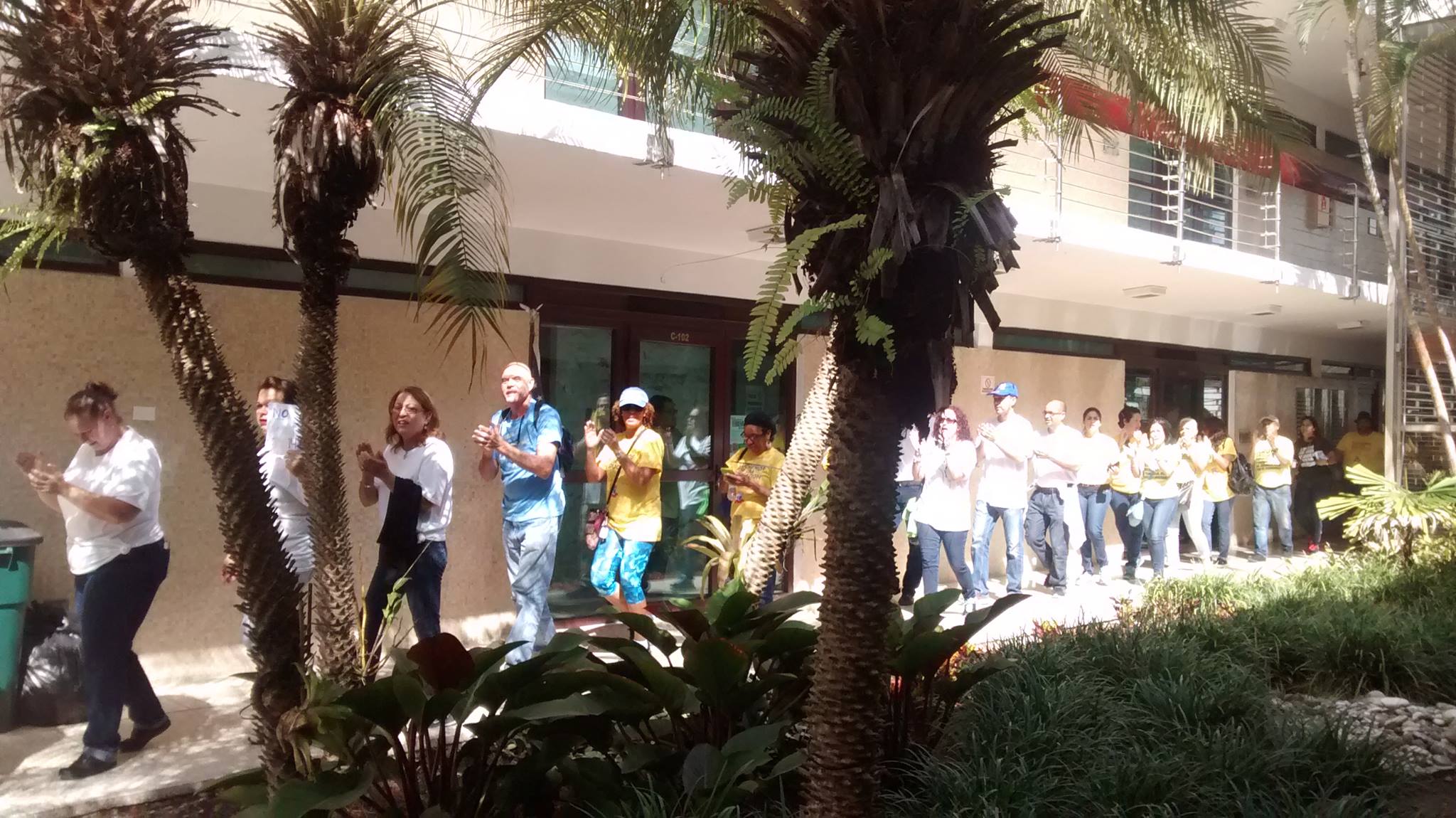
Protesters were there on Wednesday. They stood up in the government chamber and walked out en mass when it was brought up for discussion. Eighteen of them wore white T-shirts spelling out the message “Our Schools Are Not For Sale.”

12095142_10153786665063035_3426408204355682730_o

Inside the House, presidents of private universities testified in favor of the measure.

“Obviously they want to become administrators of charter schools on our island,” Martinez says.

Outside the building, protesters held their own emblematic hearing on the matter. Community members, teachers and parents testified in the open air about how this legislation would hurt children. They ended with a symbolic vote against it.

12233087_10153398610653152_624717262_n
Puerto Ricans are not alone in this fight.

Jitu Brown, a community organizer from Chicago and Director of Journey for Justice Alliance traveled there to stand in solidarity with those fighting for their schools. Brown participated in a 34-day hunger strike in his hometown a month ago to protest Mayor Rahm Emanuel’s plan to close the last open enrollment school in his neighborhood.

“This beautiful, breathtaking place is marred by ugly U.S colonialism and privatization of public services on steroids!” says Brown of Puerto Rico.

“I was blessed to spend time with powerful people fighting for a better world. Big ups to your warrior spirit, discipline and hospitality! Where we struggle, we can win! If we don’t struggle, we are guaranteed to lose.”

12243064_10153183230516981_9040874307608479627_n

The plight of Puerto Rican communities also inspired support from the Badass Teachers Association, a group of more than 56,000 educators, parents, students and activists.

“The Badass Teachers Association stands in strong solidarity with our brothers and sisters in Puerto Rico who are fighting for the very foundation of their democracy – the survival of their public school system which is under assault by the 1% who seek to close it up and deny Puerto Rican children a right to an education,” says Executive Director Marla Kilfoyle.

Protesters are getting the word out. They’ve already handed out thousands of fliers. Today they plan to drive in a large caravan across the island.

“We’ve got a bunch of cars with sound equipment,” Martinez says.

“We will go to all the communities near our schools in different regions asking parents to support the strike on the 17th.”

12233347_10153398610098152_2099123130_n

Much of the the island’s financial woes are imported from the mainland. Puerto Rico is besieged by vulture capitalists encouraging damaging rewrites to the tax code while buying and selling the territory’s debt.

Hundreds of American private equity moguls and entrepreneurs are using the Commonwealth as a tax haven.

As a result, tax revenues to fund public goods like education are drying up while the super rich rake in profits.

Officials warn the government may be out of money to pay its bills by as early as 2016. Over the next five years, it may have to close nearly 600 more schools – almost half of the remaining facilities!

12208352_10153183230836981_3863947130415132926_n

“That’s why the Teacher’s Federation and other teacher unions allied together to fight back against the attack on our education system,” Martinez says.

“As you can see, we’ve been busy.”

If Project 1456 is passed by the House, the union is considering a general strike.

12268501_10153398610318152_1824591574_o

Of the 135 schools closed in just the last two years, Commonwealth Secretary of Education Rafael Román had originally proposed shuttering 200. The remaining 65 were only kept alive because communities occupied the buildings and refused to let the government step in.

Protesters stormed the Senate in October when Bhatia first introduced Project 1456.

“Senators decided to approve it without discussion because they did not want to listen to teachers chants and indignation,” says Martinez.

“Senator Bhatia has become the symbol for privatization under this administration. He has never been in a public School. He has no bond with it. He’s a demagogue.”


NOTE: This article also was published on the Badass Teachers Association blog.


While Hillary Clinton Courts Teachers, Bernie Sanders May Have Conceded The Education Vote

hillary_clinton_bernie_sanders_ap_img

Hillary Clinton has made huge strides this week courting education voters. The Democratic Presidential candidate made a statement critical of scandal ridden charter schools. She also met with educators to answer questions in a closed door meeting.

Meanwhile Clinton’s main competition for the Democratic nomination, Bernie Sanders, remains silent on K-12 public education. He’s a favorite among teachers but he hasn’t really articulated much of an education policy at all.

Parents, educators and students are looking for a candidate with the guts to turn away from the destructive school policies of the last two presidents. Both George W. Bush and Barack Obama have increased privatization and standardized testing while reducing teacher and community autonomy. Instead of helping alleviate an epidemic of child poverty, they have blamed the problem on schools and teachers while starving them of the funding they need to succeed.

Frankly, moving away from these corporate education reform policies is a bad fit for Clinton. Her past education positions have been almost identical to that of the Obama administration. She’s been a strong advocate for charter schools and Common Core. She receives hefty support from wealthy corporate school reformers like Eli Broad, George Soros, Bill and Melinda Gates and the Walton family. After all, her first major policy achievement was her 1983 campaign to establish accountability-based school reform in Arkansas when her husband was Governor.

Her connections to this movement have not weakened. Just this week, #TeachStrong – an education reform organization – was launched with ties to Clinton. The group is organized by the Center for American Progress (CAP) – a think tank long affiliated with both Hillary and Bill. Husband and wife have hired numerous staffers from this organization and have championed policies that originated behind CAP’s closed doors. Many education observers are theorizing that the #TeachStrong initiatives which blame teachers and try to make their lives more difficult will eventually become Clinton’s education policies if she becomes President.

By contrast, Sanders would seem to be well suited to oppose these corporate-driven school reforms. He’s anti-privatization, anti-Wall Street and pro-worker. His vitriol against the banking industry and the 1% using tax loopholes to avoid paying their fair share would only be enhanced if he included corporate school reformers on his hit list. These are, after all, most of the same people he’s already going after just for different reasons. Unfortunately, he has yet to embrace public schools. Up to this week, both he and Clinton favored only pre-kindergarten and college support. Now she has started talking about K-12, but Sanders’ lips remain buttoned.

Perhaps this is because he thinks education voters have already sided with Clinton. The largest teachers unions – The National Education Association (NEA) and the American Federation of Teachers (AFT) – both endorsed Clinton in the primary. However, in each case these endorsements were highly controversial coming mainly from union leaders without much or any involvement from rank and file members.

Clinton seems to know that top-down endorsements alone won’t get her votes. She needs to win the hearts and minds of membership, and she seems to be committed to doing just that. Her education comments may not be entirely satisfactory, her connections may be highly unsavory, and her history may be deeply disturbing, but at least she’s making the effort to reach out to voters who care about the education system.

Sanders, where are you? You’re a Democratic Socialist. You say you’re committed to the public good. What is a greater public good than public schools? The education vote is by no means decided. It remains on the table for either candidate to take.

Personally, I don’t think Clinton is a good choice to come to education’s rescue. No matter what she says, I just don’t trust her. Someone who champions privatization isn’t going to save us from for-profit charter schools. Someone who is in bed with the testing industry isn’t going to reduce standardized testing. Someone who helped establish Common Core isn’t going to repeal it.

But if I’m honest, Sanders has skeletons in his closet, too. In the Senate he voted to expand charter school funding, voted for No Child Left Behind and most recently voted to keep test and punish policies in the Elementary and Secondary Education Act. However, given everything else he espouses, all these votes seem like anomalies. While Hillary looks like a seasoned professional who knows exactly what she’s doing in education circles, Bernie seems like a bumbling amateur who keeps making mistakes. It appears all he needs is a good talking to, someone to explain how our interests and his align perfectly. (Call me maybe!)

Of course, there is another possibility. Perhaps Sanders is against us as much as Clinton. Perhaps there is no major politician out there who has any interest in saving our schools.

Perhaps we really are alone.

In that case, maybe we shouldn’t wait for major politicians to come to us. Maybe we should consider supporting someone who is honestly in favor of us but does not yet have much political clout.

What say you, Dr. Jill Stein?

In the meantime I find myself waiting impatiently for Sanders to make his move. But I won’t wait forever. If he wants my vote – and the votes of hundreds of thousands of parents and teachers – he’s going to have to make his case.

Otherwise, we’ll look somewhere else.


NOTE: This article also was published on the Badass Teachers Association blog.


Hillary Clinton’s Charter School Problem

hillary

Good news! Democratic Presidential candidate Hillary Clinton just admitted there are significant problems with the nation’s charter schools!

Bad news! She has no interest in solving them! In fact, she thinks charters are just great.

Here’s Clinton criticizing charter schools:

Most charter schools — I don’t want to say every one — but most charter schools, they don’t take the hardest-to-teach kids, or, if they do, they don’t keep them. And so the public schools are often in a no-win situation, because they do, thankfully, take everybody, and then they don’t get the resources or the help and support that they need to be able to take care of every child’s education.

And all over the country, teachers, parents and students rejoice. Someone actually notices our problem!

Charter school scandals seem to hit the paper with the regularity of a grandfather clock. Charters cut student services and boost overhead to produce profit. Charters rack up debt and then sell it for a profit. Charters fudge the paperwork so they get paid for students who don’t actually attend. And just as Clinton said, they push out the children who are most in need and hardest to teach.

In short, most charter schools stink. Clinton admits we have a problem. But how do we solve it?

Clinton:

I have for many years now, about 30 years, supported the idea of charter schools, but not as a substitute for the public schools, but as a supplement for the public schools. And what I have worked on through my work with the Children’s Defense Fund and my work on education in Arkansas and through my time as first lady and senator is to continue to say charter schools can have a purpose, but you know there are good charter schools and there are bad charter schools, just like there are good public schools and bad public schools.

So I want parents to be able to exercise choice within the public school system — not outside of it — but within it because I am still a firm believer that the public school system is one of the real pillars of our democracy and it is a path for opportunity. …the original idea… behind charter schools was to learn what worked and then apply them in the public schools…

So Clinton’s solution to the charter school crisis is what exactly? She seems to be saying that charter schools have major problems, but the best way to fix them is to redouble our belief in this flawed and failing system.

It sounds like a line from Peter Pan: Clap your hands, children, and Tinkerbell will live! You just have to believe! Oh! Close your eyes and believe in charter schools, and they’ll be all fixed!

It’s a non-answer, an evasion. It’s the kind of politics Hillary Clinton excels at – say something so empty and middle-of-the-road that both sides of a position can find something to like about it. Take something and focus group the hell out of it until it’s almost meaningless.

The problem is that this kind of spin doctoring doesn’t help improve our schools one bit. It’s really an endorsement of the status quo. After all, what solution has she offered here?

If you aren’t paying attention, it sounds like a commitment to fix our charter schools, but it’s actually just a commitment to gift wrap them more of your tax dollars with zero accountability.

Notice what Clinton said about choice. She supports parents having a choice between various kinds of public schools – but not parochial and private schools.

Choice!? What a bunch of baloney! By and large parents don’t want to have to shop around for a school the way you would melons at the grocery store. Weigh them in your hands, look for soft spots and hope they’ll be sweet once you cut through the rind.

Parents want all public schools to be excellent. “Let The Buyer Beware” is a poor principle on which to found our system of public education.

Mrs. Clinton, who exactly are you trying to give choice to – parents or corporations? Do you want parents to be able to choose between several mysterious options or do you want to give corporations another market in which to make a profit?

It’s almost a veiled threat. There are some people out there, she might as well as be saying, who want to give your tax dollars to private and parochial schools. Not me. Nope. I’ll only give your tax dollars to traditional pubic schools or charters.

What goes unsaid is the fact that many charters run themselves like private schools. They’re almost the same thing but on the public dime. Why do you think so many call themselves “academies”? They want to look exactly like private schools. The biggest difference is they can’t violate the separation of church and state.

So Clinton is against private schools if they’re called private schools, but if we call them charter schools, they’re just peachy! Wow! There’s such a world of difference between that view and Jeb Bush’s!

Thanks a bunch, Mrs. Clinton. That’s a mighty progressive position you’ve got there. You’re going to support public schools by allowing parents to opt out of them? This is the best the Democrats can do these days!? Yikes!

And please spare me the nonsense about the original purpose of charter schools. They were supposed to be laboratories to try out new things that would eventually get applied in the traditional public school setting!? That has never happened! Not once! No one has ever looked at the charter school model and said, ‘Gee! They’re really doing such a great job! Let’s do that here!” unless it was in terms of the Cadillac funding they often receive while public schools strive to get by on what’s left between the couch cushions.

Moreover, if having the freedom to experiment is so great, why not offer traditional public schools the same option? Why not free public schools to experiment instead of weighing them down with Common Core and toxic testing (which – if I’m not mistaken – you wholeheartedly support, Mrs. Clinton)?

If most charter schools are abusing that freedom by pushing out needy students, why not take that power away? Why not support a national moratorium on any new charters? Why not investigate every existent charter and close down the ones that aren’t effective? Why not take the money saved by such a venture and use it to invest in the traditional public school system that has proven time-and-again to be the best educational alternative for our nation’s children?

Instead of pretending to offer choices, why not make sure every public school is excellent and allow parents and students choices within those schools such as whether they want to take art, music, foreign languages, extracurricular activities, etc.?

Why? Because those would be real solutions, and if there’s one thing politicians hate, it’s solving problems.

If Clinton did that, she might offend someone. She’d lose votes. Better to try to appear to be pleasing everyone.

And thus she pleases no one.


NOTE: This article also was published in the LA Progressive and on the Badass Teachers Association blog.


Stockholm Syndrome – The Only Reason Any Teachers Still Support Common Core

Screen shot 2015-11-05 at 11.06.26 PM

Common Core is dying a well-deserved death.

The very idea that we need the same academic standards in public schools from coast-to-coast is unpopular, expensive, ineffective and politically suicidal.

The Wall Street Journal reports at least $7 billion taxpayer dollars have been wasted implementing this plan, and it would cost significantly more to finish the job.

“Five years into the biggest transformation of U.S. public education in recent history, Common Core is far from common. Though 45 states initially adopted the shared academic standards in English and math, seven have since repealed or amended them. Among the remaining 38, big disparities remain in what and how students are taught, the materials and technology they use, the preparation of teachers and the tests they are given. A dozen more states are considering revising or abandoning Common Core.”

Meanwhile public support drops precipitously with each passing year. Less than half of all Americans – 49% – and only 40% of teachers now favor the policy. That’s a drop of 16% among the general population since 2013. But even more surprising is the plummeting backing from teachers. Advocacy has dropped 36 points from two years ago when three quarters of educators approved of the change. This is especially damning because of all social groups, teachers know the Core the best.

In political circles lawmakers who used to champion these standards now take pains to distance themselves from them. Politicians as diverse as Jeb Bush and Hillary Clinton now claim they either never supported the policy in the first place or that it’s a good idea that has been badly implemented. Support among Republicans – who initially favored the plan much more than Democrats – has practically vanished.

The writing is on the wall. Common Core is sinking fast.

Yet there remains a minority of real live educators who will cheerfully direct you away from the lifeboats even as the ship of our public schools lists dangerously to port. Despite everything going on around them, they cling to this disastrous policy blunder despite the harshest criticisms.

It’s strange.

By and large, Common Core wasn’t created by teachers. It was forced on us by policymakers, functionaries and corporations. It usurps our autonomy. It overrides our judgment. And it ties us to practices that almost all of us think are detrimental to our students. But some of us still think it’s the bees knees.

The only explanation I can come up with is Stockholm syndrome. The phenomena, also called capture-bonding, occurs when hostages empathize with their captors. Kidnapping victims sometimes feel sorry for the very people who abducted them. Something similar seems to be happening with the few hardcore supporters of Common Core that are left.

For instance, regardless of the public relations efforts being spewed by corporate America, Common Core was not created by teachers. It’s shocking that this fact is still disputed. It is easily verifiable.

Here it is from the National Governors Associationthese 24 people wrote the first draft of the standards. And these 101 people revised them. None of these people were currently employed as a K-12 classroom teacher. Moreover, very few of them even had K-12 classroom experience at some distant point in their careers. Even less had experience at the middle school or elementary level. Less than that had experience in special education or with English Language Learners.

Therefore saying Common Core was created by teachers is incredibly disingenuous. It’s like taking a single speck from a beef bullion cube and calling it a filet mignon. Something resembling a cow may have been present at one point, but add water and you couldn’t exactly call the flavor beefy.

The overwhelming majority of Common Core authors are identified as working for the testing industry – specifically the College Board and ACT. The second largest group worked for Achieve, a Washington think tank. Others worked exclusively at the college or university level.

Yet there remain a small cadre of real life K-12 teachers who still champion this product. Think about what that means.

They prefer a prepackaged set of academic standards to what they would come up with on their own or with their colleagues. They prefer to give up their own professional judgment based on years of experience, degree certifications and professional development in favor of something handed down to them from the testing corporations and policy wonks. They would rather be told what to do by people with far less experience than to make their own decisions about how to do their own jobs.

Even if everything in the Core was hunky dory, I’d have a problem with that. Call it self-respect. Call it professional pride. I did not get into this field to become anyone’s worker drone. Being a teacher is not on par with being a greeter at Walmart. We need to make complex decisions about how best to educate children every moment of every day. That’s not a mcjob.

This doesn’t mean all the standards contained in the Core are garbage. There are certainly some things in there that promote learning. However, as educators have become more familiar with the contents, glaring mistakes have become apparent – standards that are age inappropriate, too specific, not specific enough, unduly restrictive, and just plain weird. If only there were some objective means of telling the wheat from the chaff.

But there is.

We could have tested the standards to see if they actually aided in comprehension. We could have field tested the product – tried it out in a small scale and then assessed its effectiveness. You would expect any new commodity to go through rigorous research and development. Only a fool would just throw new merchandise out there without any idea if it would work.

Welcome to Fool Nation – population you. That’s where your tax dollars went. Your government spent billions on something completely untried and unproven. And guess what!? It didn’t work.

I have a major problem with that. As a teacher, I am appalled that I am being forced to institute something so careless into my classroom. If the legislature suddenly thought all children should be forced to pour lemon juice on their heads before reading a book, I’d jolly well need a good reason to do it before I started squeezing citrus on top of my classes. But that’s kind of what they did, and they even charged the taxpayers for all the lemons!

However, the strangest part of this whole concern is standardized testing. Here at least we have agreement. Almost everyone says its out of control. We give too many tests. But many teachers go even further questioning these tests effectiveness at all.

High stakes assessments do not promote learning. They narrow the curriculum and punish the neediest students for – in fact – being needy. It’s a proven fact: rich children generally score well and poor children score badly. These are terrible measurements of children’s academic success.

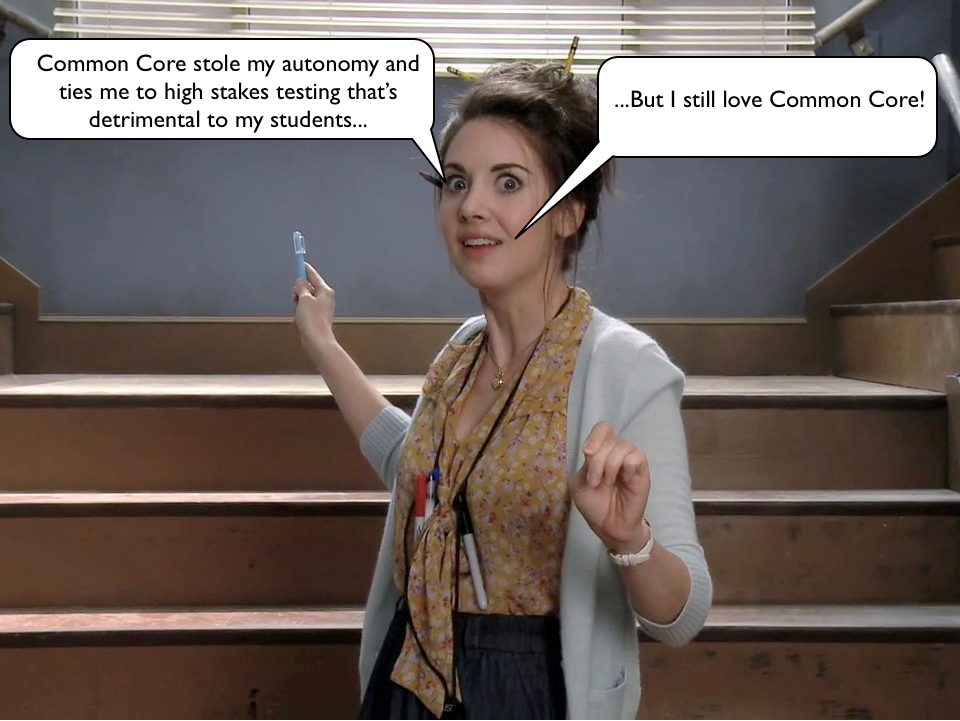
And most folks left on the dwindling bench of Common Core cheerleaders agree! They don’t like testing either! Yet so many times I’ve heard these people say, “I hate the testing but I love the Common Core!”

What!? They’re intimately connected.

Common Core was designed to be assessed by standardized tests. In fact, the standards attempt to make what is taught more representative of what is tested. For instance, most passages on Reading assessments are nonfiction. Therefore, Common Core says most of the reading done in school should be nonfiction. The tests emphasize cold reads. Therefore, the Core says teachers should make their students do more cold reads.

And yet Core advocates only find fault with the tests!? How can you say ‘I don’t like the tests but I like teaching to the tests I don’t like’?

It’s absurd.

And speaking of cognitive dissonance, why are we designing our curriculum backwards from the tests in the first place? Shouldn’t we be designing the tests based on the curriculum? Shouldn’t our assessments be made to prove that students are prepared for real life and not simply that they’re prepared to take the tests?

Bizarrely, all this remains a mystery to the few Common Core standard-bearers left in our classrooms. They want their Common Core. Yes, it was forced on them by bureaucrats. Yes, it’s never been proven to work. Yes, it’s intimately connected to the same standardized testing they hate. But they just can’t get enough of that Core.

Still, don’t be too hard on them. Everyday more of these folks are waking up. Every day more of them discover they are living in The Matrix. Reality is not as it seemed.

Perhaps it will just take more time. Or a strict regime of psychoanalysis, mediation and special pharmaceuticals.

But one day the Common Core will breath its last, and we’ll need everyone to help undo the damage.


NOTE: This article also was published on the Badass Teachers Association blog.


Rick Smith – Smuggling Teachers Voices Through the Media Embargo

FullSizeRender

I met Rick Smith for the first time in person this summer in Washington, D.C.

He had traveled to our nation’s capital to cover the Badass Teachers Association (BATs) Congress of which I was a member. Though I’d seen pictures and videos of him and even been on his daily radio show a handful of times, I was surprised to see him standing there in the lobby. He looked exactly like his pictures.

Often when you meet someone like that in the flesh, you get a glimpse behind the mask at how much the persona differs from the person. For example, when I was a journalist and interviewed Marvin Hamlisch, he was much more the cranky old man than the consummate showman.

But Rick was just… Rick. Faded denim, golf shirt, tousled hair under a ball cap.

He treated me to breakfast in the hotel restaurant and we talked about politics, activism and education. In a way it was like being on his show except there was no audience. Maybe he didn’t speak as loud and didn’t feel the need to explain the background of a subject for listeners at home, no station identification, but other than that it was pretty much the same.

He’s the real deal. What you see – or usually hear – is what you get.

I remember thanking him for trucking all the way from northern Pennsylvania to be here with us. He wasn’t getting anything extra for this. We certainly didn’t have any money to pay him. Rick was actually interested in hearing what teachers like me had to say.

We had congregated here in the capital to lobby our lawmakers and discuss among ourselves how to change our national education policy into something more student centered and less privatized, corporatized and standardized. And Rick wanted to showcase it on his show. He wanted to be there, to see what we were doing, ask us questions and put it all on the air for listeners across the country.

And – of course – he bought me breakfast.

As I was making my way through a waffle, Rick dropped the bomb on me.

He wanted to know if there was more to this story – if there was enough information for a weekly radio segment.

I carefully swallowed and told him that there was.

We’re living at a time when what’s best for school children isn’t decided by parents or educators. It’s decided by lawmakers, policy wonks, billionaire philanthropists and corporate CEOs with oodles of cash to bribe others to see things their way. Teachers, parents and students are taking to the streets to protest high stakes standardized tests, Common Core, value-added evaluations, charter schools, Teach for America and a host of other corporate education reform policies.

But few in the media seem to be listening.

In the last year, only nine percent of guests discussing education on evening cable news were educators. Yet tech millionaires attempts to dismantle teacher tenure are championed by the likes of Time Magazine. Former CNN anchor Campbell Brown creates a so-called “non-partisan” news site to cheerlead privatization and demonize teachers. At the Republican Presidential debates, candidates fall over each other for the chance to “punch teachers in the face,” while the Democratic Presidential candidates have zero to say about K-12 schools.

And here’s a guy with his own radio show and podcast who is actually interested in what educators think!

We shook hands, made plans and another trip to the buffet.

Now it’s been a little more than two months since the “BATs Radio – This Week in Education” segment premiered. Every week – usually airing Mondays at 5 p.m. Eastern – Rick has two guests chosen by the BATs. And wow! Have we had some amazing interviews!

When the National Education Association (NEA) made the controversial move to endorse Hillary Clinton despite a lack of member outreach, we had history teacher and NEA Board of Directors member Tripp Jeffers on the show. Before the vote, Tripp asked Clinton about her ties to corporate education reformers.

We had New York teacher and Co-Director of BATs Action Committee Michael Flanagan on to talk first hand about what a dismal job our new US Secretary of Education John King had done as Chancellor of New York State Education.

New Orleans parent Karran Harper Royal explained how the Obama administration’s privatization scheme has systematically destroyed public schools in the Big Easy. Wayne Au talked about what it was like to be one of the appellants in the Washington State Supreme Court Case that found charter schools to be unconstitutional. New York parent Karen Sprowal described how the Success Academy charter school had trampled her child’s rights. Jeanette Taylor-Ramann explained what pushed her and several other Chicago parents and teachers to go on a hunger strike to save their last neighborhood school. Puerto Rican teachers union president Mercedes Martinez informed us of the massive island revolt against privatizers in our US territory.

And more and more and more! And it’s only been 8 weeks!

I am so thankful to Rick for making this a reality. Teacher, parent and student voices are getting through the media embargo. We’re being heard. It’s unfiltered news! It’s what’s happening at street level.

This wouldn’t be getting out there so prominently if Rick weren’t interested, if he didn’t think it was something his listeners were interested in hearing. He gives up a significant chunk of his weekends to do it. He gives up time with his family, his children, to bring this to the public.

I can’t express how much that means to me and the more than 56,000 members of BATs.

I remember thanking Rick at the end of that first breakfast meeting and I’ll never forget what he said.

“This is what we do, Steven,” he said. “We’re activists first.”

That’s why Rick Smith is a true progressive hero.


NOTE:

You can hear the BATs Radio – This Week in Education segment most Mondays at 5 p.m. Eastern on the Rick Smith Show. The entire progressive talk show airs weekdays from 3 – 6 p.m. on several radio stations and on-line.

All BATs Radio interviews are archived here in case you missed them.

There are also a plethora of fascinating interviews from the BAT Congress on the Rick Smith Show Website.

This article also was published on the Badass Teachers Association blog.

Blame the Victim – America’s Favorite Pastime

officer-ben-fields

I watched a little girl at school refuse to get out of her seat and get pounded by the police.

I watched a teenager in his car try to zoom away from a cop and get shot dead through the driver’s side window.

I watched all of these things and more from the safety of my cell phone. I wasn’t there in person, but I felt like I was.

And I am not alone.

It seems these two events were on everyone’s lips yesterday.

This is one of the fruits of self surveillance – the selfie, the dashcam, the youtube video. Events that would have been shrouded in the haze of he-said-she said are now public domain. The shadowy corners and back alleys are now just as flooded with spotlights as the most crowded theater on Broadway.

In some ways, that’s a really good thing. So many events that only a decade ago would have been hidden forever are now open to public view.

You’d think that would solve a lot of our society’s problems. No more secrets. No more lies. Just objective facts. THIS is what happened. No denying it. We’ll need context, but facts are facts. Now we can come together and decide with clarity what really happened, why it happened and who’s to blame.

However, things don’t always work out as you’d expect.

We can – in fact – agree on the facts but not necessarily on their meaning.

We all see the same images but we somehow don’t see the same things. The same light enters our eyes and forms the same images, but our brains process those images very differently.

We all see a little girl forcibly removed by an officer of the law. We all see a victim and a perpetrator. But which is which?

We all see a police officer exit his car, approach another vehicle which flees from him before he draws his gun and shoots. But who is to blame – the cop or the driver?

We come to different conclusions. And I think the reasons why depend on deep human truths about each of us.

Which side you take says something about you. It shows what kind of person you are, what you value, what assumptions you make about human nature.

When I watch that South Carolina police officer violently grab the little girl and throw her from the room, I focus on the child. Here is a 16-year-old black teen. She apparently was told to leave the room and refused to do so. She was wrong. But my heart won’t let me side against her.

Maybe she hit the officer. Maybe she was verbally abusive. It doesn’t matter. I don’t think a police officer – or any adult – should manhandle a child. If she had a gun, a knife or some weapon, that would be different. But she was just sitting peacefully in her seat. She probably deserved some sort of punishment for insubordination – but not one that would cause her physical harm. I’d be furious if someone treated my daughter that way. And so I am angry at this police officer and all the bystanders who took pains to ignore what was going on.

In a similar manner, when I watch another South Carolina officer approach 19-year-old Zachary Hammond’s car, I begin on the adult’s side. When the teen starts to drive away, I’m with the police officer. The teen is breaking the law. He should listen to the cop who is reasonably asking to question him. However, when the officer draws his gun, things get muddy for me. As the car drives away and the officer shoots into the window, I demand answers. All ambiguity disappears when I discover the teen was unarmed. He wasn’t pointing a gun at the officer. As you can clearly see, the car was not pointed at the cop. The adult was obviously in no danger.

The officer overstepped his bounds. Despite his claims of self defense, despite prosecutors siding with him, I cannot. It seems to me this 19-year-old boy out on a first date was victimized. Yes, he may have had drugs in his system. Yes, he may have possessed drugs with the intention of selling them. None of that justifies murder by a public servant who is charged with protecting and serving society. It may justify arrest, but it does not give the officer the right to be judge, jury and executioner. Imagine if death was the consequence for your own 19-year-old misdeeds! Far too high a price.

However, there are many who disagree. They side in both cases with the adult, with the police. And I see their point to an extent. Police have very difficult and dangerous jobs. They put their lives on the line to uphold laws that are sometimes ambiguous and of dubious value. But there needs to be limits to their authority.

What I find even more troubling is the dynamic between adults and children. Too often grown ups act as if they can do whatever they want to young people. They can touch, hit, belittle. And all in the name of discipline and order.

But maybe this says more about me than anything else. I care deeply about children. Not only am I a parent, I’m a public school teacher. I’ve devoted my life to helping young people get a good start in life. As such, I think violence against children is the most heinous thing anyone can do. It is despicable beyond words. Harming or killing an adult is bad. But do the same thing to a child and it is much worse.

This should be a shared value. It should be a tenet upon which our society is built. But instead too many of us blame the child or the parents. We’re presented with facts but lapse into assumptions about the child’s upbringing and the parents shortcomings. If the youngsters parents had done this or that, things would have been different. And – heck! – that may even be true! However, unlike our infinite surveillance of moments, the facts are not there. We have no record of mass parental neglect. We have just the opposite. In so many cases parents work multiple jobs to feed and clothe these children. They work night shifts. They take classes to improve themselves. So they can’t be present to the degree they’d like. But here we are passing the blame with nothing to support our assumptions but a feeling in our bellies. And we’re so deadly certain about it.

It’s sad really. We all can see the same events but remain unclear about the blame. We share the same senses and most of the same values. But our life experiences and prejudices make all the difference.

When an adult looks at these situations and sides against the child, I think it shows a terrible blindness. When some people look at the student roughed up in the classroom, they automatically side against her for a variety of reasons – race, gender, age, etc. among them. They have preconceptions about how black people act. Preconceptions about little girls. Preconceptions about poor children and their parents. And frankly it shows their moral judgment to be sick, diseased and untrustworthy.

Likewise, when some people see the teen gunned down in his car, they have preconceptions about the police and young people. Anyone on the other side of a police officer’s barrel is wrong simply by virtue of the direction in which he is pointing his gun, they might say. Police are defined as right. Suspects are defined as wrong. This is deeply troubling. It’s counterfactual. It’s untrue. Police are just humans, too. They can be wrong. They have been wrong. If we always assume they are correct in every situation, we are being morally lazy and willfully blind. We’re refusing to look at the facts and then judge accordingly. We stop at who is involved and not at what they did.

It’s so easy to blame the victim. It’s reassuring and safe. It means nothing is out of sorts with the world. Everything is just as it should be. Only this one person who was beaten by the police or shot dead – only that person is to blame. The social order remains intact and proper and good and justified.

It takes a kind of intellectual and moral honesty to look the world in the face and accept that which is uncomfortable but true. Sometimes those charged with protecting us actually do harm. Sometimes adults know less than children. Sometimes actions are racially motivated.

Because when we watch the world, the world looks back. We reveal ourselves. And sometimes we show the world exactly how ugly and depraved we can be as a nation.


NOTE: This article also was published on the Badass Teachers Association blog.


Department of Education SorryNotSorry About High Stakes Testing

Screen shot 2015-10-24 at 11.04.43 PM

The Obama Administration must think the nation’s parents, teachers and students are pretty darn dumb.

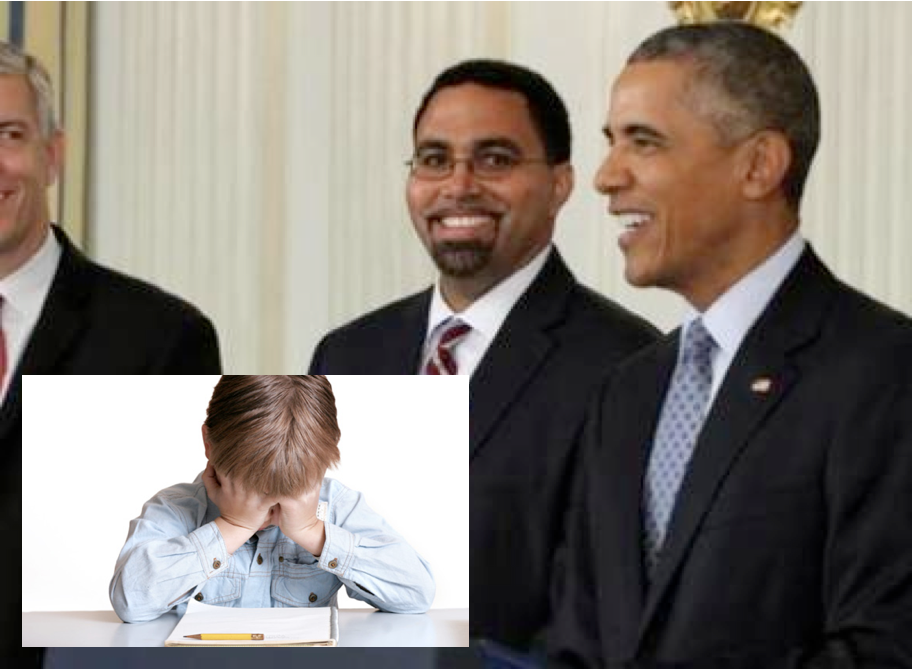
President Barack Obama and his hand-picked Department of Education are solely responsible for the knuckle dragging academic policies strangling our public schools day in, day out. Yet instead of doing anything to reverse course to proven methods that might actually help kids learn, the department trudges out its annual apology.

It goes something like this:

Hey, Everybody! So sorry about all those high stakes tests, Common Core Standards and Value-Added teaching evaluations. We know they’re bad and we’re going to stop.

Then whatever functionary drew the shortest straw toddles back into the building and for the rest of the year things continue on exactly the same as they always have.

Let’s just pause for a moment and imagine how incredibly stupid they must think we are. I’m surprised they don’t issue public service announcements reminding us to exhale, multi-colored pamphlets on the benefits of blinking, and puppet shows instructing us how to use the potty.

The Obama Administration has had 7 years to fix this mess, and the only things they’ve done are to make it worse. Most of us voted for this so-called progressive because we thought he’d improve upon George W. Bush’s astoundingly wrongheaded school policies. But instead he doubled down on them! We hired a competent janitor but he was successful only in creating greater disorder.

We thought someone with the intelligence and grace of Barack Obama would be able to understand more than the eternal C-student Bush that you can’t ensure equity by standardized testing. That’s like trying to ensure a bathtub was filling with hot water by using nothing but Tarot Cards. The cards don’t give you an accurate reading and even if they did, you’d need to adjust the faucet at some point!

We thought a Constitutional scholar would understand that a national school curriculum violates federal law – even if you get a faux state commission to propose it and slap a new name on the thing! The federal government is allowed to do some things and state governments are allowed to do others. It’s not that hard. Moreover, armchair generals who have zero understanding of educational pedagogy, psychology, sociology and no classroom experience have no business telling teachers what they should be teaching!

We thought a political party that claims to be on educators’ side wouldn’t then turn around and initiate a witch hunt against us using poor student test scores instead of pitch forks and torches. Every independent, peer-reviewed study shows that poor kids do badly on standardized assessments and rich kids do well. Every statistician says you can’t use a test created to measure one thing (students) to measure another (teachers). Yet this is exactly what this so-called intellectual president mandates, and then he and the Democrats expect us to be there for them at the polls!?

In short, we expected a liberal Democrat, but got instead a Conservative Democrat in Name Only (DINO). He took far right ideas that Bush could barely officiate and made them much more efficient and thus much more damaging.

And every year like an alcoholic stumbling off a bar stool, the administration swears they’re not going to take another drink. Then they hire the head of Anheuser-Busch (John King) as a nutritionist. And some of us still believe them!

Just look at the crumbs they’re throwing out to us, peons!

Hey, Girl. We’re going to cut testing down to 2% of the school year.

That’s 23 hours! Almost 3 full days! Imagine if the dungeon master told you he was only going to put you on the rack for 2% of the time! Would you thank him? Maybe, but it would be a pretty half-hearted thank you.

Can the administration prove any positive value for standardized testing? I’m not asking them to trot out the tired party line about equity. I mean can they prove that testing actually helps children learn in any appreciable way? If the answer is no (and Spoiler Alert: it is!) then we shouldn’t be wasting any more time with it. Not 2%. Not 1%. ZERO PERCENT!

Moreover, Obama has been talking about reducing testing since he ran for office in 2008. America’s schools are still waiting for him to come through on that one. Maybe on his last day in office we’ll have a testing moratorium. Fingers crossed!

The department says, “The assessments must be worth taking.” No shit. That’s exactly the problem! They aren’t! And they’re shrouded in secrecy under the guise of test corporations intellectual property. How will we be able to determine they’re “worth taking”? Will you just tell us? THAT sure puts my mind at ease!

You know what assessments have been proven worth taking? The ones created by teachers. Yet these are exactly the kinds of tests that schools have been forced to cut back on. Perhaps this is what the administration has in mind. No more teacher-created tests. Let’s just have tests made by the professional test creators who have no idea what the heck they’re doing!

And speaking teachers, this one’s for you: “No standardized test should ever be given solely for educator evaluation.” It sounds like a condemnation of Value-Added Measures (VAM), of evaluating teachers on student test scores. However, it’s just the opposite. Notice the word “Solely.” We’re not going to give kids tests if we ONLY use them to evaluate their teachers. Well woop-de-do! Professional flunkies will talk to you for hours (if you pay them enough) about how great the tests we give now are at doing both! So no change in policy, just some purple prose to light on fire and blow the smoke up educators hind ends.

Perhaps worst of all is the use of English Language Learners (ELL), students with disabilities and minorities as props. We’re doing it all for them, they say. Bull! Shit!

The administration has nothing to say about fully funding the Individuals with Disabilities Education Act (IDEA). There’s nothing about sanctions on districts that don’t provide proper services for ELLs. There’s nothing about ensuring adequate, equitable and sustainable funding for all students – especially the poor and minorities. Instead the Department of Education pretends like high stakes tests are candy bars and what poor disadvantaged minority ELL disabled kid doesn’t love the soft velvety chocolate taste of a multiple choice test!?

This announcement is not reason to celebrate. It’s more of the same fake apologies soaking wet in crocodile tears and bad candor.

If Hillary Clinton wants to get elected President, she’d better do more than that. If Bernie Sanders wants a shot, he’d better do more than spout socialism about Wall Street and silence about K-12 schools.

You can only lie to our faces for so long. Despite your best attempts to trash public education in the name of saving it, we’re not so dumb as to believe any more of your evasions, deceit and dishonesty.


NOTE: This article also was published on the Badass Teachers Association blog.


The Most Important Election You’ll Probably Skip

t1larg.voter.jan10

The future prosperity of your state may be decided this November.

Will your public schools receive adequate, equitable and sustainable funding?

Will you be permitted to choose medical marijuana to treat certain ailments?

Will your state enact sensible gun reforms to keep firearms out of the hands of the criminally insane?

Will your voice be heard in future elections?

All this and more is on the table and YOU get to cast the deciding vote.

But more likely than not, you won’t show up.

Why? You’re too busy worrying about the upcoming Presidential election.

With both Democratic and Republican Presidential Primaries approaching in February through June, 2016, most people just don’t have the energy for another general election before the end of 2015.

However, most states will ask residents to cast a ballot on Nov. 3 for all kinds of important initiatives. There will be municipal, school board, gubernatorial and state legislative elections in a few states; as well as numerous citizen initiatives, and a variety of other local offices on the ballot.

Yet if history is any guide, most people will stay home while vastly important decisions are being made by the few who trudge to the polls. On the one hand, that means the results are bound to be unrepresentative. On the other, it means if you show up, your vote will have more weight than ever!

Either way, the course for the future of your state will be quietly and discreetly set for years to come.

Take my home state of Pennsylvania.

We’re holding a historic election with three state Supreme Court seats up for grabs. The last time this many seats were open on our highest court in the same year was 1704, and the body was still called the Provincial Appellate Court.

This is huge because it will determine who gets the final say on a plethora of contentious political issues.

For instance, four years ago, Republicans controlled every branch of Commonwealth government and redrew the state’s legislative districts to gerrymander in a GOP majority. They redrew district lines to ensure that conservatives got elected to public office by making boundaries around areas that have pockets of people who generally lean Republican.

With that foundation in place, the GOP ran the state into the ground. While most taxpayers didn’t agree with the corporate tax giveaways and draconian budget cuts to public services like children’s schools, there wasn’t much we could do about it. The redrawn district boundaries were such that legislators were free to do whatever they wanted without fear of reprisals from constituents.

Voters gave the GOP Governor the boot, but almost all of his good soldier legislators stayed in place. This was only possible because Republicans controlled the state Supreme Court. When those gerrymandered districts were challenged, the court backed the legislature. So, in practice, continued Republican control of state Senate and House districts was due not to voters but to the state Supreme Court.

Currently, Republicans hold the balance of power in the highest Commonwealth court by 3-2 with two vacancies. This election could rewrite that balance of power.

If Democrats win two or more seats in this Supreme Court election – thereby replacing two Republicans and one Democrat – it could change everything! Democrats would have a majority.

When redistricting comes up again in 2022, if Democrats want to re-draw the lines more fairly (or in their favor), a Democratic-controlled Supreme Court could make that possible.

Moreover, the new court would almost certainly rule on cases that will have a dramatic impact on the lives of everyday Pennsylvanians.

Perhaps the most hot button issue in the state is education funding. Republicans have been waging all out war on poor Commonwealth schools. For the past 4 years, the legislature slashed public school funding by almost $1 billion – an ideological divide that still rages between the newly elected Democratic governor and the legislature where Republicans remain in control.

Several lawsuits demanding more equitable school funding are winding their way through the state court system. These cases are bound to end up in the state Supreme Court. So if voters still care about making sure all Pennsylvania children have a fair shake at an education, voting for Democrats to retake the court may be the surest option! If recent history is any guide, Republicans sure won’t do it!

Other issues such as the death penalty and gun laws are likely to appear on the docket. Moreover, without opposition, it’s feared a GOP court could easily allow Tea Party legislators to enact so-called Right to Work and other union busting initiatives. A Democratic court could stop such shenanigans cold.

For decades, Pennsylvania politics have been like a game of tennis – power going almost exclusively from one party to another. Neither major party has held the governor’s office for more than two terms since 1955. Democrats broke the Republican Party’s hold on the state House in 2006 only to give back the chamber during the 2010 elections. So the Supreme Court remains the ultimate arbiter.

Voters will have the choice of 3 of the following candidates for Supreme Court Justice: Democrats Christine Donohue, Kevin M. Dougherty and David N. Wecht; Republicans Anne Covey, Michael A. George and Judith F. Olson; and independent candidate Paul P. Panepinto.

In my opinion, the Democrats are the strongest candidates – especially Wecht who is vowing to ban gifts for judges, tighten anti-nepotism policies, and broadcast court proceedings on television. Dougherty has strong union ties and clearly respects collective bargaining rights. Donohue is a strong supporter of personal rights including holding corporations accountable for fraudulent behavior and eliminating bias against LGBTs.

Of the Republicans, Covey is the most reasonable and has shown a willingness to reach across the aisle. The others are your typical extreme right Tea Party conservatives. Panepinto may be running as an independent, but I see little to distinguish him from the GOP candidates.

Choose carefully, Pennsylvania. Whoever you decide to support in the Supreme Court race, it will have a long-term impact. State Supreme Court justices hold 10-year terms! And three more justices will be replaced by 2018.

Whether you live in Pennsylvania or anywhere else in the US, it is vital that you get off your duff on Nov. 3 and vote. Focusing exclusively on Hillary vs. Bernie is not just myopic, it’s dangerous. Even if your candidate wins the presidency and does a fabulous job, the forces of stagnation and corporate greed could net tremendous gains in these other elections.

Unless we turn up.

Unless we vote.


NOTE: This article also was published on the Badass Teachers Association blog.