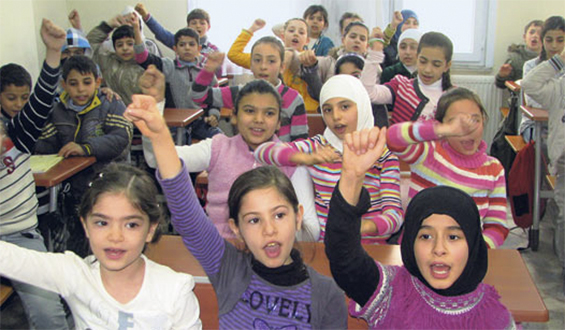
I am a Public School Teacher. Give Me All the Refugees You’ve Got!

syrian_refugee_schools

Come into my classroom any day of the week and you’ll see refugees.

That little Iraqi boy slumped over a book written in Arabic while the rest of the class reads the same story in English. Those twin girls blinking back memories of the Bosnian War as they try to underline possessive nouns on an English worksheet. That brown-skinned boy compulsively rocking back-and-forth in his seat fighting back tears wondering when his dad is going to come home from prison.

Every day, every hour, every minute our public schools are places of refuge for children seeking asylum, fugitives, emigres, exiles, the lost, the displaced, dear hearts seeking a kind word and a caring glance.

Some may shudder or sneer at the prospect of giving shelter to people in need, but that is the reality in our public schools. In the lives of many, many children we provide the only stability, the only safety, the only love they get all day.

And, yes, I do mean love. I love my students. Each and every one of them. Sometimes they are far from lovable. Sometimes they look at me with distrust. They bristle at assignments. They jump when redirected. But those are the ones I try to love the most, because they are the ones most in need.

I told a friend once that I had a student who had escaped from Iraq. His parents had collaborated with the U.S. military and received death threats for their efforts. So he and his family fled to my hometown so far away from his humid desert heartland.

I told her how difficult it was trying to communicate with a student who spoke hardly any English. I complained about budget cuts that made it next to impossible to get an English Language Learner (ELL) instructor to help me more than once a week. And her response was, “Do you feel safe teaching this kid?”

Do I feel safe? The question had never occurred to me. Why wouldn’t I feel safe? I don’t expect ISIS to track him down across the Atlantic Ocean to my class. Nor do I expect this sweet little guy is going to do anything to me except practice his English.

In one of my first classrooms, I had a dozen refugees from Yugoslavia. They had escaped from Slobadan Milosevic’s ethnic cleansing. Yet you’d never know unless they told you. They were some of the most well-behaved, thoughtful, intelligent children I’ve had the pleasure to teach. They were always smiling, so happy to be here. They approached every assignment with a seriousness well beyond their years.

But sometimes you’d see a shadow cross their faces. Rarely you’d hear them whispering among themselves. I was so new I didn’t know any better but to come down on them. But later they told me what they had been talking about, what they had been thinking about – how Henry V’s military campaign brought back memories. They taught me that day. Every year I learn so much from my children.

My high poverty school doesn’t get a lot of refugees from overseas these days. But we’re overwhelmed with exiles from our own neighborhood. I can’t tell you how many children I’ve had in class who start off the year at one house and then move to another. I can’t tell you how many come to school bruised and beaten. I can’t tell you how many ask a moment of my time between classes, during my planning period or after school just to talk.

Last week one of my students walked up to me and said, “I’m having a nervous breakdown.”

Class had just been dismissed. I had a desk filled to the ceiling with ungraded essays. I still had to make copies for tomorrow’s parent-teacher conferences. I had gotten to none of it earlier because I had to cover another class during my planning period. But I pushed all of that aside and talked with my student for over an hour.

And I’m not alone. On those few days I get to leave close to on time, I see other teachers doing just like me conferencing and tutoring kids after school.

It was a hard conversation. I had to show him he was worth something. I had to make him feel that he was important to other people, that people cared about him. I hope I was successful. He left with a handshake and a smile.

He may not be from far away climes, but he’s a refugee, too. He’s seeking a safe place, a willing ear, a kind word.

So you’ll forgive me if I sigh impatiently when some in the media and in the government complain about the United States accepting more refugees. What a bunch of cowards!

They act as if it’s a burden. They couldn’t be farther from the truth. It’s a privilege.

When I see that iconic picture of three-year-old Syrian boy Aylan Kurdi drowned in Turkey as his family tried to escape the conflict, I find it impossible that anyone could actually refuse these people help. Just imagine! There are a host of others just like this family seeking asylum and we can give it! We have a chance to raise them up, to provide them a place to live, to shelter them from the storm. What an honor! What a privilege! What a chance to be a beacon of light on a day of dark skies!

I’m an American middle class white male. My life hasn’t been trouble free, but I know that I’ve won the lottery of circumstances. Through none of my own doing, I sit atop the social ladder. It is my responsibility to offer a helping hand in every way I can to those on the lower rungs. It is my joy to be able to do it.

It’s what I do everyday at school. When I trudge to my car in the evening dark, I’m exhausted to the marrow of my bones. But I wouldn’t have it any other way.

It’s not uncommon for a student or two to see me on the way to my car, shout out my name with glee and give me an impromptu hug. At the end of the day, I know I’ve made a difference. I love being a teacher.

So if we’re considering letting in more refugees, don’t worry about me. Send them all my way. I’ll take all you’ve got. That’s what public schools do.


NOTE: This article also was published in Everyday Feminism, the LA Progressive and on the Badass Teachers Association blog. It was also quoted extensively in an interview the National Education Association did with the author.

 

Prejudice of Poverty: Why Americans Hate the Poor and Worship the Rich

2children


Take a breath.

Take a deep breath. Let your lungs expand. Let the air collect inside you.

Hold it.

Now exhale slowly. Feels good doesn’t it? You’d never realize there are hundreds of contaminates floating invisible in that air. Dirt, germs, pollution – all entering your body unnoticed but stopped by your immune system.

If only we had such a natural defense against prejudice. Racism, classism, xenophobia, sexism, homophobia – we take all that in with every breath, too.

It may not seem like it, but all these value judgments are inherent in American culture. They’re as much a part of life in the United States as the flag, football and apple pie. And to a greater or lesser extent, you have subconsciously accepted them to help construct your ideas of normality.

What does it mean to be a man? What does it mean to be a woman? How should black people be treated? To whom is it appropriate to be sexually attracted? What makes a person poor and why? All of these questions and so many more have been answered one way or another for us by the dominant culture. Not everyone accepts this perceived wisdom, but most of us have swallowed these solutions whole without thought, logic or criticism – and we don’t even know it’s happened.

Take our preconceptions about wealth and poverty.

Well paying jobs are drying up. Minimum wage work is becoming more common. Salaries are shrinking while productivity is increasing. Meanwhile the cost of living continues to rise as does the cost of getting an education.

Yet we still cling to the belief that all rich people deserve their wealth and all poor people deserve their poverty.

When we hear about someone on Welfare or food stamps, we sneer. The average conception is that this person is probably faking it. He or she could have earned enough to avoid public assistance, but he or she isn’t trying hard enough.

Moreover, we KNOW with a certainty that goes beyond mere empiricism that many of the poor still manage to buy the newest sneakers, have flat screen TVs and eat nothing but Porterhouse steaks.

You can hear this kind of story uttered with perfect certainty from the mouths of white, middle class people everywhere. They don’t mind helping people who are really in need, they say, but most poor folks are gaming the system.

Never once do they stop to consider that this story about impoverished individuals living better than middle class Americans is, itself, one of the most pervasive myths in our society. We know it the same way we know all Polish people are dumb, all Asians are smart and all Black people love fried chicken and watermelon.

However, none of this “knowledge” is supported by the facts. Look at the Supplemental Nutrition Assistance Program (SNAP). According to the New York Times:

Allegations of fraud, including an informal economy in which food stamps are turned into cash or used to buy liquor, gasoline or other items besides food have been used to argue that the program is out of control. In fact, the black market accounts for just over 1 percent of the total food stamp program, which is far less than fraud in other government programs like Medicare and Medicaid.

If you include erroneous payments because of mistakes on applications, overall loss to the food stamp program comes to 4%, according to the Department of Agriculture. Compare that to the 10% lost to Medicare and Medicaid – programs no one is calling to be cut or eliminated.

But figures like these don’t convince the average American. We’re so certain that all or most poor people are just lazy parasites. Everyone “knows” some low-income person they deem to be living too high for their circumstances.

And, yes, sometimes you do see an impoverished individual not wearing rags. Sometimes you do peek into an indigent person’s hovel and see new electronics or game systems.

How does this happen?

Debt.

Credit card companies are waiting in the shadows to extend a line of credit to just about anybody. It’s a safe bet for these businesses. If they give you money today, they can charge exorbitant rates of interest – even more so with the highest risk clientele. But there isn’t much risk to these corporations these days when almost anyone can take a job as a state constable or bail recovery agent to hunt down debtors and bring them to economic justice.

When you see a destitute child with new sneakers, his parents probably bought them with plastic. When you see an X-Box in a needy person’s house, chances are that wasn’t paid for in cash. They used the charge plate and will end up paying for that game system many times what it’s worth.

It’s a problem not limited to the poor. Even middle class folks are drowning up to their eyeballs in debt. As wages have decreased, people have used their credit cards to keep a standard of living they expect. But they’re paying for it with huge portions of their paychecks going to these credit card companies. Yet even though we all do this, middle class folks look down their noses at people lower down the economic ladder for doing the same thing.

In fact, they refuse to even see that obvious truth. Instead they cling to the lie that poor folks are social parasites. We even begrudge them food. Those are my tax dollars going to pay for that penurious person’s free ride, they say.

Unfortunately, we don’t stop to consider how much of our taxes are actually going to help the less fortunate.

Let’s say you make $50,000 a year. That means, you pay $36 toward food stamps. That’s ten cents a day – the same amount many charities ask to help feed starving children in Africa.

If you add all safety net programs, the cost only goes up an additional $6 a year. That doesn’t seem like a huge chunk of my taxes. Honestly, do you begrudge needy people less than the price of a meal for a family of four at Bennigan’s?

By and large, your tax bill isn’t going to the poverty-stricken. It’s going to the wealthy. Over the course of a year, you pay $6,000 for corporate welfare.

You read that right. Six K. Six grand. Six thou. Those are your tax dollars at work, too. And it’s a much larger burden on your bank account than the $42 you shell out for the poor.

What do you get for that $6,000 outlay? It includes at least $870 to direct subsidies and grants for corporations. An additional $870 goes to offset corporate taxes. Another $1,231 goes to plug holes in the federal budget from revenue lost to corporate tax havens. Oh! And don’t forget a sizable chunk for subsidies to Big Oil companies that are polluting our skies and fueling climate change and global warming.

Most of your money isn’t going to feed hungry children. It’s going to recoup losses for giant transnational corporations like Apple and GE that hide their money overseas to boost profits and avoid paying taxes for things we all need like schools, police and fire departments.

This money subsidizes giant multi-national corporations that are already making billions and billions of dollars in profit each year. In the past decade alone, corporations have doubled their profits – all while reducing their American workforces and sending jobs overseas. Yet we only complain about poor folks using food stamps and buying new sneakers on credit.

Why is that? Why does it only bother us when poor people get help and not when huge corporations do?

Part of it is the media. We’ve been convinced that big business deserves its money and poor people don’t. Another part of it is that these facts often go underreported. Movies and TV shows love portraying the parasite poor person but rarely portray the corporate leech. Outside of “It’s a Wonderful Life” and “A Christmas Carol,” the wealthy are usually portrayed in the most positive light possible and not as addicts hoarding cash they don’t need to compete with each other in a childish game of one-upmanship.

Finally, there is the racial and sexual element. By and large, corporations are run by white males. The poor are mostly black, brown and though women make up a slightly higher percentage than men, it is often conceptualized as uniquely female. Take the term Welfare Queen. Why is there no Welfare King? How telling that our conception only allows for one gender in this role!

The reality is much different. The true Welfare Queens are Big Businesses. They make unprecedented profits and avoid paying taxes on them. They have tons of cash on hand but never can seem to get enough. And if we increased the corporate tax rate to what it was in the 1950s when the Unite States was more prosperous than it has ever been, these same corporations would still be Filthy. Stinking. Rich.

So the next time you hear someone blaming the poor for gobbling up your taxes, remember the facts. First, it’s simply not true. There is no widespread fraud by the poor. They are not gaming the system. They are not putting an undue burden on the middle class. However, big business IS – in fact – cheating you out of income. Business people are getting fabulously wealthy on your dime – and even if we stopped subsidizing them, they’d still be fabulously wealthy!

Finally, don’t ignore the racial component. Would middle class Caucasians still complain so vehemently about the poor if they weren’t mostly talking about Black people, Latinos and women? I doubt it.

We may breath in these prejudices but we’re not helpless. It’s up to all of us to dispel these myths, not to let them stand, to confront them every time they come up. And, yes, I mean EVERY. TIME.

The only immune system we have as a society is education, knowledge, wisdom. And once you know the truth, don’t let anyone get away with this kind of racist, classist bullshit.


NOTE: This article also was published in the LA Progressive and on the Badass Teachers Association blog.
 

The Most Important Election You’ll Probably Skip

t1larg.voter.jan10

The future prosperity of your state may be decided this November.

Will your public schools receive adequate, equitable and sustainable funding?

Will you be permitted to choose medical marijuana to treat certain ailments?

Will your state enact sensible gun reforms to keep firearms out of the hands of the criminally insane?

Will your voice be heard in future elections?

All this and more is on the table and YOU get to cast the deciding vote.

But more likely than not, you won’t show up.

Why? You’re too busy worrying about the upcoming Presidential election.

With both Democratic and Republican Presidential Primaries approaching in February through June, 2016, most people just don’t have the energy for another general election before the end of 2015.

However, most states will ask residents to cast a ballot on Nov. 3 for all kinds of important initiatives. There will be municipal, school board, gubernatorial and state legislative elections in a few states; as well as numerous citizen initiatives, and a variety of other local offices on the ballot.

Yet if history is any guide, most people will stay home while vastly important decisions are being made by the few who trudge to the polls. On the one hand, that means the results are bound to be unrepresentative. On the other, it means if you show up, your vote will have more weight than ever!

Either way, the course for the future of your state will be quietly and discreetly set for years to come.

Take my home state of Pennsylvania.

We’re holding a historic election with three state Supreme Court seats up for grabs. The last time this many seats were open on our highest court in the same year was 1704, and the body was still called the Provincial Appellate Court.

This is huge because it will determine who gets the final say on a plethora of contentious political issues.

For instance, four years ago, Republicans controlled every branch of Commonwealth government and redrew the state’s legislative districts to gerrymander in a GOP majority. They redrew district lines to ensure that conservatives got elected to public office by making boundaries around areas that have pockets of people who generally lean Republican.

With that foundation in place, the GOP ran the state into the ground. While most taxpayers didn’t agree with the corporate tax giveaways and draconian budget cuts to public services like children’s schools, there wasn’t much we could do about it. The redrawn district boundaries were such that legislators were free to do whatever they wanted without fear of reprisals from constituents.

Voters gave the GOP Governor the boot, but almost all of his good soldier legislators stayed in place. This was only possible because Republicans controlled the state Supreme Court. When those gerrymandered districts were challenged, the court backed the legislature. So, in practice, continued Republican control of state Senate and House districts was due not to voters but to the state Supreme Court.

Currently, Republicans hold the balance of power in the highest Commonwealth court by 3-2 with two vacancies. This election could rewrite that balance of power.

If Democrats win two or more seats in this Supreme Court election – thereby replacing two Republicans and one Democrat – it could change everything! Democrats would have a majority.

When redistricting comes up again in 2022, if Democrats want to re-draw the lines more fairly (or in their favor), a Democratic-controlled Supreme Court could make that possible.

Moreover, the new court would almost certainly rule on cases that will have a dramatic impact on the lives of everyday Pennsylvanians.

Perhaps the most hot button issue in the state is education funding. Republicans have been waging all out war on poor Commonwealth schools. For the past 4 years, the legislature slashed public school funding by almost $1 billion – an ideological divide that still rages between the newly elected Democratic governor and the legislature where Republicans remain in control.

Several lawsuits demanding more equitable school funding are winding their way through the state court system. These cases are bound to end up in the state Supreme Court. So if voters still care about making sure all Pennsylvania children have a fair shake at an education, voting for Democrats to retake the court may be the surest option! If recent history is any guide, Republicans sure won’t do it!

Other issues such as the death penalty and gun laws are likely to appear on the docket. Moreover, without opposition, it’s feared a GOP court could easily allow Tea Party legislators to enact so-called Right to Work and other union busting initiatives. A Democratic court could stop such shenanigans cold.

For decades, Pennsylvania politics have been like a game of tennis – power going almost exclusively from one party to another. Neither major party has held the governor’s office for more than two terms since 1955. Democrats broke the Republican Party’s hold on the state House in 2006 only to give back the chamber during the 2010 elections. So the Supreme Court remains the ultimate arbiter.

Voters will have the choice of 3 of the following candidates for Supreme Court Justice: Democrats Christine Donohue, Kevin M. Dougherty and David N. Wecht; Republicans Anne Covey, Michael A. George and Judith F. Olson; and independent candidate Paul P. Panepinto.

In my opinion, the Democrats are the strongest candidates – especially Wecht who is vowing to ban gifts for judges, tighten anti-nepotism policies, and broadcast court proceedings on television. Dougherty has strong union ties and clearly respects collective bargaining rights. Donohue is a strong supporter of personal rights including holding corporations accountable for fraudulent behavior and eliminating bias against LGBTs.

Of the Republicans, Covey is the most reasonable and has shown a willingness to reach across the aisle. The others are your typical extreme right Tea Party conservatives. Panepinto may be running as an independent, but I see little to distinguish him from the GOP candidates.

Choose carefully, Pennsylvania. Whoever you decide to support in the Supreme Court race, it will have a long-term impact. State Supreme Court justices hold 10-year terms! And three more justices will be replaced by 2018.

Whether you live in Pennsylvania or anywhere else in the US, it is vital that you get off your duff on Nov. 3 and vote. Focusing exclusively on Hillary vs. Bernie is not just myopic, it’s dangerous. Even if your candidate wins the presidency and does a fabulous job, the forces of stagnation and corporate greed could net tremendous gains in these other elections.

Unless we turn up.

Unless we vote.


NOTE: This article also was published on the Badass Teachers Association blog.


If School Computer Use Reduces Standardized Test Scores, Doesn’t That Prove the Tests are Inadequate?

ipad-kids

Melvin’s hand is up.

He’s a 13-year-old African American with too much energy and not enough self-control.

He’s often angry and out of his seat. He’s usually in trouble. But today he’s sitting forward in his chair with his hand raised high and a look on his face like he’ll explode if I don’t pick him right this second.

So I do.

“Mr. Singer! Can I show my imovie now!?”

This is a first. He hasn’t turned in a lick of homework all month.

“Wow! You’re really excited about this, aren’t you?” I say.

“Yeah,” he responds. “I was up all night finishing it.”

I start to doubt this, but he does look awfully tired underneath that urgent need to share.

Airdrop it to me from your ipad,” I say, “and I’ll put it up on the SMART Board.”

This takes a few minutes.

Let’s face it.

We live in a world of high technology.

Our cell phones have more computing power than the Apollo missions to the moon.

The best, high paying jobs opening up on the world stage require increasing levels of computer literacy.

Yet according to a new study, America’s students don’t succeed as well academically if they have access to computers at school.

How can this be?

How can exposure to new technologies cause a nation of young people to fail at a system supposedly designed to prepare them for the jobs of the future?

Doesn’t real world experience usually make you better prepared?

A future chef would be helped by more time in the kitchen.

A future doctor would be helped by more access to dissection.

But a future computer-user is hurt by more time at a computer!?

Something is very wrong here.

But according to a new study by the Organization for Economic Cooperation and Development (OECD), students who use computers more at school earn both lower reading and math scores on the Program for International Student Assessment (PISA).

The organization studied 15-year-olds across 31 nations and regions from 2012. The study just released in September even controlled for income and race.

Yet here in my classroom I see the exact opposite. Computer use increases my students test scores – on my teacher-created tests.

Melvin’s movie was ready. He had been tasked with explaining the differences between external and internal conflict. I pressed play.

High adrenaline music poured from the speakers. Pictures flashed across the screen of boxers and football players.

“This is external conflict,” came rushing forward followed by a brief definition. Then an image of Homer Simpson with an angel and devil on his shoulders. “This is internal conflict,” came zooming by our eyes.

The film might not win any Academy Awards, but it was pretty impressive work for 40 minutes of class time and however long Melvin decided to spend at home.

It’s the kind of thing my students never could have done before they each had ipads. And when they took my test, few of them got the questions wrong about conflict.

Yet according to the OECD, I was somehow hurting my students academically!?

Even in my high poverty district, students have always had access to technology. But the nature of that technology and how we use it has changed dramatically this school year.

I used to have eight computers in my classroom, but they were slowly becoming obsolete and inoperable. Some days they functioned best as extra illumination if we shut out the overhead light to show a movie.

Still, I tried to incorporate technology into my lessons. I used to have my students make their own Webpages, but reserving time in the computer lab became almost impossible. And even then, the district couldn’t afford to keep the devices in the lab updated enough to run anything but the most rudimentary software.

The one lab in the building that had new devices was reserved almost exclusively for a drill and kill test prep program we had received a state grant to operate. THIS was the apex of school technology – answering multiple choice look-a-like questions. It bored students to tears and didn’t even accomplish the stipulated goal of increasing standardized test scores. Yet we were blackmailed by the state government into initiating the program so we could gain additional funding to keep the school operational.

THIS is the kind of technology use you’ll find at most poor schools like mine. And it’s one of the reasons the authors of the OECD study came to their conclusion. It’s also one of the reasons why teachers like me have been skeptical of technological initiatives offered to impoverished districts.

However, the best use of technology is something quite different.

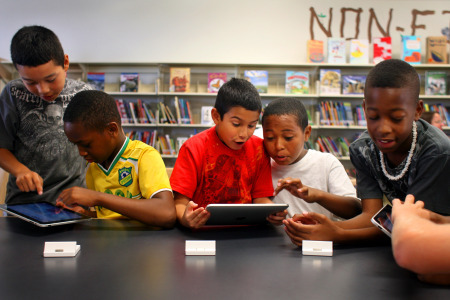
This year my district received a gift of ipads for all the students, and it’s changed everything. No longer do I have to beg and plead to get computer lab time for real high tech lessons. I don’t need it. The technology is already in the classroom in the palm of their hands.

But policymakers clutching their pearls because of this study have already began to make changes to international school curriculum. Schools in Asia have begun cutting back on student computer time. Should America follow suit?

Absolutely not.

The problem clearly is not computers. It’s the antiquated method we use to measure success.

Standardized testing has been around since 206 BC as an assessment for civil servants in ancient China. The same process spread to England in the 19th Century and then to the United States during WWI. Through all that time, the main process of rewarding rote learning through multiple choice questioning has remained the same.

But the world hasn’t. We’ve moved on a bit since the Han Dynasty. We no longer live in a medieval society of peasants and noblemen where the height of technology is an abacus. We live in an ever-changing interconnected global community where a simple search engine provides more information than could be stored in a thousand Libraries at Alexandria.

How can we possibly hope to rely on the same assessments as the ancients? Heck! Even as far back as 970 AD, standardized testing was criticized as being inadequate.

But a global multi-billion dollar industry relies on these primitive assessments. It’s the basis of an exceedingly lucrative business model.

So it shouldn’t be surprising that the same people who promise standardized testing and Common Core will best prepare students to be college and career ready are passing the blame.

They claim this report isn’t an indictment of their cash cow industry. It’s a warning against over-reliance on computers. And, yes, they’re right that technology is not a panacea. The mere presence of a computer won’t make a child smarter. Likewise, the mere presence of a book won’t make a person wiser. One must know how to use said computer and book.

But what I’m seeing in my classroom primarily is an opportunity – not a danger. Students like Melvin are more engaged and willing to take chances. They have greater freedom, intrinsic motivation and excitement about learning.

Many times when sharing Keynote presentations, after one or two, students ask to have their work back so they can improve them. That doesn’t happen with test prep.

They often elect to take ipad assignments to lunch and work on them between bites. That doesn’t happen with Pearson worksheets.

I’m not saying it’s easy. It’s up to me, my colleagues and administration to ensure technology is used to its full potential. Never should these devices be time fillers or babysitters. Nor can they ever replace the guidance of a thoughtful, creative educator to determine their best use. Teachers need to create and assign lessons that promote creativity and critical thinking skills.

Education professionals are constantly advised to individualize their lessons to meet the needs of diverse learners. Technology allows them a unique opportunity to do so. With district ipads I can talk to an English Language Learner in his own language. A struggling reader can have the device read test questions aloud. A student with poor motor control can type journal responses and have his writing be understood.

And these opportunities for enrichment don’t even need to be planned ahead of time. For instance, when discussing a short story about a character that was exceedingly proud, one of my students brought up the Seven Deadly Sins. She wasn’t exactly sure what they were or how exactly they related to pride, but one of her classmates quickly looked it up on her ipad. Then another found a medieval woodcarving to which someone else found a related manga text. The subsequent discussion was much deeper and relevant to these children’s lives than it would have been otherwise. And none of it was pre-packed, planned or standardized. It was individualized.

This is really no surprise. Administrators in charter or private schools aren’t asking themselves if they should close their computer labs and put their devices on ebay. They know the value technology can provide in the classroom, but they aren’t constrained by high stakes testing.

Even rich public schools don’t have to worry to the same degree because their students already score well on federally mandated assessments – after all, standardized tests are designed to favor children with wealthy parents over those from impoverished or minority backgrounds. It’s only in poor school districts where technology is either second hand or a charitable donation that administrators and school directors are being pressured to cut back.

As usual, best practices for the privileged become questionable when applied to the poor and minorities. You want technology? Prove it will boost your test scores!

It’s nonsense.

Think about it. Even the best use of computers won’t boost standardized scores. Computer skills aren’t on the tests.

Nor could these things ever be assessed effectively in this manner.

Yet such skills are exactly what education researchers tell us demonstrate the deepest levels of understanding and an ability to meet the demands of the best jobs of the future.

I wonder what Bill Gates thinks of this report. The Microsoft co-founder is also one of the biggest advocates for school standardization. If he had to pick between his two favorite children, which would he choose – laptops or Common Core tests? Maybe we needn’t wonder. His own children go to a private school with no standardization and a plethora of technology.

There comes a time when you have to admit the truth staring you in the face: standardized tests are poor measures of academic achievement. They are suitable only for turning our children into factory drones. They are for pawns, patsies and robots.

If we really want to prepare the next generation for the jobs of the future, we need to scrap high stakes testing. We need to invest in MORE technology, not less. We need to ensure technological lessons are being overseen by trained educators and the devices aren’t used as a babysitting tool. As such, we need to provide teachers with support and professional development so they can best take advantage of the technology they have.

America can prepare its children for the world’s high level management and administrative positions or we can prepare them to do only menial work that will soon by replaced by machines.

Computers do the former. Tests the latter.

Choose.


NOTE: This article also was published on the Badass Teachers Association blog.


Stopgap Budget a 4-inch Crap Sandwich for Pennsylvanians Who Rejected a Footlong

4026174118_390de03813_z

If you won’t pass 12 months of our crappy budget, pass 4 months of it.

That’s the plan of Pennsylvania Republicans to swindle voters into accepting lower expectations out of state government.

While Governor Wolf talks compromise, GOP lawmakers stamp their feet, cross their arms and pretend that’s somehow doing their jobs.

Three months passed the deadline for a year-long state spending plan, Republicans in both the House and Senate pushed through a stopgap budget along party lines that could only see the light of day because of their numerical majority.

Gov. Wolf vetoed their year-long budget in June because it failed to fix the damage of four years of budget cuts to essential public services like education. Now Republicans are demanding he accept four months of the same and we’ll talk about the rest later.

Wolf is expected to veto this stopgap measure on Monday.

But this doesn’t mean the newly-elected Democratic governor is unwilling to compromise. That’s all he’s been trying to do for the passed 90 days! He’s offered major concessions to the GOP including proposals for private management of the state liquor system and limits to traditional pensions for future state and public school workers.

The response? Nothing.

I guess Republicans don’t get how compromise is supposed to work. One side gives up something and then the other side does the same until both parties can meet in the middle. But in Harrisburg it’s been all give from the governor and nothing from the Republican legislature.

‘Give us everything we want for 4 months’ is not a compromise!

This is what happens when you let billionaires buy our government. You get a state of gerrymandered districts. The majority of residents voted for Wolf because he promised to overturn these Republican policies, but with the state chopped up into voting districts along party lines, the GOP gains a majority in the legislature though they do not have a numerical one of residents. And this Republican majority relies on the votes of Tea Party ideologues who will accept no discussion, no bargaining, no give-and-take.

That’s exactly what the 1% funding these stubborn legislators want. The super rich lounging behind their thick walls and glittering gates want the rest of us to become fed up with our government. They want us to give up on Democratic process as a way to ensure public goods. They are sabotaging our oldest and most revered institutions to prove to us how badly they work.

You see, they don’t care about public goods because these things don’t directly impact them. Why should they care if our public schools are dying of starvation? Their kids don’t go to public schools.

Moreover, if we actually go with Gov. Wolf’s proposed budget and fund elementary, middle and high schools, the rich will have to help pay for it. They’ll have to pay their fair share. That’s something these leeches will never do willingly.

For four years under the previous Republican governor our public schools had been put on a starvation diet cutting almost $1 billion a year from a system that already was one of the least equitable in the country.

Public schools are funded mostly by state and local governments. If you ranked all 50 states in the country by which ones shoulders the highest burden of education costs, Pennsylvania comes in 45th. The Commonwealth only pays 36.1% of the bill – far below the national average of 45.5%. Wolf wants to bring that up to 50%, but when it comes to doing right by children, Republicans apparently are fine with being below average.

But exactly how low can you go?

Not only does the Commonwealth skimp on all its children, it gives up on the poor. The money train makes long luxurious stops at rich districts but barely even comes to a halt at poor ones before chugging on down the line.

We spend less on our poor students compared to our rich ones than ANY OTHER STATE! When it comes to cheating impoverished kids out of an education, we’re number one!

Nationwide, rich schools already spend on average 15.6% more than high poverty schools. But in Pennsylvania, the difference is 33%!

We are systematically short-changing our neediest children year-after-year, and instead of fixing that, Republicans demand another 4 months of neglect!

But as lawmakers bicker, without a state budget, schools aren’t getting the funding they had expected. From Philadelphia to Pittsburgh, poor schools are forced to dip into their reserves to keep their doors open.

Districts were required by law to complete their spending plans months ago making educated guesses how much they’d get from the state. Without that money coming in, they’re surviving on their rainy day funds – and as usual storm clouds are pouring on our schools.

Districts serving poor communities often don’t have much left over to continue running while Harrisburg plays political games. If something isn’t done soon, poor districts might not be able to continue functioning.

And that’s just what Republicans are expecting.

Look at all the damage the Democrats are doing by not accepting our stopgap budget, they say. Sure! Our spending plan shortchanges these kids, but at least it gives them something! Can you really be so hard hearted that you’ll deny them anything at all!?

So our state politics has come down to a desperate game of chicken. Can our schools hold out while the Democrats try to bargain for a better deal? Will the public realize it’s really Republicans who are being unreasonable?

Does anyone care anymore? Has everyone just checked out because the whole situation is too ugly to watch?

I mean you can eat a crap sandwich if you don’t have to see yourself doing it.

You Can’t Win a Rigged Game – Standardized Tests as “Proof” of Failure

Kids_playing_video_games

One of my dearest high school friends was a bit of a doofus.

Who am I kidding? So was I!

One of our favorite things to do after school was plop on the coach and play shoot ‘em up video games. “Smash TV” was a particular favorite.

We’d bob and weave while clutching controllers and rapidly jamming our thumbs on the buttons.

And at such times, we‘d talk.

No great philosophical problems were solved during these mid-afternoon gaming sessions. We’d talk trash, dissing each other’s gaming skills, bragging about our own, and occasionally quizzing each other with trivia on a shared topic of interest.

We both loved movies, so my buddy used to shout out cinematic quotations and ask me to name where they came from.

“Frankly, my dear, I don’t give a damn.”

“Luke, I am your father!”

“Go ahead, punk. Make my day!”

None of these famous quotes made my buddy’s list. He preferred lines like these:

“Run!”

“Look out!”

“Holy S&*t!”

As you can imagine, I rarely got any of them right.

I’d laugh, punch him in the arm good-naturedly and go on shooting virtual enemies.

It was good dumb fun. But now – more than two decades later – my students are forced to take my buddy’s quiz – and if they don’t pass, the government is threatening to shut down their schools and fire me, their teacher.

No, learners don’t have to identify impossible movie quotes. Instead, they’re forced to answer impossibly bad multiple choice questions. But the results are pretty much the same.

In my home state, the Pennsylvania System of School Assessment (PSSA) and the Keystone Exams are high stakes versions of my buddy’s moronic quiz. The purpose isn’t to fairly assess: it’s to stump as many kids as possible.

And it’s working. For the fourth year in a row, student test scores have declined statewide. Previously, students had been doing relatively well. Why the change?

It began with budget cuts. The legislature slashed almost $1 billion every year in school funding. That means higher class sizes, less teachers, fewer electives, tutoring, nurses, services, etc. And districts like mine weren’t exactly drowning in money to begin with.

Students now have less resources, therefore they can’t prepare as well for the tests.

So what did the legislature do? Did our lawmakers fix the problem by putting back the money they had repurposed as gifts to the natural gas industry?

Heck no! They made the tests even more unnecessarily difficult.

As a result, the steady decline in test scores this year fell off a cliff!

After all, this was the first year in which the Commonwealth fully aligned every question of its mandatory testing with the Pennsylvania Core Standards – which are similar, but not identical to the Common Core standards adopted in other states.

Proficiency rates in grades 3 through 8 dropped by an average of 35.4 percent in math and 9.4 percent in English language arts on the PSSA. Nearly half of all seventh and eighth graders dropped an entire proficiency level in math in just one year.

If I made up a test like this in my own classroom, gave it to my students and got results like these, my first assumption would be that there was something horribly wrong with the test. I must have messed something up to fail so many students! Teachers are always on the lookout for unclear or bad questions on their self-created exams. The for-profit corporations that create our state-mandated tests? Not so much.

Though state Department of Education officials acknowledge the continued decline in scores, they insist problems will work themselves out in subsequent years – as if a 4-year trend is just an anomaly. Move along. Nothing to see here, folks.

My students used to make impressive gains on the tests. My principal stopped by today to give me the scores for my current students and those I taught last year. No surprise. Very few passed.

Are my students now lazier and less intelligent than those I taught four years ago? No. Students who scored well before the budget cuts, often score badly now.

Am I a worse teacher? Absolutely not. I have the same skills I did then. I spend the same amount of time at school – maybe more.

So what changed in my classroom? Lack of reconnaissance.

Teachers like myself used to know exactly what was expected of students on these assessments. We had plenty of materials with which to prepare them. Now the exams change every year – and I don’t mean just the individual questions, I mean what is tested!

Back in the day, when my buddy first shouted out, “Run!” and asked me which movie it came from, I had no idea. But after he did it long enough, I’d start to anticipate him. I’d learn that he was thinking of James Cameron’s “The Terminator.”

That’s how the PSSA’s used to be. Teachers knew how the test makers wanted kids to answer. And we could prepare them to do so. The tests didn’t accurately assess student learning even then. It was a game, but at least it was more fair.

Let’s be honest. These tests have never been particularly good. You can’t honestly expect to assess higher order thinking skills on a multiple choice test. Basic skills, maybe. But anything complex simply cannot be measured in this manner. We’ve known that for over a century!

It’s like my buddy’s movie quiz. I have little doubt that someone really did shout “Run!” in “The Terminator.” However, that same line probably appears in at least a dozen more action movies. There’s no way to determine a single correct answer. And shouting out a different quote instead like “Look out!” doesn’t help either.

So please stop the talk about “Rigor.” We’re not raising standards. We’re changing them. My buddy found a new bunch of movies from which to shout out impossible quotes. That’s all.

Anyone who wants to argue validity to these new test questions has to leap a host of hurdles to accomplish his goal.

First, one would have to prove PA Core – and by extension Common Core – Standards actually improve student learning. Good luck. It’s never been done and all the evidence is against you.

Second, one would have to gain access to an individual year’s worth of test questions. Again, good luck. They’re corporate property. The public is not allowed to see the questions. If a principal, student or teacher were to copy a question or snap a photo of a test, they could be subject to prosecution in a court of law.

Such a lack of transparency in government is a sure sign of malfeasance.

It’s almost impossible to avoid certain conclusions about this whole process. Standardized testing is designed to fail students – just like my buddy’s movie quiz was designed to stump me.

These tests constitute fake proof of inadequacy. They attempt to “prove” our public schools are failing and should, therefore, be replaced by private corporations – maybe even by subsidiaries of the same for-profit companies that make and grade these tests!

When my buddy unfairly stumped me, we both knew it was a joke. We’d laugh and play another video game.

But there’s nothing funny about this when it’s perpetrated by the state and federal government.

Pennsylvania’s standardized test scores are a farce just like the scores in every state and territory throughout the country. They’re lies told by corporations, permitted and supported by lawmakers, and swallowed whole by the media and far too much of the public.

We always seem on the verge of waking up. Tomorrow we will stop the state-sanctioned abuse of children by the testing industry. Tomorrow we’ll take responsibility for this sick system we allow.

But when will tomorrow come? I’m tired of waiting.


NOTE: This article also was quoted extensively on Diane Ravitch’s blog and published in full on the Badass Teachers Association blog.
Teachers Offer to Work for Free to Save Their School

Screen shot 2015-08-29 at 1.58.26 AM

Lawmakers have failed Chester Upland School District.

And now it’s up to teachers and professional staff to save the day.

For two decades, the Pennsylvania legislature hasn’t fulfilled its duty to equitably fund the public school district. Neither has the federal government. Instead, they left the impoverished school just 20 miles west of Philadelphia to survive on the drip of local property taxes from residents who, themselves, don’t have two pennies to rub together.

Moreover, our lawmakers not only permitted but encouraged three privately run charter schools to come to Delaware County and suck away whatever funds they could from the district while shortchanging student services at their privatized facilities.

And even worse, our elected officials drew up legislation allowing these charters to gobble up more funding from the district than the public school is allowed to spend on its own students.

Surprise! It didn’t work!

So the state put the school in receivership, taking away control from local tax payers so unelected bureaucrats could fix all the problems.

Surprise! That didn’t work, either!

And now state and local officials say there isn’t enough money left in the district’s piggy bank to make payroll by the time the school’s 3,300 students are scheduled to arrive on Wednesday.

In such situations, there’s only one thing to do: close the school. Bus the kids to neighboring districts and any charter or cyber schools willing to take them.

No more Chester Uplands. Another neighborhood school bites the dust.

But the district’s more than 300 employees refused to let that happen.

The dreaded teachers union held a meeting and decided to what? Hold a strike? Demand more pay?

No. The 200 members voted unanimously to work without pay as the school year begins – and the district’s secretaries, bus drivers, janitors and administrators joined them.

Sadly, this is the second time the union came to this decision. In 2012 the district was in similar straights but a federal judge forced the state to cough up a few bucks only a few days after the school year began.

To be fair, Gov. Wolf has tried to help the struggling district more than his predecessor. His administration supported a plan to eliminate the district’s $22 million spending deficit by reducing payments to charter and cyber schools so they actually reflect the cost of the services they provide.

The plan called for capping payments to cyber schools at $5,950 per student. After all, schools where students attend class on-line don’t have nearly the overhead of brick-and-mortar districts. Why pay them more than the actual cost?

The plan also would reduce reimbursements for special education students at brick-and-mortar charter schools from $40,000 to $16,000 per student. After all, if the public school only spends this much for these services, why permit charter schools to demand more than twice that amount – more than any other district in the state receives?

These proposals didn’t come out of thin air. Both changes were consistent with recommendations by two bipartisan school funding commissions.

However, County Judge Chad F. Kenney denied the measure because it would do nothing to pay back the district’s charter schools an additional $8 million it already owes.

So to sum up – teachers are willing to work pro bono for the community’s children. They’re willing to put their own lives and families at risk to ensure their neighborhood school has more time to find a solution to its financial woes.

And charter schools? They want their money! Pay up, bitch!

If nothing is done to fix the problem, Chester Uplands deficit is expected to reach $48 million by the end of the year. Wolf and other state officials are scrambling to come up with a new plan.

Meanwhile, the problem is spreading from the Chester Upland District across the entire Commonwealth. Public schools are tightening their belts because the legislature is more than 50 days late passing a state budget. The major sticking point? School funding!

Republicans refuse to heal long-standing education cuts from the previous GOP administration while Democrats support an increase.

As lawmakers bicker, schools across the state are forced to dip into their reserves to keep their doors open. Public schools were required by law to complete their spending plans months ago making educated guesses how much they’d get from the state. Without that money coming in, they’re surviving on their rainy day funds – and as usual storm clouds are pouring on our schools.

Districts serving poor communities often don’t have much left over to continue running while Harrisburg plays political games. If something isn’t done soon, Chester Upland could be the first in a series of dominoes set to topple down.

The only thing keeping these districts afloat is the hard work and good will of their teachers and staff.


A GOFundMe has been set up to help Chester Upland staff.

If you’re able to, please donate whatever you can to the 300 teachers and staff of Chester Upland School District in Eastern Pennsylvania.  Please help these heroic people make ends meet during this time they’re working pro bono.

NOTE: This article also was published on the Badass Teachers Association blog.

Bernie Sanders Explains Puzzling Education Vote – It’s Because Accountability

Screen shot 2015-08-15 at 3.24.57 AM
Photo: Alex Garland

When teachers asked, Bernie Sanders answered.

Why, Bernie? Why did you vote this summer against everything you seem to stand for on education policy?

You stood against President George W. Bush’s disastrous No Child Left Behind legislation in 2001. Why did you vote for almost the same thing in 2015?

The answer is in from the Vermont Senator turned Democratic Presidential Candidate, but it’s not entirely satisfactory.

The short version: Accountability.

In education circles, it’s a buzzword meaning opposite things to opposite people. And determined in opposite ways.

Ask a representative of the standardized testing industry, and more than likely he’ll tell you accountability means making sure public schools actually teach studentsespecially the poor and minorities. And the only way to determine this is through repeated, rigid, standardized assessments. Let’s call that TEACHER ACCOUNTABILITY.

Ask a real live educator, and more than likely she’ll tell you it means making sure local, state and federal governments actually provide the funding and resources necessary to teach studentsespecially the poor and minorities. And the best way to determine this is simple math. Let’s call that LAWMAKER ACCOUNTABILITY.

These seem to be the central disagreements: Are lawmakers providing equitable resources to all our public schools or are teachers just not doing their jobs? Are student test scores the best way to measure accountability or should we rely on something as rock solid as elementary math?

TEACHER ACCOUNTABILITY is hard to determine. You have to spend billions of taxpayer dollars buying tests, scoring tests and on test prep materials. And then you have to ignore all the evidence that this proves nothing. You could instead just poke your head into any public school across the nation and actually see teachers working their butts off. Heck! You could stop in after school hours and count the numbers of teachers still at work and tabulate the amount of their own cash they spend on class materials. But that won’t work – there isn’t an industry profiting off you using your own eyes and brain.

On the other hand, determining LAWMAKER ACCOUNTABILITY is easy. Just compare school budgets. Greater than and less than. You’ll find that none of our lawmakers provide equitable funding. Rich kids in wealthy districts get Cadillac funding while poor and minority kids in impoverished districts get bicycle funding. Strangely, this is never discussed.

Moreover, none of this relies on opinion. All it takes is empirical evidence to see the truth. Lawmakers are not accountable at all. Teachers are accountable for too much and judged by unscientific and untrustworthy methods.

Unfortunately, few politicians have fully figured this out yet. Even you, Bernie.

This summer it’s all come down to a series of votes on the Elementary and Secondary Education Act (ESEA).

The law the governs K-12 public schools was written in 1965 to ensure all schools received the proper resourcesLAWMAKER ACCOUNTABILITY.

However, under President George W. Bush and throughout the Obama years, it’s become about punishing teachers and schools for low standardized test scores – TEACHER ACCOUNTABILITY.

And the champions of TEACHER ACCOUNTABILITY this summer have been primarily Democrats including liberal lions like Elizabeth Warren and Sanders.

LAWMAKER ACCOUNTABILITY? No one’s talking that.

Most troubling is the Murphy Amendment – an attempt to double down on TEACHER ACCOUNTABILITY. Keep testing and punishing because it’s working soooo well. Thankfully, the move was defeated by Senate Republicans. But Sanders and Warren both voted for it. Warren even co-sponsored it!

That’s why a group of respected education professionals and union leaders (including myself) wrote an open letter to Sanders asking him to please explain, himself.

We aren’t exactly a hostile crowd. We like a bunch of things that Sanders represents in his presidential campaign. We want to support him, but we need to know why he voted to keep the worst aspects of the current law.

And Bernie answered! Or his staff did.

I’ll reproduce the entire letter we received from staffer Phil Fiermonte below this blog. But first I want to focus on Bernie’s specific reasons for voting in favor of the Murphy Amendment:

As you mentioned, Senator Murphy introduced an amendment on the Senate floor that would have required states to hold schools accountable for the academic performance of low-income, minority and disabled students. Senator Sanders voted for this amendment because he believes states must do more to protect every student’s right to a quality education, and that from a civil right’s perspective, the federal government has an important role to play in protecting low-income, minority and disabled children. As you pointed out, the mechanism this amendment would have used to identify struggling schools resembles the failed policies of No Child Left Behind. This was a significant concern to the Senator, and one that he shared with the sponsors of the amendment.

Senator Sanders cast his vote on this amendment to express his disapproval with aspects of the bill that were insisted upon by Chairman Alexander and Senate Republicans and that do not reflect the best interests of vulnerable populations, or a progressive view on the distribution of education resources. He has made clear to Chairman Alexander, Ranking Member Murray, and Senate Leadership that his vote was not an endorsement of the accountability mechanism included in the amendment, but rather as a statement of his intent that other measures must be put in place to protect low-income, minority and disabled students.

So Sanders voted for the Murphy Amendment for these reasons:

  1. He was mad that there is nothing about LAWMAKER ACCOUNTABILITY in the ESEA.
  2. He believes in TEACHER ACCOUNTABILITY – at least in part. He thinks the federal government needs to make sure teachers and schools are actually educating kids, BUT he doesn’t believe standardized tests are the best way of determining this.

Okay. First of all, he has a point. There is next to nothing in the whole ESEA rewrite about LAWMAKER ACCOUNTABILITY. When I was on Capitol Hill earlier this summer lobbying my lawmakers on this very issue, in general the Democrats blamed the Republicans and the Republicans changed the subject.

However, I don’t see how voting for an amendment you don’t believe in is going to make a point about something entirely unrelated. How would voting for the Murphy Amendment get us LAWMAKER ACCOUNTABILITY? The Amendment had nothing to do with that. There are places for it in the ESEA but this amendment was focused almost entirely on TEACHER ACCOUNTABILITY.

Was Sanders trying to convince Republicans to add LAWMAKER ACCOUNTABILITY elsewhere in the bill by voting against them on TEACHER ACCOUNTABILITY here? That seems a stretch. Both parties appear to love TEACHER ACCOUNTABILITY, but during this ESEA process the Republicans have been more concerned with stripping the federal government of its power over education. It’s not that they don’t like TEACHER ACCOUNTABILITY, they just want to leave it up to the states.

Then we come to Sander’s position on TEACHER ACCOUNTABILITY. He’s certainly right that schools need to teach students. However, as a public school teacher, I find it ludicrous to think that there are any schools out there that don’t.

Are there really schools in our country that don’t even TRY to educate their students? Really!? Are there hospitals that don’t try to heal their patients? Are there defense attorneys who don’t try to defend their clients? Are their airlines that don’t even try to get passengers to their destinations?

It’s absurd. Certainly if there were such places, we should do something about them, but the fact that our education policies are obsessed with something that almost never happens is asinine. It’s like going to Ireland and spending the majority of your vacation budget looking for a leprechaun! (At least, this doesn’t happen in non-cyber, non-charter, not-for-profit traditional public schools. But I digress…)

Then we get to Bernie’s suggestion that he’s against using standardized tests to measure if schools are functioning properly. At least here he is justified. But how will voting for the exact thing you’re against get you what you want? It boggles the mind. I want Pizza, that’s why I’m voting for chicken. Huh!?

However, Sanders is responsible for an innovation in the ESEA along just these lines. He proposed a 7-state pilot program that would allow TEACHER ACCOUNTABILITY to be determined on more holistic methods than test scores. Schools could use multiple measures such as student portfolios, classroom projects, or other means to be determined by the states.

This could be a step forward. But even under the best of circumstances, it is limited to a maximum of 7 states. It’s not a long term solution. The majority of the country could still be stuck with test and punish.

So we’re left with some good news and bad news.

GOOD NEWS: Bernie actually took teachers open letter seriously enough to have a staffer answer it. That’s something. I’m sure there are plenty of presidential candidates who wouldn’t even do that much.

GOOD NEWS: Bernie has some thoughtful ideas on education. His pilot program holds – limited – promise. He understands that the measures usually prescribed to determine TEACHER ACCOUNTABILITY are bogus.

GOOD NEWS: Bernie acknowledges that LAWMAKER ACCOUNTABILITY is important and says he’d like to address it.

BAD NEWS: He doesn’t mind focusing on TEACHER ACCOUNTABILITY when there is very little need for it. Moreover, TEACHER ACCOUNTABILITY without LAWMAKER ACCOUNTABILITY is actually harmful. Imagine if NASCAR fired a driver because the Pit Crew didn’t gas up the car. If schools have inadequate money and resources, putting a gun to all the teachers heads isn’t going to help.

BAD NEWS: Some of his answers don’t make sense.

BAD NEWS: He isn’t addressing us personally. Will it take teachers storming his campaign speeches and swiping the microphone before he does more than limited reforms and pays us lip service? It’s one thing to say #BlackLivesMatter. It’s another to make sure our black and brown kids get an equitable education.


The following letter was sent to Arthur Goldstein, one of the teachers who signed the original open letter to Bernie Sanders:

Sen. Sanders views on the Every Child Achieves Act, standardized testing, and school accountability 
Rand Wilson Add to contacts 4:59 PM Keep this message at the top of your inbox 
To: Arthur Goldstein Cc: Philip Fiermonte, Cwa Cohen 
laborforbernie2016@gmail.com

Dear Brother Goldstein:

Senator Sanders has asked me to respond to your email, and share his views on the Every Child Achieves Act, standardized testing, and school accountability.

As you know, Senator Sanders has long opposed the blame-and-shame approach to school accountability embodied in No Child Left Behind. He voted against No Child Left Behind in 2001 because he believed then, as he does now, that the legislation’s narrow focus on standardized test scores ignores a broad range of factors that determine how well a school is meeting the needs of its students. Since the passage of this legislation, we have seen the devastating impact that high stakes standardized testing has had on schools all over the country. In the Senator’s home state of Vermont, nearly every school is identified as “failing,” and is threatened with increasingly proscriptive federally-determined interventions.

No Child Left Behind’s narrow focus on standardized test scores has tragically led to a significant culture shift in our nation’s schools. An obsession with testing and test preparation has taken over in countless school districts in America, and educators are being forced to dedicate hours of class time getting students ready for exams rather than teaching them new material, or strengthening essential skills and qualities like critical thinking, teamwork, and problem solving. And the worst thing is that students from low-income, urban school districts spend more time in test preparation than students from the suburbs. These hours and hours of test preparation have no educational value, and the fact that poor and minority students are disproportionately subjected to test prep at the expense of lesson time is a huge problem that must be addressed.

Last month, the senate passed the Every Child Achieves Act, which would fundamentally reform No Child Left Behind, and end its system of high stakes testing and draconian interventions. Senator Sanders supports this legislation, and believes it represents a very important step forward.

As a member of the Senate Committee on Health, Education, Labor and Pensions, the Senator had an opportunity to shape this legislation at every stage of its development. For example, he was one of the leading advocates on committee for the inclusion of a “multiple measure” accountability system that allowed states to include factors other than test scores when determining a school’s effectiveness.

In addition, he worked to provide states with significant flexibility when it comes to assessment. This legislation includes a provision written by Senator Sanders that would create a groundbreaking alternative assessment pilot program which would allow states to implement alternatives to standardized testing. If the legislation passes, these new assessments would eventually reduce the number of statewide tests children are forced to take, while providing educators with timely information on student performance.

However, this legislation is far from perfect, and there are several aspects of the Every Child Achieves Act that have caused the Senator great concern. For example, there is no requirement that states focus resources or attention on schools that are meeting the needs of middle class children, but not meeting the needs of minority, low-income and disabled children. In addition, the Senator is concerned that the bill does nothing to address resource equity, and was deeply disappointed when an amendment offered by Senators Kirk, Baldwin, Reed and Brown to address resource equity failed on the Senate floor.

As you mentioned, Senator Murphy introduced an amendment on the Senate floor that would have required states to hold schools accountable for the academic performance of low-income, minority and disabled students. Senator Sanders voted for this amendment because he believes states must do more to protect every student’s right to a quality education, and that from a civil right’s perspective, the federal government has an important role to play in protecting low-income, minority and disabled children. As you pointed out, the mechanism this amendment would have used to identify struggling schools resembles the failed policies of No Child Left Behind. This was a significant concern to the Senator, and one that he shared with the sponsors of the amendment.

Senator Sanders cast his vote on this amendment to express his disapproval with aspects of the bill that were insisted upon by Chairman Alexander and Senate Republicans and that do not reflect the best interests of vulnerable populations, or a progressive view on the distribution of education resources. He has made clear to Chairman Alexander, Ranking Member Murray, and Senate Leadership that his vote was not an endorsement of the accountability mechanism included in the amendment, but rather as a statement of his intent that other measures must be put in place to protect low-income, minority and disabled students.

As congressional leaders move toward the next step in consideration of this bill – negotiating differences with the House – Senator Sanders has urged the future leaders of the conference committee to include protections for low-income, minority and disabled students, and to do so in a way that addresses the needs of the whole child. We must ensure low-income, minority and disabled children have the same access to educational resources that their wealthy suburban peers have. In addition, we must ensure that struggling students have access to adequate supports including health, mental health and nutrition services and after school programs that help level the playing field.

For many years, educators across the country have been the loudest, strongest voices against the corporatization of our nation’s education system and for the increased funding and wraparound services that will make a difference for our children. This is a fight that Senator Sanders has been waging at the national level for 25 years, and one that he will continue to pursue.

Sincerely.
Phil Fiermonte
Bernie 2016


NOTE: This article also was published in the LA Progressive.

A Brief Lesson in Pennsylvania Budget Math: a VLOG

Screen shot 2015-07-21 at 12.49.56 AM

WATCH THE VLOG BELOW:

Welcome to my first (and possibly last) VLOG or Video Log. If you haven’t already, please click on the video above, grab some popcorn and enjoy A Brief Lesson in Pennsylvania Budget Math.

Our state budget impasse continues to grow. The Republican-controlled legislature refuses to replace the almost $1 billion in annual education funding lawmakers removed 4 years ago. Democratic Governor Tom Wolf refuses to accept a spending plan that shortchanges our school children.

This is my attempt to bring clarity to the situation so ANYONE could understand what was at stake and maybe see through some of the half truths and misdirections surrounding the issue. After all, who better than a public school teacher to explain to Republicans why they need to fund our schools?

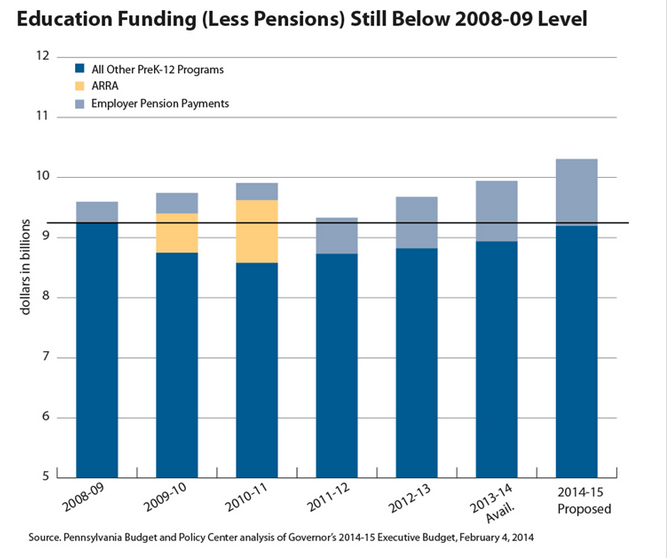
Basically, the whole video can be summarized in this graph from the Pennsylvania Budget and Policy Center:

Screen shot 2015-07-20 at 11.08.50 PM

For more information, please check out these other fine Gadfly on the Wall Blog articles:


NOTE: This article also was published on the Badass Teachers Association blog.

Do Americans “Throw Money” At Their Schools? A Fair Funding Primer

Screen shot 2015-07-06 at 11.05.59 PM

“Don’t throw money at schools.”

It’s a common rejoinder when lobbying for an increase in public education budgets.

You offer facts why schools need it: both the state and federal government continue to reduce K-12 funds, class sizes are increasing, the curriculum is being narrowed, buildings are crumbling – real world consequences to spending deficits.

And some guy (it’s often a dude) stands up with a cock-eyed grin and says, “You know, we really need to stop throwing money at schools.”

And he pauses as if we all need a moment to take that in.

Is there anything to this? We hear it often enough, but does he have a point?

Let’s see.

“Don’t throw money at schools.”

First, is it true? Is anyone actually throwing money at our schools?

I’ve worked as a public school teacher for over a decade. To my great disappointment never once has anyone hurled greenbacks through a window in my building. I have never had to dodge, duck or otherwise exercise gymnastics to avoid being thunked in the head by a stack of airborne bills.

Origami ninja stars made out of $100 notes do not routinely fly through the air in my classroom. No government representative has ever shown up in the auditorium during a professional development and said, “Yeah baby! Let’s make it rain!” before showering my coworkers and myself in Benjamin’s.

No. This has never happened. Not even coins. More change is thrown at the fountain in my local mall than at any public school where I’ve ever worked.

At this point, you’re probably saying, but, Steven, that’s not what this guy meant. He wasn’t implying someone literally tossed bills at foundations of learning. He was just being colorful.

To which I respond: was he? Because there are lots of ways to phrase that idea. He simply could have said, “We shouldn’t increase education funding.”

He could have said, “We need to spend school money more wisely before increasing it.”

He could have said, “Additional learning revenues are a waste because schools do such a bad job.”

He could have said, “We spend too much on education already.”

He could have said, “Kids don’t deserve more of my cash.”

But he didn’t say any of those things. Instead he conjured an image out of a Roman orgy or a rap video. He purposefully tried to frame this as a ridiculous situation. He wasn’t just trying to make an argument. He wanted to paint anyone who could possibly disagree with him as a fool.

“Can you believe these guys crying about public school funding?” he implied. “They’re having money thrown at them and they actually want more!?”

So before we even start to study the content of his phrase, we must remember it’s coated in bias and malicious intent. He is not really calling for a rational argument. He is appealing to emotions – most probably the emotions of those listening to the debate.

But we cannot sink to his level. We need reasons.

This is difficult because it’s not entirely clear what exactly he was getting at. Let’s examine what his statement might mean in plain English and try to determine if – underneath all this spin – he has a point or not.

Here are some possibilities.

1) “We need to spend education money more wisely before increasing it.”

This might be what he intended to say. And if so, he does have a bit of a point.

There is a problem with how school funding is spent. There is waste and misappropriation. At the local level, school boards and administrators do not always do things in the most efficient manner. But you could say the same thing at every level of democratic government. Fascist states have much less waste. Shall we just burn up the Constitution, then?

At the state and federal level, the problem is compounded by the ignorance of those allowed to write our laws. Education policy is rarely made by those who know what they’re talking about, thus funding often is wasted on useless initiatives. Common Core, standardized testing, punitive accountability systems – these were all created by business interests without regard to educational validity or efficacy and – as such – waste taxpayer money that could be better spent on things that would actually help children learn.

And speaking of waste, may I introduce you to charter schools? Favored by lawmakers yet rocked by fiscal scandals, charters are legal means of sucking up tax dollars for a profit. While public schools have to account for every penny spent and prove funds went to better the educations of real live students, charters are not just permitted but encouraged to withhold some tax money from going to student services and instead bolstering administrators’ bank accounts. Anyone who speaks of fiscal accountability in education yet is in favor of its further privatization is either disingenuous or in need of a basic math course!

The solution, however, is not to withhold additional funding. The solution is more oversight. And I don’t mean only government oversight and regulations. I mean oversight by the public.

Democracy only works if people participate. People need to push for transparency and less wasteful policies. They need to educate themselves about what’s going on. They need to investigate. They need to lobby, protest, and criticize. They need to vote. And they need a free and interested media to give them the facts to make smart decisions.

Clearly we’re lacking some of these things today. But that’s a national problem not limited to education funding.

In the meantime, we can’t wait for a perfect government before increasing school spending. Our children need help now!

If we do nothing, we doom another generation to getting less than they deserve, less than what we could have provided. Why? Because we were afraid some of it wouldn’t reach them!?

A deep sea diver with a kink in his air hose, doesn’t shrug and turn off his oxygen. He turns it up!

2) “Additional learning revenues are a waste because schools do such a bad job.”

This might have been his criticism. Let’s look at the facts.

International comparisons of national school systems are all the rage in political circles. And raw data suggests that children from the United States are not at the top. We are somewhere in the middle.

That’s all true. But what pundits refrain from admitting is that it’s been true for a long time – in fact, for as long as we’ve been making these types of comparisons. Our schools have not gotten worse. They have stayed the same.

This brings up an important issue. How does one compare national school systems to each other, anyway? What do we use to make these comparisons? Income prospects? Student portfolios? Measures of critical thinking? Classroom grades?

No. We use standardized test scores – the PISA test to be exact.

However, we’ve known for decades that standardized tests are poor measures of academic success. Bubble tests can assess simple things but nothing complex. After all, they’re scored based on answers to multiple choice questions. In fact, the only thing they seem to measure with any degree of accuracy is the parental income of the test-taker. Kids from rich families score well, and poor kids score badly.

So these comparisons are suspect.

But even if we accept them, we are leaving out a very important factor: Poverty.

Virtually all of the top scoring countries taking the PISA exam have much less child poverty than the U.S. As we’ve seen, this will boost their scores. If we adjust our scores for poverty, our students jump to the top of the list.

Let me repeat that: U.S. students do the best in the world on international tests – IF THEY ARE NOT POOR.

Moreover, the U.S. education system does something that many international systems do not. We educate everyone! Foreign systems often weed children out by high school. They don’t let every child get 13 years of grade school (counting kindergarten). They only school their highest achievers.

So when we compare ourselves to these countries, we’re comparing ALL of our students to only SOME theirs – their best academic pupils, to be exact. Yet we still hold our own given these handicaps!

In short, U.S. public schools do an excellent job educating children. They overcome incredible obstacles to achieve near miraculous ends often with very few resources.

Imagine what they could achieve if our schools were properly funded.

3) “We spend too much on education already.”

This one is a favorite of politicians of both parties. We already spend a lot on education. Some lawmakers and media personalities go so far as to claim that we spend more than any other country in the world.

Is that true? No.

We are near the top, but according to the most recent OECD study, four countries – Austria, Luxembourg, Norway and Switzerland – spend more.

Additionally, the study was released in 2014 but used data from 2011. Since that time, the U.S. has cut its school spending by leaps and bounds while most other advanced nations have been increasing it. Look for many more countries to pass us up when the next study is released.

But even using current figures, there are troubling social, economic and political differences between nations that impact how school funding needs to be spent. While most advanced countries spend their education budgets on actual instruction, the United States mandates public schools use a larger portion of their budgets on things outside the classroom.

For example, many international schools don’t have metal detectors or security staff. Given the U.S. problem with mass shootings and gun violence, our schools need to spend a significant portion of their monies in this way. I’m not suggesting we stop. Clearly we need to continue these practices, but that’s less money to help kids learn.

In addition, unfunded legislative mandates and court decisions have made U.S. public schools responsible for many things that international schools are not. About one third of all budget increases in recent years has gone to support special education students; 8 percent went to dropout prevention programs, alternative instruction, and counseling aimed at keeping students in school; another 8 percent went to expand school lunch programs; and so forth. Very few additional dollars were provided for needs associated with basic instruction.

Again, I’m not saying we should stop. Given our national epidemic of child poverty – an epidemic not shared by other advanced nations – we have to address these adjacent issues. But without additional funding, we’re letting the very heart of our schools – the classroom – go to waste while other countries are providing significantly more support.

Unfortunately, the problem doesn’t end there. Not only does the U.S. have unique problems that other nations do not share, we also are unique in how we allocate the funding we already have. And this difference only worsens the problem and increases the need for more money.

While most advanced countries divide their education dollars evenly between students, the United States does not. Some students get more, some get less. It all depends on local wealth.

The average per pupil expenditure for U.S. secondary students is $12,731. But that figure is deceiving. It is an average. Some kids get much more. Many get much less. It all depends on where you live. If your home is in a rich neighborhood, more money is spent on your education than if you live in a poor neighborhood.

The U.S. is one of the only countries in the world – if not probably the ONLY country – that funds schools based largely on local taxes. Other developed nations either equalize funding or provide extra money for kids in need. In the Netherlands, for example, national funding is provided to all schools based on the number of pupils enrolled. But for every guilder allocated to a middle-class Dutch child, 1.25 guilders are allocated for a lower-class child and 1.9 guilders for a minority child – exactly the opposite of the situation in the U.S.

So even though we spend more than many countries, we spend it so unevenly that poor and minority children are being left out.

Therefore, we have a choice: either do away with funding based on local property taxes or increase funding to poor school districts – or both.

4) “Kids don’t deserve more of my cash.”

Dollars to doughnuts, this is probably what he really means.

The United States has a moral failing. And we’re proud of it. We call it libertarianism. It means – Screw you! I’ve got mine.

We don’t care about helping others, we don’t care about the common good, we only look out for ourselves and our immediate friends and families. Everyone else can eat crap and die.

It’s ethical immaturity and, frankly, there’s not much you can say to someone who feels this way except that you disagree.

At most you can try to appeal to his self interest. Do you really want to live in a society full of uneducated people? Do you really want your kids to grow up in a world like that?

But that’s as far as it goes. You can’t help emotionally and intellectually stunted people – especially adults. Most children go through this phase. Some never grow out of it.

The good news is that most of us aren’t so far gone. If you can show that our interlocutor’s statement really comes down to this, you may be able to convince some people to agree with you simply because no one wants to be such an odious troll.

You need to pull back the curtain and show the truth.

How do we best spend these education dollars? How do we raise the money? Those are valid questions, but only a truly horrible person simply refuses to help children learn.

Because we’re not “throwing money” at schools. We’re throwing certain kids away.


NOTE: This article also was published in the LA Progressive, Commondreams.org and on the Badass Teachers Association blog.