Teaching Blind Obedience is Child Abuse

My daughter is not a little soldier.

She does not jump at my orders.

She can be rude, crude and badly behaved.

But I wouldn’t want her any other way – because the alternative is worse.

The same goes for my middle school students.

If you enter my classroom, you may find some children questioning my assignments.

“Mr. Singer, why can’t we chew gum in class?”

“Mr. Singer, why do you give so much homework?”

“Mr. Singer, why do we have to write a rough draft? Why can’t we just write a final copy?”

But you’ll notice my students almost always call me “Mr. Singer.” The reason is trust and respect.

Over time we’ve formed a relationship with each other where they’ve learned to respect me as their teacher and I have tried to earn that trust by treating them kindly and giving good reason for the things I tell them to do.

They are obedient (for the most part), but not BLINDLY obedient.

That may sound like splitting hairs but it’s one of the most important distinctions in education.

When someone knows WHY they’re doing something, they are an agent – they are responsible for their own actions. They are self-disciplined – not drones acting without thinking solely because they were told to do so.

That is incredibly important.

Think of what blind obedience does to adults.

American historian Howard Zinn famously put it this way:

“Civil disobedience is not our problem. Our problem is civil obedience. Our problem is that people all over the world have obeyed the dictates of leaders… and millions have been killed because of this obedience… Our problem is that people are obedient all over the world in the face of poverty and starvation and stupidity, and war, and cruelty. Our problem is that people are obedient while the jails are full of petty thieves… [and] the grand thieves are running the country. That’s our problem.”  

When I was a college undergraduate, I was unsure what to major in and I began my undergraduate work in psychology. Of all the things I learned in those early survey classes before changing course to writing, philosophy and (after a career in journalism) education, the lesson I’ll never forget is the groundbreaking 1961 study by Stanley Milgram, a Yale University psychologist.

Milford famously wondered how many people would willingly comply if a person in a position of authority told university students to deliver a 400-volt electrical shock to another person. His students predicted that no more than 3% of participants would deliver the maximum shocks. However, when he actually conducted the experiment, 65% delivered the maximum shocks.

During the experiment, each subject was asked to press a button that they believed gave increasingly high voltage electric shocks to the student on the other side of a wall if the student gave the wrong answer to a teacher’s questions. It should be noted that the students on the other side of the wall did not actually receive shocks, but the participants BELIEVED that they truly were shocking their fellow students by pressing the button.

Many of the subjects, while believing that the student was actually receiving shocks and hearing their protests and cries for mercy – including complaints of a heart condition – became increasingly agitated and even angry at the experimenter. Yet 36 out of 40 people, in turn, continued to do what they were instructed to do all the way to the end. Even when the student became silent when apparently receiving a shock from a switch labeled “danger: severe shock”, the subject continued based on the instruction that silence is to be read as a wrong answer.

This experiment (which would be highly unethical today) has become a classic in psychology, demonstrating the dangers of obedience.

Milgram wrote in 1974:

“Ordinary people, simply doing their jobs, and without any particular hostility on their part, can become agents in a terrible destructive process. Moreover, even when the destructive effects of their work become patently clear, and they are asked to carry out actions incompatible with fundamental standards of morality, relatively few people have the resources needed to resist authority.”

In fact, these experiments were inspired by history – specifically by the Nazi, Adolph Eichmann, who defended himself at the Nuremberg Trials by saying that he was simply following orders when he commanded the deaths of millions of Jews during the Holocaust.

This is what blind obedience gets us – a society of Nazis willing to do anything if told to do so by the proper authorities.

Parents and teachers are in a delicate situation then.

We’re responsible for guiding children into adulthood, and that often does require a measure of obedience. The question is how to get there without stripping away a child’s agency? How to get children to do generally what is necessary for their learning while still leaving their independence intact?

Let’s be honest – schools play an essential role in teaching obedience. It’s a critical life skill that helps children learn to follow rules and directions. Without obedience, adolescents would have difficulty following rules at home, at school, and in society.

One of the ways schools teach obedience is through rules and consequences. When children break rules, they face consequences such as being sent to the principal’s office, getting detention or being suspended. Such consequences help children learn that there are repercussions for their actions.

Schools also teach obedience through modeling. Teachers and administrators try to set good examples for children by obeying rules, themselves. When children see adults following the rules, they are more likely to do so themselves.

Finally, schools teach obedience through positive reinforcement. When children do the right thing, they are rewarded with praise, stickers, or other incentives. This positive reinforcement helps children learn that obedience is a good thing and that it is something that should be rewarded.

However, as children grow older, it is just as vital that teachers and parents not only foster obedience but also critical thinking about that obedience.

When a child questions a rule (and they will question it), we should not instantly meet that questioning with negativity or shock. We should calmly and rationally answer.

We should not get angry at questions, we should welcome them. Questioning should be a part of instruction because as educators and parents we should not want blind obedience. We should want trust and understanding.

As Albert Einstein said, “Peace cannot be kept by force. It can only be achieved by understanding.”

I was reminded of this when watching the recent documentary “Shiny Happy People” about the Duggar family. The brood of religious fundamentalist Christians made their TV debut in 2004, going on to become a household name with their TLC show “19 Kids and Counting,” presenting Jim Bob and Michelle Duggar and their ever-expanding household as a seemingly “perfect” family. 

However, behind the scenes, the family’s theocratic hierarchy led to sexual, emotional, and physical abuse, which was allegedly brushed aside by their church.

In 2015, it was revealed that the Duggars’ eldest son, Josh James, had molested numerous underage girls, including four of his siblings, when he was aged 14 to 15. These revelations led to the cancellation of “19 Kids and Counting.” In 2021, Josh was arrested after police discovered he had been receiving and was in possession of child pornography.

The family belongs to the Institute in Basic Life Principles (IBLP), a nondenominational Christian sect that serves as an umbrella organization for several ministries founded by minister Bill Gothard in 1961. 

According to the documentary, IBLP teachings require absolute obedience. Authority is distributed in various circles – God being the highest authority, followed by the family’s father, etc. Women are considered to be among the lowest forms of authority. In fact, two of Josh’s sisters who he had abused were even made to go on TV to speak in defense of their abuser. 

We hear a lot of propaganda from religious fundamentalists about how public schools groom students into being politically liberal. However, teaching blind obedience is the true grooming. It is setting people up to become victims of anyone who they perceive as having authority over them.

This is what made the Duggar children ready made victims for their own brother. It sets children up to be easily abused, gaslit, fooled and dominated.

And in doing research on this topic, I found many articles defending absolute obedience by reference to the Bible. The idea that authority is a hierarchy and we should simply follow the instructions of those above us in that hierarchy is as rampant as it is perverted.

Any discipline adults give to children should be in service of them eventually becoming independent and self-disciplined. That means being able to make independent choices about their own behavior without prompting from an adult.

There is a difference between being self-disciplined and being obedient.

A self-disciplined child will complete an action, regardless of who is watching. She will do the behavior because it is the right thing to do. In contrast, an obedient child may follow directions to please a parent, to avoid a consequence or to receive a reward. Being obedient is following directions or commands from an adult. It is exhibiting “good behavior” when an adult is present. Meanwhile, having self-discipline is making those choices without the presence or reminders from adults.

It may be tempting to see children marching in line or sitting calmly with their hands in their laps and consider that an ideal. But as children grow, we must learn to tolerate more frequent independence.

In fact, we must do more than tolerate it. We must cherish it.

The opposite is so much worse.


Like this post?  You might want to consider becoming a Patreon subscriber. This helps me continue to keep the blog going and get on with this difficult and challenging work.

Plus you get subscriber only extras!

Just CLICK HERE.

Patreon+Circle

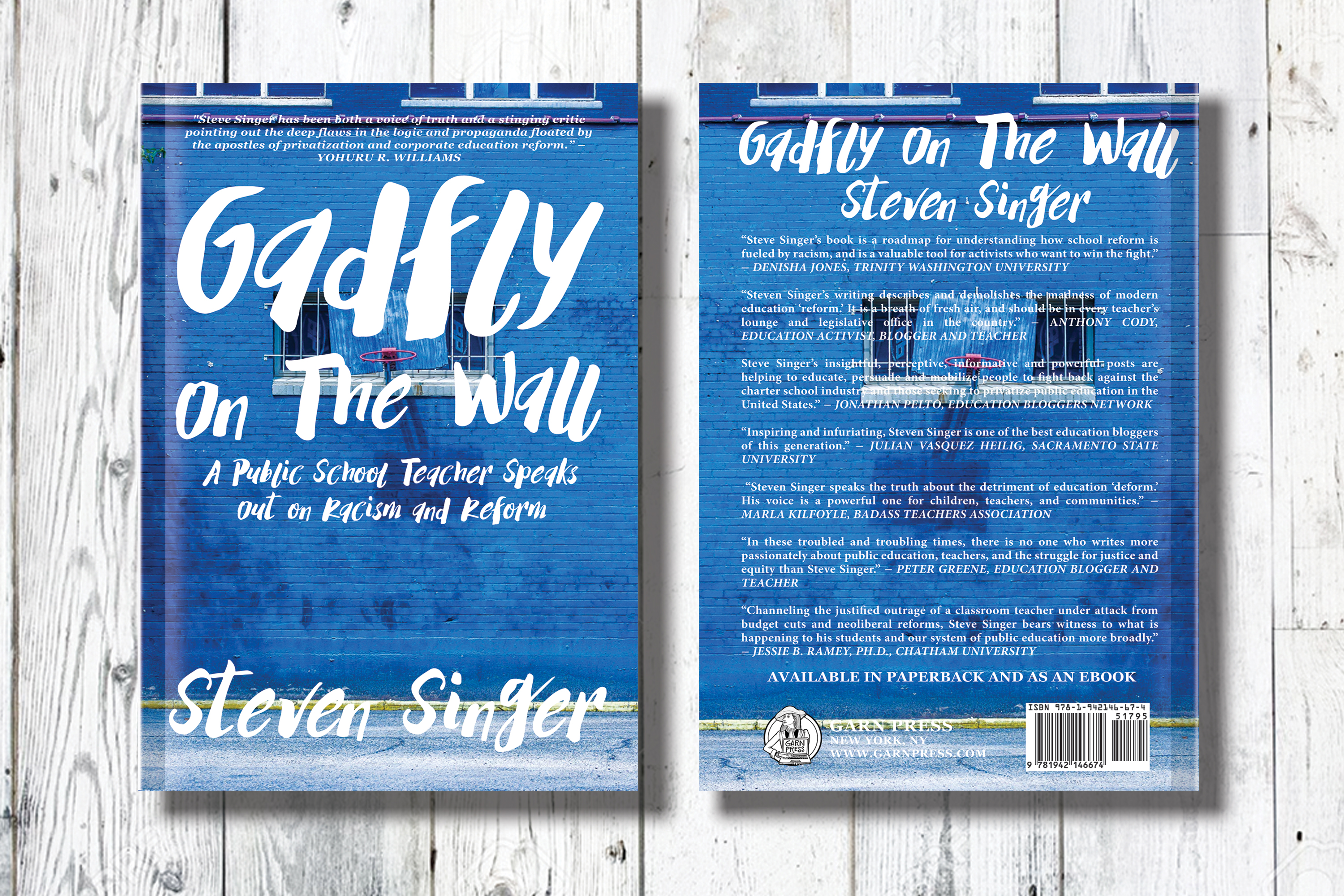
I’ve also written a book, “Gadfly on the Wall: A Public School Teacher Speaks Out on Racism and Reform,” now available from Garn Press. Ten percent of the proceeds go to the Badass Teachers Association. Check it out!

The Last Day of School

thumbnail_IMG_8831

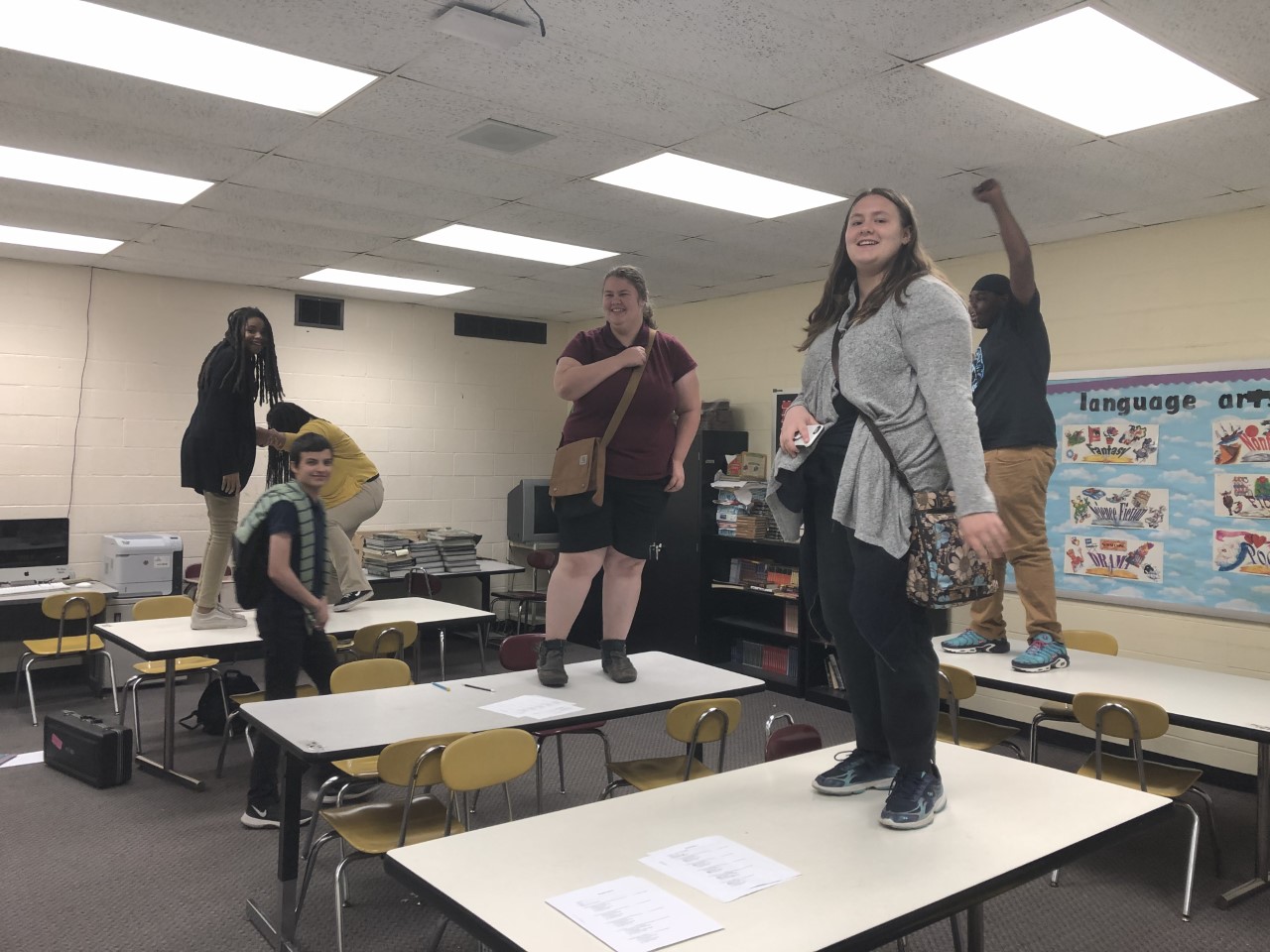
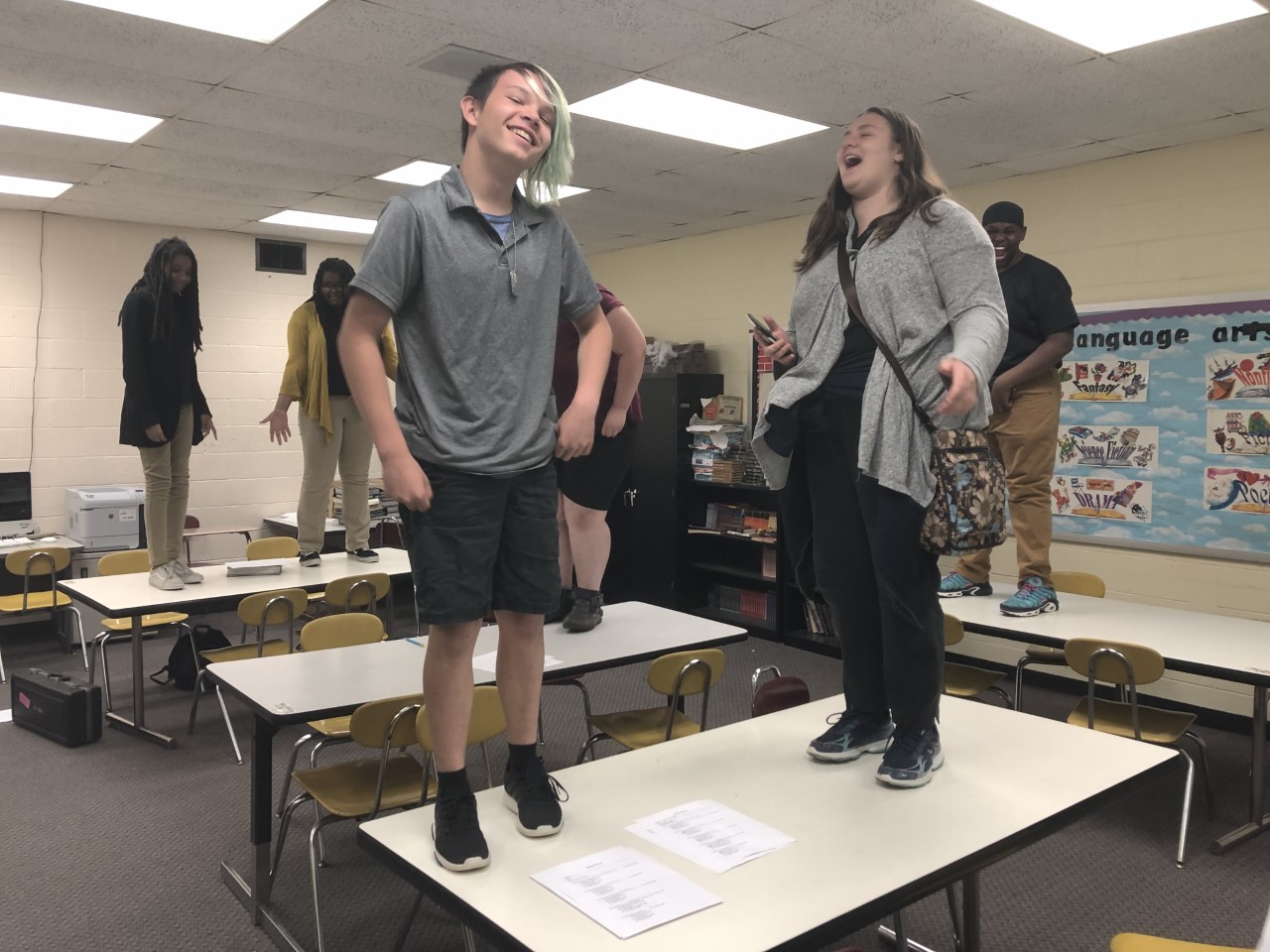
On the last day of school this year, my 8th grade students gave me one of the greatest salutes a teacher can get.


They reenacted the closing scene of “The Dead Poets Society.”


You know. The one where Robin Williams’ Mr. Keating has been fired from a boarding school for teaching his students to embrace life, and as he collects his things and leaves, the students get up on their desks as a testament to his impact and as a protest to the current administration’s reductive standardization.


That’s what my students did for me. And I almost didn’t even notice it at first.


The whole thing went down like this.

 
The bell rang and an announcement was made telling us that the day was done.

 
I was immediately rushed by a crowd of children turning in final projects, shaking my hand, saying goodbye.

 
In fact, I was so occupied with the students right in front of me that I didn’t notice what was happening with the ones just behind them.

 
I heard someone say in a ringing voice, “Oh Captain, my Captain!”

 
I looked up and there they were.

 
About a dozen students were standing on their desks, looking down at me with big goofy grins.


Some had their hands on their hearts. One had raised his fist in the air. I think someone in the back was even making jazz hands. But they were each standing up there with the same look on their faces – a mixture of independence, humor and gratitude.


It shouldn’t have come as a surprise that this happened. Some of them had threatened months ago to make just such a demonstration.

 
We had watched the movie together back in April at the introduction of our poetry unit. I guess it was my way of trying to show them that poetry could make a deep impact on people. But I certainly hadn’t wanted them to put themselves at risk by standing on the furniture.


In fact, I had specifically cautioned them NOT to do this exact thing because someone might fall off their desk and hurt themselves.


But on the last day of school after the last bell has rung and my tenure as their teacher has expired – well, things are different then.


“Thank you,” I said. “That is really one of the nicest things students have ever done for me.”


Then I took out my phone and asked if I could snap a few pictures, because who’d ever believe me if I didn’t? They didn’t mind.


thumbnail_IMG_8835thumbnail_IMG_8830thumbnail_IMG_8832


When I was done, they hopped down one at a time, many of them rushing forward to give me a hug.


This class will always be a special one in my heart.


We’ve come a long way together.


For most of them, I was their language arts teacher for two years. When they first came in the classroom they were just babies. Now they are going off to high school.


Unless you’re a parent, you wouldn’t believe how much kids can grow and change in just a few short years. And the middle school years are some of the most extreme. The line between child and adult fades into nothingness.


I’ve had a handful of children who were enrolled in my classes for multiple years before, but I’d never had so many. In some ways, we were more like a family than a classroom.


I had been there when parents got sick, left, died. I knew them all so well – who would ask questions just to stall, who never got enough sleep and why (often Fortnite), which ones had athletic aspirations, which were incredible artists, etc. Some had come out of the closet to me and their classmates but not at home.


Many of us went on a school field trip to Washington, DC, together. We’d toured the Holocaust Museum and Arlington National Cemetery. When I was invited to do a TED talk, they tracked it down on YouTube. They even found my Twitter account and made merciless fun of my profile picture. And when I actually had my book published on education issues last year, a bunch of my kids even came out to hear me talk about it at local book stores.


It’s hard to explain the depth of the relationship.


At the end of the year, I always give my students a survey to gauge how they think I did as their teacher. It’s not graded, and they can even turn it in anonymously.


The results are almost always positive, but this year, I got responses like never before:


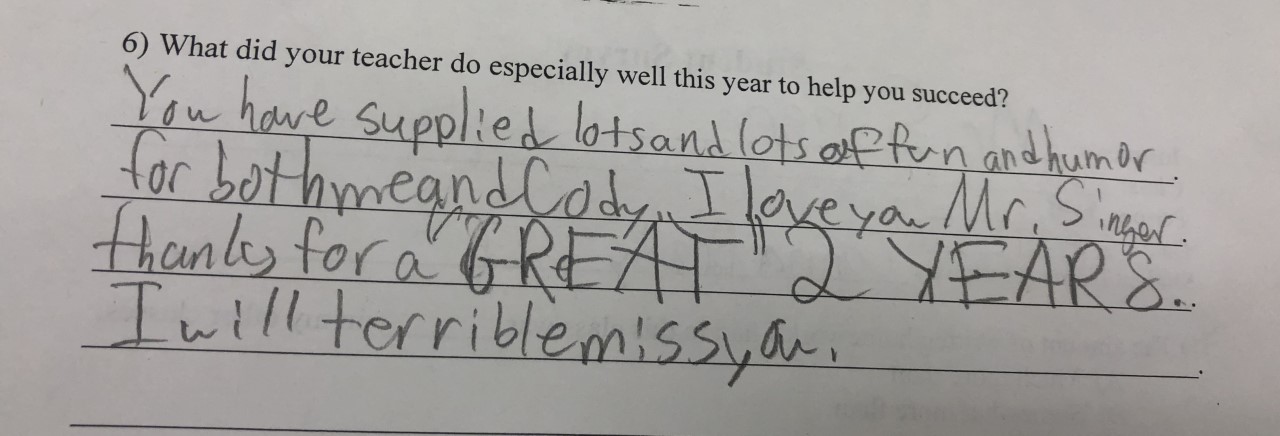
“I love you, Mr. Singer. Thanks for a great 2 years. I will terribly miss you.”


thumbnail_IMG_8849

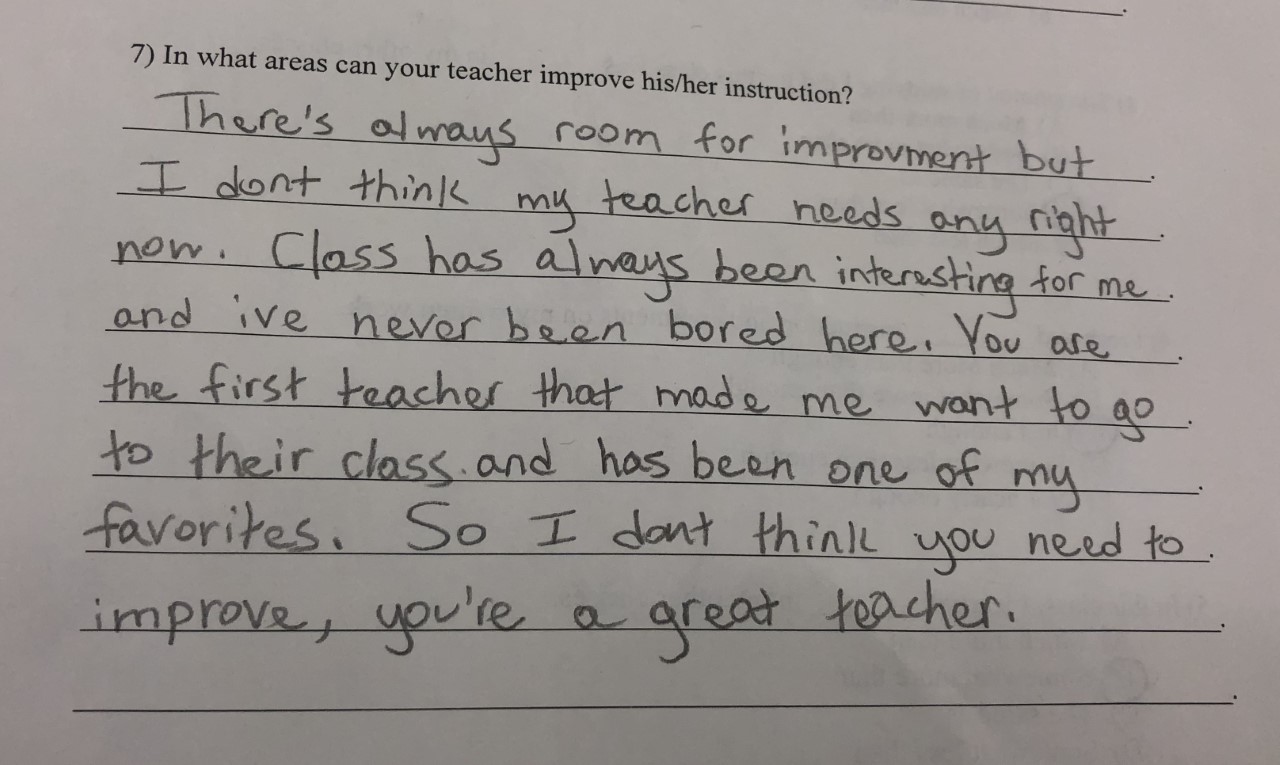
“I’ve never been bored here. You are the first teacher that made me want to go to their class and has been one of my favorites.”


thumbnail_IMG_8847

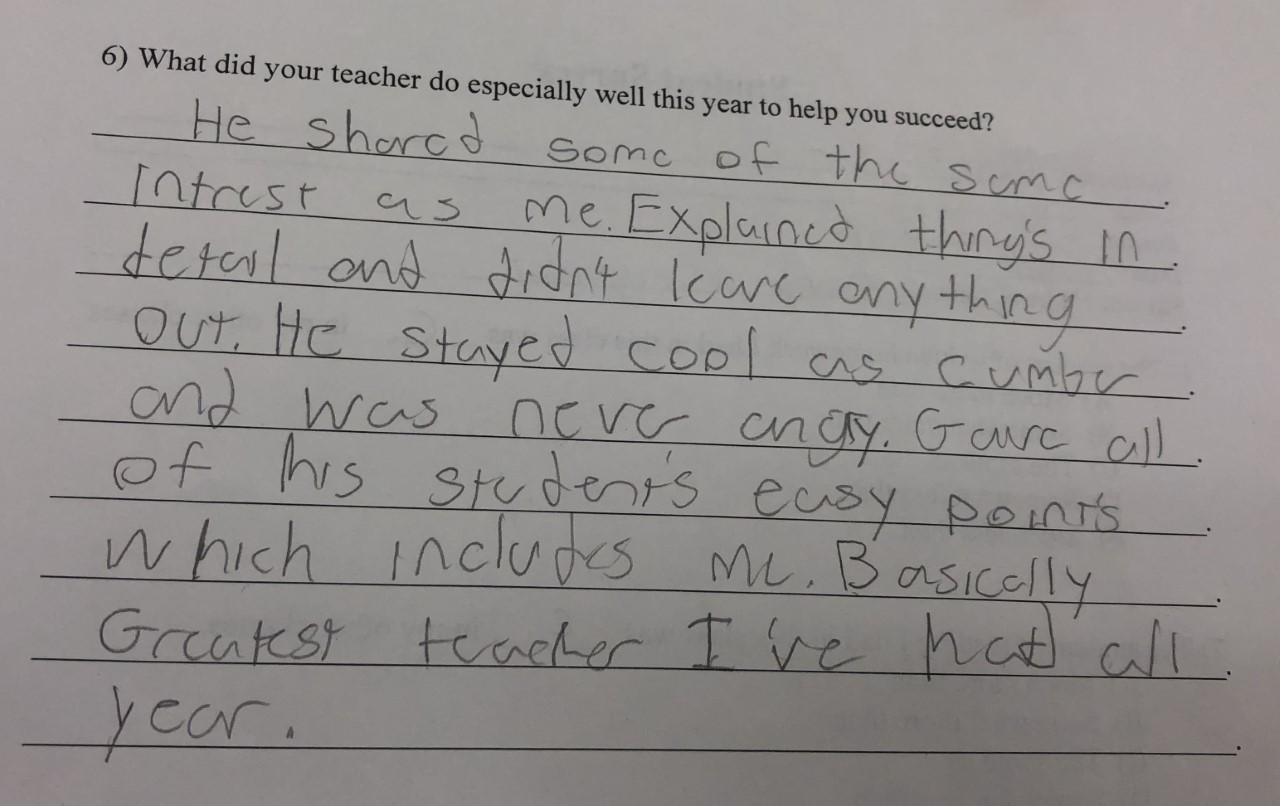
“He stayed cool as a cucumber and was never angry… Basically the greatest teacher I’ve had all year.”


thumbnail_IMG_8846

 He was “fair to all students.”


thumbnail_IMG_8845

“He was more inclusive to many different groups.”


thumbnail_IMG_8844

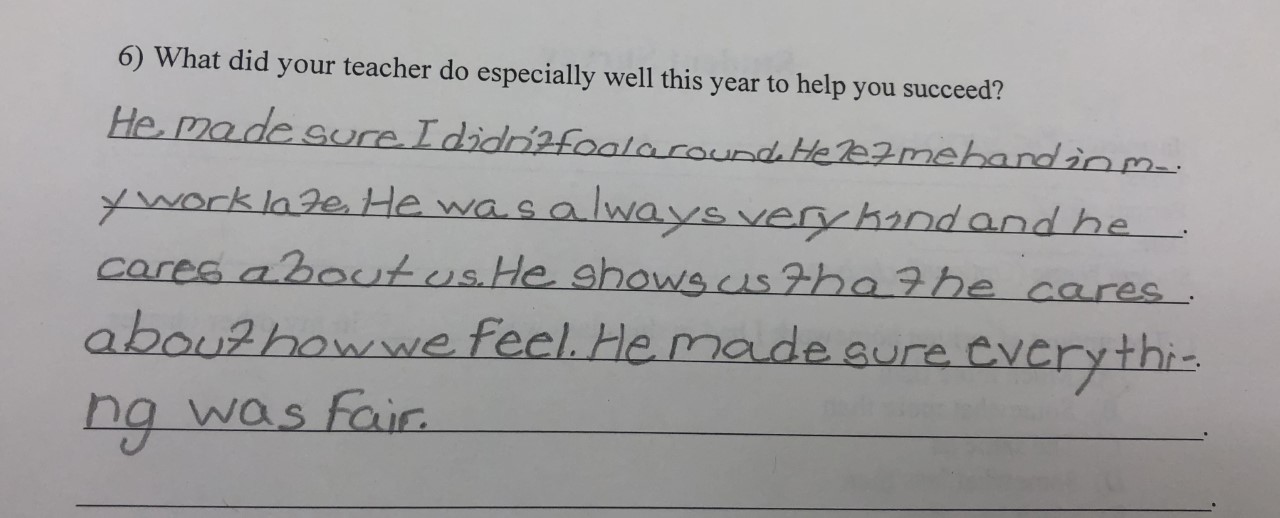
“He made sure I didn’t fool around. He let me hand in my work late. He was always very kind and he cares about us. He shows us that he cares about how we feel. He made sure everything was fair.”


thumbnail_IMG_8843

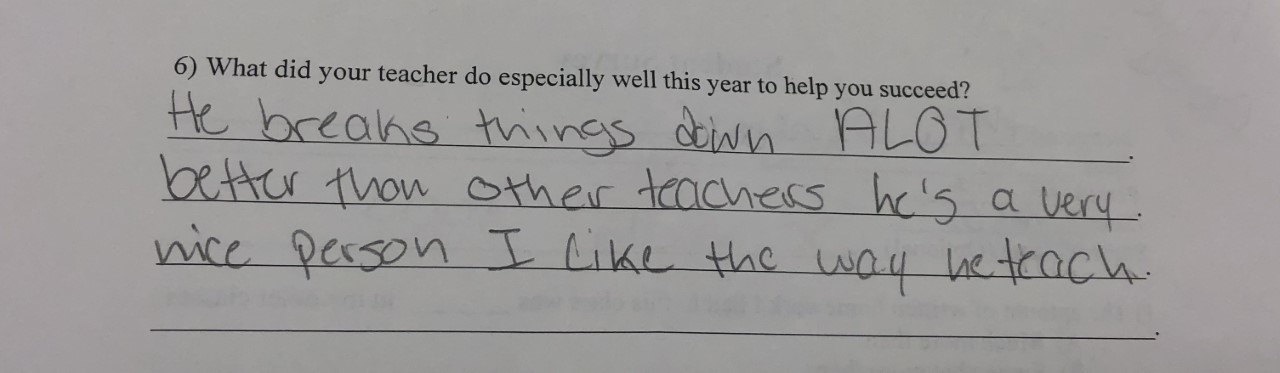
“He breaks things down A LOT better than other teachers. He’s a very nice person. I like the way he teaches.”


thumbnail_IMG_8842


“Mr. Singer did well to motivate us and help us to succeed and get a better grade.”


thumbnail_IMG_8841


“He explained things better than other teachers.”


thumbnail_IMG_8840

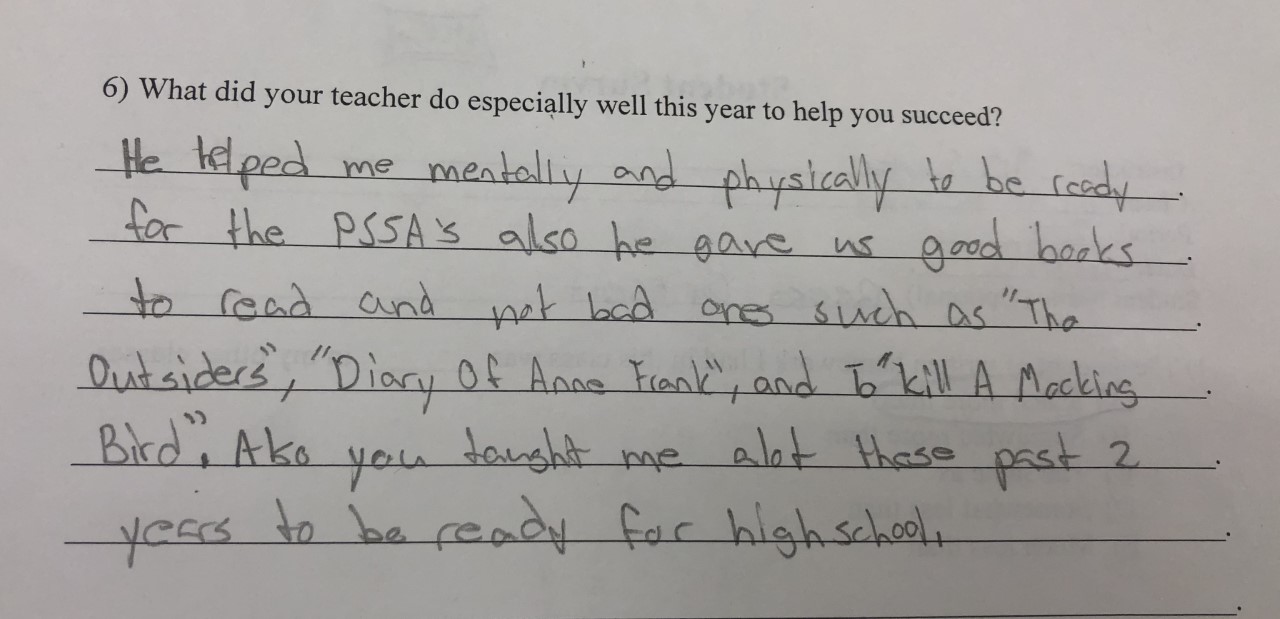
“He helped me mentally and physically to be ready for the PSSAs. Also he gave us good books to read and not bad ones such as “The Outsiders,” “The Diary of Anne Frank,” and “To Kill a Mockingbird.” Also you taught me a lot these past 2 years to be ready for high school.”


thumbnail_IMG_8839


“To be absolutely honest, I don’t think my teacher needs to improve. He actually has done more than the rest of my teachers.”


thumbnail_IMG_8838


“Well he encouraged me to succeed more in his class and in life as well. He also taught me that the meaning of life is not how you take it but where you go with it. I’m thankful that he taught me more than the history my actual history teacher taught me. He also told me the truth of our history. He talked about the parts no one else would talk about.”


thumbnail_IMG_8837


I’m not sure there’s much to say beyond that.


As these now former students reluctantly walked away in ones or twos, a few stayed behind.


I did a lot of reassuring that 9th grade would be great and that I’d probably be right here if they needed me.


I overheard one girl say to another that a certain teacher was good but not “Mr. Singer good.” I thanked her and she blushed because I wasn’t supposed to hear that.


There were tears. Some of them shed by me.


But when the last student left, I remained at my desk surrounded by a hum of fluorescent lights and ear numbing silence.


There is no emptiness like that of a space that has just been filled – a space that cries out for more.


My classroom is like that. And so is my heart.


Don’t get me wrong. I need this summer break to recover.


But I also need the end of August, when a new group of students will come rushing through those doors.


Here’s looking forward to the first day of school.


Like this post? I’ve written a book, “Gadfly on the Wall: A Public School Teacher Speaks Out on Racism and Reform,” now available from Garn Press. Ten percent of the proceeds go to the Badass Teachers Association. Check it out!
book-1

Decolonizing Through Dialogue: Authentic Teaching in the Age of Testing and Common Core

waitingsuperman3023


If you’re not careful, being a public school teacher can become an act of colonization.


This is especially true if you’re a white teacher like me with classes of mostly black students. But it’s not the only case. As an educator, no matter who you are or whom you teach, you’re a symbol of authority and you get that power from the dominant structures in our society.


Believe it or not, our schools are social institutions, so one of their chief functions is to help recreate the social order. Students enter as malleable lumps of clay and exit mainly in the shapes we decide upon. Therefore, as an educator, it’s hard not to fall into the habit of molding young minds into the shapes society has decided are appropriate.


In some ways this is inevitable. In others, it’s even desirable. But it also runs against the best potential of education.


In short, this isn’t what a teacher should be. My job in front of the classroom isn’t to make my students into anything. It’s to give them the opportunity, to generate the spark that turns them into their best selves. And the people who ultimately should be the most empowered in this process are the students, themselves.


But it’s easier said than done.


The danger is best expressed in that essential book for any teacher, “Pedagogy of the Oppressed,” where Paulo Freire writes:


“Worse yet, it turns them (the students) into ‘containers,’ into ‘receptacles’ to be filed by the teacher. The more completely she fills the receptacles, the better a teacher she is. The more meekly the receptacles permit themselves to be filled, the better students they are.”


In most cases this means Eurocentrism – a kind of worship of all things white and denigration of all things black, brown and all pigments between.


We take the status quo and find every blind justification for it. In fact, this can become the curriculum, itself. Every counter-narrative, every criticism of the power structure then naturally becomes a danger. Revisionist history becomes history. European philosophy becomes the only accepted definition of rationality. Ideologies of empire become obvious and inescapable. White becomes the norm and racism, misogyny, homophobia, xenophobia all become hidden and internalized.


You’ve heard the criticism of curriculums focusing exclusively on dead white males. This is why.


And not only does it silence minority voices, it reinforces a false view of the world. Folk singer Tom Paxton made that clear in this classic song:

What Did You Learn In School Today?”

What did you learn in school today,
Dear little boy of mine?
What did you learn in school today,
Dear little boy of mine?

I learned that Washington never told a lie,
I learned that soldiers seldom die,
I learned that everybody’s free,
And that’s what the teacher said to me,
And that’s what I learned in school today,
that’s what I learned in school.

What did you learn in school today,
Dear little boy of mine?
What did you learn in school today,
Dear little boy of mine?

I learned the policemen are my friends,
I learned that justice never ends,
I learned that murderers pay for their crimes,
Even if we make a mistake sometimes,
And that’s what I learned in school today,
That’s what I learned in school

What did you learn in school today,
Dear little boy of mine?
What did you learn in school today,
Dear little boy of mine?

I learned that war is not so bad,
I learned about the great ones we’ve had.
We fought in Germany and in France
And some day I might get my chance.
And that’s what I learned in school today,
That’s what I learned in school

What did you learn in school today,
Dear little boy of mine?
What did you learn in school today,
Dear little boy of mine?

I learned our government must be strong;
It’s always right and never wrong!
Our leaders are the finest men
And we elect them again and again,
And that’s what I learned in school today,
That’s what I learned in school


We can see why this kind of teaching is valued. It reinforces the status quo. But at its core education is essentially subversive. It supports new ways of thinking. It is by definition revolutionary. When you encourage students to think for themselves, some may come to conclusions that differ from the norm. This is entirely healthy and the only way societies can grow and change. But it’s inimical to the people in power who often are in charge of the educational system. They don’t want new ideas if those ideas will challenge their hold on the reigns of power. Socrates wasn’t forced to drink hemlock, after all, because his lessons supported the Athenian elite.


So we’re left with a real quandary. How do teachers remain free to inspire while being a part of a system that doesn’t value inspiration?


The natural forces of society work against authentic teaching like gravity pulling at a rocket. Unless you’re actively pushing against the ground, the most natural thing in the world is to just go with the flow. The textbook says this is the way. Teacher training programs often agree. Cooperating teachers who have been in the classroom for decades back it up. This is the best method. Just keep it up.


But it’s not. And you shouldn’t. There is another way even though it’s hard to see. And THAT’S often what you need to be doing for your students.


Let me pause at this point to make one thing clear: I don’t have all the answers.


I am no expert in how to do this. I have fallen victim to it, myself, more often than I’d like to admit. It may be next to impossible to avoid the accepted route much of the time. But if we want to be good teachers, we need to try.


If we really want to provide the best service to our students, their parents and the community, we have to break out of the mold. We have to allow our students the chance of seeing the world and not just our version of it.


The best ways I’ve found to do this are through selection of texts, use of Socratic Seminars and allowing as much choice as possible in assignments.


When selecting texts, you want to be as inclusive as possible. Provide students with the widest possible range of authors and opinions. In Language Arts, this means purposeful multiculturalism. It means authors of color being prized equally with the European cannon. It means women and transgender authors. It means authors subscribing to a wide range of beliefs and skepticisms. And it means accepting genres and forms that are often devalued like song lyrics, rap, Manga, graphic novels and anything that can be considered deep, substantial texts.


Finding such sources can be exhausting, but it’s also exhilarating. Unfortunately, not all schools permit teachers to do this to the same degree. Some districts mandate teachers only use certain texts already approved by the school board. Others provide a list of approved texts from which teachers can pick.


Each educator will have to find ways to navigate the system. It’s best if you can find support from administrators and in the community for what you want to do and go from there. But this can be a challenging road especially in our era of high stakes testing and Common Core which values authentic teaching not at all.


Another essential tool is class discussion. You may or may not be able to broaden the texts being discussed, but you can usually provide space for students to discuss those texts in class.


My 8th graders and I use the Socratic Seminar method of discussion extensively.


With almost every piece of literature, I write guided open-ended questions for the students to consider. The questions come out of the text, but I try to focus on queries that will get students thinking about how the text relates to their lives, gender and economic issues, questions of theme, race and opportunities to make connections of every type. Eventually, I even allow students to begin writing these questions, themselves.


The way I see it, my role is essentially an opportunity maker. It isn’t about finding an answer that will please me, the teacher. It’s about exploring the subject. It’s not about what I think. It’s about what students think. And that makes all the difference.


Finally, I’ve found it beneficial to allow students choice in their assignments.


There are many ways for students to demonstrate knowledge. They can write essays, take a test, create a collage, design a power point presentation, make an iMovie, act out a scene, etc. I try to expose students to multiple formats the first half of the year and then give them increased choice in how they’d like to express themselves in the second half.


Not only does this free students to think, it encourages the deepest kind of learning. It makes the lesson vital, important and intrinsic.


All of these approaches share a common feature: dialogue. They put the student, teacher and the author in a vital relationship. They take steps to equalize that relationship so that one isn’t more important than the others. It’s not just what the author, teacher or student thinks – it’s the interrelationship of the three.


Ultimately, it’s up to the student to decide the relative value of the results. Sure, they get grades. Sure, the system will judge students based on those grades. But the value of those grades isn’t as important as the resultant learning and the value students place on the experience.


To me, that’s the best kind of learning. And it’s the result of authentic teaching and dialogue.


It is the most inimical thing to colonization. Students are not enslaved to a system. They aren’t in servitude to a prepackaged group of ideas and norms.


They are valued and empowered.


Isn’t that what we’re supposed to be doing for them?