We Are All on the Lunatic Fringe – The Centerless Battle Against Corporate Education Reform

cliff_hanging

It was one of the strangest meetings I’ve ever had with a state legislator.

Why?

First of all, we were all teachers.

Even the legislator. Even his Aide!

Pennsylvania State Rep. Dan Miller (D-Mt. Lebanon) had been a history teacher before he sought a law degree and higher office.

His aide had been a Pittsburgh Public School teacher before she was furloughed and found a place in the representative’s office.

And, of course, there were the seven of us – all teachers at my school district.

We crowded together in his tiny district office to talk about how standardized testing is destroying public schools.

Which brings me to the second strangest thing – Rep. Miller didn’t just agree with us, he did so knowledgeably.

I’ve sat across a table from an awful lot of lawmakers, and they almost always try to find common ground. Disingenuously.

Sure! I agree teachers are important! That’s why we need to fire more of them!

You bet neighborhood schools are vital! That’s why I want to close all the public schools and replace them with charters!

Uh-huh! School funding is critical but not more so than classroom teachers. That’s why we’re cutting your budgets! We want to see what you can do!

None of that at Rep. Miller’s office.

When we brought up how important it is to allow parents throughout the Commonwealth to opt their children out of standardized tests without penalizing their school districts, he praised parent rights.

When we described how the definition of school accountability has changed from holding lawmakers accountable to holding teachers accountable, he talked about the sad scapegoating of the profession.

And when we told him about how standardized testing is failing our students, he told us how it would have failed him if he were a student today.

“I wasn’t a very good student,” Miller admitted. He loved history and aced that class consistently, but he barely squeaked by in most other subjects.

The first book he read all the way through was “North and South” by Elizabeth Gaskell – in 11th grade! Why? Because it interested him. “Jane Eyre”? Not so much.

And he admitted that in today’s environment where nothing is counted a success unless it generates a high test score, he would have been lost and probably would have dropped out.

Which brings me to the third strangest thing – Miller isn’t playing partisan politics. As a Democrat, he isn’t blaming everything on the Republicans.

“This is a bipartisan issue,” he said. There’s no reason why both parties can’t agree on what needs to be done to help our schools.

So why doesn’t the legislature do more?

Ignorance. “There’s a low level of analysis of bills down there (in Harrisburg).” Local government usually does a better job.

The representative’s teaching background gives him an edge, he says, but most legislators simply don’t have that knowledge base to draw on.

There’s a lot of good will in the capital, he says. “Most legislators aren’t trying to cause a problem.” They want to try to achieve something, but if those experiments fail, the consequences are dramatic, long lasting and hard to correct.

He even talks well of our Republican ex-Governor Tom Corbett, whose education policies – in my opinion – have crippled the state’s schools.

“He was always polite to me, “ Miller says. “He just didn’t talk.” He wasn’t approachable.

By contrast, Gov. Tom Wolf comes to you. Miller recalls walking in to his own Harrisburg office and Wolf was sitting there waiting for him because he had something he wanted to talk about. Wolf is well liked, even among Republicans. They might not agree with the new Democratic governor, but they have to admit he has the best interests of the state at heart.

Perhaps its Miller’s infinite good will that’s propelled the Democrat with only two years in state office to the House Education Committee.

Republicans have dominated state education policy for years. They still do. But in Miller we have someone who actually has a say in one of the most critical areas in the state. And he knows what he’s talking about, takes time to meet with real live educators and sympathizes with our cause.

Which brings me to perhaps the strangest aspect of the whole meeting – Miller’s analysis why more isn’t being done to combat the testing industry.

“The groundswell isn’t there,” he said. “You’re still the fringe.”

He praised teachers unions like the Pennsylvania State Education Association (PSEA) for being excellent advocates. He said lawmakers get all their emails, but the emphasis seems to be maintaining pension benefits. He understood why this is so, but the issues we were talking about didn’t seem to register on most legislators radar.

It’s bizarre.

If true, there are a heck of a lot of folks on the fringe.

Rep. Miller, himself, for one.

The majority of public school teachers, too.

And the more than three thousand Pennsylvania students whose parents opted them out of standardized testing last year – they’re on the lunatic fringe.

Heck! If we’re all dangling on the outer edge, who’s in the middle? Where’s the mainstream?

Perhaps its just a matter of perception. Maybe the other side just has better public relations.

If so, it’s up to us to spread the word until all of us counterculture anti-standardization and anti-privatization folks are seen for where we really are – at the axis of real school reform.


Thank you to Meagan O’Toole for setting up the meeting. Thank you, Ben Lander, Yvette Robinson Logan, Mary Cay Rojtas-Milliner, Susan Olsen, and Roslyn Stulga for speaking out for your students and profession. And most of all thank you, Rep. Miller, for meeting with classroom teachers to talk about what’s going on in our state’s public schools and actually listening to our stories and advice.

Parent Power Can Crush the Testocracy – and the Government is Scared Witless

opt-out7

“We need to change accountability for schools to be more holistic. My greatest frustration is that I can’t do it fast enough.”
Pedro Rivera, Pennsylvania’s Education Secretary

Parents, you can.

It doesn’t matter where you live. It doesn’t matter what laws are on the books. It doesn’t matter if your state is controlled by Democrats, Republicans or some combination thereof.

No government – not federal, state or local – can trample your parental rights. If you don’t want your child to be evaluated based on standardized tests, your child doesn’t have to be. And if a majority of parents nationwide make this decision, the era of standardized testing comes to an end. Period.

It has already begun.

Across the nation last school year, parents decided to opt their children out of standardized testing in historic numbers. The government noticed and functionaries from New York to California and all places in between are scrambling to deal with it.

In the Empire State one in five students didn’t take federally mandated standardized tests. State education commissioner Mary Ellen Elia responded yesterday by threatening sanctions against schools this year with high opt out numbers. In short, if in the coming year too many kids don’t take the test in a given school, the state will withhold funding.

It’s a desperate move. If the public doesn’t like what its duly elected officials and their functionaries are doing, those same officials and functionaries are vowing to punish the public. But wait. Don’t those people work for the public? Isn’t it their job to do our will? It’s not our job to do theirs.

The message was received a bit better in U.S. Congress where the Elementary and Secondary Education Act (ESEA) is being reauthorized. Two drafts of the law that governs K-12 public schools were approved – one in the House and one in the Senate. And both specifically allow parents to opt their children out of standardized testing. But can schools be punished for it?

The House version says no. The Senate version says it’s up to each state legislature.

These bills are being combined before being presented to President Obama for his signature. If he doesn’t veto the result, one might assume that at worst the issue will become each state’s prerogative.

But you’d be wrong. The state has as much business deciding this matter as does the fed – which is none. This is a parental rights issue. No one has the right to blackmail parents to fall in line with any government education policy. It’s the other way around.

In my own state of Pennsylvania, opt out numbers this year were not as dramatic as in New York, but they still sent a message to state government.

The number of students opted out of state tests tripled in 2015, according to data from the Pennsylvania Department of Education. PSSA math opt-outs rose to 3,270 students from 1,064 in 2014. PSSA English language arts opt-outs rose to 3,245 from 1,068. Those are the largest jumps in the nine years of available data.

And it’s not only parents who are concerned. Teachers continue to speak out against high stakes standardized tests.

Thousands of teachers have told State Education Secretary Pedro Rivera that school accountability needs to be less about test scores and more about reading levels, attendance, school climate, and other measures, he said. They have concerns about graduation requirements and the state’s current system of evaluating schools.

It’s not like these criticism are new. Education experts have been voicing them since at least 1906 when the New York State Department of Education advised the legislature as follows:

“It is a very great and more serious evil to sacrifice systematic instruction and a comprehensive view of the subject for the scrappy and unrelated knowledge gained by students who are persistently drilled in the mere answering of questions issued by the Education Department or other governing bodies.”
-Sharon L. Nichols and David Berliner, Collateral Damage: How High Stakes Testing Corrupts America’s Schools, 2007

Corporate education reformers complain that testing is necessary to hold schools accountable. However, the results are not trustworthy, according to the Pennsylvania Department of Education, itself! In 2011 and now again in 2015, officials are cautioning against using test scores to compare student achievement from year-to-year.

“The 2015 assessment should not and cannot be compared to the 2014 and 2013 assessment,” Rivera said. “It’s apples and oranges. Schools are still working on aligning curriculum to standards. They’re still catching up to teaching what we’re assessing.”

Each year students and teachers are told to hit a moving target, which was the reason also cited for caution four years ago.

While Rivera laments the issue and his inability to change anything soon within the government bureaucracy, parents are not thus encumbered.

All you have to do to save your child from being part of this outdated and destructive system is opt out.

But don’t stop there. Talk to other parents. Talk to classroom teachers. Organize informational get-togethers. Go to the PTA and school board meetings. Get others to join you.

And if the government threatens to withhold funding, lawyers are waiting in the wings to start the class action suits. Withholding taxpayer money expressly put aside to educate children because those same taxpayers disagree with government education policy!? Just try us!

Governments are tools but we hold the handles. If enough of us act this year, there will be no testing next year. Functionaries can threaten and foam at the mouth, but we are their collective boss. If they won’t do what we want them to do, we have the power to boot them out.

A multi-billion dollar industry has sprung up around high stakes standardized testing. Lobbying dollars flow from their profit margins into the pockets of our politicians. But we are more powerful.

Because you can’t serve your corporate masters if you are voted out of office.

“Talking Crap” Focus on Teacher Bathroom Breaks Misses the Point on Problems Impacting Teachers

stressed-teacher

By Yohuru Williams and Steven Singer

Nearly 18 years ago in his 1997 State of the Union address, President Bill Clinton urged Americans to prioritize education. He suggested beginning with building respect for the teaching profession. To “have the best schools,” he observed, “we must have the best teachers.” He continued, “most of us in this chamber would not be here tonight without the help of those teachers.”

Despite Clinton’s eloquence, respect for the teaching profession steadily declined due primarily to a narrative of failure constructed by the proponents of corporate education reform. They consistently blame the power of teachers’ unions and teacher tenure for society’s woes. They use both as a justification to construct a multi-billion dollar industry to standardize and privatize our public schools.

For the most part, the mainstream media has been reluctant to challenge this narrative and point to the real obstacles that exist for teachers. Such is the case with a recent article in The Atlantic by Alia Wong entitled “Using the Restroom – a Privilege If You’re a Teacher” that completely misses the point of a recent survey highlighting some of the substantive issues facing the nation’s teachers.

Tens of thousands of professionals responded to the 2015 survey. The survey was conducted collaboratively by two groups: the Badass Teachers Association, a grassroots network of more than 55,000 educators, parents and students and the American Federation of Teachers, the nation’s second largest teachers union. The survey yielded shocking results that powerfully illustrate the collateral damage of the “test and punish” environment engulfing public education. This includes such serious allegations regarding workplace conditions that it prompted a meeting between the authors and the U.S. Department of Education. A team of educators working with both BATS and the AFT launched the 80 plus question survey in April. Some 91,000 public school teachers responded and 31,000 completed the survey. The unprecedented response revealed that there are indeed major problems with our current education policy and its impact on education practitioners.

Perhaps, the most startling revelation from the survey is what prompted it to be conducted in the first place – the increasing incidence of teachers and administrators who committed suicide due to bullying and abuses stemming from national school policy and other work place stressors. These are often the hidden casualties in the war on public education.

In October of 2010, for example, a California elementary school teacher named Rigoberto Ruelas, Jr. took his own life after the Los Angeles Times published a report labeling him a “less effective teacher.” Despite the fact that students and parents praised Ruelas, who taught in one of poorest schools in his district and who also was born, raised and continued to live in area where his school was located, the Times targeted him among other so-called “less effective” teachers as part of a major propaganda campaign. Publishing their names and ranking them according to their students’ test scores was supposed to encourage “reform”.

The Ruelas case is far from an isolated incident. Just last month, a New York City principal under investigation for altering Common Core test scores, killed herself by jumping in front of a subway car.

If U.S. teachers are the proverbial canary in the coalmine, then we may already be too late. Pressures related to high stakes testing are not the only stresses educators face. Teachers also reported significant bullying and hostility from city officials and administrators. Equally disturbing were reports concerning the infamous teacher jails where educators can languish for months under conditions, leaving them “broken, depressed,” and “suicidal, according to one California teacher observer. Statements recently made by New Jersey Governor and Republican Presidential Candidate Chris Christie reveals the scope of the problem. He said he would like to punch the national teachers union in the face. Rather than enjoying esteem as valued members of the communities they serve, educators have become convenient scapegoats. They fight on multiple fronts to provide their students a superior education and make a stable living.

It’s no wonder 73 percent of teachers in the Quality of Work Life Survey said they often find themselves stressed at work.

More than half of those surveyed, 55%, highlighted the “negative portrayal of teachers and school employees in the media” as a source of stress. The pejorative portrayal of teachers in a publication like The Atlantic is especially problematic. That a national periodical elected to do a piece on the survey but limit its scope to toilet restrictions trivializes other results. It’s not that this isn’t an important factor, but Wong’s coverage of other pertinent issues get short shrift. In her words educators tend to be, “known for their tendency to complain about and perhaps over-exaggerate their stress levels.”

To be fair, Wong eventually deleted that remark from subsequent editions of the article. However, she cautioned her readers to be skeptical of the survey because of potential bias. It’s a survey of teachers conducted by teachers. This is an odd critique however given the survey takers expressed intent to use the data collected as a means to spur the Department of Education to conduct a full scientific survey of the profession and then take appropriate action to rectify these concerns.

Rather than reporting squarely on the survey, Wong picked over the evidence. Rather than heeding the call that there is a real need for a much larger and more focused study of these problems, she either ignored or debunked its claims. Rather than treat educators as professionals, she belittled them.

Wong is not a bad journalist. Like most people, she has bought into the notion that teachers don’t know how good they have it. The public still doesn’t understand why teachers have “summers off.” They still misunderstand tenure to mean “a job for life” when it’s really only a guarantee of due process. Instead of helping the public better understand these issues, Wong and other representatives of the media often become entangled in the snare of the same myths.

Once again those entrusted with the most important job of preparing the next generation through our system of public education are losing a public relations campaign that can’t or won’t distinguish truth from falsity.

In short, our problems are much worse than inadequate bathroom time. We’re turning our public schools into factories and blaming teachers when it doesn’t work. We’re allowing billionaire philanthropists to set education policy but holding educators accountable for the results. We’re segregating our schools, providing Cadillac funding for the rich and bicycle funding for the poor and minorities but expecting teachers to somehow make up the difference. We’re letting corporate raiders run charter schools with no transparency or accountability and when that proves a disaster, we point our fingers at teachers. The result is a nation of frustrated educators who are increasingly leaving the profession in droves. “The average teacher,” writer Robert Brault once observed, “explains complexity” while “the gifted teacher reveals simplicity.” The data collected from the teacher survey reveals the complexity of the issues facing public education but they also highlight a simple truth. For if the survey is indeed accurate in illustrating just how debilitating these issues are to adults, we can only imagine what it’s doing to our children.


Yohuru Williams is an author, Dean, Professor of History and Black Studies, and education activist. Steven Singer is a husband, father, teacher, and blogger, education advocate. Both are members of the Badass Teachers Association.

williams-singer


NOTE: This article also was published in the LA Progressive and on the Badass Teachers Association Blog.

Down and Out and Lobbying for Public Education

 image

Let’s get one thing straight right from the start.

I’m no lobbyist.

I’m just a private citizen who’s sick of seeing his tax dollars swallowed up by big corporations under the guise of educational accountability.

I’m just a public school teacher who’s tired of his profession being demonized by policymakers and media talking heads alike.

And I’m just a father who’s worried that his daughter won’t get the same comprehensive public education he received as a child.

No one paid me. In fact, I bankrolled myself.

So like more than 300 members of the Badass Teachers Association (BATS), I came to Washington, D.C., to speak with my Congresspeople.

And what a day it was!

I met with Senators Pat Toomey (R-PA), Bob Casey (D-PA) and Corey Booker (D-NJ). I met with U.S. Reps Mike Doyle (D-PA) and Chris Smith (R-NJ).

Well, actually I met with their legislative aides.

None of the actual lawmakers made time to sit down with a flesh and blood teacher.

In one case, a legislator seemingly went out of his way to avoid me.

image

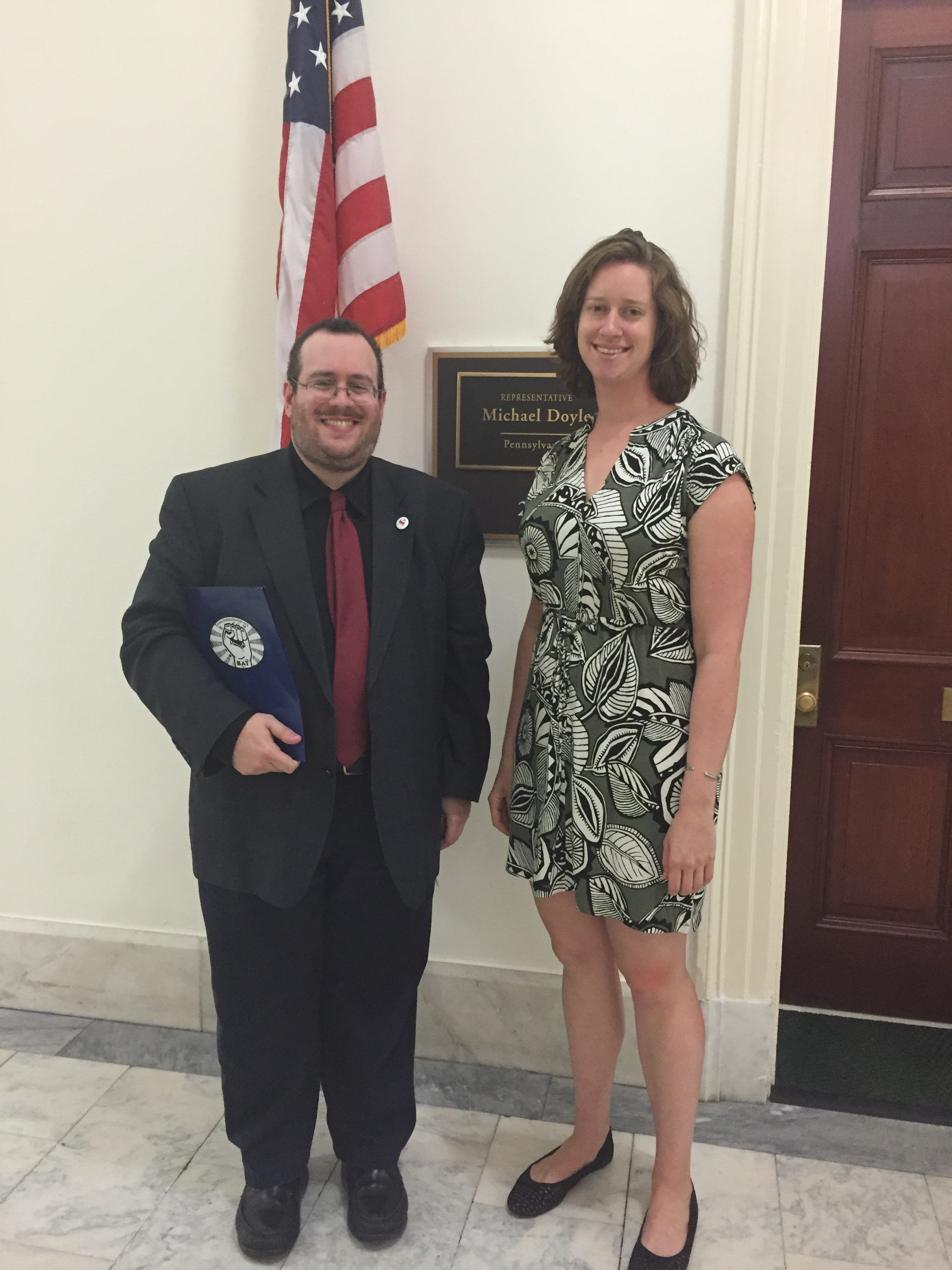
While sitting on the couch in Doyle’s office, he came out of a room to the left of me, asked his secretary for packing tape and then told her he was leaving for the day. It was 2:47 p.m. on Friday.

And they say teachers have easy hours!

I can’t say whether he was actively avoiding me. I made an appointment to see him, but it was never specified if I’d be meeting with him in person or if I’d be with his aide.

For all I know his staff never let him know I was a constituent sitting there on his couch in a suit and tie with a folder perched on my lap. But it didn’t feel good.

Maybe I should have said something. “Congressman Doyle! May I have a moment?”

But I frankly couldn’t believe this was happening. Moreover, he looks a lot different in a purple Hawaiian shirt than he does in all his press photos wearing a suit. I had to check his picture on my phone to make sure I was really seeing this correctly.

I was.

Still the meetings I had with these kids helping my legislators decide public policy were actually quite productive.

Without exception these youngsters were friendly, polite and knowledgeable. They seemed receptive to new ideas, were eager to hear my point of view, asked intelligent questions and were honest about where their bosses sometimes disagreed with me.

In Sen. Toomey’s office his assistants even asked if I was THAT Steven Singer.

“Who?” I said.

And they told me about a famous advertising campaign in eastern PA where a jeweler’s competitors are seen to complain “I HATE STEVEN SINGER.”

I laughed and told them it wasn’t me, but inside I wondered if that might explain the difficulty I had in some circumstances making these appointments. Maybe congressional staff thought I was pranking them. “Steven Singer wants an appointment!? Yeah! I’ll schedule it right after we see Mickey Mouse!”

image

I first met with Devorah Goldman, Toomey’s legislative correspondent on education and other issues. She’d only been on the job for about a year, but her qualifications included a degree in social work and she had worked in a public school resource center.

She was a very good listener. She heard me out as I spoke about a homeless student in my classes this year. She listened as I explained why Common Core is bad policy, why we need equitable school funding, an end to high stakes standardized tests, reigning in charter schools and voucher systems, and an end to judging teachers based on their students’ test scores.

Her boss isn’t exactly known as an education advocate. But she said he would agree with most of what I had said.

The main area of dispute would be charter schools. Toomey is in favor of expanding them so students can escape “failing schools.”

I explained that it was bad policy to try to save some students and let others fall behind. We need to make sure ALL our schools do an excellent job. Moreover, the Senator’s metric for determining which schools are failing is faulty at best.

I explained that traditional public schools often outperformed charter schools, which lack transparency and accountability and are wasting taxpayers dollars.

“We’ll just have to disagree on that point,” she said without explanation.

But she agreed to continue to take input from me and the BATS in the future.

image

At Doyle’s office, I eventually sat down with Hannah Malvin, a political science major who, at least, is from the Pittsburgh area – her boss’ legislative district.

She listened intently to my tales of education woe, even asking follow up questions. But she was surprised I supported the reauthorization of the Elementary and Secondary Education Act (ESEA).

Even the strongest supporters of the rewrite of the federal law that governs K-12 schools would admit it isn’t perfect. However, I would contend that the new version being cobbled together by the House and the Senate appears to be a slight improvement over what we have now – No Child Left Behind (NCLB).

Some educators think even this rewrite doesn’t go far enough to scale back standardized testing (and I sympathize but do not agree with that position). However, Malvin said Doyle had issues with it because it scaled back too much.

This was the issue I heard from Democrats all day. There isn’t enough accountability in the ESEA rewrite. How will we know which schools need extra help, they asked again-and-again.

I tried to explain that all they had to do was look at per-pupil spending. It’s no mystery which kids aren’t getting enough resources. It’s all right there on a ledger.

To her credit she heard me out and agreed to continue to dialogue with me on this subject in the future.

Next, I met up with some fellow teacher lobbyists from New Jersey and we dropped in unannounced on Booker’s office.

It’s not that we didn’t try to make an appointment. His staff never returned our calls and emails.

In fact, last week a fellow teacher not with us on Capitol Hill, Michele Miller,  even got into a scuffle with Booker on Twitter about elementary school funding. He told her to call his office and he would talk to her in detail.

To my knowledge, he never did. However, she was connected by phone to one of his aides. I’m told this is just modus operandi for Booker – strong talk in a public forum but shying away when the cameras aren’t rolling.

In any case, Booker’s senior education and health policy adviser Ashley Eden agreed to talk with us when we showed up to the office. Though her background isn’t in education, I can’t recall exactly what it is in. I do remember she has been doing this sort of legislative work for lawmakers for about 4 years – longer than any other aide we met.

She immediately made us feel welcome and found many areas of agreement. Bookers’ major point of contention – like fellow Democrat Doyle – was accountability.

How do we know which kids need help without giving them standardized tests?

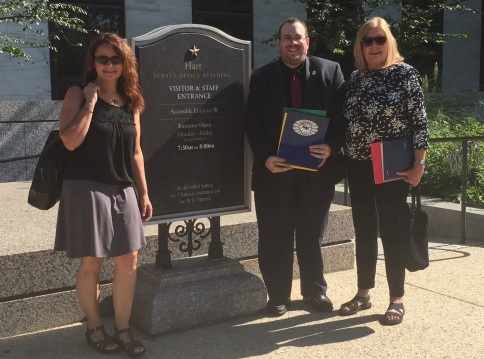
Groan. But at least I had reinforcements: BATS Assistant Manager Melissa Tomlinson and retired NJ teacher extraordinaire Elizabeth DeMarco.
image

Perhaps the most telling moment of the entire conversation was when Eden said Booker just had to back standardized testing because every Civil Rights organization wanted it. She even criticized the New Jersey Education Association (NJEA) for not supporting black and brown students.

We stopped her right there. No. Every Civil Rights organization does NOT support testing. Journey for Justice – a coalition of 38 such organizations, in conjunction with 175 additional likeminded groups wrote to both the House and Senate asking to eliminate testing. Didn’t Sen. Booker see the letter?

Suddenly she remembered it.

She said she read it real quickly and didn’t like one sentence in it so she ignored it.

Which sentence?

Something about expecting poor and minority students to do badly on tests.

I explained that it has nothing to do with thinking these children can’t achieve at the same level as other children. It’s a matter of resources. If Sen. Booker was in a foot race against someone in a Monster Truck, I’d vote on the truck. Doesn’t mean Booker can’t run or that he might not even win. But the smart money is on Big Foot.

I joined the two ladies for their meeting with Smith as well.

His legislative assistant, Katherine Talalas, was perhaps the most knowledgeable aide with whom we talked. Her mother is a special education teacher, her brother is a paraprofessional working in a public school and she went to law school focusing on education issues.

She also took more written notes than any other assistant. With her nothing seemed canned. It was a real conversation about what her boss had done to help special education students and how he might continue to help in the future.

image

I was on my own again to meet with Sen. Casey’s aide, Jared Solomon.

This was one of the most fascinating and perplexing conversations I had all day.

He was warm, friendly, and had a depth of knowledge that was a bit more political than school-centered.

He agreed with almost everything I said. Casey supports 95% of the things that are important to me in education.

I could have smiled and walked away happy, but Solomon was so gregarious he kept talking. We shared our backgrounds.

He proudly admitted that he had been a Teach for America (TFA) recruit. He worked two years in a Baltimore public school and then left. He knew it wasn’t going to be his permanent job. He was emulating his parents who had joined the Peace Corps. He did TFA because he wanted the experience.

Then he moved to the administrative offices of Michelle Rhee’s Washington, D.C., Public Schools.

He only worked there two years – only one of which was under Rhee’s administration – but he respected what they had done. He said he disagreed with 80% of their policies and even quit because he was tired of being blamed for practices with which he didn’t agree. But, he added, the people in Rhee’s administration worked harder than anyone he knew, and he thought they really had the best interests of the kids at heart.

I’m tempted to chalk it up to the same feeling the incredible blogger Jennifer Berkshire (a.k.a. Edushyster) says she gets when she interviews many corporate school reformers. We may disagree with them, but they really do believe this stuff.

But something happened that doesn’t sit well with me. In an unguarded moment of a more than hour-long conversation, Solomon pulled the same stunt Eden did for Sen. Booker. He said all the Civil Rights groups were crying out for testing. But when I called him out on it, he immediately took it back. It was like he, too, knew this was untrue. It was a talking point, quickly to be conceded if called out and then move on to another argument.

I frankly don’t know what to make of it. The arguments are too similar among Democrats and Republicans to shrug off. Each is speaking from a party line script. That can’t just be a coincidence.

And why would Casey, a legislator who supposedly agrees with me 95% of the time on education, hire as his education expert someone who was actively involved in many of the practices that go directly against his beliefs? Why would someone like Solomon, who was part of the corporate education reform movement, really be on my side against these policies?

It’s befuddling to say the least.

Now that it’s all over, I’m so glad I did this.

Will this change the nation’s education policies? Probably not.

But I am only one of hundreds of people who climbed Capitol Hill in the last two days and met with more than 52 federal legislators to fight against the standardization and privatization of education.

And tomorrow we, BATS, will hold a Teachers Congress to further solidify our goals and decide where the great ship of real positive school change should go.

I am so looking forward to it.

But this teacher, soon-to-be BAT Congressman, needs to go to bed.

Here’s to a brilliant tomorrow for our children.


NOTE: This article also was published on the Badass Teachers Association blog.

The Democrats May Have Just Aligned Themselves With Test and Punish – We Are Doomed

sanders_warren-620x412

Almost every Democrat in the US Senate just voted to keep Test and Punish.

But Republicans defeated them.

I know. I feel like I just entered a parallel universe, too. But that’s what happened.

Some facts:

No Child Left Behind (NCLB) is a disaster.

It took the Elementary and Secondary Education Act (ESEA) – a federal law designed to ensure all schools get equitable resources and funding – and turned it into a law about standardized testing and punishing schools that don’t measure up.

This was a Republican policy proposed by President George W. Bush.

But now that the ESEA is being rewritten, those pushing to keep the same horrendous Bush era policies are the Democrats.

Almost all of the Democrats!

That includes so-called far left Dems like Bernie Sanders and Elizabeth Warren!

It comes down to the Murphy Amendment, a Democratically sponsored change to the ESEA.

This provision was an attempt to keep as many Test and Punish policies as possible in the Senate rewrite.

The amendment, “reads more like NCLB, with its detailed prescription for reporting on student test results, for ‘meaningfully differentiating among all public schools’ (i.e., grading schools), including publicly identifying the lowest five percent, and, among interventions, potentially firing staff and offering students the option to transfer to other schools and using part of the budget to pay for the transportation,” according to blogger Mercedes Schneider.

Education historian Diane Ravich adds, “This amendment would have enacted tough, federal-mandated accountability, akin to setting up an ‘achievement school district’ in every state.”

Thankfully it was voted down. The ESEA will probably not be affected. The rewrite was passed by both the House and Senate without these provisions. Once the two versions of the bill are combined, it is quite possible – maybe even probable – that we’ll have a slight improvement on NCLB. Sure there is plenty of crap in it and plenty of lost opportunities, but the ESEA rewrite looks to be a baby step in the right direction.

The problem is this: the failed Murphy Amendment shows the Democrats’ education vision. Almost all of them voted for it. Warren even co-sponsored it!

When it was defeated and the Senate approved the ESEA rewrite, Warren released a statement expressing her disapproval. But if you didn’t know about the Murphy Amendment, you could have read her criticisms quite differently.

She says the (ESEA rewrite) “eliminates basic, fundamental safeguards to ensure that federal dollars are actually used to improve both schools and educational outcomes for those students who are often ignored.”

That sounds good until you realize what she means. “Educational outcomes” mean test scores. She’s talking about test-based accountability. She is against the ESEA rewrite because it doesn’t necessarily put strings on schools’ funding based on standardized test scores like NCLB.

She continues, “Republicans have blocked every attempt to establish even minimum safeguards to ensure that money would be used effectively. I am deeply concerned that billions in taxpayer dollars will not actually reach those schools and students who need them the most…”

She is upset because Republicans repeatedly stripped away federal power to Test and Punish schools. The GOP gave that power to the states. So Warren is concerned that somewhere in this great nation there may be a state or two that decides NOT to take away funding if some of their schools have bad test scores! God forbid!

And Warren’s about as far left as they come!

What about liberal lion Bernie Sanders? I’d sure like an explanation for his vote.

It makes me wonder if when he promised to “end No Child Left Behind,” did he mean the policies in the bill or just the name!?

The Democrats seem to be committed to the notion that the only way to tell if a school is doing a good job is by reference to its test scores. High test scores – good school. Bad test scores – bad school.

This is baloney! Test scores show parental income, not academic achievement. Virtually every school with low test scores serves a majority of poor children. Virtually every school with high test scores serves rich kids.

Real school accountability would be something more akin to the original vision of the ESEA – making sure each district had what it needs to give kids the best education possible. This means at least equalizing funding to poverty schools so they have the same resources as wealthy ones. Even better would be ending our strange reliance on local property taxes to provide the majority of district monies.

But the Dems won’t hear it. The Murphy Amendment seems to show that they’re committed to punishing poor schools and rewarding rich ones.

I really hope I’m wrong about this. Please, anyone out there, talk me down!

Up until now I’ve always been with the Democrats because they had better – though still bad – education policies than the Republicans. I’m not sure I can say that anymore. In fact, it may be just the opposite.

Which party is most committed to ending Common Core? The Republicans!

Which party has championed reducing federal power over our schools and giving us a fighting chance at real education reforms? Republicans!

Which party more often champion’s parental rights over the state? Republicans!

Sure, most of them still love vouchers and charter schools. But increasingly so do the Democrats.

This vote has me rethinking everything.

Our country’s education voters may have just been abandoned by their longest ally.

Where do we go from here?


NOTE: This article also was published on Commondreams.org and on the Badass Teachers Association blog. It was also mentioned in the Washington Post.

In ESEA Debate, Education is Caught in the Middle Between the State and Fed

middle-dog-300

Watching Congress debate national education policy is a bit like going to a tennis match and finding a truck and tractor pull has erupted.

“Isn’t this supposed to be about how to make our schools better?” I want to scream.

“No!” someone yells from the stands. “This is about States’ Rights vs. the Fed. Go, States!”

Face palm.

The current brouhaha centers around the Elementary and Secondary Education Act (ESEA), the federal law that governs K-12 schools.

The present version, called No Child Left Behind (NCLB), is a thorough disaster. Thankfully Congress is trying to rewrite the legislation.

However, in doing so the emphasis has been less on making things better and more on deciding who gets to make decisions about schools.

Republican President George W. Bush greatly increased federal control with NCLB, something Democratic President Barack Obama has continued through his education policies.

These days, the GOP has done a 180 and is the champion of states rights to make their own education policies.

Given the Obama administration’s continued emphasis on standardized testing, punitive accountability systems and top down education standards, a move away from federalism seems completely justified.

But this is becoming the heart of the debate even at the expense of children, parents and teachers.

Take Opt Out.

NCLB allows parents to opt their children out of standardized testing, but school districts can be punished for it. If more than 5% of the students in a district don’t take the federally mandated tests for whatever reason (including parental opt out), the district’s Title I funding is put in jeopardy.

In many parts of the country, parents are refusing to subject their children to these tests anyway. They are voting with their feet. They are telling our lawmakers they do not want their children to take standardized tests so often – or in many cases – at all.

The good news is that BOTH of the two drafts of the ESEA allow for parental Opt Outs. However, who gets to decide if doing so will penalize your school?

The House version says that opting out will not hurt your district. Period. But the Senate version leaves the matter up to the states. State legislatures get to decide if withholding your child from standardized testing will have punitive consequences for your district.

This is absurd.

It’s not a matter of States’ Rights vs. the Fed. It’s a matter of parental rights.

As a parent, I should have final say over what my child does or does not have to do in school. There may be limits in extreme circumstances (i.e. vaccines) and in terms of content (i.e. science, history), but in general the rights of parents and children should trump all others.

Ironically the parents who shield their children the most from standardized testing are those who champion it for everyone else. Secretary of Education Arne Duncan is sending his children to a Chicago private school that does not use standardized tests. Likewise, Obama’s children attend a private school free from the influence of his education policies. Same with corporate education reform cheerleaders Governors Chris Christie and Rahm Emanuel.

So many cooks who refuse to eat their own cooking!

But to return to the ESEA, pundits are lauding the Senate Opt Out restriction as a selling point between the versions of the proposed law. The House version has a better Opt Out provision, so you can choose it.

However, it is also poisoned from the start because (unlike the Senate version) it includes a backdoor voucher provision. Called Title I Portability, the House bill essentially would suck up funding now given to impoverished districts and spit it back into the lap of richer ones. Poor kids need additional funding because they go to poor schools that have less money to spend educating them. If a poor child goes to a rich school, she doesn’t need additional funding – the school already spends more to educate her than a poor district ever could. But the issue is a bit of a nonstarter anyway because Obama already has promised to veto any bill containing it.

So the only option is the Senate version, and they just sunk a big turd in it.

But like any factory farm sausage, you often have to learn to accept a few unsavory morsels in with the meat. Even if the final bill includes this Senate provision, it will be an improvement over NCLB. Punishing schools for parental opt outs is the status quo. If even a few  states decide not to punish their schools because of parents choices, that will be a step in the right direction.

It’s just so frustrating to watch our myopic Congresspeople take such baby steps forward.

Why would anyone try to override parental concerns about testing?

Many legislators worry if all students aren’t tested, there will be no way to determine if school districts are properly educating students.

But that is exactly the point!

Standardized testing does not show how well a school is functioning! It only shows how many poor students go to the school. Rich kids score well; poor kids score badly. And academics? There are so many better means of assessing them than multiple choice exams graded on a curve!

If lawmakers really wanted to ensure all students were getting a quality education, they’d hold BOTH the state and federal governments accountable for equitably funding our schools. No more funding based on local wealth. No more poor kids getting less funding than rich kids. No more kids doing without because mommy and daddy have lousy paying jobs.

Parents, children and educators have been crying out to lawmakers about the injustice of using high stakes tests as means of punishing schools for the poverty of their students. THIS is what needs to change. THIS is the essential reform we’re crying out to be enacted!

But no one’s listening. All they care about is which team is winning – Team State or Team Fed.


NOTE: This article also was published on the Badass Teachers Association Blog and it was mentioned in the Washington Post.

Atlanta Teacher RICO Conviction is Blood Sacrifice to the Testocracy

aztecshumansacrifice

Make no mistake.

The conviction of 11 former Atlanta public school teachers for cheating on students standardized tests has little to do with what these people actually did or didn’t do.

It is meant as a message for the entire education profession: if you cheat on standardized tests, you will be given the harshest possible punishment!

Don’t get me wrong. These people deserve punishment. They easily deserve to be stripped of their teaching certifications  and to return the bonuses they received for engaging in this activity.

However, they are each looking at a potential 20 year jail sentence for essentially making copies, erasing pencil marks on paper and filling in different bubbles.

This is absurd.

It’s only possible because they were charged with and found guilty of racketeering. You know, the same charge we use against organized crime!

The justification given was that bonuses and raises were awarded to the former educators based on test scores. Prosecutors characterized this behavior as participation in a massive criminal conspiracy and charged the former teachers with violating the state’s RICO (Racketeer Influenced and Corrupt Organizations) Act.

I’m not surprised that the state of Georgia tried to use this statute against these people. I am shocked, however, that it held up in court.

These defendants have been charged and found guilty of the same crime as the Hells Angels Motorcycle Club and the Gambino Crime Family.

Changing standardized test answers to make it appear students are doing better than they really are is certainly a crime, but is it really on the same level as the mafia!? Is it the same as extortion, money laundering, loan sharking, obstruction of justice and bribery?

Because those are the crimes usually prosecuted with a RICO charge!

One thing is certain: it’s worse than murder.

According to Georgia law, actually killing somebody will get you a less severe sentence than cheating on standardized tests!

The mandatory sentence for second degree murder and voluntary manslaughter in the state is only 10 years in prison. Involuntary manslaughter and assisted suicide will get you 5 years.

Heck! Even a first degree murder charge leaves you eligible for parole in 30 years! That’s only 10 years more than cheating on a bubble test!

Again, this has nothing to do with what these defendants did. It’s a message to the rest of us.

These people – all of whom are people of color – are being offered as a blood sacrifice on the altar of the testing gods.

Those of a reflective nature have already suggested that what this scandal really shows isn’t the danger of cheating so much as the problems of high stakes testing.

When you hold educators and schools responsible for student test scores, you create an environment rife for cheating. When you threaten to close schools and/or fire educators and/or withhold pay based on factors out of an individual’s control, you are inviting cheating.

People think, “why shouldn’t I cheat? I’m being held to an impossible standard anyway!”

The simple fact is that teachers can’t control how well their students do on standardized tests. Educators do their best to ensure their students are prepared, but it is up to the student to actually take the steps necessary to learn.

We all accept the axiom that you can lead a horse to water but can’t make him drink. We accept it everywhere except in the school room.

Corporations and their proxies making billions off of standardized testing will tout the importance of the teacher in the classroom. And, yes, the teacher is very important – the most important in-school factor. But out-of-school factors are even more vital.

Parental income, child nutrition, the number of books in the home, exposure to violence – all these have a greater impact than the teacher.

We continually refuse to accept this fact.

More than half of all public school students live below the poverty line, but we refuse to offer any real help. We instead offer nothing but standardization – in the form of tests and canned curriculum – and the magic bullet of increased privatization.

No wonder there are some teachers cheating on their students standardized tests!

We’re forcing them to march calmly over a cliff or take extreme measures!

What these teachers did is not excusable. They did the wrong thing. They cheated. They tried to game the system.

What they should have done is expose it.

They should have refused to give these tests in the first place. They should have made their case in the public square. They should have lobbied their politicians, educated parents and organized a coalition committed to ending this reign of terror.

And there are tens of thousands of people out there right now doing just that!

Every year the anti-standardization movement gets bigger. Every year more teachers and parents refuse the tests.

This court decision is but one more hysterical reaction from our corporate masters to turn the tide. To shut us up.

But we shall not be moved.

You can offer these people up as a blood sacrifice to your dark god, but it is a false deity and we will continue to refuse to worship at its feet.

The days of the Testocracy are numbered. And every day passed is one less in its reign!


NOTE: The article also was published in the LA Progressive, on Education Bloggers Network Website and the Badass Teachers Association blog.

APTOPIX Atlanta Schools Cheating

Not My Daughter – One Dad’s Journey to Protect His Little Girl from Toxic Testing

FATHERS-AND-DAUGHTERS

I’ll admit it – I was scared.

I’m a nationally board certified teacher with a masters degree in education. I’ve taught public school for over a dozen years. But I’ve only been a daddy for half that time.

Would making this call get my little girl in trouble?

I didn’t want to rock the boat. I didn’t want my daughter to suffer because her old man is making a fuss. I didn’t want her teachers and principal giving her a hard time because of something I did.

But I couldn’t deny what I know.

Standardized testing is destroying public education. It’s stressing kids out by demanding they perform at levels they aren’t developmentally ready to reach. And its using these false measures of proficiency to “prove” how bad public schools are so they can be replaced by for-profit charters that will reduce the quality of kids’ educations to generate profits.

No. There was no doubt about it. I had to make this phone call.

I used my most professional voice on the line with the principal.

“Hi, Mr. Smith. This is Steven Singer. I’m Amy’s father. I know she’s just in kindergarten but it’s come to my attention she’s taking standardized tests, and I’d like to opt her out.”

Before my little girl started school, I hadn’t even realized there were standardized tests in kindergarten. She takes both the DIBELS and the GRADE test.

He seemed surprised, even a bit fearful, but he quickly suggested a meeting with me, my daughter’s teacher, the councilor and a few others to get it done.

It was my turn to be surprised. I had expected to be asked to review the tests before writing a formal letter citing my “religious” reason for refusal. But I guess things are different before students reach third grade. Without legislation mandating a formal process, we needed to meet and discuss like adults.

And a few weeks later, here I was waiting for that meeting to begin.

It wasn’t long before my daughter’s teacher arrived. We chatted briefly about a fire drill and how my sweetheart hadn’t been afraid. Then the councilor, principal and others came in and ushered us into the conference room.

Most of the space was taken up by a long rectangular table surrounded by black leather chairs on wheels. It looked like the kind of place where important decisions are made – a bit imposing really.

We sat down and Mr. Smith introduced me to the team and told them I had some concerns about standardized testing.

He paused letting me know it was my turn to speak. I took out my little notebook, swallowed and began.

“Let me start by saying I think the education my daughter is receiving here is top notch,” I said.

“Her teacher is fabulous, the support staff do a wonderful job, and I could not be happier with the services she’s receiving here.

“My ONLY concern is standardized tests. In general, I’m against them. I have no problem with teacher-created tests, just not the standardized ones.

“It’s come to my attention that my daughter takes the DIBELS and GRADE test. Is that correct?”

They nodded.

“As you know, I teach at the secondary level and proctor the GRADE test to my own students. I’m sure the version given to elementary children is somewhat different, but I know first hand how flawed this assessment is.

“Put simply, it’s not a good test. It doesn’t assess academic learning. It has no research behind it to prove its effectiveness and it’s a huge waste of time where kids could be learning.”

I paused to see them all nodding in agreement.

In many ways, the GRADE is your typical standardized test. Vocabulary, sentence completion, passage comprehension – fill-in-the-bubble nonsense.

Mr. Smith blushed in agreement. He admitted that he probably shouldn’t be so candid but the district probably wouldn’t give the GRADE test if it didn’t receive a Keystone to Opportunity Grant for doing so. When and if the grant runs out, the district probably would stop giving the test, he said.

It’s an old story – the same as at my own district. Two school systems serving high poverty populations bribed with extra money if they spend a large chunk of it on Pearson testing and remediation.

“As to the DIBELS,” I went on, “I had to really do some research. As something that’s only given at the elementary level, it’s not something I knew much about.

“However, after reading numerous scholarly articles on the subject, I decided it wasn’t good for my daughter either.”

When taking the DIBELS, the teacher meets with a student one-on-one while the child reads aloud and is timed with a stopwatch. Some of the words the child is asked to read make sense. Some are just nonsense words. The test is graded by how many words the child pronounces correctly in a given time period.

“My concern is that the test doesn’t assess comprehension,” I said. “It rewards someone who reads quickly but not someone who understands what she’s reading.

“Moreover, there is a political side to the test since it’s owned by Rupert Murdoch. Cut scores are being artificially raised to make it look like more students are failing and thus our schools aren’t doing a good job.

“Finally, focusing on pronunciation separate from comprehension narrows the curriculum and takes away time from proven strategies that actually would help my daughter become a better reader.”

I closed my notebook and looked around the table.

Silence.

I thought that maybe I hadn’t done enough research. I had been too quick and simple.

But the team quickly agreed with me. And when Mr. Smith saw that, I noticed his cheeks darkening.

He stuttered a few words before giving up. “I’ve never had a parent ask to opt out of the DIBELS before,” he said.

He said the DIBELS is a piece of the data teachers use to make academic decisions about their students. Without it, how would they know if their children could read, were hitting certain benchmarks?

“I know I teach secondary and that’s different than elementary,” I said, “but there is not a single standardized test that I give my kids that returns any useful information.

“I don’t need a test to tell me if my students can read. I don’t need a test to know if they can write or spell. I know just by interacting with them in the classroom.”

The fear was still in his eyes. He turned to my daughter’s teacher. “I don’t mean to put you on the spot here, but what do you think? Does the DIBELS provide you with useful information?” he asked.

The look on her face was priceless. It was like someone had finally asked her a question she had been waiting years to answer.

“No,” she said. “I don’t need the DIBELS to know if my kids can read.”

It was all down hill from there.

I agreed to revisit the situation if a problem arose but teacher recommendation will take the place of the DIBELS in the meantime.

Conversation quickly turned to hilarious anecdotes of my daughter’s school antics. What she said to get in trouble last week. How she tries to get adults to put on her coat when she’s perfectly capable of doing it herself.

I left the building feeling really good. This is the way it’s supposed to be.

Before we signed up my little girl for school, I had been nervous about her attending my home district. I wasn’t sure it was good enough for her. The papers said it was a failing school. I wanted so much to ensure my baby would have the best of everything – the best I could provide.

My district may not have the most up-to-date facilities. It may not have the smallest classes. But it has a team of dedicated educators and administrators who are committed to meeting the needs of their students.

Even Mr. Smith’s hesitancy is understandable. I don’t blame him one bit. He probably thinks DIBELS scores make an elementary principal like him look good. Kids starting from scratch only can go up. The scores can only improve.

Moreover, he sat down with me and heard me out. He may not have entirely agreed with me – in fact at times he looked at me like I had a third arm growing out of my forehead – but he respected my parental rights.

It wasn’t until then that I realized the power parents truly have. Mr. Smith might have refused a TEACHER who brought up all of the concerns I had. He’s their boss. He trusts his own judgment.

But I don’t work for him. In fact, he works for me. And – to his credit – he knows that.

I know everyone isn’t as lucky as me. Some people live in districts that aren’t as receptive. But if parents rose up en masse and spoke out against toxic testing, it would end tomorrow.

If regular everyday Dads and Moms stood up for their children and asked questions, there would be no more Race to the Top, Common Core or annual standardized testing.

Because while teachers have years of experience, knowledge and love – parents have the power.

Imagine if we all worked together! What a world we could build for our children!


NOTE: Small details may have been changed to protect the innocent.

ADDITIONAL NOTE: This article also was published in the Washington Post, Diane Ravich’s blog and the Badass Teachers Association blog.