We Are All on the Lunatic Fringe – The Centerless Battle Against Corporate Education Reform

cliff_hanging

It was one of the strangest meetings I’ve ever had with a state legislator.

Why?

First of all, we were all teachers.

Even the legislator. Even his Aide!

Pennsylvania State Rep. Dan Miller (D-Mt. Lebanon) had been a history teacher before he sought a law degree and higher office.

His aide had been a Pittsburgh Public School teacher before she was furloughed and found a place in the representative’s office.

And, of course, there were the seven of us – all teachers at my school district.

We crowded together in his tiny district office to talk about how standardized testing is destroying public schools.

Which brings me to the second strangest thing – Rep. Miller didn’t just agree with us, he did so knowledgeably.

I’ve sat across a table from an awful lot of lawmakers, and they almost always try to find common ground. Disingenuously.

Sure! I agree teachers are important! That’s why we need to fire more of them!

You bet neighborhood schools are vital! That’s why I want to close all the public schools and replace them with charters!

Uh-huh! School funding is critical but not more so than classroom teachers. That’s why we’re cutting your budgets! We want to see what you can do!

None of that at Rep. Miller’s office.

When we brought up how important it is to allow parents throughout the Commonwealth to opt their children out of standardized tests without penalizing their school districts, he praised parent rights.

When we described how the definition of school accountability has changed from holding lawmakers accountable to holding teachers accountable, he talked about the sad scapegoating of the profession.

And when we told him about how standardized testing is failing our students, he told us how it would have failed him if he were a student today.

“I wasn’t a very good student,” Miller admitted. He loved history and aced that class consistently, but he barely squeaked by in most other subjects.

The first book he read all the way through was “North and South” by Elizabeth Gaskell – in 11th grade! Why? Because it interested him. “Jane Eyre”? Not so much.

And he admitted that in today’s environment where nothing is counted a success unless it generates a high test score, he would have been lost and probably would have dropped out.

Which brings me to the third strangest thing – Miller isn’t playing partisan politics. As a Democrat, he isn’t blaming everything on the Republicans.

“This is a bipartisan issue,” he said. There’s no reason why both parties can’t agree on what needs to be done to help our schools.

So why doesn’t the legislature do more?

Ignorance. “There’s a low level of analysis of bills down there (in Harrisburg).” Local government usually does a better job.

The representative’s teaching background gives him an edge, he says, but most legislators simply don’t have that knowledge base to draw on.

There’s a lot of good will in the capital, he says. “Most legislators aren’t trying to cause a problem.” They want to try to achieve something, but if those experiments fail, the consequences are dramatic, long lasting and hard to correct.

He even talks well of our Republican ex-Governor Tom Corbett, whose education policies – in my opinion – have crippled the state’s schools.

“He was always polite to me, “ Miller says. “He just didn’t talk.” He wasn’t approachable.

By contrast, Gov. Tom Wolf comes to you. Miller recalls walking in to his own Harrisburg office and Wolf was sitting there waiting for him because he had something he wanted to talk about. Wolf is well liked, even among Republicans. They might not agree with the new Democratic governor, but they have to admit he has the best interests of the state at heart.

Perhaps its Miller’s infinite good will that’s propelled the Democrat with only two years in state office to the House Education Committee.

Republicans have dominated state education policy for years. They still do. But in Miller we have someone who actually has a say in one of the most critical areas in the state. And he knows what he’s talking about, takes time to meet with real live educators and sympathizes with our cause.

Which brings me to perhaps the strangest aspect of the whole meeting – Miller’s analysis why more isn’t being done to combat the testing industry.

“The groundswell isn’t there,” he said. “You’re still the fringe.”

He praised teachers unions like the Pennsylvania State Education Association (PSEA) for being excellent advocates. He said lawmakers get all their emails, but the emphasis seems to be maintaining pension benefits. He understood why this is so, but the issues we were talking about didn’t seem to register on most legislators radar.

It’s bizarre.

If true, there are a heck of a lot of folks on the fringe.

Rep. Miller, himself, for one.

The majority of public school teachers, too.

And the more than three thousand Pennsylvania students whose parents opted them out of standardized testing last year – they’re on the lunatic fringe.

Heck! If we’re all dangling on the outer edge, who’s in the middle? Where’s the mainstream?

Perhaps its just a matter of perception. Maybe the other side just has better public relations.

If so, it’s up to us to spread the word until all of us counterculture anti-standardization and anti-privatization folks are seen for where we really are – at the axis of real school reform.


Thank you to Meagan O’Toole for setting up the meeting. Thank you, Ben Lander, Yvette Robinson Logan, Mary Cay Rojtas-Milliner, Susan Olsen, and Roslyn Stulga for speaking out for your students and profession. And most of all thank you, Rep. Miller, for meeting with classroom teachers to talk about what’s going on in our state’s public schools and actually listening to our stories and advice.

Parent Power Can Crush the Testocracy – and the Government is Scared Witless

opt-out7

“We need to change accountability for schools to be more holistic. My greatest frustration is that I can’t do it fast enough.”
Pedro Rivera, Pennsylvania’s Education Secretary

Parents, you can.

It doesn’t matter where you live. It doesn’t matter what laws are on the books. It doesn’t matter if your state is controlled by Democrats, Republicans or some combination thereof.

No government – not federal, state or local – can trample your parental rights. If you don’t want your child to be evaluated based on standardized tests, your child doesn’t have to be. And if a majority of parents nationwide make this decision, the era of standardized testing comes to an end. Period.

It has already begun.

Across the nation last school year, parents decided to opt their children out of standardized testing in historic numbers. The government noticed and functionaries from New York to California and all places in between are scrambling to deal with it.

In the Empire State one in five students didn’t take federally mandated standardized tests. State education commissioner Mary Ellen Elia responded yesterday by threatening sanctions against schools this year with high opt out numbers. In short, if in the coming year too many kids don’t take the test in a given school, the state will withhold funding.

It’s a desperate move. If the public doesn’t like what its duly elected officials and their functionaries are doing, those same officials and functionaries are vowing to punish the public. But wait. Don’t those people work for the public? Isn’t it their job to do our will? It’s not our job to do theirs.

The message was received a bit better in U.S. Congress where the Elementary and Secondary Education Act (ESEA) is being reauthorized. Two drafts of the law that governs K-12 public schools were approved – one in the House and one in the Senate. And both specifically allow parents to opt their children out of standardized testing. But can schools be punished for it?

The House version says no. The Senate version says it’s up to each state legislature.

These bills are being combined before being presented to President Obama for his signature. If he doesn’t veto the result, one might assume that at worst the issue will become each state’s prerogative.

But you’d be wrong. The state has as much business deciding this matter as does the fed – which is none. This is a parental rights issue. No one has the right to blackmail parents to fall in line with any government education policy. It’s the other way around.

In my own state of Pennsylvania, opt out numbers this year were not as dramatic as in New York, but they still sent a message to state government.

The number of students opted out of state tests tripled in 2015, according to data from the Pennsylvania Department of Education. PSSA math opt-outs rose to 3,270 students from 1,064 in 2014. PSSA English language arts opt-outs rose to 3,245 from 1,068. Those are the largest jumps in the nine years of available data.

And it’s not only parents who are concerned. Teachers continue to speak out against high stakes standardized tests.

Thousands of teachers have told State Education Secretary Pedro Rivera that school accountability needs to be less about test scores and more about reading levels, attendance, school climate, and other measures, he said. They have concerns about graduation requirements and the state’s current system of evaluating schools.

It’s not like these criticism are new. Education experts have been voicing them since at least 1906 when the New York State Department of Education advised the legislature as follows:

“It is a very great and more serious evil to sacrifice systematic instruction and a comprehensive view of the subject for the scrappy and unrelated knowledge gained by students who are persistently drilled in the mere answering of questions issued by the Education Department or other governing bodies.”
-Sharon L. Nichols and David Berliner, Collateral Damage: How High Stakes Testing Corrupts America’s Schools, 2007

Corporate education reformers complain that testing is necessary to hold schools accountable. However, the results are not trustworthy, according to the Pennsylvania Department of Education, itself! In 2011 and now again in 2015, officials are cautioning against using test scores to compare student achievement from year-to-year.

“The 2015 assessment should not and cannot be compared to the 2014 and 2013 assessment,” Rivera said. “It’s apples and oranges. Schools are still working on aligning curriculum to standards. They’re still catching up to teaching what we’re assessing.”

Each year students and teachers are told to hit a moving target, which was the reason also cited for caution four years ago.

While Rivera laments the issue and his inability to change anything soon within the government bureaucracy, parents are not thus encumbered.

All you have to do to save your child from being part of this outdated and destructive system is opt out.

But don’t stop there. Talk to other parents. Talk to classroom teachers. Organize informational get-togethers. Go to the PTA and school board meetings. Get others to join you.

And if the government threatens to withhold funding, lawyers are waiting in the wings to start the class action suits. Withholding taxpayer money expressly put aside to educate children because those same taxpayers disagree with government education policy!? Just try us!

Governments are tools but we hold the handles. If enough of us act this year, there will be no testing next year. Functionaries can threaten and foam at the mouth, but we are their collective boss. If they won’t do what we want them to do, we have the power to boot them out.

A multi-billion dollar industry has sprung up around high stakes standardized testing. Lobbying dollars flow from their profit margins into the pockets of our politicians. But we are more powerful.

Because you can’t serve your corporate masters if you are voted out of office.

“Talking Crap” Focus on Teacher Bathroom Breaks Misses the Point on Problems Impacting Teachers

stressed-teacher

By Yohuru Williams and Steven Singer

Nearly 18 years ago in his 1997 State of the Union address, President Bill Clinton urged Americans to prioritize education. He suggested beginning with building respect for the teaching profession. To “have the best schools,” he observed, “we must have the best teachers.” He continued, “most of us in this chamber would not be here tonight without the help of those teachers.”

Despite Clinton’s eloquence, respect for the teaching profession steadily declined due primarily to a narrative of failure constructed by the proponents of corporate education reform. They consistently blame the power of teachers’ unions and teacher tenure for society’s woes. They use both as a justification to construct a multi-billion dollar industry to standardize and privatize our public schools.

For the most part, the mainstream media has been reluctant to challenge this narrative and point to the real obstacles that exist for teachers. Such is the case with a recent article in The Atlantic by Alia Wong entitled “Using the Restroom – a Privilege If You’re a Teacher” that completely misses the point of a recent survey highlighting some of the substantive issues facing the nation’s teachers.

Tens of thousands of professionals responded to the 2015 survey. The survey was conducted collaboratively by two groups: the Badass Teachers Association, a grassroots network of more than 55,000 educators, parents and students and the American Federation of Teachers, the nation’s second largest teachers union. The survey yielded shocking results that powerfully illustrate the collateral damage of the “test and punish” environment engulfing public education. This includes such serious allegations regarding workplace conditions that it prompted a meeting between the authors and the U.S. Department of Education. A team of educators working with both BATS and the AFT launched the 80 plus question survey in April. Some 91,000 public school teachers responded and 31,000 completed the survey. The unprecedented response revealed that there are indeed major problems with our current education policy and its impact on education practitioners.

Perhaps, the most startling revelation from the survey is what prompted it to be conducted in the first place – the increasing incidence of teachers and administrators who committed suicide due to bullying and abuses stemming from national school policy and other work place stressors. These are often the hidden casualties in the war on public education.

In October of 2010, for example, a California elementary school teacher named Rigoberto Ruelas, Jr. took his own life after the Los Angeles Times published a report labeling him a “less effective teacher.” Despite the fact that students and parents praised Ruelas, who taught in one of poorest schools in his district and who also was born, raised and continued to live in area where his school was located, the Times targeted him among other so-called “less effective” teachers as part of a major propaganda campaign. Publishing their names and ranking them according to their students’ test scores was supposed to encourage “reform”.

The Ruelas case is far from an isolated incident. Just last month, a New York City principal under investigation for altering Common Core test scores, killed herself by jumping in front of a subway car.

If U.S. teachers are the proverbial canary in the coalmine, then we may already be too late. Pressures related to high stakes testing are not the only stresses educators face. Teachers also reported significant bullying and hostility from city officials and administrators. Equally disturbing were reports concerning the infamous teacher jails where educators can languish for months under conditions, leaving them “broken, depressed,” and “suicidal, according to one California teacher observer. Statements recently made by New Jersey Governor and Republican Presidential Candidate Chris Christie reveals the scope of the problem. He said he would like to punch the national teachers union in the face. Rather than enjoying esteem as valued members of the communities they serve, educators have become convenient scapegoats. They fight on multiple fronts to provide their students a superior education and make a stable living.

It’s no wonder 73 percent of teachers in the Quality of Work Life Survey said they often find themselves stressed at work.

More than half of those surveyed, 55%, highlighted the “negative portrayal of teachers and school employees in the media” as a source of stress. The pejorative portrayal of teachers in a publication like The Atlantic is especially problematic. That a national periodical elected to do a piece on the survey but limit its scope to toilet restrictions trivializes other results. It’s not that this isn’t an important factor, but Wong’s coverage of other pertinent issues get short shrift. In her words educators tend to be, “known for their tendency to complain about and perhaps over-exaggerate their stress levels.”

To be fair, Wong eventually deleted that remark from subsequent editions of the article. However, she cautioned her readers to be skeptical of the survey because of potential bias. It’s a survey of teachers conducted by teachers. This is an odd critique however given the survey takers expressed intent to use the data collected as a means to spur the Department of Education to conduct a full scientific survey of the profession and then take appropriate action to rectify these concerns.

Rather than reporting squarely on the survey, Wong picked over the evidence. Rather than heeding the call that there is a real need for a much larger and more focused study of these problems, she either ignored or debunked its claims. Rather than treat educators as professionals, she belittled them.

Wong is not a bad journalist. Like most people, she has bought into the notion that teachers don’t know how good they have it. The public still doesn’t understand why teachers have “summers off.” They still misunderstand tenure to mean “a job for life” when it’s really only a guarantee of due process. Instead of helping the public better understand these issues, Wong and other representatives of the media often become entangled in the snare of the same myths.

Once again those entrusted with the most important job of preparing the next generation through our system of public education are losing a public relations campaign that can’t or won’t distinguish truth from falsity.

In short, our problems are much worse than inadequate bathroom time. We’re turning our public schools into factories and blaming teachers when it doesn’t work. We’re allowing billionaire philanthropists to set education policy but holding educators accountable for the results. We’re segregating our schools, providing Cadillac funding for the rich and bicycle funding for the poor and minorities but expecting teachers to somehow make up the difference. We’re letting corporate raiders run charter schools with no transparency or accountability and when that proves a disaster, we point our fingers at teachers. The result is a nation of frustrated educators who are increasingly leaving the profession in droves. “The average teacher,” writer Robert Brault once observed, “explains complexity” while “the gifted teacher reveals simplicity.” The data collected from the teacher survey reveals the complexity of the issues facing public education but they also highlight a simple truth. For if the survey is indeed accurate in illustrating just how debilitating these issues are to adults, we can only imagine what it’s doing to our children.


Yohuru Williams is an author, Dean, Professor of History and Black Studies, and education activist. Steven Singer is a husband, father, teacher, and blogger, education advocate. Both are members of the Badass Teachers Association.

williams-singer


NOTE: This article also was published in the LA Progressive and on the Badass Teachers Association Blog.

Down and Out and Lobbying for Public Education

 image

Let’s get one thing straight right from the start.

I’m no lobbyist.

I’m just a private citizen who’s sick of seeing his tax dollars swallowed up by big corporations under the guise of educational accountability.

I’m just a public school teacher who’s tired of his profession being demonized by policymakers and media talking heads alike.

And I’m just a father who’s worried that his daughter won’t get the same comprehensive public education he received as a child.

No one paid me. In fact, I bankrolled myself.

So like more than 300 members of the Badass Teachers Association (BATS), I came to Washington, D.C., to speak with my Congresspeople.

And what a day it was!

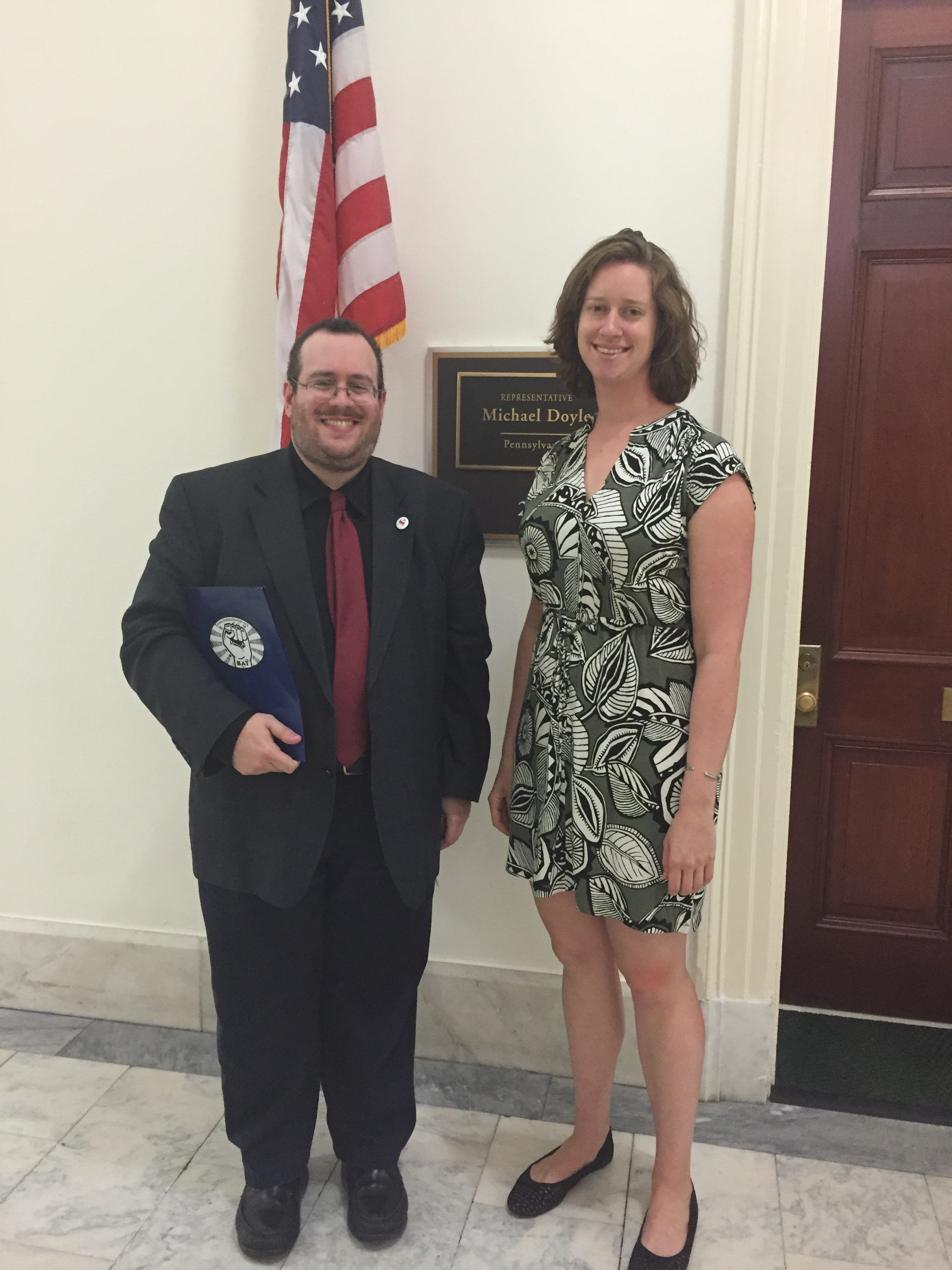
I met with Senators Pat Toomey (R-PA), Bob Casey (D-PA) and Corey Booker (D-NJ). I met with U.S. Reps Mike Doyle (D-PA) and Chris Smith (R-NJ).

Well, actually I met with their legislative aides.

None of the actual lawmakers made time to sit down with a flesh and blood teacher.

In one case, a legislator seemingly went out of his way to avoid me.

image

While sitting on the couch in Doyle’s office, he came out of a room to the left of me, asked his secretary for packing tape and then told her he was leaving for the day. It was 2:47 p.m. on Friday.

And they say teachers have easy hours!

I can’t say whether he was actively avoiding me. I made an appointment to see him, but it was never specified if I’d be meeting with him in person or if I’d be with his aide.

For all I know his staff never let him know I was a constituent sitting there on his couch in a suit and tie with a folder perched on my lap. But it didn’t feel good.

Maybe I should have said something. “Congressman Doyle! May I have a moment?”

But I frankly couldn’t believe this was happening. Moreover, he looks a lot different in a purple Hawaiian shirt than he does in all his press photos wearing a suit. I had to check his picture on my phone to make sure I was really seeing this correctly.

I was.

Still the meetings I had with these kids helping my legislators decide public policy were actually quite productive.

Without exception these youngsters were friendly, polite and knowledgeable. They seemed receptive to new ideas, were eager to hear my point of view, asked intelligent questions and were honest about where their bosses sometimes disagreed with me.

In Sen. Toomey’s office his assistants even asked if I was THAT Steven Singer.

“Who?” I said.

And they told me about a famous advertising campaign in eastern PA where a jeweler’s competitors are seen to complain “I HATE STEVEN SINGER.”

I laughed and told them it wasn’t me, but inside I wondered if that might explain the difficulty I had in some circumstances making these appointments. Maybe congressional staff thought I was pranking them. “Steven Singer wants an appointment!? Yeah! I’ll schedule it right after we see Mickey Mouse!”

image

I first met with Devorah Goldman, Toomey’s legislative correspondent on education and other issues. She’d only been on the job for about a year, but her qualifications included a degree in social work and she had worked in a public school resource center.

She was a very good listener. She heard me out as I spoke about a homeless student in my classes this year. She listened as I explained why Common Core is bad policy, why we need equitable school funding, an end to high stakes standardized tests, reigning in charter schools and voucher systems, and an end to judging teachers based on their students’ test scores.

Her boss isn’t exactly known as an education advocate. But she said he would agree with most of what I had said.

The main area of dispute would be charter schools. Toomey is in favor of expanding them so students can escape “failing schools.”

I explained that it was bad policy to try to save some students and let others fall behind. We need to make sure ALL our schools do an excellent job. Moreover, the Senator’s metric for determining which schools are failing is faulty at best.

I explained that traditional public schools often outperformed charter schools, which lack transparency and accountability and are wasting taxpayers dollars.

“We’ll just have to disagree on that point,” she said without explanation.

But she agreed to continue to take input from me and the BATS in the future.

image

At Doyle’s office, I eventually sat down with Hannah Malvin, a political science major who, at least, is from the Pittsburgh area – her boss’ legislative district.

She listened intently to my tales of education woe, even asking follow up questions. But she was surprised I supported the reauthorization of the Elementary and Secondary Education Act (ESEA).

Even the strongest supporters of the rewrite of the federal law that governs K-12 schools would admit it isn’t perfect. However, I would contend that the new version being cobbled together by the House and the Senate appears to be a slight improvement over what we have now – No Child Left Behind (NCLB).

Some educators think even this rewrite doesn’t go far enough to scale back standardized testing (and I sympathize but do not agree with that position). However, Malvin said Doyle had issues with it because it scaled back too much.

This was the issue I heard from Democrats all day. There isn’t enough accountability in the ESEA rewrite. How will we know which schools need extra help, they asked again-and-again.

I tried to explain that all they had to do was look at per-pupil spending. It’s no mystery which kids aren’t getting enough resources. It’s all right there on a ledger.

To her credit she heard me out and agreed to continue to dialogue with me on this subject in the future.

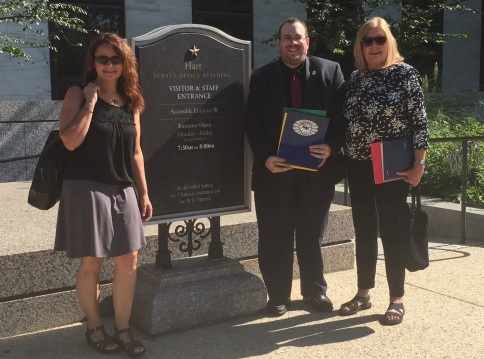
Next, I met up with some fellow teacher lobbyists from New Jersey and we dropped in unannounced on Booker’s office.

It’s not that we didn’t try to make an appointment. His staff never returned our calls and emails.

In fact, last week a fellow teacher not with us on Capitol Hill, Michele Miller,  even got into a scuffle with Booker on Twitter about elementary school funding. He told her to call his office and he would talk to her in detail.

To my knowledge, he never did. However, she was connected by phone to one of his aides. I’m told this is just modus operandi for Booker – strong talk in a public forum but shying away when the cameras aren’t rolling.

In any case, Booker’s senior education and health policy adviser Ashley Eden agreed to talk with us when we showed up to the office. Though her background isn’t in education, I can’t recall exactly what it is in. I do remember she has been doing this sort of legislative work for lawmakers for about 4 years – longer than any other aide we met.

She immediately made us feel welcome and found many areas of agreement. Bookers’ major point of contention – like fellow Democrat Doyle – was accountability.

How do we know which kids need help without giving them standardized tests?

Groan. But at least I had reinforcements: BATS Assistant Manager Melissa Tomlinson and retired NJ teacher extraordinaire Elizabeth DeMarco.
image

Perhaps the most telling moment of the entire conversation was when Eden said Booker just had to back standardized testing because every Civil Rights organization wanted it. She even criticized the New Jersey Education Association (NJEA) for not supporting black and brown students.

We stopped her right there. No. Every Civil Rights organization does NOT support testing. Journey for Justice – a coalition of 38 such organizations, in conjunction with 175 additional likeminded groups wrote to both the House and Senate asking to eliminate testing. Didn’t Sen. Booker see the letter?

Suddenly she remembered it.

She said she read it real quickly and didn’t like one sentence in it so she ignored it.

Which sentence?

Something about expecting poor and minority students to do badly on tests.

I explained that it has nothing to do with thinking these children can’t achieve at the same level as other children. It’s a matter of resources. If Sen. Booker was in a foot race against someone in a Monster Truck, I’d vote on the truck. Doesn’t mean Booker can’t run or that he might not even win. But the smart money is on Big Foot.

I joined the two ladies for their meeting with Smith as well.

His legislative assistant, Katherine Talalas, was perhaps the most knowledgeable aide with whom we talked. Her mother is a special education teacher, her brother is a paraprofessional working in a public school and she went to law school focusing on education issues.

She also took more written notes than any other assistant. With her nothing seemed canned. It was a real conversation about what her boss had done to help special education students and how he might continue to help in the future.

image

I was on my own again to meet with Sen. Casey’s aide, Jared Solomon.

This was one of the most fascinating and perplexing conversations I had all day.

He was warm, friendly, and had a depth of knowledge that was a bit more political than school-centered.

He agreed with almost everything I said. Casey supports 95% of the things that are important to me in education.

I could have smiled and walked away happy, but Solomon was so gregarious he kept talking. We shared our backgrounds.

He proudly admitted that he had been a Teach for America (TFA) recruit. He worked two years in a Baltimore public school and then left. He knew it wasn’t going to be his permanent job. He was emulating his parents who had joined the Peace Corps. He did TFA because he wanted the experience.

Then he moved to the administrative offices of Michelle Rhee’s Washington, D.C., Public Schools.

He only worked there two years – only one of which was under Rhee’s administration – but he respected what they had done. He said he disagreed with 80% of their policies and even quit because he was tired of being blamed for practices with which he didn’t agree. But, he added, the people in Rhee’s administration worked harder than anyone he knew, and he thought they really had the best interests of the kids at heart.

I’m tempted to chalk it up to the same feeling the incredible blogger Jennifer Berkshire (a.k.a. Edushyster) says she gets when she interviews many corporate school reformers. We may disagree with them, but they really do believe this stuff.

But something happened that doesn’t sit well with me. In an unguarded moment of a more than hour-long conversation, Solomon pulled the same stunt Eden did for Sen. Booker. He said all the Civil Rights groups were crying out for testing. But when I called him out on it, he immediately took it back. It was like he, too, knew this was untrue. It was a talking point, quickly to be conceded if called out and then move on to another argument.

I frankly don’t know what to make of it. The arguments are too similar among Democrats and Republicans to shrug off. Each is speaking from a party line script. That can’t just be a coincidence.

And why would Casey, a legislator who supposedly agrees with me 95% of the time on education, hire as his education expert someone who was actively involved in many of the practices that go directly against his beliefs? Why would someone like Solomon, who was part of the corporate education reform movement, really be on my side against these policies?

It’s befuddling to say the least.

Now that it’s all over, I’m so glad I did this.

Will this change the nation’s education policies? Probably not.

But I am only one of hundreds of people who climbed Capitol Hill in the last two days and met with more than 52 federal legislators to fight against the standardization and privatization of education.

And tomorrow we, BATS, will hold a Teachers Congress to further solidify our goals and decide where the great ship of real positive school change should go.

I am so looking forward to it.

But this teacher, soon-to-be BAT Congressman, needs to go to bed.

Here’s to a brilliant tomorrow for our children.


NOTE: This article also was published on the Badass Teachers Association blog.

The Democrats May Have Just Aligned Themselves With Test and Punish – We Are Doomed

sanders_warren-620x412

Almost every Democrat in the US Senate just voted to keep Test and Punish.

But Republicans defeated them.

I know. I feel like I just entered a parallel universe, too. But that’s what happened.

Some facts:

No Child Left Behind (NCLB) is a disaster.

It took the Elementary and Secondary Education Act (ESEA) – a federal law designed to ensure all schools get equitable resources and funding – and turned it into a law about standardized testing and punishing schools that don’t measure up.

This was a Republican policy proposed by President George W. Bush.

But now that the ESEA is being rewritten, those pushing to keep the same horrendous Bush era policies are the Democrats.

Almost all of the Democrats!

That includes so-called far left Dems like Bernie Sanders and Elizabeth Warren!

It comes down to the Murphy Amendment, a Democratically sponsored change to the ESEA.

This provision was an attempt to keep as many Test and Punish policies as possible in the Senate rewrite.

The amendment, “reads more like NCLB, with its detailed prescription for reporting on student test results, for ‘meaningfully differentiating among all public schools’ (i.e., grading schools), including publicly identifying the lowest five percent, and, among interventions, potentially firing staff and offering students the option to transfer to other schools and using part of the budget to pay for the transportation,” according to blogger Mercedes Schneider.

Education historian Diane Ravich adds, “This amendment would have enacted tough, federal-mandated accountability, akin to setting up an ‘achievement school district’ in every state.”

Thankfully it was voted down. The ESEA will probably not be affected. The rewrite was passed by both the House and Senate without these provisions. Once the two versions of the bill are combined, it is quite possible – maybe even probable – that we’ll have a slight improvement on NCLB. Sure there is plenty of crap in it and plenty of lost opportunities, but the ESEA rewrite looks to be a baby step in the right direction.

The problem is this: the failed Murphy Amendment shows the Democrats’ education vision. Almost all of them voted for it. Warren even co-sponsored it!

When it was defeated and the Senate approved the ESEA rewrite, Warren released a statement expressing her disapproval. But if you didn’t know about the Murphy Amendment, you could have read her criticisms quite differently.

She says the (ESEA rewrite) “eliminates basic, fundamental safeguards to ensure that federal dollars are actually used to improve both schools and educational outcomes for those students who are often ignored.”

That sounds good until you realize what she means. “Educational outcomes” mean test scores. She’s talking about test-based accountability. She is against the ESEA rewrite because it doesn’t necessarily put strings on schools’ funding based on standardized test scores like NCLB.

She continues, “Republicans have blocked every attempt to establish even minimum safeguards to ensure that money would be used effectively. I am deeply concerned that billions in taxpayer dollars will not actually reach those schools and students who need them the most…”

She is upset because Republicans repeatedly stripped away federal power to Test and Punish schools. The GOP gave that power to the states. So Warren is concerned that somewhere in this great nation there may be a state or two that decides NOT to take away funding if some of their schools have bad test scores! God forbid!

And Warren’s about as far left as they come!

What about liberal lion Bernie Sanders? I’d sure like an explanation for his vote.

It makes me wonder if when he promised to “end No Child Left Behind,” did he mean the policies in the bill or just the name!?

The Democrats seem to be committed to the notion that the only way to tell if a school is doing a good job is by reference to its test scores. High test scores – good school. Bad test scores – bad school.

This is baloney! Test scores show parental income, not academic achievement. Virtually every school with low test scores serves a majority of poor children. Virtually every school with high test scores serves rich kids.

Real school accountability would be something more akin to the original vision of the ESEA – making sure each district had what it needs to give kids the best education possible. This means at least equalizing funding to poverty schools so they have the same resources as wealthy ones. Even better would be ending our strange reliance on local property taxes to provide the majority of district monies.

But the Dems won’t hear it. The Murphy Amendment seems to show that they’re committed to punishing poor schools and rewarding rich ones.

I really hope I’m wrong about this. Please, anyone out there, talk me down!

Up until now I’ve always been with the Democrats because they had better – though still bad – education policies than the Republicans. I’m not sure I can say that anymore. In fact, it may be just the opposite.

Which party is most committed to ending Common Core? The Republicans!

Which party has championed reducing federal power over our schools and giving us a fighting chance at real education reforms? Republicans!

Which party more often champion’s parental rights over the state? Republicans!

Sure, most of them still love vouchers and charter schools. But increasingly so do the Democrats.

This vote has me rethinking everything.

Our country’s education voters may have just been abandoned by their longest ally.

Where do we go from here?


NOTE: This article also was published on Commondreams.org and on the Badass Teachers Association blog. It was also mentioned in the Washington Post.

In ESEA Debate, Education is Caught in the Middle Between the State and Fed

middle-dog-300

Watching Congress debate national education policy is a bit like going to a tennis match and finding a truck and tractor pull has erupted.

“Isn’t this supposed to be about how to make our schools better?” I want to scream.

“No!” someone yells from the stands. “This is about States’ Rights vs. the Fed. Go, States!”

Face palm.

The current brouhaha centers around the Elementary and Secondary Education Act (ESEA), the federal law that governs K-12 schools.

The present version, called No Child Left Behind (NCLB), is a thorough disaster. Thankfully Congress is trying to rewrite the legislation.

However, in doing so the emphasis has been less on making things better and more on deciding who gets to make decisions about schools.

Republican President George W. Bush greatly increased federal control with NCLB, something Democratic President Barack Obama has continued through his education policies.

These days, the GOP has done a 180 and is the champion of states rights to make their own education policies.

Given the Obama administration’s continued emphasis on standardized testing, punitive accountability systems and top down education standards, a move away from federalism seems completely justified.

But this is becoming the heart of the debate even at the expense of children, parents and teachers.

Take Opt Out.

NCLB allows parents to opt their children out of standardized testing, but school districts can be punished for it. If more than 5% of the students in a district don’t take the federally mandated tests for whatever reason (including parental opt out), the district’s Title I funding is put in jeopardy.

In many parts of the country, parents are refusing to subject their children to these tests anyway. They are voting with their feet. They are telling our lawmakers they do not want their children to take standardized tests so often – or in many cases – at all.

The good news is that BOTH of the two drafts of the ESEA allow for parental Opt Outs. However, who gets to decide if doing so will penalize your school?

The House version says that opting out will not hurt your district. Period. But the Senate version leaves the matter up to the states. State legislatures get to decide if withholding your child from standardized testing will have punitive consequences for your district.

This is absurd.

It’s not a matter of States’ Rights vs. the Fed. It’s a matter of parental rights.

As a parent, I should have final say over what my child does or does not have to do in school. There may be limits in extreme circumstances (i.e. vaccines) and in terms of content (i.e. science, history), but in general the rights of parents and children should trump all others.

Ironically the parents who shield their children the most from standardized testing are those who champion it for everyone else. Secretary of Education Arne Duncan is sending his children to a Chicago private school that does not use standardized tests. Likewise, Obama’s children attend a private school free from the influence of his education policies. Same with corporate education reform cheerleaders Governors Chris Christie and Rahm Emanuel.

So many cooks who refuse to eat their own cooking!

But to return to the ESEA, pundits are lauding the Senate Opt Out restriction as a selling point between the versions of the proposed law. The House version has a better Opt Out provision, so you can choose it.

However, it is also poisoned from the start because (unlike the Senate version) it includes a backdoor voucher provision. Called Title I Portability, the House bill essentially would suck up funding now given to impoverished districts and spit it back into the lap of richer ones. Poor kids need additional funding because they go to poor schools that have less money to spend educating them. If a poor child goes to a rich school, she doesn’t need additional funding – the school already spends more to educate her than a poor district ever could. But the issue is a bit of a nonstarter anyway because Obama already has promised to veto any bill containing it.

So the only option is the Senate version, and they just sunk a big turd in it.

But like any factory farm sausage, you often have to learn to accept a few unsavory morsels in with the meat. Even if the final bill includes this Senate provision, it will be an improvement over NCLB. Punishing schools for parental opt outs is the status quo. If even a few  states decide not to punish their schools because of parents choices, that will be a step in the right direction.

It’s just so frustrating to watch our myopic Congresspeople take such baby steps forward.

Why would anyone try to override parental concerns about testing?

Many legislators worry if all students aren’t tested, there will be no way to determine if school districts are properly educating students.

But that is exactly the point!

Standardized testing does not show how well a school is functioning! It only shows how many poor students go to the school. Rich kids score well; poor kids score badly. And academics? There are so many better means of assessing them than multiple choice exams graded on a curve!

If lawmakers really wanted to ensure all students were getting a quality education, they’d hold BOTH the state and federal governments accountable for equitably funding our schools. No more funding based on local wealth. No more poor kids getting less funding than rich kids. No more kids doing without because mommy and daddy have lousy paying jobs.

Parents, children and educators have been crying out to lawmakers about the injustice of using high stakes tests as means of punishing schools for the poverty of their students. THIS is what needs to change. THIS is the essential reform we’re crying out to be enacted!

But no one’s listening. All they care about is which team is winning – Team State or Team Fed.


NOTE: This article also was published on the Badass Teachers Association Blog and it was mentioned in the Washington Post.

Do Americans “Throw Money” At Their Schools? A Fair Funding Primer

Screen shot 2015-07-06 at 11.05.59 PM

“Don’t throw money at schools.”

It’s a common rejoinder when lobbying for an increase in public education budgets.

You offer facts why schools need it: both the state and federal government continue to reduce K-12 funds, class sizes are increasing, the curriculum is being narrowed, buildings are crumbling – real world consequences to spending deficits.

And some guy (it’s often a dude) stands up with a cock-eyed grin and says, “You know, we really need to stop throwing money at schools.”

And he pauses as if we all need a moment to take that in.

Is there anything to this? We hear it often enough, but does he have a point?

Let’s see.

“Don’t throw money at schools.”

First, is it true? Is anyone actually throwing money at our schools?

I’ve worked as a public school teacher for over a decade. To my great disappointment never once has anyone hurled greenbacks through a window in my building. I have never had to dodge, duck or otherwise exercise gymnastics to avoid being thunked in the head by a stack of airborne bills.

Origami ninja stars made out of $100 notes do not routinely fly through the air in my classroom. No government representative has ever shown up in the auditorium during a professional development and said, “Yeah baby! Let’s make it rain!” before showering my coworkers and myself in Benjamin’s.

No. This has never happened. Not even coins. More change is thrown at the fountain in my local mall than at any public school where I’ve ever worked.

At this point, you’re probably saying, but, Steven, that’s not what this guy meant. He wasn’t implying someone literally tossed bills at foundations of learning. He was just being colorful.

To which I respond: was he? Because there are lots of ways to phrase that idea. He simply could have said, “We shouldn’t increase education funding.”

He could have said, “We need to spend school money more wisely before increasing it.”

He could have said, “Additional learning revenues are a waste because schools do such a bad job.”

He could have said, “We spend too much on education already.”

He could have said, “Kids don’t deserve more of my cash.”

But he didn’t say any of those things. Instead he conjured an image out of a Roman orgy or a rap video. He purposefully tried to frame this as a ridiculous situation. He wasn’t just trying to make an argument. He wanted to paint anyone who could possibly disagree with him as a fool.

“Can you believe these guys crying about public school funding?” he implied. “They’re having money thrown at them and they actually want more!?”

So before we even start to study the content of his phrase, we must remember it’s coated in bias and malicious intent. He is not really calling for a rational argument. He is appealing to emotions – most probably the emotions of those listening to the debate.

But we cannot sink to his level. We need reasons.

This is difficult because it’s not entirely clear what exactly he was getting at. Let’s examine what his statement might mean in plain English and try to determine if – underneath all this spin – he has a point or not.

Here are some possibilities.

1) “We need to spend education money more wisely before increasing it.”

This might be what he intended to say. And if so, he does have a bit of a point.

There is a problem with how school funding is spent. There is waste and misappropriation. At the local level, school boards and administrators do not always do things in the most efficient manner. But you could say the same thing at every level of democratic government. Fascist states have much less waste. Shall we just burn up the Constitution, then?

At the state and federal level, the problem is compounded by the ignorance of those allowed to write our laws. Education policy is rarely made by those who know what they’re talking about, thus funding often is wasted on useless initiatives. Common Core, standardized testing, punitive accountability systems – these were all created by business interests without regard to educational validity or efficacy and – as such – waste taxpayer money that could be better spent on things that would actually help children learn.

And speaking of waste, may I introduce you to charter schools? Favored by lawmakers yet rocked by fiscal scandals, charters are legal means of sucking up tax dollars for a profit. While public schools have to account for every penny spent and prove funds went to better the educations of real live students, charters are not just permitted but encouraged to withhold some tax money from going to student services and instead bolstering administrators’ bank accounts. Anyone who speaks of fiscal accountability in education yet is in favor of its further privatization is either disingenuous or in need of a basic math course!

The solution, however, is not to withhold additional funding. The solution is more oversight. And I don’t mean only government oversight and regulations. I mean oversight by the public.

Democracy only works if people participate. People need to push for transparency and less wasteful policies. They need to educate themselves about what’s going on. They need to investigate. They need to lobby, protest, and criticize. They need to vote. And they need a free and interested media to give them the facts to make smart decisions.

Clearly we’re lacking some of these things today. But that’s a national problem not limited to education funding.

In the meantime, we can’t wait for a perfect government before increasing school spending. Our children need help now!

If we do nothing, we doom another generation to getting less than they deserve, less than what we could have provided. Why? Because we were afraid some of it wouldn’t reach them!?

A deep sea diver with a kink in his air hose, doesn’t shrug and turn off his oxygen. He turns it up!

2) “Additional learning revenues are a waste because schools do such a bad job.”

This might have been his criticism. Let’s look at the facts.

International comparisons of national school systems are all the rage in political circles. And raw data suggests that children from the United States are not at the top. We are somewhere in the middle.

That’s all true. But what pundits refrain from admitting is that it’s been true for a long time – in fact, for as long as we’ve been making these types of comparisons. Our schools have not gotten worse. They have stayed the same.

This brings up an important issue. How does one compare national school systems to each other, anyway? What do we use to make these comparisons? Income prospects? Student portfolios? Measures of critical thinking? Classroom grades?

No. We use standardized test scores – the PISA test to be exact.

However, we’ve known for decades that standardized tests are poor measures of academic success. Bubble tests can assess simple things but nothing complex. After all, they’re scored based on answers to multiple choice questions. In fact, the only thing they seem to measure with any degree of accuracy is the parental income of the test-taker. Kids from rich families score well, and poor kids score badly.

So these comparisons are suspect.

But even if we accept them, we are leaving out a very important factor: Poverty.

Virtually all of the top scoring countries taking the PISA exam have much less child poverty than the U.S. As we’ve seen, this will boost their scores. If we adjust our scores for poverty, our students jump to the top of the list.

Let me repeat that: U.S. students do the best in the world on international tests – IF THEY ARE NOT POOR.

Moreover, the U.S. education system does something that many international systems do not. We educate everyone! Foreign systems often weed children out by high school. They don’t let every child get 13 years of grade school (counting kindergarten). They only school their highest achievers.

So when we compare ourselves to these countries, we’re comparing ALL of our students to only SOME theirs – their best academic pupils, to be exact. Yet we still hold our own given these handicaps!

In short, U.S. public schools do an excellent job educating children. They overcome incredible obstacles to achieve near miraculous ends often with very few resources.

Imagine what they could achieve if our schools were properly funded.

3) “We spend too much on education already.”

This one is a favorite of politicians of both parties. We already spend a lot on education. Some lawmakers and media personalities go so far as to claim that we spend more than any other country in the world.

Is that true? No.

We are near the top, but according to the most recent OECD study, four countries – Austria, Luxembourg, Norway and Switzerland – spend more.

Additionally, the study was released in 2014 but used data from 2011. Since that time, the U.S. has cut its school spending by leaps and bounds while most other advanced nations have been increasing it. Look for many more countries to pass us up when the next study is released.

But even using current figures, there are troubling social, economic and political differences between nations that impact how school funding needs to be spent. While most advanced countries spend their education budgets on actual instruction, the United States mandates public schools use a larger portion of their budgets on things outside the classroom.

For example, many international schools don’t have metal detectors or security staff. Given the U.S. problem with mass shootings and gun violence, our schools need to spend a significant portion of their monies in this way. I’m not suggesting we stop. Clearly we need to continue these practices, but that’s less money to help kids learn.

In addition, unfunded legislative mandates and court decisions have made U.S. public schools responsible for many things that international schools are not. About one third of all budget increases in recent years has gone to support special education students; 8 percent went to dropout prevention programs, alternative instruction, and counseling aimed at keeping students in school; another 8 percent went to expand school lunch programs; and so forth. Very few additional dollars were provided for needs associated with basic instruction.

Again, I’m not saying we should stop. Given our national epidemic of child poverty – an epidemic not shared by other advanced nations – we have to address these adjacent issues. But without additional funding, we’re letting the very heart of our schools – the classroom – go to waste while other countries are providing significantly more support.

Unfortunately, the problem doesn’t end there. Not only does the U.S. have unique problems that other nations do not share, we also are unique in how we allocate the funding we already have. And this difference only worsens the problem and increases the need for more money.

While most advanced countries divide their education dollars evenly between students, the United States does not. Some students get more, some get less. It all depends on local wealth.

The average per pupil expenditure for U.S. secondary students is $12,731. But that figure is deceiving. It is an average. Some kids get much more. Many get much less. It all depends on where you live. If your home is in a rich neighborhood, more money is spent on your education than if you live in a poor neighborhood.

The U.S. is one of the only countries in the world – if not probably the ONLY country – that funds schools based largely on local taxes. Other developed nations either equalize funding or provide extra money for kids in need. In the Netherlands, for example, national funding is provided to all schools based on the number of pupils enrolled. But for every guilder allocated to a middle-class Dutch child, 1.25 guilders are allocated for a lower-class child and 1.9 guilders for a minority child – exactly the opposite of the situation in the U.S.

So even though we spend more than many countries, we spend it so unevenly that poor and minority children are being left out.

Therefore, we have a choice: either do away with funding based on local property taxes or increase funding to poor school districts – or both.

4) “Kids don’t deserve more of my cash.”

Dollars to doughnuts, this is probably what he really means.

The United States has a moral failing. And we’re proud of it. We call it libertarianism. It means – Screw you! I’ve got mine.

We don’t care about helping others, we don’t care about the common good, we only look out for ourselves and our immediate friends and families. Everyone else can eat crap and die.

It’s ethical immaturity and, frankly, there’s not much you can say to someone who feels this way except that you disagree.

At most you can try to appeal to his self interest. Do you really want to live in a society full of uneducated people? Do you really want your kids to grow up in a world like that?

But that’s as far as it goes. You can’t help emotionally and intellectually stunted people – especially adults. Most children go through this phase. Some never grow out of it.

The good news is that most of us aren’t so far gone. If you can show that our interlocutor’s statement really comes down to this, you may be able to convince some people to agree with you simply because no one wants to be such an odious troll.

You need to pull back the curtain and show the truth.

How do we best spend these education dollars? How do we raise the money? Those are valid questions, but only a truly horrible person simply refuses to help children learn.

Because we’re not “throwing money” at schools. We’re throwing certain kids away.


NOTE: This article also was published in the LA Progressive, Commondreams.org and on the Badass Teachers Association blog.

The Only Teaching Evaluation That Matters

Screen shot 2015-06-12 at 10.40.16 PM

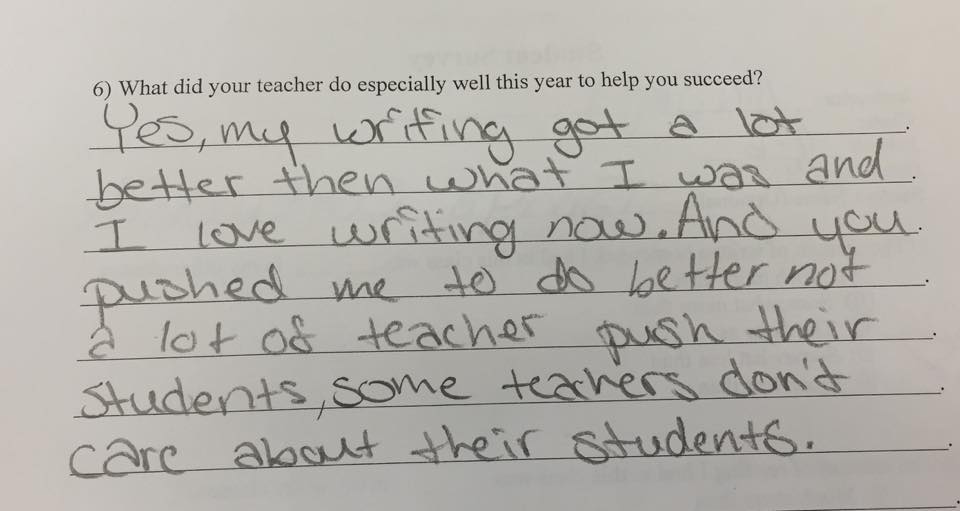
“Yes, my writing got a lot better than what I was, and I love writing now. And you pushed me to do better. Not a lot of teachers push their students, some teachers don’t care about their students.”

11280008_10153046535243860_104612156_n

One of my 8th graders wrote that to me on the last day of school.

I had asked her class to fill out an anonymous survey about my teaching. I said that all year I get to grade THEM, but this was their chance to grade ME.

I made sure to explain that they didn’t need to put their names on it. This would not be graded. Spelling and grammar didn’t count. The only thing I wanted was honesty.

I told them I wouldn’t personally collect the surveys. They should NOT hand them to me; they should put them in a pile on the desk by the door when they leave. I promised I wouldn’t even look at what they’d written until class was over. That way they could feel free to write whatever they wanted. If I did something bad or there was some way I could improve, I wanted them to tell me. If I did something exceptionally well, they should tell me that, too.

“Please help me become a better teacher,” I said.

As an 8th grade public school educator, I get evaluated a lot. I’ve spent countless hours gathering evidence that I’m “proficient” at my job.

I’ve had to endure formal observations, informal observations, H.E.A.T. observations, Student Learning Objectives (SLOs), written explanations of specific lessons with appeals to which Common Core standards I would be teaching – and there always seems to be a new one added to this list next year.

But I’ve been giving a version of this simple student survey to my classes on the last day of school for over a decade.

It’s not something I’m required to do. I don’t share the results with administration. The responses don’t go on file, increase my pay or get recorded in the newspaper. They don’t become part of the district’s ranking in the Business Times. No one is going to withhold funding from my district or close my building and convert it into a charter school based on these results. No one ever will be on television decrying the state of public education referencing these surveys. They are low stakes, class-based, teacher-centered and personal.

But I do this because I think it actually gives me useful information. I really want to know what my students think. That’s one of the things that truly drives my instruction. Not politically motivated standards monetarily incentivized and adopted before they were even completely written. Not standardized tests that measure little more than parental income. Not the latest fad handed down by the superintendent. Not a threat shouted at us through an email or at a faculty meeting.

No. I’m motivated by my kids in the classroom and the answer to the question, “Have I helped you learn?”

The survey is quite simple really. It’s two-sided.

On the front page are 5 multiple choice questions:

1) The amount of written homework I had in this class was                             in my other classes.

A) much more than
B) Somewhat more than
C) The same as
D) Somewhat less than
E) Much less than

2) The amount of reading I had in this class was                                in my other classes.

A) much more than
B) Somewhat more than
C) The same as
D) Somewhat less than
E) Much less than

3) The amount of studying I did for this class was                                 in my other classes.

A) much more than
B) Somewhat more than
C) The same as
D) Somewhat less than
E) Much less than

4) I received                                    instruction and comments on my written work.

A) much more than enough
B) Somewhat more than enough
C) Just enough
D) Somewhat less than enough
E) Much less than enough

5) In this class, I learned                                         in my other classes.

A) much more than
B) Somewhat more than
C) The same as
D) Somewhat less than
E) Much less than

When it comes to homework, students almost always say I give too much. The majority (68%) gave me an A or B.

I only require about an hour of extra-class work a week. I don’t think that’s too bad. However, many teachers give less or none. I go back and forth on the value of homework, myself, but I know that once my students get to 9th grade, they’ll have a tremendous load of it. I figure if I don’t prepare them for that, I’m doing them a disservice. So an avalanche of (one hour a week) homework it remains.

Likewise, kids often say I give a lot of reading. A language arts class should give a substantial amount of reading. So I’m glad most kids (69%) give me an A or B. I require my students to read one self-selected book a month. I don’t think that’s too burdensome. If the book is too tough or boring – hey! You picked it! Pick another one. I also provide them with 15 minutes per day to read in class.

Studying is not something I emphasize. But students are almost evenly divided whether I require too much, just enough or too little. I’m not big on having kids memorize something and then regurgitate that on a test. I’d rather spend time getting them to take good notes that they can use on the test. I’m a big fan of open notes or open book tests. But I hardly ever use the word “Test.” I give frequent short quizzes. I think tests (and even quizzes) are limited evaluation tools. I’d much rather assign a multi-day project. That tells me much more than a brief snapshot of what students were thinking at any one given point in time.

I do assign a lot of essays so I’m always anxious to know if I’ve given enough written feedback. The research seems to show that if you mark every error on an essay, you get diminishing returns. You discourage students. So instead I try to focus on a few trouble areas we’ve already discussed per essay. And students seem to appreciate it. Most of my kids (85%) gave me an A or B or C in this area.

Then comes the cumulative question. How much did you learn? I used to have my classes assign me a letter grade A-E. However, answers were all over the place. When I compared the results with surveys from students who had revealed their identities, I found that kids usually gave me the same grade they received in my class. A-students gave me As. C-students gave me Cs, and so on.

When I changed the question to “how much have you learned?” the results changed drastically. Most students (84%) gave me an A or B. Yes, that’s the result I’m aiming for, but I think it’s a more honest answer, too. It doesn’t focus on grades. It focuses on each child’s assessment of his or her own progress. That’s really what I want to know.

But this side of the survey still provides very limited answers. It is multiple choice, after all. It’s useful for a brief overview but not very deep.

The second side of my questionnaire only has two open-ended queries. Students can write as much or as little as they want to the following questions:

6) What did your teacher do especially well this year to help you succeed?

7) In what areas can your teacher improve his/her instruction?

To be honest, when looking at the surveys, I usually skip right to these questions. This is what I want to see – not a bunch of alphabet soup. I want to know what they really think.

What have I done well? Here are some answers from this year’s kids:

-He understood the learning abilities of certain students and helped them to the best of his ability.

11122062_10153046535213860_65835541_n

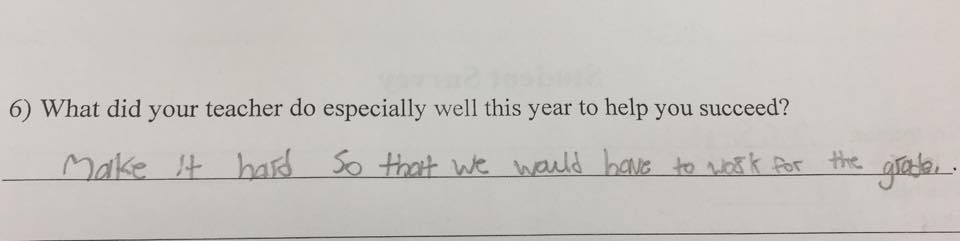
-You made it hard so that we would have to work for the grade.

11208874_10153046535223860_1052817053_n

-Before we could ask him for help, he asked us if we needed help. He’d help everyone, even the person who didn’t ask for it.

11310977_10153046535218860_807785160_n

-He was really good at explaining and pushed me to never give up. Therefore, Mr. Singer is one of my favorite teachers.

11329696_10153046535238860_1253356423_n

-Well, I didn’t like as much work as he was giving us, but then I understood he was trying to help us with our grades and trying to make our grades higher.

11348779_10153046535183860_857789294_n

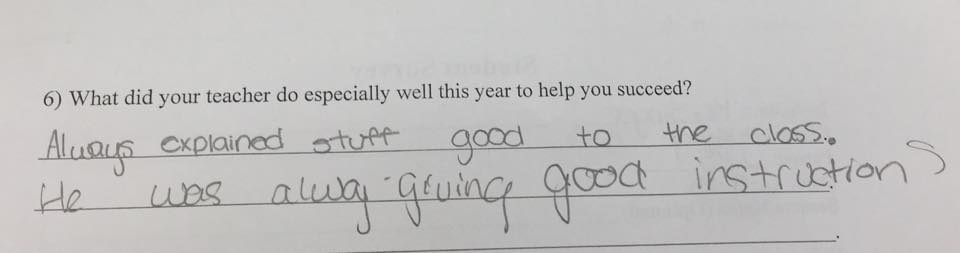
-Always explained stuff good in class. He was always giving good instructions.

11358887_10153046535198860_689871876_n

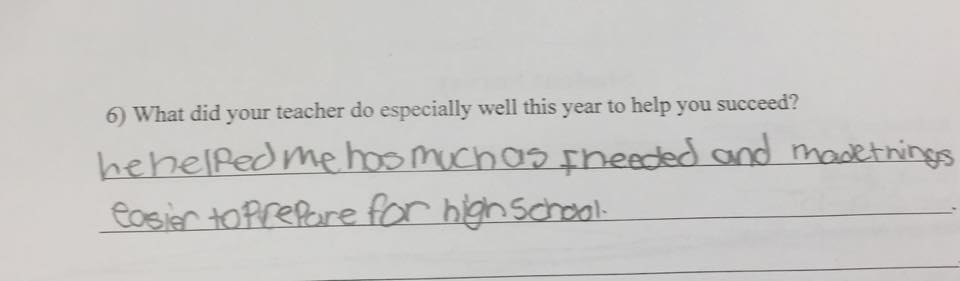
-He helped me as much as I needed and made things easier to prepare for high school.

11418417_10153046535203860_1321510136_n

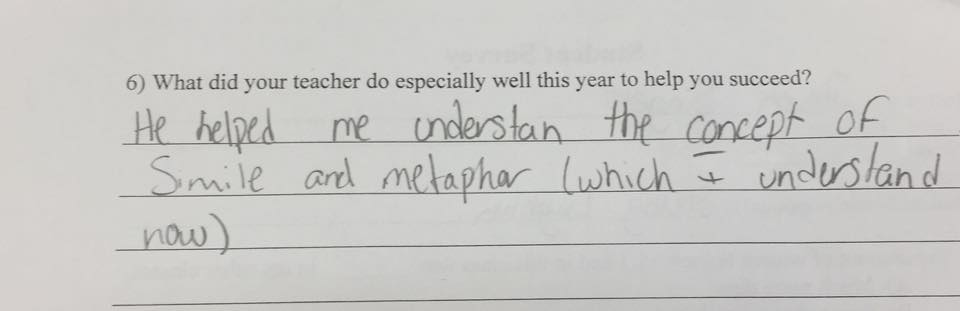
-He helped me understand the concept of simile and metaphor (which I understand now)

11420058_10153046535208860_229100346_n
-What my teacher especially helped me do to succeed is writing essays.

FullSizeRender

I was just floored by these responses. Talk about data I can use! But there was one answer that stood out above even these:

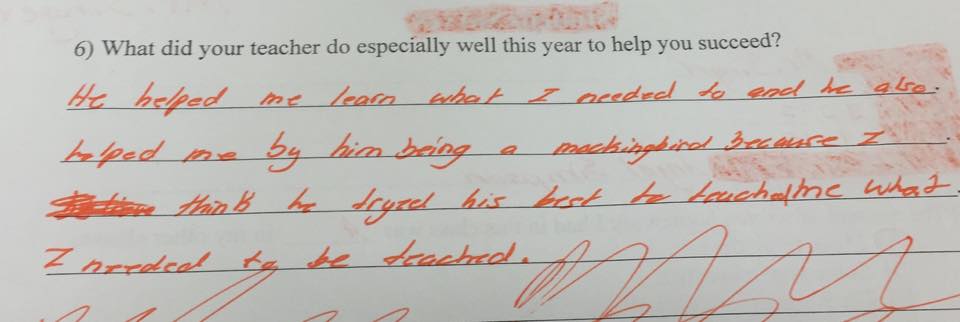
-He helped me learn what I needed to do and he helped me by being a mockingbird because I think he tried his best to teach me what I needed to be taught.

11280625_10153046535248860_1666870003_n

No, she wasn’t literally calling me a bird. She was relating me to our last novel – To Kill a Mockingbird. In the text, some characters are innocent victims. They try to help others but come under fire because of it. The author, Harper Lee, symbolizes them as “mockingbirds.” These include: Tom Robinson, the black man wrongly accused of rape; Atticus Finch, the lawyer standing up for a fair trial despite social criticism; Arthur “Boo” Radely, the recluse who saved lives at the expense of his privacy.

And here my sweet little student was including ME in this venerable list!

That choked me up a bit I can tell you.

When it comes to areas for improvement, my students aren’t the most forthcoming. Answers include:

-I don’t think he needs to because he already does his best to teach us kids what we need to be taught and his instruction is easy to understand.

11418657_10153046535193860_238476660_n
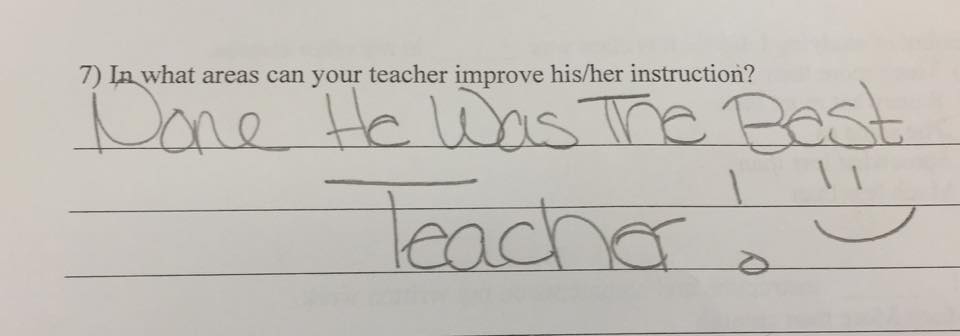
-None. He was the best teacher! 🙂

11419982_10153046535228860_393598543_n

I appreciate the approbation but I wouldn’t mind constructive criticism. I do get complaints about the amount of homework and writing I assign. I also get requests for more free time.

I think if I wasn’t in the room when students took the survey, I might get more criticism. Ideally, I would leave the room for the last 15 minutes of the class, and kids could fill out their surveys. However, this is impractical. I don’t see how I could arrange it given the current climate, lack of subs and skeleton crew staff.

These surveys have given me much to think about over the summer. Maybe I should try to include more group work in next year’s class. Maybe I should revisit the homework situation.

But as June turns to July and then August, I know I’ll be thinking about all that happened this school year.

Some kids came in and out of shelters and juvenile detention. Some were present at a shooting at the local mall. Parents and I had to fight administration over valuing standardized test scores over classroom grades for student placement. The School board enacted a pointless student uniform policy. Students were demoralized and angry over national racial tensions involving Michael Brown, Eric Garner and the Baltimore uprising. Teachers had an active shooter drill for the first time as part of our professional development.

But most of all I’ll think about my students – well, no longer mine – off to the high school and bigger, better things.

For a brief moment I was an important part of their lives and they were an important part of mine. I’ll forget their names. (It’s like my mind is making space for the new ones I’ll have to learn.) But I’ll never forget their struggles and triumphs.

It’s easy to lose sight with all the privatizers and standardizers trying to dismantle our public schools. But even with all the political nonsense, selfishness and small-mindedness, teaching is the best job in the world.

Yes, it really is!

Every day I get a chance to positively impact dozens of lives!

I am truly blessed.

That’s what these surveys tell me.

And that’s why they’re the only evaluation that really matters.


NOTE: Here is a copy of the survey I use in class.

Student Survey

-This article also was published on the Badass Teachers Association blog.

The School-to-Prison Pipeline: Turning Kids into Cash

Screen shot 2015-06-07 at 10.34.48 PM
For too many children, public school is just a “GO DIRECTLY TO JAIL” card.

Do not pass GO. Do not collect $200.

The institution that should be raising kids to the skies is chaining them to the ground.

It’s called the School-to-Prison Pipeline, and it disproportionately affects students of color and the poor.

School policy at the highest levels is designed to sort and rank students. Some go to the college track. Some go to the industrial track. And even more end up on the prison track.

We actually have procedures that prepare certain children for life behind bars.

Why? Because people make money from it.

Think about it. The United States represents only 4.4% of the world population but we house 22% of the world’s prisoners. We’re the number one jailor!

It’s not that our citizens are out of control. It’s not a rise in violent crime. In fact, the crime rate has decreased to 1970s levels.

But instead someone has found a way to convert prisoners into cash.

Since the 1980s, we’ve been handing over our prison system to private companies to run for a profit.

The number of inmates in privatized prisons has increased by 44% in the last decade alone, according to a 2013 Bloomberg report.

This creates a market. Without a steady stream of prisoners, these institutions would go bankrupt. And corporations such as Corrections Corporation of America and The GEO Group spend tons of cash lobbying our government to ensure just that.

It’s no accident that our national education policy meets the needs of the for-profit prison industry.

Look at the so-called education reforms of the last decade: increasing standardization, efforts to close schools serving poor and minority children, cutting school budgets and narrowing the curriculum. All of these serve to push kids out of school and into the streets where they are more likely to engage in criminal activity and enter the criminal justice system.

Federal education policy – whether it be No Child Left Behind or Race to the Top – continually doubles down on privatization and standardization. These policies consistently have failed to produce academic gains but are offered as the only possible solution in school reform initiatives.

Question: Why do we keep enacting the same failed policies?

Answer: Because they are not MEANT to succeed. They are meant to fail a certain percentage, race and economic bracket.

If we had effective education procedures that increased academic success, we wouldn’t have enough prisoners to feed our for-profit prisons. Lawmakers would loose valuable lobbying revenue.

Call it what you will – misplaced priorities, profiteering or an outright scam. But the reform-to-profit cycle is advocated, perpetrated and championed by the most prominent figures in the so-called education reform movement.

Take Bill Gates – the monetary force behind Common Core State Standards (CCSS), one of the leading policies in education.

The Bill and Melinda Gates Foundation also is an investor in The GEO Group – one of the biggest for-profit prison providers in the country. It’s most recent tax filing (2013) shows a more than $2 million investment.

Nominally a philanthropic organization, the Gates Foundation refuses to admit if it still backs the industry or by how much. Sure Gates underwriting is just a drop in the bucket, but it proves how the organization’s interest is economic and not charitable. It is one of a herd of Trojan horses stampeding over the cries of critics under a banner of largesse.

Likewise, Common Core essentially isn’t concerned with increasing the quality of children’s education. CCSS has never been proven to be effective and is – in fact – developmentally inappropriate. But it’s touted as a panacea to a host of ills when its real concern is to continue fortifying the prison machine.

We live in a country where more than half of the children attending public school live below the poverty line. They need proper nutrition, social assistance, tutoring, counseling and a host of wrap around services. But instead they get so-called “higher” academic standards and standardized tests.

It’s like a sporting goods store withholding wheelchairs to the Special Olympics and instead donating extra hurdles – all the while claiming it was trying to help participants become better hoppers!

Even worse, these standards aren’t actually better. They’re just confusing, ignorant and ill-conceived. After all, they weren’t developed by educators. They were made by ideologues who admit they were unqualified for the task.

Was this a huge mistake? No. These standards and the associated bubble tests that drive them do exactly what they were meant to do.

They increase the numbers of failing students. They push more kids out of school and into the waiting arms of the prison industry.

And when kids have difficulty sitting through the hours, days, and months of test prep that are increasingly replacing a well-rounded curriculum, they face unfair discipline practices.

We treat misbehaving kids like little criminals.

Can’t sit still in class? Can’t keep quiet? Can’t control your frustration?

Out you go! Detentions, suspensions, expulsions!

We have zero tolerance for your childish behavior – even if you are still a child.

And unsurprisingly the majority of the children who are crushed by the hammer of discipline have dark skin.

Let me be clear. I’m not saying that misbehaving children shouldn’t be disciplined. Far from it.

But we need to stop criminalizing their misbehavior.

If we can’t provide them with schools that teach in a developmentally appropriate manner – it’s not the children who are misbehaving. It’s us! The school system!

Moreover, when a child has a problem conforming to the norm, our first reaction shouldn’t be punishment. It should be understanding. The goal should be to find ways to change the negative behavior, not weed the kid out of the system.

But this means treating children as ends not means.

We have to care about their well-being. They have to be more than just piggy banks for big business.

Otherwise, it is our sick society that really deserves to be sent to jail.


NOTE: This article also appeared in the LA Progressive, ConversationED and the Badass Teachers Association blog.
This Article May Be Illegal – Lifting the Veil of Silence on Standardized Testing

whistle

Warning!

What you are about to read may be a criminal act.

I may have broken the law by putting this information out there.

Edward Snowden leaked data about civilian surveillance. Chelsea Manning released top secret military documents.

And me? I’m leaking legal threats and intimidation students and teachers are subject to during standardized testing.

Not exactly a federal crime is it?

No. I’m asking. Is it?

Because teachers are being fired and jailed. Students are being threatened with litigation.

All because they talked about standardized tests.

The US government mandates public school children be subjected to standardized assessments in reading and math in grades 3-8 and once in high school. Most schools test much more than that – even as early as kindergarten.

And since all of these assessments are purchased from private corporations, the testing material is ideological property. The students taking these exams – regardless of age – are no longer treated as children. They are clients entering into a contract.

At the start of these tests, students are warned of the legal consequences of violating the terms of this agreement.

In particular, the Pennsylvania System of School Assessment (PSSA) tests require students to read the following warning on the first day of the assessment:

DO NOT PHOTOGRAPH, COPY OR REPRODUCE MATERIALS FROM THIS ASSESSMENT IN ANY MANNER. All material contained in this assessment is secure and copyrighted material owned by the Pennsylvania Department of Education. Copying of material in any manner, including the taking of a photograph, is a violation of the federal Copyright Act. Penalties for violations of the Copyright Act may include the cost of replacing the compromised test item(s) or a fine of no less than $750 up to $30,000 for a single violation. 17 U.S.C. $ 101 et seq

So the first act of testing is a threat of legal consequences and possible fines.

There are no such warnings on my own teacher-created tests. Sure I don’t want students to cheat, but I don’t threaten to take them to court if they do.

The school has a plagiarism policy in place – as almost every public school does – which was created and approved by the local school board and administration. The first infraction merits a warning. The second one results in a zero on the assignment, and so on.

Moreover, this is something we go over once at the beginning of the year. We do not reiterate it with every test. It would be counterproductive to remind students of the dire consequences of misbehavior right before you’re asking them to perform at their peak ability.


Okay, Brady! Go out there and win us a football game! By the way, if you deflate that football, you will spend the rest of your life in jail. Go get ‘em!

But that’s not all.

In Pennsylvania, we also force kids to abide by a specific code of conduct for test takers. They must enter a quasi-legal relationship before they are even permitted to begin the tests we’re forcing them to take.

Much of this code is common sense. Get a good night’s sleep. Fill in bubbles completely using a number two pencil.

But some of it is deeply disturbing.

For example, students are told to “report any suspected cheating to your teacher or principal.”

They have to agree to be an informer or snitch to a government agency. My students aren’t old enough to vote or even drive a car, but they are directed to collaborate with the government against their classmates.

In addition, they are told NOT to:

-talk with others about questions on the test during or after the test.

-take notes about the test to share with others.

Sure kids shouldn’t talk about the test with classmates DURING the testing session. Obviously! But why can’t they discuss it after the test is over!?

Kids aren’t allowed to say to their friends, “Hey! Did you get the essay question about ‘The Tell-Tale Heart’?”

They aren’t allowed to discuss how difficult it was or compare how each of them answered the questions?

These are children. If you think they aren’t talking, then you just don’t know kids. You don’t know people!

And why shouldn’t they talk about it? They just shared a stressful, common experience. Who wouldn’t want to compare it to what others went through so as to decide how your experience rates? Did you answer the questions well or not? Did you get a more difficult question than others? Did the thing that struck you as odd also hit others the same way?

Personally, I do not consider talking like this to be cheating. It’s just human nature.

But we force kids into a legalistic vow they won’t do it. On the test, we make them fill in a bubble next to the following statement:

By marking this bubble I verify that I understand the “Code of Conduct for Test Takers” that my Test Administrator went over with me.

As a test administrator, I am not allowed to move on until all students have filled in that bubble. I wonder what would happen if one of them refused.

Technically, we aren’t making them promise TO ABIDE by the code of test takers. Perhaps we lack that legal authority. We are, however, making them swear they understand it. Thus we remove ignorance as an excuse for not following it.

But there is a veiled threat here. We imply that not following this code will have harsh legal consequences.

And I’m not sure it should.

Kids certainly ignore it. They almost definitely discuss the exam with their peers after the testing session. But we’ve given them a sense of guilt, fear and anxiety just for being normal human beings.

That’s wrong.

Teachers are forced to do it, too.

Just as there is a code for test takers, there is a code for test proctors.

I have to sign that I understand the “Ethical Standards of Test Administration.” Again, much of this is common sense, but it includes such statements as:

DO NOT:

-Discuss, disseminate or otherwise reveal contents of the test to anyone.

-Assist in, direct, aid, counsel, encourage, or fail to report any of the actions prohibited in this section.

So even teachers technically are not allowed to discuss the test and should report students or colleagues seen doing so.

If I walk into the faculty room, and one of my co-workers describes a question on the test and asks my opinion, I’m supposed to report this person to the authorities.

What kind of Orwellian nightmare are we living in?

If we see a question that is badly worded, misleading, has no correct answer, contains misspelled words – anything out of the ordinary – we’re supposed to remain silent. In fact, we’re not supposed to read anything on the test other than the instructions.

I can’t talk about it to my colleagues, my principal, my spouse, my priest – ANYONE.

What are the consequences of breaking this code?

Ask those teachers in Atlanta who were convicted of cheating. Obviously they did more than just talk about the test and they deserve to be punished. But there is a specific threat to teachers if they violate this code.

According to the “Pennsylvania System of School Assessment Directions for Administration Manuel”:

Those individuals who divulge test questions, falsify student scores, or compromise the integrity of the state assessment system in any manner will be subject to professional disciplinary action under the Professional Educator Discipline Act, 24 P.S. $ 2070. 1a et seq, including a private reprimand, a public reprimand, a suspension of their teaching certificate(s), a revocation of their teaching certificate(s), and/or a suspension or prohibition from being employed by a charter school. [emphasis added]

So teachers may lose our certifications, livelihoods, etc. Heck! We could be charged with racketeering like the Gambino Family and face up to 20 years in jail!

And all just for talking!

I thought speech was protected by law. Doesn’t the First Amendment protect me from prosecution for speaking except under extreme and unusual circumstances?

If my colleagues and I were to discuss the appropriateness of certain test questions, would that really be such a bad thing? If we compared the questions being asked with how we prepared our students for the test, wouldn’t that – in fact – be the responsible thing to do?

I never give my students one of my own teacher-created tests without knowing exactly what’s on it. I’ve read the test from top to bottom. Heck! I made it!

One shouldn’t feel like a whistle-blower for talking about a standardized test. Discussing the appropriateness of specific test questions does not make me Julian Assange.

Therefore, I must ask an important question of you, dear reader: Did I violate these rules by writing this very article? Is the piece you are reading right now illegal?

I contend that it isn’t. The code of conduct for both test takers and test administrators is freely available on-line from the Pennsylvania Department of Education. The legal threat at the beginning of the test is reproduced almost word-for-word in a sample letter the state Department of Education suggests schools send to parents before testing begins.

I haven’t included anything here that is not freely available on the Internet or elsewhere.

But the need I feel to stop and answer this question is kind of scary.

There is a veil of secrecy over these tests and the way they are administered. And it’s no accident. The testing companies don’t want all of this to become public knowledge. They don’t want the quality or inferiority of the actual exams to be known.

And our state and federal governments are protecting them. From whom? Our teachers, parents, and students.

Shouldn’t our legislators be looking out for our rights and not just those of private contractors who were hired to provide a service? Obviously we have to allow test manufacturers the freedom to do their jobs – but some of this seems to go beyond that requirement.

We’re being silenced and intimidated to protect an industry that is of dubious quality and obscene profitability.

Every day more people are asking questions about the validity of standardized testing. Everything from the frequency of the tests to the value of cut scores has been the subject of criticism. Thousands of parents are refusing to let their children take these assessments at all.

Isn’t it time to throw back the Iron Curtain of standardization and look at these tests in the cleansing light of day? Isn’t it time to evaluate this process as well as the product? Do we really want to support a system that encourages silence and snitching from our children and educators?

Isn’t it time to move beyond standardization and toward a system of teacher-created curriculum and testing instead of relying on capitalist profiteers.

Big Corporation is watching.

Let’s poke him in the eye.


NOTE: This article also has appeared on Diane Ravich’s blog, Commondreams.org and the Badass Teachers Association blog.