Unions Can’t Just Be About What We’re Allowed to Do: Social Justice Unionism

7983807401_6b0075f742_b.sm_a

If labor unions were an animal, they’d be an old hound dog napping on the porch.

They’re slow to get up and chase away burglars but they do like to howl at night.

Most of the time you don’t even know they’re around until the dinner bell rings. Then that ancient mutt is first to bolt into the kitchen to find a place at the table.

It’s kind of sad really. That faithful old dog used to be really something in his youth.

He was fierce! He’d bark at trespassers even tearing them apart if they threatened his patch of land.

Old Uncle Sam used to yell at him and even threaten the pooch with a rolled up newspaper, but that dog didn’t care. He had a sense of right and wrong, and he didn’t mind getting into deep trouble fighting for what he thought was fair.

Today, however, the only thing that really riles him is if you threaten to take away his ratty old bone.

Let’s face it. Unions have become kind of tame. They’re housebroken and not much of a threat to those people waiting in the shadows to rob us blind.

Some people say we’d be better off without them. But I don’t agree. Even a decrepit canine can act as a deterrent, and thieves sure are frightened of dogs.

Think about all unions have given us: the weekend, child labor laws, vacation time, pensions, lunch breaks, healthcare, the 8-hour day, maternity leave, safety measures, due process, sick leave and free speech protections on the job!

They didn’t get us all that by sitting politely at the table with their hands crossed. They didn’t do all that by contributing modest sums to political campaigns. They didn’t do it by obsessively protecting collective bargaining at the expense of all else.

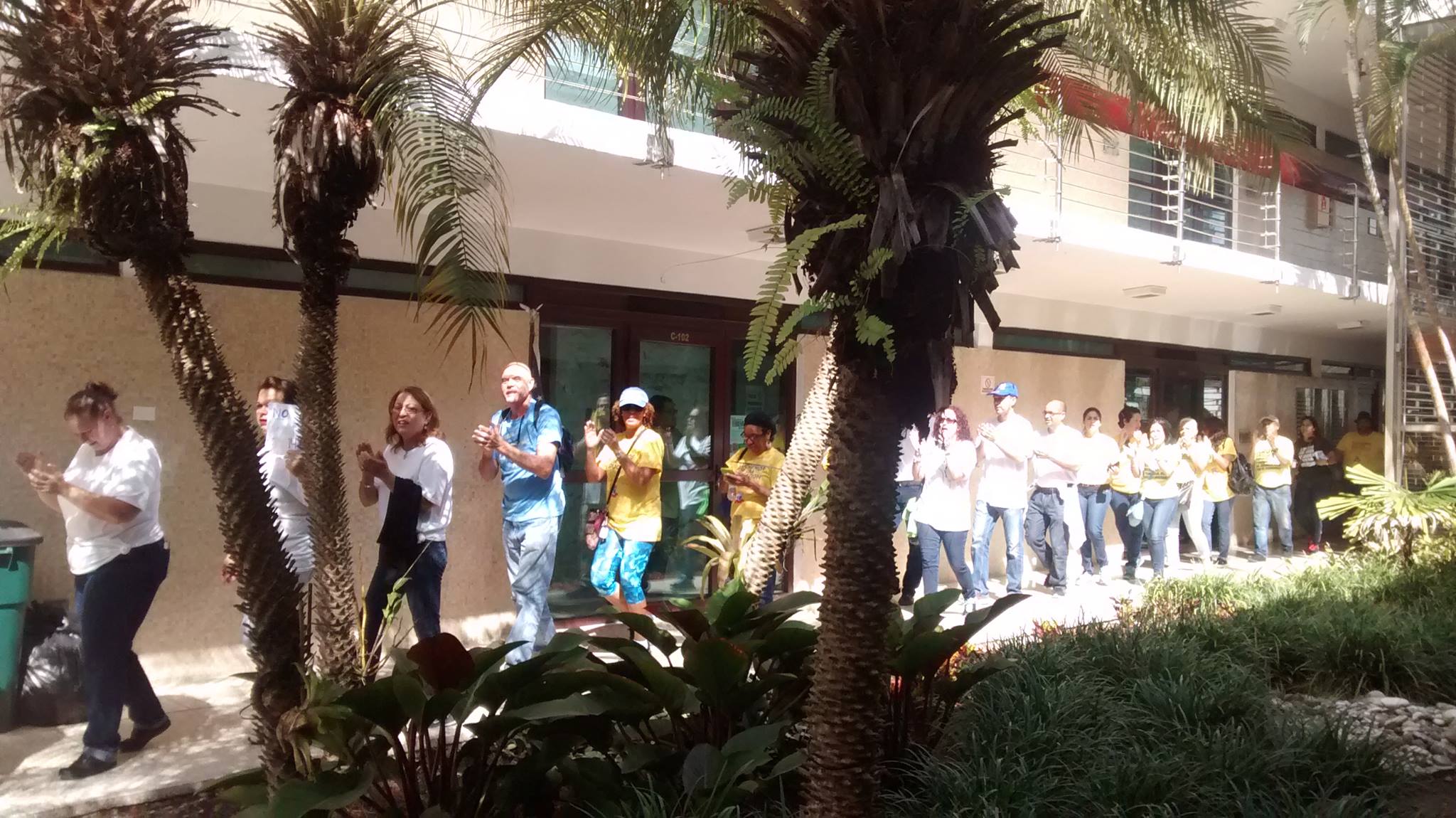
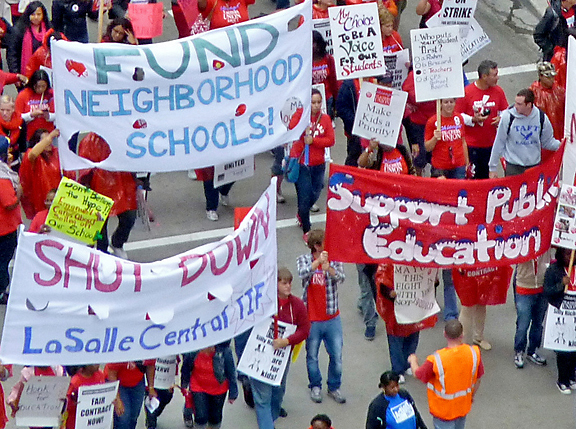
Unions used to take to the streets. They took over the job site. They marched with signs and placards. They exercised people power.

And the government was scared of them. The President called out the army to get them back to work. Lawmakers hired mercenaries to break strikes with clubs and guns. But eventually Congress passed laws to placate them.

Unfortunately, That was a long time ago.

For decades the pendulum has been swinging against us. Federal and state laws have become increasingly restrictive. They want to tell us when we can strike and how long. They want to tell us when and if we can collect dues. And – frankly – they want to tell us to just disperse and do whatever the bosses want – because the business class has already bought and paid for our politicians.

For decades we’ve heard to their propaganda on TV, the radio and the print media. Well-paid shills have poured their poison in our ears about the evils of the labor movement. They’ve spoken these lies so often lots of people believe them.

Workers used to fight to make sure everyone got a fair deal. Now the working man has been brainwashed to focus instead on making sure no one else gets more than him. And the bosses are laughing all the way to the bank.

Union membership is at the lowest it’s been in a century. So are wages adjusted for inflation. A family of four used to be able to get by comfortably on one salary. Now it can barely make ends meet with two.

Yes. There’s no doubt about it. We need unions today more than ever.

But for unions to survive, they must change. They have to become a reflection of the membership and not just of the leaders.

During this presidential election cycle, we’ve seen our largest national unions – the National Education Association (NEA) and American Federation of Teachers (AFT) endorsing a candidate without bothering to actively poll their members. We’ve seen them speak for us on policy decisions without asking our opinions. We’ve seen them act just like the corrupt politicians who we should be fighting against.

Yes, it is time for a change. No longer can our unions be run from the top down. They must be run from the bottom up. They shouldn’t tell us what to do. We, the membership, should be giving orders to them.

Moreover, we need to stop obsessing about collective bargaining. I’m not saying that’s unimportant. But it can’t be the only thing we do.

Our unions used to be in the midst of larger social movements. We were part of the Civil Rights movement. We were part of the push for desegragation. We were part of the fight to protect children and provide them a decent education.

We need to continue that today. And in some places we are already doing that! Look to Chicago, Detroit and Philadelphia. Teachers unions in those urban areas are fighting not just for better pay and benefits but for the communities they serve. Detroit teachers en mass are calling off sick to protest horrible conditions in the schools. Chicago teachers are marching in the streets with the community to demand indictments for police murdering their black and brown students. Philadelphia teachers are supporting students who walk out of class to protest state disinvestment and toxic testing.

THIS is what unions should be doing. We should be fighting for social justice. We should be a central part of the struggle to turn the tide against corporatization, privatization and standardization of our country’s public goods. We should be marching hand-in-hand with BlackLivesMatter activists. We should be in the front lines of the fight to save our environment and replace fossil fuels with renewable energy.

We must be part of the community and not apart from it. We must share in the struggles and goals of those we serve. We must be an example of the old truism that a rising tide raises all ships. After all, the word “union” literally means together. By definition we must all be in this together or else we’re not even really a union.

And to do this we have to stop being so concerned with what they tell us we can do.

We live in a democratic society. The government gets its power from us, from our consent. That means that if there are enough of us, we trump their corrupt laws. They only get to make those laws because we say so. And court decisions – even Supreme Court decisions – mean nothing next to the court of public opinion.

The bosses buy the politicians and tell them to legislate us into a box. It’s time to break out of that box. We can’t be afraid to take our power back. We shouldn’t be afraid of our government. Our government should be afraid of us.

How do we do it? Organize.

If you belong to a union, roll up your sleeves and get active. Run for office. Convince like-minded folks to join you. Take over your local. Spread to your national.

If you don’t belong to a union, start one at your job. Talk to your co-workers. Talk about the benefits for each of you and your neighborhoods. Fight for your rights.

I know. It’s a whole lot easier to complain. Real change, though, takes real work.

We used to know these things. Somewhere along the line we forgot.

So wake up, you yeller cur dog, and get off the porch. Take to the streets.

Because the surest way to take back our country is to take back our unions.
Gadfly’s Choice – Top 5 Blogs (By Me) You May Have Missed from 2015

Screen shot 2016-01-02 at 11.01.09 PM

There are an awful lot of great blogs out there.

Especially if you’re into education. But many are telling the same story.

You don’t hear much about it in the mass media, yet our public schools are being systematically starved to death. They’re being set up to fail while the vultures of privatization and free enterprise drool over the corpse.

Phony philanthropists offer schools fake donations with more strings attached than Pinocchio and noses twice as long. To secure these financial “gifts,” schools are forced to pay out more than they receive for reforms that ultimately benefit the benefactor more than the beneficiary.

And even when these philanthro-capitalists are absent, our government is pretending to hold schools accountable by forcing them to enact these same unproven, disproven or counter-factual policies that actually make things worse. Then when these schemes fail, lawmakers use that as a justification to close schools and gift them to for-profit companies who squeeze every ounce of profit they can from what’s left while further cheating students out of resources.

It’s a scam, a heist, a racket – and you’re paying for it with your tax dollars.

But if you’ve been reading the plethora of excellent edu-blogs out there, you already know this.

Who writes about this public school shakedown? Often it’s the same teachers, parents, professors and bonafide education experts whom policymakers have excluded from the conversation.

As a public school teacher, myself, with more than a decade in the classroom, a masters degree and a national board certification, my empiricism and experience is not valued. So like many folks burdened with real-world knowledge, I write a blog.

In only a year and a half, I’ve had more than 487,000 hits and 9, 208 followers. In my last post I listed my 10 most popular articles from 2015.

Today I propose to continue a tradition I stole from fellow blogger Russ Walsh. I present not my most popular work, but 5 articles that deserve another look. Most of these didn’t receive massive public attention, but perhaps they should.

Please enjoy your humble gadfly’s choice.


5) Prejudice of Poverty: Why Americans Hate the Poor and Worship the Rich

2children

Published: Nov. 18

Views: 5,005

Description: America is rife with myths about the poor – mainly that the impoverished deserve their poverty. If they just worked harder, they wouldn’t be poor. Moreover, it’s a scam. The rest of us pick up the slack while they lounge around at home living better than we do. These are pernicious lies told with the certainty of truths. This article is my attempt to dispel these myths with facts.

Fun Fact: In my experience, often people are afraid to say certain things because they don’t want to appear racist. However, no such fear exists about sounding prejudiced against the poor, because few realize such bigotry even exists. It does. Big time.


4) Stories about Puerto Rican Resistance to Corporate Education Reform

Parents and Children Occupy Puerto Rican School Refusing to Let Corporate Vultures Raid Its Contents

(Aug. 22 – 1,551 hits)

In Puerto Rico, Students Go On Strike to Stop Teacher Relocations

(Sept. 25 – 1,211 hits)

Puerto Rico Teachers Plan One-Day Strike to Protest Corporate Education Reform

(Nov. 15 – 634 hits)

12050457_10153301043793152_183452142_o

Published: Aug. – Nov.

Views: 3,396 TOTAL

Description: The US territory of Puerto Rico is besieged by vulture capitalists encouraging damaging rewrites to the tax code while buying and selling island debt. Meanwhile hundreds of American private equity moguls and entrepreneurs are using the Commonwealth as a tax haven. As a result, tax revenues to fund public goods like education are drying up and hundreds of schools are being closed. However, the citizenry is putting up one of the most aggressive and successful resistance campaigns against corporate education reform in this hemisphere.

Fun Fact: For a while, few people on the mainland were talking about this – certainly not in the media. That appears to be slowly changing. There is so much we can all learn from Puerto Rico. We need each other.


3) Education Does Not Cure Poverty – It Cures Ignorance

Screen shot 2015-10-17 at 11.36.22 PM

Published: Oct. 18

Views: 3,080

Description: One of the biggest lies told by our national education policymakers is that schools alone can cure poverty. We don’t need an anti-poverty campaign. We just need to ensure people get a good education. This is baloney. The purpose of learning has never been to gain wealth or even teach how to gain wealth. It is and always has been about eradicating ignorance.

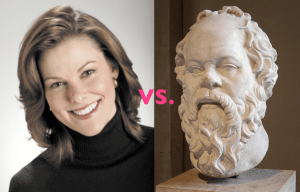
Fun Fact: If more people knew this, there would be no more high stakes testing, Common Core, etc. Also I’m kind of  partial to this article because of the image I made to go along with it. Campell Brown vs. Socrates!? That always makes me smile!


2) Do Americans “Throw Money” At Their Schools? A Fair Funding Primer

Screen shot 2015-07-06 at 11.05.59 PM

Published: July 9

Views: 1,372

Description: How many times have you heard someone complain about all the money we throw at our schools? It’s dismissive nonsense. We aren’t throwing anything. We INVEST in children. That money is not a waste. In fact, it is far from adequate for the job. This post is my attempt to explain the facts behind school funding. Please share.

Fun Fact: It is so nice to have all of this information in one place. I have tweeted, emailed, and posted this article to blowhards and ignoramuses more times than I can remember. Feel free to do the same.


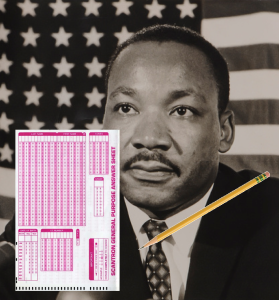
1) We Shall Overcome… Our Lack of Standardized Tests!?

Screen shot 2015-07-19 at 12.34.34 AM

Published: July 19

Views: 628

Description: This is the newest myth being spread about standardized testing. Somehow high stakes assessments ensure that minorities civil rights don’t get violated!? It is exactly the opposite of the truth. Yet many of the more well-funded civil rights organizations suddenly began singing this tune over the summer. My article tries to explain why.

Fun Fact: Make no mistake. Many civil rights organizations still vehemently oppose high stakes testing. If we really want to stand up for our black and brown brothers and sisters, we need to stand with them and counter this AstroTurf narrative at every turn. Testing violates their rights, not protects them.

The Best Way To Honor Tamir Rice is by Reforming Our Broken Justice System

Memorial for Tamir Rice, 12-year-old shot dead by Police in Cleveland

Michael Brown – no indictment.

Eric Garner – no indictment.

Sandra Bland – no indictment.

And now Tamir Rice.

How many times will our justice system refuse to charge police with killing unarmed black people?

What will it take for our courts to accept the responsibility for at least attempting to seek justice?

When will our judicial system deem the death of people of color at the hands of law enforcement to at least be worthy of a trial?

Brown had no weapon but was shot to death by law enforcement.

Garner had no weapon but was choked to death by police.

Bland had no weapon but was found hanged in her jail cell after being assaulted by police during a traffic stop.

Rice had a legal pellet gun that was not pointed at anyone yet he was shot to death two seconds after police arrived.

This is not justice. This is a national travesty that continues to be played out daily. How many more human beings will be ground under the boot of a system that finds no value in their lives?

And don’t give me any of your excuses! Police were just doing there job! These people should have listened to law enforcement! Rice shouldn’t have had a pellet gun!

Listen to yourself. Lethal force is the only option!? Police have no tasers anymore, no pepper spray? Their guns only fire death strokes? They can’t hit non-vital areas meant to incapacitate but not kill?

What a bunch of cowards we are if we don’t demand police publicly explain themselves when they kill another human being – especially someone who posed them no bodily harm! How morally and spiritually bankrupt a nation we are not to weigh the evidence and decide guilt or innocence! “Freedom and justice for all!?” What a sham! What a lie! What a farce!

I don’t know about you, but I am sick of it. I refuse to put up with it for even one more day.

But what can we do?

No. Really.

When reading about these government sanctioned murders, I feel helpless. I’m just one person. What can I do to stop it?

Here are a few suggestions:

1) Ban Grand Juries in Fatal Shootings by Police

Connecticut and – most recently – California already have laws to this effect. District attorneys should have to decide whether officers face criminal charges when they kill people in the line of duty. This decision should be made in the light of day in full view of the public and not behind the closed doors of a grand jury hearing. These hearings involve no judges or defense attorneys and the transcripts of these proceedings are almost always sealed.

The problem is that district attorneys work closely with police and depend on them for political support. Sending cases like these to a grand jury gets the DA off the hook so he or she doesn’t offend the officers.

If the decision had to be made in public, voters could hold DAs accountable. With the grand jury system, there are no consequences because we have no concrete evidence about what happened during the proceedings, what arguments were made, by whom and who made what decisions. That’s a poor breeding ground for justice.

2) Construct a National Database on Police Killings

Right now there is no way to tell exactly how many people are killed by law enforcement in this country every year. Moreover, there is no way to tell if officers involved in these killings were ever charged.

Information can be compiled state-by-state, often through unofficial and anecdotal sources. However, this does not nearly give the full picture of what is going on. The people of this country deserve to know the full scope of the issue. That’s why apologists often claim these sorts of incidents are relatively rare and blown out of proportion by the media. But are they? A national database would prove the matter one way or the other.

Federal law from 1994 already calls for just such a database, yet it has not been funded. This may be due in part to the cost. A pilot study found that it would take a decade and cost $1 billion.

Certainly this is not a quick fix. But don’t we deserve to know this information? And isn’t it suspicious that nothing is being done to compile this data now?

3) Overturn Graham v. Connor

Perhaps the biggest obstacle to seeking justice for those unnecessarily killed by police is a precedent set by the U.S. Supreme Court 25 years ago. Graham v. Connor effectively ruled that police can kill you if they feel you present a “reasonable” threat to their own lives.

The problem is the word “reasonable.” What does that mean? In court, it can be almost anything. It’s a “Get Out of Jail Free” card to police for wanton murder. Justice Sonia Sotomayor calls this a “Shoot first, think later” approach to policing. She says this violates the Fourth Amendment which stipulates what counts as “probable cause” for police actions including arrests. However, Sotomayor is the only sitting justice publicly to take this stance.

This is why without more robust protections for citizens and more realistic expectations for law enforcement, even when cases like these go to court, they rarely result in police convictions.

But courts change. Public opinion can move mountains if given enough time. We need to start putting on the pressure.

Organize, people. Start writing letters. Write petitions. Hold rallies. Meet with your Congress-people. Make some noise.

In the meantime, let us grieve for all the Browns, Garners, Blands and Rices.

Their lives matter. And the best way to prove that is to get off our collective asses and do something about it.


NOTE: This article also was published on Commondreams.org.


Puerto Rico Teachers Plan One-Day Strike to Protest Corporate Education Reform

11214329_10153183230456981_1552435887463960982_n

Welcome to sunny Puerto Rico.

The ocean is a gorgeous cerulean blue. Palm trees wave gently in the salty breeze. And in the distance you can hear percussion, horns and singing.

The protest has begun.

12242864_10153398609583152_567773654_o

Residents of this United States territory have been fighting freshman Governor Alejandro García Padilla’s efforts to close public schools, privatize those left and shackle teachers to the same corporate education reform schemes that are crippling schools on the mainland.

This Tuesday island educators are asking parents not to send their children to school. Teachers plan to conduct a one-day strike to protest legislation that could be passed the same day to further cripple the Commonwealth’s public education system.

“On November 17th we’ll be giving our lesson’s outside our classrooms,” says Mercedes Martinez, president of the Federación de Maestros de Puerto Rico, the teachers union.

“We’ll be in front of our schools early in the morning and at 10:00 a.m. will march from Congress to the Governor’s Mansion in San Juan. This is one of many activities that we’ll perform in defense of public education. We will not accept these precarious impositions and will fight back.”

12212114_10153398609843152_2007230691_n

The protest is in response to Project 1456 which would close more than 380 public schools. The government has already closed 150 schools in the past 5 years.

This would force many students into even more overcrowded classrooms. Thousands of children would have to be relocated to schools far from their homes.

But that’s not all.

The proposed legislation would also privatize 15% of those schools left standing. Unlike the mainland, Puerto Rico has no charter schools. Teachers went on a 10-day strike in 2008 which only ended after the island Secretary of Education Rafael Aragunde signed an agreement promising not to open any charters.

12226476_10153398609693152_1059022729_n

If privatized schools opened on the island, parents might have to pay an additional fee for services they now enjoy for free. Amenities like lunches and even tuition may have to be subsidized by parents out of pocket.

Moreover, it would collapse the teachers retirement system, Martinez says. Charter schools would not deduct employees payments to the pension system so it might not be able to remain solvent.

Project 1456 would harm teachers in another way, too. It would enact a punitive evaluation system where 20% of educators value would be based on students standardized test scores. Any teacher with a 79% or less would have two years to improve or be fired.

“Teachers will have no rights,” Martinez says.

12231352_10153398610428152_1685357633_n

The proposed legislation has already been approved by the Commonwealth Senate. It’s main author Sen. Eduardo Bhatia is pushing for the House to fast track it for approval.

Discussions began in the House last week.

Protesters were there on Wednesday. They stood up in the government chamber and walked out en mass when it was brought up for discussion. Eighteen of them wore white T-shirts spelling out the message “Our Schools Are Not For Sale.”

12095142_10153786665063035_3426408204355682730_o

Inside the House, presidents of private universities testified in favor of the measure.

“Obviously they want to become administrators of charter schools on our island,” Martinez says.

Outside the building, protesters held their own emblematic hearing on the matter. Community members, teachers and parents testified in the open air about how this legislation would hurt children. They ended with a symbolic vote against it.

12233087_10153398610653152_624717262_n
Puerto Ricans are not alone in this fight.

Jitu Brown, a community organizer from Chicago and Director of Journey for Justice Alliance traveled there to stand in solidarity with those fighting for their schools. Brown participated in a 34-day hunger strike in his hometown a month ago to protest Mayor Rahm Emanuel’s plan to close the last open enrollment school in his neighborhood.

“This beautiful, breathtaking place is marred by ugly U.S colonialism and privatization of public services on steroids!” says Brown of Puerto Rico.

“I was blessed to spend time with powerful people fighting for a better world. Big ups to your warrior spirit, discipline and hospitality! Where we struggle, we can win! If we don’t struggle, we are guaranteed to lose.”

12243064_10153183230516981_9040874307608479627_n

The plight of Puerto Rican communities also inspired support from the Badass Teachers Association, a group of more than 56,000 educators, parents, students and activists.

“The Badass Teachers Association stands in strong solidarity with our brothers and sisters in Puerto Rico who are fighting for the very foundation of their democracy – the survival of their public school system which is under assault by the 1% who seek to close it up and deny Puerto Rican children a right to an education,” says Executive Director Marla Kilfoyle.

Protesters are getting the word out. They’ve already handed out thousands of fliers. Today they plan to drive in a large caravan across the island.

“We’ve got a bunch of cars with sound equipment,” Martinez says.

“We will go to all the communities near our schools in different regions asking parents to support the strike on the 17th.”

12233347_10153398610098152_2099123130_n

Much of the the island’s financial woes are imported from the mainland. Puerto Rico is besieged by vulture capitalists encouraging damaging rewrites to the tax code while buying and selling the territory’s debt.

Hundreds of American private equity moguls and entrepreneurs are using the Commonwealth as a tax haven.

As a result, tax revenues to fund public goods like education are drying up while the super rich rake in profits.

Officials warn the government may be out of money to pay its bills by as early as 2016. Over the next five years, it may have to close nearly 600 more schools – almost half of the remaining facilities!

12208352_10153183230836981_3863947130415132926_n

“That’s why the Teacher’s Federation and other teacher unions allied together to fight back against the attack on our education system,” Martinez says.

“As you can see, we’ve been busy.”

If Project 1456 is passed by the House, the union is considering a general strike.

12268501_10153398610318152_1824591574_o

Of the 135 schools closed in just the last two years, Commonwealth Secretary of Education Rafael Román had originally proposed shuttering 200. The remaining 65 were only kept alive because communities occupied the buildings and refused to let the government step in.

Protesters stormed the Senate in October when Bhatia first introduced Project 1456.

“Senators decided to approve it without discussion because they did not want to listen to teachers chants and indignation,” says Martinez.

“Senator Bhatia has become the symbol for privatization under this administration. He has never been in a public School. He has no bond with it. He’s a demagogue.”


NOTE: This article also was published on the Badass Teachers Association blog.


In Puerto Rico, Students Go On Strike to Stop Teacher Relocations

12050457_10153301043793152_183452142_o

Students streamed out of their classrooms chanting in unison in the mountainous Utuado region of Puerto Rico earlier this month.

They took over the halls and doorways of Luis Muñoz Rivera High School on Thursday, Sept. 10, locking their arms together to create a human chain.

They paralyzed their school, shut it down, and allowed no one in or out.

The reason? Not too much homework. Not lack of choice in the cafeteria. Not an unfair dress code.

These roughly 100 teenagers were protesting the loss of their teachers. And they vowed to occupy their own school until the government gave them back.

Six educators had been ordered to other schools, which would have ballooned classes at the Rivera School to 35-40 students per classroom.

Government officials claimed the high school had too few students to justify the cost. However, with more than 500 young people enrolled, the school has more than double the island average.

“These teachers provide education to almost 140 students,” said Sharymel Montalvo Vélez, a senior at the school. “Do you think this is not enough (to justify the) tuition?”

“Those teachers are excellent. I was their student. I learned with them. I’m grateful for it. Their teaching quality is amazing. I can prove that.”

The students including Vélez, 17, called an assembly to discuss the situation where they voted unanimously to take action. They blocked two gates and wrote a document demanding the Puerto Rican Department of Education revoke the decision to remove their teachers.

Later that day, Sonia González, a representative of the Secretary of Education, met with students and signed the document promising to keep the teachers at the Rivera School. Three parents and one student also signed.

11998478_10153281370523152_505102187_n

The affected teachers are Alex Natal, a 10th grade physical education instructor; Naixa Maldonado, an 11th grade Math educator; José Cruz, a 10th and 11th grade History teacher; María Medina, a 12th grade Physics instructor; Damaris Figueroa, an 11th grade Spanish educator; and an 11th grade English teacher.

Vélez said she’s surprised the government agreed to students’ demands. “ I was willing to keep the strike all the time necessary to solve our problem and get our teachers back,” she said.

“I experienced a large class size some years back, and it was hard on both teacher and students. It’s not that easy to make 30 students understand something and go explaining it chair by chair. Every student likes to show his/her ideas and in a large class there is not enough time for everyone.”

What happened in the Rivera School is not an isolated incident. All across the island, communities are fighting government mandates to relocate teachers, increase class size and shutter more schools.

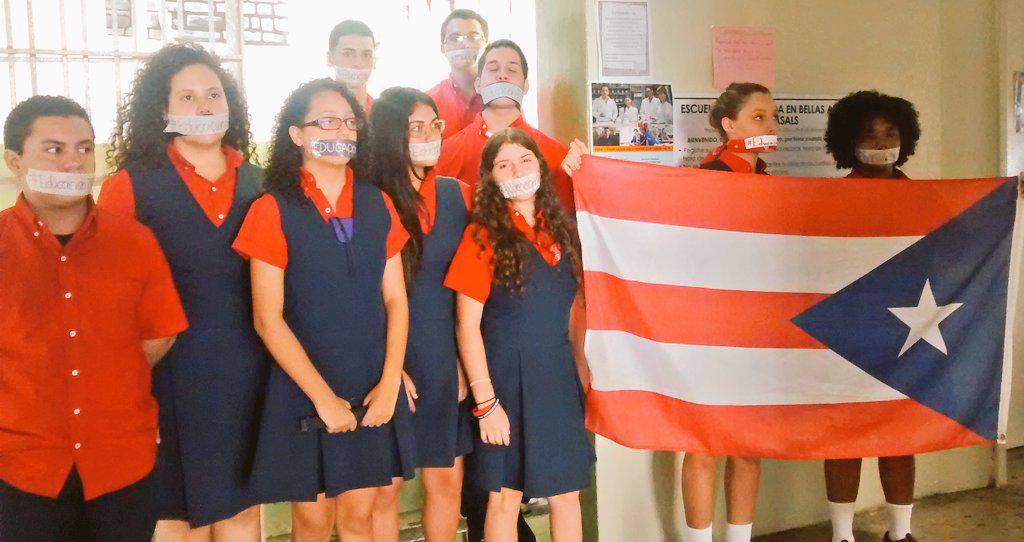
This Tuesday at Pablo Casals School, an arts institution in Bayamon along the north coast, students protested the government decision to relocate their theater teacher, Heyda Salaman.

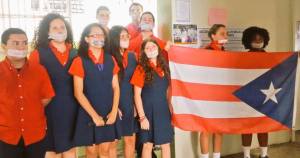
About 100 students hung the Puerto Rican flag upside down and taped their mouths shut to represent the state of the government and the silence officials expect from the community.

Young people at the specialized arts school which offers visual arts, theater, music and dance as well as academic classes, protested with music and chants of “injustice!”

Just like in the case of the Rivera School, the government eventually relented and agreed to keep the teacher with her students.

The teachers union – the Federación de Maestros de Puerto Rico (FMPR) – has supported student protesters throughout the island.

“The Teachers Federation from Puerto Rico is proud of the actions these students performed,” said union president Mercedes Martinez about student actions at both facilities.

“Schools belong to our communities according to the law, so the communities have every right to fight for the school they deserve. No more cutting funds to create over-sized classrooms.”

Vélez echoes that statement.

“We have a good education and excellent teachers but the administration is failing their workers,” she said.

“The government is cutting rights and benefits to the teachers and employees and soon there will be no teachers. Maybe our schools get privatized and then only people with money will send their children to (public) school.”

11997060_10153278954588152_587899672_n

The Commonwealth government has closed 150 schools in the past 5 years in the U.S. Territory.

Officials warn the government may be out of money to pay its bills by as early as 2016. Over the next five years, it may have to close nearly 600 more schools – almost half of the remaining facilities!

The island is besieged by vulture capitalists encouraging damaging rewrites to the tax code while buying and selling Puerto Rican debt.

Hundreds of American private equity moguls and entrepreneurs are using the Commonwealth as a tax haven.

As a result, tax revenues to fund public goods like education are drying up while the super rich rake in profits.

The indigenous population has suffered at the hands of western conquerors since Columbus, but the newest fruit of Colonialism may be these corporate education reform policies.

Young people like Vélez aren’t revolutionaries. They look just like any ordinary teenage boys and girls wearing t-shirts and blue jeans, baseball caps turned backwards, backpacks slung across their shoulders.

But they have had enough. They aren’t going to accept the low expectations of the corporate world about what constitutes a fair education.

Viva Puerto Rico!


NOTE: This article also was quoted extensively on Diane Ravitch’s blog and published in full on the Badass Teachers Association blog.