
School Vouchers and Runaway EdTech Pave the Way for the Destruction of the Very Concept of School

andres


School is where you learn to learn.


A teacher with an advanced degree and decades of experience devotes her time to figuring out what helps you comprehend the world around you.


And, if she’s good, she imparts that lesson to you as well.


Imagine if we took that away.


Imagine a world where there are no schools – just free range children plopped in front of a computer or an iPad and told to go learn something.


No schools, no teachers, just gangs of students walking the streets, stopping along the way to thumb messages to each other on social media, play a video game or take an on-line test.


That’s the world many EdTech entrepreneurs are trying to build.


And school vouchers are helping them do it.


Take Education Savings Accounts (ESAs) and other market based privatization schemes.


Normally, the federal, state and local government collect taxes to fund an individual child’s education, which is then spent at a public or charter school.


At a public school all that money must be spent on the student. At a charter school some of that money can be pocketed as profit by the private company who runs the school.


Public schools provide a better alternative because the funding must be dedicated to the student, living within a district’s coverage area guarantees enrollment, the school must be managed by an elected school board with open meetings and a plethora of other amenities you won’t find at a privatized institution. But at least the charter school is a school!


However, an ESA or other voucher would allow that money to go elsewhere. It could go to funding the tuition at a private or parochial school where organizers can use it however they like – pocketing some and using the rest to help the child as you’ll find in most charter schools.


But as bad as that is, vulture capitalists want to add another destination for that money – let it pile up in the bank where it can be used for discrete education services provided by the EdTech industry.


It’s almost like homeschooling – without the loving parent being in charge.


It goes by many names – a learning ecosystem, personalized learning, competency based or individualized education.


But it’s really a single person cyber school with little to no guiding principles, management or oversight.


Education is reduced to a series of badges students can earn by completing certain tasks.


Reading a book or an article gives you a badge. Answering a series of multiple-choice questions on a reading earns you more badges. And if you’ve completed a certain task satisfactorily, you can even earn a badge by teaching that same material to others.


It’s the low wage gig economy applied to education. We just transform a crappy job market where workers bounce from a few hours of minimum wage labor here to a few hours of minimum wage toil there – all without benefits or union protections – into learning. Children bouncing from a few hours of Khan Academy videos here to a software package there and Voila! “Modern” education!


In short, it’s school without the school or teachers.


And make no mistake, it’s not about improving the quality of education. It’s about providing the cheapest possible alternative and selling it to rubes as innovation.


The wealthy will still get institutions of learning. They will still be educated by the most qualified teachers in the world. They will still learn how to learn.


The best path to becoming a truly educated person involves human interaction and mentorship. You need experienced professional educators who use the empirical evidence they see in the classroom about your child to tailor lessons to their needs. The wealthy would never dream of making their children learn from the academic equivalent of an automated check out aisle or telemarketer robocall.


It is only the poor and middle class who will be released like chickens into the pasture of a learning ecosystem.


And as an added benefit, the badge structure creates a market where investors can bet and profit off of who gains badges and to what degree on the model of crypto-currencies like Bitcoin! So all the stability of the pre-crash housing market! What could possibly go wrong!?


Let me be clear – this is the ultimate goal of the school privatization movement.


Charter and voucher schools are only the tip of the iceberg. They still require real human beings to act as teachers (though they need not be as well educated or have as much experience as public school teachers). They still require buildings and grounds.


But this depersonalized learning approach allows them to do away with all of that. They can just provide students with an Internet accessible device and some dubious on-line tracking and management system.


Then they can pocket all the rest of the money taxpayers put aside to educate children and call it profit.


And they can use the programs students access to “learn” as a way to gather valuable marketing data about our kids. Everything students do on the device is free market research – every word they input, every keystroke, every site visited down to the slightest eye movement.


This is the logical conclusion of the monetization of education and an economy that only sees value in others as human capital that can be bought, sold and exploited.


This is where the privatization movement is going. And they’re laying the groundwork in legislation being proposed in our state capitals today.


In Pennsylvania, for instance, Senate Bill 2 proposes the creation of just such ESAs. If approved, the immediate result would be to boost private and parochial schools.


However, given a few years to strengthen the technologies and systems needed for a full learning ecosystem, the same law would allow taxpayer money to be used in this way.


And it’s something hardly anyone is talking about.


We’re fighting the privatization systems of today as the plutocrats set up the privatization systems of tomorrow.


Even if school vouchers never take off to the degree necessary to scaffold the most robust learning ecosystems, EdTech lobbyists are trying to install as much of this garbage as they can into our existing schools.


They are using one-to-one iPad initiatives and grants to fund up-to-date computers, Wi-Fi networks and software packages to pave the way for this brave new world of digital exploitation. They are selling our test score obsessed bureaucrats software like iStation and IXL that bridge the gap between test prep and learning ecosystems lite.


You can walk into many schools today where students spend hours on-line earning digital badges for watching videos and taking stealth assessments.


Few people are sounding the alarm because few people understand what’s going on.


This is not conjecture. This is not a conspiracy theory. This is the goal the edtech entrepreneurs will gladly tell you all about hoping you’ll invest.


There are hours of videos, pages of documents, mountains of graphs, charts and graphics about how this scheme will pay off for investment bankers and venture capitalists. (See below)


The only true way to win this battle is a cultural shift away from dehumanizing runaway capitalism.


We need to stop thinking that the private sector is always better than the public good. We need to stop allowing big business and corporations to get away without paying their fair share. We need to increase the voice of citizens and decrease the megaphone of money and privilege.


Otherwise, the science fiction dystopias of books like “Ready Player One” will no longer be fiction.


They will become the reality for every school child in this country.


A reality where school, itself, is a thing of the past.


And education is reduced to the mercenary collection of discrete skills that add up to nothing of value for the students except their own enslavement.


But don’t take my word for it. Here is the learning ecosystems model from the EdTech industry, itself, in corporate officers own words and graphics:

LEARNING IS EARNING – the scariest 6:58 video you’ll ever see.


KNOWLEDGEWORKS Vision for the Future of Education:
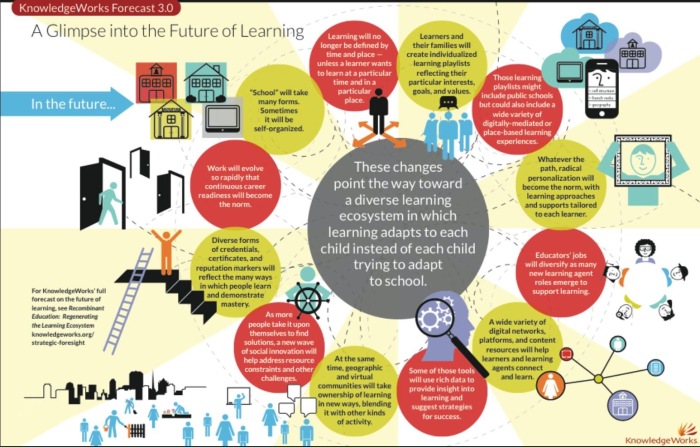
IMG_9654

Graphic as a PDF

More on KnowledgeWorks

Listing for PARENTS AS CONSUMERS Symposium

Read all about it here.


FIGHT BACK AGAINST SCHOOL PRIVATIZATION AND RUNAWAY EDTECH:

Like this post? I’ve written a book, “Gadfly on the Wall: A Public School Teacher Speaks Out on Racism and Reform,” now available from Garn Press. Ten percent of the proceeds go to the Badass Teachers Association. Check it out!

WANT A SIGNED COPY?

Click here to order one directly from me to your door!

book-2


Modernizing Education Starts With Questioning Our Assumptions

iStock_000040220958_Small-685x485


When it comes to education, we take an awful lot for granted.


For example, we look at learning almost entirely from a behavioral standpoint.


Teachers provide inputs. Students give outputs. And those outputs demonstrate the intended learning.


Yet this framework was developed in the early 1900s. Using it today is to ignore a century of subsequent psychological advancements. It glosses over the impact of the unconscious, the social nature of understanding, physical differences, even the mediating thought processes between stimulus and response such as memory and problem solving.


Instead, we force students into inauthentic laboratory conditions (i.e. the classroom) upon which they are passive actors to be molded and shaped by expert educators.


Every time we post our learning objectives on the board or when we write our lesson plans beginning with the old chestnut – Students Will Be Able To (SWBAT) – we are hearkening back to early 20th Century thinking a hundred years out of date.


We are enshrining a host of assumptions long past their fresh by date:

-Learning is observable.


-It happens immediately.


-It is measurable.


-Once you learn something it never goes away.


-Most problems with learning are attributable to inputs provided by the teacher.


None of these assumptions have been proven.


In fact, there is considerable evidence against each and every one of these premises, yet our entire system of corporate education is based on them like a house built on a foundation.


If we are truly to create a 21st Century school system, the only place to begin is here. Recognize our bedrock beliefs are mere speculation and question whether we should really support everything else that’s been built on such shaky ground.


WHAT IS LEARNING?


It is an empirical fact that human beings are capable of learning. It’s something we do every day. But what exactly does it consist of? What happens when a person learns?


Perhaps it’s best to start with a definition. We generally characterize learning as the acquisition of knowledge; the possession of facts, information or skills.


But how does one gain knowledge? How does one possess the intangible?


It seems that learning always involves thoughts – usually conscious impressions but sometimes unconscious ones, as well. However, not all thoughts qualify, only thoughts of a certain kind.


The notion must be true of the world. And often it is an idea that has surfaced before but that now can be recalled at will and used to create new concepts.


Perhaps I’m wrong, but it seems that no matter how you flesh it out, we’re talking about internal mind states.


Learning takes place in and of the brain. And this has consequences for our education system – an apparatus designed to make these brain states more frequent along certain prescribed lines.


IS LEARNING OBSERVABLE?


That depends. Can we lop off the top of students’ heads and peer at the gelatinous mass inside?


Not really. And even if we could, we wouldn’t understand what we were seeing.


Even if learning may be reducible to a complex set of on-and-off switches among synapses, that does not make it generally observable – certainly not without greater knowledge of how the brain works and advanced neural imaging equipment.


As such, the idea that learning is directly perceptible is not necessarily true. It may be evident in some second hand manner, but this is not the same as first hand experience. At best, what we see is a pale shadow of what’s actually going on in students’ gray matter.


That alone should send shock waves through the edifice of modern corporate education. We’ve built an entire apparatus to label and sort kids based on observing students. If those observations are inadequate to give us the full picture of these internal learning states, our system is likewise inadequate.

WHAT IS THE ROLE OF TEACHER INPUT?


To answer this question we must start further back – when and why does learning takes place.


A student experiences a new neural state that constitutes the acquisition of knowledge. Why?


Does it happen because of the input made by a teacher? Is it the result of experience? Is it the result of some other input – reading, interacting, writing, doing something? Or is it the result of something even the student him- or herself cannot easily identify or explain?


All of these are possible. All of these (and more) are the catalyst to learning at various times.


Thus we lose another premise – that teacher input is the essential cause of inadequate learning. If we cannot place a primacy on the teacher, we cannot wholly place blame there either.


Certainly teachers are important. They can have a tremendous impact on their students. But they are not strictly necessary. They are not even the prime cause of learning. They facilitate learning in the way a doctor facilitates healing. The surgeon may set the broken bone, but it is the body that actually does the healing. And in the case of learning, the action is not entirely involuntary. It is much more active and intentional.


In short, teachers can call students attention to something that sparks learning. They can bring about optimal conditions for learning to take place. But they are not by themselves sufficient for that learning. They cannot make it happen. Insofar as it is voluntary at all, it is up to the student. To give teachers sole reward or blame for student learning is absurd.


IS LEARNING IMMEDIATE?


Learning may be a response to stimulus of some kind. But when does that response take place? Is it immediate?


There is no evidence that it must be so. Certainly there are times when one has learned something immediately. When a child first puts her finger in the flame, she quickly learns to remove it. However, there are some lessons that we don’t learn until many years after that stimulus. For instance, that our parents’ advice was often more sage than we initially gave it credit.


Thus, again it is inadequate to place reward or blame on teachers for their students’ learning. You can judge a teacher for what he or she did to help, but not what you take to be the result. Just because the teacher’s input may not have sparked learning in the student now, that doesn’t mean that the same input might not engender learning at a later date, given time.


IS LEARNING PERMANENT?


Which brings up another question – once you learn something, does it remain yours forever or is it susceptible to degradation?


If learning is an internal state – if it is the result of neural connections like any thought or memory – it is susceptible to fading. It can be lost or degraded.


Therefore, when students enter a class without prerequisite knowledge, it is not necessarily the fault of their previous teachers. Like any skill, memory or thought – recall is enhanced through repetition. Using the knowledge often results in greater retention.


If we want a more intellectual society, we should habitualize critical thinking and reward intelligence in our public interactions. Not the exact opposite.


CAN LEARNING BE MEASURED?


And finally, we are brought to perhaps the most vital question in the field of education – measurement.


What did students grasp and to what degree was it mastered?


There is an entire industry based on providing accurate accounting of learning.


There are corporations making billions of dollars based on providing this service. Moreover, the school privatization industry is almost completely predicated on the “failure” of public schools as shown by the measurements of these testing corporations.


As such, there is a tremendous amount of economic pressure to keep this premise that learning can be accurately measured. However, when looked at logically, it cannot be supported.


When we measure learning, what are we measuring? And how are we quantifying it?


If learning is an internal state, how do we calculate that? Possibly at some point in the future, we’ll be able to look at real time pictures of the brain and be able to tell which information has been learned and to what degree. But we are not at that point now. Perhaps we will never be.


Even if we were, what exactly would we be measuring? What units would we be using? Volts? Amps? Some new element susceptible to subdivision?


The fact that we can’t give a definitive answer to that simple question illustrates how vast our ignorance is of learning. We do not understand what goes on in our own heads that constitutes understanding expect in the broadest possible terms.


Yet how much importance we put on these crude attempts to measure the ineffable!


Grades and test scores are but the rudest approximations of the real phenomena hidden inside our skulls. Yet we sort and rank students on the pedagogical equivalent of cave paintings.


“It is easier to measure the number of semicolons used correctly in an essay than the wonderful ideas contained within it,” said Alfie Kohn. “The more focused you are on measurable outcomes, the more trivial your teaching tends to become.”


Or as Linda McNeil of Rice University famously observed, “Measurable outcomes may be the least significant results of learning.”


Kohn has repeatedly suggested that McNeil’s statement ought to be printed out in “36-point Helvetica, framed, and tacked to the wall of every school administrator’s office in the country” for these same reasons.


When we talk about knowledge and learning, we don’t know what we’re talking about.


CONSEQUENCES


That should make us reluctant to say anything definitive about learning beyond our own ignorance of it.


Yet, as in so much of human affairs, when has ignorance ever stopped us?


We have to go about the business of educating. We have a society to run, markets to establish and consumers to exploit.


Imagine if, instead, we approached learning like explorers or scientists, mapping the shores of our ignorance and determining what helps us comprehend more and better.


There are so many tantalizing clues about what helps students learn, ways to foster the spark of inspiration, creativity and critical thinking.


I wish we were invested in that activity instead of a capitalist sham of education. We talk much about the skills gap between white and black kids without doing anything constructive about it – a chasm predicated on the fact that one category is predominantly poor and the other privileged.


Perhaps we would do better to talk about the ignorance gap of our own understanding of what it means to understand.


Perhaps then we wouldn’t be so bold as to monetize that which is fallacious and foolhardy.


Perhaps then we would be more curious, thoughtful and kind.


Perhaps then we could build a truly modern system of education that values students and not just how they can be transformed into profit.


Like this post? I’ve written a book, “Gadfly on the Wall: A Public School Teacher Speaks Out on Racism and Reform,” now available from Garn Press. Ten percent of the proceeds go to the Badass Teachers Association. Check it out!

WANT A SIGNED COPY?

Click here to order one directly from me to your door!

book-2